When They Challenged One Farm Gate, He Measured Every Boundary They Had Ignored
Chapter 1: The Tape Stretched Across Frank’s Gate
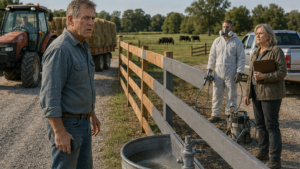
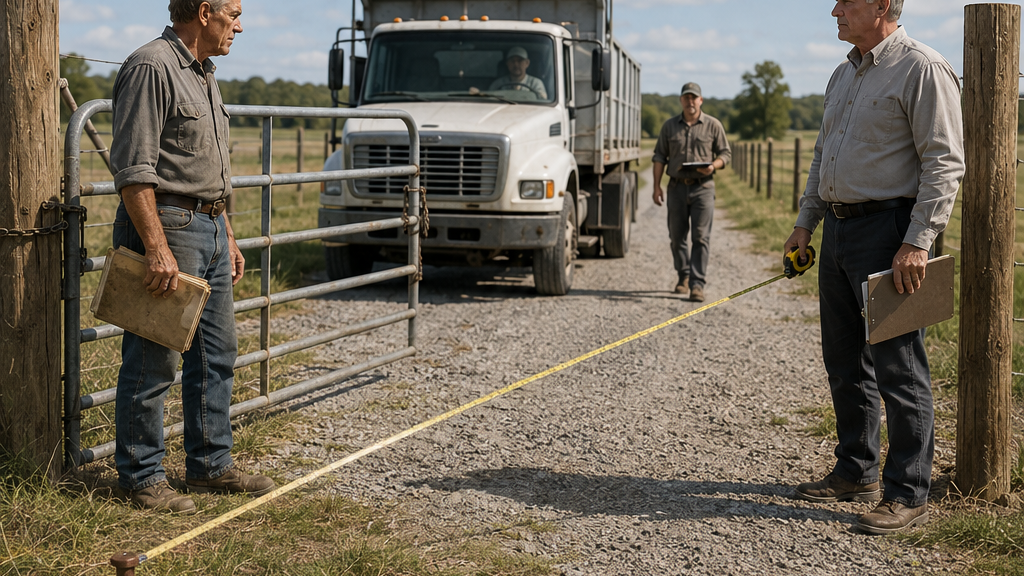
The feed truck stopped thirty feet short of Frank Hill’s gate because Robert Clark had stretched a steel measuring tape across the entrance.
Its diesel engine settled into a heavy idle on the gravel lane. Dust drifted past the windshield and hung over the ditch. The driver leaned toward the glass, looking first at Frank, then at Robert and the two road-association members standing beside him.
Frank had been tightening the new gate chain when he heard the truck brake.
“Move that tape,” he said.
Robert kept one boot planted beside the gravel shoulder and held the yellow case at his waist. The silver tape crossed the entrance at shin height, ran over the fresh turnout gravel, and ended near the cedar gatepost Frank had set three days earlier.
“We’ll be done in a minute.”
“The truck won’t.”
Robert glanced toward the driver. “He can wait.”
That irritated Frank more than the measuring.
The feed delivery had been booked for eight. The cattle in the lower pasture were already crowding the bunk, and Frank had spent half the previous afternoon rebuilding the gate specifically so delivery trucks could make the turn without dragging their rear wheels through the ditch.
He unhooked the chain and laid it over the post.
Robert said, “Don’t open it yet.”
Frank looked at him.
Robert wore clean work boots and a tucked shirt despite the heat already building off the gravel. He had a clipboard under one arm. Behind him, the two association members avoided Frank’s eyes.
“What exactly are you doing?” Frank asked.
Robert reeled in six inches of tape, checked the mark, then let it lock again.
“Checking the clear lane.”
“You’re measuring from the shoulder.”
“That’s where the maintained road ends.”
“That isn’t where the easement starts.”
Robert gave him the patient look Frank disliked most—the one that suggested an explanation had already been given even when it hadn’t.
“The association has to maintain thirty feet of usable access.”
“Then measure thirty feet of usable access.”
“I am.”
Frank stepped over the tape.
Robert’s voice sharpened. “Careful.”
Frank stopped and looked down at the strip of steel crossing his boots.
For twenty years, he had kept property papers in a dented green file cabinet inside the workshop. Deeds. Tax maps. Fence receipts. Drainage invoices. A photocopy of a survey his father had ordered before the north pasture was divided. Jennifer had once told him he kept paperwork the way other people kept family photographs.
Frank had laughed then.
Now he wasn’t laughing.
He turned toward the workshop.
Robert called after him, “Frank, this isn’t complicated.”
Frank kept walking.
The feed-truck engine idled behind him, steady and expensive.
Inside the workshop, the morning light caught filings on the bench beside a carburetor he had disassembled the night before. Frank pulled open the bottom cabinet drawer and removed a flat brown survey folder.
When he returned, Robert had moved the end of the tape closer to the gatepost.
Frank opened the folder on the hood of his pickup.
The paper was yellowing along its folds. A black line marked the recorded easement. Near the entrance, a survey pin was drawn several feet inside the grass from where Robert had started measuring.
Frank pointed.
“You’re using the road edge.”
Robert studied the page.
“The old road edge.”
“No. The legal pin.”
One of the association members shifted closer.
Robert said, “That survey is old.”
“So is the land.”
“That pin could have moved.”
Frank folded the paper once and walked to the grassy strip beside the ditch. He knelt, pushed aside dry weeds, and scraped dirt with the heel of his glove.
Rust appeared.
He cleared another inch.
The top of an iron survey pin showed beneath the soil.
Frank looked up.
“There.”
The feed-truck driver opened his door but remained in the cab.
Robert released the lock on his tape and walked over.
He crouched, though not far enough to dirty his trousers.
“That doesn’t establish current clearance.”
“It establishes that you started from the wrong place.”
Robert stared at the pin.
For the first time that morning, he said nothing.
Frank felt a small, hard satisfaction.
He should have stopped there.
Instead he said, “You came out here with two witnesses and a clipboard before you even found the boundary.”
Robert stood.
“I came because we received a complaint.”
“From who?”
“As chairman, I don’t have to identify whoever raised it.”
Frank looked at the two other men. Neither spoke.
Robert continued, “Your new post and the gravel flare reduce the lane clearance under the association standard. That’s the issue.”
“According to a measurement you just got wrong.”
“According to the road covenant.”
Frank’s satisfaction thinned.
“What covenant?”
Robert took the clipboard from under his arm. Beneath the top sheet was a photocopied document with several passages highlighted.
“The shared-access agreement.”
“I know the easement.”
“This is separate from the county easement.”
Frank took the page.
The agreement was dated long before Robert became chairman. Frank recognized some of the language: maintenance assessments, drainage obligations, prohibition against blocking passage. But halfway down the second page, a clause required owners to preserve an additional clear operating area at entrances used by association traffic and agricultural equipment.
Frank read it twice.
“That doesn’t move my property line.”
“No one said it does.”
“You said my gate had to move.”
“I said it interferes with required clearance.”
“The truck has made this turn for twelve years.”
“The old gate sat farther back.”
“Because the post was rotten.”
“And when you rebuilt it, you changed the geometry.”
Frank looked toward the new cedar post.
He had moved it. Not by much. Less than two feet, according to his own measurements. He had done it to straighten the gate with the pasture fence instead of repeating the awkward angle his father had used.
He had checked the deed line.
He had checked the county setback.
He had not reread the road covenant.
Robert saw the hesitation.
“We’re not asking you to surrender land.”
“Sounds exactly like that.”
“We’re asking you to keep the shared lane functional.”
Frank pointed at the feed truck. “Ask him if it’s functional.”
Robert did not turn around.
“The rule isn’t based on whether one driver can squeeze through today.”
That sentence landed harder than Frank expected.
Years earlier, after a storm washed gravel into the lower bend, a hay hauler had been delayed almost half a day because nobody could agree who had authority to clear the obstruction. By the time Frank got equipment through, rain had reached the cut field. He lost enough hay that summer to remember the smell of it turning dark in the windrow.
Access mattered.
That was why he had widened this turnout in the first place.
But Robert standing there with witnesses, measuring before checking the pin, made compromise feel too much like surrender.
Frank folded the photocopy.
“You could have brought this first.”
“I tried to talk to you last week.”
“You told me the post was wrong.”
“You told me it was your land and shut the conversation down.”
Frank remembered it differently.
Not entirely differently.
Robert took back the document.
“The county land-use inspector will be here Monday morning. I filed the question formally so there’s no argument about the boundary.”
Frank’s head came up.
“You already filed?”
“Yesterday.”
Before measuring the pin.
Before showing him the covenant.
Before giving the new gate a week of actual use.
Robert wound the tape back into its case.
Frank watched every bright foot disappear.
“When the inspector comes,” Robert said, “we’ll know which standard applies where.”
Frank stepped to the chain, lifted it from the post, and swung the gate wide.
The feed truck rolled forward. Its front tires cleared the gate easily. The long body followed, then the rear axle cut toward the shoulder.
It cleared the new post by more than three feet.
Robert watched it too.
Frank thought that should have settled something.
It didn’t.
As the truck rumbled toward the feed bins, Robert slid the measuring tape into his truck and said, “Monday. Eight o’clock.”
Then he drove away.
Frank remained beside the rusted survey pin with the old map in his hand.
The county inspector was coming to measure his gate.
For the first time since he had set the new post, Frank wondered whether proving where his land ended would be enough.
Chapter 2: The Inspector Found Nothing to Move
The county inspector drove a fluorescent marker into the ground four inches from the rusted survey pin Robert had dismissed on Saturday.
Frank heard the hammer strike from beside the gate.
Robert stood across the gravel with his arms folded.
The inspector checked a handheld receiver, compared it with the survey copy Frank had provided, then pulled out his own measuring tape.
Not Robert’s polished steel tape.
A wide, dirt-marked contractor’s tape with a cracked red case.
Frank liked it immediately.
The inspector measured from the pin to the cedar post, then from the post to the edge of the recorded easement. He photographed the gate from two directions and walked the turnout slowly, taking notes.
Robert finally asked, “What about operational clearance?”
The inspector did not look up.
“I’m checking the land-use complaint first.”
“I submitted the association covenant.”
“I saw it.”
“So you understand the additional requirement.”
The inspector clipped the tape to his belt.
“I understand that it’s a private agreement.”
Robert’s jaw tightened.
Frank tried not to smile.
The inspector pointed toward the marker.
“As far as the county is concerned, the post is on Hill property and outside the recorded road easement. The turnout doesn’t violate county setback or access requirements.”
Frank looked at Robert.
Robert looked at the marker.
“That’s your final finding?” he asked.
“That’s my field finding. Written notice comes through the office.”
“And the covenant?”
“You’ll need to handle private enforcement privately unless it conflicts with county rules.”
Frank’s relief came so quickly it almost embarrassed him.
Three days of thinking about the gate had sharpened every ordinary sound—the chain dragging, tires on gravel, cattle pushing against pipe panels—into reminders that someone else might force him to rebuild work he had already done correctly.
Now the inspector had measured from the pin Frank had shown Robert on Saturday.
Nothing had moved.
Nothing had needed to.
Robert thanked the inspector, which Frank found irritating for reasons he couldn’t quite justify.
Then Robert walked to his truck.
Frank called, “You can tell the association the gate stays.”
Robert stopped with his hand on the door.
“I can tell them what the county found.”
“That’s the same thing.”
“No.”
Frank’s relief cooled.
Robert looked back at the entrance.
“The county answered a property question. The covenant answers an access question.”
“You saw the truck make the turn.”
“That driver did.”
“There’s always going to be a bigger truck somewhere if you need one.”
Robert’s expression changed slightly.
Not anger. Something closer to fatigue.
“That’s exactly why the agreement exists.”
Then he got into the truck.
By Wednesday afternoon, the county’s written notice arrived.
Jennifer found it before Frank did.
She came into the kitchen holding the envelope while he was cleaning grease from his hands at the sink.
“County.”
Frank dried his hands on a dish towel and opened it with his thumb.
The language was plain enough.
No county land-use violation observed.
Existing gatepost and gravel turnout located outside the recorded shared-road easement.
No corrective action required by the county.
Frank read the final sentence twice.
Jennifer leaned against the counter.
“So?”
He handed her the page.
She read it.
“You were right.”
Frank took the paper back.
“I knew that.”
“That is generally why people enjoy being told they were right.”
He set the county notice beside the brown survey folder on the kitchen table. Together they looked almost ceremonial.
Jennifer pulled out a chair.
“You going to call Robert?”
“No need.”
“You’ve spent four days complaining that he wouldn’t listen.”
“He can read.”
She gave him a look that had been familiar since she was sixteen.
Frank ignored it.
The mail carrier had left another envelope beneath the county notice.
White. No stamp. Folded association letterhead visible through the window.
Frank opened that one next.
He made it through the first paragraph before sitting down.
Jennifer noticed.
“What?”
He slid the page across.
The county’s finding, the letter said, did not extinguish obligations imposed by the private shared-road covenant. The association believed Frank’s reconstructed gate and turnout remained subject to the operational-clearance provision. He was requested to attend the next association meeting or submit a proposed correction.
Jennifer read quietly.
“He didn’t even wait for the county letter.”
“The date’s yesterday.”
“So he sent this before the written finding.”
“He knew what the inspector said.”
Frank pulled the covenant copy from the survey folder.
This time he read the entire thing.
Not just the highlighted paragraph.
Twenty-three pages of amendments, maintenance schedules, drainage language and signatures accumulated across decades.
Some sections had been typed on a manual typewriter. Others had been added later in cleaner print. Frank recognized his father’s signature on one maintenance amendment and his own on a resurfacing assessment from years ago.
The operating-clearance language was real.
So were the exceptions.
A notation in one amendment allowed an existing equipment entrance to remain despite reduced clearance if it predated a certain road improvement. Another gave the association authority to approve practical deviations when they did not materially obstruct traffic.
Frank stopped.
“Jennifer.”
She came around the table.
He pointed.
“Read that.”
She did.
“Approved deviations.”
“Exactly.”
“Did you ask for one?”
“I shouldn’t need one.”
“That wasn’t my question.”
Frank leaned back.
The new gate was legal.
He had the county letter.
Yet Robert could still argue that Frank needed association approval because the private agreement extended beyond the legal boundary.
Worse, the covenant gave the chairman and association members discretion.
Frank disliked rules he could measure.
He disliked discretionary rules more.
He pulled an older property map from the folder.
The shared lane ran past four farms before reaching Robert Clark’s frontage near the north bend. Frank traced it with one finger.
Something on the map caught him.
A rectangular outline sat near Robert’s property, labeled as an equipment shed on a later handwritten annotation. The original easement line passed beside it.
Very close beside it.
Frank found a ruler in the kitchen drawer and laid it against the map scale.
Jennifer watched.
“What are you doing?”
“Looking.”
“At Robert’s shed?”
Frank moved the ruler again.
On paper, the distance between the shed and the easement looked smaller than the clearance Robert was demanding at Frank’s gate.
Jennifer understood at the same moment.
“Dad.”
Frank folded the county notice once.
“If that rule applies to my cedar post,” he said, “it applies to his shed.”
Chapter 3: The Records Did Not Match the Road
The county records clerk dropped the third binder onto the counter and said, “That one goes back to nineteen eighty-eight.”
Dust lifted from the cover.
Frank looked at the stack.
Three binders. Two rolled maps. A folder of road-maintenance filings thick enough to hold a winter’s worth of invoices.
He had expected an hour.
The clerk pointed toward a table near the window.
“Anything recorded with the county should be in those. Private association material only appears if somebody filed it with a deed, easement, permit application, or maintenance agreement.”
Frank nodded.
“You have copies?”
“Of specific pages.”
“I may need a few.”
The clerk looked at the stack again.
“Pick them first.”
Frank carried the oldest binder to the table.
By noon, his fingertips smelled like paper.
He found the first discrepancy at the north bend.
An old survey showed the shared lane narrowing beside what had once been open pasture. A later maintenance drawing showed the road widened there, with a gravel flare extending beyond the earlier footprint.
No corresponding easement amendment appeared in the index.
He wrote it down.
The second was a culvert.
The third, a small storage structure near an association-maintained drainage strip.
By the fourth, Frank stopped feeling surprised.
By the sixth, he started feeling pleased.
That bothered him less than it should have.
The county clerk brought him a photocopy bill and said, “You building another road?”
“Trying to understand the one I’ve got.”
She left him to it.
Frank unfolded the map showing Robert’s frontage.
The equipment shed was there, added years after the original easement. A permit number appeared beside the structure, so the building itself was not hidden or illegal.
But its location sat inside the clearance band Robert had cited against Frank.
Frank measured the map scale twice.
Then a third time.
He wrote the number in his notebook and drew a box around it.
The satisfaction returned.
This time he let himself keep it.
At home that evening, Jennifer found the kitchen table buried.
Maps covered half the surface. Photocopies were sorted into piles. Frank’s old green property ledger lay open beside a legal pad filled with distances, dates and permit references.
His steel measuring tape sat on top of the road map.
Jennifer set down a grocery bag.
“This looks healthy.”
Frank ignored the tone.
“Come here.”
She washed her hands, pulled out a chair and sat.
Frank pointed to the first map.
“Association widened this turnout after the original easement.”
“Okay.”
“No recorded amendment.”
Second page.
“Drainage culvert shifted six feet.”
Third.
“Shed inside the operational band.”
Fourth.
“This cattle entrance is narrower than mine.”
Jennifer looked at him.
“How many?”
“Seven so far.”
“And how many are Robert’s?”
Frank hesitated.
“Two directly.”
“So the other five belong to people who aren’t threatening your gate.”
“They’re association issues.”
“That isn’t what I asked.”
Frank reached for another page.
Jennifer put her hand on it.
“You said this was about whether Robert applies the rule equally.”
“It is.”
“Then why are you measuring everybody?”
“Because you can’t know whether it’s equal until you know what exists.”
She removed her hand.
“That sounds reasonable enough to get you in trouble.”
Frank almost smiled.
Instead he turned to a maintenance filing.
Near the bottom were approval initials beside a widened field entrance.
He checked the date.
Robert had already been chairman.
Frank pulled another record.
Same initials.
Another.
Robert again.
Jennifer leaned closer.
“He approved those?”
“Looks like it.”
“For whom?”
Frank read the parcel references.
One belonged to Larry Brown.
Another to a farm farther down the lane.
The third matched the north pasture entrance of a family Frank had known most of his life.
Jennifer took the pages and arranged them by date.
“These aren’t hidden.”
“No.”
“They were filed.”
“Some of them.”
“And Robert signed them.”
“Yes.”
“So maybe the association approves exceptions.”
Frank tapped the covenant.
“Then why wasn’t I offered one?”
“Did you ask?”
He looked at her.
Jennifer exhaled.
“Right. We’ve established you didn’t.”
“I shouldn’t have to request special treatment to keep a legal gate.”
“You’d rather prove everybody else got special treatment.”
“I’d rather prove the rule isn’t being applied the way he says.”
“That’s not quite the same thing.”
Frank stood.
He had spent half the day working inside documents, where lines behaved. A pin was either in one location or another. A permit existed or it didn’t. A measurement could be checked.
Jennifer kept introducing things that did not sit still.
Intent.
History.
Why one exception was approved and another wasn’t.
He picked up the steel tape.
“I’m going to drive the lane.”
Jennifer looked at the clock.
“You’re going measuring now?”
“Before it gets dark.”
“You know how that’ll look.”
“I’m staying on the shared road.”
“That isn’t what I mean.”
Frank left anyway.
The first stop was a widened gravel apron near a hayfield entrance.
He hooked the tape to a public marker and measured from the recorded lane edge.
Short.
He wrote it down.
At the second site, a corrugated culvert extended farther into the drainage area than the filed drawing showed.
He photographed it from the road.
At Larry Brown’s entrance, Frank stopped the pickup but did not get out immediately.
Years before, when Frank’s baler caught fire in the middle of second cutting, Larry had hauled over his own machine without being asked. Frank remembered Larry staying until after dark, both of them working beneath tractor lights while smoke still hung over the field.
Now Larry’s widened turnout appeared on Frank’s list.
Frank got out.
He stood beside the truck with the tape in his hand.
The entrance was plainly wider than the old county drawing.
It also plainly made it easier for large equipment to swing off the narrow shared lane without dropping a wheel into the ditch.
Frank measured it anyway.
Back at the kitchen table, he added the number.
Jennifer had organized the copied filings into folders while he was gone.
“Eleven,” Frank said.
She looked at the page.
“Eleven what?”
“Questionable sites.”
He began reading them.
“Robert’s shed. North turnout. Culvert. Larry’s entrance. The storage strip—”
“Stop.”
Frank did.
Jennifer pointed to three entries.
“You know these people.”
“I know most everybody on this road.”
“No. I mean these three.”
Frank looked.
Larry’s turnout.
The widened entrance at the north pasture.
A drainage adjustment beside another farm.
Jennifer said, “Larry brought his baler when yours burned.”
Frank said nothing.
“This one”—she tapped the north-pasture entry—“that family let us stage trailers there during the flood.”
“I remember.”
“And the drainage change?”
Frank knew that one too.
A spring washout years earlier. Three farms had worked together for two days because waiting for the county would have left the lane underwater.
The eleven marks on his page no longer looked alike.
Some were Robert’s approvals.
Some predated Robert.
Some might violate the written dimensions.
Some had kept the road working.
Frank picked up the measuring tape.
For the first time since Saturday, it felt heavier than a tool should.
Jennifer slid Robert’s three signed approvals toward him.
“If you keep going,” she said, “you’d better figure out whether you’re looking for what’s wrong—or for who you can hurt with it.”
Frank stared at the eleven entries.
That afternoon he had wanted the number to grow.
Now three of those numbers belonged to people who had once shown up when his farm needed them.
And he had no idea yet whether their crooked lines were evidence of favoritism—or evidence of neighbors doing what the road required when the written rules were not enough.
Chapter 4: Some Boundaries Had Been Bent for a Reason
Larry Brown was waiting inside his machinery shed with the wide door open when Frank pulled in.
Before Frank had fully shut off the pickup, Larry said, “Robert approved that turnout.”
Frank stayed behind the wheel a moment.
Larry stood beside an older tractor, one hand resting on the fender. He had apparently decided there was no point easing into the conversation.
Frank climbed out.
“What turnout?”
“You measured mine yesterday.”
Frank shut the truck door.
Larry nodded toward the road.
“Don’t act surprised. You were standing there with a tape measure long enough for half the county to notice.”
“I stayed on the shared lane.”
“I didn’t say you trespassed.”
“Then what are you saying?”
“That if you’re building a list, you ought to know what you’re putting on it.”
Frank looked into the shed.
A livestock trailer sat along one wall. Chains hung from hooks. Near the back was a folding chair beside an old oxygen-cylinder cart, dusty and unused.
Larry followed his gaze.
“That’s part of why.”
Frank said nothing.
Larry walked past him toward the lane.
“My father couldn’t climb into a pickup the last year he was alive. Could barely get across the kitchen some mornings. But he would not leave this farm until he had to.”
Frank knew that much.
Larry’s father had been stubborn even by local standards.
“The medical transport van couldn’t make the old turn,” Larry continued. “Neither could the feed trucks without backing twice. The ditch was deeper then.”
“So you widened it.”
“I asked the association.”
“Was it recorded?”
“No.”
Frank crossed his arms.
Larry gave a tired smile.
“There it is.”
“What?”
“That face you make when somebody tells you there isn’t a piece of paper.”
“Paper is how you prove what happened.”
“Sometimes.”
“Most times.”
Larry kicked at a piece of gravel.
“We met right here. Robert came down. Two other members came. We walked it. He said widen the apron but don’t touch the culvert. I paid for the stone myself.”
“And nobody amended the easement.”
“No.”
“Or filed an exception.”
“No.”
“So by the covenant—”
“By the covenant, it’s wrong.”
Frank stopped.
Larry looked directly at him.
“Is that what you wanted me to say?”
The question irritated him because it sounded too close to Jennifer.
Frank pulled the measuring tape from his coat pocket.
Larry noticed.
“You planning to check it again?”
“I know the number.”
“Then put it away.”
Frank kept it in his hand.
Larry nodded toward the road.
“That old turnout was eighteen feet narrower at the ditch. My father’s chair lift came in through here. So did the oxygen truck. So did the feed wagon when I was taking care of him and the cattle both.”
Frank looked at the faded tracks where the widened gravel met the lane.
“He could have moved.”
Larry’s expression changed.
“So could your gate.”
The words landed cleanly.
Frank’s jaw tightened.
Larry did not soften them.
“That’s the point, Frank. Everybody can move something if you make the problem simple enough.”
Frank slid the tape back into his pocket.
Larry went on.
“Robert helped me keep him here six extra months. Didn’t charge the association. Didn’t make a show of it. Just said the road was supposed to serve the farms, not the other way around.”
Frank looked toward the oxygen cart again.
Robert Clark, in Frank’s mind for the past week, had become a man with a clipboard and a selective memory.
That version of him did not fit comfortably beside the one Larry described.
“Then why come after my gate?”
Larry rubbed the back of his neck.
“I don’t know all of it.”
“You’re on the association.”
“That doesn’t mean Robert tells me what he thinks before he does it.”
“You defended him Saturday.”
“I said access matters.”
“You stood there while he measured from the wrong point.”
“I didn’t know it was the wrong point.”
Frank’s mouth tightened.
Larry said, “You want everyone who didn’t stop him to be part of it.”
“I want to know who agreed.”
“That isn’t the same thing.”
They stood in silence.
A tractor engine started somewhere beyond the ridge.
Larry finally said, “You remember the flood eight years ago?”
Frank did.
Water had covered the lower lane after two culverts jammed with branches and corn stalks.
“Robert brought his excavator before the county crew could get here,” Larry said. “He opened the drainage cut himself.”
“That’s one of the changes in the records.”
“I know.”
“It was never filed.”
“No.”
“It moved the drainage line.”
“And kept three farms from being cut off.”
Frank looked back toward the road.
Another mark on his list changed shape.
Not erased.
Changed.
The next morning, he drove the shared lane without stopping.
He passed Larry’s widened turnout.
Then the north-pasture entrance where trailers had once been staged during a flood.
Then the drainage cut.
He had measured all three.
For the first time, he understood that measurement had told him only what was different.
Not why.
At home, Jennifer was already at the kitchen table.
Three photocopies lay apart from the larger pile.
“You need to see these.”
Frank removed his cap.
“What now?”
“I went back through the maintenance invoices.”
He sat.
Jennifer pushed the first page forward.
“Robert’s north turnout.”
Frank recognized the location.
“Association gravel.”
“Yes. Paid from shared maintenance funds.”
“Maybe the road needed it.”
“Look at the work description.”
Frank read.
The widened section served an equipment access spur leading directly toward Robert’s storage area.
Jennifer slid over the second page.
“Culvert relocation.”
Frank followed the parcel reference.
Robert again.
“Could still be drainage.”
“Maybe. But there’s no note about general road benefit.”
The third page was a permit sketch.
The equipment shed.
Jennifer had marked the clearance band Robert had cited against Frank.
The shed sat inside it.
“How close?” Frank asked.
“Closer than your gate.”
He looked up.
Jennifer tapped the three documents.
“I checked the other eight sites. Every one either predates Robert, has meeting notes showing several owners agreed to it, or has an obvious shared-use reason.”
“And these?”
“These three benefited him directly.”
Frank leaned back.
“Approved by who?”
Jennifer placed one last sheet on the table.
Robert’s initials appeared at the bottom.
Frank stared at them.
Larry’s story had made the road more complicated.
These pages made it simpler again—but not in the way Frank expected.
The problem was no longer that Robert had tolerated exceptions.
The problem was which exceptions Robert had tolerated, and for whom.
Jennifer gathered the other records into a separate stack.
“If you want to prove he’s inconsistent,” she said, “you don’t need eleven.”
Frank looked at the three pages.
“No,” he said.
For the first time since he began counting, a smaller number felt stronger.
Chapter 5: Three Exceptions Had Only One Beneficiary
Robert’s equipment shed stood closer to the shared easement than Frank’s gate ever had.
Frank could see it before he took the tape from his pocket.
The building sat beyond a strip of mowed grass near the north bend, a plain metal structure with sliding doors facing Robert’s field. The association lane ran past it, then curved toward the culvert Jennifer had flagged in the maintenance records.
Frank parked only where the covenant allowed association members to stop.
He did not cross the fence.
He did not step onto Robert’s property.
He hooked the measuring tape to an official survey marker beside the lane and pulled the blade until the number aligned with the shed’s nearest corner.
Then he measured again.
He wrote the figure in his notebook.
Less clearance than his gate.
Not by an inch or two.
Enough that Robert could not plausibly claim the difference was meaningless.
A pickup approached from behind.
Frank expected Robert.
Instead it was a farm-equipment contractor hauling a small trailer. The driver slowed.
“Everything all right?”
“Fine.”
The driver looked at the tape.
“Surveying?”
“Checking.”
The man nodded as if that explained more than it did and drove on.
Frank waited until he was alone before taking a photograph.
He hated the feeling of it.
Not because he was doing anything improper.
Because a week earlier, Robert had arrived at Frank’s gate with two men and a clipboard, and Frank had resented being turned into an object of inspection.
Now he was doing nearly the same thing.
He rolled the tape slowly.
The difference, he told himself, was that he was checking a rule Robert had invoked.
The similarity was harder to ignore.
At the culvert, he stayed within the shared maintenance strip.
Jennifer’s copied plans showed its original location several feet east. The newer pipe redirected runoff away from Robert’s access spur and toward the association ditch.
Frank crouched beside the marker and compared the plan with the ground.
The relocation itself was not necessarily harmful.
But the invoice in Jennifer’s folder had been paid entirely from association funds.
Frank took photographs of the pipe, the outlet, and the access spur beyond it.
Then he put the tape away.
There was nothing else to measure.
By afternoon, he and Jennifer had spread the documentation across the kitchen table in three narrow columns.
Shed.
Turnout.
Culvert.
The other eight findings were stacked at the far end, clipped together.
Frank kept glancing at them.
Jennifer noticed.
“You’re still thinking about using all of them.”
“I’m thinking about being thorough.”
“No. You’re thinking eleven looks worse than three.”
Frank looked at her.
She did not retreat.
“Doesn’t it?”
“Yes.”
“Then why wouldn’t I?”
“Because five of those eleven would hit people who relied on decisions the association openly made.”
“Rules don’t stop being rules because people got comfortable.”
Jennifer sat back.
“That’s exactly what Robert would say about your gate.”
Frank looked toward the window.
His cattle were visible beyond the barn, moving slowly across the lower pasture.
“He didn’t offer me the same flexibility.”
“I know.”
“That matters.”
“It does.”
“He used formal enforcement when his own shed is inside the same clearance.”
“Yes.”
“He had association money spent on a turnout serving his equipment.”
“Yes.”
“And moved a culvert.”
“Apparently.”
Frank tapped the stack of eight.
“And if I show everything, nobody can say I picked only what helped my argument.”
Jennifer’s answer came quietly.
“They can say you punished everyone because one man made you angry.”
Frank stopped tapping the papers.
The room was silent except for the refrigerator compressor.
He remembered the morning Robert came to the gate.
The waiting feed truck.
The tape across the entrance.
The two association members standing behind him.
The humiliation had not been loud. That was why it stayed with him.
Nobody yelled.
Nobody threatened him.
Robert simply behaved as if Frank’s work was already wrong and Frank himself was the last person who needed to be consulted.
Frank had wanted to reverse that feeling.
He had not admitted it until now.
Jennifer pulled Larry’s turnout file from the stack.
“If you report this one, what happens?”
“Maybe nothing.”
“Maybe he has to narrow it.”
“Possibly.”
“And then?”
Frank knew.
A feed trailer would make the turn worse.
A medical van certainly would.
Jennifer pulled another.
“The flood drainage cut?”
Frank said nothing.
“And this?”
“The north pasture staging entrance.”
“The one we used.”
“Yes.”
She put the pages back.
“So what are you trying to fix?”
Frank looked down at his steel measuring tape.
For days, he had treated it as something neutral.
It wasn’t.
A measurement was neutral.
Choosing what to measure was not.
He opened his notebook.
Eleven numbered entries ran down the page.
Beside each, he had written distances and covenant references.
Frank drew a line through Larry’s turnout.
Then the flood drainage cut.
Then the north-pasture entrance.
He paused before a storage pad that predated Robert by twenty years.
Crossed it out.
A widened field entrance with association minutes attached.
Crossed out.
An older culvert adjusted by unanimous agreement.
Crossed out.
Jennifer watched without speaking.
Eight lines disappeared.
Three remained.
Robert’s shed.
Robert’s turnout.
Robert’s culvert.
Frank closed the notebook.
Jennifer asked, “Feel weaker?”
He considered it.
“No.”
The answer surprised him.
She slid the three-page file toward him.
“Good.”
The monthly association meeting was in two nights.
Frank had planned to arrive with a binder.
He had imagined laying eleven photographs in front of Robert and watching the man explain each one.
Now the binder remained on the kitchen table while Frank assembled three sheets instead.
One showed the equipment shed and the recorded clearance band.
One showed the turnout invoice paid from shared funds.
One showed the culvert relocation.
Behind them, he placed the county letter clearing his gate and the covenant section Robert had cited.
Five pages total.
Jennifer pointed to the county letter.
“That one stays?”
“Yes.”
“Why?”
“Because I want everyone to remember where this started.”
She nodded.
Frank picked up the measuring tape.
He almost put it into the folder.
Instead he left it on top.
Two nights later, before leaving for the meeting, he stood at the kitchen table with the eleven-item notebook open again.
Eight lines crossed out.
Three untouched.
The crossed-out entries no longer looked like concessions.
They looked like proof that he had finally decided what the argument was about.
Frank shut the notebook, slid the three documents into a plain folder, and put the steel tape in his coat pocket.
Three facts would have to be enough.
If they weren’t, eleven would not have made him more right.
Chapter 6: Frank Brought Three Pages, Not Eleven
The road-association members went quiet when Frank placed a thin folder on the fire-hall table.
Robert Clark looked at it, then at Frank.
“That’s all?”
Frank pulled out three sheets.
“That’s what matters.”
The volunteer fire hall smelled faintly of coffee, dust, and rubber hose. Folding chairs had been arranged in two short rows. At the front, Robert sat behind a plastic table with the association map taped to the wall.
Larry Brown sat near the aisle.
Jennifer had come too, but she took a chair against the back wall.
Frank had asked her not to speak unless somebody addressed her.
She had said, “I wasn’t planning to rescue you.”
Now she watched him with her arms folded.
Robert opened the meeting with ordinary business.
Gravel assessment.
Drainage maintenance.
A bill for grading.
Frank listened through all of it.
His tape measure felt heavy in his coat pocket.
Eventually Robert said, “Next item is the Hill entrance.”
Every head turned.
Robert summarized the county finding accurately.
Frank noticed that.
“The county found no encroachment into the recorded easement,” Robert said. “The unresolved matter is private operational clearance under the association covenant.”
One of the members asked, “Truck still getting through?”
“Yes,” Frank said.
Robert answered at the same time.
“That isn’t the sole standard.”
The member looked between them.
Robert continued. “We’ve always retained the authority to address obstructions before they become access problems.”
Frank stood.
“Can I put something on the table?”
Robert nodded.
Frank carried the first page forward.
A photograph of Robert’s equipment shed with the recorded clearance band marked beside it.
He placed the second beside it.
The turnout invoice.
Then the third.
The culvert plan.
That was all.
Larry looked at Frank.
“You had more.”
Frank met his eyes.
“I did.”
Robert’s expression changed slightly.
He had clearly heard about the measurements.
Frank removed the steel tape from his pocket and placed it beside the three sheets.
No flourish.
Just metal on plastic.
Robert picked up the shed photograph.
“What exactly are you alleging?”
“That the clearance language you used against my gate isn’t being applied evenly.”
“My shed predates the current interpretation.”
Frank slid over the permit date.
“No.”
Robert read it.
The room stayed quiet.
Frank pointed to the turnout invoice.
“This work was paid with association maintenance money. It widened access to your equipment spur.”
“It also improved the curve.”
“Then the record should say that.”
“It doesn’t mean the work was improper.”
“I didn’t say it was.”
Robert looked up.
That interrupted whatever defense he had prepared.
Frank pointed toward the culvert page.
“This may be perfectly reasonable too.”
“Then why is it here?”
“Because none of these were subjected to the standard you’re applying to me.”
Robert put the papers down.
“You went measuring my property.”
“I measured from association access and recorded pins.”
“That isn’t the point.”
“It was when you came to my gate.”
A murmur moved through the chairs and died quickly.
Frank could feel the old satisfaction trying to rise.
He pushed it down.
This was the moment he had pictured for a week.
Robert with papers in front of him.
Robert being measured.
But the room did not feel victorious.
It felt small.
These were people who still had to pass each other on the same gravel road tomorrow.
Robert leaned back.
“You want to make this personal.”
“No.”
“You’ve spent a week collecting material on me.”
“I spent a week collecting material on everybody.”
Larry looked down.
Robert caught the wording.
“Everybody?”
Frank nodded.
“How much?”
“Eleven sites.”
The room changed.
One member shifted in his chair.
Another said, “Eleven?”
Robert’s face tightened.
“Where are the other eight?”
“Not here.”
“Why?”
Frank looked toward Larry, then back at Robert.
“Because some of them made sense.”
Robert stared at him.
Frank continued.
“Larry’s turnout doesn’t match the old drawing. But it was widened so trucks could get through when his father needed care at home.”
Larry’s eyes lifted.
“The drainage cut from the flood isn’t recorded correctly either. But without it, three farms would’ve been cut off.”
Robert said nothing.
“Other changes were approved in meetings or made before anybody sitting here had responsibility for this road.”
Frank rested one hand on the table.
“I’m not asking this association to tear out every useful thing because a piece of paper wasn’t updated.”
One of the members said, “Then what are you asking?”
“One standard.”
Robert gave a short breath.
“We have one.”
“No. We have written rules and discretionary exceptions. That can work if the exceptions are visible and available to everyone.”
“They’ve always been available.”
Frank looked at him.
“You didn’t offer me one.”
“You didn’t ask.”
“That’s true.”
The admission surprised the room more than accusation would have.
Frank went on.
“I told you the gate was on my land and ended the conversation.”
Robert’s expression eased by a fraction.
Frank said, “That was my mistake.”
Jennifer did not move at the back of the room.
Robert looked down at the papers.
Then he said, “And after you made it clear you weren’t interested in compromise, I decided formal enforcement was the only thing you’d respect.”
There it was.
Frank felt anger return.
“You filed before you even checked the survey pin.”
“Yes.”
The answer was immediate.
Robert folded his hands.
“Because every time access comes up, Frank, you say the same thing: my land, my deed, my line. You lost hay once because this road was blocked. You know better than anyone why clearance matters.”
Frank stiffened.
Robert continued, quieter.
“I thought if I came with another informal conversation, you’d tell me to get off your property.”
Frank remembered the week before the measurement.
Robert at the fence.
Frank saying the post was legal.
Robert mentioning truck clearance.
Frank saying, “Then tell the trucks to learn the turn.”
He had forgotten that line until now.
Or chosen not to remember it.
Larry rubbed his chin.
“So both of you decided the other one wouldn’t listen.”
Nobody laughed.
Robert tapped the three pages.
“That still doesn’t make these comparable.”
“Then let an independent survey decide.”
Robert looked up.
Frank turned toward the association map.
“Survey the operational corridor from recorded pins. Put every current exception in writing. If something exists for a legitimate reason, grandfather it with the reason attached.”
One member asked, “And future changes?”
“Same process for everybody.”
Robert said, “That could force us to reopen twenty years of informal arrangements.”
“No.”
Frank pointed toward the absent eight pages.
“That’s exactly what I’m saying not to do.”
Robert’s eyes narrowed.
“Then who decides what is legitimate?”
“Not one chairman.”
Silence.
Frank took the steel tape from the table and rolled it once between his palms.
“Independent measurement for the line. Recorded vote for exceptions. Written reason. Same for me, same for you, same for Larry.”
Robert looked at Larry.
Larry said, “I’d support that.”
Another member asked, “What happens to Frank’s gate meanwhile?”
Frank answered before Robert could.
“It stays unless the independent review finds a genuine access problem.”
Robert said, “County legality isn’t enough.”
“I know.”
That was another admission Frank would not have made a week ago.
“So if a survey shows the swing is unsafe for ordinary farm traffic, I’ll change what needs changing.”
Robert stared at him.
“But,” Frank added, “if my gate satisfies the same practical standard that keeps your shed and turnout where they are, then it stays.”
Robert looked down at the three sheets again.
The equipment shed photograph was on top.
For the first time, Frank did not need Robert embarrassed by it.
He needed Robert unable to dismiss it.
One of the association members said, “We need a motion.”
Frank had written one before coming.
He took a folded page from his folder but did not hand it over.
“Independent survey of the shared lane and operating corridor. Existing deviations reviewed for safety and shared-road impact. Useful historical accommodations recorded and grandfathered. Self-serving or obstructive deviations corrected. Future exceptions require a recorded vote.”
Robert said, “That gives up chairman discretion.”
“Yes.”
“You may regret that the next time something needs fixing quickly.”
“Then write an emergency provision.”
Robert almost smiled.
“You’ve thought about this.”
“For two days.”
Jennifer’s voice came from the back.
“More like a week.”
Several heads turned.
Frank looked at her.
She lifted both hands.
“You addressed me with your face.”
A few people smiled, briefly enough not to turn the meeting into something it wasn’t.
Robert remained serious.
“What about the other eight findings?”
Frank picked up the clipped stack he had brought but never opened.
“I’ll give them to the surveyor as background if needed. I’m not filing them as complaints.”
Larry exhaled.
Robert looked at Frank for a long moment.
“You came here ready to bury the association.”
Frank thought about the eleven-item list.
“Yes.”
“And changed your mind?”
“I figured out that being inconsistent in the other direction wouldn’t make me fair.”
Robert’s eyes dropped to the tape.
Then to the three pages.
One of the members cleared his throat.
“Motion needs a second.”
Larry raised his hand.
“I second it.”
The member at the end of the table said, “Before we vote, I want to know whether the chair supports it.”
All attention returned to Robert.
Robert sat very still.
Frank could see the calculation.
Supporting the motion meant giving up authority Robert had exercised for years.
Opposing it meant defending a system the three documents had just shown could favor the man controlling it.
Frank gathered his pages slowly.
Then he stopped.
“No,” he said.
Robert frowned.
Frank slid the proposed motion across the table toward him.
“You brought the rule to my gate.”
He set the pen beside it.
“You vote first.”
Chapter 7: The Gate Stayed Where the Pin Said
The survey flags appeared on a Monday morning, and the first one Frank saw was nowhere near his gate.
It stood beside Robert Clark’s equipment shed.
A second bright flag marked the edge of the turnout farther up the lane. Two more traced the culvert line where the drainage pipe had been shifted years earlier.
Frank slowed his pickup.
For three weeks, he had imagined the independent review beginning at his cedar post.
Instead, the survey technician had started with the three places Frank had brought to the meeting.
That meant something.
He kept driving.
At his own entrance, two flags had been placed beside the rusted survey pin and the county marker. A thin wooden stake stood farther back along the gravel shoulder.
Frank parked and got out.
The technician was measuring the truck swing with a long fiberglass tape.
Frank nodded toward the stake.
“What’s that?”
“Recommended operating line.”
“Not the property line.”
“No.”
Frank looked at the gate.
“So what do I have to move?”
The technician checked his notes.
“Nothing permanent.”
Frank waited.
The technician pointed toward the hay rack sitting inside the pasture fence, several yards beyond the gate.
“That rack narrows the inside swing when a long trailer cuts across. Your gatepost itself is fine.”
Frank looked at the rack.
It was movable.
Two tires, a steel frame, and a tongue he could hook to the tractor in five minutes.
Robert had never mentioned it.
Neither had Frank.
For weeks, both men had argued about the post because the post belonged to the argument they wanted to have.
The technician continued.
“Your entrance meets the current operating corridor if we measure from the recorded pin and allow the standard truck path. There’s no reason to relocate the gate.”
Frank looked toward the road.
The same gate.
The same cedar post.
The same pin he had uncovered with his glove that first Saturday.
He had expected satisfaction.
What came instead was relief so quiet he barely noticed it.
“What about the rest?”
The technician closed his field book.
“Association gets the report this afternoon.”
“That’s not what I asked.”
The man smiled.
“I know.”
He walked toward his truck.
Frank stood beside the gate a few minutes longer.
Then he went inside, started the tractor, and moved the hay rack.
No one had ordered him to.
He hooked the tongue, dragged it twelve feet deeper into the pasture, and backed it against the fence.
When he finished, the truck swing looked obviously cleaner.
Frank got down from the tractor.
He hated how obvious it was.
Jennifer arrived just before lunch.
She noticed the moved rack immediately.
“They make you do that?”
“No.”
She looked at him.
Frank brushed hay dust from his sleeve.
“It was in the way.”
Jennifer smiled.
He pointed a finger at her.
“Don’t.”
“I didn’t say anything.”
“You were about to.”
“I was about to ask if you wanted coffee.”
“You’re a poor liar.”
“That’s probably why I don’t run a road association.”
Frank turned toward the kitchen.
Jennifer followed him inside carrying a large envelope.
“This came by email, but I printed it because you don’t trust anything you can’t hold.”
Frank took it.
The independent review was twelve pages.
He read the findings standing at the table.
Larry’s turnout could remain.
The report described it as a longstanding practical accommodation with no material obstruction to ordinary agricultural traffic.
The flood drainage cut could remain, provided the association updated the recorded maintenance map.
Two older entrances received similar treatment.
Frank read faster.
Then he reached Robert’s property.
The equipment shed did not have to be removed, but the area beside it had to be cleared to restore the operating corridor.
The turnout paid with association funds required a formal finding of shared-road benefit or partial reimbursement.
The culvert needed to be shifted at the next scheduled drainage project because its current position favored private access and reduced downstream maintenance room.
Frank lowered the report.
Jennifer asked, “Fair?”
He considered the word.
“Fair enough.”
“That sounded painful.”
“It usually is.”
Two days later, association members met briefly at the fire hall to adopt the review.
Robert voted for it.
No speech.
No defense.
He simply raised his hand when the motion was called.
Frank watched from the second row.
Robert did not look at him until the meeting ended.
Then he walked over.
No clipboard.
No folder.
Nothing in his hands.
“The surveyor suggested we mark a wider swing at your entrance,” Robert said.
Frank nodded.
“I saw it.”
“Feed truck has room?”
“More now.”
“You moved the rack.”
“Yes.”
Robert looked toward the exit.
“I didn’t know that was the thing catching the long trailers.”
“Neither did I.”
They stood there, both apparently surprised to have discovered a problem that did not require either of them to lose.
Robert said, “I should have measured from the pin the first time.”
Frank looked at him.
“Yes.”
Robert almost smiled.
Frank added, “I should’ve listened when you said the turn was tight.”
“That too.”
Neither apologized.
Frank found that acceptable.
Robert took a folded copy of the new operating map from his pocket.
“I’m marking the truck swing tomorrow. Thought you might want to look before I put stakes down.”
“Why?”
“Because you use the entrance.”
Frank took the map.
For the first time, the question sounded so ordinary that it made the previous month feel needlessly difficult.
“Come by after eight,” he said.
“I will.”
The next morning Robert arrived in an old pickup.
Still no clipboard.
Frank was already at the gate.
They walked the turn together.
Robert pointed toward the inside shoulder.
“If we flare this another foot, trailers won’t have to cut toward the ditch.”
Frank studied the line.
“That puts the gravel close to the pin.”
“Not over it.”
Frank took the steel measuring tape from his pocket.
Robert noticed.
Neither man said anything.
Frank hooked it to the survey marker and pulled it across the turnout.
He checked the number once.
Then he reeled the tape back into its case.
“One foot works.”
Robert drove two small stakes.
Frank held the second while he set it.
When they finished, Robert stepped back.
“Looks better.”
“It does.”
Frank put the tape into the toolbox behind his pickup seat.
He did not carry it back to the house.
The following week, a feed truck came up the shared lane.
Frank heard the diesel before he saw it.
For an instant, he remembered the first morning: Robert’s steel tape across the entrance, the driver waiting, two association members standing in the gravel while Frank’s gate became a public question.
This time there was no one standing in the road.
The truck slowed.
Its front tires entered the widened turn.
The rear axle followed cleanly, passing the cedar post without touching the shoulder.
The driver lifted two fingers from the steering wheel.
Frank returned the gesture.
The truck rolled through the open gate and continued toward the feed bins without stopping.
Frank looked down at the rusted survey pin beside his boot.
The gate had stayed exactly where the pin said it could.
The road had changed around it just enough for everyone to get through.
The story has ended.