They Called His Pasture a Community Garden—Until the Old Fence Line Became Impossible to Ignore
Chapter 1: The Garden Beyond Samuel’s Old Fence
“You can’t just walk in here.”
Samuel Mitchell stopped with one boot on the packed path between two raised beds.
The woman holding the watering wand did not lower it. Water continued hissing over a row of tomato plants, darkening the mulch beneath them.
Samuel looked past her instead of answering.
Fourteen garden beds filled the corner where his cattle used to nose through waist-high grass. Cedar frames stood in neat rows. Trellises climbed with beans. A small shed sat near the back, painted pale gray, with hand tools hanging beneath its overhang. Someone had run a hose line through the old woven-wire fence.
And behind the tomatoes, half-hidden by leaves, stood a weathered hedge post Samuel had driven into the ground more than thirty years earlier.
Karen Hill stepped between him and the nearest bed.
“I mean it, Samuel. This is an association-maintained area.”
Samuel shifted his eyes back to her.
He had known Karen by sight since the subdivision went in on the east side of his farm. She was in her fifties, always neat, always carrying either a folder or a phone, the kind of person who seemed uncomfortable unless something had a committee attached to it.
“I came through my pasture,” he said.
“That doesn’t give you permission to enter the garden.”
A woman farther down the row stopped tying tomato vines. Another set down a plastic basket of green beans.
Samuel felt heat rise along the back of his neck.
He had walked that corner since before there was pavement where the subdivision streets now curved. His father had grazed cattle there. Samuel had replaced that very fence after an ice storm in the early nineties. Yet here he stood being spoken to like a man who had wandered through somebody else’s gate.
He could have raised his voice.
Instead, he pointed.
“That post right there. You see it?”
Karen glanced toward the tomatoes.
“The old post?”
“That’s the corner of my fence.”
Karen’s expression barely changed. “The association settled this.”
Samuel looked at her for a long second.
“Settled what?”
“The garden area.”
“With who?”
She exhaled through her nose, as though he were forcing her to repeat something already established.
“With the property arrangements from when this was approved.”
Samuel turned slowly.
He had expected perhaps two or three beds. He had seen flashes of lumber and green leaves from the pasture over the previous year, but he had avoided coming down here. He had told himself the garden was probably still on the narrow strip near the subdivision drainage line. He had told himself someone would eventually remember the conversation they had had with him.
Now he saw what his avoiding had allowed him not to see.
The garden extended deeper into the pasture than he had imagined.
At the far side, the gray shed stood several yards beyond the old fence alignment.
That stopped him more effectively than Karen’s words had.
He walked toward it.
Karen followed.
“Samuel.”
He kept going.
“Samuel, I’m asking you not to disturb anything.”
“I’m looking.”
“That’s not the point.”
He reached the shed and studied the ground beneath it. The grass had been stripped away. Concrete deck blocks supported the corners. A wheelbarrow leaned against one wall.
He looked toward the fence post again and mentally drew the line.
The shed was on his side.
Not close.
Not arguable by a foot or two.
On his side.
One of the gardeners approached, gloves still on her hands. “Is there a problem?”
Karen answered before Samuel could.
“Just a property question.”
Samuel looked at the woman.
“This ground is part of my farm.”
Her face changed.
Not guilt. Confusion.
She looked immediately at Karen.
“I thought this belonged to the association.”
“It does,” Karen said.
Samuel’s jaw tightened.
“There was a request,” he said. “Two summers ago.”
Karen folded her arms.
“And arrangements were made.”
“I said no.”
The gardener glanced between them.
Karen’s voice sharpened slightly. “That isn’t how the board records reflect it.”
Samuel almost laughed, but nothing about the moment felt funny.
He remembered the proposal arriving in his mailbox: a request for use of a small corner near the development, supposedly for six raised beds. He remembered reading it at his kitchen table. He remembered writing his refusal because he did not want permanent structures, water lines, or public access across working pasture.
He had kept a copy.
At least, he thought he had.
“Show me,” he said.
Karen looked surprised.
“The approval,” Samuel continued. “Show me what says you have this land.”
“I don’t carry association records around the garden.”
“You just said it was settled.”
“It is.”
“Then it ought to be easy to show me.”
The watering continued behind them. Somebody had forgotten to shut off a wand, and a thin stream ran from the end of one bed into the pathway.
Karen stepped closer and lowered her voice.
“We have families using these plots. People paid dues toward the irrigation. The board spent money on the shed. Whatever disagreement you remember from two years ago, this isn’t something you can walk in and undo on a Saturday morning.”
Samuel studied her.
That sentence told him more than she probably intended.
This was no longer a few neighbors planting vegetables because they had misunderstood where a line ran.
Money had been spent.
Votes had been taken.
Someone had described this corner as association property long enough for people to rely on it.
Samuel looked again at the old fence post disappearing into tomato vines.
For years he had regarded that post as something too obvious to require explanation.
Now it looked almost like a relic from a story nobody else believed.
“I’m not undoing anything this morning,” he said.
Karen relaxed by perhaps half an inch.
“I’m going home.”
“That would be best.”
Samuel met her eyes.
“I’m going home to find the paperwork.”
The relaxation vanished.
He walked back along the path, careful not to brush the plants.
Near the pasture opening, he stopped and turned.
“Karen.”
She stood beside the shed.
“Yes?”
“You said the board records show I approved this.”
“They show the garden was approved.”
“That isn’t what I asked.”
For the first time, she hesitated.
Then she lifted her phone.
“I’ll send you the association’s approval.”
Samuel nodded once.
He stepped through the opening in the old fence and headed toward his farmhouse.
Behind him, the gardeners slowly returned to their work.
But nobody had turned the forgotten watering wand off.
Chapter 2: The Paper Samuel Never Signed
The signature line was empty.
Samuel sat at his kitchen table with the paper flat beneath both hands and read it again anyway.
LAND USE AGREEMENT appeared across the top. Beneath it was the date from two summers earlier and a short description of the proposed community garden: six raised beds, seasonal use, no permanent structures, access from the subdivision side.
At the bottom were two signature spaces.
The association representative’s line carried a signature.
The landowner’s line did not.
Samuel leaned back.
For several seconds he felt something close to relief.
He had remembered correctly.
Then he opened the second sheet.
It was his own response.
The language was plain because he had wanted no room for confusion.
He appreciated the request. He did not consent to use of the parcel. Livestock fencing, equipment access, and future agricultural needs made shared public use impractical.
At the bottom he had written, by hand, Thank you for understanding.
Samuel rubbed his thumb over the faded copy.
That last sentence bothered him now.
Not because it was wrong.
Because he had assumed understanding would follow simply because he had been polite.
His phone buzzed.
Karen had sent an email.
Samuel opened it.
Three attachments.
The first was a board meeting excerpt. The second was a garden budget. The third was a map.
He enlarged the map.
A green-shaded rectangle sat along the subdivision’s western edge. Inside the rectangle were the words COMMUNITY USE AREA.
Samuel stared at it.
The rectangle extended across the fence line and into his pasture.
There was no parcel number. No deed reference. No owner signature.
Just green shading.
He printed the page and laid it beside the unsigned agreement.
One document asked for permission.
The other behaved as though permission had already been obtained.
Samuel poured coffee he did not want and stood looking through the kitchen window.
From there he could not see the garden. Only hay field, barn roof, and the low rise leading toward the east fence.
He could, however, remember when he first saw the lumber.
It had arrived late in the spring after he refused the request.
A pickup had been parked near the subdivision side. Two people were carrying boards.
Samuel had been repairing a stock tank that morning.
He had watched for perhaps thirty seconds.
Then he told himself they were working on their side.
A month later he noticed fresh soil.
Later still, he saw tall tomato cages over the grass.
Each time he had chosen the easiest explanation.
They know where the line is.
They must have shifted it.
It isn’t worth starting something over.
By fall, six beds had become more.
The following spring, he noticed the shed roof from the tractor.
He remembered stopping at the end of a windrow, looking toward it, and thinking he ought to drive over.
He did not.
There had been hay on the ground and rain forecast for the next day. After that came a veterinary appointment, then a broken gate hinge, then another week in which the garden did not seem urgent enough to justify an unpleasant conversation.
Samuel returned to the table.
The papers in front of him proved that he had refused permission.
They also proved something less comfortable.
His refusal had been clear on paper.
His behavior afterward had not been.
By noon he drove to the subdivision clubhouse.
Karen had agreed to meet him there.
The building was newer than anything on Samuel’s farm: stone veneer, broad windows, keypad entrance. Inside, a bulletin board held pool rules, meeting notices, and photographs from neighborhood events.
One photograph showed children standing beside raised garden beds.
Samuel recognized the old hedge post behind them.
Karen was waiting at a conference table with a binder open.
Samuel placed his two papers in front of her.
“This is what I have.”
Karen looked at the unsigned agreement first.
Her eyes moved to his refusal letter.
“I’ve seen versions of these.”
“Versions?”
“The board files have changed hands.”
“That paper hasn’t.”
She looked up.
Samuel tapped the empty line.
“I never signed.”
Karen’s expression stayed controlled.
“The garden was subsequently approved.”
“By who?”
“The board approved the garden project.”
“The board can approve spending money. Can it approve using my ground?”
Karen closed the binder halfway.
“You’re reducing two years of community use to one signature.”
“I’m reducing permission to permission.”
She leaned back.
“You watched it being built.”
Samuel said nothing.
Karen continued.
“You drove past. You never posted anything. You never sent a cease-and-desist letter. You never came to a board meeting.”
“I had already said no.”
“And then you did nothing.”
The words struck because they were not entirely false.
Samuel looked toward the bulletin board.
Another photograph showed gardeners around the shed, smiling, hands muddy from work.
“I shouldn’t have had to keep saying it,” he said.
“No,” Karen replied. “Maybe you shouldn’t have. But people saw you watching and not objecting. They believed the issue had been worked out.”
“Because somebody told them it had.”
Karen opened the binder again.
“I’m telling you what happened, not assigning blame.”
Samuel looked at her.
“That map assigns ownership.”
“It identifies association-maintained space.”
“On my parcel.”
“That’s what you believe.”
He slid the original proposal across the table.
“That’s why you asked me.”
Karen’s lips pressed together.
For a moment neither spoke.
Then Samuel noticed a photocopy inside her binder.
Same basic parcel shape.
Same road.
But the old fence line was absent.
In its place, the green community-use rectangle ran uninterrupted to the pasture.
“Where did that map come from?” he asked.
Karen glanced down.
“It’s been in the garden packet for over a year.”
“Who made it?”
“I don’t know.”
Samuel pointed to the shaded area.
“That makes it look like the association owns that corner.”
“It doesn’t say ownership.”
“It doesn’t have to. Put that in front of somebody who just moved here and tell me what they’re supposed to think.”
Karen did not answer.
Samuel gathered his papers.
For the first time since morning, the question had changed.
He no longer doubted whether he had refused the garden.
What he wanted to know now was how a refusal had traveled through a committee, a budget, a construction project, and a year of planting until it emerged as a green rectangle nobody seemed to question.
At the door, Karen spoke behind him.
“Samuel.”
He turned.
“I really do think this can be handled without making it ugly.”
Samuel looked at the map still open in her binder.
“So do I.”
He paused.
“But first I need to know whose version of the truth everybody’s been using.”
Chapter 3: The Stake Beside the Tomatoes
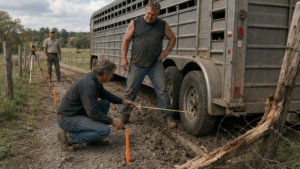
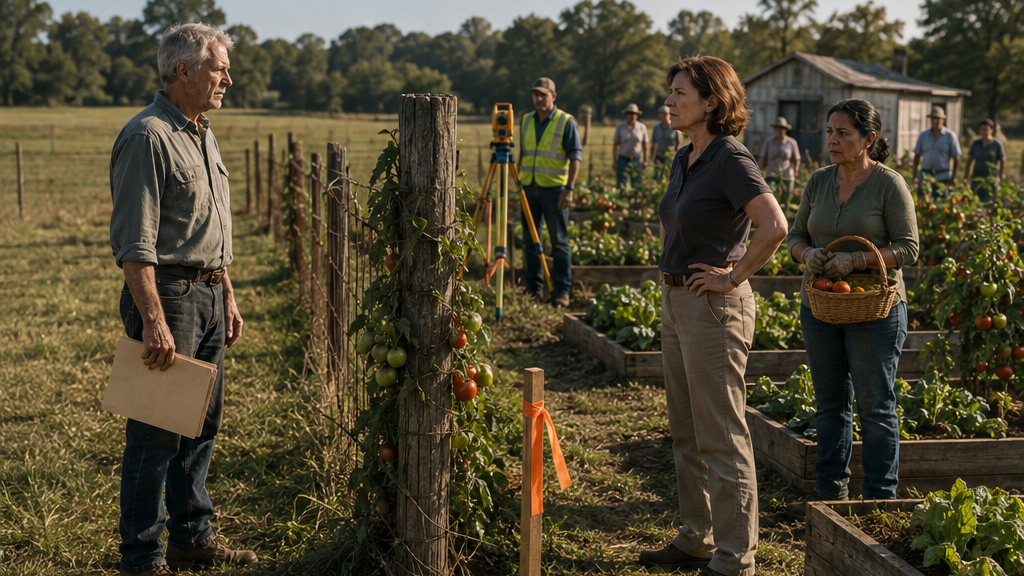
The surveyor drove the first bright stake into the soil between a tomato bed and the old fence post.
The orange ribbon tied beneath its cap snapped once in the morning breeze.
Samuel stared at the distance between the two markers.
Eleven inches.
After two years of uncertainty, the first measured point had fallen almost exactly where he remembered the line.
The survey crew supervisor crouched beside the instrument farther up the pasture, checked a reading, then called to the worker holding the rod.
“Hold there.”
The worker shifted half a step.
Samuel kept his hands in his pockets.
He had expected satisfaction.
Instead he felt tightness in his stomach.
The tomato vines beside the stake were heavy with fruit. Some were still green; others had begun turning orange. Somebody had tied them carefully with strips of old cotton cloth.
A truck door slammed on the subdivision side.
Karen Hill came down the garden path fast enough to scatter gravel.
“What is this?”
The crew supervisor looked up.
“Boundary survey.”
“Who authorized you to come into the garden?”
Samuel answered.
“I did.”
Karen stopped.
“You don’t have authority to bring a crew into an association-maintained area without notice.”
Samuel looked at the orange stake.
“You sent me a map that puts this on your side. I hired somebody to find out.”
“That doesn’t mean you can disrupt the plots.”
“We haven’t disrupted anything.”
The surveyor rose.
“We’re locating corners and line evidence, ma’am. We can work around the beds.”
Karen’s attention fixed on the stake beside the tomatoes.
“That needs to come out.”
“No,” the supervisor said evenly. “Not until we finish.”
Two gardeners had emerged from between the rows. Another stood near the shed.
Then Christine Lopez arrived carrying a plastic harvest basket.
Samuel recognized her from Saturday. She had been the woman who asked whether there was a problem.
Karen turned to the crew.
“I’m telling you this area was approved by the association.”
The supervisor gave Samuel a quick look that plainly said this was not his argument.
Samuel understood.
“Karen,” he said, “let them work.”
She faced him.
“You’re making this bigger than it needs to be.”
“I’m measuring it.”
“You approved this garden.”
The sentence carried across the rows.
Christine stopped beside them.
Samuel did not answer immediately.
He reached into the cab of his truck, opened the worn manila folder on the passenger seat, and removed one sheet.
He handed it to Karen.
“What’s that?” Christine asked.
“The agreement they sent me.”
Karen looked at the page.
Samuel pointed to the bottom.
“Show her my signature.”
Karen’s face hardened.
“That document isn’t the entire history.”
“I didn’t say it was.”
“You permitted the project to continue.”
“That’s different from approving it.”
“You knew people were planting here.”
Samuel felt the eyes around him.
That accusation was the one he could not dismiss.
“Yes,” he said.
Karen seemed briefly surprised.
“I knew the garden was growing.”
“Then you can’t stand here and act as though this appeared yesterday.”
“I’m not.”
Samuel looked at Christine.
“I should’ve come down here sooner. That part’s mine. But I never signed that agreement.”
Christine held out her hand.
“Can I see it?”
Karen did not move.
Samuel waited.
Finally Karen gave Christine the paper.
Christine read the first page, then turned it over as though another signature might be on the back.
“There isn’t anything here.”
“No,” Samuel said.
“You wrote them back?”
He gave her the refusal letter.
Christine read more slowly this time.
The garden around them had become unnaturally quiet. The survey instrument beeped once from the pasture.
Christine looked toward Karen.
“We were told this was approved.”
“It was approved as a community project.”
“That isn’t what we were told.”
Karen’s voice cooled.
“Christine, we are standing in the middle of a survey based on Samuel’s claim. We don’t even have a final result.”
The survey crew supervisor called from several yards away.
“Mr. Mitchell?”
Samuel turned.
The man pointed toward the hedge post.
“This old post is consistent with the record bearing. We’re going to run the next point north.”
Samuel nodded.
Karen folded her arms.
“Consistent isn’t final.”
“No,” Samuel said. “It isn’t.”
That answer seemed to irritate her more than if he had declared victory.
The crew worked onward.
A second marker went in near a trellis.
Then a third near the back of the shed.
With each one, the line became harder to dismiss.
It did not cut through the center of the garden randomly. It followed the same old alignment Samuel had carried in his head for decades.
Christine walked beside him while the crew moved.
“My family built bed seven,” she said.
Samuel glanced toward the row she indicated.
“My husband cut all the lumber. I hauled the soil in five-gallon buckets because the delivery truck couldn’t get close enough.”
Samuel nodded.
“I believe you.”
“We paid for the water line too.”
“I believe that.”
Christine stopped.
“You keep saying that like it doesn’t matter.”
“It matters.”
“Then what happens if the survey says you’re right?”
Samuel looked at the beds.
That was a question he had avoided asking himself in practical terms.
“I don’t know yet.”
Christine gave a short, humorless laugh.
“Everybody keeps saying they don’t know.”
She walked away.
Near the shed, Karen was speaking quietly into her phone.
Samuel watched her.
He had wanted the survey because measurements seemed clean. A line either fell somewhere or it did not.
But the orange stakes were revealing more than acreage.
They were showing him people who had not read his refusal because nobody had ever given it to them.
The crew reached the north end of the garden.
The supervisor checked the instrument, then came to Samuel.
“We still need to pull the county monument information and finish calculations. I won’t certify anything today.”
“Understood.”
“But preliminary?”
Samuel waited.
The man glanced back over the line of fresh stakes.
“It’s tracking your deed description closely.”
Samuel exhaled.
Karen heard.
“So now what?” she asked.
Samuel looked at her.
“Now we wait for the finished survey.”
Karen shook her head.
“No. You didn’t bring these people here just to wait.”
“I brought them here because you told me the association settled the property line.”
“I told you the garden was approved.”
“You also told me I approved it.”
Karen glanced toward Christine.
“That was the understanding.”
Christine had been listening.
“No,” she said.
Karen turned.
Christine set her harvest basket on the edge of a bed.
“You keep changing the sentence.”
“Christine—”
“You told us the land had been cleared for community use.”
“It had.”
“By who?”
“The board.”
Christine shook her head.
“That’s not what I’m asking.”
Samuel recognized the question because he had asked it himself.
Karen looked from Christine to Samuel, then to the unsigned agreement still in Christine’s hand.
For the first time, her confidence seemed less like certainty and more like an effort to keep several versions of events from separating.
Christine wiped one hand on her jeans.
“I have the packet we were given.”
Karen’s eyes sharpened.
“What packet?”
“The one from the garden sign-up meeting. Map, rules, budget sheet. Everything.”
“You don’t need to bring old committee materials into this.”
Christine stared at her.
“Apparently I do.”
She walked toward the subdivision entrance.
Karen took a step after her, then stopped.
Samuel said nothing.
Twenty minutes later Christine returned carrying a thick white envelope.
She laid it on the hood of Samuel’s truck.
Inside was a color map Samuel had never seen.
The disputed corner was shaded green.
A bold line marked the subdivision edge.
Samuel’s old fence line did not appear at all.
Christine pulled out a second page.
“This is what they gave every gardener.”
Samuel read the first paragraph.
The language did not call the area Samuel’s property.
It did not call it disputed.
It described the site as designated community garden space available to residents under association rules.
Samuel looked up at Karen.
She had gone very still.
Christine tapped the packet.
“You knew we had this, didn’t you?”
Karen did not answer.
The orange survey ribbon beside the tomatoes snapped again in the breeze.
Samuel looked from the unsigned agreement in his hand to the packet that had told fourteen families an entirely different story.
The boundary had become clearer.
Everything else had just become harder.
Chapter 4: Fourteen Families Believed the Same Map
“Are you planning to tear all of this out by Friday?”
Christine Lopez stood beside bed seven with both hands wrapped around the top rail. The question came before hello.
Samuel stopped at the opening in the old fence.
“No.”
Christine looked at him carefully.
“That’s not what people are saying.”
“I haven’t told anybody that.”
“People don’t always wait for you to tell them.”
Behind her, the garden looked different now that the survey stakes were in place. The bright orange ribbons cut through rows of beans, squash, peppers, and tomatoes like a second geometry laid over the first. One stake stood beside a trellis. Another marked the ground just behind the shed. The line they suggested did not care how neatly the beds had been arranged.
Samuel had spent two nights thinking about that.
Not about whether the line was his.
About what the line now contained.
“Survey isn’t final yet,” he said.
Christine glanced at the stakes.
“Everybody can see where it’s going.”
A woman carrying a watering can paused several beds away. She did not come closer, but she listened.
Christine lowered her voice.
“My daughter planted those tomatoes with me in April.”
Samuel looked at bed seven.
The wooden frame was weathered enough to show it had been through more than one season. Small white labels stuck out from the soil, written in marker. A child’s hand had painted a crooked yellow flower on one corner.
“I’m not touching them,” Samuel said.
“Today?”
“While the survey is being finished.”
Christine let out a breath, but her shoulders stayed tense.
“That sounds temporary.”
“It is temporary.”
She looked away.
Samuel understood why that answer disappointed her. It was also the only honest answer he had.
He walked toward the shed.
The old fence line had become nearly invisible there. Somebody had trained cucumber vines over a section of woven wire. Two newer trellises had been tied directly to the old posts. Samuel could see, in the construction, how the change had happened without anyone feeling as though they were crossing a border. A board here. A hose there. One more bed pushed into unused grass.
What had looked obvious to him from memory had probably looked like abandoned farm fencing to people who had never known what it marked.
Christine followed.
“I brought the whole packet to the board,” she said.
“What happened?”
“They said the map was conceptual.”
Samuel stopped.
“That the phrase they used?”
“Yes.”
He gave a quiet snort.
“What did you think it meant when you got it?”
“That the garden belonged to us.”
“Us who?”
“The association.”
Samuel nodded.
“That’s what it looks like.”
Christine crossed her arms.
“I was treasurer when we voted for the irrigation line.”
Samuel turned toward her.
“You voted on it?”
“Yes.”
“You ever see a deed?”
“No.”
“Lease?”
“No.”
“Easement?”
“No.”
Christine’s face tightened. “You don’t have to make me feel stupid.”
“I’m not trying to.”
“Well, you’re doing a fair job.”
Samuel looked toward the beds.
“I’m trying to figure out how fourteen families came to the same conclusion.”
Christine’s anger softened, though only slightly.
“Because we were all handed the same packet.”
That afternoon Samuel drove to the county records office.
Edward Thomas met him at a counter in the back records room, where rolled surveys stood in vertical racks and old subdivision plats filled metal drawers. Edward was near Samuel’s age, with reading glasses that hung low on his nose and the manner of a man who disliked certainty until he had checked it twice.
He spread Samuel’s deed, the subdivision plat, and the preliminary survey across a large table.
“I can tell you what the county has,” Edward said. “I can’t tell you what somebody promised at a meeting.”
“That’s fine.”
Edward traced a finger along the parcel boundary.
“This line here matches the deed description. The survey crew’s preliminary points are within tolerance of the older record.”
“And the garden?”
“Mostly appears to be west of that line.”
“On me.”
“According to the records we have, yes.”
Samuel waited for the feeling of victory.
It came, but only briefly.
Edward opened another file.
“No recorded transfer. No easement granting garden use. No boundary adjustment. No memorandum of lease.”
Samuel leaned forward.
“Nothing?”
“Nothing filed with us.”
“So that’s it.”
Edward looked over his glasses.
“No. That’s the land-record answer. It’s not necessarily the end of every argument.”
Samuel frowned.
Edward continued.
“People can create disputes through use, representations, contracts, all sorts of things. I’m not giving you legal advice. I’m telling you the county record doesn’t show that your title was conveyed.”
Samuel sat back.
Karen’s words returned to him.
You watched it being built.
Edward seemed to read something in his face.
“You’ve known about the garden?”
“For a while.”
“How long?”
Samuel looked at the map.
“Long enough.”
Edward did not ask more.
When Samuel returned to the subdivision, Karen was waiting beside the clubhouse entrance.
She had heard about his visit to the county office.
“You’re escalating this,” she said.
Samuel stopped on the sidewalk.
“I checked the records.”
“You’re contacting county officials while telling gardeners you’re going to wait.”
“I told them I wouldn’t touch the crops while the survey’s being finished.”
“That buys you goodwill while you build a case.”
Samuel stared at her.
“You think I’m staging this?”
“I think you understand how this looks.”
He nearly answered sharply, then stopped.
Maybe she did believe that.
Karen had spent years managing meetings where appearances mattered. A landowner who arrived with surveys and county records could look like a man preparing to corner an institution.
“I’m trying to understand what happened,” he said.
“You know what happened. The garden became part of the community.”
“That isn’t the same as permission.”
“Maybe not to you.”
Samuel’s eyes narrowed.
“That’s not a matter of perspective.”
Karen’s expression hardened.
“No, but consequences are.”
She gestured toward the garden.
“Those people didn’t invade your farm. They were told to plant there. They spent money because the association approved it. If you force the issue now, they’re the ones who lose.”
Samuel looked past her toward the rows.
“That’s why I haven’t forced anything.”
Karen gave him a skeptical look.
“You brought a survey crew.”
“Because you told me the association had settled the land.”
For a moment neither moved.
Then Christine came out of the clubhouse carrying the white packet.
She walked past Karen and handed Samuel a photocopy.
“Edward called me,” she said.
Karen’s head turned.
“Why would Edward call you?”
“I asked him to check old association references tied to the parcel.”
Samuel looked down.
It was a photocopy of meeting notes from several months earlier.
Most of the page concerned budgets and maintenance.
One line had been marked.
Garden parcel status—unsigned owner agreement remains in file; continue review before permanent improvements.
Samuel read it twice.
He looked at Karen.
Her face had lost color.
Christine spoke quietly.
“This was before we put in the new irrigation manifold.”
Karen said nothing.
Samuel felt the anger he had been trying to keep measured return all at once.
Not because the agreement was unsigned. He already knew that.
Because somebody inside the association had known it was unsigned while residents kept being told the site was settled.
Edward had given him the record answer.
This page gave him a different question.
Samuel folded the copy once.
“When did you know?”
Karen looked at the paper but not at him.
“When did you know the agreement was never signed?”
Chapter 5: What Karen Knew Before Planting Season
“I knew before planting season.”
Karen Hill said it from the end of the conference table without looking at Samuel.
Nobody moved.
The emergency board session had been called with less than forty-eight hours’ notice. Five board members sat around the table. Christine was there because she was treasurer. Samuel had been invited after insisting that if the board was discussing his property, he intended to hear the discussion.
The unsigned agreement lay in the center of the table.
Beside it sat a stack of expense sheets.
Samuel studied Karen.
“How long before?”
She folded her hands.
“Late February.”
The room seemed to shrink.
The garden had been planted in April.
Samuel said, “You knew in February.”
“Yes.”
“And you let people plant anyway.”
Karen lifted her eyes.
“I did not tell anyone to trespass.”
“That isn’t what I asked.”
One board member shifted in his chair.
Karen’s voice stayed level, but strain had entered it.
“We had already spent money. The shed was installed. The irrigation materials were ordered. Families had reserved plots. We had a waiting list.”
Samuel looked at the expense sheets.
“How much?”
Christine answered.
“Just under nine thousand over two seasons.”
Samuel looked at her.
Christine did not defend the number.
Karen continued.
“Moving the garden in February would have meant telling fourteen families that the board had built a project on ground it might not control.”
“Might not?”
“At that point, yes.”
“You had my unsigned agreement.”
“We had years of use.”
“You had two.”
“We had your knowledge of the use.”
Samuel leaned back.
There it was again.
Not permission.
Silence.
Karen pushed one sheet toward him.
“This is what I was looking at. Irrigation expense. Shed. Soil. Lumber. Insurance rider. Volunteer commitments. People had made plans around this.”
“So you decided the missing signature didn’t matter.”
“I decided we needed time.”
“To do what?”
“To resolve it without blowing up the entire project.”
Samuel stared at her.
“And in that time?”
Karen’s jaw tightened.
“We planted.”
Christine shook her head.
“You let us plant.”
Karen turned to her.
“You were treasurer. You saw the budget.”
“I saw a budget. I didn’t see his refusal.”
“You had access to the files.”
“Not the land-use folder.”
Karen looked away.
Samuel watched the exchange.
Until that moment, he had imagined Karen’s motive as simple pride. Protect the board. Protect herself.
Now he saw something more complicated and, in a way, more frustrating.
She had been afraid of telling the truth because the truth would have cost people money and exposed a mistake already made.
So she had delayed.
Samuel knew that kind of thinking.
He knew it too well.
Karen looked at him.
“You’re acting like there was a clean choice.”
“There was.”
“No. There was a legal choice. Clean isn’t the same thing.”
Samuel’s expression hardened.
Karen gestured toward the window in the direction of the garden.
“Tell fourteen families in February that their plots are gone. Tell them the lumber they paid for is sitting on disputed ground. Tell them the board used dues for a shed we might have to move. Tell them we failed to verify the paperwork before building anything.”
“You should have.”
“Yes.”
The word landed harder than an argument.
Karen drew a breath.
“Yes, Samuel. We should have.”
Silence settled over the room.
One board member rubbed his forehead.
Christine looked down.
Karen continued.
“But I thought if we could get through one more season, we could work out an agreement with you after the fact.”
Samuel laughed once, without humor.
“You thought tomatoes would make me sign.”
“I thought reality would make both sides compromise.”
“Reality.”
“Yes.”
Samuel looked at the unsigned page between them.
“You mean once enough people depended on it.”
Karen did not answer.
That was answer enough.
For several seconds Samuel felt completely justified.
Then a board member at the far end of the table spoke.
“Can I ask Mr. Mitchell something?”
Samuel turned.
The man hesitated.
“When did you first know the garden crossed what you believed was your line?”
Samuel opened his mouth.
Nothing came out immediately.
Karen looked at him.
So did Christine.
The answer had seemed easier when he was alone.
“I saw the first beds going in,” he said.
“When?”
“First season.”
The board member leaned forward.
“And you told them to stop?”
Samuel looked at the table.
“I had already refused the request.”
“That wasn’t my question.”
Samuel felt irritation flare.
Then he recognized the unfairness of being angry at someone for asking him the same kind of precise question he had asked Karen.
“No,” he said.
The word felt heavy.
“I didn’t stop them.”
Christine watched him.
Samuel continued.
“I thought they were staying close to their side. Then I saw more lumber. Later the shed.”
“And?”
“I did nothing.”
Karen’s expression changed.
Not triumph.
Something closer to recognition.
Samuel hated that more.
He had spent days telling himself the difference was obvious: he had never authorized the garden. Karen had.
But they had shared one habit.
Both had delayed an unpleasant truth because dealing with it later seemed easier.
The difference was that Karen had authority over people who trusted her.
Samuel had authority over himself.
Still, the delay had consequences either way.
Christine broke the silence.
“My daughter thinks Mr. Mitchell wants to tear out her tomatoes.”
Samuel looked at her.
“I don’t.”
“She heard that from another gardener.”
“I haven’t said it.”
“I know.”
Christine’s voice softened.
“That’s the problem now. Nobody knows what’s true.”
Samuel looked again at the unsigned agreement.
For months it had represented proof.
Now it looked more like the beginning of a chain of failures.
His refusal had been clear.
Karen’s choice had been wrong.
But between those two facts were fourteen families who had built beds under a false assumption and a farmer who had watched them do it because he did not want a fight.
Karen pushed back her chair.
“I’ll take responsibility for what I decided in February.”
One board member turned toward her.
“What does that mean?”
“It means I won’t pretend I didn’t know.”
Samuel looked at her.
Karen met his eyes.
“But if we’re putting the full story in the record, it should be the full story.”
He knew what she meant.
He could have resisted.
Instead he said, “It should.”
Christine looked between them.
Samuel folded his hands on the table.
“I knew the garden was getting bigger.”
His throat felt dry.
“I knew, and I did nothing.”
Chapter 6: The Cost of Waiting Too Long
The finished survey placed thirteen full raised beds and most of the fourteenth on Samuel’s side of the boundary.
The shed was his side too.
So was the irrigation manifold.
Samuel stood at the pasture gate with the certified drawing in his hand while the survey crew supervisor pointed along the flagged line.
“There’s not much ambiguity left,” the man said.
Samuel nodded.
He had wanted certainty.
Now he had it.
It felt less satisfying than uncertainty had promised.
By afternoon, the association’s attorney had sent a letter asking Samuel to state his intended remedy.
Removal of structures.
Restoration of fencing.
Compensation for unauthorized use.
Immediate cessation of access.
The options read cleanly on paper.
Samuel drove to the garden.
Christine was kneeling beside bed seven, pulling weeds.
She stood when she saw him.
“It’s final?”
He held up the survey.
“Pretty much where we thought.”
Christine wiped dirt from her palms.
“How long do we have?”
Samuel looked toward the tomatoes.
Some had ripened fully now. Red fruit hung low enough to brush the wooden frame.
“I haven’t given a deadline.”
“They’ll ask you for one.”
“I know.”
Christine hesitated.
“There’s another piece of ground.”
Samuel looked at her.
“Where?”
“Association-owned lot behind the maintenance building. It’s smaller. Maybe half this size.”
“Why wasn’t the garden there in the first place?”
“Drainage. Shade. And because this place was prettier.”
Samuel almost smiled.
“That usually gets expensive.”
Christine did smile, briefly.
“We could move the shed. Rebuild fewer beds. Maybe keep eight or nine.”
“And the rest?”
“Families share.”
Samuel looked toward the old fence.
A section near the north end had sagged where gardeners had cut access through it. He had brought new staples and a coil of wire that morning.
He walked over and began repairing it.
Christine followed.
“You’re closing it?”
“This section.”
“What about the opening?”
Samuel pointed toward the main garden entrance.
“I’m leaving that until we figure out the move.”
Christine watched him stretch the woven wire tight against the post.
“You could make everybody leave today.”
“I know.”
“Some people think you will.”
“I know that too.”
Samuel drove the staple in with three hammer blows.
He had spent most of his life believing that restraint meant waiting until he was absolutely forced to act. Now he saw another kind.
Restraint could also mean acting while refusing the most damaging option available.
That evening the board met again.
Several members wanted Karen’s resignation immediately.
One argued that no agreement with Samuel should be signed while she remained president. Another wanted the association’s insurer involved before anyone admitted fault in writing.
The discussion tightened into procedure.
Samuel sat at the end of the room listening.
Finally he said, “You’re using her resignation to avoid deciding what happens to the land.”
The room went quiet.
A board member said, “Those are connected issues.”
“They can be connected after you decide whether you’re moving the garden.”
Christine nodded.
“We have a possible site.”
Karen, seated apart from the others, looked tired.
“Behind maintenance?”
“Yes,” Christine said.
Karen frowned.
“The drainage work would cost money.”
“So did building on Samuel’s property,” Christine replied.
Nobody answered that.
Samuel unfolded the survey.
“I’m not asking for the garden to be cleared tomorrow.”
Several faces lifted.
“I’m asking for a written plan.”
One board member said, “What kind of plan?”
“Date for relocation. Fence repair. Removal of the shed and irrigation equipment from my parcel. And something in your records that says use of private property requires written owner consent.”
The attorney began taking notes.
Samuel continued.
“I don’t want a check for some made-up rental amount. I want the boundary fixed.”
Karen looked at him.
“And the current crops?”
Samuel paused.
“Finish the season within reason.”
Christine exhaled.
A board member looked surprised.
“You’re willing to allow continued access?”
“For transition. In writing.”
The phrase mattered.
Samuel heard it as he said it.
In writing.
Not assumed.
Not understood.
Not left alone because conversation was uncomfortable.
Karen leaned forward.
“If we agree to that, residents are going to ask why this wasn’t resolved earlier.”
Samuel looked at her.
“They should.”
The room tightened again.
“And what do you intend to tell them?” she asked.
“The truth.”
Karen held his gaze.
“All of it?”
Samuel understood the challenge.
That he had refused.
That she had known the agreement was unsigned.
And that he had watched the garden expand without stopping it.
“Yes,” he said.
“All of it.”
The emergency membership meeting was scheduled for the following Tuesday.
Samuel spent Monday night at his kitchen table.
The same table where he had found the unsigned agreement.
This time he was not reading somebody else’s terms.
He was writing his own.
He crossed out three sentences because they sounded angrier than he intended. He removed a demand for reimbursement. He added a requirement that the final survey be attached to the association’s permanent records.
Then he added one sentence near the end.
No future community use of privately owned land may be represented as authorized without written consent from the recorded owner.
Samuel read it twice.
He thought about how many problems might have been prevented if he had insisted on that clarity two years earlier instead of believing his first no would carry itself forever.
He placed the conditions in a plain folder.
The next evening, forty residents filled the clubhouse meeting room.
Samuel stood outside for a moment, hearing chairs scrape and voices rise through the door.
He could have left.
A few years earlier, he probably would have.
Instead he opened the folder, stepped inside, and walked toward the table where Karen and the board were waiting.
Chapter 7: The Boundary They Finally Put in Writing
Samuel had read three paragraphs of the proposed settlement when he closed the folder.
“No.”
Across the clubhouse table, the association attorney stopped with one hand on his legal pad.
Karen Hill sat two chairs away, looking as though she had not slept much since the previous meeting. Christine Lopez was near the end of the table. Behind them, nearly every folding chair in the room was occupied.
The attorney glanced at the document.
“Is there a particular provision you object to?”
“The confidentiality part.”
A murmur moved through the room.
The attorney kept his voice measured. “That language is standard.”
“Then take it out.”
“Mr. Mitchell, the purpose is to allow both sides to resolve the dispute without further reputational damage.”
Samuel looked toward the residents.
“That’s the problem.”
Karen’s eyes lifted.
Samuel reopened his own plain folder.
“For two years, people were told one version. I don’t see much sense fixing that with another version nobody’s allowed to talk about.”
A board member leaned toward his microphone.
“What exactly are you asking us to disclose?”
Samuel took out one sheet.
“That I did not sign the land-use agreement. That the association had no recorded easement or transfer for the garden parcel. That the board continued the project after learning the agreement was unsigned.”
A few residents shifted sharply.
Karen remained still.
Samuel paused.
“And that I knew the garden was expanding and waited too long to challenge it.”
That quieted the room more completely than anything else had.
A man in the second row said, “You knew?”
Samuel turned toward him.
“Yes.”
“How long?”
“From the first season.”
The man stared at him.
Samuel continued before anyone else could fill the silence.
“I had already refused the original request. I thought that should have been enough. When I saw beds going in, I told myself they were probably on the association side. When I saw more the next year, I told myself I’d deal with it later.”
He looked toward Christine.
“I was wrong to wait.”
Christine lowered her eyes for a moment.
Samuel turned back to the board.
“That doesn’t make the land theirs. But it does mean I helped let the confusion last longer than it should have.”
Karen watched him carefully.
The attorney tapped his pen against the settlement.
“So you want a public statement assigning responsibility to both parties.”
“I want an accurate one.”
“And compensation?”
“I told you already. I’m not asking for rent.”
Several people in the room appeared surprised.
Samuel placed his written conditions on the table.
“The association pays to move the shed and usable garden materials. You repair the fence where access was cut. The final survey gets attached to your permanent property records. The garden moves to land the association actually owns.”
Christine said, “Behind the maintenance building.”
Samuel nodded.
“And future use of private property requires written consent from the recorded owner before the association tells residents it’s approved.”
The attorney read silently.
One board member whispered to another.
Karen finally spoke.
“What about my position?”
Samuel looked at her.
“That’s between you and your board.”
“It’s part of the settlement they drafted.”
“Not mine.”
The board member beside her straightened.
Karen gave a tired smile that held no amusement.
“They want my resignation before they vote on the agreement.”
Samuel did not answer.
Karen looked around the room.
“I knew in February that Samuel’s signature was missing.”
Nobody interrupted her.
“I convinced myself the problem was technical. The garden already existed. Money had been spent. Families had signed up. I thought if I delayed the dispute long enough, Samuel would eventually accept what had become normal.”
Her fingers tightened around the edge of the table.
“That was not permission. It was pressure.”
Christine looked at her.
Karen continued.
“I should have told everyone before planting season.”
A woman in the back asked, “Why didn’t you?”
Karen looked toward her.
“Because I was embarrassed.”
The answer seemed to surprise people more than a complicated explanation would have.
“And because I thought admitting the mistake would make me look incompetent.”
Samuel watched her.
There it was—the truth stripped of procedure.
Not greed.
Not some elaborate scheme.
Fear, pride, and the hope that an uncomfortable fact might become easier if everyone kept moving around it.
Samuel understood that kind of mistake well enough.
Karen turned to the board.
“I’ll step down after the agreement is signed and the relocation is underway.”
No one applauded.
Samuel was glad of that.
The attorney spent the next half hour revising the document. Confidentiality disappeared. The association accepted the survey. Relocation expenses replaced proposed damages. A completion date was added for restoring the fence.
Then Christine raised one final issue.
“The tomatoes.”
A few people laughed softly, mostly from exhaustion.
She did not.
“Bed seven still has fruit on it. So do four others.”
Samuel looked at Karen.
Karen surprised him by asking the question herself.
“Can they ripen?”
Samuel glanced down at the agreement.
Three weeks earlier, he might have interpreted the request as one more attempt to take an inch and make it permanent.
Now it sounded like what it was.
A request.
“How long?”
“Two weeks,” Christine said. “Maybe less.”
Samuel considered it.
“Access stays limited to harvesting. No new planting.”
Christine nodded immediately.
“No new planting.”
Karen said, “And after that, the beds move.”
“Yes.”
Samuel picked up the pen.
For once, nobody was relying on implication.
He signed.
Karen signed beneath him.
By early autumn, the garden no longer occupied Samuel’s pasture.
The shed went first, lifted onto a trailer and moved behind the subdivision maintenance building. Volunteers dismantled the cedar beds, sorting warped boards from those worth saving. The irrigation manifold came out of the ground. The association paid for new soil and drainage improvements at the smaller replacement site.
Samuel did not supervise.
He came down only when the fence contractor arrived.
The old woven wire had been cut and patched in so many places that repairing it section by section made little sense. They replaced the worst stretch entirely, setting new posts along the certified line.
The weathered corner post remained.
Samuel insisted on that.
Beside it stood a permanent survey marker, small and plain, set where the bright orange stake had first appeared next to the tomatoes.
Edward Thomas completed the record filing the following week.
When Samuel received the stamped copy, he placed it in the same manila folder as the unsigned proposal.
For years, that empty signature line had seemed like the whole argument.
Now it looked different.
It proved he had said no.
It did not prove he had handled what came afterward well.
One afternoon Christine found him checking the repaired fence.
“You ought to come see the new place.”
Samuel looked toward the subdivision.
“How bad is it?”
“Smaller.”
“That means bad.”
“It means smaller.”
He smiled.
A few days later he went.
Nine beds stood behind the maintenance building. They were less picturesque than the old garden. One side faced a drainage swale. The afternoon shade arrived earlier.
But the land belonged to the association.
There was no disputed line beneath the soil.
Christine led him to one of the middle beds.
A tomato plant leaned against a new cage, its lower leaves yellowing with the season. She touched one branch.
“That’s from bed seven.”
“You moved the whole plant?”
“Three of them survived.”
Samuel examined the tomatoes.
One was turning red.
Christine said, “My daughter wanted that one saved.”
Samuel nodded.
Across the lot, Karen was helping carry empty pots from a pickup. She saw Samuel but did not come over.
After a moment, she lifted one hand.
Samuel returned the gesture.
Nothing more was needed.
On his way home, he stopped at the old pasture corner.
The shed was gone. The raised beds had left pale rectangles in the grass, and a few pieces of mulch remained where the paths had been. By spring, most of it would disappear beneath pasture growth.
Samuel walked to the corner post.
The new fence met the old wood cleanly.
He placed one hand against its rough surface.
For years he had thought a boundary was something other people were supposed to notice.
A fence.
A deed.
A letter saying no.
He understood now that a boundary neglected long enough could become invisible without ever ceasing to exist.
He also understood that speaking clearly did not require cruelty.
Beyond the fence, on ground nobody disputed, the transplanted tomatoes were still growing.
Samuel checked the new wire once, found it tight, and walked back toward his pasture.
The story has ended.