The HOA Fined Him for a Gate That Had Been Legal Longer Than Their Neighborhood Existed
Chapter 1: The Morning They Came for the Gate
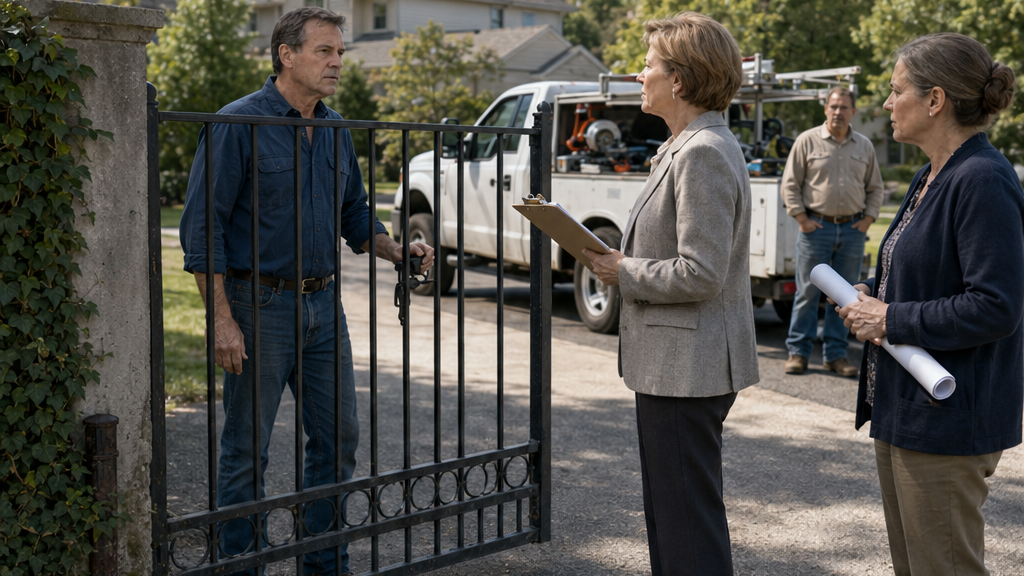
The contractor truck stopped directly in front of Samuel Miller’s gate at 8:07 on Saturday morning.
It was white, unmarked except for a magnetic company sign on the door, and carried an angle grinder, extension cords, and two lengths of chain in the open bed.
Samuel stood behind the steel bars with his coffee in one hand.
Brenda Clark climbed out of her SUV carrying a clipboard.
That was when he understood they had not come to talk.
“Morning, Samuel.”
“You brought a contractor.”
Brenda looked toward the gate instead of answering. The property manager stepped out behind her with a rolled site plan tucked under one arm.
The gate had stood across the driveway longer than Samuel had owned the house. Heavy black steel, square posts, simple horizontal rails. His uncle Patrick had maintained it with almost absurd care, repainting scratches before rust could take hold and oiling the hinges every spring.
Samuel had done the same since buying the property from Patrick’s estate in 2009.
For nearly seventeen years, nobody had called it an emergency.
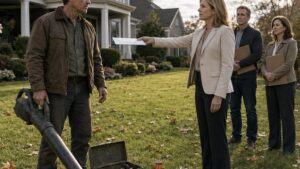
Now Brenda held out a sheet of paper.
“This is the final compliance authorization. You’ve received the prior notices.”
“I received them.”
“The association’s position hasn’t changed.”
“Neither has mine.”
Her jaw tightened slightly.
The complaint had begun with a letter saying the gate obstructed common access. Samuel had written back that the driveway was on his property. Brenda had responded that HOA records showed the corridor as association-controlled access. More letters followed. Then photographs. Then weekly fines were threatened.
Samuel had stopped answering after the fourth exchange.
He had considered that restraint.
Brenda apparently considered it permission to escalate.
“The board gave you alternatives,” she said. “Remove the gate or leave it permanently open.”
“And I declined both.”
“That’s why they’re here.”
The contractor shifted his weight near the truck. He looked uncomfortable enough that Samuel almost felt sorry for him.
Almost.
Samuel set his coffee on the brick column beside the gate.
“You’re not cutting anything.”
Brenda exhaled slowly. “Samuel, this affects more than you. There’s another parcel with access through this corridor. We’ve had complaints about the gate being locked.”
“That does not make my driveway HOA property.”
“No one said the entire driveway belongs to the HOA.”
“Your notices did.”
“The notices say common-access corridor.”
“Show me where it starts.”
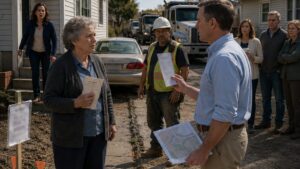
The property manager unrolled the site plan across the hood of Brenda’s SUV.
Samuel unlocked the gate himself.
The movement surprised all three of them.
He pulled one side inward, stepped through, and closed it behind him.
“I’ll make this easy,” he said. “Show me the line.”
The manager flattened the paper.
It was a simplified subdivision exhibit Samuel had seen before: lots, roads, drainage strips, common areas. A narrow shaded band ran along the edge of Samuel’s parcel.
Brenda tapped it with one fingernail.
“There.”
Samuel looked from the drawing to the pavement.
“How far from the curb?”
The manager glanced down again.
“It isn’t dimensioned on this exhibit.”
“From my house?”
“No.”
“From the property pin?”
Brenda said, “We’re not doing a survey in the driveway.”
“No. You’re here to remove a gate. So I’m asking what property you believe you have authority over.”
The contractor stared at his boots.
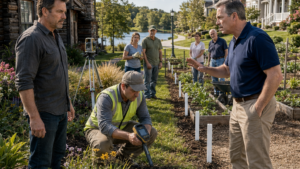
Samuel walked to the left gatepost.
Beside it, partly hidden by low ivy, was a rust-dark metal marker Patrick had once told him never to disturb.
Samuel had always assumed it was an old survey remnant.
He bent and pulled the ivy away.
A worn metal cap showed through the dirt.
The property manager stepped closer.
“What is that?”
“You tell me.”
She crouched.
Brenda remained beside the site plan.
The manager took out her phone, photographed the marker, then looked back at the paper.
“The corridor on this exhibit would put the boundary farther east.”
“How much farther?”
“I can’t tell from this.”
Samuel pointed at the weathered concrete footing beneath the gatepost. It was older than the decorative walls and newer sidewalks around it, its surface chipped and darker with age.
“Patrick built around that marker. He didn’t put that post there by accident.”
Brenda shook her head.
“This proves nothing about the association’s access rights.”
Samuel looked at her.
“I didn’t say it did.”
That was the first moment her certainty seemed to loosen.
Not much.
Just enough.
The manager rolled the plan halfway closed, then reopened it as if hoping another look would solve the discrepancy.
“This may not be the recorded plat,” she said.
Brenda turned toward her. “It’s the exhibit we’ve used for years.”
“I know. But it may be a management exhibit rather than the underlying recorded instrument.”
Samuel felt his irritation change shape.
For months he had treated the letters as bureaucratic bullying. He had been so sure the board was simply wrong that he had never seriously asked why Patrick had insisted that marker remain untouched.
“What underlying instrument?” Samuel asked.
The manager hesitated.
“Possibly an older access agreement.”
Brenda cut in.
“We are not establishing title this morning.”
Samuel gave a short laugh.
“Apparently neither were you before you brought a grinder.”
The contractor looked away.
Brenda’s face flushed, though her voice stayed measured.
“I am not authorizing physical work today if the manager believes the exhibit requires verification.”
Samuel said nothing.
She lifted the compliance notice.
“But the deadline remains. Seven days. If the board does not receive documentation establishing your right to maintain a locked obstruction across this corridor, the weekly fines begin.”
“You want me to prove your map.”
“I want you to prove your claim.”
“You’re the one threatening to remove something.”
“And you’re the one preventing documented access.”
The word documented stopped him.
“What documentation?”
Brenda closed the clipboard.
“Bring your records to the hearing if you want to challenge ours.”
She turned toward the SUV.
The contractor climbed into his truck with visible relief.
Samuel watched them leave through the bars of the gate.
He should have felt victorious.
The gate was still standing.
Instead he looked down at the old marker.
For the first time, it no longer looked like a useless piece of rust.
He spent most of Saturday in the garage.
Patrick had kept records in gray plastic bins with handwritten labels: TAXES, ROOF, WELL, INSURANCE, DRIVE.
Samuel found old receipts for hinge grease, replacement rollers, welding repairs, and a locksmith visit from years before Samuel owned the house.
Nothing explained the property line.
He nearly gave up when he noticed a thin brown folder wedged beneath a stack of gate-maintenance invoices.
Inside were two yellowed receipts.
One was from a hardware supplier.
The other carried the county recorder’s stamp.
Samuel read the date twice.
It was decades old.
Across the faded top margin, Patrick had written three words in block letters:
KEEP WITH GATE.
Samuel sat down on the garage step with the receipt in his hand.
Patrick had not saved it because of the hinges.
He had recorded something.
Chapter 2: The File His Uncle Never Explained
On Monday morning, the county records clerk brought Samuel a file indexed more than twenty years before he had ever held title to the house.
“You’ll want the full instrument,” she said.
Samuel stared through the glass partition at the number printed on the retrieval slip.
“That old receipt led to this?”
“It led to the book and page reference. That’s usually better than a street address for older records.”
A few minutes later she returned with scanned pages on a monitor.
Samuel recognized Patrick’s name immediately.
He leaned closer.
The first document was not an HOA record.
It was an agreement between two former property owners concerning a narrow access corridor running from the public road along what would eventually become Samuel’s driveway and continuing toward an adjoining parcel behind it.
Samuel read slowly.
Legal descriptions had a way of making simple ground sound theoretical. Bearings. Distances. References to monuments. Successors and assigns.
Then one sentence stopped him.
The parties could maintain a gate across the corridor provided that access was not unreasonably denied to those entitled to passage.
Samuel read it again.
A gate.
Not a fence vaguely shown on an old photograph.
Not something Patrick had installed and gotten away with.
A gate specifically contemplated in the recorded agreement.
The clerk noticed his expression.
“Find what you needed?”
“Maybe.”
She smiled faintly. “That usually means you found something complicated.”
Samuel asked for copies of everything associated with the recording.
While the machine printed, he studied a hand-drawn exhibit attached to the agreement.
The outline of the corridor was crude but recognizable.
Near the road entrance was a small double-line symbol.
Samuel pointed to it.
“Is that what I think it is?”
“I can’t interpret legal effect for you,” the clerk said. “But visually? It looks like a gate symbol.”
For months, Samuel had been answering Brenda’s notices with the same sentence in different forms: The gate has always been here.
Now he understood how weak that sounded.
“Always” was memory.
This was recorded.
He left the county building carrying certified copies in a manila envelope and feeling, for the first time since the dispute began, that he possessed something heavier than his own certainty.
At home he spread the pages across the kitchen table.
The association’s latest violation notice sat at one end.
Patrick’s recorded agreement sat at the other.
Samuel took a picture of them together.
He drafted an email to Brenda.
Attached is the recorded access agreement expressly permitting a gate across the corridor. Please suspend all enforcement and confirm cancellation of the threatened fines.
He stopped.
Deleted “expressly.”
Read the relevant paragraph again.
The document did permit a gate.
But the language around it mattered.
Samuel sent the email anyway.
Within twenty minutes Brenda replied.
Thank you. The association will review the material. Your compliance deadline remains in effect pending review.
Samuel stared at the screen.
He had expected resistance.
Still, seeing those words after attaching the document made his hand tighten around the mouse.
He almost wrote back: Read the damn thing.
Instead he closed the laptop.
That afternoon he returned to Patrick’s files.
The recorded agreement dated from a time when the area had barely resembled a subdivision. Samuel found an old property sketch folded into quarters. The public road was there, along with Patrick’s parcel and the tract behind it.
No clubhouse.
No landscaped entrance.
No row of nearly identical mailboxes.
The gate was marked with a simple notation near the front access point.
Samuel remembered Patrick standing there once, years before, holding a ring of keys.
“Never leave it swinging open,” he had said.
Samuel had assumed he meant security.
Patrick hated strangers cutting through the property. He hated salesmen. He hated anyone who drove too fast past the house.
Samuel had inherited the same instinct.
Maybe more strongly.
He kept reading.
The agreement had been modified once.
Not eliminated.
Modified.
A later instrument adjusted maintenance responsibility after the rear tract changed owners.
Samuel felt another surge of confidence.
The HOA had not created this corridor. The corridor existed before the streets around it were laid out in their current form.
By evening, he had organized the papers chronologically.
He called the county office again and asked whether there were later transfers tied to the same legal description.
“There will be,” the clerk said. “But if you’re trying to determine whether an easement still burdens or benefits the land, you may want a title professional.”
“I’m trying to determine whether an HOA can pretend it doesn’t exist.”
There was a brief silence.
“That,” she said carefully, “is definitely a question for someone who can review the whole chain.”
Samuel thanked her.
He did not like that answer.
He wanted a clean line from old document to current victory.
He wanted the county clerk to say the HOA was wrong.
He wanted Brenda to receive his attachment, recognize the date, and withdraw every notice.
Instead he had another task.
Near midnight, Samuel went outside.
The steel gate reflected the porch light in narrow bands.
He rested one hand against the cold rail.
Patrick had preserved the agreement.
Patrick had saved the recorder’s receipt beside the maintenance records.
There had been intention in that.
Samuel went back inside and read the agreement one more time, this time without searching only for sentences that helped him.
The troublesome language appeared halfway down the second page.
The owner of the burdened parcel could maintain a gate.
That was his protection.
Then came the condition.
Access was to remain reasonably available to the owners, occupants, invitees, and necessary service providers of the benefited parcel.
Samuel sat very still.
The phrase was broader than he remembered from the clerk’s monitor.
He thought about the lock he had installed eighteen months earlier after the old mechanism failed.
Patrick’s original lock had been a keyed cylinder.
The replacement was not.
Samuel had switched to a coded lock.
He had never given the code to the owner behind him.
He had told himself nobody had asked.
That was not entirely true.
There had been a note in his mailbox months before the HOA’s first violation letter.
Please call about driveway access.
Samuel had thrown it away.
At the time, he had thought it was another attempt to pressure him into leaving the gate open.
He looked again at the sentence in the recorded agreement.
For the first time since finding the file, the document did not feel like a weapon.
It felt like a question.
The gate was allowed to exist.
But perhaps Samuel was not allowed to use it exactly as he pleased.
Chapter 3: The Right That Worked Both Ways
Edward Walker did not begin by asking about the HOA.
He began with a key.
“Who has one?”
Samuel sat across from him in a small title office with Patrick’s documents arranged between them.
“To the gate?”
Edward nodded.
“I do.”
“Who else?”
“Nobody needs one. It’s a code now.”
Edward looked over the top of his reading glasses.
“Then who has the code?”
Samuel understood where this was going and disliked it immediately.
“Me.”
Edward leaned back.
He was in his late sixties, gray-haired, deliberate, and utterly unimpressed by the righteous version of the story Samuel had prepared.
Samuel tapped the recorded agreement.
“It says I can maintain a gate.”
“It does.”
“And this agreement predates the HOA.”
“It appears to.”
“So why are we talking about my lock?”
“Because you didn’t ask me whether the gate can exist. You asked me what this agreement means.”
Edward turned the document around.
He placed one finger beneath the passage Samuel had reread the night before.
“You have a burdened parcel and a benefited parcel. That means somebody has a right to cross land somebody else owns. The owner of the land doesn’t stop owning it. The easement holder doesn’t suddenly own the driveway. But neither side gets to pretend the other side’s rights disappeared.”
Samuel folded his arms.
“The HOA is claiming the whole thing is common access.”
“That may be wrong.”
“They threatened to cut down my gate.”
“That may also be wrong.”
“Then—”
Edward raised one hand.
“And you may still have interfered with somebody’s access.”
Samuel fell silent.
Edward slid the old sketch beside a current tax map.
“Your uncle appears to have understood that distinction.”
“How?”
“Maintenance references. Lock replacement. Access notation.”
Edward showed him a photocopied invoice Samuel had overlooked.
Two cylinders keyed alike.
One installed at Patrick’s gate.
The other delivered to the then-owner of the rear parcel.
Samuel stared at it.
Patrick had not merely kept a gate.
He had given the other owner a way through it.
Edward said, “That matters.”
Samuel looked toward the office window.
Outside, traffic moved through the strip-mall parking lot.
“I replaced the lock because the old one failed.”
“Reasonable.”
“I changed it to a code because I didn’t want keys floating around.”
“Also reasonable.”
“I’m not opening my property to everybody.”
“Nobody’s asking you to.”
“That is exactly what Brenda is asking.”
Edward shook his head.
“That is what Brenda appears to be asking. I’m talking about the easement.”
The distinction irritated Samuel because it was true.
He had spent months combining every complaint into one enemy. Neighbor. Board. Manager. Brenda. They all became the same demand in his head: Open the gate.
Edward separated the papers into two piles.
“One question is whether the HOA has authority to require removal or permanent opening.”
He tapped the second pile.
“The other is whether someone with a recorded right of passage has been practically denied access.”
Samuel thought about the note he had thrown away.
“I may have missed a request.”
Edward’s expression did not change.
“What kind?”
“The owner behind me left a note.”
“When?”
“Months ago.”
“What did it say?”
“To call about access.”
“Did you?”
“No.”
“Why?”
Samuel rubbed his thumb along the edge of Patrick’s old receipt.
“Because by then I was tired of people telling me what to do with the gate.”
Edward waited.
Samuel hated that too.
“I thought if I started giving people codes, the HOA would use it as proof that the drive belonged to them.”
“That’s not how title works.”
“I know that now.”
Edward looked at him for a moment.
“No. You know it intellectually now. That’s different.”
Samuel almost stood up.
He had not hired Edward to lecture him.
Then he remembered he had not technically hired him for that either. Edward had agreed to review the chain because a county clerk had recommended him, and he had charged Samuel only for research time.
Samuel forced himself to stay seated.
“What should I do?”
“First, stop trying to win the whole argument with one document.”
Edward gathered the papers.
“Second, contact the owner of the benefited parcel. Find out what access they actually need.”
“And the fines?”
“Challenge them.”
“The removal order?”
“Challenge that too.”
“So Brenda’s still wrong.”
Edward sighed.
“This is not a scoreboard.”
Samuel looked away.
That afternoon he stood with the rear neighbor at the gate.
The conversation was shorter than he had feared.
“I don’t need it open all day,” the neighbor said. “I never asked for that.”
“Then what happened?”
“Last winter I had a repair crew coming through. They couldn’t get in. I left you the note.”
“I saw it.”
The neighbor gave him a flat look.
Samuel nodded.
“I should’ve called.”
“Yes.”
No anger.
That was worse.
Samuel entered a temporary code into the lock.
“This one will work for now. Don’t share it except with people who actually need access to your place.”
“That’s all I wanted.”
Samuel looked down the corridor.
“So how did the HOA get involved?”
“I contacted the manager when I couldn’t reach you.”
“Did you ask them to remove the gate?”
“No.”
“To leave it permanently open?”
“No.”
Samuel turned.
The neighbor shrugged.
“I told them I had access rights and couldn’t get through.”
There it was.
A legitimate complaint.
Then bureaucracy had expanded it.
Samuel had spent months refusing to recognize the first part because he despised what the second part became.
When the neighbor drove through, Samuel watched the gate swing shut behind the vehicle.
For the first time, he understood what Patrick had built.
Not a barricade.
A controlled crossing.
That evening Samuel sent Brenda a second email.
The recorded agreement permits a gate while preserving access to the benefited parcel. I have contacted that parcel’s owner and restored practical access. I dispute the association’s authority to require permanent opening or removal. Please suspend enforcement while title is reviewed.
He attached the easement again.
This time he also copied the property manager.
Then he waited.
The answer did not come electronically.
Three days later, the mail carrier walked a certified envelope to Samuel’s door.
Samuel signed for it.
The return address was the homeowners association.
He opened it at the kitchen counter.
The first page listed the original violation.
The second listed weekly penalties.
They had not been suspended.
They had been added.
Samuel read the total twice.
Then he saw the date of the board’s decision.
It was two days after he had sent Brenda the recorded easement.
Samuel laid the notice beside Patrick’s file.
He had finally admitted the part he had done wrong.
The HOA, it seemed, had just chosen not to do the same.
Chapter 4: Why Brenda Would Not Back Down
The board minutes arrived on Tuesday with a sentence Samuel read three times.
Potential liability if access is restricted through Miller corridor.
The sentence appeared in minutes dated six weeks before Brenda had sent the first weekly-fine notice.
Samuel sat at his kitchen table with the certified envelope open beside him and the recorded easement spread across the wood.
Below the liability note, another line had been added.
Management to verify association authority and access obligations.
Samuel turned the page.
There was no verification attached.
No title opinion.
No recorded plat.
No attorney’s letter.
The next entry simply stated that the board had authorized enforcement.
He carried the papers outside and stood beside the steel gate.
For months, Brenda had spoken as if the association’s authority were settled. At the driveway inspection she had called the corridor common access. The notices described the gate as an unauthorized obstruction. Even after Samuel sent the recorded agreement, the fines continued.
But these minutes showed something different.
The board had known there was a question.
Samuel called the property manager.
“I received the minutes.”
“I expected you might.”
“What did the board verify before starting enforcement?”
There was a pause.
“You should direct legal questions to the board.”
“That isn’t what I asked.”
“The association relied on its governing documents and management records.”
“Which governing document says the association owns or controls my driveway?”
“I don’t have the file in front of me.”
“You had it in front of you when you brought a contractor.”
Another pause.
“That morning raised questions for me too.”
Samuel looked at the old marker beside the gatepost.
“Did you tell Brenda that?”
“Yes.”
“What did she say?”
“That access complaints still had to be addressed.”
Samuel closed his eyes for a moment.
That answer bothered him because it was not irrational.
The rear neighbor had been locked out.
Samuel had admitted that much.
But a legitimate access complaint did not explain why the HOA had jumped from restoring passage to removing the gate entirely.
“Did you recommend a title review?”
“Yes.”
“Was one done?”
“I can’t discuss board counsel.”
“That means no.”
“I didn’t say that.”
“You didn’t have to.”
The manager’s voice hardened slightly.
“Samuel, you were also unresponsive for months.”
He almost snapped back.
Then he looked at the temporary access code written on a note near the door.
She was right about that too.
“I know.”
The admission changed the silence between them.
Finally, she said, “The board hearing is being scheduled. You’ll receive notice.”
“For what?”
“To confirm the violations and accumulated fines.”
Samuel stared at the phone.
“Even after I sent the easement?”
“I’m telling you what the board voted.”
“When?”
“Last night.”
The hearing notice arrived electronically an hour later.
Samuel printed it and placed it beside the minutes.
For the first time, he stopped thinking about how to prove Brenda wrong and started asking a narrower question.
What exactly had the board known, and when?
He requested additional minutes.
He asked for the association’s current property exhibit.
He asked for correspondence concerning the corridor, excluding privileged attorney communications.
Three days passed.
Then Nicole Anderson called him.
Samuel knew the name from annual budget mailings. Treasurer. Usually quiet at meetings.
“I’m not calling for the board,” she said immediately.
“All right.”
“I’m calling because your records request is going to make this uglier than it needs to be.”
Samuel leaned against the kitchen counter.
“That sounds like a warning.”
“It isn’t.”
“Then what is it?”
Nicole sighed.
“A confession of bad timing, maybe.”
He said nothing.
“The access issue scared people,” she continued. “Not because of your gate by itself. We had a resident raise an emergency-access concern last year. Then your rear neighbor complained that a repair crew couldn’t get through. Brenda thought if the board allowed that to sit unresolved, we’d be responsible if something worse happened.”
“That explains asking me for a key.”
“Yes.”
“It doesn’t explain trying to remove my gate.”
“No.”
The word came quickly.
Samuel straightened.
Nicole continued.
“I asked whether we had a title opinion. We didn’t.”
“When?”
“Before the fines increased.”
Samuel looked at the stack of certified envelopes.
“And Brenda knew?”
“She knew the title issue hadn’t been resolved.”
“Then why did she keep going?”
Nicole was quiet long enough that Samuel could hear a lawn mower somewhere outside.
“Because by then it wasn’t only about access.”
“What was it about?”
“Authority.”
Samuel frowned.
Nicole chose her words carefully.
“Residents were asking why the board could enforce parking rules, fence rules, pool rules, but not a gate across a corridor shown on our management map. Brenda believed backing off before you proved your title position would make every future enforcement action harder.”
“So she fined me to protect the board’s reputation.”
“That’s not how she would say it.”
“How would she say it?”
“That rules mean nothing if the board stops enforcing them every time someone objects.”
Samuel almost laughed.
Instead he asked, “Do you agree with her?”
“I agreed that we needed access restored.”
Samuel waited.
“I do not agree that an unverified map is enough to tell someone to remove a structure from land we may not control.”
That distinction sounded almost exactly like Edward.
Samuel sat down.
For the first time, Brenda’s behavior made sense in a way that did not make it acceptable.
She had not invented the access problem.
She had taken a real problem, tied it to the board’s authority, and then become too invested in proving that authority to stop when the evidence changed.
Samuel knew something about that kind of pride.
He had done the same thing with the lock.
Nicole said, “The hearing is in eleven days.”
“I know.”
“The association attorney requested the complete chain of title this morning.”
Samuel went still.
“Why?”
“Because your easement predates most of the subdivision documents we have in our management file.”
“Does Brenda know?”
“Yes.”
“And the fines?”
“Still active.”
Samuel looked through the kitchen window toward the gate.
He could see the temporary keypad code taped inside a small weatherproof cover.
The gate still belonged to him.
The passage did not belong only to him.
Perhaps the board was about to learn a similar distinction.
“What happens if the title chain shows the association took its interest subject to the old easement?” he asked.
Nicole exhaled slowly.
“That,” she said, “is exactly why the attorney wants the chain.”
Chapter 5: The Year Before the Association Existed
Edward called Samuel before eight the next morning.
“I found the bridge document.”
Samuel was already reaching for his keys.
“What does that mean?”
“It means I found the instrument connecting Patrick’s parcel to the tract that later became the subdivision.”
Samuel stopped beside the kitchen table.
“Does it mention the easement?”
“Come look at it.”
Edward had arranged six documents in chronological order when Samuel arrived.
No dramatic folders.
No red circles.
Just certified copies, deed references, and handwritten notes in Edward’s small, neat print.
He pointed to the oldest instrument first.
“This is the original access agreement.”
Samuel nodded.
“Then this transfer.”
Edward moved his finger right.
“And this one. Then the larger tract changes hands.”
Another document.
“Here’s the important part.”
Samuel leaned closer.
The deed conveyed the property subject to recorded easements, restrictions, and encumbrances of record.
Edward tapped the book-and-page reference in his notes.
“The prior access agreement was still in the chain.”
“So the developer took the tract with it already there.”
“That’s what the records indicate.”
“And the HOA?”
“Not yet.”
Edward moved to the next document.
“This is when the subdivision declaration is recorded.”
Samuel compared the dates.
The easement was older.
Not by months.
By years.
“Then this,” Edward said, “is the association incorporation.”
Samuel stared at the date.
The HOA that had spent nearly two years telling him the gate violated its authority had not existed when the access right was created.
He sat back.
For a moment, the room seemed strangely quiet.
“So that’s it.”
Edward did not answer.
Samuel looked at him.
“That’s the point, isn’t it? They came later.”
“Yes.”
“So they can’t erase the easement.”
“Ordinary association rules generally don’t make a prior recorded property interest disappear just because the association prefers a different arrangement.”
Samuel smiled for the first time in days.
Edward raised one finger.
“But.”
Samuel’s smile vanished.
“There’s always a but with you.”
“There is when the records have one.”
Edward slid the oldest agreement back toward him.
“The same instrument that limits the association’s ability to pretend the gate doesn’t exist also limits your ability to make passage impractical.”
“I restored access.”
“You did.”
“Then what’s the problem?”
“The problem is what happens next.”
Edward pointed at a maintenance provision Samuel had skimmed.
The owners were expected to maintain the corridor in a manner allowing reasonable passage. Patrick had later signed a modification clarifying shared upkeep and gate access.
Samuel read the language slowly.
Edward reached for another document.
“This invoice you brought me matters more than you thought.”
It was the old locksmith bill for two matched cylinders.
Patrick had paid for both.
One for his gate.
One for the rear parcel owner.
Samuel ran his finger over the faded line item.
“He planned it.”
“Yes.”
“I always thought he kept the gate because he didn’t trust people.”
“Maybe he didn’t.”
Edward shrugged.
“People can be suspicious and responsible at the same time.”
Samuel smiled despite himself.
Edward continued.
“Your uncle’s practice tells us something about how he understood the agreement. Controlled access, not denied access.”
The words settled more heavily than the legal language.
Controlled access.
Samuel remembered Patrick jangling the old keys in his hand.
Never leave it swinging open.
Samuel had preserved that half.
He had forgotten the other.
Make sure the right people can get through.
Or perhaps Patrick had never said it because he assumed Samuel would understand from watching.
Samuel had inherited the gate as an object.
He had not inherited the reasoning behind it.
“What do I take to the hearing?” Samuel asked.
“All of it.”
“That will bury them.”
Edward shook his head.
“If that’s your goal, you’ll lose the useful part.”
“They fined me after they knew their title position was uncertain.”
“Then show that.”
“They came with a contractor.”
“Show that too.”
“They were wrong.”
“About removing the gate, possibly. About access, not entirely.”
Samuel looked away.
He knew Edward was right.
He also knew how badly he wanted Brenda to sit in that meeting and hear someone say she had exceeded her authority.
Edward seemed to read it in his face.
“You have a chance to make the record clearer than the board did.”
Samuel said nothing.
“Don’t waste it trying to humiliate somebody.”
By afternoon, Samuel had built a chronological packet.
Original easement.
Modification.
Transfers.
Developer deed.
Subdivision declaration.
HOA incorporation.
Current property exhibit.
Photograph of the rust-dark marker.
Correspondence showing when he sent the easement.
Proof that the neighbor now had working access.
He laid the documents across his dining table in a line.
The dates told the story better than anger could.
Near the end of the sequence sat the HOA’s management map.
Its shaded corridor looked authoritative until placed beside the older recorded instruments.
Then it looked like what it was.
A simplified exhibit.
Samuel called the rear neighbor.
“I’m preparing for the hearing.”
“All right.”
“I want to make the access arrangement permanent. Not just a temporary code.”
“What are you thinking?”
“A separate code for the benefited parcel. Logged changes. Emergency access protocol if the lock fails.”
“That works for me.”
Samuel hesitated.
“I should’ve called when you left that note.”
“Yes.”
“I’m not saying that because of the hearing.”
“I know.”
That answer relieved him more than he expected.
After they hung up, Samuel opened a blank document.
He began with a sentence he deleted twice.
Finally he wrote:
Proposed Access Resolution.
The gate would remain.
The association would acknowledge that it was subject to the recorded easement rather than ordinary architectural enforcement.
Samuel would maintain the gate at his expense.
The benefited parcel would receive reliable access.
Emergency and necessary service entry would be accommodated.
Changes to the locking mechanism would require notice to authorized users.
Disputes over title or boundaries would trigger record review before fines or physical enforcement.
Samuel stopped at that last sentence.
It reached beyond him.
He left it in.
At six that evening, Nicole sent a short message.
Board counsel has received the chain. Hearing remains scheduled.
Samuel read it once and closed the phone.
He no longer wanted the hearing canceled.
For weeks, he had imagined winning as the moment Brenda was forced to admit the gate was his.
Now the papers on the table demanded something more difficult.
He had to walk into the meeting, prove that the HOA had overreached, and admit in the same breath that he had mishandled the access Patrick had protected.
Samuel printed the proposal.
At the bottom, he signed his name.
Chapter 6: The Hearing Where Both Sides Lost Something
Brenda opened the hearing by reading every unpaid fine aloud.
She did not raise her voice.
That made the total sound worse.
“Initial violation assessment. One hundred fifty dollars. Weekly noncompliance assessments thereafter…”
Samuel sat at the end of a folding table in the community meeting room with his document packet stacked in front of him.
Nicole sat two seats from Brenda.
The property manager had the old management exhibit open on a laptop.
Two other board members listened without expression.
When Brenda finished, she looked directly at Samuel.
“The purpose tonight is to determine whether the continuing violation should be confirmed and whether the accumulated assessments should remain due.”
Samuel nodded.
“Understood.”
Brenda glanced at his stack of records.
“You submitted substantial material.”
“I did.”
“Before we get to that, I want the record clear that this began because access was obstructed.”
Samuel felt the old instinct rise.
Say their map was wrong.
Say they came with a grinder.
Say she had no right.
Instead he looked at the photograph of his locked gate lying on top of the packet.
“That part is true.”
Brenda paused.
Nicole looked up.
Samuel continued.
“I replaced the lock and failed to provide practical access to the owner of the benefited parcel. I received a note asking me to call about access, and I didn’t call.”
Brenda leaned back slightly.
Samuel could almost feel the room recalibrate.
“I was wrong to ignore that,” he said.
One of the board members shifted in his chair.
Brenda said, “Then you agree there was a violation.”
“No.”
Her expression hardened again.
“I agree there was an access problem. I do not agree that your board had authority to require permanent opening or removal of the gate, and I do not agree that you established such authority before imposing these fines.”
He slid the first certified document forward.
“The access corridor was created by recorded agreement before this association existed.”
Then the modification.
“Patrick Miller, my uncle, maintained the gate while preserving passage.”
Then the developer deed.
“The tract that became this subdivision was acquired subject to recorded easements and encumbrances.”
Then the declaration and incorporation record.
“The association came later.”
The property manager leaned toward the documents.
Brenda said, “Our governing documents give the association authority over common access.”
Samuel placed the current exhibit beside the recorded chain.
“This is the map you used.”
“Yes.”
“It is not the instrument that created the corridor.”
“It reflects association records.”
“It reflects management records.”
Brenda opened her mouth, but Nicole spoke first.
“That distinction matters.”
The room went still.
Brenda turned toward her.
Nicole folded her hands.
“We asked management whether the exhibit had been verified against title before the increased fines. It had not.”
Brenda’s voice remained controlled.
“We had an unresolved access complaint.”
“I know.”
“We had liability concerns.”
“I know that too.”
Nicole looked at Samuel, then back at Brenda.
“But those concerns do not establish ownership or enforcement authority.”
Samuel had expected satisfaction.
Instead he felt tired.
Brenda looked toward the property manager.
“Did counsel provide an opinion?”
The manager glanced at her notes.
“Counsel advised that the recorded access agreement appears to predate the association and may limit the association’s ability to require removal of a gate expressly contemplated by the easement.”
One board member asked, “May?”
“The attorney did not issue a final title opinion for every parcel implication. But the recommendation was to suspend structural enforcement until the rights are clarified.”
Samuel looked at Brenda.
“When did you receive that recommendation?”
The property manager hesitated.
Brenda answered.
“Before the last assessment cycle.”
Nicole looked down.
There it was.
Not conspiracy.
Not secret fraud.
Just a decision.
Brenda had known the legal position was uncertain and continued anyway.
“Why?” Samuel asked.
Brenda’s expression tightened.
“Because the access failure was not hypothetical. A resident had already been prevented from using a recorded corridor.”
“I fixed that.”
“After months.”
“Yes.”
The word surprised her.
Samuel continued.
“I should have fixed it sooner.”
He slid his proposed resolution onto the table.
“That doesn’t give the HOA a right it doesn’t have.”
Brenda looked at the document but did not touch it.
Samuel pushed it closer.
“I’m not asking you to pretend I handled everything correctly. I’m asking the board to separate two things it should have separated from the beginning.”
He pointed to the gate photograph.
“My gate.”
Then the easement.
“The access right.”
The room stayed quiet.
“I maintain the gate. The benefited parcel gets reliable entry. Necessary service access is protected. If the lock changes, authorized users get notice. If the board questions title or a boundary in the future, it verifies the record before fining somebody or sending a contractor.”
Brenda finally picked up the proposal.
“You want the association to acknowledge it has no authority over the gate.”
“I want the association to acknowledge that ordinary rules do not erase the recorded agreement.”
“That language could affect future enforcement.”
“It should.”
Brenda looked at him sharply.
Samuel did not look away.
Not with triumph.
Not this time.
Nicole asked, “Is the rear parcel owner satisfied with the access arrangement?”
“Yes.”
“Confirmed?”
“The manager has the email.”
The property manager nodded.
One of the board members turned to Brenda.
“If the actual access problem is corrected, what are we enforcing tonight?”
Brenda looked around the table.
For the first time since the dispute began, Samuel saw her not as the HOA president at his gate but as a volunteer board member who had tied too much of her judgment to one position and now had to decide whether protecting authority meant admitting its limit.
She placed the proposal down.
“I still believe the board was justified in addressing the obstruction.”
Samuel said, “I agree you were justified in addressing access.”
Her eyes moved to him.
He let the distinction sit there.
Nicole made the motion.
“Pending counsel’s review of the recorded chain and a revised access resolution, I move that all current fines associated with permanent gate opening or removal be suspended.”
One of the other members seconded.
Brenda did not vote immediately.
Then she raised her hand.
The motion passed.
Samuel did not smile.
The fines were suspended, not erased.
The policy was not yet changed.
The gate remained in legal uncertainty, even if the uncertainty had shifted sharply toward him.
But something else had changed.
Nobody in the room was calling the management exhibit proof anymore.
As the meeting ended, Brenda gathered her papers.
Samuel gathered his.
At the door she said, “Your proposal needs revisions.”
“I expected that.”
“And I’m not agreeing tonight that the board had no authority.”
“I know.”
She glanced toward the packet in his hands.
“But we should have stopped the fines when counsel raised the title issue.”
Samuel studied her face.
It was not an apology.
Not quite.
Still, it was the first thing she had said in two years that cost her something.
“When do we meet again?” he asked.
“After counsel redrafts the resolution.”
Samuel nodded and walked outside.
The steel gate was several streets away, invisible from the community room.
Yet for once, the whole dispute no longer seemed to be about whether it stood open or closed.
The board had suspended the penalties.
Now it had to decide whether the correction would last.
Chapter 7: The Gate Stayed, but the Rules Changed
The envelope from the homeowners association arrived six weeks later.
Samuel knew the shape of it before he opened the mailbox.
White business envelope. Association return address. His name printed in the same font used on every violation notice and every demand.
For nearly two years, envelopes like that had meant accusation, deadline, penalty, or some new version of the same argument.
He carried this one inside without opening it.
Then he set it on the kitchen counter beside Patrick’s old recorder receipt.
For a moment the two pieces of paper looked almost identical in importance, though they came from opposite ends of the story.
Samuel finally tore the envelope open.
The first line stopped him.
Account credit adjustment.
He read the rest standing up.
All fines connected to the gate-removal and permanent-opening enforcement had been rescinded. The association had also credited the administrative charges that had accumulated while the title question remained unresolved.
Samuel checked the total.
Then checked it again.
No apology appeared anywhere.
No sentence said Brenda Clark had been wrong.
No one admitted the contractor should never have been brought to his driveway.
But the number at the bottom of the page was zero.
Samuel folded the letter once and placed it on the table.
Outside, the steel gate was still standing.
He walked down the driveway toward it.
A gate contractor had been there the previous afternoon, but this time Samuel had hired him.
The old coded lock had been replaced with a weather-resistant access unit that allowed separate entry codes. Samuel retained the primary code. The rear parcel had its own. Necessary service access could be activated temporarily without leaving the gate open all day.
A small manual cylinder remained hidden beneath a protective cover in case the electronics failed.
Patrick would probably have approved of that part.
Samuel rested his palm against the gate.
The black paint was cool.
For years, he had thought of the gate as something Patrick had left him to defend.
Now it seemed more accurate to say Patrick had left him something to manage.
There was a difference.
That evening the final board meeting drew fewer residents than the hearing.
The absence of an audience relieved Samuel.
He had no interest in turning the end of the dispute into a performance.
The association attorney had revised the access resolution into three pages of dry language. Samuel had reviewed it twice with Edward.
The first section acknowledged the recorded easement.
The second recognized Samuel’s right to maintain a controlled gate so long as the benefited parcel retained reasonable access.
The third mattered beyond his driveway.
Before imposing fines, ordering removal of a structure, or claiming association control in future boundary or easement disputes, management would be required to verify the relevant recorded documents when ownership or title rights were reasonably contested.
Samuel read that paragraph one last time as the meeting came to order.
Nicole made the motion to adopt it.
One of the other board members seconded.
Brenda sat at the center of the table.
She looked more tired than Samuel remembered from the morning she had arrived with the contractor.
“The attorney recommends adoption,” she said. “Management also recommends updating the property exhibit so it does not imply ownership where the association may only have access-related interests.”
The property manager nodded.
Samuel noticed the old simplified map was gone.
In its place was a new draft marked with references to recorded documents rather than one broad shaded corridor.
Brenda continued.
“I want the minutes to reflect that the board still has an obligation to respond when residents report blocked access.”
Samuel waited.
Nicole said, “Agreed.”
Brenda looked at Samuel.
“And property owners also have an obligation to cooperate when valid access rights exist.”
Samuel nodded.
“I agree.”
The answer came easily now.
Six weeks earlier, he might have heard that sentence as one more accusation.
Tonight it sounded like part of the solution.
The vote was unanimous.
No one clapped.
No one stood.
The secretary marked the result, and the meeting moved to another item involving landscaping bids.
Samuel found the ordinariness of it strangely satisfying.
A dispute that had consumed nearly two years had ended with a motion, a second, and five raised hands.
When the meeting adjourned, Nicole caught him near the door.
“You got the credit notice?”
“This morning.”
“Good.”
“You voted for all of it.”
She gave him a tired smile.
“I should’ve spoken sooner.”
Samuel could have agreed.
Instead he said, “I should’ve called my neighbor sooner.”
Nicole nodded.
“Apparently everybody learned something expensive.”
“At least mine wasn’t charged weekly.”
She laughed once.
Then she left.
Brenda remained inside, organizing papers.
Samuel almost walked away.
Then she called his name.
He turned.
She stepped into the hallway carrying her binder.
“I assume the new lock is installed.”
“It is.”
“The manager tested the service code?”
“This afternoon.”
“And the rear parcel has independent access?”
“Yes.”
Brenda nodded.
There was a pause long enough to become uncomfortable.
Samuel expected another procedural comment.
Instead she said, “We exceeded our authority when we continued structural enforcement after the title issue became clear.”
The sentence was careful.
Precise.
Not warm.
Samuel understood that it had probably taken her six weeks to decide exactly how to say it.
“You did,” he said.
Her mouth tightened slightly.
He almost softened the answer.
Then decided not to.
Brenda looked down the hallway.
“I was trying to keep the board from becoming afraid to enforce anything.”
“I know.”
“That doesn’t excuse it.”
“No.”
Another pause.
“You were also difficult,” she said.
Samuel laughed quietly.
“That sounds more like you.”
“I’m serious.”
“So am I. I was.”
She studied him as if she had not expected the admission.
Samuel continued.
“I decided that because I thought the board was wrong, I didn’t owe anybody cooperation. That wasn’t true either.”
Brenda adjusted the binder against her hip.
“I don’t think we’re going to become friends.”
Samuel smiled.
“I wasn’t planning a barbecue invitation.”
For the first time, she smiled back.
Barely.
“Good night, Samuel.”
“Good night, Brenda.”
Two days later, Samuel stood at the gate with the rear neighbor.
He had written the new access code on a small card rather than sending it in a text.
“Your code is separate from mine,” Samuel said. “If it ever changes, I’ll tell you first.”
The neighbor took the card.
“And if I have contractors?”
“Use it if they need legitimate access. If it’s going to be a big crew, just let me know.”
“Fair enough.”
Samuel looked at the manual key cylinder beneath the protective cover.
“There’s also a backup key procedure with the manager for emergencies.”
The neighbor raised an eyebrow.
“You’ve become organized.”
“Don’t tell anybody.”
The neighbor laughed.
Then he looked at the gate.
“So after all that, it stays.”
Samuel followed his gaze.
“Yes.”
For a long time, that had been the only outcome Samuel cared about.
The gate stays.
Now the sentence felt incomplete.
He entered the neighbor’s code.
The lock released with a soft click.
Samuel pulled the gate open.
The neighbor drove through slowly and stopped on the other side long enough to lower his window.
“Thanks.”
Samuel nodded.
When the vehicle disappeared up the corridor, Samuel closed the gate again.
The latch caught.
The steel bars settled into place between the road and his property exactly where Patrick had maintained them years before.
But Samuel no longer heard the click as something being shut out.
He looked at the old rust-dark marker beside the post, then at the new keypad.
Past and present.
Boundary and passage.
A right preserved because somebody had recorded it.
A responsibility preserved because somebody else still needed to cross.
Samuel entered his own code once to test the lock, then stepped back.
The gate remained closed.
No one entitled to pass was locked out.
For the first time since the first violation letter arrived, Samuel did not feel the need to prove anything more.
The story has ended.