The Stain on Captain Voss
Part I — The Wine
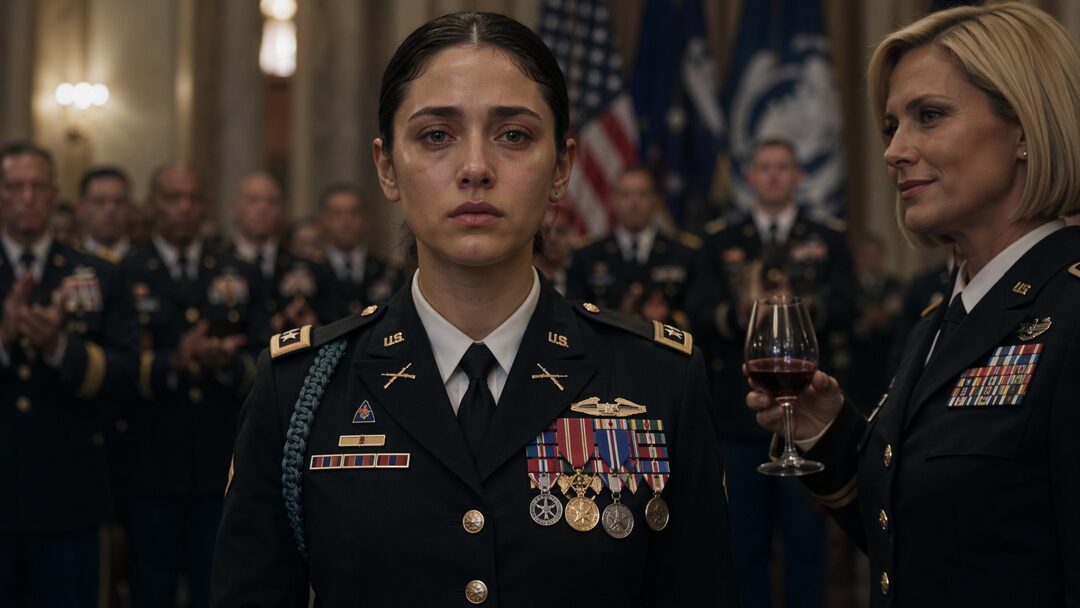
The applause began before Captain Mara Voss reached the center of the hall, which was how she knew Colonel Elise Rourke had planned every second of it.
Two hundred officers stood beneath the flags of Fort Calder, their palms striking together in clean military rhythm. Dress blues. Polished brass. Rows of ribbons catching the chandelier light. At the podium, Colonel Rourke smiled as if this were an ordinary commendation ceremony, as if Mara had been called forward to receive honor instead of a sentence.
Mara stopped on the mark taped to the floor.
Her boots were polished. Her medals were straight. Her dark hair was pinned so tightly at the base of her neck that it pulled at her scalp.
Her face did not move.
That was what made the room uncertain.
The applause kept going for three seconds too long. Then four. Then the sound thinned at the edges as officers noticed Mara’s hands were not folded in gratitude. They hung at her sides, still as stone.
Rourke stepped down from the podium with a glass in her hand.
Red wine.
Not water. Not champagne.
Red wine, dark enough to look black in the bowl of the glass.
Mara watched it tilt as Rourke approached. She watched the colonel’s smile stay perfectly in place. She watched the first two officers in the front row stop clapping, then the next two, then the entire hall, until only one pair of hands somewhere in the back completed a final, lonely clap.
“Captain Voss,” Rourke said, loudly enough for the nearest rows to hear. “Fort Calder thanks you for your service.”
Then she poured the wine down the front of Mara’s uniform.
It spread fast.
A dark red bloom opened across the pale shirt beneath Mara’s jacket, ran under the first row of ribbons, touched the edge of the campaign medal she had once received for Ash Gate, and dripped from the cloth in slow, bright beads.
No one moved.
Not the lieutenants along the wall. Not the colonels at the front. Not the chaplain who lowered his eyes. Not Major Halden Price, standing in the third row, who looked at Mara once and then looked at the floor.
Mara did not wipe the stain.
Rourke leaned in, close enough that Mara could smell the wine and the colonel’s clean, sharp perfume.
“You should have signed it in private,” Rourke murmured.
Mara’s eyes stayed forward.
Rourke lifted her left hand. A folded document waited between two fingers.
The resignation statement.
Mara knew it before the paper touched her palm. She had seen drafts of it twice already, each one phrased with more mercy than truth.
I accept full responsibility for my unauthorized decision at Ash Gate.
I acknowledge my actions resulted in preventable casualties.
I resign my commission for the good of the service.
Rourke pressed it into her wet hand.
“The board has accepted your responsibility,” she said, still smiling for the room. “All that remains is your signature.”
A murmur moved through the hall.
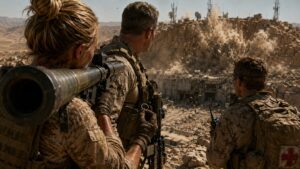
Mara heard the words Ash Gate without anyone saying them. It lived in every throat. It sat beneath every ribbon. Six months ago, eight soldiers had died near the border during a failed extraction from a field clinic. The official story had been repeated so often it had started to sound like weather.
Captain Voss disobeyed a direct order.
Captain Voss turned the convoy back.
Captain Voss exposed the unit.
Captain Voss cost lives.
Mara lowered her eyes to the paper.
The wine had soaked one corner. The ink blurred where her thumb held it.
For a moment, she saw another red spread, not across cloth, but across a concrete floor under flickering clinic lights.
Jonah Reed on one knee.
Jonah laughing once through blood in his teeth.
Captain, if you leave her here, I haunt you forever.
Mara folded the wet resignation statement once.
The sound of paper creasing was small.
In the hall, it landed like a shot.
She placed it on the podium beside Rourke’s untouched speech.
Rourke’s smile tightened.
“Still pretending silence is courage?”
Mara finally turned her head.
Not far. Just enough to meet the colonel’s eyes.
“No, ma’am,” she said. “I’m remembering what it costs.”
The hall did not breathe.
For the first time, Rourke’s smile almost failed.
Then she raised her chin, nodded to the military police near the side doors, and said, “Captain Voss is expected in final review.”
The officers parted for Mara as if shame were contagious.
She walked through them with wine cooling against her chest.
No one saluted.
Part II — The Hallway
The side corridor outside the ceremony hall smelled of floor wax, old paint, and rain-soaked wool. Mara had always hated that hallway. It connected the polished public rooms of Fort Calder to the locked administrative wing, and everyone who passed through it seemed to become less human by the time they reached the other end.
Two military police walked behind her. Not touching. Not needing to.
Her uniform stuck to her skin.
With every step, the wine moved.
A red line slipped beneath the edge of her jacket and found her ribs.
She did not wipe it.
“Mara.”
Major Halden Price’s voice came from behind her, rougher than she remembered.
The MPs looked at her. She stopped.
Price caught up, breathing once through his nose like a man trying not to show he had hurried. He had always been broad in the shoulders, but now the uniform seemed to hang on him. There were new shadows under his eyes. His collar was slightly crooked.
Six months ago, he would have fixed it before entering a room.
Now he only glanced at the stain.
“I’m sorry,” he said.
Mara almost laughed.
Not because it was funny. Because it was small.
“Which part?”
Price looked past her toward the closed hall doors. “This wasn’t how it was supposed to happen.”
“But it was supposed to happen.”
He did not answer.
That was enough.
The MPs stood a few steps away, pretending not to listen.
Price lowered his voice. “Sign it.”
Mara stared at him.
He flinched as if she had touched him.
“I’m not saying she’s right,” he said quickly. “I’m saying you know how this ends if you keep fighting. They’ll strip you in committee. They’ll open every transmission, every order, every second of that night. The families will have to go through it again.”
“The families deserve the truth.”
“The families need closure.”
Mara stepped closer.
Price did not step back, but something in him did.
“Closure built on a lie,” she said, “is only another grave.”
His jaw tightened.
There it was: the thing he had come to avoid hearing.
He looked down at her stained uniform. “You think I don’t know that?”
“I think you know exactly enough to stay quiet.”
The words landed harder than Mara intended. She saw it in his face.
Good men did not always betray loudly. Sometimes they just signed the second draft. Sometimes they corrected a timestamp. Sometimes they told themselves the dead were already dead, and the living needed order.
Price rubbed his thumb against the seam of his trousers.
“I heard Reed’s transmission,” he said.
The corridor seemed to narrow around them.
Mara’s gaze sharpened.
Price looked away. “Not all of it.”
“Yes, you did.”
He swallowed.
For a moment the hallway disappeared and the clinic returned: static in the headset, gunfire cutting the air, Jonah Reed’s voice breaking through smoke and distance.
Three wounded in basement. Interpreter alive. Repeat, interpreter alive.
Then another voice. Rourke’s.
Convoy will continue withdrawal. Do not turn back.
Price’s mouth moved before he found sound.
“They told me the recording was corrupted.”
“No,” Mara said. “They told you it would be easier if it was.”
One of the MPs shifted.
Time was closing.
Price leaned in, desperation finally cracking through his tired control. “Mara, if you say what you know in there, they’ll ask why you didn’t say it six months ago.”
“I know.”
“They’ll ask who else survived.”
“I know.”
“They’ll ask where she is.”
Mara said nothing.
Price’s face changed.
He understood then. Not everything, but enough.
“Nina,” he whispered.
Mara’s eyes cut to his.
He lowered his voice further. “She’s alive?”
The question was not accusation.
It was grief discovering it had been incomplete.
Mara looked at the closed review wing doors ahead.
“I have a final review,” she said.
Price caught her sleeve before she moved.
It was the first time anyone had touched her since the wine.
The stain had reached her cuff.
“Mara,” he said. “If Rourke knows—”
“She doesn’t.”
“How can you be sure?”
“Because if she did, she would have poured something worse.”
Price let go.
The MPs opened the doors.
Cold air moved out from the review wing, carrying the smell of sealed rooms and old coffee.
Mara walked through.
Behind her, Price said, barely audible, “I was afraid.”
She did not turn.
“So was Jonah.”
Part III — The Table
The review room had no flags.
That was the first thing Mara noticed.
No banners. No polished ceremony wood. No podium seal. Just gray walls, a long black table, and a row of officers sitting beneath lights too white to flatter anyone.
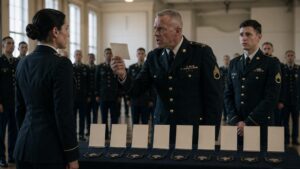
Her medals lay on the table.
Not on her chest where they belonged. On the table.
One campaign ribbon. One commendation star. The service cross she had never worn willingly. A dented challenge coin. A torn field notebook sealed in plastic. Her nameplate. Her wet resignation statement.
They had taken pieces of her record and arranged them like evidence from a crime scene.
Colonel Rourke stood at the far end beside a legal officer. Her hands rested lightly on the back of a chair. Her face had recovered from the ceremony. The smile was gone now, replaced by something more useful: command calm.
“Captain Voss,” she said. “Sit.”
Mara remained standing.
A chair scraped at the side of the room.
Major Price had entered behind her.
Rourke glanced at him. “Major, this is a closed review.”
“I was summoned,” Price said.
“By whom?”
The door opened again before he answered.
Every officer at the table stood.
General Abram Vale entered without hurry.
He was tall, gray-haired, spare in the way of men who had learned long ago to remove everything unnecessary from their presence. He carried a sealed folder under one arm. His uniform displayed fewer decorations than most of the people in the room, which somehow made them matter more.
Rourke’s expression altered by a fraction.
Enough for Mara to see.
“General Vale,” Rourke said. “We weren’t informed you’d be attending.”
“No,” Vale said. “You weren’t.”
He placed the sealed folder on the table but did not sit.
His eyes moved from Rourke to Mara’s stained jacket, then to the wet resignation statement.
“Who authorized a resignation ceremony before final classified review?”
No one answered.
Rourke’s hands tightened on the chair.
“Sir, the ceremony was intended to preserve dignity.”
Vale looked at Mara.
Wine had dried dark across her uniform.
“Whose?”
The room went still.
Rourke recovered quickly. She always did. “Captain Voss had been given multiple opportunities to accept responsibility privately. Her refusal created pressure on the families and the command.”
“Pressure,” Vale repeated.
He opened the folder.
Mara did not look at it.
She looked at Jonah’s coin on the table.
It had been his before it had been hers, scratched along the rim, one side stamped with the old medic insignia from their deployment clinic. He used to flip it whenever he was thinking. Once, during a sandstorm delay, he had told Mara a coin was the only honest officer in the Army.
“It has two sides,” he had said. “And it admits both.”
Rourke’s voice cut through the memory.
“The facts remain unchanged. Captain Voss was ordered to continue withdrawal. She turned the convoy back. Eight soldiers died because she chose sentiment over command discipline.”
Mara’s hands stayed open at her sides.
Vale turned a page.
“Command intelligence marked the Ash Gate field clinic as fully evacuated at 2140.”
“Correct,” Rourke said.
“At 2147, Corporal Jonah Reed transmitted from inside that clinic.”
Rourke did not blink.
“That transmission was deemed unreliable due to signal degradation.”
Vale looked at Price.
“Major?”
Price stood near the door, pale under the lights.
Mara did not look at him yet.
Not pleading.
Not forgiving.
Just waiting.
Price said nothing.
Rourke’s voice sharpened. “Major Price was not field command. His recollection is not material.”
“His initials are on the after-action log,” Vale said.
“They are on the corrected log.”
The word corrected stayed in the air too long.
Vale slid one page across the table.
“Then let us discuss what was corrected.”
Mara felt the room change.
Not soften.
Never that.
But shift, as if the floor had tilted one degree and everyone had just realized which way gravity pointed.
Vale opened another page.
“Captain Voss,” he said. “Tell this room what you heard at 2147.”
Mara’s mouth went dry.
For six months, silence had been a wall she stood behind and a weight she carried on her shoulders.
She could feel Nina’s file behind Vale’s hand.
She could feel Jonah’s coin on the table.
She could feel Rourke watching her, waiting for one mistake.
Mara spoke carefully.
“I heard Corporal Reed identify three wounded personnel in the clinic basement.”
Rourke’s lips thinned.
“And?”
Mara looked at the coin.
“And one civilian interpreter.”
A small sound moved through the room.
A chair leather creaked.
The legal officer wrote something down.
Vale’s voice stayed even. “Name?”
Mara did not answer.
Rourke seized the silence. “There. That is precisely the problem. Captain Voss continues to obscure details while demanding the benefit of moral interpretation.”
Mara looked at Rourke.
The colonel’s face was composed, but there was heat under it now.
She did not know.
That was the shape of her fear. Not guilt. Not remorse.
Uncertainty.
Vale closed the folder halfway.
“Her name is Nina Sayegh,” he said.
Rourke’s control broke for one second.
Only one.
But everyone saw it.
Part IV — Ash Gate
Nina Sayegh had been twenty-six when Mara met her.
Small, sharp-eyed, with a scarf tucked beneath her helmet and a way of translating not just words, but danger. She knew which checkpoint commander would lie. Which children were too quiet. Which alley dogs disappeared before shelling.
At Ash Gate, she had been assigned to the field clinic for three days.
On the fourth, the ceasefire collapsed.
Mara had been in the lead vehicle when Rourke’s order came through.
Continue withdrawal. Clinic marked clear. Do not re-enter contested zone.
There had been smoke rising behind them. Nothing unusual about that, not along the border, not in those weeks. Smoke rose from cooking fires, burning tires, failed generators, houses hit by mistakes no report ever called mistakes.
Then Jonah Reed’s voice cracked through the radio.
“Voss, clinic not clear. Repeat, clinic not clear.”
Mara had snatched the handset.
“Reed, identify.”
“Basement level. Three wounded. One interpreter. We’re pinned.”
The convoy kept moving.
For three seconds, Mara obeyed.
She could still feel those three seconds in her bones.
Rourke’s voice came next from operations, clean and remote. “Convoy will not turn back.”
Mara saw the driver’s eyes in the mirror.
She saw every soldier waiting for command to become something they could live with.
Then Jonah transmitted again.
The words were broken, but not unclear.
“Nina’s alive.”
Mara ordered the convoy to turn.
That was the crime.
Not that eight soldiers died. That came later, in fire and smoke and the terrible math of trying to retrieve the abandoned. The crime, according to Rourke’s record, was the turn.
In the review room, the memory was not told all at once. It came out under Vale’s questions, under Rourke’s objections, under Price’s worsening silence.
How many minutes between Reed’s transmission and your turn?
“Ninety seconds.”
Did you receive a direct withdrawal order?
“Yes.”
Did you understand the risk?
“Yes.”
Why did you disobey?
Mara lifted her eyes.
“Because the order was based on a false condition.”
Rourke leaned forward. “The condition was intelligence-confirmed.”
“The clinic was not clear.”
“You did not know that.”
“I heard Reed.”
“You heard a degraded transmission during an active collapse.”
“I heard my medic telling me there were living people underground.”
Rourke’s hand struck the table.
Not hard enough to be uncontrolled.
Hard enough to remind everyone of rank.
“And your decision killed eight soldiers.”
The room went silent again.
There it was. The sentence that always worked. The sentence Mara had never been able to answer without feeling the dead turn toward her.
Eight soldiers.
Eight folded flags.
Eight families who had been told the shortest version of a longer wrong.
Mara felt the stain stiffening against her skin.
She could have said Rourke’s delay trapped them. She could have said the first order had already cost time. She could have said the convoy returned to a clinic that should never have been marked clear.
But truth did not return bodies.
So she said, “Yes.”
Price looked at her then.
Fully.
Rourke did not hide her satisfaction.
Vale watched Mara for a moment longer. “And how many were extracted alive because of that turn?”
Rourke’s head snapped toward him.
Mara’s throat tightened.
“Four,” she said.
“Three wounded soldiers,” Vale said.
“And Nina,” Mara said.
Rourke’s voice went cold. “There is no surviving interpreter in the Ash Gate record.”
“No,” Vale said. “There is not.”
He opened the sealed folder fully.
“She was removed from the public record under witness protection authority after Captain Voss reported credible threats against local collaborators. Her file was sealed above brigade level.”
Rourke stared at the folder.
For the first time that day, she looked less like a commander than a person who had built a door and discovered someone else had kept a key.
“Nina Sayegh is alive?” Price asked.
His voice sounded stripped.
Vale did not look at him. “Yes.”
Price shut his eyes once.
Mara kept hers open.
Rourke found her voice. “If this is true, Captain Voss withheld material information from the investigation.”
“To protect a classified survivor,” Vale said.
“She withheld it from command.”
“She withheld it from the command under review.”
“That is a convenient distinction.”
“It is a necessary one.”
Rourke turned on Mara.
“You could have said this months ago.”
Mara said nothing.
Rourke stepped closer to the table. “You let this command absorb public outrage. You let families believe an incomplete record. You let your own name become synonymous with failure. For what? A protected file? A dead medic’s last request?”
The word dead hit harder from Rourke’s mouth.
Mara’s fingers curled once, then opened.
Vale said, “Colonel.”
But Mara raised a hand slightly.
Not to stop him.
To answer.
“Jonah Reed stayed in that basement because Nina couldn’t carry two of the wounded alone,” Mara said. “He transmitted until the wall came down.”
No one moved.
Mara’s voice remained steady.
“He asked me to get her out. Not to make him famous. Not to make Ash Gate clean. To get her out.”
Rourke stared at her.
“And you thought silence honored him?”
Mara looked at the stained resignation statement.
“No,” she said. “I thought it kept her alive.”
Part V — The Original Log
Vale turned to Price.
“Major, stand at the table.”
Price moved like his own body had become evidence.
He stopped beside Mara, leaving enough space between them to admit the last six months.
Vale placed two logs in front of him.
“One is the final after-action report. One is the original transmission summary retrieved from backup archive. Read the time entries.”
Price did not touch the papers.
Rourke’s voice was soft now. Dangerous because it had become soft.
“Major Price, consider your obligation carefully.”
He looked at her.
There was history in that look. Long briefings. Bad coffee. Shared pressure. Promotion boards. The quiet machinery of command that rewarded people who did not make rooms uncomfortable.
Then he looked at Mara.
She gave him nothing.
No rescue. No forgiveness. No invitation to become better.
Just the same steady gaze she had carried through wine, applause, and silence.
Price picked up the original log.
“At 2147, Corporal Reed transmitted clinic not clear,” he read.
His voice caught.
He started again.
“At 2147, Corporal Reed transmitted clinic not clear. Three wounded. One interpreter alive. At 2148, Colonel Rourke repeated withdrawal order. At 2149, Captain Voss ordered convoy reversal.”
The legal officer stopped writing.
Vale nodded once. “And the final report?”
Price picked up the second paper.
“At 2147, signal degradation. No verified survivor count. At 2149, Captain Voss ordered unauthorized convoy reversal.”
Rourke said nothing.
That was how everyone knew it was bad.
Vale’s voice remained calm. “Who edited the survivor count?”
Price stared at the page.
Mara could see his throat move.
“I entered the corrected language.”
Rourke exhaled.
Almost relief.
Then Price said, “After Colonel Rourke reviewed the original.”
Rourke turned slowly.
“Major.”
Price’s hands shook once. He set the paper down before anyone else could see.
“You told me the families needed certainty,” he said.
Rourke’s eyes hardened. “They did.”
“You told me Reed’s transmission would be challenged.”
“It would have been.”
“You told me Voss had already made herself the center of the report.”
“She had.”
Price looked at the medals on the table.
“No,” he said. “We made her that.”
The room seemed to draw inward.
Mara felt something inside her loosen and hurt at the same time.
Vindication did not feel like light.
It felt like pressure leaving a wound and proving the wound was still there.
Rourke faced Vale. “General, none of this changes the fact that Captain Voss disobeyed a direct order in an active combat zone.”
“No,” Vale said. “It does not.”
For one strange second, Rourke looked relieved.
Then Vale continued.
“It changes whether that order was lawful in fact, whether the report was materially altered, and whether Captain Voss was coerced into accepting sole responsibility before final review.”
Rourke’s face closed.
“The order was made with available intelligence,” she said.
“The available intelligence changed at 2147.”
“An officer in command cannot chase every desperate voice in a collapsing theater.”
Mara looked at her.
There it was. Not the public cruelty. Not the wine. Not the forged comfort of ceremony.
The real thing.
Rourke believed it.
Some voices were desperate. Some lives were already inconvenient. Some costs belonged to whoever failed to leave fast enough.
Mara spoke before Vale could.
“You taught us command is deciding who carries the cost.”
Rourke turned toward her.
Mara picked up the resignation statement. The paper had dried wavy and stiff. The wine stain had turned brown at the edge.
“At Ash Gate, I carried it,” Mara said.
No one interrupted.
“In the clinic. In the convoy. At the funerals. In every room where people stopped saying my name and started saying the incident.”
Price lowered his eyes.
Mara laid the statement flat on the table.
“But today, Colonel, you tried to make me carry the lie too.”
Rourke’s face did not change.
That was almost impressive.
“You are emotional,” she said.
Mara looked at the wine stain on her own chest.
“Yes.”
The room waited.
“And still correct.”
For the first time, something like fear moved in Rourke’s eyes.
Vale closed the folder.
“Colonel Elise Rourke, you are relieved of command pending formal investigation into alteration of official records, coercion of a subordinate officer, and obstruction of classified review.”
Rourke stood very still.
A legal officer rose beside her.
For a second, Mara thought Rourke might argue. Might reach for rank again like a weapon.
Instead, the colonel looked at the wine stain.
Not at Mara’s face.
At the stain.
As if she had only just realized it would be remembered.
Two officers escorted her from the room.
No one applauded.
That silence was better.
Part VI — The Salute
When the door closed behind Rourke, the room did not become gentle.
Truth had entered, but it had not cleaned anything.
Vale gathered Mara’s medals from the table one by one. The campaign ribbon. The commendation star. The service cross. Jonah’s challenge coin he left where it was.
He came around the table and stopped in front of her.
Up close, he looked older than he had at the doorway.
Or maybe Mara had only now allowed herself to see it.
“Captain Voss,” he said.
She straightened.
Her uniform was stained. Her throat hurt. Her hands were empty.
Vale raised his right hand.
The salute was quiet.
No music. No podium. No flags shifting above them.
Just one senior officer correcting, too late, what a room full of officers had allowed.
Mara returned the salute.
Her hand did not shake until she lowered it.
Vale’s voice dropped so only she could hear.
“The record will be reopened.”
Mara nodded.
“That will not make it painless.”
“I know, sir.”
His eyes moved briefly to Jonah’s coin.
“I’m sorry it took this long.”
Mara had no answer that would not break something.
So she gave him the truth she could afford.
“So am I.”
The review dissolved in pieces after that. Papers were collected. Officers avoided looking relieved. The legal officer placed the resignation statement in an evidence sleeve, then stopped when Mara put two fingers on it.
“Not that one,” she said.
He looked at Vale.
Vale nodded.
Mara took the paper.
Price waited by the door.
He did not approach until the room was nearly empty.
“I’ll testify,” he said.
Mara folded the statement once along its original crease.
“That’s not a gift to me.”
“I know.”
“Do you?”
He absorbed that.
Then nodded.
“I think I’m starting to.”
Mara looked at him then. Really looked.
He seemed smaller than he had in the corridor. Not because he had lost rank. Because he had lost the lie that had been holding him upright.
“Nina has agreed to testify if you want the record fully opened,” he said. “Vale told me before we came in.”
The name moved through Mara like a hand closing around something fragile.
Nina alive.
Nina willing.
Nina still carrying Ash Gate in whatever safe apartment or guarded house they had hidden her in.
Mara thought of Jonah flipping his coin.
Two sides.
And both of them true.
“Not tonight,” she said.
Price nodded.
He did not ask forgiveness.
That was the first decent thing he had done all day.
Mara left the review wing alone.
The corridor was empty now. The ceremony hall doors stood open at the end, one side propped by a brass stopper.
Inside, the chairs remained in perfect rows.
Programs lay abandoned on several seats. A glass had been knocked over near the front. Someone had taken down the Fort Calder seal from the podium, leaving a pale rectangle where it had hung.
Without the officers, the room looked smaller.
Without the applause, it looked honest.
Mara walked to the podium.
The smell of wine still lived there.
She set the resignation statement on the polished wood. Then she reached into the inside pocket of her jacket and took out Jonah Reed’s challenge coin.
She had carried it for six months.
Through hearings. Through funerals. Through nights when she woke convinced she had heard the radio again.
She placed it beside the unsigned statement.
For a while, she stood with both hands on the podium, looking down at the coin and the paper.
A person could survive being blamed.
That was not the same as being healed.
Behind her, Price stopped at the threshold but did not come in.
“Mara,” he said softly.
She did not turn.
He waited, then left.
That, too, was something.
Mara removed her jacket slowly.
The wine had soaked through to the shirt. The stain was ugly now, stiff and dark. Not bright like blood anymore. Not theatrical. Just ruined cloth.
There was a sink in the preparation room behind the stage. Soap. Cold water. A place to scrub until her fingers hurt.
She did not go to it.
Instead, Mara folded the jacket over her arm, stain facing outward, and picked up Jonah’s coin.
At the door, she looked once more at the empty rows.
In the morning, reports would begin. Calls would be made. Families would be told that closure had been built too quickly. Nina might speak. Price would have to say aloud what he had helped bury. Rourke would learn that command could not always decide who carried the cost.
But not tonight.
Tonight, the hall was silent.
Tonight, the stain remained.
Not because it was shame.
Because some marks deserved witnesses.