The HOA Threatened His Lawn Crew Over Grass Clippings—Then He Finally Asked Who Had Given Her That Power
Chapter 1: The Mower Stopped Over Three Feet of Grass
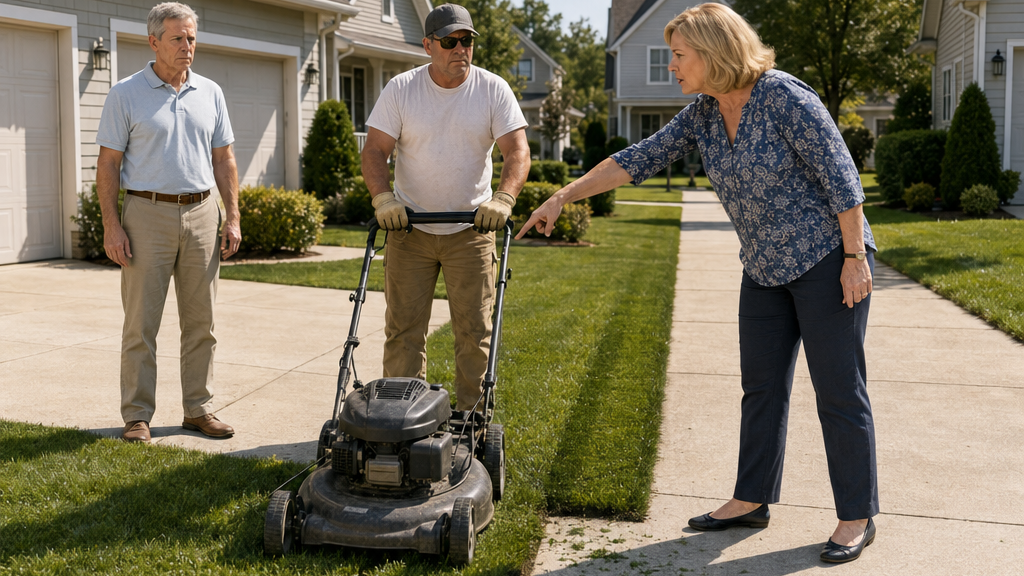
David Miller killed the mower so fast that the engine gave one last hard cough before the whole front yard went quiet.
Benjamin Carter looked up from the edge of his driveway.
Pamela Roberts was standing three feet in front of the machine.
David still had both hands on the handlebar. His sunglasses hid his eyes, but Benjamin could see the tension in his jaw.
Pamela pointed at the narrow strip between the two lawns.
“You need to stop.”
For a moment, Benjamin assumed he had missed something. A broken sprinkler head. A rock thrown by the mower. Maybe David had crossed onto Pamela’s property without realizing it.
Then Pamela pointed at several loose blades of cut grass scattered across the edge of her driveway.
“That,” she said. “That keeps happening.”
David looked down.
Benjamin did too.
There were perhaps two handfuls of clippings.
David lifted one gloved hand from the mower. “I’m going to blow everything clean when I finish.”
“I’m not asking what you’re going to do later.”
Her voice was controlled, which somehow made the scene worse.
David glanced toward Benjamin.
Twenty minutes earlier, Benjamin had quietly told him there might be trouble.
“She complains,” Benjamin had said while David lowered the mower from his trailer. “Don’t take it personally.”
David had grinned. “Grass is grass.”
Benjamin had almost told him about the envelopes.
He hadn’t.
Now Pamela folded her arms.
“You’ve been throwing debris onto my property since you started.”
David looked at the clean mowing stripes behind him. “Ma’am, the chute’s pointed the other direction.”
“I watched it blow over here.”
“I said I’ll clean it.”
“You shouldn’t be doing it in the first place.”
Benjamin felt the old instinct rise in him.
Smooth it over.
Say sorry.
Ask David to make one extra pass with the blower.
Tell Pamela it would not happen again.
For years, that method had seemed cheaper than arguing.
A trash can left visible too long after collection day? Move it.
A garden hose coiled where Pamela thought it looked untidy? Move it.
Shrubs half an inch over a line nobody had measured? Trim them.
Every time, Benjamin had told himself the same thing.
It wasn’t worth a fight.
David started the mower again.
Pamela stepped closer.
“Turn that off.”
David did, but slower this time.
“You’re working for him,” she said, nodding toward Benjamin. “That does not mean you can ignore association standards.”
David looked at Benjamin again.
Benjamin hated that look.
Not because David appeared frightened. He didn’t.
It was the look of a man wondering whether his customer expected him to obey a stranger.
Benjamin walked across the driveway.
“Pamela.”
She turned.
“He said he’ll clean it.”
“That isn’t the point.”
“What is the point?”
She stared at him for a second, as though surprised he had asked.
“The point is contractors don’t get to come in here and make a mess on somebody else’s property.”
David looked at the grass again.
“It’s clippings.”
Pamela’s head snapped toward him.
“And you’re not a resident.”
David’s mouth tightened.
Benjamin saw the answer forming and interrupted before it came.
“Pamela, what exactly are you asking?”
“I’m telling him to stop.”
“On my lawn?”
“Until this is addressed.”
“Addressed by who?”
“The association.”
Benjamin waited.
Pamela did not add anything.
He had known her for nine years. She had chaired holiday-decoration reviews, walked around with committee checklists, reminded neighbors when mailbox paint faded, and once spent an entire spring arguing that three different shades of brown mulch violated the community’s landscaping consistency.
She knew how to sound official.
That was not the same as being official.
Benjamin had never bothered separating the two before.
Pamela pointed toward David’s trailer parked along the curb.
“If he continues after being told to stop, he can be reported and barred from working in the community.”
David gave a short laugh.
Pamela’s expression hardened.
“You think that’s funny?”
“I think I’m cutting grass.”
“You’re ignoring an HOA directive.”
That phrase landed differently.
Benjamin looked at her.
“Directive from who?”
Pamela blinked.
“From the grounds committee.”
“You mean from you?”
“I am on the grounds committee.”
“I know.”
“Then you understand.”
“No,” Benjamin said. “That’s what I’m asking.”
The silence that followed felt larger than it should have.
Across the street, a neighbor who had been bringing in groceries paused beside an open car door.
David rested both hands on the mower handle again.
Pamela lowered her voice.
“Benjamin, you’ve already been warned about your property.”
There it was.
The sentence she knew would work.
It had worked before.
Benjamin remembered the pale HOA envelopes he used to leave unopened on the kitchen counter until evening. He remembered reading them after dinner, feeling the small drop in his stomach, then going outside the next morning and fixing whatever they mentioned.
He had never asked who had decided.
He had never gone to a board meeting.
He had never appealed anything.
He had simply complied.
“What warning?” he asked.
Pamela almost smiled.
“The edging last fall. The side-yard weeds. Your trash container. The hedge.”
“Were those violations?”
“You corrected them.”
“That wasn’t my question.”
David looked away, giving them privacy he could not actually give them while standing four feet away.
Pamela shifted her weight.
“They were documented concerns.”
“By the board?”
“Benjamin, don’t do this.”
He felt heat move into his face.
He was not an angry man. At least he did not think of himself as one.
He had spent thirty-four years supervising maintenance crews in commercial buildings. Problems were handled with work orders, schedules, inspection sheets, signatures.
You did not stop a technician halfway through a repair because somebody nearby had decided they disliked how it looked.
You showed the rule.
You showed the authority.
Or you got out of the way.
“What rule gives you authority to stop him?” Benjamin asked.
Pamela’s expression changed.
Not dramatically.
Just enough.
“I don’t have the documents standing here.”
“Then let him finish.”
“That’s not how this works.”
“How does it work?”
“You’ll find out when management contacts you.”
Benjamin looked at the line where David had stopped mowing.
The grass on one side stood slightly taller. On the other, the mower had left a clean dark stripe.
A neat boundary.
David waited.
Benjamin stepped away from the mower.
“Finish the job.”
Pamela stared at him.
“Benjamin.”
“He’ll clean your driveway when he’s done.”
“If he starts that machine again, I’m putting this in the file.”
Benjamin looked back at her.
“What file?”
Pamela’s face lost some of its impatience.
Then she said it.
“The HOA already has a file on your property.”
David did not restart the mower.
Not yet.
Benjamin stood beside the unfinished stripe and realized he had no idea what, exactly, that file said about him.
Chapter 2: The Warnings He Never Thought to Challenge
The envelope Benjamin remembered as a violation did not say violation anywhere on it.
He discovered that Saturday afternoon at his kitchen table.
David had finished the lawn, blown every clipping from Pamela’s driveway, loaded his equipment, and left after refusing Benjamin’s offer to pay extra for the trouble.
“No,” David had said. “You paid me to cut it. I cut it.”
Pamela had gone inside before the blower was finished.
Benjamin spent the next two hours opening drawers.
He found old association envelopes beneath appliance manuals, tax documents, a stack of warranty papers, and a yellowed packet from when he and his wife had bought the house.
The first notice concerned his hedge.
COURTESY MAINTENANCE REMINDER appeared across the top.
Benjamin sat back.
He remembered this one.
He had trimmed the hedge the morning after receiving it because he had assumed a violation would follow if he didn’t.
He found another.
Trash container visibility.
Another.
Lawn edging.
Another.
Seasonal weeds along the side fence.
None carried a fine.
None mentioned a board vote.
None used the phrase formal violation.
His wife had once teased him about those envelopes.
“You look like the principal called,” she had said.
Benjamin could still remember where she had been standing, coffee cup in both hands, smiling because she knew he hated being thought difficult.
After she died, that small habit had hardened into something else.
Keep the house quiet.
Keep the neighbors pleasant.
Don’t make unnecessary trouble.
It had felt like keeping a promise.
Now Benjamin spread the notices across the table and began arranging them by date.
Pamela’s name appeared nowhere.
That bothered him more than if it had.
He opened his phone.
The photograph he had taken that morning showed David’s mower stopped beside the property line. The fresh stripe ended exactly where the machine had stopped. A few clippings lay beyond it.
Three feet of lawn.
Three feet that had somehow brought up years of paperwork.
Benjamin zoomed in.
Then he called the management office.
It went to voicemail.
Monday morning, he was there ten minutes after they opened.
Elizabeth Wilson met him in a small conference room beside the reception desk.
She was in her fifties, dressed plainly, with reading glasses she kept pushing onto the top of her head.
Benjamin had spoken to her by phone before but never sat across from her.
He placed four old notices on the table.
“I want to understand these.”
Elizabeth picked up the first one.
“What about them?”
“Were these violations?”
She read the header.
“These are courtesy notices.”
“I know what they say now.”
She looked up.
“What did you think they were?”
“Warnings before fines.”
“They can lead to formal enforcement if the issue continues.”
“Did these?”
Elizabeth examined the dates.
“No.”
“Was there a hearing?”
“No.”
“A board vote?”
“Not for courtesy notices.”
Benjamin took out the photograph from Saturday and placed his phone between them.
“Can a grounds-committee member order a contractor off my property?”
Elizabeth looked at the screen.
“Was someone asked to leave?”
“Pamela Roberts told my lawn contractor to stop working and said he could be barred from the community.”
Elizabeth’s shoulders shifted slightly.
“Pamela is on the grounds committee.”
“I know.”
“The committee can identify maintenance concerns.”
“That isn’t what I asked.”
Elizabeth was quiet.
Benjamin felt the old impulse.
Soften it.
Tell her he understood she had a difficult job.
Say he did not want to make a big issue out of anything.
Instead, he kept his hands flat on the table.
“Can she do it?”
“Not independently.”
The answer was so simple that Benjamin almost missed its weight.
“Can she ban him?”
“No.”
“Can the committee ban him?”
“Not by itself.”
“Can she order him to stop cutting my lawn?”
“Not unless there is an immediate safety issue or some other authority involved.”
“Grass clippings?”
Elizabeth glanced at the photograph.
“No.”
Benjamin sat back.
He expected relief.
Instead, he felt embarrassed.
He had spent years responding to letters he had never properly understood.
“What is this file she mentioned?”
Elizabeth hesitated.
“All properties have account records.”
“That’s not how she said it.”
Elizabeth opened her laptop.
“What did she say?”
“That the HOA already had a file on my property.”
Elizabeth typed his address.
The screen reflected faintly in her glasses.
Benjamin watched her expression change.
Not alarm.
Something closer to reluctance.
“There are several resolved maintenance entries.”
“Resolved violations?”
“Resolved concerns.”
“Who entered them?”
“Management did.”
“Based on what?”
“Committee reports, resident complaints, inspection notes.”
Benjamin leaned forward.
“Who reported mine?”
Elizabeth clicked through the records.
“I’m not sure I should identify individual complainants without reviewing the policy.”
“You don’t have to. Tell me whether they came from the grounds committee.”
She looked again.
“Several did.”
“And Pamela?”
Elizabeth did not answer immediately.
That was answer enough.
Benjamin looked down at the old notices.
“So she reports something. Management sends me a courtesy letter. I fix it. Then the file says resolved.”
“That is generally how courtesy matters are closed.”
“Does it say I agreed there was a violation?”
“No.”
“Does it look like I agreed?”
Elizabeth paused.
“From the record alone, it could be interpreted as the issue being accepted and corrected.”
Benjamin felt something settle unpleasantly in his chest.
Every time he had chosen peace, somebody had recorded compliance.
Not guilt.
Not exactly.
But close enough to be useful.
Elizabeth turned the laptop toward him.
A list showed dates and short descriptions.
Hedge maintenance.
Waste-container visibility.
Edging irregularity.
Side-yard vegetation.
Resolved.
Resolved.
Resolved.
Resolved.
Benjamin stared at the word.
“I thought I was avoiding arguments.”
Elizabeth’s voice softened.
“I understand.”
“No. I don’t think I understood.”
She folded her hands.
“Benjamin, if you want, I can make a note that you dispute the characterization of Saturday’s incident.”
“I do.”
“And I can clarify that Pamela does not have unilateral contractor-enforcement authority.”
“That helps.”
He meant it.
For perhaps ten seconds, he believed that was enough.
Then Elizabeth said, “There’s something else.”
She turned the laptop back and opened another file.
It was a board packet from earlier that year.
Benjamin recognized his address before she scrolled to the highlighted section.
The language was dry and administrative.
Repeated informal maintenance contacts were being described as effective because homeowners usually corrected reported concerns without formal enforcement.
Benjamin’s property appeared among the examples.
His compliance had not merely closed his file.
It had become evidence that the system worked.
Chapter 3: A Courtesy Notice Became an Unwritten Rule
“No board ever voted that I violated anything?”
Benjamin asked the question twice because the first answer sounded too strange.
Elizabeth Wilson shook her head.
“Not on the entries we reviewed.”
They were still in the conference room.
The board packet lay open between them.
Benjamin tapped the page with one finger.
“But this tells the board the process has been successful.”
“It says informal resolution has reduced formal enforcement.”
“Using people like me.”
“Using resolved maintenance contacts.”
“I didn’t know there was anything to resolve.”
Elizabeth removed her glasses.
“That is the part I agree needs clarification.”
Benjamin looked toward the frosted-glass door.
For years, he had imagined HOA administration as something rigid and formal. Rules went in one side. Notices came out the other.
Now he saw something messier.
A committee member noticed something.
Management sent a polite letter.
A homeowner quietly complied.
The compliance became a resolved concern.
Enough resolved concerns became proof that the system was working.
No one had to say the homeowner had been guilty.
They only had to leave the record vague.
“I want mine corrected.”
Elizabeth put her glasses back on.
“That may require more than changing a note.”
“Why?”
“Because the same procedure was used with other properties.”
“That sounds like your problem.”
The words came out sharper than Benjamin intended.
Elizabeth looked at him.
He immediately felt the urge to apologize.
He almost did.
Then she nodded once.
“That’s fair.”
Benjamin exhaled.
Elizabeth continued.
“If we start reclassifying old entries, the board may need to determine what those entries were intended to mean. Some were complaints. Some came from inspections. Some were committee observations.”
“Were homeowners told the difference?”
“Not consistently.”
There it was.
A second answer that should have made Benjamin feel vindicated.
Instead, it widened the problem.
He asked to see the current enforcement policy.
Elizabeth printed it.
The document was shorter than he expected.
Formal enforcement required written notice, an opportunity to cure, and, depending on the issue, board or management action under delegated authority.
Volunteer committees could inspect and recommend.
Recommend.
Benjamin read that word twice.
“Where does it say they can direct contractors?”
“It doesn’t.”
“Where does it say they can threaten to bar them?”
“It doesn’t.”
“Then Saturday was simple.”
“Saturday may be simple.”
She pointed to the old packet.
“This isn’t.”
Benjamin took the policy and the copies of his records.
He left the office with more paper than he had brought and less certainty than he had expected.
On the walk home, he cut through the subdivision’s central common area.
The landscaping vendor was working near a low drainage strip between two rows of homes.
A laminated maintenance map had been clipped to a cart.
Benjamin paused.
Colored lines marked common grass, private lots, irrigation zones, drainage access, and planting beds.
The boundaries were clean.
Measured.
Named.
The grass itself did not care.
It grew across every line unless somebody maintained it.
Benjamin stood there longer than necessary.
A landscaping worker glanced at him.
“Need something?”
“No. Just looking.”
He kept walking.
At home, he spread the policy and old notices over his dining table.
He made three columns on a legal pad.
Formal rule.
Courtesy request.
Committee recommendation.
Then he tried to place every past incident into one of them.
The trash container had probably been a real rule.
He remembered the governing documents saying bins had to be screened after collection day.
The hedge was less clear.
The edging issue looked almost ridiculous now.
The side-yard weeds might have fallen under general maintenance standards, but he could not tell whether anyone with actual authority had decided that.
Benjamin stopped.
His goal had been to prove Pamela wrong.
That would have been satisfying.
It would also have been too simple.
Some of the complaints might have been justified.
The problem was that he had never known which ones.
His phone rang.
Elizabeth.
“I spoke with the board president.”
Benjamin sat down.
“And?”
“The board does not want management changing historical entries until it reviews the procedure.”
“So they stay as they are.”
“For now.”
“Even if they weren’t violations.”
“They’re not labeled violations.”
“They’re being used like they were.”
Elizabeth was silent for a beat.
“Yes.”
Benjamin rubbed his forehead.
“What happens next?”
“I’m sending you the committee charter.”
“That exists?”
“Yes.”
He almost laughed.
“Would’ve been useful Saturday.”
“I know.”
The email arrived while they were still on the phone.
Benjamin opened it.
The charter gave the grounds committee authority to observe, document, and recommend.
Again, that word.
Recommend.
No contractor bans.
No stop-work authority.
No power to impose penalties.
Benjamin scrolled farther.
“Pamela knows this document?”
“She should.”
“Should?”
“She’s served on the committee for three years.”
Benjamin stared toward the window facing Pamela’s house.
Her curtains were open.
Her porch was empty.
Elizabeth said, “I need to tell you something else before you hear it from someone else.”
Benjamin closed the charter.
“What?”
“Pamela submitted a request this morning.”
“For what?”
“A formal hearing.”
He sat very still.
“Against me?”
“She’s asking the board to review your contractor’s conduct and your refusal to comply with a committee instruction.”
Benjamin looked down at the policy.
Committee recommendation.
He had the word underlined now.
Twice.
“What instruction?”
“That will be part of the hearing.”
“When?”
“The board is scheduling it.”
Benjamin’s irritation sharpened into something cleaner.
For the first time, Pamela would not be speaking on a driveway with nobody required to define what her words meant.
She would have to put the claim in writing.
“What exactly is she alleging?”
Elizabeth hesitated.
“I haven’t seen the complete submission yet.”
Benjamin looked through the window again.
Across the narrow strip between their houses, Pamela stepped onto her porch carrying a folder.
She saw him through the glass.
Neither of them waved.
Chapter 4: The Complaint Pamela Could Actually Defend
Benjamin noticed the repaired drainage strip because it was the only piece of grass in the common area that did not match.
The rest of the lawn had faded into the dull green of late summer. Along the swale behind the first row of houses, however, a narrow band of sod was darker, newer, and held down at the edges by small wooden stakes.
A landscaping vendor representative stood beside it with a clipboard.
Benjamin slowed.
“What happened here?”
The representative looked toward the shallow channel.
“Washout repair.”
“Recently?”
“Couple months ago.”
Benjamin stepped closer. Beneath the grass, fresh stone lined part of the drainage bed. A plastic grate had been replaced near the sidewalk.
“How bad was it?”
The representative gave him the tired look of someone deciding whether a homeowner was about to complain.
“Bad enough.”
“I’m not asking because I’m upset.”
That seemed to help.
“A private crew drove across the edge with equipment. Crushed part of the inlet. Then we got heavy rain.”
Benjamin looked down the swale.
Water from several lots would have run through it.
“The HOA paid for this?”
The man nodded.
Benjamin thought about Pamela standing in front of David’s mower.
Contractors don’t get to come in here and make a mess on somebody else’s property.
At the time, the sentence had sounded ridiculous because she was pointing at grass clippings.
Here, it sounded different.
“How much damage?”
The representative shrugged. “I don’t handle billing.”
“But not nothing.”
“No.”
Benjamin thanked him and walked the rest of the common path more slowly.
By the time he reached Pamela’s house, he had decided not to knock.
Then her kitchen door opened.
“You wanted something?”
She stood behind the screen.
Benjamin stopped.
“I saw the drainage repair.”
Pamela’s expression changed slightly.
“What about it?”
“Elizabeth never mentioned that.”
“Why would she?”
“Because I’m trying to understand why you think every contractor needs supervision.”
Pamela opened the screen door but did not invite him inside.
“That wasn’t every contractor.”
“It seems to have become every contractor.”
She crossed her arms.
“A crew working two streets over drove a compact loader across common drainage without permission. They crushed an inlet and tore the grade apart. Then we had a storm.”
“I saw the repair.”
“We had water backing toward two patios.”
Benjamin looked past her toward the kitchen counter. A folder lay open beside a mug.
“You were involved?”
“I was on the committee.”
“That’s not what I asked.”
Pamela exhaled through her nose.
“Yes. I was involved.”
“How?”
“I had seen the equipment there the day before.”
Benjamin waited.
Pamela looked toward the street.
“I assumed management had approved it.”
“And they hadn’t.”
“No.”
“What happened?”
“The board wanted to know why nobody from the grounds committee said anything.”
There was no anger in her voice now.
That surprised him.
“What did you tell them?”
“The truth. I saw the crew. I didn’t question them.”
Benjamin leaned against the railing.
“And after that?”
“After that, everybody suddenly cared very much about contractor oversight.”
He could hear the bitterness underneath the words.
“Did they blame you?”
Pamela gave him a look.
“They didn’t have to use the word.”
Benjamin thought again of the repaired swale.
A real mistake.
A real bill.
A real reason to become watchful.
“That explains Saturday,” he said.
Pamela stiffened. “Good.”
“No. It explains why you were watching.”
Her mouth tightened.
“It doesn’t explain telling David you could have him barred.”
“I was trying to keep another small problem from becoming a large one.”
“It was grass.”
“Problems often start small.”
“He said he would clean it.”
“And if he hadn’t?”
“Then you complain.”
“I did complain.”
“You ordered him to stop.”
Pamela looked at him steadily.
“Because waiting until afterward is exactly how we ended up paying for that drainage.”
Benjamin understood the logic.
He also understood its flaw.
“You learned the wrong lesson.”
Pamela’s face went cold.
“Excuse me?”
“The lesson was to make the process clear. Not to become the process.”
For a moment, neither spoke.
Benjamin expected her to tell him to leave.
Instead, she opened the screen door wider.
“You know what happened after the drainage repair?”
“No.”
“They rewrote the committee checklist. They told us to document contractors, watch common areas, report unsafe work, report debris, report property damage. Every meeting after that, the same thing: Why didn’t someone catch it sooner?”
“That still doesn’t give you authority.”
“I didn’t say it did.”
“You did Saturday.”
Pamela looked away.
It was the first time Benjamin had seen her retreat even half an inch.
Then she said, “I said what I thought would make him stop.”
The admission was small.
It mattered.
Benjamin straightened.
“So you knew you couldn’t actually ban him.”
“I knew the board could restrict vendors.”
“The board.”
“Yes.”
“Not you.”
Her eyes returned to him.
“You want me to say I handled it badly?”
“I want you to stop pretending the question is whether grass clippings are good or bad.”
Pamela’s jaw flexed.
“You have spent years fixing things every time the committee contacted you.”
“Because I thought the association had decided.”
“You never asked.”
“No.”
That silenced her.
Benjamin did not enjoy saying it.
He had begun this dispute wanting a clean division: Pamela had overreached; therefore Benjamin was right.
But the more he looked at it, the less clean the line became.
He had helped create the pattern by never asking.
“I should have,” he said.
Pamela’s expression softened, but only briefly.
“That doesn’t change the fact that some of those issues were real.”
“I know.”
She seemed almost disappointed.
“You agree?”
“The trash container was real. Probably the weeds too.”
“And the hedge.”
“Maybe.”
“It was over the sidewalk sight line.”
Benjamin frowned.
He had forgotten that part.
Pamela opened the folder on her counter and pulled out an old photograph.
His hedge was visibly wider than he remembered.
He studied it.
“All right,” he said. “That one too.”
Pamela folded her arms again, but now it looked less like a weapon.
“Then what exactly are we fighting about?”
“Whether being right about one thing gives you the right to command people about everything.”
The screen door moved slightly between them.
Pamela looked down at the photograph.
“You think this is about power.”
“I think Saturday was.”
“I think it was about preventing another mess.”
“Both can be true.”
She did not answer.
Benjamin started down the steps.
“Benjamin.”
He turned.
Pamela held the folder against her side.
“I’m still going forward with the hearing.”
He had expected that.
“What are you asking them to do?”
“To clarify contractor authority.”
“That sounds reasonable.”
“And to give the grounds committee the ability to stop work temporarily when there’s a possible violation.”
Benjamin stared at her.
“You’re asking them to give you the power you acted like you already had.”
“I’m asking them to fix the gap.”
“No.”
“I’m telling you what I’m asking.”
“And I’m telling you what I’ll oppose.”
Pamela nodded once.
Not angry.
Resolved.
“Then we’ll do it properly.”
Benjamin looked toward the drainage strip at the end of the block.
For the first time since Saturday, he understood that Pamela had a case she could defend.
It simply was not the same case as the one she had pretended to possess.
Chapter 5: The Hearing Where Silence Became Evidence
Pamela placed Benjamin’s own maintenance history on the table before he had finished sitting down.
Four pages.
Four dates.
Four entries marked resolved.
Benjamin recognized every one.
The HOA clubhouse meeting room held only eight people: the board president, two board members, Elizabeth Wilson, Pamela, Benjamin, and two residents waiting for later agenda items.
No crowd.
No spectacle.
That almost made it harder.
Pamela sat opposite him with her folder open.
The board president adjusted his glasses.
“This hearing concerns contractor conduct, committee authority, and a request for clarification of enforcement procedure.”
Benjamin looked at Pamela.
She had done exactly what she promised.
Properly.
The president continued.
“Pamela, since you requested the hearing, you may summarize.”
She did not raise her voice.
“Over the past several years, the grounds committee has identified maintenance concerns at Benjamin’s property. Each was corrected after notice.”
She slid the four-page history forward.
“That pattern shows informal intervention works.”
Benjamin felt the old embarrassment return.
There it was again.
His obedience.
Turned into evidence.
Pamela continued.
“Last Saturday, a contractor working at the property allowed yard debris to cross onto an adjacent lot. When asked to stop temporarily and correct it, he refused.”
Benjamin leaned forward.
“He said he would clean it when he finished.”
The board president lifted a hand.
“You’ll have a chance.”
Pamela nodded.
“My concern is larger than grass clippings. We had a contractor-related drainage incident this year that resulted in substantial association expense. Committees are expected to identify risk, but we have no clear temporary stop-work procedure. That is the gap I’m asking the board to address.”
That was better than the argument on Benjamin’s lawn.
Stronger.
Cleaner.
And dangerous for exactly that reason.
The president turned to Benjamin.
“Your response?”
Benjamin had prepared notes.
He did not look at them.
“Pamela is right about one thing.”
She looked up.
“One of those old complaints was justified.”
The room shifted.
Benjamin could feel it.
He pointed to the hedge entry.
“I pulled the old photograph. It was too wide near the sidewalk. I should have trimmed it sooner.”
One board member leaned back.
Pamela’s expression changed from surprise to caution.
Benjamin continued.
“The trash container notice was probably justified too. I’m not here to claim every complaint against me was nonsense.”
He saw Elizabeth watching him carefully.
“What I am saying is that I never knew which ones were actual rule issues, which were courtesy requests, and which were simply committee preferences.”
Pamela opened her mouth.
Benjamin raised one hand.
“I’m not blaming Pamela for me not asking. That part is mine.”
The room went quiet.
He could almost hear his wife’s old teasing voice.
You look like the principal called.
For years he had opened those envelopes with the same instinct: fix it before anyone thinks badly of you.
“I treated every notice like an order,” he said. “No one corrected me. Then my compliance was recorded as proof that the process worked.”
The president looked at Elizabeth.
“Is that accurate?”
Elizabeth chose her words carefully.
“The historical entries were labeled resolved concerns, not formal violations. But the distinction was not always clear in resident-facing correspondence.”
One of the board members frowned.
“So we used courtesy compliance as enforcement data?”
“Informal-resolution data,” Elizabeth said.
“That sounds like the same thing dressed differently.”
No one answered.
Pamela tapped her folder.
“Benjamin did correct the issues.”
“Yes,” Benjamin said. “Because I thought I had to.”
Pamela looked at him.
“And Saturday?”
“Saturday I asked what rule allowed you to stop David.”
“I was addressing debris.”
“You told him he could be barred from the community.”
“The board can restrict vendors.”
“The board can.”
Benjamin let the sentence sit.
The president looked at Pamela.
“Did you have authorization to tell the contractor he could be barred?”
“No formal authorization.”
“Then why did you say it?”
Pamela’s face tightened.
“Because he wasn’t taking the concern seriously.”
Benjamin almost interrupted.
Instead, he waited.
Pamela continued.
“And because earlier this year we paid thousands of dollars repairing common drainage after everyone assumed someone else had authority to intervene.”
The board members exchanged a glance.
There it was.
Not an excuse.
A reason.
Benjamin opened his phone.
He pulled up the photograph from that Saturday and placed it faceup on the table.
The stopped mower.
The neat dark stripe.
The scattered grass beyond it.
“This is what started the hearing.”
The president looked down.
Benjamin traced the property edge with one finger.
“There has to be a line.”
Pamela’s eyes narrowed slightly.
“Between what?”
“Between reporting and ordering. Between private property and common property. Between a request and a violation. Between what a committee recommends and what the association has actually decided.”
A board member picked up the phone for a closer look.
Benjamin continued.
“That line can be as ordinary as this one. David cuts my side. He keeps debris off Pamela’s side. If he makes a mess, he cleans it. If he damages common property, there should be a process.”
“And if he refuses?” Pamela asked.
“Then you report it.”
“And while the damage is happening?”
“If there’s an immediate safety issue, that’s different.”
“What about property damage?”
“Then define that.”
Pamela leaned forward.
“That is what I’m asking the board to do.”
Benjamin nodded.
“Yes. But you’re asking them to give individual committee members stop-work authority.”
“Temporary authority.”
“Over private contractors.”
“When necessary.”
“According to who?”
“The committee member observing it.”
Benjamin looked at the board president.
“That puts us right back on my lawn.”
The president folded his hands.
One of the board members flipped through the proposed language Pamela had submitted.
“This is broad.”
Pamela turned.
“It needs to be broad enough to prevent another drainage incident.”
“It would allow a committee member to halt almost any landscaping work pending review.”
“If there is a suspected violation.”
“Suspected by the same person issuing the stop.”
Pamela’s expression tightened.
Benjamin saw the temptation to press harder.
To win.
To make the room see her as unreasonable.
Then he remembered the drainage strip.
The crushed inlet.
The photograph of his hedge.
“No,” Benjamin said.
Everyone looked at him.
He pointed to Pamela’s proposal.
“The problem isn’t that she wants a way to protect common property. That part makes sense.”
Pamela studied him.
“The problem is that this solution makes the same mistake we already made. It turns something informal into something that acts formal before anybody knows which it is.”
Elizabeth nodded faintly.
The board president looked at the maintenance records again.
“What would you suggest?”
Benjamin had expected a ruling.
A correction.
Maybe an apology he knew Pamela would never give.
He had not expected that question.
“I’m not sure yet.”
Pamela gave a small, humorless breath.
“Then rejecting mine is easy.”
Benjamin turned toward her.
“You’re right.”
That stopped her.
“It is easy to say no,” he continued. “It’s harder to write something better.”
The president closed Pamela’s proposal.
“Then let’s not vote tonight.”
Pamela straightened.
“Why?”
“Because the issue is broader than this complaint.”
He looked at Benjamin.
“You’ve spent your career in facilities management, correct?”
Benjamin nodded.
“Submit an alternative. Something that distinguishes private work, common property, debris cleanup, safety concerns, and actual stop-work authority.”
Pamela shook her head.
“So the homeowner accused of refusing compliance gets to write the rule?”
“No,” the president said. “He gets to propose one. Just like you did.”
The room went still.
Benjamin looked at the photograph of the mower stripe.
For years, his easiest answer had been yes.
Tonight, he had discovered that saying no carried a second obligation.
If he wanted a better boundary, he would have to help draw it.
Chapter 6: He Drew the Line Without Drawing an Enemy
Benjamin deleted the first paragraph because it sounded like revenge.
No committee member shall interfere with any privately retained contractor—
He stared at the sentence.
Then held down the backspace key until it disappeared.
It was Tuesday morning, and his dining table had become a small administrative battlefield.
Association rules on one side.
Pamela’s proposal on the other.
His legal pad in the middle.
He had written six versions.
Every version began with the thing he wanted to prevent.
Pamela stopping David.
Pamela threatening contractors.
Pamela treating recommendations as orders.
That was the problem.
He was drafting against a person instead of drafting for a community.
Benjamin pushed his chair back.
On the wall across from him hung a photograph of his wife standing in the backyard years earlier, one hand shielding her eyes from the sun.
She had hated arguments.
So had he.
But she had never been afraid of clarity.
There was a difference.
He returned to the table.
Private contractors working solely on an owner’s lot remain under the direction of that owner, subject to association rules.
Better.
He added debris-cleanup requirements.
Protection of common drainage.
Immediate reporting of suspected damage.
Emergency authority limited to clear safety threats.
No individual volunteer committee member could order a private contractor off a lot unless specifically authorized under an adopted procedure.
He read it three times.
Then he emailed it to Elizabeth.
An hour later, she called.
“This is workable.”
“That sounded surprised.”
“I was expecting something more restrictive.”
“So was I.”
She laughed quietly.
“Can I circulate it?”
“Yes.”
“There’s something else.”
Benjamin waited.
“We reviewed similar maintenance contacts after the hearing.”
“How many?”
“I’m not going to give you a number until the records review is complete.”
“That many?”
“Enough.”
Benjamin looked at the old envelopes still stacked beside his computer.
“Same problem?”
“Not identical. But there are other homeowners who received committee-originated requests and apparently understood them as mandatory.”
Benjamin closed his eyes.
His case was no longer unusual.
That was not as satisfying as he would have thought.
It meant the ambiguity had worked because people like him had made it easy to ignore.
That afternoon, he walked to the mailbox and found Pamela coming from the opposite direction.
For a second, both slowed.
Then Pamela said, “I read your draft.”
Elizabeth had circulated it quickly.
“What do you think?”
“I think your debris section is too weak.”
Benjamin almost smiled.
“Of course you do.”
“I’m serious.”
“I know.”
“If clippings or soil are left on adjoining property, cleanup should be required before the contractor leaves.”
“That seems reasonable.”
Pamela stopped.
“You agree?”
“I never argued David should leave your driveway dirty.”
“You acted like the complaint was ridiculous.”
“The threat was ridiculous.”
Her face tightened.
Benjamin immediately regretted the word.
Not because it was completely wrong.
Because it made the next part harder.
“The cleanup request wasn’t,” he added.
Pamela looked toward his lawn.
The grass had grown enough that David would be back soon.
“You know,” she said, “I never thought anyone would question the committee process.”
Benjamin waited.
Pamela rubbed one thumb along the edge of the mail in her hand.
“People complain about us all the time. They complain when we send notices. They complain when we don’t. They complain when the common grass is too long and when the vendor comes too early.”
“That sounds miserable.”
“Sometimes.”
“Then why do it?”
She shrugged.
“Because somebody has to.”
Benjamin nodded.
That answer he understood.
Facilities management had taught him the same thing.
The people who noticed problems were rarely loved for noticing them.
Pamela continued.
“After the drainage repair, I decided I wasn’t going to be the person who saw something and kept walking.”
Benjamin looked at her.
“And Saturday?”
“I didn’t keep walking.”
“No.”
The corner of her mouth moved, almost a smile.
“I went too far.”
The words were so quiet Benjamin nearly asked her to repeat them.
He did not.
Pamela looked directly at him.
“I’m not saying that at the board meeting.”
There it was.
The line she still would not cross.
“Why not?”
“Because then the entire discussion becomes whether Pamela Roberts behaved badly on one Saturday.”
“You did.”
“I know.”
“Then what’s wrong with admitting it?”
“What’s wrong is that the policy still needs fixing.”
Benjamin considered that.
Part of him wanted the public admission.
He had imagined it more than once.
Pamela acknowledging she had no authority.
The board recording it.
His name cleared.
But she was right about one thing: humiliation could become its own distraction.
“I’m not going to protect you from the facts,” he said.
“I’m not asking you to.”
“But I won’t make your apology the price of supporting a good rule.”
Pamela studied him.
“That sounded rehearsed.”
“It wasn’t.”
“It sounded like one of your meeting lines.”
“I was a facilities supervisor for thirty-four years. Everything sounds like a meeting line now.”
This time she did smile, briefly.
Then she handed him a marked copy of his proposal.
Three sections were underlined.
One had a note beside it.
Cleanup before departure.
Benjamin read it.
“I can live with this.”
“And common-property damage?”
“Immediate notification to management, with emergency work stoppage if continued operation would likely cause more damage.”
Pamela nodded.
“That’s better.”
“Still no individual authority over private work just because you think there might be a violation.”
Her expression flattened.
“I know.”
“That part stays.”
“I know.”
They stood beside the mailbox for another moment.
Not friends.
Not enemies either.
Something more inconvenient than both.
Neighbors.
That evening, Benjamin revised the draft.
He added Pamela’s debris language.
He tightened the property-damage section.
He left the authority limitation untouched.
Before sending it, he attached a short note.
The purpose of this proposal is not to reduce enforcement. It is to make responsibility identifiable before conflict occurs.
He almost deleted that sentence too.
Then he left it.
Elizabeth replied twenty minutes later.
Received. Pamela’s written comments will be attached separately. Both versions will go to the board.
Benjamin opened Pamela’s attachment.
She supported mandatory cleanup.
She supported common-property protections.
She supported emergency intervention for immediate damage.
On the final clause—prohibiting individual committee members from independently ordering contractors off private property—she had written only:
I do not agree this restriction is necessary.
Benjamin read the sentence once.
Then again.
Pamela had given ground everywhere except the place that required her to admit the old ambiguity had benefited her.
He closed the document.
There would be no perfect reconciliation.
Maybe there did not need to be.
The board now had both versions in front of it.
For once, nobody could later claim the line had never been drawn.
Chapter 7: The Next Saturday the Mower Never Stopped
The board president read the sentence twice.
“No individual committee member may direct a privately retained contractor to stop work on an owner’s lot unless an immediate safety hazard or ongoing damage to common property is reasonably apparent.”
Benjamin sat with his hands folded on the clubhouse table.
Across from him, Pamela Roberts did not move.
The sentence sounded ordinary now.
That was what struck him.
Two weeks earlier, its absence had been enough to stop a mower in the middle of his lawn.
The board president looked around the room.
“Comments before the vote?”
One board member tapped the proposed policy.
“I support the cleanup requirement. Contractors should not leave debris on neighboring property, streets, or common areas.”
The second board member nodded.
“And the damage provision is clearer than what we have now.”
Pamela opened her folder.
“I support both.”
Benjamin looked at her.
She kept her eyes on the paper.
The president turned a page.
“The remaining issue is the limitation on volunteer committee authority.”
Pamela lifted her head.
“I still think it is overly restrictive.”
Benjamin had expected the words.
They bothered him less than he thought they would.
The president asked, “Because?”
“If a committee member sees something going wrong, waiting for management can mean waiting until the damage is already done.”
“That’s why the emergency clause exists.”
“Emergency is subjective.”
“So is suspected violation,” Benjamin said.
Pamela looked at him.
He kept his voice level.
“That’s what started all of this.”
The president glanced between them.
Pamela closed her folder.
“I’m aware.”
For a second Benjamin thought she might say more.
She did not.
Elizabeth Wilson sat at the end of the table with the revised policy and the historical-record review in front of her.
She had spent the previous week sorting old courtesy notices into categories the association should have used from the beginning.
Formal enforcement.
Informal maintenance request.
Committee observation.
Resident complaint.
The distinctions looked almost embarrassingly obvious once printed on separate lines.
Elizabeth slid one page toward the board.
“We also recommend that future notices identify their status at the top. Residents should know whether they are receiving a courtesy request or formal enforcement.”
Benjamin looked down.
That change mattered to him more than he expected.
No more pale envelopes that made people wonder whether a fine was hiding behind the next sentence.
The president nodded.
“And historical records?”
“We can correct entries where the file clearly shows no formal enforcement occurred.”
Benjamin’s property was among them.
Pamela shifted in her chair.
“Correct them how?”
“Not delete them,” Elizabeth said. “Reclassify them accurately.”
“So the complaints remain?”
“If they occurred, yes.”
Pamela looked satisfied by that.
Benjamin was too.
He did not want history erased.
He wanted it named correctly.
The president called for the vote.
The debris-cleanup provision passed unanimously.
The common-property protection and emergency-stop provisions passed unanimously.
Then came the clause limiting individual committee members from independently stopping private contractors.
One board member voted yes.
The second voted yes.
The president voted yes.
Pamela, as a committee representative rather than a voting board member, did not have a vote.
But when the president asked whether she wished her position reflected in the minutes, she said, “I abstain from supporting that section.”
Benjamin almost smiled.
Pamela noticed.
“What?”
“Nothing.”
“It’s clearly something.”
He shook his head.
“I was just thinking that two weeks ago, you didn’t sound uncertain about it.”
Her expression tightened.
Then, unexpectedly, she said, “Two weeks ago, neither did you.”
That landed cleanly.
Benjamin leaned back.
She was right.
He had been certain silence was the mature choice.
Certain every notice was easier to obey than question.
Certain keeping peace meant preventing anyone from being uncomfortable.
He had been wrong too.
The board president signed the adopted policy.
“Effective immediately.”
No applause followed.
No one stood up.
The next agenda item concerned irrigation scheduling.
Benjamin preferred it that way.
When the meeting ended, Elizabeth handed him a single-page record correction.
His past entries remained listed, but the labels had changed.
Courtesy maintenance contact.
Committee-reported concern.
No formal violation issued.
He ran his thumb over the words.
“This is what the file will show?”
“Yes.”
“What about Saturday?”
“Contractor dispute. No violation.”
Benjamin folded the paper once.
“Thank you.”
Elizabeth gave him a tired smile.
“Next time, ask sooner.”
He laughed.
“I think I learned that.”
Pamela was waiting near the clubhouse door.
Benjamin stopped beside her.
For a moment neither seemed sure whether a conversation was required.
Finally Pamela said, “David coming tomorrow?”
“Saturday.”
“It is Saturday.”
Benjamin checked his watch, then laughed again.
The meeting had begun early.
“Apparently retirement has destroyed my calendar.”
Pamela looked toward the parking lot.
“I added the cleanup language because of him.”
“David?”
“He said he would clean it. And he did.”
Benjamin waited.
Pamela shrugged.
“That matters.”
“Yes.”
“He was still rude.”
“He laughed once.”
“At me.”
“You were threatening to have him barred over grass.”
Pamela gave him a look.
Benjamin held up one hand.
“I’m not starting it again.”
“Good.”
They walked out together but separated at the sidewalk.
No handshake.
No apology.
No declaration that everything was resolved.
Benjamin found that strangely reassuring.
By ten that morning, David’s trailer was parked in front of his house.
He lowered the mower and looked toward Pamela’s property.
“She home?”
“Yes.”
David pushed his sunglasses higher.
“Should I bring legal counsel?”
Benjamin stared at him.
David grinned.
“Too soon?”
“Probably.”
The mower started.
This time, no one stepped in front of it.
Benjamin stood near the driveway as David made the first pass.
The machine rolled across the lawn, leaving a dark green stripe behind it.
Then another.
And another.
At the property edge, a few light clippings lifted in the air.
Some landed on Pamela’s side.
Benjamin noticed them immediately.
So did Pamela.
She had come onto her porch with a glass in one hand.
David reached the end of the pass.
For a moment, Benjamin felt the old tension return.
He watched Pamela.
Pamela watched the grass.
David turned the mower.
Nobody said anything.
He completed the next stripe.
Then the next.
The engine never stopped.
Forty minutes later, David shut the mower down because the cutting was finished.
He picked up his blower.
Benjamin saw Pamela remain on the porch.
David worked down the driveway, cleared the sidewalk, then moved carefully along the line between the two properties.
The scattered clippings disappeared from Pamela’s pavement.
When he reached the exact spot where the confrontation had begun, he paused.
He looked toward Benjamin.
Benjamin raised his eyebrows.
David pointed the blower at the last few blades of grass and sent them back across the line.
“That good enough?” he called.
Pamela answered before Benjamin could.
“Yes.”
David glanced toward her porch.
Pamela gave a small nod.
He returned it.
Nothing more.
Benjamin looked at the lawn.
The finished stripes ran straight from the house to the sidewalk, neat and parallel.
For years, he had thought boundaries were what caused conflict.
Rules.
Lines.
The word no.
His wife had wanted peace, and after losing her he had clung to the easiest version of that promise: give way before anyone had reason to push.
But a line did not have to be hostile.
The mower line in front of him did not accuse either lawn of being wrong.
It simply showed where one ended and the other began.
David loaded the blower.
Pamela turned toward her front door.
Before going inside, she looked once at Benjamin.
He lifted one hand.
She did the same.
Then she disappeared into the house.
David started securing the mower to the trailer.
Benjamin stayed where he was until the final strap clicked tight.
The lawn was clean.
Pamela’s driveway was clean.
The common sidewalk was clean.
And for the first time in years, Benjamin did not mistake that quiet for surrender.
The story has ended.