My Neighbor Mounted Cameras on My Fence—Then the HOA Learned What Eight Inches Actually Meant
Chapter 1: The Camera Above Mark’s Backyard
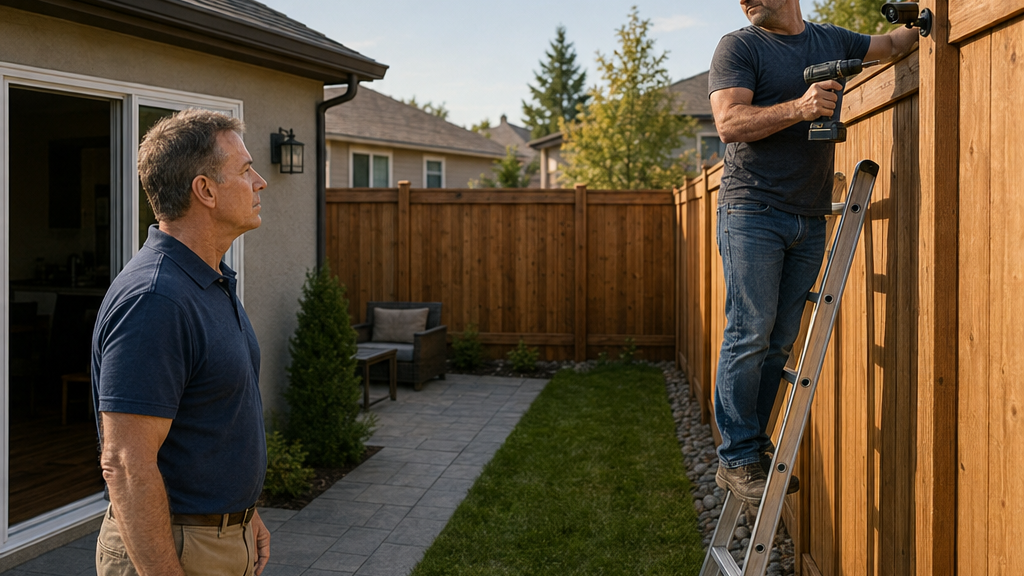
The drill bit struck cedar before Mark Carter understood where the sound was coming from.
He stepped through the sliding door with a coffee mug still in his hand and saw Timothy Davis standing on an aluminum ladder beside the fence. Timothy had one boot braced against the third rung and a cordless drill raised over his shoulder.
A black camera bracket was already screwed into one of Mark’s fence posts.
“Timothy.”
The drill stopped.
Timothy glanced down. “Morning.”
“What are you doing?”
“Finishing the cameras.”
Mark set his mug on the patio table.
There were two cameras. One had been mounted near the rear corner, angled toward the narrow walking path behind the houses. The second was directly above Mark’s patio. Its dark glass lens faced diagonally across his yard toward the sliding door and the small table where his grandson usually ate lunch.
Mark walked closer.
“That one’s on my fence.”
Timothy looked at the cedar boards, then back at him. “It’s on my side.”
“That isn’t what I said.”
For a few seconds neither man moved.
Mark had spent thirty-two years supervising facilities crews. He knew the difference between someone making an honest mistake and someone waiting for you to lose your temper.
He kept his hands at his sides.
“Take it down, please.”
Timothy gave a short laugh.
“Mark, the HOA sent that security email. Everybody’s supposed to improve coverage around the perimeter.”
“Then put it on your house.”
“My house doesn’t have a clean angle on the rear path.”
“That doesn’t make my fence yours.”
Timothy climbed down one rung.
“The face toward my property is basically my side of the fence.”
“No.”
“That’s how fences work.”
Mark stared at him.
“No,” he repeated. “It isn’t.”
Timothy climbed down completely, but he did not remove the camera. Instead he pulled his phone from his pocket.
Mark looked past him toward the strip of grass between the fence and Timothy’s mulched side yard.
Eight inches.
He had not thought about those eight inches in years.
When the cedar fence went up, Mark had deliberately kept every post inside his property line. The installer had told him four inches would probably be enough. Mark had doubled it because he disliked arguments that began with the words, “Well, technically.”
Now Timothy was standing in the exact space Mark had tried to protect himself from.
“Stay there,” Mark said.
He went into the garage and returned with a tape measure and a narrow steel landscaping trowel.
Timothy folded his arms.
“You digging up the yard now?”
“The survey pin.”
Mark knelt near the rear fence post and pushed the trowel into the grass. The soil was dry near the surface but dark underneath. After two minutes the blade scraped metal.
He cleared the dirt with his fingers.
A dull iron pin appeared.
Mark hooked the tape on it and extended the yellow blade toward the cedar post.
Eight inches.
A fraction more, actually.
He stood and held the tape where Timothy could see it.
“Property line,” Mark said, indicating the iron pin.
Then he tapped the fence post.
“My fence.”
Timothy looked down.
For the first time that morning, his confidence seemed to hesitate.
Only briefly.
“Fine. Your post is inside the line.”
“All of them are.”
“That still doesn’t change the camera issue.”
“It changes the part where you drilled holes in something I own.”
Timothy unlocked his phone.
“The HOA asked us to add security coverage after those thefts.”
“They asked you to drill into my property?”
Timothy scrolled, found something and held out the screen.
Mark did not take the phone.
He read enough from where he stood to recognize the HOA logo and a subject line about neighborhood security.
The message encouraged residents to consider exterior lighting, doorbell cameras and additional monitoring near vulnerable access points.
Mark saw nothing about attaching equipment to someone else’s fence.
Timothy scrolled farther.
“See? Rear perimeter coverage.”
“That says coverage.”
“Exactly.”
“It doesn’t say my fence.”
Timothy’s jaw tightened.
“You’re making this into something it doesn’t need to be.”
Mark almost laughed at that.
A black camera was hanging above his own patio, pointed toward his back door, and somehow he was the one enlarging the problem.
“I’m asking you once,” Mark said. “Remove anything attached to my fence.”
Timothy looked toward the camera.
Then toward the exposed survey pin.
Then back at Mark.
“I’ll talk to the management company Monday.”
“That doesn’t require leaving it up.”
“I installed it because we’ve had packages stolen, somebody messed with my rear gate twice, and the HOA told us to improve coverage. I’m not pointing it into your windows.”
“It can see my patio.”
“It can see part of your patio because your patio exists.”
Mark felt heat climb into his face.
He wanted to reach up and pull the bracket free himself.
Instead, he reeled in the tape measure.
“I’m documenting it.”
“Go ahead.”
Mark took photographs: the camera, the bracket, Timothy’s ladder, the survey pin, the tape stretched from iron to cedar.
Timothy watched without speaking.
When Mark finished, he expected him to leave.
Instead Timothy leaned against the fence.
“You know what’s funny?”
Mark waited.
“You’re acting like I just showed up and took over your property.”
“You drilled into it.”
“You let me attach something there before.”
Mark’s thumb stopped over his phone screen.
Timothy nodded toward a spot farther down the same fence.
“You didn’t have a problem then.”
Mark followed his gaze.
The cedar boards looked empty.
But suddenly he remembered a winter evening, an extension cord, a motion light, and Timothy asking for a favor Mark had barely considered important enough to answer.
Timothy picked up the drill.
“So before you turn this into some huge property-rights thing,” he said, “you might want to remember that.”
Chapter 2: The Permission Mark Never Wrote Down
The old screw holes were still there.
Mark found them Saturday afternoon, four feet from the new camera bracket and almost hidden by the grain of the cedar.
Two small silver-gray circles.
He ran his fingertip over them and remembered the motion light.
It had been the previous December.
Timothy had come over after dark holding a temporary LED fixture and an orange extension cord. Someone had stolen a package from his porch that week, and the rear side of his house had no exterior outlet in a useful location.
“Mind if I put this here for a few days?” he had asked.
Mark had been carrying groceries.
He remembered glancing at the light, then at the cold driveway.
“Sure. Just temporary.”
That had been the entire conversation.
No email.
No note.
No date for removal.
The light stayed up almost three weeks.
Mark noticed it every time he took out the trash.
He never complained.
When Timothy finally removed it, the screws remained.
Mark stood beneath those holes now, annoyed less by Timothy than by his own memory.
His daughter arrived just after four with her son.
She came through the side gate carrying a grocery bag while the boy ran ahead toward the patio.
Then she stopped.
“Dad, what’s that?”
Mark looked up.
The camera’s indicator light glowed faintly beneath the housing.
“Timothy put it up this morning.”
“On your fence?”
“Yes.”
She set the bag down.
“Why is it pointed here?”
“He says it’s covering the rear path.”
She walked to the patio table and looked toward the lens.
“Can it see this table?”
“I don’t know exactly what it sees.”
“That means yes.”
Her son had already reached the lawn. She called him back and handed him the bag to carry inside.
Mark noticed the movement.
“You don’t have to do that.”
“I know.”
She lowered her voice.
“But after everything this year, he finally likes coming here. He’ll sit out back without asking who’s walking past the house. I don’t want to tell him some camera might be recording him.”
That landed differently than Timothy’s drilling had.
Mark had promised her this place would remain uncomplicated.
Not perfect. Not sealed off from the world. Just private enough to let a child play without feeling watched.
He opened the camera application on his own phone—not Timothy’s system, just a basic field-of-view calculator he had used during his facilities years. Standing beneath the unit, he estimated the angle from the housing.
The probable frame covered the rear gate.
It also covered most of the patio.
Including the table.
His daughter watched him.
“Well?”
“It sees more than the path.”
“Are you taking it down?”
“No.”
She stared at him.
“Why not?”
“Because it’s his equipment. If I remove it and damage it, then we have two disputes instead of one.”
“You always do this.”
Mark looked at her.
“Do what?”
“Wait until you have enough proof that nobody can possibly argue with you.”
“That kept food on the table for thirty years.”
“At work.”
Her tone wasn’t angry. That made it worse.
She nodded toward the fence.
“This isn’t a maintenance report.”
Sunday morning Mark emailed Donna Green, the HOA’s community manager.
He attached five photographs and wrote three paragraphs with no adjectives.
Two cameras had been attached to his privately owned cedar fence without permission.
One appeared to cover his backyard patio.
He requested confirmation of whether the HOA had approved the installation.
Donna replied ninety minutes later.
Her response was polite and almost entirely unhelpful.
She described the matter as “primarily a private dispute between adjoining owners” and recommended that both residents avoid altering or damaging the other’s equipment until ownership and placement could be confirmed.
Mark read that sentence twice.
Then he called her.
Donna answered on the fourth ring.
“I saw your email,” she said.
“I saw your response.”
“I understand you’re frustrated.”
“I’m asking a simpler question. Did the HOA approve cameras being mounted on my fence?”
“I don’t have an architectural request in front of me.”
“That sounds like no.”
“It sounds like I need Monday access to the office records.”
Mark walked to the kitchen window. Through the glass he could see the upper edge of the camera.
“Timothy says the HOA told him to improve perimeter coverage.”
“There was a neighborhood security initiative.”
“Did it include using other people’s structures?”
“Mark, I don’t want to give you an answer before I’ve reviewed what went out.”
“That should be easy to answer.”
“It should be,” Donna said. “That doesn’t mean I’m answering it from memory.”
He disliked the answer because it was the kind he might have given when he was still working.
Careful. Procedural. Technically responsible.
He also knew what usually caused people to answer that way.
Something in the records was not as clean as everyone remembered.
Later that afternoon Timothy appeared on the other side of the fence.
Mark was sweeping dirt back around the survey pin.
“You call Donna?” Timothy asked.
“Yes.”
“She tell you about the security program?”
“She told me she’s checking records.”
Timothy gave a small nod, as though that supported him.
“You remember the light now?”
“Yes.”
“And the cord.”
“Yes.”
“You let me use the fence.”
“I let you attach one temporary light.”
“You never said I couldn’t attach anything else.”
Mark stopped sweeping.
There it was.
Not permission.
An assumption grown in the space where Mark had chosen not to speak.
“I shouldn’t have had to give you a list of everything you weren’t allowed to do,” he said.
Timothy shrugged. “Maybe. But you can’t act like there was never an understanding.”
That evening, after his daughter and grandson left, Mark received another email from Donna.
There was no message beyond one sentence:
This is the communication Timothy appears to be relying upon.
Below it was a forwarded HOA email from five months earlier.
Mark read the section Timothy had shown him on the phone.
Then he read the paragraph immediately above it.
The board had “encouraged coordinated homeowner coverage of rear access areas where practical.”
Coordinated.
Homeowner coverage.
Rear access.
The words were vague enough to argue over.
Then Mark noticed the final sentence.
Residents with questions about placement were advised to coordinate with adjoining owners and management.
Mark leaned back in his chair.
It was not authorization.
But it was not nothing either.
And Timothy had one more fact in his favor that Mark could no longer pretend away:
when Timothy had tested the boundary once before, Mark had answered with silence.
Chapter 3: Eight Inches on the Survey
The surveyor planted a fiberglass marking wand in the grass Monday morning and said, “Your boundary is over here.”
Mark looked from the wand to the fence.
The distance was almost exactly what he remembered.
Eight inches.
The surveyor checked the rear corner, then the midpoint, then another section near the patio. He worked from the recorded plat and the existing iron monuments rather than Mark’s memory.
At each relevant post, the result was the same.
The cedar fence stood entirely inside Mark Carter’s property.
“Any encroachment from the fence onto the neighboring parcel?” Mark asked.
“Not along what I’ve checked.”
“Any part of it sitting on the line?”
“No.”
Mark felt the first clean relief he had experienced since Saturday.
He had not imagined it.
He had not misremembered the installation.
He had not spent years maintaining a fence that somehow became shared property through geography.
The surveyor handed him a preliminary marked copy.
“The formal confirmation will have the measurements.”
“Put the setbacks on it.”
“I will.”
“Every checked post.”
The surveyor smiled faintly.
“You really like numbers.”
“I like arguments that end.”
But by eleven o’clock, Mark had learned this one would not.
He took the survey copy to the HOA management office.
Donna Green met him in a small conference room with a laptop, a legal pad and the tired expression of someone whose Monday had started badly.
Mark placed the survey on the table.
Donna studied it.
“So the fence is yours.”
“Yes.”
“All of it?”
“Every section adjacent to Timothy’s lot that was checked.”
“And the cameras are physically attached to it.”
“Yes.”
Donna exhaled.
“That simplifies one part.”
“One part?”
She turned her laptop around.
“I checked the architectural submissions. Timothy didn’t file one for either camera.”
Mark waited.
“So he had no approval.”
“No architectural approval.”
“Donna.”
“I’m being precise because this is where the problem is.”
She opened another file.
Five months earlier, after several theft complaints, the HOA board had discussed security improvements. The property manager circulated the email Mark had already received. Residents were encouraged to add lighting and cameras and, where useful, coordinate rear-perimeter coverage.
“Was that voted on?” Mark asked.
“There was a board discussion.”
“That isn’t what I asked.”
Donna rubbed her thumb along the edge of her legal pad.
“The minutes refer to an approved security initiative.”
Mark’s relief disappeared.
“What does that mean?”
“That’s what I’m trying to determine.”
“You manage the association.”
“I didn’t draft those minutes.”
“But you distributed the email.”
“Yes.”
“Did you tell Timothy he could use my fence?”
“No.”
“Did anyone?”
“I don’t know yet.”
Mark looked again at the survey.
Saturday morning, those eight inches had felt decisive. A bright yellow tape measure stretched over grass. An iron pin. A cedar post. Eight inches between what belonged to him and what belonged to Timothy.
Now the same measurement settled only the easiest question.
Donna scrolled through a folder.
“There are references to board members speaking with residents directly after the thefts.”
“References where?”
“Follow-up emails.”
“Can I see them?”
“Some contain information about other owners, so not without review.”
Mark sat back.
Donna looked at the photograph of the camera mounted above his patio.
“For what it’s worth, I don’t think Timothy should have installed equipment on a structure he doesn’t own without clear permission.”
“That’s worth something if you’ll put it in writing.”
Her eyes lifted.
There was no hostility in them.
Only recognition.
Mark realized he had done to her exactly what Timothy claimed Mark should have done months earlier: forced an assumption into words.
Donna nodded once.
“I’ll give you a written response after I confirm the record.”
“Thank you.”
She closed the photograph and opened the HOA’s architectural database again.
“No application,” she said. “No neighboring-owner consent form. No installation diagram.”
“So the formal process wasn’t followed.”
“Correct.”
That was the small victory Mark needed.
Not enough to end the dispute.
Enough to narrow it.
He left the office and called the county sheriff’s non-emergency number from his truck. The patrol deputy who returned his call later listened to the situation and told him the ownership question sounded civil unless there was damage, harassment or another specific violation.
“Document everything,” the deputy said. “Don’t remove his property yourself if you can avoid it.”
“I wasn’t planning to.”
“Good. Neighbor disputes get expensive when everybody decides to become their own enforcement department.”
Mark almost smiled.
By late afternoon the surveyor emailed the marked confirmation.
Mark printed it at home.
Eight inches at the rear reference point.
Eight and a quarter near the middle.
Just under eight near the patio post.
No shared fence line.
No ambiguity about ownership.
He set the pages on the kitchen table beside the HOA security email.
One document said the fence was his.
The other said residents had been encouraged to coordinate security.
Neither answered the question that now mattered most:
Who had told Timothy that encouragement gave him authority?
At five seventeen, Donna called.
“I found something.”
Mark stopped stacking the survey pages.
“What?”
“The board secretary has the original meeting packet.”
“Deborah Allen?”
“Yes.”
Mark knew Deborah well enough to wave at her mailbox, not well enough to ask favors.
Donna continued.
“The electronic minutes are abbreviated. Deborah keeps the signed version and her meeting notes.”
“And?”
“And one of the emails references a board member telling Timothy to cover the rear side of his property.”
Mark looked through the kitchen window.
The camera indicator light was visible even in daylight if he knew where to look.
“Cover it how?”
“That’s the problem. It doesn’t say.”
“Did the board authorize cameras on neighboring structures?”
“I still have no document saying that.”
“But somebody may have told him something privately.”
“Yes.”
Mark said nothing.
Donna’s voice softened.
“I’ve asked Deborah to bring the full minutes to a work session tomorrow evening.”
“Am I allowed to attend?”
“For this portion, yes.”
“And Timothy?”
“He’ll be invited.”
Mark looked down at the survey again.
Eight inches.
Saturday, he had thought those eight inches would decide who was right.
By Monday evening they had done something more uncomfortable.
They had proven the fence belonged to him while leaving open the question of how many people had helped Timothy believe ownership no longer mattered.
“Donna?”
“Yes?”
“Ask Deborah to bring everything.”
“I already did.”
Mark heard keys clicking on her end.
Then Donna added, “Because there’s one more reference in the file.”
“To what?”
“A prior privacy complaint.”
Mark straightened.
“About Timothy?”
“No.”
“Then who?”
“I don’t know yet. The entry only says the issue was discussed and no policy was adopted.”
Mark stared at the camera beyond the glass.
Tomorrow they would finally read what the board had actually voted for.
And perhaps why, after being warned once already, it had chosen not to decide where one homeowner’s security ended and another homeowner’s property began.
Chapter 4: What the Board Actually Voted For
Deborah Allen placed a stapled packet on the conference table and kept one hand on it.
“These are the signed minutes,” she said. “Not the summary that went into the portal.”
Mark Carter looked across the table at Timothy Davis.
Timothy had arrived three minutes late and had not spoken to him.
Donna Green sat between them with Mark’s survey on one side of her laptop and the HOA packet on the other. Two board members occupied the far end of the table.
Deborah slid the minutes forward.
“October seventeenth. Security discussion.”
Donna turned to the marked section.
The language was plain enough.
Residents had reported stolen deliveries, damaged gates and people using the rear pedestrian path after dark. The board had approved additional lighting near common areas and encouraged homeowners to improve security on their own lots.
Mark read the final sentence twice.
Owner-installed cameras were permitted subject to existing architectural rules and applicable privacy requirements.
He looked at Timothy.
“Nothing about neighboring structures.”
Timothy’s expression did not change.
“Keep reading.”
Deborah tapped the page.
“There isn’t anything else in the vote.”
One of the board members shifted in his chair.
Mark noticed.
Donna did too.
“You have something to add?” she asked.
The man cleared his throat.
“Not to the vote.”
Timothy turned toward him.
“You talked to me.”
The room tightened.
The board member looked uncomfortable.
“Yes.”
“When?”
“After the meeting. Maybe a week later.”
Timothy leaned forward. “You told me to cover that side.”
The man rubbed his forehead.
“I said if the rear side of your property was where you were having problems, you should cover that side.”
“You said the board wanted better coverage.”
“We did.”
“So that’s what I did.”
Mark placed one finger on his survey.
“You told him he could attach equipment to my fence?”
“No.”
“Did you ask whose fence it was?”
“No.”
“Did you tell him he didn’t need my permission?”
“No.”
Timothy exhaled sharply.
“You’re splitting words now.”
“No,” Deborah said.
It was the first time her voice had hardened.
“We’re determining what was authorized.”
Timothy looked at her.
Deborah opened a second folder.
“I have every motion from that meeting. We never voted to let one homeowner use another homeowner’s structure.”
Timothy sat back.
The defense he had repeated since Saturday did not vanish dramatically. It simply lost pieces until there was almost nothing left holding it up.
Donna turned her laptop toward him.
“There is also no architectural application for either camera.”
“I was told cameras didn’t need one.”
“Cameras mounted to your own home may not, depending on placement. Drilling into somebody else’s fence is a different issue.”
Timothy looked at Mark.
“You let me put the light there.”
Mark felt the accusation before Timothy finished saying it.
He had known it was coming.
“That was temporary.”
“You never said that in writing.”
“I said it when you asked.”
“You said, ‘Sure.’”
“For a motion light.”
“On the same fence.”
Mark could have answered immediately.
Instead he looked down at the survey.
Eight inches.
The line was exact.
His behavior had not been.
“I should have been clearer when the light stayed longer than you said it would,” Mark said.
Timothy blinked.
It was not the response he expected.
Mark continued.
“I should have asked you to remove it the first week it became something other than temporary.”
Timothy pointed toward him.
“Exactly.”
“No. Not exactly.”
Mark kept his voice level.
“My failure to object to one temporary light doesn’t give you permanent rights to my fence.”
The room stayed quiet.
Donna wrote something on her legal pad.
Timothy folded his arms.
“So what now?”
Donna looked at him.
“Now the association gives both owners a written determination.”
“You already decided.”
“The ownership question is decided,” she said. “The survey is clear.”
Timothy’s jaw tightened.
“I’ll rotate the camera.”
Mark shook his head.
“It comes off the fence.”
“Why? If it doesn’t face your yard, what’s the harm?”
“Because the fence is mine.”
“That’s the kind of technicality that turns neighbors into enemies.”
Mark almost answered with the same sentence Timothy had used Saturday: You’re making this into something it doesn’t need to be.
He did not.
“I asked you to remove it before there were surveys and meetings.”
Timothy looked away.
Donna closed the minutes.
“The HOA did not authorize installation on Mark’s fence. That’s the finding.”
It should have felt like victory.
Instead Mark felt the problem shifting again.
Timothy was wrong about the HOA authorization.
But he was not wrong that Mark had once allowed him to use the fence.
The distinction mattered legally.
It also mattered between two houses that would still be standing beside one another after everyone left this room.
Deborah remained seated when the others began gathering papers.
“There’s another file,” she said.
Donna stopped.
“The old privacy complaint?”
Deborah nodded.
One of the board members looked toward the door.
Mark noticed that too.
“What happened with it?” he asked.
Deborah opened a thin folder.
“Different homeowners. Different cameras. About eighteen months ago.”
“Was it resolved?”
“The owners worked it out themselves.”
“That isn’t what I asked.”
Deborah glanced at Donna.
Then back at Mark.
“No policy was adopted.”
“Why?”
The second board member finally spoke.
“Because people were nervous.”
“About what?”
“About being told where they could point cameras after the thefts started.”
Deborah’s expression tightened.
“That isn’t the whole answer.”
She removed a single sheet from the folder.
“At the time, management recommended an owner-consent rule for equipment attached to fences, sheds, retaining walls or other structures that didn’t belong to the person installing the device.”
Mark stared at her.
“You already had this problem.”
“Yes.”
“And you already knew what rule could prevent it.”
Deborah nodded.
“What happened?”
Neither board member answered immediately.
Donna looked genuinely surprised.
Deborah set the page beside Mark’s survey.
“The board tabled it.”
“Until when?”
“There was no return date.”
Mark looked from the old recommendation to the camera photograph.
A year and a half before Timothy ever raised his drill, someone had already asked the HOA where security ended and somebody else’s property began.
The board had not failed to imagine the question.
It had chosen not to answer it.
Chapter 5: The Complaint They Left Unfinished
The phrase had been typed in the margin of the old complaint file.
Owner consent unresolved.
Mark read it again.
Wednesday morning, Donna had allowed him to review the non-confidential portions of the file in the HOA records room. Deborah sat across from him, sorting meeting packets into careful stacks.
The old complaint involved a camera fixed to a shared-looking retaining wall between two homes.
One owner believed the wall was common.
The other produced records showing most of it sat on private property.
The cameras eventually moved.
No enforcement hearing had been necessary.
Then the board had stopped there.
“Why?” Mark asked.
Deborah did not pretend she misunderstood.
“Three homes had packages stolen that month. Two cars were broken into.”
“That explains wanting cameras.”
“It also explains why nobody wanted to be accused of weakening security.”
Mark tapped the proposed consent rule.
“This doesn’t ban cameras.”
“I know.”
“Then why table it?”
Deborah aligned the corners of a folder.
“Because several residents complained before it was even formally proposed. One board member said we were creating bureaucracy for a problem neighbors should solve themselves.”
“The same board member who talked to Timothy?”
Deborah looked at him.
“That matters less than you want it to.”
“Does it?”
“Yes. Because the rest of us let it happen.”
Her answer stopped him.
Deborah looked toward the closed records-room door.
“I thought the rule should pass. I also didn’t push when it got uncomfortable.”
“Why not?”
“Because volunteer boards get tired. You settle the urgent thing and tell yourself you’ll fix the system later.”
She slid the old file toward him.
“Later has a way of arriving at somebody else’s fence.”
Mark left with photocopies of the proposed rule and the portions of the complaint he was entitled to receive.
By noon, a city code officer had inspected the exterior placement from both properties with permission.
He did not make the dramatic declaration Mark had imagined during the weekend.
Instead he took photographs and asked precise questions.
“Who owns the fence?”
“I do.”
“Documented?”
Mark handed him the survey.
The officer studied the measurements.
“Any written permission for the equipment?”
“No.”
Timothy, standing several yards away, said, “He gave permission before.”
“For these cameras?” the officer asked.
“No. For a light.”
The officer wrote something down.
Then he stood on Timothy’s side and looked at the camera angle.
“This unit potentially captures more of the adjoining yard than would be necessary to watch the rear path.”
“Potentially?” Mark said.
“I’m not viewing the recorded feed. I’m describing placement.”
“So what happens?”
The officer returned the survey.
“Unauthorized attachment to a privately owned structure is the cleaner issue. Camera-angle and privacy rules depend on facts I haven’t established today.”
That answer disappointed Mark.
He had wanted one authority to say everything Timothy had done was plainly wrong.
Instead the officer gave him something narrower.
And probably more useful.
“I recommend voluntary correction first,” the officer said. “If it stays unresolved, there are formal routes.”
Timothy waited until the officer left.
Then he said, “You happy now?”
“No.”
“You’ve got the HOA, a surveyor and code enforcement involved.”
“You could have taken it down Saturday.”
Timothy laughed once, without humor.
“Right. Because none of the reason I put it up matters.”
Mark looked at him.
“Then tell me the reason.”
“I did.”
“No. You said packages.”
Timothy’s face changed.
Not softened.
Changed.
He looked toward his own house.
“Three packages in four months.”
Mark waited.
“Somebody cut the latch on my rear gate in February. I replaced it. Two weeks later somebody bent it again.”
Mark had noticed the newer latch.
He had never asked why it was there.
Timothy continued.
“My wife used to come home after dark. She started calling me from the car because she didn’t like walking down the side of the house when the gate had been messed with.”
Mark said nothing.
“She doesn’t work evenings anymore,” Timothy said. “But once you start checking the back door twice every night, you keep checking it.”
For the first time, the cameras looked different to Mark.
Not justified.
Not permitted.
But connected to something other than arrogance.
“You still should have asked,” Mark said.
“I thought I had.”
“You asked about a light.”
“I thought the board wanted coverage. I thought we’d already established the fence wasn’t some forbidden object.”
“That’s not the same thing.”
“No.”
Timothy looked toward the cedar boards.
“No. Apparently it isn’t.”
The concession was quiet enough that Mark nearly missed it.
Then Timothy added, “But I’m not signing anything that says I knowingly trespassed on your property.”
“I haven’t asked you to.”
“You will.”
Mark had, in fact, spent most of the morning thinking about penalties.
Reimbursement.
Written admissions.
Formal findings.
He looked at the narrow grass beyond the fence.
Eight inches of land he had deliberately kept on his side so he would never need to fight about a boundary.
Yet here he was.
That afternoon he returned to his kitchen table and spread out the documents.
The survey.
The old HOA proposal.
Donna’s emails.
The code officer’s notes.
He opened a blank document.
His first draft was angry despite containing no angry words.
Remove both cameras immediately.
Reimburse all expenses.
Acknowledge unauthorized use.
HOA to issue formal violation.
He read it once.
Then deleted the final line.
He did not need Timothy publicly branded.
He needed the cameras off the fence.
He needed his costs addressed.
And he needed the association to prevent the same argument from happening again.
Mark began again.
Removal of all devices attached to his fence.
No future attachment without written owner consent.
Reasonable reimbursement for survey and legal consultation.
No admission beyond acknowledging the fence was Mark’s private property and that permission had not been obtained for these cameras.
HOA adoption of a clear owner-consent procedure for security devices installed on privately owned structures.
He stared at the final provision.
That one would not have existed if he had only wanted to beat Timothy.
Mark printed the page.
Before folding it, he added one sentence by hand at the bottom.
Previous temporary permission for the motion light did not extend to later installations, but the lack of a clear objection at that time contributed to the misunderstanding.
He disliked seeing the words.
That was why he left them.
Thursday morning, he would have an attorney review the proposal.
For the first time since the drill hit cedar, Mark was no longer trying to assemble the perfect argument proving only that Timothy was wrong.
He was trying to write a boundary nobody would have to guess about again.
Chapter 6: Forty-Eight Hours Without a Shortcut
The certified letter gave Timothy Davis forty-eight hours to remove both cameras from Mark’s fence.
Mark read that sentence twice before signing the final copy Thursday afternoon.
The property-rights attorney across the desk tapped the survey exhibit.
“This is your strongest ground.”
“The eight inches?”
“The ownership. The eight inches make it easy to demonstrate.”
Mark glanced at the photographs.
“What about the camera pointing into the yard?”
“Potentially relevant, but don’t build the whole demand around that.”
“Why?”
“Because privacy rules depend on jurisdiction, angle, what is actually recorded, expectations of privacy, and other facts. The attachment issue is much simpler. He installed equipment on a structure you own after you told him to remove it.”
Mark nodded slowly.
He had spent days wanting every part of Timothy’s conduct condemned.
The attorney was reducing the problem to what could actually be proved.
“Don’t claim more than you need,” she said.
That sounded familiar.
Mark had given younger supervisors the same advice about incident reports.
Facts first.
Adjectives last.
The attorney reviewed Mark’s proposed terms.
She stopped at the handwritten acknowledgment about the old motion light.
“You want to include this?”
“Yes.”
“It isn’t necessary.”
“I know.”
“It gives him something.”
“Something true.”
She studied him for a moment.
“All right.”
The final letter demanded removal within forty-eight hours and reserved Mark’s right to pursue formal remedies if Timothy refused. It requested limited reimbursement for the updated survey work and legal consultation, but it did not accuse Timothy of intentional harassment.
When Mark left the office, he felt less triumphant than he expected.
The letter was firm.
It was also the first document in the dispute that admitted he had contributed anything to the confusion.
That evening Donna called a short HOA meeting with Mark and Timothy.
Timothy placed the certified envelope on the table without opening his folder.
“I’ll turn the cameras.”
Mark shook his head.
“I already told you that’s not enough.”
“I can aim them completely away from your property.”
“They’ll still be attached to my fence.”
Timothy rubbed both hands over his face.
“So this is about winning.”
“No.”
“It sure looks like it.”
Mark opened the survey exhibit.
“This is the line.”
“I’ve seen the survey.”
“And this is the fence.”
“I’ve seen the fence too.”
“Then you know why changing the angle doesn’t solve it.”
Timothy looked at Donna.
“Do you agree with this?”
Donna chose her words carefully.
“I agree that continued attachment requires Mark’s consent.”
“I thought the board wanted cameras.”
“The board encouraged cameras on property the installing owner had authority to use.”
“That isn’t how anybody explained it at the time.”
“No,” Donna said. “It wasn’t.”
Timothy’s expression shifted.
Donna continued.
“The association contributed to the ambiguity. We’re addressing that separately.”
For several seconds the room was silent.
Then Timothy pointed at Mark’s proposed settlement.
“This says reimbursement.”
“For the additional survey confirmation and part of the legal consultation.”
“You already had a survey.”
“I had to get the measurements confirmed because you disputed the fence.”
“I disputed whether I could use the outward-facing side.”
“Which required establishing ownership.”
Timothy pushed the paper away.
“I’ll remove the cameras. I’m not paying everything.”
Mark had expected that answer.
“What are you proposing?”
Timothy looked surprised.
Perhaps he had expected a demand, not a question.
“Half the survey.”
“And the consultation?”
“No.”
Mark leaned back.
A week earlier he might have refused immediately.
Not because half was unfair.
Because giving anything away after being dismissed would have felt like losing.
Now he heard his daughter’s voice: You wait until nobody can possibly argue with you.
The problem was that people could always argue.
The question was what happened after they did.
“The consultation happened because you refused removal after I objected,” Mark said. “I’m not absorbing all of that.”
Timothy was quiet.
Donna looked between them.
“Would limited reimbursement settle the private portion if the cameras are removed and the future-consent term is signed?”
Mark answered first.
“Yes.”
Timothy tapped the document.
“What about this paragraph where he says he contributed to the misunderstanding?”
“It’s staying,” Mark said.
Timothy read it again.
Something in his face loosened.
“You mean that?”
“Yes.”
“You’re admitting you let me use the fence before.”
“For one temporary light. And I’m admitting I should’ve objected when temporary stopped meaning temporary.”
Timothy folded the paper once, then unfolded it.
“I thought you didn’t care.”
“I did care.”
“You never said anything.”
“I know.”
The words cost Mark more than he expected.
Timothy looked at him for a long moment.
Then he said, “That’s what I’m talking about.”
“And that’s what I’m changing.”
They did not settle that evening.
But Timothy took the document home.
Friday morning, Mark found an email from him.
The cameras would be removed.
Timothy would reimburse half the survey update and a portion of the attorney consultation if the final agreement stated that neither party admitted intentional wrongdoing.
Mark forwarded the proposal to the attorney.
By lunch, they had language both sides could tolerate.
Donna, meanwhile, circulated a draft HOA rule requiring written owner consent before security devices, lights, wiring or similar equipment could be attached to structures owned by another homeowner.
Deborah insisted it be placed on the next formal board agenda.
Mark read the draft twice.
It was almost identical in purpose to the rule the board had tabled eighteen months earlier.
This time nobody called it unnecessary bureaucracy.
Friday evening, Timothy caught Mark at the mailbox.
“You know what bothers me?”
Mark waited.
“You could’ve just told me last year you wanted the light down.”
“You told me it was temporary.”
“And then I left it.”
“Yes.”
“And you got annoyed.”
“Yes.”
“But you didn’t say anything.”
“No.”
Timothy gave a humorless smile.
“Then Saturday you came outside acting like there had never been any gray area between us.”
Mark could have defended himself.
Instead he said, “There shouldn’t have been a gray area. But I helped create one.”
Timothy looked toward the houses.
“That doesn’t make the cameras yours to remove.”
“No.”
“It doesn’t make the fence mine either.”
“No.”
That was as close as they had come to agreement.
Saturday morning Mark woke before seven.
The forty-eight-hour deadline had not yet expired.
He made coffee and stood at the kitchen counter reading the final settlement language on his phone.
Then he heard it.
A power drill.
The sound came from the backyard.
Mark put down the mug.
For one sharp second every conversation of the past week disappeared.
He pictured another bracket.
Another camera.
Timothy testing how far a technical argument could stretch.
The drill whined again.
Mark crossed the kitchen and opened the sliding door.
Timothy’s aluminum ladder was back against the cedar fence.
He stood near the top with the drill raised beside the camera over Mark’s patio.
Mark stepped outside.
Timothy saw him.
Neither man spoke.
Then Timothy pressed the trigger.
The drill turned.
And from where Mark stood, he could not yet tell whether the screw was going deeper into the cedar or finally coming out.
Chapter 7: The Same Drill, Turning Backward
The screw backed out of the cedar and dropped into Timothy’s palm.
Mark Carter stood on the patio without moving.
Timothy looked down from the ladder.
“I’m taking it off.”
Mark nodded once.
The drill whined again, this time unmistakably in reverse.
The second screw came free. Timothy caught the camera bracket before it tipped away from the fence, then lowered the whole unit carefully against his chest.
For a moment, the black lens faced Mark.
Its indicator light was still on.
Then Timothy unplugged the cable.
The light went dark.
Neither man said anything.
The ladder creaked as Timothy climbed down.
He placed the camera in a cardboard box beside the fence and reached for the drill again.
“What about the other one?” Mark asked.
“Coming down too.”
Mark had imagined this moment several times during the week.
In some versions, Timothy complained while removing the equipment. In others, Mark stood nearby holding the survey like a verdict.
Instead there was only the metallic click of a drill chuck and the sound of Timothy repositioning the ladder.
Mark looked at the strip of grass between them.
Eight inches.
The same distance it had been Saturday morning.
Nothing about the land had changed.
Everything around it had.
Timothy climbed again and began removing the rear camera.
“Donna sent the final agreement,” he said.
“I saw it.”
“I signed.”
“So did I.”
“Half the survey update.”
“Yes.”
“And part of the legal consultation.”
“Yes.”
Timothy removed another screw.
“You could’ve asked for more.”
Mark watched him lower the bracket.
“I could’ve asked.”
“That isn’t what I said.”
Mark understood.
He rested one hand on the patio chair.
“I wanted the problem fixed.”
Timothy climbed down.
“You wanted to be right.”
“At first.”
Timothy gave him a sideways look.
“At first?”
Mark glanced toward the old screw holes farther down the fence.
“I was right about the fence.”
“You were.”
“I was right that the cameras shouldn’t have been there.”
Timothy said nothing.
“But I kept thinking if I collected enough documents, there’d be nothing left to argue about.”
“There was plenty left.”
“Yes.”
Timothy put the second camera in the box.
The two men stood with the fence between their yards but not between them.
Timothy wiped sawdust from his hands.
“When you let me put that light up last year, I thought that meant you didn’t care about that side.”
“I did care.”
“You didn’t act like it.”
“No.”
Timothy bent to gather the screws.
“I figured if something bothered you, you’d say so.”
Mark almost answered that adults should know better than to drill into another person’s property.
That was true.
It was also incomplete.
“I figured if something was obviously mine, I shouldn’t have to say so.”
Timothy looked at him.
“That’s where we got sideways.”
Mark nodded.
“It is.”
Timothy closed the cardboard box.
“My wife hated those cameras, by the way.”
Mark was surprised.
“Why?”
“She said I was turning the house into a gas station.”
A short laugh escaped Mark before he could stop it.
Timothy almost smiled.
Then his expression became serious again.
“I wasn’t trying to watch your family.”
“I believe that now.”
“I was trying to see the path and the gate.”
“I believe that too.”
Timothy looked toward the rear corner of his property.
“Doesn’t mean I should’ve used your fence.”
“No.”
“And the board should’ve been clearer.”
“Yes.”
Timothy picked up the box.
“And you should’ve told me when that light stopped being temporary.”
Mark met his eyes.
“Yes.”
That answer seemed to matter more than the others.
Timothy shifted the box under one arm.
“All right.”
He walked toward his house.
Mark looked up at the empty cedar post.
Two pale circles remained where the bracket had been.
No camera.
No indicator light.
Just wood.
The following Tuesday, the HOA meeting room was fuller than Mark expected.
Donna Green had placed the proposed equipment-consent policy on the agenda as an association-wide rule, not as a disciplinary action against a particular homeowner.
That distinction became important almost immediately.
One board member suggested adding a sentence to the policy history explaining that it had been created after “a recent unauthorized camera installation.”
Mark raised his hand.
Donna recognized him.
“I don’t think that’s necessary.”
The board member frowned.
“Residents should understand why the rule exists.”
“They can understand the problem without naming a person.”
“We didn’t name anyone.”
“You don’t have to. Everybody on this street knows whose cameras came down.”
Timothy sat two rows behind Mark.
Mark did not turn around.
The board member leaned toward his microphone.
“Accountability matters.”
“So does fixing the rule.”
Deborah Allen spoke next.
“I agree.”
She opened the signed meeting packet in front of her.
“The previous board had a chance to address this eighteen months ago and didn’t. This isn’t one homeowner’s failure.”
The room became still.
Deborah continued.
“If we’re recording history, we should record all of it.”
Donna read the revised policy aloud.
No homeowner could attach cameras, lights, wiring, brackets, sensors or similar equipment to a privately owned fence, wall, shed or other structure without the owner’s written consent.
Security devices also had to comply with architectural standards and applicable privacy requirements.
Questions of ownership were to be resolved before installation, not afterward.
The vote passed.
There was no applause.
Mark was glad.
Applause would have turned a boundary dispute into a public victory lap.
Instead pens moved across paper.
Deborah recorded the vote.
Donna collected the signed copies.
The rule became ordinary.
That seemed more useful.
After the meeting, Timothy caught Mark near the door.
“They almost named me.”
“I noticed.”
“You stopped them.”
“I stopped them from making the rule about you.”
Timothy studied him.
“Why?”
“Because the next person might be me.”
Timothy frowned.
Mark continued.
“Not with cameras. With something else I don’t handle early enough.”
For once Timothy had no quick answer.
He held out a folded check.
Mark took it.
The amount matched the settlement.
“That finishes it,” Timothy said.
“The money part.”
Timothy nodded.
Outside, they walked across the parking lot together before separating toward their cars.
“I’m putting the replacement cameras under my eaves,” Timothy said.
“Probably a better place.”
“I checked the angles.”
Mark looked at him.
Timothy lifted both hands.
“And I asked Donna.”
Mark smiled despite himself.
“Good.”
When Mark returned home, his daughter and grandson were already in the backyard.
The boy had spread plastic building pieces across the patio table and was constructing something that looked too complicated to remain standing.
His daughter glanced toward the fence.
“They’re gone.”
“They’re gone.”
She looked at the empty posts.
“You win?”
Mark set his keys on the table.
“No.”
She raised an eyebrow.
“The cameras came down.”
“Yes.”
“You got some of your money back.”
“Yes.”
“The HOA changed the rule.”
“Yes.”
“That sounds suspiciously like winning.”
Mark pulled out a chair.
“I got the boundary fixed.”
She studied him, then smiled.
“That’s a very Dad answer.”
Her son looked up.
“Grandpa, can I put this tower by the fence?”
Mark looked toward the cedar boards.
For years, he had treated boundaries as things decent people were supposed to recognize without explanation.
Eight inches of grass had taught him otherwise.
“Sure,” he said. “Just keep it on this side.”
The boy nodded as if the instruction were the simplest thing in the world.
Later, after they left, Mark walked the fence once more.
He stopped where Timothy’s first camera had been.
The screw holes remained.
He considered filling them.
Then decided there was no hurry.
Beyond the fence, Timothy’s new camera was visible beneath the eave of his own house, aimed toward his own rear gate.
Mark could see its tiny indicator light.
It did not face the patio.
He looked down.
Between the cedar post and the true property line, the narrow strip of grass remained untouched.
Eight inches.
It had never moved.
The difference was that now everyone knew where it was.
Mark went inside and closed the sliding door.
Behind him, the old camera light stayed dark.
The story has ended.