They Fined His Farm for Making Noise, So He Measured What Happened at Their Barn After Midnight
Chapter 1: The Fine Arrived Before the Tractor Went Quiet
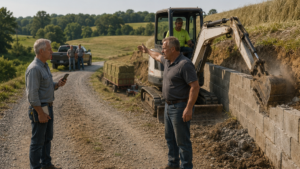
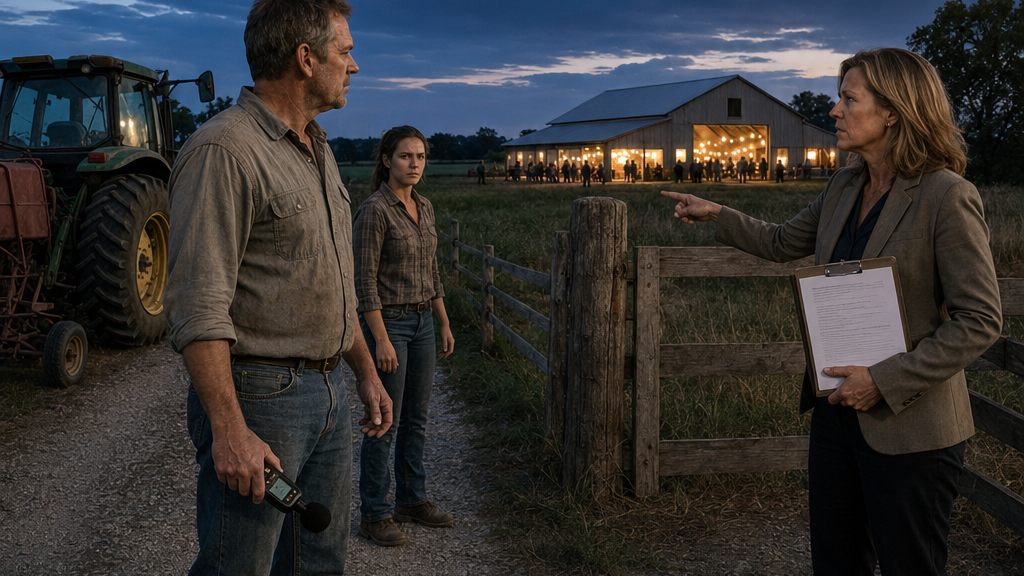
Rebecca Hall was waiting at William Anderson’s gate before the baler had finished spinning down.
He saw her as he eased the tractor toward the machinery shed, one hand resting on the wheel, the other reaching for the throttle. She stood beside the gravel lane in clean boots and a pressed jacket, holding a white envelope against a clipboard. Behind her, across the field, the converted association barn glowed gold through its tall windows.
William killed the engine.
The baler continued its mechanical sigh for several seconds.
Rebecca did not wait for the last belt to stop moving.
“You’re past the cutoff.”
William climbed down slowly. His shirt was damp between his shoulder blades, and bits of hay clung to his jeans. “By eleven minutes.”
“Eleven minutes is still past it.”
Samantha stood near the open shed door with a coil of twine over one shoulder. At twenty-two, she had inherited her father’s dark eyes but none of his habit of letting a silence do the work of an argument.
“We’re finishing before the rain,” she said.
Rebecca glanced toward her. “Everyone has reasons.”
William took the envelope.
Through the paper he could feel the stiffness of a printed form.
“What is it?”
“A violation notice.”
He opened it with his thumb.
The amount was printed near the bottom: two hundred dollars.
Above it was a reference to the association’s nighttime noise provision and a stated limit of sixty-five decibels after ten.
William read it twice.
Then he looked at Rebecca.
“You measured us?”
Her expression changed by almost nothing.
“We received a complaint.”
“That wasn’t my question.”
Behind them, the baler gave one final metallic click.
Rebecca tucked the clipboard closer to her body. “The equipment was clearly audible from the residential lots. I don’t need to stand beside a tractor with a meter to know that.”
William folded the notice once.
Across the pasture, bass from the association barn carried over the cut hay in dull, regular pulses.
Rebecca heard it too. He knew because her eyes moved for half a second toward the light.
She said nothing about it.
Samantha did.
“Is that under sixty-five?”
“Samantha,” William said.
“No. I’m asking.”
Rebecca’s mouth tightened. “The barn is hosting a scheduled association function.”
“That makes sound quieter?”
William turned slightly toward his daughter.
“Go put the twine away.”
She stared at him.
It was the same look she had given him when he had agreed, two years earlier, to stop stacking hay trailers along the shared lane even though the covenant did not prohibit it. The same look from the spring the board had asked him to move a temporary feed bin farther from the road because residents said it looked “industrial.”
He had moved both times.
It had been easier.
At least, that was what he had told himself.
Samantha dropped the twine onto a workbench instead of carrying it inside.
Rebecca lowered her voice.
“William, this area has changed. You know that.”
His gaze returned to her.
“The farm hasn’t.”
“No, but the number of families around it has. People bought homes here expecting a certain quality of life.”
He waited.
She looked past him at the baler, the tractor, the windrows stretching into the dim field.
“Property values depend on people believing standards will be enforced.”
That landed differently.
Not because William had never heard complaints about machinery. Farming beside subdivisions meant hearing complaints. Dust on dry days. Headlights at harvest. Manure odor when the wind turned east.
But Rebecca was not talking about eleven minutes.
She was talking about whether his farm belonged in the picture the association wanted to sell.
Samantha stepped forward.
“Our farm was here before half those houses.”
Rebecca turned toward her. “And that does not give your family the right to disregard everyone else.”
William felt his jaw tighten.
He had spent most of his adult life learning that anger could make a bad position worse. He also knew Samantha interpreted that restraint as surrender.
He held up the violation notice.
“I’ll read the rule.”
Rebecca nodded as if that settled something. “You have thirty days.”
She returned to her SUV.
Before opening the door, she looked back.
“I’m not asking you to stop farming. I’m asking you to respect the people who have to live beside it.”
Then she drove away, tires crunching over the shared gravel.
For several seconds William and Samantha stood without speaking.
Music from the barn drifted across the field again, louder now that the tractor was silent.
Someone inside cheered.
Samantha gave a short laugh with no humor in it.
“You really going to pay that?”
“I said I’d read the rule.”
“That means yes in your language.”
William unfolded the notice.
“It means I’m going to read the rule.”
“You always do this.”
He looked up.
“Do what?”
“Make yourself smaller so nobody can accuse you of being difficult.”
She walked into the shed before he could answer.
William remained by the gate.
The barn windows flashed as people moved inside. Cars lined the association lot. He could hear music clearly from several hundred yards away.
Rebecca had stood twenty feet from his idling tractor and issued a violation without taking a single measurement.
That detail stayed with him.
Later, at the kitchen table, William pulled the association binder from the bottom drawer where he kept road assessments, meeting notices, and insurance papers.
He found the noise provision.
It was shorter than he expected.
No paragraph distinguishing tractors from parties.
No exception for association functions.
No language about what Rebecca could judge by ear.
Just a measurable limit.
Sixty-five decibels after ten p.m., measured at the receiving property line.
William rested one finger beneath the sentence.
Outside the kitchen window, faint music still traveled over the dark field.
For the first time that evening, his anger cooled enough to become useful.
He copied the number onto a yellow notepad.
Then he wrote beneath it:
Barn?
Chapter 2: One Rule, Two Sides of the Fence
The meter read 72.6 before William had even reached the fence.
He stopped beside a cedar post at the edge of his hay field and stared at the glowing numbers.
Across the pasture, the association barn was full again.
Cars crowded the gravel lot. Light spilled from the open side entrance whenever someone passed through it. Music pressed steadily into the night, not deafening at that distance, but unmistakable.
William lowered the sound-level meter and checked the instructions for the third time.
He had bought a certified unit rather than the cheapest one he could find. He had checked its calibration before sunset. He had even measured the tractor earlier that afternoon from the same approximate distance used in the association’s complaint.
Now he raised the meter again.
71.9.
Then 73.1.
He wrote the time and reading in a small field notebook.
10:17 p.m.
Samantha leaned against the pickup parked farther down the shared lane.
“Well?”
William held up the notebook rather than answering.
She walked over and looked.
A smile appeared.
Not happiness, exactly.
Recognition.
“That’s higher than the tractor.”
“Yes.”
“Way higher.”
“Yes.”
“So now what?”
“We keep measuring.”
Her smile disappeared.
“Dad.”
“One reading proves one reading.”
“You already know what’s happening.”
“I know what the meter says tonight.”
The barn door opened again, and a burst of laughter rolled across the field.
William recorded another reading.
He had no intention of giving Rebecca an excuse to dismiss him as angry.
If he challenged the fine, he wanted more than outrage. More than Samantha’s memory. More than the obvious absurdity of hearing music across the same field where his tractor had supposedly disturbed the neighborhood.
He wanted numbers.
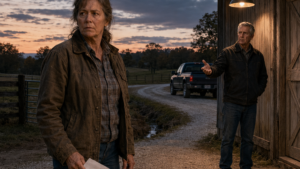
At 10:31, headlights turned onto the lane.
Rebecca’s SUV slowed beside them.
For one moment William wondered if she would keep going.
She stopped.
The window came down.
“What are you doing?”
William held the meter at his side.
“Checking the sound level.”
Rebecca looked at Samantha, then back at him.
“From what?”
He nodded toward the barn.
Her face settled into the careful expression she used at association meetings when she wanted disagreement to sound unreasonable.
“That is an association event.”
“I know.”
“It isn’t comparable to agricultural machinery.”
William looked down at his notebook.
“Why?”
“Because one is a scheduled community function and the other is commercial operating noise.”
“Where’s that distinction in the rule?”
Rebecca did not answer immediately.
Samantha shifted beside him.
William gave her a small look that meant let me handle it.
Rebecca rested one hand on the steering wheel.
“The board has always treated them differently.”
“That wasn’t what I asked.”
Her eyes sharpened.
“William, if your point is that two completely different uses of property can sometimes produce similar numbers, then yes. They can.”
“Seventy-three isn’t similar to sixty-five.”
The silence between them lasted longer than he expected.
Rebecca glanced toward the meter.
“You’ve decided to make this adversarial.”
“No.”
William raised it again toward the barn.
The display climbed.
72.8.
He wrote it down.
“I’m trying to understand which number matters.”
Rebecca’s voice cooled.
“You know perfectly well what the intention of the rule is.”
“No. I know what it says.”
Samantha looked from one of them to the other.
For the first time since the fine arrived, William felt the balance shift slightly.
Not because Rebecca had admitted anything.
Because she had not.
She had come upon him measuring a rule she had enforced against him, and instead of pointing to an exemption, she had pointed to tradition.
The board had always treated them differently.
That sentence mattered.
Rebecca put the SUV in gear.
“If you have an objection, bring it through the normal process.”
William nodded.
“I may.”
She drove toward the barn.
Samantha waited until the taillights disappeared.
“You should have told her you’re contesting the fine.”
“Not yet.”
“Why not?”
“Because now she knows I’m measuring.”
“That’s exactly why.”
William closed the notebook.
“If the board believes the events are exempt, I want to know whether they behave any differently after tonight.”
Samantha studied him.
“You think they’ll turn it down?”
“Maybe.”
“And if they do?”
“Then we learned something.”
“And if they don’t?”
“We learned something else.”
They stayed until nearly eleven.
The readings never dropped below seventy-one.
At home, William spread the covenant packet beside the meter.
He read the noise provision again, then the definitions, then the enforcement section.
Nothing.
No community-function exemption.
No event exemption.
No distinction between agricultural equipment and amplified music once the threshold applied.
The rule was simply the rule.
Samantha came into the kitchen carrying two mugs of coffee.
“You found it?”
“No.”
“What?”
“The exemption.”
She sat opposite him.
“So there isn’t one.”
“Not in here.”
“That’s it, then.”
William shook his head.
“No. That’s the beginning.”
She frowned.
“How much proof do you need?”
“Enough that they can’t turn this into an argument about me.”
“It already is an argument about you.”
He looked at her.
She lowered her voice.
“They think you’ll accept whatever they put in writing because you always have.”
The words irritated him because they were close enough to true.
William picked up the meter.
For years, when the association asked for something small, he had treated compromise as the price of being a good neighbor.
Move the feed bin.
Keep trailers off the lane.
Avoid early Sunday loading.
None had been worth a fight.
But a collection of small concessions could become something else if nobody remembered they had been voluntary.
He set the meter beside the notebook.
“One Friday isn’t a pattern.”
Samantha leaned back.
“You’re really going to do this every week.”
“If they are.”
He turned to a fresh page and wrote the date of the next scheduled barn event.
Then the next.
Then the next.
Six Fridays filled the page.
Chapter 3: Six Fridays Made the Pattern Impossible to Dismiss
The sixth Friday gave William the highest reading yet.
74.2.
He stood at the same cedar fence post, in nearly the same patch of flattened grass, while cold October air moved over the cut field.
The number held for two seconds, dropped to 73.6, then climbed again.
William wrote both figures in the notebook.
Six dates now filled its pages.
Six association events.
Six nights above the stated limit.
The lowest had been 71.4.
The highest was glowing in his hand.
Samantha watched from the pickup with her arms folded.
“You have your pattern.”
William capped his pen.
“Yes.”
“Then tomorrow we send everything to the board.”
“No.”
Her arms fell.
“What do you mean, no?”
“I want copies first. Photos of the readings. The event dates matched to association notices.”
She stared at him.
“You have six weeks of this.”
“That’s why I’m not getting sloppy now.”
Inside the barn, the music changed.
William recorded the time.
Samantha walked toward him.
“You know what I think?”
“I usually find out.”
“I think you like collecting proof because collecting proof means you don’t have to confront anybody.”
William looked at her over the meter.
“That’s not what this is.”
“Isn’t it?”
He slipped the meter into its case.
She was angry, but underneath the anger he heard something older.
Not six weeks old.
Years.
“You want me to walk into a meeting and call Rebecca a hypocrite?”
“I want you to stop acting like being reasonable means everybody else gets the last word.”
William started toward the pickup.
Samantha followed.
“Remember the hay trailers?”
He stopped.
“What about them?”
“They asked you to move them off the lane.”
“They were in the way sometimes.”
“Sometimes. So instead of agreeing on when they could be there, you stopped putting them there at all.”
“That was easier.”
“For them.”
William opened the passenger door but did not get in.
Samantha continued.
“And the feed bin.”
“That thing was temporary.”
“They said it hurt the view from the road. You moved it behind the shed.”
“It wasn’t worth fighting about.”
“That is what you say every time.”
He closed the door again.
Across the field, the barn lights shone against the black tree line.
“You think I’m scared of Rebecca?”
“I think you’re scared of becoming the person everyone blames.”
That found the place he preferred not to examine.
William had watched the countryside around him change one parcel at a time. Corn ground became five-acre homesites. Old hedgerows disappeared behind decorative fences. People moved out for quiet and space, then discovered that cattle bawled, combines ran after dark, and manure smelled exactly like manure.
He had no desire to become the farmer new neighbors warned one another about.
So he accommodated.
Then accommodated again.
Maybe Samantha was right about what that had taught them.
“I’m not afraid of Rebecca,” he said.
“No. You’re afraid of proving you’re difficult.”
William looked down the lane.
“That’s not the same thing.”
“No,” Samantha said. “But it costs you the same.”
The next morning an envelope from the association was clipped inside his mailbox.
This one was not a fine.
It was a warning.
William read it standing beside the road.
The board had received another complaint regarding agricultural equipment operated during restricted hours. Any subsequent violation, it said, could result in escalating penalties under the association enforcement schedule.
Samantha read over his shoulder.
“There. Still want more proof?”
William folded the letter.
Now the board was not merely defending the first citation.
It was building a record against him.
That afternoon he laid everything across the kitchen table.
The original fine.
The new warning.
The covenant.
Six pages of readings.
Photographs of the meter display.
Event notices showing the barn gatherings on corresponding dates.
Samantha sat opposite him, unusually quiet.
William organized the papers by date.
“I should’ve answered the first time they treated a request like a rule,” he said.
She looked up.
“The trailers?”
“And the bin.”
“That’s not what I expected you to say.”
“Don’t get used to it.”
A corner of her mouth lifted.
William tapped the warning notice.
“I thought ignoring small things kept peace.”
“What did it do?”
“Made it easier for them to assume I’d ignore the next one.”
Samantha reached across and straightened one of the photographs.
“So what now?”
William had spent the morning searching township ordinances online. The association rule referred broadly to compliance with local land-use regulations, but the public records available on the website were incomplete.
“I’m going to the township office.”
“For the noise ordinance?”
“For everything they have on that barn.”
The clerk at the counter listened while William explained that he wanted the land-use file for the association property.
He expected a map, perhaps an occupancy document.
Instead, after several minutes at a computer, the clerk looked toward him.
“The barn is under a conditional-use approval.”
William leaned closer.
“For events?”
“For assembly use, yes.”
She disappeared into a records room and returned with a thick folder.
William took it to a side table.
The first pages dealt with parking, lighting, occupancy, and access from the shared lane.
Then he reached a section marked operating conditions.
The clerk passed behind him on her way back to the desk.
“If you’re looking at noise,” she said, “there should be a separate condition in that file.”
William turned another page.
There it was.
A nighttime sound restriction tied directly to the barn’s permission to operate as an event space.
He read the number.
Then read it again.
Sixty-five decibels.
The same number printed on his fine.
William looked back toward the clerk.
“What happens if they’re over this?”
She did not answer from memory.
Instead, she returned to the computer.
“That depends on frequency, documentation, and whether there’s an enforcement finding.”
“Could the permit be affected?”
The clerk glanced at the file in front of him.
“If violations are sustained, the conditional use can be reviewed.”
William’s hand remained on the page.
For six weeks he had thought he was proving that Rebecca was applying one association rule two different ways.
The file suggested something larger.
The barn was not merely subject to the same number.
Its right to hold events depended on it.
And suddenly William understood that proving his case might carry consequences he had never intended.
Chapter 4: The Barn Permit Contained a Rule Nobody Mentioned
The clerk laid William’s violation notice beside the barn’s conditional-use approval and tapped the same number on both pages.
Sixty-five.
William stared at it.
On his association fine, the number had been presented as proof that his farm had crossed a line. In the township file, it appeared as a condition the association had accepted in order to operate the barn as an event space after dark.
Same number.
Same hour.
Different treatment.
The clerk slid the permit closer.
“This approval was amended when the barn started being used for organized events.”
William read the paragraph again.
Amplified sound and other event-generated noise could not exceed the stated nighttime threshold at neighboring property lines. Continued violations could trigger enforcement, review, or modification of the conditional use.
He looked at the folder spread open before him.
“How long has this been in effect?”
The clerk checked the approval date.
“Several years.”
“And the association would have received a copy?”
“They would have been the applicant.”
William leaned back.
That answer settled one question and created a worse one.
Rebecca could argue that she interpreted the association covenant differently for tractors and parties. She could not plausibly claim the barn’s own operating approval did not apply to the barn.
William took out his notebook.
Six Friday dates.
Six readings.
He set them beside the permit.
The numbers no longer looked like ammunition in an argument.
They looked like something capable of closing a building.
That thought stayed with him all the way home.
Samantha was waiting at the kitchen table when he returned, the original fine lying beside her laptop.
“Well?”
William set a photocopy of the permit in front of her.
She read quickly.
Her eyes stopped at the noise condition.
“No way.”
“Apparently.”
“This is perfect.”
William took off his jacket.
“No.”
She looked up.
“How is this not perfect?”
“Because it isn’t just an association rule.”
“That’s what makes it better.”
“It means the township can review the barn permit.”
Samantha’s expression changed.
“So?”
“So review can mean restrictions. It can mean suspended events. It can mean the use gets reconsidered entirely.”
She pushed the paper toward him.
“They should have thought about that before fining you.”
William opened the refrigerator, looked inside without seeing anything, then closed it.
“That barn pays for things.”
“The association has dues.”
“Dues don’t cover everything.”
“You don’t know that.”
“No. I don’t.”
That bothered him more than he expected.
The shared gravel lane had been resurfaced twice in the last five years. Culverts had been cleared after spring floods. Snow removal had improved. William used the road every time a feed truck came in and every time he hauled equipment toward the county route.
He had never asked exactly how the association budget covered those costs.
He had simply paid his share.
Samantha watched him.
“You’re doing it again.”
He knew what she meant.
Looking for reasons not to press.
“This is different.”
“How?”
“Because I wanted my fine treated fairly. I didn’t set out to shut down the barn.”
“You don’t know that it will.”
“And you don’t know that it won’t.”
She looked back at the permit.
For a while neither spoke.
Then Samantha said, “What if you complain only about the noise?”
William glanced at her.
“Not the permit?”
“Ask them to enforce the number. Let the township decide the rest.”
That was close to what he had already been thinking, but hearing her say it mattered.
Not because she had softened.
Because she had separated accountability from punishment.
The next morning William returned to the township office.
He asked what a formal noise complaint required.
The clerk gave him a form and explained that enforcement staff could conduct their own observations and measurements. Personal readings could support a complaint, but official action would depend on independent verification.
“Do I have to request permit review?”
“No.”
“What happens if your inspector finds a violation?”
“That depends on what is found.”
William frowned.
“I’m asking because I don’t want to exaggerate this.”
The clerk studied him for a moment.
“Then don’t.”
She pointed to the narrative section of the form.
“State what happened. Attach what you have. Don’t ask us to prove more than you’re alleging.”
That suited him.
At home, William drafted the complaint twice.
The first version was too long.
He had included Rebecca’s remarks about property values, the original warning, the history of the lane, the trailers, the feed bin, and everything else that had begun to feel connected.
He deleted most of it.
The second version was three paragraphs.
He stated that the association had cited his property under a nighttime sound standard. He stated that scheduled events at the association barn appeared repeatedly to exceed the same threshold. He attached dates, times, photographs, and his meter log.
Then he added one final sentence.
He was requesting consistent enforcement of the applicable nighttime standard.
Not suspension.
Not closure.
Not punishment.
Consistency.
Samantha read over his shoulder.
“That’s all?”
“That’s the issue.”
“What about Rebecca?”
“What about her?”
“She’s the reason this started.”
William looked at the complaint form.
“She doesn’t have to be the reason it ends.”
Samantha leaned against the counter.
“I still think you’re letting her off easy.”
“Maybe.”
He signed his name.
“But I’m not asking the township to settle something personal for me.”
For the first time since the dispute began, Samantha did not argue.
William scanned the completed form, copied the attachments, and placed the originals back in his folder.
Before lunch, he drove to the township office and handed the complaint across the counter.
The clerk stamped it.
That small sound carried more weight than William expected.
She looked through the attachments.
“Six separate event dates?”
“Yes.”
“And these are all from the same property line?”
“Same post.”
She nodded.
“If enforcement follows up, they may choose a scheduled event night.”
William understood.
The next Friday was four days away.
He walked back to his truck without the satisfaction he had imagined.
He had finally done what Samantha wanted: stopped staying quiet.
But now someone outside the association would measure the barn, and whatever followed would no longer be under his control.
Chapter 5: The Inspector Heard What the Board Had Ignored
The township inspector arrived while Rebecca was standing at the barn entrance greeting guests.
William recognized the government vehicle before he recognized the driver.
It turned off the county road just after ten and moved slowly down the shared gravel lane, passing William’s field without stopping.
He was standing by the same cedar post with the meter case clipped to his belt.
He did not take it out.
Tonight, his reading did not matter.
The inspector parked near the edge of the association lot and stepped out carrying equipment in a hard case.
Rebecca saw him almost immediately.
Even from across the field, William could tell the rhythm of the entrance changed.
She stepped away from two arriving guests and walked toward the vehicle.
The inspector showed her something, likely identification, then pointed toward the property boundary.
Rebecca turned.
Her gaze traveled across the dark field until it found William.
He stayed where he was.
Samantha stood several yards behind him near the pickup.
“You think she knows?”
“She knows now.”
Music continued inside the barn.
For another minute, nothing changed.
Then the volume dropped.
Samantha gave a quiet laugh.
“Interesting timing.”
William checked his watch.
10:11.
The inspector walked away from the barn and toward the boundary line.
When he reached William, he gave a small nod.
“Mr. Anderson?”
“Yes.”
“I’m here regarding the complaint you filed.”
William nodded.
The inspector looked toward the barn.
“Has the sound level changed since I arrived?”
“Yes.”
“How?”
“Lower.”
The inspector wrote something down.
“Significantly?”
“Enough to notice.”
Samantha shifted behind him.
William added, “But you should rely on your equipment.”
The inspector glanced at him.
“That’s the plan.”
He moved farther along the boundary, stopped, opened the case, and prepared his meter.
William could have taken his own out.
He did not.
For weeks the device had been the center of everything. Tonight it stayed zipped inside the case at his hip.
The inspector took several measurements, waited, changed position, and took more.
The music inside the barn rose slightly again after several minutes.
William watched the official display from a respectful distance.
He could not read every number.
Then the inspector came closer.
“What range have you been seeing?”
“Usually low seventies. Sometimes higher.”
The inspector looked at his screen.
William waited.
Finally the inspector said, “That’s consistent with what I’m getting.”
Samantha inhaled sharply.
William felt something release in his chest.
Not triumph.
Relief.
For six weeks, the numbers had belonged to him. His meter. His notebook. His photographs.
Rebecca could say he measured incorrectly.
She could say he chose the loudest moments.
She could say he was a farmer angry about a fine.
Now someone with no stake in the argument had stood on the same ground and found the same thing.
The inspector continued taking readings.
Rebecca eventually approached.
She had removed her jacket and folded it over one arm.
“This event was already underway before we were informed there was a complaint.”
The inspector looked up.
“Complaints don’t create the noise standard.”
“I understand that. I’m saying we could have made adjustments if someone had contacted the board.”
Samantha looked at William.
He said nothing.
The inspector asked Rebecca about the event schedule and operating hours.
She answered carefully.
Then she saw the meter case at William’s side.
“You could have brought your concerns to us before involving the township.”
William met her eyes.
“I brought you a question six weeks ago.”
“You brought a meter to the side of the road.”
“I asked which number you intended to enforce.”
Rebecca’s jaw tightened.
“This could affect everyone here.”
William almost answered.
Then stopped.
Because she was right.
Not about the selective rule.
About the consequence.
The inspector finished shortly before eleven.
He returned to the barn and spoke privately with Rebecca and two board members. William could not hear the conversation, but he saw a paper change hands.
The music ended within minutes.
Cars began leaving earlier than usual.
Samantha stood beside him as headlights moved down the gravel lane.
“That’s it?”
“For tonight.”
“You don’t look happy.”
William looked toward the barn.
He had expected the official confirmation to feel clean.
Instead, Rebecca’s last sentence remained with him.
This could affect everyone here.
The next morning the township called.
A violation had been documented.
William sat at the kitchen table with the phone pressed to his ear.
The official measurement had exceeded the nighttime condition. A written citation had been issued to the association.
He thanked the staff member.
Then came the part he had hoped would remain theoretical.
Because the violation involved an operating condition tied to the barn’s conditional use, the township would open a compliance review.
William sat straighter.
“What does that mean exactly?”
“It means the use will be reviewed for compliance with its approval conditions.”
“Does that mean they lose the permit?”
“Not automatically.”
“But they could.”
“Modification or further enforcement depends on the history and future compliance.”
After the call ended, William stayed at the table.
Samantha came in from outside.
“Well?”
“They confirmed it.”
Her face brightened.
Then she saw his.
“What else?”
“Compliance review.”
She lowered herself into the chair opposite him.
“So the permit really is in play.”
“Yes.”
The satisfaction disappeared from her face too.
William looked through the window toward the lane.
A feed truck had come through that morning, leaving fresh tire marks in the gravel. Two days earlier, he had hauled a loaded hay wagon along the same stretch.
The road did not care whether the money maintaining it came from dues or event rentals.
It simply carried whoever needed it.
His phone buzzed against the table.
A text message.
Eric Martin.
William had spoken to the association treasurer only a handful of times outside meetings.
The message was short.
We need to talk before the board responds to the citation.
William read it twice.
Then another message appeared.
There are things about the barn budget you don’t know.
Chapter 6: The Money Behind the Silence Changed the Argument
Eric arrived at William’s equipment shed carrying a folder thick with financial statements.
No apology.
No board letter.
No argument about decibels.
Just numbers.
William wiped his hands on a rag and nodded toward an old workbench.
“You said there were things I didn’t know.”
Eric set the folder down.
“There are.”
Samantha was stacking empty mineral tubs near the rear wall. She looked toward them but did not leave.
Eric noticed.
“This should probably be between board members and William.”
“She stays.”
Eric hesitated, then opened the folder.
The first sheet showed association income and expenses.
William saw dues, insurance, snow removal, gravel, drainage maintenance, mowing.
Then a separate line.
Barn event revenue.
He looked at Eric.
“How much?”
“Last year? A little over thirty thousand net after event costs.”
William’s eyes returned to the page.
“That much?”
“Rental fees add up.”
“And where does it go?”
“Mostly roads.”
Eric turned several pages.
Gravel resurfacing.
Culvert work.
Snow contracts.
Drainage repair after the spring washout.
William recognized every project.
“You’re telling me the lane depends on the barn.”
“I’m telling you assessments would have to go up substantially without it.”
“That’s not the same thing.”
“No. But it’s close enough that people will feel it.”
Samantha came nearer.
“So that’s why nobody enforced the noise rule?”
Eric exhaled.
“It’s part of it.”
William heard the wording.
“Part?”
Eric rested both hands on the workbench.
“There have been complaints.”
“How many?”
“A few over the years.”
“Written?”
“Not officially.”
William stared at him.
Eric looked uncomfortable now.
“That was intentional.”
The shed seemed to go still around them.
Samantha spoke first.
“You buried them.”
“We handled them informally.”
“You ignored them.”
“We asked event organizers to keep doors closed. We adjusted end times. We—”
“Did you issue fines?”
Eric looked at her.
“No.”
William said, “Did Rebecca know?”
“Yes.”
The answer came too quickly to soften.
William picked up one of the financial sheets.
“So when she fined my tractor, she knew people had complained about the barn.”
“Yes.”
“And knew the barn was tied to a noise condition.”
Eric looked down.
“Yes.”
There it was.
Not a misunderstanding.
Not a missing clause.
A choice.
William felt the anger come back, hotter than it had been at the fence.
“You all decided the rule mattered when it was my equipment.”
Eric straightened.
“We decided losing event income would create a budget problem.”
“That’s your defense?”
“No.”
“Sounds like it.”
Eric’s voice sharpened.
“You think I’m proud of this?”
“I don’t know what you’re proud of.”
“I’m trying to tell you why it happened.”
William pushed the paper back across the bench.
“I know why. Money.”
“Roads.”
“Money for roads.”
“Roads your trucks use too.”
That stopped him.
Eric tapped the maintenance figures.
“Your feed deliveries. Your hay wagons. Your equipment. You put more weight over that lane than most residents do in a month.”
Samantha stepped forward.
“So now this is his fault?”
“I didn’t say that.”
“You’re saying he benefits from you breaking your own rule.”
“I’m saying the situation is not as simple as Rebecca being a hypocrite.”
William looked at the page again.
That was exactly what made the admission difficult.
Eric had helped protect selective enforcement.
But he had not done it because he wanted William humiliated.
He had done it because the association had built part of its finances around a use that did not fit neatly inside its own standards.
Practicality had turned into concealment.
William knew something about that.
He had called his own silence practicality for years.
“How long have you known this couldn’t keep going?” he asked.
Eric rubbed the back of his neck.
“A while.”
“Then why didn’t you fix it?”
“Because every fix costs somebody.”
That answer sounded too familiar.
William looked away.
Samantha did not.
“And fining him cost you nothing.”
Eric had no response.
The emergency board meeting was scheduled for that evening.
Before Eric left, he closed the folder.
“The citation opened the permit review. If the barn loses enough operating hours, we’re going to have to raise assessments or delay road work.”
William nodded.
“I understand.”
Eric looked relieved too soon.
William added, “That doesn’t mean the old arrangement continues.”
“I didn’t say it should.”
“You didn’t have to. You came here because you wanted me to understand what my complaint might cost.”
Eric held his gaze.
“Yes.”
At least that was honest.
After he drove away, Samantha turned on William.
“You’re not backing off.”
He picked up the rag again.
“I didn’t say I was.”
“You’re thinking about it.”
“I’m thinking about the road.”
“You always find a reason to make their problem yours.”
William threw the rag onto the bench.
“And you keep pretending consequences only matter when they happen to people you’re angry at.”
She went silent.
William regretted the sharpness immediately, but not the point.
He lowered his voice.
“I wanted equal treatment. I still do.”
“Then demand it.”
“I will.”
“Even if assessments go up?”
“Yes.”
“Even if the barn loses events?”
He hesitated.
That hesitation frustrated her.
Samantha shook her head.
“This is exactly what Rebecca counts on.”
“No.”
William picked up the sound-level meter from the shelf where he had left it after the inspection.
“For six weeks I thought this was proof against her.”
He turned it once in his hand.
“It isn’t.”
Samantha frowned.
“What is it, then?”
“Proof that the rule is broken.”
The emergency meeting filled the barn faster than any regular association meeting William had attended.
Board members sat behind folding tables. Residents stood along the rear wall. The room felt different without music.
Rebecca called the meeting to order.
She described the township citation as a serious threat to a community asset.
Then, before William had been invited to speak, she presented a proposed response.
The association, she said, needed to demonstrate consistent commitment to noise control during the compliance review.
William listened until she reached the final provision.
Pending clarification of agricultural-noise standards, any discretionary farm-noise accommodation previously allowed near residential property would be suspended.
Samantha turned toward him.
Rebecca continued.
“Until the township review is resolved, enforcement must be uniform and conservative.”
William almost laughed at the word uniform.
Instead, he set the meter on the table in front of him.
Rebecca looked directly at him.
“We should vote tonight.”
William rose.
“No.”
Several heads turned.
Rebecca’s expression hardened.
“The board is in session.”
“I know.”
“Then you can speak during resident comment.”
William kept one hand beside the silent meter.
“You’re proposing to solve selective enforcement by restricting the property you already selectively enforced against.”
Rebecca stared at him.
And this time William did not sit back down.
Chapter 7: The Same Number Finally Applied to Everyone
Rebecca’s hand was already raised for the vote when William stepped away from his chair.
“No.”
The word was not loud, but it stopped the room more effectively than shouting would have.
Rebecca looked at him across the folding tables.
“You’ll have your comment period.”
“I’m commenting now.”
A few people shifted along the back wall. Eric sat two seats from Rebecca with the road-budget folder closed in front of him.
William placed the sound-level meter on the table.
He did not turn it on.
For six weeks, the glowing numbers had done the talking for him. Tonight he wanted the room to hear something else.
Rebecca folded her hands.
“We have a township review underway. The board needs to demonstrate that we take noise compliance seriously.”
“I agree.”
That caught her.
William continued.
“What I don’t agree with is pretending the answer is to tighten restrictions on my farm while keeping the barn problem separate.”
“They are separate uses.”
“They are separate uses under the same number.”
Rebecca’s expression hardened.
“That is an oversimplification.”
“No. The oversimplification was fining my equipment without measuring it.”
A murmur moved through the room and died quickly.
William glanced at Samantha near the side wall. She gave him no smile, no nod. She simply watched.
He looked back at Rebecca.
“I’m not asking the board to shut down the barn.”
Several people visibly relaxed.
Rebecca did not.
“And I’m not asking to run machinery whenever I feel like it.”
That unsettled a different group.
William rested his fingers beside the silent meter.
“What I am asking for is one written standard that means the same thing on both sides of the fence.”
Rebecca leaned forward.
“Farming cannot be treated exactly like an event venue.”
“Then write the differences honestly.”
He had spent the afternoon putting his proposal on one sheet of paper.
No legal language.
No accusations.
Nighttime events would operate within the measurable limit and end amplified sound at a fixed hour. Ordinary agricultural work would follow the same general standard where practical, but a narrow exception would apply when weather, livestock welfare, harvest timing, or equipment safety made delayed work unreasonable.
Not a permanent exemption.
Not a blank check.
A defined one.
William passed copies down the table.
Rebecca read the first paragraph, then the second.
“This invites abuse.”
“So does pretending exceptions don’t exist.”
“Who decides what counts as necessary farm work?”
“The rule can require documentation when there’s a complaint.”
“You want farmers to police themselves.”
“No. I want the same thing you wanted from me. A standard somebody can measure.”
Eric shifted in his chair.
Rebecca noticed.
“What?”
He looked at William, then at the other board members.
“There’s something the board needs to know before any vote.”
Rebecca’s face changed.
“Eric.”
He opened the folder.
“We’ve had prior noise complaints about the barn.”
The room became very quiet.
Rebecca stared at him.
Eric continued before she could interrupt.
“They weren’t formally logged as violations. We handled them internally.”
A resident near the back said, “How many?”
Eric looked down at his notes.
“Enough that we should have documented them.”
Rebecca’s voice sharpened.
“This is not the time to reconstruct informal conversations.”
“It is exactly the time.”
William watched Eric rather than Rebecca.
The treasurer looked uncomfortable, but he did not retreat.
“We were worried about losing event revenue. The road budget has depended on it more than most residents knew.”
Now the murmuring did not stop.
Someone asked whether assessments would rise.
Someone else asked why the board had hidden the complaints.
Rebecca raised her voice just enough to regain control.
“No one hid anything. We exercised discretion.”
William looked at her.
“That’s the problem.”
She turned toward him.
“Every board exercises discretion.”
“Yes.”
He nodded.
“But discretion stops being fair when the same rule becomes strict for one person and flexible for whoever controls the meeting.”
Rebecca’s face flushed.
For a moment William thought she would attack him personally again.
Instead, she looked down at his proposal.
When she spoke, her voice was quieter.
“You think this is easy because you live with agricultural noise.”
“No.”
William shook his head.
“I think it’s hard because everyone here lives with somebody else’s use of the land.”
That was the real issue, stripped of the fine, the barn, the meter, and the months of irritation.
People wanted the countryside without being inconvenienced by farming.
Farmers wanted room to work without acknowledging that hundreds of new residents now shared the roads, nights, and boundaries around them.
Neither side could have everything.
William had known that for years.
What he had not understood was that silence was not the same thing as compromise.
A board member asked, “What happens to the township review if we adopt this?”
Eric answered.
“Compliance still has to be demonstrated. But corrective rules and documented operating changes would matter.”
Rebecca looked toward him.
“You seem very informed all of a sudden.”
Eric took the remark without reacting.
“I should have been more honest sooner.”
That landed harder than anything William could have said.
Rebecca looked around the room.
For the first time, she seemed less like the person controlling the rules and more like someone trapped inside decisions she had defended too long.
William did not enjoy seeing it.
That surprised him.
A month earlier, he might have.
The vote on suspending agricultural accommodations never happened.
Instead, after nearly an hour of revisions, the board agreed to adopt an interim policy based largely on William’s proposal.
One measurable nighttime limit.
Fixed hours for amplified barn events.
A narrow agricultural-necessity exception, subject to documentation if challenged.
The original fine against William was rescinded.
Rebecca signed the withdrawal herself.
When she handed it to him, she did not apologize.
William had not expected her to.
She said, “I still think your operation creates problems for people who live here.”
“I know.”
“And I think some farmers use necessity as an excuse.”
“I know that too.”
She glanced toward the meter on the table.
“You made your point.”
William picked it up.
“No.”
Rebecca frowned.
“We made a rule.”
For several seconds she said nothing.
Then she gave one small nod.
It was not reconciliation.
But it was not contempt either.
Outside, Samantha waited beside the truck.
William handed her the rescinded citation.
She read it.
“That’s it?”
“That’s it.”
“No big apology?”
“No.”
“No resignation?”
“No.”
She handed the paper back.
“You okay with that?”
William looked toward the barn.
“I didn’t come here for her job.”
Samantha studied him, then smiled faintly.
“That’s annoying.”
“What is?”
“You were right about that part.”
He opened the truck door.
“Don’t get used to it.”
Several weeks later, a hard frost was forecast overnight and rain was expected the next afternoon.
William had one field left to finish.
At 9:58 p.m., the association barn still glowed across the pasture.
At 10:00, the music stopped.
At 10:05, the exterior lights dimmed.
The quiet reached the field gradually.
William was still working.
His tractor moved through the last windrow, baler turning behind him.
On the seat beside him lay the one-page agricultural-necessity form he had filed that afternoon, noting the weather window and expected completion time.
No secrecy.
No special favor.
No pretending the rule did not apply.
When he reached the end of the row, he shut down the machine and climbed out.
Across the field, the barn was dark.
Behind him, the last bale sat squarely in the stubble.
Samantha drove up in the pickup and lowered the window.
“Anybody complain?”
“Not yet.”
“You measure yourself?”
William reached into the tractor cab.
The sound-level meter sat in the storage pocket.
He looked at it for a moment, then left it there.
“Didn’t need to.”
They drove toward the farmyard along the shared gravel lane.
The same road carried residents home from the darkened barn and would carry William’s feed truck the next morning.
Nobody had won the land for themselves.
That was the point.
For the first time in years, William no longer felt that keeping peace required making his life smaller.
The story has ended.