She Threatened an Old Farmer Over a Halloween Skeleton, Then His Boundary Records Changed Everything
Chapter 1: The Skeleton Beside the Old Cedar Post
Dennis Campbell knew something had gone wrong when he saw a stranger in polished shoes photographing a plastic skeleton.
The man stood just beyond the cattle gate, one hand holding his phone, the other clutching a stiff white envelope. He photographed the skeleton from the road, then the weathered cedar post it hung beside, then the rusty hinge on the galvanized gate.
Dennis stopped his tractor twenty yards away.
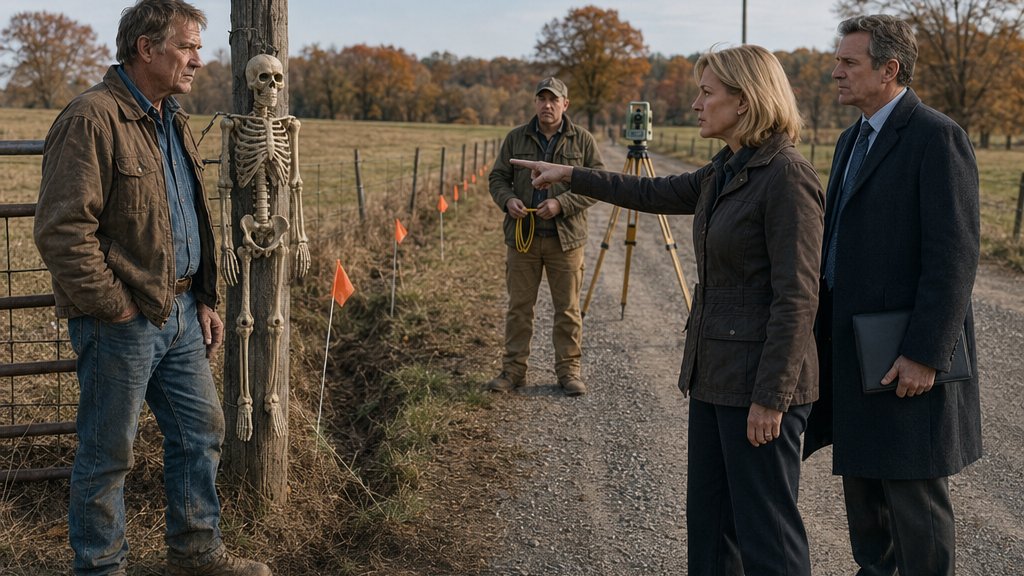
The skeleton was six feet of molded plastic bought years ago at a farm-supply clearance sale. Dennis had wired one hand around the cedar post and hung an old straw hat on its skull. A small board beneath its ribs read, in his niece’s handwriting, NO BONES ABOUT IT—SHUT THE GATE.
It had been there every October for five years.
The stranger took another picture.
Dennis climbed down.
“You lost?”
The man glanced at Dennis’s muddy boots and work jacket. “Mr. Campbell?”
“That depends.”
“I have correspondence for you.”
He held out the envelope without stepping through the gate.
Dennis took it.
“Who are you?”
“Courier.”
“For who?”
“That’ll be in the letter.”
He returned to his sedan and drove away.
Dennis watched the car disappear down the shared gravel lane toward the county road. Then he looked at the skeleton.
“You finally in trouble?”
Its jaw hung crookedly open.
By noon, Dennis had fed the cattle, repaired a loose baler belt, and left the envelope unopened on the kitchen table.
It was Carolyn White who made him open it.
She came up the lane in her spotless crossover while he was moving a mineral feeder. Instead of continuing toward her converted barn-house farther back, she stopped beside his gate and lowered her window.
“Dennis.”
He rested both hands on the feeder.
“Carolyn.”
“Did you receive something this morning?”
“So you know about it.”
“I asked Eric to handle it formally.”
Dennis’s jaw tightened. “Handle what?”
She pointed toward the skeleton.
For a moment he thought she was joking.
“You hired a lawyer over that?”
“It isn’t only that.”
“That’s what you pointed at.”
Carolyn stepped from the vehicle. She was dressed for town, not mud, but picked her way along the gravel carefully.
“We’ve had complaints.”
“From who?”
“People using the lane.”
Dennis looked down the empty road.
“How many?”
“That’s not the point.”
“It usually is when somebody says ‘people.’”
Her expression hardened.
“The association has responsibilities, Dennis. Children come through here. Delivery drivers. School pickup sometimes. That display is visible from the road.”
“It has a straw hat.”
“Some children find it disturbing.”
Dennis stared at her.
Then he laughed once—not because it was funny, but because the alternative was saying what first came into his head.
Carolyn folded her arms.
“I knew you’d dismiss it.”
“It’s a plastic skeleton.”
“And your equipment crowds the entrance. The gate opens toward the lane. You’ve got chains on the post, the old hay wagon sits too close sometimes, and sight distance there is already poor.”
That stopped him.
Dennis looked from her to the cedar post.
“So this isn’t about Halloween.”
“I didn’t say that.”
“You just listed everything except Halloween.”
Carolyn glanced toward the curve where the gravel lane narrowed between Dennis’s pasture fence and the drainage ditch.
“The association is reviewing access conditions.”
“What conditions?”
“Emergency access, for one.”
The amusement left him completely.
The shared lane had begun as a farm track long before Carolyn’s barn had become a house and long before two other homes appeared beyond it. Dennis’s father had maintained most of it himself. Over the years, people started calling it association property because an association collected money for gravel.
Dennis had never liked the phrase.
“What exactly are you reviewing?”
“You should read the letter.”
“That isn’t an answer.”
“Then come to the meeting Thursday.”
Dennis shook his head.
Carolyn gave him a tired look. “This is what I mean. Every time someone tries to discuss the road, you act as though they’re stealing your farm.”
“My farm has survived a surprising number of people explaining what belongs to them.”
“That attitude isn’t helping.”
She got back into her vehicle.
Before shutting the door, she said, “Please don’t make this harder than it needs to be.”
Dennis stood beside the mineral feeder until her crossover disappeared behind the trees.
Then he carried the envelope inside.
The letterhead belonged to Eric Roberts, Attorney at Law.
The first paragraph identified Carolyn as chair of the lane association and referred to complaints involving a “seasonal display and associated obstructions” near the shared entrance.
Dennis read it twice.
The skeleton was described as a nuisance potentially creating distraction and distress. The gate hardware, chains, and placement of farm equipment were characterized as possible interference with safe passage.
Then came the paragraph that mattered.
The association was evaluating “necessary improvements to emergency and residential access.”
Dennis set the paper down.
For years, Carolyn had complained that the lane was narrow. He had assumed it was ordinary frustration from someone who wanted a country property without country inconveniences.
Now she had hired a lawyer.
He returned outside near dusk.
The skeleton turned slightly in the wind, one heel tapping the cedar post.
Dennis ran his palm over the post’s rough gray surface.
His father had set it before Dennis was old enough to drive. The fence had been repaired around it twice, but the post itself had never moved.
At the county road, a vehicle slowed, then continued.
Dennis looked along the narrow strip of gravel.
He could imagine an ambulance there.
He could also imagine a grader blade taking another three feet from his pasture because somebody had decided the road had always been wider than it was.
The courier returned shortly before five.
This time he carried a second envelope requiring Dennis’s signature.
“You already delivered one.”
“This is separate.”
Dennis signed.
Inside was a formal demand.
The association wanted the skeleton removed, the entrance cleared, and alleged obstruction addressed within ten days. It claimed potential damages, legal expenses, and related costs.
At the bottom of the second page, one figure had been typed in bold.
$18,000.
Dennis read it standing beside the old cedar post while the skeleton’s empty eye sockets faced the road.
For the first time, the decoration no longer looked ridiculous.
It looked like an excuse.
Chapter 2: Eighteen Thousand Dollars for a Farm Decoration
Dennis circled $18,000 with a red pen until the paper nearly tore.
He sat at the kitchen table Monday morning with cold coffee, the legal demand, and three unpaid feed invoices arranged in front of him.
Eighteen thousand dollars was not enough to ruin him.
It was enough to make the threat real.
The letter tied the amount to potential damages, attorney costs, corrective expenses, and interference with what Eric Roberts called “reasonable shared-access requirements.”
Dennis underlined that phrase.
Shared access.
Not skeleton.
At nine, he folded the letter, put it inside his coat, and walked toward Carolyn’s place.
At the gate, he stopped.
The cedar post was damp from overnight fog. He put one hand against it, an old habit he had never noticed until that morning.
His father used to say property lines were easiest to lose when everybody agreed they were temporary.
Dennis had been sixteen the first time he heard that.
He had thought it was one more old man’s suspicion.
Thirty years later, he understood why certain sentences stayed.
Carolyn’s home had once been a livestock barn. The exterior still carried the long roofline, but the old openings had become tall windows, and a stone terrace replaced the loading area.
She answered on the second knock.
“Dennis.”
He held up the folded demand. “We need to talk.”
She hesitated, then stepped outside.
He did not accept when she offered coffee.
“Eighteen thousand?”
“That came from Eric.”
“You authorized Eric.”
“I authorized him to make clear that this can’t keep dragging.”
“What can’t?”
Carolyn exhaled. “The entrance.”
Dennis unfolded the letter.
“It says skeleton.”
“It says more than skeleton.”
“So did you.”
A vehicle passed slowly behind him, tires crunching gravel.
Carolyn waited until it was gone.
“The lane committee has been discussing improvements since spring.”
“You discussed them.”
“You didn’t attend.”
“I wasn’t asked until after you had a plan.”
“You were invited twice.”
Dennis’s mouth tightened.
That was true.
He had thrown the first meeting notice onto a stack of seed catalogs and ignored the second after seeing the phrase infrastructure modernization.
He had assumed they meant fresh gravel.
Carolyn continued.
“The entrance is too narrow. Drivers pull half into your grass when they meet someone. Your hay wagon has been left beside the gate more than once. The gate hardware sticks out. And yes, the skeleton has caused complaints.”
“Still waiting to hear from all these terrified people.”
“This isn’t funny.”
“No. Eighteen thousand dollars isn’t.”
Something changed in her face—not guilt exactly, but discomfort.
“Eric used the strongest available language.”
“That makes me feel much better.”
“Dennis, I’m not trying to take your farm.”
He looked at her for a long second.
“I didn’t say you were.”
“You always act like that’s what anyone wants.”
There it was again.
That same accusation.
Old man guarding every inch.
Difficult farmer.
The person progress had to move around.
“What work?” he asked.
Carolyn’s expression became careful.
“What?”
“You said this can’t keep dragging. What work is scheduled?”
She looked toward the lane.
“We have crews available next week.”
Dennis went still.
“What crews?”
“Grading. Drainage. Widening the narrow section.”
“How wide?”
“Enough to meet the recommended clearance.”
“That’s not a number.”
“The contractor has specifications.”
“On whose land?”
“The existing right-of-way.”
Dennis folded the letter slowly.
“You booked a contractor before you settled where the right-of-way is?”
Carolyn’s patience broke.
“The road has been used in the same place for decades.”
“Used isn’t owned.”
“There is a recorded easement.”
“I know.”
“Then what are we arguing about?”
“Width.”
Carolyn stared at him.
For the first time since he’d arrived, she looked less certain.
Dennis saw it.
Then she recovered.
“The association has legal advice.”
“From Eric?”
“Yes.”
“Did Eric survey it?”
“No.”
“Did you?”
“You’re doing exactly what you always do.”
“What is that?”
“Turning one practical issue into a property fight.”
Dennis felt heat rise behind his collar.
“Your lawyer threatened me with eighteen thousand dollars over a skeleton.”
“Because you refuse every smaller conversation.”
That landed harder than he wanted it to.
He had ignored the meetings.
He had dismissed Carolyn before reading what she actually wanted.
But that did not explain why she had tied a nuisance complaint to road work.
He looked at the converted barn behind her, then at the lane.
“If the road needs discussing, we discuss the road. You don’t hang eighteen thousand dollars on a plastic decoration to make me cooperate.”
Carolyn’s mouth pressed into a line.
“You need to clear the entrance before the crews arrive.”
“No.”
“Dennis.”
“No equipment moves through my fence until somebody shows me exactly what they have a right to touch.”
“This is why nothing gets done.”
“Then nothing gets done.”
He turned away.
“There’s a meeting Thursday,” she called after him. “Come this time.”
Dennis kept walking.
“I won’t sit in a room while you explain my land to me.”
It sounded strong when he said it.
By afternoon, it felt less satisfying.
One of the neighboring farmers stopped by for a hydraulic fitting and mentioned that Carolyn had already told several association members Dennis was refusing a safety improvement.
“She says emergency rigs have trouble getting through.”
“They do?”
The farmer shrugged. “I’ve seen the big county ambulance slow down there.”
Dennis looked toward the lane.
“Slow isn’t stuck.”
“No. But I wouldn’t want to meet your hay wagon coming the other way.”
Dennis handed him the fitting.
After the truck left, he stood alone in the equipment shed, hearing Carolyn’s words again.
You refuse every smaller conversation.
He did not like that she was partly right.
He liked even less what she was doing with that truth.
Thursday’s meeting notice sat on his counter.
He threw it away.
Friday morning, Dennis heard a pickup idle near the pasture before sunrise.
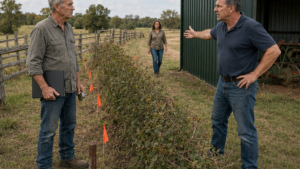
By the time he reached the gate, a contractor had already driven three bright orange stakes into the ground.
One stood beside the gravel.
One stood inches from his woven-wire fence.
The third was several feet inside the pasture.
Dennis walked through wet grass toward it.
A thin orange marking line connected the stakes.
It did not follow the road.
It cut straight across ground his cattle had grazed for decades.
The contractor, carrying another bundle of stakes, raised a hand.
“Morning. We’re marking the widening.”
Dennis pulled the third stake from the soil.
“Not here you’re not.”
The contractor stopped.
Dennis held up the stake.
“Who gave you this line?”
The man pointed down the road.
“Association plan.”
Dennis looked at the orange cord crossing his pasture.
For two days he had been asking himself what Carolyn actually wanted.
Now part of the answer was standing in his hand.
Chapter 3: The Survey Line Crossed the Fence
The gravel arrived before Dennis finished breakfast.
A dump truck backed toward the farm entrance with its warning alarm sounding through the cold morning, then tipped a gray mound beside the pasture fence.
Dennis came out without his coat buttoned.
“Stop.”
The driver lowered the bed.
“I’m already stopped.”
“You unloading for the association?”
“That’s what the ticket says.”
Dennis looked at the gravel pile, then at the orange stakes extending beyond his fence line.
“No more comes off that truck.”
The driver glanced at the paperwork clipped beside his seat. “You’ll have to call whoever hired us.”
“I’ll do better.”
Dennis called the county office and asked for a surveyor.
By ten thirty, Carolyn’s crossover had arrived, followed by Eric Roberts in a dark sedan and the association secretary in a pickup. The contractor stood near the grader with his arms crossed.
The skeleton still hung beside the gate.
Its straw hat had slipped sideways.
Eric noticed it immediately.
“I was under the impression that was being removed.”
Dennis looked at him.
“You came all this way for Halloween decorations?”
Eric adjusted his cuffs. “I came because my client says you’re interfering with contracted work.”
“Your client put stakes in my pasture.”
Carolyn stepped forward.
“They’re within the road right-of-way.”
“You keep saying that.”
“Because it’s true.”
Dennis nodded toward the orange line.
“Then measuring it shouldn’t hurt.”
A county surveyor pulled in fifteen minutes later.
He was not there to establish a final boundary—he made that clear before taking anything from his truck.
“I can locate recorded monuments and compare them with the mapping we have,” he said. “I’m not settling a private title dispute at the side of the road.”
“Fine,” Dennis said. “Locate what you can.”
Carolyn crossed her arms.
“This is unnecessary.”
Dennis almost smiled.
“Eighteen thousand dollars ago, I’d have agreed.”
The surveyor began at the county-road end of the lane, checking reference points against a tablet and an old coordinate sheet.
Everyone followed him slowly.
No one talked much.
That silence did more to unsettle Carolyn than an argument would have.
The first measurement put the edge of the traveled gravel roughly where everyone expected.
The second narrowed the distance between the road and Dennis’s fence.
At the third, near the cedar post, the surveyor stopped.
He looked at his screen.
Then at the ground.
“Who set these orange stakes?”
“The contractor,” Carolyn said. “According to the association plan.”
The surveyor nodded.
“What was that plan based on?”
“Our right-of-way.”
“I understand. What width?”
Carolyn glanced at Eric.
Eric answered. “The association believes it has sufficient access for the proposed improvements.”
The surveyor looked at him.
“That’s not a width.”
Dennis said nothing.
The surveyor walked toward the cedar post.
It leaned slightly toward the pasture, silver-gray except where old fence wire had cut dark grooves into it.
The skeleton rotated in the breeze as the surveyor passed.
He set one end of a tape at a located monument and stretched the other toward the road.
“Hold this.”
Dennis took it.
Carolyn watched.
The tape crossed the gravel edge.
Then the ditch.
Then reached the orange stake inside Dennis’s pasture.
The surveyor crouched.
He checked the tablet again.
“Interesting.”
Carolyn stepped closer.
“What?”
“I’d want the original easement before saying anything final.”
“What does the current map show?”
“It shows a traveled access corridor.”
“We know that.”
“Yes. But this proposed stake line extends beyond what I’m seeing represented as the existing road corridor.”
Dennis looked down at the tape.
“How far?”
The surveyor gave him a number.
It was not enormous.
A few feet.
On paper, a few feet could look trivial.
Along several hundred feet of pasture, it was not.
Carolyn shook her head.
“That fence isn’t original.”
Dennis looked at her.
“What?”
“The fence has been repaired. Everyone knows that.”
“Repaired isn’t moved.”
“You don’t know exactly where it was forty years ago.”
“I know where that post was.”
He pointed at the cedar post.
Carolyn gave a short, incredulous laugh.
“That thing?”
“My father set it.”
“That does not make it a legal monument.”
Dennis felt the old instinct rise—to snap back, to make certainty do the work that evidence had not yet done.
The surveyor spoke first.
“She is right about one thing. A fence post isn’t automatically a boundary marker.”
Carolyn’s shoulders loosened.
Then he added, “But old improvements can help interpret historic occupation if they correspond with recorded evidence.”
Her expression tightened again.
Eric stepped toward the gravel pile.
“So we’re not proving anything today.”
“No,” the surveyor said.
Dennis looked at him.
“But we’re not disproving it either.”
“No.”
The contractor kicked at a stone.
“Can I grade or not?”
The surveyor straightened.
“That’s not my authorization to give.”
Dennis pointed toward the orange line.
“You cross that fence before this is settled, you’ll be doing it over my objection.”
Carolyn turned toward him.
“There it is.”
“What?”
“This is exactly the problem. We bring in professionals, and you still make it personal.”
Dennis stared at her.
“You put a legal claim on a Halloween skeleton.”
“The skeleton is one part of a larger safety issue.”
“Then why didn’t your letter say, ‘Dennis, we need to settle the right-of-way before widening the road’?”
Carolyn’s face flushed.
“We tried talking to you.”
“You sent meeting notices.”
“And you ignored them.”
That stopped him.
The association secretary looked away.
Dennis felt every pair of eyes on him.
He could deny it.
He could say the meetings were vague.
He could say Carolyn had already made up her mind.
All of those things were partly true.
None erased the fact that he had refused to sit down.
“I ignored them,” he said.
Carolyn looked surprised.
Dennis continued.
“That was my mistake. It doesn’t give you my pasture.”
For several seconds, nobody spoke.
The surveyor walked back to the cedar post.
“There’s another issue.”
He bent beside it and brushed dead grass away from the base.
An old line of wire, nearly buried, ran at an angle beneath the current fence.
Dennis recognized it immediately.
“That was the original woven wire.”
“You sure?”
“Yes.”
“My father left it when we rebuilt.”
The surveyor followed the rusted line with his eyes.
It did not prove the boundary.
But it ran almost exactly parallel to the older road edge shown on his screen.
Carolyn saw it too.
Her confidence changed—not collapsing, but becoming more deliberate.
“What do you need?” she asked.
“The original easement description,” the surveyor said. “Road petitions too, if there were any. Maybe old survey notes.”
Eric checked his watch.
“How long?”
“Depends what the county has.”
Carolyn looked toward the contractor.
“Can they at least continue drainage work?”
“Not on disputed ground,” Dennis said.
Eric turned to him.
“You are not the issuing authority.”
“No. I’m the landowner objecting before somebody digs.”
The surveyor nodded toward the orange stakes.
“I’d recommend everyone pause until the underlying documents are reviewed.”
That was the first moment Dennis felt something close to victory.
The grader remained parked.
The gravel remained in its pile.
Carolyn’s planned line no longer looked inevitable.
Then the surveyor rolled up his tape and handed Dennis the loose end.
“Don’t celebrate yet.”
Dennis frowned.
“The easement could be wider than the traveled road. Old maps don’t always display rights accurately.”
Carolyn seized on that.
“Exactly.”
The surveyor looked at her.
“It could also be narrower than your proposed work.”
Her answer died.
He packed his equipment.
“Get the original recorded instrument. Until then, you’re all arguing from assumptions.”
Dennis looked at the cedar post.
That morning, it had been an old piece of farm wood with a skeleton hanging from it.
Now everyone was looking at it differently.
Not as proof.
As a question.
The county surveyor started his truck, then lowered the window.
“Mr. Campbell.”
Dennis stepped closer.
“If you want to know what that association actually has a right to use, don’t bring me another modern map.”
“What do I bring?”
“The original easement.”
He looked once toward Carolyn’s orange stakes.
“Because whatever is written there matters more than what any of you have been calling the road for the last twenty years.”
Chapter 4: The Plat Book No One Wanted Opened
Ruth Mitchell put one finger on the easement description and said, “Your orange stakes are on the wrong side of this line.”
Dennis did not smile.
They were sitting at a scratched table in the county records office with three oversized books open between them, each one smelling faintly of paper dust and basement air. Ruth had retired two years earlier, but the county clerk had recognized her when Dennis walked in and had waved them toward the old plat cabinets without argument.
Ruth pushed her glasses higher.
“Before you start planning your victory parade, I said the stakes are beyond what this description appears to grant. I did not say I just settled your boundary.”
“I don’t own a parade.”
“You own cattle. Same amount of noise.”
Dennis leaned over the page.
The original easement was older than Carolyn’s house, older than the association, and nearly as old as the cedar post. It granted passage from the county road to parcels behind the Campbell farm.
Passage.
Dennis followed the typed description with his finger.
“What about widening?”
“Not mentioned.”
“Shoulder?”
“No.”
“Drainage?”
“Maintenance necessary for passage could be argued. Expansion is another question.”
Dennis looked at her.
“So they can’t do it.”
Ruth closed one book halfway.
“That is exactly the kind of sentence that gets neighbors into court.”
He leaned back.
“You just said—”
“I said what the record says. Records are evidence. They aren’t magic spells.”
She had always been like this. Even when Dennis’s father came to the county office decades earlier, Ruth had refused to tell him what he wanted to hear until the paper supported it.
Dennis looked again at the legal description.
The corridor appeared narrower than Carolyn’s proposed widening.
That much was difficult to ignore.
Ruth opened a survey index and traced a reference number.
“Here’s something else.”
She pulled an older field sketch from a sleeve.
Dennis recognized the curve of the lane first.
Then the fence.
Then a small mark beside it.
“What is that?”
“Could be a post.”
He leaned closer.
Beside the symbol was a faded notation referring to a cedar corner and existing woven wire.
Dennis felt something settle in his chest.
“The post.”
“Maybe.”
“Ruth.”
“Maybe.”
“My father didn’t move it.”
“I believe you.”
“Then—”
“That still doesn’t make memory a recorded monument.”
Dennis gripped the edge of the table.
For two days he had imagined bringing Carolyn a clean answer. A document. A line she could not talk around.
Instead he had accumulated several pieces that pointed in the same direction without giving him the one thing he wanted: absolute certainty.
Ruth watched him.
“You came here looking for a weapon.”
“I came looking for the record.”
“Same thing, the way you’re holding your jaw.”
Dennis stood and walked toward the window.
Across the parking lot, a county road truck idled beside the courthouse annex.
“Her contractor was already inside my pasture.”
“I know.”
“She threatened me with eighteen thousand dollars.”
“I know that too.”
“So why shouldn’t I stop her?”
“I didn’t say you shouldn’t.”
Ruth lowered her voice.
“I said don’t turn good evidence into bad claims because you’re angry.”
Dennis returned to the table.
That was when she pulled out the road-maintenance file.
It contained recent correspondence rather than old deeds. Gravel invoices. Drainage recommendations. Complaints about vehicles meeting at the entrance.
One county note caught Dennis’s attention.
The largest ambulance used by the regional service could enter the lane, but turning clearance and opposing traffic created a pinch point near his gate.
Dennis read it twice.
“They’ve been through there.”
“Yes.”
“So the road works.”
Ruth tilted her head.
“The note doesn’t say it works well.”
Dennis looked down.
There was a recommendation for improved clearance or a designated pull-off.
Not an order.
Not permission to take his pasture.
But not nothing either.
The clean moral picture he had built since the survey began to blur.
Carolyn had exaggerated.
She had used a nuisance complaint as leverage.
She might even have pushed work onto land she knew she did not control.
But the access problem was not invented.
Ruth turned another page.
A contractor estimate from earlier that summer was attached to an email exchange with the association.
Dennis skimmed it.
The proposed widening line resembled the orange stakes outside his farm.
At the bottom was a note.
Boundary location along Campbell frontage to be confirmed prior to earthwork. Existing fence alignment may not correspond with assumed association width.
Dennis stopped.
“When was this sent?”
Ruth checked the date.
“July.”
Months before the skeleton.
Dennis felt the anger return, colder than before.
“So they knew.”
“Somebody knew there was uncertainty.”
“Carolyn?”
“Keep reading.”
The file contained a later message from the contractor addressed to the association chair.
The note was plain.
No grading beyond existing traveled surface was recommended until ownership and easement limits were verified.
Dennis stared at Carolyn White’s name in the routing line.
Ruth said nothing.
He read the date.
Then read it again.
It came weeks before the attorney’s demand.
Before Eric Roberts accused Dennis of obstructing reasonable access.
Before Carolyn told him crews were already booked.
“She knew.”
“She was warned.”
“Same thing.”
“Not always.”
Dennis pushed back from the table.
“What difference does it make?”
“The difference between uncertainty and fraud. Don’t claim the second because you’re furious about the first.”
He gathered the copies.
Ruth put her hand on the contractor warning before he could take it.
“One more thing.”
“What?”
“If you stop the work, that solves your boundary problem.”
“Yes.”
“It doesn’t solve the road.”
Dennis looked at the emergency-clearance note.
“I didn’t make the road narrow.”
“No.”
“I’m not responsible for everybody who bought property behind me.”
“No.”
Ruth released the paper.
“But if the question becomes whether you were right about the land, you’re probably in a strong position.”
Dennis waited.
“If the question becomes whether you knew there was a safety problem and refused even to discuss an alternative, that’s a different story.”
Dennis folded the copies carefully.
He disliked the distinction because it was harder than being right.
That evening he spread the easement, survey sketch, contractor warning, and emergency-access note across his kitchen table.
The folded plat covered the spot where the $18,000 demand had sat three days earlier.
He could stop Carolyn’s grader.
For the first time, he was reasonably sure of that.
But the same file proving she had pushed too far also proved something Dennis had been unwilling to admit.
The lane had a real problem.
His phone rang.
It was the association secretary.
“The county suspended the grading pending review,” she said.
Dennis looked toward the dark window.
“Good.”
“There’ll be an emergency meeting Wednesday.”
“I’ll think about it.”
A pause.
Then she said, “You should come.”
Dennis almost gave the answer he had given every other time.
Instead he looked at the contractor’s warning.
Carolyn had received it before she ordered the gravel.
Before the legal threat.
Before the skeleton became a nuisance worth eighteen thousand dollars.
“I’ll be there,” Dennis said.
Chapter 5: The Reason Carolyn Needed the Road Wider
Carolyn opened the association meeting by placing a photograph of an ambulance on the table.
Nobody spoke.
The meeting was held in the converted community barn near the far end of the lane. Folding chairs surrounded two long tables normally used for potlucks and association dues. Dennis sat near the back with the county plat folded inside his coat.
Carolyn remained standing.
“This was taken fourteen months ago,” she said.
The photograph showed a county ambulance angled awkwardly along the gravel lane. Its rear wheels were close to the ditch. A pickup had been pulled partly into Dennis’s grass to let it pass.
Dennis recognized the gate in the background.
His gate.
Carolyn put down a second photograph.
Her voice changed.
“My husband was inside that ambulance.”
Dennis looked up.
Until then, he had assumed the access campaign was about property value, convenience, or Carolyn’s habit of wanting everything around her orderly.
She kept one hand pressed flat against the table.
“He collapsed at home. The first crew came in a smaller unit. When the transport ambulance arrived, they lost time at the entrance because another vehicle was trying to leave.”
“How much time?” one resident asked.
Carolyn hesitated.
“I don’t know exactly.”
That answer mattered.
She could have inflated it.
She didn’t.
“He recovered,” she continued. “But I stood there watching them maneuver while somebody was working on him in the back.”
Dennis felt the folded plat against his ribs.
Carolyn looked directly at him.
“That is why I have pushed the road issue.”
The room was quiet enough for Dennis to hear the heater click on.
For the first time, Carolyn’s insistence had a shape he understood.
Fear.
Not abstract fear.
The kind that could attach itself permanently to a place.
Dennis knew something about that. His father’s warning about temporary land agreements had shaped half his adult decisions.
Fear could outlive the event that created it.
That did not make every decision after it reasonable.
Dennis stood.
Carolyn’s eyes went to the folder in his hand.
“I should’ve come to the earlier meetings,” he said.
A few people shifted in their chairs.
“I didn’t. That’s on me.”
Carolyn looked surprised again, the same way she had at the survey.
Dennis unfolded the county plat.
“But ignoring a meeting doesn’t give the association land it doesn’t own.”
He placed the easement copy beside the ambulance photograph.
Then the survey sketch.
Then the contractor warning.
Eric Roberts, seated beside Carolyn, leaned forward.
“What is that last document?”
“A contractor note from July.”
Carolyn’s face changed.
Dennis saw Eric notice.
He slid the copy toward him.
Eric read it silently.
The room seemed to contract around the table.
Finally he asked Carolyn, “You received this?”
She did not answer immediately.
“Carolyn?”
“Yes.”
Eric looked down again.
“The contractor specifically advised against grading beyond the existing traveled surface until the boundary was confirmed.”
“I believed the association easement was sufficient.”
Dennis said, “Then why didn’t you confirm it?”
Carolyn’s eyes flashed.
“Because we’d spent months getting nowhere.”
“With me?”
“With everybody. The county wouldn’t redesign a private lane. Residents wanted something done. Contractors wouldn’t hold pricing forever. And every time your name came up, somebody said you’d fight any change.”
Dennis absorbed that without reacting.
It was not entirely unfair.
Eric tapped the warning.
“But you didn’t give me this.”
Carolyn looked at him.
“I gave you the association file.”
“No. You gave me selected correspondence.”
The distinction landed across the room harder than an accusation.
Carolyn’s shoulders stiffened.
“I asked you to address the obstruction.”
“You asked me to send a nuisance demand tied to access interference.”
“The skeleton was an issue.”
Dennis nearly laughed, but stopped himself.
Carolyn turned toward him.
“You think this is funny?”
“No.”
“Because I watched my husband turn gray while an ambulance tried to get down this road.”
“And I believe you.”
That quieted her.
Dennis put both hands on the table.
“But you knew there was a boundary question. You scheduled the work anyway. Then you used that ridiculous skeleton to make me look like the reason nothing could be fixed.”
Carolyn’s face tightened.
“I needed you to engage.”
“You needed me cornered.”
Neither spoke for a moment.
Then the road-department supervisor, who had been listening from the end of the table, cleared his throat.
“The county’s position is straightforward. No widening into disputed private ground until rights are established.”
Dennis felt the first clean relief of the evening.
Then the supervisor continued.
“The access concern is also legitimate.”
Dennis looked at him.
“The lane does not meet the clearance we’d prefer at the entrance for simultaneous emergency and residential traffic. We’re not ordering a private-road reconstruction, but we recommend a lawful safety plan.”
Carolyn folded her arms.
“So Dennis gets what he wants, and we still have the same problem.”
Dennis looked at the ambulance photograph again.
He understood the trap in the sentence.
If he answered angrily, he became exactly the man Carolyn had described.
If he surrendered the strip, he betrayed the line he had spent days proving.
The county supervisor slid a sheet onto the table.
“Thirty days. The association can submit a revised plan showing work entirely within established rights, or bring documented permission from affected landowners.”
“Until then?” Eric asked.
“No widening.”
Carolyn looked down.
The victory Dennis had imagined in the records office arrived without satisfaction.
The grader was stopped.
The orange line had no authority.
Eric now knew Carolyn had withheld material information.
And still the photograph remained on the table.
Dennis refolded the plat.
Carolyn spoke before he reached the door.
“So that’s it?”
He turned.
“What?”
“You proved the line. You stop the project. Everybody goes home?”
Dennis looked at her husband inside the ambulance.
Then at the map under his hand.
“I don’t know yet.”
It was the first honest answer he had given her that did not contain a defense.
Outside, the cedar post waited at the far end of the dark lane.
For years Dennis had thought protecting land meant knowing exactly where to say no.
The county had just given him thirty days to decide whether knowing where to say yes might be harder.
Chapter 6: Winning the Boundary Was Not Enough
Dennis pulled the first orange stake from the pasture and threw it toward the fence.
Then he reached for the second and stopped.
The remaining flags ran in a bright line down the edge of his lower field, absurd against the faded November grass. The grader was gone. The gravel pile had been removed. Nothing forced him to leave the stakes there.
Still, he let the second one stand.
He went back to the barn for a measuring wheel.
For three days after the association meeting, Dennis had told himself the road was no longer his problem.
Each time, he remembered the ambulance photograph.
On the fourth morning he began measuring.
He started at the cedar post.
The wheel clicked steadily beside him as he followed the edge of the pasture. He measured the existing gravel, the drainage ditch, the fence, and the triangular corner where the lower field pinched against the county road.
That corner had never grown much hay.
The soil stayed compacted near the entrance, and machinery already turned there during harvest.
Dennis stopped.
He measured again.
Then a third time.
A vehicle could pull aside there.
Not a widened road running hundreds of feet through his pasture.
A turnout.
He stood in the grass and pictured an ambulance entering while a pickup waited safely off the traveled lane.
The idea irritated him because it worked.
At the farmhouse, Dennis spread the plat map across the table.
Beside it he placed a blank sheet of paper and drew a rough shape.
The proposed turnout would occupy a small piece of his land but would not require transferring ownership. If permission were written narrowly—emergency access, passing clearance, maintenance limits, no expansion—it could solve the pinch point without turning the entire shoulder into association property.
He stared at the drawing.
His father’s voice came back to him.
Temporary becomes permanent when nobody writes down what temporary means.
Dennis had spent decades treating that warning as a command never to give anything.
Maybe he had misunderstood it.
That afternoon, he called Eric Roberts.
“You still representing the association?”
A pause.
“I represent Carolyn in the nuisance matter. I’m advising the association separately on the access issue.”
“Good enough.”
“What do you need?”
“I have a proposal.”
Eric arrived the next morning.
Dennis did not invite him into the house. They walked the entrance together.
Dennis showed him the measurements.
“A turnout here. No widening beyond the existing lane farther in.”
Eric studied the ground.
“How much area?”
Dennis gave him the figures.
“And you’re offering an easement?”
“No.”
Eric looked at him.
“Then what?”
“A revocable license with a fixed term and renewal provisions. Emergency and passing use only. Maintenance spelled out. No ownership interest. No prescriptive claim. No additional widening.”
Eric’s eyebrows rose.
“You’ve thought about this.”
“I’ve had reason.”
Eric walked the proposed edge.
“This might work.”
“It does work.”
“I’d want the county to review the dimensions.”
“Fine.”
“And the association would maintain it?”
“Within the written limits.”
Eric nodded.
“You realize a license can make financing future improvements more complicated.”
“I don’t care about financing their improvements.”
“You care enough to offer this.”
Dennis looked toward the cedar post.
“I care whether an ambulance gets through. That’s different.”
Eric said nothing for a moment.
Then he folded Dennis’s sketch and slipped it into his folder.
“I’ll take it to Carolyn.”
Her answer came that afternoon.
No.
Dennis heard it directly from her when she pulled into his drive.
She remained in the vehicle.
“I won’t sign something saying the strip is exclusively yours.”
“That is what the records show.”
“It is what you claim the records show.”
“The county stopped your work.”
“That isn’t the same as deciding title.”
“No. Which is why I’m offering a license instead of making you sue me to find out.”
Carolyn’s hands tightened on the steering wheel.
“A license means every time we use that turnout, we’re admitting the association has no existing right there.”
“Yes.”
She stared at him.
At last Dennis understood what still mattered to her.
It was no longer only access.
It was losing.
The same thing had mattered to him when he refused the meetings.
He had just called it principle.
“Carolyn,” he said, “you wanted a safer entrance.”
“I want a permanent solution.”
“So do I.”
“Then grant an easement.”
“No.”
“Why?”
Dennis looked toward the pasture.
Because my father told me not to.
The answer rose immediately.
He did not use it.
Instead he said, “Because the access need is specific. I’m willing to solve that need. I’m not willing to surrender land so nobody ever has to ask me again.”
Carolyn shook her head.
“Everything with you comes back to ownership.”
“And everything with you comes back to control.”
The words landed badly.
Dennis regretted them at once.
Carolyn’s face closed.
“There. That’s what you think of me.”
“No.”
“It is.”
She shifted into drive.
Dennis stepped back.
“Carolyn.”
She lowered the window only halfway.
He could have let her leave angry.
A week earlier he would have.
Instead he said, “I believe you about your husband.”
She did not move.
“I believe that scared you,” Dennis continued. “I’d have been scared too.”
Her expression changed almost imperceptibly.
“But being scared didn’t give you the right to hide that contractor warning from Eric. And being right about the boundary doesn’t give me the right to pretend the road is fine.”
Carolyn looked past him toward the gate.
For a moment Dennis thought she might answer.
She drove away.
Two days later Eric called.
“Carolyn still won’t accept the license language.”
“Then she won’t.”
“The county deadline is next Friday.”
“I know.”
“There may be a compromise on terminology.”
Dennis looked down at the plat map.
“No.”
Eric sighed.
“You’re offering the ground. Why die over a word?”
“Because the word decides what happens ten years from now.”
Silence.
Then Eric said, “You know, from my side, you’re both exhausting.”
Dennis almost smiled.
“Send me the final draft by Wednesday. Same ownership language. Same limits.”
“And if Carolyn says no?”
Dennis folded the plat along its old crease.
The map no longer looked like a weapon.
It looked like a choice he had already made.
“Then the offer expires with the county deadline.”
He ended the call and walked outside.
At the cedar post, the plastic skeleton still hung in its straw hat, though Halloween had passed days earlier.
Dennis reached up and straightened the hat.
Then he looked down the lane toward Carolyn’s house.
He had finally offered enough to make the road safer without giving away the farm.
Now Carolyn had to decide whether safety had ever been the thing she wanted most.
Chapter 7: The Gate Stayed Where It Had Always Been
The road grader arrived at eight fifteen on Friday morning and stopped six feet short of the cedar post.
Dennis was already there.
He stood beside the gate with his hands in his coat pockets while the operator shut down the engine and climbed from the cab.
“You Dennis Campbell?”
“Yes.”
“I’ve got revised limits.”
The operator unfolded a laminated work sheet against the grader’s tire.
Dennis looked at the marked area.
The proposed turnout began near the county road, widened briefly into the unused corner of his pasture, then narrowed again before the cedar post. No line crossed the fence farther in. No shoulder ran down the length of his hay field.
Dennis traced the boundary with one finger.
“Who signed this?”
“County reviewed it yesterday. Association sent it over this morning.”
Dennis looked down the lane.
Carolyn’s crossover appeared between the trees.
Eric Roberts followed behind her.
For several seconds nobody moved.
The skeleton still hung from the cedar post, though the straw hat had finally blown away.
Halloween had been over for a week.
Dennis had left the decoration there partly because he had been busy and partly because taking it down while the nuisance claim remained unresolved felt too much like surrender.
Carolyn parked near the gravel pile that had once marked the start of the disputed work.
She got out carrying a folder.
Eric joined her.
“Morning,” he said.
Dennis nodded.
Carolyn did not bother with a greeting.
“Eric says the documents are ready.”
“Depends what’s in them.”
Eric opened the folder.
“The association accepts a five-year renewable license for the turnout area. Emergency access, passing clearance, snow removal, and ordinary surface maintenance only. No widening beyond the marked footprint without written permission.”
Dennis held out his hand.
Eric gave him the draft.
Dennis read the ownership clause first.
The licensed area remained Dennis’s property.
Use under the agreement would not establish adverse possession, prescriptive rights, permanent easement rights, or any expanded association claim.
He read it again.
Then he looked at Carolyn.
“You agreed to this?”
She stared past him toward the field.
“I agreed to get the road fixed.”
“That isn’t what I asked.”
“I know.”
Dennis waited.
Carolyn finally met his eyes.
“Yes. I agreed.”
The grader operator shifted his weight but kept quiet.
Eric removed another document.
“There is one more matter.”
He gave Dennis a single-page letter.
The first line referred to the nuisance demand.
The second withdrew it.
Dennis’s eyes moved to the paragraph below.
The threatened $18,000 claim, along with the allegation that Dennis had unlawfully interfered with association access, would not be pursued.
He looked up.
“What changed?”
Eric glanced at Carolyn before answering.
“The information provided to me when I sent the demand was incomplete.”
Carolyn’s expression tightened.
Eric continued carefully.
“I was not given the contractor warning concerning the boundary issue. Had I reviewed it beforehand, my letter would have been substantially different.”
Dennis folded the withdrawal.
“No eighteen thousand.”
“No.”
“And no claim that the gate hardware is blocking the association.”
“Not under the revised access arrangement.”
Dennis nodded.
A clean victory was sitting in his hand.
For weeks he had imagined this moment differently.
He had imagined Carolyn embarrassed. Eric apologetic. The association forced to admit Dennis had been right from the beginning.
Instead Carolyn looked tired.
Eric looked professional and uncomfortable.
The road still needed work.
And Dennis could remember exactly how many meeting notices he had ignored.
He took a pen from Eric.
“Where?”
Eric pointed.
Dennis signed the license.
Then he handed the pen to Carolyn.
She read the page longer than necessary.
The place for her signature waited at the bottom.
“You know,” she said quietly, “if we’d done an easement, nobody would have to renegotiate this in five years.”
Dennis leaned against the gate.
“If we need it in five years, we’ll talk in five years.”
“That is exactly the kind of uncertainty I was trying to avoid.”
“I know.”
Her head came up.
Dennis looked toward the turnout.
“But your way avoided uncertainty by deciding the answer before asking me.”
Carolyn said nothing.
Dennis continued.
“My way avoided the whole conversation until you forced it.”
That seemed to catch her off guard.
He nodded toward the paper.
“Neither worked very well.”
For the first time since the dispute began, Carolyn’s expression softened without becoming friendly.
“No,” she said. “It didn’t.”
She signed.
The road-department supervisor arrived shortly after.
The work itself was almost disappointing in its simplicity.
The grader shaved the compacted grass from the triangular corner. A small load of stone followed. The operator shaped the turnout so water drained back toward the ditch without cutting into Dennis’s field.
Dennis stood beside the cedar post while the machine worked.
At one point the grader reversed toward him.
The operator stopped, checked the work sheet, then moved forward again.
The blade never crossed the old post.
That mattered more to Dennis than he expected.
Not because the cedar itself was valuable. It was splitting near the top and probably had only a few good winters left.
It mattered because the post had stopped being an argument.
It was simply where the line was.
By noon, the turnout was wide enough for a pickup to wait while another vehicle entered from the county road.
The county supervisor drove it twice.
Then he parked and looked at Dennis.
“This should solve the pinch point.”
Dennis nodded.
Carolyn stood near her vehicle.
“Will an ambulance fit?”
“Yes,” the supervisor said. “Assuming nobody parks equipment in it.”
Carolyn glanced at Dennis.
He said, “They won’t.”
The supervisor pointed farther down the lane.
“We’d still recommend keeping the gate area clear during emergency access, but this gives larger vehicles room to pass without climbing into the ditch.”
Carolyn let out a breath.
It was small.
Dennis almost missed it.
For weeks he had treated her concern as strategy because strategy was easier to fight.
That breath reminded him that before the lawyer, before the orange stakes, before the association plans, she had stood in this same lane watching an ambulance struggle while her husband lay inside.
Fear had made her push too far.
It had not excused what she did.
But it explained why winning the argument had never been enough.
The grader left after lunch.
Eric packed his papers into the sedan.
Before getting in, he approached Dennis.
“For what it’s worth, I should have asked for the complete project file before sending the first letter.”
Dennis looked at him.
“For what it’s worth, I should’ve gone to one of those meetings.”
Eric almost smiled.
“Please don’t put that in writing. It’ll ruin your reputation.”
Dennis gave him a dry look.
Eric drove away.
Carolyn remained.
The association secretary had already left. The road was quiet except for tires humming on the distant county highway.
Dennis began unhooking the skeleton from the cedar post.
Carolyn watched.
“So you’re finally taking it down.”
“Halloween’s over.”
“I thought maybe you were keeping it there to make a point.”
“I was.”
She waited.
“What point?”
Dennis lifted the plastic rib cage free.
“I wasn’t sure.”
A reluctant smile touched the corner of Carolyn’s mouth and disappeared.
Dennis set the skeleton against the gate.
She looked toward the new turnout.
“I pushed too hard.”
It was not an apology.
Not quite.
Dennis could have demanded more.
He could have reminded her about the legal threat, the contractor warning, the photographs, the gravel dumped beside his fence.
Instead he asked, “Would you do it the same way again?”
Carolyn considered the question.
“No.”
That was enough for the moment.
She turned to leave, then stopped.
“Dennis.”
“Yes?”
“I still think that thing is ugly.”
He looked at the skeleton.
“Finally something we agree on.”
She gave a short laugh.
It was the first sound between them in weeks that was not defensive.
Then she got in her crossover and drove toward home.
Dennis carried the skeleton to the equipment shed.
The next morning, a delivery truck came up the lane as Dennis was checking cattle.
A pickup approached from behind it.
The delivery driver pulled neatly into the new turnout.
The pickup passed.
Neither vehicle touched Dennis’s grass.
Neither stopped.
The entire maneuver took less than twenty seconds.
Dennis stood beside the fence and watched them disappear.
He thought about Ruth’s warning that records were not magic spells.
She had been right.
The plat had stopped the grader.
It had not solved the road.
The contractor warning had exposed Carolyn’s choice.
It had not erased the reason she made it.
The withdrawal letter had killed the $18,000 threat.
It had not restore the weeks they had spent treating each other as obstacles.
Those things required something documents could not supply.
Dennis walked to the cedar post.
The wire hook remained where the skeleton had hung.
Without the plastic bones and straw hat, the post looked smaller.
Older.
Just a weathered piece of cedar holding a gate in place.
He laid his palm against it.
For most of his life, Dennis had understood boundaries as instructions about where other people had to stop.
Now, looking at the turnout beyond it, he understood something else.
A boundary could also tell you exactly how far you were free to give.
The turnout lay open beside the road.
The pasture remained his.
The gate remained where it had always been.
And on the old cedar post, beneath the empty hook, the line between those truths was still visible.
The story has ended.