They Fined Him for Fencing the Farm Until a 1948 Survey Showed Who Had Crossed the Line
Chapter 1: The New Fence Was Already Costing Him Two Thousand Dollars
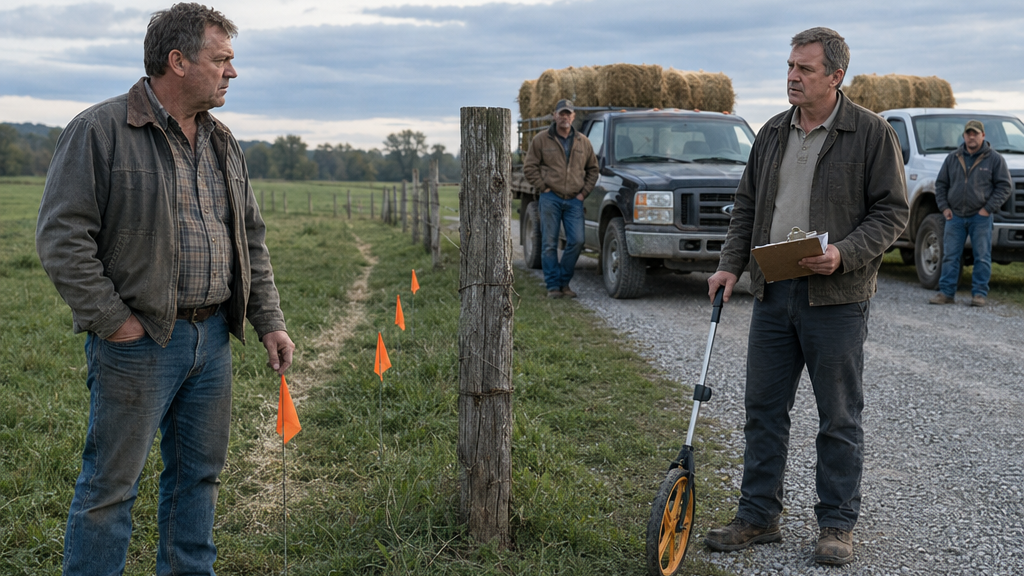
The first orange flag stood three feet inside Nicholas Hill’s pasture.
The second stood almost five.
By the time he reached the cedar corner post he had set on Saturday, there were seven of them, bright against the clipped grass along the gray gravel lane. Somebody had pushed each thin wire stem deep enough that the flags held straight in the morning breeze.
Nicholas stopped beside the post and stared down the line.
The new fence followed the pale scar left by the old woven wire almost exactly. He could still see where decades of cattle had kept the grass shorter along it. The corner post itself sat where he remembered a post standing when he was twelve, before his father replaced cedar with steel and then, years later, patched the fence so many times that there had barely been a straight stretch left.
A pickup rolled slowly up the shared lane.
Nicholas did not need to see the driver.
Ronald King parked half on the gravel shoulder and stepped out carrying a measuring wheel, a clipboard, and a folded sheet protected inside a clear plastic sleeve.
Two loaded farm trucks had stopped behind him. Their drivers remained in their cabs.
Ronald looked at the new posts.
“You didn’t move them.”
Nicholas rested one gloved hand on the cedar post. “I replaced the fence.”
“You replaced it in the wrong place.”
“That’s where it was.”
Ronald shook his head. “That’s where part of it wandered over the years.”
Nicholas glanced toward the flags. “Those yours?”
“Association measurement.”
Ronald lowered the wheel to the edge of the gravel and started walking perpendicular toward the fence.
Nicholas watched the small counter click.
Ronald stopped beside one of the orange flags.
“Right here,” he said. “That’s the setback.”
“Set back from what?”
“The association road.”
Nicholas looked from Ronald to the gravel.
“No. What point are you measuring from?”
Ronald frowned. “The road edge.”
“That moves.”
“It hasn’t moved.”
Nicholas almost laughed, but the two trucks behind Ronald kept him from doing it. The lane had been graded, widened, narrowed, crowned and reshaped more times than he could count. Spring runoff alone could move six inches of shoulder gravel in a bad year.
Nicholas walked ten yards down the fence and pushed through weeds near the ditch.
“There used to be an iron corner marker over here.”
Ronald stayed where he was. “Used to be?”
“I remember it.”
“That isn’t a survey.”
“No. But neither is measuring from loose gravel.”
One of the truck engines idled louder as its cooling fan engaged.
Ronald’s jaw tightened. He unfolded the protected sheet.
“This is the road association map.”
Nicholas took it.
Black lines showed the shared lane, parcel shapes and maintenance widths. His lower pasture was labeled with an old parcel number. A heavy dashed line ran several feet inside the place where Nicholas had rebuilt the fence.
He had never seen the drawing before.
“Where did this come from?”
“Association records.”
“Who surveyed it?”
“It’s the map we’ve used for years.”
Nicholas turned it over.
Nothing.
No surveyor’s seal. No certification. No monument references that he could see.
He handed it back.
“You didn’t answer me.”
Ronald folded the sheet more sharply than necessary.
“The association has maintained this lane since before either of us was making decisions about it.”
“That doesn’t make gravel a property corner.”
“And you remembering a rusty pin from childhood doesn’t make your post legal.”
The words carried farther than Nicholas wanted.
One of the truck drivers looked out his side window.
Nicholas felt heat rise in his face.
Ronald pulled another paper from the clipboard.
“We asked you Friday to hold off until we settled the line.”
“You asked me to put the fence five feet into my pasture.”
“I asked you not to create an access problem.”
“There’s twelve feet from my post to the traveled surface.”
“For a pickup. Not a loaded hay truck turning in here.”
Nicholas looked toward the trucks waiting behind Ronald. Now he understood why they were there.
Ronald had chosen the morning well.
The whole argument was visible.
A fence. A measuring wheel. A road. Trucks that needed room.
Anyone passing would know which man appeared to be causing the problem.
Ronald held out the paper.
Nicholas did not take it.
“What’s that?”
“Formal notice.”
“For what?”
“Encroachment into the association-maintained road corridor.”
Nicholas finally took it.
The number near the bottom caught his eye before the rest did.
$2,000.
He read it again.
“You fined me two thousand dollars?”
“The board authorized it.”
“For rebuilding a fence where the fence already stood?”
“For refusing to correct it after notice.”
“You haven’t proved it needs correcting.”
Ronald pointed toward the orange flags.
“The map puts the line there.”
“The map puts a line there. That isn’t the same thing.”
Ronald looked tired now rather than angry.
“Nicholas, just pull the posts until we sort it out.”
That almost made Nicholas agree.
Almost.
Then he looked at the two drivers, at the flags planted in his pasture, at the penalty in his hand.
If he pulled the posts now, everybody who used the lane would remember that as an admission.
“No.”
Ronald’s expression hardened.
“Then the notice stands.”
He turned toward his pickup.
Nicholas called after him.
“Ronald.”
Ronald stopped.
Nicholas pointed to the measuring wheel.
“What monument is your map tied to?”
For the first time that morning, Ronald had no answer ready.
He glanced at the plastic-covered drawing.
“The road has always been measured from the maintained edge.”
“That’s not what I asked.”
Ronald’s eyes moved toward the old fence scar.
Then back to Nicholas.
“I’ll send you the association records.”
He climbed into his truck.
The two farm trucks followed when he pulled away.
Nicholas stood alone by the cedar post with the penalty notice fluttering in his hand.
He had wanted to expose Ronald’s measurement as sloppy.
Instead, he was left with a worse question.
What if both of them were measuring from the wrong thing?
That evening Kimberly found Nicholas at the kitchen table with the notice beside his plate.
She read more slowly than he had.
Then she turned the second page over.
“Did you read this part?”
“I read it.”
“No, this part.”
She tapped a paragraph near the bottom.
Nicholas leaned closer.
The $2,000 assessment was only the initial charge.
If the stated encroachment remained after the deadline, the association could add daily penalties and recover professional costs connected to enforcement.
Kimberly looked at him.
“How many days do you have?”
Nicholas read the date.
“Ten.”
“And after that?”
He did not answer.
Kimberly pushed the paper toward him.
“Nicholas, this isn’t a fence argument anymore.”
Chapter 2: The Map Everyone Trusted Had No Surveyor’s Seal
Kimberly had already done the arithmetic when Nicholas came in from feeding cattle.
“Thirty days,” she said.
She turned her laptop around on the kitchen table.
Nicholas saw a column of numbers.
Initial assessment. Daily charges. Possible administrative costs. Survey expenses if the association ordered one and tried to bill him for it.
“At their stated rate,” Kimberly said, “this can cost more than the entire fence before we get to a lawyer.”
“We’re not getting to a lawyer.”
“You don’t know that.”
“I’m not paying an attorney to tell me where Dad’s fence was.”
Kimberly folded her arms.
“There. That.”
“What?”
“That sentence.”
Nicholas pulled off his cap and dropped it on the table.
“The fence was there.”
“I know where it was.”
“Then what are we arguing about?”
“We aren’t arguing about the fence. We’re arguing about you treating your memory like recorded evidence.”
Nicholas stared at her.
She did not look away.
That irritated him more because she was not accusing him of being wrong. She was accusing him of being certain too soon.
He went to the machinery shed after supper.
The association email had arrived with scanned records attached. Nicholas printed them because he trusted paper more when he needed to compare lines.
He spread the pages across his workbench beneath the fluorescent lights.
There were maintenance invoices, annual assessments, grading notes, culvert replacements and maps repeated so many times that at first they seemed to confirm Ronald’s position.
The same dashed boundary appeared in packet after packet.
Nicholas began laying them in date order.
The dashed line remained.
Then he reached a 1987 document.
The title stopped him.
Road Maintenance Sketch.
Not boundary survey.
Not plat.
Not legal description.
A sketch.
Nicholas leaned closer.
The drawing looked almost identical to the “association map” Ronald had used beside the lane. Same road width. Same rough parcel shapes. Same dashed line beside Nicholas’s pasture.
But in one lower corner, reduced almost to illegibility by decades of photocopying, were the words Nicholas had been waiting to see.
For maintenance planning only.
He sat back.
For ten minutes he did nothing but look at it.
Then he laughed once, quietly.
Ronald had fined him two thousand dollars using a maintenance sketch.
Nicholas carried the page into the house.
Kimberly was loading the dishwasher.
He put the paper on the counter.
“This is it.”
She dried her hands and read the heading.
“This is their map?”
“The original version.”
She looked at the small disclaimer.
“So it isn’t a survey.”
“No.”
“You’re sure?”
“There’s no seal. No monument calls. No bearings. It was drawn to show where they graded and where drainage work went.”
A smile began at the corner of Nicholas’s mouth.
Kimberly saw it.
“Don’t.”
“Don’t what?”
“Turn one mistake into proof of everything you already believe.”
He pointed at the paper.
“They’re threatening me with daily fines using a sketch that literally says it’s for maintenance.”
“That proves their paperwork is weak.”
“It proves the boundary on their paperwork isn’t surveyed.”
“Yes.”
“And that means—”
“It means you still need the actual boundary.”
Nicholas’s smile disappeared.
He took the page back.
For a moment neither of them spoke.
Kimberly softened her voice.
“You were right to question Ronald.”
Nicholas nodded once.
“But being right about that doesn’t tell you where the legal line is.”
He hated the distinction.
Mostly because he understood it.
The next morning Nicholas drove the lane slowly before starting chores.
The orange flags were still there.
He stopped at the cedar corner post and looked down toward the drainage ditch where he remembered the old iron marker.
When he was a boy, his father had once warned him not to hit it with the mower.
“That’s older than both of us,” his father had said.
Nicholas could still hear the sentence.
He stepped across the grass and searched until the weeds soaked the knees of his jeans.
Nothing.
If an iron marker had been there, grading or ditch work might have buried it years ago.
He returned to the shed and pulled a plastic tote of old farm photographs from a cabinet.
Most were useless.
Christmases. Calves. Tractors. A barn roof replacement.
Then he found one showing his father standing beside a baler near the lower pasture sometime in the early 1990s.
Nicholas carried it outside.
The old woven fence ran behind his father.
Beyond it was the lane, much narrower than it was now.
Nicholas held the photograph at arm’s length and matched the angle.
The fence scar he had followed Saturday looked right.
But the road didn’t.
The present gravel shoulder extended farther toward the pasture than the old photograph showed.
That did not prove ownership.
It proved movement.
His phone rang.
Ronald.
Nicholas answered.
“I found the source of your map.”
Silence.
Then Ronald said, “What source?”
“1987 road maintenance sketch.”
“It’s been in the association file since then.”
“Yes. And it says right on it that it’s for maintenance planning.”
“It was based on the records available.”
“Which records?”
“The old association file.”
“I’m asking which boundary survey.”
Ronald exhaled.
“Nicholas, I’m not going to debate every label on every piece of paper.”
“You fined me based on it.”
“We fined you because your fence conflicts with the corridor we’ve maintained for forty years.”
“That isn’t an answer.”
“It is the answer that matters until you produce something better.”
Nicholas looked at the photograph in his hand.
“So you won’t suspend the fine.”
“If you pull the disputed posts while you investigate, I’ll ask the board to suspend it.”
“No.”
“Then no.”
The call ended.
Nicholas stood beside the workbench for a long time.
His first instinct was to drive to Ronald’s place with the original sketch and make him read the disclaimer aloud.
Instead, he carried everything back to the kitchen.
Kimberly looked up when he entered.
“He wouldn’t suspend it?”
“No.”
“What are you going to do?”
Nicholas spread the maintenance sketch, the photograph and his deed across the table.
“Find what came before this.”
The legal description on the deed was dense with bearings and references he had read before without needing to understand every one.
This time he followed each line carefully.
Near the end was a reference to an original subdivision survey.
Filed with the county.
Nicholas read the date twice.
Kimberly leaned over his shoulder.
“Is that what you need?”
He traced the reference with his finger.
“If it still exists.”
Chapter 3: A Folded County Plat Moved the Boundary Without Moving the Land
The county recorder clerk returned carrying something that looked too fragile to settle a modern argument.
It was a wide archival folder, gray at the edges, with a handwritten notation on the tab.
“Your subdivision isn’t indexed correctly in the digital system,” the clerk said. “The scan references a later plat. This is the older one.”
Nicholas stood at the counter without touching it.
“1948?”
The clerk nodded.
“That’s the filing date.”
She opened the folder carefully.
Inside was a folded survey sheet, yellowed but intact.
Nicholas felt a ridiculous urge to smile.
For two days he had imagined this moment as the end of the argument.
Ronald’s maintenance sketch on one side.
A real old survey on the other.
Truth replacing assumption.
The clerk flattened the corners beneath clear weights.
Nicholas leaned over it.
The drawing was more precise than the association sketch but less immediately understandable. Bearings marched along property lines. Distances were written in old drafting script. Small symbols marked corners and monuments. The original road was narrower.
Nicholas found the Hill parcel.
His pulse quickened.
The line beside the lower pasture was not where Ronald’s map put it.
It sat farther toward the lane.
He took out his phone and photographed the sheet.
“You may want to talk to Margaret Roberts before you decide what it means.”
Nicholas looked up.
“Who?”
“Retired county mapping technician. She still comes in Wednesdays to help with old parcel research.”
The clerk glanced toward a side room.
“You picked the right day.”
Margaret Roberts wore reading glasses on a cord and treated Nicholas’s excitement as something requiring supervision.
He showed her the association sketch first.
She looked at it for less than a minute.
“Maintenance drawing.”
“That’s what I said.”
Margaret gave him a brief look over the top of her glasses.
“That doesn’t automatically make every line on it wrong.”
Nicholas stopped smiling.
She turned to the 1948 survey.
“This is more useful.”
“More useful?”
“Older doesn’t mean magical.”
“It’s filed.”
“Yes.”
“And it shows the boundary.”
“It shows a surveyed boundary using the monuments and measurements available then. What you need to know is whether those controls can still be recovered in the field.”
Nicholas pulled his chair closer.
Margaret pointed to a small notation near the southwest corner of his parcel.
“Here.”
Nicholas read it.
Iron pin.
Then she moved her finger to a bearing written along the line.
“This is what matters.”
“What?”
“Your later maintenance sketch doesn’t carry this bearing forward.”
Nicholas put the two documents side by side.
She was right.
The association drawing had copied the general parcel shape but simplified the line beside the road. It showed a clean setback from the lane as if the road edge itself defined the property.
The 1948 survey did not.
“What does that mean?”
“It means somebody making the later sketch may have drawn what they believed was practical rather than reproducing the surveyed geometry.”
Nicholas felt the satisfaction return.
“So my fence is right.”
Margaret sat back.
“I didn’t say that.”
“But the line is farther east.”
“On paper.”
“My corner post is almost exactly there.”
“Based on what control?”
“The old fence.”
“That is not a control.”
“My father knew where the line was.”
“That is also not a control.”
Nicholas leaned away from the table.
Margaret’s tone remained calm.
“You came here because you were angry someone treated a road edge like a legal monument.”
He said nothing.
“Don’t make the same mistake with a fence.”
That landed harder than he expected.
Nicholas looked back down at the plat.
“All right. What would convince you?”
“A licensed survey. Recovery of the original monument if possible. Corroborating corner evidence if not.”
She pointed to the lower corner notation again.
“If this iron pin still exists, it gives a surveyor something useful.”
“I remember an iron marker near the ditch.”
Now Margaret looked interested.
“Where?”
Nicholas described the spot.
“Was it flush?”
“Stuck up a couple inches when I was a kid.”
“Any reason it would’ve been removed?”
“Road work. Drainage work. Grading.”
“Then it may be buried rather than gone.”
Nicholas studied the plat.
He traced the 1948 line north.
It passed close to his newly installed cedar post.
Very close.
He felt a quiet surge of vindication.
Ronald’s flags were several feet inside the Hill parcel if this geometry survived field verification.
The fine could collapse.
Maybe Ronald would have to explain publicly why he had accused Nicholas of taking association land without checking the original records.
Maybe Nicholas would make him stand beside those orange flags and pull them himself.
Then Nicholas noticed something.
The 1948 road was drawn narrower than the present lane.
He leaned over the sheet.
“Margaret.”
She followed his finger.
“What happened here?”
“What do you mean?”
“The road.”
He took out the photograph of his father near the baler and placed it beside the survey.
“The lane used to sit farther over.”
Margaret studied the image, then the plat.
“The maintained surface certainly appears wider now.”
Nicholas took the association sketch and aligned all three records as best he could.
Old survey.
1987 maintenance drawing.
Current aerial parcel image on his phone.
The road had widened toward his pasture over time.
He felt something tighten in his stomach.
“If this line is right…”
Margaret did not finish it for him.
Nicholas traced the legal boundary again.
It did not merely run beside the modern gravel.
For part of the distance, it appeared to run beneath it.
“How far?”
“Don’t scale a legal conclusion off an old photocopy.”
“Approximately.”
Margaret hesitated.
“Several feet in places, possibly more depending on the actual field position.”
Nicholas stared at her.
He had come to the courthouse wanting proof that his fence did not occupy the association’s land.
The document in front of him suggested a different possibility entirely.
Part of the association’s road might occupy his.
He sat down again.
The anger he had carried into the building felt suddenly childish.
That lane served more than Ronald.
It carried cattle trailers, hay trucks, fertilizer deliveries and emergency vehicles to properties beyond his.
If the road had drifted onto Hill land, a corrected boundary would not just erase a fine.
It could change who controlled access.
Margaret folded her hands on the table.
“You need a surveyor before you call anyone.”
Nicholas nodded.
He was still looking at the line.
Margaret tapped the 1948 plat once.
“If this scales the way it appears, your fence isn’t the biggest problem.”
Chapter 4: The Survey Crew Found the Problem Beneath Forty Years of Gravel
The survey crew found the first iron pin less than three feet from where Nicholas remembered it.
It was not standing above the weeds anymore.
The crew chief swept a metal detector along the drainage shoulder twice, stopped, then drove a narrow shovel into the damp soil. After several minutes of scraping through roots and compacted gravel, the blade struck metal with a dull click.
Nicholas felt his chest tighten.
The crew chief knelt and cleared the hole by hand.
A rust-dark iron pin emerged beneath nearly six inches of soil.
“You remember this one?” he asked.
Nicholas stepped closer.
“I remember Dad telling me not to hit it with the mower.”
“That helps explain why you were looking here. Doesn’t establish what it is.”
Nicholas nodded.
Two days earlier, he might have argued the point.
Now he waited.
The crew chief set equipment over the recovered pin, checked the 1948 survey, then began working outward from it. Another crew member carried a prism rod farther up the lane while the instrument turned in small mechanical movements.
Ronald’s orange flags were still standing inside the pasture.
Nicholas had left them untouched.
He wanted them there when the measurements came back.
Kimberly had told him that sounded like pride.
He had told her it was evidence.
Neither of them had been entirely convinced.
The first measurements put the old pin within inches of the monument position described in the 1948 survey.
Nicholas folded his arms.
The crew chief noticed.
“Don’t celebrate yet.”
“I’m not.”
“You are.”
Nicholas looked toward the cedar post.
The crew moved north.
A survey string eventually stretched from the recovered corner toward a second point farther along the lower pasture. It crossed near the cedar post Nicholas had set on Saturday.
Not exactly through its center.
Close enough that his breathing changed.
The post was not five feet inside the association corridor.
It was almost exactly where the historic geometry said the boundary should be.
Nicholas looked across the lane.
Ronald was not there.
For one selfish second, Nicholas wished he had been.
He imagined Ronald standing where he had stood Monday, measuring from the loose gravel edge, explaining in front of two waiting trucks that Nicholas had knowingly pushed into association land.
Nicholas imagined handing him the $2,000 notice and asking whether he wanted to measure again.
The crew chief interrupted the thought.
“We need corroboration.”
The second monument was harder.
The 1948 plat referenced another iron point near a shallow turn in the drainage ditch, but grading had altered the shoulder repeatedly. The detector gave three weak signals before the crew dug.
The first was wire.
The second was an old bolt.
The third lay deeper beneath a band of compacted stone.
When the shovel uncovered the top of another iron marker, the crew chief stopped talking entirely.
Measurements followed.
Then more.
Nicholas watched figures go into the field book.
Finally the crew chief walked back to him.
“The bearing between these recovered monuments is consistent with the historic survey.”
Nicholas stared at him.
“And the fence?”
“Your new line is substantially consistent with the surveyed parcel boundary.”
Substantially.
Nicholas almost smiled at the caution of the word.
“Meaning?”
“Meaning I would not call your cedar post an encroachment into association land based on what we’ve recovered.”
The satisfaction came hard and clean.
For five days Nicholas had carried Ronald’s accusation around like grit under his skin.
Now an independent surveyor had stood in the pasture, recovered two physical monuments, and connected them to the 1948 record.
The fence was not the problem.
Nicholas looked toward the orange flags.
“Can you put that in the preliminary report?”
“Yes.”
“All of it?”
“Yes.”
He wanted to call Ronald immediately.
Then the crew chief said, “We need to talk about the road.”
Nicholas’s satisfaction stopped.
The survey string extended beyond the cedar post and continued on its proper bearing.
For part of that distance, it lay in grass.
Then it crossed the gravel shoulder.
A few yards farther north, the line disappeared beneath the traveled surface itself.
Nicholas stepped onto the lane.
“You’re telling me the boundary runs here?”
The crew chief pointed.
“Based on recovered monuments and the record geometry, yes.”
A loaded hay truck came slowly down the lane.
The driver saw the equipment and eased farther toward the opposite side.
Its right tires passed less than two feet from Nicholas.
He looked down.
The truck had just driven across his parcel.
Not a theoretical sliver at the edge.
A functioning piece of the road.
“How much?”
“It varies.”
“Maximum?”
“I don’t want to give you a final number until the calculations are complete.”
“Roughly.”
The crew chief considered it.
“Several feet of the maintained surface in this stretch. More of the shoulder.”
Nicholas walked along the string.
The old fence scar remained visible in places, running roughly parallel to it. His father had not fenced directly on the legal line everywhere. In some places he had stayed back.
Nicholas had always assumed that was because the old fence wandered.
Now the space between the scar and the surveyed boundary looked intentional.
The crew chief moved the prism rod farther up the lane.
Nicholas’s phone buzzed.
Kimberly.
He answered.
“Well?”
“The post is good.”
There was a pause.
“You’re sure?”
“Survey sure.”
He heard her exhale.
“So Ronald’s fine—”
“Kim.”
Something in his voice stopped her.
“What?”
“The road’s on us.”
“How much?”
“I don’t know yet.”
Silence.
Nicholas watched the crew set another temporary marker.
“The actual gravel?”
“Yes.”
“That road serves everyone beyond us.”
“I know.”
A few hours earlier, he had thought the best possible outcome was proving Ronald wrong.
Now that seemed almost small.
Ronald had accused him of occupying association property.
If the survey held, the reverse was closer to true.
The association had been grading, widening and maintaining a road partly across Hill land for decades.
Nicholas could demand correction.
He could insist the traveled surface move.
He could raise questions about permission, maintenance rights and future access.
He could also make it impossible for some of the larger trucks to turn safely without crossing the legal line.
None of those choices felt like victory.
Late that afternoon the preliminary field sketch arrived by email.
Nicholas opened it on the kitchen computer.
Kimberly stood behind him.
The legal line was marked clearly.
So was the existing road.
For a long stretch, the two overlapped.
At the bottom of the email, the crew chief had included a careful sentence stating that the surveyed parcel boundary appeared consistent with the 1948 record and recovered monuments.
Nicholas scrolled farther.
There was another note recommending review of any recorded easements, access agreements or historic rights affecting the roadway.
Kimberly touched the screen.
“This part is going to matter.”
Nicholas nodded.
His phone rang before he could answer.
Ronald.
Nicholas let it ring twice.
Then answered.
“I got a copy of the preliminary,” Ronald said.
“So did I.”
A long pause followed.
Ronald’s voice had lost the certainty it carried Monday.
“The association is meeting tonight.”
“You moving fast now.”
“We need to understand what this affects.”
“The fine too?”
Another pause.
“We’ll discuss everything.”
Nicholas looked at the survey line crossing through the road.
“You should’ve discussed it before you fined me.”
Ronald did not argue.
That silence gave Nicholas less satisfaction than he expected.
“Seven o’clock,” Ronald said. “Machinery shop.”
“Tonight?”
“Yes.”
Nicholas looked at Kimberly.
She had heard enough to understand.
“I’m not coming tonight,” Nicholas said.
Ronald’s voice sharpened slightly. “Why not?”
“Because your board had four decades to rely on that road and five days to fine me. I can take one weekend before I decide what this means.”
Ronald was quiet again.
“Fine.”
The call ended.
Kimberly looked at the map.
“You know they’re going to think you’re planning something.”
Nicholas looked toward the lane outside.
The survey string was still visible in the lower pasture, crossing from the cedar post toward the gravel.
For the first time since Monday, he did not care whether Ronald was embarrassed.
What worried him was how many people could be hurt if the line Nicholas had fought so hard to prove suddenly became a wall.
Chapter 5: His Father’s Notebook Made Winning the Argument Much Harder
Kimberly found the notebook behind a stack of seed invoices in the machinery office.
She carried it into the farmhouse with both hands, as if something inside might fall loose.
“Nicholas.”
He was at the kitchen table reading the preliminary survey again.
She set the notebook beside it.
The cover was black, softened at the corners by years of handling. Nicholas recognized his father’s handwriting before Kimberly opened it.
Dates.
Fuel figures.
Calving notes.
Field repairs.
Nothing unusual at first.
Then she turned to a page marked with a strip of faded masking tape.
There was a hand-drawn section of the lower lane.
Nicholas sat straighter.
The measurements were crude compared with the survey crew’s work, but the numbers meant something immediately.
Distance from ditch.
Distance from old iron pin.
Fence offset.
Road width after grading.
Nicholas pulled the preliminary survey closer.
“Where did you find this?”
“Bottom drawer.”
He compared the figures.
One measurement was within inches of the distance shown on the 1948 plat.
Another recorded the widening of the road toward the Hill pasture.
A date at the top read 1989.
Nicholas turned the page.
His father’s handwriting became smaller where the notes crowded together.
Drainage reconstruction after spring washout.
Road shifted east for crown and ditch clearance.
King side too wet to carry full width.
Nicholas stopped reading.
Kimberly leaned over.
“What?”
He pointed.
The road had not drifted gradually by accident.
At least part of the shift had been deliberate.
He turned another page.
There were notes from a meeting Nicholas did not remember. His father had listed the farms using the lane and how many large trucks needed to pass during hay season.
Then a sentence appeared beneath the measurements.
Leave fence back. Don’t make road fight bigger.
Nicholas read it twice.
The words irritated him so quickly that he shut the notebook.
Kimberly did not speak.
“He knew.”
“Yes.”
“He knew the road was over.”
“It looks like it.”
“And he did nothing.”
Kimberly pulled out the chair across from him.
“He left the fence back.”
“That is doing nothing.”
“No. It isn’t.”
“He let everyone think the line was somewhere it wasn’t.”
“He made a practical choice.”
“He made a private choice about land I inherited without telling me.”
Kimberly’s face tightened.
“There it is.”
Nicholas looked at her.
“What?”
“The part you’re actually angry about.”
He opened the notebook again.
His father’s handwriting filled the page.
Nicholas had spent years treating those notes as proof of competence. His father wrote down what mattered. Fertilizer rates. Cattle weights. Rainfall. Machinery hours.
Apparently he had also written down a property dispute and never mentioned it.
Nicholas turned more pages.
A later note referred to keeping access open after another neighbor bought wider equipment. Another mentioned that the association should eventually formalize the road width.
Eventually never happened.
Nicholas stood and walked to the window.
The lane was visible beyond the yard.
“Why wouldn’t he record an easement?”
“Maybe he thought they would.”
“He knew better than that.”
“Maybe.”
“Or maybe he didn’t want the argument.”
Kimberly was quiet.
Nicholas laughed without humor.
“That sounds familiar.”
She looked at him carefully.
His father had hated prolonged disputes.
He would absorb inconvenience until it became part of routine, then call the routine common sense.
Nicholas had spent much of his adult life resisting that habit.
He had returned to the farm determined not to let small losses become permanent because nobody wanted an uncomfortable conversation.
A fence here.
A drainage edge there.
A few feet of access.
He had told himself that protecting the farm meant refusing erosion in all its forms.
Now the notebook complicated the story.
His father had not been ignorant.
He had known the surveyed line.
He had simply valued uninterrupted access more than enforcing it.
Nicholas sat down again.
Kimberly turned to the page containing the sentence.
Don’t make road fight bigger.
“He wasn’t giving the land away,” she said.
“He let people act like it belonged to them.”
“Yes.”
“That matters.”
“I know.”
“He left me the consequences.”
“And maybe he left you the chance to fix what he didn’t.”
Nicholas looked at her.
“Without closing the road.”
“I didn’t say that.”
“You were thinking it.”
“I was thinking there has to be something between pretending the line doesn’t exist and making everyone move forty years of gravel.”
Nicholas looked at the old measurements.
The anger slowly changed shape.
His father had stayed silent because the road mattered.
That silence had protected neighbors.
It had also allowed a maintenance sketch to harden into supposed ownership.
Ronald had inherited the same assumption Nicholas had inherited the farm.
One man trusted a road.
The other trusted a fence.
Neither had checked the oldest record until the argument forced it.
Nicholas closed the notebook more gently.
His phone rang.
Ronald.
Kimberly gave him a look but said nothing.
Nicholas answered.
“You ready to meet?”
“Monday.”
“The board wants clarity before then.”
“So do I.”
Ronald breathed out.
“We’ve got operators asking whether they can move equipment through there.”
“Nobody’s blocking anything.”
“That isn’t what they’re hearing.”
“What are they hearing?”
“That you’ve got a survey showing part of the road is yours.”
“That part’s true.”
“And that you may insist the road be moved.”
Nicholas looked at his father’s notebook.
“I haven’t decided what I’m insisting on.”
“That’s the problem.”
“No, Ronald. The problem started when you fined me before checking what you owned.”
“I know what happened.”
“Do you?”
Ronald’s voice lowered.
“What happens if the board doesn’t agree to your terms?”
“I haven’t given you terms.”
“Then answer one question.”
Nicholas waited.
Ronald said, “Are you going to block the lane?”
Nicholas’s eyes went again to his father’s line of handwriting.
Don’t make road fight bigger.
For a moment he could have given Ronald the easy answer.
No.
He could have ended the fear and returned everyone to the old arrangement.
But that was exactly how the mistake had survived.
“I’m not promising anything until the ownership and access are put in writing.”
Ronald went silent.
Nicholas continued.
“The road can stay open Monday. After that, we talk about something recorded.”
“You’re using the road as leverage.”
“No. I’m refusing to leave the next person the same mess we inherited.”
Ronald’s voice was flat.
“Seven o’clock Monday.”
“I’ll be there.”
The call ended.
Nicholas opened his father’s notebook one more time.
He no longer saw proof that his father had been weak.
He saw proof that a practical compromise, left undocumented long enough, could become someone else’s certainty.
This time Nicholas intended to make the line clear.
The harder question was whether he could do that without turning it into a weapon.
Chapter 6: The Man Who Fined Him Finally Explained What He Was Afraid Of
Ronald began the Monday meeting with the sentence Nicholas had been waiting a week to hear.
“The association may not own the entire maintained road corridor.”
No one interrupted him.
The machinery shop smelled of oil, dust and old hay. Folding chairs had been arranged around a worktable. The association treasurer sat beside Ronald. Two neighboring farmers stood near the open overhead door rather than taking seats.
Nicholas remained at the end of the table.
A projector cast the preliminary survey onto a plywood wall.
The boundary line was bright and unmistakable.
It ran beside Nicholas’s cedar post.
Then it crossed into the gravel.
Ronald pointed at it.
“The survey is preliminary, but the recovered monuments appear consistent with the 1948 plat.”
Nicholas watched the men near the door.
Neither looked at him.
Ronald continued.
“That means the penalty issued last Monday is under review.”
“Under review?” Nicholas said.
Ronald met his eyes.
“Yes.”
“You know the fence isn’t in association land.”
“We know the available survey evidence supports your position.”
“Then withdraw it.”
The treasurer shifted in her chair.
Ronald’s mouth tightened.
“We can deal with that tonight.”
Nicholas had expected resistance.
Instead Ronald slid a paper across the table.
“I have a proposal.”
Nicholas did not touch it.
Ronald continued.
“The board withdraws the $2,000 assessment and all related charges. You leave the road and fence relationship as it existed before your rebuild.”
Nicholas stared at him.
“Meaning?”
“You move the disputed section back to the old practical line.”
“The line your own survey evidence now says is inside my property.”
“In exchange, nobody disputes your deeded ownership elsewhere.”
Nicholas finally picked up the paper.
A paragraph near the bottom asked him to acknowledge the association’s historic road corridor as controlling for maintenance purposes.
No separate easement.
No corrected parcel description.
No admission that the previous map had been wrong.
Just a private settlement that would make the problem disappear.
Nicholas placed the paper back down.
“No.”
Ronald rubbed a hand across his jaw.
“Read all of it.”
“I did.”
“This keeps the road functioning.”
“It also keeps the mistake functioning.”
One of the neighboring farmers spoke from the doorway.
“What’s the alternative?”
Nicholas looked at him.
“A recorded access easement based on the surveyed line.”
The farmer frowned.
“That means lawyers.”
“It means a description everyone can find ten years from now.”
Ronald said, “It also means defining a road corridor narrower than what we’re using.”
“Not necessarily.”
“Look at the map.”
“I have.”
Ronald stood.
For the first time since the meeting began, his control slipped.
“You know what a loaded hay truck needs to make that turn.”
Nicholas said nothing.
Ronald pointed toward the projected road.
“That lower bend isn’t a subdivision driveway. We’ve got tractor-trailers, cattle pots, fertilizer trucks. If we lose usable width on the Hill side, everything shifts toward the ditch.”
Nicholas looked at the survey line again.
Ronald continued.
“Two years ago an ambulance came up this road in January. We had one frozen rut and snow stacked on both shoulders. You start treating the legal line as a hard edge and we lose room where we have none to lose.”
The shop went quiet.
Nicholas had imagined Ronald’s motive in simpler terms.
Authority.
Embarrassment.
Refusal to admit being wrong.
Those things were there.
Nicholas could hear them in the way Ronald spoke.
But beneath them was something practical.
Ronald was afraid the road would stop working.
“You should have said that Monday,” Nicholas said.
Ronald gave a short laugh.
“You were putting posts in.”
“And you were planting flags.”
“Because I thought the corridor was ours.”
“You thought.”
“Yes.”
The admission landed differently than Nicholas expected.
Ronald looked toward the projected line.
“My father measured that road off the same maps. So did the board before me. County graders used it. Lenders used it. Nobody questioned it.”
“That doesn’t make it ownership.”
“I know that now.”
Nicholas watched him.
“Then why are you asking me to sign this?”
“Because if we reopen every assumption at once, people start protecting themselves instead of solving the road.”
Nicholas thought of his father’s notebook.
Don’t make road fight bigger.
Ronald was asking for the same solution his father had chosen.
Keep quiet.
Leave the fence back.
Let practical use outrun legal clarity.
It had worked for decades.
Until it hadn’t.
Nicholas pulled a folded sheet from his folder.
Kimberly had helped him organize the points the night before.
He placed it on the table.
“I’ll give the association access.”
Ronald looked at him.
“Recorded access.”
The treasurer picked up the page.
Nicholas continued.
“Enough width for the trucks. Maintenance rights. Drainage access. Emergency passage. Whatever the surveyor and attorney say needs to be defined.”
Ronald’s eyes narrowed.
“And the fence?”
“Most of it stays on the surveyed boundary.”
“That won’t work at the bend.”
“I know.”
Nicholas pointed to the projected map.
“This section here. I can recess the fence enough to keep the turn.”
One of the farmers leaned closer to the projection.
“How much?”
“Only what the truck path actually needs.”
Ronald looked at Nicholas for several seconds.
“You’d keep ownership.”
“Yes.”
“And grant the association permanent access.”
“A recorded easement. Not ownership.”
“That distinction may not matter much on the ground.”
“It matters to whoever owns this farm after me.”
Ronald’s expression changed slightly.
Nicholas thought he understood why.
For the first time, the proposal was not about humiliating anyone.
It was about preventing the exact argument they were having from happening again.
Ronald picked up the draft.
“What about the penalty?”
“Withdraw it.”
“And if we don’t accept the easement?”
Nicholas looked toward the open shop door.
Beyond it, headlights moved slowly along the shared lane.
“I keep the road open while we handle it properly.”
Ronald waited.
“But I won’t sign away the boundary to make this easier.”
The treasurer read the draft again.
Ronald remained standing.
“So that’s it?”
Nicholas nodded.
“Correct the record. Protect the access. Stop pretending they’re the same thing.”
Ronald looked down at the paper in his hands.
For once, Nicholas did not need an immediate answer.
The survey had already changed who held the leverage.
What mattered now was what he chose to do with it.
Chapter 7: He Kept the Boundary and Gave the Road a Future
Ronald arrived at the Hill farm carrying no measuring wheel.
That was the first thing Nicholas noticed.
The second was the envelope in Ronald’s hand.
The orange flags from the original dispute were still scattered along the pasture edge, faded now from sun and dust. Between them stood the newer official survey stakes, taller and cleaner, each marked in ways Nicholas had stopped pretending he could interpret without help.
Ronald parked beside the lane and walked toward the cedar corner post.
Nicholas waited there with Kimberly.
Two weeks had passed since the machinery-shop meeting. Long enough for documents to move between a surveyor, an attorney, the association board and the county recorder’s office. Long enough for everyone involved to discover that correcting a line on paper was easier than correcting forty years of habit on the ground.
Ronald held out the envelope.
“This is the withdrawal.”
Nicholas took it.
He opened the flap and read the first paragraph.
The $2,000 assessment was rescinded in full.
All related daily charges were canceled.
The association acknowledged that its prior enforcement action had relied on a maintenance drawing that did not establish the legal property boundary.
Nicholas read that sentence again.
Ronald watched him.
“That wording took three meetings.”
“I figured.”
“The board didn’t like it.”
“Did you?”
Ronald looked toward the gravel.
“I didn’t like being wrong.”
Nicholas folded the letter and put it back into the envelope.
“That isn’t the same answer.”
“No.”
Ronald met his eyes.
“I like it better than pretending we weren’t.”
It was not an apology.
Not exactly.
Nicholas realized he no longer needed one as badly as he had a week earlier.
A pickup approached slowly from the south. Its driver stayed centered through the bend, passed them without difficulty, then continued up the shared lane.
Ronald watched it go.
“Final easement’s in the truck.”
“Corrected parcel description attached?”
“Yes.”
Nicholas did not move.
Ronald gave him a tired look.
“You’re going to check.”
“Yes.”
“I brought two copies.”
Kimberly almost smiled.
They walked to the pickup.
Ronald spread the papers across the lowered tailgate. The final survey drawing sat on top.
The heavy boundary line followed the recovered monuments, passed beside Nicholas’s cedar post and then crossed beneath the edge of the existing gravel road.
A second line marked the easement corridor.
It was not the old association corridor.
That had mattered to Nicholas.
The easement recognized Hill ownership first, then granted the road association permanent rights for travel, maintenance, drainage work and emergency access within a defined strip.
At the lower bend, the corridor widened.
Nicholas pointed to it.
“This is the truck clearance.”
Ronald nodded.
“We had the surveyor lay out the turning path.”
“And the fence recess?”
“Right there.”
The map showed a short section where Nicholas would set the livestock fence back from the legal boundary.
Not because the association owned the strip.
Not because Ronald’s maintenance sketch had been correct.
Because loaded agricultural trucks needed the extra room.
Kimberly read through the typed description.
Then she tapped the final page.
“This attachment wasn’t on the last draft.”
Ronald leaned closer.
“That’s the corrected parcel description.”
Nicholas took the page from her.
The old ambiguous reference had been replaced by language tied to the recovered monuments and completed survey.
He read it once.
Then again.
For decades the road and the fence had depended on memory, custom and photocopies.
Now ownership and access were separate and explicit.
Nicholas reached for the pen.
Then stopped.
Ronald’s expression changed.
“What?”
Nicholas turned to the survey sheet.
“The association isn’t claiming adverse ownership anywhere inside this easement?”
“No.”
“Maintenance doesn’t change title?”
“No.”
“Future widening requires written agreement?”
Ronald pointed to the appropriate paragraph.
“Right there.”
Nicholas read it.
Only then did he sign.
Kimberly signed as required.
Ronald added his signature on behalf of the association.
No one shook hands immediately.
The paperwork sat between them on the tailgate while a breeze lifted one corner.
Ronald held it down with his palm.
“You know,” he said, “if you’d just pulled those posts the first morning, none of this would’ve happened.”
Nicholas looked at him.
Ronald’s mouth moved slightly.
“Bad joke.”
“Pretty bad.”
“I’ve had two weeks to work on it.”
“Keep working.”
That earned the smallest laugh.
It disappeared quickly.
Ronald looked toward the cedar post.
“I shouldn’t have issued the penalty before getting a survey.”
Nicholas said nothing.
“I thought I was protecting the road.”
“You were protecting what you thought the road was.”
“Yes.”
“And you made that my problem.”
Ronald nodded.
“I did.”
There it was.
Smaller than the apology Nicholas had once imagined.
Better because it sounded true.
Nicholas folded his copy of the easement.
“I wasn’t exactly easy to deal with.”
Kimberly looked at him.
Ronald did too.
Nicholas continued before either could enjoy it.
“I should’ve ordered the survey before telling you the fence wasn’t moving.”
Ronald raised an eyebrow.
“That almost sounded painful.”
“It was.”
“But you still weren’t wrong about the post.”
“No.”
Nicholas looked at the cedar corner.
“That made it worse.”
Ronald understood.
Being technically right had made Nicholas more certain that he was entitled to skip the process.
He had demanded proof from Ronald while trusting his own memory almost as completely.
The difference was that eventually he had gone looking for something stronger.
They spent the rest of the morning resetting only the short fence section at the bend.
Nicholas did the work himself.
He pulled two newly installed posts from the surveyed line, measured the agreed recess and drove replacements farther inside his pasture.
The action felt different from what Ronald had demanded on Monday.
Then, moving those posts would have implied that Nicholas accepted the association’s ownership claim.
Now the official stakes still marked the real boundary several feet beyond the fence.
The land remained his.
The space was being given for a purpose.
Ronald stood beside the lane as Nicholas tightened the wire.
“Wide enough?”
Nicholas stepped back.
A loaded hay truck approached from beyond the bend.
Neither man signaled the driver.
They simply watched.
The truck slowed, swung through the turn and cleared the recessed fence without touching the gravel shoulder on the opposite side.
Ronald looked at Nicholas.
“That’ll work.”
Nicholas nodded.
The truck disappeared up the lane.
Kimberly brought the recorded copies from the house later that afternoon. The county filing mark appeared at the top of the easement and corrected survey.
Nicholas held the papers where he had once held Ronald’s penalty notice.
The contrast was almost too neat.
He resisted the urge to say so.
Ronald had already returned home.
There had been no gathering of neighbors, no public announcement, no dramatic board meeting where everyone admitted Nicholas had been right.
People simply began using the road again with a clearer understanding of what it was.
A road crossing private land by recorded permission.
Not an invisible strip of association ownership created by repetition.
Near sunset Nicholas walked the fence alone.
The new cedar line ran straight along the verified boundary until it reached the deliberate recess.
Official survey stakes remained at several points.
He intended to leave them.
Near the corner he found one of Ronald’s old orange flags still standing where it had been planted the first morning.
Nicholas wrapped his fingers around the thin metal stem and pulled.
It came free easily.
He carried it several yards, then stopped.
The pale scar of his father’s old fence remained visible in the grass beside the new line.
For years Nicholas had thought that scar represented neglect.
Then he had thought it represented an error.
Now he understood it differently.
His father had known where the land ended.
He had also known that a boundary could be respected without being used as a barrier.
What his father had failed to do was make that understanding durable.
Nicholas looked toward the gravel lane.
Then toward the official stakes.
The new fence acknowledged both.
He dropped the orange flag into the bed of his pickup but left the old fence scar untouched.
Grass would eventually cover it.
Not yet.
The story has ended.