She Asked Him Twelve Times to Stop Blocking Her Farm Road—Then the Yellow Clamp Changed Everything
Chapter 1: The Truck Was Across Her Gate Again
At 6:35, Melissa Hall rounded the last bend in her gravel lane and saw Gregory Walker’s truck stretched across her gate again.
The pickup sat almost sideways, nose toward the county road, with a flatbed equipment trailer angled behind it. Between the truck and trailer, there was no space wide enough for Melissa’s aging farm SUV to squeeze through without dropping a wheel into the ditch.
Her phone buzzed in the cup holder.
6:45 CALF EXAM.
She looked from the screen to the truck.
“Of course.”
Melissa stopped twenty feet short of the gate, set the brake, and got out.
The morning air smelled of wet hay and diesel. Somewhere behind the barn, cattle shifted against a metal feeder. Gregory was standing beside the trailer, tightening a chain around a compact excavator bucket.
“Gregory.”
He looked over.
“You’re blocking me.”
He glanced toward the road as though the truck had appeared there without his involvement.
“I’m loading out.”
“I can see that.”
“Five minutes.”
“You said five minutes yesterday.”
He gave the chain another pull.
“That was yesterday.”
Melissa checked her phone again. Nine minutes.
She had already asked him twice that week not to use the entrance as a staging area. Before that, there had been the dump trailer on Monday. The skid-steer Thursday. His truck parked across the gate while he talked to a supplier for half an hour the Saturday before.
None of the incidents had seemed serious enough by itself to justify turning a neighbor dispute into something official.
That was how she had explained it to herself.
Gregory stepped onto the trailer tongue.
“I’ll be gone before you know it.”
“I need to be gone now.”
Something in her voice made him stop.
Melissa rarely raised it. She had spent too many years working around frightened animals and impatient owners to believe volume improved much.
“There’s a calf waiting,” she said. “I’m supposed to be there at six forty-five.”
Gregory looked at his watch.
“You’ll make it.”
“No. I won’t.”
He sighed and jumped down.
For a moment Melissa thought he was finally going to move the truck. Instead, he leaned against the fender.
“Your dad never had a problem with it.”
The sentence landed harder than she expected.
Melissa looked past him toward the cedar fence post her father had set when she was sixteen. The top had split years ago. He had meant to replace it and never had.
“My dad isn’t here.”
“I know that.”
“Then don’t use him to end this conversation.”
Gregory straightened.
“I’m not using him. I’m telling you how this road has always worked.”
“This is my farm entrance.”
“And we’ve crossed through here since before you took over.”
“That doesn’t mean you get to block it.”
“I said I’d move.”
“You said five minutes.”
His expression tightened, not quite anger, more like offense at being corrected.
Melissa knew that look. Gregory had worn it at feed auctions, equipment sales, even funerals when someone challenged his version of an old story.
He was not stupid.
That made this worse.
Her phone rang.
The clinic manager.
Melissa answered.
“I know.”
A pause.
“I’m trying to get out now.”
Another pause.
“No, don’t tell them ten minutes. I’m farther than that.”
Gregory looked away.
Melissa listened while the clinic manager explained that the owner had already been waiting in a cold barn with a calf that would not stand. Another technician was twenty-five minutes away.
“I understand,” Melissa said.
She ended the call.
“Move the truck.”
This time Gregory did.
He climbed into the cab and started the diesel. The engine filled the narrow entrance with a low mechanical throb. He pulled forward, backed twice, then dragged the trailer far enough onto the shoulder that Melissa could pass.
By the time she reached the county road, the dashboard clock read 6:48.
The clinic called again before she reached the highway.
They had sent the other technician.
Melissa drove the rest of the way with both hands tight on the wheel.
At 7:10 she walked through the side entrance of the veterinary clinic. The manager was waiting beside the desk, holding a tablet.
“The calf’s covered.”
Melissa nodded.
“I’m sorry.”
“I know you are.”
That was worse than being scolded.
The manager tapped the screen.
“I have to record it as a missed emergency assignment.”
Melissa stared at the line that appeared beside her name.
“I was physically blocked in.”
“I believe you.”
“By a truck.”
“I still have to record it.”
Melissa understood procedures. She depended on them herself.
That did not make the small red mark beside her name feel less personal.
On the drive home that afternoon, Gregory’s trailer was gone.
The gate stood open and ordinary.
Melissa pulled into the equipment shed and shut off the engine.
On the back shelf, behind a grease gun and two boxes of fencing staples, sat a dusty cardboard carton she had bought months earlier at an estate auction.
Inside was a commercial wheel clamp.
Bright yellow.
Heavy enough that she had laughed when the auction clerk handed it to her.
She had bought it because it came bundled with a locking toolbox she actually wanted. Since then the clamp had sat untouched, embarrassing in its severity.
Melissa looked at it for several seconds.
Then she closed the shed door.
That evening, while she was checking water in the lower pasture, her phone buzzed.
A message from Gregory.
Used that lane twenty years. Never had an issue till now.
Melissa read it twice.
He had not written that her father had given him permission.
He had written something more dangerous.
He believed time itself had turned permission into ownership.
Chapter 2: What Her Father Had Actually Promised
“The deed is clean,” the county recorder clerk said. “At least as far as vehicle access goes.”
Melissa remained standing at the counter.
“What does ‘clean’ mean?”
“It means I don’t see a recorded easement granting the Walker parcel access over this lane.”
The clerk rotated the monitor.
Melissa leaned closer.
Parcel lines spread across the screen in thin black geometry. Her farm ran from the county road west toward the creek. The gravel lane sat entirely inside her boundary.
The Walker property touched hers along the northern edge.
No easement line crossed between them.
Melissa should have felt relieved.
Instead, she heard Gregory’s voice.
Your dad never had a problem with it.
“Can something exist without being recorded?” she asked.
“An agreement can exist.”
“That’s not what I asked.”
The clerk gave her a patient look.
“Then you need somebody qualified to tell you what legal effect an old agreement might have. I can tell you what’s recorded. I can’t tell you what a judge would do with a handshake from fifteen years ago.”
Melissa nodded.
That was fair.
It was also exactly the kind of answer she had hoped not to hear.
She paid for certified copies of the plat and deed and carried them home in a large brown envelope.
At the farmhouse kitchen table, she spread the papers beneath the ceiling fan.
Black lines.
Measurements.
Parcel numbers.
Nothing about Gregory.
Nothing about his father.
Nothing about access.
For twenty minutes she let herself believe that settled it.
Then she remembered the old farm notebooks.
Her father had kept them everywhere.
Seed orders. Calving dates. Fence repairs. Rainfall. Diesel prices. Notes about which neighbor owed him a wagon, which one had borrowed a post-hole auger, who had promised to bring back a hydraulic hose.
Melissa went to the mudroom closet and pulled out three plastic tubs.
The first contained receipts.
The second held tax records and equipment manuals.
The third had a cardboard box wedged beneath something bright yellow.
She stopped.
The wheel clamp.
Even dusty, the paint looked aggressive.
Melissa lifted it out by the handle and set it against the wall.
Underneath were six narrow notebooks, their covers softened by grease and years.
She sat cross-legged on the floor and opened the first.
Her father’s handwriting slanted hard to the right.
New mineral feeder lower pasture.
Walker brought disc through east lane.
She turned the page.
Two weeks later:
Greg’s dad through lane w/ baler. Dry enough.
Another notebook.
Walker trucks through east lane after rain. Told them stay off low ground.
Melissa’s stomach tightened.
Another.
Let Greg haul stone through lane till county ditch work done.
There it was.
Not once.
Not accidentally.
Her father had allowed it repeatedly.
Melissa stayed on the floor with the notebook open across her knees.
She remembered pieces now.
Gregory’s father bringing over a tractor when their own had thrown a belt.
Her father borrowing a hay rake.
The Walker boys crossing the lane during harvest.
Nobody asking each time because everybody already understood.
Or thought they understood.
The next morning Melissa walked the boundary herself.
The gravel road left the county pavement, crossed between two cedar posts, then curved toward her barns. About sixty yards in, a faint grass track split north toward the Walker property.
She stood at the split.
When she was young, it had barely been a track.
Her father used to tell people not to drive there after heavy rain because the soil held water.
But he had let them through when conditions were right.
That much was undeniable.
Gregory’s story contained truth.
The realization irritated Melissa more than if he had been lying.
If there had never been permission, the conflict would have been simple.
Instead, her father had created a habit.
Melissa had inherited the land but also the expectations attached to it.
She returned to the farmhouse and placed the county plat beside the open notebook.
On one side, a clean legal line.
On the other, twenty years of handwritten exceptions.
That afternoon Gregory drove past slowly on the county road.
He lifted two fingers from the steering wheel.
Melissa almost waved back.
Almost.
She spent the next hour drafting a message and deleting it.
The lane is mine.
Too hard.
You can’t use it anymore.
Too abrupt.
We need to clarify the arrangement.
Too vague.
That was the problem.
Melissa had spent months being vague.
Please don’t park there.
I need the gate open in the mornings.
Can you stage your equipment somewhere else?
Every sentence treated the obstruction as bad manners instead of a disagreement over authority.
Her father had rarely needed to say no twice.
Melissa remembered that too.
People had liked him because he helped.
But they also knew where he stood.
She wondered when she had started believing kindness meant never making anyone uncomfortable.
Near sunset she heard diesel from the road.
Gregory’s lifted truck turned into the entrance.
Melissa stepped off the porch.
The truck rolled past the gate and stopped just inside, where the lane widened.
Gregory climbed out.
“I’m only dropping the trailer.”
Melissa looked at the flatbed behind him.
“You can’t leave it here.”
“I’ll grab it in the morning.”
“I asked you not to use the lane.”
“You asked me not to block your gate.”
“I’m asking you now not to use the lane.”
Gregory stared at her.
Something changed in his face.
Not surprise.
Recognition.
“So that’s what this is.”
Melissa said nothing.
“You went looking through records.”
“Yes.”
“And?”
“There’s no recorded easement.”
Gregory gave a short laugh.
“Your dad didn’t need one.”
“That isn’t an answer.”
“It was good enough for him.”
Melissa felt the old instinct rise—to soften the edges, postpone the argument, tell him they would talk later.
She looked toward the farmhouse.
On her kitchen table, the plat and notebook lay side by side.
Gregory had history.
She had ownership.
Neither erased the other.
“Move the trailer,” she said.
He studied her for a moment.
Then he climbed back into the truck.
He did not argue again.
But thirty minutes later, Melissa heard the diesel return.
When she walked back toward the entrance, Gregory’s truck was parked across the gravel shoulder beside her gate.
Not technically blocking it.
Close enough to make the point.
Chapter 3: A Favor Is Not an Easement
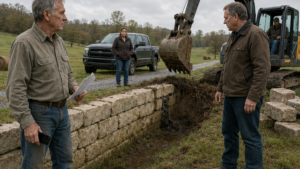
The orange survey flags appeared on Tuesday morning.
Melissa saw them from the pasture before she saw the county truck.
Bright triangles snapped in the breeze along the edge of her gravel lane, each one marking a line that had existed on paper for decades but had never looked so sharp on the ground.
Ronald King stood near the cedar post with a measuring rod.
He was older than Melissa had expected, lean and careful, with the patient expression of a man accustomed to neighbors hoping geometry would choose sides.
Gregory was already there.
Of course he was.
Melissa climbed through the fence and approached.
Ronald looked up.
“Ms. Hall?”
“Yes.”
He nodded toward Gregory.
“Mr. Walker said he wanted to observe.”
Gregory folded his arms.
“I live here too.”
Ronald did not react.
“I’m only confirming monuments and the recorded boundary. I’m not deciding anybody’s access rights.”
“I know,” Melissa said.
Gregory said, “That’s what I told her.”
Melissa looked at him.
“No, you didn’t.”
Ronald walked toward the road before either of them could continue.
They followed.
He found the first iron pin near the drainage ditch, then another farther west. Measurements went into a field tablet. The orange flags multiplied.
By midmorning, the result was visually impossible to misunderstand.
The gravel entrance sat inside Melissa’s parcel.
All of it.
Even the grass shoulder Gregory favored for parking.
Ronald pointed with the end of his rod.
“Based on the recorded plat and the monuments I’ve located, your north property line is here.”
He walked ten feet.
“The traveled lane is south of it.”
Melissa glanced at Gregory.
He did not look surprised.
That bothered her.
“So the lane is hers,” Gregory said.
Ronald paused.
“The lane appears to lie on the Hall parcel.”
“Same thing.”
“For ownership location, yes.”
“And that means I can’t use it?”
Ronald lowered the rod.
“That is not what I said.”
Gregory looked at Melissa as if Ronald had just proven his point.
“There.”
Melissa nearly laughed.
Ronald continued.
“A survey can tell you where the property is. It does not automatically answer every question about licenses, historic use, permission, easements, or other legal claims. If you’re disputing those, you need legal advice.”
“I’m not disputing the line,” Gregory said.
Melissa stared at him.
He finally met her eyes.
“That isn’t the point.”
The words settled between the orange flags.
For days Melissa had been waiting for him to say the survey was wrong.
He had never needed to.
He knew.
“This whole time,” she said slowly, “you knew the road was on my property.”
Gregory exhaled through his nose.
“Everybody knows it’s your road.”
“Then why are we here?”
“Because your dad let us use it.”
Melissa looked at the line of flags.
There it was.
The dispute had never been confusion over geography.
It was Gregory’s belief that permission once given had become something she could not withdraw.
Ronald packed his equipment without joining the conversation.
Melissa waited until the county truck had gone.
“Whatever my dad allowed,” she said, “I’m ending it.”
Gregory’s jaw shifted.
“You don’t know what that does to me.”
“I know what your truck across my gate does to me.”
“That alternate road adds almost six miles round trip.”
“Then use six miles.”
“I’ve got three jobs on the west side this month.”
“That isn’t my responsibility.”
“It might cost me one of them.”
Melissa hesitated.
Gregory saw it.
His voice lowered.
“Fuel. Labor. Machine hours. Everybody thinks because you own equipment, you’re making money. Half the time I’m trying to keep the payments from outrunning the jobs.”
For the first time since the argument began, Melissa could hear something beneath his pride.
Fear.
Not enough to excuse what he had done.
Enough to make her wish the solution were easier.
“My father helped you,” she said.
“He helped everybody.”
“I know.”
“He understood what it meant to live next to people.”
The sentence found its mark.
Gregory knew it would.
Melissa felt heat rise into her face.
“You think I don’t?”
“I think things changed when you took over.”
Her first instinct was to defend herself.
List the times she had hauled calves for neighbors. The fencing she had repaired along the county ditch. The snow she had cleared from the road after her father died.
Instead she looked at the orange flags.
Maybe things had changed.
They had to.
Her father had worked the farm full-time. Melissa divided her days between livestock and the veterinary clinic. He had owned less equipment, had fewer locked schedules, and had been able to absorb interruptions she could not.
Different did not mean worse.
“You can think whatever you want about me,” she said. “But you cannot block that entrance again.”
Gregory stared down the lane toward her barns.
“What about crossing through?”
“No.”
“Even when it’s dry?”
“No.”
“Harvest?”
“If we make a new agreement later, we can discuss it. Right now, no.”
He shook his head.
“So twenty years means nothing.”
“No. It means my father gave you twenty years of favors.”
Gregory looked back at her.
Melissa heard the sentence as soon as she said it.
Sharper than she intended.
But true.
“A favor is not an easement,” she said.
Neither spoke for several seconds.
Then Gregory walked to his truck.
He opened the door and stopped.
“You’re going to find out people remember who helped them.”
Melissa felt the old fear again.
The daughter who had inherited the farm and closed the gate.
The woman who needed paperwork where her father had needed only a handshake.
She almost called Gregory back.
Instead she went into the farmhouse.
At the kitchen table she drafted a notice.
This time she did not write around the point.
Effective immediately, permission for Walker vehicles, equipment, trailers, or contractors to use or obstruct the Hall farm entrance and private lane is withdrawn.
She read it twice.
Then added one more sentence.
Future access may be discussed only by prior agreement.
Melissa printed two copies.
One she placed in an envelope.
The other she slid into a clear weatherproof sleeve and carried to the gate.
The orange survey flags were still moving along the boundary.
She fastened the notice to the cedar post.
For the first time, nothing about her request was implied.
Nothing depended on Gregory understanding her tone.
Nothing depended on the memory of her father.
Melissa stepped back and looked at the paper.
The gate stood open.
For now.
Chapter 4: Six Forty-Five Became the Breaking Point
At 6:44 the next Thursday morning, Melissa’s phone lit up with an emergency call just as she saw Gregory’s truck sitting across the gate.
For one second she thought she had misjudged the angle.
Then the headlights of her SUV struck the trailer ramps.
Blocked.
Again.
Her phone kept ringing.
Melissa answered.
“Hall.”
The clinic manager’s voice was already moving fast. A cow had gone down after calving. The owner was forty minutes east and frightened she was losing both the cow and calf.
“I’m leaving now,” Melissa said.
She looked through the windshield.
Gregory’s truck did not move.
The manager said, “Can you be there by seven-thirty?”
Melissa stared at the clock.
6:45.
“I’ll call you back.”
She hung up and got out.
The written notice was still attached to the cedar post in its clear sleeve.
Gregory’s truck was parked less than four feet from it.
Melissa walked around the trailer and found him beside the excavator, drinking coffee from a stainless travel mug.
He saw her coming and frowned.
“Morning.”
“Move it.”
He looked at the truck, then at her.
“I’m just loading.”
“You’re blocking the gate.”
“Ten minutes.”
“No.”
Gregory lowered the cup.
Melissa pointed toward the cedar post.
“You saw the notice.”
He glanced at it.
“Yes.”
The answer stopped her more effectively than denial would have.
“You saw it.”
“I saw it.”
“And you parked here anyway.”
Gregory took a breath.
“That paper was unnecessary.”
Melissa felt something inside her go still.
Not anger.
Clarity.
She had spent weeks wondering whether he misunderstood.
He did not.
“You don’t get to decide whether it was necessary.”
“Melissa, I’m not trying to start something.”
“You already did.”
Her phone buzzed again.
The clinic.
Gregory looked at the screen in her hand.
“I said I’ll move.”
“You said that every other time too.”
He set his coffee on the trailer fender and climbed into the cab.
Melissa waited while the diesel engine started.
He backed once.
Stopped.
Pulled forward.
The trailer jackknifed slightly.
He corrected.
Every maneuver cost seconds she could feel leaving.
At 6:51 the gate was clear.
Melissa drove through without looking at him.
She called the clinic from the county road.
“I’m six minutes late leaving.”
The manager was quiet for half a beat.
Then: “I sent somebody else.”
Melissa gripped the wheel.
“Who?”
“The other technician.”
“She’s twenty-five minutes farther out.”
“I know.”
“Then why—”
“Because the owner needed an answer.”
Melissa had no reply.
The manager continued, softer now.
“I can’t keep assigning emergencies if I don’t know you can physically get here.”
Melissa looked in the rearview mirror.
Gregory’s truck was already angled toward her lane again.
“I understand.”
She did.
That was what made it sting.
At the clinic later, the manager asked Melissa into the supply room.
The door shut behind them.
“You’re good at this job,” the manager said.
Melissa folded her arms.
“But.”
“But I’ve had two mornings in three weeks where someone else had to cover.”
“I know.”
“I know you know.”
The manager leaned against a metal cabinet.
“I’m not punishing you for having a bad neighbor.”
Melissa stared at a stack of sterile packs.
“It feels a little like it.”
“I’m protecting coverage.”
Melissa looked up.
The manager did not sound cruel.
That made it harder.
“One more missed outside call,” the manager said, “and I may have to pull you off early emergency rotation for a while.”
Melissa swallowed.
Those shifts mattered.
Not only for the extra income.
They mattered because she had spent years proving that she could run cattle at home and still be reliable at the clinic.
Her father had never understood why she wanted both.
“Farm’s enough work for three people,” he used to say.
But Melissa had wanted the clinic too.
She liked knowing that when someone called before sunrise because an animal was in trouble, she could be useful.
Now Gregory’s truck was turning that reliability into a question.
That afternoon Melissa drove to the farm whose emergency she had missed.
The other technician had stabilized the cow.
The calf was standing.
The owner met Melissa at the barn door.
“You didn’t have to come.”
“I wanted to check.”
The owner shrugged.
“Worked out.”
Melissa nodded.
Worked out.
Those two words should have relieved her.
Instead they made her feel worse.
Someone else had fixed the problem because Melissa had not gotten through her own gate.
On the drive home she did not think about Gregory’s father or her father or twenty years of neighbor favors.
She thought about 6:45.
A simple time on a digital clock.
A boundary that did not care about history.
Either she was through the gate by then or she was not.
At home, Melissa went straight to the equipment shed.
She turned on the overhead light.
The yellow wheel clamp sat where she had left it.
She pulled the box down.
Inside were the clamp, two keys, a steel padlock, and the faded instructions from the estate auction.
Melissa stared at the metal jaws.
Then she took out her phone.
She did not call Gregory.
She called the sheriff’s office first and asked what they could and could not do about repeated obstruction of a private farm entrance.
The deputy who answered was careful.
Civil property issues, he explained, were not something the sheriff could adjudicate roadside. Blocking access could become a separate issue depending on circumstances, but he was not going to tell her to seize or damage anyone’s property.
Melissa wrote that down.
Then she called a roadside-service company in the county seat.
She explained the situation without using Gregory’s name.
The operator listened.
“What are you asking?”
“What can I legally arrange if a vehicle is left on my private lane after written permission has been withdrawn?”
“That depends on the property, notice, local rules, and how the vehicle is situated.”
“So there’s a process.”
“There can be.”
“I want the process.”
The operator gave her the number for the county office that handled private-property towing requirements and told her what documentation they usually asked to see.
Melissa wrote every item on a yellow legal pad.
Photographs.
Posted notice.
Recorded parcel information.
Dates.
Times.
Prior warnings.
By sunset, the legal pad was full.
For the first time, Melissa was not asking how to get Gregory to understand.
She was asking what she could do when he understood and chose not to care.
Chapter 5: The Yellow Clamp Came Out of the Box
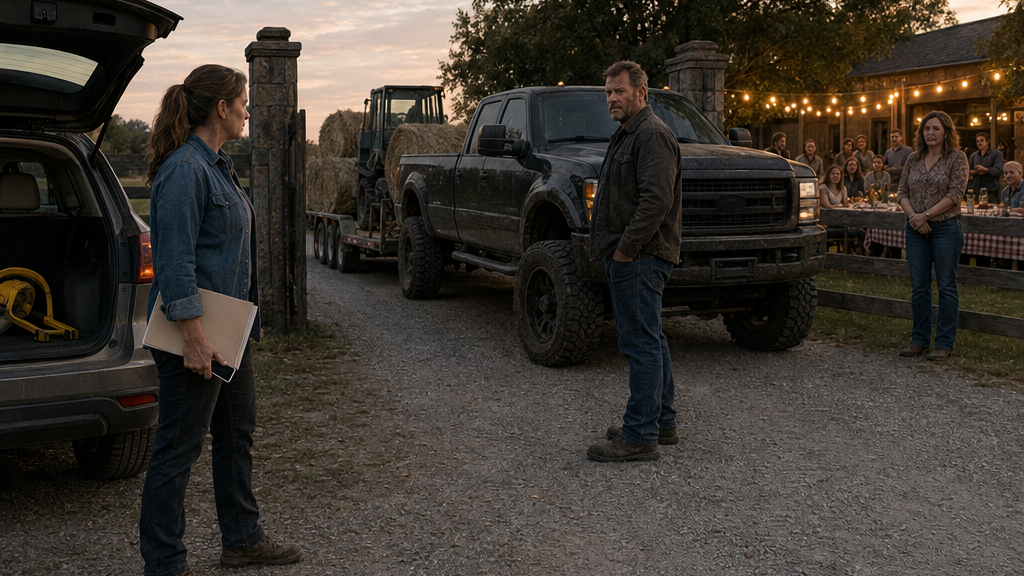
Saturday evening, Melissa saw the party lights before she saw the truck.
Strings of warm bulbs ran between two maples behind the Walker house. Cars lined the county shoulder. Laughter drifted over the fence, followed by the brief off-key beginning of a birthday song.
Then Melissa turned into her entrance.
Gregory’s lifted pickup was parked directly across the gate.
The equipment trailer sat behind it.
Loaded.
Melissa stopped.
For several seconds she did nothing.
The yellow clamp was in the back of her SUV.
So were copies of the deed, the survey, photographs of the posted notice, her written withdrawal of permission, and the instructions she had received after spending two days confirming exactly what she could and could not do on her own property.
She had hoped none of it would be necessary.
That hope now felt less like patience than denial.
Melissa got out.
Across the fence, someone laughed loudly enough that several people joined in.
Gregory appeared near the side of the house carrying a paper plate.
He saw her and walked toward the gate.
“Don’t start tonight.”
Melissa looked at the truck.
“You parked across my entrance.”
“I’m moving it later.”
“You were told not to park here at all.”
“It’s Laura’s birthday.”
“I know.”
“We’ve got people over.”
“I can see that.”
Gregory looked back toward the tables.
“Then don’t make a scene.”
There it was.
Melissa had expected anger.
She had not expected confidence.
He was not simply asking her to wait.
He was counting on her embarrassment.
Counting on the neighbors watching.
Counting on her imagining what people would say about Melissa Hall putting enforcement papers on a truck during Laura Walker’s birthday dinner.
Counting on her father’s memory doing the work Gregory’s argument no longer could.
Gregory lowered his voice.
“Just leave it alone until morning.”
Melissa looked at him.
“You knew the lane was mine.”
“We’ve covered this.”
“You knew permission was withdrawn.”
He said nothing.
“You saw the notice.”
Gregory’s mouth tightened.
“Melissa.”
“You parked here anyway.”
“It’s one night.”
That was when the last piece shifted.
Not because one night was so terrible.
Because every obstruction had survived by being reduced to one small thing.
Five minutes.
One trailer.
One morning.
One night.
Melissa walked back to her SUV.
Gregory called after her.
“Where are you going?”
She opened the rear hatch.
The yellow clamp was inside.
Its paint seemed almost absurd under the party lights.
Gregory stopped walking.
“No.”
Melissa lifted it out.
It was heavier than she remembered.
“What are you doing?”
She set it beside the front tire.
“Documenting the obstruction.”
Gregory laughed once, but there was no humor in it.
“You cannot be serious.”
Melissa took photographs.
The truck.
The trailer.
The gate.
The posted notice.
The orange survey flags still visible along the boundary.
She checked the time stamp.
Then she pulled the prepared paperwork from the SUV.
A few guests had noticed.
Conversation near the closest table thinned.
Laura stood beside the cake, watching from across the yard.
Gregory moved closer.
“Put that thing back.”
Melissa did not answer.
“Melissa.”
She crouched beside the tire.
The lifted truck suddenly looked different from down there.
For weeks its size had been part of the problem. High hood. Wide tires. Heavy trailer. A machine that occupied whatever space Gregory decided to give it.
The yellow clamp looked small against the black wheel.
Melissa opened the jaws.
Gregory stepped forward.
“Don’t touch my truck.”
She stopped.
Her hands remained on the clamp.
“You can move it now.”
His face flushed.
“What?”
“Move the truck. Right now. Clear the gate and take it home.”
He looked toward the party.
Twenty or more people were no longer pretending not to watch.
Gregory’s eyes came back to Melissa.
“You’re not doing this in front of everybody.”
The words were quiet.
Certain.
Melissa understood then that this was the real test.
Not ownership.
Not paperwork.
Not even the truck.
He believed she would rather surrender privately than be judged publicly.
Melissa looked at the tire.
Then closed the yellow clamp around it.
The metal clicked.
A small sound.
Almost disappointing.
But Gregory went completely still.
Melissa fitted the lock.
Turned the key.
Removed it.
The party behind him was silent enough now that she could hear paper plates shifting on a table.
Gregory stared at the yellow metal wrapped around his tire.
“You’ve lost your mind.”
Melissa stood.
“No.”
“This is my vehicle.”
“And this is my access.”
“You think some county paper gives you the right to humiliate me?”
“I gave you the chance to move it.”
“This is Laura’s birthday.”
Melissa looked across the fence.
Laura had walked closer.
Her expression was not angry exactly.
It was tired.
Melissa hated that.
This was the part she had feared.
Not Gregory shouting.
Laura seeing the clamp.
Neighbors carrying the story home.
Her father’s name entering conversations where he could no longer speak for himself.
Gregory pointed at the wheel.
“Take it off.”
Melissa held the key in her fist.
“When the obstruction is resolved according to the process I gave you.”
Gregory’s voice rose.
“You’re standing on a road my family has used for twenty years.”
“And I told you the permission ended.”
“My dad used it.”
“My dad allowed it.”
“That’s not how it was.”
“Then tell me how it was.”
He opened his mouth.
Nothing came.
Melissa watched him.
The anger in his face changed.
Not gone.
But underneath it now was something closer to panic.
A guest near the tables began speaking quietly to another.
Gregory heard.
His embarrassment sharpened.
“You wanted this,” he said.
Melissa’s grip tightened around the key.
“No.”
“You dragged out surveyors. You posted signs. Now you bring out some ridiculous clamp during a family dinner.”
“You parked here during the dinner.”
“You knew people were here.”
“So did you.”
That landed.
Gregory looked away.
Melissa suddenly felt no satisfaction at all.
Only exhaustion.
She had imagined that enforcement would feel clean.
Instead it felt like standing in mud after finally deciding which direction to walk.
Laura crossed the grass and stopped several feet away.
“Gregory.”
He did not look at her.
“Go back to the party.”
“No.”
“Laura.”
She ignored him and looked at Melissa.
“Is the truck staying like this tonight?”
“For now.”
Laura glanced at the yellow clamp.
Then at Gregory.
“Did she tell you not to park here?”
Gregory’s jaw worked.
“That’s not the whole story.”
“That wasn’t my question.”
He gave no answer.
Laura closed her eyes briefly.
When she opened them, she looked at Melissa again.
“Can I talk to you?”
Gregory turned sharply.
“About what?”
Laura’s gaze stayed on Melissa.
“About her dad.”
Melissa felt the clamp key press into her palm.
Laura stepped closer and lowered her voice.
“What did your father actually tell you about this road?”
Chapter 6: The Part Melissa Never Corrected
Laura came to Melissa’s porch twenty minutes later without Gregory.
The party was still going across the fence, though the music had been turned lower.
Melissa had removed the clamp only after the roadside operator arrived, documented the obstruction, and Gregory agreed to move the truck and trailer off the entrance under the process Melissa had arranged. He had done it without speaking to her again.
The yellow clamp key now sat on Melissa’s kitchen table beside her father’s old harvest notebook.
Laura saw both when Melissa opened the door.
“That notebook,” she said.
Melissa stepped aside.
Laura entered.
They sat across from each other at the kitchen table.
For a while neither spoke.
Finally Laura touched one finger to the notebook cover.
“Gregory says your dad gave them permanent access.”
Melissa looked at the key.
“No.”
Laura waited.
Melissa could have stopped there.
The answer was technically true.
Instead she opened the notebook.
“He gave them access a lot.”
She turned several pages.
“Harvest. Wet years. County ditch work. Stone hauling.”
Laura read the entries.
“So Gregory isn’t making that part up.”
“No.”
“And you knew?”
Melissa felt the question settle where she had hoped it would not.
“I knew some of it.”
“How much?”
Melissa leaned back.
“When I was younger, I saw them come through. Everybody did. I knew Dad let them.”
“Then why didn’t you say that before?”
“I did say he let them.”
“No. You said there was no easement.”
“There isn’t.”
Laura looked up.
“That’s not the same answer.”
Melissa almost defended herself.
Then she stopped.
Laura was right.
“I kept hoping Gregory would understand the difference on his own.”
“Between permission and a right.”
“Yes.”
“But you never really told him the permission was over until that notice.”
Melissa stared at the old handwriting.
“No.”
The word was difficult.
Laura sat quietly.
Melissa continued.
“I asked him not to block the gate. Then I asked him not to stage equipment there. Then not to leave trailers. I kept changing the request instead of saying the thing I actually meant.”
“Why?”
Melissa looked toward the dark window above the sink.
Because saying it aloud made her feel disloyal.
Because every person who had known her father seemed to have a story about something he lent, fixed, hauled, or allowed.
Because she had inherited more than acreage.
She had inherited comparison.
“My father was good to people,” she said.
Laura nodded.
“He was.”
“I didn’t want to be the person who took over and started closing everything.”
Laura looked down at the notebook.
“So you waited.”
“Yes.”
“And Gregory took that as permission.”
“Yes.”
Melissa forced herself to add, “That part is on me.”
Laura exhaled.
It was not triumph.
If anything, she looked sadder.
“Gregory should’ve listened once you finally said no.”
“He should have.”
“He knew about the notice.”
“I know.”
“He told me.”
Melissa looked at her.
“He told you he saw it?”
Laura nodded.
“He said you were overreacting and it would blow over.”
Melissa felt the last of her sympathy harden into something more precise.
Not hatred.
Responsibility.
Laura rubbed her thumb over the edge of the notebook.
“You want to know why he’s been pushing so hard?”
Melissa hesitated.
“Yes.”
“Work.”
Melissa waited.
Laura gave a humorless smile.
“What else?”
She explained that Gregory’s excavation business had lost two contracts over the winter. A machine payment had gone up after refinancing. Fuel had eaten into a drainage job he had underbid. The alternate county route added almost six miles each round trip to several west-side jobs.
“He keeps saying the lane saves him forty minutes some days.”
“That doesn’t give him the lane.”
“I know.”
Laura met her eyes.
“I’m not asking you to give it to him.”
Melissa studied her.
“Then what are you asking?”
“For you to understand why he convinced himself it still belonged to the old arrangement.”
Melissa looked at the notebook.
“That explains why he wanted access.”
“Yes.”
“It doesn’t explain why he blocked my gate.”
“No.”
Laura’s answer came immediately.
That mattered.
“He was angry,” Laura said. “And proud. And once you posted that notice, I think he decided backing down meant admitting he had no say at all.”
“He doesn’t.”
Laura gave Melissa a tired look.
“You know what I mean.”
Melissa did.
The difference between having no legal right and feeling erased from a place your family had crossed for decades.
Gregory had confused history with authority.
Melissa had confused kindness with silence.
Both had let the confusion grow.
But only one of them had kept parking a truck across the gate after the answer was clear.
A knock came at the back door.
Gregory stood outside.
Laura did not move to open it.
Melissa did.
He remained on the step.
His face was calmer now.
Embarrassment had burned down into fatigue.
“Tow operator’s gone.”
Melissa nodded.
“So is the truck.”
“I saw.”
Gregory looked past her toward Laura.
“You done?”
Laura said, “Not quite.”
He looked at Melissa again.
“You want an apology?”
The question sounded defensive before she could answer.
“I want you to stop blocking my entrance.”
“I have.”
“For tonight.”
Gregory’s mouth tightened.
Melissa felt the familiar urge to let the conversation end before it became worse.
She resisted.
“I should have been clearer years ago.”
Gregory blinked.
Laura looked at her.
Melissa continued.
“I knew Dad let your family use the lane seasonally. I kept assuming you understood that it was permission, not something permanent. I should have said plainly when I took over that any access had to be agreed with me.”
Gregory said nothing.
“That was my mistake,” Melissa said.
His expression shifted.
For a moment she thought he might meet her halfway.
Instead he said, “So you admit this didn’t come out of nowhere.”
Laura closed her eyes.
Melissa almost laughed.
“No. I admit I let ambiguity last too long.”
“Same thing.”
“No.”
Her voice stayed level.
“Because after the notice, there was no ambiguity.”
Gregory looked away.
Melissa took the clamp key from the table and set it beside the notebook.
“You saw the notice.”
He said nothing.
“You told Laura you saw it.”
His silence changed the room.
Melissa let it.
Finally he said, “I thought you’d cool off.”
“That was your choice.”
Gregory looked at the key.
“And the clamp was yours.”
“Yes.”
For a long moment neither backed away from that.
Then Melissa said, “Meet me at the west field entrance Monday morning.”
Gregory frowned.
“Why?”
“Because there may be another way to handle seasonal access.”
Laura looked at her sharply.
Gregory did too.
Melissa raised one hand before either could speak.
“Not this lane.”
Gregory’s expression hardened again.
“Then what’s the point?”
“The point is I’m willing to discuss access. I’m not willing to discuss whether you own a right you don’t have.”
Gregory glanced at the notebook.
Then at the clamp key.
“You expecting me to apologize first?”
“No.”
Melissa shook her head.
“I’m expecting you to show up without your truck blocking anything.”
He looked at her for several seconds.
“Monday?”
“Seven.”
Gregory stepped off the porch.
Laura followed him toward the yard, then stopped and looked back.
Melissa remained in the doorway.
On the kitchen table behind her, the old harvest notebook and the yellow clamp key lay side by side.
One represented everything her father had allowed without paperwork.
The other represented the point where Melissa had finally stopped allowing silence to speak for her.
Monday morning would decide whether those two things could exist without becoming the same mistake.
Chapter 7: The Gate Stayed Clear After That
Gregory arrived at the west field entrance on Monday morning without his truck.
That was the first thing Melissa noticed.
The second was the folded envelope in his hand.
He walked down the grass shoulder from Laura’s car while Melissa waited beside the old field gate. Beyond them, the alternate track curved along the edge of a hayfield before joining the Walker property near a stand of walnut trees.
It was longer.
Rougher.
And unlike the main lane, it did not pass directly in front of Melissa’s barns.
Gregory stopped several feet away.
“You said seven.”
Melissa checked her watch.
“Six fifty-eight.”
He held out the envelope.
“What’s that?”
“The roadside charge.”
Melissa did not take it immediately.
Gregory’s eyes narrowed.
“You said I should cover the direct cost.”
“I did.”
“So I am.”
She accepted the envelope.
There was no apology attached to it.
That was probably better.
Laura stayed near the car.
Melissa opened the gate and pointed down the track.
“This is what I wanted you to see.”
Gregory looked beyond her.
“That road hasn’t carried equipment in years.”
“Not regularly.”
“The low spot washes out.”
“I know.”
“And the culvert’s too narrow.”
“For your trailer, yes.”
Gregory gave a short laugh.
“So this is your solution?”
“No. It’s the beginning of one.”
Melissa walked several yards into the field.
He followed.
The grass track ran along higher ground for most of its length. Near the far corner it dipped toward an old drainage cut where spring runoff had eaten away one shoulder.
Melissa had measured it twice over the weekend.
“If the culvert is widened and the drainage edge is repaired, you can get your truck and smaller equipment through here during dry periods.”
Gregory looked at the ditch.
“That’s not cheap.”
“I didn’t say it was.”
“You want me to pay for it.”
“Yes.”
He turned toward her.
“You’re offering me access and charging me to build your road.”
“No.”
Melissa pointed toward the line of fence posts.
“I’m offering you limited seasonal permission to cross my land by a route that doesn’t interfere with my gate. If you want that option, the route has to be usable, and the work has to be done without costing me money.”
Gregory looked toward Laura.
She said nothing.
His shoulders dropped slightly.
“And the main lane?”
“No.”
“Ever?”
Melissa waited.
This was the part she had rehearsed least.
She could have softened it.
Maybe harvest only.
Maybe emergencies.
Maybe if he called first.
Every version opened the same door she had spent weeks trying to close.
“The main lane stays mine for farm and veterinary access,” she said. “If there is an actual emergency, you can call me like anyone else.”
Gregory looked back toward the farmhouse in the distance.
“My dad used that entrance.”
“So did yours.”
“My kids did too.”
“I know.”
“You’re really done with it.”
“Yes.”
The word did not feel cruel.
That surprised her.
Gregory rubbed a hand over his jaw.
“What would this arrangement look like?”
Melissa took a folded sheet from her jacket pocket.
His expression changed.
“Of course you brought paperwork.”
“I did.”
He almost smiled.
Almost.
Melissa opened the page.
“Seasonal access only. Dry-ground conditions. No parking, staging, or storage. No contractors unless we both agree ahead of time. No use before six in the morning or after nine at night unless there’s an emergency.”
Gregory glanced at her.
“You thought about this.”
“I had reason to.”
He accepted that without argument.
“And if I repair the drainage?”
“You maintain whatever your equipment damages.”
“What if cattle tear something up?”
“That’s mine.”
He read farther.
“You can cancel this.”
“Yes.”
“So can I?”
“Yes.”
“That’s different from what your dad did.”
Melissa looked down the track.
“Yes.”
Gregory folded the paper once.
For a moment she expected him to hand it back.
Instead he said, “I still think you could’ve handled this sooner.”
Melissa nodded.
“I could have.”
That answer caught him.
She continued.
“I should have told you plainly when I took over that Dad’s permission didn’t automatically continue. I didn’t.”
Gregory looked at the paper.
“But once I did tell you, you should have stopped.”
He nodded slowly.
“I know.”
It was the closest thing to an apology she had heard from him.
Melissa did not ask for more.
Laura walked over from the car.
“What about the drainage repair?”
Gregory pointed toward the low spot.
“Needs stone, a wider pipe, probably a half day with the excavator.”
Melissa said, “And that rut on the north edge needs filled. Your trailer made most of it last spring.”
Gregory looked at her.
“You kept track?”
“I run a farm.”
Laura laughed once under her breath.
Gregory gave her a look, then shook his head.
“Fine.”
The agreement took another twenty minutes.
They changed two phrases.
Gregory wanted forty-eight hours’ notice for suspension of ordinary seasonal access unless weather or livestock conditions required immediate closure. Melissa agreed.
Melissa wanted photographs before and after drainage work. Gregory complained, then agreed.
Nobody won everything.
That was why it felt usable.
Three days later Gregory brought the excavator through from his own property rather than crossing the main gate.
Melissa watched from the hayfield as he widened the drainage cut and set a new culvert.
He did not ask her father’s name into the argument.
She did not mention the clamp.
By late afternoon the alternate track was rough but serviceable.
Gregory climbed down from the machine.
“Try it.”
“With what?”
“Your pickup.”
Melissa drove the farm pickup over the repaired section.
The gravel held.
Water moved cleanly through the culvert.
She stopped on the other side and looked back.
Gregory stood with one boot on the excavator track.
“Well?”
“It works.”
He nodded.
That was all.
Over the next several weeks, the new arrangement survived small tests.
Gregory called before bringing a skid-steer through.
Melissa closed the alternate track after two days of heavy rain.
He complained once.
She said no once.
Nothing collapsed.
The main entrance remained clear.
One evening Melissa carried the yellow clamp back into the equipment shed.
She had left it on a bench since the birthday dinner.
Dust had begun settling along the edges.
She lifted it onto the back shelf.
For months the thing had seemed like evidence of failure—a ridiculous piece of bright metal waiting for a dispute to become ugly enough to justify it.
Now it looked different.
Not like victory.
Not even like punishment.
A tool.
One she hoped never to need again.
She hung the key on a nail beside it.
By early autumn, the orange survey flags had faded almost white.
The hayfield had been cut again.
Gregory’s alternate track showed two clean tire paths through the grass, neither deep enough to hold water.
The neighbors still talked to one another, though differently.
There were fewer assumptions.
More phone calls.
Melissa found she preferred it.
One morning her alarm went off before six.
She dressed, fed the barn cats, checked the nearest water trough, and loaded her veterinary bag into the SUV.
At 6:43 she started down the gravel lane.
For months she had developed a habit at the last bend.
Slow down.
Look for headlights.
Look for a trailer.
Look for Gregory’s truck.
That morning she reached the bend without thinking about it.
The gate stood open.
Nothing blocked the gravel.
The county road waited beyond the cedar posts.
Melissa glanced at the dashboard.
6:45.
She drove straight through.
Only after she was half a mile away did she realize she had not checked twice.
The story has ended.