For Nine Sundays They Dumped Their Fairground Trash Beside His Farm Gate—Then He Started Keeping Records
Chapter 1: The Ninth Sunday at the Cattle Gate
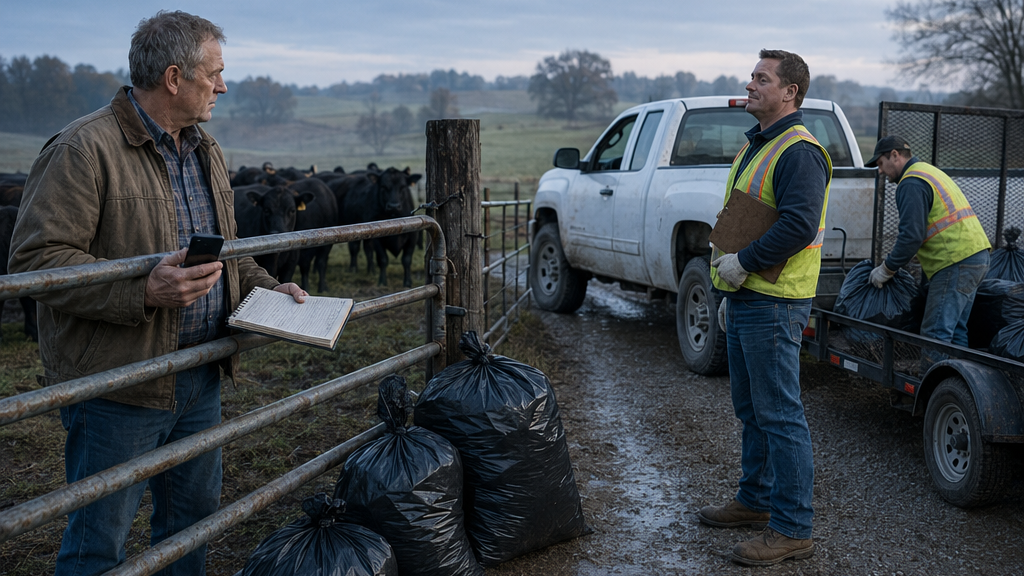
The first black bag was leaning against the lower rail of Charles King’s cattle gate.
The second had split.
Greasy paper trays, crushed drink cups, plastic forks, and a ribbon of yellow ticket stubs lay across the gravel where his feed truck needed to turn in less than an hour.
Charles stopped his pickup twenty feet short of the entrance and kept both hands on the wheel.
Nine Sundays.
He did not need a calendar to count them anymore.
The first weekend, he had assumed somebody’s bag had fallen from a truck. He had tossed it into his own utility trailer and taken it to the transfer station.
The second time there were three bags.
The third time there were five.
After that, the piles changed size, but they always arrived between Saturday night and Sunday morning, and they always appeared at the same place: beside the galvanized gate at the east entrance of his farm.
Charles killed the engine.
Beyond the fence, several cattle had already gathered near the lane, expecting him to open the gate and move them toward the lower pasture. One cow pressed her nose between the rails, then jerked back when a paper plate skittered across the gravel.
Charles climbed out.
A sweet, sour smell came off the torn bag. Ketchup. Beer. Wet cardboard. Something fried.
He crouched without touching anything.
Among the trash was a green paper wristband stamped with the county fairgrounds logo. Nearby, a cardboard catering tray had a vendor sticker from the Saturday livestock fundraiser.
Charles straightened slowly.
The fairgrounds sat less than two miles west of his farm.
Saturday evenings during the warmer months, the board rented the exhibition hall and outdoor pavilion for tractor-club dinners, livestock auctions, youth fundraisers, wedding receptions, and community events. Charles had attended more of them than he could count.
He had never minded the noise.
He minded this.
His phone rang.
The feed delivery driver.
“I’m at the county road,” the man said. “You want me at the east gate?”
Charles looked at the bags.
“No.”
A pause.
“That’s what the order says.”
“I know. Use the north lane.”
“With this load?”
Charles glanced toward the muddy slope beyond the barn. The north lane was narrow, and yesterday’s irrigation leak had softened the shoulder.
“You’ll have to take it slow.”
“You sure?”
Charles looked again at the gate.
“Yes.”
Twenty minutes later, the feed truck crawled down the north lane with one set of tires nearly brushing the ditch. Charles stood by until it cleared the bend.
Amy Scott arrived while he was sweeping loose plastic away from the roadway.
She parked beside his pickup and got out holding two coffees.
“What happened?”
Charles pointed with the broom.
Amy stared at the trash.
“Again?”
“Nine.”
“Nine what?”
“Nine Sundays.”
She looked at him.
“You’ve counted?”
“I can count without writing it down.”
“That isn’t what I asked.”
Charles leaned the broom against the fence.
Amy stepped closer to the pile. She had helped him with tax records, seed invoices, veterinary bills, and cattle registrations for nearly six years. She knew the difference between her father remembering something and proving it.
She picked up nothing, but bent over the torn bag.
“That’s from the fairgrounds.”
“I know.”
“You said that three weeks ago.”
“I knew then too.”
Amy pointed at the wristband.
“You should photograph this.”
Charles gave her a look.
“Before you move it.”
“I’m not moving it.”
That surprised her.
Normally, Charles dealt with problems because they were there. Broken hinge, he fixed it. Fallen limb, he cut it. Trash on the road, he moved it.
Standing still beside a mess offended some private rule he had lived by for most of his life.
Amy took out her phone.
Charles said, “Use mine.”
She handed it back to him.
“You use yours.”
He frowned.
“Why?”
“Because if this turns into anything, I don’t want you saying later that I took the pictures and you never saw half of it.”
Charles almost told her she was making too much of it.
Instead, he photographed the bags.
The gate.
The fairgrounds wristband.
The catering sticker.
The crushed cups scattered from the ditch to the gravel apron.
When he finished, he opened the spiral-bound farm log he kept behind the pickup seat.
Most pages held ordinary entries.
Heifer weights.
Hay moisture.
Fence repairs.
Diesel delivery.
He turned to a clean page.
Sunday.
He wrote the date.
Then: east gate—event trash again.
Amy watched him.
“That the first time you wrote it down?”
Charles did not answer.
Her silence answered for him.
By late morning, the cattle had been moved through the north lane instead. The feed had been unloaded. Charles finished checking a water line and returned to the east gate with heavy gloves.
He stopped before touching the bags.
There were tire tracks in the gravel.
At first he assumed they belonged to the feed truck from an earlier delivery.
Then he saw the angle.
The tracks did not stop at the public-road edge.
Two fresh impressions crossed the gravel apron, passed between the gateposts, and continued several yards inside his property before curving back toward the road.
Charles followed them on foot.
A narrow trailer tire had cut across the grass beside the lane.
He stood there longer than he had stood beside the trash.
The bags were one thing.
Someone using his entrance was another.
He looked toward the fairgrounds beyond the tree line.
Then he opened the log again.
Under the morning entry, he added one more sentence.
Vehicle entered beyond gate line.
Chapter 2: The Shortcut Nobody Put on Paper
On Monday afternoon, Charles drove past his own gate without turning in.
He continued west along the county road toward the fairgrounds.
He had driven that stretch for decades, but this time he watched it differently.
The main public entrance came first, marked by a broad paved apron and a wooden county-fair sign. Beyond it stood the exhibition hall, livestock barns, maintenance sheds, and a gravel loop used by vendors and service vehicles.
Charles stayed on the public road until he reached the western service entrance.
A chain-link enclosure sat inside the grounds behind the maintenance building.
Three commercial dumpsters stood there.
The approved waste area.
Charles pulled onto the shoulder and looked back east.
His farm gate was not visible from there, but he knew the distance.
Nearly a mile by the internal loop and county road.
A much shorter run if a crew cut east, staged bags at his entrance, and used the old gravel lane that paralleled his fence.
He drove the route twice.
Then a third time.
That evening Amy found him at the kitchen table with a county road map, a ruler, and the farm log spread beside his coffee.
“You look like you’re planning an invasion.”
Charles pointed at the map.
“Fairgrounds waste enclosure to the west gate. Then around.”
Amy leaned over.
“And?”
“East gate to my entrance is shorter.”
“How much?”
“Depends how they’re moving.”
She pulled out her phone.
Charles sighed.
“What?”
“Nothing. Keep using the ruler if it makes you happy.”
She checked the public-road distance and estimated the internal loop based on the fairgrounds map available online.
“If they’re doing repeated loads,” she said, “they could cut several minutes each trip.”
“Several minutes isn’t much.”
“Not once.”
Charles leaned back.
Amy counted on her fingers.
“Four loads? Six? Eight?”
“We don’t know how many.”
“Exactly.”
Charles looked at the map again.
Convenience was a better explanation than hostility.
He was not sure whether that made him feel better.
By Wednesday he had obtained a copy of the fair board’s public service schedule from the county office. He had not asked for the full contract. He did not want to accuse anyone of something he could not prove.
The schedule was enough.
Post-event cleanup included collection of event refuse and transport to the designated waste enclosure beside the maintenance building.
Charles read the line twice.
Then a third time.
Nothing mentioned an east pickup point.
Nothing mentioned his farm.
That afternoon he called Sarah Brown at the fairgrounds office.
“Operations,” she answered.
“This is Charles King.”
A slight pause.
“I know who you are.”
“I have a question about cleanup routing.”
Another pause, longer this time.
“All right.”
“Does the contracted crew have permission to stage waste off fairgrounds property?”
“Not that I’m aware of.”
“What about private property east of the grounds?”
“No.”
“Do they have an east pickup location?”
“I’d have to check.”
Charles looked through his kitchen window toward the distant gate.
“I’d appreciate that.”
Sarah’s voice became careful.
“Is this about the trash you mentioned?”
“It’s about where they’re putting it.”
“I was told that was temporary staging.”
“By who?”
“I’d have to look at the crew notes.”
Charles waited.
Sarah added, “The waste is eventually removed, correct?”
“Eventually.”
“So the concern is timing?”
“No. The concern is that it’s on my land.”
Silence.
Then Sarah said, “I’ll make a note.”
Charles nearly laughed.
Instead, he thanked her and hung up.
On Friday morning he went to the fairgrounds office in person.
Jerry Nelson was standing near the counter talking with two board members when Charles walked in.
Jerry was in his early sixties, broad through the shoulders, with the practiced ease of someone who had chaired too many meetings to be surprised by any complaint.
“Charles.”
“Jerry.”
“Heard you’ve got a trash issue.”
“I’ve got a property issue.”
Jerry’s expression barely changed.
“That crew gets stretched pretty thin after events.”
“That doesn’t make my gate theirs.”
“No one says it does.”
Charles set a copy of the service schedule on the counter.
“This says waste goes to the enclosure.”
Jerry glanced down.
“That’s the standard route.”
“So why is it at my place?”
Jerry rubbed one thumb over the edge of the paper.
“I’ll ask.”
“I already asked.”
“Sarah said she was checking.”
Charles nodded.
Jerry lowered his voice.
“We’re trying to keep costs under control this year. Insurance is up. Portable power is up. Everything is up. If a cleanup crew stages a few bags for pickup—”
“On my property.”
“I understand.”
“No, you understand the sentence. I’m not sure you understand the problem.”
Jerry’s face tightened.
For a moment Charles regretted the sharpness.
They had known each other too long for either man to enjoy this.
Jerry said, “There is no official use of your property. None.”
“Then tell them to stop.”
“I’ll speak to them.”
Charles picked up the service schedule.
At the door, Jerry added, “Don’t turn this into more than it is.”
Charles stopped.
He did not turn around.
“I’m trying to find out what it is.”
He drove home by the east road.
The farm gate came into view beyond the ditch.
For the first time, he noticed how convenient it looked from a truck cab: wide gravel apron, level shoulder, enough room to back a trailer without entering the main fairgrounds traffic.
A place that looked unused if you did not own cattle.
A place that looked available if nobody had told you otherwise.
Jerry had just told him nobody had.
So why, Charles wondered, did the crew keep behaving as if someone had?
Chapter 3: He Wrote Down the Truck Number
Charles was waiting when the truck arrived.
It was 5:42 Sunday morning.
He stood inside the closed cattle gate with the spiral-bound log resting against the top rail and a coffee cooling beside him on the fencepost.
At 5:47, headlights appeared from the west.
A white commercial pickup came slowly along the county road pulling a loaded utility trailer.
Charles wrote the time.
The truck passed the entrance.
Then its brake lights came on.
It reversed.
The trailer swung across the gravel apron until it blocked nearly the entire gate.
Charles wrote the plate number.
Two workers got out.
One opened the trailer gate.
The other began dragging black bags toward the fence.
Neither seemed surprised to see Charles.
“Morning,” one called.
Charles nodded.
The first bag landed beside the gatepost.
Then another.
Charles checked his watch.
He wrote 5:51.
The worker looked at the notebook.
“You keeping score?”
“Keeping time.”
The man laughed once.
Charles did not.
A third worker climbed down from the pickup. He wore a reflective vest and carried a clipboard.
“You need through here?” he asked.
“Yes.”
“We’ll be ten minutes.”
“This is my entrance.”
The man looked toward the field, then back at Charles.
“I know.”
That caught Charles more sharply than if the man had argued.
“You know?”
“East pickup point.”
Charles closed the logbook.
“Who told you that?”
The man shifted the clipboard under his arm.
“It’s on our route.”
“Whose route?”
“Our cleanup route.”
“That wasn’t my question.”
One of the other workers stopped moving bags.
The supervisor looked toward the fairgrounds.
“We’ve been using it all season.”
“I know.”
“You want us to move?”
Charles glanced at the trailer blocking the gate.
Behind him, cattle had begun gathering along the lane.
“I want to know whether you have written permission to use this property.”
The supervisor’s expression changed.
Not fear.
Annoyance.
The kind a person showed when a routine suddenly required explanation.
“I don’t carry contracts in the truck.”
“Do you have permission?”
“We were given this point.”
“By who?”
“You’d have to ask the office.”
Charles opened his log again.
5:56.
He wrote: supervisor states east pickup point.
The man watched him.
“You filming too?”
Charles held up his phone and took a photograph of the truck, trailer, bags, gate, and plate.
“I am now.”
One worker muttered something Charles did not catch.
The supervisor said, “Look, we’re trying to get this cleared before traffic picks up.”
“Then clear it.”
“We are.”
“Not onto my land.”
For a few seconds nobody moved.
Charles could feel his temper rising, not hot but tight.
The old instinct told him to step forward, unhook the trailer himself if necessary, and end the obstruction by force of work.
Instead, he stayed behind the gate.
He had moved their mess eight times.
He was done helping them erase the evidence of it.
The supervisor finally pointed to the bags.
“Put those back.”
The crew loaded them again.
At 6:03, a cattle trailer belonging to a neighboring farmer slowed on the county road. The driver stared at the blocked entrance, then continued.
Charles wrote that down too.
At 6:07, the utility trailer moved just enough to expose the gate.
Charles opened it.
The cattle hesitated at the unfamiliar truck noise.
One heifer turned sideways and pushed against another.
Charles raised an arm and called softly until they settled.
The supervisor watched.
“This is why it matters,” Charles said.
The man looked at the cattle, then at the trailer.
For the first time, his annoyance seemed to weaken.
“I didn’t know livestock came through here.”
“It’s a cattle gate.”
“Looks like a service entrance.”
“To you.”
The supervisor said nothing.
The crew finished securing the bags.
Charles photographed the gravel beneath the trailer tires.
The supervisor climbed into the passenger seat.
Before the door closed, Charles asked, “Where are you taking that load?”
“Disposal.”
“West enclosure?”
The man hesitated.
“Eventually.”
The truck pulled out at 6:14.
Charles wrote the departure time.
Then he watched which way it went.
East.
Not west toward the fairgrounds waste enclosure.
East.
Amy arrived twenty minutes later carrying a paper sack of breakfast biscuits.
Charles handed her the logbook before she had shut the car door.
She read the page.
“You got all this?”
“I was standing here.”
“Did they say who authorized it?”
“No.”
“But they called it an east pickup point.”
“Yes.”
Amy looked toward the road.
“Where’d they go?”
“East.”
She stopped reading.
“The enclosure is west.”
“I know.”
“Maybe they’re taking it somewhere else.”
“Maybe.”
Amy studied him.
“You don’t believe that.”
“I don’t know enough to believe anything.”
That answer surprised both of them.
Charles took the log back.
Years earlier, his father had kept records in almost the same fashion. Calving dates. Fuel receipts. Hay yields. Nothing fancy. His father used to say memory was good for knowing what mattered, but paper was better for proving when it happened.
Charles had always thought that was bookkeeping advice.
Now he looked at the line he had written:
5:47 arrival.
6:14 departure.
Eastbound.
Amy pointed toward the gravel.
“You should get the tire marks too.”
Charles photographed them.
Then she walked several yards inside the gate.
“Dad.”
He looked up.
“What?”
She crouched beside the grass.
There were two sets of trailer impressions.
One fresh.
One older and partly dried.
Both turned inward from the gate before curving back toward the county road.
Amy stood.
“They’ve been farther inside than you thought.”
Charles looked from the tracks to the road.
The white truck was long gone.
But if the waste enclosure was west, and the truck had gone east, then the bags were no longer the only question.
He opened the logbook to a new line.
Route direction: east.
Then beneath it he wrote:
Find where they go.
Chapter 4: The Complaint Jerry Called Too Small
Jerry Nelson turned Charles’s photographs face-down before Charles had finished explaining the third one.
The movement was small, almost polite, but Charles noticed it.
One photograph showed the white cleanup truck backed across his cattle gate. Another showed black bags beside the post. The third showed the utility trailer’s tires several yards inside the farm.
Jerry rested his palm on the overturned prints.
“I understand what you’re saying.”
Charles remained standing on the other side of the fair board office table.
“No. You understand there are pictures.”
Sarah Brown sat near the filing cabinet with a contractor folder open in front of her. She had invited Charles in after receiving his written complaint Monday morning. Jerry had joined the meeting before Charles arrived.
Sarah glanced at the top page.
“The crew’s route reports show collection from the east side, then transport to the designated enclosure.”
Charles looked at her.
“Every trip?”
“That’s what was submitted.”
“At what times?”
Sarah hesitated.
“The reports aren’t minute-by-minute logs.”
Charles opened his spiral notebook.
“Mine are.”
Jerry exhaled through his nose.
“Charles, nobody’s saying you didn’t see a truck.”
“They called my gate the east pickup point.”
“We’ve already talked to the contractor.”
“And?”
“He says the crew used the gravel apron temporarily because it was safe to pull off the county road.”
“They went through the gate.”
Jerry’s jaw tightened.
Sarah turned a page.
“The supervisor says they believed the staging area was outside the property line.”
Charles slid one photograph toward her.
“Does that look outside?”
She examined it longer than Jerry had.
The trailer’s rear wheels were plainly past the gateposts.
“No,” she said.
Jerry leaned back.
“Then we tell them not to do that again.”
Charles waited.
“That’s it?”
“What else are you asking for?”
“I’m asking why it happened nine times.”
“Was it nine times exactly?”
“Yes.”
“You documented all nine?”
The question landed harder than Charles expected.
He looked at the notebook.
Not all nine.
He had photographs from the latest incident. Notes from Sunday. Dates he could reconstruct from deliveries, church traffic, and fairground event schedules.
But the first several weekends?
He had simply moved the bags.
Jerry noticed the silence.
“That’s what I mean,” he said. “We need to separate what we know from what we think happened.”
Charles felt heat climb into his neck.
“I know what I carried away from my own gate.”
“I’m not calling you a liar.”
“Sounds close.”
Sarah raised a hand slightly.
“Charles, when did you first tell anyone they couldn’t stage material there?”
He looked at her.
“That shouldn’t need saying.”
“I agree privately.”
“Privately?”
“I mean from a documentation standpoint.”
Charles almost stood up straighter, then realized he already was.
Sarah continued.
“If the contractor claims the crew believed the apron was permitted for temporary staging, the question becomes when they were clearly told otherwise.”
“The land is mine.”
“Yes.”
“That’s clear.”
“Legally, ownership matters. Operationally, so does notice.”
Charles stared at the face-down photographs.
His father had never needed a letter to tell someone not to park machinery inside a cattle gate.
But that was not the question Sarah had asked.
She was asking when Charles had made the boundary explicit.
He had not.
Not at first.
He had cleaned up the bags because they were there. He had moved them because cattle needed through. He had complained to Amy. He had muttered to himself.
He had done everything except put the objection where someone else had to answer it.
“I moved the first loads,” he said.
Jerry’s expression softened a fraction.
“There.”
Charles looked at him sharply.
“There what?”
“You handled it. Maybe the crew assumed it wasn’t causing trouble.”
“They left garbage on my land.”
“I know.”
“No, Jerry. You keep saying that right before explaining why it shouldn’t matter.”
Jerry pushed his chair back.
“That isn’t what I’m doing.”
“Then what are you doing?”
The room went quiet.
Beyond the office wall, something metallic clanged in one of the livestock barns.
Jerry rubbed his forehead.
“We have the county fair coming up. Insurance went up again. Portable toilets went up. Security went up. Fuel went up. The cleanup contract is one of the few things that didn’t.”
Charles said nothing.
Jerry continued.
“If I replace that contractor three weeks before the fair, I’m not replacing them at the same price.”
“So that’s the issue.”
“The issue is proportionality.”
“Whose proportion?”
Jerry looked at him.
“A temporary pile of bags gets removed. A contract disruption affects the whole fair.”
Charles closed the notebook.
There it was.
Not permission.
Not innocence.
Arithmetic.
His inconvenience had been assigned the cheaper side of someone else’s equation.
Sarah said, “We can issue a written route clarification today.”
Charles looked at her.
“That should’ve happened nine Sundays ago.”
“Yes.”
The simple agreement took some of the fight out of him.
He gathered the photographs.
At the door, Jerry said, “Charles.”
He turned.
“I’m not asking you to accept trash at your gate.”
“Good.”
“I’m asking you not to make this bigger than it needs to be.”
Charles tucked the photographs inside his notebook.
“I tried small.”
That evening he was checking the lower fence when he returned through the east entrance.
He had almost passed the gate before something in the grass caught his eye.
A dark line cut through the green beyond the gravel.
Charles stopped.
He walked back.
The mark began at the road shoulder, crossed the apron, passed between the gateposts, and continued almost twenty feet onto his property.
A trailer rut.
Fresh.
Deep enough that damp soil had curled along both sides of the tire track.
He followed it to where the lane widened near an old service turnout.
There, several overlapping impressions showed that something heavier than a pickup had turned around.
Charles crouched and pressed two fingers into the exposed soil.
Still soft.
He looked toward the fairgrounds.
The trash had been visible.
This was different.
The crews had not merely been dropping bags where they should not.
They had been using the farm.
He took out his phone.
Then the logbook.
For the first time, Charles did not feel foolish writing down something he already knew.
Chapter 5: The Camera Saw More Than Trash
At 12:43 Saturday night, a trailer crossed Charles’s gate line.
He saw it Sunday morning on a twelve-second recording.
The small camera Amy had helped him mount beneath the equipment-shed eave showed the east entrance in gray infrared. Headlights washed across the frame. A pickup slowed, reversed, and pulled a utility trailer through the open gate far enough to clear the county road.
The timestamp continued.
12:44.
12:45.
12:46.
The truck remained there.
Charles paused the video.
The trailer sat almost exactly where the fresh rut had appeared.
Amy leaned over his shoulder at the kitchen table.
“Keep going.”
He pressed play.
At 12:49, two workers appeared. They moved bags from one side of the trailer to another, then disappeared outside the camera angle.
At 12:55, the pickup backed farther down Charles’s service lane.
Charles stopped the footage again.
“That’s fifty yards in.”
Amy said nothing.
At 1:03, the truck returned to the gate.
At 1:05, it left eastbound.
Charles wrote every time into the spiral notebook.
Amy watched him for several minutes.
“You’re going to run out of pages.”
“I’ve got another notebook.”
“That may be the most modern thing you’ve said all week.”
He ignored her.
The camera had run through the entire night.
At 2:18, another vehicle stopped briefly at the gate.
At 3:07, the first truck returned.
At 3:19, it left again.
East.
Not west.
Charles went outside and stood where the camera had shown the trailer.
The physical marks were easier to read now that he knew what he was looking for.
Compressed gravel.
Flattened weeds.
Mud pressed into the lane.
The crew had found a place where they could get off the county road, reorganize loads, turn trailers, and apparently shorten whatever route they were supposed to be driving.
His farm entrance was not simply a dumping location.
It was infrastructure they had never paid for.
The next weekend Charles recorded again.
This time he did not wait at the gate.
He worked as usual.
He checked cattle, repaired a water line, and moved hay while the camera watched without argument.
By Monday morning he had seven separate vehicle movements.
Amy entered the times into a simple spreadsheet.
Charles preferred his notebook, but he watched while she placed arrival and departure times in columns.
“What are you looking for?” he asked.
“Patterns.”
“We already know the pattern.”
“No. We know they’re coming here.”
She clicked through the entries.
“What we don’t know is how the times compare with the route they say they’re driving.”
Charles pulled the public service schedule from a folder.
They knew where the approved enclosure was.
They knew roughly how long the county-road loop took.
They knew the crew’s truck had repeatedly left Charles’s gate headed east.
Amy pointed at one interval.
“Eleven minutes.”
“What?”
“Truck leaves here at 1:05 and comes back at 1:16.”
Charles leaned closer.
“Couldn’t make the enclosure and return.”
“Not if they followed the normal route.”
Another interval was thirteen minutes.
Another was nine.
None fit the full loop.
Charles sat back.
The shortcut was no longer merely plausible.
The timing depended on it.
That afternoon he inspected the gate itself.
The lower hinge had begun dragging.
Charles lifted the metal frame and felt movement at the post.
The hinge plate had twisted slightly out of alignment.
He stared at it.
For weeks, the argument had been about garbage.
Garbage could be picked up.
A rut could be filled.
But a gate that would not latch was different.
That evening cattle were scheduled to move through the east lane.
Charles swung the gate shut after them.
The latch missed.
He tried again.
Metal struck metal.
A gap remained several inches wide.
He tied the gate temporarily with a length of rope.
Amy pulled up while he was finishing.
“What happened?”
“Hinge shifted.”
“From the trailers?”
“Probably.”
“Probably?”
Charles gave her a look.
She held up both hands.
“I’m learning.”
He almost smiled.
Instead, he photographed the hinge.
Then he added it to the log.
The next morning he sent Sarah Brown a short email.
No accusation.
No demand.
He attached still images with timestamps, photographs of the tire ruts and hinge, and a copy of his handwritten vehicle log.
Sarah called before noon.
“I need the original timestamp files.”
Charles set down the wrench in his hand.
“For what?”
“Send everything you have.”
“You said the contractor reports showed the proper route.”
“They do.”
“Then why do you need mine?”
There was a pause.
“When your truck leaves the gate at 1:05, do you have footage showing it returning at 1:16?”
“It isn’t my truck.”
“You know what I mean.”
“Yes.”
“And on the previous weekend you recorded a departure at 3:19?”
“Yes.”
Sarah went silent again.
Charles could hear papers moving.
“What?”
“Nothing yet.”
“That doesn’t sound like nothing.”
“I’m looking at the contractor logs.”
Charles waited.
Sarah said, “Their reported route times don’t line up with yours.”
The sentence changed the shape of the problem.
Charles looked through the equipment-shed doorway toward the east gate, tied shut with rope because the latch no longer held.
“By how much?”
“I’m not answering that until I verify it.”
“Sarah.”
“I need the original files.”
He rubbed his thumb against the wrench handle.
A week earlier he would have demanded an explanation.
Now he understood the value of not outrunning what could be proven.
“I’ll send them.”
“And Charles?”
“Yes?”
“Don’t edit anything.”
“I wouldn’t know how.”
“That may actually help.”
The call ended.
Charles stood motionless for a moment.
Then he opened the notebook.
Beside the recorded route times, he drew a single line down the margin.
The garbage had explained the gate.
The gate had explained the shortcut.
Now the shortcut was beginning to explain something written somewhere else.
Chapter 6: The Fine Was Not the Real Problem
The county truck stopped beside Charles’s gate at 9:12 Wednesday morning.
Jerry Nelson was already parked across the road.
That bothered Charles more than the truck.
The solid-waste inspector stepped out carrying a clipboard and measuring wheel. A county road-department employee followed and began photographing the shoulder.
Jerry remained beside his pickup with his arms folded.
Charles opened the gate.
It dragged.
The inspector noticed immediately.
“That normally do that?”
“No.”
“When did it start?”
“After the trailer traffic.”
“Can you prove that?”
Charles looked at the damaged hinge.
“No.”
The inspector glanced up.
Charles added, “I can prove when the trailers were here. I can prove when I first noticed the hinge. I can’t prove which trailer bent it.”
The inspector wrote something down.
Jerry shifted across the road.
The inspector measured from the pavement edge to the gateposts, then followed the tire impressions into the service lane.
“How many incidents?”
“Nine dumping incidents before I started keeping full records.”
“Before?”
“Yes.”
“You didn’t document the earlier ones?”
“Not properly.”
Jerry looked over.
Charles could feel the temptation to soften the answer.
Instead he said, “I moved the bags myself.”
“All of them?”
“First several loads. I needed the gate.”
“Did you tell the crew they could use the entrance?”
“No.”
“Did you tell them they couldn’t?”
Charles paused.
“Not the first few times.”
The inspector studied him.
Jerry unfolded his arms.
Charles continued before anyone could interpret the silence for him.
“I assumed owning it was enough.”
The inspector wrote again.
“What changed?”
“They started going through the gate. Then I found out the crew considered it a pickup point.”
“Who designated it?”
“I don’t know.”
“That’s what we’re trying to establish.”
For the next hour, Charles answered only what he could answer.
Dates.
Approximate dates when necessary.
Photographs.
Video timestamps.
The county employee marked damage along the gravel shoulder where repeated turns had pushed stone toward the ditch.
By noon the inspector had enough.
The formal notice arrived two days later.
The fair board was cited for unauthorized waste staging connected to contracted event operations and ordered to correct the routing immediately. The notice also required restoration of the affected roadside shoulder and verification that future waste collection remained within approved service areas.
Charles read it twice at his kitchen table.
Amy stood across from him.
“You won.”
Charles folded the paper.
“No.”
She frowned.
“What would you call that?”
“A county notice.”
“Dad.”
“The gate still doesn’t latch.”
Amy shook her head.
“You’re impossible.”
But there was relief in her voice.
Charles felt some too.
Not satisfaction exactly.
Something quieter.
For weeks Jerry had treated the complaint like a difference of opinion. The citation removed that shelter. Whatever else was uncertain, the entrance was not an approved waste point.
By afternoon, however, the feeling had changed.
Sarah called.
“I need you to come by.”
“What happened?”
“I compared your timestamps with three contractor invoices.”
Charles looked at the citation lying beside his coffee.
“And?”
“Come by.”
The fairgrounds office felt different when he arrived.
No one mentioned the county notice.
Sarah had papers spread across the meeting table in rows. Charles recognized photocopies of his logbook beside printed contractor service sheets.
Jerry sat at the far end.
He did not look pleased.
Sarah tapped one invoice.
“This Saturday event ended at eleven forty.”
Charles nodded.
“The cleanup crew bills extended hauling service from midnight until three thirty.”
She pointed to Charles’s log.
“Your camera shows their trailer entering your property at twelve forty-three.”
“Yes.”
“Leaving at one oh-five.”
“Yes.”
“Returning at one sixteen.”
“Yes.”
Sarah slid the invoice toward him.
“The contractor charged the board for a complete disposal run during that window.”
Charles read the line.
Extended haul—approved enclosure route.
He looked at Sarah.
“That run takes longer than eleven minutes.”
“Yes.”
Jerry spoke.
“We don’t know what truck performed which run.”
Sarah turned another sheet.
“That’s why I checked the vehicle identifiers.”
Jerry went quiet.
Sarah pointed to the contractor unit number.
It matched the truck in Charles’s photographs.
Charles felt no triumph.
Only a slow tightening in his stomach.
“Maybe they dumped somewhere else,” he said.
Sarah looked at him.
“That would create another problem.”
“I’m saying we don’t know.”
She nodded.
“Correct.”
Jerry leaned forward.
“We also don’t know that the billing is intentional.”
Charles looked at him.
“I didn’t say it was.”
“No, but this is where everybody starts making the leap.”
Sarah slid out a second invoice.
Then a third.
Different weekends.
Similar charges.
Charles opened his notebook.
Sarah stopped him.
“You don’t need to.”
“I want the times.”
She let him compare them.
One invoice billed an extended disposal run from 2:50 to 3:35.
Charles’s footage showed the same truck at his gate from 3:07 until 3:19.
Another billed a full hauling cycle during a period when the trailer had been sitting inside his service lane.
The county citation suddenly felt small.
Charles closed the notebook.
Jerry stood.
“This needs to stay here until we know what we’re looking at.”
Charles looked at him.
“Why?”
“Because the main fair opens in less than two weeks.”
Sarah said, “Jerry.”
“I’m not saying ignore it. I’m saying verify it before we blow up the cleanup contract.”
Charles studied him.
The same calculation again.
Cost.
Schedule.
Institution first.
Except now it was no longer a pile of garbage beside one farmer’s gate.
Sarah gathered the invoices into a single stack.
“We’ll verify it.”
Jerry stared at the papers.
Charles looked down at one page that had not been covered.
A full disposal run had been billed during a seventeen-minute period.
For twelve of those minutes, Charles’s camera showed the contractor’s truck parked on his land.
The shortcut had saved more than driving.
Someone had charged the fair for hours and miles that, at least on paper, still existed.
Even when the truck never drove them.
Chapter 7: The Hours They Charged but Never Drove
Sarah Brown laid Charles’s spiral-bound farm log beside three contractor invoices and lined up the dates.
The handwritten pages looked almost out of place on the polished meeting table.
Across from them, Jerry Nelson sat with both hands wrapped around a paper cup he had not touched.
Sarah tapped the first invoice.
“June twenty-first. Extended hauling, three and a half hours.”
Then Charles’s notebook.
“Your camera records their truck at your gate at twelve forty-three.”
Charles nodded.
“And leaving east at one oh-five.”
“Yes.”
“Returning eleven minutes later.”
“Yes.”
She moved to the next sheet.
“June twenty-eighth. Same truck. Full enclosure route billed twice.”
Charles looked down his notes.
“One trip was thirteen minutes.”
Sarah nodded.
“The approved route cannot be completed in thirteen minutes.”
Jerry said, “Unless they used another disposal point.”
Sarah looked at him.
“Then they billed us for a route they didn’t use.”
The room went still.
Three fair board members sat farther down the table. None spoke.
Charles had expected anger once the numbers were laid out.
Instead, what settled over the room felt more like embarrassment.
The invoices had already been approved.
The checks had already been written.
Jerry finally put down his cup.
“How many?”
Sarah did not pretend not to understand.
“I’ve found six questionable entries so far.”
“Out of how many?”
“I’m still reviewing them.”
Jerry looked toward Charles.
Charles kept his hands on his notebook.
“I can only tell you where the truck was when my camera saw it.”
One board member asked, “But you think they were falsifying hours?”
Charles shook his head.
“I think the truck wasn’t where the invoice says it was.”
“That’s the same thing.”
“No.”
The board member frowned.
Charles continued.
“It might become the same thing. But I’m not saying what I can’t prove.”
Sarah looked at him for a moment.
That was the first time since the dispute began that Charles saw something in her expression other than professional caution.
Respect, perhaps.
Or relief that someone in the room was still willing to distinguish fact from conclusion.
Jerry pushed back from the table and walked to the window.
Outside, crews were hanging banners along the livestock pavilion. The main county fair opened in nine days.
“You know what happens if we terminate now,” he said.
Nobody answered.
Jerry turned.
“We don’t have another waste contractor lined up.”
Sarah said, “We can solicit emergency service.”
“At fair-week prices.”
“Yes.”
“Which will be double.”
“Possibly.”
Jerry gave a tired laugh.
“Possibly.”
Charles understood the pressure.
He did not enjoy understanding it.
The fair was not some distant organization run by strangers. His family had entered cattle there. Amy had sold baked goods at fundraisers. Charles’s father had spent twenty years helping repair livestock pens before opening day.
If the fair stumbled, the cost would not fall only on Jerry.
That was what made the choice difficult.
Jerry returned to the table.
“There’s something else.”
Sarah looked at him.
Jerry stared at the invoices.
“I noticed the crew finishing faster this year.”
No one moved.
Charles said, “How much faster?”
“I don’t know.”
“You noticed.”
“Yes.”
“When?”
“Early summer.”
Sarah’s voice sharpened.
“And you didn’t ask why?”
Jerry looked at her.
“I asked Thomas whether they’d changed routing.”
“What did he say?”
“That they’d improved staging.”
Charles felt something settle into place.
“Did he mention my gate?”
“No.”
“Did you ask what ‘improved staging’ meant?”
Jerry did not answer.
Sarah closed the folder.
“Jerry.”
He rubbed both hands over his face.
“You want the truth?”
Charles said, “That would help.”
Jerry looked at him without irritation this time.
“The renewal quote came in lower than the other bids. Not much lower. Enough.”
He glanced toward the fairgrounds outside.
“We were already cutting things. One livestock judge instead of two. Fewer overnight security hours. Delayed roof work on the poultry barn. Then Thomas tells me his crew found a faster system and their labor hours are staying flat.”
“And you didn’t want to know how,” Charles said.
Jerry’s mouth tightened.
“I wanted one thing to go right.”
The answer surprised Charles because it was not a defense.
It was worse.
Jerry had not ordered anyone onto Charles’s land.
He had not knowingly approved fake invoices.
But he had seen something that deserved a question and chosen the comfort of not asking it.
Jerry looked at the table.
“I thought if the work was getting done and nobody was getting hurt—”
“My gate got bent.”
“I know.”
“My cattle lane got blocked.”
“I know that too.”
“And you knew something was off before I came in with pictures.”
Jerry met his eyes.
“Yes.”
There was no victory in hearing it.
Only clarity.
Sarah opened another folder.
“I’m recommending suspension of the contractor pending full invoice review.”
One board member immediately said, “Nine days before opening?”
“Yes.”
“We’ll have trash everywhere.”
Sarah replied, “Then we find another way.”
Jerry stared at the window.
Charles could have stayed quiet.
Part of him wanted to.
He had spent weeks being told his problem was too small compared with the fair. Now the board finally faced a problem big enough to frighten them.
They could solve it.
Or fail.
Neither was his responsibility.
Then he remembered his father repairing livestock panels without billing the fair because a storm had torn them down three days before opening.
Not because the board deserved a favor.
Because the cattle still needed somewhere safe to stand.
Charles opened his notebook to a blank page.
“How many local haulers do you need?”
Sarah looked at him.
“What?”
“For the first weekend. How many trucks?”
Jerry turned from the window.
“Charles, you don’t have to fix this.”
“I’m not fixing your contract.”
He looked around the table.
“I’m asking how much waste has to move.”
Sarah hesitated.
“With coordinated roll-offs? Three local operators could probably cover it until we place an emergency contract.”
Charles nodded.
“I know farmers with dump trailers. I know two commercial haulers who already service livestock operations.”
Jerry stared at him.
“You’d help arrange that?”
“I’ll make calls.”
“After all this?”
Charles closed the notebook.
“I want your contractor off my land. I don’t want the county fair shut down.”
The distinction seemed to take the room several seconds to absorb.
Sarah was the first to move.
She slid a blank sheet toward Charles.
“Write down who you think might help.”
He picked up a pen.
Across the table, Jerry lowered himself back into his chair.
For weeks the argument had been framed as a choice between Charles’s boundary and the fair’s survival.
Charles had finally realized he did not have to accept that choice.
He could protect one without destroying the other.
Chapter 8: A Gate Can Stay Closed Without Closing People Out
The next crew to arrive at Charles King’s east gate came with gravel, a post auger, and a replacement hinge.
No trash bags.
No utility trailer backed across the entrance.
No one acted as if the land belonged to them.
Charles stood beside the fence while workers cut away the damaged shoulder and rebuilt the edge where repeated tires had pushed stone toward the ditch.
A county road employee checked the grade before they compacted the final load.
The new hinge was heavier than the old one.
When the gate swung shut, the latch met cleanly.
Charles opened it.
Closed it.
Opened it again.
Amy, watching from her car, called, “You planning to wear it out now?”
Charles left the gate closed.
“Testing it.”
“Three times?”
“Third one was confirmation.”
She smiled.
Several weeks had passed since the board suspended Thomas Rodriguez’s company.
The invoice review had grown beyond the three sheets Sarah first placed on the table.
Some charges proved legitimate.
Others did not.
The contractor disputed portions of the findings, but eventually agreed to reimburse the fair board for service hours and route charges that could not be supported by dispatch records or disposal receipts.
It did not replace every dollar the board spent hiring emergency crews.
It covered enough.
More important to Charles, the board changed the process.
Waste trucks now entered through one designated service gate.
Loads were logged when they left event areas and again when they reached the enclosure.
Temporary staging points required written authorization.
No private farm entrance could become part of an operational route because someone decided it looked convenient.
The system was almost painfully ordinary.
Charles wondered why ordinary things so often had to be learned the expensive way.
The county fair opened on schedule.
For two days Charles avoided it.
He had plenty of reasons.
Hay needed cutting.
A mineral feeder needed repair.
The north pasture fence had two loose posts.
On the third afternoon, Amy found him replacing a bolt that did not need replacing.
“You’re not going.”
He kept turning the wrench.
“I’m working.”
“You’ve removed that bolt twice.”
“Threads were rough.”
“They were rough yesterday?”
Charles looked at her.
Amy folded her arms.
“You helped keep the fair open.”
“I made phone calls.”
“And now you’re hiding from it.”
“I’m not hiding.”
“Fine. Sulking with tools.”
Charles set down the wrench.
“I don’t want to spend an afternoon having people ask me about Jerry.”
“Then don’t.”
“They will.”
“Say you’re there to look at cattle.”
“I own cattle.”
“Exactly.”
She walked toward her car.
“You coming?”
Charles looked toward the east gate.
For several weeks, he had thought of that gate only as something that had been crossed.
A boundary ignored.
A place where other people had decided his inconvenience was acceptable.
It had become easy to extend that feeling beyond the gate itself.
To the fairgrounds.
To the board.
To the whole community.
His father would have called that foolish.
Not because boundaries did not matter.
Because a fence was supposed to tell you where one thing ended and another began.
It was not supposed to make the world outside it your enemy.
Charles wiped his hands.
“Give me five minutes.”
The fairgrounds smelled of straw, grilled onions, dust, and diesel.
Children moved between livestock barns carrying paper cups of lemonade. Farmers leaned against pen rails discussing calves with the seriousness of international negotiations. A tractor demonstration rattled somewhere beyond the exhibition hall.
Charles and Amy had nearly reached the cattle barn when Jerry stepped out from behind a row of temporary fencing.
He stopped.
Charles stopped too.
Amy looked between them.
“I’m going to see the heifers.”
Neither man objected.
Jerry put his hands in his pockets.
“The east entrance looks good.”
“It closes.”
“I heard.”
Silence filled the few feet between them.
People passed without paying attention.
Jerry looked toward the midway.
“We nearly lost the whole cleanup operation.”
“You didn’t.”
“No.”
Charles waited.
Jerry scraped the heel of his boot through the dust.
“I kept telling myself I was protecting this.”
He nodded toward the fairgrounds.
“The barns. The vendors. Everybody who counts on the weekend.”
Charles said nothing.
Jerry continued.
“After a while, that became a pretty useful excuse for not asking questions I should’ve asked.”
There it was.
Not an apology polished for a board meeting.
Not a defense.
Just an admission.
Charles looked toward the livestock barn where Amy had disappeared.
“You should have asked.”
“I know.”
“And when I came to you, you should’ve listened.”
“I know that too.”
Charles studied him.
A month earlier he would have wanted more.
He might have imagined some perfect sentence that would make nine Sundays of trash, a damaged gate, and weeks of being dismissed feel balanced.
Now he understood there was no sentence like that.
Jerry said, “I’m sorry, Charles.”
Charles nodded once.
“I believe you.”
Jerry seemed uncertain what came next.
So was Charles.
Finally Jerry said, “You staying for the cattle judging?”
“That’s why I’m here.”
For the first time, a faint smile crossed Jerry’s face.
“Thought maybe you came for the fried dough.”
“Not at those prices.”
Jerry laughed.
It was brief.
They did not shake hands.
They did not become friends.
They simply walked in different directions without carrying the argument with them.
Near sunset, Charles and Amy left the fairgrounds.
At the farm she stopped beside his pickup before driving home.
“You glad you went?”
Charles looked at the gate.
“Yes.”
She waited, probably expecting qualification.
He gave her none.
After she left, Charles opened the gate and drove through.
He parked near the shed, then walked back.
The repaired gravel shoulder was firm beneath his boots.
Small reflective markers stood just inside the property line, placed where service vehicles could see that the entrance was private.
He rested one hand on the top rail.
For years the gate had been nothing more than part of the farm.
Then other people had treated it as empty space.
Charles had answered first by cleaning up after them, then by getting angry, then by writing things down.
He had thought asking for help meant handing the problem to somebody else.
Instead, the records had allowed him to keep hold of it.
He swung the gate inward.
The hinge moved smoothly.
On the road beyond it, there were no black bags.
No crushed cups.
No trailer tires pressing into the shoulder.
Nothing waiting for him to clean up in silence.
Charles closed the gate until the latch clicked.
Then he walked back toward the house, leaving the boundary exactly where it belonged.
The story has ended.