They Bolted a Gate Across His Farm Road, Then Learned the Whole Development Needed His Permission
Chapter 1: The New Gate Across an Old Farm Road
Thomas Walker saw the black steel gate only after the feed truck had committed to the turn.
The driver hit the brakes hard enough to send a pale cloud of gravel rolling past the cab. Behind him, twelve tons of bagged mineral feed shifted against the pallets with a low wooden thump.
Thomas stood beside his pickup fifty yards down the lane and stared.
Yesterday, there had been two weathered cedar posts and an open stretch of gravel.
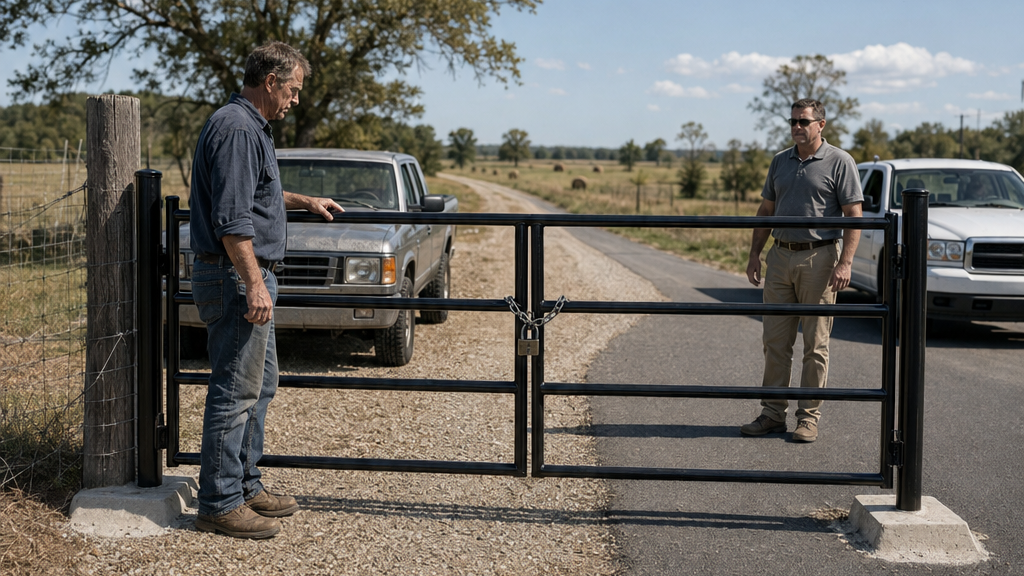
This morning, a double-leaf steel gate stretched from ditch to ditch.
A chain ran through the center. A new brass-colored padlock hung from it.
The feed-truck driver lowered his window.
“You expecting this?”
“No.”
“You got a key?”
Thomas kept looking at the gate.
“No.”
The driver glanced at the narrow county road behind him. There was no safe place for the truck to sit for long. Thomas’s lane had handled feed trucks, hay wagons, stock trailers, tractors, and whatever else the farm required for longer than Thomas cared to count.
Now somebody had turned it into an entrance Thomas himself could not enter.
“I can back out,” the driver said.
Thomas nodded once. “Better.”
The truck eased backward while Thomas walked toward the gate.
At first he noticed the obvious things: glossy black paint, fresh hardware, a keypad mounted chest-high on the development side. Then he saw the concrete.
Two square footings had been poured beside the gravel. The steel posts disappeared into them.
Thomas crouched beside the left post and pressed two fingers against the pale concrete. It had set, but the surface still looked new enough to show trowel marks.
He straightened slowly.
The line between his farm and the newer acreage development had always been easy to understand from the ground. Asphalt stopped. Gravel began. To Thomas, that had always meant something.
The people who lived beyond the paved road apparently had developed another interpretation.
A laminated notice had been wired to the gate.
PROPERTY OWNERS ASSOCIATION SECURITY IMPROVEMENT.
Residents were instructed to register for access credentials before the end of the week.
Thomas read it twice.
Nothing on the page mentioned him.
Nothing asked permission.
He pulled out his phone and photographed the notice, the chain, both posts, the keypad, the concrete, and the place where the new footing met the edge of his gravel.
A white utility pickup rolled toward him from inside the development.
Mark Adams stepped out before it had fully settled.
He wore a gray polo shirt, clean work boots, and the expression of a man arriving to explain something already decided.
“You found it,” Mark said.
Thomas looked from him to the gate. “Hard to miss.”
“We were going to send everybody the registration information this afternoon.”
“Everybody?”
“Residents. Property owners. Anyone who needs regular access.”
Thomas slipped his phone back into his pocket.
“I need regular access.”
Mark gave a short smile, as if Thomas had made his point for him.
“Exactly. We’ll get you set up.”
Thomas stared at him.
“Who authorized you to drill into this ground?”
Mark’s smile faded a little. “The board approved the security project.”
“That wasn’t what I asked.”
“The road serves the development.”
“The road serves my farm.”
“It serves both.”
Thomas stepped closer to the left post.
The old fence line ran behind it, sagging in places from years of cattle rubbing against woven wire. A rusted corner brace stood several feet inside the pasture. Thomas knew every repair on that fence because he had made most of them himself.
Mark followed his glance.
“We’ve had complaints,” he said. “People cutting through at night. Packages disappearing. Somebody left the livestock gate open last month.”
“That wasn’t this gate.”
“No, but it’s the same access point.”
Thomas looked back at him. “Who poured the concrete?”
“A contractor.”
“On whose property?”
Mark’s jaw tightened.
“The association maintains this entrance.”
“That wasn’t my question either.”
A second vehicle slowed behind Mark’s pickup. The driver waited, saw the two men at the gate, then turned around.
Thomas felt the heat climb into his face.
He had spent years watching houses appear on former pasture beyond his southern fence. First three homes. Then seven. Then a loop of paved road with stone mailboxes, decorative lamps, and carefully trimmed shoulders.
He had not objected.
He had let people wave when they passed.
He had pulled one resident’s SUV from a snowbank with his tractor and never sent a bill.
Permission had always seemed like a neighborly thing when nobody tried to rename it.
Mark folded his arms.
“This road has been used by residents for years.”
“Yes.”
“The association maintains the shoulder.”
“Sometimes.”
“We put gravel on it last spring.”
Thomas remembered the load. He had not asked for it, but he had not complained either.
Mark took Thomas’s silence as agreement.
“So the board believed it had authority to secure the access.”
Thomas looked at the concrete again.
“Believed.”
“Thomas, nobody’s trying to take anything from you.”
“You put a locked gate across my lane.”
“And I’m telling you we’ll give you access.”
Thomas almost laughed.
Instead, he took his phone back out.
He photographed the base of the second post.
Then the measuring marks in the gravel where the contractor had scraped aside the shoulder.
Then Mark’s pickup parked behind the gate.
Mark watched him.
“What are you doing?”
“Keeping track.”
“For what?”
Thomas pocketed the phone.
“I don’t know yet.”
That answer seemed to bother Mark more than anger would have.
“The board has already paid for this,” he said.
Thomas nodded.
“That sounds like the board’s problem.”
He walked back toward his pickup.
Mark called after him.
“You can’t just decide this road isn’t part of the development.”
Thomas stopped but did not turn around.
“I’m going to find out exactly what it is.”
At the farmhouse, he left his boots by the kitchen door and went straight to a narrow cabinet beside the refrigerator.
The drawer stuck halfway, as it always did.
Inside were tax records, equipment titles, old survey copies, and a brown deed folder his father had once told him never to throw away no matter how useless the papers looked.
Thomas carried it to the kitchen table.
He unfolded the old parcel map carefully.
The paper had yellowed along the creases.
His house sat near the center. The barn was marked farther north. The pasture boundaries ran in thin black lines.
And from the county road to the southern boundary, the gravel lane sat entirely inside the outline of the Walker parcel.
Thomas leaned closer.
Beside it, in smaller print, was a notation he had not thought about in years.
ACCESS EASEMENT—SEE ATTACHED INSTRUMENT.
He stared at those words longer than he had stared at the gate.
Owning the road, he realized, might be the easy part.
The harder question was what everyone else had been promised.
Chapter 2: The Deed Proved Less Than Thomas Expected
The county parcel map gave Thomas exactly what he wanted for less than thirty seconds.
The roadbed belonged to him.
Then the records clerk placed four easement documents beside it.
Thomas looked at the stack.
“All four?”
“All four parcels,” the clerk said. “Different recording dates, but they reference the same access strip.”
The county records office occupied the ground floor of an old brick building forty minutes from the farm. Thomas had arrived before lunch with photographs on his phone and the deed folder tucked under his arm.
He had expected to prove ownership.
He had not expected ownership to come with footnotes.
The clerk rotated the first document toward him.
“This is the oldest one.”
Thomas read the legal description slowly.
A twenty-foot strip.
Ingress and egress.
Access to the public road.
Successors and assigns.
He moved to the second document.
Then the third.
None transferred ownership.
None mentioned a property owners’ association.
But all four gave specific neighboring parcels a recorded right to use the lane.
Thomas sat back.
“So they can drive through.”
“That’s what it appears to say.”
“Can they put a gate on it?”
The clerk gave him a polite expression that meant she had been asked to stop being a clerk and become a lawyer.
“You’d need legal advice for that.”
Thomas nodded.
He had known the answer before he asked.
He paid for certified copies of the deed, the plat, and all four easements.
Back at the farm, he spread them across the kitchen table.
On his phone, the gate looked even more unnatural than it had in person. New steel. New concrete. New keypad.
Beside it lay documents older than several of the houses beyond his south pasture.
Thomas traced the road on the plat with one finger.
The easements complicated his anger.
He could no longer tell himself everyone using the road was merely being tolerated. Some had a legal right to cross it.
That did not mean they owned it.
But it meant he did not own every decision about movement across it either.
He called Patrick Brown shortly after two.
Patrick had handled a boundary disagreement for another farmer Thomas knew, and Thomas remembered liking one thing about him: he did not talk fast.
Thomas sent photographs and scans while they spoke.
Patrick was quiet for nearly a minute.
“Those posts are permanent?”
“Concrete.”
“Inside the area shown on your deed?”
“Looks that way.”
“Looks that way isn’t enough.”
“I know.”
“Good.”
Thomas frowned at the phone.
“What do the easements give them?”
“The documents you sent appear to give four parcels rights of ingress and egress. We’ll want the complete recorded instruments, not just the first pages.”
“I bought certified copies.”
“Better.”
“What about the association?”
“I don’t see the association named in what you sent.”
“That means they can’t build there.”
“It means I don’t see authority in these documents. Don’t turn that into more than it is yet.”
Thomas leaned against the kitchen counter.
“Someone bolted a gate onto my land.”
“I understand.”
“They locked it.”
“I understand that too.”
“And you’re telling me to wait.”
“I’m telling you not to transform a strong complaint into a weaker one because you’re mad.”
Thomas looked through the window toward the lane.
The gate was too far away to see from the house, but he knew it was there.
“What do I do?”
“First, get a surveyor to confirm the installation location if there’s any boundary uncertainty. Second, don’t cut the lock. Third, don’t block lawful easement holders until we know exactly what their rights are.”
Thomas said nothing.
Patrick noticed.
“You were thinking about blocking it.”
“I was thinking about taking my road back.”
“Those may not be the same thing.”
Thomas disliked that sentence because he knew it was probably useful.
By late afternoon, he met a surveyor at the lane.
Mark was not there.
The gate remained locked.
The surveyor worked from old markers and county references, taking measurements while Thomas stood near the fence.
Finally, the surveyor planted a temporary flag several inches beyond one of the concrete footings.
Thomas pointed at it.
“That’s the line?”
“That’s consistent with the recorded parcel description and the monuments I found. I’ll prepare the formal work.”
“So both posts are on me.”
“They appear to be within your parcel.”
That was the first clean answer Thomas had received all day.
He photographed the flag beside the black post.
For a moment, satisfaction returned.
Then a vehicle approached from inside the development.
A woman slowed at the keypad, entered a code, and drove through after the gate opened.
Thomas watched it close behind her.
She had legal access, he reminded himself.
Possibly.
Maybe certainly.
The gate itself was another question.
That distinction irritated him because it refused to let the problem stay simple.
That evening Patrick called again.
“I’ve reviewed all four instruments.”
Thomas sat at the kitchen table, the documents arranged in rows.
“And?”
“They grant passage to the parcel owners. They don’t transfer fee ownership of the roadbed.”
“I knew that.”
“Yes. But here’s the part you need to hear. An easement holder can sometimes make reasonable improvements necessary for use of an easement. That doesn’t automatically authorize any structure they want.”
Thomas sat straighter.
“Is this reasonable?”
“I didn’t say it was.”
“Permanent steel gate. Concrete posts. No permission.”
“I see the issue.”
“So I make them remove it.”
“You demand removal first.”
Thomas’s thumb tapped the table.
“And if they refuse?”
“We decide the next step based on what they actually claim gives them authority.”
Thomas looked at the association notice he had taken down long enough to photograph and then wired back where he found it.
“Mark says the board approved it.”
Patrick gave a small sound of impatience.
“The board can approve repainting its clubhouse. That doesn’t tell us whether the board can authorize construction on someone else’s parcel.”
Thomas almost smiled.
Patrick continued.
“What I want to know is whether there’s another recorded agreement we haven’t found. Maintenance agreement. Development covenant. Assignment. Anything that gives the association rights beyond those four parcel easements.”
“And if there isn’t?”
“Then Mark has a bigger problem.”
Thomas looked down at the old plat.
The road was his.
Four neighbors could use it.
The association, so far, appeared nowhere.
Patrick let the silence sit for a moment.
Then he asked the question Thomas would carry into the next morning.
“Who, exactly, gave Mark Adams the right to build on your land?”
Chapter 3: Forty-Eight Hours Changed the Argument
Patrick’s first instruction Wednesday morning was not to touch the gate.
His second was more irritating.
“Being right about the dirt does not make every reaction you have to it legal.”
Thomas stood beside the gate with his phone pressed to his ear.
“So we leave it.”
“For forty-eight hours.”
“They already had long enough to ask.”
“This is not about courtesy anymore. It’s about creating a record.”
Thomas looked through the bars toward the paved road beyond.
Someone had taped a small plastic sleeve beside the keypad containing registration instructions.
The association was moving forward as though Thomas’s objection were a scheduling inconvenience.
“What goes in the notice?”
“That you own the underlying parcel, that the survey places the installation within your boundary, that you did not consent to the structure, and that you demand removal and restoration.”
“And if they ignore it?”
“Then call me.”
Thomas ended the call and spent most of the morning assembling evidence.
Survey photographs.
Certified deed.
Copies of the four access easements.
Pictures of both concrete footings.
The association notice.
He disliked paperwork, but he liked sequence. On a farm, mistakes became easier to diagnose when you knew what happened first.
At eleven, he drove to Patrick’s office.
Patrick had already drafted the notice.
Thomas read the first page.
Then the second.
“What’s this part?”
“Reservation of rights.”
“Sounds like lawyer language.”
“It is lawyer language.”
“I don’t want lawyer language. I want the gate gone.”
Patrick leaned back.
“And I want the gate gone without creating three new arguments while we remove one.”
Thomas dropped the paper onto the desk.
Patrick did not react.
“You’re angry,” he said.
“Good observation.”
“You’re also close to having a very clean encroachment dispute. Don’t make it messy.”
Thomas picked the notice up again.
The demand was simple beneath the formal wording: remove the gate and concrete-mounted posts within forty-eight hours, restore the disturbed ground, and provide any document the association believed authorized the installation.
Thomas signed.
They sent copies by certified mail and electronic delivery to the association’s registered address.
Patrick recommended Thomas also hand Mark a copy if possible.
Thomas found him that afternoon near the development entrance.
Mark read the first paragraph, then looked up.
“You hired a lawyer?”
“I hired somebody to read what you apparently didn’t.”
Mark’s expression hardened.
“Thomas, this is unnecessary.”
“So was the gate.”
“We have residents asking for security.”
“Then secure property you own.”
“We have access rights.”
“Four property owners have access rights.”
“The association represents those owners.”
“That isn’t the same thing.”
Mark folded the letter once.
“We maintain this road.”
“You put gravel on part of it.”
“We maintain it.”
“You didn’t ask before that either.”
“And you never objected.”
There it was.
Thomas felt something click into place.
Years of silence had become evidence in Mark’s mind.
Every time Thomas had shrugged at a grader, tolerated a gravel load, or let residents trim weeds near the shoulder, he had assumed everyone understood those actions as neighborly maintenance.
Mark had interpreted the same history as authority.
“That was permission,” Thomas said.
“You never said that.”
“I didn’t know I had to.”
Mark shook his head.
“This is exactly the problem. Nobody knows where your rules begin until you decide somebody crossed one.”
The remark landed harder than Thomas expected.
He almost answered immediately.
Instead, he pointed to the notice.
“Forty-eight hours.”
Mark’s mouth tightened.
“You close this access and you’ll have more than me to deal with.”
Thomas stepped back.
“I didn’t say I was closing anything.”
“Not yet.”
By Thursday morning the certified-delivery receipt showed acceptance.
Patrick called with the result of another records search.
“No recorded easement to the association. No construction license. No assignment I can find.”
Thomas stood in the machine shed, one hand resting on the hood of an old utility tractor.
“So they have nothing.”
“Don’t say nothing. They may claim implied authority through maintenance or through the owners’ rights.”
“Would that let them pour concrete?”
“I think that is a difficult argument for them.”
Thomas heard the caution.
“You lawyers hate saying yes.”
“We hate saying yes when the truthful answer is more expensive.”
Despite himself, Thomas laughed.
Patrick continued.
“Your position on the structure looks good. Your position on shutting down every easement holder would be different.”
Thomas looked toward the shed door.
“I understand.”
He believed he did.
Friday afternoon came.
The gate remained.
The chain remained.
The padlock remained.
At four, Thomas drove to the entrance and parked on his side of it.
He waited ten minutes.
Then twenty.
A resident entered a code and passed through, looking at him through the windshield.
At 4:37, Mark arrived.
Thomas got out.
“Deadline was four.”
Mark checked his watch.
“I know what time it is.”
“You removing it?”
“The board is reviewing counsel’s response.”
“That wasn’t my question.”
“You like that line.”
“I keep having to use it.”
Mark walked closer to the gate.
“Our position is that the security installation is a reasonable improvement to a shared access route.”
“My survey says it’s on my parcel.”
“We don’t dispute the underlying title.”
Thomas stared at him.
It was the first time Mark had said it plainly.
“Then why is it still here?”
“Because title doesn’t eliminate access rights.”
“Access is not concrete.”
“We disagree.”
“No. You’re hoping those are the same thing.”
Mark’s face flushed.
“You remove this yourself and damage association property, we will pursue it.”
Thomas looked at the gate.
Then at Mark.
“I’m not going to damage it.”
Mark seemed briefly uncertain.
Thomas drove home.
At the kitchen table, he called Patrick.
“They refused.”
Patrick was quiet.
“Did they provide anything new?”
“No.”
“Any document?”
“No.”
“Any proposal?”
“No.”
Thomas looked at the clock.
“Then I’m hiring somebody.”
Patrick exhaled.
“If you remove it, use a licensed contractor. Photograph everything. Preserve the gate. Don’t destroy association property.”
“I know.”
“And Thomas?”
“What?”
“Do not confuse removal of the encroachment with permission to obstruct people who have recorded access.”
Thomas looked through the window toward the southern lane.
The gate had been installed because Mark believed years of use had become control.
Thomas had spent three days proving that assumption wrong.
Yet even now, what he wanted most was not merely the gate removed.
He wanted everyone beyond it to understand whose road it was.
That desire sat uneasily beside Patrick’s warning.
Thomas called a licensed fence contractor and scheduled removal for Saturday morning.
Then he made a second call.
A rental yard had two heavy temporary road-control barriers available, the kind used to close private construction lanes.
“Yes,” Thomas told the clerk. “I’ll take both.”
When he hung up, the kitchen was quiet.
On the table, the certified notice sat beside the old easement documents.
Thomas looked at one stack, then the other.
He had proven Mark could not simply lock him out.
By tomorrow morning, he intended to prove something else.
And he had not yet decided whether that second lesson was going to cost only Mark.
Chapter 4: Closing the Lane Hurt the Wrong People
The association’s gate came down at eight-ten Saturday morning.
At eight-forty-three, Thomas’s new barrier stopped Sandra Martin.
The fence contractor had worked carefully. He unbolted what could be unbolted, cut nothing that did not need cutting, and lifted both steel gate sections onto a flatbed. Thomas photographed every stage, including the chipped edges of the concrete footings after the posts were pulled.
Nothing was thrown aside.
Nothing was damaged deliberately.
The black gate was stacked on association common ground beyond the paved entrance, with the chain and padlock secured to one section.
By nine, the lane looked open again.
Then Thomas positioned the two temporary road-control barriers across it.
He had left just enough room for his own pickup to turn onto the farm track from the pasture side. On the development side, reflective panels made the message clear even without the temporary notice he had fastened to the center.
Private access suspended pending resolution.
He stood back and felt something he had been waiting four days to feel.
Relief.
The black steel was gone.
No keypad.
No association notice.
No stranger’s lock between him and his own gravel.
Then a dark SUV rolled to a stop on the other side.
Sandra lowered her window.
“Thomas?”
He recognized her from around the development but could not remember ever having spoken with her longer than a wave.
She pointed at the barriers.
“What is this?”
“The gate’s gone.”
“I can see that.”
“Then you can probably see the rest.”
Her expression changed.
“I need through.”
“Road’s closed.”
“To Mark?”
“To association access.”
“I’m not the association.”
Thomas folded his arms.
“You live back there.”
“I also have a recorded easement.”
That word landed differently now.
Thomas walked closer.
Sandra got out and held her phone in one hand.
“I’m supposed to meet a service technician at my place in twenty minutes.”
“You can use the north entrance.”
“There is no north entrance for my parcel.”
“There’s a utility track.”
“That track crosses somebody else’s pasture and it isn’t mine to use.”
Thomas looked past her toward the paved road.
“You need to talk to Mark.”
“I already did.”
“Good.”
“No, not good.”
Her voice sharpened without becoming loud.
“I told him not to put that gate here.”
Thomas said nothing.
Sandra watched his face.
“You didn’t know that.”
“No.”
“I was at the board meeting. I said they needed to speak to you before they poured anything.”
“Mark didn’t mention it.”
“I imagine Mark left out several things.”
For the first time since Tuesday, Thomas felt the clean line he had drawn between himself and the development blur.
Sandra pointed toward the gravel beneath his feet.
“My deed gives my parcel access over this lane. That did not make Mark’s gate right. It also does not make your barrier right.”
Thomas’s jaw tightened.
“You came through their gate all week.”
“Because it was there. What did you expect me to do, drive through it?”
“You registered for the keypad.”
“Yes. Because I still had to get home.”
The answer irritated him precisely because it was reasonable.
A pickup appeared behind Sandra’s SUV.
Then another.
Within several minutes three vehicles were stopped on the development side.
Nobody honked.
That almost made it worse.
Sandra lowered her voice.
“I’m not asking you to forgive what they did.”
“I didn’t say you were.”
“I’m asking you not to punish four properties because one board president decided permission meant ownership.”
Thomas looked at the temporary barrier.
Forty-eight hours earlier, he had imagined this sight differently. Mark would arrive. Mark would finally understand the road could not simply be controlled by committee vote.
Instead, Sandra stood in front of him.
“Move it,” she said. “At least for the easement holders.”
Thomas shook his head.
“Not until Patrick looks at everything.”
“Patrick?”
“My attorney.”
“Then call him.”
“I will.”
“When?”
Thomas glanced at the vehicles waiting behind her.
“When I’m ready.”
Sandra’s eyes narrowed.
“That sounds a lot like Mark.”
She got back into her SUV.
Thomas stood still as she reversed away.
The words stayed.
At eleven-thirty, Thomas’s feed supplier called.
The truck that had been turned around Tuesday was coming again.
Thomas told the driver to approach from the county-road side and call when he arrived.
“You got that gate problem fixed?” the driver asked.
“Gate’s gone.”
“Good.”
Thomas looked at the barrier.
“Just call me.”
Twenty minutes later he moved one barrier enough for the feed truck to enter.
As the loaded truck rolled through, Thomas saw a white service van waiting behind it on the development side.
The driver stepped out.
“I’m trying to get to a house back there.”
“Can’t.”
“I’ve got a well pump appointment.”
Thomas pointed toward the pavement. “Call your customer.”
The driver stared at him.
“She already called me. Said you might let me through.”
Thomas knew immediately who she meant.
He looked toward Sandra’s house, hidden beyond a rise and several stands of trees.
The feed truck rumbled past him toward the barn.
Thomas could open the barrier.
He chose not to.
“Sorry.”
The service driver climbed back into the van.
By afternoon, Thomas no longer enjoyed the quiet road.
For years he had complained about tires kicking dust across the shoulder and cars traveling too fast near his cattle fence.
Now almost nothing moved.
The stillness felt less like possession than interruption.
Patrick called after four.
“You closed it?”
“I removed their encroachment.”
“That was not my question.”
Thomas leaned against the kitchen counter.
“I put up temporary barriers.”
Patrick was silent for a moment.
“Have you prevented recorded easement holders from passing?”
“Until this gets settled.”
“That is not what I advised.”
“They put a permanent gate on my land.”
“And you may have a strong claim about that. Their mistake does not expand your rights.”
Thomas looked out toward the lane.
“So I’m supposed to leave everything open while they decide what else they want?”
“You’re supposed to distinguish between the association and the people whose deeds may already entitle them to passage.”
A vehicle entered the farm drive from the county road.
Sandra.
She parked near the house and walked toward the porch carrying a flat document envelope.
Thomas ended the call.
She did not bother with small talk.
“I found something.”
Thomas looked at the envelope.
“What?”
“My closing papers.”
She opened it and removed several photocopied pages.
“My easement.”
“We already have that.”
“Not this page.”
She handed it over.
The document was older than the development association itself. Thomas recognized the surname of the man who had owned his farm before Thomas’s father bought it.
One paragraph had been marked with a yellow tab.
Thomas read it once.
Then again.
The owner of the burdened property agreed not to unreasonably obstruct continuous ingress and egress to the benefited parcels, provided the users maintained the lane in a manner consistent with its agricultural use and did not materially interfere with the farm operation.
Thomas felt Sandra watching him.
“That was signed before your father bought the place,” she said.
He kept reading.
The agreement protected the farm.
But it protected passage too.
Sandra crossed her arms.
“I’ll say Mark had no right to put that gate there.”
Thomas finally looked up.
“And?”
“And if you keep blocking me, I’ll say you have no right to do this either.”
For four days Thomas had been waiting for someone from the development to admit Mark had crossed the line.
Sandra had just done it.
It did not feel like winning.
He looked down at the old agreement in his hands.
For the first time, Thomas wondered whether getting his road back and controlling everyone who used it had become two different things.
Chapter 5: Mark Finally Explained Why He Ordered It
Mark Adams placed three printed incident reports on the association office table before Thomas had even sat down.
“You think I woke up one morning and decided I wanted a gate?”
Thomas remained standing.
“I think you installed one on my land.”
“I know what you think.”
“Then we’re making progress.”
Patrick had advised Thomas not to meet Mark alone if the discussion was going to become formal. Thomas had ignored that part. He had agreed to talk because Sandra’s document had spent most of Sunday afternoon on his kitchen table, forcing him to reconsider what he thought he knew.
Mark tapped the first report.
“Package theft. Two homes.”
The second.
“Fuel siphoned from a contractor’s truck.”
The third.
“Livestock incident.”
Thomas looked down.
“What livestock?”
“A calf.”
“Whose?”
“A resident keeps two on the south acreage. Somebody came through at night, opened the secondary fence, and left it that way.”
Thomas’s eyes lifted.
“Did the calf get out?”
“Onto the development road.”
“Anybody hurt?”
“No.”
“Then call the sheriff about trespassing.”
“We did.”
Mark slid another sheet across the table.
It was an insurance letter.
Thomas read enough to understand the concern. The carrier had raised questions about uncontrolled vehicle access, liability, and documented security measures.
“So that’s it?” Thomas asked. “Insurance company asks questions and you pour concrete on me?”
“Residents were demanding something visible.”
“There’s your problem.”
“What?”
“You wanted visible instead of lawful.”
Mark sat back.
For a moment, the fight went out of his face.
“You don’t attend our meetings.”
“I don’t belong to your association.”
“You don’t answer half the messages sent about the road either.”
“Because it isn’t an association road.”
“That road affects thirty-six households whether you like the association or not.”
“Four parcels have rights over it.”
“And those parcels connect into the development network.”
Thomas stared at him.
“That still doesn’t make my dirt yours.”
Mark rubbed a hand over his forehead.
“No. It doesn’t.”
The admission came so quietly Thomas almost missed it.
Mark looked at the reports again.
“You want to know what I was thinking? I was thinking if somebody gets hurt after we’ve had three security complaints and an insurance warning, every resident in that development asks why the board did nothing.”
“You could have called me.”
“We tried.”
Thomas’s expression hardened.
“You sent notices.”
“We left messages.”
“You sent association notices addressed to residents. I’m not a resident.”
“You knew what was happening around you.”
Thomas leaned forward.
“That sentence right there. That’s how you got into this.”
Mark looked up.
“You assumed because I didn’t object to gravel, mowing, or people driving through, I’d handed you management of the road.”
“And you assumed because nobody had ever written down every maintenance arrangement that the association had no responsibilities.”
“Responsibility is not ownership.”
“I know that now.”
Thomas caught the word.
“Now?”
Mark looked away.
The office door opened and one of the board members entered carrying a binder.
Mark’s face changed.
“Not now.”
The board member stopped.
Thomas noticed it.
“What?”
“Nothing.”
The board member looked from Mark to Thomas.
“I brought the minutes you asked for.”
Mark stood.
“Leave them.”
Thomas reached for the binder first.
Mark’s hand came down on it.
Neither man moved.
Thomas looked at him.
“What’s in the minutes?”
Mark released the binder.
The board member remained by the door.
Thomas opened to the marked page.
The meeting had taken place six weeks earlier.
Security gate proposals.
Contractor estimates.
Insurance discussion.
Then one sentence in the recorded notes stopped him.
Board member recommends obtaining written authorization from Walker parcel owner before permanent installation due to unclear property boundary and easement scope.
Thomas read it twice.
He looked at Mark.
“You knew.”
Mark’s face tightened.
“I knew there was a question.”
“That says get my permission.”
“It says authorization should be obtained because the scope was unclear.”
“And you ordered the gate anyway.”
“The contractor had availability that week. We had already delayed the project twice.”
Thomas closed the binder.
All the security reports remained on the table between them.
For several minutes they had almost made Mark’s decision understandable.
Now Thomas saw the choice underneath the pressure.
Mark had not accidentally misunderstood after the gate was built.
He had known enough beforehand to stop.
He had chosen speed.
“You could have knocked on my door,” Thomas said.
Mark’s voice was lower now.
“Yes.”
“But you thought you’d rather explain it after.”
Mark did not answer.
That silence gave Thomas more satisfaction than shouting would have.
Then Mark glanced toward the window.
“You have your answer about the gate. Now we talk about your barriers.”
Thomas felt the satisfaction disappear.
“My attorney is handling that.”
“Good. Ours is too.”
Mark pulled a letter from beneath the incident reports.
“We’re prepared to seek an injunction if lawful access remains obstructed.”
Thomas took it.
“You threatening me?”
“I’m telling you what the board authorized this morning.”
“The same board?”
Mark’s mouth tightened.
“The same board that is also prepared to discuss removing any claim of unilateral construction authority.”
Thomas paused.
That was new.
Mark continued.
“But you don’t get to use four homeowners as leverage because you’re angry with me.”
Thomas thought of Sandra standing at his barrier.
He disliked hearing the same point from Mark.
That did not make it wrong.
“You installed the gate.”
“Yes.”
“You ignored forty-eight hours.”
“Yes.”
“You knew permission was unclear.”
Mark’s gaze stayed level.
“Yes.”
The third admission changed the room.
Mark was not apologizing.
But he was no longer hiding behind the board either.
Thomas folded the injunction letter.
“Why are you telling me this?”
“Because I want the road open.”
“For the association?”
“For the people who live there.”
Thomas almost answered sharply.
Then he saw how tired Mark looked.
Not defeated.
Tired.
The kind of tired Thomas knew from calving nights and broken equipment: the exhaustion of making decisions because everyone expects someone else to carry the consequences.
Mark had still made the wrong one.
But for the first time, Thomas understood why he had been tempted to make it.
That evening Patrick read both the old easement agreement and the association’s new letter.
Thomas sat across from him.
“So?”
Patrick removed his glasses.
“You have a strong argument that the gate exceeded their rights.”
“I know.”
“And they have a potentially strong argument that your blanket obstruction interferes with the recorded easements.”
Thomas stared at him.
“You sound like their lawyer.”
“I sound like yours.”
Patrick placed the two documents side by side.
“They may owe you restoration costs. Possibly other damages depending on what we establish. You may be able to obtain a declaration preventing future permanent structures without consent.”
“And the barriers?”
Patrick tapped Sandra’s agreement.
“If you keep lawful users blocked, you give them a reason to ask a judge to act quickly.”
Thomas leaned back.
“So everybody’s wrong.”
“Not equally. Not about the same things.”
“That’s convenient.”
“No. It’s expensive.”
Thomas looked toward the office window.
Patrick continued.
“A court fight could clarify the documents. It could also take months, cost both sides money, and leave you living beside people who still need the same road when it’s over.”
Thomas said nothing.
Patrick slid a blank legal pad toward him.
“You wanted them to learn the road was yours.”
“They have.”
“Then decide what you want them to learn next.”
Thomas looked at the blank paper.
For the first time since seeing the gate, he could not improve his position simply by proving Mark wrong.
Chapter 6: The Agreement Thomas Almost Refused to Offer
Patrick read Thomas’s proposed agreement for less than two minutes before pushing it back across the desk.
“No.”
Thomas stared at him.
“No what?”
“No, I won’t recommend this.”
The draft had taken Thomas most of Sunday night.
Monthly access fees.
A security deposit from the association.
Advance approval for every contractor vehicle.
Penalties for unauthorized maintenance.
A clause allowing Thomas to suspend access after any violation he considered material.
He had written it carefully.
Patrick had rejected it almost immediately.
“Which part?”
“The part where you turn a property dispute into a private toll kingdom.”
Thomas’s jaw tightened.
“They used my land for years.”
“Under recorded easements.”
“They also maintained it without asking.”
“You tolerated that.”
“They installed a gate.”
“Yes, and we can address the gate.”
Patrick tapped the draft.
“This does not address the gate. This addresses the fact that you finally discovered leverage and want to make sure nobody forgets it.”
Thomas took the papers.
“You said I should decide what I want.”
“I did.”
“This is what I want.”
“No. This is what you want Mark to feel.”
Thomas stood.
Patrick remained seated.
“Send me a bill.”
“You already have one coming.”
Thomas reached the door.
“Thomas.”
He stopped.
Patrick’s voice softened.
“You can protect the farm. Written permission for future structures. Defined maintenance obligations. Restoration costs. Notice before substantial work. Agricultural priority when equipment needs the lane. Those are defensible things.”
Thomas looked back.
“And fees?”
“If there are legitimate maintenance costs, allocate them reasonably. Not eight hundred dollars a month because you want the number to hurt.”
Thomas opened the door.
“You sound disappointed.”
“I’m trying to keep you from becoming evidence for the other side.”
Thomas left with the draft folded under his arm.
Sandra was waiting near the barrier when he returned to the farm.
She had parked her SUV on the development side and walked through the narrow grass shoulder Thomas had left open for foot traffic.
“You still haven’t moved it.”
“I’ve been busy.”
“So have I.”
She held out a sheet of paper.
Thomas did not take it.
“What now?”
“A statement.”
“From who?”
“Me.”
He finally accepted it.
Sandra had written that she objected to the association’s permanent gate before installation and believed the gate exceeded anything required for ordinary access.
Thomas looked up.
“You putting this in writing?”
“Yes.”
“Why?”
“Because it’s true.”
He read farther.
Then stopped.
The next paragraph said Thomas’s current obstruction also interfered with her recorded right of passage.
He lowered the page.
“You came here to help me and threaten me at the same time?”
“I came here to stop pretending one of you has to be completely right.”
Thomas gave a dry laugh.
“That’s useful.”
“I will testify that Mark was warned.”
Thomas said nothing.
“And I will testify that you blocked me after I showed you my easement.”
He looked at her.
Sandra held his gaze.
“That’s not disloyalty, Thomas. I’m not on anybody’s team.”
He glanced toward the gravel lane.
For nearly a week, he had divided the landscape into sides.
His farm.
Their development.
His road.
Their gate.
Sandra complicated every one of those categories.
“Walk with me,” he said.
She looked surprised.
“Where?”
“Lane.”
Thomas moved the barrier aside enough for them to pass without moving a vehicle.
They walked toward the farm.
Gravel cracked beneath their shoes.
At the first bend, the newer houses disappeared behind trees. The lane looked the way it had before the development existed: worn tire paths, grass pushing at the middle, cattle fence running beside it.
Thomas pointed to the shoulder.
“Feed truck needs this whole width when it turns.”
Sandra nodded.
“The association kept talking about making the entrance prettier.”
“They wanted curbing once.”
“I know.”
“I told them no.”
“You never told us why.”
Thomas looked at her.
“Didn’t think I needed to.”
Sandra gave him a small, tired smile.
“That may be part of the problem.”
He almost objected.
Instead, he looked at the tire marks.
His father had been the same way. If a boundary was obvious to him, he assumed it was obvious to everyone.
But property lines did not speak.
Neither did favors.
People filled silence with whatever interpretation served them best.
They reached the scarred places where the gate posts had been removed.
Two rough concrete patches sat beside the gravel.
Thomas stopped.
Sandra touched one with the toe of her shoe.
“I hated that thing.”
“You used it.”
“I needed to get home.”
Thomas nodded.
He finally understood the difference without resenting it.
Back at the kitchen table, he unfolded his harsh draft.
Then he tore the first page in half.
By late afternoon, the replacement was shorter.
The roadbed remained Thomas’s property.
The four recorded easement holders retained uninterrupted passage subject to the original agricultural-use limitations.
No permanent gate, post, curb, utility fixture, sign foundation, drainage structure, or similar installation could be placed within the defined road corridor without Thomas’s written consent.
Routine grading and gravel work would require notice.
Emergency repairs could proceed when necessary to preserve safe passage.
The association would pay the documented cost of removing the unauthorized gate and repairing the disturbed ground.
Maintenance costs would be divided according to a schedule tied to actual work, not punishment.
Farm vehicles and livestock operations would retain priority when temporary conflicts arose.
Thomas stared at the final provision.
Disputes would require written notice and a short meeting before either side blocked access or installed permanent structures.
He did not like it.
That was how he knew it might be fair.
Patrick reviewed the new version that evening.
“This I can work with.”
Thomas leaned against the kitchen counter.
“I’m not thanking them.”
“Nobody asked you to.”
“I’m not apologizing for removing the gate.”
“You shouldn’t.”
Thomas glanced toward the barn.
The black padlock from the association gate sat on a shelf inside, tagged with the date and photographs as part of the preserved evidence.
He had thought about placing it on the kitchen table when Mark came.
A trophy.
Instead, he left it in the barn.
The following afternoon, Sandra returned with copies of messages from two other easement holders.
They would support the revised terms if access remained protected.
Thomas read each one.
“They’ll back me against the association?”
“They’ll back the agreement.”
“That’s not what I asked.”
Sandra shrugged.
“It’s the answer.”
Thomas smiled despite himself.
Near dusk, they walked the lane again.
This time Thomas pointed out the culvert that washed during heavy rain, the shoulder that needed gravel before winter, and the section where hay wagons sometimes had to swing wide.
Sandra pointed out the blind corner where residents worried about unfamiliar vehicles.
Neither problem canceled the other.
By the time they returned to the house, Thomas had added one more provision: any future security measure would have to be discussed by the affected landowners together, and nothing permanent could be installed on his parcel without written consent.
The next day he arranged copies across his kitchen table.
Old plat map.
Four easements.
Survey.
Gate photographs.
Removal invoice.
Revised agreement.
No dramatic fee schedule.
No punitive penalties.
No clause allowing him to shut the road whenever he decided someone had crossed him.
Thomas stood over the papers.
Giving those things up did not feel like surrender.
Not quite.
But it did not feel like victory in the way he had imagined victory on Saturday morning.
Outside, tires crunched over the main farm drive.
Thomas looked through the window.
Mark’s white utility pickup turned past the mailbox and came toward the house.
A second association vehicle followed.
Thomas placed one hand on the revised agreement.
For the first time since the steel gate appeared, the next move did not depend on proving who had more power.
It depended on whether either man could accept having less of it.
Chapter 7: The Road Reopened Under Different Rules
Mark Adams sat at Thomas Walker’s kitchen table with the old association notice folded beside his elbow.
Two weeks earlier, that notice had been wired to a steel gate across Thomas’s road.
Now Mark had no gate, no keypad, and no document giving the association authority to build another one.
Thomas placed the revised agreement in front of him.
A second board member sat to Mark’s right. Sandra Martin took the chair nearest the window. Patrick Brown had joined by speakerphone and made it clear before the meeting began that the decisions belonged to the people in the room.
Mark read the first page without speaking.
Thomas watched him reach the section defining ownership of the roadbed.
Mark stopped.
“This says the association disclaims any ownership interest.”
“Yes.”
“We never claimed ownership.”
Thomas looked at the folded notice.
“You claimed enough of it to put a lock across it.”
Mark’s mouth tightened, but he continued reading.
The room remained quiet except for paper turning and the faint hum of the refrigerator.
When Mark reached the section on permanent improvements, he placed one finger on the paragraph.
“Written consent from you for anything installed in the corridor.”
“Anything permanent.”
“That gives you veto power.”
“It gives the property owner consent rights over permanent construction on his property.”
Mark looked toward Sandra.
She did not rescue him.
“That seems reasonable to me,” she said.
Mark leaned back.
“And what happens the next time we have a security problem?”
Thomas had expected the question.
“You bring it to the affected owners before you build something.”
“That could take weeks.”
“Then don’t wait until you’ve already hired a contractor.”
The second board member shifted uncomfortably.
Mark looked at Thomas.
“We had actual incidents.”
“I know.”
“That part seems to keep disappearing.”
“It doesn’t.”
Thomas rested both hands on the table.
“A calf got loose. Fuel was taken. Packages disappeared. Your insurer wanted action. None of that gave you the right to pour concrete on my parcel.”
Mark looked down again.
“No.”
The word came without argument this time.
Thomas felt no rush of victory.
That surprised him.
He had imagined this moment during the first days of the dispute—Mark sitting across from him, finally forced to admit what he had done.
In Thomas’s imagination, the admission had felt much better.
Mark turned another page.
Then he stopped again.
“The monthly fee is gone.”
“Yes.”
The original draft had demanded eight hundred dollars per month from each benefited property.
Sandra glanced at Thomas.
He did not look at her.
Mark studied the replacement language.
Instead of punitive fees, the agreement divided verified maintenance costs among the parties actually using the lane. Thomas would cover the portion attributable to farm use. The easement holders would contribute according to the agreed schedule. Extraordinary damage caused by one party would be that party’s responsibility.
Mark looked almost suspicious.
“What changed?”
Thomas thought of Patrick pushing the first draft back across his desk.
He thought of Sandra standing on the wrong side of his barrier.
“I did.”
Nobody spoke for a moment.
Thomas continued.
“You damaged the shoulder and poured two footings without permission. I want the contractor bill covered and the ground restored.”
“That’s in here.”
“Yes.”
“No damages beyond that?”
“If restoration is done properly, no.”
Mark’s expression softened, but only slightly.
“And the road stays open?”
Thomas pointed to the clause.
“To the recorded easement holders, yes.”
Sandra leaned forward.
“Uninterrupted passage, subject to the agricultural-use terms already in the older agreement.”
Mark read the wording.
“So Thomas can’t just block everyone again.”
Thomas answered before Sandra could.
“No.”
Mark looked at him.
Thomas disliked saying it.
He said it anyway.
“And the association can’t install another gate because it decides everybody needs one.”
“No,” Mark said.
The word carried more reluctance than Thomas’s had.
That made it fair.
Patrick’s voice came from the phone.
“If you’re all agreeing on the substance, the remaining question is enforcement and notice.”
Mark turned a page.
“Thirty days before planned permanent work?”
Thomas nodded.
“Except emergencies.”
“And forty-eight hours before routine grading?”
“Yes.”
Mark glanced through the window toward the farm lane.
“What about security cameras?”
Thomas paused.
That had not been in the latest argument.
“Where?”
“At the paved entrance. On association property.”
“If it’s not on my land, I don’t control it.”
“What if it faces the lane?”
Thomas considered.
Sandra spoke quietly.
“That’s the kind of thing this agreement is supposed to make us discuss instead of assume.”
Mark gave her a tired look.
“You enjoy being in the middle.”
“No. I enjoy being able to get to my house.”
That ended the argument.
They moved to signatures.
The second board member signed first.
Sandra signed acknowledgment of the access provisions.
Mark held the pen longer than necessary.
His eyes went once more to the paragraph stating that the association possessed no independent right to install permanent structures within Thomas’s road corridor.
Then he signed.
Thomas signed last.
The sound was small—the scratch of a pen across paper.
Nothing like the clang of a steel gate closing.
Patrick asked them to confirm that everyone had signed the correct pages.
They did.
Then Mark said, “I want one thing added before this is recorded.”
Thomas’s shoulders tightened.
“What?”
“A security-review meeting twice a year.”
Thomas stared at him.
“No construction authority,” Mark said quickly. “No automatic right to install anything. Just a meeting. A chance to review problems involving this entrance.”
Sandra looked at Thomas.
Mark continued.
“If we get trespassing complaints again, I don’t want the only choices to be doing nothing or making another mistake.”
Thomas looked toward the documents spread across his table.
Two weeks ago he would have heard the request as another attempt to put the association’s hands on his road.
Now he heard something else.
A request to talk before acting.
“What does the meeting accomplish?” Thomas asked.
“Maybe nothing.”
Mark shrugged.
“Maybe we decide better lighting belongs on association property. Maybe cameras. Maybe residents need reminders about closing their own livestock gates. Maybe you tell us something won’t work because a hay trailer has to swing through there.”
Thomas looked at Sandra.
She gave him no signal.
The decision remained his.
“Twice a year,” Thomas said.
Mark nodded.
“No authority attached.”
“None.”
Thomas picked up his pen.
“Add it.”
The second board member wrote the sentence into the amendment section.
They initialed it.
When the meeting ended, Mark remained behind while the others stepped outside.
The folded association notice was still on the table.
Mark picked it up.
“I should have come here first.”
Thomas looked at him.
“Yes.”
Mark gave a short nod.
“I thought you’d say no.”
“I might have.”
“That was part of why I didn’t ask.”
Thomas almost smiled.
“There’s a lesson in there somewhere.”
“For both of us?”
Thomas looked at him for a moment.
“For both of us.”
They walked outside together.
The temporary barriers still crossed the gravel lane.
Farther down, the repaired ground showed two pale patches where the gate posts had been removed. The contractor would return after the final restoration agreement cleared.
Thomas went to the chain securing his barrier.
The padlock was his.
Not the association’s.
That mattered less than it had a week earlier.
He put in the key.
Sandra stood on the paved side beside her SUV. Mark and the board member waited several yards back.
Nobody said anything.
Thomas turned the key.
The lock opened.
He removed the chain, dragged one barrier toward the fence, then moved the second far enough for a vehicle to pass.
The gravel road opened from the county route through the farm edge and toward the development beyond.
Sandra drove through first.
She slowed beside Thomas and lowered her window.
“Thank you.”
Thomas nodded.
“Keep it slow around the bend.”
“I always do.”
She drove on.
Mark approached next but stopped before getting into his truck.
“What are you doing with the old gate?”
“Your gate sections are already on association property.”
“The lock?”
Thomas knew which one he meant.
The black gate’s padlock still sat tagged on a shelf in his barn.
“Keeping it for the file.”
Mark nodded.
“Probably smart.”
Then he drove through.
Thomas remained beside the lane after the vehicles disappeared.
A few minutes later a farm pickup came the other direction, followed by a service van heading toward the development.
Tires pressed into the same gravel tracks they had used for years.
The road did not look different.
It still belonged to Thomas.
Others still possessed the right to cross it.
Neither fact erased the other.
For years Thomas had believed that if people understood where the property line was, they would understand everything else.
The gate had proved otherwise.
A boundary could tell someone where ownership began.
It could not tell them what permission meant, what cooperation required, or what silence had allowed people to assume.
Thomas picked up the unlocked chain and carried it toward the barn.
Behind him, another vehicle rolled slowly along the gravel lane.
This time, he did not turn around to see who it was.
The road was open.
And for the first time since the black steel gate appeared, open did not feel the same as unprotected.
The story has ended.