They Kept Fining His Farm Truck Until He Mapped Who the Rural Association Was Really Targeting
Chapter 1: The Notice Under the Windshield Wiper
Ryan Carter saw the orange slip before he saw the delivery truck coming down the county road.
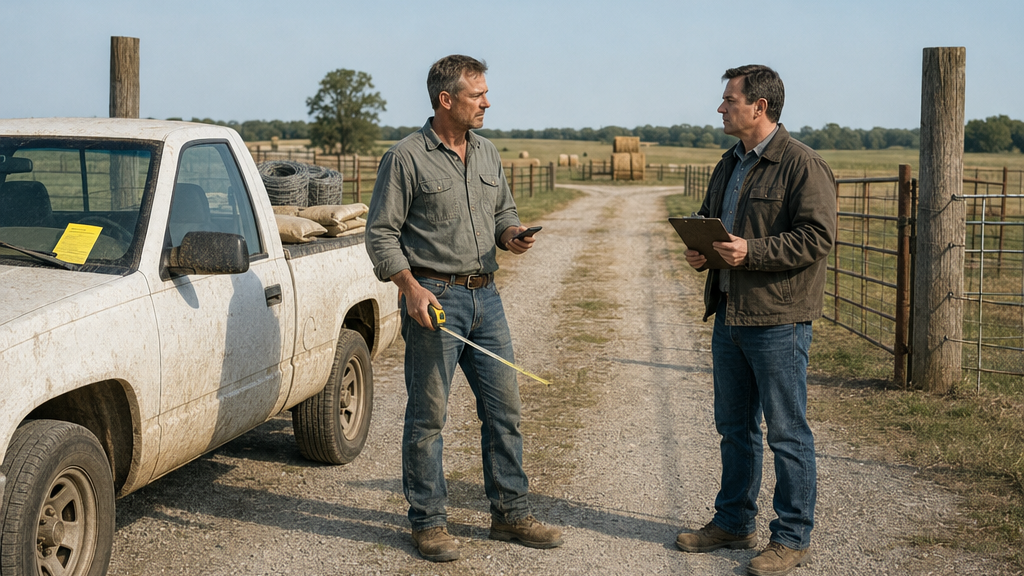
It was tucked under the driver-side windshield wiper of his white pickup, bright against the dust that had dried along the hood. For half a second he assumed it was an invoice from the feed supplier or a note one of the neighbors had left.
Then he saw the association seal.
He pulled the paper free and read it once.
Then again.
UNSAFE APPEARANCE AND OBSTRUCTION.
Fifty-dollar penalty.
Ryan looked from the notice to the truck as if something about it might have changed overnight.
The bed held two unopened mineral tubs, a coil of woven wire, three steel posts, and a shovel with dried clay on the blade. The passenger-side rear tire had the same slow leak he had been meaning to address. The right fender carried a dent from a gate hinge the previous winter.
Nothing new.
Nothing unsafe that he could see.
A diesel engine growled somewhere beyond the hedgerow.
Ryan folded the notice once and slid it into his shirt pocket just as the cattle delivery rig appeared at the bend.
The driver needed the shared gravel lane clear enough to swing the trailer wide. Ryan climbed into his pickup, moved it ten feet farther toward his own fence, then walked out to guide the rig through.
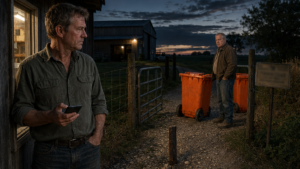
That was when he noticed Kevin Mitchell standing beside the association marker at the edge of the lane.
Clipboard in one hand.
Phone in the other.
Ryan waited until the livestock trailer had passed.
“You leave this?”
Kevin glanced at the paper Ryan had pulled from his pocket.
“Yeah.”
“For what?”
Kevin pointed toward the pickup.
“Appearance and obstruction.”
Ryan looked over his shoulder.
“You’ve seen that truck there for six years.”
“I’m not talking about six years.”
“You said obstruction. How much lane do I have to leave?”
Kevin shifted the clipboard under his arm.
“Enough for reasonable access.”
“How much is that?”
“It depends.”
“On what?”
“Conditions.”
Ryan waited.
Kevin didn’t add anything.
The cattle in the trailer bawled as the driver eased toward the loading lot.
Ryan asked, “Is there a number?”
“A number?”
“Feet. Width. Something I can measure.”
Kevin shook his head once.
“The association rule gives field discretion.”
That answer bothered Ryan more than the fifty dollars.
He could fix six feet.
He could fix eight.
He could move the truck behind the machine shed if that was the rule.
But “discretion” was not a place he could park.
He took the notice from his pocket again.
“Give me the rule in writing.”
Kevin looked mildly surprised.
“You can get it from the office.”
“I’d rather have the section.”
Kevin flipped several pages on the clipboard and read out the article number.
Ryan wrote it on the back of the penalty notice.
Kevin watched him do it.
“You planning to contest?”
“I’m planning to understand it.”
“If you contest, they can hold the access renewal until review.”
Ryan stopped writing.
The shared lane crossed association-maintained ground before splitting toward three farms. Every fall, the association renewed commercial access permissions for heavy trailers, feed deliveries, and equipment loads.
Ryan’s cattle operation could survive a fifty-dollar fine.
A delayed access renewal during hay hauling was another matter.
Kevin must have seen the change in his face.
He said, more quietly, “I’m just telling you how the process works.”
Ryan folded the paper again.
“That supposed to make it better?”
Kevin’s expression tightened.
“I don’t write the policy.”
“No. You just decide what it means.”
Neither man said anything after that.
Ryan turned away first.
By nine-thirty, the cattle were unloaded and the delivery driver had gone. Ryan repaired a loose section of fence, filled two water tanks, and tried not to think about the notice.
He failed.
At lunch, he called the association office.
The meeting secretary found the rule and read it to him.
Vehicles, equipment, or stored materials adjacent to shared agricultural access routes could be cited if their condition, placement, or appearance created an unreasonable obstruction, hazard, or interference with common use.
Ryan asked the same question.
“What does unreasonable mean?”
“That’s determined during inspection.”
“By Kevin?”
“By the field inspector, yes.”
“Is there a lane-width standard?”
“Not in that section.”
“Photograph requirement?”
“Not required.”
“Written measurement?”
“No.”
Ryan leaned against the kitchen counter and stared through the window at the pickup.
“So if I pay this, what am I supposed to change?”
There was a pause.
“You can move the vehicle farther from the shared access.”
“It’s on my side.”
“I understand.”
“Do you?”
Another pause.
Then the secretary said, “Mr. Carter, if you want formal review, I can send you the dispute form.”
Ryan glanced at the calendar beside the refrigerator.
Two hay loads scheduled next week.
A replacement bearing needed for the baler.
The access renewal due before the end of the month.
He had promised his father, years earlier, that the farm would stay solvent.
His father had not meant that Ryan should pay every questionable bill placed in front of him.
But Ryan had learned early that small disputes had a way of becoming expensive.
“How long does review take?”
“Usually ten business days.”
“Usually.”
“It can be longer.”
Ryan closed his eyes.
“Don’t send it.”
That afternoon he moved the pickup another fifteen feet onto his property.
Then, because it annoyed him that he felt compelled to prove anything, he moved it five feet more.
The next morning he took a photograph before leaving for the north field.
The lane was clear enough for a grain truck.
Clear enough for a livestock trailer.
Clear enough for two pickups to pass slowly if their drivers knew what they were doing.
He paid the fifty dollars online.
The confirmation page appeared.
Ryan stared at it longer than necessary.
He told himself the matter was finished.
Three mornings later, he came outside carrying a thermos and found another orange slip trembling beneath the same windshield wiper.
Chapter 2: Nothing About the Truck Had Changed
The second fine was seventy-five dollars.
Ryan read that number before anything else.
Repeat violation.
Same rule.
Same phrase.
Unsafe appearance and obstruction.
He stood beside the pickup while the engine ticked after a short run to the feed shed. The truck was parked farther from the lane than it had been when Kevin issued the first notice.
Ryan measured the distance with his eyes.
Then he went inside the machine shed and came back with a twenty-five-foot tape.
He hooked the end near the lane marker.
Nineteen feet, four inches of open gravel at the narrowest point.
He wrote it on the back of the citation.
At seven-fifteen, Kevin’s association pickup came slowly down the lane.
Ryan stepped into the road.
Kevin braked.
The window came down.
“You got a minute?”
Kevin looked at the tape measure hanging from Ryan’s hand.
“What is it?”
Ryan held up the notice.
“Nineteen feet, four inches.”
Kevin frowned.
“What?”
“The open lane.”
“I didn’t measure it.”
“I know.”
Kevin glanced toward Ryan’s truck.
Ryan said, “Tell me what changed.”
“Ryan—”
“First notice, truck was closer. I paid it. Moved the truck. Now I get another one.”
“The area is still cluttered.”
Ryan turned.
The pickup bed held fencing supplies and feed.
“This is a farm.”
“I’m not arguing with you.”
“I’m not asking for an argument.”
He pulled his phone from his pocket and took a photograph of the truck, then another with the tape stretched across the lane.
Kevin watched him.
“You documenting me now?”
“I’m documenting my lane.”
“You know this can be handled through review.”
“You know review can hold up my access renewal.”
Kevin’s jaw shifted.
“That’s the procedure.”
Ryan stepped closer, not enough to threaten, only enough that Kevin had to look directly at him.
“What measurement did I fail?”
Kevin’s answer came almost immediately.
“There isn’t one measurement.”
“What hazard?”
“It doesn’t have to be a single hazard.”
“What obstruction?”
“Field discretion, Ryan.”
There it was again.
Ryan felt something in him settle.
Not calm exactly.
Precision.
He opened the notes app on his phone.
“Seven-seventeen a.m.,” he said aloud. “Nineteen feet, four inches clear. Inspector declined to identify measurable obstruction.”
Kevin’s face changed.
“You trying to make me look bad?”
“No.”
Ryan typed.
“I’m trying to know what I’m supposed to fix.”
Kevin stared at him for a long moment, then put the truck in gear.
“File the form.”
He drove away.
Ryan stood in the road until the dust settled.
For the first time, he did not remove the notice.
He left it beneath the windshield wiper while he finished morning chores.
By noon, irritation had become experiment.
He emptied the truck bed.
The mineral tubs went into the barn.
The fencing wire went behind the tool bench.
The steel posts went against the south wall.
He washed the mud from the lower panels and parked the pickup another twenty feet deeper inside his own property.
It looked almost absurdly tidy.
Three days passed.
Then the third notice appeared.
One hundred dollars.
Ryan laughed once when he saw it.
Not because it was funny.
Because the alternative was throwing the paper into the ditch.
He photographed the truck before touching anything.
The citation described “continued noncompliance near common access.”
Near.
That was new.
Not blocking.
Not obstructing.
Near.
Ryan called the association office.
The secretary sounded tired when she recognized his name.
“I moved the truck.”
“I understand.”
“There’s nothing in the bed.”
“I understand.”
“I washed it.”
“I’m not the inspector, Mr. Carter.”
“What exactly am I paying for now?”
“The repeat violation schedule increases penalties.”
“That wasn’t my question.”
Silence.
Ryan lowered his voice.
“I’ve done everything they implied I should do. If Kevin can’t tell me what compliance looks like, how can this be a repeat violation?”
The secretary said, “You should probably submit the dispute.”
Ryan looked toward the equipment barn.
His baler sat half disassembled inside.
The replacement bearing had arrived that morning.
The invoice was $286.
Three fines now totaled $225.
He had money for both.
Technically.
But farms were full of things you could technically afford until three more things broke.
He rubbed his thumb against the edge of the notice.
“What happens to the renewal?”
“I can’t guarantee the timing.”
Ryan ended the call.
That afternoon he fixed the baler bearing himself instead of paying the equipment supplier to install it.
It took four hours longer than it should have.
He skinned two knuckles and lost a washer in the straw.
By dark, the machine was running.
He should have felt satisfied.
Instead he kept thinking about the hundred-dollar paper lying on his kitchen table.
The next week brought a fourth notice.
One hundred fifty dollars.
Ryan did not pay it.
He set all four citations side by side on the hood of the white truck.
Same vehicle.
Four positions.
Four dates.
Increasing penalties.
No measurement.
He opened the photographs on his phone and scrolled backward.
The truck had moved farther from the shared lane every time.
The citations had become more expensive every time.
He realized then that he had been asking the wrong question.
Not how far did he need to move the truck?
Why did moving it make no difference?
A pickup slowed on the county road.
Brenda Adams turned into his drive.
She rolled down her window.
“You selling something?”
Ryan looked at the papers covering his hood.
“Apparently parking lessons.”
Brenda got out.
Her boots were muddy to the ankle.
She picked up the newest notice.
“One-fifty?”
“Repeat.”
She looked at the truck.
“That thing’s practically in your hayfield now.”
“Tell Kevin.”
Brenda handed the citation back.
“You fighting it?”
“Thinking about it.”
She made a face.
Ryan knew that face. It meant she had an opinion she had already decided not to give.
“What?”
“Nothing.”
“Brenda.”
She leaned against the fender.
“You’re going to spend more time fighting them than the fines cost.”
“That’s what I told myself at fifty.”
“And?”
“And now it’s three-seventy-five total.”
Her eyebrows rose.
Then something else crossed her expression.
Too quick.
Ryan noticed.
“What?”
Brenda looked toward the lane.
“Just pay it.”
“You already said that.”
“I mean it.”
“Why?”
She hesitated.
Ryan waited.
Finally she said, “You remember the drainage assessment vote in June?”
“Hard to forget.”
Ryan had voted against it. Not because he opposed the repairs, but because the proposal gave the board authority to raise the assessment without a second member vote if costs exceeded the estimate.
Brenda had voted against it too.
Ryan said, “What about it?”
She lowered her voice though no one was near them.
“Two farms east of me got notices last month.”
“For trucks?”
“One for equipment storage. One for weeds by the ditch.”
“So?”
“They both voted no.”
Ryan stared at her.
Brenda pushed away from the fender.
“Could be nothing.”
“Who?”
“I’m not dragging anybody into this.”
“You brought it up.”
“I’m telling you because you asked.”
“You told me to pay.”
“I still think you should.”
Ryan watched her walk back toward her pickup.
Before opening the door, Brenda stopped.
“There are people who need that association more than they like it, Ryan.”
Then she got in and drove away.
Ryan stood beside the white truck with the four citations in his hand.
For the first time, he was no longer wondering what was wrong with his parking.
He was wondering what his vote had cost him.
Chapter 3: The Pins on Katherine’s Map
“Prove it without saying Paul Harris’s name.”
Katherine Davis pushed the stack of citations back across her desk.
Ryan frowned.
“What?”
“You think the board is targeting you.”
“I think something’s wrong.”
“That isn’t what you said on the phone.”
Ryan sat back.
Katherine’s workspace occupied the rear room of a small bookkeeping office near the county courthouse. Metal file cabinets lined one wall. Property plats, assessment records, and tax maps filled another.
She pointed at Ryan’s four notices.
“Pretend Paul doesn’t exist. Pretend Kevin doesn’t exist. What can you prove?”
Ryan tapped the papers.
“Same truck. Four fines.”
“That proves you were cited four times.”
“I moved it.”
“Good. Show me.”
Ryan opened the photographs on his phone.
Katherine studied them.
First position.
Second.
Third.
Fourth.
She zoomed in on the lane.
“You measure this?”
“Nineteen feet, four inches on the second one. More after that.”
“Write every measurement down. Exact dates.”
“I already did.”
That earned him the smallest nod.
Katherine took a legal pad from a drawer.
“Now tell me about the other farms.”
“Brenda said two people who voted against the drainage assessment got cited.”
“Names?”
“She wouldn’t give them.”
“Then we don’t have them.”
Ryan folded his arms.
“You always this encouraging?”
“Yes.”
Despite himself, he smiled.
Katherine did not.
“Ryan, if you walk into an association meeting saying everybody who opposed Paul got targeted, and they produce five legitimate violations, you’re finished.”
“I’m not saying every violation was fake.”
“You were twenty minutes ago.”
He looked away.
She had him there.
Katherine stood and pulled a county parcel map from a flat drawer.
“We start with records, not conclusions.”
The association was member-run, but its meeting minutes, assessments, formal notices, and road-maintenance agreements were kept in a mixture of association files and county-linked property records.
For the next three hours, Ryan learned how little suspicion was worth compared with dates.
They gathered publicly available meeting minutes from the drainage assessment vote.
They marked the parcels of members who had voted against the proposal.
Then they requested copies of recorded compliance notices that had been attached to association access disputes.
Not everything was available.
Some records had to be requested directly from the association.
Some were summarized rather than copied.
But enough existed to start.
Katherine spread a paper map across the table.
“Your place.”
Ryan pointed.
She pushed a red pin into the parcel.
“First citation date?”
He told her.
A second pin marked another property farther east.
Then another.
By late afternoon, nine red pins stood across the map.
Seven belonged to owners who had voted against the drainage assessment.
Ryan stared at them.
“There.”
Katherine kept reading.
“There what?”
“You see it.”
“I see seven people who voted no and later received citations.”
“That’s a pattern.”
“It might be.”
“Might?”
Katherine finally looked up.
“What were they cited for?”
Ryan glanced at the paperwork.
“Weeds. Equipment. Ditch access. Storage.”
“Were any of those real?”
He didn’t answer.
Katherine pushed two files toward him.
“Read.”
The first included photographs of an abandoned cultivator sitting partly across a drainage easement.
The second showed brush tall enough to hide a culvert marker.
Ryan’s certainty weakened.
“That equipment should’ve been moved.”
“Yes.”
“And the brush is bad.”
“Yes.”
He looked at the map again.
“So what are you saying?”
“I’m saying legitimate violations don’t prove fair enforcement.”
Ryan went still.
Katherine tapped the red pins.
“If ten properties have the same problem and only three get cited, the question isn’t whether those three were perfect. The question is how the three were chosen.”
The distinction landed harder than Ryan expected.
He had wanted clean proof.
Something simple enough to hold up in one hand.
Fraud on one side.
Innocence on the other.
Instead Katherine had given him a harder case.
One that required comparison.
They spent another hour pulling aerial images and inspection dates.
Ryan began marking properties he knew well enough to identify comparable conditions.
A stock trailer routinely parked near the lane on one farm.
A sprayer stored beside a shared ditch on another.
A line of round bales that narrowed a turn more than Ryan’s pickup ever had.
No citations appeared for those properties in the records they had.
Katherine asked, “Association connections?”
Ryan studied the names.
“One’s the treasurer’s brother.”
She marked it with a blue pin.
“The sprayer?”
“Paul hunts with him.”
Another blue pin.
“The round bales?”
Ryan hesitated.
“That farm belongs to the guy who spoke for the assessment at the meeting.”
Blue.
By five o’clock, the map had changed.
Red pins clustered among assessment opponents.
Blue pins marked similar conditions with no recorded enforcement.
It was not proof of motive.
But it was no longer nothing.
Ryan leaned over the table.
“How far back can we go?”
“Depends how cooperative the association is.”
“Can we ask?”
“You can.”
“Will they know it’s me?”
“Yes.”
Ryan straightened.
That familiar instinct returned immediately.
Keep it quiet.
Handle it himself.
Don’t make the farm a topic.
Katherine saw the hesitation.
“You want an answer without anyone knowing you asked the question.”
“I want to keep working.”
“Those aren’t always the same thing.”
Ryan looked at the red pin marking his farm.
His father had spent forty years avoiding public fights.
Pay what needed paying.
Fix what needed fixing.
Don’t give neighbors a reason to talk.
Ryan had treated that like wisdom.
Maybe sometimes it was.
Maybe sometimes it was only silence with good manners.
He picked up his phone.
“I’ll request the records.”
Katherine stopped him.
“Before you do, one more thing.”
She pulled three files from the edge of the table.
“These are properties that voted yes on the assessment.”
Ryan opened the first.
No citations.
Second.
None.
Third.
None.
He looked at the map.
Katherine placed three more blue pins.
“Still not proof,” she said.
“But?”
“But now I’d keep looking.”
Ryan took a slow breath.
For the first time since the first orange notice appeared, he felt a small measure of relief.
Not because he had been proven right.
Because the question had finally become precise.
Who was being inspected?
Who was not?
And under what standard?
He reached for the stack of files.
Then noticed a cluster of four blue pins along the western side of the shared drainage district.
All four properties had visible equipment or storage issues in recent photographs.
None had recorded citations.
Ryan knew every owner.
One sat on Paul’s maintenance committee.
One had campaigned for the assessment.
One routinely loaned equipment to the association.
The fourth was Paul Harris’s cousin.
Ryan pointed at the cluster.
Katherine followed his finger.
“Those people close to Paul?”
Ryan nodded.
Katherine looked at the map for several seconds.
Then she removed her glasses.
“Request the inspection logs.”
Ryan stared at the untouched cluster.
Until that moment, he had still been able to tell himself the red pins might be coincidence.
Now the empty spaces were beginning to say more than the citations did.
Chapter 4: The Assessment Nobody Wanted to Revisit
Paul Harris did not answer Ryan’s question about the inspection logs.
Instead, he called at six-thirty the next morning and said, “Meet me at the south crossing.”
Ryan stood beside the white truck with the phone against his ear.
“What for?”
“You think this is about fines. Come look at what I’m trying to keep open.”
Then Paul hung up.
Ryan almost ignored him.
The request for inspection logs had gone in the afternoon before. Katherine had warned him that Paul would probably learn about it within hours. The association was too small for records requests to remain anonymous.
Ryan looked at the truck.
Four citation photographs were now saved in a folder on his phone. The newest fine remained unpaid.
He climbed in.
The south crossing sat half a mile beyond the association equipment barn, where the shared lane narrowed between a drainage ditch and a low pasture. Ryan had driven across it hundreds of times without thinking much about what lay beneath the gravel.
Paul was already there when he arrived.
He wore work gloves and stood beside an exposed concrete culvert with a pry bar resting against one shoulder.
“No clipboard?” Ryan asked.
Paul didn’t smile.
“Come down here.”
Ryan followed him off the road.
The ditch smelled of mud and standing water. Along the downstream edge, the soil had washed away beneath one side of the culvert. A dark hollow had formed under the concrete apron.
Paul pushed the pry bar into the gap.
It disappeared nearly to the handle.
Ryan’s expression changed.
“How long?”
“Worse since spring.”
Ryan crouched.
The road surface above looked ordinary except for a shallow depression near the shoulder.
From underneath, it was different.
The fill had begun collapsing into the washout.
Paul said, “Heavy rain comes before we stabilize that, we could lose the shoulder.”
Ryan stood.
“You should’ve put this in the assessment packet.”
“It was.”
“Not like this.”
“We had engineering estimates.”
“You had three pages of numbers.”
“And half the room called them inflated.”
Ryan looked toward the pasture.
The crossing carried the only practical heavy-equipment route to several properties south of the drainage channel. A cattle trailer could use the county road around it, but only by adding nearly twelve miles and crossing a bridge with a posted weight limit.
Paul pointed toward the culvert.
“That goes out, Brenda can’t get a loaded livestock trailer through here. Neither can two others.”
“I know.”
“Do you?”
Ryan’s jaw tightened.
“I voted against giving the board an open-ended assessment. I didn’t vote against fixing roads.”
Paul wiped mud from the pry bar.
“Everybody says that right up until there’s a number attached.”
Ryan let that sit.
Paul was irritated, but he wasn’t wrong about everything.
The drainage assessment had failed by a narrow margin in June. Since then, fuel costs had risen, aggregate prices had increased, and one contractor had withdrawn his bid.
Ryan said, “How short are you?”
Paul looked at him.
“The association?”
“Yes.”
“More than we’ve got.”
“That isn’t a number.”
Paul exhaled.
“About eighteen thousand if the culvert needs full replacement. Maybe eleven if we can stabilize it and get another season.”
Ryan stared at the washout.
Eighteen thousand was not a theoretical problem.
It was a road.
A crossing.
Feed deliveries.
Livestock trailers.
Harvest equipment.
He understood why Paul had been pushing.
That understanding irritated him almost as much as the citations.
“You could call another assessment vote.”
“We did one.”
“You could do another.”
“And lose another month.”
“Then show people this.”
Paul shook his head.
“You think pictures fix it? Half the membership thinks every maintenance proposal is somebody trying to spend their money.”
“And the other half thinks discretion means whatever you say it means.”
Paul turned toward him.
“So this is why you came?”
“You called me.”
“I called because I’m tired of hearing that the association is inventing problems.”
Ryan pulled his phone from his pocket.
“I’m not saying this culvert is invented.”
“Then what are you saying?”
“That my truck isn’t this culvert.”
Paul looked away.
For several seconds, neither spoke.
A pickup crossed farther up the lane, its tires grinding against loose gravel.
Ryan said, “Why was I cited four times?”
“Kevin handles field compliance.”
“That’s not an answer.”
“Then talk to Kevin.”
“I did.”
Paul’s face hardened.
Ryan continued.
“He couldn’t give me a measurement. Couldn’t identify a hazard. I moved the truck farther onto my property and got fined again.”
“Shared access has to stay orderly.”
“Orderly according to who?”
Paul’s voice sharpened.
“You think I enjoy this? You think I want to spend September begging grown men to clear equipment, mow ditches, and pay assessments?”
Ryan watched him.
There it was.
Not guilt.
Exhaustion.
Paul jabbed the pry bar into the soft bank.
“I inherited deferred maintenance, unpaid dues, and a board that wouldn’t raise anything for six years because nobody wanted to be unpopular. Now every repair is an emergency.”
Ryan understood that too.
His own father had delayed replacing a barn roof until three leaks became seven.
Good intentions did not make deferred bills disappear.
But they did not explain the red pins on Katherine’s map.
Ryan said, “Then enforce the rule the same way.”
Paul stopped moving.
“You don’t know that we don’t.”
“I know enough to ask.”
“You know four fines on your truck.”
“And some other things.”
That got Paul’s attention.
Ryan saw it immediately.
A pause too measured to be casual.
“What things?”
“Inspection records.”
Paul’s mouth flattened.
“You’ve been talking to Katherine.”
Ryan did not answer.
Paul gave a short, humorless laugh.
“You want to make this into a political fight, go ahead.”
“I’m trying to find out whether it already is one.”
Paul picked up the pry bar.
“We’re done.”
Ryan followed him back toward the road.
At the truck, Paul stopped.
“You remember what happens if this crossing fails.”
Ryan looked at the white pickup parked on the gravel above them.
For the first time, the truck seemed small against the problem Paul had shown him.
That bothered him.
He had wanted the conflict clean.
His truck wrongly cited.
Paul abusing power.
End of story.
The culvert ruined that simplicity.
Ryan opened the driver’s door.
“I remember.”
Paul walked away.
Before starting the engine, Ryan looked back at the exposed washout.
He could challenge the fines.
He could challenge selective enforcement.
But if he pretended the association had no real problem, Paul would be able to dismiss everything else he said.
That afternoon, Katherine called.
“I found something.”
Ryan was replacing a hinge on a mineral feeder.
“What?”
“A budget revision from August.”
He wiped grease from his fingers.
“Go ahead.”
“There’s a maintenance revenue line.”
“So?”
“It changed.”
“How much?”
“Not huge. But enough to notice.”
Ryan waited.
Katherine said, “Penalty and compliance revenue was transferred into road and drainage maintenance.”
Ryan leaned against the feeder.
“Is that allowed?”
“That’s not the question.”
He knew what she meant.
“How much?”
“Just under four thousand since July.”
The figure landed differently now that he had seen the culvert.
Four thousand dollars could buy aggregate.
Pipe.
Equipment time.
It could also explain why fines that once felt incidental had suddenly become useful.
Ryan said, “Maybe they just used money that came in.”
“Maybe.”
“You don’t sound convinced.”
“I’m not convinced either way.”
Ryan looked toward the lane.
The white truck sat where he had parked it that morning.
No notice.
Not today.
Katherine said, “We need to know whether the fines increased because the money was needed, or whether the money became useful after the fines increased.”
Ryan stared at the truck.
For the first time, he could see the shape of Paul’s argument.
And the shape of the thing that could make it dangerous.
Chapter 5: The Farmers Who Stayed Quiet
Brenda Adams was carrying a bucket through her livestock lot when she said, “I gave Kevin one of the addresses.”
Ryan thought he had misheard her.
He stood outside the fence with his hands in his coat pockets.
“You what?”
Brenda set the bucket down.
Her cattle shifted behind her, impatient for feed.
“One of the inspection addresses.”
Ryan said nothing.
That silence made her look more uncomfortable than anger would have.
She opened the gate.
“You came here asking who else knew something. I’m telling you.”
“You told Kevin where to inspect?”
“One place.”
“Whose?”
“I’m not giving you that.”
Ryan stared at her.
“You don’t get to confess halfway.”
Brenda’s expression tightened.
“I’m not confessing. I’m explaining.”
“Sounds a lot like confessing.”
She stepped through the gate and latched it behind her.
“Last spring I needed the low-water crossing cleared for a livestock trailer. You know that.”
Ryan remembered.
A storm had pushed branches and debris into the association-controlled crossing near Brenda’s south pasture.
“What does that have to do with Kevin?”
“I called the office three times.”
“And?”
“Nothing.”
Ryan waited.
Brenda rubbed her palms on her jeans.
“Then I talked to Kevin.”
“What did he say?”
“That everybody had requests.”
Ryan gave her a flat look.
“That’s it?”
“No.”
She looked toward the cattle.
“He said some members were making things harder than they needed to be.”
Ryan felt something cold move through him.
“Who?”
“He didn’t name anybody.”
“But you knew.”
“I had an idea.”
“The assessment vote.”
Brenda nodded.
Ryan took a step back.
“And then?”
“He said if I knew about any compliance problems that had been overlooked, I could help them keep inspections fair.”
Ryan almost laughed.
“Fair.”
“I know what it sounds like.”
“Do you?”
She looked at him then.
“Yes.”
Ryan waited.
Brenda said, “There was equipment sitting beside a drainage easement. I told him.”
“Belonged to somebody who voted no.”
Another nod.
Ryan looked away.
The ground inside the lot had been churned into dark mud around the water trough. One of Brenda’s cows pushed its nose through the fence and breathed against the wire.
Ryan said, “Did they clear your crossing?”
“Two days later.”
There it was.
Not a written threat.
No envelope.
No explicit bargain.
A request delayed.
A suggestion made.
An inspection produced.
A crossing suddenly cleared.
Ryan’s anger had nowhere clean to land.
“You knew what you were doing.”
Brenda flinched.
“I suspected.”
“That supposed to be better?”
“No.”
Her answer stopped him.
She picked up the bucket again.
“I told myself the equipment was really there. Which it was. I told myself Kevin was supposed to inspect things like that. Which he was.”
Ryan said nothing.
“And I told myself if the association wanted to play favorites, that wasn’t my problem.”
She looked at him.
“That part was a lie.”
Ryan felt the accusation inside her confession because it applied to him too.
He had paid the first fine for the same reason.
Not because he believed it was right.
Because paying was easier than becoming involved.
Brenda said, “You want everyone to march into a meeting with you?”
“I didn’t say that.”
“You’re thinking it.”
“I’m trying to prove what happened.”
“And then what?”
Ryan had no good answer.
Brenda picked up the feed bucket.
“My cattle cross association ground. My hay contractor uses that lane. If somebody decides my paperwork needs extra attention, it can cost me a season.”
“You think Paul would do that?”
“I think systems don’t have to threaten you out loud.”
She walked toward the feeder.
Ryan stayed by the gate.
“Would you say any of this at a meeting?”
Brenda stopped.
“No.”
“Why not?”
She turned.
“Because you don’t have enough yet.”
Ryan frowned.
“You just told me—”
“I told you what happened to me. That doesn’t prove what happened to everybody.”
“So you’re going to stay quiet.”
“If you walk in there accusing people based on stories they can deny, yes.”
Ryan felt his temper rise.
“What do you need?”
“Something they can’t call gossip.”
She dumped feed into the trough.
The cattle crowded forward.
“And if I get that?”
Brenda hesitated.
“Then ask me again.”
That evening, Ryan emptied the glove box of the white truck onto his kitchen table.
Receipts.
A tire gauge.
Two old work gloves.
An expired insurance card.
Four orange citations.
He laid them in chronological order.
Then he added copies of other notices Katherine had obtained.
A weed complaint.
An equipment-storage citation.
A ditch-maintenance penalty.
Each one had seemed ordinary when viewed alone.
Together, they began to look like pressure points.
Ryan sat down.
His father had always kept farm bills in a metal box on top of the refrigerator.
Pay them.
File them.
Move on.
Ryan had inherited that habit along with the land.
He had always thought silence was discipline.
Now he wondered how often it was only convenience.
His phone buzzed.
Katherine.
He answered.
“Tell me you found something better than a budget line.”
“Maybe.”
Ryan straightened.
“What?”
“Kevin’s inspection schedule.”
“You got it?”
“Part of it.”
“How?”
“The association produced the logs you requested. Not everything. But there’s a routing sheet attached.”
Ryan reached for a pen.
“Dates?”
“August and early September.”
“That covers my first notices.”
“Yes.”
He heard paper moving on her end.
Then Katherine went quiet.
Ryan said, “What?”
“There are categories.”
“What kind?”
“Routine. Safety. Drainage.”
“And?”
Another pause.
“High resistance.”
Ryan stopped writing.
“Say that again.”
“High resistance.”
“What does that mean?”
“I don’t know.”
“Who’s on it?”
“I’m looking.”
He could hear the careful tone she used when she did not want him jumping ahead.
Ryan asked, “Am I?”
“Yes.”
The kitchen seemed suddenly smaller.
“Brenda?”
“Not on the page I have.”
“Who else?”
“Several parcels from the red cluster.”
Ryan stood.
“Paul’s people?”
“I haven’t checked every one.”
“Check.”
“Ryan.”
“Check.”
Silence.
Then Katherine said, “None of the blue-cluster properties I marked are categorized that way on this sheet.”
Ryan looked down at the citations spread across his table.
For weeks, the language had been vague.
Appearance.
Obstruction.
Discretion.
Near common access.
Now, for the first time, the paperwork contained a category that had nothing to do with trucks, weeds, equipment, or drainage.
High resistance.
Ryan lowered himself back into the chair.
“Who created the list?”
“That’s what we need to find out.”
Chapter 6: The List Was Never About Parking
Ryan’s farm appeared on Kevin Mitchell’s “high resistance” schedule eleven days before the first orange citation touched the windshield.
Katherine had circled the date.
Ryan stared at it across the desk.
“You sure?”
“I’ve checked it three times.”
The routing sheet listed parcel numbers, priority codes, and inspection windows. Ryan’s parcel appeared beneath the category in late August.
His first fine had been issued in early September.
“So the inspection wasn’t triggered by the truck.”
Katherine folded her hands.
“That’s what the sequence suggests.”
“Suggests?”
“You want this to survive a room full of people looking for reasons to dismiss it.”
Ryan exhaled.
“Fine. What does it prove?”
“That your property was designated for higher-priority inspection before the cited condition was documented.”
“By who?”
“That’s the next problem.”
The routing sheet carried Kevin’s name, but no instruction source.
Ryan leaned back.
He had expected anger when the answer finally came close.
Instead, he felt tired.
For weeks, he had moved the truck, cleaned it, photographed it, measured the lane, and questioned whether he had somehow failed to understand a simple rule.
The truck had never been the starting point.
It had only been something available to cite.
Katherine slid another page toward him.
“Association email archive.”
Ryan read the header.
Paul Harris to Kevin Mitchell.
The message was short.
Prioritize high-resistance parcels before assessment renewal discussions. We need full compliance leverage where possible.
Ryan read it again.
“Leverage.”
Katherine nodded.
“That word matters.”
“Sounds pretty clear.”
“It does.”
Ryan looked at the date.
Six days before the routing sheet.
“You think that’s enough?”
“To prove targeted inspection priorities? Strongly.”
“To prove the fines were about money?”
“No.”
Ryan pushed away from the desk.
He wanted the whole thing to close around one answer.
Paul wanted revenue.
Paul targeted dissenters.
Kevin wrote citations.
Simple.
Katherine reached into another folder.
“There’s more.”
Ryan stopped.
She placed a printed email on top of the first.
This one came from the association treasurer to Paul and the meeting secretary.
Projected penalty and compliance income had increased enough to postpone discussion of an emergency maintenance surcharge until October.
Ryan read the figure.
It was not enormous.
But it aligned with the transfer Katherine had already found.
He said, “So they knew the fines were covering the hole.”
“They knew revenue was helping.”
“Same thing.”
“No.”
Ryan looked at her sharply.
Katherine did not move.
“Ryan, this is exactly where you can ruin your own case.”
“They targeted people and used the money.”
“Yes.”
“For maintenance.”
“Yes.”
“And you’re telling me not to connect that?”
“I’m telling you to connect only what the records connect.”
He looked back at the email.
Katherine said, “Paul ordered priority inspections of high-resistance parcels. Fines increased. Penalty revenue was moved into maintenance. That is documented.”
“And motive?”
“Could be pressure. Could be money. Could be both.”
Ryan rubbed a hand across his face.
“What do you think?”
“That doesn’t matter.”
“It matters to me.”
Katherine’s voice softened.
“I think Paul convinced himself that difficult members were creating a funding problem, so pushing compliance against them felt justified.”
Ryan looked at her.
“That’s worse.”
“Maybe.”
“No. Because then he knew exactly who he was pushing.”
Katherine didn’t argue.
They drove to the association records room that afternoon to inspect the remaining files.
The room occupied a partitioned corner of the equipment barn. Metal shelves held binders, repair invoices, assessment ledgers, and years of meeting minutes.
Kevin was there when they arrived.
He stood near a filing cabinet with a stack of forms.
His eyes went immediately to Ryan.
“So this is what you’re doing now?”
Ryan answered evenly.
“Reading records.”
Kevin glanced at Katherine.
“Association business.”
“Ryan’s a member,” she said.
Kevin looked back at him.
“You could’ve just filed the dispute.”
“I did better. I measured the lane.”
Kevin’s mouth tightened.
Ryan did not push further.
He had learned something from Katherine.
Evidence did more work when he stopped talking before his anger did.
They found the remaining September schedules.
More “high resistance” parcels.
More overlap with the assessment opposition.
Not perfect overlap.
Enough to make coincidence increasingly difficult.
Then Ryan found a photograph attached to his first inspection report.
The white truck sat beside the lane exactly as he remembered.
He placed his own photograph beside it on the table.
Same fencing coil.
Same dented fender.
Same lane markers.
Katherine checked the timestamps.
“Your photo is twelve minutes later.”
Ryan nodded.
“After Kevin left.”
They compared the next citation photograph.
The truck was farther inside Ryan’s property.
Then the third.
Farther again.
The association’s own images confirmed the same progression Ryan had documented.
No added obstruction.
No worsening condition.
Only increasing penalties.
Kevin had been watching from across the room.
Finally he said, “You think I made the list?”
Ryan looked at him.
“Did you?”
“No.”
“Who did?”
Kevin hesitated.
That hesitation answered more than the denial.
Ryan waited.
Kevin looked toward the open barn door.
“Paul gave priority guidance.”
“What did ‘high resistance’ mean?”
“You’d have to ask him.”
“I’m asking you. You inspected it.”
Kevin set the forms down.
“It meant members who had unresolved association issues.”
“Like voting against an assessment?”
“I didn’t make the category.”
“But you used it.”
Kevin’s expression hardened defensively.
“That’s what I’m contracted to do. The board gives me priorities, I inspect.”
“Did you think my truck was unsafe?”
Katherine glanced at Ryan, but he kept his voice level.
Kevin rubbed his thumb along the edge of the forms.
“The area qualified under the rule.”
“That wasn’t my question.”
Silence.
Then Kevin said, “I thought it was citeable.”
Ryan almost smiled at the distinction.
Not unsafe.
Not obstructing.
Citeable.
He picked up the photographs.
“That’s all I needed.”
Kevin frowned.
“What are you planning?”
Ryan didn’t answer.
By the next morning, Paul knew.
The association sent an email announcing an early membership meeting for the following Thursday.
The stated purpose was “maintenance funding, compliance procedure, and member standing.”
Ryan read that last phrase twice.
Then a second message arrived.
Members with unresolved compliance balances or active access violations might be subject to review of voting eligibility under association bylaws.
Ryan’s unpaid one-hundred-fifty-dollar citation was still open.
He called Katherine.
“They’re going after the vote.”
“Maybe.”
“You say maybe a lot.”
“Because words matter.”
Ryan paced the farm office.
“This isn’t subtle.”
“No.”
“If I pay, they say the enforcement worked.”
“If you don’t, they may challenge your eligibility.”
Ryan stopped at the window.
Outside, the white truck sat beside the machine shed.
For weeks, he had moved it every time someone told him moving might solve the problem.
Now the same fines could be used to keep him from voting on the system that issued them.
Katherine said, “What are you going to do?”
Ryan looked at the truck.
Then at the folder of photographs.
The map.
The routing sheets.
The emails.
He thought of the culvert.
Of Brenda’s crossing.
Of the other farmers who had stayed quiet because cooperation in a place like this was not optional.
“I’m not paying it.”
“Then be ready for the challenge.”
“I am.”
“No, Ryan. Be ready to lose the first argument.”
He understood.
Paul would talk about roads.
Money.
Rules.
Responsibility.
And some of it would be true.
Ryan gathered the documents into one stack.
“I don’t need to prove every fine was wrong.”
Katherine was silent.
Ryan looked again at the first photograph of the white truck.
“I only need to prove they didn’t use the same rule on everybody.”
Chapter 7: The Meeting Where the Truck Became Evidence
Ryan knew they were going to challenge his vote before he reached the first row of folding chairs.
The meeting secretary was standing beside a card table at the entrance to the association equipment barn. A membership ledger lay open in front of her.
When Ryan gave his name, her finger stopped on the page.
“I need you to wait.”
Behind him, boots scraped against concrete as other members filed inside.
Ryan set his folder on the table.
“Why?”
She lowered her voice.
“You have an unresolved compliance balance.”
“One hundred fifty dollars.”
“Yes.”
“And?”
“Paul wants voting eligibility reviewed before the meeting starts.”
Ryan looked past her.
Paul Harris stood near the scarred wooden worktable at the front of the barn, speaking with the association treasurer. Kevin Mitchell was several feet away, arms folded.
Ryan had expected anger.
Instead, he felt the same precision that had come over him the morning he first stretched a tape measure across the lane.
“Show me the bylaw.”
The secretary hesitated.
Ryan waited.
Finally she turned the ledger around and pointed to a paragraph.
Members seriously delinquent in association obligations could have voting privileges suspended after notice and board determination.
Ryan read it twice.
“Where’s the determination?”
“There hasn’t been one yet.”
“Where’s the notice?”
She looked uncomfortable.
“I’m just doing what I was asked.”
Ryan nodded.
“I know.”
He picked up his folder and walked into the room.
He did not claim a chair near the front. He sat halfway back, beside the aisle, and laid his documents across his knees.
More people arrived than Ryan expected.
Brenda Adams came in alone.
She saw him, paused, then sat two rows behind.
When the meeting began, Paul did not mention Ryan immediately.
He began with the road.
Photographs of the south crossing were passed among the members. The treasurer explained the repair estimates. Paul spoke plainly about aggregate prices, the failing culvert, and the cost of waiting.
Ryan listened.
Nothing Paul said about the road was false.
That mattered.
Then Paul moved to compliance.
“We’ve had increased disagreement over field enforcement,” he said. “Some members believe inspection discretion has been used inconsistently.”
His eyes settled briefly on Ryan.
“We also have people asking the association to maintain roads while resisting the assessments necessary to pay for them.”
A farmer near the front shifted in his chair.
Someone murmured agreement.
Paul continued.
“We cannot run shared infrastructure on preference. Everybody has obligations.”
Ryan felt the room tilting toward the easiest version of the argument.
Pay your dues.
Follow the rules.
Stop complaining.
Paul gestured toward the secretary.
“Before voting matters are considered, we need to resolve standing questions.”
Ryan stood.
Paul looked at him.
“I assume this is about me.”
“It includes you.”
“My fine is under dispute.”
“You never filed the formal dispute.”
“No. I requested the records instead.”
A few heads turned.
Paul’s expression tightened.
“That doesn’t erase the balance.”
“I’m not asking you to erase it.”
That changed the room.
Paul paused.
Ryan walked to the front carrying the folder.
He placed the first photograph on the table.
The white farm truck sat beside the shared lane, fencing supplies visible in the bed.
Then he placed the second photograph beside it.
And the third.
And the fourth.
“The truck moved farther onto my property each time.”
Paul said, “We’ve been through this.”
Ryan laid the measurements beside the photographs.
“Nineteen feet, four inches clear after the first citation. More after that.”
Kevin shifted against the wall.
Ryan placed copies of the inspection photographs beside his own.
“The association’s pictures show the same thing.”
Paul said, “That doesn’t mean the conditions complied with every standard.”
“No.”
Ryan looked around the room.
“And I’m not here to tell you every citation this association issued was wrong.”
Katherine’s warning had stayed with him.
Be ready to lose the first argument.
Ryan opened another folder.
“Some weren’t.”
He placed two photographs on the table: the abandoned cultivator in a drainage easement and the brush-covered culvert marker.
“These needed attention.”
The room grew quieter.
Paul’s expression changed slightly.
Ryan continued.
“That’s not my complaint.”
He unfolded Katherine’s map.
Red and blue pins covered the association parcels.
“The question is why comparable conditions were treated differently.”
He showed them the red cluster.
Members who had opposed the June assessment.
Then the blue properties with similar equipment, ditch, or storage conditions and no recorded citations.
Paul stepped closer.
“You’re making assumptions about why people were inspected.”
Ryan nodded.
“I was.”
Then he put Kevin’s routing sheet on the table.
“So I stopped assuming.”
Nobody spoke.
Ryan pointed to the heading.
“High resistance.”
Kevin looked down.
Ryan showed his own parcel number.
“My farm was placed on that priority schedule eleven days before my first truck citation.”
A voice from the back asked, “High resistance to what?”
Ryan looked at Paul.
Paul did not answer.
So Ryan placed the email beside the schedule.
“Paul instructed Kevin to prioritize high-resistance parcels before the assessment renewal discussion.”
The room stirred.
Paul raised one hand.
“I’ll explain that.”
Ryan stepped back.
“Go ahead.”
Paul looked around the barn.
“We had members refusing assessments, ignoring maintenance requests, and challenging nearly every cost we proposed. We were trying to get compliance under control before another funding vote.”
“So voting no made somebody high resistance?” a farmer asked.
Paul’s jaw tightened.
“It wasn’t based solely on voting.”
Ryan said, “Then show us the criteria.”
Paul looked at him.
There was no answer ready.
Ryan placed the budget email on the table.
“The fines also became useful.”
The treasurer looked uneasy.
Ryan continued.
“Penalty revenue went into road and drainage maintenance. The increased revenue helped delay an emergency surcharge.”
Paul struck the table once with his palm.
“And that road still needs fixing.”
The barn went silent.
Paul pointed toward the door as though the failing culvert were visible beyond it.
“You’ve seen it, Ryan. You know what happens if that crossing washes out.”
“I do.”
“Then don’t stand here pretending this was about putting money in somebody’s pocket.”
“I’m not.”
Paul stopped.
Ryan met his eyes.
“That’s why I’m not asking to cancel every fine.”
A murmur moved through the chairs.
Ryan turned toward the membership.
“Review the penalties where there was no measurable standard. Compare them to properties with the same conditions. Keep the legitimate ones. Refund or remove the ones that can’t survive the comparison.”
Paul stared at him.
“And the repair deficit?”
“Fund it separately.”
“With what?”
“A maintenance assessment that tells us the actual shortfall, the actual work, and what happens if costs change.”
Someone near the aisle said, “Another assessment?”
Ryan looked toward the voice.
“Yes.”
That answer cost him something.
He had opposed the first one.
Everyone knew it.
Ryan said, “I voted no because I didn’t trust an open-ended number. I’ll vote for a defined repair plan.”
The silence that followed felt different.
Not agreement.
Consideration.
Then a chair scraped behind him.
Brenda stood.
Ryan turned.
Her face was pale, but her voice was steady.
“I knew inspections weren’t even.”
Paul looked at her.
Brenda swallowed.
“I stayed quiet because I needed the low-water crossing cleared. Kevin suggested I report another property’s problem. I did. My crossing got cleared two days later.”
Kevin uncrossed his arms.
“That wasn’t a trade.”
Brenda looked at him.
“Maybe not on paper.”
No one spoke.
She continued.
“I told myself the violation I reported was real, so it didn’t matter why I reported it.”
Her eyes moved to Ryan.
“It mattered.”
The room shifted then, not with outrage, but recognition.
Small favors.
Delayed requests.
Selective attention.
Things everyone could dismiss individually.
Together, they had weight.
Paul lowered himself into his chair.
After a long moment, he said, “I gave Kevin the priority instruction.”
Ryan waited.
Paul looked at the map.
“I thought pressure was necessary. I thought if the assessment failed again, we’d lose the crossing.”
He rubbed both hands across his face.
“I still think the road problem is real.”
“It is,” Ryan said.
Paul looked up.
“But the way you handled it wasn’t.”
Paul did not answer.
The vote took nearly an hour.
There was no cheering.
No dramatic removal.
The membership suspended discretionary appearance and obstruction penalties pending review. They approved an independent examination of recent citations and required future violations to include measurable conditions wherever possible.
Penalty revenue would no longer be counted toward ordinary maintenance planning.
The association would prepare a separate repair assessment for the south crossing.
Kevin’s discretionary inspection authority was suspended during the review.
Then the meeting secretary read the final motion.
A temporary standards committee would draft the new enforcement criteria.
Ryan heard his own name among those proposed.
His first instinct was to refuse.
He had cattle to feed.
Fence to repair.
A baler that would eventually break again.
He had spent weeks wanting only to get the association out of his life.
Then he looked at Brenda.
At Paul.
At the map.
At the first photograph of the white truck lying on the worktable.
For weeks, that truck had represented an accusation.
Disorder.
Obstruction.
Noncompliance.
Now it represented something simpler.
A fixed point.
Something that could be measured.
Something people could compare instead of merely interpret.
Ryan raised his hand.
“I’ll serve.”
Paul looked across the table at him.
Their disagreement had not disappeared.
The culvert still needed money.
The citations still needed review.
Neighbors would still have to use the same roads after saying things they could not unsay.
But Paul gave him one small nod.
Ryan returned it.
When the meeting ended, he carried the photographs back outside.
The white pickup sat under the barn light, dusty again, fencing wire back in the bed because there was work waiting in the morning.
No notice rested beneath the windshield wiper.
Ryan put the folder on the passenger seat but kept the first photograph in his hand for another moment.
Then he laid it carefully on top.
This time, he did not file the problem away and move on.
The story has ended.