The HOA Fined Him for a Violation Nobody Could Show Him—Then the Missing Attachment Changed Everything
Chapter 1: The Fine With Nothing Attached
Benjamin Carter knew something was wrong with the notice before he understood what the violation was.
The envelope had been tucked beneath the lid of his mailbox on Monday morning, folded slightly where the carrier had forced it past a grocery circular. Across the top of the first page, in bold type, were the words FINAL NOTICE OF VIOLATION.
Below that sat a fine of one hundred dollars.
Benjamin stood at the end of his driveway with the page in one hand and his coffee cooling in the other.
He read it once.
Then again.
The notice said he had failed to correct an “unapproved exterior property alteration” observed during a recent inspection. It referred to photographs, inspection notes, and “Attachment A.”
There was no Attachment A.
Benjamin turned the page over.
Blank.
He checked the envelope.
Nothing.
His first reaction was not anger. It was the same irritation he had felt for thirty-four years whenever a production report landed on his desk without the numbers necessary to support its conclusion.
Something had been decided before the paperwork could explain why.
He walked slowly back toward the house, stopping halfway up the driveway to look at the front of his property.
The shutters were the same dark gray they had been for eleven years. The porch railing had not changed. The mailbox was approved. The roof had been replaced three summers earlier with the exact shingle color specified by the association. The only recent work had been ordinary maintenance: trimming shrubs, repainting a section of fascia, replacing two cracked landscape bricks.
Nothing looked like an “exterior alteration.”
Inside, Benjamin set the notice on the kitchen table and opened the hall cabinet where he kept his household records.
The three-ring binder was thick enough that its spine had begun to bow. Insurance papers. Appliance warranties. HOA approvals. Contractor invoices. Copies of old correspondence.
His wife had once teased him that if the water heater ever exploded, Benjamin would probably save the receipt before turning off the valve.
Since her death five years earlier, no one teased him about the binder anymore.
He opened the HOA section.
Roof approval.
Fence repair approval.
Exterior paint record.
Tree removal request.
Nothing recent.
Benjamin picked up the notice again.
“Photographic evidence attached.”
He looked at the empty envelope.
“No, it isn’t.”
He called the management company before he could talk himself into setting the problem aside until afternoon.
A recorded menu kept him waiting for several minutes before Emily Green answered.
“Community management, this is Emily.”
Benjamin gave his address and case number.
“I received a violation notice this morning,” he said. “It references photographs and inspection notes. They weren’t included.”
He heard keys clicking.
“One moment.”
Benjamin waited.
Emily came back with the efficient tone of someone who had found the line she expected to find.
“Yes. I see the case. It’s an exterior architectural violation.”
“What alteration?”
“The supporting evidence is in the file.”
Benjamin glanced at the notice.
“I’m asking what the alteration is.”
There was a pause.
“The violation description states unapproved exterior modification visible from the common roadway.”
“Which modification?”
Another pause.
“I would need to review the inspection attachment.”
“That’s what I’m calling about. I don’t have it.”
“I understand.”
“No,” Benjamin said, still calm. “I mean the notice says it was sent to me. It wasn’t.”
Emily’s tone softened slightly.
“I can resend the case materials.”
“Good. Thank you.”
Benjamin almost ended the call.
Then his eyes caught the final paragraph.
Failure to cure within ten calendar days may result in additional fines in accordance with the association’s enforcement policy.
“Emily.”
“Yes?”
“Does the ten-day period start today?”
“It starts from the notice date.”
“Even though I haven’t received the evidence showing me what I’m supposed to correct?”
“The violation itself has already been documented.”
Benjamin looked through the front window toward his driveway.
“By something I haven’t seen.”
“I understand your concern.”
It was the kind of sentence he had spent decades hearing in meetings where nobody intended to change anything.
Benjamin did not raise his voice.
“Please email me the complete file today.”
“I’ll send what’s available.”
What’s available.
That phrase bothered him more than it should have.
After the call, Benjamin walked outside again.
He checked the south wall of the house, then the north. He studied the trim beneath the gutters. He stepped into the street and looked back at the property from the angle an inspector might have used.
A neighbor passing with a dog lifted a hand.
Benjamin returned the gesture.
He did not mention the notice.
That was his habit. Problems stayed private until they were solved.
By noon, nothing had arrived.
At two seventeen, his phone chimed.
An email from Emily.
Subject: Case Documentation.
Benjamin opened it immediately.
There was a short message.
Mr. Carter, please see the case information below. The association records show violation case 24-8176 relating to an exterior architectural modification. The board has directed management to proceed under the normal enforcement schedule.
Below that was a case number, a rule citation, an inspection date, and a notation that read:
Supporting materials: Photo set / inspection attachment.
There was no photo set.
No inspection attachment.
Benjamin scrolled to the bottom.
Nothing.
He downloaded the email as a PDF, printed it, and placed it beside the mailed notice.
Two documents now referred to the same evidence.
Neither contained it.
He called Emily again.
This time she sounded less certain.
“I received the email,” Benjamin said. “There are still no photographs.”
“I attached the case information available in the system.”
“You told me the supporting evidence was in the file.”
“That is what the case record indicates.”
“Is the actual photograph in the file?”
Silence.
“I would need to check the document archive.”
Benjamin sat down at the kitchen table.
“So you haven’t seen it?”
“I’m not saying it isn’t there.”
“That wasn’t my question.”
Emily exhaled quietly.
“No. I haven’t personally opened the image.”
Benjamin looked at the two printed pages.
“Then before the fine increases, I’d like someone to show me exactly what I’m being fined for.”
“I’ll look into it.”
He thanked her and ended the call.
For several minutes, he sat without moving.
Five years earlier, he would have printed a second copy, added a sticky note, and forgotten about the issue until someone answered.
Retirement had been supposed to mean he no longer had to chase missing pieces through other people’s systems.
He had promised himself that much.
But the ten-day deadline was already running.
Benjamin opened his binder to a fresh divider and wrote the case number at the top of a sheet of paper.
Monday, 8:12 a.m. Notice received.
9:04 a.m. Called management.
2:17 p.m. Email received. No attachments.
2:31 p.m. Called again. Manager has not viewed photograph.
He stopped.
For years, he had believed good records were a shield. Keep receipts. Save approvals. Follow the rules. Avoid meetings full of people arguing about grass height and pool hours.
It had always seemed simpler.
Now he had every record of what he had done correctly.
And none of them answered the only question that mattered.
At 4:46, Emily sent one final email.
Mr. Carter, I have requested the archived supporting materials. Your case remains active pending review.
Underneath was the same case number.
No photograph.
No Attachment A.
Benjamin printed that email too.
Then he opened the binder rings and slid it behind the others.
The file was getting thicker.
The evidence was still missing.
Chapter 2: The File That Should Have Been There
Two days later, Benjamin received an email with the words COMPLETE CASE FILE in the subject line.
He opened it standing at his desk.
Six pages.
Not one photograph.
Benjamin sat down slowly.
The first page was the violation notice he already had. The second was an internal case summary. The third contained a rule citation. The fourth was an activity log. The last two were boilerplate enforcement procedures.
He went back through them once, then again.
At the bottom of the activity log, one entry caught his eye.
IMAGE UPLOAD — 10:43 A.M.
Benjamin leaned closer.
The line showed a date, a user code, and an upload event.
No filename.
No thumbnail.
No link.
He printed the page and circled the entry in pencil.
The existence of an upload changed the problem.
Until then, he had assumed someone had simply forgotten to include a photograph with his notice.
Now the system itself claimed a photograph had once been put somewhere.
Benjamin called Emily.
“I received the complete file.”
“Good.”
“It still doesn’t contain the photograph.”
Silence.
Then, “You’re sure?”
Benjamin looked at the six pages spread across his desk.
“There’s an image-upload entry. There’s no image.”
He heard typing.
“That may mean the attachment is stored separately.”
“Where?”
“In the management portal or archived correspondence.”
“Can you open it?”
More typing.
“No.”
Benjamin said nothing.
Emily continued.
“I can see the upload event you’re referring to.”
“Can you see a filename?”
“No.”
“Can you see who uploaded it?”
“Only an internal user code.”
“Can you identify the code?”
Another pause.
“It appears to be associated with the prior management team.”
Benjamin leaned back.
Emily had inherited the community account only eight months earlier. He knew that because the HOA newsletter had announced the management-company staffing change with far more enthusiasm than residents had shown for it.
“Was the evidence transferred when you took over?”
“It should have been.”
“That isn’t quite the same answer.”
“No,” Emily said.
It was the first time she had agreed with him without cushioning it.
Benjamin glanced at the calendar.
Seven days remained before the fine could increase.
“Then I’m asking you to suspend the deadline until the evidence is found.”
“I don’t have authority to suspend enforcement without board direction.”
“Can you ask the board?”
“I can.”
“Please do.”
Before hanging up, Emily said, “Mr. Carter?”
“Yes?”
“This is unusual.”
Benjamin looked again at the empty space beneath the upload line.
“How unusual?”
“I don’t want to speculate.”
Neither did he.
That had always been one of his rules.
Facts first.
At his old job, missing documentation could mean anything from a harmless clerical error to a process failure nobody wanted examined closely. The fastest way to lose credibility was to decide which one it was before knowing.
Benjamin created a timeline.
He added the date the violation was supposedly observed. The date the image was supposedly uploaded. The date the notice was generated. His calls with Emily. Her emails.
Then he checked his own records.
The architectural guidelines required owners to obtain approval for exterior modifications affecting visible materials, colors, structural elements, or permanent landscaping features.
Benjamin could not find a modification.
He went outside with the violation language printed in his hand.
His front elevation looked almost exactly as it did in the real estate photograph taken when he bought the property.
He walked along the side yard.
Near the front corner, one piece of decorative trim beneath the porch had a strip of peeling paint no wider than two fingers.
Benjamin touched it.
Maintenance.
Not an architectural modification.
He frowned.
A month earlier, he remembered seeing Scott Walker and another architectural committee member walking the neighborhood with clipboards. Benjamin had been trimming a hedge. Scott had waved.
Nothing had been said.
Back inside, Benjamin searched his email for the inspection date.
No warning.
No courtesy notice.
No request to repair anything.
Only the formal violation.
At 3:11 that afternoon, Emily called him.
“I spoke with Katherine Roberts.”
Benjamin knew Katherine casually. They had lived in the same subdivision for years. She chaired meetings with the brisk confidence of someone accustomed to having seven agenda items and forty-five minutes to get through them.
“And?”
“The board’s position is that the case record establishes that an inspection occurred and supporting evidence was uploaded.”
“The evidence nobody can open.”
“Yes.”
Benjamin waited.
Emily sounded uncomfortable.
“Katherine doesn’t believe the enforcement period should be suspended solely because the image is not currently accessible.”
“Then what am I expected to correct?”
“The violation description.”
“Which says exterior modification.”
“Yes.”
“Which one?”
Emily did not answer.
Benjamin closed his eyes briefly.
“Emily, if I send you a bill saying an attachment proves you owe me a hundred dollars, but I can’t show you the attachment, would you pay it?”
“I understand the point.”
“I’m not trying to make a point.”
That surprised even Benjamin.
He lowered his voice.
“I’m trying to find out what the association says I did.”
Emily was quiet for a moment.
“Katherine has offered you a hearing.”
“When?”
“Next Thursday.”
“That’s after the original cure period.”
“I raised that concern.”
“And?”
“The board will not add further fines until the hearing.”
Benjamin looked at the timeline.
There it was.
The first useful result.
Not a solution, but something concrete.
“Please send that in writing.”
“I will.”
After the call, Benjamin updated his notes.
Deadline escalation held pending hearing.
He stared at the sentence.
He should have felt relieved.
Instead, he felt something else tightening beneath the relief.
The board had been willing to continue the fine when nobody could locate the underlying photograph. It had taken a formal hearing request simply to pause an escalation based on evidence no one had shown him.
That was no longer a mailing mistake.
It was a decision.
The hearing notice arrived by email an hour later.
Benjamin opened it and read carefully.
Homeowner hearing regarding architectural violation case 24-8176.
Then the final sentence:
The board will review the inspection record, photographic documentation, and homeowner response before determining further action.
Benjamin read that sentence twice.
He picked up the phone and called Emily again.
She answered on the second ring.
“I just received the hearing notice.”
“Yes.”
“It says the board will review the photographic documentation.”
“That is the standard hearing language.”
“Have you found the photograph?”
“No.”
“Has Katherine?”
“Not that I know of.”
Benjamin looked at the printout of the upload log.
“Then what photograph are they planning to review?”
Emily did not answer immediately.
“I’m continuing the archive search.”
Benjamin thanked her.
Afterward, he added the hearing notice to his binder.
The pages no longer felt like protection.
They felt like a trail.
One notice referred to a photograph.
One internal log claimed someone had uploaded it.
One hearing notice promised the board would review it.
And the property manager responsible for producing the case file still could not find it.
Benjamin closed the binder.
For the first time since the fine arrived, he knew exactly what he was going to ask at the meeting.
Not whether he deserved the fine.
Not whether the board had authority.
Not whether the rule itself was reasonable.
Just one question.
Show me the photograph.
Chapter 3: Show Me the Photograph
“The photographic attachment speaks for itself.”
Katherine Roberts said it before anyone in the room had produced a photograph.
Benjamin sat at the end of the folding conference table in the HOA clubhouse, his binder closed in front of him.
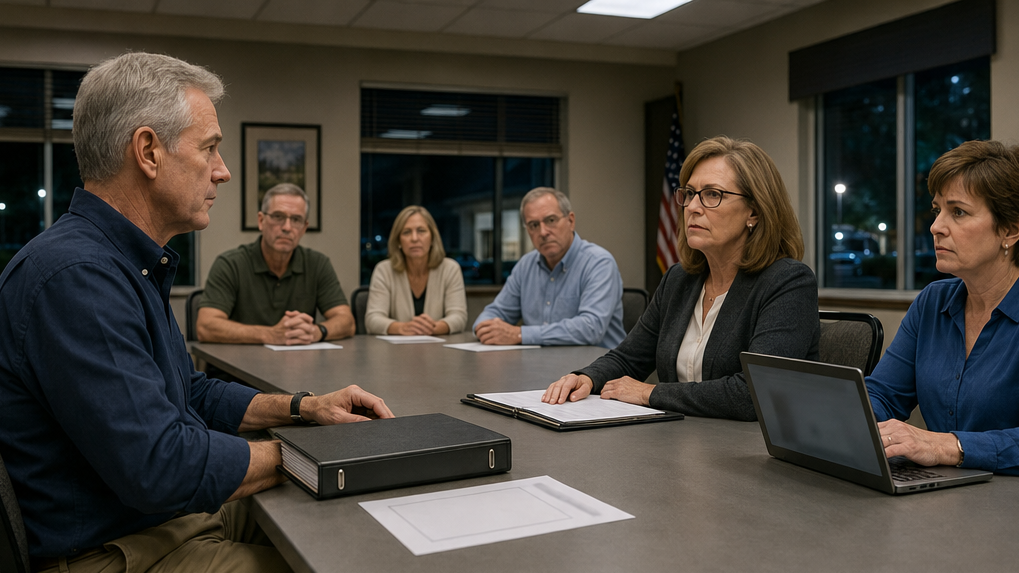
Across from him sat Katherine, the treasurer, two board members, and Emily Green. A stack of meeting packets rested beside the association seal. Fluorescent light flattened every face in the room.
Benjamin looked down at his copy of the violation notice.
Beside the line marked Supporting Documentation was a reference to Attachment A.
Beside the notice itself was empty table space.
Katherine adjusted her glasses.
“This hearing concerns an exterior modification observed during an architectural review. The association has a duty to enforce standards consistently.”
Benjamin nodded.
“I understand.”
“The purpose tonight is to give you an opportunity to explain why the condition hasn’t been corrected.”
“I’m still trying to find out what condition you mean.”
Katherine’s mouth tightened slightly.
“It is identified in the notice.”
“The notice says unapproved exterior modification.”
“Yes.”
“Which modification?”
One of the board members shifted in his chair.
Katherine glanced toward Emily.
“The inspection record contains the supporting materials.”
Benjamin opened his binder, removed the mailed notice, and placed it on the table.
“This is what I received.”
He placed Emily’s first email beside it.
“This is what management resent.”
Then the six-page “complete case file.”
“This is the full file I was sent.”
He did not slide the pages toward Katherine. He simply arranged them in a straight row.
“Would someone show me where the photograph is?”
Nobody moved.
The silence lasted only a few seconds, but it changed the room.
Katherine looked at Emily.
“Do you have the attachment?”
Emily opened her laptop.
“I have the electronic case record.”
“That isn’t what he asked,” the treasurer said quietly.
Katherine gave him a quick glance.
Emily turned the laptop slightly.
“The portal shows an image-upload event associated with the original inspection date.”
Benjamin leaned forward.
“Can you open the image?”
“No.”
“Can you identify the filename?”
“No.”
“Can you identify the person who took it?”
“Not from the portal entry.”
“Can you tell us the date the photograph itself was taken?”
Emily hesitated.
“No.”
Benjamin stopped there.
He had promised himself before leaving home that he would not overplay it.
No accusations.
No speeches.
No satisfaction if someone else looked embarrassed.
Just the record.
Katherine folded her hands.
“Mr. Carter, I think we’re allowing a technical issue to overshadow the substance.”
Benjamin looked at her.
“What substance?”
“The architectural condition.”
“Which condition?”
Katherine exhaled.
“You’ve lived here long enough to understand that exterior changes require approval.”
“I do.”
“And the committee reported a condition that appeared inconsistent with the approved exterior.”
“What appeared inconsistent?”
“The trim area.”
Benjamin felt the first flicker of recognition.
“What trim area?”
Katherine looked again at Emily.
Emily searched the electronic record.
“There’s a short inspection note,” she said. “Front elevation. Lower porch trim. Visual inconsistency.”
Benjamin pictured the narrow strip of peeling paint he had touched beside the porch.
“That’s the first specific description anyone has given me.”
Katherine frowned.
“You’re saying you weren’t aware of it?”
“I’m saying I don’t know whether we’re talking about chipped paint, replaced material, altered color, or something else.”
“The photograph would make that clear.”
Benjamin rested one hand on the notice.
“Then show me the photograph.”
The treasurer leaned back.
One of the board members looked down at his packet as though checking whether his copy contained something Benjamin’s did not.
Katherine’s tone hardened.
“The absence of a retrievable image tonight does not mean the inspection never happened.”
“I didn’t say it didn’t.”
“It also doesn’t mean the violation is invalid.”
“I haven’t said that either.”
Katherine studied him.
Benjamin continued.
“I’m asking for the evidence the notice says was sent to me before I’m required to correct whatever that evidence supposedly shows.”
The difference in wording mattered.
He could see it in the way the treasurer stopped looking at Katherine and started looking at the documents.
Emily cleared her throat.
“For the record, I should clarify something.”
Katherine turned toward her.
Emily’s hands rested near the keyboard.
“The current management portal contains the violation entry, rule code, inspection notation, and an upload event. It does not contain the original image file.”
Katherine’s face did not change much.
But Benjamin saw the small pause before she responded.
“Could it be in archived board correspondence?”
“Yes.”
“Could it have been attached under the prior management system?”
“Yes.”
“So it may exist.”
“Yes.”
Benjamin looked at Emily.
“But it isn’t in the case file now.”
Emily met his eyes.
“No.”
There it was.
Not victory.
Something smaller and more useful.
A fact everyone in the room now shared.
Katherine tapped one finger against the table.
“We have had serious complaints about inconsistent enforcement in this community. Residents have accused prior boards of ignoring violations depending on who lived in the house. We cannot simply suspend enforcement every time a file has a clerical problem.”
Benjamin understood more in that moment than he had expected to.
Katherine was not defending a photograph.
She was defending the idea that backing away meant becoming the kind of board residents already distrusted.
That did not make her right.
But it made her position less mysterious.
“I’m not asking you to stop enforcing rules,” Benjamin said.
“Then what are you asking?”
“For the board to know what evidence supports a fine before the homeowner has to pay it.”
The treasurer looked at Katherine.
“That seems reasonable.”
Katherine’s jaw tightened.
“We also have to consider precedent.”
Benjamin nearly smiled, but did not.
“In my experience, precedent is usually a reason to make sure the first decision is sound.”
Katherine looked at him sharply.
He regretted the sentence almost as soon as he said it. It sounded more pointed than he intended.
Old habits.
The need to be correct could become its own kind of arrogance.
He leaned back.
“I’m not trying to embarrass anyone.”
“I appreciate that,” Katherine said, though her tone suggested she was not certain she believed him.
A board member finally spoke.
“What exactly happens if we pause this for two days?”
Emily answered.
“I can search the archived committee inbox and the prior management export. If the image was transferred, it may be stored outside the active portal.”
“And if you don’t find it?”
Katherine spoke before Emily could.
“Then we address that when we know.”
Benjamin noticed the change.
Not if the photograph exists.
If it can be found.
The board discussed the deadline for several minutes. Katherine objected to an indefinite suspension. The treasurer suggested forty-eight hours. Emily said she could complete a targeted archive search by then.
Benjamin listened.
He wanted to push farther.
He wanted the fine dismissed immediately.
The part of him that had spent years resolving process failures could already see the cleanest argument: no evidence, no enforcement.
But that would answer only his case.
And he still did not know what had actually happened.
When Katherine asked whether forty-eight hours was acceptable, Benjamin nodded.
“Yes.”
She seemed surprised.
“You’re agreeing to keep the case open?”
“For forty-eight hours.”
“Why?”
“Because if there is a photograph, I want to see it.”
The room went quiet again.
Katherine looked toward Emily.
“Search everything available. Committee emails, archived inspection records, prior management exports.”
Emily nodded.
“I will.”
The hearing adjourned without anyone using the word victory.
Benjamin packed his documents back into the binder.
As he stood, Katherine said, “Benjamin.”
He turned.
Her voice was lower now.
“I know this feels personal.”
“It doesn’t.”
She looked unconvinced.
“That may be part of the problem.”
He waited.
Katherine gathered her papers.
“When I joined the board, people were furious because rules depended on who complained loudest. One house got cited, another didn’t. One owner got six months, another got ten days. We’ve spent two years trying to make enforcement consistent.”
Benjamin looked at the empty place on the table where the photograph should have been.
“Consistency matters.”
“Yes.”
“So does knowing what you’re consistently enforcing.”
Katherine held his gaze for a moment.
Then she looked away.
Benjamin drove home without turning on the radio.
He was halfway through making tea when his phone rang.
Emily.
He checked the clock.
9:18 p.m.
“Hello?”
“Mr. Carter, I’m sorry to call this late.”
Benjamin put the kettle down.
“That’s all right.”
“I started searching the old architectural committee mailbox after the meeting.”
He waited.
Emily’s voice had changed. Less administrative now. More careful.
“I found an email thread from the inspection date.”
Benjamin gripped the edge of the counter.
“Was there an attachment?”
“Yes.”
For the first time in ten days, the answer was immediate.
Benjamin looked toward the binder lying on the kitchen table.
“Is it the photograph?”
“I believe so.”
He did not feel relief.
Not yet.
“Can you send it?”
“I’m forwarding it now.”
A second later, his phone chimed.
Benjamin opened the email.
At the bottom was a single image file.
He tapped it.
The photograph filled his screen.
And for one uncomfortable moment, Benjamin thought Katherine had been right.
Chapter 4: The Photograph Proved Something Else
The photograph looked bad.
Benjamin enlarged it on his phone until the porch trim filled the screen. A pale section ran beneath the railing, uneven against the darker painted surface around it. From that angle, in that light, it could easily look like new material had been installed without approval.
For several seconds, he simply stared.
Katherine had been right about one thing: the photograph made the property look different.
Emily was still on the line.
“Do you see it?”
“Yes.”
“I wanted you to have it before anyone made another decision.”
Benjamin set the phone on the kitchen counter.
“When was this taken?”
“The email is dated April third.”
He looked toward the calendar hanging beside the refrigerator.
April third.
His violation notice identified the architectural alteration as having been observed during the June inspection.
“Emily, that’s more than two months earlier.”
“I noticed.”
Benjamin picked up the phone again.
“Does the file show when the image itself was created?”
“The archived email preserves the attachment information. The file date is April third as well.”
Benjamin felt the tension in his shoulders change shape.
Not disappear.
Change.
“What was the subject line?”
Emily hesitated.
“Maintenance observation.”
“Not architectural violation?”
“No.”
He enlarged the photograph again.
Now that he knew when it had been taken, he remembered exactly what he was looking at.
In late March, heavy rain had loosened a thin strip of paint along the lower porch trim. Benjamin had scraped the failing section down before repainting it. For less than a week, the exposed primer had been visible from the street.
He had finished the repainting before Easter.
Benjamin walked to the porch with the phone.
Morning light struck the same section of trim. He crouched and compared the image to the wood in front of him.
Same corner.
Same railing post.
Same decorative molding.
But the pale section in the photograph was gone.
The trim had not been replaced.
Nothing had been structurally altered.
It had simply been prepared for paint.
Benjamin took a current photograph from approximately the same angle.
Then another.
He did not feel triumphant.
If anything, the discovery bothered him more.
The HOA had finally found its missing evidence, and the evidence belonged to a different problem.
He sent Emily the current image along with a short message explaining the maintenance work.
She replied twenty minutes later.
I see the difference. I’m adding this to the case file.
At 8:37, another email arrived.
This one came from Katherine.
Benjamin,
The archived photograph confirms that an exterior condition was documented on your property. While the date may precede the formal notice, the association’s concern regarding unauthorized exterior changes remains unresolved. Please understand that correcting a condition after inspection does not necessarily eliminate the underlying violation.
Benjamin read the message twice.
He could almost hear Katherine’s voice in it.
Measured. Formal. Determined not to surrender ground.
He typed a response, deleted it, and started again.
Katherine,
The photograph shows exposed primer during routine repainting. No material, structural, or color change occurred. The photograph is dated April 3. The violation notice identifies a June inspection and an unapproved exterior alteration.
Please identify what alteration the board contends occurred in June.
Benjamin stopped there.
No accusation.
No sentence about reused evidence.
Not yet.
He printed the recovered photograph and placed it beside the violation notice in his binder.
For the first time, the missing attachment had a physical form.
That should have made the file clearer.
Instead, it made the gap larger.
Later that morning, Benjamin walked down the sidewalk to see the porch from farther away.
From across the street, the house looked ordinary. Dark gray trim. White railing. Brick front. The same appearance approved years earlier.
He crouched near the curb and held the printed photograph up beside the actual porch.
The angle matched.
The condition did not.
A voice behind him said, “Everything all right?”
Benjamin stood.
Scott Walker had come out of his driveway carrying a recycling bin.
“HOA issue,” Benjamin said.
Scott’s expression changed almost imperceptibly.
“Ah.”
Benjamin noticed it.
He held up the photograph.
“Do you remember this?”
Scott glanced at it but did not take it.
“Maybe.”
“It came from an architectural committee email.”
Scott rubbed one hand against the handle of the bin.
“We look at a lot of houses.”
“Apparently.”
The answer came out sharper than Benjamin intended.
Scott looked at him.
Benjamin lowered the paper.
“Sorry. I’m trying to understand how a photo of primer in April became an unapproved alteration in June.”
Scott looked toward Benjamin’s porch.
“That was primer?”
“Yes.”
“You repainted the same color?”
“The same can of paint, actually.”
Scott gave a small breath through his nose.
“That matters.”
“To me, it does.”
“It should matter to the board.”
Benjamin waited, but Scott said nothing more.
The hesitation was familiar. Benjamin had used it himself for years—the careful silence of someone who knew a conversation was about to become inconvenient.
“Were you on the inspection walk?”
Scott shifted the recycling bin.
“I was on several.”
“April third?”
“I’d have to check.”
Benjamin nodded.
He could have pressed harder.
He did not.
“Fair enough.”
Scott looked relieved, which told Benjamin almost as much as an answer might have.
By afternoon, Emily had forwarded another piece of the archived thread. Most of it concerned ordinary maintenance observations: weeds around a utility box, a leaning mailbox post, faded paint on a garage door.
Benjamin’s address appeared in one line.
Front lower porch trim—finish incomplete/needs touch-up.
Nothing about replacement.
Nothing about an architectural modification.
Nothing about approval.
Benjamin read the line several times.
The original observation was real.
Someone had seen something.
He had never been falsely selected out of nowhere.
But the thing actually observed was not the thing he had been fined for.
That distinction mattered to him.
It also made the situation harder.
If the whole case had been fabricated, anger would have been easy.
Instead, somebody had started with a minor legitimate concern and turned it into something else.
At 4:12, Katherine replied.
The association considers visible exterior finish conditions within the scope of architectural compliance. The age of the photograph does not by itself invalidate the concern.
Benjamin stared at the message.
She had shifted again.
First the violation was an unapproved modification.
Now it was a finish condition.
He opened the rules and found separate sections.
Maintenance standards.
Architectural alterations.
Different notice language. Different correction procedures.
He printed both.
The file in his binder was becoming almost absurdly thick for a strip of porch paint that had been repaired months earlier.
At five thirty, he received a text.
Scott.
Can you talk Saturday morning? Better in person.
Benjamin read it once.
Then a second message arrived.
There’s something about the committee note you should know before the next meeting.
Chapter 5: What the Committee Actually Said
“That isn’t what we wrote.”
Scott said it before Benjamin had even opened the binder.
They stood on the sidewalk near Scott’s mailbox Saturday morning, far enough from either porch that the conversation did not feel like an invitation to stay.
Benjamin kept the binder tucked under one arm.
“What did you write?”
Scott looked down the street before answering.
“A maintenance note.”
“I saw the archived line.”
“That’s the short version.”
Benjamin waited.
Scott shoved his hands into his pockets.
“The committee did a neighborhood walk in April. Your trim had a light patch. We thought maybe paint had peeled or somebody had started a repair.”
“That’s what happened.”
“I know that now.”
“Did anyone think I’d changed the structure?”
“No.”
“Changed the material?”
“No.”
“Changed the color?”
“No.”
Benjamin felt his grip tighten on the binder.
“Then how did I get an architectural-alteration fine?”
Scott’s face showed the discomfort of someone who had hoped to provide information without becoming part of what followed.
“There were complaints.”
“About my house?”
“Not exactly.”
Benjamin frowned.
Scott leaned against the mailbox post.
“People had been complaining that the board wasn’t enforcing appearance standards consistently. Some residents had open maintenance issues for months. Some got courtesy emails. Some got formal notices. Katherine wanted the categories cleaned up.”
“That still doesn’t explain my notice.”
“No.”
Scott looked at him directly.
“The committee sent over a list of maintenance observations. Yours was one of them. Katherine said some of the items had been sitting too long and needed stronger classifications so management could move them through the formal process.”
Benjamin absorbed that.
“Stronger classifications.”
“That was the phrase.”
“So a paint touch-up became an architectural modification.”
Scott grimaced.
“I don’t know who entered the final code.”
“But you knew it had changed.”
“Not then.”
Benjamin stared at him.
Scott’s expression hardened defensively.
“We don’t see every notice management sends.”
“You’re on the committee.”
“I’m not on the board.”
“You signed off on the inspection list.”
“Yes.”
“And after that?”
“After that, I assumed management handled it.”
Benjamin almost laughed.
Not because it was funny.
Because it sounded too familiar.
He had spent years saying essentially the same thing about HOA business.
I pay my dues. I follow the rules. Somebody else handles the rest.
Scott kicked lightly at a seam in the sidewalk.
“I should have checked.”
Benjamin said nothing.
“I’m not trying to dump this on Katherine,” Scott continued. “She came onto the board after years of people complaining that enforcement was random. She got hammered at meetings. One resident would show pictures of a house that never got cited. Someone else would demand to know why their fine was higher. She wanted a process that moved.”
“So she broadened the violations.”
“She wanted things classified in ways management could track.”
“That’s not the same thing.”
“I know.”
“Does she?”
Scott looked uncomfortable again.
“I think she believes the basic concern was legitimate, so the category is secondary.”
Benjamin looked toward his own house farther down the street.
There it was.
The logic beneath the paperwork.
If something needed fixing, then the exact mechanism used to force the fix did not seem important.
Until the mechanism was wrong.
“Will you say this at the meeting?”
Scott rubbed the back of his neck.
“I’ll say what the committee observed.”
“That isn’t quite what I asked.”
“No.”
Benjamin felt irritation rise.
“You came to me.”
“I know.”
“Why?”
“Because I don’t want you walking into the next meeting thinking the committee accused you of replacing half your porch.”
“Then say that publicly.”
Scott’s mouth tightened.
“I will clarify the record. I’m not going to stand up there and call Katherine dishonest.”
“I didn’t ask you to.”
“You might not. Other people will.”
Benjamin looked at him carefully.
Scott was not protecting Katherine because he thought she was entirely right.
He was protecting himself from becoming a weapon in a fight he had helped create.
Benjamin recognized that too.
It annoyed him because he recognized it.
“I’m not looking for someone to attack her,” Benjamin said.
“What are you looking for?”
“The truth of the sequence.”
Scott gave a faint, humorless smile.
“That sounds like something you’d say.”
“What does that mean?”
“You always want things clean.”
Benjamin said nothing.
Scott continued.
“You keep every approval. Every receipt. Every email. You don’t come to meetings. You don’t argue with anybody. Then when something lands on your property, you show up with a binder and expect the record to make everybody behave.”
Benjamin felt the words more sharply than he expected.
“Shouldn’t it?”
“In a perfect system?”
Scott shrugged.
“Sure.”
“And in this one?”
“In this one, people built the system.”
The sentence stayed between them.
Benjamin looked down at the binder.
Scott was not accusing him.
That made it worse.
“Why didn’t anyone contact me about the April note?” Benjamin asked.
“I assumed management sent a courtesy reminder.”
“They didn’t.”
Scott nodded slowly.
“That happened more than once.”
Benjamin looked up.
“With other people?”
“Yes.”
“How many?”
“I don’t know.”
“You never questioned it?”
Scott met his eyes.
“Did you?”
Benjamin frowned.
“What?”
Scott glanced toward the houses across the street.
“Two years ago, there was a resident on the other side of the subdivision who kept complaining about violation notices without documentation. Remember?”
Benjamin searched his memory.
There had been emails.
Too many emails.
A community thread that had become increasingly irritated until Benjamin muted it.
“He said they were citing things without photographs,” Scott continued.
Benjamin remembered now.
Not details.
Tone.
The resident had written that management kept referring to inspection evidence he had never received.
Benjamin had thought the whole exchange exhausting.
He had deleted several messages without reading them fully.
“He was different,” Benjamin said automatically.
Scott raised his eyebrows.
“How?”
Benjamin opened his mouth.
Nothing useful came.
The resident had complained constantly. That was what Benjamin remembered.
About parking.
Pool access.
Landscaping.
Then violation procedures.
Benjamin had mentally placed him in the category of people who always had a grievance.
Scott watched the realization arrive.
“I’m not saying he was right about everything.”
Benjamin looked away.
“But?”
“But the missing-document part sounds familiar now.”
Benjamin felt a slow discomfort settle in his stomach.
“What happened to him?”
“He paid something. I think. Maybe settled it. Then he moved the next year.”
Scott picked up the recycling bin he had left beside the curb.
“I’ll speak at the meeting. I’ll say the committee recorded a maintenance concern, not an unapproved structural or material change.”
“Thank you.”
“But Benjamin…”
He stopped.
“What?”
“Before you decide this started with your file, look through your old email.”
Benjamin stared at him.
Scott wheeled the bin toward his driveway.
“You may have seen this problem before.”
Chapter 6: The Complaint Benjamin Never Answered
Benjamin found the email at 12:43 Sunday morning.
He knew the exact time because he had been searching for nearly two hours when the subject line appeared on the screen.
Need Help Understanding HOA Evidence Procedure.
He stopped scrolling.
The message was two years and four months old.
It had been sent not just to Benjamin but to a long list of residents after an earlier neighborhood meeting. Benjamin recognized the sender only vaguely as the homeowner Scott had mentioned.
He opened it.
The first paragraph complained about a fine.
The second made Benjamin sit back.
The violation letter says photographs document the condition, but those photographs were never provided to me. Management keeps telling me the evidence is in the file. I have asked twice to see the complete file.
Benjamin read the words again.
The evidence is in the file.
His kitchen seemed suddenly too quiet.
He scrolled down.
There were replies beneath it.
One resident said the board should enforce the rules equally.
Another complained that community emails were becoming excessive.
Someone suggested the sender simply fix the property and move on.
Then Benjamin found his own response.
It was only three sentences.
I’ve never had an issue when I’ve kept my approvals and maintenance records current. There may be more to the situation than we’re seeing here. It might be best to work directly with management rather than continue the neighborhood email chain.
Benjamin stared at the screen.
He could barely remember writing it.
That almost made it worse.
The words were calm.
Reasonable.
Dismissive.
He had not insulted anyone. Had not defended the board explicitly. Had not accused the resident of lying.
He had simply placed the problem outside the boundaries of his concern.
There may be more to the situation.
Now there was more to his situation too.
That had not stopped him from demanding evidence.
Benjamin printed the old email.
He carried it to the table where his binder lay open.
For several minutes he did not know where to put it.
The HOA section seemed wrong.
This was not an approval.
Not a notice.
Not evidence against Katherine.
It was evidence against the version of himself who believed careful recordkeeping made him separate from people caught in messy disputes.
Eventually he slid it into the front pocket.
Not behind a divider.
Where he would see it first.
On Monday morning, Emily called.
Her voice was cautious.
“I wanted to update you before the board sends anything formally.”
Benjamin closed the laptop.
“All right.”
“We’ve been reviewing several older violation records.”
His attention sharpened.
“Why?”
“Because your case raised questions about how attachments migrated from the prior management system.”
“And?”
“There are other files where the case log references supporting materials that are not currently stored with the notice.”
Benjamin looked at the old email on the table.
“How many?”
“I’m not ready to give you a number.”
“More than one.”
“Yes.”
“More than a few?”
Emily paused.
“We’re still reviewing them.”
Benjamin understood the answer.
This was no longer his missing attachment.
Not entirely.
“Does Katherine know?”
“Yes.”
“How did she react?”
Emily took a breath.
“She wants to distinguish migration problems from enforcement validity.”
Benjamin almost said, Of course she does.
He stopped himself.
“What do you think?”
“I think records should contain what the notice says they contain.”
It was the strongest opinion Emily had expressed.
“Thank you.”
“There’s something else.”
Benjamin waited.
“Katherine would like to speak with you directly.”
The call came that afternoon.
“Benjamin,” Katherine said, without the formal Mr. Carter she had used during the hearing.
“Katherine.”
“I’d like to resolve your case.”
He looked at the binder.
“What does resolve mean?”
“The board is prepared to withdraw the current fine.”
Benjamin said nothing.
Two weeks earlier, that sentence would have ended the problem.
Katherine continued.
“Given the documentation issue and the fact that the visible condition has already been corrected, I don’t think continuing your case serves anyone.”
“Was there ever an architectural alteration?”
A pause.
“The original observation involved an exterior maintenance condition.”
“That isn’t what I asked.”
“No,” Katherine said finally. “Based on what we have now, I don’t see evidence of a material architectural alteration.”
Benjamin closed his eyes briefly.
There it was.
The fine was finished.
He should have felt lighter.
Instead he saw the old email.
“What happens to the hearing agenda?”
“I don’t think your individual case needs further board time.”
“What about the records issue?”
“Management is reviewing it internally.”
“And the other files with missing attachments?”
“We don’t yet know whether those files are comparable.”
Benjamin rubbed one thumb along the edge of the binder.
“What are you asking me to do?”
“I’m not asking you to do anything.”
“Katherine.”
Another silence.
Then her voice changed.
Less polished.
“I’m asking whether we can resolve your fine without turning a records migration problem into a referendum on the entire enforcement system.”
Benjamin leaned back.
“Why?”
“Because we have forty-seven open compliance cases.”
The number surprised him.
“We have residents demanding action on abandoned landscaping, unauthorized structures, parking obstructions, exterior deterioration. If we tell people every case is questionable because an old system lost attachments, enforcement stops while we untangle years of records.”
“That sounds like a reason to untangle them.”
“It sounds simple when it’s your case.”
The words landed harder than Katherine probably intended.
Benjamin thought of the email he had sent two years ago.
There may be more to the situation.
Katherine continued, quieter now.
“I’m not saying mistakes shouldn’t be corrected. I’m saying the association still has to function.”
Benjamin looked at his binder.
He had spent most of his adult life solving exactly that tension: the work still had to continue, even when the process failed.
And sometimes the easiest answer had been to patch the immediate problem and promise to fix the system later.
Later had a way of never arriving.
“If you withdraw my fine,” Benjamin said, “will the board still discuss the evidence procedure?”
“I don’t think a broad discussion is necessary until management finishes its review.”
“When will that be?”
“I can’t give you a date.”
Benjamin knew what that meant too.
He stood and walked to the kitchen table.
The old email lay on top.
Two years earlier, another homeowner had asked the neighborhood to care about missing evidence.
Benjamin had told him to work it out privately.
Now Katherine was offering Benjamin exactly that privilege.
A private solution.
Clean.
Quiet.
No more meetings.
No more evenings under fluorescent lights.
No more becoming one of those residents who always seemed to have an HOA complaint.
For several seconds, he wanted it.
That was the part he would remember later.
He wanted to say yes.
Then he picked up the old email.
“Katherine, withdraw the fine if the board believes it’s unsupported.”
“That’s what I’m offering.”
“But leave the records issue on the agenda.”
Her voice cooled.
“Benjamin.”
“I’m not asking the board to invalidate every violation.”
“It may have that effect.”
“I’m asking for a rule that says if a notice cites evidence, the homeowner receives that evidence.”
“We already have procedures.”
“Then this should be easy.”
Katherine did not answer.
Benjamin looked at his own old response again.
“I’ve been on the wrong side of this before.”
“What do you mean?”
“Nothing you need to defend.”
He folded the email.
“I just don’t want my case disappearing to become proof that the process is fine.”
Katherine’s voice was restrained now.
“If you insist on keeping this on the agenda, people are going to treat it as a challenge to the board.”
“I can’t control that.”
“You can control whether you make it one.”
Benjamin nearly replied that she was the one making it personal.
He stopped.
That would have been satisfying.
It would also have been wrong.
“I’m asking for the records question to stay public,” he said. “That’s all.”
Katherine was silent for several seconds.
“Then submit your request in writing.”
“I will.”
The call ended politely.
Benjamin sat down.
For once, he did not immediately file the notes away.
He opened a blank email to Emily and copied Katherine.
Please keep the violation evidence procedure and associated records review on the agenda for the next board meeting. I understand that my individual fine may be withdrawn separately. I am not requesting that unrelated violations be dismissed. I am requesting discussion of a requirement that evidence cited in a formal notice be included with, or made accessible to, the homeowner before fines begin.
He read it once.
Then he added one sentence.
I should have cared about this procedure before it affected me personally.
Benjamin stared at that line longer than the rest.
Then he pressed Send.
The message left his screen.
His own fine was almost gone.
For the first time, that was no longer enough.
Chapter 7: A Rule That Applies to the Board Too
Benjamin began the next board meeting by admitting something no one in the room expected him to admit.
“Two years ago, another homeowner complained about missing evidence in a violation case,” he said. “I told him to deal with management privately. I thought if people kept their own records and followed the rules, the system would mostly take care of itself.”
The clubhouse was fuller than it had been for his first hearing, though not crowded. Several homeowners occupied the folding chairs along the back wall. The board sat behind two pushed-together tables. Emily had her laptop open. Katherine sat at the center with the agenda in front of her.
Benjamin placed his binder on the table.
Beside it, he set one sheet of paper.
He had reduced everything he wanted to ask for to a single page.
No accusations.
No list of old grievances.
No demand that every prior violation be erased.
Katherine watched him carefully.
Benjamin continued.
“I was wrong about one part of that.”
A chair creaked behind him.
“The system only works if the records behind the rules can be checked.”
He stopped there.
Katherine looked down at the agenda.
“Your individual violation has been withdrawn,” she said. “I want that clear before we continue.”
Benjamin nodded.
“I understand.”
“The board determined that the available documentation does not support the architectural classification used in your notice.”
There was no apology attached to the statement.
Benjamin had not expected one.
“Thank you.”
Katherine looked toward Emily.
“Management has also completed an initial review of active enforcement files.”
Emily turned her laptop slightly toward herself.
“We reviewed forty-seven open cases and a sample of older closed cases transferred from the previous system.”
Benjamin felt several people in the room shift.
Emily continued.
“Most active files contain complete supporting documentation. Some do not.”
“How many?” asked one of the board members.
“Eight active cases contain a reference to evidence that is not currently attached to the notice record. Of those eight, five have supporting images elsewhere in archived correspondence. Three are still unresolved.”
The treasurer frowned.
“And older cases?”
“We found similar gaps.”
Katherine spoke before anyone else could.
“I want to emphasize that a records gap does not necessarily mean the underlying violation was improper.”
Benjamin looked at her.
She looked back.
He understood what she was protecting.
If the room decided missing paperwork meant every enforcement action had been illegitimate, the meeting would turn into exactly what she feared: owners challenging everything at once.
Benjamin picked up his one-page proposal.
“I agree.”
That surprised her.
One of the board members looked at him.
Benjamin went on.
“I’m not asking you to assume a violation is false because a file is incomplete. I’m asking you not to fine someone until the evidence you’re relying on is actually available to them.”
He slid copies of the page across the table.
At the top were five lines.
Evidence cited in a formal violation notice must be attached or accessible.
The notice must identify the inspection date.
The notice must identify the specific condition observed.
The violation category must match the condition documented.
Fines do not begin until required evidence is delivered.
Katherine read silently.
The treasurer reached for his copy.
“This is it?”
“That’s it,” Benjamin said.
“No automatic reopening of every old case?”
“No.”
“No dismissal based only on a missing image?”
“No.”
Katherine looked up.
“Then what happens to old cases where the evidence can’t be recovered?”
Benjamin paused.
“That’s a board decision. I’m talking about what happens going forward.”
He saw her shoulders loosen slightly.
Not agreement.
Less resistance.
That mattered.
Scott sat in the second row behind Benjamin.
Katherine glanced toward him.
“You asked to clarify the committee’s role in Mr. Carter’s case.”
Scott stood reluctantly.
He did not approach the table.
“The committee’s April note on Benjamin’s property was maintenance-related,” he said. “The visible issue was incomplete finish on lower porch trim. We did not record a structural change, replacement material, or color change.”
Katherine’s expression remained still.
Scott continued.
“The later notice classified it more broadly than our observation.”
A homeowner in the back whispered something to the person beside him.
Scott looked uncomfortable.
Benjamin did not turn around.
Katherine asked, “Did the committee believe the condition should be corrected?”
“Yes.”
“So the original concern itself was legitimate.”
“Yes.”
Benjamin saw what she was doing.
Not escaping responsibility.
Narrowing it.
Scott nodded.
“The maintenance concern was legitimate. The architectural-alteration description wasn’t ours.”
That distinction landed cleanly.
No villain.
No fabricated inspection.
No innocent board trapped by a malicious homeowner.
A real concern had been pushed through the wrong category because the stronger procedure moved faster.
Emily cleared her throat.
“In reviewing older files, we also found inconsistent use of categories. Some maintenance issues were entered as architectural compliance matters.”
Katherine looked at her.
“How many?”
“We’re still checking.”
One of the board members leaned back.
“That sounds like more than a transfer problem.”
No one answered immediately.
Benjamin looked at his binder.
For weeks, he had imagined this moment as a test of whether the board would admit he had been right.
Now that his fine was already gone, that seemed almost irrelevant.
The question was whether anything would change after the room emptied.
Katherine tapped the one-page proposal.
“I have one concern.”
Benjamin waited.
“If every notice has to wait for supporting documentation to be attached, management will need a verification step. That adds time.”
Emily nodded.
“It does.”
“And staff time costs money.”
“Yes.”
A homeowner in the back muttered, “So do bad fines.”
Katherine ignored the comment.
Benjamin said, “Then maybe the delay is useful.”
She looked at him.
“If a file can’t survive one extra verification step before money is demanded, that seems worth knowing.”
The treasurer nodded slowly.
“We already verify invoices before payment.”
Katherine gave him a dry look.
“This isn’t an invoice.”
“No,” he said. “It’s more personal.”
The room quieted.
Katherine read the proposal again.
Benjamin could see that she was doing what he had failed to do for years: weighing a process problem while everyone expected an immediate answer.
He almost felt sorry for her.
Almost.
Then one of the board members asked, “What about the three active cases where the evidence still hasn’t been found?”
Katherine folded her hands.
“I would support pausing additional fines on those cases until the records review is complete.”
Benjamin looked up.
It was the first time she had said it without being forced into the wording.
Emily nodded.
“That would be workable.”
The treasurer added, “And the eight active cases with documentation gaps should all receive whatever evidence we can recover.”
Katherine looked around the table.
“Any objection?”
No one spoke.
She turned to Benjamin.
“I’m not prepared tonight to adopt your exact wording as permanent policy.”
Benjamin felt disappointment flicker.
Then she continued.
“But I am prepared to support an interim procedure requiring management to verify cited evidence before new fines begin.”
The treasurer said, “With a formal policy draft next month?”
“Yes.”
Benjamin let out a breath he had not realized he was holding.
A homeowner behind him asked whether old fines would be refunded.
Another asked whether the board would audit closed cases.
The room began to grow noisier.
Katherine raised one hand.
“We are not deciding every historical question tonight.”
Some people groaned.
She did not flinch.
“We are deciding what we can responsibly decide.”
Benjamin understood that too.
Partial repair.
Not absolution.
Not collapse.
The treasurer made a motion to suspend additional fines in the unresolved active cases, require management to deliver recoverable supporting evidence in cases with documentation gaps, and conduct an audit of the remaining open violations before escalation.
A board member seconded it.
Katherine called the vote.
It passed.
Not unanimously.
But it passed.
Benjamin did not smile until he was packing his binder.
Scott approached him near the door.
“You got what you wanted.”
Benjamin looked back at the board table, where Katherine and Emily were already discussing the audit.
“No.”
Scott raised an eyebrow.
“My fine was what I wanted.”
“And this?”
Benjamin picked up the one-page checklist.
“This is what I should have wanted before.”
As he turned to leave, Katherine called his name.
He stopped.
She stood behind the table with a stack of case files beside her.
“This audit is going to need homeowner participation if we’re going to make the new procedure practical.”
Benjamin knew what was coming.
He felt an old instinct rise immediately.
No committees.
No meetings.
No managing somebody else’s system.
Katherine held his gaze.
“We’ll discuss volunteers next week.”
Benjamin looked down at the binder in his hand.
His own case was over.
For the first time, walking away would be the easiest thing he could do.
Chapter 8: The Empty Page Meant Something Different
Three weeks later, Benjamin opened his mailbox and found an HOA notice addressed to someone else.
He almost laughed.
The envelope had been delivered to his house by mistake, one digit off from the address printed beneath the clear window.
For a moment, he considered walking it straight to the correct mailbox without looking further.
Then something visible through the envelope caught his attention.
A thick stack of pages.
Not one sheet.
Not two.
Several.
Benjamin carried it down the sidewalk and handed it to the neighbor whose address appeared on the front.
“Wrong mailbox,” he said.
The neighbor thanked him.
Benjamin turned to leave.
“Looks like they sent me a whole book,” the neighbor said.
Benjamin glanced back.
“Maybe that’s progress.”
The neighbor smiled, not understanding.
Benjamin did.
That afternoon, he attended the temporary records committee meeting at the clubhouse.
He had nearly declined when Katherine asked.
In fact, he had drafted the refusal.
Thank you, but I prefer not to take on an ongoing association role.
The sentence had sat unsent for most of an afternoon.
Then he opened his binder and saw the old resident email in the front pocket.
He deleted the refusal.
Now he sat at a smaller table with Emily, the treasurer, one board member, and Katherine.
No audience.
No hearing.
No confrontation.
Just files.
Emily slid a sample notice toward him.
“This is the revised format.”
Benjamin looked at it.
The first page identified the specific condition.
The second listed the inspection date.
The third contained the photograph.
The fourth explained the applicable rule.
At the bottom of the first page was a short line confirming the attachments included with the notice.
Benjamin ran one finger down the list.
Nothing was missing.
“What happens if the photograph fails to attach?” he asked.
Emily pointed to a status field on her laptop.
“The case can be created, but the fine stage stays locked until someone verifies delivery.”
“Who verifies it?”
“Management staff.”
“And if the board changes the violation category?”
“New review required.”
Katherine spoke from across the table.
“That was added after our last meeting.”
Benjamin looked at her.
She did not sound pleased about the extra step.
But she had added it.
“Good,” he said.
She gave him a tired smile.
“You enjoy that word too much.”
“Only when it applies.”
The treasurer laughed quietly.
Katherine did not.
Then, after a second, she did too.
The moment was small enough that Benjamin trusted it.
The audit had not produced a dramatic scandal.
Most open violations had valid underlying concerns.
Several needed better documentation.
Two had been reclassified.
Three fines had been paused.
One had been withdrawn besides Benjamin’s.
Older cases were harder. Files were incomplete, owners had moved, circumstances had changed. The board had chosen to review formal disputes individually rather than reopen every closed matter automatically.
Some residents thought that was too little.
Others thought the board had already gone too far.
Benjamin had discovered that institutional repair was less satisfying than winning an argument.
It involved exceptions.
Costs.
Incomplete records.
People who remembered events differently.
And meetings.
Far too many meetings.
He also discovered something else.
Katherine stayed.
Several homeowners had expected her to resign after the procedural problems became public.
She did not.
At first, Benjamin had been unsure how he felt about that.
Then he watched her spend two evenings reviewing case files she could easily have blamed on prior management.
She defended some enforcement decisions.
She admitted others had been badly categorized.
She resisted suggestions that every disputed owner had therefore been right.
And she stopped insisting that consistency alone made a process fair.
That was enough for Benjamin.
Not forgiveness, because he was no longer certain forgiveness was the right word.
They had disagreed.
She had made a harmful choice.
Then she had helped correct it.
People were allowed to remain complicated.
Emily handed Benjamin another sample.
“This one is from the first batch issued under the interim rule.”
The address was covered for privacy.
Benjamin checked the pages.
Notice.
Specific condition.
Inspection date.
Two photographs.
Rule citation.
Delivery record.
Every item referenced on the first page was there.
He found himself looking for the empty space that had started everything.
There wasn’t one.
Katherine watched him.
“Well?”
“It works.”
“That sounded almost painful.”
Benjamin closed the sample file.
“I’m adjusting.”
The meeting continued for another hour.
They debated how long management should retain original images. Whether homeowners should receive full-resolution files or portal links. How to document verbal committee observations. What happened if an owner refused electronic delivery.
None of it felt dramatic.
That was precisely why Benjamin thought it mattered.
Bad systems rarely announced themselves with alarms.
Sometimes they appeared as a blank attachment field everyone had learned to ignore.
When the meeting ended, Emily gathered the files.
Benjamin reached automatically for his binder.
He had brought it to every meeting since the fine arrived.
The spine was more worn now. The front pocket still held the old email that embarrassed him.
Across the room stood a short shelving unit the committee had cleared for shared reference materials: current policies, sample notices, procedural checklists, meeting records.
Benjamin looked at the binder in his hand.
“Emily.”
She turned.
“If I leave this here, can we remove the pages that are only about my property?”
“Of course.”
Katherine glanced over.
“You’re donating the famous binder?”
Benjamin looked at her.
“It’s not famous.”
“It has appeared at more meetings than some board members.”
The treasurer laughed.
Benjamin opened it.
He removed his roof approval, paint records, contractor receipts, personal correspondence, and the original fine.
Then he stopped at the old resident email.
For a moment, he considered taking it home.
Instead, he removed the sender’s identifying information from the printed copy and wrote one sentence at the top.
Example of an earlier evidence-delivery complaint.
He placed it behind the section on notice procedures.
Not as an accusation.
As history.
Then he put his personal papers under one arm and carried the binder to the shelf.
It fit between the enforcement policy and the new records checklist.
Benjamin stepped back.
For years, that binder had meant one thing to him.
Protect yourself.
Keep proof.
Do your part.
Stay out of everybody else’s trouble.
Now its most useful pages no longer belonged in his house.
Katherine joined him by the shelf.
“The permanent policy vote is next month,” she said.
“I know.”
“You coming?”
Benjamin almost gave his old answer.
Maybe.
Depends.
Send me the minutes.
Instead he said, “Yes.”
Katherine nodded once.
No celebration.
No handshake.
Just an answer accepted.
Outside, Benjamin walked home carrying only the thin stack of records that actually belonged to him.
At his mailbox, he paused.
Nothing waited inside.
No violation.
No deadline.
No unexplained reference to evidence that existed somewhere else.
Across the street, the neighbor who had received the misdelivered notice stood near a hedge, comparing one of the attached photographs to the condition on the property.
The neighbor looked at the page, then at the hedge, then back at the page.
Whatever the issue was, at least the person knew what the association meant.
Benjamin continued up his driveway.
The porch trim caught the afternoon light.
Same wood.
Same color.
No mystery left in it.
The empty attachment that had once seemed like an annoying clerical mistake had forced him into the one place he had spent years avoiding: other people’s problems.
He had not fixed the association.
Katherine had not become a different person.
The board had not confessed to some hidden scheme.
There would be arguments again.
There would be bad decisions.
There would probably be another file misplaced someday.
But now there was a rule saying that before the association demanded money from a homeowner, the evidence it relied on had to exist where both sides could see it.
And Benjamin had learned that keeping his own records perfectly was not enough if he was willing to ignore the empty pages handed to someone else.
The next morning, he passed the clubhouse on his walk.
Through the front window, he could see the records shelf.
His binder stood upright among the association files.
For once, Benjamin did not feel the need to take it home.
The story has ended.