My Neighbor Poured a Garage Over the Utility Easement—Then the HOA Learned What It Had Approved
Chapter 1: The Concrete Reached the Orange Marker
The concrete was already flowing when Jonathan Carter noticed the orange utility marker bending toward the wet gray surface.
He stopped halfway down his driveway.
Across the narrow strip between the two houses, a concrete truck idled beside Gregory Hall’s property. One worker guided the chute while two others pulled the heavy mix toward wooden forms. Fresh concrete covered nearly the entire rectangular pad behind Gregory’s driveway.
The orange marker stood at the eastern edge of the pour, close enough that splatter dotted its plastic stem.
Jonathan stared at it.
He had seen that marker for years. Sometimes it leaned. Sometimes a utility crew replaced it. Most days he barely noticed it.
This morning it looked like a warning nobody else could see.
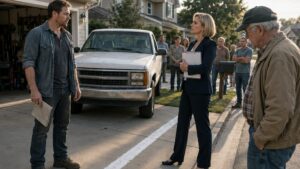
“Gregory.”
Gregory turned from the contractor and smiled.
“Morning.”
“What are you putting there?”
“The garage.”
Jonathan looked from him to the slab.
“What garage?”
Gregory’s smile tightened slightly. “The one I told you about.”
“You said you were adding storage.”
“That’s what a garage is.”
Behind him, the crew kept moving. A rake scraped across wet concrete.
Jonathan stepped closer to the property edge.
“How far over does it come?”
Gregory gestured toward the forms. “Everything’s inside my setbacks.”
Jonathan pointed at the orange marker.
“What about that?”
Gregory glanced at it.
“The utility flag?”
“Marker.”
“Okay. Marker.”
“There’s an easement through there.”
Gregory gave the kind of patient smile Jonathan disliked because it made him feel as if he had arrived late to a conversation everyone else understood.
“I checked all of this.”
“With who?”
“The HOA. County too.”
The chute shifted.
Concrete spread into the last unfinished corner.
Jonathan felt the old instinct rise in him: step back, verify first, avoid making a scene in front of contractors and neighbors.
It was the same instinct that had kept him quiet during the drainage argument six years earlier until water was already running across three yards. He had eventually been right about that, too. Being right had not stopped people from remembering him as the man who had “made a thing out of it.”
He looked again at the marker.
“Did anybody review the utility easement?”
Gregory exhaled through his nose.
“Jonathan, I have approval.”
“That wasn’t my question.”
Gregory pulled out his phone.
A worker glanced between them, waiting only long enough to decide this was not his problem.
Gregory opened an email and held the screen toward Jonathan.
There was the HOA logo, the architectural-review heading, the property address and a short approval paragraph.
“Approved,” Gregory said. “Setbacks, exterior materials, roof height. All of it.”
Jonathan did not touch the phone.
“Does it mention the easement?”
“It doesn’t need to. They had the plan.”
“Did the plan show it?”
Gregory lowered the phone.
“You don’t like where I’m putting the garage.”
“That’s not what I said.”
“It’s not blocking your driveway. It’s not on your lot.”
Jonathan looked past him at stacks of framing lumber near the fence.
“I’m asking whether anybody checked what’s under that slab.”
Gregory’s patience thinned.
“I went through the process. I paid the fees. The county issued the permit. The HOA signed off. I’m not stopping a concrete truck because you suddenly remembered an orange stick.”
One of the finishers looked away quickly.
Jonathan felt heat climb into his face.
For a moment he imagined walking onto the forms and forcing everything to stop until somebody answered him.
Instead he took out his phone.
He photographed the orange marker.
Then the slab.
Then the distance from the marker to the wooden edge.
Gregory stared at him.
“Seriously?”
Jonathan put the phone away.
“One question. Did anyone specifically tell you the recorded utility easement had been reviewed?”
Gregory folded his arms.
“I’m telling you I’m approved.”
“That’s not the same answer.”
The chute clanged as the crew pulled it back.
The last section filled.
Jonathan watched the wet surface settle around the marker’s shadow.
He could no longer remember the exact wording on the plat. He had bought the house more than twenty years ago. The closing documents sat in a metal file cabinet in his office, buried behind tax folders, repair invoices and warranties for appliances that no longer existed.
But he remembered a strip.
Twelve feet, he thought.
Maybe ten.
He remembered a line along the eastern edge and language granting access to a utility company. He remembered noticing it because, as a municipal drafting technician, he had spent half his career telling people that thin lines on plans mattered precisely when nobody expected them to.
Yet over the years, he had treated this one as background.
A previous owner had stacked firewood there.
Gregory had once parked a utility trailer partly across it for two weeks.
Jonathan had never said anything.
Temporary was temporary.
Concrete was not.
Gregory tucked his phone away.
“We good?”
Jonathan almost said, I don’t know.
Instead he said, “Not yet.”
He walked back toward his house.
Behind him, Gregory called, “Jonathan.”
He turned.
“I’m not trying to start something with you,” Gregory said.
It sounded sincere enough to make the situation worse.
“I know.”
“I’ve got a lot of money in this already.”
Jonathan looked at the slab.
“That’s why I asked before the framing goes up.”
Gregory’s expression closed.
“The framing is going up Monday.”
Inside his house, Jonathan went straight to the office.
The metal file cabinet resisted on the second drawer, as it always did. He lifted slightly, pulled, and found the old closing folder underneath a stack of insurance records.
The plat was folded into quarters.
Its paper had yellowed along the creases.
Jonathan spread it across his desk and weighted one corner with a stapler.
For several seconds he saw nothing but lot lines, measurements and tiny survey notes.
Then he found his eastern boundary.
A dashed line ran parallel to it.
Beside the line, in small block lettering, was the notation he remembered.
UTILITY EASEMENT.
Twelve feet.
Jonathan leaned closer.
He traced the strip with one finger from the street toward the rear of the property.
Then he compared it to the photograph on his phone.
The orange marker.
The wooden forms.
The new slab.
The twelve-foot strip did not run beside Gregory’s concrete.
It ran through it.
Chapter 2: The Approval Everyone Thought Was Enough
At 2:17 Saturday afternoon, Gregory sent Jonathan two attachments.
The message contained only four words.
Here are the approvals.
Jonathan opened the first file on his computer.
The county permit looked legitimate. Detached accessory structure. Residential use. Approved dimensions. Required setbacks.
The second document was the HOA architectural approval Gregory had shown him beside the concrete.
Jonathan printed both.
Then he laid them directly over the old plat.
For a few minutes, the paperwork bothered him more than Gregory’s attitude had.
The county permit clearly existed.
The association clearly had approved the garage.
Perhaps Jonathan was the one confusing two different things. Easements were common. Some were abandoned. Others allowed improvements as long as access could be restored. He had worked with municipal drawings, not private easement law.
Knowing how to read a plan was not the same as knowing what rights remained enforceable decades later.
He searched the closing folder again.
There was no separate easement agreement.
Only the recorded notation and references he would need to trace.
He emailed the HOA management office before he could talk himself out of it.
He attached the plat, Gregory’s approval, and three photographs.
His message was deliberately short.
Please confirm whether the recorded utility easement shown on the attached plat was reviewed as part of the architectural approval for the detached garage at the neighboring property.
He did not accuse anyone.
He did not mention lawyers.
He did not copy Gregory.
Less than an hour later, Jennifer Adams replied.
Jonathan had known Jennifer for years. She was efficient, careful in public meetings, and almost impossible to read when she believed someone was trying to pull the board into a private dispute.
Her answer was polite.
The architectural committee had approved Gregory’s submitted plans. Gregory had also supplied confirmation of county permitting. Based on the association’s review, the project complied with applicable architectural requirements.
Jonathan read the paragraph twice.
Then he replied.
Was the easement reviewed?
Jennifer’s response took eleven minutes.
The association does not adjudicate private property-title matters between owners.
Jonathan stared at the screen.
That was not an answer either.
He called the management office Monday morning.
Brenda Green answered.
“I saw the email chain,” she said before he finished introducing himself.
“I’m trying to figure out what was actually reviewed.”
“I understand.”
“Jennifer keeps telling me what the HOA doesn’t do.”
A pause.
“That may be because there are limits to what we should do.”
“I’m not asking the HOA to interpret the easement. I’m asking whether the committee knew it was there.”
Another pause, longer this time.
“I need to pull the architectural file.”
Jonathan looked through his office window.
Across the property line, a delivery truck had just stopped in front of Gregory’s house.
Framing lumber.
Bundles of it.
“Can you do that this morning?”
“I can look.”
“The walls are arriving now.”
Brenda’s voice became firmer.
“Jonathan, I need to be careful here. HOA approval does not replace a homeowner’s responsibility to confirm title restrictions, easements, permitting requirements or other private obligations.”
“That sounds like something the approval should say.”
“It does contain disclaimer language.”
“Does it?”
“Yes.”
“Then why is Gregory treating it like permission to build across the easement?”
“I can’t speak for Gregory.”
Jonathan heard boards striking against boards outside as the delivery crew unloaded.
“Please check the file.”
“I will.”
He ended the call and walked outside.
Gregory stood near the lumber pile with the framing contractor.
When he saw Jonathan, his shoulders dropped slightly.
“Please don’t tell me we’re doing this again.”
“I called the management company.”
Gregory gave a tired laugh.
“Of course you did.”
“They’re checking what the committee reviewed.”
“I already know what they reviewed. The plans.”
“The plans may not show the easement.”
Gregory pointed toward his house.
“I gave them what they asked for.”
“I’m not saying you didn’t.”
“Then what exactly are you saying?”
Jonathan hesitated.
That was the problem. He did not yet know.
“I’m saying I wouldn’t frame it until we know whether that line is still active.”
Gregory’s face changed.
Not anger exactly. Fear covered by irritation.
“You know what stopping a crew costs?”
“No.”
“I do.”
The contractor stayed several feet away, studying a tape measure.
Gregory lowered his voice.
“I scheduled this six weeks ago. I paid deposits. I moved everything out of my old workspace. Now you show up after the slab is poured with a twenty-year-old piece of paper.”
“The plat isn’t twenty years old. It’s older.”
“That helps.”
Jonathan let the sarcasm pass.
“I’m trying to stop this from getting more expensive.”
Gregory looked toward the lumber.
“From where I’m standing, you’re the thing making it expensive.”
By ten-thirty, the first wall sections were being laid out on the slab.
Jonathan went back inside.
At 11:06, Brenda called.
“I found the application.”
“And?”
“The committee received a site sketch.”
“Does it show the easement?”
“No.”
Jonathan sat straighter.
“Did anybody request a plat?”
“Not according to the file.”
“So nobody checked it.”
“I didn’t say that.”
“What did you say?”
“I said there’s no plat in the architectural file.”
Jonathan heard papers moving on her end.
Brenda continued more slowly.
“The committee reviewed dimensions, placement relative to the lot lines shown on the sketch, exterior finish and height.”
“Placement relative to lot lines. But not easements.”
“Correct.”
“Then Jennifer telling me it was approved doesn’t answer the question.”
“No.”
It was the first direct answer he had received from anyone.
Jonathan felt a flicker of vindication, immediately followed by something less comfortable.
“If your committee didn’t know about the easement, did Gregory?”
“I’m still reviewing the correspondence.”
“Correspondence?”
“There are notes attached to the application.”
Jonathan stood.
“What kind of notes?”
“I need to speak with Jennifer before I characterize them.”
Outside, a nail gun cracked.
Once.
Twice.
Then in a quick series.
Jonathan moved to the window.
The framing crew had begun fastening the first wall.
“Brenda.”
“Yes?”
“Whatever you found, I need to know whether someone told Gregory that easement didn’t matter.”
She did not answer immediately.
When she did, her voice was quieter.
“There’s something in here about it.”
Chapter 3: The Question Gregory Had Already Asked
“I did ask.”
Gregory said it before Jonathan could mention Brenda’s phone call.
It was Monday afternoon, and the first framed wall lay flat across the slab while the crew measured the second.
Jonathan stood near the boundary.
“Asked who?”
“The architectural committee.”
“About the easement?”
“Yes.”
Gregory looked almost relieved to finally have something Jonathan did not.
“You think I just ignored it?”
“What did they tell you?”
Gregory pointed toward the orange marker, now partly hidden behind stacked lumber.
“I asked whether that utility strip was going to be a problem. I was told nobody had ever had an issue with it.”
“Who told you that?”
“One of the review volunteers.”
“In writing?”
“No. On the phone.”
Jonathan’s first reaction was disbelief.
His second was recognition.
That sounded exactly like how neighborhood decisions sometimes happened.
Not maliciously.
Casually.
Someone had lived there for fifteen years, remembered seeing sheds, fences or trailers near an easement, and turned experience into authority.
“What exactly did you ask?”
Gregory frowned.
“I said the plat showed a utility easement and asked whether I needed to move the garage.”
“And the answer?”
“That it had never caused a problem and the committee only cared that I met the setback.”
Jonathan looked toward the slab.
That changed something.
Not enough.
But something.
“You should’ve checked with the utility.”
Gregory laughed once.
“And the HOA should’ve told me that instead of approving the plan.”
“Your plan didn’t show the easement.”
“They had my address.”
“That isn’t the same thing.”
Gregory’s jaw tightened.
“No. Apparently nothing is the same thing when you’re explaining it.”
The framing contractor called Gregory over.
Jonathan started toward his house, but Gregory stopped him.
“You know what else they told me?”
Jonathan turned.
“That you’ve lived next door forever and never complained about anybody using that strip.”
Jonathan said nothing.
“There used to be a trailer there.”
“Temporarily.”
“Firewood before that.”
“For one winter.”
“You didn’t care.”
“I didn’t say that.”
“You didn’t say anything.”
The words landed harder because they were true.
Jonathan remembered the utility trailer. Gregory had parked it partly across the strip when his driveway was resurfaced. Jonathan had noticed. He had considered saying something.
Then he had decided it would be needlessly confrontational.
The firewood had belonged to the previous owner. Same decision.
Temporary. Harmless. Not worth becoming that neighbor.
Silence had felt like restraint at the time.
Now Gregory was describing it as precedent.
“I should’ve said something sooner,” Jonathan said.
Gregory blinked.
It was clearly not the answer he expected.
Jonathan continued.
“But not saying something about a trailer doesn’t mean I agreed to a permanent building.”
“No, but maybe you can understand why I didn’t think I was walking into a disaster.”
“I can.”
Gregory looked at him closely.
“Can you?”
“Yes.”
For several seconds, neither man spoke.
Then the nail gun started again.
Jonathan looked at the wall sections.
“That doesn’t mean you should keep framing.”
Gregory’s face closed immediately.
“There it is.”
“I’m telling you now. Clearly. There is a recorded easement under that footprint, and nobody has confirmed that you can build over it.”
“I have a permit.”
“And you now know the permit may not answer this.”
“I have HOA approval.”
“And you now know they didn’t review the easement.”
Gregory rubbed one hand across his mouth.
“You expect me to shut the whole job down based on what?”
“Based on the possibility you may have to tear down anything you build today.”
Gregory looked toward the contractor.
The crew had stopped pretending not to listen.
“What would you do?” Gregory asked.
Jonathan almost answered immediately.
Then he thought about the question.
“If it were my money?”
“Yes.”
“I’d stop until I knew.”
Gregory’s eyes narrowed.
“That’s easy to say when stopping doesn’t cost you anything.”
Jonathan nodded.
“That’s fair.”
The answer seemed to irritate Gregory more than an argument would have.
He turned toward the contractor.
“Keep going.”
Jonathan stayed where he was.
“Gregory.”
“I heard you.”
“I want to be clear.”
“You’ve been clear all day.”
“No. I mean formally clear.”
Jonathan pulled out his phone.
“I’m going to email you what I’m telling you now. The easement appears to cross the garage footprint. The HOA has confirmed it didn’t review the easement. I think you should pause until the utility confirms whether access is required.”
Gregory stared at him.
“You’re documenting me.”
“I’m documenting the warning.”
“That’s the same thing.”
“No.”
“It feels the same.”
Jonathan had no good answer for that.
He sent the email from his phone while standing there.
Gregory’s phone vibrated seconds later.
Neither man looked at it.
The first wall went upright before five that evening.
By Tuesday morning, Jonathan’s anger had thinned into something more complicated.
Brenda confirmed what Gregory had told him.
An architectural volunteer remembered the call. The volunteer had not promised that building over the easement was legally permissible. He had said he had “never known the utility strip to cause an issue” and then discussed HOA setbacks.
It was careless.
It was also easy to understand how Gregory had heard what he wanted to hear.
Jonathan spent part of Tuesday searching county property records and the utility company’s service contact information.
He found the easement reference.
It was old.
Old enough to make him hesitate again.
Infrastructure changed. Lines were abandoned. Rights remained on plats long after practical use disappeared.
Maybe Gregory was wrong procedurally but right practically.
Maybe the line no longer mattered.
Late that morning, a utility locating technician arrived in a white service vehicle.
Jonathan had requested a locate after explaining there was planned construction near a recorded utility corridor.
The technician walked the strip with equipment, occasionally stopping to mark the grass.
Gregory came outside.
“What’s this?”
“Utility locate,” Jonathan said.
Gregory’s expression hardened.
“You called them?”
“I told you I would verify it.”
The technician sprayed a short line onto the grass.
Then another.
Bright paint appeared several feet from the orange marker.
He continued toward the new slab.
Gregory followed at a distance.
Jonathan watched the locator’s wand.
The technician reached the edge of the fresh concrete and stopped.
He checked his receiver again.
Then he painted a mark on the grass beside the slab.
Walked around the corner.
Measured.
He looked at the framed structure, then down at his instrument.
“Your rear wall going here?” he asked Gregory.
Gregory nodded slowly.
The technician pointed.
The painted utility line ran straight toward it.
Not beside it.
Not near it.
Directly beneath the place where the new rear wall was planned to stand.
Chapter 4: The Line Under the New Wall
“Everybody off the slab for a minute.”
Samuel Brown said it before he asked Jonathan who owned which lot, before Gregory could produce a permit, and before anyone explained why two neighbors had spent three days arguing over a twelve-foot strip of ground.
The framing crew stopped.
One worker stepped down from the slab with a cordless saw in his hand. Another leaned a wall section back against temporary bracing.
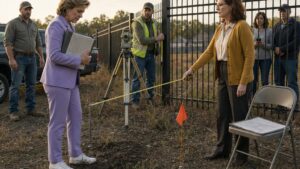
Samuel walked toward the orange utility marker carrying a receiver and a narrow probe. Fresh locating paint from the day before crossed the grass in short bright segments before disappearing at the concrete.
Jonathan stood near his own driveway.
Gregory remained beside the framed rear wall.
Samuel looked at both men.
“Which one of you requested the field review?”
“I did,” Jonathan said.
Gregory folded his arms. “And I’m the one building.”
Samuel nodded as if both statements carried equal weight.
“Good. I’m not here to settle a property dispute. I’m here to determine whether our facilities are active and whether we can safely access them.”
Gregory started to speak.
Samuel raised a hand.
“Permits, HOA approvals, title rights—those are not my department.”
Jonathan watched Gregory swallow whatever argument he had prepared.
Samuel followed the painted line with the receiver. Near the slab, the unit gave a steady signal.
He marked the point.
Then another.
The line continued directly beneath the planned rear portion of the garage.
Gregory stepped closer.
“How deep?”
“Depth estimate varies.”
“So it’s underground.”
Samuel looked at him. “That is generally where underground utilities are.”
One of the workers turned away to hide a smile.
Gregory did not.
“I mean if it’s deep enough, why does the garage matter?”
Samuel put the receiver down.
“Because the issue isn’t whether your footing touches the line today.”
He walked toward the rear of the property and pointed across the strip.
“If there’s a failure, upgrade, splice problem, conduit issue, or replacement, we need to bring equipment through here. We don’t excavate through a building.”
Gregory looked toward the narrow opening between the proposed garage and the fence.
“There’s room on the other side.”
“For a person, maybe.”
Samuel measured the space with his eyes.
“Not necessarily for what we need.”
Jonathan felt a brief, sharp satisfaction.
There it was.
Not his interpretation.
Not an old drawing.
Not an HOA argument.
A utility supervisor standing beside the slab saying access mattered.
The feeling lasted only seconds.
Gregory asked, “So you’re ordering me to tear it out?”
Samuel shook his head.
“No.”
Jonathan looked at him.
Gregory’s shoulders loosened.
Samuel continued.
“I’m telling you our line is active and this footprint appears to interfere with practical access to our facilities. What happens to the structure is a legal and property matter beyond my authority.”
Gregory gave Jonathan a look that almost said, See?
Jonathan stepped forward.
“But you’re saying the access is obstructed.”
“I’m saying if you finish this as shown, we would have an access concern.”
“Concern,” Gregory repeated.
Samuel turned to him.
“A serious one.”
The distinction restored silence.
Samuel crouched near the orange marker.
“This is why markers and recorded corridors matter. They don’t always mean nothing can ever be built nearby. They mean somebody should verify before permanent improvements go in.”
Gregory looked toward Jonathan.
Jonathan knew exactly what the sentence sounded like.
He also knew it applied to more than Gregory.
For years, Jonathan had treated the strip as something that could wait until it mattered.
Now it mattered after the concrete was hard.
Samuel walked the route again, this time explaining the access path. A small excavation might be manageable by hand. A significant repair would require equipment. The slab narrowed the approach. The planned rear wall would make it worse.
Gregory listened without interrupting.
When Samuel finished, Gregory said, “If I shift the wall?”
“Depends how far.”
“How far?”
“That’s not something I’m going to design for you.”
Gregory gave a humorless laugh.
“Everybody knows what I can’t do. Nobody wants to tell me what I can.”
Samuel picked up his receiver.
“That’s usually because those are different questions.”
Jonathan watched Gregory’s expression.
For the first time since Saturday, Gregory did not look dismissive.
He looked tired.
The framing contractor approached.
“Do you want us working or not?”
Gregory looked at the wall.
Then at Samuel.
Then at Jonathan.
“Give me ten minutes.”
The crew moved toward their truck.
Gregory walked to the edge of the slab.
“I’ve got a building permit.”
Jonathan said nothing.
“I’ve got an approval letter.”
“I know.”
“And now he says there’s a problem, but he won’t order anything.”
“He told you why.”
Gregory stared down at the utility paint.
“You wanted him to tell me I was wrong.”
Jonathan almost denied it.
Instead he said, “Part of me did.”
Gregory looked up.
“And?”
“And now I mostly want to know how this gets fixed.”
“That’s convenient.”
“No. Convenient would’ve been saying something years ago every time somebody blocked that strip.”
Gregory’s expression shifted.
Jonathan continued.
“I didn’t. I told myself temporary things didn’t matter. Maybe that helped everybody start treating the easement like decoration.”
Gregory studied him.
“That doesn’t pay for my concrete.”
“No.”
“At least you finally admit that.”
“I admit my part. I’m not admitting the garage can stay where it is.”
Gregory turned away.
Samuel had finished writing notes near his vehicle. Before leaving, he handed both men the same contact information and repeated that his office would document the access issue.
No victory.
No order.
Only a technical fact neither of them could erase.
By late afternoon, the framing crew had done almost nothing.
Gregory sent them home.
Jonathan was inside when his phone rang.
Jennifer Adams.
Her tone was different from the emails.
“Jonathan, I just spoke with Brenda.”
He waited.
“She also received the utility field notes.”
“All right.”
“We need to discuss this with the board.”
“Discuss what?”
There was a pause.
“The fact that the structure we approved appears to interfere with an active utility easement.”
Jonathan looked through the window.
Across the line, the unfinished wall cast a long rectangle across the slab.
“When?”
“Tomorrow evening.”
“That fast?”
“Yes.”
Jennifer lowered her voice.
“Gregory forwarded us his approval letter and asked whether the association intends to stand behind it.”
Jonathan closed his eyes briefly.
“And does it?”
“That,” Jennifer said, “is what we have to determine.”
Chapter 5: The Board Could Not Call It Private Anymore
Gregory placed the HOA approval letter in front of Jennifer Adams and kept one finger on it.
“If that garage has to move,” he said, “who pays?”
Nobody answered.
The clubhouse meeting room had been arranged for a small emergency session rather than a regular board meeting. Two folding tables formed an L. Brenda Green sat at one end with the architectural file open beside her laptop. Jonathan had brought the old plat in a flat folder instead of folding it again.
Gregory had brought everything.
Permit.
Approval.
Contractor invoice.
Deposit receipt.
Even photographs showing the slab before the framing began.
Jennifer looked down at the letter.
“Gregory, the association isn’t prepared tonight to make a determination about financial responsibility.”
“Of course not.”
“We’re here to establish what happened.”
“I know what happened. I submitted plans. You approved them. I built what you approved.”
Brenda spoke quietly.
“The site sketch you submitted did not show the easement.”
Gregory looked at her.
“You had my address.”
“That doesn’t give an architectural committee constructive knowledge of every recorded encumbrance.”
Jonathan watched Jennifer flinch slightly at the language.
Gregory noticed too.
“So now it’s my fault?”
“I didn’t say that.”
“You’re all getting very careful with your words.”
Jennifer leaned forward.
“Because this has consequences.”
“It had consequences when your committee approved it.”
Jonathan felt the room edging toward the kind of meeting he hated—everyone defending a narrower version of their own responsibility.
He slid the plat onto the table.
“Can we start with what we know?”
Gregory looked at him but did not object.
Jonathan opened the plat flat.
The twelve-foot strip ran clearly along the eastern edge.
“The easement is recorded. The utility says the line is active. Their field supervisor says the current footprint obstructs practical access.”
Jennifer nodded.
“And the HOA does not have authority to extinguish the easement.”
“Correct.”
Gregory tapped the approval letter.
“Then what exactly did this approve?”
Nobody answered immediately.
Brenda reached for a form in the file.
“This.”
She turned it around.
It was the association’s standard architectural-review sheet.
Jonathan had seen versions of it before for fences and exterior paint changes. At the bottom was a paragraph in smaller print.
Brenda read part of it aloud.
“Approval by the association does not relieve an owner of responsibility for compliance with governmental requirements, recorded restrictions, easements, or other applicable obligations.”
Gregory stared at her.
“That was on my approval?”
“Yes.”
“Where?”
Brenda showed him.
Gregory leaned over.
The print was there.
Small.
Dry.
Legally useful and practically invisible.
He sat back.
“So that’s it? You bury a sentence at the bottom and nothing the committee says matters?”
Jennifer said, “No one is saying that.”
“I asked about the easement.”
“We know.”
“Your volunteer told me it had never caused a problem.”
Jennifer looked toward Brenda.
Brenda closed the file.
“We confirmed that conversation.”
The room changed.
Jonathan could feel it.
Until then, the board could still describe the matter as Gregory’s failure to disclose and Jonathan’s private easement dispute.
Now the association had participated.
Jennifer’s voice softened.
“The volunteer should not have answered that question that way.”
Gregory laughed without amusement.
“That way?”
“They should have told you to verify it independently.”
“But they didn’t.”
“No.”
“Then you approved the garage.”
“Yes.”
“And now you want me to pay to undo it.”
Jennifer’s face tightened.
“I didn’t say that either.”
Gregory pushed his chair back slightly.
“This is why people hate HOAs.”
Jonathan almost smiled, but did not.
Brenda pulled another document from the file.
“There’s a second problem.”
Jennifer turned.
“What?”
“Our architectural review checklist asks applicants to certify that the project complies with setbacks, permits and recorded restrictions.”
“That sounds like Gregory’s responsibility,” one board member said.
Brenda nodded.
“It does. But the approval letter says the committee reviewed the application for compliance with association requirements and applicable placement standards.”
Jonathan understood before anyone spoke.
Gregory did too.
“That sounds broader,” he said.
“Yes,” Brenda replied.
Jennifer rubbed her forehead.
“How long has that language been in the form?”
“Several years.”
“And we don’t verify recorded easements.”
“No.”
“Then why does the form imply that we do?”
Brenda did not answer.
She did not need to.
Jennifer sat back.
For the first time since the conflict began, Jonathan saw her stop trying to protect the institution long enough to look honestly at it.
“That’s a process failure,” she said.
Gregory’s anger eased by a fraction.
Not because he had won.
Because someone had finally named part of what had happened.
Jennifer continued.
“It does not mean the association authorized construction over an easement. We couldn’t. But our process helped create the impression that the placement had been comprehensively reviewed.”
Gregory looked at Jonathan.
Jonathan knew the moment invited him to press harder.
He could demand that Gregory remove everything.
He could point to Monday afternoon, to the warning email, to the fact that Gregory had chosen to keep framing after the approval gap was known.
His attorney had already told him that preserving a clear written record mattered if negotiations failed.
Instead Jonathan said, “There are two different mistakes here.”
Gregory frowned.
“The approval process failed before the concrete. Gregory made a separate decision after I warned him.”
Gregory’s mouth tightened.
Jennifer looked between them.
“That’s probably fair.”
Gregory turned toward Jonathan.
“So you want me punished for not taking your word for it.”
“No. I want the cost after the warning treated differently from the cost before it.”
The room went quiet.
Gregory looked down at the invoice.
His voice was lower when he spoke.
“You know why I kept going?”
Jonathan waited.
“Because by Monday this had turned into you standing there telling me everything I’d done was wrong.”
“That wasn’t what I meant.”
“That was what it felt like.”
Jonathan did not argue.
Jennifer tapped her pen once.
“The immediate question is what happens to the project.”
Gregory looked at her.
“My contractor can finish the framing in two days.”
Brenda said, “I strongly recommend you don’t.”
“Are you ordering a stop?”
“No.”
“Then everybody is still giving me advice while I pay for delays.”
His frustration was no longer theatrical.
It was practical.
Crew schedules.
Material storage.
Interest on money already spent.
A half-built structure exposed behind his house.
“If nobody gives me a real alternative,” Gregory said, “I’m finishing it.”
Jennifer stiffened.
“That would be unwise.”
“Then give me something better than unwise.”
Jonathan looked at the plat.
The easiest position was total removal.
It was also the one that required nothing from him except insistence.
He studied the garage footprint.
The slab extended beyond what the walls actually required. Gregory had built extra apron space along one side. The access corridor needed clearance, not moral perfection.
Jonathan turned the plat toward the framing contractor, who had been invited for the construction portion of the discussion and had remained near the wall.
“If the garage moved inward and shortened slightly, could you preserve most of the slab?”
The contractor leaned over the drawing.
“Maybe.”
Gregory stared at Jonathan.
“What are you doing?”
“Looking for a way not to tear down all of it.”
The contractor pointed.
“You’d have to cut this side. Move the rear wall. Probably adjust the roof framing.”
“How long to know?” Jonathan asked.
“A day, maybe two, if I get revised measurements.”
Jonathan looked at Jennifer.
“Forty-eight hours.”
She raised an eyebrow.
Jonathan continued.
“Pause construction for forty-eight hours. Have the contractor draw a compliant footprint. Let the utility review the access. Then we know whether this can be corrected instead of destroyed.”
Gregory said nothing.
Jennifer looked at Brenda.
Brenda nodded slowly.
Finally Jennifer turned to Gregory.
“Will you agree to that?”
Gregory looked from the approval letter to the old plat spread open across the table.
Then he looked at Jonathan.
“Forty-eight hours,” he said.
Jonathan nodded.
For the first time, the question was no longer whether Gregory had been wrong to build there.
It was whether enough of the garage could still be saved.
Chapter 6: Saving the Garage Meant Cutting the Slab
The redesign saved the garage.
It did not save the concrete.
The framing contractor placed the revised sketch across a temporary worktable Friday morning and drew a heavy pencil line through the fresh slab.
“This section comes out.”
Gregory stared at it.
“How much?”
“About four feet along this side, tapering toward the rear.”
“That’s brand-new concrete.”
“I know.”
“And the wall?”
“Moves inward. Rear dimension gets shortened. Roof changes slightly.”
Gregory looked toward the orange utility marker.
The revised setback had been measured from it after Samuel’s office supplied the practical access requirements.
For days, the marker had looked incidental.
Now every measurement began there.
Jonathan stood on the other side of the table.
“Does the utility accept this?”
The contractor nodded.
“Subject to final field confirmation.”
Gregory looked at Jonathan.
“And you?”
“If they have access, I have no reason to object.”
“No reason.”
“That’s what I said.”
Gregory folded the sketch.
“You realize how much this is going to cost.”
Jonathan did.
Not precisely.
But enough.
Concrete cutting. Removal. Disposal. New forms. A smaller replacement pour. Reframing work already completed. Revised drawings. Lost labor time.
The contractor had produced a preliminary estimate that made Gregory go silent for nearly a minute.
“What happens if I don’t agree?” Gregory asked.
Jonathan answered carefully.
“Then we go back to lawyers.”
“And you’d seek removal.”
“Yes.”
“All of it?”
“If that’s what protecting the easement requires.”
Gregory looked at the unfinished structure.
Jonathan saw him calculating.
Not just money.
Pride.
Months of planning.
The restoration equipment he had intended to move into the garage.
The embarrassment of having contractors cut apart something neighbors had watched go up days earlier.
Gregory walked several feet away.
Jonathan almost followed, then stopped himself.
For once, silence felt appropriate because the decision actually belonged to someone else.
Gregory returned.
“I’ll do the redesign.”
The contractor nodded.
“But,” Gregory added, “I’m not eating all of this.”
Jonathan said nothing.
Gregory looked at him.
“The slab was poured before you had anything but an old plat.”
“I warned you about the easement before the pour finished.”
“You asked questions. You didn’t have utility confirmation.”
“That’s true.”
“The HOA approved my plan after I asked them about the easement.”
“Also true.”
Gregory pointed toward the partially framed wall.
“But I kept building Monday after you sent that email.”
“Yes.”
For a moment the argument seemed ready to repeat itself.
Instead Gregory sat on the edge of the worktable.
“You know why?”
Jonathan waited.
“Because stopping felt like admitting you’d won.”
The sentence landed with none of the force Gregory probably expected.
It was too plain.
Jonathan looked at the lumber stacked against the wall.
Gregory rubbed his hands together.
“I’d spent weeks getting approvals. Then you walked outside, looked at the marker, and suddenly everybody was supposed to stop because Jonathan Carter had noticed something.”
“I can see how that looked.”
Gregory gave him a sharp look.
“Can you?”
“Yes.”
“That doesn’t excuse it.”
“No.”
Gregory seemed almost disappointed by the lack of resistance.
Jonathan continued.
“I’ve done the opposite for years.”
“What?”
“Waited too long to say things because I didn’t want anyone thinking I was difficult.”
Gregory looked toward the utility strip.
“Worked out great.”
“No.”
That earned the smallest smile either man had given all week.
It disappeared quickly.
Gregory unfolded the estimate.
“I’ll pay for the work that happened after Monday’s warning.”
Jonathan looked at him.
“You’re dividing it by date?”
“I’m dividing responsibility.”
“That sounds like something Brenda would say.”
“Maybe she’s rubbing off on me.”
Gregory pointed at the line items.
“I’ll cover dismantling the framing that went up after your email. I’ll cover rebuilding it. But the redesign fees and at least part of the slab correction? The HOA helped put me there.”
Jonathan considered it.
It was not unreasonable.
“What about the concrete that was poured Saturday?”
“That’s exactly what I mean. Their approval was already in my hand.”
“And so was the easement on your plat.”
Gregory’s face tightened again.
“I asked them.”
“I know.”
They stood on opposite sides of the same table.
The old version of the argument waited between them: your fault, no, yours.
Jonathan felt the familiar urge to retreat into technical certainty.
Instead he said, “I think the board bears some responsibility for the approval process. I don’t know what amount.”
Gregory studied him.
“You’d say that at the meeting?”
“If that’s what I believe.”
That afternoon, cutting began.
The saw was louder than Jonathan expected.
A thin stream of water ran across the slab as the blade traveled down the marked line. Gray slurry collected along the cut.
Gregory stood nearby with his hands in his pockets.
Jonathan stayed on his own side of the strip.
When the first section separated, the removal contractor lifted it in broken pieces.
The orange utility marker stood several feet beyond the new edge.
Clear.
Visible.
No longer trapped against permanent construction.
Samuel returned early the following week.
He walked the revised access path with the contractor and checked the dimensions.
“This works much better.”
Gregory looked at him.
“Better or acceptable?”
Samuel glanced at the sketch.
“Acceptable, subject to the final construction staying inside these limits.”
Gregory let out a breath.
It was the first official answer anyone had given him that contained something he could actually build.
The new wall line went up that afternoon.
Shorter.
Shifted inward.
Still a garage.
Jonathan watched from his kitchen window until he realized he was doing exactly what he had done for years—observing from behind glass while decisions hardened outside.
He went out.
Gregory noticed him.
“Something wrong?”
“No.”
Gregory looked suspicious anyway.
Jonathan nodded toward the new wall.
“Looks better.”
“You mean farther away from you.”
“I mean it leaves the corridor open.”
Gregory gave a small shrug.
“Same thing from your side.”
“Probably.”
They stood quietly until Gregory said, “Jennifer called.”
Jonathan turned.
“She wants a formal vote on cost sharing.”
“When?”
“Next board meeting.”
Jonathan knew what that meant.
The question that had begun with an orange marker and wet concrete was now going to become numbers in front of the entire board.
Gregory looked at the saw-cut edge of the slab.
“I’m not asking them to pay for my stubbornness.”
Jonathan said nothing.
“I am asking them to pay for their mistake.”
“That seems fair.”
Gregory glanced at him.
“And you’re going to say that?”
“Yes.”
The next evening, Jennifer emailed both men the agenda.
One item had been added under association business:
Architectural Review Process and Allocation of Corrective Design Costs.
Jonathan read it twice.
For the first time since Saturday morning, nobody was pretending the problem belonged entirely to someone else.
Chapter 7: The Boundary They Finally Chose to Respect
The cost-sharing motion passed by one vote, and nobody in the room looked pleased.
Jennifer Adams read the result twice before setting the paper down.
“The association will cover the revised design fees and the administrative costs connected to correcting the architectural review. Gregory will be responsible for demolition, concrete removal, reframing, and reconstruction performed after Jonathan’s written warning.”
Gregory leaned back in his chair.
“So I lose money because your committee gave me bad information, and the association pays for paperwork.”
Jennifer did not flinch.
“The association is accepting responsibility for the part of the process it controlled.”
“And the concrete?”
“That was installed before the easement was verified, but after the easement existed on your recorded plat.”
Gregory looked toward Jonathan.
Jonathan kept his hands folded on the table.
Gregory said, “You agree with this?”
Jonathan took a second before answering.
“I think it’s fairer than either one of us getting everything we asked for.”
“That’s not exactly an answer.”
“It is my answer.”
Gregory looked down at the estimate in front of him.
A month earlier, Jonathan might have taken satisfaction in that silence.
Now he mostly saw a man calculating the price of a decision that had been partly encouraged, partly assumed, and partly made out of pride.
Jennifer moved to the next agenda item.
The architectural checklist.
Brenda Green distributed a revised draft.
The new form was longer.
It required homeowners to disclose known easements, submit a recorded plat when a project approached a property edge, and acknowledge in plain language that HOA approval did not verify private title rights, utility access, or county code compliance.
One sentence had been bolded.
Applicants are responsible for confirming recorded easements and obtaining any necessary third-party approvals before permanent construction begins.
Gregory read it.
Then he raised his hand.
Jennifer looked surprised.
“Yes?”
“I want something added.”
Jonathan glanced at him.
Gregory tapped the form.
“If a homeowner identifies an easement, the committee shouldn’t answer questions about whether it matters unless they actually know.”
Brenda nodded immediately.
“That makes sense.”
“Don’t say, ‘It’s never been a problem.’ Don’t say, ‘Nobody has complained.’ Just tell them who they need to verify it with.”
Jennifer wrote something in the margin.
“We can add that.”
Gregory looked at the paper for another moment.
Then, when Jennifer called for the vote, he voted in favor of the new procedure.
Jonathan noticed because Gregory did not hesitate.
The motion passed unanimously.
After the meeting, people packed folders and folded chairs without ceremony.
No applause.
No speeches.
Jennifer stopped Jonathan near the door.
“I owe you an apology.”
He shifted the folder under his arm.
“For what part?”
She almost smiled.
“Fair question.”
Then her expression settled.
“I treated your first email like you were trying to drag the association into a private disagreement. I was protecting the board before I understood the problem.”
Jonathan nodded.
“I’ve probably trained people to expect that from me.”
“What do you mean?”
“I wait until something bothers me enough that I arrive with documents.”
Jennifer looked at him.
“That doesn’t make the documents wrong.”
“No.”
“But?”
“But it probably makes me harder to hear.”
Jennifer considered that.
“Maybe.”
It was not the comforting answer.
Jonathan appreciated it more for that.
Brenda joined them with the revised checklist.
“We need somebody who understands plans to look at the wording around plats and setbacks.”
Jonathan knew what was coming.
“No.”
Brenda smiled.
“I haven’t asked yet.”
“You were going to.”
“I was.”
“I spent twenty years trying not to end up on an HOA committee.”
“This isn’t a committee seat.”
Jennifer said, “Just review the language.”
Jonathan looked from one woman to the other.
Two weeks earlier, he would have refused automatically.
The association had its responsibilities.
He had his.
Keep the line clean.
Do not get involved unless necessary.
That philosophy had seemed reasonable until he watched wet concrete spread across a place everyone had quietly decided no longer mattered.
“Send it to me,” he said.
Brenda handed him the paper already in her hand.
Jonathan looked at it.
“You planned that.”
“I hoped.”
Outside, Gregory was standing beside his truck.
Jonathan walked past him.
Gregory said, “Carter.”
Jonathan stopped.
“I heard you backed the cost split.”
“I said what I thought was fair.”
Gregory nodded.
“That’s what Jennifer said.”
Jonathan waited.
Gregory looked toward the clubhouse.
“I’m still not happy about it.”
“You don’t have to be.”
“That might be the first thing we fully agree on.”
Jonathan smiled slightly.
Gregory held out his hand.
Not warmly.
Not dramatically.
Just plainly.
Jonathan shook it.
The construction finished near the end of the month.
The garage was smaller than Gregory had originally planned, but not by much. The shifted rear wall gave the structure a slightly different proportion, and the saw-cut section of the original slab had been repoured inside the new footprint.
Jonathan watched the final inspection from his own driveway.
Samuel Brown returned for the utility clearance.
He walked the access strip once, checked the revised edge of the concrete, and looked toward the rear.
The orange utility marker stood in open ground.
Nothing covered it.
Nothing leaned against it.
The garage wall ended several feet away.
Samuel nodded.
“This works.”
Gregory, standing near the new garage door, asked, “You’re sure?”
Samuel looked at him.
“Yes.”
Gregory let out a breath.
“Good.”
Samuel left.
For a while, Jonathan and Gregory stood on opposite sides of the strip that had caused so much trouble.
The grass near the concrete was still rough from removal work. A pale seam showed where the new pour met the older slab.
Gregory looked at the orange marker.
“You know, I hate that thing now.”
Jonathan said, “You’ll stop noticing it.”
“Probably.”
“That was the problem.”
Gregory glanced at him.
Then he nodded.
A week later, Jonathan sat at his kitchen table with the final version of the HOA checklist.
He had crossed out one sentence and rewritten another.
Not because he wanted authority.
Because vague language had already cost everyone enough.
He sent the changes to Brenda.
Then he went outside.
Gregory’s garage door was open. Inside, shelves were going up along one wall. A workbench sat against the back.
The building looked permanent now.
Properly permanent.
Jonathan walked toward the side yard.
The utility strip was clear.
The orange marker stood exactly where it had stood the morning the concrete truck arrived.
Only now there was space around it.
Visible space.
Deliberate space.
The garage stopped before the boundary instead of pretending the boundary did not exist.
Jonathan looked at it for a moment, then turned back toward his house.
The line had always been there.
What changed was that, finally, everyone had chosen to respect it.
The story has ended.