My Neighbor Blocked the Drainage Beside My House—Then the Old Subdivision Map Changed Everything
Chapter 1: The Water Stopped at the Concrete
The water was standing where I had never seen it stand before.
I noticed it from the kitchen window just after eight on Saturday morning, a brown-gray strip of rainwater pressed against the side lawn like somebody had drawn a line through it. The storm had been steady since dawn, not especially hard, but the shallow swale between my house and Matthew Thompson’s usually carried that kind of rain toward the street without trouble.
That morning, it stopped halfway.
I pulled on an old rain jacket and went outside.
The reason was obvious before I reached the side yard.
A low concrete berm, perhaps six inches high, ran along Matthew’s side of the property line. It was fresh enough that the edges still looked pale and sharp. The lawn beside it had been disturbed, with damp soil pressed flat by boots and a narrow track where a wheelbarrow had passed.
Water had reached the berm and spread sideways.
Toward my house.
I stood there for several seconds, listening to rain tick against my hood.
Matthew had mentioned landscaping. He had not mentioned concrete.
The houses in our subdivision sat close enough that neither of us had much side yard to waste. Mine was an older brick house I had inherited through my family and then spent years maintaining one small repair at a time. Between our properties, the ground sloped almost imperceptibly toward a storm inlet farther down the block.
It had always worked.
Until somebody interrupted it.
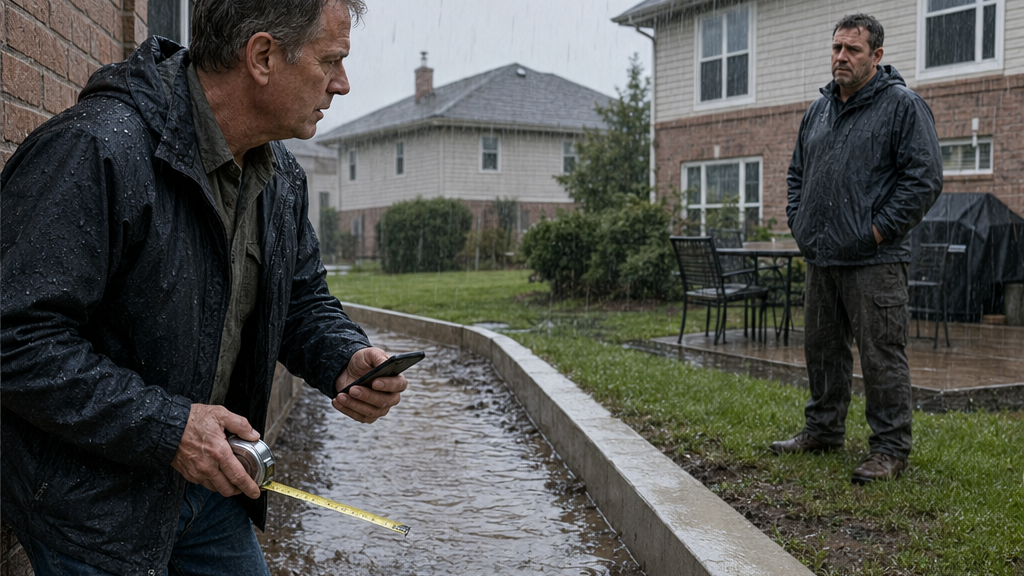
I walked to the deepest part of the pooling water and pushed a metal ruler into the grass. Nearly four inches.
Then I looked toward the back corner.
Matthew was standing under the roof of his patio, coffee mug in hand.
He raised one hand.
Not exactly a wave. More an acknowledgment that he had seen me looking.
I walked over.
“You put this in?”
He set down the mug.
“Yesterday.”
“This concrete?”
“Yes.”
I waited for an explanation.
None came.
“The water can’t cross now.”
“That was the idea.”
The rain suddenly seemed louder.
Matthew was in his early fifties, broad through the shoulders, the kind of man who usually spoke in short practical sentences. We had never been friends, but we had never been enemies either. We exchanged greetings. I collected packages for him once. He had helped me move a dead branch after a storm.
I pointed behind me.
“It’s backing toward my foundation.”
He looked.
“I’ve had water coming onto my property for months.”
“That’s where the drainage runs.”
“That’s where your water runs.”
He said it without raising his voice.
That made it worse.
I stared at him.
“You never said you were building a barrier.”
“I’ve complained.”
“To me?”
“To the association.”
“That’s not the same thing.”
He shrugged.
“They approved the landscaping.”
I looked again at the concrete.
“You showed them this?”
“I showed them the plan.”
“What plan?”
“My yard plan.”
The distinction landed immediately.
“Did the plan show a concrete berm?”
Matthew’s mouth tightened.
“It showed edging.”
“That isn’t edging.”
“It’s on my property.”
I could feel myself wanting to say too much. For most of my working life, I had made estimates from drawings and specifications. I had learned that arguments went downhill fast when people started talking before they had dimensions, documents, or facts.
So instead of arguing, I stepped back into the rain.
Matthew called after me.
“Redirect your downspouts if you’re worried.”
I turned.
“The downspouts aren’t the issue.”
“That water starts on your side.”
“It also leaves my side through that swale.”
“Not anymore.”
He said it like that settled the matter.
I went inside and found my tape measure.
When I came back, the water had risen another half inch.
I photographed the berm from both ends, then measured the distance between the standing water and the brick foundation. The closest point was less than three feet.
Matthew watched from his patio.
“Documenting me now?”
“I’m documenting the water.”
He gave a dry laugh.
“That sounds different somehow?”
I ignored that.
At the lowest section of my lawn, the grass had already disappeared under muddy water. A thin stream had started creeping sideways toward the house because it had nowhere else to go.
I crouched beside it.
That was when irritation turned into something colder.
The water reached the edge of the foundation bed.
I stood.
“Matthew.”
He came closer but stayed on his side of the line.
“This is touching the foundation.”
“I told you. Fix your drainage.”
“You understand this didn’t happen before yesterday.”
“You understand my yard has been taking runoff for years.”
“That’s because this is a drainage path.”
“So you say.”
I looked at the concrete, then at him.
“Did you check the recorded plat before you built this?”
For the first time, his expression changed.
Not fear. Not quite.
Annoyance.
“I checked my property line.”
“That isn’t what I asked.”
“I own this strip.”
“You can own land with restrictions on it.”
Matthew folded his arms.
“If you’ve got something official, send it to the association.”
“I might.”
“Good.”
He started back toward his patio.
“And Joseph?”
I waited.
“The concrete stays.”
By early afternoon, the rain weakened.
The water did not disappear.
It sat against the grass in a long shallow pool, leaving a dark stain along the brick mulch bed. I set a small wooden stake at the farthest point it had reached and took another photograph.
Then I went inside.
My home office still had the filing cabinet I had inherited with the house. Most of what was inside had been useless for years—old insurance notices, appliance manuals, tax assessments, faded closing papers.
But somewhere in that cabinet was a subdivision package.
I remembered seeing it after my uncle died.
A thick folded sheet. Streets, lots, dimensions.
I pulled drawers open until I found a brown envelope marked with the subdivision name.
Inside were copies of old plats, several later surveys, and a title policy.
I spread the largest sheet across my desk.
The print was faint.
I turned on the overhead lamp and leaned closer.
Lot lines crossed the paper in thin black strokes. Utility corridors were shown in dashed lines. At first I found nothing that explained the swale.
Then I saw a narrow strip running behind several houses before angling between mine and Matthew’s.
I followed it with my finger.
The line crossed my side yard.
Continued across his.
And beneath the faded notation beside it were two words that changed the shape of the entire dispute.
Drainage Easement.
Chapter 2: The Line Drawn in 1987
The faded easement line passed directly beneath the place where Matthew had poured the concrete.
I enlarged the scanned plat on my computer until the lettering broke into pixels.
The original recording date was 1987.
I sat back.
For nearly forty years, a drainage corridor had been marked between the lots. I had lived with it without thinking much about it because functioning infrastructure becomes invisible. Water came through the swale, crossed the low ground, and disappeared toward the storm inlet.
Nobody noticed until it stopped.
I spent Sunday morning comparing the old plat with my more recent survey.
The property lines had not changed.
Neither had the easement.
On the newer survey it was easier to read: a drainage strip extending across portions of both lots, with language referring back to the original subdivision recording.
That alone did not tell me exactly what Matthew could or could not build.
I knew enough from years of reading plans to know the difference between recognizing a symbol and pretending to be a lawyer.
So I searched the county records portal.
The original subdivision declaration was available as a scanned document. It took me almost an hour to find the relevant section.
The language was dry, repetitive, and old.
But the meaning was fairly clear.
The drainage easements existed for the movement and maintenance of stormwater. Permanent obstructions that materially interfered with their function could be subject to removal.
I read the paragraph twice.
Then a third time.
There it was.
Not revenge.
Not a loophole.
Just a restriction attached to the land.
I printed the page and placed it beside my photographs.
For several minutes, I felt something close to relief.
Matthew had said the concrete stayed because it was on his property.
The document said ownership was not the only issue.
I drafted an email.
Matthew,
I located the recorded subdivision plat and drainage easement affecting both lots. The new concrete berm appears to sit within the easement and is causing water to back toward my foundation. I am asking that we pause further work and discuss removing the obstruction before additional damage occurs.
I attached the plat and photographs.
Then I stopped.
The email sounded correct.
It also sounded like something written to preserve a record.
Which, if I was honest, was exactly what I was doing.
I considered walking next door first.
Instead I clicked send.
That was how I handled uncomfortable things.
I made them precise.
By Monday morning, Matthew had not replied.
The HOA office opened at nine.
I called and was told the management representative could send me the architectural request connected with Matthew’s landscaping, provided the relevant board material was not confidential.
An hour later, an email arrived.
The attachment was only four pages.
The first showed a simple overhead sketch of Matthew’s side yard and planned patio area. There were landscaping beds, dimensions, and a heavy line near the property edge.
That line was labeled decorative edging.
There was no drainage easement.
No swale.
No concrete section detail.
The approval stamp from the association was dated six weeks earlier.
Approved as submitted.
I felt my earlier relief change shape.
If Matthew had submitted a drawing showing only decorative edging, then he had not shown the board what he ultimately built.
But the board had also approved a plan in an area crossed by a recorded drainage easement without apparently checking the plat.
Neither possibility was good.
I drove to the HOA office shortly after lunch.
It occupied two rooms in the subdivision clubhouse, beside a fitness room and a small meeting hall. Janet Robinson was already waiting.
I knew her by sight. She had been board president for about two years and had the permanently hurried manner of somebody doing unpaid work that everyone else believed should be done perfectly.
She placed Matthew’s application on the table.
“I saw your email.”
“To Matthew?”
“He forwarded it.”
I sat across from her.
“Did the board review the easement?”
Janet looked down at the plan.
“We review architectural appearance and covenant compliance.”
“That wasn’t my question.”
“I know.”
She rubbed one thumb against the corner of the paper.
“No. We did not pull the original subdivision plat.”
“Why not?”
“Because it was presented as landscaping.”
“There’s concrete across a drainage path.”
“I understand what you’re saying.”
“Have you looked at the water?”
“I’ve seen the pictures.”
“You should see it in person.”
Janet leaned back.
“Joseph, I want to be careful here. HOA approval does not necessarily mean we warranted compliance with county drainage requirements.”
“I’m not asking you to warrant anything.”
“It sounds like you might be.”
There it was.
Liability.
Not drainage.
I pushed the old plat across the table.
“This easement runs through the exact area you approved.”
Janet studied it.
“It’s hard to read.”
“The newer survey shows the same thing.”
I placed that beside it.
She looked from one sheet to the other.
For the first time, she stopped defending the process.
“Did Matthew have this?”
“I don’t know.”
“Did you?”
“I had it in my files.”
“But you didn’t send it before the work?”
“I didn’t know he was putting in concrete.”
Janet nodded slowly.
That was fair.
She opened the architectural request again.
“We approved this line as edging.”
“He built a berm.”
“I see that.”
“Then tell him to remove it.”
Janet looked at me.
“We can’t issue an enforcement decision based solely on your interpretation.”
“My interpretation?”
“I’m not saying you’re wrong.”
“You just said you didn’t check the plat.”
“And I’m saying we need to determine what authority applies.”
I felt my jaw tighten.
“That sounds like delaying until the next rain.”
“It sounds like avoiding a decision the board may not legally control.”
That answer irritated me because it was reasonable.
Janet turned the plat toward herself.
“How old is this?”
“Recorded in 1987.”
She traced the easement line.
Then she took Matthew’s approved plan and placed it on top.
The alignment was obvious.
The heavy line showing his decorative edging sat almost exactly where the drainage corridor ran.
Janet exhaled.
“I wish this had been attached to his application.”
“So do I.”
She looked up.
“We approved the project.”
I waited.
“But we never pulled this.”
The room seemed suddenly quieter.
“Who was supposed to?”
Janet did not answer immediately.
Finally she said, “That may be the problem.”
Chapter 3: The Approval Nobody Checked Closely
Janet placed a printed stack of emails on the clubhouse table and pushed them toward me.
“These started in February.”
The first message was from Matthew.
Subject: standing water at side yard.
I read it once.
Then again more slowly.
He had written that water was collecting near his planned patio area after moderate storms. He believed runoff was entering from the neighboring lot and asked whether the association maintained the shallow drainage channel between the properties.
The management reply was brief.
Private-lot drainage generally remains homeowner responsibility.
Matthew wrote again two weeks later.
Then again in April.
The third email included photographs.
I recognized the side yard immediately.
The swale was visible, but the grass on Matthew’s side was flattened and muddy. Water had collected near the edge of a landscape bed.
Not against his foundation.
Not yet.
But enough to be a nuisance.
I looked up.
“You had these before you approved the landscaping.”
Janet nodded.
“The management company had them.”
“You’re the president.”
“I’m also one volunteer on a board that gets a condensed report unless something is escalated.”
“That sounds convenient.”
Her eyes narrowed.
“So does pretending none of this existed before Saturday.”
That stopped me.
Janet tapped the photographs.
“Matthew has been complaining for months.”
“He never talked to me.”
“He says he mentioned runoff to you.”
“He said my yard was wet near the fence once.”
“And what did you say?”
I remembered.
Late March.
Matthew had been carrying mulch bags from his truck. He had pointed toward the side yard and said, “That channel’s holding more water than it used to.”
I had looked.
The ground had been damp.
I had said, “It always drains after a while.”
Then I went inside.
At the time, it had seemed like nothing.
Now Janet was watching my face.
“That doesn’t justify pouring concrete.”
“I didn’t say it did.”
“He blocked an easement.”
“Probably.”
“Probably?”
“We need an engineer or county inspection before I’m going to pretend the board can make a technical determination.”
I pushed the emails back.
“Matthew knew there was a drainage problem.”
“Yes.”
“And instead of fixing it correctly, he shoved the water toward me.”
Janet’s expression hardened.
“And apparently nobody took him seriously before he did.”
I stood.
“That includes me, I suppose.”
She did not answer.
Outside, the clouds had cleared, but the evidence from Saturday remained.
A brown water stain marked the grass along my side of the berm.
I walked past my house toward the rear of the property, looking at the swale more carefully than I had in years.
Near the back corner, the depression was still visible.
Closer to the middle, it seemed shallower.
Grass roots, years of topsoil, maybe landscaping changes.
Nothing dramatic.
That was the problem.
Things deteriorated slowly enough that you could call each change normal.
Matthew came out while I was standing there.
“You find your paperwork?”
“Yes.”
He looked toward the concrete.
“Then I guess you know the HOA approved it.”
“They approved decorative edging.”
“That’s what it is.”
“It’s holding water like a dam.”
“Because too much water is coming through.”
“We’re getting an engineer.”
Matthew laughed once.
“We?”
“The HOA needs a technical opinion.”
“Of course they do now.”
His voice had changed.
Not smug this time.
Bitter.
“You asked them for help?”
“For months.”
“You didn’t ask me.”
“I told you the drainage was getting worse.”
“You said it stayed wet.”
“What did you think that meant?”
“That it stayed wet.”
Matthew shook his head.
“That’s exactly the problem.”
I felt my patience slipping.
“No, the problem is you poured concrete across a drainage route.”
“And the problem before that?”
I said nothing.
He pointed toward the swale behind me.
“You think I woke up last week and decided I wanted a concrete wall beside your house?”
“It isn’t beside my house. It’s beside your yard.”
“And now you care about the distinction?”
The words landed harder than I wanted them to.
Matthew stepped off his patio.
“I paid for drainage work twice. Regraded that corner. Added soil. Changed the beds. Every storm, more water.”
“Then you should have hired an engineer.”
“With what money?”
That was the first time his frustration sounded less like defiance and more like exhaustion.
He immediately seemed to regret saying it.
He looked away.
“I’m not removing anything until somebody tells me exactly what’s supposed to happen with the water.”
“That concrete may already have damaged my foundation.”
“Then get it inspected.”
“I am.”
“Good.”
He went inside.
I stood alone beside the berm.
For the first time since Saturday, I looked away from the concrete and followed the drainage path backward.
Toward my own property.
Near the rear fence, the swale was clear.
Halfway forward, it widened but flattened.
A section beside one of my planting beds had almost disappeared entirely beneath years of accumulated soil.
I crouched.
There was still a depression, but barely.
I remembered adding topsoil there two summers earlier because the grass had been thin.
Only a few bags.
I had never considered whether I was changing drainage.
The thought irritated me immediately.
Then, because it irritated me, I knew I needed to take it seriously.
That afternoon, Janet emailed both of us confirming that the HOA would split the cost of an independent drainage assessment pending board review.
Matthew replied with one sentence.
Fine.
I replied with three paragraphs, citations to the easement, and six photographs.
I stared at the email after sending it.
Too much.
Again.
Facts stacked like sandbags.
By Wednesday, Samantha Lee had agreed to inspect both properties.
Before she arrived, I scheduled a foundation contractor.
He came late Thursday morning carrying a moisture meter and flashlight.
We started outside.
He knelt beside the lowest bricks, where Saturday’s water had reached the mulch bed.
“How often does water get this close?”
“It never did before the berm.”
He looked toward Matthew’s property.
“Never?”
“Not like this.”
He pressed the meter against the lower wall, then checked inside the crawlspace access.
I followed him down.
The air smelled of earth and old wood.
He moved slowly along the foundation, shining the flashlight over mortar joints.
At one point he stopped.
My stomach tightened.
“What?”
“Nothing catastrophic.”
“That isn’t reassuring.”
He smiled faintly.
“No visible structural failure. That’s the reassuring part.”
“And the other part?”
He pointed to a darker section near the base.
“You’ve got recent moisture here. Could be from this event. Could be cumulative.”
“Can you tell?”
“Not from one visit.”
He stood and brushed dust from his knee.
“What I can tell you is you don’t want repeated saturation at this wall.”
“How close is too close?”
He looked toward the exterior.
“If the water line you marked is accurate, it’s already too close.”
We went outside again.
The wooden stake I had placed Saturday was still there.
He measured from it to the brick.
Then he looked toward the concrete berm.
“You need the drainage path restored or redesigned. Quickly.”
“Even if the rain stops?”
“The next storm doesn’t care whether you’re still arguing.”
That afternoon, another bank of dark clouds appeared beyond the rooftops.
I stood at the kitchen window watching them gather.
For three days I had been building a case around one simple idea: Matthew had caused the problem.
Now I had his complaint emails, the old swale, the filled-in section on my own property, and a contractor telling me the latest water line was already too close to the house.
The concrete was still wrong.
I was increasingly sure of that.
What I was no longer sure of was whether it was the whole problem.
Chapter 4: The Engineer Refused the Easy Answer
The test water split before it reached Matthew’s concrete.
Samantha Lee had poured it from a five-gallon bucket into the rear section of the swale while Matthew and I stood several yards apart, each of us expecting the same simple result.
Instead, the water traveled cleanly for perhaps twenty feet, slowed beside my planting bed, then divided.
One thin ribbon continued toward the original drainage path.
The rest spread sideways across my lawn.
Samantha crouched and watched until the last trickle disappeared into the grass.
“That’s not supposed to happen,” Matthew said.
“No,” she replied.
I looked toward the berm.
“But the concrete is still blocking the easement.”
Samantha stood and wiped mud from one glove.
“Yes.”
Matthew made a short sound in his throat.
I turned toward him.
“What?”
“Nothing.”
“That sounded like something.”
Samantha stepped between the lines of orange flags she had placed through both yards.
“Let me finish before either of you decides which half of my answer you like.”
That silenced us.
She had arrived just after nine with a survey level, measuring rod, hand tools, and a folder containing the documents I had sent. She had asked us not to explain the dispute until she walked the site herself.
I found that reassuring.
Matthew did not.
Within twenty minutes she had identified the old swale, measured the berm, and confirmed that the concrete crossed the mapped drainage corridor.
That was the part I had been waiting to hear.
Then she kept measuring.
Near the rear of my property, the swale was nearly eight inches lower than the surrounding grade.
Closer to the house, it was less than three.
At my planting bed, Samantha pressed the measuring rod into the grass, checked the level, and looked at me.
“Has soil been added here?”
“A little.”
“How much is a little?”
“I don’t know. A few bags over the years.”
Matthew looked at me.
I ignored him.
Samantha walked farther along the depression.
“You’ve also got root buildup and sediment. That happens over time.”
“So that’s causing Matthew’s water?”
“I didn’t say that.”
“Then what are you saying?”
“I’m saying the original drainage path is no longer carrying water as efficiently as the recorded design assumed.”
Matthew crossed his arms.
“There.”
Samantha looked at him.
“And your concrete prevents the remaining flow from leaving this section.”
His arms lowered.
“There,” I said.
She gave me the same look.
I stopped.
For the next hour, Samantha seemed almost determined to disappoint both of us equally.
She checked downspout outlets.
Measured grades.
Took photographs.
Ran a second test from farther upslope.
This time, I saw the problem before she said anything.
Water coming from the rear section of my property entered the swale normally. When it reached the flattened area near my planting bed, some stayed in the channel while some spread into the grass.
By the time it reached Matthew’s side, the flow was wider than the original corridor.
The berm then stopped almost all of it.
The obstruction had not created every part of the problem.
It had turned a deteriorating drainage problem into a dangerous one.
Matthew stood beside Samantha, staring down at the flags.
“So if I remove it, I get all that water again.”
“You get water through a drainage easement.”
“That’s not an answer.”
“It is technically the answer.”
“I spent money trying to keep this side dry.”
“And you installed a permanent obstruction across a mapped drainage path.”
“The HOA approved my project.”
“They approved a drawing labeled decorative edging. I’m not here to interpret their approval.”
He turned away.
Samantha looked toward me.
“And Joseph, removing the berm does not restore the original capacity upstream.”
“I understand.”
“Do you?”
The question irritated me.
“Yes.”
She pointed toward my planting bed.
“That area needs to be lowered and reshaped. The channel has to be reestablished before the flow reaches Matthew’s property.”
“That can be done.”
“It should have been maintained.”
The words were not accusatory.
That made them harder to dismiss.
For days, I had built the conflict around Matthew’s decision.
He had poured concrete.
He had blocked the water.
He had refused to remove it.
All true.
But the engineer’s orange flags now ran across my lawn too.
At noon, Janet arrived.
Samantha walked the three of us through her preliminary findings near the property line.
“The recorded drainage corridor is still valid as a physical feature,” she said. “The concrete berm materially interferes with it.”
Janet looked at Matthew.
He stared at the ground.
“But,” Samantha continued, “the upstream swale has lost grade and effective capacity. Some maintenance or landscaping changes on Joseph’s property contributed to that.”
Janet looked at me.
I hated how quickly I noticed.
“Contributed how much?” I asked.
“I can’t assign a percentage today.”
Matthew laughed without humor.
“Funny how percentages matter now.”
I turned.
“You still built the barrier.”
“Because nobody fixed anything.”
“You could have talked to me.”
“I did.”
“You made one comment.”
“I made complaints for months.”
“To the association.”
“Because I thought they were responsible.”
Janet said, “We’re all standing here now.”
Matthew looked at her.
“After I poured concrete.”
Nobody answered.
That silence changed the scene more than any argument could have.
Samantha closed her field book.
“My recommendation will likely have three parts. Remove or modify the obstruction. Restore the upstream swale. Inspect the downstream connection to make sure the system still has capacity.”
“Who pays?” Matthew asked.
“That is not an engineering determination.”
Janet exhaled.
“Of course it isn’t.”
The first drops of another light shower began falling as Samantha packed her equipment.
I watched water collect along the berm.
It still moved toward my house.
I still wanted the concrete gone.
But now every orange flag between my rear fence and Matthew’s yard represented a fact I had not wanted.
The next morning Samantha emailed a preliminary report.
I opened it at the kitchen table.
Under Recommended Corrective Actions, three responsible parties were listed.
Matthew Thompson: removal of obstruction within drainage corridor.
Joseph Miller: restoration of altered or degraded upstream swale.
Homeowners Association: evaluation and remediation of common drainage connectivity and prior architectural-review deficiency.
I read the section twice.
Then I reached the last paragraph.
Temporary removal of the berm without coordinated corrective work may restore historic flow while leaving both properties vulnerable to continued drainage impacts.
Being right about Matthew had just become the easiest part of the problem.
Now all three of us had to decide whether we were willing to be responsible for the part that belonged to us.
Chapter 5: The Cost of Being Completely Right
The foundation repair estimate was large enough that I read the total twice before setting it facedown on the kitchen table.
It was not a catastrophe.
It was worse in a quieter way.
Large enough to justify a claim.
Large enough to make lawyers sound reasonable.
Large enough to tempt me into believing that recovering every dollar would settle what had happened.
The contractor had separated immediate moisture remediation from work that might become necessary if repeated saturation continued. Some items were precautionary. Others were tied directly to the water intrusion after Matthew’s berm went in.
I called an attorney recommended by a former coworker.
After I explained the sequence, he asked for the plat, Samantha’s report, photographs, HOA approval, and repair estimate.
I emailed everything.
He called the next afternoon.
“You have leverage,” he said.
“That sounds expensive.”
“It can be.”
“What can I recover?”
“Potentially documented damages tied to the obstruction. Maybe fees depending on how it proceeds. But litigation won’t make the water move faster.”
I looked out the kitchen window.
A shallow puddle still sat along the concrete after that morning’s rain.
“So what would?”
“An agreement.”
“With Matthew?”
“With everyone responsible.”
That word again.
Responsible.
I thanked him and ended the call.
The HOA meeting was that evening.
Janet had put the drainage issue near the top of the agenda, though she asked that we avoid turning it into a public dispute. Most of the meeting concerned budgets, landscaping, and a pool repair.
Then Samantha’s preliminary findings appeared on the projector.
No photographs of either of us.
Just a site diagram.
The room became very attentive.
Janet summarized the three corrective actions.
Matthew sat two chairs away from me.
When she reached the HOA’s role, several board members began asking what restoration might cost.
Janet did not minimize it.
“The association approved work without checking the recorded drainage restriction,” she said. “That doesn’t make us responsible for every private improvement, but it does mean we should participate in correcting the shared drainage issue.”
Matthew looked at her for a long moment.
“You could have said that six months ago.”
Janet’s face tightened.
“You’re right.”
There was no applause.
No dramatic reaction.
Just uncomfortable silence.
It was the first apology anyone had offered.
After the meeting, Matthew left before I did.
I found him on his porch when I walked home.
He was sitting on the top step with an unopened envelope beside him.
I almost kept walking.
Instead I stopped at the edge of his driveway.
“Can we talk?”
He looked tired.
“About which document?”
The remark deserved an irritated answer.
I let it pass.
“About what you actually wanted.”
He stared at me.
“You know what I wanted.”
“No. I know what you built.”
That seemed to catch him off guard.
For a moment neither of us spoke.
Then Matthew picked up the envelope and turned it over in his hands.
“I wanted the water off the area where the patio was going.”
“You could have told me that.”
“I did tell you the drainage was getting worse.”
“You didn’t tell me you were about to pour concrete.”
“No.”
“Why?”
His jaw moved.
“Because I was done asking permission for my yard to stop being a ditch.”
I felt the old anger rise.
“That ditch is an easement.”
“I know that now.”
“You knew water would back up.”
He did not answer.
“Matthew.”
“Yes.”
The admission was barely louder than the air conditioner beside the house.
I waited.
He looked toward the side yard.
“I knew some of it would stay on your side.”
“Some?”
“I didn’t think it would reach your foundation.”
“But you knew it might make my problem worse.”
He nodded once.
That was the moment I could have stopped seeing him as complicated.
He had known.
Not everything, but enough.
“Why keep it after I showed you the water?”
His face hardened, then softened again.
“Because for five months nobody cared when it was my problem.”
I said nothing.
He continued.
“I sent pictures. I regraded. I paid a landscaper. I put the patio on a card because I’d already committed to it. Then I was told drainage on private lots was homeowner responsibility.”
He tapped the envelope.
“Now everybody cares.”
“What is that?”
“Loan statement.”
I understood.
“You financed the yard.”
“Most of it.”
The answer did not excuse anything.
But it removed the easiest version of Matthew from my mind.
He had not built the berm because he enjoyed watching water collect beside my house.
He had built it because he was angry, financially stretched, and convinced that the only way to make someone else take the drainage seriously was to stop absorbing it himself.
It was reckless.
It was also human.
“I have a repair estimate,” I said.
He looked at me.
“How bad?”
“Enough.”
His eyes closed briefly.
“You suing me?”
“I don’t know.”
“That means maybe.”
“It means I talked to an attorney.”
Matthew stood.
“Of course you did.”
“I had water against my foundation.”
“And I had water wrecking my yard.”
“You didn’t have a concrete barrier put there by me.”
“No. I just had your runoff.”
I almost corrected him.
Then I thought of Samantha’s flags.
“My swale needs work,” I said.
Matthew paused.
It was the first time I had said it to him directly.
“I know.”
“No. I mean I accept that.”
He sat again.
The tension changed.
Not gone.
Just redistributed.
“My part doesn’t erase yours,” I said.
“I didn’t say it did.”
“And yours doesn’t erase the HOA’s.”
He nodded.
Rain began tapping lightly against the porch roof.
We both looked toward the side yard.
Thin streams were already searching for paths through the grass.
“The attorney told me a formal claim could take months,” I said.
Matthew gave a humorless smile.
“Good for attorneys.”
“I care more about getting the water fixed.”
He looked at me.
“What are you asking?”
I realized I had spent almost two weeks sending documents without once answering that question plainly.
“The berm comes out. First.”
His expression closed.
“Joseph—”
“Not after the HOA votes. Not after another study. It comes out because Samantha says it obstructs the easement and because it is pushing water toward my house.”
“And then what?”
“I restore my section. The HOA fixes what it’s responsible for. We document actual damage and figure out reimbursement without pretending punishment is drainage repair.”
Matthew looked at the rain.
“I can’t pay everything at once.”
“I didn’t ask you to.”
He studied me as if looking for the legal sentence hidden underneath what I had said.
There wasn’t one.
The next morning Janet called.
The board was willing to fund restoration of the shared swale and downstream connection if Matthew removed the obstruction and I accepted responsibility for the degraded section on my property.
“Will you support that?” she asked.
“Yes.”
“And your damage claim?”
“I’ll pursue documented damage. Not more than that.”
There was a pause.
“That may make settlement possible.”
“Only if the berm comes out.”
“I understand.”
“No, Janet. I need Matthew to understand.”
“I’ll tell him.”
I looked through the window at the concrete line dividing our yards.
“Don’t.”
“Why?”
“Because I’m going to.”
Chapter 6: The Weekend the Concrete Came Apart
The first sledgehammer strike woke me at seven twenty-three Saturday morning.
For half a second I thought someone had dropped a trash can.
Then came another blow.
Metal against concrete.
I went to the window.
Matthew stood beside the berm wearing work gloves, safety glasses, and an old sweatshirt. A rented demolition hammer sat nearby, but he was using the sledge on one end where the concrete was thinner.
The third strike broke off a fist-sized piece.
I watched it fall into the grass.
For nearly two weeks, I had imagined that moment as a victory.
It did not feel like one.
I dressed and went outside.
Matthew looked up.
“Morning.”
“Morning.”
He struck the concrete again.
A crack spread diagonally through the edge.
“You decided.”
“I decided I’m tired of talking about it.”
“That makes two of us.”
He almost smiled.
Almost.
I walked closer.
“Need help moving pieces?”
“No.”
The answer came too fast.
I nodded.
“All right.”
I turned toward my house.
“Joseph.”
I stopped.
“I’m removing it. That doesn’t mean I agree with everything.”
“I didn’t expect it to.”
“And I want that understood.”
“It is.”
He studied my face, then returned to the hammer.
By midmorning, half the berm was broken.
The visual change was startling.
What had looked permanent dissolved into jagged chunks stacked near Matthew’s driveway.
Water from a garden hose moved through the first opening and followed the grass depression toward his side.
Not perfectly.
But it moved.
Janet arrived around eleven with a copy of the board’s written commitment.
The HOA would fund reshaping of the shared swale, inspection of the downstream inlet connection, and restoration of turf disturbed by the work.
I had signed an acknowledgment that my section needed regrading.
Matthew had agreed to remove the obstruction.
It was the first document in the dispute that did not feel like ammunition.
Matthew shut off the demolition hammer and pulled off his gloves.
Janet handed him the paper.
“You have a copy by email too.”
He glanced over it.
“So the association is actually paying for part of this.”
“Yes.”
“Because you approved the landscaping?”
“Because the drainage system serves more than one lot and because our review should have identified the easement.”
Matthew looked at her.
“That’s a careful answer.”
“It’s also the answer.”
He folded the paper.
“Fair enough.”
She walked the side yard with us.
With the concrete removed from the central section, something underneath had become visible.
A narrow washout ran beneath the former berm.
Samantha had suspected erosion, but none of us had seen its extent.
The soil had been scoured away several inches below the grass line, leaving a shallow channel.
Janet stared at it.
“That wasn’t on the report.”
“It wasn’t visible,” I said.
Matthew crouched.
“This happened from the water backing up?”
“Some of it probably.”
I pointed toward the upstream section.
“Some may predate the berm.”
He looked at me, surprised.
A week earlier I might have let him assume otherwise.
Now I did not see the point.
By afternoon the contractor coordinating the swale repair had been contacted. Work could begin Tuesday.
That left three days with the concrete mostly removed and the drainage corridor only partially stabilized.
The sky stayed clear.
For the moment.
Matthew resumed breaking the remaining section.
I helped carry smaller chunks after he stopped objecting.
We worked mostly without talking.
Around three, he sat on the edge of his patio and drank from a bottle of water.
I leaned against the fence.
He looked at the broken concrete pile.
“You still going after the whole estimate?”
There it was.
The question he had been carrying all day.
“No.”
He looked up.
“No?”
“I’m going after what the contractor can reasonably tie to the water event and what insurance doesn’t cover.”
“And the rest?”
“If it’s preventive work my house needed anyway, that’s mine.”
Matthew rubbed both hands over his face.
“I don’t know what I can pay.”
“We’ll deal with the number after it’s documented.”
“You trust me that much?”
“No.”
He laughed.
It was the first genuine laugh I had heard from him since the dispute started.
“Appreciate the honesty.”
“I trust the process more if we both stop trying to make it do emotional work.”
“What does that mean?”
“It means money should repair damage. It shouldn’t be how I punish you for being difficult.”
His smile disappeared.
“I was difficult.”
“You knowingly left something in place after seeing water near my foundation.”
“Yes.”
“That matters.”
“I know.”
He looked toward my property.
“And your swale matters.”
“Yes.”
We sat with that.
Not reconciliation.
Accounting.
But accounting was more than we had managed before.
By Sunday evening the berm was gone.
Only one thicker concrete footing remained near Matthew’s rear landscaping, outside the main flow path. It would be removed when the contractor returned.
For the first time since the dispute began, I could stand near my side yard and see an uninterrupted depression running toward his.
I turned on the hose near the rear corner.
Water traveled forward.
It slowed at the degraded section on my property.
Spread slightly.
Then gathered again and crossed the former berm location.
Matthew watched from several feet away.
“It works.”
“Partly.”
He nodded.
“Tuesday.”
“Tuesday.”
The contractor began grading that morning.
My planting bed had to lose several inches of accumulated soil. Grass came up in strips. The swale was reshaped into a broad, nearly invisible depression that followed Samantha’s elevations.
On Matthew’s side, the eroded section was stabilized.
The HOA contractor cleaned the downstream connection.
By Thursday afternoon, most of the earthwork was finished.
Fresh seed and straw covered the exposed soil.
Temporary erosion fabric crossed several sections.
The permanent turf would take weeks.
But the route existed again.
Friday morning, my phone showed an alert.
Heavy storms expected Sunday night into Monday.
I opened the detailed forecast.
Several inches were possible.
I went outside.
Matthew was already standing beside the unfinished swale.
He held his phone in one hand.
“You saw it?”
“Yes.”
He looked at the straw, exposed soil, and temporary fabric.
“The contractor said this needed another week.”
“I know.”
“What happens if we get three inches?”
I looked along the drainage path.
For all the records, measurements, arguments, engineering, and agreements, the ground itself was about to give us the only test that mattered.
“We find out whether we fixed it in time.”
Sunday evening, the county weather alert changed from watch to warning.
The permanent swale work was not finished.
And the first real storm since the concrete came out was moving directly toward us.
Chapter 7: The Water Took the Old Route Home
The rain was already striking the bedroom window when I woke at four thirty-eight Monday morning.
For several seconds I stayed still, listening.
Then I heard the gutter overflow.
I was out of bed before I had fully decided to move.
The storm had arrived harder than forecast. Water sheeted across the driveway under the porch light, silver for an instant and then black again. The temporary straw over the repaired swale was already flattened.
I pulled on boots and a rain jacket and stepped outside.
Matthew’s back door opened almost at the same time.
Neither of us called to the other.
We both went straight toward the side yard.
Water was entering the rear section of the swale in a broad, fast-moving stream. It reached the newly graded portion on my property and gathered instead of spreading.
That was the first thing I noticed.
The second was that it kept moving.
I followed it with my flashlight.
Past the planting bed where I had added soil.
Past the orange flags Samantha had left behind.
Toward the place where Matthew’s concrete berm had stood.
The water reached that point.
For one terrible second, debris caught against the temporary erosion fabric.
The flow bulged sideways.
Matthew saw it too.
“There.”
He stepped toward it.
“Wait.”
The fabric shifted on its own.
A clump of straw broke free.
Then the water passed through.
Not toward my foundation.
Not into Matthew’s patio area.
Through the center of the shallow channel.
Exactly where it was supposed to go.
Matthew let out a breath I could hear over the rain.
I looked back toward my house.
The mulch bed beside the brick wall was wet from direct rainfall, but no standing water had reached it.
The wooden stake I had driven at the old high-water mark stood several feet away from the moving stream.
I crossed the grass and checked it anyway.
Nothing.
Matthew was doing the same thing on his side.
He crouched near the edge of his patio, where water had collected before the berm was built.
A thin sheen crossed the lawn.
No pool.
No widening brown patch.
He stood.
“So far.”
“So far,” I agreed.
We stayed outside far longer than either of us needed to.
The storm became the inspection nobody could influence.
Every few minutes another burst of rain moved across the roofs, and the swale filled higher. I kept waiting for the water to escape the channel.
It never did.
Around six, Janet pulled up in a raincoat and rubber boots.
She hurried across the lawn carrying an umbrella that was nearly useless in the wind.
“I assumed you two would be out here.”
Matthew pointed toward the moving water.
“You wanted a site inspection.”
Janet gave him a tired look.
“Apparently I did.”
She watched the swale for a full minute.
“That’s considerably more flow than Samantha used in the test.”
“Yes,” I said.
“And it’s holding?”
“So far.”
Matthew pointed downstream.
“The inlet’s taking it too.”
Janet walked toward the curb to check.
When she returned, her expression had changed.
Not relief exactly.
Recognition.
“That old design knew what it was doing.”
I looked toward the house.
“Before we all modified it.”
Matthew glanced at me.
Janet heard the wording too.
She nodded.
“That should probably go in the final board report.”
“Don’t make it sound like a confession.”
“I wasn’t planning to.”
Matthew said, “You should include the part where the board approved work without checking the easement.”
Janet looked at him.
“I will.”
There was no defensiveness in her answer.
He seemed almost disappointed by that.
The rain began easing shortly after seven.
By eight, the flow had dropped from a rush to a steady stream.
Samantha arrived later that morning after the worst of the storm passed.
She inspected the temporary fabric, checked several elevations, and photographed the water marks.
“The channel performed,” she said.
Matthew looked at her.
“That means fixed?”
“It means the geometry worked under this event.”
He shook his head.
“You engineers hate simple words.”
“We prefer words that survive the next storm.”
I laughed before I could stop myself.
Matthew did too.
Samantha pointed toward the downstream section.
“There’s minor erosion here. The contractor should stabilize it before laying sod. But your foundations stayed clear.”
She turned toward me.
“Both of them.”
That mattered more than anything else she said.
Later that week, the contractor returned.
The temporary straw disappeared.
The shallow erosion was filled and compacted.
Sod replaced the disturbed grass in wide strips, and the swale became almost invisible again.
If someone had walked through the subdivision without knowing what happened, they might have seen nothing except fresh grass between two houses.
I kept a copy of the 1987 plat on my desk.
For weeks it had been the document I reached for whenever I wanted to prove something.
After the repair, I looked at it differently.
The faded line between the lots was not a weapon.
It was an instruction.
Water did not care who owned the grass.
It followed grade, obstruction, capacity, and gravity.
The map had simply acknowledged that before any of us moved into the neighborhood.
The settlement took another three weeks.
The foundation contractor documented the moisture treatment attributable to the berm-related event. My insurance covered part. Matthew agreed to reimburse the remaining verified amount on a payment schedule.
I paid for reshaping the portion of the swale on my property.
The HOA covered the shared drainage restoration and downstream work.
Nobody received everything they wanted.
That was probably why the agreement held.
Matthew did not become my friend.
We did, however, start talking before doing things near the property line.
The difference sounded small until I remembered how the dispute began.
One Saturday afternoon, several weeks after the storm, I heard a shovel outside.
I looked through the kitchen window.
Matthew was working near the rear corner where the last concrete footing had remained beside his landscaping.
I went outside.
The footing was already broken into pieces.
He had removed the last of it and was filling the shallow hole with topsoil.
“What happened to waiting for the contractor?” I asked.
“They were done.”
He tamped the soil with the back of the shovel.
“I figured I could handle this part.”
He spread grass seed over the patch.
I looked at where the berm had once crossed the swale.
“You’re leaving that lower.”
“Yes.”
“On purpose?”
Matthew gave me a look.
“I learn eventually.”
He raked lightly over the seed.
Then he stepped back.
There was no concrete line anymore.
No hard edge pretending the two properties could be separated from what moved between them.
Only grass, lower through the middle by a few inches.
“You know,” Matthew said, “when I put that berm in, I thought I was finally making the water somebody else’s problem.”
I waited.
He looked down the swale.
“Turns out that’s not really how water works.”
“No.”
He rested both hands on the shovel.
“Probably not how neighbors work either.”
It was not an apology.
I did not need to force it into one.
“I should’ve paid more attention when you first said the drainage was getting worse,” I said.
Matthew nodded.
“And I should’ve knocked before pouring concrete.”
“That would’ve helped.”
“Considerably.”
He gave the smallest smile.
Then he went back to smoothing the soil.
A week later another storm came through in the afternoon.
Not severe.
Just steady summer rain.
I stood under the back porch for a while and watched the first runoff gather in the swale.
It traveled from the rear of my property, through the section I had neglected, across the place where Matthew’s berm had stood, and toward the storm inlet beyond his yard.
No hesitation.
No spreading toward either foundation.
The same route marked on a subdivision map recorded in 1987.
For years, I had thought of the old drainage line as something beneath us—an easement buried in paperwork, irrelevant until somebody violated it.
I understood it differently now.
Some boundaries told you where your responsibility ended.
Others told you where it began.
Across the property line, Matthew stepped onto his porch and looked down at the moving water.
He saw me watching.
This time when he raised his hand, it was unmistakably a wave.
I raised mine back.
Then both of us looked toward the swale.
The rainwater passed between our houses and kept going.
The story has ended.