My Neighbor Said the Snow Would Melt—Then the Survey Put Fourteen Inches of His Driveway on My Land
Chapter 1: The Snowbank That Kept Crossing the Fence
The snowbank was nearly level with the lower rail of the fence when Christopher Baker realized it had not gotten there by accident.
He stood at the side of his house with one boot sunk ankle-deep in powder, staring at a hard-packed ridge that ran from the back corner of the garage toward the gate. Fresh white snow had been thrown over older gray layers until the pile leaned against the wood.
Across the fence, Donald Green was shutting down his red snowblower.
Christopher watched the auger slow.
“Donald.”
Donald looked over, one gloved hand still on the handle.
“Can you stop throwing it over here?”
Donald glanced at the snowbank as if Christopher had pointed out a cloud.
“Where else am I supposed to put it?”
“On your property.”
Donald gave a short laugh. “It is on my side.”
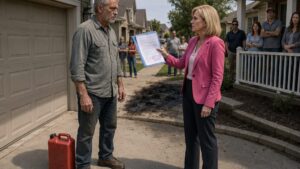
Christopher looked down. Somewhere beneath three feet of accumulated snow was the narrow strip between his fence and Donald’s driveway. In summer, it was just grass and mulch. In February, there was no line to see.
“I’m pretty sure this side of the fence is mine.”
Donald shrugged.
Christopher had lived beside him for seven years. They were not friends, but they had exchanged tools, moved trash cans for one another, and once spent twenty minutes trying to free a delivery van that had slid into a snowbank at the end of the cul-de-sac.
That history was why Christopher had said nothing the first time.
Or the second.
When the first major storm hit in December, Donald’s snowblower had sent an arc of powder over the fence. Christopher had noticed it while shoveling his steps and assumed Donald had misjudged the chute.
The next storm left another ridge.
By January, the snow beside Christopher’s fence was higher than the rest of his yard.
He told himself it was temporary.
He told himself that decent neighbors did not turn snow placement into a property dispute.
He told himself a lot of things that sounded reasonable until he was standing in February looking at a mound large enough to press against the fence boards.
Donald followed his gaze.
“It melts,” he said.
Then he pulled the starter cord.
The engine barked to life.
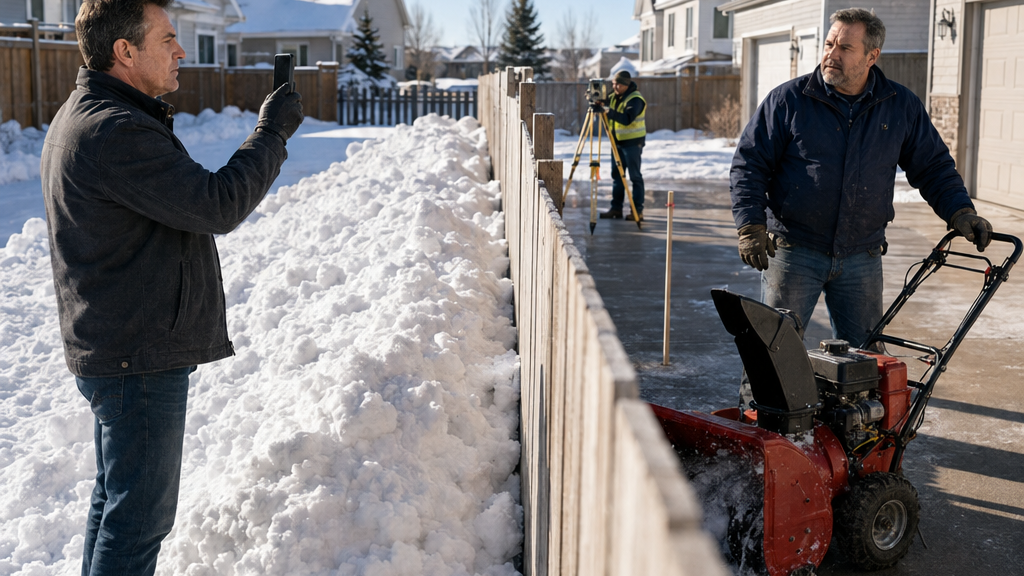
Christopher stepped back as the red machine moved down the driveway. Donald rotated the chute. A white stream climbed into the air and landed against the same ridge.
For a moment Christopher felt something hot and immediate rise through him.
He could have walked through the gate. He could have stood in front of the machine. He could have shouted over the engine.
Instead, he took out his phone.
The camera captured the red snowblower, the angle of the chute, the falling plume, the fence and the growing pile.
Donald noticed.
He stopped the machine.
“You taking pictures of me now?”
“I’m taking pictures of the snow.”
Donald’s mouth tightened.
“That’s ridiculous.”
“Maybe.”
Christopher took another photograph.
Donald shook his head, turned the chute toward the center of his driveway for the next pass, and finished clearing without speaking.
Christopher remained outside after Donald went in.
He photographed the fence from the front corner, then from the gate, then from the back. He put one gloved hand against the upper crust of the pile to show its height. On impulse, he took a picture of the date and time displayed on his phone screen.
That night, he created a folder.
SNOW – EAST SIDE.
The name embarrassed him.
It sounded like the beginning of the kind of neighbor feud he had always considered absurd.
Over the next three weeks, the folder grew anyway.
Fourteen photographs became twenty-three.
Twenty-three became thirty-eight.
Some showed new snow. Others showed the ridge after wind had polished the top into a hard slope. One showed a fence board bowed slightly inward where the pile had settled against it.
Christopher still did not complain to the HOA.
He drafted an email to Nicole Adams, the community manager, then deleted it.
He considered knocking on Donald’s door again and decided against that too.
His problem, he told himself, was not fear. It was proportion.
A person should know when something was worth escalating.
But each time he said that, the snowbank became a little larger.
Late one Saturday morning, Christopher was brushing snow off the top of the fence when Donald came out carrying a bag of ice melt.
“You still keeping your evidence?” Donald asked.
Christopher looked at him.
Donald nodded toward the phone in Christopher’s coat pocket.
“I asked you to stop throwing snow here.”
“And I told you, the fence is the line.”
“You know that for a fact?”
Donald stared at him.
Then he walked over and tapped the top board with two fingers.
“It’s been there longer than either of us.”
“That doesn’t answer the question.”
“It answers it enough for me.”
Christopher looked from the fence to the narrow exposed corner of Donald’s driveway where the snowblower had scraped down to concrete.
The concrete edge did not run perfectly parallel with the fence. He had noticed that before. He had never cared.
Now he did.
“Have you ever had the property surveyed?” Christopher asked.
Donald’s expression changed just enough to show annoyance before he laughed again.
“For snow?”
“No. For the line.”
Donald adjusted the bag under his arm.
“Christopher, if you want to spend money proving where a fence has been for twenty years, go ahead.”
He walked toward his porch.
Christopher stood there for another minute.
That sentence stayed with him longer than the insult.
Not because Donald sounded certain.
Because Christopher realized he was not.
He had bought his house eleven years earlier. The closing documents had included a plat. There had been measurements. Bearings. Lot numbers. He had looked at all of it exactly once.
After that, the fence had become the boundary because it looked like one.
Donald had done the same thing.
Maybe every owner before them had too.
That evening Christopher searched for the plat in a cabinet beneath his desk. He found the closing folder, unfolded the old subdivision map and stared at thin printed lines that made perfect sense until he tried to match them to the actual ground outside.
He could not.
On Monday morning, he called a licensed surveyor.
The earliest appointment was after the thaw.
“That’s fine,” Christopher said.
He looked through the window toward the snow piled against the fence.
For the first time all winter, he was no longer wondering whether Donald would stop.
He was wondering what the snow was hiding.
Chapter 2: What the Melting Snow Left Behind
The grass beneath the snowbank did not come back green.
It emerged in strips.
By the second week of March, most of Christopher’s yard had softened into the dull brown-green of early spring, but the narrow band beside the fence looked flattened and bruised. The turf was dead in places. Mud had collected in shallow depressions. One fence post leaned enough that Christopher could see it from the kitchen window.
He stood beside it with his phone.
The last pieces of dirty ice clung to the base.
Donald came down his driveway carrying two empty trash cans.
Christopher pointed toward the ground.
“This is what I was trying to avoid.”
Donald stopped.
He looked at the grass for several seconds.
“You’re saying snow did that?”
“I’m saying a winter’s worth of snow piled in one strip did.”
Donald set the trash cans beside his garage.
“That ground’s always been low.”
“The post wasn’t leaning.”
“Fence posts move.”
Christopher felt the old urge to keep the conversation small.
He could hear himself saying, Fine, forget it.
Instead, he unlocked his phone.
“I have pictures from December through February.”
Donald’s face hardened.
“I know you do.”
“I’d rather fix this without making it bigger.”
“Then don’t make it bigger.”
Donald went inside.
Christopher stared after him.
It was the kind of answer that could sound almost reasonable if no one asked who had created the problem.
Two days later, a landscaper walked the strip with a metal probe and a measuring wheel.
He crouched near the worst patch, pressed a boot into the soil, then looked along the fence.
“This got compacted pretty good.”
“Can it recover?”
“Some of it. Not all.”
He explained that the damaged turf would have to be removed in sections. The soil needed loosening and regrading so water would not collect against the fence. The leaning post could be reset if the wood below grade had not split.
“How much?”
The landscaper typed into his phone.
“Roughly eight hundred, assuming we don’t find anything worse.”
Christopher had expected an annoying number.
Eight hundred felt different.
It was large enough to matter and small enough that filing a lawsuit over it would feel ridiculous.
He asked for the estimate in writing.
That afternoon he emailed Nicole Adams.
He attached six photographs, the landscaper’s estimate, and a short explanation of the snowblowing pattern.
Nicole responded the next morning.
She asked him to come by the management office.
The HOA office occupied two rooms beside the clubhouse gym. Nicole sat behind a desk with a monitor angled toward the wall and a stack of violation notices in a tray.
She had printed Christopher’s photographs.
“I want to be careful here,” she said.
“Okay.”
“The association doesn’t normally mediate neighbor-to-neighbor damage claims.”
“I’m not asking you to decide damages.”
“You’re asking us to tell him to stop placing snow over the property line.”
“Yes.”
Nicole tapped one of the photos.
“The difficulty is that our site map shows the fence as the practical separation between the lots.”
Christopher looked at her.
“Practical separation?”
“That’s how the file reads.”
“Is it the legal boundary?”
Nicole hesitated.
“I’m not a surveyor.”
“Neither is Donald.”
“I understand that.”
Christopher leaned back.
Nicole turned the monitor so he could see an old aerial image with lot outlines laid over it. The lines were thick and imprecise.
“What I’m saying is that from the association’s perspective, this has always been treated as the dividing line.”
“The fence.”
“Yes.”
Christopher looked at the image.
It made him uncomfortable for a reason he had not expected.
Donald had said almost exactly the same thing.
The fence had always been there.
Therefore, it must mean something.
“What happens if the fence isn’t the line?”
Nicole folded her hands.
“Then we deal with what the survey shows.”
Christopher nodded.
“That’s already scheduled.”
Nicole’s eyebrows lifted.
“For when?”
“Next week.”
Her expression became more guarded.
“All right. Send me the report when you receive it.”
On his way home Christopher stopped beside the damaged strip.
The snow was almost entirely gone now.
For months, the physical boundary had been hidden beneath white accumulation. Now it was exposed, and somehow that made it less certain, not more.
He opened his photo folder.
Fifty-two images.
The sequence told the story more clearly than he remembered living it.
The first snow scattered lightly along the fence.
Then another layer.
Then another.
By the end, the ridge had become a wall.
He found the photograph from the day Donald had pointed at the fence.
Donald’s hand was caught mid-gesture, one gloved finger angled toward the top board.
Christopher enlarged it.
Behind the fence, barely visible through the snow, the concrete edge of Donald’s driveway curved closer toward the wood than it did farther down.
He had never noticed that.
Three mornings later, the survey crew arrived.
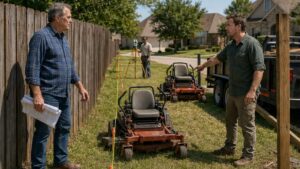
The licensed surveyor worked quietly, setting equipment near the sidewalk and taking measurements from two different corners of the lot.
Donald came outside halfway through.
He stood in his driveway with his arms folded.
Christopher did not go over to him.
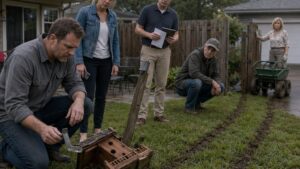
The surveyor moved toward the side yard carrying a bright flag and a wooden stake.
He checked the instrument again.
Then he stepped past the fence line.
Not toward Christopher’s lawn.
Toward Donald’s driveway.
The first flag went into the ground several inches beyond the fence.
Donald unfolded his arms.
The surveyor measured again.
Then he moved farther down the line and placed a second marker.
This one was closer to the concrete.
Christopher stared at it.
Donald walked forward.
“What’s that supposed to mean?”
The surveyor did not answer immediately.
He checked his notes, looked through the instrument once more, and then pointed toward the markers.
“This appears to be the recorded property line.”
Donald looked at the fence.
Then at the stake.
Then at Christopher.
The distance between the two was not large.
It was only several inches.
But it was enough to make every photograph Christopher had taken that winter mean something different.
Chapter 3: Fourteen Inches Changed the Argument
The next survey stake went into the edge of Donald’s driveway.
Not beside it.
Inside it.
Christopher heard the wooden marker scrape against concrete before the surveyor shifted it half an inch and drove it into the narrow joint beside the slab.
Donald stepped forward.
“That can’t be right.”
The surveyor straightened.
“I’m going to verify everything before I issue the report.”
“How far off is it?”
“I don’t want to give you a final number until I close the survey.”
Donald pointed at the fence.
“The line is there.”
The surveyor looked at the fence, then back at his instrument.
“The fence is a fence.”
Donald’s face reddened.
Christopher almost smiled.
He stopped himself.
The moment felt too significant to enjoy yet.
For the next hour, the surveyor rechecked corners, measurements and recorded monuments. Christopher stayed mostly inside, watching through the front window. Donald remained in his driveway much longer than necessary.
By early afternoon, the surveyor knocked on Christopher’s door.
“I’ve got enough to tell you the situation.”
Christopher followed him outside.
The surveyor stretched a measuring tape from the fence toward the stake.
“Your recorded line is approximately fourteen inches beyond the fence along this section.”
Christopher looked at the tape.
Fourteen inches.
It was smaller than a shovel blade and larger than a mistake.
“And the driveway?”
The surveyor looked down.
“Part of it crosses the line.”
Donald had come close enough to hear.
“How much?”
“Approximately fourteen inches at the widest portion here. It varies slightly.”
Donald let out a breath through his nose.
“No. The HOA approved this.”
“That may be,” the surveyor said. “I’m telling you what the deed and recorded plat establish.”
Donald turned to Christopher.
“You knew this?”
Christopher almost laughed at the absurdity.
“I hired him because neither of us knew.”
“You’ve lived here eleven years.”
“So have you.”
Donald pointed toward the concrete.
“That driveway was here before you started taking pictures of snow.”
“I’m aware.”
For several seconds, neither man spoke.
The surveyor collected his tape.
“I’ll send the signed report once the drawing is finished.”
Christopher waited until he left before looking again at the driveway.
He had passed that edge thousands of times.
It had never looked threatening.
Now fourteen inches of gray concrete carried more weight than the snowbank ever had.
His first reaction was satisfaction.
Not joy exactly.
Vindication.
Donald had pointed at the fence all winter as if certainty itself made him right.
The survey had answered him.
But the feeling lasted only until Christopher remembered Nicole’s words.
The association’s file showed the fence as the practical boundary.
Two days later, Christopher received the signed survey.
The legal description matched the recorded plat. The marked line crossed the edge of Donald’s poured concrete.
Christopher printed two copies and drove to the county records office to compare them against the subdivision documents.
A clerk helped him pull the recorded plat and an older property transfer.
Nothing contradicted the survey.
“The plat controls the lot dimensions,” the clerk said. “Anything about private improvements would be separate.”
“Like HOA approvals?”
“That wouldn’t be in county land records unless something was separately recorded.”
Christopher thanked her and left with certified copies.
He sat in his truck for several minutes before calling Nicole.
“I have the final survey.”
“How bad?”
“Fourteen inches.”
There was a pause.
“Fourteen inches of what?”
“My property goes beyond the fence.”
Another pause.
“Into Donald’s driveway?”
“Yes.”
Nicole exhaled.
“Send it to me.”
He emailed the report before leaving the parking lot.
By the time he got home, Donald was waiting near the side yard.
“You went to the county?”
Christopher stopped.
“Yes.”
Donald shook his head.
“You’re really doing this.”
“I’m verifying it.”
“You think I poured a driveway on your property on purpose?”
“I didn’t say that.”
“You don’t have to.”
Christopher looked at the concrete.
“I think you believed the fence was the line.”
“Because it was treated like the line.”
“So did I.”
Donald’s anger faltered for a fraction of a second.
Christopher continued.
“That doesn’t make the survey disappear.”
Donald folded his arms.
“The HOA approved the driveway.”
“You’ve said that.”
“Because it matters.”
Christopher nodded.
“It might.”
That answer seemed to bother Donald more than an accusation would have.
“What does that mean?”
“It means I’m not deciding what happens next until I know what they approved.”
Donald stared at him.
“You’re going to make me tear up concrete over fourteen inches?”
“I didn’t say that either.”
“But you’re thinking it.”
Christopher was not sure what he was thinking.
Eight hundred dollars in lawn damage had been simple. The snow came from Donald’s machine. Christopher’s grass had been damaged. There was a repair estimate.
The driveway was different.
It had been there for years. Christopher had never objected because he had never known.
If the HOA had approved it, someone else had relied on the same mistaken assumption.
Maybe Donald had done exactly what he was told.
Maybe Christopher himself had been looking at the wrong line for eleven years.
That evening, Nicole called.
Her tone was different.
More formal.
“I found Donald’s architectural file.”
Christopher stood at the kitchen counter.
“And?”
“The driveway extension was approved.”
“So he was right about that.”
“Yes.”
“But?”
“There’s a problem with the exhibit.”
Christopher said nothing.
Nicole continued.
“The site sketch in the approval file uses the fence as the lot boundary.”
“Was there a survey?”
“I haven’t found one.”
“Was one required?”
“For that type of improvement, not necessarily under the old guidelines.”
Christopher looked through the window toward the strip of ground between the fence and Donald’s concrete.
“What exactly did the board approve?”
“I need to show you the drawing.”
“When?”
“Tomorrow evening. Susan Walker is going to attend.”
Christopher knew Susan as the HOA president, a measured woman who rarely spoke at meetings unless something required a vote.
“Donald too?”
“He’ll be invited.”
The next evening, Christopher entered the clubhouse meeting room carrying the survey in a folder.
Nicole was already there with Susan and two board members.
Donald arrived a minute later.
He did not sit beside Christopher.
Nicole placed an old architectural sketch in the middle of the table.
It showed Donald’s house, driveway, fence and proposed extension.
A thick hand-drawn line ran along the fence.
Beside it, someone had written a note indicating the assumed property boundary.
Christopher laid the new survey beside the old sketch.
The two lines did not match.
For a long moment, nobody spoke.
Then Susan looked up.
“This was approved from the owner-submitted drawing?”
Nicole nodded.
“No field verification.”
“No survey?”
“No.”
Donald leaned forward.
“I built what you approved.”
Christopher looked at the two documents.
For the first time since the snow began falling, Donald had said something Christopher could not dismiss.
The driveway might be on Christopher’s land.
But Donald had not invented the mistake alone.
Nicole slid the old approval sketch across the table toward Christopher.
And suddenly the question was no longer whether the fence had been wrong.
It was how many people had trusted it because no one had ever bothered to verify the line.
Chapter 4: The Approval Nobody Had Verified
The old approval drawing put the property line exactly where the fence stood.
Christopher stared at the thick hand-drawn mark while the new survey lay beside it, clean and precise, showing a different line fourteen inches farther into Donald’s driveway.
Susan Walker tapped the older exhibit with one finger.
“This is what the board approved?”
Nicole Adams nodded. “According to the file.”
Donald leaned back in his chair.
“Then I don’t understand why we’re still sitting here.”
Christopher looked at him.
Donald’s voice was controlled, but the anger underneath it had changed. He was no longer arguing that the survey was wrong. He was arguing that the mistake belonged to someone else.
“I submitted this,” Donald said. “You approved it. I hired the contractor. They poured exactly where the plan said.”
Susan turned toward Nicole.
“Was there any boundary verification?”
“No.”
“Survey requirement?”
“Not under the guidelines at the time.”
One of the board members shifted in his chair.
“So technically the association approved an improvement based on an unverified owner sketch.”
Nicole’s jaw tightened slightly.
“That’s one way to describe it.”
“It’s the accurate way,” Christopher said.
The room went quiet.
Nicole looked at him. “Christopher, the association doesn’t determine legal property boundaries.”
“But you approved construction as if you knew where one was.”
Susan raised a hand before Nicole could answer.
“Let’s keep those two issues separate.”
Christopher almost laughed.
That was exactly what everyone seemed to want now: separate pieces.
The snow from the grass.
The grass from the fence.
The fence from the property line.
The property line from the driveway.
The driveway from the approval.
Each piece looked smaller when discussed alone.
Together, they were the reason they were sitting in the clubhouse on a Tuesday evening.
Donald pushed the old drawing toward the center of the table.
“I relied on that approval.”
Christopher nodded slowly.
“I believe you.”
Donald stopped.
It was the first thing Christopher had said all evening that seemed to catch him off guard.
Christopher looked again at the documents.
He had spent several days imagining this meeting. In every version, the survey was the clean answer. He would place it on the table, the HOA would recognize the mistake, and Donald would finally have no argument left.
Instead, the old approval had given Donald one.
Not a complete defense.
But a reason.
Christopher hated how much that mattered.
Susan folded her hands.
“The association’s position should probably be that the owners resolve the encroachment privately.”
Nicole glanced at her.
“That avoids the association taking a position on title.”
Christopher looked up.
“You already took a position on it when you approved the concrete.”
Nicole’s expression hardened.
“We approved an architectural modification. We did not certify ownership.”
“But Donald relied on that approval.”
Donald pointed toward Christopher.
“Exactly.”
Christopher turned to him.
“That doesn’t mean the concrete becomes mine to absorb.”
“I didn’t say it did.”
“You’ve refused to even acknowledge the lawn damage.”
“Because I still don’t agree your dead grass is worth eight hundred dollars.”
Christopher opened his folder and slid the estimate across the table.
“The landscaper does.”
Donald did not touch it.
Susan looked between them.
“What outcome are you actually asking for, Christopher?”
The question surprised him.
He had spent so much time proving what was wrong that he had not decided exactly what being right should entitle him to.
He could demand removal.
The survey gave him a basis.
He could insist Donald reimburse the lawn damage.
He could involve an attorney.
He could make the HOA explain its old approval process in writing.
All of those things were possible.
Not all of them were necessary.
“I want my property restored,” Christopher said.
Donald gave a short, humorless laugh. “Fourteen inches.”
Christopher ignored it.
“I want the damaged strip repaired. I want the encroachment corrected. And I want the HOA file updated so nobody treats that fence as the legal boundary again.”
Susan nodded.
“That’s clearer.”
Donald leaned forward.
“You’re talking about cutting concrete.”
“I’m talking about correcting what crosses the line.”
“You know what that costs?”
“No.”
“I do.”
Christopher met his eyes.
“Then you understand why I asked you to stop before this became anything bigger than snow.”
Donald’s face tightened.
For a moment Christopher thought he would stand up.
Instead, Donald looked away.
Nicole pulled the survey closer.
“There may be a way to resolve this without full removal.”
Christopher looked at her.
“What do you mean?”
“If the encroaching portion can be cut back and the remaining driveway still meets the association’s dimensional requirements, the board could approve a revised edge.”
Donald frowned.
“So now I need another approval for a driveway you already approved?”
Susan answered before Nicole could.
“For a corrected driveway, yes.”
Donald stared at her.
“That’s unbelievable.”
“No,” Susan said quietly. “What’s unbelievable is that we apparently approved the first one without verifying the boundary.”
Nicole’s eyes moved toward her.
The statement hung in the room.
It was not an admission of legal liability.
But it was the first time anyone from the HOA had openly said the old process had failed.
Christopher felt a small release in his chest.
Then Donald shook his head.
“I’m not paying to tear out concrete because of a mistake in your records.”
“It wasn’t our property record,” Nicole said. “It was the sketch you submitted.”
“The fence was already there.”
“And none of us checked it,” Susan said.
Donald looked at Christopher.
“You didn’t either.”
“No,” Christopher said.
That stopped the argument for a second.
Christopher could have defended himself. He could have said he had not built anything across the line. He could have said Donald was the one who dumped snow, ignored the damage and pointed at the fence with absolute confidence.
All of that was true.
It was also true that Christopher had accepted the same fence for eleven years because checking it had never mattered to him until the conflict made it matter.
Susan leaned back.
“We need to correct the file going forward. That part is clear. The private remedy is still between you two unless you both want mediation.”
Donald said nothing.
Christopher looked at the old sketch and the new survey again.
Two lines.
One convenient.
One recorded.
The difference between them was barely more than a foot.
Yet that narrow strip had accumulated years of assumption on top of it.
After the meeting, Christopher found Donald standing beside the driveway.
The survey stake was still in place.
Donald had not removed it.
“You really going to make me cut that?” he asked.
Christopher stood on his side of the fence.
“I don’t want your whole driveway torn up.”
“That’s not what I asked.”
Christopher looked at the concrete edge.
The encroachment was narrow enough that a contractor could probably cut only the offending strip.
“I’ll have an attorney put something together,” he said.
Donald’s mouth hardened again.
“There it is.”
“What?”
“The lawyer.”
“I said I’d rather fix this without making it bigger.”
“And this is smaller?”
Christopher waited.
Then he said, “Smaller than pretending the survey doesn’t exist.”
Donald stared at him.
Christopher continued.
“I’ll propose removing only the part across the line. Not the whole driveway. You reimburse the documented lawn repair. We both accept the corrected boundary. The HOA updates its file.”
Donald looked toward the stake.
“And if I say no?”
Christopher did not answer immediately.
That was the part of himself he had been avoiding since December: the moment when being reasonable required a consequence behind the request.
“Then I stop asking informally.”
He went inside before Donald could answer.
The next morning, Christopher called a real-estate attorney and asked him to draft the narrowest settlement that would actually restore the property.
Chapter 5: Thirty Days to Choose a Smaller Loss
Donald signed for the certified envelope at 10:17 on a Thursday morning.
Christopher knew because the tracking page showed the time.
Delivered.
Signature obtained.
He stared at those words longer than he should have.
The attorney’s letter was not aggressive. Christopher had read it enough times to know.
It enclosed the survey, the landscaper’s estimate and photographs of the damaged strip. It proposed a thirty-day window for Donald to arrange removal of only the concrete extending across the surveyed line, repair the resulting edge and reimburse the verified landscaping cost.
No demand for punitive damages.
No claim for years of land use.
No threat to remove the entire driveway.
The final paragraph simply stated that if no agreement was reached within thirty days, Christopher reserved the right to pursue formal remedies for the encroachment.
Donald said nothing.
On day two, Christopher saw him collecting mail.
On day five, Donald’s spouse walked the property line with him after dinner. They stood beside the survey stake for several minutes.
On day eight, a contractor’s truck stopped at Donald’s house and left twenty minutes later.
Still nothing.
Christopher began checking the mailbox with an irritation he disliked in himself.
He had wanted a clean process.
Send the proposal.
Receive an answer.
Negotiate.
Resolve.
Instead, silence began doing what snow had done all winter: accumulating.
Nicole called him during the second week.
“Can you talk privately?”
“I’m alone.”
She lowered her voice anyway.
“Donald has been asking questions.”
“About what?”
“Whether long-term use of the strip gives him any claim.”
Christopher stood up from his desk.
“What kind of claim?”
“I’m not giving legal advice. I’m telling you what he asked the association.”
“What did you tell him?”
“That we don’t determine ownership.”
Christopher looked through the window.
Donald’s driveway was empty.
“Did he say he was refusing the proposal?”
“No.”
“Then why is he researching ways to avoid it?”
Nicole paused.
“I think he’s trying to understand his options.”
Christopher laughed once.
“That’s generous.”
“So is giving him thirty days.”
He regretted the sharpness as soon as he said it.
Nicole did not respond for a moment.
Then she said, “Christopher, I understand why you’re angry. But don’t assume asking questions means he’s planning a war.”
“He could answer the letter.”
“Yes.”
“That would help.”
“Yes.”
Her agreement took some force out of him.
After the call, Christopher contacted his attorney.
The office smelled faintly of coffee and printer toner. The attorney reviewed the survey again, then looked through the packet Christopher had assembled.
“You’ve done a lot of documenting.”
Christopher heard the implied caution.
“Too much?”
“Not necessarily.”
“That sounds like yes.”
The attorney smiled slightly.
“It sounds like someone who waited a long time to draw a line and then started measuring everything.”
Christopher looked down at the photographs.
The comment bothered him because it was accurate.
“What about this idea of long-term use?”
“There are legal theories people raise in boundary disputes. Whether any apply depends on facts, time, state law, how the use occurred, whether it was permissive, and other issues.”
“Does he have a good argument?”
“Based on what you’ve given me, I would not tell you to abandon your survey because he asked about one.”
Christopher nodded.
“What would you tell me?”
“To stay proportional.”
The attorney tapped the proposed settlement.
“You’re asking him to remove the encroaching portion, not destroy the driveway. You have an estimate for actual landscaping damage. The HOA approval complicates why he believed the boundary was where it was, but it doesn’t rewrite the deed.”
“So if he ignores this?”
“Then you decide whether correcting the line matters enough to enforce.”
That sentence followed Christopher home.
Not whether he was right.
Whether it mattered enough.
By the third week, Christopher began to understand that the question was harder than he had expected.
He could leave the concrete there and require Donald to stop piling snow across the actual line.
He could negotiate an easement.
He could sell the narrow strip.
He could insist on removal.
Each option would say something different about what Christopher believed the dispute had become.
Donald finally approached him on day twenty-two.
Christopher was replacing a loose board near the damaged post.
“You got a minute?”
Christopher set down the drill.
Donald remained on the driveway.
“I got two estimates.”
“For the concrete?”
“Yes.”
“And?”
Donald named a number considerably higher than Christopher had expected.
“That’s for fourteen inches?”
“It’s not like cutting a loaf of bread. They have to saw it, remove the strip, finish the edge, deal with drainage.”
Christopher nodded.
“I didn’t set the price.”
Donald rubbed a hand over his jaw.
“What if I pay half the lawn and we leave the concrete?”
“No.”
The answer came too quickly.
Donald noticed.
Christopher did too.
He forced himself to slow down.
“The concrete is the boundary issue.”
“It’s been there for years.”
“That doesn’t make it disappear.”
“You never cared before.”
“I didn’t know before.”
Donald looked toward the fence.
“You’re acting like I stole something.”
“I’m not.”
“Feels like it.”
Christopher almost said, Then stop making it personal.
But that would have been dishonest.
It was personal.
Not because fourteen inches mattered by itself.
Because Donald had dismissed the snow, the damage, the photographs and the survey until each issue became harder to ignore.
“I’m asking for the same thing I put in the letter,” Christopher said. “Correct the strip. Pay the documented repair. Then we’re done.”
Donald shook his head.
“You could let this go.”
“So could you.”
Donald’s expression closed.
He walked back toward his garage.
Christopher watched him go and felt no satisfaction.
On day twenty-nine, there was still no written response.
On day thirty, Christopher checked the tracking page once more even though nothing there could change.
Delivered.
Signature obtained.
Thirty days earlier.
At 5:40 that afternoon, he saw Donald pull into his driveway, step out, glance toward the survey stake and go inside.
No call.
No email.
No knock at the door.
The next morning, day thirty-one, Christopher sat at his kitchen table with the attorney’s number on his phone.
For several minutes he did nothing.
This was the point he had always told himself sensible people avoided.
The official notice.
The legal file.
The kind of conflict that stopped being neighborhood friction and became paperwork with deadlines.
Then he remembered the first conversation beside the snowbank.
It melts.
Christopher pressed call.
When the attorney answered, Christopher looked through the window at the fourteen-inch strip of concrete.
“The deadline expired,” he said.
“Do you want to proceed?”
Christopher took one breath.
“Yes.”
Chapter 6: The Reason Donald Would Not Back Down
Donald asked to speak privately ten minutes before the mediation was supposed to begin.
Christopher had just set his folder on the conference table when Donald appeared in the doorway of the HOA meeting room.
“No attorneys for five minutes,” Donald said. “Just us.”
Christopher looked toward the hallway.
Nicole and Susan had not arrived yet.
The formal encroachment action had changed the rhythm of everything. Letters now came through offices. Deadlines were written instead of implied. Even Donald’s request sounded strange without paperwork attached to it.
Christopher stayed standing.
“Five minutes.”
Donald led him outside.
They stopped beside the two properties, where the old fence and the survey stake were both visible.
Donald did not point at either one.
That was the first thing Christopher noticed.
For months, Donald had used the fence like evidence. A finger on the top rail. A hand toward the posts. An easy certainty that anything beyond it belonged to him.
Now he stood in the narrow space between the fence and driveway with his hands in his jacket pockets.
“I talked to a lawyer,” Donald said.
Christopher nodded.
“I assumed you would.”
“He said fighting over the line could cost more than fixing it.”
“That sounds possible.”
Donald gave him a tired look.
“You always talk like that now?”
“Like what?”
“Like you’re reading something before you say it.”
Christopher almost answered defensively.
Instead, he waited.
Donald looked toward his garage.
“I knew before the deadline.”
Christopher said nothing.
Donald rubbed the toe of his shoe against the edge of the concrete.
“I knew the survey was probably right.”
The admission was quieter than Christopher had imagined it would be.
“When?”
“After the HOA meeting.”
Christopher felt anger return so quickly that it surprised him.
“You had almost three weeks.”
“I know.”
“You let the deadline run anyway.”
“I know.”
Christopher stepped back.
“Then why are we doing this?”
Donald looked at him.
For once there was no irritation in his face, only something closer to embarrassment.
“Because I couldn’t stand the idea that I had been that sure.”
Christopher frowned.
Donald continued.
“I told you the fence was the line. I told my wife. I told Nicole. I kept saying the HOA approved it, like that settled everything.”
“It didn’t.”
“I know that now.”
“You knew before the deadline.”
“Yes.”
Christopher folded his arms.
“That still doesn’t answer why.”
Donald looked toward the survey marker.
“My contractor asked me years ago if I had a survey. I told him the fence had been there forever and the HOA had the site plan. He said fine.”
Christopher had never heard that before.
Donald exhaled.
“When your survey came back, I kept thinking about that conversation. I could’ve checked then. I didn’t.”
“So this is about embarrassment?”
Donald laughed without humor.
“Partly.”
“And the money.”
“Yes.”
“At least that makes sense.”
Donald looked at him sharply.
“You think I have three or four thousand dollars sitting around because I own a house?”
Christopher did not answer.
That was another assumption he had made.
Donald continued.
“My wife wanted me to take your deal.”
Christopher looked at him.
“She did?”
“Day twelve.”
That surprised him more than the admission about the survey.
“What happened?”
“I told her you were trying to make me pay for the HOA’s mistake.”
“And she said?”
Donald looked away.
“She said I was using their mistake to avoid mine.”
Christopher let the silence sit.
It would have been easy to enjoy that sentence.
He did not.
Donald’s shoulders seemed lower than usual.
“I started asking about long-term use because I wanted someone to tell me I didn’t have to admit I was wrong.”
Christopher thought of Nicole’s phone call.
He had interpreted Donald’s questions as preparation for a bigger fight.
They had been that.
But they had also been something smaller and more human: searching for a door that would let him leave without losing face.
Christopher understood it more than he wanted to.
He looked at the fence.
“I trusted that line too.”
Donald frowned.
“You didn’t pour concrete.”
“No.”
“That’s different.”
“It is. But I lived here eleven years and never checked it. The only reason I know now is because I got angry about snow.”
Donald looked at him.
Christopher continued.
“I spent weeks telling myself I was being reasonable by not saying anything. Mostly I was avoiding an uncomfortable conversation.”
“I didn’t stop when you did say something.”
“No.”
The word landed between them without drama.
That was the part understanding could not erase.
Donald had reasons.
He had also made choices.
Donald took his hands out of his pockets.
“If I agree to cut the concrete, I want the lawn claim gone.”
Christopher’s expression changed.
Donald saw it.
“I’m trying to meet you halfway.”
“No.”
“Christopher—”
“The lawn damage is the reason any of this got looked at.”
“I’ll fix the post.”
“The estimate includes the soil and turf.”
“Eight hundred dollars for grass.”
“Documented damage.”
Donald shook his head.
“There you go again.”
“No. This is where I’ve been bad at this.”
Donald stared at him.
Christopher stepped closer to the stake.
“I keep thinking that if I explain something carefully enough, nobody will be upset. That isn’t how boundaries work.”
Donald’s face tightened.
“So you’re refusing?”
“I’m refusing to trade accountability for cooperation.”
“That sounds like something your lawyer wrote.”
“It isn’t.”
Christopher looked directly at him.
“I understand why you believed the driveway was okay. I understand why the HOA approval mattered. I even understand why admitting you were wrong got harder every day you waited.”
Donald looked down.
“But the snow damaged my property. The concrete crosses the line. Those are separate problems, and both still need fixing.”
Donald was silent.
The clubhouse door opened behind them.
Nicole stepped outside, saw them talking and stopped.
Susan appeared a moment later.
Donald glanced toward them.
“So what now?”
Christopher opened his folder.
Inside was a revised settlement his attorney had prepared that morning.
He held it out.
“One last offer.”
Donald did not take it immediately.
“What changed?”
“The schedule. Not the substance.”
Donald finally accepted the pages.
Christopher pointed toward the first section.
“Cut only the encroaching strip. Refinish the edge. Pay the verified landscaping invoice. No claim from me for past use. No punitive damages. No attempt to make you replace anything else.”
Donald read silently.
“And the HOA?”
“They correct the file and approve the revised driveway based on the survey.”
Donald looked at him.
“You’d sign off on that?”
“Yes.”
“Even after all this?”
Christopher glanced at the fence.
“I want the line corrected. I don’t want your house.”
For the first time in months, Donald almost smiled.
It disappeared quickly.
He folded the agreement once.
“I need to show this to my lawyer.”
“Fine.”
“When do you need an answer?”
Christopher looked toward the conference room, where the mediation documents waited on the table.
“Before we turn this into something neither of us can control.”
Donald stood with the agreement in his hand, between the fence everyone had trusted and the survey stake neither of them could ignore.
Then he walked inside to decide which line mattered now.
Chapter 7: The Line Stayed After the Snow Was Gone
The concrete saw followed the surveyed line so precisely that Christopher could see the fourteen inches disappearing one narrow section at a time.
The contractor had snapped a chalk line along Donald’s driveway that morning. It ran almost parallel to the fence, but not quite. That slight difference was what had caused months of argument.
Now the blade screamed against the concrete.
Christopher stood several feet back with his hands in his jacket pockets while wet gray dust collected along the cut. Donald watched from the opposite side.
Neither man spoke.
The settlement had been signed three days after their conversation outside the clubhouse.
Donald had not apologized when he signed it.
Christopher had not asked him to.
The terms were almost exactly those in the final proposal: the encroaching portion would be removed, the remaining driveway edge would be refinished, Donald would reimburse the verified landscaping repair, and Christopher would waive any claim for past use of the strip.
The HOA would correct its property file and approve the revised driveway against the licensed survey rather than the old fence-line sketch.
No one called it a victory.
That suited Christopher.
The contractor stopped the saw and examined the cut.
“Once we break this strip out, we can shape the edge and pour the narrow replacement section on his side.”
Donald nodded.
“How long before I can drive on it?”
“Give it a few days.”
Donald looked toward Christopher as though he expected some comment.
Christopher said nothing.
The broken concrete came out in pieces.
For years, that narrow strip had looked permanent simply because concrete looked permanent. Now two workers lifted sections of it into a trailer as easily as old patio blocks.
Underneath was compacted gravel and soil.
Christopher thought of the snowbank.
That had looked permanent too in February.
Donald came over while the contractor prepared the new form.
“I brought this.”
He held out an envelope.
Christopher took it.
Inside was a check matching the landscaper’s invoice.
Eight hundred dollars.
Christopher looked at it, then at Donald.
“You didn’t have to give it to me today.”
“Agreement says before the work is finished.”
“It does.”
Donald glanced toward the damaged lawn.
The landscaper had already reset the leaning fence post and loosened the compacted soil. Fresh topsoil covered the worst section, waiting for sod.
“My wife said I should’ve paid that part a month ago,” Donald said.
Christopher folded the envelope closed.
“She was probably right.”
Donald gave him a look.
Christopher almost smiled.
After a second, Donald did too.
Barely.
Then the contractor called him over to check the new driveway edge, and the moment ended.
Later that week, Christopher met Nicole and Susan at the clubhouse.
This time there were no competing drawings spread across the table.
Nicole had a revised property file open on her laptop. The licensed survey was attached as the controlling boundary reference. The old architectural sketch remained in the archive but carried a notation that its fence line was not verified as the legal lot boundary.
Susan handed Christopher a printed copy of the revised policy language.
“Any future improvement within a certain distance of a property boundary will require a survey or another acceptable form of boundary verification.”
Christopher read the paragraph.
“So nobody else gets to call a fence a property line just because it’s convenient.”
Nicole gave him a tired smile.
“That’s the idea.”
Susan sat back.
“We should have caught the problem when Donald’s driveway was approved.”
Christopher looked at her.
It was closer to an admission than anything he had expected.
Nicole added, “The old process assumed homeowners knew where their boundaries were.”
“So did the homeowners,” Christopher said.
Susan studied him.
“That’s generous.”
“It’s accurate.”
He thought again about the closing folder he had ignored for eleven years.
Donald had built across a line he had not verified.
The HOA had approved a drawing based on the same assumption.
Christopher had looked at the same fence every day and assumed it meant something it did not.
The difference was what each of them had done once the mistake became visible.
Before Christopher left, Susan asked whether his attorney had discussed any additional claims.
“He did.”
Nicole looked up.
“What kind?”
Christopher folded the revised policy and put it into his folder.
“Past use. Some additional costs. Nothing I’m pursuing.”
Susan raised an eyebrow.
“You’re sure?”
“Yes.”
The attorney had told him he could investigate other remedies. He had also told him that winning every available argument was not the same as solving the problem.
Christopher understood that now.
He wanted his property restored.
It was being restored.
He wanted the boundary recognized.
It was recognized.
He wanted Donald to stop treating restraint as permission.
That part could not be ordered by a board.
It had to show up in behavior.
By early summer, the side yard no longer looked like evidence.
The new sod took quickly.
The fence stood straight again.
Donald’s driveway had a clean finished edge several inches farther from the fence, following the surveyed boundary instead of the old assumption.
A permanent survey marker remained near the rear corner.
For the first few weeks, Christopher noticed it every time he walked past.
Then one day he realized he had stopped looking.
The line had become ordinary.
That surprised him more than anything.
For months, the boundary had occupied his thoughts because no one agreed where it was or what it meant.
Once everyone respected it, it almost disappeared.
Donald and Christopher did not become close friends.
They exchanged greetings.
Donald returned a ladder he had borrowed the previous fall.
Christopher moved Donald’s trash can away from the curb one afternoon when a storm warning came through.
Neither man mentioned the lawsuit that had almost happened.
Neither pretended it had not.
That was enough.
The first real snow arrived in December.
Christopher heard the engine before he saw Donald.
The familiar red snowblower moved down the driveway, throwing white powder ahead of its wheels.
Christopher stopped beside his kitchen window.
For a moment he felt foolish for watching.
Donald reached the narrowest section beside the fence.
A year earlier, he would have rotated the chute toward Christopher’s yard.
Christopher could almost picture the arc.
Instead, Donald stopped.
He adjusted the chute.
Then he pointed it toward the center of his own property and pushed forward.
The snow landed in a neat ridge beside his garage.
Christopher watched him make another pass.
Again, Donald redirected the chute before reaching the boundary.
No wave.
No apology.
No dramatic glance toward the house.
Just a small mechanical turn of the handle.
Christopher stepped away from the window.
Later, while clearing his own front walk, he found Donald working near the street.
Donald shut off the machine.
For several seconds they stood in the sudden quiet.
“Keeping it on my side,” Donald said.
Christopher looked at the clean strip beside the fence.
“I noticed.”
Donald nodded once.
Then he restarted the snowblower.
Christopher went back to shoveling.
The grass beneath the new snow was healthy now. The driveway followed the corrected line. The HOA records matched the survey. The permanent marker sat unnoticed beneath a thin layer of white.
Christopher had spent most of the previous winter believing peace meant avoiding the moment when one neighbor had to tell another, clearly, this is where your space ends and mine begins.
He understood it differently now.
A boundary did not have to be an act of hostility.
Sometimes it was what allowed two people to remain neighbors after the snow was gone.
The story has ended.