My Brother Took My Family and Used the HOA Against Me—Then I Opened the Plans I Drew Years Ago
Chapter 1: The Test Result That Changed Every Name in the House
The first line Ronald Lewis understood was the one that told him Timothy was not his son.
Parent-child relationship excluded.
He read it once, then again, as if the laboratory might rearrange the words if he held the page at a different angle.
It was just after six on Friday evening. The house was quiet except for the refrigerator cycling in the kitchen and Timothy moving around upstairs, getting ready to meet friends. Ronald had opened the envelope in his study because he assumed the results would confirm what everyone already knew.
The test had been Timothy’s idea.
A biology teacher had assigned a family-genetics project, and Timothy had become curious about an inherited trait that did not line up neatly with either parent. Elizabeth had laughed about it. Ronald had ordered a reputable test, more amused than concerned.
Now his thumb covered the bottom corner of the report while the paper trembled against the edge of his desk.
He forced himself to keep reading.
The next section was worse.
The laboratory had not simply excluded him as Timothy’s biological father. It had estimated that Ronald shared enough genetic material with Timothy to indicate a close paternal relationship.
Uncle-nephew was listed among the strongest possibilities.
Ronald stopped breathing for a moment.
Upstairs, Timothy called, “Dad, have you seen my gray hoodie?”
Ronald looked toward the ceiling.
The word Dad struck him differently than it had ten minutes earlier. Not falsely. Not yet. Just differently.
“Laundry room,” he called back.
His voice sounded normal.
That frightened him more than if it had cracked.
He lowered the report and stared at the framed photograph on his bookshelf: Timothy at eight years old, missing a front tooth, sitting on Ronald’s shoulders at a neighborhood Fourth of July picnic. Brandon stood at the edge of the picture holding two paper cups and laughing at something outside the frame.
Ronald felt a cold pressure settle behind his ribs.
There were not many men who could explain an uncle-nephew result.
There was only one who made immediate sense.
Brandon.
His younger brother lived four houses down on the other side of the common green. He had moved into the subdivision six years earlier, after Ronald helped him find a house before prices rose again. Three years ago, Brandon had joined the homeowners association board. Last year he became president.
Ronald folded the DNA report once.
Then unfolded it.
His desk drawer stood open beneath his hand. Inside were old survey notes, warranties, tax papers, and a thick roll of blue-lined engineering plans secured with a faded rubber band.
He had designed much of the subdivision’s original stormwater layout nearly twenty years ago, when the development was still raw earth, temporary stakes, and drainage calculations.
He had kept the plans because throwing them away had always felt wrong.
The doorbell rang.
Ronald froze.
A second later, Timothy came down the stairs two at a time.
“I’ve got it.”
“No.”
The word came out too sharply.
Timothy stopped at the bottom step.
Ronald stood and pushed the DNA report beneath a stack of papers.
“I’ll get it.”
Timothy looked at him. “Okay.”
Ronald crossed the hall and opened the front door.
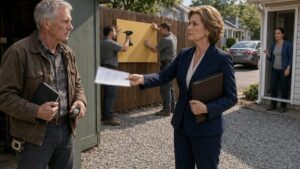
Brandon stood on the porch wearing a navy HOA polo and carrying a clipboard.
For one strange second, Ronald studied his brother’s face as if genetics should be visible there.
Same narrow chin.
Same brown eyes their father had.
Same crease beside the mouth when Brandon was trying not to show irritation.
“Bad time?” Brandon asked.
Ronald did not answer.
Brandon lifted the clipboard slightly. “I’m doing a couple of notices in person. Saves Lisa from mailing them Monday.”
He slid a white sheet free.
Ronald took it automatically.
The violation concerned the side-yard fence.
One panel had weathered unevenly and was now lighter than the HOA’s approved stain range.
Ronald stared at the photograph attached to the notice. The difference was almost impossible to see.
“You came here Friday night for this?”
“We’ve had complaints.”
“From who?”
“You know I can’t get into individual complainants.”
Brandon’s tone was practiced now. Calm, managerial, almost sympathetic.
Ronald looked beyond him toward the street.
Brandon’s SUV sat at the curb.
Four houses down, his roofline was visible through the trees.
Timothy had spent dozens of afternoons there over the years. Basketball in the driveway. Video games. Cookouts when Ronald was working late.
The report inside the study seemed to pull at the back of his mind.
Brandon tapped the notice.
“Thirty days. It’s not a big deal.”
Ronald looked at him.
“Anything else?”
Brandon’s eyebrows lifted.
“Actually, yes. The board’s moving forward with the common-area grading behind your lot. We’ll have a hearing Monday. You should have an email from Lisa by tomorrow.”
“What grading?”
“The drainage strip and walking path. We’ve talked about it.”
“No. You’ve talked about improving the green. You haven’t shown me grading plans.”
Brandon exhaled.
“There it is.”
“What?”
“The engineer voice.”
Ronald’s grip tightened around the notice.
“What does that mean?”
“It means every project near your property turns into a seminar.”
Timothy appeared behind Ronald.
“Uncle Brandon.”
Brandon’s expression changed instantly.
Warmth came into his face.
“Hey, man.”
Timothy grinned. “You still taking me to look at that truck Sunday?”
Brandon glanced at Ronald.
“If your dad’s okay with it.”
The word dad landed between them.
Ronald watched Brandon say it.
No hesitation.
No visible discomfort.
Nothing.
“Timothy,” Ronald said, “your friends are waiting.”
“Right.”
Timothy grabbed his hoodie from the laundry room and moved past them.
“Later, Uncle Brandon.”
“Later.”
Ronald waited until Timothy’s car pulled away from the curb.
Then he looked back at his brother.
Brandon was already stepping off the porch.
“Monday at seven,” he said. “Clubhouse.”
Ronald held up the violation.
“You sign this?”
“Lisa processes them.”
“That wasn’t my question.”
Brandon paused.
“I’m president, Ron. Some things come through me.”
Then he walked away.
Ronald closed the door.
He stood in the entry with the HOA notice in one hand and listened to Brandon’s SUV start.
The kitchen light was on.
Elizabeth was there now, setting grocery bags on the counter.
“Who was that?”
“Brandon.”
She took a carton of eggs from one bag.
“What did he want?”
Ronald walked into the study without answering.
He retrieved the DNA report.
For several seconds he looked at the two pieces of paper side by side on his desk.
The laboratory result.
The HOA violation.
Two official-looking sheets, each carrying a conclusion about his life.
He carried both into the kitchen.
Elizabeth was putting vegetables into the refrigerator.
“Something wrong?”
Ronald placed the DNA report on the counter.
She glanced down.
Her hand stopped.
Ronald watched the color leave her face before she reached the second line.
That was the moment he stopped hoping the laboratory was wrong.
Elizabeth did not ask what it meant.
She already knew.
Ronald heard himself say, very quietly, “Is Brandon Timothy’s father?”
Elizabeth gripped the refrigerator handle.
Her mouth opened.
Nothing came out.
And Ronald understood that silence had just answered the first question while opening one far worse.
Chapter 2: Elizabeth Tells One Truth and Hides the Rest
“It happened once.”
Elizabeth said the words before Ronald asked anything else.
She stood on the opposite side of the kitchen island, one hand pressed flat against the countertop as though she needed to steady herself.
Ronald remained near the refrigerator.
“How long ago?”
“You know how long.”
“I want you to say it.”
She closed her eyes.
“Sixteen years.”
Timothy was fifteen.
The arithmetic did not require an engineer.
Ronald looked at the DNA report between them.
“Where?”
Elizabeth’s face tightened. “Does that matter?”
“Yes.”
“Why?”
“Because I’m trying to find out which parts of my life I was actually present for.”
She looked away.
The sentence hurt her. He could see it.
He did not take it back.
“It was after your mother’s birthday dinner,” she said. “You had gone home because you had a deadline. Brandon stayed. I stayed.”
Ronald remembered the project.
A drainage redesign for a commercial site outside the county. He had worked until nearly three in the morning.
At the time, Elizabeth had told him the dinner had been uneventful.
“One time?” he asked.
“Yes.”
“Then what?”
“Nothing.”
“Nothing for sixteen years?”
“Nothing like that.”
Ronald heard the qualification.
“Nothing like that.”
Elizabeth’s shoulders lowered.
“You were gone constantly back then.”
“That’s not an answer.”
“I know.”
“Did Brandon know?”
“Not at first.”
Ronald waited.
“When did he know?”
“Years later.”
“How many years?”
“I don’t remember exactly.”
He gave a humorless laugh.
“You remember one night sixteen years ago but not when my brother found out he had a son?”
“I said I don’t remember exactly.”
Ronald stared at her long enough that she finally said, “Timothy was maybe nine.”
Nine.
Ronald thought of baseball practices. Parent-teacher conferences. Brandon becoming more present at barbecues. Brandon offering to pick Timothy up when Ronald was stuck at work.
At the time, Ronald had been grateful.
Now every memory seemed to contain a second version of itself.
Elizabeth stepped around the island.
“Ronald, please don’t do this.”
“Do what?”
“Turn every good thing that ever happened into proof.”
He looked at her.
“You don’t get to tell me what counts as proof tonight.”
Her face hardened for the first time.
“And you don’t get to decide the entire last sixteen years in one hour.”
The words stopped him.
Not because they were fair.
Because part of them might be.
Ronald picked up the DNA report.
“Does Timothy know?”
“No.”
“Did Brandon ever ask you to tell him?”
“No.”
“Did he ever ask to claim him?”
“No.”
“Then why stay close?”
Elizabeth’s eyes flickered.
“Because he’s family.”
Ronald almost answered, but his phone vibrated against the counter.
An email notification.
Sender: Lisa Thompson, Community Manager.
Subject: Expedited Board Hearing — Common Area Improvement and Compliance Review.
Ronald opened it.
Monday, 7:00 p.m.
The agenda included two items tied directly to his property: escalating enforcement of his side-yard violation and approval of grading along the common drainage strip behind his lot.
Attached was a simplified site sketch.
Ronald enlarged it.
A new walking-path extension curved along the green. Near his rear property line, the drawing showed fill material feathered toward the existing drainage corridor.
Something in his chest shifted.
Not because he knew it was wrong.
Because he knew enough to see that the sketch was incomplete.
“I need some air,” he said.
Elizabeth followed him into the hall.
“Ronald.”
He took his keys.
“You’re going to Brandon’s?”
“No.”
“Don’t confront him tonight.”
He turned.
“That’s the first useful thing you’ve said.”
Her expression folded inward.
Ronald regretted it immediately.
He left anyway.
Outside, dusk had settled over the subdivision. Porch lights were coming on. A child rode a scooter across the cul-de-sac while someone farther down dragged a trash bin toward a garage.
Ordinary life continued with insulting efficiency.
Ronald walked instead of driving.
At the common green, he left the sidewalk and followed the narrow grass strip behind his property.
The drainage corridor was barely noticeable to most homeowners. A shallow depression through the lawn, broad enough to carry overflow during heavy storms.
To Ronald it had never been invisible.
He had calculated it.
Near the rear corner of his lot, bright orange paint marked the grass.
Several short stakes had been driven into the ground.
Ronald crouched.
The marks formed a line that cut toward the shallow drainage path.
He pulled up the site sketch on his phone.
The proposed grading matched the marks.
The fill line would narrow the overflow width.
Maybe not dangerously.
Maybe not at all under current conditions.
But the original system had been designed with limited margin because the developer had wanted to preserve as much usable green space as possible.
Ronald stood.
He had not thought about that calculation in years.
By the time he reached home, Elizabeth was upstairs.
Ronald went directly to the study.
He opened the bottom drawer of the steel plan cabinet and removed the old roll.
The rubber band broke when he pulled it free.
He spread the sheets across the desk.
Blue lines. Elevation marks. Catch basins. Swales. Overflow arrows.
His younger handwriting appeared in the margins.
He traced the drainage corridor behind his own lot.
The proposed path project was not shown, of course. The subdivision had been built long before anyone wanted a decorative trail through the common area.
He found the design assumption he remembered.
Then another notation.
Maintain unobstructed emergency overflow width.
Ronald leaned back.
His phone buzzed again.
This time it was a text from Brandon.
Hope Monday stays professional.
Ronald read it twice.
Then he opened the HOA attachment again.
At the bottom, beneath several lines of recommendation language, was an approval block.
Board project sponsor:
Brandon Lewis, President.
Ronald enlarged the signature.
His brother had not merely voted on the proposal.
He had sponsored it.
The same brother who knew Timothy was his biological son.
The same brother who had delivered Ronald’s violation notice by hand.
The same brother who had just asked him to keep Monday professional.
Ronald placed the phone beside the old plan.
For the first time since reading the DNA result, his hurt narrowed into something colder and more useful.
He still did not know whether the grading was unsafe.
But he now knew exactly who had pushed it forward.
Chapter 3: He Unfolded the Plan Nobody Wanted to See
“This objection is personal.”
Brandon said it before Ronald had finished his first sentence.
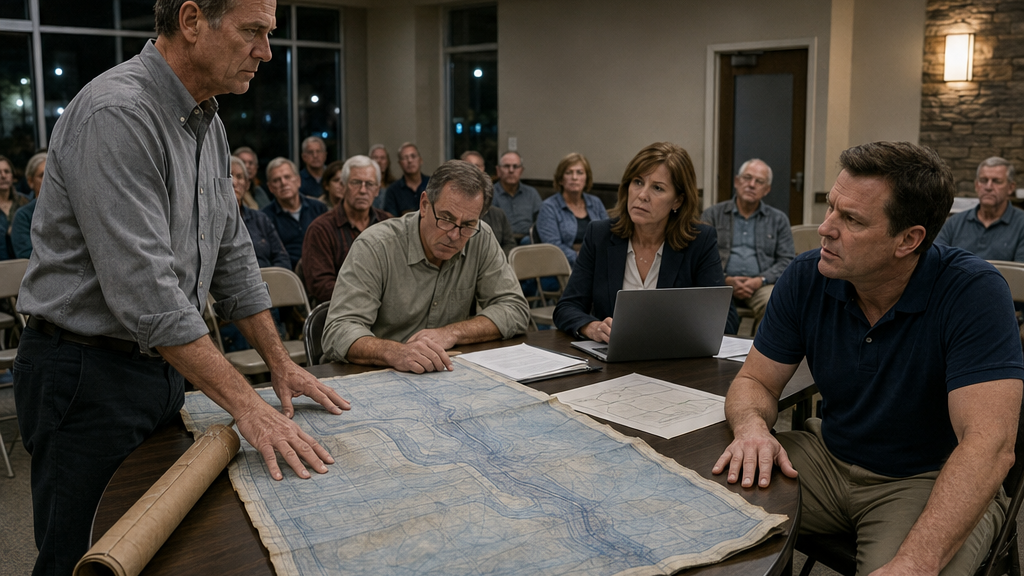
The clubhouse meeting room went still.
Ronald stood beside the rear row of folding chairs with a cardboard plan tube under one arm. About twenty homeowners had come to the Monday meeting, more than usual for a routine board session. The drainage-path project had drawn interest because the board had described it as an upgrade that would make the common green easier to use.
Brandon sat at the center of the folding table with the HOA treasurer and two board members.
Lisa Thompson occupied the end seat with a laptop open.
An independent drainage engineer sat nearby, brought in by the board to answer questions about the proposed grading.
Ronald had been careful.
He had not mentioned the DNA result.
He had not mentioned Elizabeth.
He had not mentioned that Brandon was Timothy’s biological father.
He had simply asked whether the grading exhibit preserved the original emergency overflow width.
Brandon leaned toward his microphone.
“My brother has opposed changes near his property for years. I think everyone should understand the context.”
A few people shifted.
Ronald looked at Lisa.
“Is my family relationship relevant to the engineering question?”
Lisa’s mouth tightened.
“Let’s keep comments directed to the agenda item.”
Brandon sat back.
“Fine. The project has been reviewed.”
“By whom?”
“The contractor. Management. The board.”
Ronald looked toward the independent engineer.
“Did you review the original stormwater plan?”
The engineer shook his head slightly.
“I reviewed the materials provided for the proposed work.”
“That’s not what I asked.”
Brandon interrupted.
“Ron, this is exactly what I mean.”
Ronald ignored him.
He set the cardboard tube on an empty table.
The sound was small, but everyone watched.
He removed the cap and slid out the old sheets.
The blue-lined paper had softened with age. Creases ran through sections that had been folded and reopened countless times during construction.
Ronald spread the main drainage plan across the table.
One corner tried to curl upward.
Lisa placed a water bottle on it.
The gesture was practical, almost involuntary.
Ronald laid the HOA’s newer grading sketch beside the original.
The contrast was immediate.
The old plan was dense with elevations and drainage arrows.
The new exhibit was clean and simple, designed for homeowners to understand at a glance.
Ronald pointed to the shallow corridor behind his lot.
“This is not a decorative depression. It’s the emergency overflow path for the upstream section.”
Brandon folded his arms.
“No one said it was decorative.”
“The grading exhibit doesn’t label it.”
“That doesn’t mean it disappears.”
Ronald looked to the independent engineer.
“Can you show me where this plan preserves the required overflow width?”
The engineer leaned forward.
He examined the new sketch.
Then the original.
He measured the scale with a small ruler.
Nobody spoke.
Brandon’s foot moved once beneath the table.
The engineer pointed.
“This appears to be the existing swale.”
“Yes,” Ronald said.
“And the proposed fill comes to approximately here.”
“Yes.”
The engineer frowned.
He looked at the contractor’s contour lines again.
“Do we have existing cross-sections?”
Lisa searched through the digital attachments.
“Not in the meeting packet.”
“Drainage calculations?”
“No.”
Brandon said, “This is a walking-path project, not a stormwater redesign.”
The engineer did not look at him.
“Any fill in an overflow corridor can become a stormwater issue.”
That changed the room.
Not dramatically.
No one gasped.
No one applauded.
But several homeowners who had been looking at Ronald now looked at the drawings instead.
That was enough.
Ronald felt his first small measure of relief since Friday.
His concern was legitimate.
Not proven.
Legitimate.
Brandon heard the distinction too.
“So we get the cross-sections,” he said. “That doesn’t mean we halt the whole project because Ronald pulled out a twenty-year-old drawing.”
Ronald kept his hand flat on the plan.
“The age of the plan isn’t the issue.”
“No. The issue is you don’t like anyone changing something you designed.”
There it was.
Not brother against brother.
Creator against successor.
Ronald understood suddenly that Brandon had been carrying that grievance longer than Ronald had noticed.
One of the board members asked, “Were you the original engineer?”
“Yes.”
Brandon gave a short laugh.
“Exactly.”
Ronald looked at him.
“What is that supposed to mean?”
“It means you walk around this neighborhood like every drain and curb belongs to you.”
“I’ve never said that.”
“You don’t have to.”
The treasurer shifted uneasily.
Lisa said, “Brandon.”
But Brandon continued.
“You fought the mailbox shelter because you didn’t like where they poured the pad. You fought the landscaping change at the entrance. Now this.”
“I raised drainage questions.”
“You raise questions until everyone gets tired enough to do it your way.”
Ronald felt anger rise, sharp and welcome.
He nearly answered with the truth that would destroy the meeting.
You slept with my wife.
You knew Timothy was yours.
You delivered a violation notice to my house two days after I learned it.
The words reached his throat.
He stopped them.
If he said them here, no one would remember the drainage plan.
They would remember only the scandal.
Ronald turned back to the engineer.
“What information do you need to determine whether the grading is appropriate?”
The engineer tapped the plan.
“Original calculations, any later modifications, field elevations, and the proposed finished grades.”
“I have the original calculations.”
Brandon’s expression changed.
Just slightly.
Ronald noticed.
Lisa did too.
“You still have the project file?” she asked.
“Most of it.”
Brandon leaned forward.
“Then maybe you should also give them the rest of it.”
Ronald looked at him.
“What does that mean?”
Brandon opened a folder.
He removed a printed email.
“I assumed this would come up.”
Ronald recognized the formatting before Brandon read from it.
An old message.
His own name at the top.
The subject line concerned landscaping changes near the common green.
Brandon handed the page to Lisa, who read silently.
Then to the independent engineer.
Ronald held out his hand.
The engineer passed it to him.
The email was eleven years old.
Ronald had written it after a landscaping contractor asked whether adding soil near the green would create a drainage problem.
His own sentence was highlighted.
Existing stormwater conveyance appears adequate for the proposed landscape improvements.
Ronald read the line again.
Memory came back in pieces.
Mulch beds.
Minor soil placement.
Nothing like the current path project.
But the word adequate looked very different now than it had when he typed it.
Brandon addressed the room.
“So either the system was adequate when Ronald said it was, or it wasn’t. We can’t keep treating every old note as sacred except the ones that don’t help his argument.”
The relief Ronald had felt disappeared.
He studied the email.
Below the highlighted sentence was another paragraph, partly obscured by Brandon’s yellow marker.
Ronald remembered what came after.
He lowered the page.
“Do you have the whole email chain?”
Brandon shrugged.
“That’s what management had.”
Ronald looked at Lisa.
“Is that true?”
She searched on her laptop.
“I have the message as an attachment from Brandon.”
“Not from the association archive?”
“No.”
The room shifted again.
Different tension now.
Not victory.
Suspicion.
Ronald looked at his brother.
Brandon held his gaze.
The independent engineer spoke.
“I don’t think we should draw conclusions from one email.”
Brandon turned toward him.
“I’m not asking you to.”
“But it does raise a question.”
Ronald already knew which one.
The engineer looked directly at him.
“If you believed the overflow corridor required protection, why did you later describe the system as adequate?”
Ronald’s fingers tightened on the old paper.
Because he had believed it was adequate.
Under the conditions that existed then.
Because he had trusted that future work would be reviewed properly.
Because he had noticed a vulnerability once and decided it could wait.
Because Ronald had spent much of his life assuming that if he understood a problem, understanding it was almost the same as solving it.
He did not say any of those things.
Not yet.
Lisa closed the agenda packet.
“I’m recommending we postpone both the grading approval and any escalation of the related property enforcement until we have an independent review.”
Brandon stared at her.
“The fence violation has nothing to do with drainage.”
“No,” Lisa said. “But the board president’s direct involvement in both matters is now part of the record. Pausing avoids making this worse.”
Brandon’s jaw tightened.
One board member nodded reluctantly.
The other followed.
The treasurer said, “Agreed.”
Brandon looked around the table and realized he did not have the votes to push forward.
“Fine,” he said.
The independent engineer gathered the drawings.
“I’ll need access to the full original design file.”
Ronald nodded.
“And anything you wrote later concerning modifications or reduced capacity.”
Ronald hesitated.
There were notes.
Not formal revisions.
Margin calculations. Correspondence. A concern he had once intended to revisit.
Brandon saw the hesitation.
For the first time all evening, he smiled.
Not broadly.
Just enough.
The board voted to suspend the grading project pending independent review.
Ronald should have felt vindicated.
Instead, he rolled the old blue-lined plan with slower hands than before.
By the time he left the clubhouse, one question had replaced all the others.
Not whether Brandon had abused his position.
Not whether the new grading was wrong.
But whether the records Ronald himself had kept for twenty years were about to prove that he had known more than he had ever formally said.
Chapter 4: The Old Design Was Not as Clean as Ronald Remembered
“Why didn’t you issue a formal revision?”
The independent engineer asked the question while standing ankle-deep in the shallow grass corridor behind Ronald’s house.
Ronald looked down at the clipboard in the man’s hand.
There it was again: his own handwriting, photocopied from a yellowed calculation sheet.
Maintain overflow width if adjacent grades are raised.
The note had felt responsible when Ronald wrote it.
Now it looked like an unfinished sentence that had lasted eleven years.
The engineer crouched beside one of the orange stakes marking the proposed path.
“This original system works,” he said. “But it works because water has somewhere to go after the inlets surcharge. That assumption depends on this area staying open.”
Ronald nodded.
“And according to these later landscaping records, grades changed incrementally.”
“Not enough to fail the system.”
“Not individually.”
The engineer stood.
“That’s the issue.”
A maintenance mower moved somewhere beyond the trees. Ronald could hear it but not see it.
The engineer held out the old email Brandon had produced at the meeting.
“You called the system adequate.”
“For the landscaping work being discussed at the time.”
“I understand that.”
“Then why are we still talking about it?”
“Because ‘adequate’ isn’t the same as ‘adequate only if nobody keeps adding fill for the next decade.’”
Ronald looked toward the common green.
The statement irritated him because it was accurate.
The engineer continued.
“Did you ever tell the association that future grading should require hydraulic review?”
“I told the landscaping contractor.”
“That wasn’t my question.”
Ronald almost smiled at the repetition of his own words from the night Brandon delivered the violation.
“No,” he said.
“Why not?”
“I meant to.”
The engineer waited.
Ronald hated silence when someone else used it on him.
“I assumed I’d still be around if something significant came up.”
“And you were.”
“Yes.”
“But nothing formal was in the association file.”
“No.”
“So the next manager saw landscaping. The next board saw a path project. They didn’t see a protected hydraulic constraint.”
Ronald glanced at his house.
He had wanted the review to prove Brandon careless.
Instead, it was dividing the problem into pieces, and one piece belonged to Ronald.
Inside his study later that afternoon, he opened every folder from the original project.
Calculation sheets covered the desk.
He found the missing paragraph from the email Brandon had shown publicly.
The existing stormwater conveyance appears adequate for the proposed landscape improvements. Any future work that materially raises finished grade within the designated overflow corridor should be independently reviewed.
Ronald stared at it.
Better.
Not good enough.
He had written the warning.
He had never required anyone to preserve it as a design condition.
A handwritten note appeared in the margin of another sheet.
Future path/fill could reduce freeboard. Revisit if common area is redeveloped.
He remembered writing it after a summer storm had pushed water farther across the green than his original model predicted.
He had told himself the system still had margin.
It had.
He had told himself there was no reason to alarm residents over a theoretical future project.
There hadn’t been.
Then.
Ronald placed the page beside the DNA envelope still sitting in the upper drawer.
Both documents now represented the same habit.
He knew something uncomfortable.
He delayed saying it.
He called that restraint.
His phone rang.
Brandon.
Ronald let it ring twice before answering.
“What?”
“The engineer was at the green.”
“I noticed.”
“Happy?”
“No.”
That seemed to catch Brandon off guard.
“You got the project stopped.”
“Temporarily.”
“That’s what you wanted.”
“I wanted it reviewed.”
“You always want things reviewed until you’re the one being reviewed.”
Ronald’s jaw tightened.
“Did you know about my note?”
“What note?”
“The future grading warning.”
“No.”
“The full email?”
“I sent management what I had.”
“Where did you get it?”
“Old board files.”
“Lisa said it came from you.”
“So?”
“So you highlighted one sentence and left out the next paragraph.”
Brandon went quiet.
“I didn’t alter anything.”
“I didn’t say you did.”
“You’re implying it.”
“I’m asking whether you knew the rest existed.”
Another pause.
Then Brandon said, “Maybe if you’d actually documented things properly, nobody would have to interpret your old emails.”
The sentence landed harder because Ronald could not dismiss it.
“You pushed the project anyway.”
“Yes.”
“Without the original plans.”
“It’s a walking path, Ronald.”
“You keep saying that like water cares what you call it.”
“And you keep acting like you’re the only adult in the room.”
Ronald stood.
“No. Apparently I’ve spent years acting like being the smartest person in the room meant I didn’t have to explain anything.”
Brandon said nothing.
Ronald ended the call.
When he turned, Timothy was standing in the study doorway.
Ronald’s stomach dropped.
Timothy’s eyes moved from the engineering sheets to the open drawer.
The DNA envelope was visible.
“What’s that?”
“Nothing you need to worry about.”
Timothy’s expression changed instantly.
Ronald heard the mistake as soon as he said it.
From the hallway came Elizabeth’s voice.
“Ronald?”
She appeared behind Timothy.
He saw her look at the envelope.
Saw the alarm.
Too late.
Timothy looked from one parent to the other.
“Why did Mom just make that face?”
“Timothy—”
“No. What is it?”
Elizabeth stepped forward.
“We should sit down.”
Timothy backed away.
“That sentence is never followed by anything good.”
Ronald reached for the envelope.
Timothy got there first.
He pulled the report free.
Ronald could have stopped him.
He didn’t.
The boy read the first page standing beside the desk where Ronald had designed subdivisions, checked homework, paid bills, and once helped Timothy build a model bridge for science class.
His face went still.
He read the relationship estimate.
Then looked at Ronald.
“Uncle?”
Elizabeth pressed both hands to her mouth.
Timothy looked at her.
“Who?”
No one answered quickly enough.
His eyes moved toward the window.
Down the street, Brandon’s house was partly visible beyond the common green.
Timothy understood.
He put the report on the desk with extraordinary care.
Ronald said, “Tim—”
“Don’t.”
“I was trying to figure out how to tell you.”
“You found out Friday.”
Ronald did not ask how Timothy knew.
He had heard enough.
“Were you going to tell me tonight?”
“Yes.”
It was a lie by perhaps several hours.
Timothy recognized it anyway.
“Were you ever going to tell me before I figured it out myself?”
Ronald looked at the engineering note in the margin of the old plan.
Revisit later.
He could not make himself answer.
Timothy nodded once.
“Right.”
Then he walked out.
Chapter 5: Timothy Refuses to Become Either Brother’s Evidence
“I don’t want to see the percentages.”
Timothy held the DNA envelope by one corner and extended it toward Ronald.
Two days had passed.
During that time he had spoken to Ronald only when absolutely necessary.
Elizabeth had moved into the guest room.
Brandon had texted Timothy three times.
Timothy had answered none of them.
Ronald took the envelope.
“I thought you might want the full report.”
“I know enough.”
“You don’t have to decide anything right now.”
Timothy laughed once without humor.
“Everybody keeps saying that while everybody else keeps deciding things.”
Ronald sat across from him at the kitchen table.
Elizabeth stood near the sink.
Timothy looked at both of them.
“So tell me what happened. Not the version that makes either of you look better.”
Elizabeth sat down.
“It happened once.”
Timothy closed his eyes.
“Mom.”
“It did.”
Ronald said, “She says Brandon didn’t know until years later.”
Elizabeth turned toward him.
“He didn’t.”
“You don’t know what he knew.”
“Yes, I do.”
“How?”
“Because I was there, Ronald.”
He stared at her.
“You were there for one night. You weren’t inside his head for the next sixteen years.”
“And neither were you.”
Timothy pushed his chair back slightly.
“Can you two stop arguing about which one of you understands Uncle Brandon better?”
Neither answered.
Elizabeth lowered her voice.
“What happened was wrong. I was lonely. I was angry with your father. Brandon was angry with him too. We made a terrible choice.”
Ronald felt heat rise in his face.
“You’re still calling it a choice like you missed an exit.”
She looked directly at him.
“What would make you happier? If I told you Brandon planned Timothy?”
“Happier?”
“You’ve been building that story since Friday.”
Ronald went still.
Elizabeth continued.
“You think he wanted your wife, your son, your house, your neighborhood. That he spent sixteen years executing some plan to replace you.”
“Didn’t he?”
“No.”
The answer came without hesitation.
Timothy watched Ronald.
Elizabeth’s hands trembled on the table.
“The affair wasn’t a plan. It was exactly what I said it was. One selfish night.”
“Then why did Brandon get closer once he knew?”
“Because he knew.”
“That’s not an explanation.”
“He wanted to be near Timothy.”
“As what?”
“I don’t know. An uncle. A father who couldn’t say he was one. Something in between.”
Ronald stood.
“And the HOA?”
Elizabeth’s eyes hardened.
“That came later.”
“So you admit he used it.”
“I’m saying Brandon resented you long before he became president.”
Ronald looked at her.
“He thought you got to be the successful one. The engineer. The dependable husband. The father everyone trusted. He knew one thing about your life that you didn’t, and yes, I think knowing it changed how he acted around you.”
Timothy whispered, “So everybody knew except me.”
Elizabeth’s face collapsed.
“I thought I was protecting you.”
Timothy looked at Ronald.
“And you?”
“I found out five days ago.”
“That’s not what I asked.”
Ronald understood.
Was silence protection?
He looked down at the envelope in his hand.
“I thought if I understood everything first, I could tell you without making it worse.”
Timothy shook his head.
“You wanted to control the order.”
Ronald had no defense.
Later that afternoon, Timothy went upstairs and shut his door.
Ronald walked to Brandon’s house alone.
Brandon opened the door before Ronald knocked a second time.
“Is he okay?”
“You don’t get to start there.”
Brandon’s face tightened.
“He’s my—”
“Don’t.”
Ronald heard Timothy’s voice in his own.
Brandon stepped onto the porch and closed the door behind him.
“I’ve been trying to reach him.”
“He doesn’t want to talk to you.”
“Did he say that?”
“Yes.”
Brandon looked down the street.
Ronald studied his brother.
For days he had wanted to see calculation there.
A mastermind.
Someone whose every kindness toward Timothy could be reclassified as theft.
What he saw instead was a tired man gripping the porch railing.
That did not absolve him.
It made the truth harder.
“You used the HOA against me,” Ronald said.
Brandon’s jaw worked.
“I enforced rules.”
“You delivered a stain violation yourself.”
“You ignore notices until somebody forces you to answer.”
“You sponsored grading beside my lot without the original review.”
“Because I knew if I brought it to you first, you’d bury it in questions.”
“So you bypassed me.”
“I bypassed Ronald Lewis, neighborhood engineer emeritus.”
Ronald stared at him.
Brandon laughed bitterly.
“You want to know why I pushed it? Because every board discussion about that green ended the same way. Somebody said, ‘Ask Ronald.’”
“I designed the system.”
“Exactly.”
“That isn’t arrogance. It’s relevant experience.”
“It became the same thing.”
Ronald stepped closer.
“And Timothy?”
Brandon’s face changed.
“That was never about the HOA.”
“It was all tangled together for you.”
“Maybe.”
The admission was quiet.
Brandon looked toward Ronald’s house.
“You had everything I thought I wanted. Then I found out one piece of it was technically mine and still wasn’t mine.”
Ronald felt something cold move through him.
“Timothy is not a piece of anything.”
“I know that.”
“Do you?”
Brandon looked ashamed.
“Yes.”
For the first time, Ronald believed him.
That belief did not feel good.
Brandon continued.
“I told myself I was improving the neighborhood. I told myself you’d oppose me because you always do. And maybe part of me wanted to finally make a decision you couldn’t overrule by being the expert.”
“That’s not governance.”
“No.”
The word hung between them.
Ronald had expected resistance.
An argument.
Instead Brandon had admitted enough to remove the satisfaction from defeating him.
When Ronald returned home, Lisa Thompson’s name was on his phone.
He answered.
“Ronald, municipal stormwater staff have reviewed the preliminary information.”
His attention sharpened.
“What do they need?”
“The complete original engineering file. Not selections.”
Ronald looked toward his study.
Lisa added, “They specifically requested calculations, correspondence, field notes, and any later warnings about grading.”
The handwritten margin note flashed in Ronald’s mind.
Future path/fill could reduce freeboard.
He knew exactly what the city would find.
Not only Brandon’s mistake.
His own.
Lisa said, “They want it by Monday morning.”
Ronald looked at the closed DNA envelope lying on the kitchen counter.
For once, there was no question about what the truth was.
Only whether he would finally hand over all of it.
Chapter 6: The Report Could Hurt Brandon, but It Could Hurt Ronald Too
The municipal stormwater inspector placed two folders on the table.
One was thin.
One was thick.
The thin folder contained Ronald’s complaint about the proposed grading.
The thick one contained everything Ronald had brought that morning.
The inspector touched the thick folder.
“Before I log this, I need to ask you something.”
Ronald waited.
“Do you want your original role identified in the review?”
Ronald looked through the glass wall of the conference room.
Outside, municipal employees moved between cubicles carrying coffee and rolled plans. Nothing about the room suggested judgment.
That somehow made the question worse.
“If my role is relevant, yes.”
“It is.”
“Then include it.”
The inspector studied him.
“You understand we’re not only reviewing the association’s proposed modification.”
“Yes.”
“We’ll also review whether original design cautions were communicated adequately.”
“Yes.”
“And that could result in findings that are uncomfortable for you professionally.”
Ronald placed both hands on the table.
“Include my name.”
The inspector nodded once and opened the thick folder.
Ronald had spent Sunday night assembling it.
Original calculations.
Construction correspondence.
The old landscaping email in full.
Handwritten notes.
Storm observations.
Everything.
He had considered leaving the margin calculation out for almost thirty seconds.
That thirty seconds bothered him more than any document in the folder.
So he had placed it near the front.
The inspector read the note.
“Future fill could reduce freeboard.”
“Yes.”
“Why wasn’t this converted into a formal design restriction?”
Ronald could have answered with context.
The system met code.
The risk was conditional.
The landscaping change had been minor.
The association had its own consultants later.
All true.
Instead he said, “I believed I could deal with it if redevelopment ever happened.”
The inspector looked up.
“You expected to remain the institutional memory.”
“I suppose I did.”
“That’s not uncommon.”
It was not forgiveness.
Ronald appreciated that.
By afternoon, they were standing on the common green with the independent engineer, Lisa, two board members, and Brandon.
Orange stakes still marked the proposed path.
The inspector walked the corridor, stopping several times to compare field elevations with the original plan.
Brandon remained apart from Ronald.
They had not spoken since the porch.
Finally, the inspector gathered everyone near the rear corner of Ronald’s property.
“The proposed grading as currently shown should not proceed.”
Lisa wrote something down.
One board member asked, “Unsafe?”
“I didn’t say that.”
The inspector pointed toward the shallow swale.
“The issue is cumulative loss of overflow capacity. Existing conditions already differ from the original assumptions. Adding fill without redesigned conveyance would reduce the available margin further.”
Brandon folded his arms.
“So Ronald was right.”
The inspector looked at him.
“Mr. Lewis was right that further review was necessary.”
Ronald heard the distinction.
So did Brandon.
The inspector continued.
“He was also part of why that necessity wasn’t obvious in your records.”
Brandon looked at Ronald.
Ronald did not look away.
“My old warning was never formalized,” he said.
Lisa asked, “What happens now?”
“Redesign. Survey current grades. Restore the narrowed section where practical. Any path should be designed around verified stormwater capacity.”
“And the enforcement issues?”
“That’s association governance, not my office.”
The association attorney handled that part later in the clubhouse.
There was no audience this time.
Only the board, Lisa, Ronald, Brandon, and the attorney.
The attorney spoke plainly.
“Given that the president sponsored the project, personally participated in enforcement against an adjacent owner, and had an undisclosed family conflict with that owner, I recommend the board void the escalation actions and adopt a conflict-of-interest procedure before reconsidering any related matter.”
Brandon leaned back.
“The fence stain was still out of range.”
Lisa looked at him.
“Technically, yes.”
Ronald almost laughed.
Instead he said, “I’ll stain it.”
Everyone looked at him.
“It needs it anyway.”
The tension loosened by one degree.
Not more.
The attorney turned to Brandon.
“The issue isn’t whether every violation lacked merit. It’s whether the process can be trusted when personal interests aren’t disclosed.”
Brandon rubbed his forehead.
“I didn’t think my family situation belonged in HOA business.”
“It didn’t,” Ronald said.
Brandon looked up.
“Until you made HOA business part of the family situation.”
No one answered.
The board voted to suspend the common-area project pending redesign.
The related enforcement escalation was voided.
Lisa was directed to draft a conflict-of-interest policy and arrange an independent review of recent project approvals.
There was no dramatic expulsion.
No shouting.
No moment when the room turned against Brandon as one.
That was not how institutions usually corrected themselves.
They wrote motions.
They revised procedures.
They made uncomfortable records permanent.
After the meeting, Ronald remained at the table while Lisa collected papers.
His signed technical report lay on top of the original blue-lined plan.
For years the plan had represented something Ronald had built.
Tonight it looked different.
Not ownership.
Obligation.
Brandon approached the table.
“You put your own failure in the report.”
“Yes.”
“You didn’t have to phrase it that strongly.”
“Yes, I did.”
Brandon stared at the plan.
“You know people are going to act like I nearly flooded the neighborhood.”
“You didn’t.”
“Will you tell them that?”
“If they ask me.”
Brandon gave a tired nod.
Then said, “Timothy still won’t answer me.”
Ronald’s first instinct was to say good.
He let the instinct pass.
“That’s his decision.”
“I know.”
Brandon looked older than he had a week earlier.
“I kept thinking if I had some official place here, something that was mine, people would stop seeing me as your brother.”
Ronald closed the plan tube.
“And did they?”
“No.”
Brandon looked toward the empty board seats.
“Apparently not.”
He left.
Ronald stayed until Lisa shut down her laptop.
As he reached the clubhouse door, he heard footsteps behind him.
Brandon had returned.
He held a single sheet of paper.
For a moment Ronald assumed it was another board document.
Brandon placed it on the table.
A resignation.
Effective immediately.
“I’m not waiting for them to vote on whether I should step aside,” he said.
Ronald read the first line.
“You sure?”
“No.”
Brandon gave a thin smile.
“But I’m doing it anyway.”
He signed his name.
Then he walked out of the clubhouse before Ronald could decide whether there was anything left worth saying.
Chapter 7: The Boy He Raised Chose What Father Still Meant
The excavator arrived before eight on Monday morning.
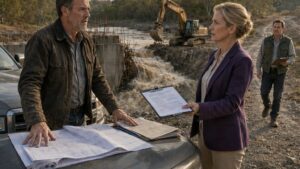
Ronald stood at the edge of his driveway with a mug cooling in his hand while a crew removed the first strip of compacted fill from the common green.
For weeks, the orange stakes had marked an argument.
Now they marked a repair.
The redesigned path had been shifted several feet away from the overflow corridor. The association had approved the change after the independent engineer completed new field measurements, and the narrowed section of the swale was being reopened to match the verified stormwater capacity.
Nothing about the work looked dramatic.
A small machine scraped soil.
A worker checked elevation with a survey rod.
Another spread seed over the exposed ground.
That was what accountability looked like most of the time, Ronald thought.
Not a building wrapped in hazard tape.
Not someone publicly ruined.
A corrected grade.
A revised drawing.
A meeting minute nobody would remember in five years.
Behind him, the front door opened.
Timothy came outside with his backpack over one shoulder.
He stopped when he saw the equipment.
“They finally fixing it?”
“Yes.”
“Your way?”
Ronald looked at him.
“No.”
Timothy waited.
“The reviewed way.”
That earned the smallest hint of a smile.
“Sounds less impressive.”
“It usually is.”
Timothy started toward the sidewalk, then slowed beside Ronald.
Things between them had become functional again.
Not normal.
Ronald no longer trusted that word.
Timothy ate dinner at the table. He asked for the car keys. He complained when Ronald forgot to replace the milk.
But conversations about Brandon remained short.
Elizabeth had told Timothy the full story without Ronald in the room. That had been Timothy’s request.
When he came downstairs afterward, his eyes were red, but he had offered no report.
Ronald had not asked for one.
That restraint felt different from his old silence.
This time, Timothy knew he could speak.
Ronald was simply allowing him to decide when.
Across the green, Brandon’s garage door opened.
He stepped outside carrying a cardboard box.
Even after resigning from the HOA board, he remained four houses away.
There would be no clean geographic ending.
No disappearing antagonist.
No convenient sale sign.
Brandon saw them.
He stopped.
Timothy saw him too.
For several seconds, nobody moved.
Then Timothy raised one hand.
Not a wave exactly.
An acknowledgment.
Brandon returned it.
That was all.
Ronald felt something tighten in him anyway.
Timothy noticed.
“Don’t.”
Ronald looked down at him.
“I didn’t say anything.”
“You did with your face.”
Ronald almost denied it.
Then he stopped.
“What did my face say?”
“That you’re trying to figure out what that meant.”
“I probably was.”
“It meant I said hi.”
“All right.”
Timothy adjusted his backpack.
“I haven’t decided what I want with him.”
“You don’t have to.”
“I know.”
“And whatever you decide—”
Timothy groaned.
“Dad.”
Ronald stopped.
The word had come naturally.
Neither of them mentioned it.
Timothy looked toward Brandon’s house.
“He’s my biological father.”
“Yes.”
“And you’re my dad.”
Ronald felt his fingers close around the coffee mug.
Timothy continued before Ronald could answer.
“Those aren’t the same question.”
“No.”
“I wish everybody had understood that before making me the answer to whatever was wrong between you.”
Ronald lowered his eyes.
“You’re right.”
Timothy studied him, perhaps waiting for an explanation.
Ronald did not provide one.
For once, he let an apology remain uncomplicated.
“I’m sorry.”
Timothy nodded.
Then he headed for school.
At the corner he turned.
“Thursday night.”
Ronald frowned.
“What?”
“My school thing.”
“What school thing?”
Timothy stared at him.
“The engineering showcase.”
Ronald remembered immediately.
Timothy had mentioned it weeks earlier, before the DNA report, before the HOA meeting, before every conversation in the house became too important.
“You built the bridge sensor.”
“Water-level sensor.”
“Right.”
Timothy narrowed his eyes.
“You forgot.”
“I did.”
“Seven o’clock.”
“I’ll be there.”
“No family meeting afterward.”
Ronald smiled faintly.
“Agreed.”
“No big conversation in the parking lot.”
“Agreed.”
“Just come.”
“I will.”
Timothy walked away.
Ronald remained beside the driveway until he disappeared around the corner.
The request was so ordinary that it hurt more than any declaration could have.
Just come.
That evening, Ronald returned to his study.
The old blue-lined drainage plan still occupied half the desk.
Beside it lay the revised version supplied after the municipal review.
The new drawing preserved the overflow corridor, shifted the walking path, and included a formal restriction on future grading.
Clear language.
Recorded responsibility.
No assumption that somebody would remember.
Ronald rolled the original plan carefully.
He did not throw it away.
The old sheet contained his good work and his mistake.
Both deserved to remain part of the record.
He placed it in the cabinet.
Then he spread the revised plan flat for one last look.
A knock sounded on the study door.
Elizabeth stood there.
She had begun looking at apartments.
Neither of them had used the word divorce yet, but they had stopped pretending that confession automatically created repair.
“Can I come in?”
Ronald nodded.
She looked at the revised drawing.
“So that’s finished.”
“The engineering part.”
She gave him a tired smile.
“Of course you’d phrase it that way.”
He almost defended himself.
Instead he said, “Fair.”
Elizabeth leaned against the doorframe.
“Timothy told me he wants you at the showcase.”
“He told me too.”
“He asked if Brandon could come.”
Ronald looked up.
Elizabeth watched him carefully.
“What did you say?”
“I told him it was his invitation to make.”
Ronald absorbed that.
A month earlier he would have immediately pictured Brandon in the room, standing near Timothy’s project, occupying another place Ronald considered his.
Now the image still hurt.
But hurt was not authority.
“Good,” he said.
Elizabeth nodded.
“He may change his mind.”
“That’s fine.”
“He may not.”
Ronald looked at the revised plan.
“That’s fine too.”
This time he almost meant it completely.
Elizabeth left him alone.
Ronald placed the revised drawing inside a clean folder.
On the tab he wrote the subdivision name and the date of the correction.
Nothing else.
No claim that he had been right.
No notation about Brandon.
Just the record of what had changed.
Outside, the repair crew had removed the last equipment from the green. The restored swale curved through the grass, plain enough that most people would never notice it.
Ronald switched off the study lamp.
As he reached the front hall, he heard Timothy outside.
“Dad?”
Ronald opened the door.
Timothy stood on the sidewalk holding a basketball under one arm.
“You coming?”
Ronald glanced once toward the study, where the revised plan had replaced the old one.
Then he closed the door behind him.
“Yeah,” he said.
“I’m coming.”
The story has ended.