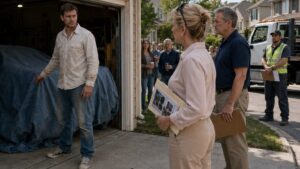
The HOA Threatened an Elderly Man Over His Yard, Until His Neighbor Read the Rule They Ignored
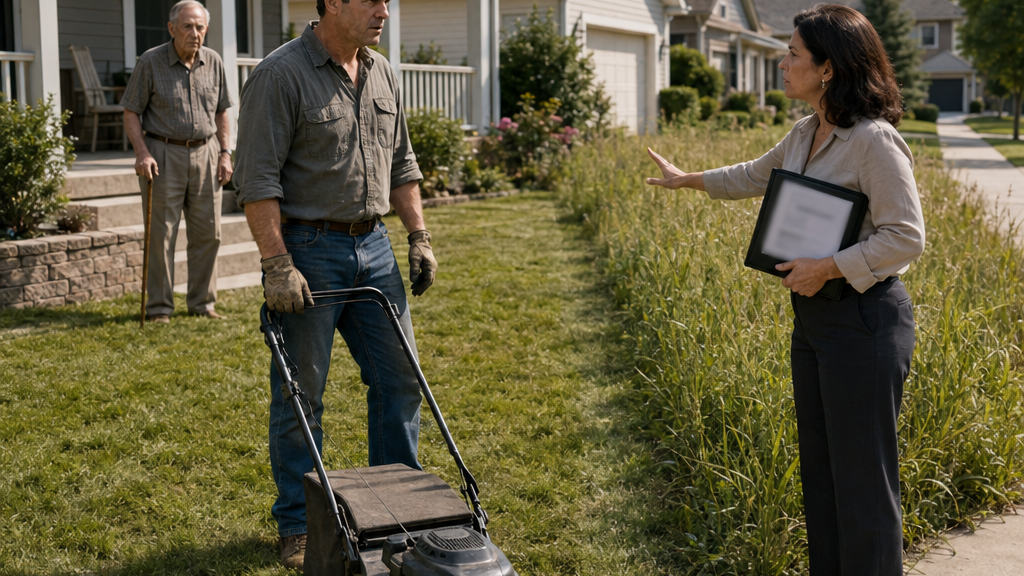
Chapter 1: The Mower Stopped Halfway Down George’s Yard
“You don’t have the right to do that.”
Jeffrey Allen heard the voice over the mower before he saw who was speaking.
He released the handle. The engine coughed down to silence halfway through a strip of knee-high grass, leaving a sharp green line between what he had cut and what he had not.
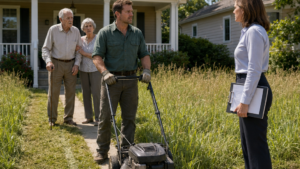
Sandra Ramirez stood on the sidewalk with one hand against her hip and the other holding a thin HOA folder.
Jeffrey pulled off one work glove.
“Do what?”
“Work on someone else’s property.”
He looked from her to George Carter’s front porch.
George was standing near the top step with his cane planted beside his right shoe. His shoulders had the slight forward bend Jeffrey had noticed since George came home from the hospital three weeks earlier.
“I’m mowing his yard,” Jeffrey said.
“I can see that.”
“Then I’m not sure what part is confusing.”
Sandra’s jaw tightened.
“The association has procedures. Owners are responsible for their own lots. If contractors are being brought in, there are requirements.”
“I’m not a contractor.”
“You’re operating equipment on private property.”
“I live next door.”
“That doesn’t make it your property.”
Jeffrey almost laughed, but George shifted on the porch, and the sound died before it left his throat.
He had offered to mow because he had watched George spend ten minutes one morning trying to drag a trash cart from the garage to the curb. George had stopped twice, leaning hard on the cane as though waiting for his legs to remember what they were supposed to do.
Jeffrey had said nothing then.
That bothered him now.
Sandra opened her folder.
“This property already has a maintenance issue.”
“I know. That’s why I’m fixing it.”
“That isn’t how compliance works.”
Jeffrey stared at her.
Behind the mower, cut grass lay in damp clumps along the curb. Ahead of it, the side strip narrowed beside a low retaining wall and disappeared toward George’s backyard, thick with weeds and old leaves.
“What exactly do you want?” Jeffrey asked.
“I want you to stop until we establish whether this work is authorized.”
George cleared his throat.
Both of them turned.
“I asked him,” George said.
His voice was thin but steady.
Sandra looked up at him. “You asked him to do the work?”
“Yes.”
“For payment?”
“No.”
Jeffrey saw something change in Sandra’s expression, but not enough.
She closed the folder halfway.
“You understand that the condition of the property is your responsibility.”
George’s fingers tightened around the curved handle of his cane.
“Yes.”
“And that the association sent notices.”
“Yes.”
“I’m trying to help him answer those notices,” Jeffrey said.
Sandra turned back to him.
“You’re making this worse by interfering.”
That landed harder than Jeffrey expected.
“Interfering?”
“You showed up with equipment and started working without checking anything.”
“I brought a mower across one driveway.”
“That’s not the point.”
“What is the point?”
“The point is that rules apply consistently.”
A garage door opened two houses down. Jeffrey noticed one neighbor step outside carrying a bag of trash, slow down, then remain near the driveway.
Sandra noticed too.
Her tone became more formal.
“If you’re providing maintenance services, there may be insurance and vendor requirements.”
Jeffrey felt his patience thinning.
“I’m not providing services. I’m helping my neighbor.”
“You keep calling it help.”
“Because that’s what it is.”
Sandra gave a small, tired exhale.
“Helping doesn’t erase property rules.”
George lowered his eyes.
That was what changed Jeffrey’s anger.
Not Sandra’s tone. Not the folder. Not the fact that someone was watching.
George’s face.
Jeffrey had known him seven years. George was the man who used to edge his sidewalk with a hand tool because he said string trimmers made people lazy. He washed his own windows every spring. He once spent an entire Saturday repairing a porch rail rather than hiring anyone because, as he put it, he had “two hands and nowhere urgent to be.”
Now he was looking at his own yard as if it belonged to somebody else.
Jeffrey stepped away from the mower.
“He was in the hospital.”
Sandra glanced toward George.
Jeffrey continued. “He can barely stand long enough to get down these steps.”
“I can hear you,” George said quietly.
Jeffrey stopped.
George’s eyes were on him now.
Not angry. But not grateful either.
Jeffrey felt a quick sting of embarrassment.
George looked at Sandra.
“I used to take care of it myself.”
Sandra said nothing.
“Before the hospital,” George added.
The neighbor two houses down had disappeared inside.
For a moment, the street was quiet except for a sprinkler ticking somewhere behind a fence.
Sandra looked down at the folder.
“I’m sorry you’ve been ill.”
George gave a brief nod.
“But the property still has to be maintained.”
Jeffrey stared at her.
“That’s your answer?”
“My answer is that the board can’t decide which standards matter based on who has the most sympathetic explanation.”
“No one is asking you to ignore the yard. I’m standing here fixing it.”
“And I’m telling you that there are procedures.”
George shifted his cane and winced.
Jeffrey saw it.
Sandra did too.
Still, she continued.
“The cure period ends tomorrow. If the violation remains open, the next assessment is three hundred dollars.”
George looked up.
“Three hundred?”
“That’s the scheduled assessment.”
Jeffrey felt his stomach tighten.
Sandra added, “And if Jeffrey refuses to leave after being asked to stop, I can contact the non-emergency line and have the situation documented.”
Jeffrey gave a disbelieving laugh.
“For mowing grass?”
“For refusing a compliance instruction.”
“You’re going to call police because I’m cutting weeds for an old man who just got out of the hospital?”
“Jeffrey,” George said.
The warning in his voice was unmistakable.
Jeffrey turned.
George had lowered his head. His cane was angled slightly forward, both hands resting on it now.
Sandra started to speak, but George beat her to it.
“I thought I could catch up.”
Neither of them answered.
“I kept thinking next week I’d feel stronger.” He looked toward the uncut strip beside the wall. “Then next week came.”
Jeffrey felt his anger give way to something heavier.
George swallowed.
“I didn’t think I’d have to fight this hard just to stay in my own home.”
Sandra’s expression changed then.
Only slightly.
But Jeffrey saw it.
He stepped closer to George, stopping before he blocked Sandra’s view of him.
“You’re not paying that fine,” he said.
George looked at him.
Sandra’s face hardened again, as if the moment of hesitation had embarrassed her.
“Oh, really?”
Jeffrey faced her.
“Yes.”
“And who exactly is going to stop it?”
The mower sat between them, silent in the middle of the half-finished yard.
Jeffrey looked at the folder in Sandra’s hand, then at George’s cane.
“I am.”
Chapter 2: The Rule Sandra Quoted Wasn’t the Whole Rule
The violation notice arrived before Jeffrey had even cleaned the grass from underneath his mower deck.
He found the envelope wedged into George’s mailbox at the shared cluster near the entrance that afternoon, its association logo visible through the little plastic window.
George had asked him to check for mail because walking to the cluster was harder than crossing his own driveway.
Jeffrey carried the envelope back like evidence.
George opened the front door before he knocked.
His cane was just behind him, leaning against the wall within reach.
“They’re fast,” Jeffrey said.
George looked at the envelope.
“That’s one thing they’ve always been good at.”
They sat at George’s kitchen table. Jeffrey waited while George opened it himself.
The letter was brief.
Jeffrey read over the copy only after George handed it to him.
Exterior maintenance violation. Overgrown turf and weeds. Cure period expired Sunday at five. Hearing rights noted in smaller print below.
Jeffrey read it twice.
Then a third time.
“What?” George asked.
“It doesn’t say anything about an unauthorized contractor.”
George frowned.
Jeffrey tapped the page.
“That was half her argument this morning. Insurance. Vendors. Me being on your property. None of it is here.”
“Maybe she changed her mind.”
“Or maybe it was never actually a rule.”
George leaned back carefully.
“Does that matter?”
“It matters if she used something that doesn’t exist to stop me from fixing what they’re fining you for.”
Jeffrey went home and opened the thick PDF of community rules on his laptop.
He hated documents written in the language of committees. Facilities maintenance had taught him to read manuals, contracts and inspection logs, but HOA documents had a special ability to turn simple sentences into fog.
He searched “contractor.”
Then “vendor.”
Then “landscape.”
The rules required commercial vendors hired by the association itself to carry insurance. Architectural work sometimes required approved contractors. Owners were responsible for lot maintenance.
But Jeffrey found nothing stating that an owner could not ask an unpaid neighbor to mow a lawn.
He printed the relevant pages.
By four o’clock, he had highlighted two sections and written a note in the margin: NO BAN ON UNPAID HELP.
For a few minutes, victory felt embarrassingly easy.
Then he reread the violation notice.
The yard condition remained a separate issue.
Sandra could have been wrong about him and still right that George’s property violated the maintenance standard.
Jeffrey sat back.
His statement from the morning came back to him.
You’re not paying that fine.
At the time, it had felt like courage.
In his kitchen, surrounded by paper, it sounded more like a promise he had no authority to make.
He took the pages next door.
George had moved to a chair near the front window. Through the screen door, his cane stood against the frame.
Jeffrey laid the pages on the table.
“I found something.”
George gave him a look. “You look disappointed about it.”
“I proved Sandra was probably wrong about me being some kind of unapproved contractor.”
“That sounds useful.”
“It is.”
“But?”
Jeffrey sat down.
“But the grass rule is real.”
George nodded without surprise.
“I figured.”
“They can still enforce that.”
“I figured that too.”
Jeffrey rubbed a hand over his face.
“You could’ve said that before I told her I was stopping the fine.”
“You looked busy.”
Jeffrey glanced at him.
George’s mouth twitched.
It was the first hint of humor Jeffrey had seen all day.
Then it disappeared.
“There has to be something for temporary medical situations,” Jeffrey said.
“There might be.”
“You ever ask?”
George did not answer immediately.
Jeffrey noticed a stack of envelopes near the end of the table. Some opened, some not.
“George?”
“I filled something out.”
Jeffrey leaned forward.
“What?”
“A hardship form.”
“When?”
“A while back.”
“How long?”
“Before I came home.”
Jeffrey stared at him.
“You filed for an accommodation?”
“I don’t know what they called it.”
“Where is it?”
George gestured toward a small pile beside the refrigerator.
Jeffrey stood, then stopped himself.
“Can I?”
George nodded.
The pile contained a clinic discharge packet, prescription instructions, HOA letters and a photocopy of a form with George’s handwriting across the top.
TEMPORARY HARDSHIP REQUEST.
Jeffrey looked at the date.
Three weeks earlier.
“You sent this?”
“Put it in the outgoing mail before they transferred me to rehab.”
“Did they answer?”
George’s face tightened.
“I thought one of those letters was the answer.”
Jeffrey picked up two unopened envelopes.
“Why didn’t you open them?”
George looked toward the window.
The half-cut lawn was visible through the glass.
“Some days I got tired of finding out what else I was behind on.”
The sentence silenced Jeffrey.
He put the envelopes down.
“Did anyone call you?”
“No.”
“Email?”
“I don’t use it much.”
Jeffrey looked again at the form.
There was a section for supporting documentation.
One box was marked physician or medical-provider confirmation.
The copy in George’s pile did not include any attachment.
“Was there another page?”
George frowned.
“There was something from the clinic.”
“Did you send it?”
“I thought so.”
Jeffrey looked toward the envelopes again.
Maybe George had missed something. Maybe the board had. Maybe both.
The neat answer Jeffrey wanted was getting farther away.
He gathered the printed rules, then placed the hardship form on top.
“Monday morning we call the management office.”
George gave him a skeptical look.
“We?”
Jeffrey caught the word.
He hesitated.
“You call,” he corrected. “I can sit here if you want.”
George watched him for a second.
Then nodded.
As Jeffrey stood to leave, George touched the hardship form with one finger.
“I sent that because I knew the yard would get away from me.”
Jeffrey looked back.
“I wasn’t waiting for somebody to rescue me.”
“I know.”
George’s expression suggested he wasn’t sure Jeffrey did.
Then he said, “I already mailed them the hospital form weeks ago.”
Chapter 3: George Had Asked for Help Before Anyone Knocked
On Monday morning, George placed a photocopy of the hardship request in the middle of the dining table before Jeffrey had even sat down.
The date at the top was impossible to miss.
It had been submitted nineteen days before Sandra stopped the mower.
Beside it lay three HOA envelopes, now opened, a clinic discharge folder and George’s cane hooked over the back of the chair next to him.
Jeffrey picked up the first letter.
Routine violation reminder.
The second.
Notice of pending inspection.
The third was a generic acknowledgment saying correspondence had been received by management.
Nothing said the hardship request was incomplete.
Jeffrey checked the pages again.
“No list of missing documents.”
George shook his head.
“No phone message?”
“No.”
“Nothing asking for a doctor’s page?”
“If there had been, I would’ve asked the clinic.”
Jeffrey reached for his phone.
“Let’s call.”
George gave him a look.
Jeffrey set the phone down between them instead.
“You call.”
George dialed the management number and put it on speaker.
A property manager answered after several minutes and asked for George’s address.
George gave it.
“I’m calling about a hardship request I submitted after I was hospitalized.”
Keyboard taps came faintly through the speaker.
“What date was that, sir?”
George read it from the copy.
Another pause.
“I do see an entry.”
Jeffrey straightened.
George asked, “What does it say?”
The manager hesitated.
“It appears the request was logged as incomplete.”
George’s face changed.
“Incomplete how?”
“I’m not seeing a provider verification attached.”
“I sent what they gave me.”
“The system notes medical documentation missing.”
“Was I told that?”
The manager paused again.
“I don’t see a separate notice in the file.”
Jeffrey leaned toward the phone before he could stop himself.
“So you marked it incomplete, didn’t notify him, and kept running the violation clock?”
George turned sharply.
The manager said, “Sir, may I ask who else is on the call?”
“I’m his neighbor,” Jeffrey said.
George’s hand moved toward the phone.
Jeffrey kept going.
“He filed nineteen days ago. Somebody knew there was a medical issue.”
“Jeffrey,” George said.
“If the association failed to tell him what was missing, then—”
George pressed the mute button.
The room went quiet.
Jeffrey stopped.
George looked at him with a tired expression that was somehow worse than anger.
“I was talking.”
Jeffrey opened his mouth.
Then closed it.
George unmuted the call.
“This is George Carter,” he said. “It’s my property. I’d like to know who reviewed the request.”
The property manager answered more carefully now.
“The board secretary may have access to the correspondence history. I can ask her to call you.”
“Please do.”
“And Mr. Carter?”
“Yes?”
“You can also request a hearing while the violation remains active.”
“I intend to.”
George ended the call.
Jeffrey stared at the phone.
“I’m sorry.”
George moved the cane from the chair to the floor and used it to stand.
The motion was slow. Jeffrey automatically started to rise.
George held up one hand.
Jeffrey stayed seated.
“I know what you’re trying to do,” George said.
Jeffrey nodded.
“That doesn’t mean I always like how you do it.”
Jeffrey looked down at the papers.
“I heard something wrong and jumped in.”
“You heard something wrong happening to me and jumped in.”
“That’s worse.”
“Sometimes.”
George walked toward the kitchen, each step measured.
Jeffrey remained at the table.
A few minutes later, the phone rang.
The caller identified herself as Rebecca Moore, the board secretary.
George returned to his chair before answering.
Rebecca’s voice was cautious but direct.
“I reviewed the management file after they contacted me.”
George put the phone on speaker.
“I found your hardship form.”
“So they got it.”
“Yes.”
“And?”
“There’s an electronic note attached to the submission.”
George glanced at Jeffrey.
“What note?”
Rebecca paused.
“Incomplete—no action.”
Jeffrey felt his jaw tighten but kept silent.
George asked, “Was there supposed to be action?”
“There should have been follow-up if documentation was missing.”
“Should have been?”
“I’m trying to determine whether the manager at the time believed the acknowledgment letter was enough.”
“The acknowledgment letter didn’t say anything was missing.”
“I understand.”
George’s fingers rested over the head of his cane.
Rebecca continued.
“The request requires a provider statement explaining the temporary limitation and expected duration. That page is not in the digital file.”
George looked at the clinic folder.
“I may still have it.”
“If you do, submit it immediately.”
Jeffrey almost said they would.
He stopped himself.
George said, “I will.”
Rebecca lowered her voice slightly.
“I also want to be clear that I can’t promise the violation will be withdrawn. The board has to address that.”
“I’m not asking you to promise.”
Jeffrey looked at George.
There was no tremor in his voice now.
“I’m asking whether somebody will finally look at what I sent.”
Rebecca answered, “Yes.”
That was the first small victory.
Not cancellation.
Not vindication.
Just confirmation that George had not imagined the process. He had asked for help before anyone came to his yard with a folder.
After the call, they searched the clinic paperwork.
The provider statement was there, clipped behind a discharge summary.
George stared at it.
“I thought I mailed a copy.”
“Maybe you did.”
“Maybe I didn’t.”
Jeffrey resisted the urge to rescue even that uncertainty.
Instead he said, “We can copy it now.”
George nodded.
Jeffrey drove them to the management office that afternoon because George did not feel steady enough to drive.
At the counter, George handed the provider statement to the property manager himself.
Jeffrey stood beside him.
The manager scanned the page and gave George a stamped receipt.
“Your hearing request is also entered.”
“When?”
“Thursday next week.”
George folded the receipt and put it in his pocket.
Jeffrey began, “Can we get confirmation that enforcement—”
George looked at him.
Jeffrey stopped.
The manager noticed.
George asked, “Will enforcement pause until the hearing?”
“I can’t authorize that.”
“Who can?”
“The compliance chair or the board.”
“Sandra Ramirez?”
“Yes.”
George nodded once.
On the drive home, Jeffrey apologized again.
George watched houses pass outside the window.
“You don’t need to apologize every five minutes.”
“I only did it twice.”
“Felt like five.”
Jeffrey almost smiled.
Then George said, “You know what the worst part is?”
Jeffrey waited.
“When you talked over me this morning, the manager started answering you.”
Jeffrey gripped the steering wheel.
George continued.
“I disappeared in my own phone call.”
The words stayed between them all the way back to the subdivision.
When Jeffrey pulled into George’s driveway, he got out to help with the door.
George waved him off and stood using the cane.
At the porch, he turned.
“I’m glad you mowed the yard.”
Jeffrey nodded.
“I’m glad you found the rule.”
Another nod.
“But I asked for help with the yard, Jeffrey.”
George rested both hands on the cane.
“I didn’t ask you to become me.”
Chapter 4: The Fine Was About More Than One Overgrown Lawn
Sandra Ramirez refused to discuss George’s fine until Jeffrey stopped asking her to cancel it.
They were standing outside the HOA management office on Wednesday morning when she finally closed the folder in her hand and said, “If every conversation starts with you telling me what the outcome has to be, there isn’t much point in having one.”
Jeffrey almost answered.
Then George’s words from Monday came back to him.
I didn’t ask you to become me.
He let the silence sit.
“All right,” he said. “What outcome do you think makes sense?”
Sandra studied him as if she suspected a trap.
“That’s different.”
“I’m trying something new.”
She gave him a flat look, but some of the tension left her shoulders.
They walked along the sidewalk beside the management office rather than going inside. Sandra said she had only twenty minutes before another appointment.
Jeffrey kept his hands in his pockets.
“Why wouldn’t you pause the violation when you knew George had been in the hospital?”
Sandra stopped.
“I knew he had been absent.”
“That isn’t what I asked.”
“I knew there was some medical paperwork.”
Jeffrey felt the old anger rise.
He made himself wait.
Sandra continued.
“You think this is about one lawn.”
“Isn’t it?”
“No.”
She pointed across the parking lot toward a row of townhomes.
“Last year the board let things slide. Broken fencing. Boats sitting in driveways for months. Dead landscaping. One owner got three extensions because he knew somebody on the board. Another owner got fined immediately because he didn’t.”
Jeffrey said nothing.
“The residents noticed,” Sandra said. “They always notice.”
“So the answer was to become stricter.”
“The answer was to apply the written rules.”
Her voice had changed. Less combative. More tired.
“We had people standing up at meetings asking why one family got six months while somebody else got thirty days. They weren’t wrong.”
Jeffrey thought about George’s lawn.
“You’re worried an exception looks like favoritism.”
“I’m worried an undocumented exception becomes favoritism.”
“That sounds reasonable.”
Sandra looked almost surprised.
Jeffrey added, “Until somebody submits documentation and no one tells him it’s incomplete.”
Her mouth tightened again.
“I didn’t process his request.”
“But you knew it existed.”
“I knew there was a pending question.”
“And you kept the deadline running.”
Sandra started walking.
Jeffrey followed.
“There is no automatic stay just because someone says paperwork is coming.”
“He didn’t say it was coming. He sent it.”
“Incomplete.”
“He didn’t know that.”
Sandra looked at him.
“You keep talking as if every failure in the process was intentional.”
“I’m trying to figure out which ones were.”
That stopped her again.
For several seconds, the only sound was a landscaping crew working somewhere behind the clubhouse.
Sandra looked away first.
“You weren’t here for the meetings last fall.”
“I live here.”
“You didn’t attend them.”
“No.”
“There were people accusing the board of protecting friends. There were threats to replace half of us. One homeowner brought photos from six different properties and asked why the rules apparently changed depending on the address.”
Jeffrey could imagine it.
A room full of angry owners. Phones held up with pictures. Volunteer board members trying to explain decisions nobody had documented well.
Sandra said, “So yes. When I took over compliance, I said we would stop making decisions in hallways and driveways.”
Jeffrey glanced at her.
“That part I agree with.”
“Good.”
“But Saturday was a driveway.”
Sandra’s jaw tightened.
“And you were making a decision.”
She looked toward him.
Jeffrey did not push further.
For the first time since the mower confrontation, he could see the shape of her reasoning without agreeing with what she had done.
Sandra was not protecting an imaginary empire.
She was protecting a system she believed would collapse the moment someone accused it of bending.
The problem was that George had been caught under the weight of that rigidity.
When Jeffrey returned home, he saw George’s porch from across the narrow strip between their houses.
The front door was open behind the screen.
George’s cane leaned against the porch rail.
George himself was nowhere outside.
That empty cane bothered Jeffrey more than seeing George use it.
He walked over but stopped at the bottom step.
“George?”
“Kitchen.”
Jeffrey entered only after George told him to.
George was sitting with the provider statement and stamped receipt spread in front of him.
“How’d it go?” George asked.
“I listened.”
“That bad?”
“Apparently I have a reputation.”
George smiled faintly.
Jeffrey sat opposite him.
“Sandra told me why they tightened enforcement.”
George waited.
“There were real complaints. Different owners getting different treatment. Extensions nobody could explain.”
“That doesn’t surprise me.”
“She thinks informal exceptions are what caused it.”
George tapped one finger on the table.
“She may be right.”
Jeffrey looked at him.
“About that part.”
George shrugged.
“You can be right about one thing and wrong about another. That’s usually how people manage to make a real mess.”
Jeffrey leaned back.
“Sandra admitted she knew there was medical paperwork.”
George’s expression changed.
“How much did she know?”
“She called it a pending question.”
“Before Saturday?”
“Yes.”
George looked toward the stamped receipt.
“Then why didn’t she wait?”
“I don’t know yet.”
His phone vibrated.
A message from Rebecca Moore.
She asked whether Jeffrey could speak privately for five minutes at the clubhouse office.
George raised an eyebrow.
“You going?”
Jeffrey hesitated.
“Only if you want me involved.”
George looked at him for a long second.
“Go find out what she wants.”
The clubhouse office smelled faintly of copier toner and coffee.
Rebecca was waiting near the filing cabinets with a printed activity log.
“I’m not giving you confidential board material,” she said immediately.
“Okay.”
“But this entry relates directly to George’s case, and he’s entitled to it.”
She held the page where Jeffrey could read it.
The electronic record showed George’s hardship form arriving nineteen days earlier.
Below it was the notation they already knew.
INCOMPLETE—NO ACTION.
Then another entry dated two days later.
Compliance review requested.
Jeffrey read the line beneath that twice.
CONTINUE STANDARD VIOLATION TIMELINE. NO HOLD PENDING COMPLETE SUPPORT.
“Who entered that?” he asked.
Rebecca’s face was uncomfortable.
“The system initials belong to Sandra.”
Jeffrey looked up.
Rebecca continued before he could speak.
“She may have believed she was following the policy correctly.”
“But she chose not to pause it.”
“Yes.”
“Knowing there was a medical request.”
“She knew there was an incomplete hardship request.”
Jeffrey heard the distinction.
He also understood why Rebecca made it.
“What happens now?”
“The hearing still happens.”
“And Sandra?”
“She’ll explain her decision.”
Jeffrey folded his arms.
Rebecca lowered the page.
“You wanted to know whether this was an accident.”
He met her eyes.
“It wasn’t entirely one.”
Chapter 5: Consistency Became Sandra’s Excuse for Not Looking Closer
The notation was only one sentence, but Jeffrey could not stop staring at it.
CONTINUE STANDARD VIOLATION TIMELINE.
Rebecca had printed a copy for George the next morning. George read it once, folded it carefully, then placed it beneath the stamped clinic receipt.
He did not swear.
He did not complain.
He simply said, “So somebody made a decision.”
Jeffrey nodded.
“That matters.”
“It does.”
George looked at him.
“It doesn’t mean she wanted me thrown out of my house.”
“No.”
Jeffrey was surprised by how quickly the answer came.
Two days earlier, he would have wanted Sandra’s initials to mean everything.
Now they meant something narrower and, in some ways, more difficult.
She had not invented the maintenance violation.
She had not hidden George’s request.
She had made a choice.
A bad one.
That afternoon, Jeffrey met Rebecca in the HOA records room because George had authorized him to collect copies for the hearing.
The room was hardly dramatic. Metal shelves. Banker boxes. A humming fluorescent fixture. A printer that sounded like it was grinding its teeth.
Rebecca pulled up the previous year’s compliance notes.
Jeffrey scanned meeting minutes rather than individual owner files.
The pattern Sandra had described was there.
Residents complaining about inconsistent extensions.
A board member recusing himself from a case involving a friend.
A motion directing management to standardize violation timelines.
One sentence caught Jeffrey’s attention.
Exceptions must be documented to preserve equal treatment.
He pointed to it.
“This is what Sandra was relying on.”
“Partly.”
“Partly?”
Rebecca hesitated.
“She pushed for the policy after the accusations last year.”
“Because she was accused?”
“Not directly.”
Rebecca leaned against a file cabinet.
“But she defended the old board at one of the meetings. Loudly.”
Jeffrey waited.
“Afterward, several residents said she was part of the favoritism problem even though she hadn’t made the original decisions. When she became compliance chair, she was determined nobody would say that again.”
There it was.
Not corruption.
Not cruelty for its own sake.
Fear, converted into procedure.
Jeffrey looked at George’s file copy.
“She wanted to prove she wouldn’t bend.”
Rebecca nodded.
“And George became the person she chose not to bend for.”
Rebecca did not answer.
She didn’t need to.
When Jeffrey returned home, George was on his porch.
He had moved a straight-backed chair near the rail. His cane stood between his shoes.
Jeffrey watched him rise.
George pushed down on the handle and stood slowly.
Then he took three steps toward the porch rail.
Stopped.
Turned.
Three steps back.
“What are you doing?”
“Going to a meeting.”
“You could attend remotely.”
“I could.”
“That wasn’t an argument against it.”
George lowered himself into the chair.
“I’ve been talking to people through phones and forms for almost a month.”
He looked toward the street.
“I want them to see who they’re discussing.”
Jeffrey sat on the porch step.
“I can speak for the timeline if you want.”
George looked down at him.
“No.”
Jeffrey nodded once.
“All right.”
“You said that fast.”
“I’m learning.”
George rested both hands over the cane.
“I want you there.”
“I’ll be there.”
“I may need you to explain what you found in the rules.”
“I can do that.”
“If they ask you.”
Jeffrey smiled faintly.
“If they ask me.”
George looked satisfied.
They spent the next half hour reducing George’s request to three points.
Temporary time to recover physically.
Removal of the current assessment while the hardship request was considered properly.
Permission to use unpaid neighbor assistance or a maintenance service while he recovered.
Jeffrey wrote each point on an index card.
George read them.
“Too much.”
“That’s three sentences.”
“Still too much.”
He picked up a pen and crossed out half of Jeffrey’s wording.
When he finished, the card read:
I asked before the deadline.
I need time, not exemption forever.
I will maintain the property with help while I recover.
Jeffrey looked at it.
“That’s better.”
“I know.”
A little later, George stood again.
This time he made it to the porch rail without pausing.
Jeffrey resisted the instinct to put out a hand.
George noticed.
“See?” he said.
“See what?”
“You can learn.”
Jeffrey laughed.
The sound disappeared when George’s knee buckled slightly on the turn back.
Jeffrey rose halfway.
George caught himself on the cane.
“Sit down.”
Jeffrey sat.
George returned to the chair, breathing harder.
“You sure about Thursday?”
“No.”
Jeffrey frowned.
George added, “I’m going anyway.”
That evening, Jeffrey knocked on Sandra’s door.
She opened it but did not invite him inside.
“I know about the notation,” he said.
Her face changed just enough to confirm she knew which notation he meant.
“Rebecca showed George?”
“She gave him a copy he was entitled to.”
Sandra folded her arms.
Jeffrey said, “Why didn’t you pause the timeline?”
“Because the request wasn’t complete.”
“You knew he was recovering medically.”
“I knew the form claimed a medical hardship.”
“That distinction really matters to you.”
“It has to.”
Jeffrey stared at her.
Sandra’s voice remained controlled.
“You think I wanted to fine George?”
“I don’t know what you wanted.”
“I wanted a process that didn’t depend on whether I personally felt sorry for somebody.”
Jeffrey almost interrupted.
He stopped.
Sandra noticed.
She continued.
“Last year, everybody had a reason. Travel. Divorce. Illness. Money. Contractors. Family emergencies. Some were serious. Some weren’t. The board handled them differently, and people lost trust.”
“So you stopped making judgment calls.”
“I stopped making undocumented ones.”
“George documented his.”
“Incompletely.”
“And nobody told him.”
Sandra looked away.
That was the first time Jeffrey saw no answer waiting behind her expression.
Finally she said, “Management should have sent a deficiency notice.”
“But you still chose to continue the clock.”
“Yes.”
“Why?”
Her eyes came back to him.
“Because I thought pausing it would look like another quiet exception.”
There it was.
Jeffrey had expected the admission to feel better.
It didn’t.
“You were more worried about how fairness looked than whether the process was fair.”
Sandra’s face hardened, but she did not deny it.
The next evening, George called Jeffrey over.
A new line had appeared in the homeowner account portal.
ASSESSMENT—OPEN MAINTENANCE VIOLATION.
Three hundred dollars.
Posted one day before the hearing.
George stared at the screen.
Jeffrey felt the old urge rise—to call, demand, accuse, fix.
Instead he asked, “What do you want to do?”
George reached for his cane.
“We go tomorrow.”
“And the assessment?”
George looked at the number once more.
“We make them explain it to me.”
Chapter 6: George Took the Cane to the Board Meeting Himself
Sandra described George Carter’s case as “an unresolved exterior maintenance violation” before George had even settled fully into his chair.
Jeffrey sat beside him in the clubhouse meeting room, close enough to help if George asked and far enough away that no one could mistake whose hearing it was.
George’s cane rested against his knee.
The HOA president sat at the center of the folding table. Rebecca Moore was two seats down with a laptop open in front of her. Sandra had a folder containing photographs of George’s yard before Jeffrey began mowing.
Two homeowners sat in the back as observers.
The property manager stood near the wall.
Sandra continued.
“The lot was documented with excessive turf and weed growth. Standard notices were issued. The cure period expired. The assessment was then posted according to the current schedule.”
Jeffrey looked at George.
George was watching Sandra, not the photographs.
The president asked, “Mr. Carter, do you dispute that the property was out of compliance?”
George adjusted his cane.
“No.”
Sandra glanced toward him, perhaps expecting more.
The president said, “All right. What relief are you requesting?”
George took the index card from his pocket.
Jeffrey could see the slight tremor in his fingers.
“I asked for temporary hardship consideration before the deadline.”
Sandra opened her folder.
“The request was incomplete.”
George looked at her.
“I know that now.”
The room went still.
“I didn’t know it then.”
Rebecca shifted slightly in her chair.
George continued.
“I was in rehabilitation after being hospitalized. I sent the form before I came home. There was a provider page missing from the file. Nobody told me.”
Sandra said, “The requirements are printed on the application.”
The president raised a hand.
“Let him finish.”
Jeffrey felt something tighten in his chest.
George glanced at his card.
“I’m not asking you to remove the yard rule.”
Sandra’s eyes lifted.
“I’m asking for time to recover and permission to maintain the property with help while I do.”
The president looked toward the property manager.
“Is neighbor assistance prohibited?”
The manager hesitated.
“I’m not aware of a blanket prohibition on unpaid assistance.”
Sandra said, “My concern Saturday was liability and unauthorized work.”
Jeffrey almost spoke.
George touched his sleeve.
It was barely a movement.
Enough.
Jeffrey stayed quiet.
The president turned toward him.
“Mr. Allen, did Mr. Carter pay you?”
“No.”
“Are you operating a landscaping business?”
“No. I work in facilities maintenance. I used to supervise landscaping crews, but I’m his neighbor.”
“And he asked you to mow?”
“Yes.”
“That answers that portion.”
Jeffrey felt the satisfaction rise and pass.
A week earlier, he would have treated that sentence as victory.
Now he looked at George.
George had not moved.
Sandra turned to the president.
“The maintenance requirement still existed regardless of who performed the work.”
“I agree,” the president said.
Sandra seemed relieved.
Then he added, “The issue is whether the hardship process was handled correctly.”
Rebecca cleared her throat.
“I reviewed that.”
The president nodded.
Rebecca turned her laptop slightly.
“The association received Mr. Carter’s hardship request nineteen days before the Saturday confrontation. The submission was recorded as incomplete because the provider statement was absent.”
“Was he notified?” the president asked.
“I cannot find a deficiency notice.”
The property manager spoke from the wall.
“The standard acknowledgment went out.”
“Did it identify what was missing?”
“No.”
Sandra said, “The application itself lists the requirement.”
George shifted.
Jeffrey saw his mouth tighten.
The president asked, “Mr. Carter?”
George leaned forward.
“May I stand?”
Jeffrey’s hand moved instinctively toward the cane.
He stopped before touching it.
George took it himself.
He pushed himself upright slowly.
One hand remained on the cane.
The other rested against the edge of the board table.
For a moment, nobody spoke.
George looked at Sandra.
“I have lived here twelve years.”
His voice was not loud.
“I cut that lawn myself for twelve of them.”
Sandra looked down.
“I didn’t stop because I decided the rules didn’t apply to me.”
He paused for breath.
Jeffrey stayed still.
“I stopped because I couldn’t do it.”
George glanced at the photographs.
“The first week I was home, I thought I’d be stronger by Friday. Friday came, and I wasn’t.”
His fingers tightened on the table.
“I sent the form because I knew I was behind.”
Sandra started, “No one is questioning—”
George lifted one hand.
It surprised everyone, including Jeffrey.
Sandra stopped.
“I’m not finished.”
The words were calm.
No anger.
That made them stronger.
“I don’t want special treatment. I don’t want the board pretending the weeds weren’t there.”
He looked toward the president.
“I want you to tell me what I’m missing before you punish me for not sending it.”
Rebecca looked down at her keyboard.
George continued.
“And if I tell you I need help maintaining my property for a few months, I want to be treated like the homeowner making that decision. Not like I’ve disappeared because somebody else is holding the mower.”
Jeffrey felt that sentence land exactly where it belonged.
He had expected George to use the words they practiced.
He hadn’t.
George had found better ones.
The president asked him to sit.
George lowered himself carefully.
This time, Jeffrey waited until George gave a small nod before steadying the back of the chair.
Sandra opened her folder again.
“I understand Mr. Carter’s position,” she said. “But if we retroactively cancel assessments every time an application is incomplete, we create another consistency problem.”
The president turned toward her.
“Is granting an accommodation the same as ignoring a violation?”
“No.”
“Is correcting a failure to provide notice the same as favoritism?”
Sandra hesitated.
“No.”
“But?”
She looked around the table.
“My concern is precedent.”
Rebecca spoke.
“I think we already have a precedent problem.”
Everyone looked at her.
She pulled up another screen.
“Our governing policy says hardship applications are reviewed after supporting documentation is received. It does not specify what management must do when documentation is missing.”
The president frowned.
“There’s no notice requirement?”
“Not in the written procedure.”
Sandra said, “Which is why the application lists the required documents.”
Rebecca shook her head.
“That tells the owner what to submit. It doesn’t tell us what to do when a submission is incomplete.”
The property manager shifted uncomfortably.
Rebecca continued.
“Some incomplete applications received follow-up emails. Some received phone calls. George’s received neither.”
Jeffrey saw Sandra’s expression change.
The president asked, “How many?”
“I checked the last eighteen months. The treatment wasn’t consistent.”
Sandra stared at the table.
The irony was visible now.
The system she had pushed hardest to make consistent contained an inconsistency exactly where George had fallen through it.
Sandra said quietly, “I didn’t know that.”
Rebecca answered, “Neither did I until this week.”
The president turned to George.
“Mr. Carter, has the provider statement now been submitted?”
“Yes.”
“And do you have a maintenance plan?”
George nodded toward Jeffrey.
“For now, my neighbor helps with the heavy work. I can pay for a service later if I need one.”
Jeffrey looked at him.
George added, “I am not asking Jeffrey to do everything forever.”
A few people smiled faintly.
Jeffrey did too.
Sandra did not.
But her face had softened.
The president asked her directly, “Knowing what we know now, do you still recommend keeping the assessment in place?”
Sandra sat very still.
When she answered, her voice was quieter.
“I recommend the board decide the assessment together with the hardship request.”
It was not an apology.
It was not surrender.
But it was the first time she had stopped insisting the timeline itself settled the matter.
The president nodded.
“I think we need to separate three issues. The underlying maintenance obligation. The hardship accommodation. And whether the association’s failure to notify Mr. Carter of missing documentation makes the assessment defensible.”
Rebecca said, “I agree.”
Sandra nodded reluctantly.
The president looked at George.
“We’re going to take a short procedural recess.”
George’s eyebrows drew together.
“What does that mean?”
“It means we need to determine what we can correct tonight and what requires a formal policy vote.”
He gathered the papers in front of him.
“Rebecca, I want the application history. Sandra, I want the compliance timeline. Manager, I want the account ledger and confirmation of the assessment posting.”
Jeffrey glanced at George.
A week earlier, he would have interpreted the recess as delay.
Now he understood something else.
The room was finally asking the right question.
Not whether George’s grass had been too high.
Not whether Jeffrey had been too angry.
Not even whether Sandra had been too rigid.
The question was whether a community could demand consistent compliance while operating an inconsistent process.
The president stood.
“Board members, back room. Ten minutes.”
Sandra gathered her folder.
Rebecca took her laptop.
George remained seated with one hand resting on his cane.
As the door closed behind the board, Jeffrey leaned toward him.
“You okay?”
George exhaled slowly.
“No.”
Jeffrey waited.
George looked at him.
“But I said what I came to say.”
Behind the closed door, voices began to rise and fall.
The three-hundred-dollar assessment was still on George’s account.
The lawn rule still existed.
And for the first time, none of them knew which part of the old process would survive when that door opened again.
Chapter 7: The Yard Was Finished, but That Wasn’t the Real Victory
The corrected HOA letter arrived before Jeffrey started the mower.
George was already on the porch when Jeffrey crossed the driveway the following Saturday morning, an envelope open across his lap and his cane resting against the rail beside him.
Jeffrey saw the association logo and stopped.
“Well?”
George held up one finger.
“Read it yourself.”
Jeffrey climbed the steps but did not take the letter until George handed it to him.
The first paragraph confirmed that the board had approved a temporary hardship accommodation based on the completed medical documentation.
The second suspended the three-hundred-dollar assessment.
Jeffrey read that sentence twice.
The third required George to maintain the property through reasonable assistance during his recovery, with a review after ninety days.
Then came the part Jeffrey had not expected.
The board had also directed management to create a written deficiency-notice procedure for incomplete hardship applications. Owners would have to be told what supporting material was missing and given a defined period to provide it before enforcement escalated.
A separate paragraph clarified that unpaid assistance from neighbors did not constitute commercial contracting merely because lawn equipment was being used.
Jeffrey lowered the letter.
“They changed the procedure.”
George nodded.
“They changed more than my account.”
Jeffrey looked toward the yard.
The front section was nearly restored now. He had finished the worst of the overgrowth after the hearing, with George directing from the porch. The side strip beside the retaining wall still needed trimming, but the difference from the morning Sandra stopped the mower was almost absurd.
“You won,” Jeffrey said.
George’s expression tightened slightly.
“We got a reasonable answer.”
“That’s a very George way of saying you won.”
“I’m trying not to become you.”
Jeffrey laughed.
George did too.
Then a car pulled up along the curb.
Sandra Ramirez stepped out carrying no folder this time.
Jeffrey’s first instinct was to move toward the driveway.
He caught himself.
George noticed.
“Good,” he murmured.
Sandra walked up the path.
“Morning.”
“Morning,” George said.
She stopped below the porch.
“I wanted to make sure you received the decision.”
George lifted the letter.
“I did.”
Sandra nodded.
“The board approved the policy language Friday night.”
Jeffrey leaned against the porch post and said nothing.
Sandra looked toward him briefly, then back to George.
“There’ll be a written cure notice now if a hardship application is missing anything. Management has to identify the specific document and give the owner ten business days before the request can be closed.”
George asked, “That applies to everybody?”
“Yes.”
“Not just medical requests?”
“All hardship requests that require supporting documentation.”
George folded the letter once.
“That should have been there already.”
Sandra accepted the sentence without defending herself.
“Yes.”
The answer hung between them.
Jeffrey had wondered, during the week, whether Sandra would apologize.
Part of him had wanted it.
A clear sentence. An admission. Something that made the entire story simple.
Instead she said, “I was trying to make the process consistent.”
George waited.
Sandra looked at the half-finished side yard.
“I should have looked harder at whether the process itself was consistent.”
It was not an apology exactly.
But it was close enough to truth that Jeffrey did not resent the difference.
George nodded.
“I appreciate you saying that.”
Sandra turned to Jeffrey.
“And the neighbor-assistance language is in writing now.”
“So I’m officially allowed to be a nuisance with a lawn mower?”
“I believe the policy uses different wording.”
“That seems wise.”
For the first time, Sandra smiled.
Only slightly.
Then she looked back at George.
“The accommodation doesn’t eliminate the maintenance standard.”
“I know.”
“The board will review it after ninety days.”
“I know that too.”
Sandra hesitated, perhaps waiting for an argument that never came.
George said, “I never asked you to pretend the yard was fine.”
“No.”
“I asked for enough time to fix it in a way I could manage.”
“I understand that now.”
Sandra nodded to them both and walked back toward her car.
Jeffrey watched her leave.
George tapped the porch floor lightly with the end of his cane.
“You can stop staring.”
“I’m thinking.”
“That usually causes trouble.”
Jeffrey sat on the step.
“So what’s the plan?”
George looked at him.
“For what?”
“The yard.”
“I have one.”
“Of course you do.”
George reached beside his chair and picked up another piece of paper.
It was an estimate from a local maintenance service.
Jeffrey frowned.
“You hired somebody?”
“Twice a month.”
“You don’t need to do that.”
George’s eyes narrowed.
Jeffrey heard himself.
He stopped.
George waited.
Jeffrey tried again.
“Do you want to do that?”
“Yes.”
“Okay.”
George handed him the estimate.
“It covers mowing and edging. I’ll still handle the small things when I’m able.”
“And me?”
“You are not my unpaid landscaping department.”
“I never said I was.”
“You acted like it.”
Jeffrey looked down at the paper.
George continued.
“I’m grateful for what you did.”
Jeffrey looked up.
“But?”
“But I need something that works if you go out of town, get sick, get busy, or simply decide you have better things to do on a Saturday.”
“That last one seems unlikely.”
George ignored him.
“I don’t want my staying here to depend on whether my neighbor feels responsible for me.”
The words were quiet.
Jeffrey understood immediately.
He had spent two weeks thinking the central problem was a fine.
Then he thought it was a broken process.
But George had been trying to tell him something else from the beginning.
He wanted help.
He did not want dependency disguised as kindness.
Jeffrey folded the estimate and handed it back.
“Twice a month sounds reasonable.”
“I thought so.”
“And between visits?”
“I’ll tell you if I need something.”
Jeffrey smiled.
“Dangerous system.”
“You’ll survive.”
George stood.
He set his cane against the porch rail and held the railing as he stepped down once.
Jeffrey watched without moving.
George looked toward the narrow strip beside the retaining wall.
“That corner still looks terrible.”
“It does.”
“You missed under the hydrangea.”
“I was waiting for professional instruction.”
“You’re getting it.”
George pointed.
“Trim that side first. Leave the patch near the downspout alone. I want to see whether the grass comes back.”
“Yes, sir.”
“And don’t scalp the edge by the sidewalk.”
Jeffrey stared at him.
“I supervised landscaping crews for six years.”
“And yet I’ve seen what you do with an edger.”
Jeffrey shook his head and walked toward the garage.
The mower was where he had left it, cleaned and fueled.
For a moment, his hand rested on the handle.
He remembered the same machine sitting silent halfway across the lawn while Sandra stood on the sidewalk and George gripped his cane behind him.
Back then, Jeffrey had thought the important moment was when he said, I am.
Who was going to stop the fine?
He had thought the answer needed to be him.
Now the yard was almost finished, the assessment was suspended, and the HOA had changed the process.
But none of those things felt as significant as what happened next.
Jeffrey wheeled the mower toward the grass.
George came down one more step, retrieved his cane, and stood beside the porch rail.
Then he reached into his pocket and held out the mower key Jeffrey had left with him earlier in the week.
Jeffrey walked over.
George did not hand it to him immediately.
“Side strip first,” he said.
“Side strip first.”
“Leave the downspout patch.”
“Leave it.”
“And stop when I tell you to stop.”
Jeffrey looked at him.
This time, there was no hesitation.
“You got it.”
George placed the key in his hand.
Only then did Jeffrey start the mower.
The story has ended.