The Tags on the Table
Part I — The Back Door
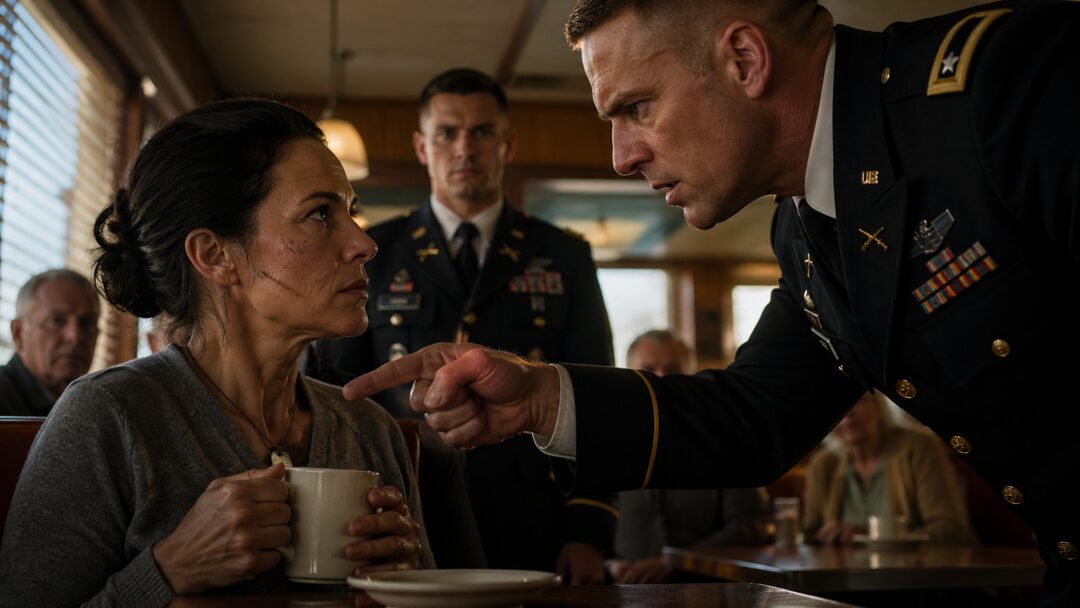
Mara Vale saw the soldiers before the bell over the diner door had a chance to betray them.
They did not come through the front like regular customers. They entered through the back hall beside the restrooms, where delivery men came in with sacks of flour and old men slipped out to smoke when June Haskell pretended not to notice. Their uniforms were clean. Their boots were polished. Their faces were set for something heavier than breakfast.
Mara kept both hands around her white coffee mug.
She had not taken a single sip.
Across the Copper Bell Diner, morning tried to behave like morning. A waitress topped off coffee. A trucker cut into eggs gone cold around the edges. The pie case hummed under the counter lights, its curved glass throwing back a dim reflection of the room.
That reflection was why Mara had chosen the corner table.
She watched the two soldiers cross the floor behind her in the mirror of coconut cream and cherry lattice.
The younger one hesitated first.
The older one did not.
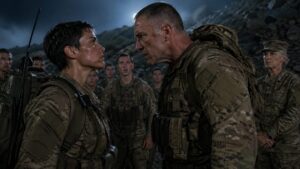
Captain Elias Rourke moved like a man who still believed every room had to arrange itself around rank. Forty-two, maybe, with a square jaw, close-cut hair, and a uniform so sharply pressed it seemed less worn than declared. The kind of man a town like Bellweather stood up for before it knew what he had done.
Behind him, Sergeant Jonah Pike followed half a step back.
Jonah’s uniform was clean too, but not as perfect. His left hand hung stiff at his side, the fingers curled slightly inward as if they had forgotten how to rest. His eyes moved over the diner, over June behind the counter, over the old veteran at the second stool, and finally to Mara.
For one second, he looked almost afraid.
Then Rourke stopped at Mara’s table.
The diner went quieter without deciding to.
Mara lowered her mug to the saucer. Ceramic touched ceramic with a small, careful sound.
Rourke looked down at the chain partly visible beneath the collar of her gray sweater.
His face changed.
Not into surprise. Into confirmation.
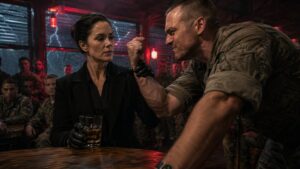
“You don’t get to wear his tags.”
He said it loudly enough for the booth behind Mara to hear. Loudly enough for June’s coffee pot to stop in midair. Loudly enough for the entire diner to understand that whatever this was, it had not come for privacy.
Rourke lifted one hand and pointed at her chest.
At the little flash of metal near her throat.
Mara did not move to cover it.
She did not ask what he meant.
That was the first thing that made people look twice.
A guilty person would have flinched. An innocent person would have protested. Mara only sat there with her hands empty now, palms resting near the mug, as if she had practiced this moment and still hated that it had arrived.
June Haskell set the coffee pot down.
“Captain,” Jonah said quietly.
Rourke did not look back. “Not now.”
Mara finally raised her eyes to him.
They were steady, but not cold. That bothered him more.
“You came early,” she said.
The old veteran at the counter turned all the way around.
Rourke’s finger stayed pointed. “You were expecting me?”
“I was expecting grief to run out of other places to go.”
A muscle jumped in his jaw.
Someone at the back booth whispered, “That’s Mara Vale.”
Someone else whispered, “The medic?”
Rourke heard it. Mara knew he heard it. The whole room heard everything now.
That was the trouble with small towns and public accusations.
Silence did not protect anybody.
It only made better walls for judgment.
Rourke leaned closer. “Take them off.”
Mara looked at the chain, then back at him. “No.”
The word was soft.
It landed harder than if she had shouted.
Rourke’s expression tightened into something almost satisfied, as if refusal gave him permission. He drew himself up, every inch the decorated captain, every inch the grieving brother.
“You ran from Glass River,” he said. “You vanished before the extraction point collapsed. You let men better than you carry the cost, and now you sit here wearing my brother’s name like you earned it.”
The waitress near the coffee machine stopped breathing through her mouth.
June’s hand moved once toward the counter phone, then stopped.
Mara noticed. So did Rourke.
“Don’t,” Mara said without looking at June.
June went still.
It was the first time Mara had asked anyone in that room for anything.
Rourke gave a short, humorless laugh. “Still giving orders?”
“No,” Mara said. “Remembering what they cost.”
Jonah’s left hand twitched.
Mara saw it.
So did he.
And something old shifted in his face, too small for Rourke to catch.
Rourke’s voice hardened. “Operation Glass River was classified. That’s the only reason you got to hide behind silence all these years.”
Mara’s fingers moved once toward the mug, then stopped before touching it.
“Classified,” she said, “is not the same as forgotten.”
“Then say his name.”
The room froze around the challenge.
Mara looked up at Rourke’s pointed hand, at the knuckle gone white, at the wedding ring he wore on a chain tucked beneath his own uniform collar. Not for Daniel. Someone else. Some life he had managed to build around the hole.
Then she looked him in the eye.
“Daniel Rourke.”
Rourke’s face flickered.
It was there and gone fast. The brother, not the captain.
Mara saw that too.
She wished she had not.
Part II — His Tags
Rourke had spent eight years believing anger was a form of loyalty.
It had kept him straight-backed through hearings that were not called hearings, through folded flags and official condolences, through handshakes from men who used phrases like operational loss and hostile conditions because they had never had to wash blood from under a fingernail with canteen water.
His younger brother Daniel had died at the extraction point.
That was what the report said.
Killed instantly during the collapse.
That was what Elias had repeated to their mother until she could sleep.
That was what he had told himself every night when the dark asked why he had left the southern road unsecured, why his last order before the radio died had been to hold position, why Daniel’s unit never made it to the ridge.
Killed instantly.
No suffering. No waiting. No asking why his brother had not come.
Then three weeks ago a retired logistics officer with liver spots on his hands and guilt in his throat had found Elias after a memorial dinner and said, “There was a medic. Vale. She came out with tags that weren’t hers.”
A week after that, a photo surfaced in a private veterans’ group.
Mara Vale sitting by the Copper Bell window, gray sweater, dark hair pulled back, dog tags visible at her collar.
Daniel’s dog tags.
Elias had stared at the photo until the names blurred.
Then he requested travel under the shape of routine review, brought Jonah because Jonah had been there and remembered almost nothing, and drove through the night until Bellweather woke under a weak, blue dawn.
Now he stood over Mara in a diner that smelled of bacon grease and cinnamon rolls, and she had said Daniel’s name like she still had the right.
“You should have left them in the ground,” Rourke said.
Mara’s face did not change, but something in her eyes folded inward.
“There wasn’t ground,” she said.
Rourke’s anger stalled for half a breath.
“What?”
“You said I should have left them in the ground. There wasn’t any.”
His hand lowered an inch, then came back up as if remembering its purpose. “Don’t play word games with me.”
“I’m not.”
“You ran.”
“No.”
“You disappeared from the extraction roster.”
“Yes.”
The answer stunned the room more than a denial would have.
Rourke’s mouth tightened. “At least you can admit that much.”
Mara looked past him for a moment, toward the pie case, toward the reflection of Jonah standing behind his captain with his damaged hand shaking now in small pulses.
“I disappeared from the roster,” she said. “That isn’t the same thing as running.”
Rourke stepped closer. The table edge nudged his thigh. The mug trembled slightly in its saucer.
“You don’t get to split words over my brother’s death.”
Mara’s voice sharpened for the first time. “And you don’t get to use his death as a weapon because grief gave you good aim.”
The old veteran at the counter whispered, “Jesus.”
June said, “Mara.”
Not warning. Not scolding.
Pleading.
Mara did not look away from Rourke.
He seemed taller when angry, but anger had begun to cost him. His certainty was still there, but it was working harder to hold its shape.
“You think this room saves you?” he asked.
“No,” Mara said. “I think you chose it because you needed witnesses.”
His eyes narrowed.
She went on. “If you wanted truth, you could have called. If you wanted Daniel, you could have written. If you wanted to punish someone and call it honor, a diner works better.”
Jonah inhaled quietly.
Rourke turned his head halfway. “Sergeant.”
Jonah straightened. “Sir.”
“Do you have something to say?”
Jonah looked at Mara.
For a second, the diner slipped away from him.
There was water.
Not enough to drown in, not at first, but enough to make every breath taste like rust. Flashlight beams cut across broken tile. Someone was counting. A woman’s voice, rough from smoke.
Pulse one-thirty. Pressure falling. Stay awake. Tell me your name.
He blinked.
The diner returned.
“No, sir,” he said.
But the lie sounded wrong even to him.
Mara heard it.
Rourke turned back. “You see? That’s what discipline looks like.”
Mara almost smiled.
It was not kind.
“No,” she said. “That’s what fear looks like when it’s been dressed correctly.”
Rourke’s face went white at the edges.
June moved out from behind the counter. She stopped at the end of the aisle, not close enough to interfere, close enough to be seen.
“Captain,” she said carefully, “this is still my diner.”
Rourke did not look at her. “Then you should know who you’ve been serving.”
“I do,” June said.
Mara closed her eyes once.
June’s voice softened, but it carried. “I know she fixes the sink when the plumber won’t come. I know she sits with Mr. Larkin when the VA sends another letter he can’t read without shaking. I know she pays cash and never lets anybody owe her comfort.”
“That doesn’t answer Glass River,” Rourke said.
“No,” June said. “It doesn’t.”
That honesty quieted everyone more than defense would have.
Mara opened her eyes.
“June,” she said.
The older woman held her gaze.
Mara shook her head once.
Do not save me from this.
June understood.
It cost her to step back.
Rourke saw the exchange and mistook it for weakness. “Even your friends know there’s something to answer for.”
Mara’s hand finally returned to the mug.
She did not lift it.
She only turned it slowly, so the handle faced away from her.
“There is,” she said.
Rourke leaned in.
Mara’s voice dropped. “Just not what you came here to hear.”
Part III — The Schoolhouse
Rourke’s laugh was quiet and ugly.
“Then enlighten me.”
Mara looked at the soldiers first, then at the civilians who had trapped themselves inside the silence. The waitress still held a pot of coffee no one wanted. A man near the window had his phone half-raised, not recording yet, not innocent either. June saw and gave him a look that made him put it down.
Mara appreciated that.
She still hated the room.
“Daniel didn’t die at the extraction point,” she said.
Rourke did not understand the sentence at first.
His face remained arranged around disbelief, but the words had reached him. They had entered under the uniform and found the brother.
“What did you say?”
Mara pushed back her chair.
The scrape of its legs on tile sounded too loud.
Rourke’s eyes followed her as she stood.
She was shorter than him by almost a head. Her sweater sleeve rode up when she moved, revealing pale burn scars along the inside of her wrist. Old scars. Rope-thin. Heat-made. She tugged the sleeve down by habit, then stopped herself.
No.
Let him see something.
Let him see one true thing.
“He didn’t die at the extraction point,” Mara said again. “He died six hours later in a schoolhouse north of the river.”
Rourke stared at her.
Behind him, Jonah’s face drained.
“North?” Jonah whispered.
Rourke rounded on him. “Quiet.”
But the word had already slipped out, and Mara heard the memory inside it.
She turned to Jonah. “You were in the east room.”
His lips parted.
Mara’s voice remained controlled. “Left shoulder wound. Nerve damage from the blast. You kept asking for a man named Becket.”
Jonah’s damaged hand curled tighter.
Rourke looked between them. “What is this?”
“The part that didn’t fit the report,” Mara said.
“There was no schoolhouse in the report.”
“No.”
“Daniel was killed instantly.”
“No.”
“You’re lying.”
Mara nodded once, almost gently. “I know why you need that.”
Rourke stepped forward so fast Jonah moved with him, instinctively, as if to stop him without knowing he meant to.
“Don’t you dare.”
Mara did not step back.
The diner seemed to narrow around them. The booths, the counter, the pie case, June’s hands pressed flat to her apron. All of it drew inward toward the tags beneath Mara’s collar.
Rourke’s voice lowered. “My brother would never abandon an extraction order.”
“He didn’t abandon anything.”
“He would never order a retreat without authorization.”
“He didn’t have authorization.”
“Then he wouldn’t do it.”
Mara’s face changed then.
Not anger.
Pain, sharp enough to look like anger from far away.
“Daniel had shrapnel in his lungs,” she said. “He had eight wounded men in a building taking water through the walls. Two radios were dead. One was transmitting nothing but static. The road south was burning. The north stairwell had collapsed. Your brother was not standing over a map making clean decisions.”
Rourke’s breath came harder.
“He was scared,” Mara said.
“Shut up.”
“He was furious.”
“I said shut up.”
“He was lucid enough to know that if I stayed with him, more men would die.”
The words hit Rourke like a hand to the chest.
For the first time, his finger dropped.
Only for a moment.
Then he raised it again, but lower now. Not at her face. At the tags.
“No,” he said. “Daniel wouldn’t ask that.”
Mara looked at the finger, then at him.
“He did.”
Rourke shook his head once. “You don’t get to make him smaller because it makes your story cleaner.”
Mara’s voice went thin. “I am not making him smaller.”
“Then don’t call him scared.”
“He was scared because he was alive.”
The diner held its breath.
Mara swallowed once.
“The dead get turned perfect because the living can’t bear the rest. Daniel was not perfect. He was bleeding into his own chest and cursing your name because he thought you’d come through the west door even though there wasn’t a west door anymore. He begged me not to cut his boot off. He asked if his hand was still attached. He made one joke so bad I remember hating him for making me laugh.”
Rourke’s eyes shone now, but nothing fell.
Mara had seen men cry without tears before.
It was worse.
“And then,” she said, “when he understood the building would not hold, he gave the only order left.”
Rourke’s mouth worked around a word that would not come.
Jonah spoke before him.
“What order?”
Mara looked at him.
Jonah seemed younger now. Not thirty-one. Not a sergeant. A wounded man in the dark, trying not to sleep because a stranger’s voice kept dragging him back.
Mara answered him, not Rourke.
“He told me to carry the living first.”
Jonah closed his eyes.
The memory came in broken pieces.
Cold hand on his face.
A light in one eye.
The taste of river mud.
A woman saying, Stay with me, Pike. Don’t you make me learn your name for nothing.
He had thought that voice belonged to a dream.
Now it stood in front of him with burn scars and Daniel Rourke’s tags under her sweater.
“It was you,” Jonah said.
Rourke turned slowly.
Jonah opened his eyes.
His captain was staring at him in warning.
But memory, once returned, had its own chain of command.
“It was you,” Jonah said again, to Mara.
Part IV — Witness
Rourke’s voice cut through the room.
“Sergeant Pike.”
Jonah flinched.
Not visibly enough for most people.
Mara saw it anyway.
Rourke did too, and shame flashed across his face before anger covered it.
“You were unconscious when they pulled you out,” Rourke said. “You said you didn’t remember.”
“I didn’t,” Jonah said.
“Then don’t start inventing things now.”
Jonah’s damaged hand shook harder. He closed it into a fist against his thigh.
“I remember numbers.”
Rourke stared at him.
Jonah’s voice was rough. “Pulse. Pressure. Names. Doses. She kept saying them. Like if she stopped counting, we’d disappear.”
Mara looked away.
That was the first time she looked ashamed.
Not when Rourke accused her. Not when he pointed. Not when the diner judged her.
Only when Jonah remembered her trying to keep the living measured against the dark.
He took one step toward her.
Rourke barked, “Pike.”
Jonah stopped, but he did not retreat.
“I remember someone putting tags in my hand,” Jonah said. “I couldn’t hold them. My fingers wouldn’t close. She pressed them into my palm anyway.”
Mara’s breath caught.
She had thought he was gone by then. Not dead. Never dead. But gone deep enough that words could not follow.
Jonah looked at Rourke.
“And she said, ‘If I don’t get him out, get his brother the truth.’”
The sentence did not echo.
It sank.
Rourke stood motionless, face stripped of command.
Mara reached instinctively toward the chain at her neck, then stopped before touching it.
Rourke noticed. His eyes followed the movement.
“You gave them to him?” he asked.
Mara did not answer.
Jonah did. “She tried.”
Rourke looked at him like betrayal had entered through a door he had been guarding his whole life.
“You were my witness,” Rourke said.
Jonah’s voice cracked. “I think I was hers.”
The diner changed then.
Not dramatically. No one gasped. No one cried out.
But the room’s weight shifted off Mara’s shoulders just enough for everyone to feel who had been carrying it.
Rourke looked around and seemed, for the first time, to notice the public he had chosen. June. The waitress. The old veteran. The trucker. The man who had almost used his phone. Faces turned toward him now not with admiration, not even with blame, but with the terrible expectation of people watching a man discover he has hurt the wrong person.
He turned back to Mara.
“Why didn’t you say something?”
It came out harsher than the question deserved because he could not yet make his voice small.
Mara looked tired.
That was all.
Not victorious. Not vindicated. Just tired in a way the room had no right to witness.
“Say it to whom?” she asked. “The board that already had a report? The officers who needed the timeline clean? Your mother at the funeral? You?”
Rourke swallowed.
“You could have found me.”
“I tried.”
His face tightened. “No.”
“Yes.”
“You did not.”
Mara’s eyes hardened. “I sent a letter through casualty affairs. It came back with half the page blacked out and a note telling me not to contact next of kin regarding classified operational matters.”
Rourke stared at her.
“I left a message with a chaplain at Fort Hollis. I called once from a pay phone outside a gas station in Nebraska and hung up when your mother answered because I could hear people in the background bringing casseroles into the house.”
Her voice almost broke there.
Almost.
“I was twenty-nine,” she said. “I had Daniel’s blood in the lines of my hands no soap would take out. I had eight living men and four dead ones in my head. And every official door I knocked on told me that silence was service.”
Rourke had no answer.
That was dangerous.
Men like him sometimes reached for anger when answer failed.
Mara knew it, so she gave him one last mercy before he could.
“I should have tried harder.”
Rourke closed his eyes.
The mercy landed worse than accusation.
Jonah looked down.
June wiped one hand over her apron and found flour there, though she had not baked since four that morning.
Rourke opened his eyes again.
“They told me he died instantly,” he said.
His voice was not loud now.
It was worse.
“They told me he died before the building went under.”
Mara said nothing.
“They told me there was no delay. No secondary position. No northern structure.”
Still nothing.
Rourke looked at her with something raw pushing through the discipline.
“The report is the only reason I forgave myself.”
There it was.
The thing under the thing.
Mara felt it enter the room and settle between them.
June looked down.
Jonah’s shoulders slumped as if he had been carrying the sentence too without knowing it.
Rourke’s hand rose once, not pointing now, just hovering near his own chest.
“I left the southern road unsecured,” he said. “I was told it didn’t matter. I was told the blast took them before any route mattered.”
Mara’s throat tightened.
She could have let him drown in that.
Some part of her, small and wounded and human, wanted to.
He had come into June’s diner in uniform. He had pointed at her like guilt had a body and he had found it. He had said Daniel’s name like she had stolen it.
But Daniel had not given her the tags so she could punish Elias with them later.
That had never been the promise.
Mara touched the chain.
Rourke watched her fingers.
“Don’t ask me for the whole account because you need a new place to put the blame,” she said.
His eyes lifted.
“This diner is not a courtroom,” Mara said. “And Daniel is not a weapon for you to swing at me.”
No one moved.
Rourke took the sentence without defending himself.
Then he said, very quietly, “Then tell me what he wanted.”
Part V — Carry the Living
Mara did not answer right away.
She looked at the mug first.
White ceramic. Brown coffee gone cool and untouched. A half-moon stain where a drop had run down the side and dried. Her hands had wrapped around it for nearly twenty minutes because holding something had kept them from remembering other things.
Tape torn with teeth.
Skin slick under gloves.
Daniel’s fingers catching her sleeve.
Not yet.
Don’t you leave yet.
Then later:
Go.
She drew the chain from beneath her sweater.
The tags came free with a soft metallic click.
Rourke stared at them.
Jonah stared too.
Mara had worn them under cotton, wool, raincoats, scrubs, thrift-store dresses, hospital gowns, and once under a bridesmaid dress when June’s niece had begged her to stand in after someone got sick. She had worn them so long that the weight had become less like a necklace and more like a second pulse.
Now the chain looked too thin for what it carried.
She unclasped it.
Her fingers did not shake until the tags were off.
Then they shook badly.
Rourke saw.
He did not look away.
Mara placed Daniel’s tags beside the untouched mug.
Metal against Formica.
A small sound.
A final one.
“Daniel knew the route was compromised before you did,” she said.
Rourke’s face altered, but he stayed silent.
“He heard it on a broken transmission. Not enough to call it in. Enough to know the southern road was not coming. Enough to understand that if he moved the worst wounded toward the extraction point, he would deliver them into fire.”
Rourke’s mouth opened, then closed.
“He held the schoolhouse because it bought time,” Mara said. “Not much. Thirty minutes at first. Then more because the rain got heavy and the smoke covered the courtyard.”
Jonah whispered, “The bell.”
Mara looked at him.
“There was a bell,” Jonah said. “Somewhere above us. It kept moving in the wind.”
Mara nodded once. “It rang every time the wall took a hit.”
Jonah pressed his fist to his side.
Rourke seemed to be listening now with his whole body, as if attention itself hurt.
“Daniel asked about you,” Mara said.
Rourke’s face broke for one second.
Mara kept going because stopping would be worse.
“He was angry you weren’t there. Then he was angry at himself for being angry. Then he asked me if you’d blame yourself.”
Rourke looked down at the tags.
“I lied,” Mara said. “I told him no.”
Something moved through the room, quiet and brutal.
Mara’s voice stayed steady only because she had spent eight years building it for this moment without knowing she had.
“He told me not to let you mistake command failure for personal damnation.”
Rourke closed his eyes.
“He used those words?” he asked.
“No,” Mara said. “He said, ‘Tell Eli not everything that goes wrong belongs to him.’”
Rourke covered his mouth with one hand.
Not to hide grief.
To hold himself together.
“He asked me to get you the truth,” Mara said. “Then he asked me to carry Pike.”
Jonah’s head bowed.
“And Becket. And Simms. And Alvarez. And two men I never got names for because they could no longer give them.” Mara’s eyes shone now, but her voice did not break. “He told me he could wait.”
Rourke dropped his hand.
Mara looked at him directly.
“He could not wait.”
The sentence struck clean.
No decoration. No mercy added. No cruelty either.
Just truth, after too many years under lock.
Mara continued. “I dragged Jonah first because he was closest to the door and still breathing. Daniel shouted at me the whole time to move faster. Then Becket. Then Simms. By the time I came back for Daniel, the east wall had shifted. He was pinned from the waist down. The water was higher.”
Rourke’s lips formed Daniel’s name without sound.
“He made me promise,” Mara said.
Rourke looked up.
“Not asked. Made. He said if I stayed, he would die watching me waste the only thing left he could give.” She touched the table edge with two fingers, as if steadying a memory that wanted to flood the room. “So I obeyed him.”
The word obeyed changed everything.
Rourke had come to accuse her of abandoning an order.
Instead, she had obeyed the last one Daniel ever gave.
Jonah wiped his face once with the heel of his hand.
June turned away, then turned back because turning away felt worse.
Mara looked down at the tags.
“I carried the living first,” she said. “That is what your brother asked of me. That is what I did. And I have hated him for it every day since.”
Rourke inhaled sharply.
Not because she had insulted Daniel.
Because he understood.
Love did not always end as tenderness.
Sometimes it ended as obedience you could never forgive.
For a long moment, no one spoke.
The old veteran at the counter lowered his head.
The waitress set the coffee pot down because her arm had begun to tremble.
The man by the window stared at his plate as if he had been caught trespassing in someone else’s grief.
Rourke looked at the tags beside the mug.
His pointing hand hung at his side now, useless.
“I called you a coward,” he said.
Mara did not answer.
“I said you ran.”
Still nothing.
“I came here in uniform.”
“Yes,” Mara said.
The word held him accountable without crushing him.
Rourke nodded once, but it looked more like impact than agreement.
“I don’t know how to apologize for that.”
Mara’s face softened by one degree. Not forgiveness. Not yet.
“Then don’t start with apology.”
“What do I start with?”
Mara looked at the empty seat across from her.
The booth where no one had sat all morning.
The place she had not admitted she had been keeping open.
“Start by listening.”
Part VI — The Empty Seat
Rourke removed his cap.
It was such a small thing that, in another room, it might have meant nothing. Here, it changed the air.
The uniform remained. The rank remained. The years remained. Daniel remained dead.
But the cap came off, and with it went the last shape of command he could still pretend to hold.
“May I sit?” he asked.
Mara did not say yes.
Not right away.
The diner waited, but not like before. Before, the silence had wanted a verdict. Now it seemed to understand that none of them deserved one quickly.
Jonah stepped back from behind Rourke.
Only one step, but it mattered.
He was no longer a wall.
He reached into his pocket, took out a folded bill, and set it on the counter near June.
“For the coffee,” he said.
June looked at the untouched mugs, then at the money.
“No charge,” she said.
Jonah left the bill there anyway.
“Then for the quiet.”
June’s eyes softened.
She did not touch the money.
The waitress moved first. She poured coffee for the trucker whose cup had gone empty ten minutes ago. The sound was ordinary enough to hurt. Forks resumed in cautious fragments. Someone cleared a throat. The man by the window pushed his phone deeper into his jacket pocket as if ashamed of the shape of his hand.
Life did not restart all at once.
It came back limping.
Mara looked at Rourke standing beside the booth with his cap held in both hands.
Eight years ago, Daniel had called him Eli.
Not Captain. Not sir. Not the rank that made grief stand straighter.
Eli.
Mara wondered when Elias Rourke had last heard his name without duty attached to it.
She slid into the booth.
Not away from him.
Across.
Rourke sat down slowly, like a man entering a room where the dead were already waiting.
The tags lay between them beside the white mug.
He did not reach for them.
Mara respected him more for that.
Jonah remained standing near the end of the table.
For a moment, he seemed unsure where he belonged. Behind his captain, beside the woman who had carried him, or somewhere outside the grief that had purchased his life.
Mara looked at him.
“You asked for Becket,” she said.
Jonah swallowed.
“He made it,” she added.
Jonah shut his eyes.
One tear escaped before he could stop it. He wiped it away quickly, embarrassed by its publicness, but no one in the diner punished him for it.
Rourke stared at the tags.
“Did Daniel suffer?” he asked.
Mara had known the question would come.
She had feared it more than the accusation.
There were lies people called kindness because they did not want to do the work of truth.
Mara had no strength left for those.
“Yes,” she said.
Rourke bent forward slightly.
Mara continued, quieter. “But not alone.”
The captain’s face tightened, and this time tears came.
Two of them. Silent. Uncontrolled. Human.
Mara looked away to give him the little privacy a public place could still offer.
June came to the table with a fresh pot. She did not ask if anyone wanted coffee. She filled Mara’s cup first, then the empty one across from her, then Jonah’s when he quietly pulled a chair from the next table.
Rourke looked at the filled cup before him like he did not know what to do with ordinary mercy.
June touched the edge of Mara’s saucer.
Just once.
Then she left them.
For a while, nobody spoke.
That was not the same as silence.
Silence was what had followed Mara for eight years, sat in the passenger seat of her truck, slept beside her, stood with her at grocery store aisles when someone whispered Glass River and looked away.
This was something else.
This was a room holding its tongue because the truth had finally become heavier than rumor.
Rourke picked up the dog tags at last.
Mara’s hand tightened under the table, but she let him.
He held them with both hands, thumb moving over Daniel’s stamped name.
“I thought if I found the person who failed him,” he said, “I could stop being the person who did.”
Mara watched him.
There it was. Not an apology. Not yet.
Something closer to the ground beneath one.
“You were his brother,” she said. “Not his god.”
Rourke bowed his head.
Jonah stared at Mara as if that sentence had reached him too.
Maybe all soldiers needed to hear it eventually.
Maybe all survivors did.
Outside, dawn had finished becoming morning. A school bus hissed at the corner. Someone laughed on the sidewalk, then quieted passing the diner window, sensing something inside without knowing what.
Rourke set the tags back on the table.
Closer to Mara than to himself.
She looked at them.
Then at him.
“They’re yours,” he said, voice rough. “Until you don’t need to carry them.”
Mara did not touch them.
Not yet.
The offer was not forgiveness. It was not absolution. It did not return Daniel to either of them.
But it changed the shape of the weight.
For eight years, she had carried Daniel’s tags because no one else could hear what they meant.
Now Elias Rourke sat across from her, stripped of certainty, holding a cup of coffee he had not earned and grief he could no longer aim.
Mara picked up her mug.
For the first time that morning, she drank.
The coffee was cold.
She swallowed it anyway.
Then she looked at Rourke and said, “Ask me about the joke.”
He blinked.
“What?”
“The bad one. The one Daniel made in the schoolhouse.”
Rourke’s mouth trembled, almost breaking and almost smiling.
Mara wrapped both hands around the mug again, but this time it was not a shield.
This time, it was only something warm trying to remember how to be warm.
“He said,” Mara began, and stopped until Rourke could meet her eyes.
The diner moved around them in soft clinks and low voices.
The tags remained on the table.
Daniel remained gone.
But for the first time, his brother was ready to hear him as a man.
Mara took one breath.
Then she gave him back the part of Daniel that had laughed in the dark.