The HOA Locked My Only Road Home—Then a Thirty-Year-Old Easement Changed Who Controlled the Gate
Chapter 1: The Morning Someone Chained the Road Home
Andrew Hall hit the brake hard enough to throw the coffee in his cup against the lid.
His pickup stopped less than two feet from the gate.
For nineteen years, he had driven through that opening without thinking about it. Sometimes before sunrise. Sometimes after dark. Sometimes with groceries in the passenger seat, sometimes pulling a small utility trailer, sometimes following a delivery truck toward the house at the back of the old property.
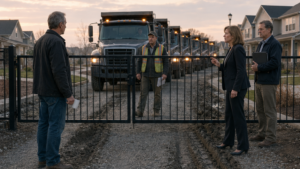
That Monday morning, a new steel chain looped through the gate and around the post.
A brass padlock hung from it.
Andrew stared through the windshield for several seconds before shutting off the engine.
Someone had fastened a laminated notice to the metal bars with two white zip ties. It carried the subdivision association’s name at the top and, beneath it, a short directive stating that access through the private community lane had been restricted by board action.
Andrew read it twice.
Then a third time.
The language was careful enough to sound official but vague enough to answer nothing. It referred to “unauthorized continued use” and instructed affected parties to use an alternate point of access.
Andrew looked past the gate at the narrow gravel lane running between the subdivision lots before bending toward his truck window to look back at the road behind him.
Alternate point of access.
He almost laughed.
His house sat behind the newer subdivision, on what remained of the acreage his family had divided decades earlier. The gravel lane had always been the practical route in and out. The other edge of his parcel met rough ground and a drainage cut that no ordinary vehicle could cross without construction.
He got out.
The chain was new. The padlock was new. Whoever had installed them had wrapped the links tightly enough that the gate barely moved when Andrew tested it.
He took out his phone and photographed the chain, the post, the notice, and the road beyond.
Then he called the HOA office.
The manager answered on the fourth ring.
“This is Andrew Hall. I’m standing at the rear access gate.”
There was a pause.
“Yes, Mr. Hall.”
That answer bothered him more than confusion would have.
“So you know what I’m talking about.”
“Yes.”
“Who locked it?”
“The board authorized the restriction.”
“When?”
“Last night.”
Andrew looked again at the laminated paper.
“There was a board meeting last night?”
“A special session.”
“I wasn’t notified.”
“It was a board session, not a membership meeting.”
“And the board voted to block the road to my property?”
“The board voted to restrict nonresident vehicle access through association-maintained property.”
Andrew rubbed his thumb against the edge of his phone.
“I’ve lived back here nineteen years.”
“I understand.”
“No, I don’t think you do. My truck is sitting against your gate because this is the road to my house.”
“The board’s position is that your use has been permitted as a courtesy.”
Andrew went still.
“A courtesy.”
“That’s the language I was given.”
“Who gave it to you?”
Another pause.
“Brian Carter.”
Andrew knew Brian. Everybody along the subdivision edge did. HOA president for three years. Organized. Polished. Always had a folder tucked under one arm at meetings and a way of talking that made provisional decisions sound permanent.
Andrew had disagreed with him before over gravel grading and delivery trucks, but nothing serious enough to remember past dinner.
“Tell Brian to call me.”
“He’s aware.”
“That isn’t what I asked.”
“I can let him know.”
Andrew ended the call before his temper did something unhelpful.
He stood beside the truck and looked toward his property. From the gate, the roof of his house was hidden behind trees. Beyond the ditch to his left, newer homes lined the subdivision road with clipped lawns, privacy fences, mailboxes in matching stone columns.
His land had been there first.
That thought came quickly and, because it came quickly, Andrew distrusted it.
Being there first did not automatically make him right.
But locking a man out of his own driveway without speaking to him first did not feel much like careful governance either.
He drove backward until he could turn around.
For the next hour, he tried the routes he already knew would not work.
At the west edge of his parcel, an old farm track disappeared into brush before reaching a steep drainage channel. At the north end, a strip that looked like access on aerial maps narrowed between two properties and ended behind a retaining wall installed years earlier.
He parked, walked the distance, and took photographs.
No truck was getting through there.
Not safely. Not legally. Not without building something that did not exist.
By ten-thirty, he was back at the gate.
A second sheet of paper had been tucked beneath the first.
This one was addressed to him.
Formal notice.
It instructed Andrew to discontinue use of the community lane immediately and warned that removing the lock, cutting the chain, or entering through the gate without authorization could be treated as interference with association property.
He read the warning slowly.
The first notice had irritated him.
The second one changed something.
This was not somebody overreacting to a complaint and expecting the problem to disappear by lunchtime. Someone had drafted this, approved it, printed it, and come back to attach it after Andrew’s call.
He photographed that too.
A white SUV slowed on the subdivision side of the gate.
Kathleen Adams was driving. She lived in the corner house nearest the lane, the one with the tall wooden fence and a side yard that bordered the gravel.
She lowered her window.
“Andrew.”
“Kathleen.”
Her eyes went to the chain, then back to him.
“I heard there was a problem.”
“I’d say that depends which side of the gate you’re standing on.”
She winced slightly.
“I didn’t know they were locking it this morning.”
“But you knew about the vote?”
“I knew they were discussing access.”
Andrew waited.
Kathleen tightened both hands on the steering wheel.
“There have been complaints. Trucks. Dust. People using that lane too fast.”
“People?”
“Deliveries. Contractors. I don’t know who all.”
“My deliveries.”
“I didn’t say you were speeding.”
“Then why am I the one locked out?”
Kathleen looked toward the houses behind her.
“There was an incident with a kid on a bike. Brian’s been under pressure to do something.”
Andrew had not heard about that.
“Was anybody hurt?”
“No. But it was close.”
That mattered.
He did not want it to.
“Then put up a speed sign,” he said. “Call me. Tell drivers to slow down. Don’t chain the road to my house.”
“I’m not saying this was handled right.”
“You voted for it?”
“I’m not on the board.”
“That wasn’t the question.”
Her face answered before she did.
“I told Brian I supported restricting through traffic.”
Andrew nodded once.
Kathleen looked uncomfortable.
“I thought you had another entrance.”
“So did the board, apparently.”
He stepped away from her window.
At noon, Brian finally called.
His voice was calm.
“Andrew, I understand you’re upset.”
“I’m not interested in whether you understand my mood. I’m interested in why you chained my road.”
“It isn’t your road.”
There it was.
Andrew leaned against the truck.
“What exactly do you think it is?”
“Association-maintained access inside the development.”
“I use it to reach my parcel.”
“And the association has allowed that.”
“Allowed.”
“For years.”
Andrew stared at the padlock.
“On what document are you basing that?”
Brian hesitated only slightly.
“We have the subdivision plat, road maintenance records, and the board’s authority over common property.”
“Do those records say my access can be revoked?”
“They establish association control.”
“That wasn’t what I asked.”
Brian’s voice hardened.
“We can go in circles on the phone, or you can come to the meeting tonight. I’ve put it on the agenda so everyone hears the same explanation.”
“Everyone?”
“There’s already interest.”
Andrew almost said he had no intention of being paraded in front of neighbors over a road he had used since before many of them bought their homes.
Instead, he looked at the chain again.
“All right.”
“Seven o’clock.”
“Bring whatever you relied on.”
Brian went silent.
Then he said, “I’ll have the association file.”
The call ended.
Andrew stood alone at the gate with his truck on the wrong side of it.
At seven that evening, Brian intended to explain publicly why Andrew had no right to use the road.
Andrew intended to find out whether he could prove it.
Chapter 2: Thirty Neighbors Heard Him Call It a Courtesy
“The board’s decision is final unless new information changes the underlying facts.”
Brian Carter said it before Andrew had taken his seat.
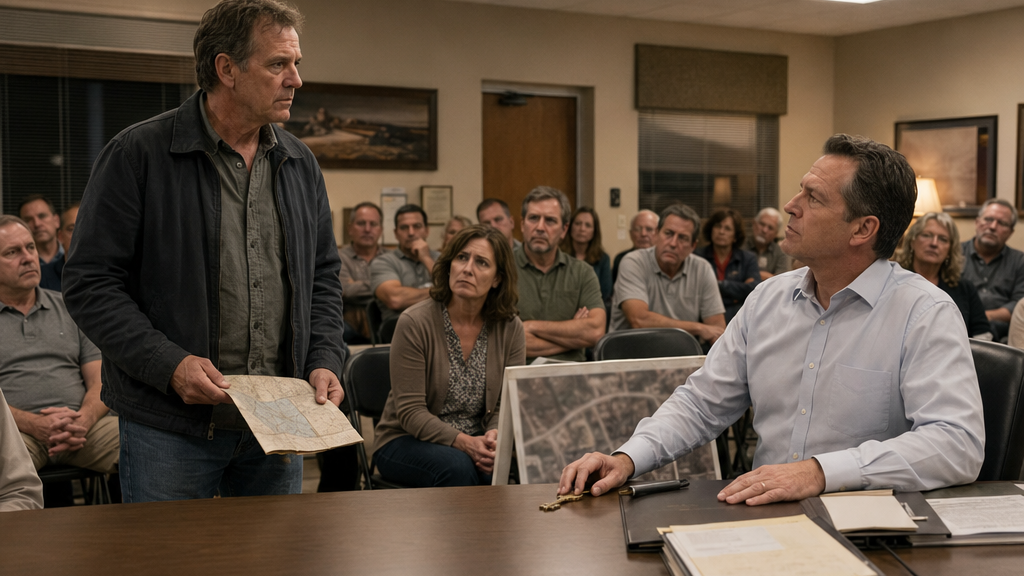
Nearly thirty residents filled the HOA meeting room. Folding chairs had been added along the back wall, and two people stood near the doorway. Andrew recognized most of the faces, though he knew only a handful well enough to call.
Brian sat behind a long table with two board members and the manager. A thick folder lay in front of him.
Beside it sat a small brass key.
Andrew recognized it immediately.
The gate key.
He took a seat in the second row.
Brian continued.
“The purpose tonight is not to relitigate the entire board vote. It is to explain why access was restricted and allow Mr. Hall to present any information he believes the association has overlooked.”
That phrasing made Andrew sound like the visitor.
A projector showed a subdivision plat on the wall.
Brian stood.
“The lane in question lies within property maintained by the association. For many years, Mr. Hall has been permitted to use that lane to access property outside the association boundary.”
“Permitted by whom?” Andrew asked.
Brian looked at him.
“I’ll give you time.”
“I’m asking because you just used the word.”
A few people shifted.
Brian kept his expression neutral.
“The arrangement predates the current board.”
“Then who granted permission?”
“As far as our records show, it was treated as a courtesy arrangement.”
The word landed differently in a room full of people.
Courtesy.
Andrew could feel attention turning toward him.
Brian pointed at the projected plat.
“The board has received repeated concerns regarding vehicle traffic, delivery trucks, dust, and safety near the lane. After reviewing the association’s obligations, we voted to limit vehicle access to residents, emergency services, and authorized vendors.”
“And I use what road instead?”
Brian clicked to another image.
A thin property line appeared near the rear of Andrew’s parcel.
“The board understands there is potential access from the western side.”
Andrew leaned forward.
“Potential?”
“That is outside our jurisdiction.”
“There is a drainage cut there deep enough to swallow your front bumper.”
A man near the wall chuckled, then stopped when Brian glanced over.
Brian said, “How you develop access to your property is not an HOA responsibility.”
Andrew felt heat move into his face.
“You chained the only existing road and now you’re saying I should build another one.”
“We’re saying the association is not obligated to continue an informal accommodation forever.”
There it was again.
Not shouted. Not dramatic. Almost worse because of that.
Brian sat back slightly, as if the essential part had now been settled.
A woman in the back whispered something to her husband.
Andrew looked around the room. No one met his eyes for long.
He understood what they were seeing: one man from outside their association asking to keep driving through property they paid to maintain.
Brian had a map on the wall.
Andrew had habit.
Nineteen years of it, but habit nevertheless.
Kathleen raised her hand.
Brian nodded.
“I want to be clear about something,” she said. “This isn’t personal against Andrew. But those trucks come past our side yards. We’ve had dust all summer. And a child almost got hit.”
Several heads nodded.
Andrew turned toward her.
“What happened?”
Kathleen folded her arms.
“A delivery van came through too fast while a boy was riding near the bend.”
“Was it delivering to me?”
“I don’t know.”
“Then why does locking me out solve through traffic?”
“Because most of the nonresident traffic goes back toward your place.”
That was probably true.
Andrew hated that too.
He looked toward Brian.
“Did anybody call me after the near miss?”
“The board addressed the broader issue.”
“That means no.”
Brian’s jaw tightened.
“The meeting isn’t about whether communication could have been better.”
“It should be.”
One of the board members leaned toward the microphone.
“Mr. Hall, the president is trying to keep this orderly.”
Andrew sat back.
His first impulse was to tell them exactly what he thought of their order.
Instead, he reached into the folder he had brought from home.
Inside was an old photocopy of a parcel map. Not a deed. Not anything he trusted as proof. Just a family paper he had found before coming over, folded twice and marked in pencil near the old acreage.
He laid it on the edge of the board table.
Brian glanced at it.
“What’s that?”
“An older parcel map.”
“Is it recorded?”
“I don’t know.”
A few people murmured.
Brian’s confidence returned.
“Then I’m not sure what relevance it has.”
“Maybe none.”
Andrew flattened one curled corner with his hand.
Then he pointed to the newer subdivision plat on the projector screen.
“This is what you relied on?”
“The plat and association records, yes.”
“Current plat.”
“Yes.”
Andrew looked at the three board members.
“One question.”
Brian’s hand rested beside the brass key.
Andrew nodded toward it.
“Before you voted to chain that gate, did anyone review the original conveyance for the acreage behind this development?”
The room became quiet enough for Andrew to hear the projector fan.
Brian did not answer immediately.
Andrew waited.
One of the other board members opened a folder.
The manager looked down.
Brian finally said, “We reviewed the documents in the association file.”
“That isn’t what I asked.”
“We reviewed the relevant property materials.”
“The original conveyance?”
Brian’s mouth tightened.
“I don’t know that we have that document.”
Andrew felt the first change in the room.
Small.
Nothing like victory.
Just uncertainty.
“Then how do you know my access was a courtesy?”
Brian leaned forward.
“Because there is no easement shown on the association plat.”
“Does the plat create my parcel?”
“No.”
“Does it predate my parcel?”
“No.”
“So the map you checked came later.”
Brian’s voice sharpened.
“That does not mean an easement exists.”
“I didn’t say it did.”
Andrew picked up the old map.
“I said you locked the gate before checking.”
Kathleen spoke from behind him.
“Andrew, if you had some legal right, why haven’t you ever shown anybody?”
The question struck harder than Brian’s.
Because Andrew did not have a good answer.
He had never needed one.
When the subdivision had first gone in, the developer knew about his access. When management companies changed, people still waved him through. When the first gate was installed years ago, someone gave him a key without paperwork.
He had accepted continuity as proof.
“That’s fair,” he said.
Kathleen looked surprised.
Andrew continued.
“I don’t know tonight whether there’s a recorded right or not. I know my family used that lane before this HOA existed. I know I’ve used it every day for nineteen years. And I know none of you checked the old deed before putting a chain across it.”
Brian pushed his chair back slightly.
“You’re making this sound reckless.”
“I’m describing the order you did things in.”
The president gave a short, humorless laugh.
“If you think there’s an easement, bring one.”
Andrew heard the challenge in it.
So did everybody else.
Brian picked up the brass key and turned it once between his fingers.
“Until then, the restriction remains.”
The meeting moved on after that, but Andrew barely heard the next agenda item.
The embarrassment had not disappeared.
If anything, it had become cleaner.
He had admitted in front of thirty people that he could not prove his own claim.
But Brian had admitted something too.
The board had never checked the oldest record.
Outside, Andrew walked toward his truck under the parking-lot lights.
Kathleen came out behind him.
“I wasn’t trying to embarrass you.”
“I know.”
“I really did think you had another road.”
“So did I, once.”
She frowned.
“What does that mean?”
“Nothing yet.”
His phone buzzed before he reached the door.
Anthony Williams.
Andrew answered.
His brother did not bother saying hello.
“You asked me earlier about the old back road.”
“Yeah.”
“I’ve been thinking.”
Andrew stopped.
Anthony’s voice had the uncertain sound it took on whenever family history collided with paperwork.
“Dad had a closing box. Brown metal thing. He kept tax receipts, surveys, all that.”
“I remember it.”
“There was something in there about access.”
Andrew looked back through the clubhouse windows. Brian was still inside, talking with two residents.
“What kind of something?”
“I don’t know. Easement, right-of-way, whatever they called it.”
“Recorded?”
“I couldn’t tell you.”
“Which property?”
“The twelve acres. Before everything got split.”
Andrew gripped the phone tighter.
“You’re sure?”
“No. I’m telling you what I remember.”
“That’s not the same thing.”
“I know.”
Anthony went quiet.
Then he added, “But Dad used to say nobody could landlock the back piece. I always thought he meant because everybody knew everybody.”
Andrew looked toward the dark line of the gravel lane beyond the houses.
“What if he didn’t?”
Chapter 3: The Clause Nobody Had Bothered to Read
The brown metal box was under a shelf in Andrew’s utility room, behind two paint cans and a broken sprinkler head he had been meaning to throw away for years.
He dragged it onto the workbench Tuesday morning and found the hinge stiff with rust.
Inside were forty years of the kind of papers families keep because no one knows which ones can safely be discarded.
Tax receipts.
Closing statements.
Old insurance documents.
A hand-drawn sketch of the original acreage.
Andrew sorted for nearly an hour before finding an envelope with his father’s handwriting across the front.
PROPERTY DIVISION.
Anthony had remembered a handshake agreement.
The papers inside suggested something more complicated.
Andrew spread them across the bench.
The original acreage had been acquired in 1987. Later documents showed portions sold or transferred over time, eventually leaving the rear parcel where Andrew now lived.
A photocopied deed referenced access.
Not clearly enough for Andrew to trust his own reading.
He found one phrase typed into the legal language:
permanent easement for ingress and egress.
Andrew read it again.
Then he sat down.
The gate was visible through the utility-room window if he leaned slightly to the right.
From this distance, the chain was only a dark line across the opening.
He called Anthony.
“You were wrong.”
“That sounds familiar.”
“It wasn’t just a handshake.”
Silence.
“What did you find?”
“A deed reference. Permanent easement. Ingress and egress.”
Anthony breathed out.
“Well.”
“Don’t say ‘I told you so.’”
“I wasn’t going to.”
“You were thinking it.”
“I was thinking Dad hated leaving things to chance more than we remembered.”
Andrew looked down at the paper.
“This copy doesn’t tell me enough. I need the recorded instrument.”
“You going to call that HOA guy?”
“Not yet.”
That surprised Anthony.
“You’ve got what you need, don’t you?”
“No. I’ve got a photocopy in a rusty box.”
Andrew folded his arms.
“Last night I criticized them for acting before checking. I’m not doing the same thing from the other direction.”
By late morning, he was at the county records office.
The clerk took the reference numbers Andrew had copied down and searched the index.
He watched her screen without understanding half of what appeared.
Then she stopped.
“There.”
Andrew leaned closer.
The easement was not just mentioned in family paperwork.
It had been recorded.
The clerk pulled the older instrument and a related deed from the archive system.
Andrew read slowly.
The language granted a permanent appurtenant easement for ingress and egress benefiting the rear parcel and burdening a defined strip across the original property.
“Appurtenant means it stays with the land?” he asked.
The clerk gave him a cautious smile.
“I can tell you how it’s indexed. I can’t give legal advice.”
“Fair.”
“But yes, you’ll want an attorney to explain the effect.”
Andrew requested certified copies.
While the printer worked, he looked again at the legal description.
Numbers.
Bearings.
Distances.
Nothing that looked like the narrow lane he had driven that morning.
The clerk placed the pages on the counter.
Andrew pointed.
“Is there a map attached?”
“Not to this instrument.”
“So how wide is this?”
She looked at the description.
“You’d need somebody qualified to plot it.”
Andrew left with less certainty than he had expected.
The easement existed.
That should have felt like the whole answer.
Instead, he had discovered that the answer was written in measurements he could not visualize.
He called Susan Moore from the parking lot.
She had handled a boundary issue for someone Andrew knew several years earlier. Her office was fifteen minutes from the courthouse, and she agreed to look at the documents that afternoon.
Susan read without speaking for several minutes.
Andrew sat across from her desk.
Finally she tapped the first page.
“This is real.”
“That’s good.”
“It’s significant.”
“Better.”
She gave him a look.
“Don’t celebrate yet.”
Andrew stopped smiling.
Susan turned the certified deed toward him.
“This easement benefits your parcel. It was recorded. The language says it runs with the land.”
“So they can’t lock me out.”
“Probably not in the way they did, assuming there hasn’t been a later release, relocation agreement, abandonment issue, or some other instrument affecting it.”
Andrew frowned.
“You just put four exits on what sounded like a straight road.”
“That’s what lawyers are for.”
She pulled the current subdivision plat closer.
“Do you have a full title history?”
“No.”
“We get one.”
“Fine.”
“And a surveyor.”
Andrew glanced at the plat.
“I thought this was about whether the easement exists.”
“It is. But existence is only the first question.”
Susan laid a ruler across the newer map.
“Your family document describes a corridor using old bearings and monuments. This subdivision came later. The traveled gravel lane today may not occupy the exact legal corridor.”
Andrew leaned forward.
“What are you saying?”
“I’m saying the road you drive and the easement recorded in 1987 may overlap, but they are not necessarily identical.”
She traced a line along the edge of several lots.
Andrew watched where her finger went.
Kathleen’s property.
Then the next yard.
Then a strip beside the subdivision parking area.
“How wide?” he asked.
Susan checked the deed again.
“Thirty feet.”
Andrew thought he had misheard.
“The lane isn’t thirty feet.”
“The worn surface isn’t.”
He sat back.
For the first time since finding the deed, vindication gave way to something colder.
Thirty feet was not just a road.
Thirty feet touched fences.
Landscaping.
Possibly pavement.
Possibly structures he had passed for years without ever imagining they sat inside anything connected to him.
Susan noticed his expression.
“You see the problem.”
“I see several.”
“Good.”
“That doesn’t sound good.”
“It means you’re not walking in here thinking one old document automatically makes every later decision disappear.”
Andrew looked at the certified copy.
“What happens next?”
“I confirm the chain of title. Then we have the legal description plotted.”
“And Brian?”
“I’ll send notice once I know exactly what I’m asserting.”
Andrew picked up the document.
Yesterday, Brian had challenged him to produce an easement.
Now Andrew had one.
But the paper in his hand had not simply reopened his gate.
It had drawn a thirty-foot question through the middle of a neighborhood.
Susan tapped the subdivision plat one last time.
“If this description lands where I think it does, Andrew, your HOA problem is about to become four homeowners’ property problem too.”
Chapter 4: Thirty Feet Was Wider Than Anyone Expected
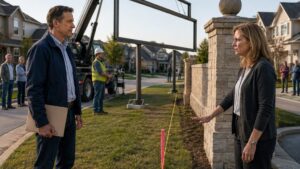
The first orange survey stake went into the ground six feet inside Kathleen Adams’s fence.
Kathleen stared at it as if the surveyor had driven it through her kitchen floor.
“That can’t be right.”
The surveyor did not argue. He checked the instrument again, walked back toward the lane, then returned with the rod.
Andrew stood on the gravel shoulder with Susan beside him.
The locked gate was visible thirty yards away.
The chain still hung through the bars.
Brian had not removed it after receiving Susan’s letter.
Kathleen folded her arms.
“My fence has been there twelve years.”
“I know,” Andrew said.
“You’ve driven past it twelve years.”
“I know that too.”
“Then how can you suddenly say six feet of my yard is part of your road?”
“I’m not saying that.”
She pointed at the stake.
“That says it.”
Susan stepped in before Andrew answered badly.
“The stake identifies the recorded easement corridor. It does not automatically mean Andrew intends to use every foot of it.”
Kathleen gave a short laugh.
“That is not very comforting.”
Andrew understood.
For two days he had imagined the survey as the moment everything became simple.
A licensed professional would mark the legal line. Brian would see it. The chain would come off.
Instead, the first mark turned his private dispute into Kathleen’s property problem.
The surveyor moved farther along the corridor.
Another stake landed near a hedge.
A third fell beside a concrete parking pad serving the common area.
By noon, a line of orange caps stretched through the neighborhood edge like a question no one had known to ask.
Andrew followed the surveyor as he worked.
“How certain are you?”
The man adjusted his equipment.
“About the record description? Very.”
“And where it lands?”
“That’s what I’m establishing.”
Andrew looked at Kathleen’s fence again.
“Thirty feet.”
“Thirty.”
“The traveled lane is maybe fourteen.”
“Depends where you measure.”
Andrew rubbed a hand over his mouth.
Susan had warned him.
The easement protected passage.
It did not promise that everyone who had built around the lane for thirty years had understood exactly where the legal strip sat.
The surveyor called him over.
“Here’s your centerline reference.”
He pointed from one newly set stake across the gravel to another.
Andrew followed the imaginary line.
It cut across part of the HOA fence at the bend.
Not just Kathleen’s fence.
The association’s.
The same black metal section that funneled vehicles toward the gate was sitting inside the easement.
Farther down, white paint marked the edge of a parking area.
“That too?” Andrew asked.
The surveyor nodded.
“Part of it.”
“How much?”
“Enough that parked vehicles could obstruct the legal corridor.”
Susan took photographs.
Andrew felt the vindication before he could stop it.
There it was.
Brian had put a chain across a gate while association improvements already occupied the same recorded easement.
For one clean second, Andrew wanted Brian standing beside him.
He wanted him looking at the stakes.
He wanted him to explain the word courtesy again.
Then Kathleen spoke behind him.
“If you enforce all thirty feet, what happens to my fence?”
Andrew turned.
Her anger had changed.
She looked frightened.
Not frightened of him exactly.
Of consequences.
“My husband built that fence after we bought the house. We had HOA approval. We submitted the plan.”
Susan said, “That is something the association will need to address.”
Kathleen shook her head.
“No. I’m asking Andrew.”
Andrew looked from the fence to the stakes.
“I don’t know yet.”
“You could make us move it.”
“I said I don’t know.”
“But you could.”
Susan answered carefully.
“The existence of an easement can limit what remains in the corridor. That doesn’t mean every foot has to be cleared if reasonable access can be protected another way.”
Kathleen looked at Andrew.
“So you get to decide what reasonable means?”
“Not by myself.”
It came out sharper than he intended.
Kathleen stepped back.
Andrew immediately regretted it.
He had spent three days furious that the board had treated his home access like a technical inconvenience.
Now Kathleen was hearing that a technical description might run through land she had considered hers for twelve years.
Being right did not make her fear foolish.
The surveyor moved toward the gate.
Andrew followed him.
The last stake went down near the post where the chain was wrapped.
The line was unmistakable now.
The gate sat directly across the easement corridor.
Andrew photographed the stake with the locked gate behind it.
For the first time, he possessed something Brian could not dismiss as memory or habit.
A deed.
A county record.
A survey.
Still, Andrew did not feel the relief he expected.
Susan called Brian from the lane.
She put the phone on speaker only after identifying herself and asking permission to discuss the matter with Andrew present.
“The field survey confirms a thirty-foot recorded easement benefiting Mr. Hall’s parcel,” she said. “Several association improvements appear to encroach into the corridor, including a fence segment and part of the paved parking area.”
Brian’s answer came quickly.
“We dispute your interpretation.”
“The surveyor is working from the recorded instrument.”
“We’ll have our own review.”
“That’s appropriate. In the meantime, the gate is obstructing documented access.”
“The gate stays until the board’s counsel responds.”
Susan’s expression did not change.
“I sent a deadline for voluntary access restoration.”
“I saw it.”
“It expires Friday.”
“Then I suppose we’ll speak Friday.”
The call ended.
Andrew stared at the phone.
“He knows.”
“Yes.”
“And he’s leaving it locked.”
“Yes.”
“Why?”
Susan put her phone away.
“That is no longer a surveying question.”
Friday afternoon passed without a response from HOA counsel.
Instead, the manager emailed Susan a short statement that the board was maintaining the restriction pending further review.
Andrew read it twice at his kitchen table.
He looked out toward the distant gate.
For days he had imagined the stakes as proof strong enough to end the argument.
They had done the opposite.
They had widened it.
The next morning, Kathleen called.
Her voice was controlled.
“I want to show you something.”
“What?”
“The complaints Brian used before the vote.”
Andrew was silent.
Kathleen continued.
“I supported him because I thought I knew what he was responding to.”
“And now?”
“Now I’m not sure he told us everything.”
Chapter 5: The Safety Complaint Brian Never Fully Explained
Kathleen had printed the emails and arranged them across her dining table in date order.
Andrew recognized some of the names but did not comment.
There were complaints about dust.
A delivery truck that had backed badly at the bend.
Two reports of vehicles moving too fast.
Then he found the one Kathleen had mentioned at the gate.
A child on a bicycle had entered the lane as a delivery van came around the curve.
No collision.
No injury.
But the description was close enough that Andrew stopped reading for a moment.
Kathleen watched him.
“That’s why I supported restricting traffic.”
Andrew nodded.
“I probably would have supported doing something too.”
She looked surprised.
“Then why are we fighting?”
“We’re not fighting over whether trucks should slow down.”
He tapped the email.
“We’re fighting over whether Brian can lock me out of my house to solve it.”
Kathleen sat across from him.
“That’s what I’m starting to understand.”
She slid another set of pages toward him.
Meeting minutes.
Andrew read the section she had marked.
A board member had proposed sending the access issue to association counsel before any physical restriction was installed.
The motion had been deferred.
Three days later, Brian authorized the gate lock.
Andrew looked up.
“Why was legal review deferred?”
Kathleen shook her head.
“That’s what bothered me.”
“Were you at that meeting?”
“No. Brian summarized it afterward. He said the board had confirmed control of the lane.”
Andrew returned to the minutes.
“That isn’t what these say.”
“No.”
He read farther.
The board had discussed liability, homeowner complaints, and pressure to act before another incident occurred.
Nothing about the original deed.
Nothing about the easement.
Nothing establishing that Andrew’s use was legally revocable.
A sentence near the bottom caught him.
The president recommended immediate access control pending later legal clarification.
Andrew sat back.
“He knew there was a legal question.”
Kathleen looked toward the window.
“I think he knew there might be one.”
“That’s enough.”
“For you.”
Andrew looked at her.
Kathleen’s voice tightened.
“I’m not defending the chain. But Brian had people calling him every week. Somebody’s child almost got hit. Residents were asking what they paid dues for if the board couldn’t control traffic on its own roads.”
Andrew said nothing.
“He told us he needed something visible,” Kathleen continued. “A gate restriction. Enforcement. Something that showed the complaints weren’t being ignored.”
The word visible stayed with Andrew.
The chain had not just been a barrier.
It had been proof of action.
Brian had needed residents to see him controlling the problem.
Andrew felt some of his anger shift shape.
Not disappear.
Brian had still made the choice.
But Andrew could finally see the path that led to it.
A frightened parent.
Complaints.
A board president expected to act.
A legal question that would take time.
Then the temptation to act first and verify later.
Kathleen gathered the emails into a stack.
“I should have asked more questions.”
“So should I.”
She frowned.
Andrew stared at the survey stake visible beyond her fence.
“For years, whenever someone complained about the lane, I figured they’d eventually learn it had always been used that way.”
“You knew about the easement?”
“No.”
“But you knew your family had some kind of arrangement.”
“I knew we used it.”
“That isn’t the same.”
“No.”
The admission bothered him because it sounded too much like the question Kathleen had asked at the meeting.
If Andrew believed access mattered enough to defend now, why had he never made sure the people maintaining the road understood where that right came from?
He had relied on everybody remembering a history most of them had never lived.
Anthony arrived at Andrew’s house that afternoon with another folder.
He set it on the kitchen counter.
“I found maintenance receipts.”
Andrew opened it.
Gravel invoices.
Equipment rental.
Old handwritten notes.
Some paid by their father.
Some by neighboring owners.
No consistent agreement.
“This is a mess.”
Anthony leaned against the counter.
“It worked.”
“It worked when four people knew each other.”
Anthony shrugged.
“That’s how things were.”
“And then you sold pieces.”
“We both did.”
Andrew looked up.
Anthony’s expression became defensive.
“We didn’t create that subdivision.”
“No. But we never cleaned up the access paperwork either.”
“There was an easement.”
“An easement says I can get through. It doesn’t tell anybody who pays for gravel, who trims the ditch, what speed delivery trucks should go, or whether somebody can put a gate there.”
Anthony looked at the invoices.
“Dad never worried about that.”
“Dad knew everybody using it.”
Silence settled between them.
Andrew had spent the week thinking the HOA’s failure was simple: they had not checked the old records.
His family had done something quieter.
They had trusted old relationships to explain what the records did not.
Now strangers were inheriting the ambiguity.
The next HOA meeting was smaller.
Brian stood near the front rather than sitting behind the table.
He looked tired.
Andrew noticed that before he noticed anything else.
Brian opened with the safety complaints.
He described the near miss involving the child and the pressure the board had been receiving.
“This was not about targeting Mr. Hall,” he said. “It was about controlling a growing traffic problem.”
Andrew raised his hand.
Brian nodded.
“Then why did you order the lock after legal review was proposed?”
The room went still.
Brian’s eyes moved toward Kathleen.
She did not look away.
“We had an immediate safety concern.”
“You also had an unresolved property question.”
“We had association records showing control.”
“You had records you knew might be incomplete.”
Brian’s jaw tightened.
“We had to make a decision.”
“And you made the one that looked decisive.”
A board member shifted in his seat.
Brian said, “That’s easy to say now that you found a thirty-year-old document nobody had raised before.”
Andrew felt the hit because it was partly fair.
“You’re right.”
Brian blinked.
Andrew continued.
“I should have raised it years ago. I should have known what my own deed said. That doesn’t make the chain legal.”
Brian’s shoulders relaxed slightly, then hardened again.
“No. But it does mean the board isn’t the only one responsible for this confusion.”
“I didn’t say it was.”
For the first time, the argument had nowhere simple to go.
Brian looked down at his papers.
Then he said, “The board is willing to discuss continued access if Mr. Hall agrees to relinquish the unused portion of the thirty-foot easement and accept a narrower recorded corridor.”
Susan, seated beside Andrew, did not move.
Andrew did.
He leaned forward.
“How narrow?”
“Enough for ordinary residential access.”
“And who decides that?”
“Our counsel can propose dimensions.”
Susan spoke.
“Relinquishment is permanent.”
Brian nodded.
“So is the uncertainty residents are being asked to live with.”
Andrew understood the offer.
Give up part of the legal right.
Get the gate open.
Reduce the impact on Kathleen and the other properties.
It was not absurd.
That made it harder.
Susan closed her folder.
“We’ll respond in writing.”
Outside, Andrew stood beside her near the locked gate.
The chain rattled when a breeze moved the metal bars.
“You think I should take it?” he asked.
“I think you should understand what you’d be giving away first.”
“And if I don’t?”
“Then you may win more than you actually need.”
Andrew looked down the marked corridor.
For the first time, the real choice was not whether he had a right.
It was how much of that right he was willing to use.
Chapter 6: Being Right Was Not the Same as Winning Well
Susan placed two drawings on the conference table.
“One is what you can probably enforce.”
Andrew looked at the first.
The entire thirty-foot easement corridor was shaded.
Fences removed.
Parking shifted.
Vegetation cut back.
A broad strip cleared along the subdivision edge.
“And the other?”
Susan slid the second drawing over.
“This is what you actually need.”
A narrower traveled corridor curved through the same legal easement.
Enough width for Andrew’s truck.
Enough for deliveries and emergency access.
Turnout space near the bend.
Drainage left intact.
Kathleen’s fence moved only where it physically interfered.
The HOA fence at the gate required alteration.
Part of the parking area needed to remain clear.
But most of the yards stayed as they were.
Andrew studied both pages.
“The first one would make Brian understand.”
Susan looked at him.
“He already understands.”
“No. He understands there’s a document.”
“That’s what matters legally.”
Andrew sat back.
For weeks, he had pictured the moment Brian would lose control of the gate.
He had pictured contractors taking down the fence while residents watched.
He had pictured the chain lying useless on the ground.
Now Susan had shown him exactly how far he could push.
The larger remedy felt satisfying for about five seconds.
Then he saw Kathleen’s yard in his mind.
The hedge.
The fence her husband had built.
Owners farther down the line who had never voted on anything.
“What would you recommend?”
Susan folded her hands.
“I’d recommend protecting the legal easement while defining a practical travel corridor and maintenance rules. Do not release the underlying right unless you have a compelling reason. But you can agree not to demand unnecessary clearing.”
“Brian will say I backed down.”
“He can say whatever he wants.”
Andrew smiled faintly.
“You make that sound easy.”
“It gets easier when you stop treating his opinion as part of the property description.”
That afternoon, Andrew met Kathleen beside the orange stakes.
She had heard about the two drawings.
“You’re not making us clear the whole thirty feet?”
“No.”
Her shoulders dropped.
“But I’m not giving the easement away either.”
She nodded.
“That seems fair.”
“It comes with conditions.”
“Of course it does.”
“Speed limit. Delivery instructions. Shared maintenance. Emergency access. No parking in the travel corridor.”
Kathleen glanced toward the common parking pad.
“That will irritate people.”
“So did chaining me out.”
“I’m not arguing.”
She touched the top of one survey stake with two fingers.
“I supported Brian because I thought you were asking for special treatment.”
“I know.”
“I was wrong.”
“Partly.”
Kathleen looked at him.
“The traffic problem was real.”
“Yes.”
“And you’re still going to have deliveries.”
“Yes.”
“Then don’t make me regret changing my mind.”
Andrew almost laughed.
“That sounds less like support than a warning.”
“It’s both.”
At the next board session, Kathleen spoke before Andrew did.
She did not defend him.
That helped.
“I still want traffic controls,” she said. “I still want delivery vehicles slowed down. But we were told the association had confirmed authority before the gate was locked. The minutes show that wasn’t true.”
Brian looked at her.
“We acted on the information available.”
“You acted before the information was complete.”
The distinction hung there.
Andrew watched Brian’s face change.
Not defeat.
Something closer to isolation.
Brian had built his authority around certainty. Kathleen had given that certainty social backing.
Now she was withdrawing it.
Susan presented Andrew’s proposal.
Preserve the thirty-foot recorded easement.
Define a narrower travel corridor inside it.
Remove only actual obstructions.
Share maintenance costs under a recorded agreement.
Adopt speed and delivery rules.
Provide emergency access.
No unilateral gate changes.
Brian read without comment.
Finally he said, “You expect the association to pay your legal and survey expenses.”
“I expect that to be part of settlement.”
“And you won’t release the unused width.”
Andrew answered.
“No.”
“Then this isn’t compromise.”
“It is from where I’m sitting.”
Brian leaned back.
“You’re keeping leverage over four properties.”
“I’m keeping the recorded easement. I’m agreeing not to unnecessarily disturb four properties.”
“That distinction protects you.”
“It also protects them from whoever owns my place after me.”
Brian stared at him.
Andrew continued.
“If I release it down to the bare minimum now, the next gate dispute starts with less room and the same unanswered questions.”
No one spoke for several seconds.
The board did not accept the proposal that night.
But two days later, its counsel contacted Susan.
The chain came off under an interim access agreement while settlement discussions continued.
Andrew was present when the manager unlocked it.
The sound was smaller than he expected.
Metal scraping metal.
Then the chain dropped into the manager’s hands.
Andrew swung the gate open.
He drove through slowly.
Kathleen stood beside her mailbox watching.
He raised two fingers from the steering wheel.
She did the same.
For the first time in weeks, he drove home by the road he had always used.
But the argument was not finished.
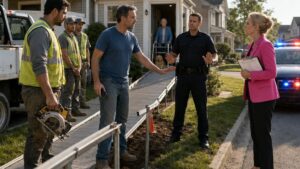
Three weeks later, contractors arrived to remove the HOA fence section that obstructed the agreed travel corridor.
Orange cones marked the work zone.
A sheriff’s deputy stood nearby because Susan had insisted everything be documented and calm.
Andrew arrived just after eight.
Brian’s SUV was parked directly inside the marked corridor.
The contractor approached him.
“We notified the association yesterday.”
“I know.”
“Vehicle has to move before we can work.”
Brian was nowhere in sight.
The manager called him.
No answer.
They waited twenty minutes.
Then thirty.
The deputy looked at the notice paperwork.
“He was properly notified?”
Susan handed him the documentation.
“Yes.”
The deputy nodded toward the tow operator waiting near the subdivision entrance.
Andrew felt something ugly and satisfying stir in his chest.
This was the scene he had imagined.
Brian’s vehicle.
The marked easement.
A tow truck.
Consequences.
Susan looked at Andrew.
“We can postpone.”
Andrew stared at the SUV.
If they postponed, Brian learned that ignoring notice still controlled the schedule.
If they proceeded, the whole neighborhood would watch.
Kathleen appeared at the edge of her yard.
Brian finally came walking from the clubhouse.
“What is this?”
The contractor answered.
“We’re scheduled to remove the encroaching fence.”
“I told management I objected to today.”
The manager’s face tightened.
“You did not tell me that.”
Brian looked at Andrew.
“You really want to tow my vehicle over a few feet?”
Andrew heard the echo immediately.
A few feet.
As if access became minor when it belonged to someone else.
He could have said that.
Instead he asked, “Can you move it?”
Brian looked toward the deputy, the tow truck, the contractor.
Then at the residents beginning to watch from driveways.
“No.”
It was not an inability.
It was a refusal.
Andrew nodded once.
“Then follow the notice.”
The deputy confirmed the paperwork.
The tow operator hooked the SUV.
No shouting.
No applause.
Just machinery.
The vehicle rolled slowly out of the marked corridor.
Brian stood with his arms at his sides while the contractor began unbolting the first fence panel.
Andrew did not feel triumphant.
He felt tired.
The chain had come down.
The survey had been proved.
The obstruction was being removed.
But Brian’s expression told him the next decision would not be made at the gate.
It would be made at a table.
And either Brian would finally sign an agreement, or both of them were going to court.
Chapter 7: The New Gate Opened for More Than One Family
Brian Carter was sitting at the same conference table where he had once called Andrew’s access a courtesy.
This time, the brass gate key lay on the table between them.
Beside it sat the proposed settlement agreement.
Andrew noticed the key before he noticed anything else.
Eight weeks earlier, Brian had turned that same key between his fingers while telling a room full of neighbors that Andrew’s use of the lane depended on permission.
Now nobody touched it.
Susan Moore sat to Andrew’s right with a thin stack of marked pages. The HOA manager sat beside Brian. Two board members occupied the far end of the table.
Kathleen was not part of the meeting, but Andrew knew she had submitted a written statement supporting the proposed access arrangement.
Brian looked tired in a way Andrew had not seen before.
Not defeated.
Just worn down.
The association’s attorney had already circulated most of the terms. The remaining dispute was no longer whether the easement existed.
That question was over.
The argument now concerned what everyone would have to live with because it did.
Susan opened the agreement.
“Permanent recorded easement remains intact. The parties define a maintained travel corridor within it. Association improvements may not obstruct that corridor. Mr. Hall agrees to speed restrictions, delivery instructions, and proportional maintenance obligations.”
One board member nodded.
Brian said nothing.
Susan continued.
“The association reimburses documented survey and attorney expenses related to the access restriction. The fence segment already removed will be reconstructed outside the travel corridor. Emergency services retain unrestricted gate access.”
Andrew watched Brian’s expression.
No objection yet.
Then Susan reached the clause they had not resolved.
“The draft also provides that the association’s prior access determination resulted from review of incomplete property records.”
Brian finally moved.
“That language is unnecessary.”
Andrew had expected it.
Susan said, “It is accurate.”
“It is also inflammatory.”
“No names are attached to it.”
Brian looked at Andrew.
“You need that sentence?”
Andrew thought about the first meeting.
Thirty people.
The word courtesy.
The way he had gone home wondering whether nineteen years of daily use had ever meant what he thought it meant.
He could have asked for more.
He could have insisted the minutes say Brian personally ordered the chain while legal review was pending.
Susan had told him they had support for that.
But Andrew no longer wanted a paragraph designed to preserve humiliation.
“I need the record to say the board acted before the title review was complete.”
Brian’s face tightened.
“That sounds like an admission of negligence.”
“It sounds like what happened.”
“We had a safety issue.”
“Yes.”
“We had complaints.”
“Yes.”
“We had a near accident involving a child.”
“I know.”
Brian leaned forward.
“Then stop talking as if I woke up one morning and decided to lock you out for entertainment.”
Andrew kept his voice low.
“I haven’t said that.”
“You haven’t had to. Everybody in this neighborhood thinks I ignored the law because I wanted to prove something.”
Andrew looked at the key between them.
“Didn’t you?”
Brian’s eyes hardened.
The room went quiet.
Andrew continued before the question became an accusation.
“I think you wanted people to see that the board was doing something.”
Brian did not answer.
“And I understand why,” Andrew said. “That child could have been hurt. People were complaining. You had residents telling you the board couldn’t control its own road.”
One of the board members glanced toward Brian.
Andrew went on.
“But you also knew somebody had suggested checking the title first.”
Brian’s jaw worked once.
“Yes.”
It was the first time Andrew had heard him say it plainly.
Brian looked down at the agreement.
“I thought it would take weeks.”
Susan said nothing.
Brian continued.
“And I thought if we did nothing and somebody got hurt while we were waiting, everyone would ask why the board sat on its hands.”
Andrew understood the fear because it sounded so ordinary.
Not corruption.
Not revenge.
A decision made under pressure, followed by pride when the decision turned out to be wrong.
Brian rubbed his thumb over the edge of the folder.
“I was trying to stop a traffic problem.”
“And you made an access problem.”
Brian gave him a tired look.
“Yes.”
The word settled differently from every other argument they had had.
Andrew looked at Susan.
She gave no signal.
This part was his.
“There’s another clause,” Andrew said.
Brian looked up.
“The confidentiality provision.”
The manager shifted in her chair.
Brian said, “Standard settlement language.”
“I won’t sign it.”
Susan had warned Andrew that refusing confidentiality might cost him something in negotiations.
He had decided before coming in.
Brian frowned.
“You want to discuss the settlement publicly?”
“No.”
“Then what’s the problem?”
“I want the easement agreement recorded and the board minutes to show why it exists.”
“That already happens.”
“Not if the settlement says nobody can discuss the dispute.”
Brian sat back.
Andrew touched the certified copy of the old easement in his folder.
“My family made this worse by treating old arrangements like everybody would always understand them. We knew the lane. We knew who maintained what. We never cleaned it up because the people involved knew each other.”
He glanced at the board members.
“Then houses changed hands. Boards changed. Management changed. And one day a chain went across the road because nobody had the full story in one place.”
Brian said, “So you want future owners reading about this fight?”
“I want future owners not having it again.”
That ended the argument.
Not immediately.
The attorneys adjusted language for another forty minutes.
The confidentiality clause came out.
The recorded maintenance agreement stayed.
The board statement was softened but not erased.
It would say that the access restriction had been imposed before completion of a full title review and that subsequent review confirmed a pre-existing recorded easement.
No blame.
No excuse.
Just sequence.
Then Susan turned to Andrew.
“One issue remains.”
He knew which one.
His obligations.
The easement did not become a one-way instrument simply because the HOA had been wrong.
Under the proposed terms, Andrew would contribute to gravel maintenance in proportion to his use. Delivery vehicles serving his parcel would follow a designated route and posted speed. Large contractors would coordinate access in advance when practical. The gate would remain operable for emergency services and could not be locked against him, but Andrew could not treat the lane like private property either.
Brian tapped that section.
“If traffic is part of the problem, this has to mean something.”
Andrew read the provision again.
A month earlier, he might have bristled at the idea of the HOA setting any condition on his use.
Now he thought about the complaint email.
The bicycle.
Kathleen standing beside the survey stake in her yard.
Anthony’s folder full of inconsistent gravel receipts.
Andrew signed.
“I can live with that.”
Brian looked at him.
“Even the delivery restrictions?”
“They’re not restrictions if they’re reasonable safety rules.”
Brian almost smiled.
Almost.
The HOA president signed next.
Then the board members.
The manager dated the pages.
Susan gathered the originals for recording.
For a few seconds, no one stood.
The conflict that had filled eight weeks of calls, letters, meetings, survey work, contractor notices, and legal bills ended with the scratch of pens and the soft sound of paper being stacked.
Brian picked up the brass gate key.
Andrew watched him.
Brian held it across the table.
“This is yours.”
Andrew did not take it immediately.
“The new lock?”
“Same key system as emergency access. You’ll have permanent access under the agreement.”
Andrew closed his hand around the key.
Brian released it.
There was no apology.
Andrew found he did not need one as much as he once thought he did.
Outside, Kathleen was waiting near the lane.
The reconstructed fence now sat clear of the defined travel corridor. The orange survey stakes were gone except for two reference markers left near the property corners.
A new gate had been installed where the old one stood.
It looked almost identical from a distance.
Up close, everything about it was different.
The lock system had multiple authorized keys.
A small emergency-access box sat on the post.
Reflective speed markers lined the curve.
The maintained travel corridor was visible without consuming the entire thirty-foot easement beneath it.
Kathleen looked at the key in Andrew’s hand.
“So that’s it?”
“That’s it.”
“You won?”
Andrew looked at her.
She smiled faintly.
“That was a loaded question.”
“Little bit.”
He walked toward the gate.
“I got access back.”
“And the HOA paid your costs.”
“Most of the documented ones.”
“And Brian had to admit the board was wrong.”
“They admitted the review came after the action.”
Kathleen shook her head.
“You’re making that sound much less satisfying than it is.”
Andrew unlocked the gate.
“I spent eight weeks learning that satisfying and useful aren’t always the same thing.”
She leaned against the fence post.
“My husband still thinks we should send you the bill for moving six feet of fence.”
Andrew looked over.
“You only moved the part blocking the corridor.”
“He says six feet sounds better when he complains.”
“Tell him I’ll trade him for my attorney bill.”
Kathleen laughed.
It was the first easy sound Andrew had heard near that gate since the chain appeared.
A delivery truck turned into the subdivision entrance.
Andrew checked the time.
It was scheduled.
The driver slowed at the new speed marker, followed the curve, and stopped before the gate.
Andrew opened it fully and stepped aside.
The truck passed through at little more than walking speed.
Kathleen watched it.
“So this is what all that was for.”
Andrew looked down the lane toward his house.
“No.”
She raised an eyebrow.
“This is what should have been written down thirty years ago.”
Later that afternoon, Andrew carried the old chain into his barn.
The HOA manager had returned it after the contractor removed the original gate hardware. Nobody had wanted it.
He laid it on the workbench beside the brown metal closing box.
For a moment, the two objects looked like they belonged to different stories.
One had caused the fight.
The other had contained the answer.
Andrew opened the box and placed copies of the recorded easement, survey, settlement, and maintenance agreement inside a new waterproof folder.
On top, he added a page explaining where the gate keys were kept and who was responsible for road maintenance.
Nothing complicated.
Nothing dependent on memory.
He closed the box.
Then he picked up the chain.
He could have thrown it away.
Instead, he hung it from a nail inside the barn cabinet and shut the door.
Outside, the new gate stood open.
The delivery truck came back down the gravel lane after unloading at Andrew’s house. It slowed near Kathleen’s yard, passed cleanly through the marked corridor, and continued toward the subdivision street.
No one waved it down.
No one unlocked anything.
No one had to ask permission.
Andrew stood beside the gate until the truck disappeared.
The old easement had protected his right to pass through.
The new agreement did something the old papers never had.
It made sure everybody else knew what that right required.
The story has ended.