They Ordered Him to Move the Farm Fence—But the Record They Needed Was Missing
Chapter 1: The Line They Painted Beside His Fence
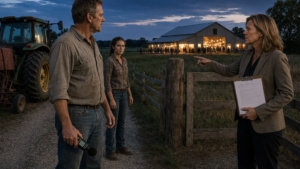
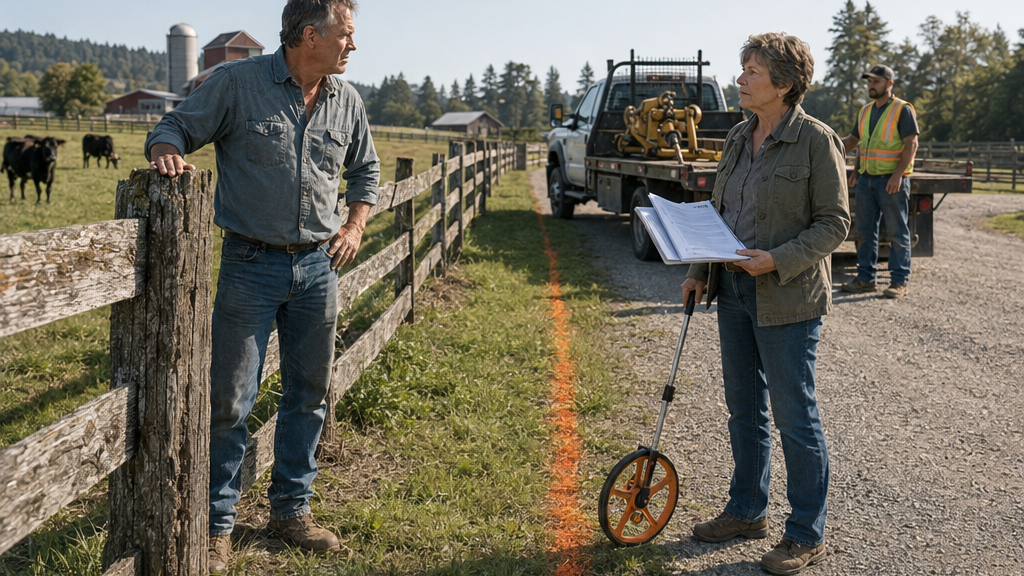
The contractor had already laid a pry bar beside Raymond Hill’s fence before Raymond understood they had come to move it.
He stopped halfway across the gravel apron with one work glove still tucked beneath his belt. A flatbed truck sat at the entrance to his farm, angled partly into the shared lane. Behind it, a man in a reflective vest unloaded a post puller and a bundle of orange marking flags.
Brenda Roberts stood near Raymond’s oldest corner post with a measuring wheel in one hand.
A streak of orange paint cut through the grass beside her boots.
Raymond looked from the paint to the weathered cedar post.
“What’s that?”
Brenda straightened. “The maintenance line.”
“That isn’t what I asked.”
She let the measuring wheel rest against her leg. “The board approved the work Thursday. We sent notice.”
“You sent me a letter saying you wanted the fence moved.”
“We sent you an order.”
Raymond stepped closer, stopping short of the orange stripe. It ran nearly parallel to the fence for thirty yards, then widened where the gravel lane bent toward the neighboring farms.
“How far?”
“Four feet here. More at the curve.”
“Based on what?”
Brenda’s mouth tightened.
She was in her early sixties, practical in the way people became when they had spent years being the person everyone called after culverts clogged, limbs fell across roads, or somebody decided the association ought to fix something without raising dues.
She opened a folder tucked beneath her arm.
“Twenty-foot maintenance easement.”
Raymond held out his hand.
Brenda gave him a photocopy.
The first page was a recorded easement from decades earlier. The print had been copied so many times the edges had softened to gray. Raymond read the legal description twice.
Then he looked at the drawing clipped behind it.
“This isn’t recorded.”
“It’s the maintenance sketch.”
“That’s not what I said.”
The contractor shifted his weight but stayed out of it.
Brenda pointed at the paper. “The road has been maintained to that width for years.”
Raymond tapped the first page. “This says the easement is shown on Exhibit A.”
“Yes.”
“Where’s Exhibit A?”
Brenda turned one page, then another, though both of them knew what was there.
A board meeting cover sheet.
The maintenance sketch.
No exhibit.
Raymond looked down at the orange paint again.
“So what did you measure from?”
“The existing road centerline.”
“According to what width?”
“The accepted maintenance width.”
“According to what recorded document?”
Brenda exhaled through her nose.
“Raymond, we’ve been over this.”
“No. You’ve told me the fence is wrong. That isn’t the same thing.”
A pickup slowed on the lane behind them. The driver lifted two fingers from the steering wheel, then kept going. Raymond knew by evening half the road would have heard that he had held up the grading work again.
That irritated him almost as much as the paint.
Brenda turned toward the bend.
“The grader can’t safely make that turn with your fence where it is. We have drainage work scheduled. The contractor needs clearance.”
“Then show me where you have the right to clear.”
“You know perfectly well the road’s always been maintained wider than the gravel.”
“Always isn’t a measurement.”
The contractor looked down.
Brenda’s expression hardened.
“This is exactly why the board wanted you at Thursday’s meeting.”
Raymond had received the notice. He had also sent back three sentences in an envelope.
I object to any removal or relocation of my fence without documentation establishing the claimed boundary. Please provide the recorded instrument and survey basis. No work is authorized on my property.
He had considered that sufficient.
Standing beside orange paint now, he began to suspect everyone else had considered it something else.
Brenda took the photocopy from his hand.
“You could have come and discussed it.”
“I asked for the document.”
“You sent a demand.”
“I sent a question.”
“You sent three lines and didn’t show up.”
Raymond glanced toward the contractor’s tools.
“And you brought a post puller.”
For the first time, Brenda looked uncomfortable.
Only briefly.
Then she opened the folder again and withdrew a formal notice on association letterhead.
“We’re giving you until Monday morning. If the fence isn’t moved to the maintenance line, the contractor will proceed.”
Raymond read the first paragraph without taking the page from her.
“Under what authority?”
“The easement.”
“The easement with the missing exhibit.”
“The easement exists.”
“I didn’t say it didn’t.”
“You’re acting like one missing page erases fifty years of road maintenance.”
“And you’re acting like fifty years tells you exactly where to paint a line.”
That silenced her.
Not because she agreed.
Because neither of them had an immediate answer.
Raymond crouched beside the oldest fence post. The cedar was gray at the top and almost black where years of soil had stained the base. His father had set that post before Raymond took over the cattle side of the farm.
There were things Raymond could forgive himself for changing. Roofing. Gates. Water lines. Machinery.
Boundaries were different.
His father had always said that once ground changed hands on paper, nobody remembered how it happened. Raymond had treated that as instruction.
Keep the records.
Keep the corners.
Don’t rely on memory.
He stood.
“Don’t touch the fence today.”
Brenda looked at the contractor.
The contractor looked at Brenda.
Finally, she nodded.
“Today, no.”
Raymond folded his arms.
“And Monday?”
“Monday the board’s authorization takes effect.”
“You still haven’t shown me the line.”
“I’ve shown you what we have.”
“That’s the problem.”
Brenda’s patience finally broke around the edges.
“No, Raymond. The problem is you keep treating the absence of one attachment like proof that everybody else is wrong.”
He looked at her.
“I’m treating it like proof that we don’t know.”
She stared at him for several seconds.
Then she gathered the folder under her arm.
“Then prove your fence is outside the easement.”
Raymond almost answered immediately.
The words formed easily: You’re the one ordering it moved.
But something about the confidence in her face stopped him.
Not certainty exactly.
Expectation.
As if the responsibility had already been transferred to him and everyone else had accepted it.
Brenda turned to the contractor. “Load it back up.”
The post puller clanged against the flatbed.
Before leaving, Brenda tapped the orange line with the toe of her boot.
“Monday, Raymond.”
He watched the truck back carefully onto the lane and drive away.
Only when the dust settled did he walk the full length of the painted stripe.
At the bend, the orange line crossed close enough to the fence that moving it would cost him a strip of pasture wide enough for a truck. Farther down, the gap narrowed again.
It did not look surveyed.
It looked practical.
That bothered him more.
He returned to the corner post and crouched beside it once more. Beneath the fresh orange paint, the grass was flattened where Brenda’s measuring wheel had passed.
Someone had converted an assumption into a line.
And unless Raymond could show them why it was wrong, they intended to convert the line into fact.
Chapter 2: The Easement With One Page Missing
Amanda Perez found the problem before Raymond had finished explaining why he was there.
She sat at a county computer behind a waist-high counter, scrolling through scanned property records while Raymond stood with Brenda’s photocopy folded in his shirt pocket.
“There,” Amanda said.
She leaned closer to the screen.
Raymond followed her finger.
The recorded easement appeared in black-and-white, each page stamped with an old book and page number. Near the bottom of the legal description was the sentence he remembered from that morning.
As shown on Exhibit A attached hereto and incorporated herein.
Amanda clicked forward.
The next scanned page belonged to an unrelated filing.
She clicked back.
Then forward again.
“That’s it?” Raymond asked.
“That’s it in the digital image set.”
“The exhibit isn’t there.”
“Not in this scan.”
He felt a small, sharp satisfaction.
It came too quickly.
Amanda must have seen it because she added, “That doesn’t mean it never existed.”
Raymond’s satisfaction cooled.
“Can we check the original?”
“We can check the film and the bound copy.”
Twenty minutes later, she returned from the records room with a large volume on a cart and a reel number written on a yellow slip.
The bound record showed the same thing.
Easement.
Signature page.
Recording stamp.
No Exhibit A.
Amanda checked the microfilm after that. Raymond waited while a county clerk helped load the reel into an older machine near the back wall.
Again, the pages jumped from the easement directly to the next instrument.
Amanda sat back.
“Same sequence.”
“So the exhibit was never recorded.”
“I didn’t say that.”
Raymond looked at her.
She gave him the patient expression of someone accustomed to people arriving at a records counter wanting certainty more than information.
“I can tell you it isn’t in the recorded image sequence we have. I can tell you the book copy doesn’t contain it. I can’t tell you whether it was omitted at recording, lost before recording, filed somewhere under another reference, or never attached in the first place.”
“But the county doesn’t have it.”
“Not where it should be.”
That distinction annoyed him, mostly because it was accurate.
He took out Brenda’s sketch.
“What about this?”
Amanda studied it.
The page showed the gravel lane as two heavy lines with handwritten widths at several points. One corner bore an old association notation and a date from more than twenty years earlier.
“No recording information,” she said.
“It’s what they used to mark my fence.”
“It may be useful for maintenance history.”
“Is it a boundary survey?”
“No.”
“Does it establish the easement width?”
“Not by itself.”
That was enough to make Raymond straighten.
Amanda noticed.
“Again,” she said, “don’t hear more than I’m saying.”
“I heard you.”
“I’m not deciding the dispute.”
“I didn’t ask you to.”
“You’re smiling.”
He stopped.
He had been.
Amanda turned back to the computer.
“Let’s look at the deeds in your chain.”
They traced the farm backward through several transfers.
Each deed described Raymond’s acreage by metes and bounds, then referred generally to the existing road easement. One deed repeated the old book and page number. Another incorporated prior restrictions without restating the dimensions.
None reproduced Exhibit A.
None gave the four-foot setback Brenda had painted into Raymond’s grass.
By the third deed, Raymond felt the argument arranging itself neatly in his head.
No exhibit.
No surveyed width.
No basis for the painted line.
Then Amanda opened an older aerial image from the county’s mapping archive.
“Your parcel is here.”
Raymond leaned over the counter.
The image was grainy and washed pale by age. The lane appeared as a thin gray thread between darker fields.
Amanda enlarged the bend near Raymond’s farm.
The gravel itself was hard to distinguish.
But a lighter strip curved beyond the present edge of the road.
“What’s that?” Raymond asked.
“Could be disturbed ground.”
“Could be?”
“Older aerials aren’t magic.”
She moved to another year.
Again, the light strip appeared.
Wider near the bend.
Narrower beyond it.
Raymond stared.
Amanda pulled up a later image.
The strip remained visible.
“Equipment path?” he asked.
“Possibly.”
“Grader?”
“Possibly.”
He did not like the way the answer sounded when it was his uncertainty.
Amanda folded her hands.
“If the road association has maintained outside the present gravel for a long time, that can matter.”
“Even if their document doesn’t show where?”
“I’m not giving you legal advice. I’m telling you physical use and recorded rights are two different questions. Missing Exhibit A answers neither one by itself.”
Raymond looked again at the pale arc through what was now his grass.
He had come expecting the county file to give him something clean enough to take back to Brenda and end the discussion.
Instead it had removed her certainty without replacing it with his.
“Can I get copies?”
“Of everything we pulled.”
“Including the aerials?”
“Yes.”
She printed the easement, the deed references, and three aerial images.
At the copier, Raymond lined the pages up in order.
The gap where Exhibit A should have been looked almost absurdly small. A missing attachment. Maybe one sheet of paper.
Yet everyone outside the building had spent years behaving as if they knew exactly what it said.
Amanda handed him the packet.
“You may want a surveyor.”
“I know.”
“And you may want to ask people who were around when the road was maintained differently.”
Raymond tucked the pages into a manila envelope.
“People remember what suits them.”
Amanda gave him a faint smile.
“Records do too, sometimes.”
Outside, Raymond sat in his pickup without starting it.
He laid the oldest aerial across the steering wheel.
The pale strip beside the road curved directly through the ground Brenda had marked that morning.
Not approximately.
Not somewhere nearby.
Right through it.
The missing exhibit had weakened Brenda’s line.
But the land itself had just produced a different kind of evidence.
Chapter 3: What Everyone Remembered Differently
Timothy Lewis drove the heel of his boot into a shallow depression beyond the gravel and said, “That’s where the blade used to run.”
Raymond looked down.
The grass was greener there, but that could have meant anything. Water. Compaction. Old tire traffic. A cow pushing through the fence years ago.
Timothy pointed farther along the bend.
“You can still see it if you know what you’re looking for.”
“That sentence usually comes right before somebody tells me something they can’t prove.”
Timothy gave him a sideways look.
“You asked.”
Two days had passed since Raymond visited the county records office. In those two days, the orange paint beside his fence had become brighter in his mind rather than duller.
He had walked the line twice.
Measured from the gravel edge.
Compared the county aerials.
Then, against his preference, he had started asking neighbors what they remembered.
Timothy remembered everything.
At least according to Timothy.
He had grown up two farms down and had spent enough years maintaining equipment, hauling hay, clearing storm debris, and helping with the private lane that people often accepted his memory as local record.
Raymond had once done the same.
Now he was less comfortable with it.
“The grader came wide through here,” Timothy said. “Had to. Still does, if you want the crown right.”
“That doesn’t mean the association owns it.”
“I didn’t say owns.”
“Brenda’s saying easement.”
“She’s saying maintenance.”
“She painted a line four feet inside my fence.”
Timothy shrugged. “Maybe that’s where it belongs.”
“Based on what?”
“Based on the fact that equipment’s been using it longer than you’ve been running that farm.”
Raymond felt the response rise in him.
My family has owned that ground longer than Brenda’s association has existed.
He kept it to himself.
That was another kind of history people used when documents failed.
Instead he unfolded one of the aerial copies.
“This is from twenty-eight years ago.”
Timothy squinted.
Raymond pointed to the pale arc.
“You think that’s the grader?”
“I know it is.”
“You were there when this picture was taken?”
“No.”
“Then you don’t know.”
Timothy looked irritated.
“I was here when they graded the road.”
“That isn’t the same thing.”
“No, Raymond. It’s called remembering.”
They stood facing each other until the sound of cattle at Raymond’s water trough broke the silence.
Timothy looked toward the fence.
“You always did make everything into a paperwork problem.”
“That’s convenient coming from a man who thinks memory is a survey.”
Timothy laughed once, without humor.
“Your dad didn’t.”
The words landed differently.
Raymond folded the aerial.
“What’s that supposed to mean?”
“It means he knew the road needed room.”
Before Raymond could ask more, a neighbor approaching in a utility vehicle slowed beside them.
“You two fighting or fixing something?”
“Depends which one you ask,” Timothy said.
Raymond stepped closer to the vehicle.
“Do you remember the grader running outside the gravel here?”
The neighbor looked toward the bend.
“Sure.”
“How far?”
The neighbor hesitated.
“Far enough.”
“That’s not a distance.”
“No, but I remember having to move a couple fence rails once.”
Raymond stared.
“Whose rails?”
The neighbor nodded toward Raymond’s fence.
“Your dad’s.”
Timothy crossed his arms.
Raymond looked from one man to the other.
“When?”
“Long time ago,” the neighbor said. “Before they brought in that heavier machine.”
“Why did he move them?”
“So they could get around the bend.”
“Because they had an easement?”
“I don’t know anything about that.”
“Did he say they had the right?”
The neighbor shook his head.
“I didn’t hear him say anything like that.”
Timothy stepped in.
“He didn’t have to. Everybody knew the road crew used that strip.”
Raymond turned sharply.
“That isn’t what I asked.”
“No, because you only ask questions that fit in folders.”
The neighbor held up one hand.
“I’m not getting in the middle of this.”
“You already are,” Timothy said.
The neighbor ignored him and looked at Raymond.
“All I remember is your dad pulled the rails before grading sometimes. Put them back afterward.”
Raymond felt something shift beneath his certainty.
“Sometimes?”
“Wet years, mostly.”
“You’re sure?”
“As sure as I’m going to claim.”
That answer, cautious and incomplete, carried more weight with Raymond than Timothy’s certainty.
“When was the last time?”
The neighbor thought.
“Maybe fifteen years ago. Could be more.”
Raymond’s father had still been alive then.
Still managing most of the farm.
Still deciding who crossed what and why.
The neighbor drove on.
Raymond walked toward the oldest cedar post at the entrance.
The orange paint ran beside it.
He put one hand on the post and looked at the wire stretching away toward the pasture.
His father had rebuilt sections of the fence more than once. Raymond knew that. They had done some of the work together.
But he could not remember ever discussing why the corner at the lane had been set exactly where it was.
Timothy came up behind him.
“You see that worn patch?”
Raymond glanced down.
Barely visible beneath the grass was a shallow groove just beyond the current gravel shoulder.
“Equipment tires,” Timothy said.
“Maybe.”
“There you go again.”
Raymond turned.
“You want me to say you’re right because you remember something?”
“I want you to stop acting like everybody who remembers differently is lying.”
The accusation struck harder than Raymond expected.
He had not said lying.
But he had treated every uncertain memory as contamination.
Maybe because uncertainty felt dangerous when it touched land.
“What exactly did my father tell you?” Raymond asked.
Timothy’s face changed slightly.
Not triumph.
Something closer to hesitation.
“He told us to use the room we needed.”
“When?”
“More than once.”
“Who’s us?”
“Me. The grader operator. Whoever was helping.”
Raymond stared at him.
“Those were his words?”
“Near enough.”
“No. Not near enough.”
Timothy looked away toward the bend.
Finally he said, “One spring the ditch had washed full. We couldn’t keep the machine on the gravel without dropping the rear tire into it. Your dad came out, looked at the fence, and told us he’d open it up.”
“That isn’t the same as granting an easement.”
“I didn’t say he used that word.”
“Then what did he say?”
Timothy rubbed his jaw.
“He said, ‘Use what you need. Just put it back when you’re done.’”
Raymond went still.
The sentence sounded like his father.
That was the problem.
Plain.
Practical.
Unwritten.
Exactly the kind of arrangement Raymond had spent his adult life trying not to make.
Timothy pointed toward the post.
“He did it other times too.”
“Moved the fence?”
“Opened sections. Let the grader swing wide.”
“For how long?”
“Years.”
Raymond looked again at the aerial in his hand.
The pale strip no longer looked like an unexplained mark.
It looked like repetition.
Permission repeated often enough that people had stopped remembering it as permission.
“That doesn’t make Brenda’s painted line correct,” Raymond said.
“No.”
The answer surprised him.
Timothy bent and pulled a dead stem from the grass.
“But it means the whole thing isn’t made up either.”
Raymond folded the aerial slowly.
For two days he had been asking whether the association could prove its claim.
Now a harder question had appeared.
What if Brenda’s measurement was unsupported, but the use itself was real?
He looked at the weathered corner post.
His father had always warned him not to let people mistake a favor for a right.
Apparently, at least once, he had trusted them not to.
Timothy started back toward his truck, then stopped.
“There’s something else.”
Raymond waited.
Timothy looked toward the fence rather than at him.
“Your dad didn’t just let us through when we asked.”
Raymond’s grip tightened on the folded aerial.
Timothy finally met his eyes.
“He told the road crew himself that they could use that strip whenever the grader needed it.”
Chapter 4: The Favor His Father Never Recorded
Raymond found the hinge plate by accident.
He was kneeling beside the oldest cedar post with a socket wrench, checking the lower brace where the wire had begun to sag, when his thumb struck a rectangle of rust beneath the grass.
At first he thought it was scrap.
Then he pulled away the dead stems.
Two square bolts passed clean through the post.
A second plate, almost hidden by weathered wood, sat four feet higher.
Raymond stopped moving.
The post had once carried hinges.
Not decorative hinges. Not gate hardware added later.
Heavy ones.
He stood and stepped back.
From that angle, the construction made sense immediately. The corner section that looked permanent now could once have swung open.
He had passed that post thousands of times.
He had helped replace wire on it.
He had never noticed.
By noon he was in the barn pulling old coffee cans from a shelf his father had used for hardware. Most held washers, cotter pins, fencing staples, chain links.
The third contained two rusted hinge pins.
Raymond set them on the workbench.
They fit the plates.
For several minutes he simply stared at them.
His father had not just allowed a grader to squeeze around the fence once. He had built the fence so part of it could be moved.
The discovery irritated him in a way Brenda’s painted line had not.
He could argue with Brenda.
He could challenge Timothy’s memory.
He could not cross-examine a pair of hinge pins.
That afternoon, Raymond drove to the home of the former property owner’s adult child, who had grown up on land farther down the shared lane before the family sold it years earlier.
He brought no folder.
That was deliberate.
He wanted memory before documents.
The former owner’s child listened from a porch chair while Raymond described the bend, the grader, and the removable fence section.
“Your dad used to open that corner,” the person said.
“For road maintenance?”
“Mostly.”
“Mostly?”
“Sometimes for farm equipment. But yes, the grader too.”
Raymond leaned forward.
“Did the association have the right to use it?”
A pause.
“That wasn’t how anybody talked about it.”
“How did they talk about it?”
“Your father would say the road had to serve everybody. If the grader needed room, he gave it room.”
“Did he ever say the strip belonged to the association?”
“No.”
“Did he ever say they had a permanent easement over that extra ground?”
“I never heard him.”
Raymond let that settle.
“What about Timothy?”
A faint smile.
“Timothy remembers every favor as a tradition.”
That sounded fair enough to make Raymond uncomfortable.
“And Brenda?”
“She wasn’t running things then.”
“So this wasn’t a board rule?”
“Not that I remember.”
Raymond looked toward the yard.
“Was there an agreement?”
“A handshake, maybe.”
“With who?”
“Whoever was handling the road that year.”
“That’s not an agreement I can read.”
“No.”
The answer was simple.
Then came the harder part.
“But your father liked it that way.”
Raymond looked back.
“What way?”
“He didn’t want paperwork every time neighbors needed something.”
That sounded unlike Raymond and exactly like his father.
“Why?”
“Because he thought paperwork made people territorial.”
Raymond almost laughed.
Instead he said, “And now we’re arguing because there isn’t any.”
The former owner’s child nodded.
“Seems about right.”
On the drive home, Raymond kept hearing the sentence.
Paperwork made people territorial.
His father had believed a man’s word could remain attached to its purpose.
Use what you need.
Put it back when you’re done.
Raymond had built his adult life around the opposite assumption.
Memory drifted.
People changed.
Boards changed.
A favor survived longer than the person who understood its limits.
Back at the farm, he carried the hinge pins to the fence.
He slid one through the old upper plate.
It fit with almost no resistance.
For the first time, the corner post looked less like a boundary marker and more like part of a mechanism.
Something meant to hold.
Something also meant to open.
Raymond did not like the lesson.
He liked even less that his father had understood it first.
His phone buzzed.
A message from Brenda.
He considered ignoring it.
That had been his habit all week: answer only what required an answer, put everything else into silence.
Then he remembered Brenda telling him he had skipped the meeting.
He opened the message.
Formal notice attached.
Road and drainage work would begin Monday at 7:30 a.m.
The association expected the fence to be relocated before the contractor arrived.
If Raymond failed to comply, the board intended to authorize removal necessary for access.
He read it twice.
Then he called Brenda.
She answered after four rings.
“I got your notice.”
“I assumed you would.”
“You’re still going ahead.”
“We can’t keep pushing the work.”
“I found the old hinge hardware.”
Silence.
Brenda said, “What hinge hardware?”
“The fence was removable.”
Another pause.
“That supports what we’ve been saying.”
“No. It supports that my father let equipment through.”
“That’s maintenance access.”
“It’s permission.”
“Raymond—”
“Those aren’t automatically the same thing.”
Her voice flattened.
“And that is exactly what we need somebody qualified to determine.”
For once, he had no immediate contradiction.
He looked at the hinge pin in his hand.
“I’m coming to the meeting Saturday.”
Brenda was quiet again.
“You should have come to the first one.”
“I know.”
The admission cost less than he expected.
She said, “Fine.”
“Bring everything you have. Not just the sketch.”
“I already did.”
“Bring it again.”
Raymond ended the call and remained beside the post.
Monday was no longer just a deadline.
It was a test of whether he could stop Brenda without pretending the road had never needed his father’s ground.
Chapter 5: Brenda’s Reason for Forcing the Deadline
When Raymond entered the association meeting room Saturday morning, conversation stopped.
Not gradually.
All at once.
Seven people sat in folding chairs facing a plastic table where Brenda had arranged folders, invoices, maps, and photographs.
An empty chair remained in the second row.
Raymond took it.
Brenda looked at him for one second longer than necessary, then continued.
“The drainage contractor is still scheduled for Monday.”
No greeting.
No welcome.
Raymond preferred it that way.
A photograph lay on the table showing standing water along the lane after the last heavy rain. Another showed a washed shoulder near the bend below Raymond’s pasture.
Brenda tapped the second image.
“We’ve lost gravel here three times this year.”
An association member said, “And the grader can’t carry the crown through the corner.”
Raymond looked at Brenda.
“You knew the exhibit was missing.”
The room changed.
A few heads turned toward her.
Brenda did not deny it.
“Yes.”
“When?”
“When we pulled the packet before sending your first notice.”
Raymond stared at her.
“So before you painted the line.”
“Yes.”
“And you still called it the easement line.”
“I called it the maintenance line.”
“You told me the easement gave you the width.”
“The easement gives the association maintenance rights.”
“Not a number anybody can show me.”
Brenda folded her hands.
“No. Not in the recorded pages we found.”
A man in the front row shifted in his chair.
Raymond heard it.
So did Brenda.
He expected her to become defensive.
Instead she opened another folder.
“This is what you haven’t asked about.”
She slid three invoices across the table.
Drainage stone.
Culvert work.
Grader mobilization.
Then she placed down an estimate marked with a handwritten expiration date.
“If we lose Monday’s slot, the contractor can’t come back for at least six weeks.”
Raymond glanced at the figure.
“What happens in six weeks?”
“Possibly nothing.”
“And possibly?”
“Another hard rain cuts the shoulder deeper.”
An association member spoke from behind Raymond.
“Last storm, the school bus had to stop before the bend because water was running over the gravel.”
Raymond turned.
He had not heard that.
Brenda continued.
“We have two older households farther up the lane. One uses home medical equipment. The road has to remain passable.”
“You think I want it impassable?”
“No.”
“Then stop talking like I’m blocking the road.”
Brenda’s jaw tightened.
“You are blocking one repair option.”
“That isn’t the same thing.”
“No. But when you refuse every meeting and send three-line objections, people fill in the rest themselves.”
The words were quiet.
They landed harder than if she had raised her voice.
Raymond looked around the room.
Nobody seemed eager to fight him.
That bothered him.
He had spent the week imagining himself against a group convinced they could take whatever they needed.
Instead he saw tired neighbors, a stack of invoices, photographs of water damage, and Brenda carrying responsibility she had handled badly because she thought delay was the greater risk.
Raymond reached for the maintenance sketch.
“Where did this come from?”
“Old association files.”
“Who drew it?”
“We don’t know.”
“Surveyor?”
“No indication.”
“Engineer?”
“No.”
“Then why rely on it?”
Brenda took a breath.
“Because it matched the way the road had been maintained.”
“And Timothy’s memory.”
“Yes.”
Raymond leaned back.
“So you had an incomplete easement, an unrecorded sketch, and people saying that’s where equipment had always gone.”
“Yes.”
“And from that you ordered my fence moved.”
Brenda met his eyes.
“Yes.”
There it was.
Not confusion.
Not conspiracy.
A choice.
A bad one, in Raymond’s view.
But a choice she was willing to own.
“You should have told me the exhibit was missing,” he said.
“I should have.”
That surprised him more than anything else.
Brenda glanced at the photographs.
“And you should have come to the meeting.”
Raymond did not answer.
She looked back at him.
“We were trying to solve the road before the next storm. I let that become an excuse to treat the line like it was settled.”
Raymond tapped the sketch.
“It isn’t.”
“No.”
One of the members frowned.
“So what does that mean for Monday?”
Brenda looked at Raymond.
“The work still needs to happen.”
He almost laughed.
“You just admitted the line isn’t settled.”
“I admitted the exact boundary isn’t settled. I did not say the drainage problem disappeared.”
Raymond looked again at the photographs.
At the bend, the water channel had eaten into the shoulder close to the place where his father once opened the fence.
He thought of the hinge pins.
Permission had solved a practical problem before.
Silence had turned that solution into confusion.
“What if you don’t move the fence?” he asked.
Brenda pointed to the image.
“The grader either stays tight to the gravel and can’t shape the outside edge correctly, or the contractor risks equipment against the fence.”
“And if the ditch isn’t corrected?”
“We keep losing the shoulder.”
Raymond rubbed a thumb along the edge of the maintenance sketch.
For the first time, he understood the thing Brenda had been unable to say at his gate.
She was not defending the painted line because she trusted the paper completely.
She was defending it because the road needed room and she feared that admitting uncertainty would stop the work.
That did not excuse her.
It made the problem harder.
“I want a surveyor there before anybody touches the fence.”
Brenda shook her head.
“Monday is forty-eight hours away.”
“I know.”
“You can’t get a full boundary survey done by then.”
“I didn’t say full.”
“What are you proposing?”
“Locate the existing monuments. Establish what can be established. Measure the bend on the ground before your contractor starts.”
A board member said, “And if it doesn’t settle anything?”
“Then nobody pulls posts based on a sketch.”
Brenda studied Raymond.
“And the drainage work?”
“Work where you unquestionably have room.”
“That may not be enough.”
“Then we deal with what the measurements actually show.”
She looked down at the invoices.
Raymond could see the calculation happening.
Delay.
Cost.
Liability.
Risk.
Finally she said, “If you can get the county surveyor there before the contractor begins, I’ll hold fence removal until we hear what they can establish.”
“Put that in writing.”
Brenda gave him a tired look.
“Of course you want it in writing.”
“Yes.”
For the first time that morning, the corner of her mouth moved.
Not quite a smile.
“Maybe your father had the easier system.”
“Look where that got us.”
That did make her smile, briefly.
Then it vanished.
Raymond stood.
“I’ll make the call.”
Outside, he stopped at the edge of the lane and phoned the county surveyor’s office.
The surveyor listened, asked for the recording reference, parcel number, and location, then said there was one opening early Monday.
“Seven fifteen?”
Raymond looked toward the bend.
The contractor was scheduled for seven thirty.
“I’ll be there.”
He hung up and returned to the doorway.
Brenda was gathering the incomplete packet into its folder.
“Seven fifteen Monday,” Raymond said.
She looked up.
“Surveyor?”
“Yes.”
Brenda closed the folder.
“Then I’ll tell the contractor not to unload until we’re done.”
For the first time since the orange line appeared, both of them had agreed to wait for something neither controlled.
Chapter 6: The Survey Did Not Give Either Side Everything
The first wooden stake went into the ground eighteen inches inside Brenda’s orange line.
Nobody said anything.
The county surveyor checked the instrument, walked back to the prism, then returned to the stake and pressed it deeper with one boot.
Raymond stood beside his fence.
Brenda stood beside the contractor’s truck.
Timothy had arrived without being invited and was leaning against his pickup with his arms folded.
The surveyor pointed.
“Based on the monuments I can recover and the deed description, this is the property line at this station.”
Raymond looked at Brenda.
She looked at the orange paint.
Eighteen inches was not much.
But it was enough to prove the painted line was not a boundary.
The surveyor moved farther along the curve.
At the second point, the difference widened.
At the third, the orange paint lay nearly three feet inside Raymond’s ground.
Raymond felt something loosen in his chest.
For a week he had been treated as though his fence existed only because nobody had bothered to correct it.
Now the stakes said otherwise.
The surveyor continued to the oldest cedar post.
He checked the instrument again.
“The fence is inside the parcel.”
“How far?” Raymond asked.
“Varies. Close here. More farther south.”
Brenda said, “So the association has no right past the stakes?”
The surveyor glanced at her.
“I didn’t say that.”
Raymond’s satisfaction stopped cold.
The surveyor pointed toward the gravel lane.
“I’m locating the property boundary from the available deed evidence. I am not giving you an opinion on the full extent of easement rights, especially with a referenced exhibit missing.”
Timothy muttered, “There it is.”
Raymond ignored him.
The contractor climbed down from his cab.
“So where can I run the grader?”
The surveyor gave him a flat look.
“That’s not my decision.”
Brenda walked to the bend.
“We need enough room for the outside tire.”
The contractor measured visually.
“With that fence where it is, I can make it through. But I can’t cut the shoulder right without getting close.”
“How close?” Raymond asked.
“Too close for me to promise your posts stay straight.”
The contractor crouched and traced the intended path with one gloved hand.
“To shape this correctly, the rear wheel wants to swing here.”
He pointed beyond the present gravel.
Beyond one of the survey stakes.
Onto Raymond’s property.
Not as far as Brenda’s painted line.
But far enough.
Raymond looked at the fence.
The victory he had been preparing to enjoy had lasted less than five minutes.
Brenda said quietly, “That’s what we’ve been trying to tell you.”
He turned.
“No. You were telling me that your line was established.”
“And you were telling us the road didn’t need your ground.”
“I said you hadn’t proven the right.”
“You acted like that settled the need.”
Raymond wanted to answer.
He did not.
Because she was right about that part.
The surveyor walked farther down the lane, marking two more points. At the narrowest section, the property line and road shoulder nearly touched.
At the bend, though, the geometry was unforgiving.
The contractor needed swing room.
The ditch needed reshaping.
The fence constrained both.
Timothy stepped away from his truck.
“Your dad understood that.”
Raymond turned sharply.
“This isn’t about my father now.”
Timothy nodded toward the hinge plates.
“Looks like it still is.”
Raymond followed his gaze.
The old removable corner section sat exactly where the grader needed its widest arc.
Not because anyone had surveyed it there.
Because his father had solved the same physical problem decades earlier.
The surveyor returned to the group.
“Here’s what I can tell you today. The fence, as presently located, is on Mr. Hill’s property. The maintenance sketch does not match the property boundary.”
Brenda looked at Raymond.
He said nothing.
The surveyor continued.
“The recorded easement exists. Its missing exhibit prevents me from using that document alone to give you an exact width today. Historic maintenance use may be relevant, but that’s beyond what I’m here to determine.”
Raymond looked at the line of fresh stakes.
They were cleaner than the orange paint.
More precise.
And still incomplete.
The contractor checked his watch.
“I need an answer.”
Brenda opened her mouth.
Raymond spoke first.
“You’re not pulling the fence.”
The contractor looked at Brenda.
Brenda did not answer immediately.
Raymond walked to the old cedar post and put one hand against it.
For a moment he imagined the simple version of the morning.
Tell them no.
Point to the stakes.
Send everyone home.
He would be within his rights to refuse work on his land until the easement issue was formally resolved.
Maybe that was enough.
Then he looked down the lane.
Water had already carved a shallow groove through the shoulder. Another strong rain would deepen it.
His father had seen the same bend and built a section of fence that could open.
Not because the ground stopped being his.
Because ownership had not been the only thing that mattered.
Raymond looked at Brenda.
“Your painted line is wrong.”
“Yes.”
“You issued an order without enough support.”
“Yes.”
“You withdraw it.”
Brenda hesitated.
Then nodded.
“I’ll withdraw the fence-removal order.”
Timothy shifted.
The contractor said, “And the road?”
Raymond pulled the old hinge pin from his jacket pocket.
He had brought it without knowing why.
Now he held it up.
“I’ll give you room.”
Brenda frowned.
“How?”
“Not your line.”
He walked along the survey stakes to the bend.
The contractor followed.
Raymond pointed to a narrower strip.
“Swing through here. Only where the equipment actually needs clearance.”
The contractor studied it.
“That might work.”
“Might?”
“If that corner section opens.”
Raymond looked at the fence.
“It used to.”
Timothy’s expression changed.
Raymond ignored him.
He pointed again.
“No permanent relocation today. No assumption that this becomes association ground. You use only what’s needed for the work.”
Brenda said, “Raymond, if we do this informally again, we’re recreating the same problem.”
He looked at her.
That was the sentence that decided it.
She had learned something too.
Raymond nodded.
“Then we don’t do it informally.”
The group went quiet.
He took Brenda’s maintenance sketch from the folder and laid it across the hood of the contractor’s truck.
Then he placed the surveyor’s field copy over it.
The orange line and the actual stakes diverged visibly.
Raymond drew his finger along a third path between them.
“Here.”
Brenda leaned closer.
“What is that?”
“A maintenance access strip. Defined. Limited. Recorded.”
Timothy frowned.
“You’re giving them an easement?”
“I’m offering terms.”
Brenda looked at him carefully.
“What terms?”
Raymond folded the survey copy.
“Not standing in the road while a grader waits.”
The contractor gave a short laugh.
Raymond looked toward the fence again.
The old post was still his.
The ground beneath it was still his.
But for the first time, preserving what his father left did not seem to require freezing it exactly as he had found it.
He turned back to Brenda.
“Don’t move the fence.”
She nodded.
Raymond pointed to the narrower line he had traced.
“But meet me tomorrow with a clean copy of the survey.”
Brenda’s eyes narrowed slightly.
“What are you planning?”
Raymond slipped the hinge pin back into his pocket.
“A line we can actually defend.”
Chapter 7: The Agreement That Finally Named the Ground
Raymond put his marked survey copy on the table before Brenda could open the old folder.
“Use this one.”
They were standing in the same association meeting room where, a week earlier, Raymond had sat beneath seven pairs of watchful eyes while Brenda defended a line she could not document. This time there were only four people present: Raymond, Brenda, Timothy, and the county surveyor.
The original maintenance sketch lay near Brenda’s elbow.
Raymond placed the new survey directly beside it.
The difference was plain enough that nobody needed an explanation.
The old sketch showed a broad, confident strip following the road.
The survey showed something narrower, irregular, and inconvenient.
Raymond tapped the bend.
“This is the ground the contractor actually needs to cross.”
Brenda leaned closer.
“And this?”
“Temporary maintenance access.”
“Temporary how?”
“During scheduled grading, drainage work, emergency road repair, or when the shoulder has to be rebuilt.”
Timothy gave him a skeptical look.
“So every time the grader comes through, somebody has to ask permission?”
“No.”
“Then it isn’t temporary.”
Raymond looked at him.
“The permission is recorded. The use is limited.”
Timothy opened his mouth.
The surveyor spoke first.
“That distinction can be written.”
Raymond nodded.
He had spent three evenings working through the problem he had once believed could be solved with one sentence: Show me the document.
Now he had his own documents.
Not to prove Brenda entirely wrong.
To prevent both sides from repeating the same mistake.
He pulled a second page from the folder he had brought.
“This is what I’m proposing.”
Brenda read silently.
Raymond waited.
He had resisted the urge to make the terms punitive.
That had been harder than he expected.
He could have demanded notice for every entry, restricted machinery more tightly, or made the association pay enough that no future board would forget the land belonged to him.
But every condition that felt satisfying on paper had to survive one question.
Would his father have considered it useful?
The final version was simpler.
The association could enter a defined strip for specified road-maintenance purposes. It could not widen the gravel road into that strip, store material there, remove permanent fencing without written approval, or treat the access area as association property.
The access would remain attached to maintenance need, not general use.
And the exact surveyed drawing would be recorded with the agreement.
No missing exhibit.
No inherited guess.
No memory carrying more weight than the paper.
Brenda reached the final paragraph.
“You want the removal order withdrawn before signing.”
“Yes.”
“That part is easy.”
She pulled another sheet from her folder.
“I already drafted it.”
Raymond looked at her.
“You were that sure I’d offer something?”
“No.”
She slid the page toward him.
“I was sure the order shouldn’t remain in effect after Monday’s survey.”
Raymond read it.
The association acknowledged that the previously marked maintenance line had not been established by the available recorded documentation and formally withdrew the directive requiring relocation of his fence.
No apology.
No admission of misconduct.
No dramatic confession.
Just a correction.
Oddly, Raymond preferred it that way.
He signed where the acknowledgment indicated receipt, then set the page aside.
Brenda tapped his proposal.
“I have one concern.”
“Which one?”
“The removable section.”
Raymond knew before she said more.
The contractor had completed most of the drainage work after Monday’s survey, but the final shaping at the bend still required room.
Raymond had opened the old fence section himself after cleaning the rust from the hinge plates and fitting replacement hardware.
It worked.
Barely.
But the lower rail dragged through the grass, and the old cedar had twisted enough that opening it required a shoulder against the post.
“You want it rebuilt,” Raymond said.
“I want to know that when we need access five years from now, it actually opens.”
Timothy nodded.
“That makes sense.”
Raymond looked at him.
Timothy raised both hands.
“I’m just saying it makes sense.”
The old version of Raymond would have heard surrender in the request.
Move the fence.
Change the farm.
Let somebody else determine how his ground worked.
Now he saw something different.
The existing section had not been designed to remain frozen.
It had been designed to move.
“I’ll rebuild that section,” Raymond said.
Brenda looked surprised.
“Association pays half the materials.”
“Done.”
“And the posts stay on my side of the surveyed property line.”
“Agreed.”
“No locks controlled only by the association.”
Brenda considered that.
“Shared access?”
“Shared.”
The surveyor made a note.
Timothy stared at the new drawing.
“What happens if the next board decides this strip belongs to them?”
Raymond looked at him.
“They read the record.”
Timothy smiled faintly.
“And if they don’t?”
“Then somebody makes them.”
That earned a short laugh from Brenda.
The tension in the room eased, but did not disappear.
Raymond was glad.
Too much ease would have felt false.
They still disagreed about how far Brenda should have gone.
Timothy still believed long use deserved more respect than Raymond gave it.
Raymond still believed both of them had been too willing to convert memory into authority.
But the disagreement no longer needed to decide where the fence stood.
The surveyor pointed to the access strip.
“I recommend describing this by reference to the new drawing rather than trying to rebuild the old exhibit.”
Raymond nodded.
“That’s the point.”
Brenda glanced at the original easement packet.
“What happens to this?”
“Nothing,” the surveyor said. “It remains part of the chain. The new instrument explains the rights you’re establishing now.”
Raymond looked at the empty place in the old packet where Exhibit A should have been.
For days he had imagined finding it.
A forgotten drawer.
A mislabeled book.
A folded page tucked behind another deed.
Something that would emerge and tell everybody who had been right from the beginning.
It never had.
And by then, Raymond understood that finding it might not have answered the most important question anyway.
The road had changed.
Equipment had changed.
Families had changed.
His father’s informal permission had outlived his father.
A forty-year-old drawing could not decide what responsible neighbors should do now.
The new agreement could.
Two days later, Raymond rebuilt the corner section.
Timothy showed up with a post-level without being asked.
Raymond nearly told him he had enough help.
Instead he handed him the level.
They worked mostly without talking.
The old cedar post was sound enough to keep, but Raymond reset the hinges and replaced the warped rails. The new section swung inward over Raymond’s pasture, clear of the maintenance strip.
Timothy held the gate while Raymond tightened the last bolt.
“You know,” Timothy said, “your dad probably would’ve just used baling wire.”
“He did.”
“That’s why it sagged.”
Raymond stepped back.
The rebuilt section looked newer than the rest of the fence, but not out of place.
Timothy brushed dirt from his palms.
“I was wrong about one thing.”
Raymond waited.
Timothy nodded toward the lane.
“I kept saying the association had always used that ground.”
“They did.”
“Yeah.”
Timothy looked at the new hinges.
“But using it wasn’t the same as owning the right to it.”
Raymond said nothing.
Timothy glanced at him.
“You can enjoy that sentence if you want.”
“I am.”
“I figured.”
They both smiled.
Then Timothy became serious again.
“Your dad did mean for us to use it, though.”
“I know.”
“He wasn’t careless.”
Raymond tightened the wrench around one last bolt.
“I know that too.”
That had taken longer to admit.
For years, Raymond had interpreted preservation as imitation.
Keep the same lines.
Keep the same posts.
Do not let small changes accumulate into loss.
But his father’s arrangement had contained something Raymond had overlooked.
The fence was not built only to mark where other people had to stop.
Part of it had been built to open when necessary.
That afternoon the grader returned.
The contractor slowed at the bend and waited.
Raymond walked to the new section, released the latch, and swung it inward.
The machine passed through the defined strip without touching a post.
Its outside tire crossed Raymond’s ground for less than thirty feet, exactly where the new drawing showed it could.
The contractor reshaped the shoulder, restored the crown, and backed out.
When the work was finished, Raymond closed the fence.
Not because the association demanded it.
Because the work was done.
The following week, Raymond and Brenda met Amanda Perez at the county records office.
Amanda recognized him as soon as he approached the counter.
“Find your exhibit?”
“No.”
Raymond placed the new packet in front of her.
“We made one.”
Amanda read the first page, then the survey drawing.
Her eyes moved to the signatures.
Raymond Hill.
Brenda Roberts for the association.
The survey certification.
The maintenance limitations.
“This is clearer,” she said.
“That was the idea.”
Brenda stood beside him, quiet.
Amanda checked the recording requirements, then passed the packet to the county clerk.
They waited while the clerk reviewed the pages.
Raymond looked through the glass toward the shelves of old record books.
Somewhere among them sat the easement that had caused the argument.
A complete legal instrument except for the thing everyone needed most.
For years, people had apparently filled the gap with practice.
Then with memory.
Then with confidence.
Finally with paint.
The clerk stamped the new agreement.
The sound was small.
A mechanical thump against paper.
Raymond watched the recording number appear at the top.
Amanda handed him a copy.
Attached behind the agreement was the new surveyed drawing.
Not missing.
Not assumed.
Not reconstructed from what somebody thought his father had meant.
There.
Brenda looked at it.
“So that’s it.”
Raymond shook his head slightly.
“That’s the record.”
She glanced at him.
“What’s the difference?”
He folded his copy carefully.
“The road still has to be maintained.”
Brenda smiled.
“Fair enough.”
They walked out together.
At the farm entrance later that day, Raymond stopped beside the oldest cedar post.
The orange paint was fading.
The new survey stakes had already been removed except for the permanent reference points.
Nothing about the ground looked dramatically different.
The fence still followed the pasture.
The gravel lane still curved toward the neighboring farms.
The rebuilt section still carried some of the old cedar his father had set.
Raymond opened it once, tested the latch, and closed it again.
Then he slipped the recorded drawing into the farm file where future owners could find it.
The missing exhibit had never been recovered.
It no longer needed to be.
The story has ended.