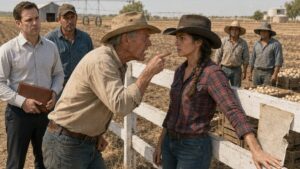
They Ordered Him to Remove the Farm Gate—So He Built the Boundary Their Own Rules Allowed
Chapter 1: The Tracks Beside Matthew’s Cattle Gate
The tire tracks crossed the grass at an angle that left no room for doubt.
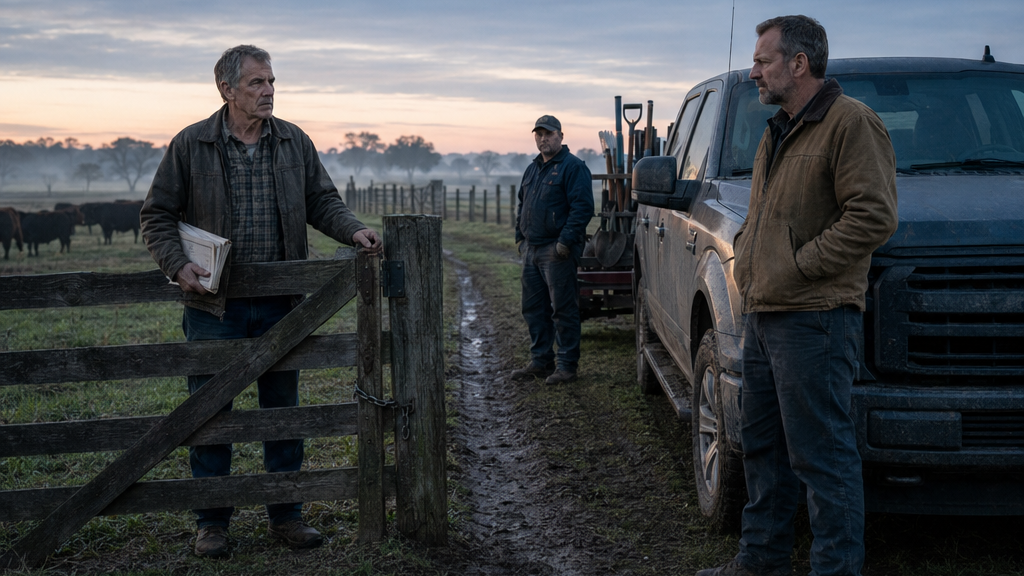
Matthew Clark stopped his pickup halfway down the lane, killed the engine, and stared through the windshield at two muddy ruts cutting across the narrow strip between his cattle fence and the private road.
Rain had softened the ground the night before. Whoever had driven through had come after that.
He got out without closing the truck door.
The tracks entered from the gravel road, passed through the gap beside his fence, and disappeared toward the neighboring properties. One rut ran close enough to the old cedar post that the mud had been pushed against its base.
Matthew crouched and pressed two fingers to the soil.
Still damp.
At the fence, the damage was worse.
The lower board of the nearest panel had pulled loose again. One nail hung crooked from the post. The board had been repaired twice since spring, once after somebody dragged a mower trailer through the opening and once after a pickup clipped it turning too sharply.
Matthew stood and looked along the pasture.
His cattle were farther back near the hay feeder. None had gotten out. That was the only good part.
He carried a hammer and a handful of fencing nails in the pickup because lately he needed them often enough that putting them back in the barn seemed pointless.
He set the board, drove the first nail, and heard tires on gravel behind him.
A neighbor in an older pickup slowed near the opening.
“You fixing that again?”
Matthew kept the hammer against the board. “Looks that way.”
The man leaned toward his open window and glanced at the tracks.
“Ground’s soft.”
“So I noticed.”
A pause followed. Matthew knew the man well enough to recognize the hesitation that came before somebody explained his own property to him.
“You know everybody’s always gone through there.”
Matthew turned.
“Always?”
“Long as I remember.”
“That make it a road?”
The man shrugged. “Just saying it’s been used.”
Matthew looked at the ruts.
Used was one word for it.
The pickup rolled on.
By evening the board was tight again, but Matthew’s irritation had settled deeper than the nails.
The opening had existed before he took over the farm from his father. It was barely wide enough for a truck unless the driver was careful. There had once been a sagging section of fence there, and for years people had slipped through on foot, then with lawn equipment, then pickups, then whatever else they could fit.
No one had ever come to Matthew and said, May I?
That was the part that stayed with him.
Not the mud. Not even the broken boards.
The assumption.
He went inside after feeding and pulled the property file from the metal cabinet beside the kitchen.
The survey copy was old but clear enough. His parcel line ran along the edge of the lane and included the strip where the tracks crossed. He followed the black line with one finger, then checked the notes.
No access easement was marked there.
No dedicated turnaround.
No gate.
Nothing.
He found a newer county map online and compared it with the paper copy.
Same line.
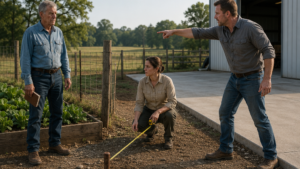
The next morning he walked the strip from the road to the pasture corner. He measured the opening, checked the fence line, and stood for a while where the tires had pressed the grass flat.
He could close it in half a day.
A simple gate. Treated lumber. Hinges heavy enough to hold. Nothing fancy.
Matthew knew enough about rural disputes to understand that the easiest time to ask questions was before putting in a post.
He also knew enough about himself to recognize when he was deliberately not doing that.
He did not call Jack Miller, who chaired the private road-maintenance association.
He did not knock on Sarah Lewis’s door.
He did not ask who used the opening or why.
He told himself he did not need permission to protect land shown inside his own boundary.
By noon Saturday, the gate was hanging level.
It matched the fence closely enough that from the road it looked as though it had always been there. Matthew used a simple chain and latch, not a lock. He wanted to stop vehicles from passing through, not create a fortress.
He stepped back and tested it.
The hinges held.
He opened it once, swung it closed, and listened to the latch settle against the post.
For the first time in years, the gap looked like part of his farm instead of a piece of ground everybody else had forgotten belonged to someone.
That afternoon, a pickup came down the lane, slowed, and stopped.
Matthew watched from the equipment shed.
The driver got out, walked to the gate, tested the latch, then stood with both hands on his hips.
He looked toward Matthew’s house.
Matthew did not move.
After a moment the man returned to his truck, backed up, and continued along the regular road.
Nothing happened Sunday.
Nothing happened Monday morning.
Matthew began to think that was the end of it.
Then, just after lunch, he saw the white envelope sticking out of his mailbox.
It was heavier than ordinary mail and folded around a green certified-delivery card.
The return address belonged to the road-maintenance association.
Matthew opened it beside the mailbox.
The first line identified the wooden gate as an unauthorized obstruction.
The second cited a section of the association rules.
The third gave him ten business days to remove it.
Near the bottom was a sentence explaining that removal costs and administrative charges could be assessed to the property owner if he failed to comply.
Matthew read it twice.
Then he looked past the paper toward the gate standing quietly in the distance.
Someone had crossed that strip for years without asking.
He had closed it for three days.
Now there was paperwork.
Chapter 2: The Notice That Called His Gate Temporary
The notice used the word temporary four times.
Matthew counted.
He sat at the kitchen table Tuesday morning with the letter flattened beside his coffee and a yellow legal pad under his hand.
Temporary obstruction.
Temporary boundary structure.
Temporary installation.
Temporary impediment to maintained access.
He circled each phrase.
What the notice did not explain was why a wooden gate on his property had suddenly become part of “maintained access.”
At nine, he called the number at the bottom.
Jack Miller answered on the fourth ring.
“Road association.”
“It’s Matthew Clark.”
A pause.
“I figured you’d call.”
“I got your notice.”
“Then you know what the issue is.”
Matthew looked at the paper. “I know what you called the issue.”
Jack exhaled softly.
“The opening needs to stay passable.”
“According to what?”
“According to the association rules.”
“The rule says temporary obstruction.”
“That gate is temporary.”
“Everything’s temporary if you wait long enough.”
Jack did not laugh.
“You installed it without approval.”
Matthew leaned back in the chair.
“I’m asking where the association gets authority over that strip.”
“We maintain the road.”
“You maintain the gravel. You don’t maintain my pasture fence.”
“It affects access.”
“To what?”
Another pause.
“Matthew, this doesn’t need to turn into something.”
“It already turned into certified mail.”
Jack’s tone tightened.
“The board has received complaints. People have used that cut-through for years. If the gate stays, we’ll have to proceed.”
“Proceed how?”
“If necessary, a crew removes it and the cost goes on your account.”
Matthew looked again at the ten-business-day deadline.
“You planning that before the deadline?”
“I’m telling you what can happen.”
“That wasn’t my question.”
Jack said nothing.
Matthew ended the call before irritation turned into something less useful.
He spent the next hour reading the rules.
The road association was small, the kind of organization that existed because the county did not maintain every rural lane serving scattered farms and houses. Annual dues paid for gravel, ditch work, culvert clearing, and snow removal. The rule packet had been amended enough times that the numbering was inconsistent.
Section 7 appeared on page eleven.
The paragraph quoted in Matthew’s notice prohibited temporary obstructions along maintained access boundaries when those obstructions interfered with passage, maintenance, or safe maneuvering.
Matthew read it twice.
Then he kept going.
The next paragraph began with an exception.
Permanent boundary improvements, it said, were permitted when located within the owner’s surveyed parcel and constructed in accordance with county requirements and applicable association setbacks.
Matthew sat still.
He read the paragraph again.
Permanent boundary improvements.
He turned to the notice.
Temporary obstruction.
The distinction was so plain he wondered if he was missing something.
By afternoon he had driven into town.
At the county permitting counter, a clerk listened while Matthew described the opening, the fence line, and the type of gate he had in mind.
“Farm access gate?” the clerk asked.
“Boundary gate.”
“Steel?”
“Probably.”
“Any utilities in the strip?”
“Not that I know of.”
“You’ll need a current survey if you’re putting posts close to the line.”
“I have one, but it’s old.”
“Get it certified again.”
The clerk slid a form toward him.
“If it’s entirely on your parcel and meets setback, height, sightline, and footing requirements, there’s nothing unusual about it.”
Matthew tapped the form.
“Road association approval?”
“County doesn’t require that unless they hold a recorded interest that affects the construction.”
That sentence followed him home.
Recorded interest.
He called a surveyor the next morning.
The surveyor came Thursday, found the old corner monument, checked the measurements, and placed two small flags along the disputed strip.
Matthew watched from the lane.
“Your line’s where you thought it was,” the surveyor said.
“The opening?”
“Inside your parcel.”
“Any easement?”
“Not on the plat I’m working from.”
Matthew felt the first clean measure of relief since the certified letter arrived.
Then his phone rang.
Jack.
Matthew considered letting it go unanswered.
He picked up.
“We need to talk about Saturday,” Jack said.
“What about Saturday?”
“The gate.”
“I’m still inside my ten days.”
“We’ve got a maintenance crew available.”
Matthew looked toward the surveyor, who was packing his tripod.
“For what?”
“To remove the obstruction.”
Matthew’s grip tightened around the phone.
“You told me what could happen. Now you’re saying you scheduled it?”
“I’m trying to keep this simple.”
“You scheduled somebody to come onto my property before the deadline in your own letter.”
“The gate affects association access.”
“Then bring the document showing your access right.”
Jack went quiet.
Matthew could hear a truck engine somewhere on Jack’s end.
“You want to make this a paperwork fight,” Jack said finally, “that’s your choice.”
“No. The paperwork was your choice. You mailed it certified.”
He ended the call.
That evening, Matthew clipped the association notice to the gate with a spring clamp.
Not because it needed to be there.
Because he wanted to see it beside the thing it described.
Temporary.
The gate was pine boards, bolts, two hinges, and a chain. Jack was right about one thing. It was not built to last forever.
Matthew went inside and opened the county application.
He changed the proposed material from wood to galvanized steel.
The next morning he returned to the permitting office with the certified survey, construction sketch, setback measurements, and footing specifications from Scott Adams, a fence contractor Matthew had used years earlier.
The clerk reviewed the pages.
“This is more substantial than what you have now.”
“That’s the idea.”
She looked at him over the top of the plan.
“Dispute?”
“Something like that.”
She stamped the intake page.
“Assuming no utility conflict, this qualifies as a permanent agricultural boundary improvement.”
Matthew looked at the stamp.
“When will I know?”
“I can finish this today if the site dimensions check out.”
He waited.
Twenty minutes later she returned with the signed approval sheet.
Matthew folded it carefully and slid it into the same envelope as the survey.
Outside the county building, he called Scott.
“You still have those six-inch galvanized posts?”
“Depends how many you need.”
“Two.”
“And the gate?”
“Solid steel frame. Lockable.”
Scott whistled softly.
“That old opening by the lane?”
“Yes.”
“You finally got tired of fixing boards?”
Matthew looked at the permit in his hand.
“That’s part of it.”
Scott said he could stage material the following week.
Matthew thanked him and hung up.
By the time he returned to the farm Friday evening, the notice clipped to the wooden gate had curled at the corners.
He removed it and carried it inside.
At five-thirty, Jack’s truck stopped at the end of the lane.
Jack did not get out.
He lowered the window.
“Crew will be here at six tomorrow.”
Matthew stood beside the gate.
“You understand I still have days left on your notice.”
“I’m aware.”
“And you’re coming anyway.”
“We need the opening restored.”
Matthew nodded once.
Jack studied him.
“You going to make this difficult?”
Matthew looked at the wooden gate, then at the envelope under his arm containing the survey and permit.
“No.”
Jack seemed relieved too quickly.
Matthew added, “You won’t have to remove it.”
The relief disappeared.
“What does that mean?”
Matthew tucked the envelope closer against his side.
“It means I’ll see you at six.”
Chapter 3: The Morning the Removal Crew Arrived
The work truck turned into Matthew’s lane at 5:57 Saturday morning.
Its headlights swept across the pasture fence, caught the wooden gate, and stopped there.
Behind it came a small trailer carrying a post puller, shovels, a compressor, and enough tools to dismantle a wooden gate in minutes.
Matthew was already outside.
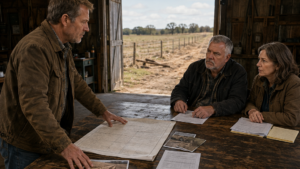
He had made coffee at five, fed the cattle early, and placed a folding table near the equipment shed. On it sat the certified survey, county permit, Scott’s construction drawing, and the road association’s notice.
Jack climbed from the passenger side of the truck.
An equipment operator got out on the other side.
“Morning,” Jack said.
Matthew nodded.
Jack wore work boots and a canvas jacket, as though he wanted the visit to look less official than the certified letter had made it.
“The crew won’t take long,” he said.
“You bring anything showing the association owns access across the strip?”
Jack’s jaw moved.
“We’ve been over this.”
“No. We’ve been over the rule you quoted.”
The equipment operator glanced from one man to the other.
Jack held out a sheet of paper.
“This authorizes removal of the obstruction and billing of labor to your road account.”
Matthew took it.
The wording was formal. The signature at the bottom was Jack’s.
“You signed this yourself?”
“As chair.”
Matthew folded it once.
Then he walked to the wooden gate.
Jack followed.
“Matthew.”
Matthew slipped the chain free.
Jack stopped talking.
Matthew lifted the latch and swung the gate inward.
The hinges gave a dry squeak.
He left it standing open.
“There,” Matthew said.
Jack frowned. “There what?”
“You came to remove a temporary obstruction.”
“Yes.”
“You don’t need to.”
Matthew reached for the hinge bolts.
“I’m taking it down.”
For the first time that morning, Jack looked uncertain.
The operator shifted his weight.
“You want a wrench?” he asked.
“I’ve got one.”
Matthew had loosened the first bolt the night before. It turned easily. He removed the nut, then the second.
Jack looked toward the truck.
“If you’re removing it voluntarily, that resolves the violation.”
“That one.”
Jack’s eyes returned to him.
Matthew carried the wooden gate away from the opening and leaned it against the fence.
Then he walked to Jack’s truck, laid the certified survey across the hood, and placed the county permit beside it.
Jack did not touch either document at first.
“What’s this?”
“My parcel survey.”
“I know what a survey looks like.”
“Then you’ll see the line.”
Jack leaned closer.
The operator came around the truck but stayed several steps away.
Matthew tapped the flagged measurement.
“The whole opening is inside my boundary.”
Jack’s expression hardened.
“That doesn’t change the access rule.”
Matthew placed the association rule packet beside the survey.
“No. This does.”
He opened Section 7.
Jack read the paragraph he knew.
Matthew moved his finger down.
“Keep going.”
Jack read the next paragraph.
His face changed only slightly, but Matthew saw it.
Permanent boundary improvements located within the owner’s surveyed parcel, compliant with county standards and association setback requirements.
Jack looked at the permit.
Matthew said, “Approved yesterday.”
“You can’t block maintained access.”
“Show me where the association holds maintained access on my parcel.”
“We have decades of use.”
“That wasn’t my question.”
Jack straightened.
“You think changing wood to steel changes what this is?”
“It changes what your own rule calls it.”
“That’s gamesmanship.”
“You scheduled a crew before your own deadline expired.”
Jack’s eyes narrowed.
Matthew felt the old anger rise and nearly let it speak for him.
Instead, he pushed Scott’s drawing across the hood.
“Six-inch galvanized posts. Concrete footings. Permanent steel frame. County-approved setback.”
The equipment operator whistled once under his breath.
Jack ignored him.
“You’re building a wall now?”
“A gate.”
“Locked?”
“Yes.”
Jack stared at him.
“This is exactly why the rule exists.”
Matthew almost laughed.
“No. The rule says temporary obstructions are prohibited. Then it says permanent boundary improvements are allowed. You chose the first paragraph. I read the second.”
For a moment nobody spoke.
A cow called from the pasture.
The sound carried across the lane with absurd calm.
Jack gathered the pages into a neater stack but did not move them off the hood.
“You understand this is going to make things harder for people.”
“People have been making things harder for me for years.”
“That opening’s been used since before you ran this place.”
“My father letting something happen doesn’t make it yours.”
“I didn’t say it was ours.”
“You sent me a bill authorization like it was.”
Jack looked toward the open gap.
Matthew could see the counterargument forming.
Then another vehicle came up the road.
Sarah Lewis’s SUV.
She pulled to the shoulder, got out, and walked toward them quickly.
“What are you doing?”
Jack answered before Matthew could.
“He’s replacing the gate.”
“With what?”
Matthew pointed to the drawing.
Sarah looked down.
Her face tightened.
“You’re closing it permanently?”
“I’m putting a permanent gate on my property.”
“You can’t.”
Matthew was tired of hearing that sentence.
“According to the survey, I can.”
“I’m not talking about the survey.”
“Then what are you talking about?”
Sarah looked at Jack.
Jack looked away.
That small exchange bothered Matthew more than another argument would have.
Sarah stepped closer.
“That opening isn’t just people taking a shortcut.”
Matthew folded his arms.
“I’ve watched pickups cut through there to save themselves a trip around the lane.”
“Yes. People do that.”
“So?”
“So that’s not all it’s for.”
Matthew waited.
Sarah looked toward her house farther down the private road.
“When my husband was sick, emergency crews used that opening.”
Matthew’s arms loosened.
“What?”
“The main lane was blocked that winter. Ice and a fallen limb. Ambulance came from the lower road. They couldn’t turn near my place.”
Jack said quietly, “Sarah—”
“No. He ought to know.”
She faced Matthew.
“They backed through this strip. It was the only place wide enough to get the unit turned around without backing half a mile.”
Matthew looked at the muddy ground beyond the open gate.
The worn tracks he had spent a week treating as proof of entitlement suddenly looked different.
Not harmless.
Not automatically justified.
But older than irritation.
Sarah continued, her voice flatter now.
“My husband had another episode two months later. Same route. We never had papers for it. Nobody thought we needed them because the opening had always been there.”
Matthew felt the satisfaction of the permit drain away.
He looked at Jack.
“You knew this?”
Jack did not answer immediately.
“I knew it had been used for emergencies.”
“You didn’t think to mention that before mailing me a removal notice?”
“I thought you knew why people cared.”
“No. You assumed.”
Jack’s face tightened.
“And you put up a gate without asking anybody why they used it.”
The sentence landed cleanly because it was true.
Matthew looked back toward the wooden gate leaning against the fence.
He had spent days furious that nobody had asked permission.
He had not asked a single question either.
Sarah touched the edge of the steel-gate drawing.
“I’m not saying the land isn’t yours.”
That was the first time anyone on the other side of the dispute had said it plainly.
“I’m saying closing it changes more than you think.”
Matthew looked at the approved permit.
An hour earlier it had felt like an ending.
Now it looked like permission to make a decision he did not yet understand.
He gathered the papers from Jack’s hood.
“The steel gate is still going in.”
Sarah’s expression closed.
Matthew continued before she could respond.
“But before Scott pours concrete, I want to know exactly what this opening has actually been used for.”
Jack said, “Matthew—”
“And I want records. Not ‘everybody knows.’ Not ‘it’s always been that way.’ Records.”
Jack looked down the lane.
Sarah remained beside the truck.
After a moment she said, “Come by Monday.”
Matthew met her eyes.
“I’ll show you where the ambulance turned.”
The removal crew left without touching a tool.
Matthew stood beside the empty opening after the trucks were gone, staring at two sets of tracks running through the grass.
For the first time, he could not tell whether they represented trespass, necessity, or some untidy mixture of both.
Chapter 4: What the Worn Road Had Been Used For
Sarah was waiting beside the opening when Matthew arrived Monday morning.
She had parked her SUV on the regular lane, not on the strip through his property.
That small choice did not escape him.
“You said you’d show me,” he said.
Sarah nodded toward her house. “Come on.”
They walked downhill along the road, past the ditch where gravel had washed thin around a culvert. Near Sarah’s driveway, the lane narrowed between a bank and an old line of trees.
She stopped at a patch of ground where the ditch widened.
“This is where the ambulance tried first.”
Matthew looked at the space.
A pickup could turn there with patience. An ambulance would have had trouble.
“They came in during freezing rain,” Sarah said. “Tree was down farther up. The driver tried to back around here and couldn’t get the rear clear.”
She pointed toward Matthew’s side of the road.
“So they went up to your opening, backed through, turned, and came down nose-first.”
“When was this?”
“Seven years ago.”
Matthew did the arithmetic.
His father had still been alive then, though Matthew had been running most of the farm.
“You asked him?”
“My husband did.”
Matthew looked at her.
Sarah held his gaze.
“He called your father from the ambulance.”
That stopped him.
“He asked?”
“Yes.”
“And my father said yes.”
“Yes.”
Matthew rubbed a thumb against the edge of his work glove.
He had spent the past week telling himself no one had ever asked.
Apparently, at least once, someone had.
Sarah walked farther toward her house.
“The second time was different. Your father was already gone. We didn’t call you.”
“Why not?”
She stopped.
“Because by then everybody treated it like the arrangement was still in place.”
“That’s exactly the problem.”
“I know that now.”
Her answer came too quickly for him to argue with.
They stood looking back toward the opening.
From this angle Matthew could see why the strip had become useful. The main road bent sharply uphill. His parcel offered the only broad, reasonably level place near Sarah’s property where a longer vehicle could leave the gravel, straighten itself, and return.
Useful was not the same as owned.
But it was not nothing.
“Who else uses it?” he asked.
“Farm equipment during haying. Snowplow sometimes. Delivery trucks if they miss the turn. People cutting through because they’re lazy.”
Matthew gave her a look.
“I’m not defending that part.”
“Good.”
“I’m telling you it became several things at once.”
That was the first sentence about the opening that felt accurate.
Later that morning Matthew drove to the county records office.
The clerk there pulled the parcel history and recorded plats. Matthew read every notation affecting his boundary.
No easement crossed the strip.
No dedicated emergency turnaround.
No association access right.
The surveyor had been correct.
Still, Matthew asked the clerk to search older recorded documents connected to the neighboring parcels.
Nothing.
He went home with copies.
The absence of an easement should have felt better than it did.
That afternoon the county surveyor returned Matthew’s call.
“I checked the older plat references,” the surveyor said. “No recorded right through that location.”
“So it’s mine.”
“As far as title boundaries go, yes.”
“And long use doesn’t change that automatically.”
“Not automatically.”
Matthew heard the caution.
“What aren’t you saying?”
“I’m saying property questions get complicated when people start talking about prescriptive rights, permission, historical use, things like that. I’m not your lawyer.”
“But if the prior owner allowed it?”
“Permission is different from an adverse claim.”
Matthew leaned against the kitchen counter.
That mattered.
His father’s permission had not surrendered ownership.
It had created a courtesy.
The question was what happened when courtesy survived longer than the person who granted it.
Two days later Matthew called the former owner of a small parcel farther up the road. The man had sold and moved several counties away but still remembered the lane.
“That gap by your fence?” he said. “Sure.”
“Did people have a right to use it?”
“A right?”
“Recorded or otherwise.”
The man laughed softly.
“Not that I ever knew.”
“Then why was everybody using it?”
“Because your dad let us.”
The simplicity of the answer irritated Matthew.
“Everybody?”
“Within reason.”
“What does that mean?”
“It means if somebody was pulling a hay wagon and needed room, he wasn’t going to stand there measuring tires. Same with the plow. Same with Sarah’s husband when he got sick.”
“So it was permission.”
“That’s how I understood it.”
“Did Jack know?”
There was a pause.
“Jack?”
“Jack Miller.”
“I’d assume so. He was on the road committee back then.”
Matthew straightened.
“Did he ever say there was an easement?”
“Not to me.”
After the call, Matthew drove the length of the private road slowly.
He noticed things he had driven past for years without really seeing them.
A steep shoulder.
A narrow curve.
A culvert with little room beyond it.
The entrance to Sarah’s property, tight for anything longer than a pickup.
When he reached his gate opening, he stopped.
The worn tracks ran through the grass in multiple directions.
He had seen only disrespect in them.
Now some looked like the wide arc of farm machinery. Some looked like ordinary pickups. One older pair, nearly hidden under newer growth, curved broadly before returning to the road.
A turning path.
That evening he called the volunteer fire station.
The representative who answered did not pretend to know the history, so Matthew described the road.
“Is that opening required emergency access?” he asked.
“Required? No.”
“If I close it?”
“If the main lane remains passable, you’re not blocking a designated fire route.”
Matthew felt his shoulders loosen.
Then the representative added, “Would I rather have more turning room than less on a narrow rural lane? Sure.”
“So legally unnecessary, practically useful.”
“That’s fair.”
Matthew thanked him.
He could legally install the steel gate.
He could close it and still be right about the boundary.
But he could no longer tell himself the only people affected were neighbors shaving thirty seconds off a drive.
That night he spread the road-association notice, survey, and county permit across his table again.
This time he also wrote down the names of everyone he had spoken with.
At the bottom he wrote one question.
What did Jack know before he sent the notice?
The next morning Matthew called the road-association secretary.
He asked for meeting minutes relating to the opening.
There were few.
Most mentions were informal: snow removal, equipment access, “Clark turnaround,” occasional maintenance notes.
Then the secretary said something that made him grip the phone tighter.
“You know Jack asked about the easement last year, right?”
Matthew went still.
“What easement?”
“The one people assumed was there.”
“What did he find?”
“Nothing recorded. He told us the files were incomplete.”
Matthew stared through the kitchen window toward the lane.
Jack had known.
Before the certified notice.
Before the scheduled crew.
Before telling Matthew the opening had to remain accessible.
Jack had already searched for the document that would have proven the association’s authority.
And he had not found it.
Chapter 5: Jack’s Reason for Acting Before He Knew
“There is no easement document.”
Jack Miller said it before Matthew had even sat down.
The road-association meeting was being held in the small office at the end of a machinery shed, where metal filing cabinets shared wall space with grease charts and an old calendar.
Three folding chairs faced a scarred wooden desk.
Matthew remained standing.
“You knew that before you sent me the notice.”
Jack looked at the association secretary, then back at Matthew.
“I knew we didn’t have one in our file.”
“That’s not what I asked.”
Jack’s mouth tightened.
“I checked the county records last year.”
“And?”
“And I didn’t find one.”
Matthew put the certified notice on the desk.
“So why does this read like you had the right to order me around?”
“The rule doesn’t depend entirely on a recorded easement.”
“You scheduled a crew to enter my property.”
“To remove an obstruction affecting access.”
“Access you already knew might not belong to the association.”
Jack pushed his chair back.
“Might not.”
Matthew almost laughed.
“You still saying that?”
“I’m saying the road has worked a certain way for decades.”
“That doesn’t make the strip yours.”
“I didn’t say it did.”
“You acted like it did.”
The association secretary gathered her papers and quietly moved to the far end of the table.
Jack rubbed a hand across his jaw.
“You want to know why I moved fast?”
“Yes.”
“Because the morning after your gate went up, I had six calls.”
Matthew said nothing.
“Two were complaints from people who were annoyed about the shortcut. I didn’t care about those. One was from the snow contractor. One was Sarah. One was a farmer worried about moving equipment. And one was from a neighbor asking what happened if an ambulance needed to turn.”
“Then you could have told me that.”
“I assumed you knew.”
Matthew heard his own words from Saturday coming back at him.
You assumed.
Jack looked at the gate diagram Matthew had brought.
“I’ve chaired this thing eight years. Every winter somebody’s mad about plowing. Every spring somebody’s mad about gravel. A culvert plugs, I get called. A tree falls, I get called. People don’t want a road association until the road stops working.”
“That still doesn’t give you my land.”
“No.”
Jack said it plainly.
The lack of argument took some force out of Matthew’s anger.
Jack continued.
“But I’d spent years telling people that opening was available if we needed it. I believed it was part of the way the road functioned.”
“Because people used it.”
“Because your father allowed it.”
“That’s permission.”
“I understand that now.”
“You understood enough last year to look for an easement.”
Jack leaned back.
“That’s where I made the mistake.”
Matthew waited.
Jack looked toward the shed window.
“When I couldn’t find one, I should have dealt with it then. I didn’t.”
“Why?”
“Because nothing had changed.”
There it was.
Not corruption.
Not some secret claim.
Inertia.
Jack had found a weakness in the arrangement and left it alone because the arrangement still worked.
Then Matthew had installed the wooden gate.
“And suddenly it was your problem,” Matthew said.
“It was everybody’s problem.”
“No. Suddenly everybody could see the problem you already knew was there.”
Jack’s face hardened.
“Yes.”
The answer surprised Matthew.
Jack lowered his voice.
“I had people asking why the route was closed after I’d told them for years we could use it when necessary. What was I supposed to tell them? That I’d never made sure we had the authority I thought we had?”
“That would’ve been accurate.”
“It would’ve also meant I’d been wrong for years.”
Matthew saw something then he had not wanted to see.
Jack had not sent the notice because he believed Matthew was powerless.
He had sent it because Matthew’s gate exposed Jack’s own certainty as something weaker than certainty.
Custom.
Assumption.
A promise made without paperwork beneath it.
That did not excuse the crew.
It explained the speed.
Jack slid a sheet across the desk.
“I can withdraw the removal charges.”
“There shouldn’t be charges to withdraw.”
“Fine. I can cancel them.”
Matthew looked at the page but did not pick it up.
“In exchange for what?”
Jack hesitated.
“You don’t install the steel gate.”
Matthew let the silence sit between them.
“So that’s your solution.”
“We restore the opening.”
“To what?”
“To how it was.”
“Which is the arrangement that caused this.”
“It worked for years.”
“It worked because nobody asked who had control.”
Jack’s hands flattened on the desk.
“I’m trying to solve the practical problem.”
“No. You’re trying to put it back where nobody has to admit anything changed.”
The secretary looked down.
Jack stared at Matthew.
“You want an apology?”
Matthew considered it.
A week earlier, maybe he had.
He had imagined Jack being forced to admit he had overreached. He had imagined the steel gate standing there as a permanent answer.
Now the idea felt smaller than it had before Sarah’s story.
“No,” Matthew said.
Jack seemed almost disappointed.
“I want the association to stop pretending permission and ownership are the same thing.”
“And what about access?”
“That’s a separate question.”
“It isn’t separate to Sarah.”
“I know.”
Matthew picked up his gate diagram.
Jack pointed at it.
“If you build that exactly as drawn, you can keep everybody out.”
“Yes.”
“And you’re comfortable with that?”
Matthew did not answer.
The silence irritated him because Jack had found the question Matthew had been avoiding.
He could build the gate.
He had the survey.
The permit.
The rule.
The contractor.
Everything he had wanted.
Legally, the argument was becoming simple.
Morally, it was becoming inconvenient.
Matthew folded the drawing.
“I’m not taking your deal.”
Jack’s expression closed.
“The gate goes in?”
“A permanent boundary goes in.”
“That sounds like the same thing.”
“It might be.”
Matthew walked toward the door.
Then he stopped.
“When Sarah’s husband was sick, did you know my father gave permission?”
Jack nodded.
“Yes.”
“And after my father died?”
“We kept using it when needed.”
“Without asking me.”
“Yes.”
“Why?”
Jack looked tired now.
“Because by then we’d stopped thinking of it as permission.”
Matthew opened the door.
“That’s the part I’m changing.”
Outside, the late-afternoon light caught dust suspended inside the machinery shed.
Matthew drove directly to Sarah’s house.
She came out onto the porch before he reached the steps.
“How’d the meeting go?”
“Jack admitted there’s no easement.”
Sarah nodded once.
“I figured he would.”
“He offered to drop everything if I don’t build the steel gate.”
“What did you say?”
“No.”
Her face tightened, though she tried to hide it.
Matthew continued.
“I’m still building something.”
Sarah folded her arms.
“Then why are you here?”
Matthew looked down the lane toward the opening.
“Because I’ve spent two weeks telling everybody what they can’t do.”
Sarah waited.
He forced himself to ask the question he should have asked before setting the first post.
“What access do you actually need?”
Chapter 6: The Gate Matthew Could Legally Close Forever
Scott Adams tapped the steel drawing with one finger.
“You building this for protection,” he asked, “or punishment?”
Matthew looked up sharply.
They stood beside the open strip Saturday morning. Two galvanized posts lay on timber blocks nearby, bright against the grass. Bags of concrete were stacked behind Scott’s trailer.
“You always ask customers that?”
“Only when they change their mind three times about the lock.”
“I changed it twice.”
“Three if you count the solid panel.”
Matthew looked toward the lane.
The original approved design would have closed the opening almost completely: steel frame, solid lower panel, lock, posts set deep enough that a pickup would lose the argument before the gate did.
The county had approved it.
The association could not stop it.
A week earlier, that had been the appeal.
Now Sarah’s answer from the porch sat uneasily in his mind.
“I don’t need people driving through whenever they feel like it,” she had said. “I need a way for emergency crews to turn if the upper lane is blocked. And maybe farm equipment twice a year. That’s it.”
She had surprised him again by adding, “If you want it locked the rest of the time, lock it.”
Matthew had asked about ordinary shortcuts.
“Those can stop.”
It was such a smaller request than the one he had been fighting that he had not known what to do with it.
Scott crouched beside the first footing mark.
“If we pour here, this is where it lives.”
“I know.”
“You still want the solid gate?”
Matthew walked to the survey flag.
From there he could see the old wheel tracks beneath the new grass.
His father had allowed a favor.
The neighborhood had slowly turned the favor into a habit.
Jack had turned the habit into assumed authority.
Matthew had nearly answered all of it with steel.
“Can we change the hardware?” he asked.
Scott stood.
“To what?”
“Keyed lock. Outside emergency release in a protected box.”
Scott considered it.
“Who gets keys?”
“Me. Sarah. Road association only for defined maintenance or emergency use.”
“You’ll want that written down.”
“It will be.”
“And the gate itself?”
“Open frame above the lower livestock panel. No solid wall.”
Scott smiled slightly.
“That’ll cost you less.”
“That wasn’t the point.”
“I know.”
Scott walked back to the trailer and pulled out a different hardware sheet.
“County won’t care as long as dimensions and posts stay within the permit. Lock change is easy.”
Matthew looked at the concrete bags.
“Do it.”
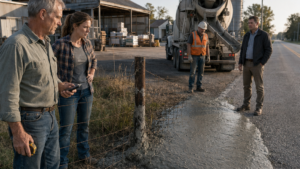
By midday the auger was chewing two clean holes into the ground.
The sound carried across the pasture.
Jack arrived just before the first post was set.
He parked on the road and walked over carrying a folder.
“I heard you changed the design.”
“News travels.”
“It’s a short road.”
Matthew looked at the folder.
“What’s that?”
“Draft access agreement.”
Matthew wiped dust from his hands.
Jack gave it to him.
The language was brief.
Emergency vehicle turning.
Association maintenance equipment when the regular lane was obstructed.
Seasonal agricultural access only with the owner’s permission.
No general shortcut rights.
No admission of easement.
Gate to remain under Matthew’s control.
He read it twice.
“You wrote this?”
“Secretary cleaned it up.”
Matthew looked at Jack.
“You willing to sign it?”
“That depends.”
“On what?”
“Whether you’re willing to stop calling every past use trespass.”
Matthew’s first instinct was to refuse the wording simply because Jack had asked for it.
He caught himself.
“I won’t call the permitted uses trespass.”
Jack gave a dry nod.
“That’s probably as good as I’m getting.”
“And you stop telling people this is association access.”
Jack looked toward the first galvanized post as Scott guided it upright.
“It’s going to be strange seeing a gate there.”
“There was a gate there last week.”
“You know what I mean.”
Matthew did.
The wooden gate had looked temporary, almost argumentative.
The steel posts did not.
Once the concrete cured, nobody would mistake the boundary for an informal opening again.
Scott called from the footing.
“Matthew.”
He held up two latch assemblies.
“One key-only. One key plus emergency box.”
Matthew pointed to the second.
Jack watched.
“So Sarah gets a key?”
“Yes.”
“And us?”
“One controlled key. Use logged. Emergencies or agreed maintenance.”
Jack raised an eyebrow.
“Logged?”
“You wanted rules.”
For the first time since the dispute began, Jack laughed.
It was brief, but real.
By late afternoon both posts were plumb and braced.
The steel gate itself would hang after the concrete cured.
Sarah walked down before Scott left.
She stopped several feet from the new posts.
“That’s substantial.”
“It’s permanent,” Matthew said.
She looked at him.
The word had been used against him so many times that saying it now felt different.
Not a threat.
A fact.
He showed her the lock arrangement and the draft agreement.
Sarah read the access section.
“This says I have to call if it’s not an emergency.”
“Yes.”
“And emergency use doesn’t require permission first.”
“No.”
She nodded.
“That seems fair.”
Matthew had expected more negotiation.
“You’re sure?”
“I told you what I needed.”
She handed the paper back.
“I never needed everybody to be able to drive through whenever they wanted.”
Jack looked away.
Matthew noticed.
“So how did it become that?” Matthew asked.
Sarah glanced toward the old tracks.
“Same way most things do out here. One person gets permission. The next person sees them do it. Then nobody remembers who asked.”
Scott closed his trailer.
“That’s why I build gates.”
No one answered him.
The following Friday, after the steel frame had been hung and the latch tested, the road association met again at Matthew’s farm entrance.
No machinery shed.
No desk.
Just the people, the gate, and the boundary itself.
The secretary brought the final access protocol.
Matthew signed first.
Sarah signed as the neighboring participant.
Then the secretary handed the document to Jack.
He read the first page slowly.
When he reached the line stating that all use remained permissive and created no ownership interest or unrestricted access right, his pen stopped.
Matthew watched him.
Jack had spent years treating the opening as part of the road’s practical infrastructure.
Signing meant admitting it never had been—not without Matthew’s consent.
“You can still walk away,” Matthew said.
Jack looked up.
“And then?”
“Then the gate stays locked except when I choose otherwise.”
Jack gave him a long look.
“You’d do that?”
Matthew considered the question carefully.
“I could.”
That was the difference now.
He did not need to prove it.
Jack lowered his eyes and signed.
The secretary collected the pages.
Scott handed Matthew the final keys.
One stayed on Matthew’s ring.
One went into the sealed emergency box.
One he placed in Sarah’s palm.
The association key went into a numbered envelope for the secretary’s records.
When everyone left, Matthew stood alone by the new gate.
Galvanized steel caught the last light. The lower panel was high enough to hold cattle and open enough above that the lane remained visible beyond it.
The old wooden gate had been an answer made in anger.
This one was something else.
A boundary, certainly.
But also a decision about when a boundary should open.
Matthew closed it.
The latch settled with a solid metallic click.
This time the sound did not feel like keeping everyone out.
It felt like making everyone ask what the opening was for.
Chapter 7: The First Time Someone Asked Permission
The tractor stopped at the gate.
Matthew heard it before he saw it: the low diesel idle dropping into a steady rumble outside the barn, then nothing but the soft ticking of an engine waiting under load.
For years, people had approached that opening as though stopping was optional.
This time, nobody touched the latch.
Matthew set down the wrench he had been using on the hay elevator and walked toward the lane.
A neighboring farmer sat in the tractor seat with a wagon behind him, loaded high enough that taking the sharp bend farther up the private road would be awkward. The man raised one hand when Matthew approached.
“Morning.”
“Morning.”
The farmer nodded toward the steel gate.
“I need to bring this through if you’re all right with it.”
Matthew glanced at the wagon.
“Where you headed?”
“Lower field. Culvert entrance is too tight with the load stacked like this.”
Matthew looked at the tires, the width of the wagon, the dry ground beyond the gate.
A month earlier, seeing the same equipment waiting there would have sent a familiar irritation through him before a word was spoken.
Now the irritation had nowhere to land.
The man had stopped.
He had asked.
Matthew reached for the key ring clipped to his belt.
“Give me a second.”
The lock turned smoothly.
He lifted the latch and pulled the steel gate toward him.
It was heavier than the wooden one had been, but balanced well on Scott’s hinges. The galvanized frame swung open without sagging.
The farmer eased the tractor forward.
“Appreciate it.”
Matthew stepped clear.
The wagon passed within several feet of the old fence line. No wheel clipped a post. No tire dropped into the ditch. The driver took the turn slowly, watching Matthew in the mirror until the last axle cleared.
Then he stopped again.
“You want me to shut it?”
“I’ve got it.”
The tractor continued toward the lower field.
Matthew stood holding the gate.
The exchange had taken less than a minute.
That was what unsettled him.
For weeks, the dispute had grown large enough to involve certified letters, survey flags, county records, contractors, association meetings, concrete footings, and legal language about rights that no one had bothered to define.
Yet the difference between resentment and cooperation had just been five words.
I need to bring this through.
Not I’ve always used it.
Not everybody does.
Not you can’t stop me.
A request.
Matthew closed the gate but did not lock it immediately.
Sarah was walking up the lane from her house.
She carried a small envelope in one hand.
“I saw you open it,” she said.
“He asked.”
“I noticed.”
Matthew slid the latch into place.
Sarah stopped beside the post.
For a moment neither of them mentioned the weeks when simply standing near this spot had been enough to start an argument.
Then she held out the envelope.
“What’s that?”
“My copy of the access agreement.”
“You’re giving it back?”
“No. Read the note clipped to it.”
Matthew opened the envelope.
A yellow slip of paper was folded over the first page.
Sarah had written only two lines.
Emergency key tested. Gate works.
Thank you for hearing the difference.
Matthew read it twice.
“The difference between what?”
“Needing access and owning access.”
He looked at her.
Sarah gave a small shrug.
“I didn’t hear it either, for a long time.”
Matthew folded the note back into the envelope.
“You didn’t exactly make it easy.”
“No.”
“Neither did I.”
“No.”
That nearly made him smile.
Sarah looked across the pasture.
“My husband would have liked this better than the old opening.”
“The gate?”
“The asking.”
Matthew rested one hand on the steel latch.
“He asked my father.”
“He did.”
“And somewhere along the way everybody forgot that.”
“Not everybody. Just enough of us.”
A truck approached from the upper lane.
Both of them looked up instinctively.
It was Jack.
He slowed at the gate but did not turn in. Instead, he parked on the shoulder and stepped out with a folder tucked under his arm.
Matthew felt a small tension return.
Not anger exactly.
Habit.
Jack walked over.
“Am I interrupting?”
“Depends what’s in the folder,” Matthew said.
Jack gave him a tired look.
“Association corrections.”
He opened the folder on the hood of his truck.
Inside were revised maintenance notices and a new access map. The old shorthand label—Clark turnaround—was gone.
In its place the strip was identified as private property with conditional emergency and maintenance access by written agreement.
Matthew read the line carefully.
“You changed the language.”
“We said we would.”
“You also removed ‘maintained access.’”
“Because we don’t maintain it.”
Matthew looked at him.
Jack added, “We maintain the road. Your strip is your strip.”
The sentence was simple.
It had taken them all a month to reach it.
Sarah examined the map.
“What about winter?”
“Snow contractor has the protocol,” Jack said. “If the regular lane is blocked and the gate is needed, he calls first unless it’s an immediate safety issue.”
Matthew nodded.
“And the association key?”
“Still sealed with the secretary.”
“Good.”
Jack closed the folder.
“I also told the neighbors the opening isn’t a shortcut anymore.”
Matthew raised an eyebrow.
“How’d that go?”
“One complained.”
“Only one?”
“Two, if you count the fellow who said this was all easier before.”
Sarah said, “It was easier because Matthew absorbed the inconvenience.”
Jack looked at her, then at Matthew.
“That’s fair.”
Matthew had wanted that sentence from Jack once.
Not those exact words, but something like them.
An admission.
Acknowledgment that the burden had not been shared evenly.
Now that he had it, it did not feel like a victory.
It felt more useful than that.
Jack stepped back from the truck.
“I should’ve talked to you before sending the notice.”
Matthew said nothing.
Jack continued.
“I should’ve told people years ago that the opening depended on permission. I didn’t because the system worked and nobody wanted to disturb it.”
“It worked for you.”
“Yes.”
That was enough.
Matthew did not offer to erase what had happened.
Jack did not ask him to.
By late afternoon, the farmer returned with the empty wagon.
He stopped at the gate again.
Matthew was repairing a feeder in the pasture and saw him climb down from the tractor rather than reach through the bars.
The farmer waited.
Matthew walked over and unlocked the gate.
“Load get there all right?”
“Fine.”
He drove back through.
This time, after clearing the opening, he stopped and climbed down.
“You sure you don’t want me to shut it?”
Matthew handed him the gate.
“Go ahead.”
The farmer swung it closed carefully.
He waited until Matthew stepped forward to engage the latch.
“Thanks.”
“You’re welcome.”
When the tractor disappeared up the lane, Matthew remained there.
The old wheel tracks were fading now.
Grass had begun filling the deepest ruts. In another season some of them would disappear entirely.
Others would remain because the gate would still open when there was a reason.
That no longer bothered him.
The boundary had never needed to mean nobody could cross it.
It needed to mean crossing was not assumed.
Sarah had returned home. Jack’s truck was gone. The pasture settled into the ordinary sounds of cattle moving through dry grass and the occasional clink from the water trough.
Matthew took the key from the lock.
He thought of the first wooden gate, built quickly because he had been tired of asking himself why other people believed they could use what was his.
He had mistaken strength for finality.
The steel gate was stronger, but that was not what made it better.
It had rules around it now.
Names.
Reasons.
Limits.
Permission that could be given without being surrendered.
Matthew pulled the gate toward him.
The latch met the post with the same solid metallic click it always made.
A month ago, that sound would have meant the opening was closed.
Now it meant something more precise.
The equipment had passed.
The farmer had asked.
Matthew had said yes.
And when the gate closed behind him, nobody standing on that road mistook it for hostility.
The story has ended.