The Broken-Wing Salute
Part I — The Shirt Tore First
The first thing Fort Arlen heard was not Mara Voss falling.
It was her shirt tearing.
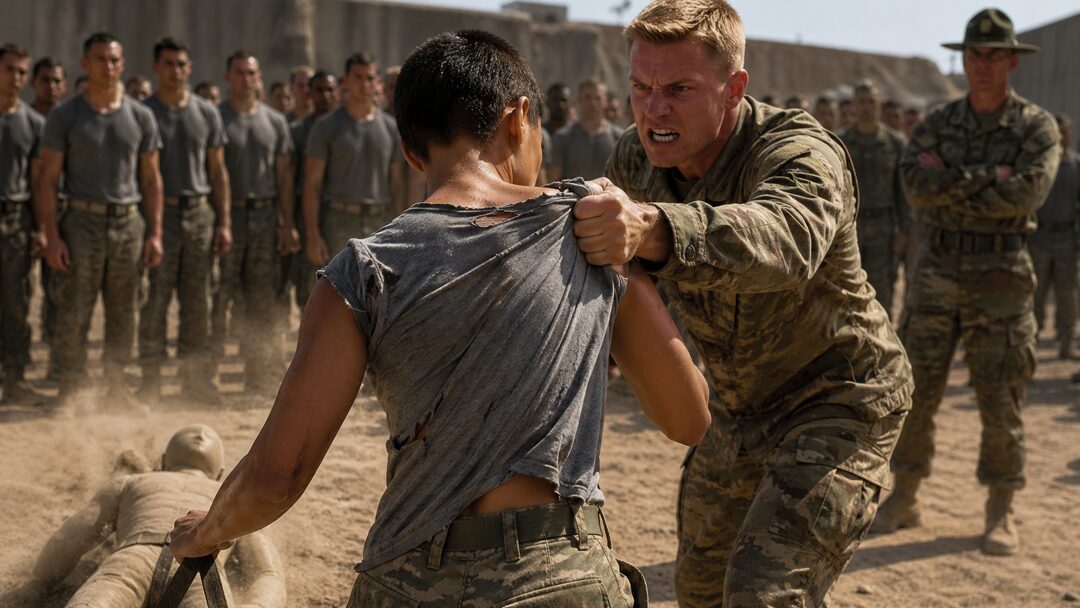
A dry, ugly rip cut across the training yard as Corporal Dane Harker yanked her upright by the back of her gray PT shirt. Dust jumped around her boots. The sand-filled casualty dummy dragged behind her slumped to one side, its canvas head leaving a crooked track through the dirt.
Mara did not cry out.
That seemed to irritate him most.
“Come on,” Dane said, loud enough for the ring of recruits to hear. “You wanted back in, didn’t you?”
Heat shimmered above the yard. The afternoon sun had burned the color out of everything except sweat, dust, and embarrassment. Twenty-six recruits stood in a loose semicircle, some with hands on hips, some trying not to grin, some watching the ground because watching her felt too much like joining in.
Mara kept one hand on the dummy’s drag strap.
Her hair was clipped close to her head. Her face was narrow, sun-browned, marked by an old scar through one eyebrow. She wore faded camouflage pants and boots polished cleaner than anyone else’s. She looked too controlled for the yard and too tired for the joke.
Dane leaned closer behind her.
“Paper transfer,” he said. “That’s what they call you, right? Somebody upstairs signed you in because they felt bad?”
A couple of recruits laughed. Not hard. Just enough to survive the moment.
Juno Reyes did not laugh.
She stood half a step behind the others, hands twitching at her sides, watching Dane’s fingers twist in the torn collar of Mara’s shirt. Juno had seen men like Dane before. Men who smiled while checking where the audience stood.
Mara turned her head slightly.
“Let go,” she said.
Two words. No tremor.
Dane’s grin sharpened.
“Or what?”
The yard held still.
At the far end, Drill Sergeant Elias Rourke stood with his arms folded. He had not moved since Dane started circling Mara five minutes earlier. His shaved head shone with sweat. His eyes were fixed not on Dane, but on Mara’s shoulders.
Mara’s breathing stayed even.
That bothered Rourke.
Not because it looked weak.
Because it looked trained.
Dane gave the shirt another short pull, forcing Mara onto the balls of her feet.
“You’re slowing my squad down,” he said. “You know that?”
Mara looked at the recruits. Not pleading. Not challenging. Just seeing them.
That was worse.
Juno dropped her eyes.
Dane released her with a shove.
“Again,” he said. “From the line.”
Mara bent, adjusted the drag strap around her wrist, and walked the dummy back through the dust.
No argument.
No glare.
Nothing Dane could hit back.
That silence spread through the yard like pressure before a storm.
The dummy weighed almost as much as a grown man. Its canvas seams had darkened with sweat from every body that had dragged it that week. Mara set her boots at the starting mark, lowered her hips, and began again.
The first ten yards were ugly. The sand caught. Her shoulders flexed. The torn collar slipped lower on one side, showing the top of her shoulder blade before fabric slid back into place.
Dane watched it.
So did Rourke.
Mara dragged the dummy past the first cone, then the second. Dust climbed her shins. Her jaw stayed locked.
“Look at that,” Dane called. “She can move when she remembers people are watching.”
A few recruits shifted. The joke was losing air.
“Back off, Harker,” someone muttered.
It was quiet, almost swallowed by the heat.
Dane heard it anyway.
His head turned.
Juno knew the voice had come from somewhere near her. Maybe from her. She honestly was not sure. Her mouth had opened before her courage arrived.
Dane smiled at the group.
“You all want to carry her too?”
No one answered.
He turned back to Mara.
“Drop it.”
Mara stopped. The dummy slid against her boot.
Dane stepped in front of her, bright and clean and almost shining in the heat. Blond hair, square shoulders, uniform immaculate even during punishment drills. He was the kind of soldier instructors liked before they had to know him.
“Hand-to-hand correction,” he said. “Since dragging is too complex.”
Mara’s eyes moved to Rourke.
Rourke’s face did not change.
That was his first mistake.
Mara released the strap.
Dane took two steps back and lifted his hands. “Come on, Voss. Show us what special transfer training looks like.”
“I’m not here to show you anything,” Mara said.
“That’s obvious.”
The recruits laughed again, smaller this time.
Dane lunged.
Mara moved.
Not fast enough to embarrass him. Not slow enough to be caught.
She turned his wrist with two fingers and slid out of the line of force. Dane stumbled half a step, recovered, and swung an arm around as if the stumble had been part of the demonstration.
The yard went quieter.
He came again.
She blocked with her forearm, absorbed the contact, shifted her weight, and let him pass. She did not strike. Did not throw. Did not prove what every nerve in her body clearly knew.
Dane’s cheeks flushed.
“Fight back,” he snapped.
“No.”
The word hit harder than a punch.
Dane grabbed her again.
This time, he hooked his fingers into the ripped collar at the back of her shirt and spun her toward the recruits like he was presenting evidence.
“See?” he said. “This is what happens when people get carried through a system.”
The fabric tore farther.
Mara’s shoulder went bare.
At first, the recruits only saw black ink.
A curved line near the back of her neck.
Then the torn cloth slipped down another inch.
The mark spread across her upper back: an eagle, wings uneven, one broken and falling, the other still open. Beneath it, seven small black marks sat in a row like tally lines or graves.
The yard changed.
Not all at once.
First, laughter stopped.
Then someone inhaled too sharply.
Then Rourke unfolded his arms.
Dane still had hold of the shirt.
He had not understood yet.
He looked at the tattoo, then at the silent recruits, then back at Mara, irritated by a reaction he had not ordered.
“What?” he said. “A tattoo doesn’t make you a soldier.”
Rourke’s voice cut through the yard.
“Release her.”
Dane turned. “Drill Sergeant, I was—”
“Now.”
Dane’s hand opened.
The torn shirt fell loose against Mara’s back.
Mara did not turn around. Her head lowered one fraction, as if the sun had suddenly become too bright.
Rourke walked across the yard.
Every bootstep sounded deliberate.
He stopped behind Mara. Close enough to see the black eagle. Close enough to see the seven marks. Close enough to remember a casualty list that had never officially existed.
His face went pale under the tan.
Then Drill Sergeant Elias Rourke raised his hand.
He saluted her.
“Sergeant Voss,” he said.
The recruits froze.
Dane’s mouth opened, but no sound came out.
Mara closed her eyes.
And for the first time all day, she looked wounded.
Part II — The Mark No One Named
Nobody at Fort Arlen knew what to do with a salute that did not fit the paperwork.
Mara Voss was listed on the roster as a re-entry recruit. Medical separation. Conditional assessment. No active rank. No command authority. No history that mattered to anyone standing in the yard.
And yet Drill Sergeant Rourke held his salute like the truth had outranked every file in the office.
Mara turned slowly.
The front of her shirt was still intact. The back hung open from collar to shoulder blade, exposing enough of the tattoo that several recruits stared despite themselves.
Dane looked from Rourke to Mara, then back again.
“Sergeant?” he said.
Rourke lowered his hand.
“Fall out,” he ordered.
No one moved.
He did not raise his voice.
“I said fall out.”
The semicircle broke. Recruits scattered in stunned, clumsy lines toward the water station and shade netting. Nobody laughed now. Nobody looked comfortable.
Juno stayed a second too long.
Mara met her eyes.
There was no accusation in the look. That somehow made it harder.
Juno left.
Dane remained where he was, red-faced, dust on one knee, still trying to rebuild the world in which he had been right.
Rourke stepped between him and Mara.
“Corporal Harker,” he said, “you will report to my office in ten.”
“With respect, Drill Sergeant, I don’t understand what just happened.”
“No,” Rourke said. “You don’t.”
Mara bent for the casualty dummy’s strap.
Rourke looked at her. “Leave it.”
“I was assigned a drill.”
“It’s over.”
“I didn’t finish.”
For a second, something like grief moved across his face.
“You finished enough.”
She lifted the strap anyway and dragged the dummy the last few yards to the line.
Every recruit saw it.
That was the part Juno remembered later. Not the salute. Not Dane’s stunned face. The way Mara completed the task after the yard had already changed its mind about her.
She did not do it for them.
That made it worse.
By evening, Fort Arlen had turned the tattoo into ten different stories.
By dinner, it was an assassination unit.
By lights-out, it was special operations.
By midnight, someone claimed Mara had killed twelve men with a broken radio and a shovel.
None of it touched the truth.
The truth sat in a locked cabinet in an office that smelled like dust, paper, and old coffee.
Dane stood in front of Rourke’s desk while the drill sergeant pulled one thin folder from the drawer and did not open it.
“You ever heard of Ghost Lark?” Rourke asked.
Dane shook his head.
“Good,” Rourke said. “Means somebody kept at least one promise badly enough.”
Dane swallowed. “Was she in it?”
Rourke looked at him for a long moment.
“She was the last one walking.”
The words landed, but Dane would not let them in.
“Sir, with respect, people get tattoos for all kinds of reasons.”
Rourke’s jaw tightened.
“That mark was not decoration.”
Dane stared at the folder.
His brother Aaron had a shadow box at home. Medals. A folded flag from a dead friend. A photograph in dress uniform. Their mother dusted it every Sunday like it was a shrine.
Captain Aaron Harker had survived the Veyr Border Evacuation.
That was how the family said it.
Survived.
Nobody said carried.
Rourke opened the folder just enough to remove a photocopied page with half the lines blacked out.
He placed it on the desk.
Dane saw his brother’s name first.
HARKER, AARON M. — EXTRACTED ALIVE.
His throat closed.
Below that, in a line nearly swallowed by ink, was another name.
VOSS, MARA E. — MOBILE UNTIL FINAL CONTACT.
Dane stared at it.
“What is this?”
“A record no one wanted to exist.”
“My brother never mentioned her.”
“I imagine not.”
Dane looked up sharply.
Rourke did not soften.
“Your brother came home breathing. Not everyone who got him there did.”
The office seemed to shrink.
Outside, a bugle call moved thinly over the yard. Dane had heard it every day at Fort Arlen. For the first time, it sounded like something being lowered into the ground.
“How many?” he asked.
Rourke tapped the seven marks at the bottom of the photocopy. There was a blurred image of the tattoo, taken for identification years earlier.
“Seven came out after command marked the route lost. Captain Harker was one of them.”
Dane’s hands curled.
He wanted to defend Aaron. Wanted to say his brother was brave, that he had earned everything in that shadow box, that their family had not been worshipping an incomplete story.
But incomplete did not mean false.
That was the first thing that hurt.
“What happened to the others in her unit?” Dane asked.
Rourke closed the folder.
“That is not your story to handle.”
Dane heard the door open behind him.
Mara stood there in a clean shirt, one sleeve damp from where she had washed blood or dust off her arm. Her expression did not change when she saw the paper.
Rourke’s face hardened.
“I didn’t call you in.”
“No,” Mara said. “You opened the drawer.”
Dane stepped back as if caught stealing.
“I didn’t know,” he said.
Mara looked at him.
“No. You didn’t.”
It should have comforted him.
It did not.
“I’m sorry,” he said, because the words were there and because he needed them to be enough.
Mara’s eyes moved to the folder.
“Don’t say that in here.”
Dane blinked. “What?”
“An apology in private can still be about protecting yourself.”
Rourke looked away.
Dane’s face burned again, but differently now.
Mara turned to leave.
Dane spoke before she reached the door.
“Why didn’t my brother tell us?”
That stopped her.
Not fully. Just enough.
For a moment, the room held three people and too many dead.
Mara did not turn around.
“Maybe because he wanted to live inside the part of the story where he survived.”
Then she left.
Dane did not sleep that night.
He lay on his bunk and saw his brother’s shadow box. The medals. The polished glass. The photo their mother loved.
Then he saw Mara’s back.
The broken-wing eagle.
Seven marks.
He had put his hand on a memorial and pulled.
Part III — Ghost Lark
The next morning, Mara became famous in the worst possible way.
No one called her paper transfer anymore.
That would have been simpler.
Instead, recruits stepped aside when she passed. Conversations died. A private from Third Platoon stood too straight near the mess hall and whispered, “Is that her?” like Mara was a weapon on display.
By noon, someone had drawn a broken-wing eagle in dust on the side of the barracks.
Mara wiped it off with her palm.
Juno saw her do it.
She also saw Dane watching from across the yard, pale and motionless, like he had found a door in his own house that had never opened before.
Juno approached Mara after lunch, when the heat pressed everyone into shade and the instructors were busy pretending nothing had changed.
“I should’ve said something,” Juno said.
Mara kept cleaning her boots with a rag. “You did.”
“Not enough.”
Mara looked up.
Juno’s throat tightened.
“I don’t know if it counts when you whisper it.”
“It counts to you,” Mara said. “Not always to the person who needs it.”
That was not cruel.
That made it worse.
Juno sat on the bench beside her without being invited.
“Do you want people to know?”
Mara folded the rag once. Twice.
“No.”
“Then why come back here?”
Mara’s hand paused on the boot.
Across the yard, recruits were setting barriers for the next evaluation: simulated wreckage, smoke canisters, low beams, weighted doors. An extraction course. A safe imitation of unsafe things.
Mara watched them.
“Because I still know how to bring people out.”
That was all she said.
Juno did not ask from where.
Some questions arrived carrying their own warning.
Dane found Mara behind the equipment shed at dusk.
She was alone, repairing the torn shirt with a needle from a field kit. The rip was too large to mend cleanly. The fabric puckered around every stitch.
He stood several feet away.
This time, he did not come closer without permission.
“My brother called today,” he said.
Mara kept sewing.
Dane continued. “I asked him about you.”
The needle went through cloth. Pulled tight. Through again.
“He hung up the first time.”
Mara said nothing.
“The second time, he asked if you still had the tattoo.”
The needle stopped.
Dane stared at the ground.
“He said there was another woman. A medic. Talia, I think.”
Mara’s hand closed around the shirt.
Dane’s voice lost its polish. “He said she died because he couldn’t walk.”
Mara pulled the thread until it snapped.
For several seconds, there was only wind moving dust against metal siding.
“Talia died,” Mara said, “because the route was burned and the radio was dead and six people were bleeding in a dry canal with no air support coming.”
Dane flinched.
“She didn’t die because one wounded man couldn’t walk.”
“He thinks she did.”
“People think all kinds of things when living feels expensive.”
Dane looked at her then.
He had expected anger. He wanted anger. Anger would have let him kneel under it, take it, maybe walk away cleaner.
Mara gave him no such gift.
“I humiliated you,” he said.
“Yes.”
“In front of everyone.”
“Yes.”
“I didn’t know who you were.”
Mara looked at him.
“You knew I was someone.”
The sentence hit with no raised voice.
Dane looked away first.
“I thought leadership meant not letting weak links hide.”
“Leadership starts when you stop needing an audience.”
His jaw tightened, but he did not fight it.
The old Dane would have.
The new one was not born yet, but something in him had cracked open enough to hear.
“I can tell them,” he said. “About my brother. About what I did.”
“No.”
He stared. “No?”
“You want a confession because guilt is loud. Repair is quieter.”
“I don’t know how to repair this.”
Mara picked up the torn shirt.
“Start by not making my dead carry your shame.”
For a second, Dane looked almost young.
Then the alarm bell rang.
Three short blasts.
Training incident.
Not scheduled.
Every head in the barracks row turned.
Smoke was already rising from the extraction course.
Part IV — Smoke Course
The course was supposed to be controlled.
That was the phrase everyone used later, as if controlled danger could not become real danger if fear entered the wrong body.
Smoke canisters rolled under a collapsed-beam obstacle. Weighted doors trapped sound. Recruits moved in teams through simulated wreckage, locating dummies, carrying them out, calling counts.
It was routine.
Until Private Miller froze under the low concrete crawlway with a steel training beam pinning his pack strap.
Until the smoke thickened.
Until the recruit behind him panicked and kicked the support brace loose.
The beam dropped six inches.
Not enough to crush him.
Enough to trap him.
Enough to make him scream.
Dane reached the entrance first.
“Everyone back,” he shouted. “Give me room.”
The squad obeyed out of habit.
That was the danger.
Dane dropped to one knee, peering into the smoke. Miller’s boots thrashed inside the crawlspace. Someone coughed hard enough to gag. The smoke was theatrical, but panic made it real.
“Cut the pack,” Juno shouted.
“The strap’s under the beam,” Dane snapped.
“Then lift it.”
“With what?”
He looked around. Too many faces. Too much expectation. His voice had always known where to go when people watched him.
Now it went nowhere.
Rourke was sprinting from the far range, still too far.
Mara arrived without running.
That was what everyone noticed.
She moved fast, but not frantic. Her eyes took in the obstacle, the brace, the wind direction, Miller’s trapped pack, Dane’s hands, Juno’s position, the recruits blocking the exit.
“Clear the mouth,” she said.
No one moved.
She was not wearing rank.
Dane turned toward her, smoke streaking his face.
For one raw second, the entire yard waited to see which version of him would answer.
Then Miller screamed again.
Dane swallowed his pride so visibly it looked painful.
“Clear the mouth!” he shouted. “Do what she says!”
The recruits moved.
Mara pointed to Juno. “You. Low crawl left side. Talk to him. Keep him breathing slow.”
Juno dropped without hesitation.
“Miller,” she called into the smoke, voice shaking but loud. “Hey, it’s Reyes. Look at my hand. Not the beam. My hand.”
Mara pointed to two others. “Bring the pry bar from the rack. Not the short one. The long one.”
They ran.
Dane stepped beside her. “What do you need?”
Mara looked at him once.
No forgiveness.
No punishment.
Just use.
“Repeat my calls,” she said. “They’ll follow you faster.”
He nodded.
She went to her knees at the crawlway entrance.
Smoke swallowed half her face. For a moment, she was somewhere else. Not Fort Arlen. Not a safe course. Not a yard full of recruits.
A dry canal.
Concrete dust.
A man begging for water.
Talia’s hand slipping off a stretcher rail.
Mara closed her eyes once.
When she opened them, Fort Arlen returned.
“Juno,” she called, “tell me what you see.”
“His pack strap is twisted under the beam. Right shoulder. He can move his legs.”
“Good. Miller, listen to me.” Mara’s voice lowered, cutting through panic without fighting it. “You are not buried. You are stuck. Stuck is a problem. Buried is a story. We are solving a problem.”
Inside, Miller sobbed once.
Then, “Yes, Sergeant.”
Dane heard it.
So did everyone.
Mara did not correct him.
The pry bar arrived.
Mara placed hands, bodies, weight. No wasted explanation. No technical lecture. Just command after command, clean and calm.
“Brace the left.”
Dane shouted it. “Brace the left!”
“On my count, lift two inches only.”
“On her count, two inches only!”
“Juno, pull the strap toward his hip, not back.”
Juno coughed. “Got it.”
“Miller, when she pulls, you exhale and slide.”
“I can’t.”
“You can be afraid and still move.”
The yard went utterly silent except for coughing and the metallic groan of the beam.
Mara counted.
“One.”
Dane repeated, louder. “One!”
“Two.”
“Two!”
“Lift.”
Bodies strained. The beam rose barely enough to matter.
“Now,” Mara said.
Juno pulled. Miller screamed. The strap tore loose.
“Slide,” Mara ordered.
“I can’t—”
“Slide.”
He moved.
Six inches.
Then a foot.
Hands grabbed his boots and dragged him into open air.
Miller came out coughing, crying, alive, furious with himself for crying. Juno crawled out after him with smoke-streaked cheeks and shaking hands.
The recruits surrounded them, then stopped, unsure if they were allowed to cheer.
Mara sat back on her heels.
Her torn shirt, badly stitched, had split open again during the rescue.
The broken-wing eagle showed through.
No one laughed.
No one looked away.
Dane stood over Miller, breathing hard. His face was white under the grime. He turned toward Mara, and for once there was no performance left in him.
He said, loudly enough for the platoon to hear, “Sergeant Voss had command.”
Mara looked up sharply.
Dane continued, voice rough. “I repeated orders. She gave them.”
Rourke arrived at the edge of the group, slowing as he understood what had happened.
Dane faced him.
“I froze,” Dane said. “She didn’t.”
The words cost him. Everyone could hear that too.
Rourke’s eyes moved from Dane to Mara to Miller, who was still gripping Juno’s sleeve like it was the only fixed thing in the world.
“Medical,” Rourke ordered.
The spell broke. Recruits moved, but differently now. Not as a crowd hungry for spectacle. As a unit trying, clumsily, to become useful.
Juno helped Miller sit up.
Dane picked up the long pry bar and carried it back with both hands, as if returning something sacred.
Mara stood.
The shirt hung open at the back.
She reached for the torn fabric, but stopped when she saw everyone watching.
This time, the watching was not the same.
That did not make it easy.
It only made it possible to breathe.
Part V — The Clean Shirt
Dane did not apologize in front of the platoon immediately.
That was the first right thing he did.
He waited until Miller had been checked, until the smoke had cleared, until the course had been reset and the yard no longer smelled like panic.
Then he asked Rourke for permission to address the unit.
Rourke looked at Mara.
Mara said nothing.
Rourke looked back at Dane. “Briefly.”
Dane stood where Mara had dragged the casualty dummy the day before.
The recruits gathered in formation. Juno stood near the front, Miller beside her with red eyes and a bruised shoulder. Mara remained several paces away, neither inside the formation nor fully outside it.
Dane held a folded gray PT shirt in both hands.
Not new from supply. Washed. Clean. His own spare.
On top of it lay the torn shirt Mara had worn.
He had folded that one too.
The rip still showed.
Good, Mara thought.
Some things should not be hidden just because they were ugly.
Dane’s voice carried across the yard.
“Yesterday, I put my hands on another soldier to humiliate her.”
No one moved.
“I called it discipline. It wasn’t.”
His throat worked.
“I called her a paper transfer because I didn’t know how to read silence unless it looked like weakness.”
Mara’s face stayed still.
Dane looked toward her, then away. He did not ask her to save him from the moment.
“I was wrong,” he said. “Not because of what I found out after. I was wrong before I knew.”
That line changed the air.
Rourke’s eyes narrowed, not in anger.
Attention.
Dane lowered the shirts onto the bench beside Mara.
“The clean one is yours if you want it,” he said. “The torn one is yours too.”
He stepped back.
No speech about Ghost Lark.
No mention of Aaron.
No stolen grief.
Mara looked at the shirts.
For a while, she did not move.
Then she picked up the torn one.
The fabric was stiff with dust and sweat. Her rough stitches had failed along the collar. The hole gaped wide enough to show exactly where Dane’s hand had been.
She folded it once more.
Smaller.
Neater.
Then she set it beside the clean shirt.
Dane’s shoulders dropped, but not with relief. Something heavier. Acceptance, maybe. Or the beginning of it.
Rourke stepped forward.
The yard seemed to know before he moved.
He raised his hand again.
This time, he did not look like a man revealing a secret.
He looked like a man asking permission to honor one.
“Sergeant Voss,” he said.
Juno was the first recruit to follow.
Her salute was too fast, too stiff, almost frightened.
Then Miller raised his hand.
Then another.
Then another.
Dane was last.
That mattered.
He held the salute with his jaw tight, eyes wet but not falling apart. Mara looked at him for one second longer than the others.
She could have refused it.
Maybe part of her wanted to.
Not because they did not mean it.
Because they did.
Meaning was dangerous. Meaning made stories out of people. Meaning polished pain until strangers could hold it without cutting themselves.
Mara looked past them, toward the far side of the yard where the dust lifted in the heat.
For a moment she saw Talia laughing with a radio handset pressed to her ear, saying the signal was trash but she had heard worse songs in worse bars.
Then the yard returned.
Mara accepted the salute.
Only for a breath.
Then she lowered her hand.
“Back to work,” she said.
A few recruits almost smiled.
Not because it was funny.
Because it was mercy.
Formation broke slowly. No one rushed her. No one asked about the tattoo. No one called her a legend.
Juno passed by and paused.
“Sergeant,” she said softly.
Mara gave her a look.
Juno corrected herself. “Voss.”
That earned the smallest nod.
Dane remained by the bench after the others moved off.
“My brother wants to write you,” he said.
Mara picked up the clean shirt.
“Tell him to write Talia’s mother first.”
Dane absorbed that.
Then nodded.
“I will.”
Mara turned to leave, the clean shirt under one arm, the torn one under the other.
Dane spoke once more.
“Will you ever forgive me?”
She stopped.
The question hung between them, too large for the dusty yard, too small for what had happened.
Mara looked back.
“Forgiveness isn’t a performance,” she said. “Don’t ask for it where people can clap.”
Dane lowered his eyes.
“Yes, Sergeant.”
She almost corrected him.
This time, she did not.
Mara walked toward the barracks as the sun dropped behind Fort Arlen’s low buildings. Behind her, the yard returned to motion: recruits lifting, carrying, calling counts, learning the difference between noise and command.
In her room, Mara placed the clean shirt on her bunk.
The torn one she folded again and set at the bottom of her locker.
Not hidden.
Not displayed.
Kept.
That night, before lights-out, she took a black pen and marked one small line on the inside hem where no one else would see it.
Not an eighth mark beneath the eagle.
Not another survivor.
A different kind of count.
A day she had been seen and had not disappeared.
Then she shut the locker gently and sat on the edge of the bunk while the base settled into darkness.
Outside, someone called cadence across the yard.
Mara listened until the voices blurred into footsteps.
Tomorrow, there would be drills.
Tomorrow, there would be heat.
Tomorrow, someone would expect her to be either broken or legendary, because people loved simple shapes.
But she had never been simple.
She had been a soldier.
She had been a witness.
She had been the last one walking.
And in the quiet after the salute, with the torn shirt folded in the dark, Mara Voss let herself believe that being remembered did not have to mean being used.