He Mowed an Elderly Neighbor’s Overgrown Lawn—Then the HOA Notice in His Hand Changed the Entire Fight
Chapter 1: The Morning She Ordered the Mower Shut Off
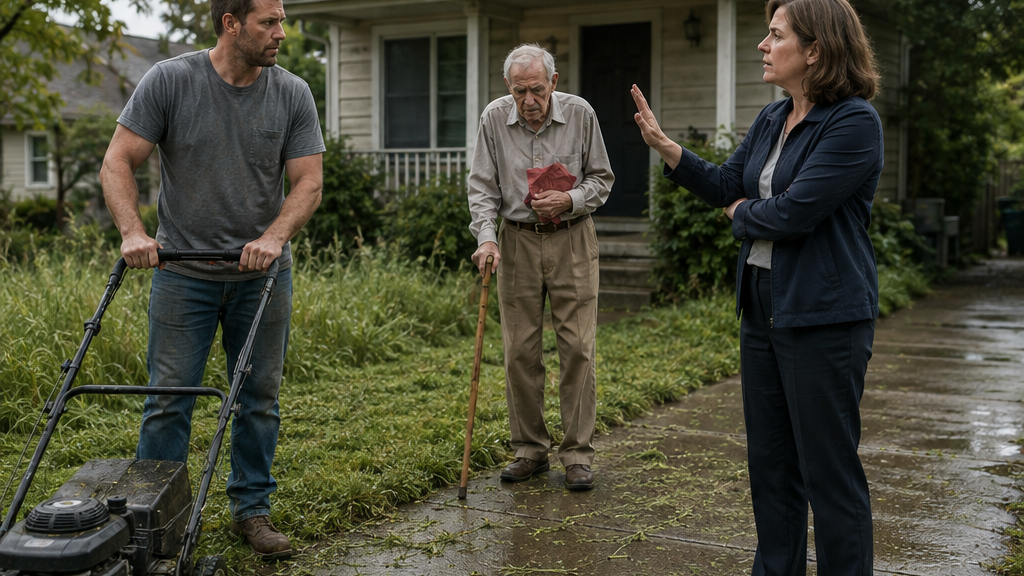
“Turn that thing off right now.”
Jason Robinson barely heard the first three words over the mower.
He let go of the handle. The engine dropped from a roar to a sputter, then died beneath him. Suddenly the whole street seemed too quiet.
Wet grass clung to his work boots. A dark spray of clippings covered the edge of the sidewalk where he had just made his second pass.
Catherine King stood ten feet away with her arms crossed.
She wasn’t dressed for yard work. Clean white sneakers. Dark slacks. Lightweight jacket zipped neatly to the collar. She looked from the clippings to the half-cut lawn as though Jason had dumped trash in the street.
“What?” Jason asked.
“I said turn it off.”
“It is off.”
“This is exactly the problem.”
Jason looked around.
“The grass?”
“The property.”
Donald Harris’s front lawn had been bad when Jason started. Knee-high in patches near the porch. Dandelions crowded the mailbox. The strip beside the driveway had folded over itself after several days of rain.
Jason had noticed it getting worse for almost a month.
That morning, he had finally walked across the street with his mower.
Donald had opened the door after a long delay and tried to say no.
Jason had ignored the first refusal.
“I’m already doing mine,” he’d told him. “Another twenty minutes won’t kill me.”
Now Catherine pointed toward the curb.
“You’re blowing debris onto the sidewalk.”
“I’ll sweep it.”
“That doesn’t fix the fact that this property has been out of compliance for weeks.”
Jason wiped the back of his hand across his forehead.
“So I’m cutting it.”
“That isn’t the point.”
He stared at her.
“It seems exactly like the point.”
Catherine’s mouth tightened.
“You don’t understand what’s been going on here.”
“No. I understand there’s an eighty-year-old man inside who can barely get down his front steps.”
“You don’t get to decide which rules matter.”
“And you do?”
“I chair the compliance committee.”
There it was.
Jason had known Catherine lived two streets over. He knew she attended every HOA meeting because her car was always outside the clubhouse on Thursday nights. But he hadn’t realized she was the person attached to the notices Donald had mentioned once and then refused to discuss.
Catherine glanced at the porch.
“This property has received repeated warnings.”
Jason felt his irritation sharpen.
“For grass.”
“For ongoing maintenance violations.”
“He uses a cane.”
“The association doesn’t enforce rules based on who we like.”
“I didn’t say anything about liking him.”
“You’re making this personal.”
“You walked over here and ordered me to shut off a mower.”
“Because you’re scattering wet clippings across a common sidewalk.”
Jason looked down. She wasn’t entirely wrong about that.
The clippings had formed a thin green line along the concrete.
“I told you I’ll clean it.”
“And the edging?”
“I’ll do that too.”
“The shrubs?”
He looked toward the front windows.
“Are you serious?”
Before Catherine answered, the front door opened.
Donald stood behind the screen.
For a moment he didn’t move.
Then he pushed the door outward and stepped onto the porch.
Jason had seen him walk before. He knew Donald was slow. But from across the street, slowness could look ordinary.
Up close, every step seemed negotiated.
Donald put his cane down first, tested his weight against it, then brought one foot forward. His free hand trembled against the railing.
Catherine stopped talking.
Donald descended the first step.
Jason moved instinctively toward him.
Donald lifted one hand.
“I’m all right.”
He wasn’t.
His face had gone pale.
“Mr. Harris,” Catherine said, softer now, “you really don’t need to come out.”
Donald reached the walkway.
“I’m sorry.”
Jason turned toward him.
“For what?”
Donald kept his eyes on Catherine.
“We didn’t mean to make trouble.”
Something changed inside Jason.
He had expected embarrassment.
What he saw was fear.
Donald’s fingers had closed so tightly around the cane handle that the skin across his knuckles looked stretched and shiny.
Catherine exhaled.
“Being sorry doesn’t resolve the compliance issue.”
Jason looked at her.
“Catherine.”
“I’m explaining the process.”
“To a man apologizing because somebody cut his grass?”
Her eyes moved to Jason.
“There is another enforcement recommendation already pending.”
Donald went still.
Not dramatically. No gasp. No sudden movement.
He simply stopped.
Jason saw the tip of the cane tremble against the concrete.
“What recommendation?” Jason asked.
Catherine hesitated.
“Another fine may be considered if the property remains out of compliance.”
“It won’t remain out of compliance. I’m standing here fixing it.”
“That doesn’t erase the history.”
Donald reached for Jason’s sleeve.
The gesture was so light Jason almost missed it.
“Please.”
Jason looked down.
Donald’s eyes were wet.
“Come inside.”
Catherine began, “Mr. Harris, I’m not trying to—”
“Enough,” Jason said.
His voice came out harder than he intended.
Catherine’s shoulders stiffened.
Jason immediately knew he had made the situation worse, but he was too angry to care.
“I’ll finish the lawn,” he said. “I’ll clean the sidewalk. And whatever else this is, I’ll handle it.”
Donald’s hand slipped from his sleeve.
Something in the old man’s expression tightened.
Jason mistook it for relief.
Catherine did not.
“This isn’t yours to handle,” she said.
Jason stepped closer.
“It is now.”
Donald turned toward the house.
Jason followed him.
The screen door closed behind them, cutting off the sight of Catherine standing beside the silent mower.
Inside, the air felt still.
Donald moved through a narrow living room toward the kitchen. There were two chairs at the table, but only one had been used recently. A folded newspaper sat beside a pill organizer. An old photograph of a smiling woman stood near the fruit bowl.
Donald lowered himself carefully into the chair.
Jason remained standing.
“What was she talking about?”
Donald looked toward the front window.
“Nothing.”
“That wasn’t nothing.”
Donald reached into a drawer.
His hand shook as he searched beneath takeout menus, rubber bands, and unopened mail.
Then he pulled out a crumpled red sheet of paper.
He flattened it against the table with both hands.
Jason saw the association logo at the top.
Below it were several paragraphs and a bold line boxed near the middle.
Donald pushed it toward him.
“I already paid one.”
Jason looked up.
“One what?”
Donald swallowed.
“One fine.”
Chapter 2: The Red Notice on the Kitchen Table
Donald kept one hand on the red paper as though Jason might take it away.
“I don’t like opening them anymore,” he said.
Jason sat across from him.
“Opening what?”
Donald looked toward the counter.
Jason followed his eyes.
A stack of envelopes sat behind a ceramic sugar bowl.
Three were white.
Two had the HOA’s return address.
One was still sealed.
Jason leaned back.
“How many notices have you gotten?”
Donald rubbed his thumb along the edge of the paper.
“I don’t know.”
“You don’t know?”
“I stopped keeping count.”
Jason felt anger rise again, fast and hot.
Not at Donald.
At Catherine. At the board. At anyone who had kept mailing warnings to a man who clearly could not keep up.
“What was the fine?”
Donald named an amount.
It was not ruinous by most standards.
That somehow made Jason angrier.
For Donald, it might as well have been.
“I get my pension,” Donald said. “Social Security. That’s about it.”
He nodded toward a folder on the counter.
“Doctors took more than I expected this year.”
Jason looked again at the pill organizer.
“What happened?”
Donald gave a small shrug.
“Getting old happened.”
“That’s not an answer.”
“It’s the answer I’ve got.”
Jason waited.
Donald finally looked at him.
“Heart tests. Physical therapy. Medication they keep changing because one thing fixes something and bothers something else.”
He tried to smile.
It disappeared almost immediately.
“After the hospital bill last winter, I started moving things around. Paid this late. Paid that later.”
He tapped the notice.
“I thought the grass could wait.”
Jason thought about the lawn outside.
He had been annoyed by it himself.
Not enough to complain, but enough to notice.
That realization settled badly.
“What about a landscaper?”
Donald laughed once.
“I had one.”
“What happened?”
“I stopped calling him.”
“Because of the money?”
Donald nodded.
Jason looked toward the living room. The photograph near the fruit bowl was visible from where he sat.
The woman in it had one hand on Donald’s shoulder.
“Your wife?”
Donald followed his gaze.
“Five years.”
“I’m sorry.”
“She handled this stuff.”
Donald motioned around the kitchen, but Jason understood he didn’t mean the kitchen.
“Bills. Insurance. Taxes. All the things that come in envelopes.”
He stared at the red notice.
“She’d have opened this the day it arrived.”
The room went quiet.
Jason remembered his own uncle after a stroke several years earlier. Jason had meant to visit. Meant to call more often. Meant to check whether the man was actually managing alone instead of accepting every cheerful “I’m fine.”
By the time the family understood he wasn’t fine, there had already been a fall.
Jason pushed the memory away.
“Let me see the rest.”
Donald’s shoulders tightened.
“The rest of what?”
“The mail.”
“No.”
“Donald.”
“I said no.”
Jason stopped.
It was the first time Donald had spoken sharply all morning.
Donald straightened as much as his back allowed.
“I didn’t invite you in here so you could go through my house.”
“I’m not trying to.”
“You said you were.”
“I asked to see the HOA letters.”
“They’re mine.”
Jason stared at him, then slowly nodded.
“You’re right.”
Donald looked surprised.
Jason rested both hands flat on the table.
“You show me what you want me to see.”
For several seconds, neither moved.
Then Donald reached toward the sugar bowl.
He pulled the envelopes forward one at a time.
The first contained a warning about the lawn.
The second referenced shrubs blocking part of the front window.
The third mentioned weeds near the mailbox and an untrimmed side strip.
Jason read each page twice.
The language was cold but ordinary.
No threats.
No insults.
No obvious smoking gun.
That bothered him.
He had expected something outrageous.
Instead, he found procedure.
Dates.
Deadlines.
References to governing rules.
Then he opened the final envelope with Donald’s permission.
Inside was a notice stating that the matter had advanced after prior noncompliance.
Jason traced the dates with his finger.
“You had weeks between these.”
Donald looked away.
“I know.”
“Did you respond?”
“No.”
“Did you call anybody?”
“No.”
“Why not?”
Donald’s jaw worked.
“Because I kept thinking I’d get it done.”
“The yard?”
“Yes.”
“With what?”
“Myself.”
Jason glanced at the cane.
Donald noticed.
“Don’t.”
“I didn’t say anything.”
“You didn’t have to.”
Donald pushed himself up from the table, then immediately gripped its edge.
Jason started to rise.
Donald shot him a look.
Jason stayed seated.
Slowly, Donald lowered himself again.
“I used to do all of it,” he said. “Front, back, hedges, gutters. I could work all Saturday and still cook dinner.”
“I believe you.”
“That doesn’t help.”
“No.”
Donald breathed through his nose.
“My wife got sick first. I took care of her. After she died, everybody started talking to me like I was next.”
Jason said nothing.
“My daughter wanted me to sell.”
“You have a daughter?”
Donald’s expression changed.
The answer came more quietly.
“Yes.”
“You told me last month you hadn’t heard from your kids in forever.”
“I haven’t. Not really.”
“Where does she live?”
“Far enough.”
Jason could hear the evasion, but he let it go.
Donald lifted the red paper again.
“I just wanted them to stop.”
“The HOA?”
“The letters. The calls. People looking at the house.”
His voice dropped.
“If another fine comes, I can pay it. Maybe. But then something else doesn’t get paid.”
Jason felt the easy solution rise in him.
He could cut the lawn every week.
Trim the shrubs.
Call the manager himself.
Challenge Catherine.
Go to the board.
He leaned forward.
“Then you’re done worrying about it.”
Donald looked at him.
“I’ll take care of everything.”
There was no relief this time.
Donald’s face closed.
“Jason.”
“I mean it.”
“That’s not what I asked.”
“You don’t have to ask.”
“Yes, I do.”
Jason stopped.
Donald folded the red paper once, carefully this time.
“You keep talking like I’m not sitting here.”
“That’s not what I’m doing.”
“You told Catherine you’d handle it. Now you’re telling me.”
Jason opened his mouth.
Nothing useful came.
Donald looked tired rather than angry.
“That woman made me feel like a child in my own yard.”
He tapped the paper.
“I don’t need you doing it in my kitchen.”
The sentence landed harder than Catherine’s accusation had.
Jason lowered his eyes.
“You’re right.”
Donald stared at him for a moment, then nodded.
“Help me understand it.”
“That I can do.”
They went through the pages again.
Slowly this time.
Jason made a list on the back of an old grocery receipt.
Warning date.
Correction deadline.
Fine date.
Next recommendation.
Then he found a separate page folded between two notices.
He unfolded it.
At the top was a date from the previous month.
Below it was a time and location.
Jason read the first paragraph.
“Donald.”
“What?”
“You had a hearing.”
Donald’s face emptied.
“A what?”
“A compliance hearing.”
He turned the paper around.
“It says you could appear before the committee before the fine was finalized.”
Donald stared at the date.
“I didn’t go.”
“I can see that.”
“I didn’t know.”
“It was in the envelope.”
Donald looked toward the unopened mail still on the table.
Jason watched him understand what that meant.
This wasn’t only something being done to him.
He had missed the one point where he might have explained himself.
Donald touched the edge of the paper.
“Did I lose my chance?”
Chapter 3: The Rules Were Real, but the Story Wasn’t Simple
“The notices themselves aren’t fake.”
Ruth Davis said it before Jason had finished explaining why he was there.
He sat across from her desk Monday morning with Donald’s red notice in a clear plastic folder.
By then the paper had Jason’s handwriting all over the margins.
Why no welfare contact?
Hardship option?
Who approved fine?
Can hearing be reopened?
Ruth folded her hands.
“I didn’t say they were fake.”
“You implied they were wrong.”
“I said the situation was wrong.”
“That’s different.”
Jason disliked how quickly she had separated those two things.
The HOA management office occupied one side of the small clubhouse near the subdivision entrance. Behind Ruth’s desk were labeled binders, a printer, and a bulletin board full of meeting schedules.
Everything looked orderly.
Donald’s kitchen had not.
That contrast made Jason uneasy.
Ruth turned the first notice toward herself.
“Initial lawn maintenance warning. Proper notice period.”
She picked up the second.
“Follow-up inspection. Still outside the standard.”
Then the hearing notice.
“This was mailed and emailed.”
“Donald doesn’t use email much.”
“That doesn’t invalidate the mailed notice.”
“I know.”
Ruth looked at him over the top of the page.
“Do you?”
Jason leaned back.
“I came here to find out what can be done.”
“Good.”
“Not to defend the paperwork.”
“I’m not asking you to.”
She opened a computer record.
“Mr. Harris had multiple opportunities to contact management.”
“He’s eighty.”
“That matters.”
“He walks with a cane.”
“That matters too.”
“Then why didn’t anybody stop?”
Ruth’s expression tightened.
“Because we can’t automatically know why someone isn’t responding.”
“You could have looked.”
“We manage over three hundred homes.”
Jason almost answered too fast.
He caught himself.
Ruth noticed.
“This is where these things get difficult,” she said. “If a homeowner tells us there’s a hardship, there are options. Extra time. Payment plans. Board review. Sometimes temporary maintenance arrangements.”
Jason stared at her.
“Then why wasn’t any of that offered?”
“It was.”
“No, it wasn’t.”
Ruth clicked through a file.
“A standard hardship statement is included in the hearing notice.”
Jason pulled the page from his folder.
He found the paragraph near the bottom.
It was there.
One line among several.
“If he couldn’t read all this?”
“Then someone needed to tell us that.”
Jason hated the answer because it was both inadequate and reasonable.
“So unless a struggling person correctly tells you he’s struggling, the process keeps moving.”
Ruth sighed.
“That’s an unfair way to put it.”
“Is it inaccurate?”
She didn’t answer immediately.
“No.”
Jason looked down at the red notice.
On Saturday it had seemed like proof of cruelty.
Now it looked more complicated.
Still cruel in effect, perhaps.
But not fabricated.
Not obviously illegal.
Not something he could tear up in front of Catherine and declare meaningless.
“What happens now?”
Ruth turned back to the computer.
“A review can be requested.”
“Even though he missed the hearing?”
“Yes.”
Jason sat forward.
“Then let’s do that.”
“Mr. Harris has to request it.”
“I can bring him.”
“That would be fine.”
“I can explain what happened.”
Ruth paused.
“You can support him.”
Jason understood the distinction.
He didn’t enjoy it.
“Right.”
Ruth printed a short form and slid it across the desk.
“His current condition needs to be documented only to the extent he is comfortable. He doesn’t have to provide his entire medical history. He can explain mobility limits and financial circumstances.”
Jason read the form.
“What happens to the new fine recommendation?”
Ruth’s face changed slightly.
“What?”
“You know about it.”
“Yes.”
“Catherine said another one is pending.”
“It is.”
“Can you pause it?”
“I can note the review request once Mr. Harris signs.”
“That doesn’t answer me.”
“No, I can’t personally withdraw the recommendation.”
“Who can?”
“The committee can revise it. The board can act on appeal.”
Jason stood, then forced himself to sit back down.
“So Saturday she watched him come outside barely able to walk, watched him apologize, and still left the recommendation in place.”
Ruth looked at him carefully.
“I wasn’t there.”
“I was.”
“I understand.”
“Do you?”
“Mr. Robinson, I deal with neighbors who accuse each other of everything from selective enforcement to harassment because somebody’s garbage can stayed visible six hours too long. I don’t assume every dispute is what the first person tells me it is.”
Jason felt the rebuke.
“You think I’m exaggerating.”
“I think you’re angry.”
“I am.”
“And angry people sometimes simplify things.”
He looked away toward the clubhouse window.
Across the parking area, two residents were walking dogs beside a trimmed strip of ornamental grass.
Everything outside looked tidy enough to be harmless.
Ruth lowered her voice.
“For what it’s worth, I think the process failed to notice what was happening.”
Jason turned back.
“That sounds different from what you said five minutes ago.”
“It isn’t.”
She tapped the notices.
“The rules were applied. That doesn’t mean the outcome was good.”
It was the first thing she had said that felt useful.
Jason looked again at the hardship form.
“So we file this.”
“Yes.”
“He gets another hearing.”
“Most likely. I can place it on the board review agenda.”
“And the fine?”
“Can be stayed pending review if the president agrees.”
Jason exhaled.
That was something.
Not much.
But something.
Ruth began gathering the papers.
Then she stopped.
“One more thing.”
Jason waited.
“You said Mr. Harris has nobody nearby.”
“He told me his daughter doesn’t call.”
Ruth’s eyebrows lifted.
“What?”
“Why?”
Ruth hesitated.
“I shouldn’t discuss personal details outside the account.”
“You just brought it up.”
“Because there’s a contact entry.”
Jason’s attention sharpened.
“What contact entry?”
Ruth turned the monitor slightly away from him.
“An emergency contact. Emma Harris.”
“That’s his daughter.”
“I assumed so.”
“When was it added?”
“Years ago.”
Jason leaned forward.
“Has she contacted the association?”
Ruth didn’t answer.
That was answer enough.
“When?”
“I’m not giving you her communications.”
“Then tell me why you asked whether I knew about her.”
Ruth studied him.
Finally she said, “Because last year, someone identifying herself as his daughter called asking whether there were maintenance issues at the property.”
Jason felt a slow unease replace his anger.
“What did you tell her?”
“Very little. She wasn’t an owner on the account.”
“But she called.”
“Yes.”
“More than once?”
Ruth looked down at the red notice.
“Jason.”
It was the first time she had used his first name.
“Before you decide everyone has abandoned Mr. Harris, you may want to ask him why he stopped answering his daughter.”
Chapter 4: The Daughter He Said Never Called
“He told you I disappeared?”
Emma Harris’s voice came through Jason’s phone so sharply that he pulled it away from his ear.
Donald sat three feet away at the kitchen table.
His cane leaned against the cabinet beside the unopened HOA envelopes.
Jason looked at him.
Donald did not look back.
“I didn’t use that word,” Jason said.
“What word did he use?”
Jason hesitated.
Emma answered for him.
“He said I don’t call.”
Donald’s mouth tightened.
Jason had asked permission before making the call. Donald had given him Emma’s number reluctantly, writing it from memory on the back of the hardship form.
What Jason had not expected was for Donald to insist on sitting in the room.
“He said he hadn’t heard from you in a long time,” Jason said.
Emma went silent.
Then, quieter, “Put me on speaker.”
Donald shook his head.
Jason covered the microphone.
“She asked for speaker.”
“No.”
“You wanted me to call her.”
“I wanted you to ask one question.”
“What question?”
“Whether she’d come if I needed her.”
Jason stared at him.
“That isn’t the question we agreed on.”
Donald reached for the phone.
Jason moved it back.
“Don’t.”
Donald glared.
“You’re in my house.”
“And you asked me to help.”
“Not manage my family.”
The accusation found its mark because it sounded too much like what Donald had said Saturday.
Jason took a breath.
Then he lifted the phone.
“You’re not on speaker,” he told Emma. “But he’s here.”
“I figured.”
Her voice had lost its edge.
“I called him last Thursday.”
Jason looked at Donald.
Donald stared at the tabletop.
“And the Sunday before that,” Emma continued. “And twice the week before.”
“Did he answer?”
“No.”
Donald’s hand moved toward the stack of mail, straightening envelopes that were already straight.
Emma sighed.
“This is what he does.”
Donald spoke loudly enough for the phone to pick up.
“I’m sitting right here.”
“I know you are, Dad.”
It was the first time Jason had heard anyone call him that.
Something about it changed the room.
Emma’s anger did not disappear, but it became familiar rather than distant.
“When did you last speak?” Jason asked.
“Three months ago. Really speak? Maybe four.”
Donald muttered, “That’s not true.”
Emma heard him.
“Christmas doesn’t count if you hang up after twelve minutes.”
“I didn’t hang up.”
“The call ended.”
“My hand hit the button.”
“You did the same thing in January?”
Donald looked toward the window.
Jason suddenly felt like an intruder.
He should have ended the call.
Instead, he asked, “What happened four months ago?”
Emma took a long breath.
“I suggested he sell the house.”
Donald’s chair scraped back half an inch.
“There.”
Emma continued before he could answer.
“He had fallen twice.”
“Once.”
“Twice.”
“The second wasn’t a fall.”
“You were on the garage floor.”
“I dropped something.”
“And decided to look for it lying down?”
Jason closed his eyes briefly.
There was enough affection under their irritation to make Donald’s earlier version of abandonment feel different now.
Not false exactly.
But incomplete.
Emma said, “I asked him to move closer to me. I even found a place he could look at.”
“Assisted living,” Donald said.
“It had independent apartments.”
“It had nurses.”
“It had nurses available.”
“It had people checking whether you took a shower.”
“Dad.”
“I’m not going there.”
Jason looked at Donald’s cane.
At the unopened mail.
At the hearing notice he had missed.
He understood Emma’s fear.
He also understood Donald’s.
“He thought you were trying to take his house away,” Jason said.
Emma’s voice softened.
“I was trying to keep him from dying alone in it.”
Donald flinched.
Jason immediately regretted not taking the call outside.
Emma must have heard the silence.
“I shouldn’t have said that.”
“No,” Donald said. “You shouldn’t.”
The room went still.
Then Emma said, “I’m scared, Dad.”
Donald’s face shifted.
Not much.
Just enough.
“I know.”
“No, you don’t. Because every time I tell you, you stop talking to me.”
He rubbed one hand across his knee.
“You don’t listen either.”
“I listen.”
“You solve.”
Jason looked down.
That word belonged to him too.
Donald continued.
“I tell you the steps hurt, and you tell me to move. I say the yard’s getting difficult, and you send me listings. I tell you the bills are confusing, and suddenly you want power of attorney.”
“I wanted to help.”
“I know.”
Emma went quiet.
Donald’s voice dropped.
“And that’s what scares me.”
Jason watched him.
The old man who had apologized to Catherine on his own front sidewalk was gone for the moment.
This Donald was stubborn, wounded, and precise.
“I know I’m slower,” he said. “I know there are things I can’t do anymore. But every time somebody notices, they start deciding the rest for me.”
Jason felt heat rise in his face.
He had done exactly that.
Emma said, “So you stopped answering me.”
“Yes.”
“That hurt.”
“I know.”
“And you told people I abandoned you.”
Donald’s eyes closed.
“I said I hadn’t heard from you.”
“Because you didn’t pick up.”
“That is technically true.”
Despite himself, Jason almost smiled.
Emma gave a short, disbelieving laugh.
Then Donald laughed too.
It lasted barely a second.
But the tension changed.
Jason took the opening.
“There’s an HOA hearing.”
Emma became serious immediately.
“What hearing?”
Donald shot Jason a warning look.
He ignored it.
“Property maintenance. He missed the first one. We’re asking them to reopen review.”
“Why didn’t you tell me?”
Donald’s hand tightened around the edge of the table.
“Because this is exactly what I didn’t want.”
“What?”
“Everybody assembling.”
Jason said, “Nobody’s assembling.”
“You called my daughter from my kitchen.”
“You gave me the number.”
“To ask if she’d come if I needed her.”
Emma interrupted.
“I would.”
Donald looked toward the phone.
“I know.”
There was no accusation in it this time.
Emma said, “Do you want me to come now?”
Donald thought for several seconds.
“No.”
Jason expected Emma to fight.
She didn’t.
“All right.”
Donald seemed almost disappointed by the lack of resistance.
“But I want to call tomorrow.”
He nodded.
“She can’t see you nodding,” Jason said.
Donald frowned at him.
“Yes,” he said into the phone.
“And you’ll answer?”
“Yes.”
“Dad.”
“I said yes.”
After the call ended, Jason set the phone down.
Donald stared at the dark screen.
“You had no business telling her about the hearing.”
“I know.”
Donald looked up sharply, apparently unprepared for agreement.
Jason continued.
“I keep doing that.”
“Doing what?”
“Deciding that because I’m trying to help, I get to choose how.”
Donald leaned back.
The anger in his face loosened.
“I haven’t made it easy.”
“No.”
“That was fast.”
“You want me to lie?”
Donald gave him a tired smile.
Jason slid the hardship form across the table.
“You still want to do this?”
Donald looked at it.
“Yes.”
“I can go with you.”
“Yes.”
“I can explain the timeline if they ask.”
Donald shook his head.
“No.”
Jason waited.
Donald lifted his cane from beside the cabinet and rested it across his knees.
“You can sit there.”
“That’s it?”
“That’s plenty.”
“And if Catherine starts pushing you?”
“I’ll answer her.”
Jason wanted to say something reassuring.
He stopped himself.
Donald noticed.
“Learning?”
“Slowly.”
Donald pulled the form closer.
His hand trembled as he signed his name, but the letters were careful and legible.
When he finished, he placed the pen down.
“I’m going to that hearing myself.”
Chapter 5: Catherine Had a Reason and Still Made the Wrong Choice
“I knew he was having trouble.”
Catherine King said it before Jason even asked.
They stood on the sidewalk two houses from her driveway, the marked red notice tucked beneath Jason’s arm.
For a second, he thought he had misunderstood.
“You knew?”
“I knew he was having difficulty keeping up.”
“And you still recommended another fine.”
Catherine’s eyes narrowed.
“Yes.”
Two days remained before Donald’s hearing.
Jason had come prepared with questions instead of accusations. Ruth had helped him understand the sequence: notice, correction period, inspection, hearing, recommendation, board action.
He had written each step in the margin of Donald’s red notice.
Now every calm question he had planned seemed harder to ask.
“Why?”
Catherine folded her arms.
“Because I’m responsible for more than one property.”
“That doesn’t answer it.”
“It does if you’ve been doing this longer than a weekend.”
Jason felt the old anger rise.
He kept his voice even.
“Then explain it.”
Catherine glanced toward the street.
A moving company’s sign stood in one yard. Farther down, a homeowner was washing a driveway.
“Last year we had three owners appeal violations because another property was given extra time.”
“Were their circumstances the same?”
“No.”
“Then why did that matter?”
“Because people don’t care about nuance when they think rules are being applied differently.”
Jason said nothing.
Catherine continued.
“One homeowner threatened legal action. Another accused the board of playing favorites. Someone circulated an email saying committee members were protecting friends.”
“So now nobody gets flexibility.”
“I didn’t say that.”
“You saw Donald barely make it down his front steps.”
“Yes.”
“You heard him apologize.”
“Yes.”
“And you left the recommendation in place.”
Her jaw tightened.
“You’re trying to reduce this to one scene because that makes your position easy.”
“That scene happened.”
“So did the previous six months.”
Jason adjusted the folder under his arm.
“What happened in those six months?”
“We received complaints.”
“From who?”
“I’m not giving you names.”
“About grass?”
“Grass. Shrubs. Weeds. General maintenance.”
“Did any of those people offer to help?”
Catherine’s expression sharpened.
“That is not the compliance committee’s function.”
“That wasn’t my question.”
“No, because your question assumes anyone who reports a problem is obligated to fix it.”
Jason looked away.
She had a point.
He disliked that too.
Catherine said, “There are people here trying to sell homes. There are retirees whose biggest asset is their house. They believe neighborhood appearance matters to its value. You may think that’s shallow.”
“I think an eighty-year-old man choosing between medication and yard work matters more.”
“So do I.”
“Then act like it.”
Color rose in Catherine’s face.
“You think I enjoy fining people?”
“I don’t know.”
“No, you don’t.”
For the first time, her voice sounded less official than angry.
“Every time this committee makes an exception, someone shows up with photographs of another property and demands the same treatment. If we say the situations are different, they call it favoritism. If we enforce everything, we’re heartless. If we wait, people accuse us of doing nothing.”
Jason watched her.
This was the justification Ruth had hinted at.
Not greed.
Not cruelty for pleasure.
Fear of losing control of a system that depended on consistency.
Jason could understand it.
That did not make Saturday acceptable.
He pulled the red notice from the folder.
“Where in this process does it say you can’t pause long enough to ask why somebody isn’t responding?”
Catherine looked at the paper.
Jason had underlined the hardship paragraph.
She recognized it.
“That’s his notice.”
“Yes.”
“You shouldn’t be carrying his documents around.”
“He gave it to me.”
Her mouth tightened.
Jason pointed to the paragraph.
“He never applied because he never read this.”
“That isn’t the association’s fault.”
“No.”
Catherine looked surprised.
Jason continued.
“He missed his hearing too. That’s on him.”
The defensiveness in her face eased slightly.
“He should have responded.”
“Yes.”
“But?”
“But Saturday you had information the paperwork didn’t.”
Catherine’s eyes shifted toward Donald’s street.
“You saw him.”
“I did.”
“And that didn’t require you to erase six months of notices.”
“I didn’t erase anything.”
“You could have recommended a delay.”
“That isn’t as simple as you think.”
“Why?”
She hesitated.
Jason knew before she answered that this was the real argument.
“Because once I started making judgment calls based on appearances, I would be deciding who looked sick enough, old enough, poor enough, sympathetic enough.”
Jason frowned.
That was not a foolish concern.
Catherine saw him register it.
“Exactly.”
“Then don’t decide based on appearances.”
“What would you have me do?”
“Ask.”
She looked at him.
“One question. ‘Mr. Harris, is there something affecting your ability to comply?’ Then tell him where the hardship process is.”
“He had the information.”
“Buried in a page he wasn’t opening.”
“We can’t force people to participate.”
“No. But you didn’t have to punish his silence after you finally understood what it meant.”
Catherine’s face hardened again.
“There’s the moral judgment.”
“Yes.”
Jason surprised himself with how calmly he said it.
“I understand why you want consistency. I understand why complaints put you in a bad position. I understand why you don’t want committee members deciding cases based on who makes them feel sorry.”
He held the red notice between them.
“But you knew enough Saturday to slow down. You chose not to.”
Catherine stared at him.
For once, she had no immediate procedural answer.
A car passed.
The driver lifted one hand in greeting to Catherine. She returned the gesture automatically.
Then she said, “The recommendation is already submitted.”
“So withdraw it.”
“No.”
“Why?”
“Because I’m not going to change an enforcement recommendation because a neighbor confronts me on the sidewalk.”
“This isn’t about me.”
“It became about you when you told me you were going to handle everything.”
Jason felt the rebuke.
She had remembered.
Worse, she was right about that moment.
“I shouldn’t have said that.”
Catherine blinked.
Jason continued.
“I was angry. Donald didn’t ask me to speak for him.”
Her arms loosened.
“But he is asking for review now.”
“Yes.”
“And he’ll be there.”
“Yes.”
“Then the board can hear him.”
Jason studied her.
“You’re still going to defend the fine.”
“I’m going to explain why the committee recommended it.”
“That means yes.”
“It means I’m going to do my job.”
They stood facing each other with the red page between them.
For the first time, Jason did not see her as the woman who had simply bullied an old man.
He saw someone who had mistaken consistency for fairness so many times that she no longer trusted discretion.
It made her more understandable.
It did not make her less responsible.
Jason slipped the notice back into the folder.
“Then I guess we’ll see you Thursday.”
He had made it halfway down the block when his phone rang.
Donald.
Jason answered.
“You all right?”
“Yes.”
Donald sounded breathless.
Jason stopped walking.
“What happened?”
“Nothing happened.”
“Then why do you sound like that?”
“I’ve been writing.”
Jason waited.
“Writing what?”
“What I’m going to tell them.”
Jason looked back.
Catherine was still standing on the sidewalk behind him.
“You want me to come look at it?”
“No.”
The answer was immediate.
Jason smiled despite himself.
“All right.”
Donald took a breath.
“I know what I’m asking for now.”
Chapter 6: He Did Not Ask Them to Feel Sorry for Him
Donald refused Jason’s arm at the clubhouse door.
“I can manage three steps.”
Jason let his hand fall.
“You sure?”
Donald looked at him.
Jason nodded.
“Right. Sorry.”
Donald planted the cane on the first concrete step and climbed slowly.
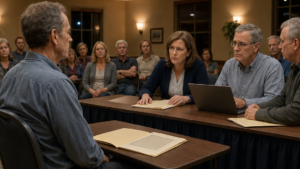
Thursday night’s HOA meeting was already underway inside. Through the glass door, Jason could see folding chairs, a long table, and Ruth moving between stacks of paper.
Donald paused at the top.
His breathing was shallow.
“You want a minute?”
“No.”
He opened the door himself.
Catherine sat near one end of the board table.
She looked up as Donald entered.
For half a second, Jason saw the same expression she had worn Saturday: surprise at how much effort ordinary movement cost him.
Then her face settled back into professional neutrality.
Ruth came over.
“Mr. Harris, we have seats here.”
Donald nodded.
Jason pulled out the chair beside him.
Donald lowered himself carefully.
His cane rested against his knee.
On the table in front of him, he placed the red notice.
Not Jason.
Donald.
Jason sat one chair back and to the side.
Exactly where he had been told to sit.
The board president called the matter.
Ruth summarized the timeline without drama.
Initial notice.
Follow-up inspection.
Hearing notice.
Missed hearing.
Fine.
Continued condition.
New recommendation.
Then she added the reason for reopening review: Donald had submitted a hardship request based on mobility limitations and financial strain.
The board president turned toward him.
“Mr. Harris, would you like to speak?”
Donald unfolded a page from his shirt pocket.
His hand shook.
Jason instinctively leaned forward.
Donald glanced sideways.
Jason stopped.
Donald looked at the page for several seconds.
Then he folded it again.
“I wrote something,” he said. “But I don’t think I want to read it.”
The board president nodded.
“That’s fine.”
Donald rested both hands on the cane handle.
“I missed the letters.”
Catherine looked down.
“I got them. I just didn’t open all of them.”
Jason watched one board member make a note.
Donald continued.
“My wife used to handle our paperwork. She died five years ago. That is not the association’s fault.”
His voice was quiet, but the room was small enough that nobody strained to hear.
“I let things pile up. That’s mine.”
Jason felt something in his chest tighten.
Saturday, Donald had apologized because he was afraid.
Tonight he was accepting responsibility without surrendering himself.
“That lawn got away from me,” Donald said. “I kept telling myself I’d do it next week.”
He glanced toward Jason.
“Then next week came and I couldn’t.”
Catherine shifted in her chair.
Donald turned toward her.
“I should’ve answered.”
“Yes,” Catherine said softly.
The board president looked at her, but Donald continued before anyone could intervene.
“But once you knew I was having trouble, I wish you had talked to me differently.”
Catherine’s face reddened.
“I was trying to explain—”
“I know.”
Donald did not raise his voice.
“That’s the problem. Everybody’s explaining.”
A silence settled over the room.
Jason looked down so Donald would not catch him smiling.
Donald rubbed his thumb across the worn cane handle.
“My daughter explains why I should move. Doctors explain what I shouldn’t do. The association explains what happens if I don’t keep up. Jason explains what he’s going to take care of.”
Several heads turned toward Jason.
His face warmed.
Donald did not spare him.
“He’s getting better.”
A small sound moved through the room—not laughter exactly, but close.
Jason accepted it.
Donald looked at the board.
“I’m not asking you to pretend the grass wasn’t high.”
The board president nodded.
“I’m not asking to never follow a rule again.”
Catherine’s posture changed slightly.
Donald leaned forward.
“I’m asking for enough time to fix what I can fix, and a way to tell somebody when I can’t.”
One board member asked, “What specifically would that look like?”
Donald unfolded his paper.
This time he read from it.
“Thirty days to bring the shrubs and side strip into compliance. My neighbor has agreed to help with mowing if I ask him.”
Jason noticed the wording.
If I ask him.
Donald continued.
“If I have a medical problem that affects maintenance, I want one person at management I can call instead of trying to figure out which committee notice goes where.”
Ruth said, “That can be arranged.”
“And I’d like the new fine stopped while I do it.”
Catherine leaned toward her microphone.
The board president acknowledged her.
“I want to be careful here,” Catherine said. “The committee’s concern has never been Mr. Harris personally. It’s consistency.”
Jason watched Donald.
He did not shrink.
Catherine continued.
“If we waive enforcement every time someone has a sympathetic circumstance, we create a standard we cannot apply equally.”
Donald’s fingers tightened around his cane.
Jason felt the urge to interrupt.
He knew exactly what he wanted to say.
Compassion isn’t favoritism.
He could practically hear himself saying it.
Then he remembered Donald in the kitchen.
You keep talking like I’m not sitting here.
Jason stayed silent.
Catherine looked toward the board.
“We have other homeowners on fixed incomes. We have people with illnesses we may not know about. If one person receives relief, how do we justify denying another?”
Donald answered before the board did.
“Then don’t deny them.”
Catherine turned toward him.
Donald’s voice remained calm.
“If somebody else needs help, let them ask too.”
“That could become difficult to administer.”
“Probably.”
For the first time that evening, Catherine had no immediate response.
Donald looked down at the red notice.
“I’m not asking you to feel sorry for me.”
He flattened the page with one palm.
“I’m asking you to have a process people can actually use before they’re already in trouble.”
Ruth stopped writing.
The board president leaned back.
One member asked Ruth, “Do we have any policy requiring direct hardship outreach before escalating a fine?”
“No.”
“Could we?”
Ruth considered it.
“We could establish a management contact step after repeated nonresponse, particularly for an owner who requests hardship status.”
Catherine said, “That needs careful limits.”
“I agree,” Ruth replied.
The discussion shifted.
Not away from Donald, but beyond his individual lawn.
For ten minutes, board members worked through possibilities: temporary hardship designation, defined review periods, written maintenance plans, payment arrangements.
Then one board member returned to the immediate issue.
“Why don’t we reduce the current fine by half and close the matter? Mr. Harris gets relief, and the association preserves the enforcement record.”
Jason’s stomach dropped.
It sounded reasonable.
It solved almost nothing.
Donald looked at Ruth.
“If they do that, what happens next month?”
The member frowned.
“What do you mean?”
“If I have another bad week and the grass grows again.”
The room went quiet.
Donald tapped the red notice.
“I’ll be right back here.”
That was the problem in one sentence.
Not the amount.
Not Catherine.
Not even the missed hearing.
The system could reduce today’s punishment without changing tomorrow’s failure.
Ruth spoke carefully.
“I would recommend separating the existing account from future compliance.”
The board president nodded for her to continue.
“Stay the new recommended penalty pending a formal hardship maintenance plan. Give Mr. Harris a defined correction period. Management becomes the contact point. Once the property is stable, the board can decide what portion of the previous fine remains appropriate.”
Catherine leaned back.
“That’s more defensible.”
Jason looked at her.
It was not an apology.
But it was movement.
The president asked Donald, “Would you accept that?”
Donald considered it.
“How long is the plan?”
“We’d work that out with you.”
“With me.”
“Yes.”
“Not with him?”
He pointed his cane slightly toward Jason.
A few people looked over.
Jason raised both hands.
“Definitely not with me.”
This time there was actual laughter, brief and restrained.
Donald smiled.
“Then yes.”
The board president called for a motion.
The new penalty would be paused.
No collection action would occur while the hardship review was active.
Ruth would meet with Donald to create a written maintenance plan.
The board would revisit the earlier fine after the correction period rather than pretending the issue had vanished.
The motion passed.
Not unanimously.
But it passed.
Jason felt relief rise so quickly he nearly spoke.
Donald reached down for his cane.
That stopped him.
This was not Jason’s victory.
Catherine gathered her papers.
As people began standing, she approached Donald.
Jason stayed where he was.
Catherine stopped across from him.
“Mr. Harris.”
Donald looked up.
“I meant what I said about consistency.”
“I know.”
She hesitated.
“I could have handled Saturday better.”
Donald studied her.
“Yes.”
Catherine nodded once.
No dramatic apology followed.
No handshake.
She walked away.
Donald pushed himself upright.
Jason stood beside him without reaching out.
They made it to the door slowly.
Outside, Donald paused at the top of the three concrete steps.
Jason waited.
Donald looked down at them.
Then at Jason.
“You can carry the folder.”
Jason took it.
“That all?”
“That’s all.”
Donald descended under his own power.
At the bottom, he tapped his cane once against the pavement.
Behind them, through the clubhouse window, Ruth was already gathering the paperwork for the formal hardship maintenance plan.
Chapter 7: The Lawn Looked Different Because the House Was No Longer Silent
Jason arrived Saturday morning and found Donald waiting for him in the driveway.
That alone stopped him.
Donald was wearing an old ball cap and a light work jacket despite the mild air. His cane stood planted beside his right shoe. In his left hand he held a yellow notepad.
Jason killed the truck engine and climbed out.
“You planning an inspection?”
Donald lifted the pad.
“I made a list.”
Jason looked toward the yard.
The grass had grown, but only a little. The shrubs beneath the front windows had been cut back the week before. The side strip no longer looked abandoned. Nothing about the property was perfect.
It looked maintained.
More important, Donald looked involved.
“What’s on the list?” Jason asked.
Donald read from it.
“Front lawn. Edge the sidewalk. Leave the back alone.”
“Why?”
“Because I’m paying someone Tuesday to handle the back.”
Jason raised an eyebrow.
“You hired somebody?”
“For once a month.”
“Look at you.”
“Don’t start.”
Jason smiled.
Donald continued.
“And don’t touch the hedge beside the garage.”
“That thing is trying to become a tree.”
“I like it.”
“It’s ugly.”
“It’s my ugly hedge.”
Jason held up both hands.
“Your hedge.”
Donald folded the list once and tucked it into his pocket.
It had been three weeks since the hearing.
In that time, Ruth had sat with Donald at his kitchen table and written out the maintenance plan in plain language. No dense paragraphs. No buried hardship clause.
Mowing every two weeks during the growing season.
Shrubs checked monthly.
A thirty-day correction period for the side strip.
Direct contact with Ruth if a medical issue prevented compliance.
The board had also suspended the new penalty while the plan remained active.
The earlier fine had not disappeared. It was still under review.
Donald had been strangely relieved by that.
“I don’t want them pretending I didn’t miss things,” he had told Jason. “I just don’t want to be buried for missing them.”
Jason rolled the mower from his truck.
“You want to sit on the porch?”
Donald gave him a look.
“I’m already standing.”
“That wasn’t an answer.”
“I’m going to pull weeds by the mailbox.”
“No.”
The word came out automatically.
Donald stared at him.
Jason closed his eyes.
“Sorry.”
“Very good.”
“You want to pull weeds.”
“Yes.”
“Do you want help getting down there?”
“No.”
“All right.”
Donald took three careful steps toward the mailbox.
Jason started the mower.
Halfway across the first pass, he glanced over.
Donald had lowered himself onto a small garden stool Jason had not noticed before. He was working slowly, one weed at a time, dropping them into a plastic bucket.
Jason smiled and kept moving.
The house sounded different now.
That was the thing he noticed most.
Not the lawn.
The house.
The first Saturday, it had seemed sealed shut. Quiet in the way unused rooms became quiet.
Now, when Jason went inside for water, Donald’s phone was ringing on the kitchen counter.
Donald came in behind him, breathing harder from the weeds.
“You going to answer that?”
Donald looked at the screen.
“Yes.”
He picked it up.
“Hello?”
His voice changed.
Not softer exactly.
Less guarded.
“Hi, Emma.”
Jason reached for a glass and turned toward the sink to give him privacy.
“You called yesterday,” Donald said.
A pause.
“No, I’m not complaining.”
Another pause.
“All right. Maybe I’m complaining a little.”
Jason could hear Emma’s voice faintly but not the words.
Donald sat down.
“No. I haven’t fallen.”
He rolled his eyes toward Jason.
“Yes, I would tell you.”
Jason looked at him.
Donald frowned.
“I would eventually tell you.”
That earned a louder response from the phone.
Jason laughed.
Donald pointed at the door.
“Go mow.”
Jason went.
An hour later, he finished the front and edged the sidewalk.
The grass clippings gathered in thin damp lines along the concrete.
He shut the edger off.
For a moment, he thought about the first morning.
Catherine’s voice.
Turn that thing off right now.
Donald apologizing on his own walkway.
The cane shaking against the pavement.
Jason walked back to his truck for the broom.
When he returned, Donald was standing near the mailbox.
“You missed one,” Donald said.
“One what?”
“Weed.”
Jason looked down.
A small green shoot stood between the concrete and the mulch.
“You left that on purpose.”
Donald smiled.
“Prove it.”
Jason bent to pull it.
“Don’t.”
He straightened.
Donald pointed with the cane.
“I can get that one.”
Jason almost argued.
Instead, he waited.
Donald lowered himself carefully, reached down, and pulled the weed free.
When he stood again, his face had gone red from effort.
Jason said nothing.
Donald dropped the weed into the bucket.
“That was unnecessary,” Jason said.
“Yes.”
“You could’ve let me do it.”
“Yes.”
“Why didn’t you?”
Donald leaned on the cane.
“Because I wanted to.”
Jason nodded.
That was becoming an answer he understood.
A few minutes later, Catherine appeared on the sidewalk.
Jason saw her before Donald did.
She was walking toward them with a small stack of mail in one hand.
His shoulders tightened automatically.
Donald noticed.
“Don’t.”
“I didn’t do anything.”
“You were about to.”
Jason picked up the broom.
“Fine.”
Catherine stopped at the edge of the driveway.
“Mr. Harris.”
Donald turned.
“Morning.”
Her eyes moved over the lawn.
Then toward the trimmed shrubs.
“It looks good.”
Donald glanced around as though checking whether she meant another house.
“Thank you.”
Catherine looked at Jason.
“Sidewalk too.”
“I was about to sweep it.”
“I can see that.”
There was an awkward pause.
Jason had imagined this moment more than once.
In some versions, Catherine apologized properly.
In others, Donald told her exactly what the previous month had done to him.
In one version Jason was particularly proud of, he said something so precise she had no answer.
The real moment contained none of that.
Catherine held out one envelope.
“This was delivered to my box by mistake.”
Donald took it.
The HOA return address was printed in the corner.
His fingers paused.
Jason watched the old reaction begin.
Not the full panic.
Just the tightening.
Catherine saw it too.
“It isn’t a violation,” she said quickly.
Donald looked at her.
“How do you know?”
“I asked Ruth because I didn’t want to hand you something without knowing.”
Jason looked at Catherine.
She seemed slightly embarrassed by the admission.
“It’s the board’s final hardship-review letter,” she said. “Ruth said you were expecting it.”
Donald turned the envelope over.
“Thank you.”
Catherine nodded.
Then she hesitated.
“The board approved a new procedure Thursday.”
Jason stopped sweeping.
Donald looked up.
“What procedure?”
“For repeated nonresponse.”
Catherine kept her eyes on Donald.
“Management has to make a direct contact attempt before a fine recommendation if the owner is enrolled in hardship review.”
Donald said nothing.
“And the committee has to document why additional time is or isn’t appropriate.”
Jason leaned on the broom.
“That your idea?”
Catherine looked at him.
“Partly.”
He had not expected that.
She continued.
“It needed limits.”
“Of course it did.”
Her mouth almost curved.
Almost.
Donald tapped the envelope against his palm.
“What happens to the old fine?”
“The board reduced it and approved a payment schedule if you want one.”
Donald nodded slowly.
“I can live with that.”
Catherine looked at the lawn again.
“I’m glad.”
Another silence.
Then she started walking.
After a few steps, Donald called after her.
“Catherine.”
She turned.
Donald lifted the envelope.
“Next time, just knock.”
Catherine stood still.
Then nodded.
“I will.”
She continued down the sidewalk.
Jason watched her go.
Donald said, “Don’t look so pleased.”
“I didn’t say anything.”
“You don’t have to.”
Donald carried the envelope inside.
Jason followed after loading the mower.
At the kitchen table, Donald opened it immediately.
That mattered more than what was inside.
He read the letter from beginning to end.
Then read it again.
Jason waited by the counter.
“Well?”
Donald folded it.
“Thirty days completed. Plan approved. Reduced balance.”
“And?”
“And what?”
“You’re not going to tell me the amount?”
“No.”
Jason smiled.
“Fair enough.”
Donald opened the drawer where the first red notice had come from.
The old notice was still there.
But it no longer sat crumpled beneath unopened envelopes.
It was flattened beneath the new letter.
Jason could still see his own handwriting in the margins.
Hardship option?
Who approved fine?
Can hearing be reopened?
Questions that had once looked like weapons now seemed almost clumsy.
Donald closed the drawer.
His phone rang again.
He glanced at it.
“Emma?”
“Yes.”
“You want me to leave?”
“No.”
Jason leaned against the counter.
Donald answered.
“Twice in one day is excessive.”
A pause.
His expression softened.
“Yes, Saturday is still fine.”
Another pause.
“No, I said visit. I did not say move me.”
Jason looked away to hide his smile.
Donald continued listening.
“All right.”
A longer pause.
Then, quietly, “I’d like that too.”
When the call ended, Donald remained still for a moment.
Jason did not ask.
Eventually Donald said, “She’s coming next month.”
“That good?”
“Yes.”
“Scary?”
“Yes.”
Jason nodded.
Donald looked toward the window.
“You know what she’ll do first.”
“What?”
“Open every cabinet in this house.”
“That sounds helpful.”
Donald glared.
Jason laughed.
He packed the last of his tools while Donald moved slowly through the living room.
At the front door, Donald reached for the lock.
Jason said, “Want me to get that?”
Donald didn’t even turn around.
“No.”
“Had to ask.”
“No, you didn’t.”
“Still learning.”
Donald locked the door himself.
Then he stepped carefully onto the porch.
The front lawn stretched clean and green toward the sidewalk.
Not perfect.
Not manicured into submission.
Just cared for.
Donald tapped his cane once against the top step.
Jason waited beside him.
Donald looked toward the driveway, then toward the mailbox where the last weed had been pulled.
“Next Saturday,” he said.
Jason nodded.
“Next Saturday.”
The story has ended.