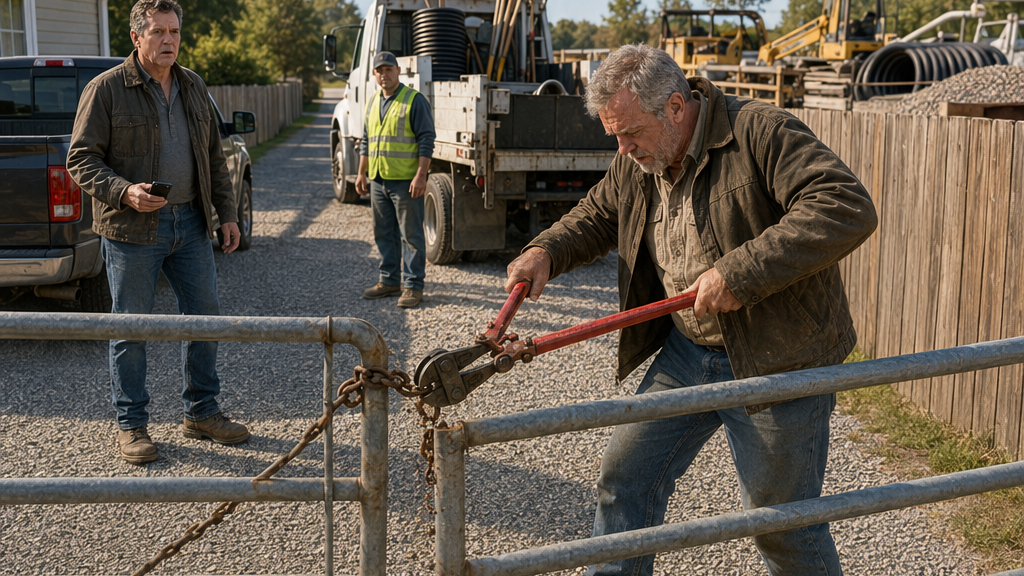
The HOA Neighbor Cut My Gate for “Shared Access”—Then the Old Maintenance Deal Changed Everything
Chapter 1: The Morning Someone Cut Jonathan’s Gate
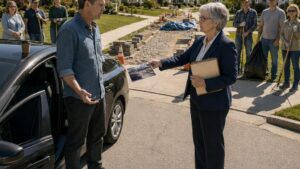
The jaws of the bolt cutters closed around Jonathan Baker’s chain just as he turned into his driveway.
For half a second, he thought the man at the side gate was a utility worker. Then the chain snapped.
Donald Nelson straightened, the long red handles hanging from one hand. The severed end of the chain dropped against the galvanized gate with a hard metallic slap.
Behind him, an HOA maintenance truck idled on the gravel lane.
Jonathan stopped his pickup in the middle of the driveway.
He had been home less than an hour after twelve days away on an industrial maintenance job. His duffel bag was still on the passenger floorboard. He had expected coffee, a shower, and a morning spent checking everything that tended to go wrong while he was gone.
Instead, Donald had just cut his lock.
Jonathan climbed out.
Donald saw him and did not look embarrassed.
“You could’ve called,” Jonathan said.
Donald set the cutters against the fence post. “Wouldn’t have changed anything.”
The answer irritated Jonathan more than an argument would have.
He walked toward the gate but stopped several feet away. The narrow gravel corridor stretched behind Donald for more than three hundred feet, an eighteen-foot strip running along the eastern edge of Jonathan’s property. Beyond the opposite fence sat Donald’s equipment yard: trailers, a compact excavator, a skid steer, and an old grader coated with pale dust.
The maintenance truck waiting behind Donald carried drainpipe and landscaping tools.
Jonathan looked at the broken chain.
“Who authorized you to cut that?”
Donald gave him a tired look.
“Nobody needed to.”
The maintenance crew stayed inside their truck.
Jonathan took his phone from his pocket.
Donald’s expression changed slightly. “What are you doing?”
“Taking a picture.”
He photographed the cut link, the lock lying in the gravel, the bolt cutters, and the waiting truck.
Donald shook his head.
“You’re making this into something it isn’t.”
“You cut a chain on my gate.”
“It’s an access road.”
“It’s my access road.”
Donald gave a short laugh without humor.
“We’ve been running equipment through here longer than you’ve lived in that house.”
Jonathan felt the old instinct rise in him—the one that had caused trouble at job sites before. Say nothing until he had all the facts. Let the other person talk. Fix the problem afterward.
It often worked at work.
At home, he had begun to suspect it simply taught people that silence meant agreement.
“I locked it,” Jonathan said.
“And the HOA has drainage work scheduled.”
“That truck doesn’t make this public property.”
Donald stepped toward him.
“Your uncle gave me access.”
Jonathan’s thumb stopped over the phone screen.
“Jerry?”
“Who else?”
Jonathan looked past Donald at the lane.
His uncle Jerry Campbell had used the property for his landscaping business before Jonathan took over responsibility for it. Trucks had come and gone then. So had trailers, mowers, pallets, and piles of mulch. Jonathan remembered Donald’s machines occasionally appearing near the back lot, but he had never paid attention to which route they used.
“That was years ago,” he said.
“Exactly.”
“That doesn’t explain why you cut my gate.”
Donald picked up the lock from the gravel and held it out.
“It explains why I shouldn’t have found this here.”
Jonathan did not take it.
The driver of the HOA truck finally stepped out.
“We’re just here for the drainage run behind the common strip,” he said. “We were told this was the service entrance.”
“Told by who?”
The man hesitated.
“Management.”
Jonathan looked at Donald.
Donald spread his hands as if that settled it.
“Everybody uses it.”
Jonathan’s phone rang.
Lisa Roberts, the HOA property manager.
He stepped away before answering.
“Jonathan,” she said immediately, “I just got a call from the maintenance vendor. There seems to be an access problem.”
“Donald cut my chain.”
There was silence.
“He what?”
“He cut the lock off my gate while your crew waited behind him.”
“I did not authorize anyone to cut anything.”
Jonathan glanced at Donald, who was talking quietly with the crew.
“Then why do they think my property is their service road?”
Another pause.
“I’m looking into that.”
“Look fast.”
“Jonathan, please don’t permanently block the corridor today.”
He almost laughed.
“Why?”
“We have drainage work scheduled on the lower common area. There’s weather moving in later this week, and that route has been used by our vendors for several seasons.”
Jonathan stared down the gravel strip.
“For several seasons?”
“That’s what I’m being told.”
“You have an easement?”
“I’m checking.”
“A license?”
“I’m checking that too.”
“So you don’t know.”
“No. Which is why I’m asking everyone not to escalate until I can review the records.”
Jonathan looked at the broken chain again.
“That request came about ten minutes late.”
He ended the call.
Donald had heard enough to understand.
“See?” he said. “It’s not just me.”
Jonathan crouched and picked up the cut section of chain.
The exposed steel inside the link was bright against the rusted surface.
He had owned the parcel for years. Taxes came in his name. Insurance came in his name. He paid for the gravel when washouts formed near the road.
Yet Donald spoke about the lane as though Jonathan had wandered into an arrangement already too old to question.
Jonathan stood.
“No more equipment through here until I know what Jerry actually agreed to.”
Donald’s jaw tightened.
“You planning to stop their drainage job too?”
“I’m planning to find out who owns what.”
“You know who owns it.”
“Then we agree on something.”
Donald stepped closer to the gate.
“You think a piece of paper tells the whole story?”
Jonathan held up the cut chain.
“It tells more than this does.”
For the first time that morning, Donald looked genuinely angry rather than merely inconvenienced.
“You want the whole story?”
Jonathan waited.
Donald pointed down the gravel corridor.
“Ask your uncle what I paid for that road.”
Chapter 2: The Handshake Nobody Ever Wrote Down
Jerry Campbell recognized the broken chain before Jonathan said where it came from.
He was sitting at his kitchen table Wednesday morning with a mug of coffee when Jonathan placed the two-foot section of rusted steel between them.
Jerry stared at it.
“Donald cut that?”
Jonathan pulled out a chair.
“So you know the chain.”
“I bought that chain.”
“That wasn’t what I asked.”
Jerry rubbed his thumb across one of the worn links.
“You came over here to fight with me?”
“I came over because Donald told me to ask what he paid for my road.”
Jerry leaned back.
For several seconds, the only sound was the refrigerator motor.
Then he said, “It wasn’t like that.”
Jonathan had heard those words enough times to know they usually meant it was exactly like that, only more complicated.
“Then tell me what it was like.”
Jerry looked toward the window.
“When I had the landscaping operation over there, that lane was rough.”
“I remember.”
“No, you remember it after we fixed it.”
Jonathan said nothing.
Jerry stood, crossed to a cabinet, and removed an old photo envelope. Inside were faded prints from the years before everything lived on a phone.
He spread several across the table.
One showed Jerry’s old landscaping trucks lined near the back lot.
Another showed fresh gravel.
In the third, Donald’s grader sat halfway down the corridor, blade lowered.
Jonathan picked up the picture.
“How often did he do this?”
“Whenever it washed bad.”
“For free?”
Jerry hesitated.
“He didn’t send invoices.”
“That’s not the same thing.”
Jerry gave him a sharp look.
“You weren’t running the place.”
Jonathan set the picture down.
“No. I was working out of state most of the time. Which is apparently the excuse everybody used to make decisions about my property.”
“It wasn’t your property then.”
“It became mine, and nobody bothered telling me the neighbor thought he had permanent access.”
Jerry rubbed his forehead.
“He never said permanent.”
“He cut a lock because he thinks he can’t be stopped.”
“That’s Donald being Donald.”
“No. That’s Donald believing somebody promised him something.”
Jerry’s face tightened.
Jonathan waited.
Finally Jerry said, “He needed a way through to the back of his yard. I needed somebody who could keep that lane passable.”
“So you traded.”
“You make it sound formal.”
“That’s because informal is why I’m sitting here.”
Jerry pushed the photographs toward him.
“Donald ran his grader through there. Brought stone a couple times. Helped pull one of my trucks out when the lower end turned to soup. I let him run equipment through instead of going around by the county road.”
“How many years?”
“Quite a few.”
“How many?”
“I don’t know, Jonathan.”
“You know approximately.”
Jerry exhaled.
“Eight. Maybe nine before I shut the landscaping business down.”
Jonathan looked again at the grader in the photograph.
Donald had not invented the history.
That did not make cutting the chain acceptable. But it changed the shape of the conflict.
“You ever charge him?”
“No.”
“He ever charge you?”
“No.”
“You ever write anything down?”
Jerry almost smiled.
“Back then? No.”
“Back then was not 1950.”
“It worked.”
“Until it didn’t.”
Jerry picked up the chain.
“This used to hang across the lane before you put the lock on it. We’d unhook it when we needed through.”
“We?”
“Me. Donald. Whoever was working.”
Jonathan stared at him.
“So Donald had been opening my gate before Tuesday.”
“It wasn’t really a gate then.”
“It is now.”
Jerry put the chain down.
Jonathan leaned forward.
“Did you ever tell him the arrangement ended?”
“When I stopped the business, I figured he knew things would change.”
“That’s not an answer.”
“No.”
“Did I?”
Jerry looked at him.
“You tell me.”
Jonathan sat back.
That landed harder than he wanted it to.
After taking responsibility for the property, Jonathan had changed insurance, repaired the fencing, ordered gravel, and installed a better gate at the roadside entrance. But he had never gone next door and told Donald that whatever arrangement existed with Jerry was finished.
Jonathan had seen occasional tire tracks in the corridor.
He had complained privately.
He had done nothing.
“You knew he was still using it,” Jerry said.
“I suspected.”
“And you never said anything.”
“That doesn’t give him ownership.”
“I didn’t say it did.”
“Then what are you saying?”
Jerry’s voice softened.
“I’m saying you don’t get to act like this started Tuesday.”
Jonathan looked down at the photographs.
That was the part he did not want.
He wanted Tuesday to be the beginning because Tuesday was simple: Donald arrived with bolt cutters and cut a chain that did not belong to him.
Everything before Tuesday was less convenient.
That afternoon Jonathan walked the corridor alone.
Now he noticed things differently.
The gravel crown was too even to have happened by neglect. The drainage shoulder on Donald’s side had been shaped by machinery. Near the back end, old crushed stone had been packed into a low place where Jonathan remembered water once pooling.
He had paid for some later loads himself.
But not all of it.
Donald appeared at the far end near his equipment yard.
He did not come closer.
Jonathan raised the old photograph.
“You graded this lane for Jerry?”
Donald nodded.
“How often?”
“When it needed it.”
“You expect me to believe you did that for access forever?”
“No.”
Donald paused.
“I expect you to understand I didn’t wake up Tuesday and decide your property was mine.”
“Then why cut the lock?”
“Because you put one across a road I’ve used for fifteen years without saying a word to me.”
Jonathan looked at him.
“You could’ve knocked.”
“You could’ve called before locking it.”
Neither man had much to say after that.
That evening, Jonathan emailed Lisa requesting every HOA record connected to the lane: easements, licenses, maintenance maps, vendor instructions, board minutes.
Her response arrived shortly before ten.
Jonathan read it twice.
Lisa had located maps showing the corridor used as a service route.
She had found vendor schedules referencing access through the east lane.
But the final line changed everything again.
I have not found a recorded easement, access agreement, or current license authorizing HOA use of your parcel.
Chapter 3: The Road the HOA Thought It Had
Jonathan knew the map was wrong before Lisa finished unfolding it.
His parcel was outlined in black.
The gravel corridor running along its eastern edge had been highlighted in yellow and labeled as part of an HOA maintenance route.
No boundary break.
No note saying private.
No permission date.
It simply continued from the public street, across Jonathan’s property, and toward the common drainage strip as if the HOA had always owned the way through.
“Where did this come from?” Jonathan asked.
Lisa Roberts sat across the conference table from him.
“An old vendor packet.”
“How old?”
“Seven years.”
Cynthia Davis, the HOA president, folded her arms.
“Which is why I think we need to distinguish between a paperwork problem and an actual access problem.”
Jonathan turned toward her.
“What does that mean?”
“It means crews have used this route for years without complaint.”
“From who?”
Cynthia’s expression tightened.
“From anyone.”
“That isn’t the same thing as permission.”
“No, but we have drainage work scheduled. Several homes along the lower common area have had standing-water complaints.”
Jonathan pointed at the map.
“My property being convenient doesn’t make it HOA property.”
“Nobody said it did.”
“It’s colored like it is.”
Lisa spoke before Cynthia could answer.
“I agree the map is a problem.”
Cynthia looked at her.
“A problem in the sense that it should have been documented better.”
Lisa shook her head.
“A problem in the sense that I still cannot find the authority behind it.”
The room went quiet.
Jonathan had expected resistance. He had not expected Lisa to give him that much.
She opened a folder.
“I reviewed board minutes going back ten years. I found discussions about drainage access, mowing routes, and vendor staging. I found Donald’s company mentioned twice for grading work near the common strip.”
Jonathan leaned forward.
“Any vote approving access across my parcel?”
“No.”
“Any easement?”
“No.”
“Any written agreement signed by Jerry?”
“No.”
Cynthia tapped one finger against the table.
“That doesn’t necessarily mean nobody gave permission.”
Jonathan looked at her.
“I’m becoming familiar with that argument.”
Cynthia ignored the edge in his voice.
“What I’m saying is that associations inherit practices. Managers change. Boards change. Contractors keep doing what they were shown.”
“And homeowners are supposed to figure out which habits involve their land?”
Lisa closed the folder.
“No. That part should have been caught.”
Cynthia turned toward her.
“We also shouldn’t pretend Jonathan had no awareness that people were using the lane.”
Jonathan felt the accusation before she finished.
She was not entirely wrong.
“I knew Donald used it sometimes.”
“And the maintenance crews?”
“I work away from home.”
“That’s not quite an answer.”
Jonathan stared at her.
For a moment, he understood Donald better than he wanted to. Cynthia was doing what he had done himself: treating silence as evidence because certainty was more convenient.
“What exactly do you want from me?” he asked.
Cynthia slid a work order across the table.
“Temporary access through Friday.”
Jonathan read it.
Drainage swale clearing. Culvert inspection. Debris removal.
“Why Friday?”
Lisa answered.
“Forecast says heavy rain starts Saturday night.”
Jonathan looked at the service map again.
“Is there another route?”
“Yes,” Lisa said.
Cynthia added, “Not a practical one for the larger equipment.”
The alternate entrance ran from the other side of the subdivision, across a narrow common strip. Smaller maintenance vehicles could manage it. The excavator and dump trailer would require removing a section of decorative fencing and protecting a landscaped corner.
“What happens if the work isn’t done?” Jonathan asked.
Cynthia’s tone became less combative.
“Probably nothing dramatic.”
“Probably?”
“Three homes had water near their crawlspace vents last spring. We cleared the channel then. It needs another pass.”
Jonathan sat back.
There it was.
The simple victory he had expected was disappearing.
No easement.
No board vote.
No license.
He owned the corridor.
He could replace the chain that afternoon and tell everyone to use another route.
Legally, at least according to what they had found so far, his position looked stronger by the hour.
Practically, three families down the hill might spend Saturday night watching rainwater rise because everyone else had quietly designed years of maintenance around land that was never theirs.
Jonathan hated that this had become his decision.
“If I allow the crew through,” he said, “nobody gets to call that permission for next month.”
Lisa nodded immediately.
“We can document one-time access.”
“And Donald doesn’t cut anything.”
Cynthia sighed.
“I think we can all agree on that.”
Jonathan looked at her.
“I thought we all agreed chains shouldn’t need protecting from bolt cutters.”
Lisa suppressed a reaction.
Cynthia did not.
“This isn’t helping.”
“No,” Jonathan said. “What would’ve helped was somebody checking this map seven years ago.”
Lisa turned the map around and studied the yellow route.
“I want to know how this got into the vendor packet.”
She left the room and returned several minutes later with a second folder.
The older map inside was less polished, hand-marked in places.
The yellow route was there too.
Beside it, someone had written a short instruction: access via Nelson equipment yard.
Jonathan read it twice.
“So Donald wasn’t just using my lane.”
Lisa nodded slowly.
“He was apparently directing HOA vendors through it.”
Cynthia looked unsettled for the first time.
“Was he being paid?”
“For some grading work, yes. I’m still checking the rest.”
Jonathan looked from the old map to the newer one.
A private favor between Jerry and Donald had somehow become a contractor routine, then a vendor instruction, then a colored line on an HOA map.
Nobody had voted.
Nobody had signed.
Nobody had stopped to ask.
And Jonathan, who had spent years noticing tire tracks and deciding he would deal with them later, had left the silence intact.
Cynthia drew a breath.
“I need an answer before the crew leaves today.”
Jonathan folded his arms.
She pointed to the maintenance order.
“You can close your gate now. Based on what Lisa has found, I’m not going to tell you that you can’t.”
That surprised him.
Then she pointed toward the three homes marked near the drainage channel.
“But if you do, the work probably won’t be finished before the rain.”
Jonathan looked at the map.
For the first time since Donald cut the chain, having the right to say no did not make the choice easier.
Chapter 4: The Favor Jerry Never Explained
Jerry put the invoice on the table face down.
Jonathan noticed that before he noticed anything else.
“Turn it over,” he said.
Jerry kept two fingers on the paper.
They were standing inside what remained of his old landscaping yard, a narrow metal-sided building behind his house where shelves still held irrigation fittings, mower blades, rusted hand tools, and plastic bins labeled in Jerry’s block handwriting. Dust lay over everything except a small section of workbench Jerry had cleared that morning.
“You wanted to know what Donald paid,” Jerry said. “This is part of it.”
Jonathan reached for the paper.
Jerry let go.
The invoice was more than a decade old. The print had faded, but Jonathan could still make out a load of crushed stone, machine hours, grading, and hauling.
At the bottom, across the amount due, Jerry had written one word.
Paid.
There was no check number.
No receipt.
No notation showing cash.
Jonathan looked up.
“You paid him some other way.”
Jerry rested his hands on the workbench.
“I told you there was an arrangement.”
“You told me he graded the lane.”
“He did more than that.”
Jonathan waited.
Jerry walked toward the open bay door. Beyond it, the old yard sloped toward the same gravel corridor now dividing Jonathan from Donald.
“For a while,” Jerry said, “I was barely keeping that business running.”
Jonathan knew Jerry had struggled near the end. He had not known how badly.
“You had crews,” Jonathan said.
“That was part of the problem. Crews expect paychecks whether customers pay you or not.”
Jerry gave a short, embarrassed laugh.
“I had two commercial accounts ninety days late. Transmission went out in the dump truck. Then we got enough rain to wash the lane so bad I couldn’t get trailers through without burying them.”
Jonathan looked at the invoice again.
“Donald fixed it.”
“Donald brought stone.”
“For free.”
“Not exactly.”
Jerry turned around.
“He said he needed a cleaner route to the back of his own yard. Going around the county road cost him time, especially hauling his larger equipment. I needed the lane rebuilt.”
“So you traded access for work.”
“Yes.”
“That’s not what you told me Wednesday.”
“I told you enough.”
“No. You told me the part that made it sound casual.”
Jerry’s mouth tightened.
Jonathan felt his irritation sharpening, and this time it was not aimed at Donald.
“How long did you let him use it as payment?”
“We never put a number on it.”
“There it is again.”
“Jonathan—”
“No number. No end date. No written terms. And now everybody acts surprised that nobody agrees what the deal was.”
Jerry picked up a small metal fitting from the bench and set it down again.
“I was trying to keep five men working.”
“And I’m the one dealing with the result.”
“I know.”
The quiet answer stopped Jonathan.
Jerry did not defend himself.
He did not say it had worked out fine.
He simply looked older than Jonathan remembered him looking a week ago.
“You want the part I didn’t tell you?” Jerry asked.
Jonathan said nothing.
Jerry leaned against the bench.
“One winter, things got worse. I was behind on fuel, behind with the stone supplier, and one of my bigger customers folded owing me almost twenty thousand dollars.”
Jonathan had never heard that.
“I was going to shut down.”
“Why didn’t you tell anybody?”
“Because I was fifty-eight years old and embarrassed.”
Jonathan looked away.
That answer he understood too easily.
Jerry continued.
“Donald knew. He had enough work then. Not a fortune, but enough. He graded the lane, hauled stone, and let me use one of his machines twice when mine was down. Never sent a bill.”
Jonathan tapped the invoice.
“So this was repayment.”
“Partly.”
“And the access?”
“Partly.”
Jerry’s voice lowered.
“I told him, ‘Use that road as long as you need it.’”
Jonathan stared at him.
The words seemed to remain between them.
“You said exactly that?”
“Close enough.”
“You told him he could use land you didn’t own forever?”
“It wasn’t forever when I said it.”
“What does that mean?”
“It means I thought I’d be there. I thought the business would recover. I thought we’d keep working next to each other and sorting things out the way we always had.”
Jerry rubbed his jaw.
“I wasn’t writing a deed. I was thanking a man who kept me afloat.”
Jonathan looked out through the open door.
From there, the gravel lane looked almost ordinary.
For years, that same strip had carried Jerry’s trucks and Donald’s machines. What Jonathan had seen as a boundary was also where two struggling businesses had once depended on each other.
It did not excuse bolt cutters.
But it explained why Donald had looked offended rather than guilty.
“You should have told me when I took over the property,” Jonathan said.
“I should have.”
“You should have told Donald the arrangement changed.”
“I should have.”
“And I should have asked.”
Jerry glanced at him.
Jonathan hated saying it.
He hated more that it was true.
For years he had seen tracks and occasional equipment movement. Each time, he had thought, I’ll deal with that when I’m home longer.
Then he had left again.
His ownership had been clear on paper and vague in practice.
Jerry picked up the old invoice.
“Donald’s wrong for cutting your chain.”
“At least we agree on that.”
“He’s also wrong if he thinks what I told him gives him the road forever.”
Jonathan looked at him.
“But?”
“But if you go after him like none of the history mattered, you’ll be wrong too.”
Saturday morning, Jonathan spread the property records across his kitchen table.
The surveyor had confirmed the corridor boundary from the deed description and existing monuments. There was no recorded easement benefiting Donald’s parcel. No transfer. No permanent access agreement.
Jonathan should have felt relieved.
Instead he kept thinking about Jerry saying, Use that road as long as you need it.
His phone rang.
The surveyor.
Jonathan answered.
“I finished checking the line,” the man said. “Your fence location is fine. Corridor is entirely within your parcel.”
“Good.”
“There’s something else.”
Jonathan stood straighter.
“What?”
“I was out there checking the rear monument about an hour ago.”
Jonathan looked toward the side window.
“And?”
“Nelson’s loader came through.”
Jonathan said nothing.
“The temporary chain was open,” the surveyor continued. “He crossed from his yard, came down the corridor, and went out to the public road.”
Jonathan’s hand tightened around the phone.
He had sent Donald written notice Friday morning.
No ambiguity.
No family history.
No old handshake language.
Permission withdrawn.
“Did he see you?”
“Yes.”
“What did he say?”
“He said he knew who owned the land.”
Jonathan looked down at the survey lying open on his table.
The past explained Donald’s anger.
It no longer explained what he had just done.
Chapter 5: Three Crossings After Permission Ended
The tire tracks were fresh enough that loose gravel still rested on top of the grass.
Jonathan stood inside the side gate Monday morning and followed them with his eyes.
They ran straight past the temporary chain, down the center of the corridor, and toward Donald’s equipment yard.
He photographed them.
Then he photographed the chain.
It had not been cut this time.
Someone had disconnected the temporary fastener, passed through, and hooked it back loosely enough that it hung several inches lower than Jonathan had left it.
His phone already contained photographs from Saturday.
Now he added Monday.
By Wednesday, he would have a third set.
That was the part that changed the dispute.
The attorney Jonathan had consulted did not react dramatically when he placed the photographs on the desk.
“Before written notice,” she said, “we have ambiguity.”
She tapped the first photograph.
“After written notice, we have a different problem.”
Jonathan sat across from her.
“He knows I told him to stop.”
“You sent it certified. He signed for it.”
“He crossed anyway.”
“Apparently.”
Jonathan slid the photograph from Monday forward.
“He thinks if he keeps using it, he can prove something.”
“Possibly.”
“Can he?”
The attorney did not give him the answer he wanted.
“I’m not going to tell you that a complicated access dispute becomes simple because your records look strong. Historic use matters. Permission matters. Reliance can matter. State law matters.”
Jonathan frowned.
“But there’s no recorded easement.”
“That helps you.”
“Ownership is confirmed.”
“That helps you too.”
“So what doesn’t?”
She looked at him.
“History.”
Jonathan leaned back.
Even the lawyer was telling him the same thing Jerry had.
She continued.
“But history doesn’t give someone permission to cut your gate. And written withdrawal matters. Especially if continued crossings are unnecessary.”
“They’re unnecessary.”
“Are they?”
Jonathan did not answer immediately.
Donald’s business yard sat in an awkward pocket behind older parcels. The county-road route existed, but it required a long loop and a narrower entrance.
The attorney noticed his hesitation.
“Before you decide what claim you want to make, find out why he keeps crossing.”
Jonathan almost laughed.
“He already told me. He thinks he can.”
“That’s not the same as why.”
Later that afternoon, Jonathan found Donald beside a lowboy trailer in his yard.
He stayed on his own side of the fence.
Donald glanced over.
“If you’re here to take another picture, get my good side.”
“I have three crossings after notice.”
Donald’s hands stopped on the binder chain he was tightening.
“Three?”
“Saturday, Monday, today.”
Donald looked toward the gravel lane.
“You counting every tire now?”
“I’m counting every time you use my property after I told you not to.”
Donald pulled the chain tight.
Jonathan waited.
Finally Donald said, “You want to know why?”
“I do.”
Donald pointed toward a large excavator parked behind the trailer.
“That machine weighs enough that I can’t take the old north entrance loaded.”
“Then improve your entrance.”
“You think I haven’t priced it?”
That surprised Jonathan.
Donald went to the cab of his truck and pulled out a folded estimate.
He did not hand it through the fence. He held it where Jonathan could see the total.
It was not ruinous.
But it was substantial.
“New apron,” Donald said. “Culvert replacement. Tree removal. Widening. County inspection.”
“That’s your business expense.”
“I know that.”
Jonathan watched him.
The lack of argument caught him off guard.
Donald folded the estimate.
“I should’ve done it years ago.”
“Why didn’t you?”
“Because I had a road.”
“You had permission.”
Donald looked at him.
“Call it whatever makes you feel better.”
“That’s the problem.”
Donald threw the folded paper onto his truck seat.
“You think I’m crossing because I enjoy making you mad?”
“You cut my lock.”
“Yeah.”
For once, Donald did not defend it.
“That was stupid.”
Jonathan said nothing.
Donald continued.
“But if I reroute everything tomorrow, I cancel two jobs this month. Maybe three. I’ve got equipment on both sides of this mess. Drivers who’ve been using that lane for years. A trailer that barely clears the county approach.”
“So you just keep crossing.”
“I keep moving until I can fix the other entrance.”
“You could have asked.”
Donald gave him a tired look.
“Would you have said yes?”
Jonathan opened his mouth.
Then stopped.
Before the chain was cut, maybe.
Afterward, almost certainly not.
Donald nodded as if Jonathan had answered.
“That’s what I thought.”
The exchange stayed with him that evening.
Understanding Donald’s position made Jonathan angrier in a different way.
Donald knew he had another route.
He knew it needed work.
He had simply relied on Jonathan’s property because reliance was cheaper than preparation.
At the same time, Jonathan could see his own version of the same habit. He had relied on legal ownership instead of setting boundaries because ownership was easier than conversation.
Thursday brought another surprise.
Cynthia asked Jonathan to meet her and Lisa near the HOA common area.
The drainage work had been completed under a one-time written access permission Jonathan had reluctantly signed. The crew had finished before the rain.
Now Cynthia stood beside an older section of decorative fence, looking at a strip of common land leading toward the service area.
“What would it cost to open this?” Jonathan asked.
Lisa handed him a contractor estimate.
Less than he expected.
Cynthia said, “The board can vote on it next week.”
“You’re serious?”
“I don’t like discovering that our maintenance plan depends on somebody’s private driveway.”
“Corridor.”
“You know what I mean.”
Jonathan looked at the proposed route.
“It would solve the HOA problem.”
“Yes.”
“Not Donald’s.”
“No.”
Cynthia glanced toward the distant tree line.
“I assumed because his company handled work for the association and everyone used that lane, somebody before me had taken care of the paperwork.”
Lisa said, “So did I.”
Cynthia folded the estimate.
“We were wrong.”
The admission was plain.
No speech.
No excuse.
Jonathan appreciated it more than he expected.
That night he arranged the three photographs on his kitchen table.
Saturday.
Monday.
Wednesday.
Three crossings after written notice.
Beside them sat the survey, Jerry’s old invoice, Donald’s rerouting estimate, and the HOA proposal for its own entrance.
A week earlier, Jonathan had wanted the strongest possible response. Damages. Immediate closure. Whatever legal leverage existed.
Now the problem looked less like one line and more like several badly drawn lines crossing each other.
His attorney answered on the second ring.
“You ready for me to move forward?” she asked.
Jonathan looked at the photograph of Donald’s loader passing the surveyor.
“Yes.”
He paused.
“But not with everything.”
“What do you mean?”
“I want the damage claim preserved. I want the crossings documented.”
“And the broader action?”
“Hold it.”
There was silence.
“You’re sure?”
Jonathan looked toward the side window, where the temporary chain hung across the lane.
“No,” he said. “But hold it anyway.”
Chapter 6: The Fence That Could Not Solve Everything
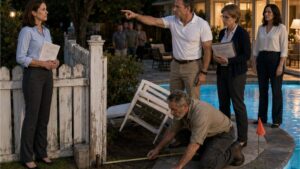
The first timber post went into the ground three feet from the piece of chain Donald had cut.
Jonathan watched the contractor check the survey stake, lower the post into the augered hole, and brace it level.
Concrete followed.
The sound of the mixer carried down the gravel corridor.
For the first time since the dispute started, Jonathan could see a permanent boundary taking shape.
He expected satisfaction.
What he felt instead was caution.
The permitted fence would run along the full corridor, tying into a new gate near the road. Heavy timber posts, reinforced corners, clear separation between Jonathan’s property and Donald’s yard. No improvised chain stretched between mismatched posts. No uncertainty about where passage began or ended.
The contractor wiped concrete dust from his gloves.
“We can have the gate operational by Friday.”
Jonathan nodded.
“Do it.”
A truck door slammed behind him.
Donald.
He walked up the gravel shoulder and stopped near the first post.
“You starting already?”
Jonathan turned.
“You knew the permit cleared.”
“I knew you applied.”
“There’s a difference?”
“About four days.”
Jonathan almost answered sharply, but Donald looked less confrontational than he had at the gate.
More tired.
“How far are you on the north entrance?” Jonathan asked.
Donald stared at him.
“So you did listen.”
“I listen more than people think.”
“That might be part of your problem.”
Jonathan ignored that.
Donald looked at the line of survey stakes.
“County approved the culvert plan. Contractor can start next week.”
“How long?”
“Three weeks if nothing goes wrong.”
“Something always goes wrong.”
“Exactly.”
The auger started again farther down the corridor.
Donald raised his voice slightly.
“I need thirty days.”
Jonathan thought he had misheard him.
“What?”
“Thirty days of access.”
After everything—the bolt cutters, the written notice, three documented crossings—Donald was asking.
Not claiming.
Asking.
Jonathan looked at the fresh post.
“You had years.”
“I know.”
“You had notice.”
“I know.”
“You crossed anyway.”
Donald’s jaw tightened.
“I know that too.”
Jonathan waited for an excuse.
None came.
Donald pointed toward his yard.
“One excavator is behind the lower pad. The lowboy can’t get to it from the north side until the entrance is widened. If you close this gate Friday, that machine is stuck unless I tear out part of my own fence and cross ground that won’t carry the trailer.”
“That sounds like a planning problem.”
“It is.”
Donald met his eyes.
“Mine.”
The admission changed the air between them.
Jonathan had prepared himself to resist entitlement.
Responsibility was harder to fight.
“You’re asking me to trust you after you cut my chain.”
“No.”
Donald looked toward the construction crew.
“I’m asking you to put it in writing so neither of us has to trust the other.”
Jonathan almost smiled.
“That’s new.”
“I learn slow.”
“So do I.”
They stood in silence while another post dropped into place.
That afternoon, Jonathan met his attorney at the corridor. Lisa joined them with the HOA’s preliminary approval for a separate service entrance.
The pieces were beginning to separate.
The HOA could solve its own access problem.
Donald could build his north entrance.
Jonathan could complete the fence.
The remaining question was timing.
His attorney walked the line and stopped near the future gate.
“If you give temporary access,” she said, “define everything.”
“Dates?”
“Start and end. Vehicles. Purpose. No transfer. No implication of permanent rights. Damage responsibility. Insurance.”
Jonathan glanced at Donald’s equipment yard.
“That sounds less like a neighbor favor.”
“That’s the point.”
Lisa held up the HOA plan.
“Our board approved the alternate service entrance last night.”
“Already?”
“Cynthia pushed it through.”
Jonathan looked at her.
“She did?”
“She told them she wasn’t voting to spend another year explaining why we had a maintenance route across land we didn’t control.”
Jonathan nodded slowly.
At least one bad assumption had already ended.
By Friday afternoon, more than half the timber posts were standing.
The corridor no longer looked open.
Each post narrowed the visual space until the gravel lane seemed less like a road and more like what the survey said it was: a strip belonging to one parcel.
Then the contractor found the excavator.
It sat near the rear of Donald’s yard, positioned so that moving it toward the north entrance would require crossing a soft section of recently disturbed ground.
The contractor pointed toward it.
“If we close the rear section today, he’s got no clean way out.”
Jonathan felt irritation rise again.
Donald had known.
“He planned this,” Jonathan said.
The contractor shrugged.
“Maybe. Maybe it was just parked there before all this started.”
Jonathan walked toward Donald’s fence.
Donald saw him coming.
“You knew that machine was back there.”
“Yes.”
“And you waited until now to mention it.”
“I told you I had equipment on both sides.”
“You didn’t say one was trapped.”
“It’s not trapped yet.”
Jonathan laughed once.
“That supposed to make me feel better?”
“No.”
Donald stepped closer.
“If you want it moved today, I’ll move it.”
“Through my property.”
“Yes.”
“And then?”
“I wait for the north entrance.”
Jonathan studied him.
There was the easy answer.
Let Donald move the machine once. Finish the fence. Lock the gate.
Done.
It was exactly the decisive ending Jonathan had imagined when he first saw the broken chain.
But it would not solve the next three weeks. Donald still had scheduled jobs. Drivers would still arrive. Pressure would continue. Every exception would become another argument.
A fence could stop traffic.
It could not fix the arrangement that had made the traffic seem normal.
Jonathan walked back to the unfinished gate.
The old cut chain lay in the bed of his pickup.
He picked it up.
For days, he had thought of it as proof.
Now it also looked like evidence of everything that had never been said before someone finally forced the issue.
Donald joined him but stayed several feet away.
“Thirty days,” Jonathan said.
Donald’s face revealed nothing.
“You get thirty days.”
The contractor glanced toward them.
Jonathan continued before Donald could answer.
“Only for moving your business equipment through this corridor while your north entrance is completed. No HOA traffic. No third-party access unless it’s directly tied to moving your equipment. You repair any damage.”
Donald nodded.
“And after thirty?”
“The gate closes.”
Donald looked down the line of new posts.
“What if the county delays inspection?”
“Then you use the county road however you have to.”
Donald exhaled through his nose.
Jonathan held up the chain.
“And there’s another condition.”
“What?”
“You pay for the gate damage.”
Donald’s expression hardened slightly.
“I figured.”
“You acknowledge the three crossings after notice.”
A pause.
“All right.”
“And you sign that this thirty-day access is temporary permission. Not an easement. Not a permanent right. Not proof that Jerry’s old arrangement still exists.”
Donald looked at him for several seconds.
There it was—the point underneath everything.
Money was not the hardest part.
Neither was rerouting.
What Donald did not want to surrender was the idea that the road had somehow become partly his through years of work and use.
“You need all that?” he asked.
“Yes.”
“You already have your survey.”
“This isn’t about the survey.”
Donald’s gaze shifted to the old chain in Jonathan’s hand.
Jonathan lowered it.
“For years, Jerry thought you understood one thing. You thought he meant another. I saw you using the lane and kept telling myself I’d deal with it later.”
Donald said nothing.
“I’m not doing that again.”
The construction crew had gone quiet nearby, waiting for instructions about the rear section.
Jonathan looked at the unfinished fence, then back at Donald.
“You wanted thirty days. I’ll give you thirty.”
Donald rubbed a thumb across his knuckles.
“But only if I know what happens on day thirty,” Jonathan said.
“And what happens?”
Jonathan pointed toward the future gate.
“That becomes a boundary again.”
Donald looked down the corridor.
Then at his equipment.
Then at Jonathan.
“I’ll look at the paper.”
“No.”
Donald’s eyes narrowed.
Jonathan had surprised even himself with the firmness in his voice.
“You don’t get thirty days for looking at it.”
He placed the cut chain in his truck bed.
“You get thirty days when you sign it.”
Chapter 7: Thirty Days to Leave the Old Road
Donald crossed out the acknowledgment clause before he finished reading the second page.
One hard line of blue ink ran straight through the sentence stating that his temporary access created no easement, permanent right, or continuing claim to Jonathan’s corridor.
Jonathan watched him cap the pen.
They sat across from each other in the HOA conference room. Lisa had arranged the meeting because the board wanted Donald’s equipment traffic separated from future HOA maintenance access before construction began on the association’s new service entrance.
Cynthia sat near the end of the table with a folder open in front of her. Jerry had taken the chair beside the window.
Jonathan’s attorney had already reviewed the agreement.
Thirty days.
Limited equipment movement.
Proof of insurance.
Responsibility for damage.
No third-party use beyond what the agreement specifically allowed.
And, most importantly, a written acknowledgment that the old informal arrangement did not grant Donald permanent access.
Donald slid the paper across the table.
“I’m not signing that part.”
Jonathan did not touch it.
“Then you don’t get the thirty days.”
Cynthia shifted in her chair.
“Can we identify what exactly you object to?”
Donald pointed at the crossed-out language.
“That says I never had a right to be there.”
“It says this agreement doesn’t recognize one,” Jonathan said.
“That’s lawyer wording.”
“Yes.”
Donald looked toward Jerry.
“You going to sit there and tell them I had no right to use that road?”
Jerry’s gaze stayed on the table.
“I’m going to tell them what happened.”
“I know what happened.”
“So do I.”
Donald leaned back.
“For fifteen years I kept that lane usable.”
Jonathan said, “Nobody is denying that.”
“You’re asking me to sign something that makes it sound like I was sneaking through your property.”
“I’m asking you to sign something that says the access was permission, not ownership.”
Donald’s face tightened.
“To you, maybe that distinction was obvious.”
“It should have been.”
“Not after what your uncle told me.”
Jerry finally looked up.
“That part’s on me.”
Donald stared at him.
Jerry folded his hands.
“I told you to use the road as long as you needed it.”
“Yes.”
“I meant while we had the arrangement.”
“You didn’t say that.”
“No.”
Donald gave a bitter laugh.
“Well, that’s convenient now.”
Jerry did not flinch.
“It isn’t convenient. That’s why we’re sitting here.”
The room went quiet.
Jerry continued.
“You helped me when I was in trouble. More than Jonathan knew. More than anybody knew.”
Donald looked away.
“I didn’t do it for a thank-you speech.”
“I know.”
Jerry’s voice remained steady.
“But I never meant to give you part of the property. I couldn’t have, even if I wanted to. I meant you could use the lane because you were helping me and because it worked for both of us.”
Donald stared at him.
“You never told me it ended.”
“No.”
“That matters.”
“It does.”
Jerry nodded once.
“But it doesn’t make cutting Jonathan’s chain right.”
Donald’s jaw moved as though he had an answer, then stopped.
Jonathan had expected Jerry’s admission to strengthen his position.
Instead, it made the room more uncomfortable.
Because Donald was right about one thing.
He had not invented the promise.
He had simply stretched it farther than Jerry intended.
Lisa broke the silence.
“The HOA has approved funding for its new access.”
She turned a site plan toward them.
“We’re removing a portion of the decorative fence here, reinforcing the service surface, and relocating the maintenance entry. Once it’s complete, association vendors will no longer use Jonathan’s corridor.”
Donald glanced at the plan.
“So everybody gets a new road except me.”
Cynthia said, “The HOA is correcting its own mistake.”
“And I’m supposed to eat fifteen years of maintaining theirs?”
Jonathan looked at him.
“What do you mean?”
Donald sat forward.
“You want gate damage. Fine. I cut it.”
That was the first time he had admitted it in front of everyone without qualification.
“You want me to fix damage from the crossings, show insurance, limit traffic. Fine.”
He pointed at Jerry.
“But nobody is going to pretend I spent years grading that lane for nothing.”
Jerry said quietly, “You didn’t.”
Donald turned back to Jonathan.
“I brought stone. I shaped the ditch. I fixed washouts. Some years I did it because Jerry needed it. Later I did it because I needed it. Then HOA trucks started using it too.”
Lisa asked, “Do you have records?”
“Some.”
“How much?”
“I don’t know until I pull them together.”
Jonathan felt the old reaction rise again.
Donald was changing the deal.
Adding another demand at the table.
A month earlier, Jonathan would have ended the conversation there.
Instead he looked at Jerry.
Jerry gave a slight nod.
Not agreement with Donald’s number—there was no number yet.
Agreement that the work had existed.
Jonathan turned toward his attorney.
“Can documented maintenance be accounted for without recognizing any access right?”
“Yes.”
Donald looked skeptical.
“How?”
“As a settlement credit,” she said. “Separate from ownership and access.”
Jonathan understood immediately.
The damage claim could remain.
Donald’s documented contributions could be recognized.
Neither would decide who owned the corridor.
That had already been decided.
Donald began pulling old invoices and photographs together over the next week.
Some were precise.
Others were little more than dated notes.
There were loads of stone Jerry remembered. Grader hours. Drainage work. A washed-out section repaired after a storm. Donald had no clean total because the arrangement had never been clean.
That was almost the point.
Jonathan reviewed each item instead of dismissing the stack.
He rejected work clearly done for Donald’s own benefit.
He accepted several older loads tied to Jerry’s business.
Lisa found one HOA vendor note confirming that Donald had reshaped part of the service approach without separate billing during an association drainage project.
Cynthia stared at that record for a long time.
“We inherited more than a route,” she said.
Nobody disagreed.
By the final meeting, the agreement had changed.
Donald would pay for the cut chain, lock, and documented damage caused after Jonathan withdrew permission.
He would receive a limited settlement credit for specific historic grading and material costs that could reasonably be verified.
The thirty-day access remained temporary.
The end date remained fixed.
The acknowledgment remained.
Donald read it again.
Then he crossed out the same sentence.
Jonathan leaned back.
“We already did this.”
“I know.”
“Then why are we doing it again?”
Donald tapped the clause.
“Because this still feels like I’m signing that the last fifteen years meant nothing.”
Jonathan looked at the old cut chain lying on the table beside the agreement.
He had brought it without planning to.
Maybe because it belonged there.
“The last fifteen years are why you’re getting thirty days instead of a locked gate,” he said.
Donald looked at him.
“They’re why I agreed to credit work I didn’t personally ask for. They’re why I’m not pretending Jerry’s promise never happened.”
Jonathan touched the damaged chain.
“But this is why the old arrangement ends in writing.”
Donald said nothing.
Jerry spoke from beside the window.
“I should have written it down when we started.”
Donald looked at him.
Jerry continued.
“And I should have told you when I shut down the business that the deal was finished.”
“You didn’t.”
“No.”
Donald’s voice softened.
“I took you at your word.”
“I know.”
“And now you’re taking it back.”
Jerry shook his head.
“No. I’m telling you what I should’ve said then.”
Donald’s eyes stayed on him.
“The favor was real,” Jerry said. “So was what you did for me. But it was never ownership.”
Something in Donald’s expression changed.
Not defeat.
Recognition, perhaps, of a distinction he disliked but could no longer honestly say he had never understood.
He picked up the pen.
Jonathan watched him reread the acknowledgment.
This time, Donald did not cross it out.
He signed.
Then he pushed the agreement toward Jonathan.
“You better make that gate worth all this trouble.”
Jonathan signed beneath him.
“I intend to.”
Thirty days later, Donald’s final equipment trailer rolled through the corridor just before noon.
He stopped his truck outside the new gate after the trailer cleared.
Jonathan stood beside the timber post.
Donald lowered his window.
“That’s the last one.”
Jonathan looked down the empty lane.
“I know.”
Donald glanced at the new lock hanging open from the chain.
Then toward his own yard, where fresh gravel led north through the widened entrance he had finally built.
He nodded once.
Jonathan closed the gate.
Chapter 8: When the Gate Became a Boundary Again
The grader approached Jonathan’s property three weeks later and turned before it reached the gate.
Jonathan had been carrying tools toward his shed when he heard the diesel engine.
For one reflexive second, he stopped.
The old habit returned: watch the lane, check the gate, prepare for another argument.
Then Donald’s grader continued past the entrance and followed the public road toward the new north access.
Jonathan let out the breath he had been holding.
The HOA’s new service entrance was finished too. Its maintenance trucks now entered from the common strip, where fresh gravel and reinforced edging marked a route the association actually controlled.
No borrowed road.
No inherited assumption.
No yellow line on a map pretending somebody else’s property belonged to everyone.
A few minutes later, Donald’s pickup came back along the public road.
It slowed near Jonathan’s driveway.
For a moment, Jonathan thought he might stop at the gate.
Donald did not.
He pulled onto the shoulder outside the property line and lowered his window.
“Drainage holding up?” he asked.
Jonathan glanced toward the corridor.
“So far.”
Donald nodded.
“My north culvert settled a little. Contractor’s coming back Thursday.”
Jonathan almost said, You should have built it years ago.
Instead he said, “Better catch it before the next rain.”
“Yeah.”
Neither man apologized.
Neither pretended the month had restored what existed before the chain was cut.
But Donald had stopped outside the gate.
That mattered.
After the pickup left, Jonathan went into the shed.
The old severed chain still lay on a shelf where he had dropped it after the agreement was signed.
He picked it up.
For weeks, he had imagined hanging it beside the new gate.
A reminder.
Proof.
A warning.
Now the idea seemed unnecessary.
Jonathan drove a nail into a wooden beam inside the shed and hung the chain there instead.
Then he walked back outside.
The new gate closed with a solid click behind him.
This time, he locked it without anger.
The story has ended.