The HOA Fined Edward for Watching the Mailboxes—Then His Delivery Truck Recorded What Happened After Midnight
Chapter 1: The Letter That Made No Sense
Edward Harris knew something was wrong before he finished reading the second paragraph.
The certified envelope had been wedged beneath his front door mat instead of left with the ordinary mail. Across the top of the page, beneath the management company’s letterhead, the HOA had denied his request to install a security camera aimed toward the neighborhood mailbox turnout.
He read the sentence twice.
Then he looked across the street.
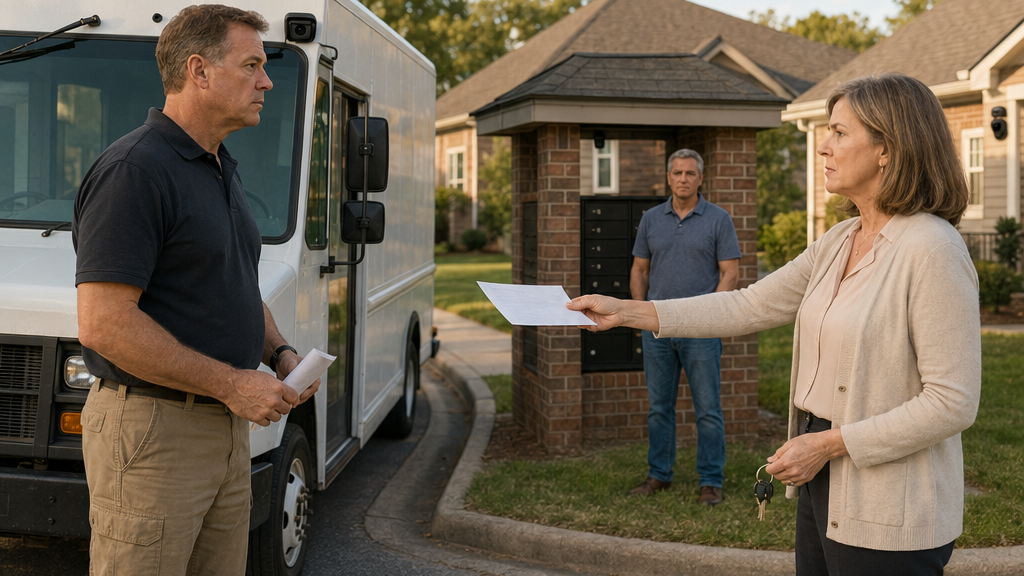
The mailbox shelter sat less than a hundred yards away, a tidy brick structure with silver compartments on one side and an open counter for parcels on the other. Nothing about it looked dangerous. That was part of the problem.
Three packages had disappeared there in six weeks.
One had belonged to Edward.
The other two had belonged to neighbors.
He folded the letter once and walked toward Christopher Walker’s house.
Christopher opened the door holding a brass mailbox key between two fingers.
“Anything?”
“No.”
Christopher stepped onto the porch. “Pharmacy says it was delivered Friday.”
Edward had already heard the story twice, but each time the details bothered him more. Christopher’s medication had been marked delivered. The carrier’s system showed the correct community box. Christopher had checked less than an hour later.
Nothing.
“Did they replace it?”
“Eventually.” Christopher rolled the key against his thumb. “Insurance didn’t want to. Pharmacy didn’t want to. Everybody wanted somebody else to be responsible.”
Edward handed him the HOA letter.
Christopher read until his eyebrows lifted.
“They denied it?”
“They say it would record a common area.”
“You asked to point it at the package shelf.”
“I know what I asked.”
Christopher continued reading.
“‘Potentially creating an atmosphere of monitoring inconsistent with community standards.’”
Edward gave a short laugh without humor.
Christopher looked toward the mailbox shelter. “We have packages disappearing, and cameras are what make the neighborhood feel unsafe?”
That evening Edward attended the monthly board meeting at the clubhouse.
Donna Campbell sat at the center of the folding table with a binder open before her. She had lived three streets over from Edward for almost twelve years. They had exchanged Christmas cards once. She had brought soup when his wife had been recovering from surgery years earlier. None of that appeared in her expression now.
Catherine Martin, the HOA treasurer, sat beside her with a calculator and a yellow legal pad.
Edward waited through landscaping expenses and a discussion about pool furniture before Donna called his name.
“You received the management company’s response?”
“This morning.”
“Then you understand the board’s position.”
“I understand the words. I don’t understand the reasoning.”
Donna closed the binder.
“The mailbox turnout is common property. Residents have a reasonable expectation that they can retrieve their mail without being recorded by another homeowner.”
Edward glanced around the room.
“Half the houses between here and mine have doorbell cameras.”
“Those cameras monitor private entries.”
“Some of them see the sidewalk.”
“That’s incidental.”
“My camera would see the package counter.”
“That is precisely the concern.”
Edward paused.
It was the certainty in her answer that unsettled him.
Not irritation. Not hesitation.
Prepared certainty.
“What about the packages that keep disappearing?”
Donna’s expression softened just enough to become official.
“We take those complaints seriously.”
Christopher, seated near the back wall, said, “Mine was medication.”
Donna turned toward him. “And I’m sorry that happened.”
“But?”
“No but. We’re discussing Edward’s request.”
Edward leaned forward.
“If theft is occurring in a common area, why is recording that area unacceptable?”
“Because we do not solve one problem by creating another.”
“What problem?”
“A hostile atmosphere.”
The phrase landed strangely in the room.
Edward had spent twenty-seven years in delivery operations. He had sat through investigations involving damaged freight, missing parcels, driver complaints, and disputed signatures. Whenever someone introduced a vague phrase into a discussion that should have required a specific answer, he noticed.
Hostile atmosphere.
Not privacy violation.
Not legal restriction.
Not equipment specification.
Atmosphere.
Donna slid another sheet from her binder.
“If you install equipment covering the common mailbox area after receiving this notice, the association may impose a continuing violation assessment.”
“How much?”
“Up to five hundred dollars per day after the applicable notice period.”
A chair shifted behind Edward.
Christopher muttered, “For a camera?”
Donna heard him.
“For an unauthorized installation.”
Edward took the paper but did not respond immediately.
On his walk home, he began counting cameras.
A black video doorbell beside a blue front door.
A floodlight camera above a garage.
A small white camera mounted beneath an eave.
Another doorbell.
Another garage camera.
By the time he reached his driveway, he had counted six without leaving the sidewalk.
He turned back toward the mailbox shelter.
The seventh was visible on a corner house whose front porch faced directly toward the street.
The HOA was not opposed to cameras.
It was opposed to his camera seeing one particular place.
At dusk, Edward carried his trash bin toward the curb. The mail carrier had already finished the route; he had watched the white truck leave almost forty minutes earlier.
A dark SUV stopped beside the mailbox turnout.
Donna stepped out.
Edward slowed.
She glanced once toward the street, then walked beneath the shelter roof.
A cluster of keys hung from her right hand.
Not one key.
Several.
Edward stood beside his trash bin and watched her choose one.
Donna inserted it into a lock on the side of the mailbox structure, turned it, and disappeared behind the narrow service door.
Edward looked down at the folded violation notice still sticking from his back pocket.
For the first time that day, the five-hundred-dollar threat bothered him less than the question the board had never answered.
What exactly did Donna Campbell have a key to?
Chapter 2: The Rule Applied Only to Him
At seven the next morning, Edward photographed the first camera from the public sidewalk.
By eight-fifteen, he had seven.
He did not photograph windows, people, or backyards. He framed each image tightly enough to show the device and what direction it faced. Years of workplace investigations had taught him that evidence became weaker when the person collecting it tried too hard to make it dramatic.
Camera one faced a porch and part of the sidewalk.
Camera two covered a driveway and street.
Camera three could plainly see the mailbox turnout from across the intersection.
That one made Edward stop.
He checked the angle twice.
There was no realistic argument that his proposed camera would be uniquely intrusive.
At home he printed the photographs, labeled them by address, and placed them beside the HOA denial.
Christopher arrived just after lunch.
“You building a court case?”
“I’m building a question they have to answer.”
Christopher picked up the photograph of the corner-house camera.
“That thing sees the mailboxes.”
“Exactly.”
“You think Donna’s stealing packages?”
Edward looked at him.
“I didn’t say that.”
“You’re thinking something.”
“I’m thinking people don’t usually threaten five hundred dollars a day over something they allow everywhere else.”
Christopher leaned against the kitchen counter.
“Donna can be controlling. That’s not the same as criminal.”
Edward felt irritation rise faster than he expected.
“My job is moving things from one person to another without losing track of them. If something disappears, you document every hand that touched it.”
“This isn’t your depot.”
“No. At my depot, we keep records.”
Christopher set the photograph down.
The silence between them lasted long enough for Edward to recognize that he had gone further than his evidence.
He disliked the feeling and covered it by gathering the papers.
At Thursday’s special board meeting, Donna did not appear surprised by the photographs.
“That camera is attached to a private residence,” she said.
“It records the common sidewalk.”
“Incidental capture.”
Edward placed the corner-house photograph on the table.
“This one has a direct line toward the mailbox shelter.”
Donna looked at it.
“So?”
“So explain why mine is prohibited.”
“The issue is not whether any portion of common property appears in a residential recording. Your application specifically identified the mailbox turnout as the surveillance target.”
“Because things are disappearing there.”
“And that creates a different privacy issue.”
Edward heard someone behind him sigh.
Donna continued.
“Residents should not have another resident cataloging when they collect prescriptions, financial documents, or other sensitive correspondence.”
That answer was better than “hostile atmosphere.”
It was specific.
For a moment Edward almost accepted that she believed it.
Then Catherine Martin approached him during the break.
She held her coffee with both hands, though the room was warm.
“You should let the management company handle this,” she said quietly.
“They already handled it.”
“I mean the missing-package complaints.”
“They’re not solving them.”
Catherine glanced toward Donna.
“Just don’t make this about the mailbox.”
Edward studied her face.
“What does that mean?”
“It means exactly what I said.”
“No, it doesn’t.”
Catherine’s mouth tightened.
“You push too hard, everyone gets defensive.”
“About a piece of brick and metal?”
She stepped away before he finished.
Edward watched her return to the board table.
He had expected dismissal.
What he saw instead was fear.
That made him less careful.
When the meeting resumed, Edward stood with the denial letter in his hand.
“I think the board knows more about what happens around that mailbox area than residents have been told.”
Donna’s head came up.
“That is an irresponsible statement.”
“Then correct it.”
“There is nothing to correct.”
“You have after-hours access.”
A murmur moved through the room.
Donna’s expression changed.
Barely.
But Edward saw it.
“You observed me performing an association responsibility,” she said.
“What responsibility?”
“That is not relevant to your camera application.”
Christopher shifted behind him.
Edward knew, even before speaking, that the next sentence was sharper than he could support.
“When mail is disappearing, unexplained access is relevant.”
Donna stared at him for several seconds.
Then she slid a printed notice across the table.
“This conversation is over.”
The paper formally warned him against installing any recording device directed toward the mailbox turnout.
Edward picked it up.
Outside, Donna followed him to the parking lot.
His company delivery truck was parked along the curb beside his house across from the clubhouse, where he routinely kept it overnight with his employer’s permission.
Donna pointed toward it.
“If you’re thinking of mounting anything on that vehicle to get around the rule, don’t.”
Edward unfolded the notice.
“I haven’t mounted anything.”
“You know what I mean.”
“I know exactly what the notice says.”
Donna looked at the truck, then back at him.
“You are turning a neighborhood issue into something adversarial.”
“No,” Edward said. “I asked for a camera because things are disappearing. You turned the camera into the issue.”
For once, Donna had no prepared answer.
Edward walked home.
He climbed into the truck to retrieve his work tablet and noticed the small black lens near the windshield.
Every company vehicle had them now: forward camera, rear camera, side cameras. Drivers complained about them constantly.
Edward barely thought about them anymore.
At the depot the next afternoon, he found the fleet manager near the dispatch desk.
“How long do the truck cameras retain footage?”
The manager looked up.
“Depends on the event and storage cycle.”
“Do they record when the engine’s off?”
“Some channels do.”
Edward kept his face neutral.
“Mine?”
The manager checked the vehicle number on Edward’s tablet.
“Exterior security mode stays active while parked. Why?”
Edward looked through the bay door toward his truck.
“Package issue near my house.”
“Company package?”
“Not necessarily.”
The manager frowned.
“Then don’t start pulling footage yourself. If there’s a legitimate security concern, submit the request. We preserve the original.”
That sentence slowed Edward down.
Preserve the original.
At home that evening, he parked exactly where he always parked.
He did not move the truck closer to the mailbox shelter.
He did not alter the cameras.
He did not install a thing.
Across the street, the HOA warning remained folded on his passenger seat.
The truck, meanwhile, was already looking in four directions.
And sometime after Edward went inside, it would keep looking.
Chapter 3: The Truck That Never Looked Away
The first useful clip began at 12:43 a.m.
Edward watched it at the delivery depot two mornings later with the fleet manager standing beside him.
The footage was gray-green under the parking lights, crisp enough to distinguish vehicles and clothing but not every facial detail.
At 12:41, the mailbox turnout was empty.
At 12:42, headlights passed.
At 12:43, a figure entered from the sidewalk.
Edward leaned closer.
The person wore a light jacket and carried something small in one hand.
A key.
It flashed briefly beneath the shelter light.
The figure unlocked the side service door.
Edward felt a surge of vindication so immediate that it embarrassed him.
“There,” he said.
The fleet manager did not react.
“There what?”
“Someone accessing it after midnight.”
“I see someone opening a door.”
Edward looked at him.
“That’s not normal.”
“Maybe not. But the video only proves what it proves.”
The phrase irritated Edward because it sounded exactly like something he would tell one of his own drivers.
The manager exported the clip into the company’s incident system rather than giving Edward a loose copy.
“If this becomes official, we have the untouched file.”
Edward nodded.
Chain of custody.
That mattered.
Over the next ten nights, he changed nothing.
He parked in his assigned place.
He submitted timestamp requests only when the truck’s motion notifications showed activity facing the mailbox turnout.
Night four produced nothing.
Night five showed a resident collecting something from the ordinary boxes shortly before eleven.
Night six changed the pattern.
At 1:07 a.m., the same light-jacketed figure appeared again.
This time another person waited outside the shelter.
The first figure unlocked the service door, went inside, and returned holding two parcel-sized boxes.
One box was handed to the second person.
The other remained with the key holder.
Edward replayed the transfer.
Then again.
By the third viewing, he was no longer thinking in questions.
He was thinking in conclusions.
Donna had known.
Maybe she had organized it.
Maybe the camera restriction had never been about privacy at all.
He printed still frames and drove home with them inside a folder.
Christopher was bringing his trash cans in when Edward crossed the street.
“I’ve got something.”
Christopher saw his expression.
“What?”
Edward took him into his kitchen and opened the folder.
He laid out the nighttime stills in sequence.
Christopher stared at the first one.
Then the second.
His reaction was not what Edward expected.
Instead of shock, Christopher leaned closer.
“Can you enlarge that?”
“Why?”
“The guy outside.”
Edward zoomed the image on his tablet.
Christopher sat down.
“I know him.”
Edward felt the pieces snap together.
“Board member?”
“No.”
“Management?”
“No.”
“Then who?”
Christopher kept looking at the image.
“He lives near the south entrance.”
“That doesn’t explain why he’s there at one in the morning.”
Christopher rubbed his forehead.
“He brought me a package once.”
Edward stopped.
“What?”
“Last winter. Before the prescription thing.”
“You never told me that.”
“I forgot about it.”
“You forgot someone delivered your missing package to your house?”
“It wasn’t missing yet. I got home late. He knocked and said Donna had asked him to bring it over because packages had been sitting out.”
Edward stared at him.
“Donna asked him?”
“That’s what he said.”
Edward looked back at the still frame.
The story in his head shifted, but only slightly.
“So Donna has residents removing packages.”
“Maybe.”
“After midnight.”
“Apparently.”
“With keys.”
Christopher raised both hands.
“I’m not saying it’s smart.”
“It’s not legal just because Donna thinks it is.”
“I didn’t say that either.”
Edward paced once around the kitchen island.
For days he had imagined catching an unknown thief moving through the shelter. Now the person on the screen had apparently returned a package before.
That did not make the activity proper.
It did make it more complicated.
The next motion event arrived two nights later.
A dark SUV stopped near the turnout at 12:18 a.m.
Donna stepped out.
Edward froze the frame.
She entered the shelter using the same side access.
Four minutes later she emerged with three parcels.
She placed them in the rear of the SUV and drove away.
Edward’s pulse quickened.
This was the image he had been waiting for.
He showed Christopher the next morning.
Christopher went pale.
“That looks bad.”
“It is bad.”
“It looks bad.”
“She denied knowing anything relevant.”
“She denied your camera request.”
“She told me her access had nothing to do with missing mail.”
Christopher stood.
“Then confront her about that.”
“I will.”
“But don’t tell people you caught her stealing.”
Edward’s jaw tightened.
“I watched her take packages.”
“You watched her move packages.”
“At midnight.”
“Yes.”
“Into her car.”
“Yes.”
“And you think the distinction matters?”
Christopher met his eyes.
“It matters if you’re claiming you care about proof.”
Edward had no immediate answer.
The words landed where his professional pride was thinnest.
Years earlier, a driver under Edward’s supervision had been accused of bypassing a scan procedure. Edward had accepted a manager’s explanation that the driver had simply ignored policy. Weeks later, logs showed a malfunctioning handheld device had been dropping scans intermittently.
By then the driver had already been dismissed.
Edward had promised himself afterward that he would never again accept an undocumented conclusion because it happened to fit what everyone expected.
Now he was doing something dangerously similar in reverse.
The recordings proved after-hours access.
They proved packages were being moved.
They proved Donna was involved.
They did not yet prove why.
That afternoon Edward requested the footage from all relevant nights through the formal fleet-security process.
He wanted the entire sequence, not selected clips.
At 6:30, Christopher came over again.
He carried no papers.
Only his mailbox key.
He placed it on Edward’s kitchen table.
“You asked me yesterday why that guy had access.”
Edward waited.
Christopher sat down.
“I called him.”
“And?”
“He said he didn’t copy anything himself.”
“Who did?”
Christopher looked uncomfortable.
“He says Donna gave him the key.”
Edward’s eyes moved to the small brass key lying between them.
For the first time, the question was no longer whether the board knew about after-hours access.
The question was why the president of the HOA had been giving residents keys to a mailbox area she had threatened Edward five hundred dollars a day for trying to watch.
Chapter 4: The Explanation Edward Did Not Want
Christopher’s first sentence the next morning made Edward stop halfway through pouring coffee.
“Donna brought one of my packages back once.”
Edward set the pot down.
Christopher stood at the kitchen table, both hands wrapped around a mug he had barely touched.
“When?”
“Last December. I got home and there was a box sitting inside my storm door. She texted me afterward and said it had been left at the mailbox shelter too long.”
Edward stared at him.
“You never told me that.”
“I didn’t think it mattered.”
“She entered the shelter, removed your package, took it to your house, and you didn’t think it mattered?”
Christopher’s expression hardened.
“At the time, I thought she was helping.”
Edward pulled out a chair.
“Was she?”
“I don’t know anymore.”
That answer was worse than the one Edward wanted.
He opened his tablet and replayed the clip from the truck. Donna entered the shelter after midnight, emerged with three parcels, placed them in her SUV.
The motion looked less sinister now that Christopher had supplied another explanation for it.
Not acceptable.
Not authorized.
But potentially different.
Edward hated how much that distinction mattered.
By ten, he had requested a meeting with Donna and Catherine at the HOA office.
Donna arrived first.
She did not sit.
“I was told you have company surveillance footage.”
“I have footage from my company vehicle.”
“That records the mailbox area.”
“It records the street where I park.”
“You understand why that distinction sounds convenient.”
Edward opened the tablet.
“I didn’t install anything.”
“I know.”
There was no satisfaction in her admission.
Edward showed her the first clip.
A resident unlocked the side service door after midnight.
Donna’s expression did not change.
He showed her the second.
Two people. Two parcels.
Then he showed her herself.
Donna looked away from the screen.
Catherine, seated at the far end of the conference table, lowered her eyes.
Edward saw it.
“You both knew.”
Donna folded her arms.
“Knew what?”
“That residents were accessing that room.”
“Yes.”
The answer came so quickly that Edward almost missed its importance.
“You denied it had anything to do with the missing packages.”
“I said my access had nothing to do with your camera application.”
“That’s not the same thing.”
“No.”
“Then explain it.”
Donna remained silent for several seconds.
When she finally sat, the tension in the room changed. She no longer looked like the president of a board defending a rule. She looked like someone deciding how much damage an admission might cause.
“A year and a half ago,” she said, “we had repeated complaints about parcels being left exposed.”
Edward said nothing.
“Not just theft. Rain damage. Deliveries left outside the lockers. Boxes sitting overnight because residents were traveling. People blamed the board for not doing anything.”
“You’re not the postal service.”
“I’m aware.”
“Are you?”
Catherine glanced up sharply.
Donna ignored the remark.
“We asked the management company for options. They recommended better lighting and cameras.”
Edward leaned back.
“Cameras.”
“Yes.”
“And?”
“The cost was high. Residents objected to another assessment. Others complained about being recorded.”
“So you rejected cameras.”
“We delayed them.”
“And replaced them with what?”
Donna looked at Catherine.
Catherine answered.
“A volunteer retrieval list.”
Edward frowned.
“What does that mean?”
“Certain residents agreed to move exposed parcels temporarily.”
“Move them where?”
“At first, inside the secured portion of the shelter.”
Edward stared at her.
“You gave residents access.”
Donna cut in.
“It was meant to be controlled.”
“That is not an answer.”
“It was meant to be controlled,” Donna repeated. “A small number of people. Known residents. Only when packages were visibly exposed.”
“Who authorized you?”
No one answered.
Edward felt the anger return.
Donna said, “We were trying to stop theft.”
“So you created unlogged access to fix unlogged theft.”
“That is an unfair description.”
“It is an accurate one.”
Christopher’s warning came back to him.
Do not claim more than you can prove.
Edward took a breath.
“How many people had keys?”
Donna’s silence lasted too long.
Catherine reached for a folder.
“We don’t know.”
Edward turned toward her.
“What?”
“There was a sign-out sheet initially.”
“Initially?”
“The first set of keys was controlled. Then people made arrangements between themselves. Someone copied one.”
Donna said, “We stopped that.”
Catherine looked at her.
“No, we told them to stop.”
The room went still.
Edward watched Donna’s face.
For the first time, real anger appeared there.
“At the time, no one had reported misuse.”
Catherine’s voice remained low.
“Not at the time.”
Edward heard the distinction.
“What happened later?”
Catherine looked toward the door before answering.
“A resident complained that a package had been opened.”
Donna said immediately, “The contents were intact.”
“That isn’t the point.”
“I know that.”
“Then why didn’t you stop?”
Donna’s hands tightened.
“Because we had another theft complaint the same week. Because people were demanding solutions. Because half the neighborhood wanted cameras and the other half threatened to sue if we put cameras near the mailboxes. Because whatever we did, somebody accused us of negligence.”
There it was.
Not innocence.
Pressure.
Not justification.
Context.
Edward looked at the footage again.
The story he had wanted was simpler.
Donna bans cameras because Donna has something criminal to hide.
Instead, she had created something reckless, informal, and increasingly secret because admitting failure would expose the board’s judgment.
That did not make Edward less angry.
It made the anger harder to aim.
He closed the tablet.
“Who has a key now?”
Donna said, “We’ve asked everyone to return them.”
“That wasn’t my question.”
Catherine opened the folder.
“There were four names on the original list.”
“And now?”
“Two confirmed returns.”
“Two?”
“One resident says he gave his to someone else when he moved.”
Edward stared at her.
“Who?”
“We don’t know.”
Donna said, “We’re working on it.”
Edward turned toward her.
“You threatened me five hundred dollars a day for wanting to watch a place you couldn’t even control access to.”
Donna’s expression tightened.
“I made the decision I thought reduced liability.”
“No. You made the decision that reduced visibility.”
She flinched.
It was slight, but Edward saw it.
Later, Christopher walked with Edward to the mailbox shelter.
The service door looked ordinary.
A narrow lock. A metal frame. Nothing that suggested how much informal authority had passed through it.
Christopher slid his own mailbox key into his assigned compartment and opened it.
“One little key,” he said.
Edward looked at the service door.
“That’s the problem. Everybody thinks a key means permission.”
Christopher closed his box.
“And you think a camera means truth.”
Edward looked at him.
Christopher shrugged.
“Both can be wrong.”
Edward disliked the observation because it was accurate.
As they turned to leave, Catherine came across the street carrying the same folder from the meeting.
She stopped several feet from them.
“There’s something else.”
Donna was not with her.
Catherine opened the folder and removed a photocopy of the original key sign-out sheet.
Three signatures were crossed through.
One line remained.
“The resident on this line moved eight months ago,” Catherine said.
Edward read the note beside the name.
Key not returned.
“Did Donna know?”
Catherine nodded.
“When?”
“Before your first package disappeared.”
Edward looked from the page to the service door.
One copied key had been outside the HOA’s control for eight months.
And no one could tell him where it was.
Chapter 5: The Key Nobody Could Account For
The postal service technician did not raise his voice.
He did not need to.
“You should never have had residents circulating copies of access hardware around a secured mail area.”
Edward stood beside Catherine in the narrow service space while the technician examined the lock assembly.
Donna had insisted on meeting internally first.
Edward had insisted on having someone outside the HOA look at the physical setup.
The compromise was the technician.
Now Donna looked as though she regretted agreeing.
“We did not duplicate postal master keys,” she said.
The technician glanced at her.
“I didn’t say you did.”
Donna’s shoulders loosened slightly.
Then he pointed to the side access door.
“But this door provides access to a space adjacent to secured receptacles and parcel handling areas. If your association created informal access without documenting who had it, that creates a chain-of-custody problem whether or not you copied a federal key.”
Edward watched Catherine.
Her expression changed at the phrase.
Chain of custody.
It was language Edward understood.
Donna did too, apparently.
“We can correct that immediately,” she said.
The technician nodded.
“You should.”
Edward asked, “Is that enough?”
Donna turned toward him.
“Edward.”
“I’m asking him.”
The technician gave a careful answer.
“I’m not an investigator. I’m here to look at hardware.”
“So if mail was moved or opened?”
“That’s a different issue.”
Donna stepped between them verbally before Edward could continue.
“We already agreed the HOA will replace the access lock and collect all outstanding keys.”
Edward looked at her.
“You don’t know who has them.”
“We will.”
“That is not a plan.”
“It is more constructive than accusing your neighbors of crimes.”
Catherine flinched.
Edward felt the old anger come back.
“You knew a key was missing for eight months.”
Donna’s face tightened.
“We knew one resident had failed to return a key.”
“That is what missing means.”
“We contacted him.”
“And?”
“He said he passed it to someone else.”
“Who?”
“He didn’t remember.”
Edward almost laughed.
Instead, he stepped away.
On the drive home, Christopher’s words followed him.
A camera means truth.
Not always.
That afternoon, Catherine called.
“Can you come to the records room?”
Donna was not there.
The HOA records room was hardly a room at all—two metal cabinets, a desk, and a printer beside the clubhouse storage closet.
Catherine had printed a stack of emails.
“I should have given you these sooner.”
Edward stayed standing.
“How much sooner?”
“Months.”
She pushed the first page toward him.
The subject line referenced parcel volunteers.
The earliest email was mundane: residents complaining about packages left overnight.
The next documented Donna’s proposal for a volunteer retrieval system.
Another showed concern about liability.
Then the tone changed.
One resident reported finding a parcel already moved from the public shelf.
Another asked why someone had entered the shelter late at night.
Then came the email that made Edward stop.
Catherine had written to Donna six months earlier.
We no longer have a reliable list of who has copies. We need to suspend this until access is reset.
Edward read it twice.
Donna’s reply was beneath it.
Suspending retrieval now will leave packages exposed until the board approves another option. Continue with known volunteers while we sort out the key issue.
Edward looked at Catherine.
“She knew.”
“Yes.”
“How long?”
“Long enough.”
“Why didn’t you stop it?”
Catherine sat down.
“Because I told myself she was president.”
“That didn’t answer the question.”
She looked at him.
“Because I didn’t want to be the person who blew up the board over something everyone kept calling temporary.”
Edward said nothing.
“I handle the money,” she continued. “I knew what a proper camera system would cost. I knew people would fight another assessment. I knew if we admitted we’d created a bad system, residents would say we were incompetent.”
“So you stayed quiet.”
“Yes.”
The simplicity of the answer removed any satisfaction Edward might have felt.
Catherine handed him another sheet.
A complaint from three months earlier.
A resident reported receiving an envelope that appeared to have been opened.
Donna’s response said the association had no evidence of intentional interference.
Edward’s pulse rose.
“This was before my request.”
“Yes.”
“And she still fought the camera.”
“Yes.”
There it was.
The part he could prove.
Not that Donna had stolen mail.
Not that she had organized theft.
But that she knew control had failed and had chosen to prevent scrutiny rather than expose that failure.
For several minutes, Edward felt vindicated.
Then Catherine pulled out another page.
It was a copy of his own email sent after the second board meeting.
Given the board president’s undisclosed after-hours access, I believe the association knows who is responsible for the missing items.
Edward stared at the sentence.
Catherine said nothing.
He remembered writing it.
At the time, it had felt precise.
Now it looked different.
“You think I was wrong.”
“I think you knew less than you thought.”
Edward looked again at Donna’s emails.
Then his own.
He had been right that something was hidden.
He had been wrong to turn suspicion into conclusion.
The memory of the dismissed driver returned.
A manager explaining the missing scan.
Everyone accepting the explanation.
Edward accepting it too.
The driver’s locker cleaned out before anyone examined the device logs.
Edward had spent years telling himself that mistake taught him to demand evidence.
Maybe it had taught him something else too.
Maybe he had become so afraid of accepting the wrong explanation that he now rushed toward the explanation that best matched concealment.
That evening Donna came to his driveway.
“We’re changing the lock tomorrow,” she said.
Edward was loading his work bag into the truck.
“That’s good.”
“I want this handled internally.”
“I know.”
“No one benefited from this.”
“That isn’t the standard.”
“We were trying to protect residents.”
“And then you learned the system wasn’t controlled.”
Donna’s jaw tightened.
“We were correcting it.”
“For months?”
She looked away.
Edward continued.
“You want intent to decide responsibility.”
“And you want every bad decision to become evidence of corruption.”
The words hit harder than he expected.
Donna stepped closer.
“You told people I knew who was stealing their mail.”
Edward did not answer.
“Did your cameras prove that?”
“No.”
Donna waited.
“No,” he said again.
For the first time, neither of them had anywhere easy to stand.
The next morning, Edward contacted the delivery-company fleet manager.
“I need the entire preserved set.”
“For your dates?”
“All of them. Including the nights where nothing happened.”
The manager studied him.
“You making this official?”
“Yes.”
Edward also requested copies of his own HOA correspondence and Catherine’s emails with her permission.
He did not remove the clip where Donna carried parcels.
He did not remove the clips showing residents apparently retrieving boxes for others.
He did not remove the nights that weakened the idea of an organized theft operation.
At the regional postal office, a postal inspector met him in a small interview room.
Edward placed the materials on the table.
“What do you believe happened?” the inspector asked.
Edward looked at the folder.
A week earlier, the answer would have come easily.
Now he chose each word.
“I believe the HOA created unauthorized access around the mailbox area. I believe they lost control of who had keys. I believe the president knew that and continued the practice. I know packages were moved after hours.”
“And theft?”
Edward paused.
“I don’t know.”
The inspector nodded once.
“That’s useful.”
Edward looked at him.
“Not knowing?”
“Knowing the difference.”
Edward pushed the complete footage log across the table.
“Everything is there.”
The inspector placed one hand on the folder.
Including the evidence that made Edward’s accusation look weaker.
Especially that evidence.
When he left, he understood that for the first time since the letter arrived, the outcome no longer belonged to him.
Chapter 6: When the Board Lost Control
The postal inspectors arrived before the morning mail carrier.
Edward saw the vehicles from his kitchen window at 7:12.
Two unmarked cars stopped near the mailbox turnout. A third vehicle from the postal service pulled in behind them.
No flashing lights.
No dramatic rush.
Just doors opening and people carrying clipboards, evidence bags, and a camera.
Donna arrived seven minutes later.
Catherine came on foot.
By eight, three residents had gathered across the street.
Edward stayed on his porch until an inspector waved him over.
“Mr. Harris?”
“Yes.”
“We’ll need you to confirm where your company vehicle was normally parked.”
Edward pointed.
“Same place almost every night.”
“Did you reposition it for surveillance?”
“No.”
“Alter any cameras?”
“No.”
“Access the raw storage directly?”
“No. The company preserved it.”
The inspector made a note.
The questions were routine.
That steadied Edward.
Facts.
Position.
Time.
Control.
The things that could be established.
Donna stood several yards away with her arms folded.
For once, no binder separated her from everyone else.
The inspectors examined the shelter, photographed the access door, and collected keys from Donna, Catherine, and two residents.
Each went into a separate evidence bag.
Edward watched the small brass pieces disappear behind clear plastic.
Objects that had once represented convenience now looked entirely different.
The missing key remained unaccounted for.
At the clubhouse later that morning, the inspector interviewed residents one at a time.
Christopher came out after twenty minutes.
Edward met him near the water fountain.
“Well?”
Christopher rubbed his palms against his jeans.
“They asked about my medication. And the package Donna brought back last winter.”
“What did you tell them?”
“The truth.”
Edward nodded.
Christopher looked at him.
“You should try it sometime without adding a theory.”
Edward almost reacted.
Then he smiled faintly.
“Fair.”
The meeting with the board began that afternoon.
The management-company representative sat beside the postal inspector.
Donna looked exhausted.
Catherine had a stack of documents but barely touched them.
The inspector summarized only what could be supported.
The HOA had created an informal package-safekeeping practice.
Residents had been given after-hours access.
The access list became unreliable.
At least one duplicate key had circulated beyond the documented volunteers.
Several packages had been moved without clear records.
One parcel had been delivered to the wrong resident after being removed for “safekeeping.”
Another item appeared to have been opened before reaching its intended recipient.
There was no evidence, at least at that stage, of an organized theft ring operated by the HOA board.
Edward felt something in the room deflate.
Not disappointment exactly.
The collapse of the story everyone had begun telling themselves.
One resident near the back whispered, “So nobody stole anything?”
The postal inspector looked toward him.
“That is not what I said.”
The room quieted.
“We have established improper access and handling. Whether any individual act meets a criminal standard depends on facts that are still being reviewed.”
Donna exhaled slowly.
Edward noticed.
The relief angered him.
Then Donna spoke.
“I would like the record to reflect that the board’s original intention was to protect packages from theft.”
The inspector said, “Intent is part of the record.”
Donna nodded.
“And we were under significant pressure from residents.”
“Also part of the record.”
Edward watched her gathering pieces of justification around herself.
Then Catherine spoke.
“We knew the key list was no longer reliable.”
Donna turned toward her.
Catherine continued.
“We knew that before Edward’s camera request.”
No one moved.
Donna’s face changed.
Not surprise.
Recognition.
The last place to hide had just disappeared.
The management representative asked, “Donna, is that correct?”
Donna looked down at the table.
“Yes.”
Edward felt the admission land.
He had wanted it for weeks.
Now that it came, it was quieter than he had imagined.
“When did you know?” the inspector asked.
Donna answered without looking up.
“Several months earlier.”
“And you continued the volunteer retrieval program?”
“Yes.”
“Why?”
Donna pressed her fingers together.
“Because every time we stopped moving exposed packages, residents complained. We had people traveling. Elderly residents who couldn’t get to the boxes immediately. We had rain damage. Theft reports. The proper camera system was voted down twice because of cost and privacy objections.”
She looked toward Edward.
“And I thought if I admitted the volunteer system had failed, the board would lose control of the whole issue.”
Edward said, “So you threatened me.”
Donna looked at him.
“Yes.”
The directness surprised him.
“You made my camera the problem.”
“Yes.”
“Because you knew what it might show.”
Donna shook her head.
“Not theft.”
“That isn’t what I asked.”
She closed her eyes briefly.
“No. Because I knew it would show people entering after hours, and I knew I couldn’t explain the access cleanly.”
There it was.
Not the confession Edward once expected.
Something more ordinary and, in some ways, more damning.
Fear of embarrassment.
Fear of liability.
Fear of losing authority.
Enough fear to keep a bad system running.
The inspector collected the remaining keys.
One bag held Donna’s.
One Catherine’s.
Two held resident copies.
The copied key from the former resident was still missing, though the lock was scheduled for replacement immediately.
Outside the clubhouse, several residents began talking about removing the entire board.
One suggested posting Donna’s emails publicly.
Another wanted her photograph circulated through neighborhood groups.
Edward heard his own name.
“He should release the footage.”
Edward turned.
The resident approached him.
“You have the videos. Put them out there.”
Christopher stepped between them before Edward answered.
“No.”
The resident frowned.
“You don’t think people should know?”
“They should know what happened.”
“That’s what the videos show.”
Christopher shook his head.
“They show pieces.”
The resident looked to Edward.
Edward could have said yes.
For weeks he had imagined everyone seeing exactly what he had seen: Donna’s SUV at midnight, packages in her hands, the locked door opening.
Those images would travel faster than the inspector’s careful explanation ever could.
And they would tell a simpler story.
The wrong one.
“No,” Edward said.
The resident stared at him.
“You’re protecting her now?”
“I’m protecting the difference between evidence and accusation.”
Christopher looked at him but said nothing.
Inside the clubhouse, Donna returned to the microphone.
Her voice carried through the open door.
“Effective immediately, I am resigning as president.”
The conversations outside stopped.
Donna continued.
“I will remain available to the management company and postal authorities for any records or questions.”
No applause followed.
No one shouted.
The silence was more fitting.
After the room emptied, Edward gathered his papers.
Donna stood near the board table alone.
Her key ring was gone.
Without it, her hands looked strangely empty.
“Edward.”
He stopped.
“I owe the residents an explanation,” she said. “But before I give it, I want to say something to you privately.”
Edward looked toward the open clubhouse door.
For weeks he had wanted Donna to answer him in front of everyone.
Now she was asking for the opposite.
He stayed where he was.
“Go ahead.”
Donna shook her head.
“Not here.”
She glanced at the empty chair where she had sat as president.
“After the next meeting.”
Then she picked up her binder and walked away without another word.
Chapter 7: The Last Key Went Back
Edward arrived at the clubhouse expecting another argument and found a white envelope waiting on his chair.
His name was printed across the front.
He opened it before sitting down.
The management company had removed the camera-policy violation from his account. No fine. No warning balance. No continuing assessment.
The letter also stated that the previous surveillance restriction was suspended pending an independent review of the association’s common-area security policy.
Edward read the page once, folded it, and put it in his jacket pocket.
A month earlier, that would have felt like victory.
Now it felt more like a correction that had taken too long.
The room filled slowly.
Christopher took a seat beside him. Catherine sat at the board table, though not in Donna’s old chair. The chair remained empty.
On the wall behind them hung a temporary security plan prepared by the management company. The mailbox shelter lock had been replaced. Volunteer access had ended. Residents with delivery concerns were directed to use carrier-approved options rather than informal retrieval.
A professional camera proposal was listed for review, this time with defined viewing limits, retention rules, access controls, and resident notice.
Edward studied the language.
Who could view footage.
How long it could be stored.
When it could be released.
Every line answered a question the old system had avoided.
Christopher leaned toward him.
“Looks like they finally learned how to write things down.”
Edward almost smiled.
“Expensive lesson.”
“Usually is.”
The meeting began without ceremony.
Catherine reviewed the corrective actions. The management-company representative confirmed that affected residents had received formal notice of the access problem. The postal review remained open regarding the mishandled and opened items, but no broader theft operation had been established.
No one applauded.
That was fine with Edward.
The room had spent too much time looking for heroes and villains already.
Near the end of the meeting, the back door opened.
Donna walked in.
Conversation dropped away.
She was not carrying the binder she used to bring everywhere.
She chose a chair along the wall instead of the board table.
Catherine paused.
Donna said, “I asked for a few minutes.”
Catherine nodded.
Donna stood.
She did not begin with the camera dispute.
“Eighteen months ago, we had nine package complaints in six weeks.”
Several residents looked up.
“Two were confirmed thefts. Three were weather damage. The others could never be resolved.”
She kept her hands clasped in front of her.
“People were angry. Some residents wanted cameras immediately. Others said cameras near the mailboxes were invasive. We priced a proper system twice. Both proposals failed.”
Edward remembered the meetings vaguely. At the time, he had considered the arguments ordinary HOA noise.
Donna continued.
“So I tried to solve the problem cheaply.”
No one moved.
“We used volunteers. At first, there were two keys. We knew exactly who had them. Packages left exposed overnight could be moved into the sheltered area and delivered to residents we knew.”
Christopher glanced at Edward.
This was the beginning Donna had never explained when it mattered.
“For a while,” Donna said, “it seemed to work.”
Her voice tightened slightly.
“That was the mistake. Because it worked at first, I started treating the lack of complaints as proof that the system was sound.”
Catherine looked down.
“When one key was copied, I told myself we would fix the list. When a resident moved without returning his copy, I told myself we would replace the lock. When Catherine warned me we no longer knew exactly who had access, I told myself we could manage it for another week.”
Donna looked toward Edward.
“Then the weeks became months.”
The room stayed silent.
“The first time someone reported an opened item, I should have stopped everything.”
She paused.
“I didn’t.”
There was no defense attached to the sentence.
Edward felt that absence more strongly than any apology.
Donna continued.
“I was afraid that if I admitted the system had failed, every person who opposed the camera expense would blame the board for not spending the money, and every person who supported the cameras would blame us for waiting. I thought keeping control meant keeping the problem contained.”
Christopher shifted beside Edward.
Donna looked directly at him.
“It meant hiding how little control we actually had.”
Then she turned to Edward.
“And when you requested a camera, I knew exactly what it might reveal.”
Edward watched her face.
“Not theft,” she said. “I did not know anyone was stealing. I still don’t know that.”
He nodded once.
“But I knew it would show after-hours access I could not justify cleanly. So instead of admitting that, I threatened you with enforcement.”
Her voice dropped.
“That was wrong.”
The words were plain.
Not polished.
Not institutional.
Edward had imagined this moment many times.
In those imagined versions, Donna’s apology had always produced satisfaction.
It did not.
It produced recognition.
He could see how the problem had happened now.
One temporary decision.
Then another.
Then the shame of admitting the earlier decision had been bad.
That did not excuse it.
It made it understandable enough to be dangerous.
Donna sat down.
The meeting moved to public comments.
One resident demanded permanent removal of everyone associated with the old board.
Another wanted Donna’s emails published on the neighborhood website.
A third wanted the association to sue her personally for the cost of changing the locks.
Edward listened until Catherine asked whether he wanted to speak.
He had not planned to.
Christopher looked at him but gave no signal.
Edward stood.
“I wanted proof because nobody would give me a straight answer.”
He looked around the room.
“I was right about that part.”
Then he looked at Donna.
“But I also told people I thought the board knew who was stealing mail.”
Donna held his gaze.
“I couldn’t prove that.”
A murmur passed through the room.
Edward continued before he could reconsider.
“The footage showed access. It showed packages being moved. It showed Donna involved. I treated those facts like they proved motive.”
He thought of the driver whose job had disappeared before the failed scanner was discovered.
“I’ve made that mistake before in another form.”
Christopher lowered his eyes.
“So I’m not interested in replacing one bad process with another. We don’t need rumors. We need rules that still work when the person in charge is embarrassed, tired, or afraid of being blamed.”
Edward sat down.
No applause followed.
He was grateful for that too.
Afterward, Donna waited near the door.
“This was what I wanted to tell you privately,” she said.
Edward glanced toward the empty board chair.
“You said it better in there.”
“I probably needed to.”
She reached into her purse.
Edward stiffened when he saw the small brass object in her palm.
A key.
“The former resident mailed this back to me yesterday.”
Edward stared at it.
“The missing copy?”
Donna nodded.
“He found it in a box after the inspector contacted him.”
She held it out.
Edward did not take it.
“Give it to Catherine.”
Donna looked at the key, then crossed the room.
Catherine accepted it without ceremony and sealed it inside a small evidence envelope provided by the management company.
The last unauthorized key was no longer in circulation.
Three days later, contractors completed the rebuilt access controls at the mailbox turnout.
Edward walked past the shelter that evening with Christopher.
The old side lock was gone.
A new camera had been mounted beneath the roofline, its viewing angle posted in the association notice residents had approved.
Christopher opened his mailbox.
Inside was an ordinary pharmacy envelope.
He held it up.
“Right place.”
Edward laughed.
“That’s a start.”
For the next seven days, no one reported a missing package.
On Friday evening, Edward returned from work and parked his company truck in his driveway.
For weeks he had angled nothing, changed nothing, and still thought constantly about what its cameras might be seeing.
This time he shut off the engine, gathered his bag, and looked once toward the mailbox shelter.
A resident walked up, used his own key, collected his mail, and left.
Nothing happened.
No midnight visitor.
No copied key passing from hand to hand.
No argument.
Just an ordinary person retrieving ordinary mail.
Edward went inside.
The truck remained where it was, its cameras still recording because that was what the company designed them to do.
For the first time, Edward did not care what they caught.
The story has ended.