The HOA Kept Towing His Family Until He Discovered Who Actually Owned the Road
Chapter 1: The Tow Truck Was Already Behind Her Car
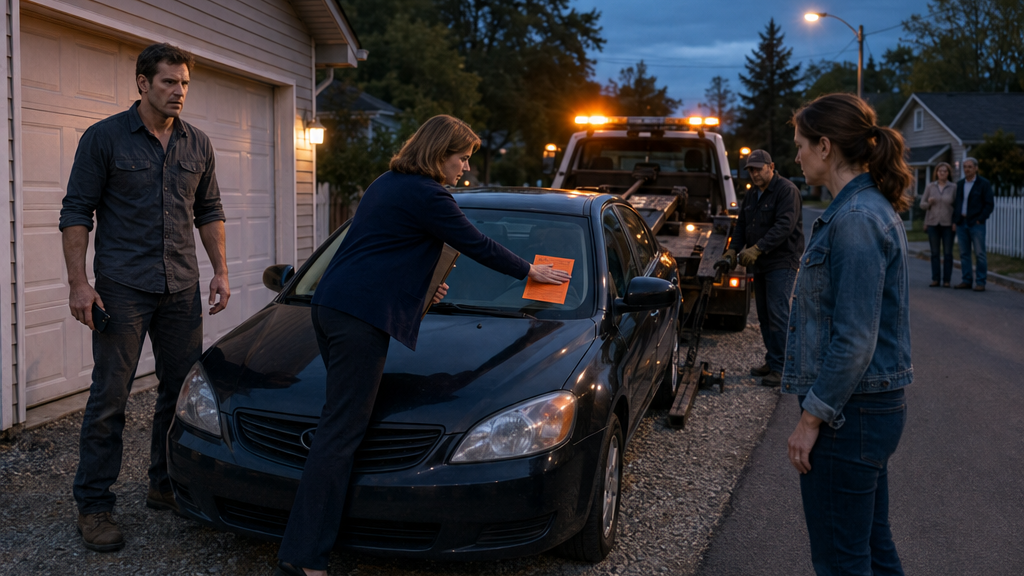
The tow truck’s amber lights flashed across Samantha Walker’s windshield before Benjamin had even reached the end of his driveway.
For half a second he thought the truck was trying to turn around. Then he saw the steel wheel-lift lowering behind Samantha’s sedan.
“Ben?” Samantha called from beside the garage. “Is this for me?”
A fluorescent orange warning sticker had been pressed onto the lower corner of her windshield.
Benjamin crossed the narrow strip of pavement between his detached garage and the private access road. The road ran behind a row of homes and climbed sharply enough that delivery drivers sometimes stopped at the bottom before committing to it. Samantha’s car sat partly on the gravel shoulder beside Benjamin’s garage, leaving the paved lane open.
Karen Nelson stood beside the sedan with a clipboard tucked under one arm.
“Karen.”
She looked at him as if he were late for an appointment.
“Your guest vehicle is in violation.”
“My sister’s car is off the travel lane.”
“It’s still within the restricted access area.”
The tow-truck driver stepped from his cab and pulled on a pair of work gloves.
Benjamin looked at the road. A pickup could pass. So could the garbage truck that came every Tuesday morning. He had parked work vans in tighter spaces on commercial sites without blocking an emergency lane.
“Restricted by what?”
Karen tapped the clipboard.
“Association policy.”
Samantha folded her arms. “I’ve been here twenty minutes.”
Karen gave her a professional smile. “The time doesn’t change the rule.”
Benjamin felt the familiar pressure rise in his chest—the same pressure he got when a project manager stood over a panel he had wired and explained electricity to him because Benjamin was wearing work boots instead of a tie.
He glanced toward two neighbors who had stopped near their mailboxes.
He could already imagine how this would look if he raised his voice.
So he took out his phone instead.
He photographed Samantha’s car from the rear, then from the side. He photographed the road between the sedan and the opposite edge. Finally, he took a close picture of the orange sticker.
Karen watched him.
“You can document it,” she said. “It doesn’t change anything.”
“What parcel is she parked on?”
Karen’s expression shifted slightly.
“What?”
“The shoulder. Which recorded parcel gives the association authority to tow from that exact spot?”
“The association controls access.”
“That wasn’t my question.”
The tow driver lowered the wheel-lift another few inches.
Karen drew a breath.
“This road is governed by the HOA. Guest access is a privilege, not a right.”
Samantha looked at Benjamin.
There it was.
Not just a parking rule.
A declaration.
Benjamin looked back at Karen. “I own the house. I use this road to reach my garage.”
“You have access rights.”
“So do my guests when they’re coming to my property.”
“Not if they’re parked in violation.”
“Of what ownership boundary?”
Karen’s smile disappeared.
“You’ve been given the policy.”
Benjamin stepped closer to the orange sticker, careful not to touch it.
He knew enough from construction work to understand the difference between permission and ownership. Easements appeared constantly in utility plans. A company might have a right to cross private land to service a transformer without owning the grass beneath its tires.
He had never needed to think about the same distinction behind his own house.
Until now.
“Show me the parcel,” he said.
Karen shook her head. “Benjamin, this isn’t a survey dispute.”
“Then it should be easy.”
The tow driver cleared his throat.
“Ma’am, am I hooking it?”
Karen looked toward the sedan.
“Yes.”
Samantha’s face reddened. “Seriously?”
Benjamin held up a hand before she could say more.
“How much to release it here?”
The driver named a fee that was already too high for a car that had moved nowhere.
Karen said, “Once the tow is authorized, you need to deal with the company.”
“You authorized it.”
“I’m enforcing the association’s rules.”
The driver backed the lift under Samantha’s rear tires.
Metal scraped against pavement.
Benjamin forced himself to stand still.
Every instinct told him to stop the process physically—to plant himself behind the car, to demand a board member, to make Karen explain herself in front of everyone watching.
Instead, he took another picture.
The wheel straps tightened.
Samantha whispered, “Ben, just let it go.”
The phrase bothered him more than Karen’s smile had.
He watched the sedan rise.
The tow truck pulled away slowly, carrying Samantha’s car down the private road, amber lights turning against garage doors and fences as it disappeared.
Karen closed her clipboard.
“You can appeal the tow.”
Benjamin looked at the empty patch of gravel.
“Send me the recorded document that gives the HOA towing authority here.”
“I’ll send you the access exhibit.”
“Not the rule. The property document.”
Karen paused.
Then she said, “I’ll send what we have.”
She walked toward the clubhouse path without another word.
Samantha stood beside him.
“You’re doing that thing.”
“What thing?”
“The thing where you get quiet because you’re actually furious.”
Benjamin looked down at the sticker residue still clinging to a corner of broken backing paper near the curb.
“She couldn’t tell me who owns the ground.”
“She’s the HOA manager.”
“That’s not an answer.”
Inside the house, Samantha called a ride to retrieve her car while Benjamin went to the cabinet where he kept his closing documents.
He had bought the home in 2018. He remembered signing stacks of paper, initialing pages he barely read, trusting the title company to flag anything unusual.
Now he spread the documents across his kitchen table.
The deed described his lot.
The title packet listed an easement for access.
A subdivision exhibit showed the road behind the houses.
Benjamin traced the line with his finger.
Then he stopped.
The access exhibit referenced one parcel number.
His closing documents referenced another beside the same stretch of road.
He checked again.
Two numbers.
One road.
And nowhere on the page in front of him did it say the HOA owned both.
Chapter 2: Fifteen Minutes Was Too Fast for Coincidence
The next orange sticker appeared before Benjamin had finished his Saturday coffee.
He saw it from his kitchen window.
A neighbor’s SUV sat farther down the private road, two tires on the shoulder. Someone had placed the same fluorescent warning square on the windshield.
Benjamin checked the time on his phone.
8:17.
At 8:29, a tow truck turned onto the road.
Benjamin set his mug down.
“Twelve minutes,” he said.
Samantha, who had come by to collect paperwork from her tow, looked through the window.
“You’re timing them now?”
“I wasn’t planning to.”
The truck stopped behind the SUV.
A neighbor came running from a back gate, still pulling on a jacket.
Benjamin and Samantha walked outside.
The neighbor was arguing with the driver.
“I was loading tools. I was gone ten minutes.”
The driver pointed toward the sticker.
“Call the association.”
“How did you even get here this fast?”
The driver did not answer.
Benjamin photographed the sticker.
Same color. Same printed layout. Same small authorization code in the corner.
“Ben,” Samantha said quietly, “don’t start.”
“I’m not starting anything.”
“You’re taking pictures of somebody else’s tow.”
“That’s because it looks exactly like yours.”
The neighbor heard him.
“They got your sister too?”
“Friday.”
The neighbor let out a humorless laugh. “They got my son last month. Four hundred and change.”
“How much?”
“Four twenty-five after everything.”
Benjamin looked at Samantha.
Her bill had been almost identical.
The tow driver attached the SUV.
By the time Benjamin returned to his kitchen, he had spoken to two more homeowners.
One family had paid three tow-related charges in less than a year. Another neighbor said his daughter had stopped visiting because she was afraid of leaving her car anywhere along the road.
Nobody could explain exactly where guest parking ended and prohibited shoulder began.
Everybody knew the stickers.
By Monday, Benjamin had assembled photographs, tow receipts voluntarily shared by neighbors, and a copy of Samantha’s invoice.
He went to the HOA office during his lunch break.
Karen sat behind a desk with a framed subdivision map on the wall behind her.
“I asked you for the property document.”
“I sent the road-use policy.”
“You sent me rules adopted six years ago.”
“They govern the road.”
“Do they govern land the association doesn’t own?”
Karen leaned back.
“We’ve been through this.”
“No. We’ve been through the parking rule. I’m asking about authority.”
She folded her hands.
“The association has a duty to maintain access.”
“I’m not disputing that.”
“Then I’m not sure what you want.”
Benjamin placed Samantha’s invoice on the desk.
“I want to know why a tow truck can arrive fifteen minutes after a sticker goes on a windshield.”
Karen’s eyes flicked to the page.
“Our vendor is responsive.”
“Very.”
“That’s what we pay them for.”
Benjamin almost laughed.
Instead he said, “Who owns the towing company?”
Karen’s posture changed by less than an inch, but he noticed.
“It’s an independent contractor.”
“That wasn’t my question either.”
The office door opened behind him.
Eric Nelson stepped in carrying a folder.
Benjamin knew Eric mostly from annual meetings and community emails. He was the kind of board president who spoke in phrases like consistent enforcement and homeowner expectations.
Eric looked from Benjamin to the invoice.
“Problem?”
Benjamin turned.
“Who owns the towing company?”
Eric’s mouth tightened.
Karen said, “Benjamin is questioning the parking policy.”
“I’m questioning the contract.”
Eric set his folder down.
“The company is licensed and insured.”
“Who owns it?”
Eric waited a moment too long.
“My brother has an ownership interest.”
Benjamin stared at him.
Karen said quickly, “The board approved the contract.”
“Did residents know?”
“It was disclosed.”
“Where?”
“In the board records.”
Benjamin looked at Eric.
“So your brother’s company gets called every time Karen puts one of those stickers on a car?”
Eric’s face hardened.
“You’re implying something you can’t prove.”
“I’m asking why your family makes money every time the HOA decides somebody’s guest parked wrong.”
“Careful.”
That single word broke Benjamin’s restraint.
He had spent three days looking at tow bills and watching residents shrug as if four hundred dollars were simply the price of having family visit.
“So what do you call it?” he asked. “Because from where I’m standing, it looks like the board built a towing racket on a road it may not even own.”
The office went silent.
Karen looked down.
Eric stepped closer.
“You don’t get to walk in here and accuse volunteers of corruption because your sister ignored a parking rule.”
“My sister parked beside my garage.”
“And was towed under a policy residents have followed for years.”
“Following something for years doesn’t make it legitimate.”
Eric pointed toward the door.
“When you have evidence instead of accusations, bring it.”
Benjamin knew immediately that he had gone too far.
Not because Eric was necessarily right.
Because Benjamin had made a claim larger than what he could prove.
Outside, Samantha was waiting in his truck.
“Well?”
“Eric’s brother owns part of the tow company.”
She stared at him.
“You’re kidding.”
“No.”
“That’s bad.”
“It looks bad.”
She caught the distinction.
“What did you say?”
Benjamin started the engine.
“More than I should have.”
That evening, one of the neighbors brought him copies of two additional tow receipts.
Another sent a photograph of a warning sticker placed on a car while groceries were still being unloaded.
The pattern was real.
Whether the pattern was corrupt was another question.
At 9:42, Benjamin’s phone chimed.
An email from Karen.
Attached was the document he had requested.
Subject: Recorded Road Access Exhibit.
Benjamin opened the PDF.
The drawing looked official enough—survey lines, easement notes, parcel references, stamped recording information.
He zoomed in.
The association clearly had rights over the road.
But the exhibit still did not say what Benjamin expected it to say.
It described access.
Maintenance.
Passage.
He scrolled through it twice.
Then a third time.
Nowhere could he find a sentence giving the HOA ownership of the shoulder where Samantha’s tires had been sitting.
Chapter 3: The Map Proved Less Than Everyone Thought
“You’re reading the wrong instrument.”
The county records clerk said it without looking up from her monitor.
Benjamin stood at the counter with Karen’s exhibit open on his phone and a legal pad covered in parcel numbers.
“I’m reading the recorded exhibit.”
“You’re reading an easement exhibit.”
“That’s what the HOA sent me.”
The clerk finally looked at him.
“That doesn’t make it a deed.”
Benjamin felt a small, unwelcome shift in his confidence.
“So what do I need?”
“If you want to know who owns the underlying land, you need the chain of title. Start with the current parcel reference, then work backward.”
She turned the monitor slightly and showed him the county index.
Benjamin had expected confirmation.
Instead he got homework.
For the next hour he moved between the terminal, microfilmed records, and scanned deeds. The road behind his house had been described differently over time. Older documents used metes and bounds. Later subdivision records introduced parcel numbers. Easements crossed property interests that had been split, transferred, and partially retained.
Nothing was as clean as the HOA map.
The clerk returned when she saw him comparing two documents.
“You’re mixing the easement holder with the fee owner again.”
Benjamin frowned.
“Explain that like I’m not standing in your office pretending I already understand it.”
That earned the faintest smile.
She pointed to one document.
“This grants access across the land.”
Then another.
“This transfers ownership of adjacent property.”
“So the association can have the right to use the road without owning the road.”
“Potentially. Depends on the exact instruments.”
Benjamin looked at the pages.
He had known the concept in theory. Utility easements worked the same way. He had run conduit through commercial sites where the power company had permanent rights to enter but did not own a square foot of the parking lot.
But knowing the principle and proving it here were two different things.
He found a deed from years before the subdivision was fully built.
A developer had transferred several residential lots and granted road-access rights.
Another document transferred maintenance responsibilities.
A later association filing referred to those rights broadly.
Benjamin’s pulse quickened.
Then he found language he had not expected.
Emergency access.
Service access.
Ingress and egress.
The HOA had not invented everything.
He leaned back in the chair.
That mattered.
There had been a part of him—an increasingly loud part—that wanted the records to show the board had no authority at all. He wanted a clean line between wrong and right. He wanted Eric embarrassed. He wanted Karen forced to admit she had been bluffing.
The documents refused to give him that.
The association had genuine access rights.
The road did require maintenance.
Residents did have obligations tied to passage.
Benjamin wrote one sentence on his legal pad.
THEY HAVE RIGHTS. QUESTION IS WHICH ONES.
Back outside, he drove home with copies of the older deeds on the passenger seat.
The private road looked different now.
Not because anything had changed physically.
Because he could finally see competing interests layered over the asphalt.
Near his garage, he stopped where Samantha’s car had been parked.
A faint rectangle of adhesive remained on the metal utility cabinet beside the garage where Benjamin had stuck a spare copy of her orange tow notice.
He took out the photograph from Friday.
Samantha’s rear tire had been almost directly beside a narrow gravel line.
Benjamin paced from the pavement to the garage wall, comparing the image to the older survey.
The road easement was wide enough to preserve passage.
But the shoulder appeared to extend into a separate strip.
He needed a professional survey before claiming anything.
That realization irritated him.
He had already told Eric the HOA might not own the road.
He had already used the phrase towing racket.
Now the records were telling him a more complicated story.
That evening, Samantha found him at the kitchen table with documents spread in ordered stacks.
“You look disappointed.”
“I found proof they have access rights.”
She laughed once. “That’s disappointing?”
“It means Eric wasn’t completely wrong.”
“You wanted him to be completely wrong.”
Benjamin did not answer.
Samantha sat across from him.
“Does it mean the tow was valid?”
“I don’t know.”
“Then that’s your answer.”
“I don’t like not knowing.”
“I know.”
He looked at the oldest deed again.
A name appeared in the grantor section.
Edward Adams.
Benjamin stopped.
The name tugged at him.
He searched through the next document.
Edward Adams again.
He knew that name.
Years earlier, Benjamin’s company had rewired two houses for a retired property investor with that name. Older man. Quiet. Paid invoices on time. Had spent half the projects complaining about developers who created legal messes and left them for somebody else to clean up.
Benjamin pulled out his phone.
He searched his old contacts.
Nothing.
Then he searched archived work invoices from the cloud account he still used for commercial jobs.
ADAMS — RESIDENTIAL SERVICE.
There it was.
An address.
The following morning Benjamin returned to the county office.
The clerk helped him trace one more transfer.
A large development parcel had been broken apart.
Residential lots transferred.
Access rights granted.
Association responsibilities established.
But one narrow strip bordering the private road did not appear in the later transfer Benjamin expected.
He placed the old deed beside the newer association exhibit.
“Why wouldn’t this transfer with everything else?”
The clerk shook her head.
“Could be intentional. Could be an omission. Could have been transferred under something you haven’t found yet.”
“So I still don’t know.”
“You know more than you did yesterday.”
Benjamin looked again at the ownership line.
Edward Adams.
He thought about Karen’s sticker.
Eric’s warning.
The tow truck arriving in twelve minutes.
And his own accusation in the HOA office.
For the first time, he considered the possibility that everyone in the dispute had been operating from only part of the truth—including him.
He folded the copy carefully.
If Edward still owned that strip, Benjamin needed to know why.
And if he did not, Benjamin needed to find the document that proved where it had gone.
Chapter 4: The Man Who Never Signed Away the Shoulder
Edward Adams opened the door before Benjamin reached the porch.
For a moment, Benjamin thought he had the wrong house.
Then Edward narrowed his eyes and said, “You wired that place on Hawthorne.”
Benjamin stopped halfway up the last step.
“And the one near the reservoir.”
Edward nodded once. “Thought I knew you.”
He looked older than Benjamin remembered. Thinner through the shoulders. Gray hair cut short. A faded work shirt buttoned wrong at the bottom.
Benjamin held up the folder in his hand.
“I’m not here about electrical work.”
“I figured.”
Edward looked past him toward the truck, then back at the folder.
“Come in.”
The house was small and orderly. No framed development plans on the walls, no trophies from old business deals. Just family photographs, a clock that ticked too loudly, and a dining table covered at one end with unopened mail.
Benjamin placed copies of the deeds on the other end.
Edward did not sit immediately.
When he saw the old parcel number, his expression changed.
“Where did you get this?”
“County records.”
“That answer usually means trouble.”
Benjamin slid the older deed across.
“I live here.”
He pointed to the subdivision map.
“My detached garage sits beside this private road. The HOA has been towing vehicles from the shoulder.”
Edward sat down slowly.
“How long?”
“I don’t know exactly. Years, maybe.”
“And they say they own it?”
“They say they control it.”
“That’s not the same thing.”
Benjamin felt his pulse quicken.
“That’s why I came.”
Edward studied the map without touching it.
Benjamin showed him the location where Samantha’s car had been parked.
“The association has access rights through here. Maintenance rights too. But I can’t find where this strip transferred.”
Edward leaned back.
“It didn’t.”
The answer came so plainly that Benjamin almost missed its weight.
“What?”
“I never signed it away.”
Benjamin stared at him.
Edward tapped the narrow roadside strip.
“That stayed with me.”
“Why?”
“Because the original plan changed.”
Edward finally pulled the papers closer.
“The developer wanted a wider private road than the county required. There were drainage issues, utility access, turnaround space. We carved up the lots and granted permanent passage over the center section.”
He traced one line.
“The association got responsibilities. Residents got access. But this shoulder?”
His finger moved to the strip beside Benjamin’s garage.
“That wasn’t included in the transfer.”
Benjamin leaned forward.
“So you own it.”
“Unless somebody forged my name after I stopped paying attention.”
Benjamin did not smile.
He wanted to.
For days he had imagined finding one clean fact that would make Eric and Karen look foolish. Now the fact was sitting in front of him.
But Edward was not finished.
“They weren’t supposed to control parking there,” he said.
Benjamin looked up.
“What were they supposed to control?”
“Passage.”
Edward pointed to the paved portion.
“The whole purpose was to keep residents from getting trapped. Garbage trucks. Deliveries. Fire equipment if needed.”
“And the shoulder?”
“Buffer. Drainage in some sections. Extra room in others.”
Benjamin thought of Karen pressing the sticker onto Samantha’s windshield.
“They’re towing from it.”
Edward rubbed his jaw.
“That sounds like somebody expanded a rule.”
“Eric Nelson says the association governs the road.”
“Doesn’t surprise me.”
“You know him?”
“No.”
“Then what doesn’t surprise you?”
Edward gave him a tired look.
“People inherit paperwork. Then they inherit somebody else’s interpretation of the paperwork. After ten years, the interpretation starts feeling more real than the document.”
Benjamin opened another copy.
“The president’s brother has an ownership interest in the towing company.”
Edward’s eyebrows rose.
“That’s messy.”
“That’s one word for it.”
“But messy isn’t automatically illegal.”
Benjamin stiffened.
Edward noticed.
“You came here hoping I’d tell you they’re all crooks?”
“No.”
“Yes, you did.”
Benjamin looked down at the map.
Edward continued in a quieter voice.
“You were good at your work because you checked what was actually connected before you energized anything.”
Benjamin remembered the houses. Edward had watched him troubleshoot an overloaded panel for nearly two hours without interfering.
“Property’s not much different,” Edward said. “Find out what’s actually connected.”
Benjamin pointed toward the easement.
“If I bought this strip from you, could I stop the HOA from using the road?”
Edward’s face changed immediately.
“No.”
The answer irritated Benjamin more than it should have.
“Why not?”
“Because ownership doesn’t erase recorded access.”
“I mean if they’re abusing it.”
“You might stop unauthorized towing from land you own. You might control parking outside the easement, depending on the survey. But you can’t wake up one morning and tell families they can’t reach their houses.”
Benjamin said nothing.
Edward studied him.
“That what you were thinking?”
“I was thinking they might understand boundaries better if somebody enforced one against them.”
“Maybe.”
Edward folded his hands.
“But you’ll want to decide whether you’re trying to fix their mistake or inherit it.”
The words sat between them.
Benjamin gathered the copies more slowly than he had spread them out.
“Why did you keep the strip all these years?”
Edward looked toward the window.
“At first because I thought the development might need it later. Then because transferring it meant attorneys and survey work.”
“And after that?”
Edward gave a small shrug.
“After that, it became easier not to think about.”
The answer was less satisfying than negligence or strategy.
It was ordinary.
Which somehow made the mess more believable.
Edward stood and went to a cabinet. He returned with an old folded survey, edges yellowed and softened by years.
“You can copy this.”
Benjamin opened it carefully.
The same road appeared, but the lines were clearer than the later HOA exhibit.
The easement ran through the central travel corridor.
The shoulder beside his garage extended outside it.
Almost exactly where Samantha’s car had sat.
Almost exactly where the orange sticker had appeared in Benjamin’s photograph.
He placed his phone beside the survey and compared them.
For the first time, the pieces lined up.
Edward watched him.
“There’s your problem.”
Benjamin looked at the old boundary.
“No,” he said. “That’s their problem.”
Edward’s expression hardened just enough to stop him.
Benjamin heard himself.
He closed the folder.
“Right.”
Outside, he sat in his truck for several minutes before starting the engine.
He had found what he wanted.
An owner.
A boundary.
A reason the HOA map had never answered his question.
But the victory did not feel as clean as he had imagined.
Edward still owned the strip, yet residents still held rights across the road. The board had overreached, but it had not invented the need for access. Benjamin could prove one kind of authority was wrong without proving all authority was wrong.
His phone rang before he pulled away.
Edward.
Benjamin answered.
“You forget something?”
“No,” Edward said. “I did.”
Benjamin waited.
“If you’re thinking about buying that strip, I don’t want to manage it anymore.”
Benjamin sat straighter.
“What would you want for it?”
Edward was quiet for several seconds.
“Thirty-eight thousand.”
Benjamin stared through the windshield at the modest house.
“Thirty-eight?”
“That’s the number.”
“For a strip of private road shoulder?”
“For land underneath a problem you seem determined to own.”
The call ended a minute later.
Benjamin remained parked with both hands on the steering wheel.
He had spent days asking who owned the road.
Now he knew.
The question waiting for him was worse.
How badly did he want to become that person?
Chapter 5: Buying the Road Did Not Mean Owning Everyone
Benjamin signed his name beside the last yellow tab and set down the pen.
Thirty-eight thousand dollars had become ink.
The closing agent turned the page toward herself and checked his signature.
“That completes the transfer documents.”
Benjamin looked through the window at the parking lot.
He had expected a rush.
Instead he felt the same thing he felt after throwing a large breaker for the first time on a new commercial installation: not excitement, exactly.
Awareness.
Something was live now.
Three weeks had passed since Edward named his price.
Benjamin had spent most of them resisting the decision.
Then he paid for a title review, confirmed Edward still held the fee interest, and ordered a survey before closing.
The results had been enough.
The narrow strip beside the private road was real.
So were the easements crossing it.
He was now the owner.
Not of the residents’ right to pass.
Not of the HOA’s maintenance easement.
But of the land underneath the shoulder it had been policing as though ownership and access meant the same thing.
Outside the closing office, Samantha waited beside his truck.
“Well?”
Benjamin held up the folder.
“You did it.”
“I did.”
“How does it feel?”
“Expensive.”
She laughed.
Then her face became more serious.
“What are you going to do?”
Benjamin opened the truck door.
“First thing? Stop their towing authorization.”
“That’s not what I meant.”
He knew.
Two days later, bright survey paint appeared along the road beside his garage.
The surveyor walked the boundary with a measuring wheel while Benjamin followed, carrying a copy of the recorded plat.
A narrow line of fresh paint curved past the gravel shoulder.
Benjamin stopped beside the location where Samantha’s car had been towed.
“So anything outside this line is mine.”
The surveyor glanced at him.
“The underlying fee interest is yours.”
“Same difference.”
“No.”
Benjamin looked over.
The surveyor pointed to the road.
“You’ve got recorded easements crossing portions of the parcel. Ownership is subject to those rights.”
“I know.”
“I’m saying it because people hear ‘I bought the road’ and start imagining gates.”
Benjamin had, in fact, imagined a gate.
Not permanently.
Just long enough for Eric to understand what it felt like to ask permission.
Benjamin unfolded a sketch he had made.
“What if I put controlled access here?”
The surveyor studied it.
“You’d interfere with the recorded passage.”
“What if I issue access permission myself?”
“You don’t need to. They already have it.”
Benjamin felt irritation push through his voice.
“So I spend thirty-eight thousand dollars and they still get to use it?”
The surveyor looked at him for a second.
“You bought land with easements on it.”
“I know what I bought.”
“Then you know the answer.”
Benjamin said nothing.
The surveyor tapped the shoulder.
“What you may control is parking outside the easement, use of the fee strip, and authorization for private towing from property you own. But if your plan is to make the association ask you every time somebody drives home, that plan isn’t going to survive contact with the recorded documents.”
Benjamin folded his sketch.
He hated being corrected in front of his own garage.
Worse, the surveyor was right.
That evening, he spread the new survey across the kitchen table.
Fresh boundary measurements in black ink crossed the same space where Karen’s orange sticker had started everything.
Beside the survey sat the faded spare tow notice Benjamin had kept.
Samantha came in carrying takeout.
She looked at the table.
“Still doing battle planning?”
“I’m defining boundaries.”
She put the food down.
“That sounds healthier.”
Benjamin ignored the comment.
“I can prohibit their tow contractor from removing vehicles from my property without my authorization.”
“Good.”
“I can define parking outside the access corridor.”
“Also good.”
“I could require the HOA to request permission for any activity outside its recorded rights.”
Samantha pulled out a chair.
“Okay.”
“And if they want to keep acting like they own it, maybe I make the limits very clear.”
“How clear?”
Benjamin slid his first sketch toward her.
Samantha looked at the proposed controlled-access point.
Then at him.
“You’re kidding.”
“It was an option.”
“For what?”
“Making them understand.”
“They already don’t get to tow there, right?”
“Once I revoke permission.”
“And everybody still needs to drive through.”
“Yes.”
“So why are you trying to make it harder for everybody else?”
Benjamin folded his arms.
“I’m not.”
“You drew a gate.”
“It was preliminary.”
Samantha gave him a long look.
“You’re starting to sound like Karen.”
Benjamin’s jaw tightened.
“That’s ridiculous.”
“Is it?”
“She told you your access was a privilege.”
“And now you’re talking about reminding everybody that you own the ground.”
“I do own it.”
Samantha nodded.
“That’s exactly what I mean.”
The room went quiet.
Benjamin looked down at the orange notice.
He remembered Karen’s voice.
Guest access is a privilege, not a right.
He had hated the sentence because it reduced people to permission.
Yet in his mind, he had already begun constructing a version of the same power.
He pushed the gate sketch aside.
The next morning he called the surveyor.
“I want another layout.”
“For what?”
“Keep the full recorded travel easement clear. Mark actual guest spaces only outside it.”
“That’s workable.”
“And show me exactly where the HOA’s maintenance rights end.”
“I can do that.”
Benjamin hesitated.
“One more thing.”
“What?”
“No gate.”
The surveyor laughed softly.
“That usually saves money.”
Over the next several days, Benjamin drafted a formal notice with help from the title documents and recorded survey.
He did not claim the association had no rights.
He listed the rights it did have.
Passage.
Maintenance within the recorded area.
Emergency access.
Then he stated what it did not have from him.
Authority to authorize private towing from his fee-owned shoulder without his written consent.
He attached the parcel identification, survey, and deed recording information.
Before sending it, he stared at the language for nearly ten minutes.
It was less satisfying than the letter he had first wanted to write.
No accusations.
No mention of Eric’s brother.
No demand for apologies.
Just boundaries.
Samantha read the final version.
“This one sounds like you.”
Benjamin looked at her.
“What did the first one sound like?”
“Like you wanted them angry.”
He did not argue.
At 4:16 that afternoon, Benjamin emailed the notice to Karen, Eric, the HOA board, and the towing company.
At 4:18, he sent certified copies.
Then he walked outside.
The new survey paint curved past his garage in bright marks.
He stood where Samantha’s car had been.
Nothing about the road looked different.
No gate.
No barrier.
No dramatic sign.
But for the first time, Benjamin knew exactly where his authority began.
More importantly, he knew where it stopped.
His phone buzzed.
A delivery receipt showed the email to the HOA had been opened.
The towing company’s copy had been opened too.
Benjamin stared at the screen.
Now there would be no question whether they had been told.
The only question was whether they would act as if the old authority still existed.
Chapter 6: The Board Had One Last Reason to Refuse
Eric Nelson dropped three photographs onto the folding table.
“Before everybody decides this policy came from nowhere,” he said, “look at those.”
Benjamin sat across from the board with his survey rolled beside him.
The clubhouse meeting room was fuller than usual. Residents lined two walls. Karen sat at the end of the table with a binder open in front of her.
Benjamin picked up the first photograph.
A service truck was angled awkwardly on the private road, blocked by two parked vehicles.
The second showed the same truck attempting to reverse.
The third showed a narrow gap between a bumper and a retaining edge.
“When was this?”
“Three years ago,” Eric said.
“What happened?”
“A utility crew couldn’t reach a damaged line for almost forty minutes.”
Benjamin looked at the photograph again.
Eric continued.
“Residents complained about blocked access before we ever had the current towing contract. Delivery drivers got trapped. Trash pickup was missed twice. People parked wherever they wanted because nobody wanted to be the bad guy.”
A board member nodded.
“So we created a uniform rule.”
Benjamin set the photographs down.
“Uniform isn’t the same as authorized.”
“No,” Eric said. “But neither is ownership the same as permission to make the road unusable.”
“I’m not making it unusable.”
“You bought a strip of land and immediately revoked enforcement.”
“I revoked towing from property the association does not own.”
“Because your sister got towed.”
Benjamin felt the room shift toward him.
That part was true.
He unrolled his survey.
“My proposed layout preserves the recorded travel corridor.”
Eric barely glanced at it.
“Until guests overflow.”
“Then you enforce actual obstruction.”
“With what?”
“Not by towing cars from land you don’t own just because they’re nearby.”
Eric leaned forward.
“You think this is simple because you found a deed.”
Benjamin almost answered too quickly.
Then he looked at the old service-truck photographs again.
For weeks he had pictured the towing policy as something invented entirely for convenience—or profit.
But there had been a real problem first.
That did not excuse what followed.
It did explain why residents had tolerated it.
Benjamin pointed to the survey.
“This line keeps the travel lane clear. The marked guest spaces sit outside it. If a vehicle obstructs the easement, document it and deal with the obstruction.”
Eric shook his head.
“That creates judgment calls.”
“Rules require judgment sometimes.”
“The whole reason we contracted towing was to remove judgment.”
“And you replaced judgment with automatic punishment.”
A murmur moved through the room.
Eric looked toward the residents.
“This is exactly what I mean. If every homeowner starts negotiating each rule based on where one tire sits, we lose enforceability.”
Benjamin heard the fear beneath the argument.
Not fear of him.
Fear of losing control.
He understood it better than he wanted to.
Karen closed her binder.
“We could revise the towing map.”
Eric turned toward her.
“We’ve already discussed that.”
“We discussed updating it after the survey.”
“And I said not until counsel reviews the access documents.”
Benjamin looked at Karen.
It was the first time she had publicly suggested changing anything.
The meeting dragged through maintenance responsibilities, turning radius, signage, and insurance.
No one applauded Benjamin.
Several residents worried that ending automatic towing would bring back the old parking problems.
One neighbor said plainly, “I don’t care who owns six feet of gravel. I care whether an ambulance can get through.”
Benjamin answered, “So do I.”
And meant it.
After the meeting ended, people gathered their papers in small groups.
Eric left through the side door with two board members.
Benjamin rolled his survey and headed toward the parking lot.
“Benjamin.”
Karen stood near the hallway.
He stopped.
She waited until the last resident walked past.
“I want to show you something.”
She opened her binder to several printed emails.
They were months old.
Karen had written to Eric and the board asking whether the tow contractor should be required to photograph actual obstruction before removing vehicles.
Another message questioned whether vehicles parked entirely outside the paved travel lane should receive automatic towing authorization.
A third recommended revising the road map.
Benjamin looked up.
“You knew.”
“I knew the policy was too broad.”
“Then why did you keep putting stickers on cars?”
Karen’s mouth tightened.
“Because I’m the manager.”
“That’s not an answer.”
She flinched at the phrase.
Benjamin realized he had used the same words on the road.
Karen lowered her voice.
“When residents couldn’t get service trucks through, they blamed management. When the board adopted a strict policy, complaints dropped. Then when people got towed, they blamed management too.”
“So you just kept enforcing it.”
“I recommended changes.”
“Privately.”
“Yes.”
“While telling my sister her access was a privilege.”
Karen looked away.
“That was a bad choice of words.”
“It was more than wording.”
“I know.”
For the first time, Benjamin saw what he had refused to see before.
Karen was not secretly pleased by every tow.
She had been afraid of becoming the person responsible if the road clogged again.
That did not absolve her.
It made her harder to hate.
“Why didn’t you tell me this when I asked?”
“Because Eric made it clear policy questions went through the board.”
“And your job?”
Karen nodded once.
“Yes.”
Benjamin handed the emails back.
“Then help fix it now.”
She closed the binder.
“I’m trying.”
Outside, Eric was waiting beside his SUV.
“The existing instructions stay in place until the board finishes its review,” he told Benjamin.
Benjamin stopped.
“You received my revocation.”
“I received your letter.”
“They are not authorized to tow from my parcel.”
“We disagree about the operational effect.”
“You don’t get to disagree with ownership.”
“And you don’t get to ignore the easement.”
“I’m not.”
Eric opened his vehicle door.
“Then let counsel sort it out.”
Benjamin stepped closer.
“If your contractor hooks another car from outside the travel easement, that’s on you.”
Eric looked at him.
“No. If somebody blocks this road and emergency access fails, that’s on all of us.”
He drove away.
Benjamin stood beside his truck with the rolled survey under his arm.
The argument had changed.
It was no longer whether the HOA had overreached.
It had.
The harder question was how to correct that overreach without recreating the exact problem the policy had originally been designed to solve.
His phone vibrated.
A message from one of the neighbors who lived above the bend.
Tow truck just came in.
Benjamin read it twice.
A second message arrived.
Heading toward your garage.
Chapter 7: The Same Tow Truck Returned to a Different Road
Amber lights washed across Benjamin’s garage before he reached the bottom of the steps.
For one suspended second, the scene looked exactly like the night Samantha’s car had disappeared.
Same narrow road.
Same hard flashes against siding and parked cars.
Same low diesel idle.
But this time Benjamin knew where the line was.
He crossed the driveway with the recorded survey folded under one arm and his phone in his hand.
The tow truck had stopped behind a compact sedan parked in one of the unmarked shoulder areas beside the garage. The car belonged to a neighbor’s guest. Its right-side tires sat outside the paved travel lane.
The driver was already stepping down.
Benjamin recognized him.
“You get another call?”
The driver looked tired rather than confrontational.
“Dispatch sent me.”
“From the HOA?”
“Same authorization file.”
Benjamin stopped a few feet away.
“That authorization was revoked.”
The driver looked toward the sedan, then back at Benjamin.
“Not according to what I’ve got.”
Benjamin opened the email on his phone.
“Sent to your company. Certified copy delivered too.”
The driver rubbed the back of his neck.
“I don’t handle contracts.”
“I’m not asking you to.”
He unfolded the survey on the hood of his truck.
“I’m asking you not to tow a vehicle from property I own without my authorization.”
A porch light came on across the road.
Then another.
Benjamin felt the old pressure building again—the sense that the whole neighborhood was waiting to see whether he would finally turn this into the showdown everyone had been predicting.
The driver glanced at the survey.
“I was told this whole lane is association-controlled.”
“They have an easement through the travel corridor.”
Benjamin pointed.
“This is the corridor.”
Then to the shoulder.
“This is outside it.”
The driver did not touch the car.
That mattered.
Five weeks earlier, the wheel-lift would already have been under Samantha’s tires.
Now the driver stood with his hands on his hips, uncertain.
A neighbor approached from farther up the road.
“That’s my daughter’s friend’s car,” he said.
“Is it blocking you?” Benjamin asked.
“No.”
“Blocking the lane?”
“No.”
Benjamin looked at the driver.
The driver sighed.
“I need to call dispatch.”
“Call whoever you need.”
Benjamin stepped back.
He could hear himself being calmer than he felt.
The difference was that this time the calm did not come from helplessness.
It came from knowing what he could prove.
The driver returned to the cab.
While he was on the phone, Karen arrived in her SUV.
She parked beyond the survey paint and walked over carrying no clipboard.
That alone felt strange.
“What happened?” she asked.
“Old authorization,” Benjamin said.
Karen looked at the tow truck.
“I told the office there was a dispute.”
“Apparently the contractor’s file didn’t change.”
Her jaw tightened.
Before she could answer, headlights turned onto the road.
A sheriff’s cruiser approached slowly and stopped behind Karen’s SUV.
Benjamin did not know who had called.
The deputy stepped out and listened first to the driver, then to Karen, then to Benjamin.
Benjamin handed over copies of the deed and survey.
The deputy studied them under the cruiser’s interior light.
“This appears to be a civil property issue,” he said.
Benjamin nodded. “I understand.”
The driver asked, “So can I remove the vehicle?”
The deputy looked toward him.
“Who authorized you tonight?”
“The association.”
The deputy turned to Benjamin.
“You’re saying you own this section?”
“Yes. Subject to the recorded easement.”
“And you’ve withdrawn consent for towing from the portion outside that easement?”
Benjamin showed him the notice.
The deputy read the first page.
Then looked at the driver.
“I’m not making a title determination out here. But if the current fee owner is expressly telling you he has not authorized removal from his property, you may want your company to sort that out before taking the vehicle.”
The driver nodded almost immediately.
“I’m not getting in the middle of that.”
He began raising the empty wheel-lift.
A small sound came from one of the porches—not applause, just somebody releasing a breath.
Benjamin looked at the sedan.
It stayed exactly where it was.
That should have felt like victory.
Instead he found himself watching the clear strip of pavement beside it.
A service truck could pass.
An ambulance could pass.
The road remained open.
No one had needed to be towed.
A car door slammed behind them.
Eric Nelson walked toward the group.
He had arrived without a jacket, as if he had left home quickly.
“What is going on?”
Karen answered first.
“The contractor didn’t have the updated property authorization.”
Eric looked at Benjamin.
“You called law enforcement?”
“I didn’t.”
The deputy said, “Someone reported a dispute involving a tow.”
Eric’s eyes went to the survey in Benjamin’s hand.
“So this is what we’re doing now?”
Benjamin said nothing.
Eric walked toward the edge of the pavement.
“You want to claim this strip? Fine.”
He pointed down the road.
“Then claim all of it. Put up your gate. Tell everyone when they’re allowed through. Take responsibility every time somebody parks wrong.”
Benjamin stared at him.
The words landed differently than Eric intended.
A month earlier, Benjamin might have accepted the challenge.
He might have enjoyed it.
A gate.
Codes.
Permission.
A clear demonstration that Eric no longer controlled the road.
Instead Benjamin thought about Samantha sitting at his kitchen table.
You’re starting to sound like Karen.
He thought about Edward asking whether he wanted to fix the mistake or inherit it.
Then he looked at Eric.
“I’m not closing the road.”
Eric gave a short, disbelieving laugh.
“You bought it.”
“I bought property subject to access rights.”
“Exactly.”
“So the access stays.”
Eric folded his arms.
“And the parking?”
“Defined outside the travel corridor.”
“The towing policy?”
“Not on my parcel without authorization.”
Eric shook his head.
“You’re trying to have it both ways.”
“No.”
Benjamin pointed toward the sedan.
“I’m separating two things you kept treating as one.”
Eric looked at the open lane.
Benjamin continued.
“They have a right to pass.”
He pointed to the shoulder.
“You don’t have a blank check to tow from everything beside it.”
The tow driver returned to his cab.
Amber lights stopped flashing.
For the first time since he arrived, the road went dark except for the porch lamps and the sheriff’s headlights.
Karen spoke quietly.
“Eric, we need to revise the map.”
Eric looked at her.
She did not look away.
Something shifted then—not a surrender, not yet.
But the old united front was gone.
The deputy handed Benjamin his documents.
“I’d suggest everybody get the authorization issue clarified in writing.”
“It is in writing,” Benjamin said.
The deputy gave him a measured look.
“Then make sure everybody is reading the same writing.”
Benjamin almost smiled.
“That seems to be the whole problem.”
The cruiser left first.
The tow truck backed down the hill after it.
The neighbor’s guest car remained in place.
Eric stood beside the survey line.
“You realize this doesn’t end the access problem.”
“I know.”
“You’ll still have people parking badly.”
“I know.”
“You’ll still have residents expecting someone else to fix it.”
Benjamin rolled the survey.
“I know.”
Eric seemed almost frustrated by the answers.
“Then what exactly did you accomplish tonight?”
Benjamin looked toward the shoulder where Samantha’s sedan had once been lifted from the ground.
“The car stayed.”
Eric stared at him.
“That’s it?”
“No.”
Benjamin nodded toward the open road.
“The road stayed open too.”
For several seconds, neither man spoke.
Then Benjamin said the thing he had finally become certain of.
“Access stays. The towing arrangement doesn’t.”
Chapter 8: The New Sign Said Less and Meant More
The workers removed the last old towing notice on a Tuesday morning.
It had been bolted to a post near the bend in the private road, faded at the edges and tilted slightly from years of weather.
One worker held the post steady while another backed out the rusted fasteners.
Benjamin watched from beside his garage.
The sign came down without ceremony.
No crowd.
No board members.
No dramatic confrontation.
Just a cordless drill, a metal clatter, and a pale rectangle left behind where the sun had never reached the post.
In its place went a smaller sign.
The wording was simpler.
Keep travel lane clear.
Guest parking in marked spaces only.
Unauthorized towing prohibited without property-owner approval.
The new white boundary markings followed the survey rather than the HOA’s old enforcement map. They left the easement corridor unobstructed and created several defined guest spaces along the shoulder.
For the first time, residents could tell where parking was allowed without knowing the history of a thirty-year-old development parcel.
Benjamin found that more satisfying than he expected.
Three weeks after the tow truck confrontation, the board had approved the revised layout.
Not unanimously.
Eric voted against the first version.
Then against the second.
The third passed after Benjamin agreed to keep the maintenance easement unchanged and the association agreed that any future towing from Benjamin’s parcel required proof of actual obstruction plus his authorization unless emergency conditions applied.
It was not the kind of victory anyone could summarize with a photograph of a defeated opponent.
It was paperwork.
Paint.
Responsibilities.
Limits.
And it worked.
One afternoon Karen arrived carrying a cardboard file box.
Benjamin was in the garage replacing a worn receptacle when he heard her knock on the open doorframe.
He looked over.
“No clipboard?”
She glanced at the box.
“Different kind of paperwork.”
Benjamin set down his screwdriver.
“What is it?”
“Tow records.”
She placed the box on his workbench.
“The board authorized a review of disputed charges from the shoulder areas.”
Benjamin looked inside.
Invoices.
Photographs.
Copies of warning notices.
Some of the orange stickers had been peeled from windshields and attached directly to complaint forms.
“How far back?”
“Two years for formal review. Older cases if residents still have documentation.”
“And Eric agreed to that?”
Karen paused.
“The board agreed.”
Benjamin understood the distinction.
“What happens if a tow was authorized from outside the old travel corridor?”
“Refund recommendation.”
“From the association?”
“In some cases. Contractor adjustment in others.”
Benjamin picked up one of the warning notices.
It was the same fluorescent orange as Samantha’s.
For weeks the color had made him angry on sight.
Now it looked cheap.
Just adhesive paper carrying more authority than anyone had bothered to question.
Karen stood beside the workbench.
“I should have pushed harder.”
Benjamin looked at her.
She did not defend herself.
He could have made her.
He could have reminded her exactly what she had said to Samantha.
Guest access is a privilege.
Instead he asked, “Why didn’t you?”
Karen looked out toward the road.
“I thought if I challenged the policy and somebody blocked a service truck the next week, every complaint would land on me.”
“So you let the towing complaints land on you instead.”
A tired smile crossed her face.
“That was apparently my strategy.”
Benjamin put the sticker back.
“You were wrong.”
“I know.”
The simplicity of it left nowhere for his anger to go.
Karen touched the edge of the box.
“These records are what I can do now.”
Benjamin nodded.
“All right.”
She started toward her SUV, then stopped.
“For what it’s worth, the new layout is better.”
Benjamin looked toward the painted spaces.
“Because I own it?”
“No.”
She opened the door.
“Because people can understand it.”
After she left, Benjamin stood for a while beside the box.
That had been the problem from the beginning.
Not only who had power.
Who could see where the power stopped.
The following Saturday Samantha pulled into one of the new guest spaces.
She got out carrying two grocery bags and looked down at the white lines around her tires.
“No sticker?”
Benjamin was sweeping the garage floor.
“Give it time.”
She laughed.
“Do I need to sign in?”
“No.”
“Text anyone?”
“No.”
“Ask the land baron for permission?”
Benjamin leaned on the broom.
“You’re very close to losing guest privileges.”
Samantha froze theatrically.
Then both of them laughed.
It was the first time the phrase had been funny.
She carried the groceries inside without looking over her shoulder at the road.
Benjamin noticed that too.
Later that month, the association sent him a proposed maintenance agreement for the strip.
The document included a yearly access payment.
Benjamin read the number twice.
It was higher than necessary.
Not enormous.
But high enough that he understood what had happened.
Someone had calculated what Benjamin could plausibly demand now that the HOA needed formal cooperation from him.
For several minutes he sat at the kitchen table with a pen in his hand.
Thirty-eight thousand dollars.
Survey costs.
Recording fees.
Weeks of conflict.
He could justify the charge.
He could tell himself the association owed him.
Instead he crossed out the proposed access payment.
He replaced it with proportional actual maintenance costs tied to the shared road.
Samantha saw the document later.
“You could have taken the money.”
“I know.”
“They would have paid it.”
“I know.”
She studied him.
“That hurts you, doesn’t it?”
“A little.”
“Good.”
He smiled.
The final agreement was signed the next week.
Residents kept their access.
The HOA kept responsibility for shared maintenance within the recorded easement.
Benjamin retained control of his fee-owned shoulder.
The old tow contractor was removed from automatic enforcement on the strip.
Nothing about the arrangement required anyone to pretend the previous system had been reasonable.
Nothing required Benjamin to punish everyone for it either.
One evening, while putting tools away in the garage, he noticed something stuck to the side of the metal cabinet.
A faded orange rectangle.
Samantha’s original tow sticker.
He had kept it after the first night, pressing it there as if he might someday need to remember exactly what had been done.
The adhesive had dried around the edges.
Benjamin worked a fingernail underneath one corner.
The sticker tore halfway down.
He peeled again.
For a second, it resisted.
Then the whole thing came free.
He held it between two fingers.
Outside, Samantha’s car sat inside a marked guest space.
Farther up the road, a delivery van passed without slowing.
No one moved a car.
No one rushed outside.
No tow truck appeared.
Benjamin dropped the faded sticker into the trash.
Then he closed the garage cabinet and went inside.
The story has ended.