My Neighbor Used My Driveway for Eleven Months—Then the HOA Tried to Make His Shortcut Permanent
Chapter 1: The Boat Was Waiting When Thomas Came Home
Thomas Campbell saw the boat before he saw his house.
Its white hull rose above the hedge at the bend in the street, bright against the darkening row of roofs. For half a second he thought Jack had parked it along the curb again.
Then Thomas turned into his driveway and hit the brake.
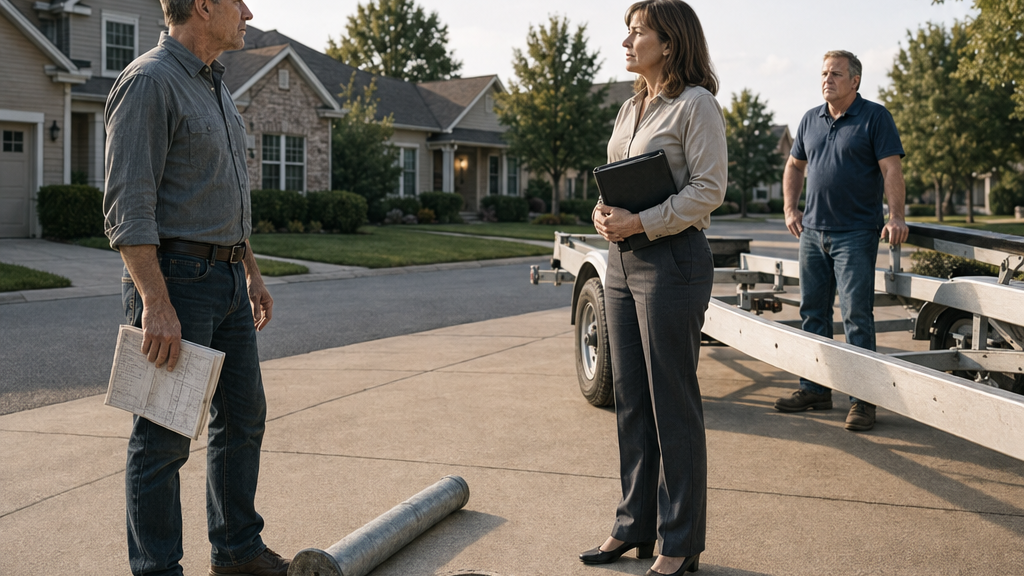
The trailer was angled across the lower half of his concrete, one wheel nearly touching the grass. The tongue extended toward Jack Nelson’s property next door. A blue nylon strap fluttered against the winch post.
Thomas sat behind the wheel with the engine running.
He had been gone twenty-two days.
His suitcase was in the trunk. His laptop bag lay on the passenger seat beside a paper cup he had bought two hours earlier at the airport. All he wanted was a shower, something hot to eat, and eight hours in his own bed.
Instead, he was staring at somebody else’s boat.
He backed into the street, parked along the curb, and shut off the engine.
The neighborhood looked as it always did when he returned from a trip: lawns cut evenly, porch lights beginning to come on, recycling bins pulled back from the curb. There was something mildly accusatory about how normal everything appeared.
Thomas walked around the boat.
Twenty-two feet, Jack had once told him proudly. Long enough to make the turn into Jack’s own narrow driveway awkward. Thomas knew that because he had watched Jack try it the first time almost a year earlier.
That afternoon, Jack had stopped beside Thomas’s garage and asked, “Mind if I swing wide through here?”
Thomas had waved a hand.
“Sure.”
It had seemed harmless.
A maneuver. Thirty seconds of borrowed pavement.
Weeks later, the trailer had spent an afternoon on Thomas’s driveway while Jack washed it. Then an evening. Then a Saturday morning.
Thomas had noticed.
He had also been packing for Denver, Dallas, Phoenix, Chicago. There was always a flight, a client meeting, a report due by midnight. Each time he told himself the same thing: if it becomes a problem, I’ll say something.
Now the boat was blocking him from his own garage.
He crossed the strip of grass between the houses and knocked on Jack’s front door.
Jack opened it wearing gym shorts and an old marina T-shirt.
“You’re back.”
Thomas looked over his shoulder toward the boat.
“I need you to move the trailer.”
Jack glanced past him, as though he had forgotten where he left it.
“Oh. Yeah. I can probably get to it tomorrow.”
“Tonight.”
Jack gave a short laugh.
“You just got home.”
“That’s why I need my driveway.”
Something in Thomas’s voice made Jack stop smiling.
“It’s not hurting anything.”
“It’s blocking my garage.”
“You can park on the street for one night.”
Thomas felt heat rise into his face. Not anger exactly. Something worse: the sensation of having been assigned a solution to a problem someone else had created.
“I’m not parking on the street because your boat is in my driveway.”
Jack leaned one shoulder against the doorframe.
“Thomas, you’re never here anyway.”
The sentence landed harder than Thomas expected.
Jack said it without hostility. That was what made it sting.
As if the logic were self-evident.
As if absence had turned Thomas’s property into spare capacity.
Jack continued, “I’ve been putting it there forever. You never said anything.”
“I’m saying something now.”
Jack’s expression tightened.
“So after all this time, suddenly it’s a crisis?”
Thomas almost softened. It was an old reflex. Explain. Reduce friction. Give the other person a way to leave without embarrassment.
“I’m not trying to make this a crisis.”
“Then don’t.”
Jack pushed away from the doorframe.
“I’ll move it tomorrow.”
Thomas looked at him for several seconds.
“No more parking it there.”
Jack blinked.
“What?”
“No more using my driveway for the trailer.”
“You’re serious.”
“Yes.”
Jack shook his head once, slowly.
“You’ve let me use it for almost a year.”
“I let you swing through it.”
“You watched me park there.”
Thomas knew the accusation was true enough to be uncomfortable.
“I should have said something sooner.”
“That’s not the same as saying I wasn’t allowed.”
“No,” Thomas said. “But I’m telling you now.”
Jack stared at him.
For the first time, Thomas had the unsettling impression that Jack did not view this as Thomas finally setting a boundary.
Jack viewed it as Thomas withdrawing something that already belonged to him.
“I’ll deal with it tomorrow,” Jack said.
Then he closed the door.
Thomas stood on the porch for a moment, listening to the deadbolt turn.
He walked back to his house.
The boat still sat across the driveway.
He carried his suitcase from the curb around the trailer and through the front door.
Inside, the house smelled faintly closed-up, with the air-conditioning set higher than usual. Thomas dropped his bag in the entryway and went to the kitchen.
He did not turn on the television.
He did not unpack.
Instead, he opened his laptop.
For years he had made a living walking into companies where small problems had become expensive because nobody wanted to confront them early. Departments tolerated broken processes. Managers avoided difficult employees. Temporary workarounds became permanent systems.
He was very good at identifying that pattern in other people’s organizations.
The thought irritated him.
He opened the folder connected to his home security cameras.
There were months of recordings.
Thomas hesitated before searching.
He had installed the cameras for package theft and travel security, not to build a case against the man next door.
But Jack’s sentence stayed with him.
You never said anything.
Thomas searched the previous weekend.
There was the boat.
Then the weekend before.
Again.
He clicked back farther.
The same white hull appeared again and again in the thumbnails.
His phone chimed.
An email notification.
The sender was the HOA management address.
Subject: Driveway Access Concern.
Thomas opened it.
The message was brief.
Dear Mr. Campbell,
The Association has been contacted regarding the driveway access concern raised by Mr. Nelson. Because the matter may involve an existing neighborhood access practice, the Board would like to review the situation before either homeowner makes changes affecting current access.
Thomas read the phrase twice.
Existing neighborhood access practice.
He looked through the window toward the white boat under the streetlight.
Twenty minutes earlier, he had believed the argument was about getting a trailer off his driveway.
Now somebody had given the arrangement a name.
Chapter 2: Eleven Months Looked Different on Camera
The oldest clip Thomas found began at 7:14 on a Saturday morning eleven months earlier.
Jack’s pickup entered the frame first.
The boat followed.
Thomas watched the trailer cross the edge of his lawn, straighten, and stop neatly in the center of his driveway.
The timestamp made his stomach tighten.
He remembered that weekend.
He had been home.
Thomas leaned toward the screen.
In the recording, Jack climbed out, unhooked the trailer, and walked back toward his house. Twenty minutes later, Thomas himself appeared.
He came through his front door carrying a roller bag.
He paused.
He looked directly at the boat.
Then he walked past it toward a rideshare waiting at the curb.
Thomas froze the image.
There he was.
Evidence for Jack.
He sat back.
Saturday morning passed in a sequence of clips.
The boat stayed six hours that first day.
Two weeks later, it appeared again.
Then again.
Thomas began making a spreadsheet.
Date.
Arrival time.
Departure time.
Activity.
At first, it felt reassuring.
He had expected to find occasional use. Instead, the record showed a pattern.
Nine Saturdays in the first three months.
Then weeknights.
A Sunday afternoon when Jack and two other men carried coolers and fishing rods across Thomas’s driveway.
Another clip showed Jack rinsing the hull with a garden hose stretched from his own side yard.
Thomas wrote each event down.
By noon, he had recorded thirty-seven separate uses.
Thirty-seven.
He got up, made coffee, returned to the desk, and kept going.
By midafternoon, vindication had become something more complicated.
There were clips where he had clearly seen the boat.
One showed Thomas arriving from a trip, parking along the curb, taking his bag from the trunk, and walking past Jack while Jack adjusted the trailer jack.
Jack waved.
Thomas waved back.
No confrontation.
No request to move it.
Nothing.
Another clip showed Jack rolling the trailer several feet to let Thomas into the garage. Thomas said something from outside the camera’s microphone range. Jack laughed.
They had behaved like neighbors cooperating.
Thomas rubbed his forehead.
He wanted the footage to prove trespass.
Instead, it proved two things at once.
Jack had used the driveway far more often than Thomas realized.
And Thomas had allowed the pattern to grow in plain sight.
Near four o’clock, there was a knock.
Thomas expected Jack.
It was one of the homeowners from across the street.
The neighbor nodded toward the driveway, now empty. Jack had moved the boat late that morning.
“Heard you two had words.”
Thomas disliked how quickly the sentence confirmed that the dispute had already become neighborhood material.
“A conversation.”
The neighbor smiled without humor.
“Jack called it more than that.”
“What did he say?”
“That you suddenly decided he couldn’t use the turnaround anymore.”
Thomas looked toward his driveway.
“The turnaround?”
“That’s what he called it.”
“It’s my driveway.”
“I know.”
The neighbor raised both hands slightly.
“I’m not getting involved.”
Which meant he already was, Thomas thought.
The man shifted his weight.
“For what it’s worth, I always thought you two had some arrangement.”
Thomas felt the spreadsheet behind him like an accusation.
“Why?”
“Because it happened all the time.”
The neighbor left after another minute.
Thomas closed the door and returned to his computer.
The phrase bothered him because it was so simple.
Because it happened all the time.
Routine had become explanation.
By Sunday morning, Thomas had eleven months of dates.
He printed the calendar on several sheets, marking every known trailer use with a small black square.
The first page had scattered marks.
The second had more.
By the final months, the pattern looked almost scheduled.
He spread the pages across his dining table.
Eleven months.
He remembered Jack’s claim that Thomas had “let” him use the driveway.
Maybe Jack believed that.
Thomas still did not believe belief created ownership.
But he could see how certainty had formed.
He had confused not objecting with being generous.
Jack had confused not hearing no with hearing yes.
At noon, Thomas received a second message from the HOA management representative.
A set of meeting notes was attached.
Thomas opened the PDF.
The notes were from a board discussion three months earlier regarding trailer parking and street congestion.
He searched for his address.
There it was.
Nelson residence: existing trailer access historically permitted through adjacent Campbell driveway. No current complaint. Board recommends no action unless circumstances change.
Thomas stared at the sentence.
Historically permitted.
It was worse than the email.
This was not Jack improvising after Friday’s argument.
The language had existed for months.
Thomas searched his inbox for anything from the HOA on the subject.
Nothing.
No request for confirmation.
No question asking whether he had granted access.
No notification that his driveway had been discussed.
His phone rang.
Jack.
Thomas let it ring twice before answering.
“What?”
Jack spoke calmly.
“Did you get the email?”
“Yes.”
“Then you see this isn’t just me making something up.”
Thomas looked at the meeting notes.
“You told them I gave you permission.”
“I told them you’d always allowed it.”
“That isn’t the same thing.”
“Thomas, come on.”
“No. Did I ever tell you, ‘Jack, you can use my driveway whenever you want’?”
Silence.
Then Jack said, “Not in those words.”
“Did I ever give you anything in writing?”
“No.”
“Did you ever ask for permanent access?”
“You knew I was using it.”
“That’s not what I asked.”
Jack exhaled.
“You’re trying to turn normal neighbor stuff into legal language.”
Thomas almost answered sharply.
Instead he looked at the eleven-month calendar.
“No,” he said. “I think everybody else turned normal neighbor stuff into a permanent arrangement while I wasn’t paying attention.”
“You weren’t paying attention because it wasn’t a problem.”
“It is now.”
Jack’s voice hardened.
“Because you decided it is.”
“That’s how permission works.”
Jack said nothing.
Thomas continued.
“If it’s mine to allow, it’s mine to stop.”
“We’ll see what the board says.”
The call ended.
Thomas remained seated.
He had expected Jack to argue about inconvenience.
Instead, Jack had confidence.
Not bluffing confidence.
Institutional confidence.
Thomas reopened the HOA meeting notes and read the wording carefully.
Existing trailer access historically permitted.
He had spent the weekend proving how often Jack used the driveway.
Now he understood the danger in that evidence.
The calendar demonstrated a pattern.
The cameras demonstrated knowledge.
And his silence connected the two.
For the first time, Thomas wondered whether the question was no longer simply who owned the concrete.
He picked up the printed calendar.
Eleven months of black squares.
Proof that Jack had crossed the boundary.
Proof that Thomas had never clearly drawn one.
Chapter 3: The Survey Said No, but the HOA Said Maybe
Amanda Lee laid the current survey over the older subdivision plat and aligned the corner marks.
“There,” she said.
Thomas leaned across the county records counter.
“You’re certain?”
Amanda tapped the page with the capped end of a pen.
“Your lot line runs here. Your driveway is entirely inside it. No access easement across this section. No shared-drive notation. No utility easement that would give another homeowner vehicular rights.”
Thomas looked down at the lines.
He had expected relief to feel larger.
“So that ends it.”
Amanda looked at him.
“No.”
The answer irritated him.
“I own it.”
“Yes.”
“There’s no easement.”
“Correct.”
“Then what is left?”
“Your HOA problem.”
Thomas straightened.
Amanda had reviewed the emails he brought with him, including the phrase historically permitted.
She slid the survey back toward him.
“The property record answers one question. It doesn’t answer what your association can regulate around modifications, nuisance claims, parking, or whatever argument they’re building from your prior conduct.”
“They can’t invent an easement.”
“I didn’t say they could.”
“Then Jack has no right.”
Amanda capped her pen.
“Recorded property right? I don’t see one.”
Thomas heard the distinction.
He did not like it.
Amanda continued, “You also have eleven months where you apparently knew he was doing this.”
“I never agreed to permanent use.”
“I believe you.”
“That sounds like there’s a ‘but.’”
“There is. People build expectations around repeated behavior. Expectations aren’t the same thing as ownership. They still create disputes.”
Thomas gathered the copies.
“So what would you do?”
Amanda gave him a small smile.
“I survey property. I don’t run your life.”
By Tuesday afternoon, Thomas had the survey copies in a folder on his kitchen counter.
Outside, two workers were measuring the width of the lower driveway.
Between them lay a removable steel bollard.
It was simpler than Thomas had imagined: a thick galvanized post that could slide into a reinforced ground sleeve and lock upright. When removed, the sleeve would sit nearly flush with the concrete.
He had chosen removable specifically because he traveled often and wanted service vehicles to have access when needed.
Jack came outside while the workers marked the drilling location.
“What is that?”
Thomas looked up.
“A bollard.”
“I can see that.”
Jack walked closer.
“You’re putting a post in the driveway?”
“Yes.”
“You can’t be serious.”
Thomas folded the survey and put it on the hood of his car.
“That’s what the contractor is here for.”
Jack looked toward the workers.
“You’re doing this before the board meeting?”
“I’m closing my driveway.”
“They told both of us not to make changes.”
“They asked us to wait.”
“Same thing.”
“No, it isn’t.”
A car pulled up before Jack could answer.
Jennifer Brown got out.
Thomas recognized her from HOA meetings, though he had spoken to her only a handful of times. She carried a slim binder under one arm.
Behind her, the HOA management representative stepped from the passenger side.
Jennifer looked from Thomas to the contractor to the steel post lying on the concrete.
“I was hoping we’d get here before installation.”
Jack gave Thomas a look that said, See?
Jennifer approached.
“Thomas, can we talk before you make this permanent?”
“It’s removable.”
“That isn’t really the point.”
“What is the point?”
Jennifer opened the binder.
“The board is reviewing whether this driveway has functioned as a shared access area through long-standing practice.”
Thomas looked at Jack.
Jack did not look away.
Jennifer continued.
“We’re not saying ownership changed.”
“Good.”
“We are saying there may be a reasonable accommodation that avoids escalating this.”
“What accommodation?”
“Limited access for maneuvering and temporary trailer staging. Possibly defined hours.”
Thomas stared at her.
“You want to create a schedule for somebody else to use my driveway.”
“I’m saying the board is considering options.”
“Based on what?”
“Based on how the property has actually been used.”
One of the workers stopped beside the drill case, clearly listening while pretending not to.
Thomas looked toward the street.
Jack’s boat trailer sat across the lower part of his driveway again.
Jack had brought it back that morning.
Whether that was habit or strategy, Thomas could not tell.
Jennifer followed his gaze.
“Which is why we need everyone to pause.”
Thomas felt the old reflex return.
Explain.
Be reasonable.
Show them he understood their position.
He had spent most of his adult life making tense rooms less tense.
For once, he let the tension remain.
He opened the folder and removed the survey.
“Can you show me the easement?”
Jennifer frowned.
“What?”
“The recorded easement giving Jack access.”
“We’re not claiming—”
“Written permission from me?”
“No.”
“A covenant provision saying my driveway is shared?”
Jennifer’s tone changed slightly.
“That’s not the framework we’re discussing.”
“What framework are you discussing?”
“Reasonable reliance and established practice.”
Thomas nodded.
“Then we’re talking about the same thing in different language.”
“No, we’re not.”
“Jack used my driveway. I didn’t stop him. Now you want my failure to stop him earlier to become the reason I’m not allowed to stop him now.”
Jack stepped forward.
“That’s not fair.”
Thomas turned toward him.
“No. It isn’t.”
Jack’s face tightened.
Jennifer lowered the binder.
“Thomas, nobody is trying to take your property.”
“Then there should be no problem with me controlling access to it.”
“The board also has authority over exterior modifications.”
There it was.
Thomas had been waiting for something like it.
He looked at the steel bollard on the ground.
“Is this installation prohibited?”
“We haven’t reviewed it.”
“Did I need architectural approval?”
“For certain visible alterations, yes.”
“Is a removable driveway security post listed?”
Jennifer hesitated.
“I’d need to check.”
Thomas turned to the contractor.
“Install it.”
Jennifer’s eyes widened slightly.
“I’m asking you to wait.”
“I already waited eleven months.”
The drill started.
Its sound cut through the conversation, hard and mechanical.
The worker bored into the marked concrete.
Jack folded his arms.
“This is ridiculous.”
Thomas watched gray dust collect around the drill bit.
Maybe it was.
A steel post because two men had never managed a clear conversation.
An HOA board because Thomas had spent almost a year choosing convenience over clarity.
But ridiculous did not mean unnecessary.
When the sleeve was installed, the worker lifted the bollard.
Thomas took it from him.
The steel was heavier than it looked.
He slid it down into the opening until it seated with a dull metallic sound.
For the first time, Jack’s expression changed.
Not anger.
Recognition.
The open stretch of concrete he had treated as available space now had a physical limit.
Thomas did not lock it.
Not yet.
Jennifer watched him.
“I need to make this clear,” she said. “The board may review whether that post violates the association’s exterior-modification standards.”
Thomas rested one hand on the top of the bollard.
“Then review it.”
“You could receive a violation notice.”
“If the rule applies, send me the rule.”
Jack gave a short, disbelieving laugh.
“So that’s it? You just put up a post?”
Thomas looked at him.
“No.”
He glanced toward the boat.
“That’s the first clear thing I should have done months ago.”
For several seconds nobody spoke.
Then Jennifer closed her binder.
“We’ll schedule a formal review.”
“When?”
“Likely next week.”
Thomas nodded.
She turned toward the car, then paused.
“One more thing. Until that review, I strongly recommend you don’t lock the post in a way that prevents removal of the trailer.”
Thomas looked at the boat again.
He understood the warning beneath the careful language.
The HOA could not produce an easement.
It could not produce written permission.
It could not show him a covenant granting Jack access.
So now the fight would move somewhere else.
Architecture.
Modification rules.
Procedure.
The board did not need Jack to own the driveway if it could make Thomas regret closing it.
Jennifer opened the car door.
“You’ll receive written notice of the review.”
Thomas stood beside the new steel post as the HOA car pulled away.
Jack remained at the property line.
“You really want to take this that far?”
Thomas looked at him.
“I didn’t take it anywhere.”
Jack shook his head.
“That’s what you keep telling yourself.”
He walked back toward his house.
Thomas stayed in the driveway.
The bollard stood between him and the boat, unlocked but unmistakable.
By evening, the promised HOA email arrived.
The subject line read:
Exterior Modification Compliance Review — Campbell Property.
Thomas opened it.
The first paragraph confirmed the board would examine whether the newly installed driveway barrier complied with association standards.
Ownership had not solved anything.
It had only forced everyone to choose a different rule.
Chapter 4: Jack Finally Explained Why the Boat Mattered
“Do you really want to wreck a family routine over six feet of pavement?”
Jack said it from the edge of his side yard before Thomas had finished bringing in the mail.
The boat was no longer on Thomas’s driveway. It sat crooked beside Jack’s garage, its trailer wheels sunk slightly into a strip of grass where the side yard narrowed between the house and fence. Jack had apparently forced it into the space somehow. The angle looked wrong enough that Thomas wondered how he planned to get it back out.
Thomas kept the HOA envelope in his hand.
“I’m not wrecking anything.”
Jack gave him a tired look.
“You put a steel post in the driveway.”
“I put a removable post in my driveway.”
“Right. Your driveway.”
The words had lost their earlier confidence. Now they sounded worn.
Thomas almost walked inside.
Then Jack said, “My son comes over for that boat.”
Thomas stopped.
Jack looked toward the trailer instead of at him.
“He doesn’t come over for dinner. He doesn’t come over to sit around and talk about work. We take the boat out.”
Thomas said nothing.
Jack rubbed the back of his neck.
“You think I’m too lazy to park it on my own property.”
“I think you kept using mine after I told you not to.”
“That’s not what I said.”
“No.”
Jack stepped off the grass and pointed toward his driveway.
It was narrower than Thomas’s and bent slightly where an ornamental tree and a retaining wall pinched the entrance.
“Try backing twenty-two feet of trailer through there without putting a tire over the curb.”
“I’ve seen you try.”
“Exactly.”
Jack’s voice dropped.
“The first time I used yours, I asked.”
“You asked to swing through.”
“I know what I asked.”
“Then you know that’s different from parking there.”
Jack looked at him.
“I thought it changed.”
“How?”
“You never complained.”
Thomas nearly answered at once, but the words caught.
Jack continued.
“You came home and saw it. You walked past me while I was loading it. Once you even moved your car so I could get the trailer straight.”
Thomas remembered the security clip.
The roller bag.
The wave.
The easy avoidance of a conversation he had postponed until it became something much larger.
“That wasn’t permission forever.”
“I know that now.”
The answer was quieter than Thomas expected.
Jack sat on the low edge of the retaining wall.
“For a while, I thought you were just being decent about it.”
Thomas looked at the boat.
“Then why go to the HOA after I told you to stop?”
Jack’s jaw tightened again.
“Because you didn’t just tell me to stop. You went from saying nothing for almost a year to acting like I’d been stealing from you.”
Thomas felt the envelope in his hand.
Inside was the notice scheduling mediation before the compliance review.
He had spent the previous night drafting a letter to Jack.
Not merely a demand to remove the trailer.
An invoice.
He had calculated what covered storage might cost locally, then reduced it to one hundred ninety-five dollars a month. Eleven months came to two thousand one hundred forty-five dollars.
The arithmetic had pleased him.
That bothered him now.
He had told himself it was about assigning value to something Jack had treated as worthless.
Standing across from Jack, Thomas could admit another part.
He wanted Jack to feel embarrassed.
He wanted a number large enough to make eleven months hurt.
Jack glanced toward the HOA envelope.
“They setting up the meeting?”
“Yes.”
“So we’ll say it there.”
Thomas nodded.
The mediation took place two days later in a small room behind the community clubhouse.
Jennifer Brown sat at one end of a rectangular table with the HOA management representative beside her. Thomas and Jack sat opposite each other.
Through the window, Thomas could see the top of the bollard in his driveway across the common green. He had left it in place but unlocked.
Jennifer began carefully.
“This isn’t a hearing. The purpose is to see whether there’s an arrangement both homeowners can live with before the board considers separate compliance questions.”
Jack leaned back.
Thomas kept his hands on the folder in front of him.
Jennifer looked at him.
“Would you permit limited access for maneuvering the trailer if overnight parking stopped?”
Thomas had expected the question.
“No permanent access arrangement.”
“Even for turning?”
“I might allow something occasionally if Jack asks. I’m not agreeing that he has an ongoing right.”
Jack shook his head.
“That’s the problem. You want me to ask every single time for something I’ve been doing for almost a year.”
“Yes.”
The answer sounded harsher in the room than it had in Thomas’s head.
Jack looked toward Jennifer.
“See?”
Jennifer did not take the bait.
“Thomas, can you explain why that distinction matters so much?”
Thomas looked at the binder.
Because it’s mine was the first answer.
It was also incomplete.
“If I say yes once,” he said, “that means yes once. If I say nothing, that should not get converted into yes forever.”
Jennifer nodded slowly.
Jack stared at the table.
Then he said, “You know why I thought it was okay?”
Thomas looked at him.
“Because after the first couple months, I asked if I was causing you trouble.”
Thomas searched his memory.
Jack continued.
“You were leaving for another trip. I said, ‘If the boat’s in your way, tell me.’ You said, ‘I’m barely here enough for it to matter.’”
Thomas remembered.
Not the exact day, but the sentence sounded like him.
A joke meant to end a conversation.
Jack looked at him.
“What was I supposed to think?”
Thomas did not answer immediately.
Jennifer folded her hands.
“That doesn’t create a recorded property right.”
Jack exhaled.
“I know.”
It was the first time Thomas had heard him say it plainly.
Jennifer continued.
“But it does explain how the expectations got crossed.”
Thomas opened his folder.
On top was the draft demand letter.
$195 per month.
$2,145 total.
He looked at the figure.
It suddenly seemed less like justice than an attempt to charge interest on his own silence.
Jack noticed the paper.
“What’s that?”
Thomas slid it back into the folder.
“Something I’m not sending.”
Jack frowned.
Thomas closed the folder.
“I should have told you months ago that the parking bothered me.”
Jack waited.
“That doesn’t mean you get to keep doing it.”
“I know.”
“And when I finally told you to stop, you should have stopped instead of going to the board.”
Jack’s mouth tightened.
“Probably.”
It was not an apology.
But it was closer than either man had come.
When Thomas returned home, he stood for a moment beside the bollard.
The lock hung unused from its bracket.
He took the draft invoice from his folder, tore it once down the center, then again.
The satisfaction he expected did not come.
What remained was harder.
He had given up the punishment.
Now he had to decide what boundary was actually worth enforcing.
Chapter 5: The Board Wanted a Compromise Thomas Could Not Undo
Thomas knew the meeting had changed before anyone spoke.
A photograph of his driveway filled half a page in the board packet.
The steel bollard stood in the foreground.
Behind it was Jack’s boat.
Across the top of the page, in bold type, were four words:
Shared Access Precedent — Campbell/Nelson.
Thomas read the heading twice.
Jennifer Brown noticed.
“That wording is for internal discussion.”
“It’s in a packet handed to six people.”
“It’s still a working description.”
Thomas sat down at the long clubhouse table and placed his own folder beside the packet.
Jack was already there.
He looked uncomfortable.
That was new.
Three board members sat along one side, with the HOA management representative near the end. Two neighboring homeowners had come for the open portion of the meeting, apparently because their own parking complaints were also on the agenda.
Jennifer called the meeting to order.
The bollard compliance issue came first.
The management representative summarized the rule: permanent exterior structures visible from the street required architectural approval. Removable security devices were not specifically named.
One board member asked whether the post counted as permanent if a ground sleeve had been drilled into the concrete.
Another asked whether the association had ever regulated driveway security posts before.
No one knew.
Thomas listened.
He had expected an accusation.
Instead, he heard uncertainty.
Finally Jennifer said, “The compliance question can be reviewed separately. The more immediate issue is whether closing the driveway affects an established access practice.”
Thomas opened his folder.
Jack looked at him but said nothing.
Jennifer continued.
“The board’s proposed compromise would allow Mr. Nelson to cross the lower section of the Campbell driveway solely for trailer maneuvering during specified daytime hours. No storage. No overnight parking. No independent staging.”
Thomas looked around the table.
“You want to put that in writing?”
“Yes.”
“As what?”
“A neighbor-use accommodation.”
“Attached to my property?”
Jennifer paused.
“Potentially recorded in association files as an approved arrangement.”
There it was.
Thomas felt the same sensation he had felt when he first read historically permitted.
A casual practice acquiring vocabulary.
Then paperwork.
Then permanence.
“If I sell the house?”
“That would need review.”
“If Jack sells his?”
“Same.”
“So this isn’t just Jack asking if he can swing a trailer through once in a while.”
Jennifer’s expression remained composed.
“No. The point is to reduce future ambiguity.”
One of the homeowners at the end of the table spoke.
“That actually sounds reasonable.”
Thomas turned toward him.
The man gestured toward the packet.
“Limited hours. No parking. Seems like everybody gives a little.”
Thomas almost laughed.
Everybody.
Jack would receive guaranteed access.
The board would receive a clean policy solution.
Thomas would give the only thing anyone was dividing.
His control.
Jennifer must have seen the thought cross his face.
“This isn’t meant to punish you.”
“I know.”
“Then help us find something workable.”
Thomas looked again at the photograph.
“Why does the board care so much about this one driveway?”
The room changed.
Not dramatically. Just enough.
Jennifer glanced toward the management representative.
Thomas waited.
Finally she said, “Because it isn’t only this driveway.”
The representative opened another section of the packet.
There were photographs of a pickup parked partly across a neighboring apron, a basketball goal sitting near a shared sidewalk, and a camper extending beyond one driveway into another homeowner’s turnaround space.
Jennifer said, “We have several arrangements around the neighborhood that started informally. Some have become disputes.”
One of the visiting homeowners shifted in his chair.
Thomas understood.
“My driveway is the test case.”
Jennifer frowned.
“I wouldn’t use that term.”
“It’s on the page.”
She looked down at Shared Access Precedent.
“Yes,” she said after a moment. “To some extent.”
Jack sat forward.
“I never asked to be anybody’s test case either.”
Thomas looked at him.
Jennifer continued.
“If we say repeated neighbor use has no relevance once somebody objects, several existing arrangements could collapse overnight. If we say it always creates permanent rights, that’s obviously too broad. We’re trying to define the middle.”
Thomas felt some of his anger leave.
Not because he agreed.
Because the board’s behavior finally made sense.
They were not protecting Jack because they liked him.
They were trying to solve multiple messy human arrangements with one administrative rule.
Thomas knew that impulse.
He had been paid very well to do versions of it in corporate conference rooms.
Turn inconsistent behavior into repeatable process.
Reduce uncertainty.
Make the exception manageable.
But there was a difference between standardizing a workflow and standardizing someone else’s permission.
Thomas closed the packet.
“I’ll give you a policy.”
Jennifer looked at him.
“Permission should be explicit.”
One board member leaned back.
“That’s a little simplistic.”
“Maybe. But it’s clear.”
Thomas continued.
“If a homeowner wants to let a neighbor use a driveway, side gate, turnaround, whatever, put it in writing. Define whether it’s one-time or ongoing. Either person can end it unless there’s a recorded legal right. Don’t use silence as the agreement.”
Jack looked down at his hands.
Jennifer said, “That doesn’t solve current reliance.”
“It solves mine.”
“Thomas—”
“No. I’m not asking you to declare Jack a bad neighbor. I’m not asking for a fine. I’m not sending him an eleven-month bill.”
Jack looked up sharply.
Thomas met his eyes.
“I’m saying I’m ending permission now, clearly, in writing.”
He removed an envelope from his folder.
The management representative looked at it.
“What is that?”
“A revocation notice.”
Thomas passed copies down the table.
The language was plain.
No claim for retroactive rent.
No demand for damages.
No accusation that Jack had knowingly trespassed for eleven months.
It stated that any prior informal permission for trailer access or storage was revoked. The boat and trailer were to be removed from Thomas’s property and remain off it unless Thomas gave specific future permission.
The deadline was seventy-two hours.
Jennifer read the final paragraph.
“You’ve included towing.”
“If the trailer is still on my property after the deadline.”
Jack’s face reddened.
“It isn’t there now.”
“It was there again yesterday morning.”
“For an hour.”
“That’s why this has to stop being about how long each time lasts.”
Jack leaned toward him.
“So you’re really going to tow my boat.”
“I’m giving you three days not to make that necessary.”
Jennifer looked from one man to the other.
“What about maneuvering access?”
Thomas shook his head.
“No standing arrangement.”
“Even temporarily?”
“If Jack asks me on a specific day and I choose to say yes, that’s between us.”
The distinction settled over the table.
Not never.
Not permanent.
Choice.
One of the board members reread Thomas’s notice.
“What about the bollard?”
Thomas looked at Jennifer.
“If it violates a real written rule, tell me what rule and I’ll address it.”
Jennifer was silent.
Then she closed the packet.
“The board will defer any enforcement on the bollard until architectural review is complete.”
It was not approval.
But it was no longer a threat.
Jack pushed his chair back.
“This is unbelievable.”
Thomas turned toward him.
“No, Jack. This is the first part that’s completely clear.”
Jack stood.
For a second Thomas thought he would argue again.
Instead, he took his copy of the seventy-two-hour notice.
“You’re going to regret making this formal.”
He left the room.
Thomas watched the door close.
The sentence would once have unsettled him.
Now he looked at the remaining copies on the table.
Formal was exactly what had been missing.
The deadline began at noon the next day.
Chapter 6: The Deadline Passed With the Trailer Still There
At noon on the third day, Jack’s boat was still in Thomas’s driveway.
Thomas stood beside the garage with his phone in one hand and the bollard key in the other.
The deadline on the certified notice had expired thirty seconds earlier.
Nothing happened.
No door opened next door.
No pickup started.
No apology arrived.
The white hull sat exactly where Jack had left it the previous evening, angled across the lower driveway as if the last seventy-two hours had been theoretical.
Thomas checked his phone.
11:59 became 12:00.
Then 12:01.
He hated how much he wanted that minute to matter.
The towing company dispatcher had told him to call only after the deadline expired and only if the trailer remained on his property. Thomas had confirmed the procedure twice.
He had also received an email from Jennifer that morning.
The board would not intervene in a lawful removal from private property. The architectural review of the bollard remained pending.
For the first time since the conflict began, the HOA had stepped out of the way.
Thomas dialed the towing company.
He gave the address, described the boat trailer, and confirmed that notice had been provided.
The dispatcher said a truck could arrive within forty minutes.
When the call ended, Thomas slid the steel bollard into its sleeve.
He fitted the lock through the bracket.
Then he stopped.
For months, he had imagined this moment as satisfying.
The post upright.
The lock closing.
The rule finally visible.
Instead, his fingers felt clumsy around the key.
He turned it.
The lock clicked.
Jack’s front door opened.
Thomas looked up.
Jack crossed the lawn without a jacket, moving quickly.
“You called them.”
It was not a question.
“The deadline passed.”
“By what, five minutes?”
“Eleven.”
Jack stared at the locked bollard.
“You were waiting with a stopwatch?”
“No.”
“That’s what this looks like.”
Thomas put the key in his pocket.
“You had seventy-two hours.”
“I was arranging somewhere to put it.”
“You didn’t tell me that.”
“Because every conversation with you turns into documentation now.”
Thomas almost answered.
Then he caught himself.
Jack had a point, though not the one he intended.
Documentation had become a kind of armor for Thomas.
Useful armor.
Maybe necessary.
Still armor.
“When can you move it?” Thomas asked.
Jack looked toward the boat.
“Tomorrow morning.”
“The truck is already coming.”
“Cancel it.”
“If you can move the trailer now, I will.”
Jack’s eyes narrowed.
“You know I can’t get it into my driveway without someone guiding me.”
“I’ll guide you.”
That seemed to surprise him.
Jack looked toward his house.
“My son’s working.”
“I said I’ll help.”
“No.”
Thomas waited.
Jack’s face hardened.
“I’m not going to have you stand there directing me off the property like I’m some idiot who didn’t understand the rules.”
“This isn’t about making you look stupid.”
“You think I don’t know what this is about?”
“I’m starting to think neither of us did.”
Jack stepped closer.
“You get to put up your post. You get the HOA to back off. You get your paperwork. And now you get to stand here being generous?”
Thomas felt the old anger stir.
“I offered to help you remove your boat before the tow truck gets here.”
“Because then you still get exactly what you want.”
“Yes.”
Jack blinked.
Thomas continued.
“I want the boat off my driveway.”
For once, there was no extra argument behind it.
No claim that Jack needed to learn a lesson.
No two-thousand-dollar invoice.
No attempt to make the last eleven months balance mathematically.
Just the thing itself.
Jack looked away.
A low diesel engine sounded at the far end of the street.
Both men heard it.
The tow truck turned the corner.
Jack’s shoulders dropped slightly.
Thomas took out his phone.
“I can still stop this if you move it now.”
Jack watched the truck approach.
The driver slowed near the curb and checked the house numbers.
Thomas waited.
Jack said, “If I move it now, everybody knows you were right.”
Thomas frowned.
“About what?”
“That I never had permission.”
The answer was so direct that Thomas almost missed what sat beneath it.
This was no longer about where the boat fit.
Jack had carried the argument past inconvenience and into pride.
For eleven months he had believed the arrangement meant something: neighborly consent, maybe friendship, maybe simply proof that he was not imposing.
Admitting Thomas could end it with a letter meant admitting Jack had built certainty on silence.
Thomas understood because he had done the opposite.
He had built resentment on silence.
The tow truck stopped.
The driver climbed out but stayed near the cab.
Thomas walked toward him.
“Give us a minute.”
The driver nodded.
Thomas returned to Jack.
“I was wrong too.”
Jack looked at him sharply.
“I should have told you the first time the boat staying here bothered me.”
“That doesn’t change what you’re doing now.”
“No.”
Thomas pulled the bollard key from his pocket.
“It changes why I’m doing it.”
He unlocked the post and removed it from the sleeve.
Then he stepped aside.
“You can take the boat now. No tow charge. No audience. I’ll help you back it out.”
Jack stared at the open driveway.
For several seconds, Thomas thought he might accept.
Instead Jack shook his head.
“No.”
“Jack.”
“No. You called the truck. Finish it.”
“That isn’t necessary.”
“It is now.”
Jack walked back across the lawn.
The tow driver looked at Thomas.
Thomas could have stopped everything.
He knew that.
But the trailer was still on his property, the deadline had passed, and Jack had just refused the final chance to remove it.
Thomas nodded once to the driver.
The process took less time than he expected.
Chains.
A careful repositioning.
The dull metal sound of the trailer being secured.
There was no gathering crowd. One neighbor watched briefly from a window and disappeared.
Jack did not come back outside.
When the truck pulled away, the driveway looked strangely wide.
Thomas replaced the bollard.
This time, when he locked it, he felt no triumph.
Only finality.
That evening, he went outside to bring in a package.
Something small rested on the porch beside it.
A key.
Brass, worn smooth at the edges, attached to a faded blue plastic float stamped with the logo of a marina.
Thomas picked it up.
He had seen Jack use it before.
The spare boat key.
There was no note.
Across the narrow strip between the houses, Jack’s blinds were closed.
Thomas turned the key over in his hand.
It could have meant surrender.
It could have meant accusation.
Or it could have been the one thing Jack could not bring himself to say through a locked door.
Thomas carried the key inside.
Chapter 7: The Driveway Stayed Closed Until Thomas Chose Otherwise
Thomas knew Jack was selling the boat when he saw him photographing it from the curb.
Three weeks had passed since the tow truck pulled the trailer away from Thomas’s driveway. In that time, the bollard had remained upright and locked every night, lowered only when Thomas left for work or needed access to the garage.
Jack had barely spoken to him.
The spare boat key still sat in Thomas’s kitchen drawer.
Now the boat had returned, but not to Thomas’s property. It was parked along the street for the afternoon, hitched to Jack’s pickup, its hull polished brighter than Thomas had ever seen it.
Jack moved slowly around it with his phone.
Side view.
Stern.
Trailer tires.
Console.
He stepped back and took another picture.
Thomas was halfway to his mailbox when Jack noticed him.
Neither man spoke at first.
Then Thomas nodded toward the boat.
“You selling it?”
Jack looked at the phone in his hand.
“Thinking about it.”
Thomas stopped beside the driveway.
The bollard stood between them at knee height, its padlock catching the afternoon light.
“I thought you’d found somewhere else to keep it.”
“I did.”
Jack slipped the phone into his pocket.
“Costs more than I expected.”
Thomas waited.
Jack added, “And it’s forty minutes away.”
There was no accusation in the words.
That made them harder to answer.
Thomas glanced at the boat.
“You could keep using the marina.”
“For storage, yes.”
“But?”
Jack gave a tired smile.
“You know how long it takes to get my son to commit to anything these days?”
Thomas did not.
He knew only what Jack had said at mediation: the boat was one of the few things that still brought his son over.
Jack rested a hand on the trailer rail.
“If we decide Saturday morning, ‘Let’s go,’ it used to be easy. He’d come here. We’d hook up. We’d leave.”
Thomas looked toward Jack’s driveway.
The narrow turn was unchanged.
“So you’re selling because it’s inconvenient.”
Jack shrugged.
“Inconvenient becomes not worth doing pretty fast.”
Thomas recognized the sentence more than he wanted to.
That had been the logic behind eleven months of silence.
A difficult conversation had been inconvenient.
So he had postponed it.
Then postponed it again.
Until something small had become a board issue, a survey, a bollard, certified mail, and a tow truck.
Jack looked at the boat.
“I told myself I was mad because you made everything harder.”
“You were.”
“I was.”
He rubbed the palm of his hand over the metal rail.
“But that wasn’t really it.”
Thomas said nothing.
Jack continued.
“My son stopped coming around much after his divorce. Not because of me. Not exactly.”
He looked down the street.
“He works too much. I guess that runs in families.”
Thomas heard the bitterness, but it was aimed inward.
Jack went on.
“When we took the boat out, we didn’t have to talk about anything important. That helped.”
Thomas looked at him.
Jack smiled once, without much humor.
“I know how stupid that sounds.”
“No.”
“It’s a boat.”
“It can still matter.”
Jack nodded.
“That’s what I kept trying to tell you badly.”
Thomas glanced toward his house.
Inside the kitchen drawer was the spare key.
“What was the key for?”
Jack looked embarrassed.
“I didn’t know what else to do with it.”
“That doesn’t answer the question.”
“I know.”
Jack leaned against the trailer.
“I was angry. Then I wasn’t. Then I was embarrassed that I’d made the whole thing into some principle.”
Thomas nearly smiled.
“That sounds familiar.”
Jack looked at him.
Thomas continued.
“I had an invoice drafted.”
“For what?”
“Eleven months of driveway use.”
Jack stared.
“How much?”
“Two thousand one hundred forty-five dollars.”
For one beat, Jack looked offended.
Then he laughed.
Not loudly.
But genuinely.
“You calculated it?”
“Of course I calculated it.”
“That is the most Thomas thing I’ve ever heard.”
Thomas found himself laughing too.
Only for a moment.
Then Jack shook his head.
“You should’ve sent it.”
“No.”
“I might have framed it.”
“You would have gone to the HOA.”
“I absolutely would have gone to the HOA.”
The tension eased.
Not disappeared.
Just moved.
Thomas looked at the bollard.
“I didn’t send it because I realized I wasn’t trying to recover money.”
Jack waited.
“I was trying to make you feel as stupid as I felt.”
Jack’s expression changed.
Thomas continued.
“For letting it go on that long.”
Neither man spoke.
A car passed slowly, then turned at the end of the block.
Jack looked back at the boat.
“My son asked if we could take it out one more time before I list it.”
Thomas followed his gaze.
“When?”
“Saturday.”
Jack hesitated.
“There’s one problem.”
Thomas already knew.
“You can’t make the turn.”
“Not without coming across your driveway.”
Thomas looked at the bollard.
Jack immediately added, “I’m asking.”
The words were simple.
No argument.
No reference to history.
No HOA.
No claim that past permission meant future permission.
Just the thing Thomas had wanted from the beginning.
He looked at Jack.
“What time?”
“Seven?”
“Too early.”
Jack almost smiled.
“Seven-thirty.”
Thomas considered it.
Then nodded.
“Seven-thirty.”
Jack exhaled.
“Thank you.”
Saturday morning, Thomas was outside before Jack.
The street was quiet.
The bollard stood upright in its sleeve.
For a moment Thomas rested his hand on top of it.
Three weeks earlier, the steel post had meant the end of an argument.
Before that, it had meant defense.
Before that, he had imagined it as punishment.
Now it was simply a mechanism.
Locked when he wanted it locked.
Open when he wanted it open.
That difference mattered.
Jack’s garage door rose.
His son arrived a few minutes later in a dark pickup and climbed out wearing a cap and carrying two travel mugs.
Thomas had seen him only a handful of times before.
Jack walked toward the driveway.
He did not assume.
He stopped on his own side of the property line.
Thomas took the key from his pocket.
He unlocked the bollard.
The metal post slid upward with a slight scrape, then came free.
Thomas placed it flat beside the garage.
The opening across the driveway looked exactly as it had before the dispute.
But it did not feel the same.
Jack backed the trailer slowly.
Thomas stood near the curb and raised one hand.
“Come left.”
Jack adjusted.
“More.”
The trailer cleared the retaining wall.
Jack’s son stepped out to guide the opposite side.
Within two minutes the boat was straight.
Jack lowered the window.
“Clear?”
Thomas stepped back.
“Clear.”
Jack nodded.
Then the truck pulled away.
Thomas watched it disappear at the end of the street.
He did not regret saying yes.
That surprised him.
For months he had thought a boundary became real only if it was never crossed.
Now he understood something else.
A boundary mattered because the choice remained with the person who owned it.
Late that afternoon, Thomas heard the truck return.
He went outside.
Jack backed the boat in using the same path.
This time, when the trailer reached the street, he stopped.
His son got out and walked over to Thomas.
“Thanks for letting us use the driveway.”
Thomas nodded.
“Hope the water was good.”
“It was.”
Jack climbed out after parking the boat along the curb.
For a moment the three men stood there with nothing obvious to say.
Then Jack’s son walked back toward the truck.
Jack remained.
“You still have the spare key?”
“Yes.”
“Keep it.”
Thomas frowned.
“Why?”
“In case I sell the boat before I remember where I put everything else.”
“That doesn’t sound like a good system.”
“It’s worked for me so far.”
Thomas smiled.
Jack looked toward the open sleeve in the driveway.
Then at Thomas.
“I meant what I said before.”
“Which part?”
“Thanks.”
Thomas nodded once.
Jack walked home.
Thomas lifted the bollard from beside the garage.
He slid it back into the sleeve.
The post settled with the same dull metallic sound it had made the first day.
Thomas threaded the lock through the bracket and turned the key.
Click.
Across the yard, Jack was opening his front door.
He looked back once.
Thomas expected a joke or a final remark.
Jack only lifted one hand.
Thomas did the same.
Then Jack went inside.
The bollard remained locked.
The driveway remained Thomas’s.
And for the first time in eleven months, that fact did not require anger to make it true.
The story has ended.