The HOA Cut Down Her Coastal Grass for the View—Then the Shoreline Started Moving
Chapter 1: The Morning They Called Eighteen Months of Work Weeds
The first thing Cynthia Mitchell saw was orange.
Six fluorescent stakes stood in the pale sand outside her cottage, bright enough to look almost cheerful. Between them lay a flattened strip of ground where, the evening before, thousands of blades of American beach grass had leaned west beneath the salt wind.
For several seconds she could not make sense of the emptiness.
Then she saw the cut stems.
Cynthia set down the canvas bag she was carrying and stepped off the porch.
The cleared area ran almost the full length of the dune-facing side of her property. Eighteen months of planting had been reduced to short torn crowns, wheel tracks, and piles of clipped vegetation waiting beside the access lane.
A landscaping crew was working thirty yards away.
One man guided a brush cutter through the remaining strip.
“Stop.”
The machine kept running.
Cynthia crossed the sand faster.
“Stop the cutter.”
The operator finally looked up and released the throttle. The engine dropped into a metallic idle.
“You Cynthia?”
“Yes.”
He pointed toward her fence. “Paperwork’s there.”
“That doesn’t answer me.”
“We’ve got authorization.”
“From whom?”
He nodded toward the notice as though the question had already been settled.
Cynthia did not argue. She took out her phone.
She photographed the machine, the tire tracks, the piles of grass, the orange stakes, the surviving plants, then the crew’s truck and the time displayed on her screen.
Only after that did she walk to the fence.
The sheet had been placed inside a clear plastic sleeve.
HOA COMPLIANCE ACTION.
Beneath the heading was her lot number and a short description:
Removal of unmaintained vegetation obstructing approved coastal landscaping standards and shared view corridor.
Cynthia read the sentence twice.
Unmaintained vegetation.
Her jaw tightened.
For eighteen months she had recorded planting density, sand accumulation, root spread, wind exposure, soil moisture, and survival rates. She had replaced dead specimens by hand and measured the dune after winter storms. Every four weeks she photographed the same marked transects.
The HOA had called it unmaintained.
She turned the page over.
The authorization carried Richard King’s electronic signature.
Cynthia walked back toward the crew.
“How much is left?”
The contractor looked across the property. “That section by the south marker. Maybe twenty percent.”
“You’re done.”
He shook his head. “I can’t stop because a homeowner tells me to stop.”
“This is my lot.”
“We’re working under the association’s right to correct a violation.”
“I’m formally telling you the vegetation you’re removing is part of a shoreline stabilization project.”
He hesitated.
That was enough for Cynthia to see that no one had told him.
“Was that in your work order?”
“No.”
“Did anyone tell you there were county shoreline conditions attached to this property?”
“No.”
He glanced toward the surviving grass.
Cynthia lowered her voice.
“Then don’t touch another plant until someone verifies what you’ve been sent here to do.”
The contractor rubbed one hand over his jaw.
“I need to call the property manager.”
“Please do.”
She returned to the damaged strip and crouched beside one of the torn crowns.
Aboveground, beach grass could look unimpressive. A handful of stiff green blades. Nothing a homeowner buying a glass-walled house for the view would choose from a landscape catalog.
Belowground was the point.
Cynthia eased loose sand away with her fingers.
White roots threaded sideways beneath the surface, binding into darker fragments of organic matter. One cut plant had left a rhizome almost three feet long exposed by the mower.
She photographed it with a measuring tape beside it.
There.
Not proof of everything.
But proof that someone had destroyed something deliberate.
Her phone rang.
Richard King.
She let it ring once more before answering.
“Cynthia.”
“Richard.”
“I understand you’re preventing the contractor from completing approved work.”
“I’ve asked him to pause while you verify what he’s removing.”
“We already verified the violation.”
“With whom?”
“With management. The landscaping committee reviewed it.”
“Did the landscaping committee review the shoreline plan?”
Silence.
Then Richard said, “The issue isn’t your research.”
“That is exactly what they’re cutting.”
“The issue is that your property has been out of compliance for months.”
Cynthia looked uphill.
Richard’s house stood several lots back, all cedar, glass, and steel, positioned to frame a strip of gray Pacific between neighboring roofs.
“This wouldn’t have anything to do with the view corridor language you added to the notice?”
“That language is in the governing standards.”
“So is the requirement to evaluate site conditions before corrective work.”
“We’re not going to litigate the covenants by phone.”
“Good. Then stop the work until we know what applies.”
Another pause.
When Richard answered, his voice had lost the neighborly layer he sometimes used at meetings.
“No. The remaining section is scheduled for removal today.”
Cynthia stared at the surviving grass.
“You’re authorizing them to continue after I’ve told you there may be shoreline implications?”
“I’m authorizing completion of an existing compliance action.”
The distinction sounded carefully chosen.
“Send that to me in writing.”
“Cynthia—”
“In writing.”
She ended the call.
The contractor had moved away from the cutter. He was speaking with someone at his truck.
Cynthia went inside.
Her cottage felt smaller after the openness outside. She opened the cabinet beside her desk and pulled out a weatherproof field binder, then a second folder containing county correspondence.
She found photographs from the previous winter.
In one, the planted strip had trapped windblown sand against the base of the dune. In another, taken during heavy rain, water spread thinly through the grass instead of cutting a channel.
She began assembling copies.
At eleven eighteen, Richard’s email arrived.
The board directs its contractor to complete the approved corrective action consistent with the recorded landscaping standards.
Cynthia saved it.
Then she searched her inbox for the objection she had sent earlier that week.
Tuesday, 7:42 a.m.
She had written that removal should not proceed until the board reviewed the restoration purpose and county shoreline conditions. The property manager had acknowledged receipt and said the matter would be placed before the landscaping committee on Friday.
Cynthia pulled up the compliance order again.
Approval date: Saturday’s work had been authorized on the previous Saturday.
Three days before she sent her objection.
She frowned.
That alone meant nothing. Perhaps the board had approved it provisionally.
Then she opened the work order attached to the contractor’s email.
A second date appeared near the bottom.
Final release to contractor: Monday, 4:16 p.m.
Her objection had been sitting in the association’s inbox since Tuesday morning when the property manager promised it would be discussed Friday.
Cynthia looked back through the timeline.
The committee meeting had occurred the day before.
Richard had told her, minutes ago, that the remaining grass had to be removed because the compliance action was already settled.
But the final work release had been issued after her objection existed and before anyone had supposedly considered it.
Outside, the brush cutter started again.
Cynthia stood.
This was no longer only about whether Richard understood beach grass.
It was about whether he had decided not to understand it.
Chapter 2: The Roots Beneath the View Nobody Wanted Explained
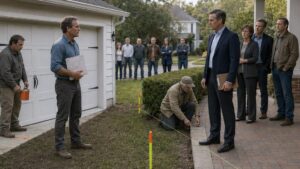
Richard arrived before Cynthia could finish placing temporary stakes around the surviving grass.
His SUV stopped beside the landscaping truck, followed by Heather Lee’s smaller sedan. The HOA property manager came with them, along with another board member and the contractor Cynthia had already asked to pause.
Richard stepped onto the sand carrying a binder.
He looked at the cleared strip, then at Cynthia’s improvised rope barrier.
“You can’t obstruct authorized association work.”
Cynthia pushed the last stake into the ground.
“I can keep people from disturbing the site while we’re discussing what they already disturbed.”
Richard glanced toward the ocean.
The morning clouds had thinned, leaving a clean horizontal line of water beyond the houses.
“The lot looks considerably better.”
Cynthia straightened.
“Better.”
“Consistent.”
“With what?”
“With the neighborhood.”
Heather had been studying the ground.
She wore waterproof boots that were already collecting sand around the soles. “Is this where the grass was highest?”
“No,” Cynthia said. “Highest density.”
Richard opened his binder.
“That distinction may matter to you professionally, but the covenant doesn’t require the association to accept unmanaged native planting simply because a homeowner prefers it.”
Cynthia nearly answered too quickly.
She could hear the contempt ready in her own voice.
She swallowed it.
“Do you have ten minutes?”
Richard looked at his watch.
“For what?”
“For me to show you what you removed.”
“We know what we removed.”
“No. You know what it looked like.”
Heather glanced at Richard. “Ten minutes won’t hurt.”
The contractor said nothing, but his expression suggested he agreed.
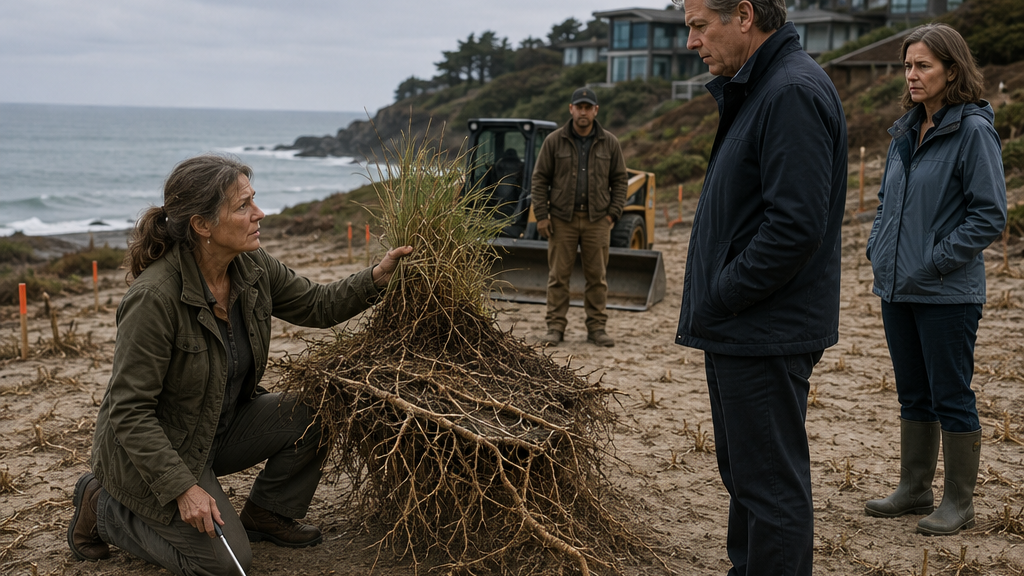
Cynthia walked to the southern corner where one narrow patch of beach grass remained untouched. It was barely four feet across.
She picked up a stainless-steel soil probe from beside her field bag.
Richard sighed softly.
“Cynthia, this isn’t a classroom.”
“No.”
She pushed the probe vertically into the sand.
“This is your drainage edge.”
That got Heather’s attention.
Cynthia worked the probe loose, then knelt and cleared sand from one plant with a hand trowel.
Aboveground, the grass had seven narrow blades.
Richard folded his arms.
Cynthia dug carefully around it until a pale underground runner appeared. She followed it sideways. It continued beneath the sand, crossed beneath another clump, then branched again.
She slid both hands under the loosened section and lifted.
The plant came up with a woven mass of roots and rhizomes wider than her shoulders.
Sand hung inside it.
For a moment nobody spoke.
The contractor stepped closer.
“All that came from that?”
“From that visible clump and the connected growth around it.”
Cynthia held the root mat low enough for them to see the interlocking fibers.
“The blades slow wind near the surface. They trap moving sand. The roots and rhizomes bind the upper layer. Not like concrete. Not like a retaining wall. But enough to change how water and sand move through a small coastal slope.”
Richard looked unimpressed, but he was looking.
Cynthia lowered the roots.
“You removed most of that network yesterday.”
Heather crouched.
She pinched a handful of the newly cleared sand and let it fall through her fingers.
“It’s much looser here.”
“It was always sand,” Richard said.
“Yes,” Cynthia replied. “The question is whether it stays where it is.”
She pointed toward a shallow groove beginning near one orange stake.
It was perhaps an inch deep.
Barely noticeable unless someone knew where to look.
Heather moved closer. “Was that there yesterday?”
“No.”
Richard said, “A boot could have made that.”
“Possibly.”
Cynthia appreciated that he had given her the answer himself.
“That’s why I’m not telling you the hill is collapsing. I’m telling you to stop changing the site until we know what we’ve changed.”
The contractor looked toward Richard.
“I’m not cutting any more today.”
Richard’s head turned.
“You have a contract.”
“I also have Cynthia telling me this may involve shoreline stabilization. Nobody put that in the scope.”
“You’re not responsible for interpreting regulations.”
“No. But I’m responsible for not ignoring someone when they tell me my crew might be damaging something outside the scope.”
Richard closed his binder.
Cynthia saw the irritation in his face, but also something more careful.
The first small reversal had occurred.
Not victory.
Only doubt.
Heather stood.
“How formal is this project?”
Cynthia hesitated.
That question was more dangerous than Richard’s arguments.
“Formal enough that I coordinated the planting with the county shoreline office.”
“Permit?”
“Site authorization and restoration conditions.”
Richard’s expression sharpened.
“So this isn’t just something you decided to plant?”
“No.”
Heather looked at the root mat again.
Richard asked, “Do you have copies?”
“Yes.”
“Then why weren’t they in your HOA file?”
Cynthia felt the change immediately.
Until that moment, the damaged ground had belonged to her argument.
Now the paperwork belonged to his.
“I sent the board a description when I started.”
“A description isn’t an application.”
“The work stayed within the existing native vegetation footprint.”
Richard opened the binder again and removed a printed page.
“I’d like everyone to look at section eight.”
Cynthia did not take it.
She already knew the section.
Exterior alterations affecting visible landscaping required architectural review.
At the time she began the project, she had considered the language absurdly broad. The grass was native. There was no construction, irrigation, retaining wall, fence, or hardscape. She had been restoring an already vegetated part of her own lot.
She had assumed county review mattered more than an HOA landscaping committee.
That assumption suddenly looked less comfortable.
Richard held the page toward her.
“You’ve spent two days telling us we acted before understanding your rules. Did you follow ours?”
Cynthia looked toward the stripped sand.
“The association’s rules don’t authorize unnecessary damage.”
“I didn’t ask that.”
“No.”
“Did you submit an architectural landscaping application for this project?”
Heather was watching her now.
So was the contractor.
Cynthia could have answered with the county correspondence. She could have explained that her work was restorative, not ornamental. She could have argued definitions for twenty minutes.
But none of those answers changed the thing Richard had asked.
“I don’t remember whether I completed the association form.”
Richard almost smiled.
“That’s different from what you’ve been implying.”
“I haven’t implied anything about an application.”
“You’ve implied that the association had no authority here.”
“I said you didn’t understand what you were removing.”
“And perhaps you didn’t bother telling us through the process every other owner has to use.”
The words landed harder because there was truth inside them.
Cynthia had sat through enough HOA meetings to know why she avoided them. People debated fence stains for forty minutes. They complained about recycling bins. They treated landscape height as a moral issue.
She had not wanted to put eighteen months of field work in front of a committee that might judge it from photographs.
So she had sent a brief project description.
And then she had gone ahead.
Heather broke the silence.
“We need both files.”
Richard nodded. “Agreed.”
Cynthia looked at him.
That sudden reasonableness bothered her more than his earlier certainty.
Richard placed the covenant page back in the binder.
“No more work today. But this isn’t settled because you showed us roots.”
“No,” Cynthia said.
“It isn’t.”
He turned to the contractor.
“Secure the equipment.”
Then he looked back at Cynthia.
“Monday morning, bring the county documents. We’ll pull the architectural records.”
“I will.”
Richard took two steps toward his SUV, then stopped.
“One more thing.”
Cynthia waited.
He faced her across the bare strip.
“Where is your approved landscaping application?”
She had no answer that would fit inside the silence he left behind.
Chapter 3: Her Permit Was Real but Her Paperwork Wasn’t Complete
The unfinished application was exactly where Cynthia had left it eighteen months earlier.
Not lost.
Not misplaced.
Not even buried in a forgotten folder.
It sat in a directory on her laptop labeled HOA, beneath a filename that read LANDSCAPE_REVIEW_DRAFT.
Cynthia opened it at 6:12 Monday morning.
Her name was there.
Her address was there.
She had filled in the project description: native beach-grass restoration within existing coastal vegetation zone.
She had attached a rough planting diagram.
Then she had stopped at a box asking whether neighboring view corridors could be affected.
The answer field was blank.
Cynthia leaned back from the screen.
She remembered the afternoon.
The form had irritated her.
The county shoreline planner had already reviewed the planting density and setback. Cynthia had been spending evenings preparing specimens and mornings on site. She had looked at the HOA application, thought of Richard and two committee members debating whether ornamental grasses could exceed thirty inches, and decided she would finish it later.
Instead, she had emailed the property manager a short project summary with the county correspondence attached.
No one had replied.
She took silence as acceptance.
That had been convenient.
It had not been the same thing as approval.
Cynthia printed the application.
She placed it on the desk beside the root sample she had pressed between two pieces of blotting paper. Even dry, the network looked stubbornly complicated—thin pale threads crossing and recrossing in ways the visible plant never advertised.
At nine, she met the property manager in the HOA records room.
Richard was not there.
Cynthia was relieved until she realized that meant she could not use his personality as an excuse to dismiss what the file showed.
The manager placed a thin folder on the table.
“This is everything under your lot for the last two years.”
Cynthia opened it.
Annual inspection.
Exterior paint note.
Fence repair approval.
Her restoration email.
No architectural application.
“No committee response?”
The manager shook her head.
“It looks like it was saved as correspondence.”
“I attached the county conditions.”
“Yes.”
“Did anyone review them?”
“I can’t tell you that.”
“Can you tell me who received the email?”
“The board distribution address and me.”
Cynthia stared at the printout of her own message.
It was concise to the point of arrogance.
Native vegetation restoration commencing this month. County shoreline correspondence attached for association file.
She had not asked permission.
She had announced.
The difference mattered.
“Richard was right about this part,” she said.
The manager looked surprised.
Cynthia closed the folder.
“Not about removing it. About my application.”
She spent the next hour comparing the association records with her county documents.
The county material was solid. The restoration had been reviewed as low-impact native stabilization. The planting density and species were appropriate. There were conditions about avoiding mechanical disturbance near the dune edge and maintaining drainage patterns.
But nothing in the county letter said private association procedures vanished.
Cynthia knew enough about regulatory systems to dislike anyone who pretended one approval answered every question.
Apparently that included herself.
At home, she opened her email archive and searched Richard’s name.
There were dozens of messages.
Meeting notices. Landscaping reminders. A complaint about bins.
Then she found one from the week before the removal.
From Richard to the property manager, copied to the landscaping committee.
Please obtain confirmation from county regarding whether Mitchell’s vegetation requires special treatment before corrective work proceeds.
Cynthia stopped.
The email was dated Wednesday.
That was one day after her objection.
She read it again.
Richard had asked for confirmation.
For a moment, the story she had built about him shifted.
Maybe he had not simply ignored her.
Then she opened the next message in the thread.
Friday morning.
The property manager had written:
County contact unavailable until Monday. Recommend postponing contractor release pending clarification.
Richard replied eleven minutes later.
Proceed under existing violation authorization. We have received no evidence that association maintenance authority is suspended.
Cynthia read that line twice.
There it was.
Not ignorance.
A choice.
He had asked the question, failed to get the answer in time, and proceeded anyway.
Her phone rang.
Heather.
“I wanted to check whether you found the application.”
“I found it.”
“And?”
“I never finished it.”
Heather was quiet.
“That’s not ideal.”
“No.”
“I appreciate you saying it.”
“Don’t sound so surprised.”
“I didn’t mean—”
“You did.”
Heather exhaled. “Fair.”
Cynthia looked again at Richard’s email.
“I found something else.”
“What?”
“Richard asked management to confirm county restrictions before the removal.”
“That sounds responsible.”
“He didn’t wait for the answer.”
The silence on the line changed.
“He released the contractor after management recommended postponement.”
Heather spoke more slowly.
“Send me that.”
“I will.”
“So what does that mean?”
“It means my paperwork problem is real.”
“And his?”
“Also real.”
Heather made a small sound that might have been frustration.
“Everyone was hoping one of you would be completely wrong.”
“That would be easier.”
Cynthia forwarded the email chain.
An hour later, the weather alert appeared on her phone.
A strong Pacific system was expected overnight Tuesday into Wednesday: heavy rainfall, sustained coastal wind, higher gusts along exposed headlands.
Cynthia opened the local rainfall forecast.
She looked through the window toward the cleared strip.
Bare sand did not automatically mean disaster. She refused to make that mistake. Coastal systems were more complicated than one planting and one storm.
But she knew exactly what she would have preferred to see before two inches of rain.
Roots.
She went outside with a level, measuring rod, and notebook.
Along the northern half of the cleared area, the surface remained nearly unchanged.
At the southern end, the shallow groove she had shown the board on Saturday had widened.
Only slightly.
She marked both sides with two temporary orange stakes.
The color irritated her now.
She measured the depression.
One and three-quarter inches.
She photographed it.
By late afternoon the wind had begun to rise.
Richard appeared at the edge of her lot without calling first.
“I received Heather’s message.”
Cynthia kept writing.
“About your email?”
“Yes.”
“You knew management recommended waiting.”
“I knew they couldn’t get an answer before Monday.”
“So you decided absence of an answer meant permission.”
“I decided an existing violation order remained valid.”
“That isn’t the same thing.”
“No. It isn’t.”
His willingness to admit that made her look up.
Richard had his hands in his jacket pockets.
“Are you planning legal action?”
“I haven’t decided.”
“Against the association?”
“I haven’t decided that either.”
He glanced at the stakes.
“What are those?”
“Monitoring points.”
“For what?”
“Surface runoff.”
He looked uphill, then back at her.
“Are you expecting a problem?”
“I’m expecting rain.”
“That’s not what I asked.”
“No,” Cynthia said. “I’m not predicting a landslide, if that’s what you’re worried about.”
His shoulders loosened almost invisibly.
“But?”
“But you’ve removed vegetation from a drainage-sensitive coastal slope before a major storm. I’m going to measure what happens.”
Richard looked toward the ocean.
“People are already nervous enough.”
“About what?”
He did not answer.
Instead he said, “Let me know if anything changes.”
Cynthia watched him walk back toward the road.
People are already nervous enough.
It was an odd thing to say about a landscaping dispute.
She wrote it in the margin of her field notebook.
By dusk, the first rain had begun.
At eight thirty Cynthia checked the southern stake. Water darkened the sand but had not pooled.
At ten fifteen she checked again.
A thin sheet was moving across the cleared surface.
She measured the groove at just over two inches.
At eleven forty, rain rattled hard against the cottage windows.
Cynthia stepped onto the porch in waterproof pants and a headlamp.
For a moment she saw nothing except rain.
Then her light caught the orange stakes.
Water had collected between them.
Not a puddle.
A moving line.
It entered the bare strip from uphill, spread for several feet, then narrowed exactly where the roots had been cut away.
Cynthia stepped down from the porch.
The water was already carrying sand with it.
She followed the flow toward the darker edge of the property and stopped.
There was more water arriving than her surface measurements could explain.
Somewhere uphill, something else was feeding it.
Chapter 4: The Storm Found the Weakness Before the Board Did
At two seventeen in the morning, Cynthia woke to the sound of water striking the side of the cottage where water had never struck before.
She sat up immediately.
The rain was still hammering the roof, but beneath it she could hear another sound—a low, continuous hiss.
Moving sand.
Cynthia pulled on boots and a rain jacket and stepped outside with her headlamp.
The orange stakes were still visible.
The ground between them was not.
A stream no more than eight inches wide had formed across the newly cleared strip. Brown water came down from the uphill side of the development, spread briefly over Cynthia’s property, then tightened into a shallow channel aimed toward the bluff.
She crouched beside it.
Sand moved through the water like smoke.
“Damn.”
Not because the channel was large.
Because it was organized.
Water that had once dispersed through vegetation was now choosing a path.
Cynthia took photographs, then measured the channel as best she could in the dark.
Three inches deep near the first stake.
Almost four near the second.
She followed it downhill.
At the edge of the cleared area, the flow curved unexpectedly around the surviving patch of beach grass.
There, the water slowed.
Roots held the surface together while the bare section beside it continued to peel away grain by grain.
For one bitter second, Cynthia wanted Richard standing beside her.
She wanted him to see exactly what she had warned about.
Then the channel widened again.
Vindication disappeared.
She called the county shoreline office’s emergency number.
The planner who answered sounded half awake until Cynthia described the flow.
“Any structural movement?”
“Not that I can see.”
“Foundation exposure?”
“No.”
“Active slumping?”
“No.”
“Then don’t go near the bluff edge. Photograph from stable ground. If runoff is concentrating, we need to know why.”
“I think vegetation removal changed surface flow.”
“You think?”
Cynthia hated the question because it was the correct one.
“I know it changed the surface. I don’t know if that’s the whole cause.”
“Good. Keep those separate.”
The line went quiet for a moment.
“Is there any drainage infrastructure uphill?”
Cynthia looked into the dark.
“Possibly.”
That word stayed with her after the call ended.
Possibly.
At dawn the rain weakened enough for her to see the full path.
The channel had crossed the cleared strip, then cut diagonally toward a depression she had always assumed was natural.
Now something dark showed beneath the washed sand.
Cynthia knelt several feet away and brushed loose material aside with the handle of her probe.
A straight edge appeared.
Not rock.
Concrete.
She stopped.
A second sweep exposed a narrow seam.
Drainage structure.
Her stomach tightened.
She went inside and found the property plat she had received when she bought the cottage.
The original drawing showed her lot, setback lines, utility corridors, and an easement along the eastern boundary.
She had noticed it years ago.
She had never paid much attention because most of it lay uphill from the restoration area.
DRAINAGE AND UTILITY EASEMENT.
Cynthia returned outside.
By then, Richard was coming down the road in a waterproof jacket.
He did not greet her.
“What happened?”
“Runoff concentrated across the cleared strip.”
He looked at the channel.
“That could happen in any storm.”
“Yes.”
“You said the grass prevented it.”
“I said the grass changed how water moved.”
“You’re splitting hairs.”
“No. I’m being accurate.”
Richard stared at the exposed concrete.
“What is that?”
“I think it’s part of the drainage system.”
His face changed.
Only slightly.
But Cynthia saw it.
“You think?”
“I haven’t confirmed it.”
He stepped closer.
“Can you?”
“Not by digging around during an active event.”
Richard looked uphill.
More houses stood beyond his, each perched behind landscaped retaining beds and paved drives.
“There’s a catch basin near the corner,” he said.
“Where does it discharge?”
“I don’t know.”
Cynthia looked at him.
“You’re the board president.”
“That doesn’t make me the stormwater engineer.”
“No.”
Richard heard the edge in her voice.
“Don’t do that.”
“Do what?”
“Act as though every problem in this subdivision proves you were right about everything.”
Cynthia stood.
Rain slid from the brim of her hood.
“I didn’t put that drain here.”
“And we didn’t invent the storm.”
“No. But you removed most of what was stabilizing the surface beside it.”
“You still don’t know that caused this.”
He pointed toward the channel.
“If you’re about to tell the county that the association endangered the bluff because of landscaping, you should be certain.”
Cynthia felt anger rise.
Not because he was wrong to demand certainty.
Because he wanted certainty only now.
“You were willing to proceed without certainty when the uncertainty belonged to me.”
Richard looked away.
The county planner arrived shortly after eight.
She walked the site slowly, staying uphill from the damaged edge.
Cynthia showed her the previous photographs, measurements, planting plan, and overnight channel.
The planner crouched near the surviving vegetation.
“This section barely moved.”
“No.”
“And adjacent bare surface lost several inches.”
“Yes.”
“That doesn’t prove the planting was the only control.”
“I know.”
The planner looked up.
“Good.”
Richard stood several yards away with his arms folded.
The planner followed the exposed concrete line.
“Who maintains this?”
Richard said, “Association, I believe.”
“You believe?”
“I’ll pull the records.”
She turned to Cynthia.
“Was your restoration designed around the drainage easement?”
Cynthia hesitated.
“I accounted for surface runoff.”
“That wasn’t my question.”
“No.”
It was another uncomfortable answer.
The county authorization had focused on vegetation and dune stabilization. Cynthia had mapped visible drainage patterns, but she had not traced every component of the older HOA infrastructure.
The planner nodded.
“Then nobody gets to pretend we know the entire system yet.”
Richard exhaled as though that helped him.
It did not.
“Temporary stabilization first,” the planner continued. “No additional clearing. No excavation except what we approve. Cover the bare section, slow the runoff, keep people away from the bluff margin.”
“Who pays?” Richard asked.
She looked at him.
“That’s not today’s question.”
By noon, sandbags and erosion-control fabric had been delivered.
Cynthia helped position them under the planner’s direction.
Richard stayed.
That surprised her.
He carried bags, moved stakes, and said very little.
At one point he paused beside the surviving grass.
Water still split around it.
“You showed us those roots Saturday.”
“Yes.”
“I thought you were making a point.”
“I was.”
“I mean a point about yourself.”
Cynthia looked at him.
“What did you think I was saying?”
“That you’re the expert and everyone else is an idiot.”
The answer stung because she recognized part of herself in it.
She returned to the sandbags.
“Maybe I was saying some of that too.”
Richard stared at her, apparently not expecting the admission.
Before he could answer, the planner called them over.
She had found a faded marker on the exposed concrete.
A number.
Cynthia wiped rainwater from it.
Richard pulled the easement map from the folder he had brought.
They matched.
The planner traced the line uphill with one finger.
“This isn’t just your lot.”
“How far does it run?” Cynthia asked.
The planner pointed toward the houses above them.
“Until we verify the drawings, I can’t tell you exactly.”
Then she looked at Richard.
“But if this map is current, multiple properties are feeding into this corridor.”
Richard’s face went still.
The damaged strip beside Cynthia’s cottage was no longer a private landscaping dispute.
It was where the neighborhood’s water had been going all along.
Chapter 5: The Easement Made Everyone’s Problem Larger Than Cynthia’s Yard
Michael Roberts placed the drainage map on the clubhouse table and drew six arrows toward Cynthia’s property.
No one spoke.
The arrows began at six separate lots uphill, crossed paved drives and landscaped common ground, converged into a collection line, then followed the easement beside Cynthia’s cottage.
Heather Lee leaned closer.
“All six?”
“Based on the record drawings,” Michael said. “Possibly more surface contribution during major events. I’m still verifying modifications.”
Richard sat at the end of the table.
“So the drain worked.”
“Mostly.”
“Before Cynthia’s vegetation was installed?”
“Apparently.”
“And during the storm?”
Michael looked at him.
“You’re asking a yes-or-no question about a system that isn’t behaving yes-or-no.”
Cynthia almost smiled.
Michael had spent the morning measuring grades, checking inlets, examining the exposed structure, and asking questions that irritated everyone equally.
She trusted that more than immediate agreement.
Michael pointed to the cleared strip.
“The stormwater infrastructure carried part of the flow. The problem is what happened when water exceeded or bypassed that controlled route. Vegetation and surface roughness mattered.”
Richard said, “How much?”
“I don’t know yet.”
“Then we don’t know removal caused the erosion.”
“No.”
Richard leaned back.
Cynthia watched relief travel through two neighboring homeowners seated against the wall.
Then Michael continued.
“But we do know the cleared area eroded significantly more than the surviving planted section under the same storm.”
The relief vanished.
Heather folded her arms.
“What does fixing this cost?”
“That depends on what you mean by fixing.”
“Make it safe.”
“Temporary stabilization is already in place. Long-term, we need the drainage inspected, the surface restored, and the runoff path corrected where necessary.”
Heather opened a spreadsheet.
“How much?”
Michael gave a preliminary range.
The lower number made one homeowner shift in his chair.
The upper number made Heather stop typing.
Richard said, “That’s excessive for a landscaping problem.”
Michael looked at him.
“This isn’t a landscaping estimate.”
Cynthia felt the phrase settle across the table.
That was the small victory she had wanted from the beginning.
It gave her less satisfaction than expected.
Heather asked, “Which reserve covers it?”
The property manager answered quietly.
“Drainage maintenance.”
Heather turned a few pages in her binder.
“How much is in that reserve?”
The manager gave the figure.
Heather stared at her.
“That can’t be right.”
“It is.”
“We’ve collected for drainage every year.”
“We’ve also spent from that category.”
“On what?”
The manager listed catch-basin cleaning, a culvert repair, emergency pumping two winters earlier, and an assessment the board had deferred funding fully.
Heather’s expression hardened.
“We are underfunded.”
Richard said, “We are not underfunded. We prioritized based on actual needs.”
“If Michael’s upper estimate is even close, we don’t have enough.”
“We don’t have his final estimate.”
Cynthia listened to them argue and realized the conflict had changed shape again.
Saturday, it had been her property against HOA authority.
Now it was six drainage connections, an inadequate reserve, a damaged surface, and a board that did not know how much responsibility belonged to whom.
Richard turned toward Cynthia.
“Your restoration altered the site too.”
“Yes.”
“If drainage conditions are part of the problem, then your project may have changed them.”
“Possibly.”
He seemed surprised by the answer.
Cynthia had spent two days forcing herself not to overclaim.
It was unpleasant.
It was also useful.
Michael tapped the map.
“The vegetation likely reduced surface erosion. But Cynthia’s project wasn’t designed as a drainage retrofit. Those are different things.”
“So responsibility is shared?” Heather asked.
Michael shrugged.
“Engineering isn’t a liability opinion.”
One of the homeowners spoke from the wall.
“If the HOA didn’t maintain the drain, why should Cynthia pay anything?”
Richard turned.
“Because she changed a common visual area without approval.”
“That isn’t what caused the storm.”
“No one said it did.”
The room began to fracture into competing versions of the same problem.
Cynthia saw exactly where it could go.
Everyone could spend months proving someone else was more wrong.
She looked at the map again.
The orange survey stakes drawn around her lot had once marked the boundary of an alleged aesthetic violation.
Now similar stakes outside marked runoff limits, safe access, and the edge of temporary stabilization.
Same objects.
Different meaning.
Heather closed her spreadsheet.
“I need one answer before we talk about blame. Can the association charge Cynthia for the corrective work?”
The mediation attorney, attending by video, answered.
“Not automatically. Especially not work tied to common drainage infrastructure.”
Richard’s jaw tightened.
“What about restoration of her landscaping?”
“Separate issue.”
Cynthia said, “You mean replacement.”
The attorney nodded.
“If the board authorized removal improperly or prematurely, reimbursement may be appropriate.”
Richard looked toward her.
Neither of them spoke.
It was the first concrete sign that the association might not be able to push the entire expense onto Cynthia.
She should have felt vindicated.
Instead she looked at the six arrows.
Six households.
Six sets of mortgages, insurance bills, retirement plans, sale expectations.
The issue was spreading faster than her anger could comfortably hold.
Michael turned to the next page.
“There is another consideration.”
Heather sighed.
“Of course there is.”
“Formal documentation of erosion exposure may trigger questions from insurers, lenders, or buyers depending on how severe the final findings are.”
The room went silent again.
One homeowner said, “My house is under contract.”
Richard turned sharply toward Michael.
“Are you saying this report will affect sales?”
“I’m saying I won’t speculate about real-estate consequences. But if you ask whether a documented drainage and erosion issue can generate questions, yes.”
The homeowner’s face had gone pale.
“My buyer’s inspection is Thursday.”
Heather rubbed her forehead.
Cynthia suddenly understood Richard’s strange comment during the storm.
People are already nervous enough.
This had been larger than landscaping even before the storm.
Not physically.
Financially.
By late afternoon, most people had left.
Michael packed his equipment and promised a more complete report within forty-eight hours.
Heather remained behind with the property manager, searching reserve records.
Cynthia walked outside.
The drainage corridor was visible down the hill between houses.
Orange stakes marked temporary limits.
Richard followed her.
For several seconds he said nothing.
Then, quietly, “Does the county need Michael’s full report?”
Cynthia turned.
“What?”
“You heard me.”
“Yes.”
He looked back toward the clubhouse windows.
“If his final report includes every possible risk before we know which ones are real, that language becomes discoverable. Sellers disclose it. Insurers ask for it. Buyers panic.”
“So you want him to soften it?”
“I want accuracy.”
“That’s not what you asked.”
Richard’s eyes returned to hers.
Cynthia waited.
He lowered his voice.
“I’m asking whether every preliminary concern needs to become part of the county file.”
There it was.
Not quite concealment.
Not quite caution.
Something uncomfortable between them.
Cynthia looked downhill toward the place where the grass had been removed.
For the first time, she could not tell whether Richard was trying to protect himself or everyone else.
Chapter 6: Richard Finally Explained What He Was Trying to Protect
“I knew about your request to delay the work.”
Richard said it before Cynthia had fully closed the clubhouse door.
The building was empty now.
Heather had left twenty minutes earlier. The property manager had taken the reserve files home. Outside, the parking lot was wet but quiet.
Cynthia remained standing.
“I know.”
Richard looked at the orange survey stake in his hand.
He must have picked it up from the table with Michael’s maps. He turned it slowly between his fingers.
“I saw your email Tuesday.”
“And released the contractor Friday.”
“Yes.”
“After management advised waiting.”
“Yes.”
Cynthia had imagined this admission several times.
In every version, it felt satisfying.
It did not feel satisfying now.
“Why?”
Richard set the stake against the table, then picked it up again.
“Because three owners had already complained about your lot. One had a buyer asking why the association allowed unmanaged vegetation in a protected view corridor. Another had an insurance renewal coming up. And the board had been getting pressure for months to show that we were enforcing the covenants consistently.”
“That explains why you wanted the grass cut.”
“It explains why waiting didn’t feel neutral.”
Cynthia said nothing.
Richard continued.
“You know what houses here cost.”
“That isn’t the same as knowing what people can afford.”
“No.”
His voice had changed.
Less defensive.
More tired.
“One couple bought at the top of the market. Their insurance nearly doubled. Another owner is trying to refinance after a divorce. The house under contract today belongs to people who need the sale to close because they’re already carrying another mortgage.”
Cynthia folded her arms.
“And acknowledging erosion threatens all of that.”
“Yes.”
“So you decided the better answer was not to look too closely.”
Richard’s face tightened.
“I decided a landscaping violation shouldn’t become an environmental declaration unless someone could prove it was one.”
“And I asked you to wait long enough to find out.”
“I know.”
The words were quiet.
That made them harder to dismiss.
Cynthia sat across from him.
The anger remained.
But it no longer had a clean target.
Richard placed the orange stake flat on the table.
“When people bought here, the pitch was stability. Managed community. Protected views. Predictable standards. Then insurance markets tightened. Storm maps changed. Buyers started asking different questions.”
“And your answer was to make everything look controlled.”
“Yes.”
“At least that’s honest.”
“I’m not proud of it.”
Cynthia studied him.
“You still authorized the work.”
“I did.”
“You still chose appearance over information.”
“I did.”
“And if the storm hadn’t happened?”
Richard looked toward the dark windows.
“I probably would have believed we solved the problem.”
There it was.
Not a hidden villain.
A hidden fear.
It did not absolve him.
But it explained why he had needed Cynthia’s grass to be weeds.
Weeds were manageable.
A vulnerable shoreline was not.
Richard pushed a folder toward her.
Inside was a proposed reimbursement amount for the destroyed planting, her field materials, and part of her professional time.
Cynthia looked up.
“What is this?”
“If you accept reimbursement, the board can authorize replanting under an expedited review.”
“And Michael’s report?”
“We submit a limited stabilization summary unless he finds an immediate structural hazard.”
Cynthia closed the folder.
“You’re trying to settle this privately.”
“I’m trying to keep a manageable problem manageable.”
“By deciding in advance which facts count.”
“By not turning preliminary concerns into permanent labels.”
Cynthia remembered another shoreline site years earlier.
Administrators had delayed intervention because every warning was technically preliminary. By the time the language became certain enough for everyone, the repair had become far more expensive.
She had promised herself she would never stay quiet around that kind of delay again.
But she also remembered her unfinished HOA application.
Her own belief that she did not need to explain herself had helped create this mess.
“We’re both very good at deciding which process matters when it suits us,” she said.
Richard gave her a tired look.
“Maybe.”
Cynthia pushed the folder back.
“I won’t take this.”
His jaw hardened again.
“You want more money?”
“No.”
“Then what?”
“I don’t know yet.”
“That isn’t helpful.”
“No. But it’s honest.”
She stood.
Richard picked up the orange stake again.
“What are you going to tell the county?”
“The truth.”
“That could cost people.”
“So could hiding it.”
“I didn’t say hide it.”
“You asked whether they need the full report.”
He looked down at the stake.
Cynthia softened her voice without softening the point.
“I understand what you’re afraid of now.”
Richard glanced up.
“That doesn’t mean I’m agreeing with you.”
“I didn’t expect you to.”
“But you’re right about one thing.”
He waited.
“Not everyone who gets hurt by this made the decision you made.”
Something in his face eased.
Cynthia continued.
“I don’t want six households paying for a war between you and me.”
“Then help me narrow it.”
“No.”
The ease vanished.
“But I may be able to give the board something better than narrowing it.”
Richard frowned.
“What?”
“A repair plan that separates what we know from what we don’t, restores the surface quickly, inspects the drainage properly, and doesn’t pretend the only choices are panic or concealment.”
“You have that?”
“Not yet.”
“When?”
Cynthia looked at the clock.
The special board meeting was three days away.
“By then.”
Richard leaned back.
“And what do you want in return?”
There was suspicion in the question.
Cynthia understood why.
A week earlier, she might have wanted the board embarrassed. Richard removed. Every dollar recoverable paid back.
Now she pictured the six arrows on Michael’s map.
“I want what was broken fixed.”
“That can’t be all.”
“No.”
She picked up the reimbursement folder and slid it back across the table one final time.
“I also want rules that make it harder for anyone—including me—to skip the part where we have to explain what we’re doing.”
Richard stared at her.
Cynthia opened the door.
Cold air entered the clubhouse.
Behind her, Richard said, “You really think the board will vote to restrict its own authority?”
Cynthia looked back.
“No.”
Then she stepped outside.
“But I’m going to make them choose in public.”
Chapter 7: She Could Punish the Board or Make Them Fix What Broke
Cynthia walked into the special board meeting carrying two folders and no demand letter.
Richard noticed.
His eyes went first to the folders, then to her empty hands.
Heather had already arranged Michael’s drainage map across the center of the table. Six arrows still converged toward Cynthia’s property, but someone had added colored markings showing the temporary stabilization work completed after the storm.
Beside the map, Cynthia placed the pressed root sample from the surviving beach grass.
It looked almost embarrassingly small.
A brittle brown crown. Pale rhizomes. Fine roots woven together around grains of sand.
Richard stared at it.
“You brought that again.”
“Yes.”
“I remember what it is.”
“Good.”
The meeting began without ceremony.
The mediation attorney appeared on a monitor at one end of the room. The property manager sat beside Heather with the reserve records open. Michael had joined in person, though he had made it clear that his role was limited to engineering questions.
Two neighboring homeowners occupied chairs against the wall.
One of them owned the house under contract.
Cynthia could feel his attention on every page she touched.
Heather opened the meeting.
“We have three immediate issues. Restoration of Cynthia’s lot, drainage inspection and stabilization, and responsibility for costs.”
Richard added, “And legal exposure.”
Heather looked at him.
“Yes.”
Cynthia waited until they turned toward her.
“I have two proposals.”
Richard leaned forward.
“Two?”
“The first one treats this mainly as a dispute.”
She opened the thinner folder.
“The association reimburses my documented planting losses and professional time. We preserve everyone’s legal claims regarding the drainage work. Michael completes his report. Attorneys determine responsibility. We negotiate the rest separately.”
The attorney nodded slowly.
“Conventional.”
“It protects positions.”
Richard asked, “And the second?”
Cynthia opened the larger folder.
“The second fixes the site.”
Silence.
She passed copies around.
Richard began reading immediately.
Heather did not. “Explain.”
Cynthia pointed to Michael’s drainage map.
“The bare surface is the immediate vulnerability. We already know the surviving vegetation reduced erosion during the storm. We know the common drainage line requires inspection. We also know we don’t have evidence of structural bluff failure.”
Michael nodded.
“Correct.”
“So instead of waiting months to assign every percentage of blame, we restore the surface now.”
Richard looked up.
“With what?”
“The original planting design, adjusted around the drainage corridor.”
“You’d put the grass back.”
“Yes.”
“All of it?”
“Where Michael and the county agree it won’t interfere with inspection access.”
Michael leaned over the plan.
Cynthia continued.
“The HOA funds drainage inspection and the portion of stabilization tied to common infrastructure. It reimburses the vegetation the association removed. I absorb part of my own design time because I failed to complete the HOA application.”
Heather looked at her sharply.
“You’re volunteering that?”
“I made a procedural mistake.”
Richard said nothing.
Cynthia looked directly at him.
“That doesn’t erase yours.”
“No.”
“But I don’t need yours to erase mine either.”
One of the homeowners against the wall shifted.
The tension in the room changed.
The meeting was no longer arranged around discovering which person could be declared completely innocent.
Cynthia turned to the final pages.
“The landscaping rules also change.”
Richard stopped reading.
“There it is.”
“Yes.”
“What exactly are you asking for?”
“No mechanical removal of established vegetation inside mapped shoreline and drainage-sensitive areas until environmental and infrastructure conditions are checked.”
“By whom?”
“A qualified reviewer when the situation requires one. Not automatically me.”
Richard gave a short laugh without humor.
“You’re asking the board to give up enforcement authority.”
“No. I’m asking the board to stop treating every landscaping issue as though appearance is the only thing on the ground.”
Heather was reading now.
“What about homeowners? Cynthia didn’t file correctly either.”
“Same rule.”
Cynthia tapped the page.
“Any owner changing vegetation in those mapped areas has to submit enough information for the board to understand the function, not just the appearance.”
Richard looked at her.
“So this would have stopped you too.”
“Yes.”
That quieted him.
Michael turned the restoration plan sideways.
“This is technically reasonable as a preliminary approach.”
Richard’s attention snapped toward him.
“Preliminary?”
“It still depends on inspection results. But the cost is materially lower than rebuilding the entire drainage corridor or installing hard stabilization you may not need.”
Heather asked for the number.
Michael gave it.
The room changed again.
It was not cheap.
But it was far below the figure that had frightened everyone at the previous meeting.
The homeowner with the pending sale let out a breath.
Richard noticed.
Cynthia did too.
Heather turned several pages.
“If we approve this, we can use the drainage reserve for the infrastructure portion?”
The attorney answered.
“Subject to the governing documents, likely yes.”
“And Cynthia’s vegetation reimbursement?”
“Operating funds or insurance, depending on coverage.”
Richard said, “Insurance means reporting the claim.”
Heather looked at him.
“We are past pretending nothing happened.”
His face tightened.
No one spoke for several seconds.
Then Heather closed the reserve binder.
“I support the second proposal.”
Richard looked at her.
“You haven’t even seen final liability allocation.”
“That’s why I support it. I’m tired of paying professionals to tell us whose fault it is while the ground sits under fabric.”
“You’re the treasurer.”
“Exactly.”
One of the neighboring homeowners spoke.
“If the repair costs less than the legal fight, why are we still arguing?”
Richard turned toward him.
“Because rules changed under pressure tend to become bad rules.”
Cynthia lifted the root sample.
“This rule didn’t change under pressure. Our understanding did.”
Richard looked at the roots.
Cynthia laid them beside Michael’s map.
The fine white network crossed the paper over one of the six drainage arrows.
A week earlier, the same roots had been dismissed as the hidden part of an ugly plant.
Now everyone at the table understood that the important part had been the part they could not see.
Richard rubbed his thumb along the edge of Cynthia’s proposal.
“If this passes, any future board president has less discretion.”
“Yes.”
“Including me.”
“Yes.”
“And you agree your own projects go through the same process.”
“Yes.”
“Even if you think the committee doesn’t understand them.”
Cynthia felt the point land where he intended.
She answered anyway.
“Especially then.”
Heather called for the vote.
The first board member voted yes.
Heather voted yes.
Another board member hesitated, then voted yes.
Richard was last.
He stared at the proposal long enough that Cynthia could hear the small hum from the video monitor.
Then he raised his hand.
“Yes.”
No one applauded.
The homeowner under contract closed his eyes briefly.
Heather began discussing implementation dates.
The property manager asked about contractor access.
Michael wrote something on the drainage map.
It felt strangely ordinary for a decision Cynthia had spent days preparing to force.
Richard remained seated after the formal meeting ended.
Cynthia gathered the root sample.
“Cynthia.”
She looked up.
He held the revised policy in one hand.
“The board still needs someone to coordinate shoreline reviews while we establish the outside consultant process.”
“You have Michael.”
“For engineering.”
“Then hire an ecologist.”
“We will.”
He paused.
“But Heather thinks there should also be a homeowner chair.”
Cynthia knew what was coming.
She disliked the answer before he asked.
Richard said, “Would you do it?”
She almost laughed.
“You want me on an HOA committee.”
“I want someone who knows the difference between a plant and what a plant is doing.”
“That sounds dangerously close to admitting I was useful.”
“Don’t make me withdraw the offer.”
For the first time in days, Cynthia smiled.
Then the smile faded.
Joining meant meetings.
Emails.
Neighbors asking questions she thought they should already know to ask.
It meant explaining before she was angry.
It meant becoming partly responsible for the institution she had found so easy to stand outside and criticize.
Richard waited.
Cynthia put the root sample back into its sleeve.
“I’ll think about it.”
He nodded.
She started toward the door.
Behind her, Richard said, “For what it’s worth, I should have waited for the county answer.”
Cynthia stopped.
She did not turn around.
“For what it’s worth,” she said, “I should have finished the application.”
Neither statement repaired anything.
But neither of them tried to take it back.
Chapter 8: The New Grass Looked Almost Exactly Like the Old Grass
Six months later, a new homeowner stood beside Cynthia’s restored coastal strip and pointed at the beach grass.
“So the HOA actually allows weeds here?”
Cynthia had a tray of new plugs balanced against one hip.
She opened her mouth.
Richard answered first.
“They’re not weeds.”
Cynthia looked at him.
Richard was holding the opposite end of a measuring line stretched between two permanent survey markers.
The new homeowner glanced from one of them to the other.
“They look like weeds.”
Richard shrugged.
“They looked like weeds to me too.”
Cynthia lowered the tray.
This was already better than anything she had planned to say.
Richard pointed toward the narrow strip of vegetation nearest the drainage corridor.
“They slow surface water and trap sand. Roots help stabilize the upper layer.”
The explanation was simplified.
Not wrong.
The new homeowner nodded toward Cynthia.
“You did this?”
“Some of it.”
“She’s being modest,” Richard said.
Cynthia gave him a look.
He corrected himself.
“She designed the restoration.”
“That sounds expensive.”
“It was cheaper the second time than removing it the first time.”
Richard’s expression tightened.
Cynthia almost apologized for the line.
Then she decided not to.
The new homeowner laughed lightly, unaware of most of what sat beneath the joke.
He continued up the path.
Cynthia watched him leave.
“You’ve been practicing,” she said.
Richard reeled in a little slack from the measuring line.
“I’ve had questions.”
“And you answer them?”
“Sometimes.”
“Voluntarily?”
“Don’t ruin the moment.”
The restored strip no longer looked fragile.
Young grass moved in the wind beside older surviving plants. The drainage line had been inspected, two sections repaired, and an inlet uphill modified to reduce overflow during heavy rain.
Michael’s final report had been less dramatic than almost everyone feared.
There was no finding of imminent bluff collapse.
There was no declaration that six homes were suddenly unsafe.
There was, however, a documented maintenance problem, a disturbed erosion-control surface, and a clear recommendation for monitoring and restoration.
Enough to require work.
Not enough to end anyone’s life as they knew it.
The house that had been under contract eventually sold.
Insurance questions came.
They were answered.
Some premiums still rose for reasons that had nothing to do with Cynthia’s grass.
Reality had refused to organize itself into winners and losers as neatly as the board once had.
Heather had created a separate reserve line for drainage inspections and published the numbers in each quarterly statement.
Richard had stopped calling native vegetation “unmaintained” unless he was quoting old records.
And Cynthia had accepted the committee chair position.
Reluctantly.
Her first meeting lasted fifty-eight minutes longer than necessary.
The second involved an argument about whether a homeowner’s ornamental hedge fell inside the mapped shoreline zone.
At the third, Cynthia caught herself using the phrase “the science is obvious.”
Heather had stared at her across the table.
Cynthia stopped.
Then she explained it.
That had been the harder change.
The revised rules required environmental review before mechanical vegetation removal in designated shoreline and drainage-sensitive areas. Homeowners also had to provide actual project information instead of assuming the board would understand their intentions.
Including Cynthia.
Her new restoration application was the first one approved under the system.
She had filled in every box.
Even the one about view corridors.
Richard pulled the line taut.
“Twenty-four inches.”
Cynthia pushed a planting tool into the sand.
“That’s too close.”
“You drew twenty-four.”
“From center to center.”
“This is center.”
“No, that’s the edge of the previous crown.”
Richard looked down.
The beach grass had spread farther than the marker installed three months earlier.
“You’re serious.”
“Yes.”
He moved his end of the line.
“Twenty-seven?”
“Twenty-eight.”
“You realize nobody but you will know the difference.”
“I’ll know.”
“Of course.”
Cynthia pressed a new plug into the sand and firmed the soil around it with both hands.
Aboveground, it was unimpressive.
Five green blades, none higher than her palm.
Belowground, new roots had already begun forming inside the nursery plug.
She imagined them spreading through the loose sand over the next season, meeting neighboring roots, holding particles too small for anyone to notice.
The motif had become almost too obvious to her now.
People liked what they could see.
Property lines.
House prices.
Ocean views.
Cut grass.
Clean rules.
But much of what kept a place intact operated beneath that level.
Roots.
Drainage.
Maintenance reserves.
Promises.
Information passed early enough to matter.
Richard moved to the next marker.
“Did you hear about the house at the north end?”
“No.”
“They want to replace their entire front planting with gravel.”
“Why?”
“Lower maintenance.”
“Inside the drainage overlay?”
“Partly.”
Cynthia sighed.
“And they’ve filed an application?”
“They have.”
“Complete?”
“I think so.”
“You think?”
Richard gave her the folder he had tucked under his arm.
She opened it.
Site plan.
Material specification.
Drainage note.
Photographs.
A short letter from the homeowner explaining why they wanted the change.
Cynthia looked up.
“This is annoyingly competent.”
“I told them we’d reject it without enough information.”
“You told them?”
“Yes.”
The old Cynthia would have enjoyed that reversal more.
The new Cynthia mostly felt relieved.
She closed the folder.
“We’ll review it Tuesday.”
Richard nodded.
Neither of them pretended future disagreements had disappeared.
There would be another owner who thought the process was excessive.
Another board member who wanted faster enforcement.
Another project Cynthia disliked for reasons that might turn out to be partly personal.
A functioning system did not remove conflict.
It gave conflict somewhere to go before someone rented a brush cutter.
They reached the last open patch.
Cynthia knelt.
Richard held the measuring line at twenty-eight inches without being reminded.
She placed one final beach-grass plug into the sand.
A gust came off the Pacific.
The taller plants bent together and rose again.
Richard tightened the line when it fluttered.
“You know,” he said, “from the road, this still looks almost exactly like what we removed.”
Cynthia pressed sand around the plant.
“Yes.”
Richard looked across the restored strip, then toward the drainage markers and the houses beyond them.
“All that trouble to put it back.”
Cynthia brushed the sand from her gloves.
“Not exactly.”
“What changed?”
She looked at the small plant between them.
“The grass didn’t.”
Richard followed her gaze.
After a moment, he nodded.
Cynthia pressed one last handful of sand firmly around the new roots while he held the measuring line steady.
The story has ended.