She Built a Stone Entertaining Yard Across His Farm Boundary—Then the Survey Stakes Split It in Half
Chapter 1: The Stone Crew Crossed the Old Grass Line
The loader bucket tipped before John Harris could reach the fence.
Gray pea gravel poured in a rushing sheet onto the narrow strip between his hayfield entrance and Jessica Taylor’s event property, burying the pale edge of grass John had mowed for nearly thirty years.
He stopped halfway down the lane.
The machine backed up with its warning beeper sounding across the field. Beyond it, three men were setting flagstones beside the renovated barn Jessica used for weddings. A pallet of stone stood where cattle trailers had once turned. A shallow trench marked the footing for an outdoor grill.
John stared at the gravel.
It was not the amount that bothered him. He had lost more ground than that to washouts and fence repairs. It was the direction.
The gravel was several feet past the line he had always treated as his.
He climbed down from the tractor and walked over.
The stone contractor saw him coming and shut off a saw.
“Morning, John.”
“You mind holding up a minute?”
The man glanced toward Jessica’s barn.
“We’re already behind.”
“I understand. I’m asking you to hold up before you put anything permanent along this side.”
The contractor followed John’s finger toward the strip.
“We’re on the Taylor parcel.”
“I’m not certain you are.”
That got the man’s attention.
John crouched and brushed gravel aside with his boot. Beneath it, the old grass line was still visible where his mower had turned for years.
“The property edge has always been around here.”
The contractor looked at the gravel, then at a rolled site plan lying on a folding table.
“We were given dimensions.”
“By Jessica?”
“Her plans, yes.”
John nodded once.
“I’m not asking you to tear anything out. I’m asking you not to build farther until we know.”
The contractor rubbed the back of his neck. “How long?”
“Give me an hour.”
The man looked toward his crew. “One hour.”
John thanked him and walked the length of the strip.
The farther he went, the worse it looked.
At the upper end, pea gravel alone crossed the grass. That could be moved. Below it, several flagstones already sat on compacted base. Farther down, two men had dug a rectangular footing for the grill station.
John stopped beside it.
The outside corner was deep into the ground he had always considered part of his farm.
He felt something tighten in his jaw.
He had noticed stakes and string earlier in the week. He had assumed Jessica was landscaping up to the old working edge. He had even waved at the crew from his tractor.
That was how trouble usually started with John—not because he failed to see something, but because he preferred giving people room until they proved they needed less of it.
His father had been the same way.
“Don’t make an enemy over six inches of grass,” the old man used to say.
But this was not six inches.
And stone did not behave like grass.
John crossed to the venue office, but Jessica’s truck was gone. Robert Allen, her brother-in-law and operations manager, was loading folding tables into a utility trailer.
“Jessica around?”
“Town. Flowers, I think.”
“I need to talk about that terrace.”
Robert’s expression changed slightly.
“What about it?”
“It’s crossing the boundary.”
Robert set one end of the table down.
“No, it isn’t.”
“You sure?”
“Her dad’s layout has that whole side with this property.”
“Layout or survey?”
Robert hesitated.
“Old farm drawing. Been in the office forever.”
John looked back toward the gravel.
“I’d like to see it.”
Robert disappeared inside and returned with a plastic sleeve containing a yellowed sheet. The drawing showed the barn, a former equipment shed, drainage arrows, fence lines, and handwritten measurements. A heavy pencil line ran beside John’s current hayfield.
Robert tapped it.
“That’s what we’re using.”
John studied the line.
It looked convincing.
That bothered him more than if it had looked foolish.
“You know where this came from?”
“Jessica’s father kept it with all the property files.”
“Was it ever recorded?”
“I don’t know.”
John handed it back.
“Then neither of us knows enough to pour concrete.”
Robert gave a tired sigh. “John, we’ve got an event next Saturday and three more in September. The grill company comes Monday. Jessica has been planning this since spring.”
“I’m not trying to interfere with her business.”
“It feels like interference from this side.”
John looked at him.
“That ground feels different from this side too.”
Robert said nothing.
For a moment John thought that might be enough.
Then a white SUV turned off the county road and came quickly up Jessica’s driveway.
Jessica stepped out holding a stainless travel mug in one hand and her phone in the other.
She took in the idle crew, the loader, John, and Robert.
“Why is everybody standing around?”
The contractor answered first.
“Boundary question.”
Jessica’s eyes went directly to John.
“What boundary question?”
John kept his voice even. “The new work appears to be over on me.”
She gave a short laugh, not cruel exactly, but impatient.
“John, no.”
“I’d rather check before anything else gets set.”
“We did check.”
“You checked that old drawing.”
“My father used that line for twenty-five years.”
“That doesn’t make the drawing a survey.”
Jessica set her mug on the folding table.
Her face tightened. “This has been our working side since before I owned the place.”
“And I’ve mowed to a different line since before you owned it.”
“Your mower isn’t a property marker.”
“No.”
John glanced toward the footing.
“That’s why I asked them to stop.”
Jessica followed his gaze and seemed to understand for the first time what he was questioning.
“You think the grill is on your land?”
“I think enough of it might be that we ought to know before it’s built.”
She folded her arms.
“What exactly do you want me to do?”
“Pause this side. Let me check the records. If we need a survey, we get one.”
Jessica shook her head.
“I am not stopping a contracted project during event season because you suddenly decided the grass edge looks wrong.”
“It didn’t suddenly look wrong.”
“Then why didn’t you say something last week?”
The question landed harder than he expected.
Because he had seen the string.
Because he had assumed she knew what she was doing.
Because saying something last week would have required the kind of awkward conversation he had spent half his life postponing.
John looked at the unfinished footing.
“I should have.”
Jessica seemed briefly surprised by the admission.
Then she picked up her mug.
“Well, I can’t run a business around what you should have said.”
She turned toward the contractor.
“You can keep going.”
The contractor looked at John before moving.
John felt the old instinct rise in him: let it go for today, talk tomorrow, avoid making a scene in front of working men.
Then he looked at the rectangular hole where a permanent foundation would sit.
“No,” he said.
Jessica turned back.
John’s voice remained low.
“I’m not telling your contractor what to do on your property. I’m telling you I dispute whether that corner is your property.”
Her mouth flattened.
“What do you want, John? A fight?”
“That’s what I’m trying not to have.”
“Then stop holding up my crew.”
He looked toward the old grass line disappearing beneath fresh gravel.
“Give me until Monday.”
Jessica shook her head immediately.
“No.”
“Jessica.”
“If you believe my father’s map is wrong, prove it.”
The loader started again behind them.
She lifted the mug to her lips.
“Bring me a survey, John. Then we’ll talk.”
Chapter 2: The Surveyor Put Orange Stakes Through Stone
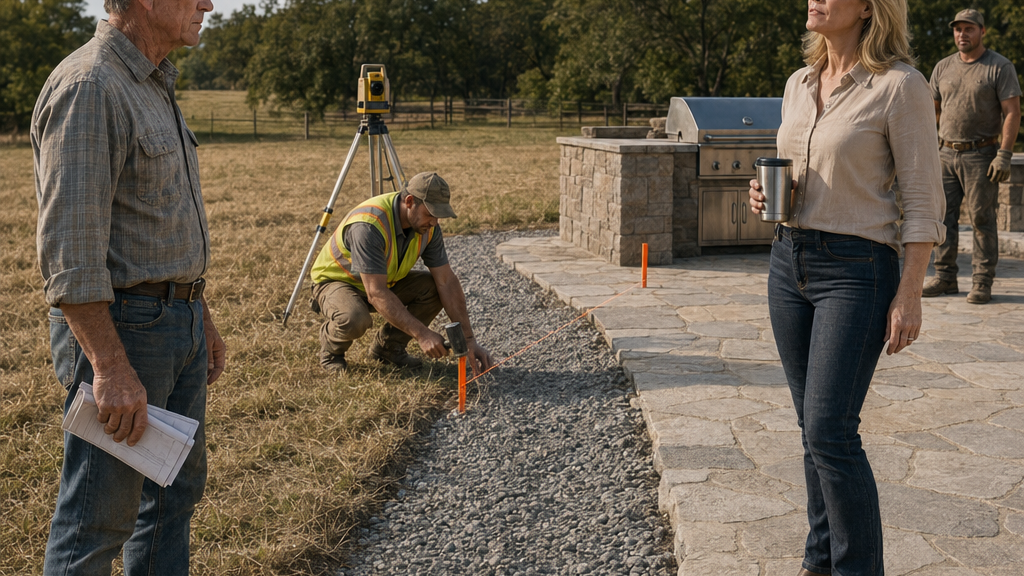
The first orange stake went into Jessica Taylor’s new pea gravel at 8:17 Monday morning.
John knew the exact time because he had looked at his phone just before the surveyor swung the hammer.
The wooden stake disappeared several inches into the compacted base. Its fluorescent top stood almost obscenely bright against the gray stone.
Jessica was not there.
John was grateful for that.
The licensed surveyor had spent the first hour locating monuments, checking bearings and comparing the recorded plat with county parcel information. He worked without drama, stopping often to enter figures into an instrument mounted on a tripod.
John followed at a distance.
He had told himself all weekend that he wanted only an answer.
Now that the answer seemed to be taking shape, he felt no relief.
The surveyor moved thirty yards downhill, checked his equipment again, and placed a second orange stake.
This one landed between two newly set flagstones.
John stared at it.
“You sure?”
The surveyor looked up.
“I’m sure enough to keep working.”
“I mean—could an old fence have shifted the practical line?”
“Practical line and recorded boundary aren’t necessarily the same thing.”
“That isn’t what I asked.”
The surveyor studied him, then looked back through the instrument.
“I’ll run it again.”
That was what John wanted to hear.
Not that he was right.
That it would be checked twice.
The stone crew had nearly completed the terrace over the weekend. Most of the flagstones were fitted now, and the grill foundation had been poured Saturday afternoon.
Jessica had not waited.
John had driven past it Sunday after church and felt the same mixture of irritation and guilt. He had been angry at her for pushing ahead, and angry at himself for leaving room for an argument about where the boundary had ever been.
The surveyor returned to the upper monument and repeated the measurements.
Then he walked the line again.
The second pass put the boundary in the same place.
A third orange stake went through the terrace edge.
The fourth stood beside the corner of the grill footing.
The line was so simple once it existed that John almost resented it.
For years the two properties had been divided by habits: where one person mowed, where another parked, where a tractor turned, where an old fence had once leaned.
Now four bright pieces of wood reduced all that memory to a straight line.
The surveyor pointed toward the grill base.
“Recorded boundary runs through that corner.”
“How far?”
He gave John the measurement.
It was more than enough to matter.
John exhaled.
The contractor had come over and was standing with his hands on his hips.
“Well,” he said quietly, “that’s a problem.”
John looked at him.
“Don’t tear anything out.”
The contractor blinked. “Wasn’t planning to until somebody tells me.”
“I mean it. Nothing comes out because I’m standing here angry.”
“You don’t look angry.”
“I am.”
The contractor almost smiled, then decided against it.
John looked back at the orange line.
“Jessica needs to see it first.”
The surveyor began photographing each marker and writing notes.
By nine-thirty, Robert Allen arrived.
He got out of his pickup, took three steps, and stopped.
His eyes traveled from one stake to the next.
“Oh.”
“That was about my reaction,” John said.
Robert walked the line twice without speaking.
At the grill footing he crouched.
“How much of that is over?”
John told him.
Robert rubbed his forehead.
“This is not where her drawing puts it.”
“I know.”
“She’s going to say your surveyor is wrong.”
“He checked twice.”
“That won’t matter for the first ten minutes.”
John almost laughed.
Robert called Jessica.
She arrived twenty minutes later.
The stainless mug was with her again, but she did not drink from it. She walked straight to the nearest orange stake.
“What is this?”
“The line,” John said.
“No. I can see what it is. Why is it here?”
The surveyor stepped forward and explained his process in plain terms: recorded plat, monuments, bearing, measurement.
Jessica listened with her jaw set.
When he finished, she walked to the grill foundation.
“You’re saying this belongs to John.”
“I’m saying the recorded property line crosses the foundation here.”
“That is not the same line my father used.”
“No, ma’am.”
She turned sharply.
“My father owned this place for thirty-two years.”
The surveyor nodded once. “I can only tell you what the recorded documents and monuments establish.”
Jessica looked at John.
“You hired him.”
“Yes.”
“And you expect me to accept that?”
“I expect us to understand it before anybody builds more.”
She laughed once, but there was no amusement in it now.
“Convenient.”
John felt his anger rise.
He forced himself not to answer quickly.
“You told me to bring you a survey.”
“I told you to prove your claim. I didn’t tell you I’d accept the first person you paid to agree with you.”
The surveyor’s expression did not change.
John said, “Then hire another one.”
Jessica looked at the stakes as though they had been driven there to embarrass her personally.
Robert went into the venue office and returned with the old drawing.
“Show him this.”
Jessica took it from him and spread it across the hood of her SUV.
“There.”
She pointed to the heavy pencil line.
“That has been the property division since I was a kid.”
The surveyor studied the sheet.
“Do you know who prepared this?”
“My father.”
“Was he a surveyor?”
“No.”
“Engineer?”
“No. He ran the farm.”
The surveyor nodded.
“There are useful details here. Drainage. Building locations. Equipment paths. But this isn’t a boundary survey.”
Jessica’s face reddened.
“It shows the boundary.”
“It shows a line.”
“What’s the difference?”
“A recorded boundary has a legal description and surveyed basis. A working drawing can show whatever the person who made it believed or needed it to show.”
Jessica stared at him.
“So my father was lying?”
“I didn’t say that.”
John noticed the change in her expression.
Until then she had looked angry.
Now she looked hurt.
It passed quickly, replaced by defensiveness.
“My father did not steal land from the Harrises.”
John spoke before he had decided whether he should.
“I didn’t say he did.”
“You’re standing here with stakes through my patio.”
“They’re not through it because I wanted them there.”
She folded the map sharply.
“This survey is wrong.”
Robert had been silent.
Now he held out his hand.
“Let me see that.”
Jessica gave him the drawing.
He spread it again and looked near the lower corner, where faded handwriting ran beside an arrow.
“What?”
Jessica leaned closer.
Robert pointed.
There was a short pencil notation John had never noticed.
The writing was faint, partly rubbed away with age.
Robert read what he could.
“‘Use line…’ something. Then initials.”
Jessica frowned.
“That isn’t on the county plat.”
John looked at the surveyor.
The surveyor shook his head.
“No.”
Robert stared at the old sketch.
“If this line was supposed to be a property boundary, why would somebody label it a use line?”
No one answered.
The orange stakes stood between them, bright and straight.
Chapter 3: The Map Her Father Trusted Was Not a Survey
The county clerk searched twice before she looked over the counter and told Jessica, “There’s nothing in the recorded file that matches this.”
Jessica stood very still.
John had expected anger.
Instead, for several seconds, she seemed not to understand the sentence.
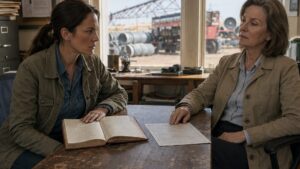
The old farm drawing lay between them beneath the fluorescent lights of the county records office. Its corners had curled despite the plastic sleeve. The heavy pencil line that had seemed so authoritative beside the terrace looked different here, surrounded by recorded plats, deeds and legal descriptions.
Jessica tapped it.
“My father kept this with the property papers.”
“I understand,” the clerk said.
“But you’re saying it means nothing.”
“I’m saying I can’t find it as a recorded survey or plat.”
Robert stood beside Jessica, hands in his pockets.
John remained a few feet back.
He had not wanted to come with them. Jessica had told him she intended to check the county herself, and he had said that was probably best.
Then Robert had called.
“She wants you there so nobody can say later that different things were told to different people.”
It was the first practical sentence Jessica had offered since the stakes appeared.
So John came.
The clerk pulled up the recorded plat and rotated the monitor.
“This is the controlling subdivision of the older farm parcels. There were later transfers, but I don’t see a boundary adjustment between these two tracts.”
Jessica pointed at a structure on the old drawing.
“That shed was real. So was this equipment path. So was the drainage ditch. Everything else on this page is accurate.”
“No one is saying it isn’t useful.”
“Then why would the property line be the one thing wrong?”
The clerk gave a patient shrug.
“It may not have been intended as a property line.”
Robert removed the drawing from the sleeve.
The faint notation near the pencil mark was easier to see beneath the office lighting.
USE LINE.
The second word was clear now.
Jessica read it without speaking.
John felt a small release in his chest, but it did not last.
Because the words created a new problem.
A use line implied use.
Longstanding use.
Perhaps expected use.
Jessica looked toward him.
“You knew about this?”
“No.”
“Your father never told you?”
“Not in those words.”
She folded her arms.
“But you remember us using it.”
John hesitated.
“Yes.”
“How long?”
He considered lying by omission.
It was an old habit: answer the narrow question, avoid opening the wider one.
“Your father mowed part of that side.”
Jessica gave a humorless smile.
“Part of it?”
Robert looked at John too.
John rubbed his thumb along the edge of the counter.
“He parked equipment there sometimes.”
“What kind of equipment?”
“Wagons. A baler once in a while. Trucks during harvest.”
Jessica stared at him.
“For how many years?”
“I don’t know.”
“You do know.”
The clerk quietly stepped away from the counter to give them space.
John looked at the old drawing.
“Long enough that I stopped noticing it.”
Jessica let out a breath through her nose.
“And now you want me to believe everybody understood that land belonged to you.”
“I didn’t say everybody understood anything.”
“That’s exactly the problem, John.”
He looked at her.
For the first time since the gravel arrived, he agreed completely.
They left the records office without settling anything.
Outside, Robert held the drawing against the hood of his truck.
“My guess,” he said, “is this was an operations map.”
Jessica frowned.
“Based on what?”
“The equipment arrows. Water locations. Where they staged hay. It’s not drawn like a survey.”
“It still shows our side using that strip.”
“Yes.”
“Which means Dad believed we had a right to it.”
Robert did not answer immediately.
“He believed you could use it. That isn’t necessarily the same thing.”
Jessica turned away.
John could see what the distinction cost her.
Her father had been dead several years, but the event venue carried him everywhere. His old barn had become the reception hall. His farm office was still Jessica’s office. Some of the original beams had been left exposed because she told clients they were part of the property’s story.
The expansion was not only business.
It was proof, perhaps mostly to herself, that she could take what he left and make it survive.
That did not give her John’s land.
But it made the map more than a convenient excuse.
By afternoon, the four of them were back at the venue edge.
The orange stakes remained untouched.
Jessica stood beside the nearest one.
“Dad mowed all this.”
John nodded.
“He did.”
“He stored wagons here.”
“Sometimes.”
“And nobody stopped him.”
“No.”
She looked at him sharply.
“Then what was I supposed to think?”
John glanced toward the hayfield.
“That’s a fair question.”
Jessica appeared startled again.
He continued before she could mistake the concession.
“But permanent stone isn’t mowing. A grill foundation isn’t parking a wagon for two days.”
“I have four weddings booked in the next five weeks.”
“I know.”
“Three deposits are nonrefundable to vendors. The grill station is part of the new package we already sold.”
“I understand.”
“No, you don’t.”
Her voice rose, then she pulled it back.
“I financed this expansion against the fall calendar. If I start tearing up the terrace now, I don’t just lose stone. I lose events.”
John looked at the finished work.
He understood more than she wanted to believe.
Farmers also made decisions months before knowing what weather, markets, or machinery would do to them.
A bad choice did not stop being bad because reversing it hurt.
“I’m not asking you to cancel weddings today.”
“You’re asking me to remove part of the space they’re paying to use.”
“I’m asking you not to assume the survey disappears because removing the work is expensive.”
Jessica picked up her stainless mug from the table and held it with both hands.
“What if I get another survey?”
“Get one.”
“And if it disagrees?”
“Then we deal with that.”
“And if it doesn’t?”
John looked at the orange line.
“Then we deal with that too.”
Robert spoke quietly.
“We should probably stop anything else on that side.”
Jessica turned toward him.
“You too?”
“I’m saying don’t spend another dollar until we know what the county considers controlling.”
The look she gave him contained more disappointment than anger.
Then she faced John.
“My attorney says if you interfere with scheduled events or block access before this is formally resolved, we can treat it as harassment and business interference.”
John’s expression hardened.
“I haven’t blocked anything.”
“Keep it that way.”
“I intend to.”
She lifted the mug, but did not drink.
“And I intend to keep operating until somebody with authority tells me otherwise.”
John looked at the terrace, then at the cheap orange stakes cutting through it.
The first time he saw them, he had expected them to end the argument.
Instead they had made it larger.
Now he knew where the recorded boundary stood.
What he did not know was how much damage decades of silence had already done on either side of it.
Chapter 4: The County Notice Made the Argument Expensive
The county officer set the end of his tape beside the same orange stake Jessica had called wrong.
John watched from several yards away.
Jessica stood on the terrace with her stainless mug tucked against her ribs, while Robert waited beside the grill station with a folder of permits and contractor invoices. No one spoke as the officer walked the measurement toward the poured footing.
He stopped where the tape crossed the concrete.
“Here,” he said.
Jessica’s mouth tightened.
The officer made a mark on his inspection sheet.
Then he moved to the next stake and measured again.
John had already seen the surveyor do essentially the same thing. Watching a county employee repeat it should have felt like confirmation.
Instead, it felt like the argument had left their hands.
The officer crouched beside the terrace edge and examined the layers beneath the flagstone.
“Loose gravel can be moved,” he said. “Plantings can be relocated. Stone that isn’t permanently fixed is straightforward.”
Jessica nodded once, as though collecting the parts of the answer she could use.
Then he pointed toward the grill foundation.
“This is different.”
“How different?” she asked.
“It’s a permanent improvement crossing the recorded parcel line.”
Jessica looked at John.
He wished she wouldn’t.
The officer continued.
“I’m not deciding ownership. The survey and recorded description establish what we use for enforcement purposes. Based on those, permanent construction extends onto the adjoining parcel.”
“So what happens?” Robert asked.
The officer closed his tape.
“A notice goes out. You’ll have a compliance period to correct the encroachment or demonstrate why the county’s information is wrong.”
Jessica’s fingers tightened around the mug.
“How long?”
He gave her the deadline.
Robert looked down at the folder.
Jessica said, “And if another survey comes back differently?”
“Submit it.”
“If we challenge the boundary legally?”
“That’s between the owners and the court. Until something changes the recorded basis we have, this is what we enforce from.”
The officer walked the line once more, photographed the grill footing and several stakes, then left an inspection marker beside the terrace.
John stared at the little official tag.
The orange stakes had looked temporary.
The county marker did not.
Jessica waited until the officer had reached his vehicle.
Then she turned to John.
“Well. Congratulations.”
John frowned. “For what?”
“You got what you wanted.”
“No.”
She gave him a look that said she had no patience left for restraint.
“A county notice is coming, John. My contractor may have to pull apart something we finished two weeks ago. What exactly would you call that?”
“I’d call it correction if it’s on my land.”
“That sounds a lot like getting what you wanted.”
He felt heat rise in his face.
“You told me to prove the line.”
“And you did.”
“You kept building after I asked you to wait.”
“I believed the map.”
“You believed it because it was convenient.”
Jessica’s expression changed.
There it was—the sentence he should not have said.
Not because it was entirely false.
Because it was too simple.
Robert shifted his weight.
Jessica set the mug on the stone counter.
“You want to know what’s convenient?” she said quietly. “Convenient would have been leaving this place exactly the way my father left it and watching it fail.”
John said nothing.
She opened the folder Robert had been carrying and removed a calendar page covered with notes.
“Four weddings. Five weeks. Deposits to caterers, rental companies, florists, musicians. The terrace is on photographs clients already approved. Two couples moved dates specifically because the expansion was supposed to be finished.”
“That doesn’t change the boundary.”
“No. It changes the cost.”
Her voice did not rise.
That made the words harder to dismiss.
“If I lose one weekend, I can probably absorb it. If I close this entire side for a month, maybe I can’t.”
John looked toward the barn.
He had never seen it as a fragile business. On Saturdays, vehicles lined the gravel drive and people in good clothes crossed the yard carrying gifts and flowers. From his fields it had always looked successful.
Success, he knew better than most people, could still be one equipment failure away from a bad year.
He glanced at the grill footing.
“What if the contractor removes only what crosses the line?”
Jessica laughed without humor.
“You think stone comes apart according to survey measurements?”
“I don’t know.”
“Neither do I. That’s the problem.”
Robert opened the construction plan on the counter.
“The grill may be movable if they cut this side and rebuild the base,” he said.
Jessica looked at him.
“You told me last week it wasn’t.”
“I told you it wasn’t when we thought all of it was ours.”
John noticed the change in Robert before Jessica did.
He was no longer defending the original plan.
He was solving the new problem.
Jessica noticed eventually.
She looked away.
The official notice arrived two days later.
John found his copy in the mailbox because he had been listed as the adjoining property owner. It was plain paper, not dramatic. No red stamp. No threat in oversized type.
But the meaning was clear.
The permanent encroachment had to be corrected within the stated compliance period unless contrary legal documentation was produced.
He read it twice at his kitchen table.
For weeks he had wanted somebody other than him to say the line mattered.
Now somebody had.
He felt less satisfied than he expected.
That afternoon he drove the tractor past the venue and saw Jessica standing alone on the terrace.
She was talking on the phone, one hand pressed to her forehead.
The orange stakes remained in place.
The county marker stood beside them.
John kept driving.
Near sunset, a pickup turned into his lane.
Nancy Baker climbed out carrying nothing.
She was in her seventies now, though she still walked the same quick way John remembered from church suppers and fence repairs twenty years earlier.
“You busy?”
“Depends what you’re selling.”
“Bad timing.”
“That usually costs more.”
She smiled, but only briefly.
Then she looked across toward Jessica’s property.
“I heard the county got involved.”
John leaned against the tractor tire.
“Seems everybody heard.”
“Jessica called me.”
He straightened slightly.
“Why?”
“She wanted to know if I remembered where the old fence ran.”
John looked toward the orange stakes.
“Do you?”
Nancy did not answer at once.
Instead she walked several yards toward the boundary and pointed beyond the terrace, where weeds had grown around a half-rotted wooden post almost level with the ground.
“You see that?”
John had seen it thousands of times.
“That old thing?”
“That old thing used to matter.”
He frowned.
Nancy looked at him.
“Has anybody ever told Jessica why her father was using your side of that fence in the first place?”
John said nothing.
Something in her tone made the county notice in his mailbox suddenly feel like only half an answer.
Chapter 5: What Their Fathers Never Put on Paper
Nancy Baker put her shoe against the rotted post and said, “That was never the property line.”
John stared down at it.
The post leaned toward the venue, gray wood split almost to the soil. Grass had grown through the old staple holes. Ten yards away, one of the orange survey stakes stood bright and straight.
“Then what was it?”
“Convenience.”
John looked at her.
Nancy folded her arms.
“Come to the house. I’m not explaining thirty years of bad habits while standing in weeds.”
An hour later they sat at her kitchen table with coffee neither of them was drinking.
Nancy had known both families before Jessica was old enough to drive and before John had taken over full responsibility for his father’s cattle. Her late husband had helped repair fences along all three properties.
“The real line was awkward,” she said. “Always was. Cut across the easiest turning area.”
John pictured the old layout.
“The equipment path.”
“Exactly.”
She drew an invisible shape on the tabletop with one finger.
“Jessica’s father needed room to swing wagons and park during hay season. Your father told him to use the strip as long as he kept it mowed and didn’t block your access.”
John leaned back.
“He never told me that.”
Nancy gave him a look.
“Your father told people about practical things when he thought they needed telling.”
“That sounds like him.”
“So does not putting it on paper.”
John looked toward the window.
“Was it an easement?”
“No.”
“Lease?”
“No.”
“Anything written?”
“Not that I ever saw.”
“Then how do you know?”
“Because I was there when they argued about it.”
That caught him.
Nancy smiled faintly.
“You two aren’t inventing anything new.”
She described a summer years earlier when Jessica’s father had left a wagon too close to the lane and John’s father had been unable to bring a cattle trailer through. Voices had been raised. The wagon had been moved.
“Your father told him, ‘Use it. Don’t start owning it.’”
John looked down at the table.
He could hear the sentence in his father’s voice.
Blunt, practical, almost joking.
And dangerously easy to misunderstand once the men who understood it were gone.
Nancy continued.
“After that, Jessica’s father kept the strip cut. Sometimes he parked there. Your father didn’t care because it saved him mowing around the old fence corner.”
“The use line.”
“That’s what we called it.”
John thought of the faint pencil notation on the old drawing.
USE LINE.
Jessica’s father had not necessarily drawn the line because he believed he owned everything inside it.
He may have drawn it because that was where his work routinely stopped.
“When did the fence come out?”
“Little by little. Storm took part of it. Your father pulled another section because it was catching machinery. Nobody rebuilt it.”
John rubbed his chin.
“And we all kept using the ground.”
Nancy nodded.
“Until people forgot why.”
The words stayed with him.
Until people forgot why.
John drove back to his farm just before dark and stopped at the old post.
From there he could see it differently.
The orange stake marked ownership.
The rotten post marked habit.
For decades, those two ideas had lived several feet apart without causing trouble because the people involved understood the difference.
Then time had removed the explanation and left only behavior.
John remembered Jessica’s father mowing the strip.
He remembered wagons parked there.
He remembered, years after taking over the farm, seeing one of Jessica’s trucks sitting partly beyond where John believed the property line ought to be.
He had noticed.
He had said nothing.
Not once.
He had told himself it was temporary.
Then he had told himself it was neighborly.
Later, he had stopped thinking about it.
Jessica had inherited more than her father’s business.
She had inherited everyone else’s silence.
The next morning John found her beside the terrace talking with Robert and the stone contractor.
Jessica saw him approaching.
“If you’re here about the deadline, we know.”
“I’m here about your father.”
The contractor quietly moved away.
Jessica’s expression sharpened.
“What about him?”
“Nancy told me what that use line was.”
Robert looked up.
Jessica said nothing.
“My father let your father use the strip for equipment. Mowing, parking, turning. It was informal.”
Her eyes narrowed.
“So we did have permission.”
“Yes.”
“To use the land.”
“Yes.”
“And your family knew.”
“Yes.”
Jessica looked toward the orange stakes.
“Then why are we pretending this suddenly became sacred ground?”
John felt the argument opening under his feet.
“We’re not.”
“You just admitted my father used it with permission.”
“I also said permission isn’t ownership.”
“He used it for decades.”
“For wagons. Not a permanent terrace.”
“You keep making that distinction because it helps you.”
“No. I make it because it matters.”
Jessica crossed her arms.
“If the use was accepted for thirty years, why should putting stone there change everything?”
“Because I can ask you to move a wagon.”
“You can ask me to move stone.”
“That’s what the county is doing now.”
She looked away.
John could have stopped there.
Instead, he said the part that cost him something.
“I should have spoken sooner.”
Jessica turned back.
“When?”
“Years ago.”
Robert stayed quiet.
John continued.
“I saw your family using more of that strip after your father died. Trucks. Mowers. Temporary storage. I thought it wasn’t worth an argument.”
Jessica’s face softened only slightly.
“And now?”
“Now I think avoiding the argument helped create this one.”
For a long moment, nobody said anything.
The contractor scraped mud from his boot with a stick.
Jessica finally said, “That doesn’t put the terrace on my property.”
“No.”
“And it doesn’t pay to move it.”
“No.”
“So what exactly does your admission change?”
John looked at the stakes.
“It changes how I think we got here.”
Jessica shook her head.
“I don’t need philosophy, John. I need to know whether I’m ripping out a project I borrowed money to build.”
The sympathy he had begun to feel hardened at the edges.
“Understanding how this happened doesn’t mean you get to keep it.”
She stared at him.
“There it is.”
“There what is?”
“You get to be reasonable right up until the answer still costs me.”
John’s voice stayed low.
“The alternative costs me my land.”
“It’s a strip beside a hayfield.”
“And that sentence is exactly why we’re still arguing.”
Jessica looked as though she regretted saying it.
But she did not take it back.
Robert unfolded the contractor drawing.
“We need a decision,” he said. “County deadline isn’t going away.”
Jessica pointed at the terrace.
“If we remove everything they want, the grill has to be rebuilt. The stone curve changes. We lose seating.”
Robert said, “Maybe.”
“No. We do.”
John looked at the plan.
For the first time, he saw a possibility between keeping everything and tearing out more than necessary.
“Give me a copy.”
Jessica frowned.
“Why?”
“I want to mark something.”
“You’re redesigning my venue now?”
“No.”
He met her eyes.
“I’m trying to figure out whether there’s a way for you to keep operating without me pretending that ground belongs to you.”
Jessica said nothing.
John folded the copied plan and put it in his shirt pocket.
“I’ll bring you one proposal before the county deadline.”
She watched him walk away.
Behind him, the orange stakes stood beside the remnants of the old fence—one line precise, the other almost forgotten.
Chapter 6: John Drew a Line He Could Live With
John arrived two days before the compliance deadline carrying no attorney’s letter.
He had the survey under one arm and the contractor plan folded in his back pocket.
Jessica was already waiting near the terrace.
Robert stood with her.
“You said you had a proposal,” Jessica said.
“I do.”
“Is this the part where you tell me which half of my business I’m allowed to keep?”
John ignored the edge in her voice.
“Walk with me.”
He started at the upper orange stake.
Jessica hesitated, then followed.
For most of his life John had thought about that side of the farm in curves and habits. The mower turned here. The cattle trailer swung there. Jessica’s father used that patch. John’s father avoided another.
Now he walked from stake to stake.
Straight lines.
Recorded distances.
No guessing.
At the second stake, he stopped.
“This gravel on my side comes out.”
Jessica nodded impatiently.
“We know.”
“The permanent stone crossing the line comes out too.”
Her jaw tightened.
“And the grill corner?”
“Moved entirely onto your parcel.”
She looked toward the poured foundation.
“That means cutting the base.”
“Your contractor says it can be done.”
“He says lots of things are possible when someone else is paying.”
John unfolded the contractor plan.
He had drawn one line in pencil parallel to the survey boundary.
Jessica leaned closer.
“What’s that?”
“A working limit.”
“I thought the orange stakes were the working limit.”
“They’re the ownership line. I’m talking about access.”
Robert took the paper.
John pointed toward the upper portion of the strip.
“Your delivery trucks need enough room to swing during events. Your father needed the same thing with wagons. That problem didn’t disappear because we found the legal boundary.”
Jessica studied him.
“What are you offering?”
“A written license for limited access over this section.”
She blinked.
Robert looked from the plan to John.
“For vehicles?”
“Equipment and event-service vehicles when needed. No permanent structures. No storage. No expansion. Defined width.”
Jessica’s suspicion returned immediately.
“For how long?”
“We can settle that in writing.”
“And what does it cost?”
“Nothing beyond restoration and whatever fees it takes to document properly.”
She gave a short disbelieving laugh.
“So after all this, you’re offering to let me use the ground?”
“I’m offering to let you use part of it under terms we both understand.”
Jessica looked at the orange stakes.
“My father already had that.”
“He had a handshake nobody wrote down.”
“And you’re saying that was worthless.”
“No.”
John shook his head.
“I’m saying it worked until everyone who understood it was gone.”
That quieted her.
Robert continued examining the drawing.
“If we keep deliveries on this path, we could shift the service gate six feet and still get catering trucks around the barn.”
Jessica looked at him.
“And guest space?”
“We lose some.”
“How much?”
“Less than if we abandon the whole terrace.”
She turned back to John.
“You’d let events keep using the access while we reconstruct?”
“Temporarily, yes, if your contractor keeps equipment off the rest of my side.”
“And if we sign something permanent later?”
“That’s the point.”
Jessica folded her arms.
“Why?”
John knew what she meant.
Why help after weeks of fighting?
Why concede anything when the county had given him leverage?
He could have said because he was trying to be fair.
That sounded too clean.
The truth was less flattering.
“Because I helped make this mess.”
Jessica stared at him.
“I didn’t pour the footing,” he said. “But I watched your family use that strip for years and kept choosing not to clarify it. I thought silence was the neighborly thing.”
He looked at the survey stake between them.
“It wasn’t.”
She glanced away.
“You still think I’m wrong.”
“I think you’re wrong about owning it.”
“That isn’t the same answer.”
“No.”
John waited.
“You had reason to believe your family could use the ground. You didn’t have reason to keep building after I disputed the line.”
Jessica pressed her lips together.
“That’s the part you want me to say out loud?”
“I don’t need you to say anything.”
“That would be easier for you.”
“Probably.”
Robert cleared his throat.
“If we’re doing this, we need the contractor now. Not tomorrow.”
Jessica looked toward the terrace.
A row of chairs sat stacked beneath the barn overhang for the weekend wedding. Decorative lights had already been strung along the eaves.
Her business had not stopped while the dispute unfolded.
Neither had John’s farm.
A tractor moved slowly in the distant hayfield.
Two lives continued on either side of a line neither could afford to pretend away.
Jessica walked to the grill station and rested one hand on the stone counter.
“My father would hate this.”
John did not ask whether she meant the demolition or the argument.
After a moment she said, “He hated admitting when a plan was wrong.”
John almost smiled.
“So did mine.”
“That supposed to make me feel better?”
“No.”
It did anyway, slightly.
Jessica looked at Robert.
“If we cut the grill base, how long before it can be rebuilt?”
“Couple days if the contractor can move the crew.”
“And the terrace edge?”
“Depends how much stone we can reuse.”
She closed her eyes briefly.
Then she picked up her phone.
John waited.
Jessica called the stone contractor.
When he answered, her voice became the controlled business voice John had heard her use with vendors.
“We’re changing the job.”
A pause.
“Yes. Again.”
She looked at the orange line.
“Everything permanent over the surveyed boundary comes out.”
Another pause.
“No, don’t argue with me. I know what you said last week.”
Robert looked down, hiding what might have been relief.
Jessica continued.
“We need the breaker and the excavator here at sunrise.”
She listened.
“Yes. Sunrise.”
Then she ended the call.
For several seconds none of them moved.
John folded the plan.
Jessica looked at him.
“If I do this, your access offer stays on the table?”
“It stays on the table if we put the terms in writing.”
Her expression tightened at the phrase, then relaxed.
“In writing.”
“Yes.”
She picked up her stainless mug and walked toward the barn.
At the doorway she turned.
“Seven o’clock.”
“For what?”
“The demolition.”
John glanced toward the terrace.
Jessica gave him a tired look.
“You wanted the line corrected.”
“I did.”
“Then you should probably be here when we find out what correcting it actually costs.”
Chapter 7: The Jackhammer Followed the Orange Line
The jackhammer struck the first flagstone six inches from an orange survey stake.
The sound cracked across the farm hard enough to send two cattle at John’s lower fence lifting their heads.
He stood near the edge of the terrace with his hands in his coat pockets while the stone contractor guided the breaker into the joint between two slabs.
Jessica stood on the other side of the work area.
She had brought the stainless mug again.
For once, she was not holding it like part of a uniform. Both hands were wrapped around it, elbows close to her sides, as if it were simply warm.
Robert had already moved the stacked event chairs away from the demolition area. The excavator waited near the gravel apron with its bucket resting on the ground.
Nobody looked pleased.
The contractor killed the jackhammer after the first section fractured.
“That’s the cut,” he said.
John stepped closer.
A chalk line ran parallel to the orange stakes, just inside Jessica’s parcel where the rebuilt terrace edge would sit.
The contractor pointed with his boot.
“We stay on this side, remove everything that crosses, rebuild from there. You both agree?”
Jessica looked at John.
John looked at the orange stakes.
“Yes.”
Jessica gave one short nod.
“Do it.”
The hammer started again.
For weeks John had imagined this moment without admitting he had imagined it.
Not in detail.
Just as a conclusion.
The construction would come out. His ground would be restored. The argument would finally become visible in the only language that seemed impossible to dispute: stone on one side, grass on the other.
He had expected satisfaction.
Instead he found himself watching the contractor lift pieces of flagstone Jessica had paid to install less than a month earlier.
Each slab came free with a different sound.
Some broke.
Some lifted intact enough for reuse.
Robert marked the reusable pieces with chalk and directed two workers to stack them beside the barn.
Jessica said almost nothing.
When the excavator scraped back the pea gravel, the buried edge of John’s old hayfield appeared in patches—flattened soil, pale roots, the scar where the loader had first crossed.
The sight gave John a small, undeniable sense of relief.
There it was.
His land.
Not abstract acreage on a tax statement.
Ground.
The contractor worked down the line until he reached the grill foundation.
Then everything stopped.
He crouched beside the concrete with a saw and studied the earlier marks.
“We can separate it here,” he said.
Jessica stepped forward.
“You told Robert that yesterday.”
“I said I thought we could.”
“That sounds different now.”
“It is different now that I’m looking at the pour.”
Robert came beside him.
“What’s the risk?”
“Crack carries the wrong direction, we lose more of the base than planned.”
Jessica closed her eyes briefly.
John watched the contractor position the saw.
This was the point where the correction became expensive in a way gravel never had.
The machine whined.
Concrete dust rose in a pale cloud.
Jessica turned away from it.
John almost did too.
Instead, he watched the blade follow the marked cut until it reached the line established by the survey.
The contractor switched tools.
The breaker struck.
Once.
Twice.
A narrow fracture opened precisely where intended.
The crew eased the outer section away.
The main grill base remained intact on Jessica’s side.
Robert exhaled so loudly John heard him over the machinery.
“Well,” he said, “that’s the first good thing this week.”
Even Jessica gave a tired half-smile.
The contractor looked toward John.
“Your side is clear once we remove that footing.”
John nodded.
There was his payoff.
The thing he had fought for had become physically true.
The concrete on his side would leave.
The permanent structure would stop at the boundary.
Yet seeing Jessica’s relief that the remaining base had survived made triumph feel smaller than he had expected.
Around noon, the crew paused.
John walked toward his truck for water.
Jessica followed him.
“John.”
He stopped.
She looked back toward the half-dismantled terrace.
“I owe you something.”
He waited.
She seemed to reconsider the sentence.
“Not an apology exactly.”
“That sounds promising.”
She gave him a dry look.
Then she glanced at the mug in her hands.
“I knew there was a possibility the line was wrong before your survey.”
John said nothing.
The admission changed the air between them.
“How much of a possibility?”
“Not much.”
“That isn’t an answer.”
“No.”
She looked toward the barn.
“When Robert first measured for the terrace, one dimension on Dad’s sketch didn’t match the newer parcel sheet. He mentioned it.”
John felt anger begin to return.
“And you built anyway.”
“I told myself the parcel sheet was approximate.”
“You told me your map was certain.”
“I know.”
“After I asked you to stop.”
“I know.”
He waited for the excuse.
It did not come immediately.
Jessica rubbed her thumb along the lid of the mug.
“My father never hesitated in front of contractors. Or clients. Or anybody working for him.”
John said, “Your father hesitated plenty.”
“Not where I could see it.”
There was no accusation in her voice now.
Only something more difficult.
“When he died, everybody started asking me what he would have done. Vendors. Robert. People who booked the barn for years. Every decision felt like an exam I hadn’t studied for.”
John looked toward the workers.
Jessica continued.
“When Robert said the measurements didn’t match, I thought if I stopped the project, everybody would know I wasn’t sure.”
“So you kept going.”
“Yes.”
“That wasn’t your father’s map making the decision.”
“No.”
She finally looked directly at him.
“That part was me.”
John let the silence sit.
He had wanted responsibility from her.
Now that she had given it, he found no pleasure in pressing harder.
“You still should have stopped.”
“I know.”
“You threatened me with a lawyer.”
“I know that too.”
“That wasn’t uncertainty.”
“No.”
Her voice became firmer.
“That was me trying to make the problem go away after I’d already made it worse.”
John glanced toward the orange stakes.
He thought of all the years he had done his own version of the same thing.
Not threats.
Silence.
He had let uncertainty remain because dealing with it felt worse than leaving it alone.
Jessica’s method had been louder.
His had taken longer.
Neither had produced clarity.
The jackhammer started again.
They watched the crew break the last section of foundation from John’s side.
Jessica said, “I’m not asking you to tell me it was understandable.”
“Good.”
“I’m telling you because you were right about one thing.”
“Which thing?”
“That using ground and owning it aren’t the same.”
John nodded.
She looked at him.
“And you were wrong about something too.”
He raised an eyebrow.
“Silence doesn’t make people understand what you mean.”
He almost objected.
Then he remembered the rotted fence post.
“I’ve been hearing that lately.”
By late afternoon, the permanent encroachment was gone.
The excavator feathered new soil across the damaged strip. The farmhand would seed it after the crew left.
The terrace looked smaller, but not ruined.
Robert had already marked the shifted service path. Several intact stones waited to be reset.
Jessica walked the newly exposed boundary with John.
Neither needed to argue about where it was now.
The orange stakes told them.
At the last one, she stopped.
“Your access offer.”
John waited.
“Is it still on the table?”
“Yes.”
“Even after today?”
“That was the point of putting it in writing.”
Jessica looked down at the restored soil.
“All right.”
She nodded once.
“Then let’s write something neither of us has to remember correctly thirty years from now.”
Chapter 8: This Time They Put the Boundary in Writing
John pulled the first orange stake from the restored grass and laid it across the tailgate of his pickup.
Three weeks had passed since the demolition.
Most of the disturbed ground had begun showing green again. The rebuilt terrace now curved away several feet before reaching the surveyed line. Jessica’s grill station stood entirely on her parcel.
John moved to the second stake.
It took more effort to pull.
The surveyor had driven it deep.
He twisted it free, shook soil from the bottom, and placed it beside the first.
By the time he reached the final marker near the old fence corner, Jessica’s SUV had turned into the lane.
She got out carrying a document folder instead of her mug.
“That the last one?”
“Last one I’m pulling today.”
She looked at the orange stake.
“I thought we were finished with those.”
“We are after the new corner gets set.”
Jessica came closer.
The rotted post Nancy had shown them was gone now. Robert had removed it while clearing the service path, but John had saved a piece of it in the equipment shed.
He had considered keeping it as some kind of reminder.
Then decided he already understood the lesson.
Jessica held out the folder.
“County clerk said the access license was recorded this morning.”
John wiped his hand on his jeans before taking it.
The agreement was narrow.
Specific.
It allowed defined event-service and farm equipment passage over part of John’s strip when necessary. It prohibited permanent structures, storage, expansion, or transfer of ownership rights. Either side could point to the language instead of trying to remember what somebody’s father had meant decades earlier.
Jessica watched him read.
“You already read three drafts.”
“I read contracts twice.”
“That explains your exciting personality.”
John glanced at her.
“That almost sounded neighborly.”
“Don’t get used to it.”
He closed the folder.
Her first large autumn event since the reconstruction was scheduled for that afternoon.
Rental vans had already begun arriving. The redesigned service gate let them turn without crossing the protected portion of John’s field, though the licensed access strip was there if a larger vehicle needed it.
Robert had tested it with a delivery truck the day before.
Nothing dramatic had happened.
That seemed to be the point.
Jessica looked toward the terrace.
“You coming over later?”
“To a wedding?”
“Not the ceremony. Robert’s grilling after the vendors clear out.”
John considered it.
“You inviting me because of the license?”
“I’m inviting you because Robert bought too much meat.”
“That I believe.”
She smiled.
Then her expression became more serious.
“I paid the restoration invoice.”
“I saw.”
“And the contractor finished the drainage edge?”
“Yesterday.”
“If you see anything washing toward your field, tell me.”
John looked at her.
“I will.”
The answer came easily.
That surprised him.
Not because he intended to complain.
Because for most of his life, “I will” had been exactly the promise he avoided making.
He had preferred to notice, wait, adjust and decide later whether something was worth bringing up.
The boundary dispute had cured him of some of that.
Not all.
He was still John Harris.
But enough.
They drove separately to the county records office later that morning to collect the stamped copy of the license.
The same clerk who had searched for Jessica’s old farm sketch slid the new document across the counter.
Jessica ran her finger over the recording information.
“So this one people can actually find.”
“That’s generally the idea,” the clerk said.
John almost laughed.
Jessica did.
Outside, she held the document against the hood of her SUV.
“My father would probably think we made this too complicated.”
“My father would think paying a filing fee was a personal insult.”
“That sounds about right.”
John looked at the paper.
“But they’re not the ones who have to live with what they left unclear.”
Jessica’s smile faded.
“No.”
She closed the folder.
For a moment they stood without speaking.
There had been no grand apology between them.
No declaration that everything was forgiven.
Jessica had lost money.
John had spent money on the survey and weeks thinking about a strip of ground he had barely noticed before.
They both had reasons they could still use to blame the other.
But the property line was corrected.
The terrace remained open.
The farm remained intact.
And their arrangement no longer depended on two dead men being remembered accurately.
That afternoon John returned to the boundary with a new corner marker and his post driver.
Jessica was busy across the way with the first event guests arriving. White rental chairs stood in rows near the barn. The rebuilt terrace held small tables and flowers.
No one standing there would know which stones had once crossed the property line.
John preferred it that way.
He set the new marker exactly where the survey called for it.
Then he placed a fence post several inches inside his side, leaving the licensed access area unobstructed.
The final orange stake stood beside him.
He gripped it near the top and pulled.
For an instant it resisted.
Then the soil released it.
John looked at the fluorescent orange paint, faded now from weeks of sun.
At first the stakes had felt accusatory.
They had seemed to announce that somebody was wrong.
Later they had guided the demolition.
Now they had done something quieter.
They had made explanation unnecessary.
Jessica crossed the terrace and stopped on her side of the new corner.
“That it?”
“That’s it.”
She looked at the post.
Then at the recorded line between their properties.
“Looks smaller than all the trouble.”
“Most lines do.”
She nodded toward the barn.
“Robert says food at six.”
John picked up the orange stake.
“I’ll come over after I feed.”
Jessica turned away, then stopped.
“John.”
He looked up.
“Next time something looks wrong, say it before I pour concrete.”
He gave her a long look.
“Next time something looks uncertain, don’t pour concrete.”
“Fair.”
She walked back toward the venue.
John carried the last orange stake to his truck and set it with the others.
Behind him, the new fence marker stood exactly where it belonged.
Not as a wall.
Not as an accusation.
Just a line both neighbors finally knew how to respect.
The story has ended.