They Kept Cutting Across His Newly Seeded Hayfield—Until One Sprinkler Exposed Why the Shortcut Existed
Chapter 1: The Path That Was Never Supposed to Be There
The footprints crossed the field before David Green had finished his first cup of coffee.
He saw them from the cab of the utility tractor: a fresh line of dark impressions pressed through the damp surface he had seeded the previous afternoon. They began near the east fence, cut straight across the lower hayfield, and disappeared beside the gravel entrance near the county road.
David stopped the tractor.
For several seconds he simply sat with one hand on the wheel.
The grass seed was barely covered. In places, the shallow grooves from his drag harrow were still visible. Yet someone had already walked directly across them.
He climbed down.
The footprints were not isolated. Under the newest impressions lay older marks, some hardened at the edges, some overlapping until they formed a narrow brown scar through the field. The path ran diagonally from the neighboring homes behind his property toward the school-bus pickup beside the road.
It was the shortest possible line.
It was also entirely on his land.
David followed it twenty yards, then crouched and pinched a crushed patch of soil between his fingers. The seed had been kicked aside. A few pale roots from earlier germination showed through.
He stood and looked toward the road.
The paved shoulder curved around his property in a long bend. Anyone walking it had to follow nearly three times the distance. David knew why the field tempted people. He had known for years.
What he did not understand was why asking them to stop had changed nothing.
A month earlier he had spoken to two teenagers who crossed while he was repairing a fence brace.
“Use the road, please,” he had said.
They had nodded.
The next morning, there were fresh tracks.
He had put up two temporary stakes with orange ribbon.
Someone stepped between them.
Then he tied a handwritten note to the east gate.
NEW SEED. PLEASE STAY OUT OF FIELD.
He had kept the wording simple on purpose. No threats. No legal language. No warnings about trespassing.
Just a request.
By eight that morning, David was standing beside the gate when Rebecca Walker came down the gravel lane from her family’s property with a backpack over one shoulder.
She was seventeen, maybe eighteen soon, old enough to drive but still taking the school bus some mornings. David had watched her grow up from a child who used to trail behind Michael Walker at community cookouts into someone who moved quickly and rarely looked away from her phone.
She saw him.
She also saw the sign.
“Morning, Rebecca.”
“Morning.”
She slowed, but only for a second.
David waited.
She stepped around the gatepost and onto the dirt path.
“Rebecca.”
She stopped.
“I reseeded that yesterday.”
She glanced at the ground beneath her shoes. “I know.”
“Then why are you walking on it?”
Her expression tightened, not insolent exactly, but impatient. “I’m staying on the same path.”
“That path is what I’m trying to get rid of.”
The bus could be heard somewhere beyond the bend, still distant.
Rebecca shifted her backpack higher.
“I’m going to miss it.”
“Then use the road.”
She looked toward the county pavement, then back at him.
For the first time, David noticed something in her face that was not simple annoyance.
But she said only, “Sorry,” and continued across the field.
David watched her go.
The word did not slow her feet.
By the time she reached the far side, two more teenagers had appeared behind her. They saw David beside the gate, looked at one another, and followed the same line.
One of them lifted a hand.
“Morning, Mr. Green.”
David did not answer.
He returned to the tractor.
The morning work should have settled him. Usually it did. There was hay equipment to grease, a water trough to check, a section of fence wire sagging near the north lot.
Instead, his eyes kept returning to the brown diagonal.
By ten, three more people had crossed.
One carried a coffee cup.
Another had a small dog on a leash.
Nobody wandered randomly through the field. They all used the same line, as if repetition had turned private ground into an accepted road.
David remembered his father saying that a gate left open twice became an invitation the third time.
That was one of the few things his father had been strict about.
Which made the path harder to understand.
Near noon, David drove cattle from the smaller paddock toward the shaded lot beside the equipment shed. When he reached the connecting gate, he found it hanging six inches open.
His stomach tightened.
The chain had been looped over the post but not latched.
Someone had passed through recently.
A black cow was nosing toward the opening.
David moved quickly, pushed the gate shut, and secured the chain.
That changed the problem.
Flattened grass was irritating.
A loose gate beside cattle was not.
He stood with one hand on the top rail and looked toward the path.
The people using it were not all careless. Rebecca had grown up around farms. Michael knew what an open livestock gate could mean.
And still the route continued.
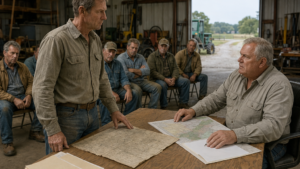
At lunch, David carried a glass of iced tea to the kitchen table and spread out a county parcel map beneath it.
The boundaries were clear.
He knew them without looking.
East fence. Road frontage. Drainage ditch. South corner marked by an old iron pin.
But looking at the lines made something in him settle.
Lines could be measured.
Lines could be defended.
He took out a sheet of graph paper.
From the kitchen window, he could see the worn trail cutting through the new seed like a pencil stroke.
He measured approximate distances from the fence and irrigation connection, then drew the field to scale.
The path crossed the center.
David stared at it for a while.
Then he marked four small circles along the brown line.
Chapter 2: Four Sprinklers Along One Brown Line
The feed-store clerk looked at the four motion-triggered sprinkler heads on the counter and then at David.
“Deer?”
“People.”
The clerk paused.
David slid his card toward the register.
“People-shaped deer,” he added.
That earned half a smile.
The sprinklers were meant for garden protection. Each had a motion sensor, an adjustable sweep, and enough reach to cover a broad patch of ground. David read the specifications twice before buying them.
He did not want something dangerous.
He wanted something impossible to ignore.
The clerk rang them up.
David kept the receipt.
Back at the truck, he folded it once and placed it in the small envelope where he kept maintenance expenses. His father would have laughed at that part. The older man had kept receipts in coffee tins, glove boxes, shirt pockets, and once inside a seed catalog for nearly a year.
David had spent too much of the last decade untangling arrangements nobody had written down.
A cattle panel borrowed indefinitely.
A shared well-line repair paid in cash.
A neighbor allowed to park equipment “until winter” and still doing it four winters later.
After his father died, David learned how expensive unclear kindness could become.
By two that afternoon, the four sprinkler heads were on the farmhouse kitchen table.
David opened his graph paper beside them.
He drew the irrigation line, field edge, east fence, and road frontage. Then he measured the likely sensor arcs.
The first unit would sit just inside the east approach.
The second near the middle of the diagonal.
The third lower toward the road.
The fourth would cover the last portion before the gravel entrance.
He made sure none of them needed to spray beyond the field boundary.
That mattered to him.
This was not about soaking someone on public ground.
If they entered his field, the water would reach them.
If they stayed out, nothing happened.
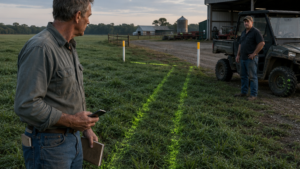
Before installing anything, David walked the entire path with a measuring tape.
Near the lower corner, he found the old rust-dark survey marker partly hidden under weeds.
He scraped around it with his boot.
The county survey technician had confirmed the corner years earlier when David replaced a fence. Still, he pulled up the parcel image on his phone and checked the bearing.
The dirt path lay well inside the line.
Every inch of it.
The legal simplicity of that fact gave him more satisfaction than it should have.
He was straightening when a pickup slowed on the road.
An elderly former neighbor rolled down the window.
“You measuring for a fence?”
“Maybe something better.”
The man looked across the field and chuckled when he saw the trail.
“Still got the school-kid highway, I see.”
David glanced at him.
“School-kid highway?”
“Your dad never minded them cutting through.”
David’s grip tightened slightly around the measuring tape.
“What do you mean?”
The man shrugged. “Kids used it for years.”
“He told them they could?”
“Your dad?”
“Yes.”
The elderly man considered that.
“Don’t know what he told anybody. Just know he never minded.”
“That isn’t the same thing.”
“No.”
The answer came easily enough that David had nothing to push against.
The man lifted two fingers from the steering wheel.
“Good luck with whatever you’re building.”
Then the pickup moved on.
David remained beside the survey marker.
Your dad never minded them.
It irritated him because it sounded like exactly the kind of sentence that caused trouble after a person was dead.
Never minded did not mean permission.
Permission did not mean permanent access.
And none of it meant people could leave a cattle gate open.
He put the thought aside and started digging.
The irrigation connection was easy. He already had a supply line serving part of the lower field. He trenched narrow branches from it toward the four positions on his map.
By late afternoon, the first sprinkler stood only a few inches above the young grass.
David did not like how visible the plastic body looked, so he darkened the outer casing with a flat field-safe coating he kept for equipment repairs. He left the moving parts untouched.
The second unit disappeared even better beside the brown path.
By six, all four were connected.
He tested them one at a time.
The first sensor clicked.
The head snapped sideways and sent a hard arc of water across the dirt trail.
David stepped back before it caught his boots.
The second overlapped the first by several feet.
The third covered the widest part of the field.
The fourth aimed toward the lower exit.
From the road, almost nothing could be seen.
He shut the system down and returned to the house.
At the kitchen table, he put the receipt in his farm-maintenance binder.
Then, because the elderly neighbor’s comment would not leave him alone, he went to the cabinet where he kept old property papers.
Deeds.
Tax maps.
Fence invoices.
A drainage agreement from the north lot.
He found nothing granting anyone permission to cross the hayfield.
No easement.
No signed note.
No letter from his father.
Nothing.
David sat back.
For once, absence felt clean.
The land was his.
The path was not recorded.
The seed was being damaged.
He had asked people to stop.
Whatever his father had tolerated years ago did not give anyone a permanent claim.
That should have settled it.
Yet when he walked outside before dark, the old man’s words followed him.
Never minded them.
David crossed the field and checked each sprinkler one last time.
He adjusted the first sensor higher.
Then the second.
Then all four.
At the final unit, he turned the sensitivity knob as far as it would go.
The hayfield went quiet.
David looked along the brown diagonal toward the east fence.
Tomorrow morning, somebody would make a choice.
Chapter 3: The First Person Through at Dawn
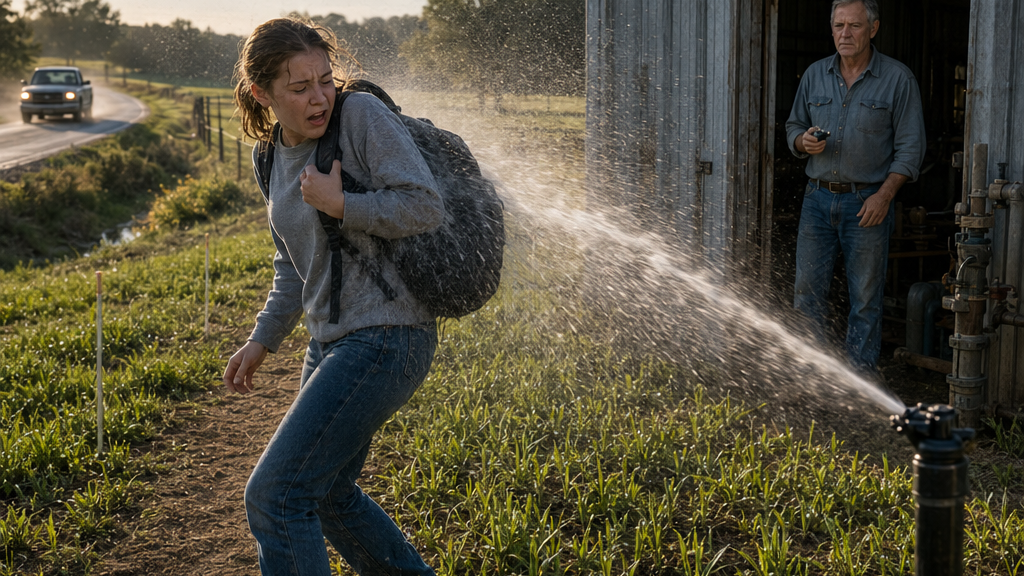
The first sprinkler moved before Rebecca realized it was there.
David heard the mechanical click from inside the equipment shed.
He had been pretending to sort fittings at the workbench while watching the east edge of the field through the open door.
It was 6:45.
Rebecca stepped off the grass verge and onto the worn path with her backpack over both shoulders.
The sensor caught her at once.
The sprinkler head snapped toward her.
A fan of cold water struck her across the side.
Rebecca shouted and twisted away, but the rotating head followed its programmed sweep. A second burst caught the back of her sweatshirt.
For one instant, David felt exactly what he had expected to feel.
Relief.
Not delight.
Not cruelty.
Just the blunt satisfaction of seeing a boundary finally enforce itself.
Rebecca jumped clear of the stream.
She stared toward the farmhouse.
David remained inside the shed.
He expected anger.
A gesture.
Maybe a shouted insult.
Instead, Rebecca yanked her backpack tighter and ran toward the county road.
Not back home.
Toward the road.
She reached the lower corner, stepped onto the narrow shoulder, and hurried along the pavement toward the bus stop.
A pickup came around the bend behind her.
Rebecca moved farther toward the drainage ditch.
The truck passed without slowing.
David’s satisfaction vanished.
He walked out of the shed.
The road was not built for pedestrians. He knew that. Everyone did.
The shoulder looked wide from a truck seat. On foot, especially near the drainage cuts, it narrowed to almost nothing.
Rebecca kept moving.
The school bus appeared beyond the bend.
She made it to the stop before it arrived.
David stood in the field long after the bus pulled away.
At seven twenty, two other teenagers approached.
They spotted the wet patch around the first sprinkler.
One pointed.
Neither entered the field.
They turned and took the road.
Again, David watched them walk single file along the shoulder.
This time a delivery van passed.
One teenager stepped onto the sloped edge of the ditch until it cleared.
David folded his arms.
The system was working.
That was the problem.
By nine, nobody had crossed.
At ten thirty, a woman walking a small dog approached the east opening, saw the first sprinkler twitch, and backed away.
She chose the longer route.
At noon, the brown path was empty.
David drove the tractor through the lower field and inspected the reseeded ground.
No new footprints.
No flattened seedlings.
No fresh scuffs in the damp soil.
It was the first clean stretch he could remember seeing there in years.
He should have been pleased.
Instead, he found himself staring toward the road every time an engine passed.
The visible path through his field had always seemed like proof of one thing: people did not respect the boundary.
Now that nobody was using it, the absence suggested something else.
They had wanted that route badly enough to keep taking it even after being asked to stop.
Why?
Convenience was an answer.
But was it enough?
That afternoon David drove his pickup around the bend and stopped near the bus pickup.
He parked well off the pavement and got out.
From the bus-stop sign, he walked back toward his farm.
The first hundred yards were tolerable.
Then the shoulder narrowed.
A concrete drainage opening cut into the verge.
Beyond it, grass sloped sharply into a ditch.
A truck approached from behind.
David stepped aside.
There was nowhere level to go.
He put one boot on the slope and waited while the truck passed close enough that the wind of it lifted the hem of his shirt.
He watched it disappear.
Then he looked across his fence.
From where he stood, the diagonal path through the field made perfect sense.
It shortened the walk, yes.
But it also avoided the worst part of the road.
David returned to the house irritated with himself.
He had known the shoulder was narrow.
He had driven it almost every day for forty years.
He had simply never considered it from the height of a teenager walking beside traffic.
That realization did not excuse the open gate.
It did not restore the seed.
It did not give Michael Walker the right to treat the field as public property.
David repeated those facts to himself because they were still true.
But they no longer felt complete.
Late in the afternoon, he shut down three of the four sprinkler heads and left only the upper sensor active while he worked near the cattle lot.
The field remained empty.
The grass looked strangely still without people cutting through it.
Near sunset, David watered the reseeded section properly.
This time the spray fell slowly over the ground instead of snapping toward a moving body.
The brown path darkened.
Young green shoots along its edges bent under the water and rose again.
David was coiling a hose beside the porch when a truck came up his drive fast enough to scatter gravel.
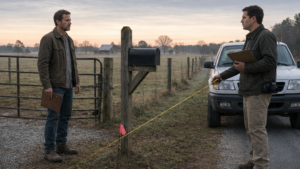
Michael Walker stopped hard near the gate.
He got out before the engine had fully settled.
David recognized the expression before Michael said anything.
It was not neighborly irritation.
It was a father’s anger.
Michael crossed the yard.
“My daughter came home soaked.”
David set the hose down.
“She crossed the field.”
“She was going to school.”
“I asked people to stay out.”
Michael stopped a few feet from him.
“You sprayed a kid on her way to the bus.”
“I installed irrigation on my field.”
“Don’t play games with me, David.”
“I’m not.”
Michael’s jaw tightened.
David could see how this conversation could go if either of them raised his voice.
So he kept his own low.
“The heads activate when somebody enters the seeded section. Stay out of the field, they don’t activate.”
Michael stared at him for a moment.
Then he said, “You really don’t know, do you?”
David frowned.
“Know what?”
Michael pointed toward the diagonal track beyond the fence.
“Your dad showed us where to walk.”
Chapter 4: What David’s Father Had Allowed
“Your dad showed us where to walk.”
Michael Walker said it without raising his voice, which made the words harder for David to dismiss.
They stood a few feet apart beside the farmhouse porch. Behind Michael, the evening sun lay low across the reseeded field, turning every sprinkler droplet into a brief flash. The brown diagonal path was still visible from one fence line to the other.
David looked at it, then back at Michael.
“My father’s been gone eleven years.”
“I know.”
“And whatever he allowed eleven years ago doesn’t mean you get to ignore me now.”
Michael’s mouth tightened.
“You think Rebecca crossed because she wanted to save five minutes?”
“That’s what everybody keeps doing.”
“No. That’s what you decided everybody was doing.”
David felt the old reflex rise in him: state the facts, keep them simple, refuse the argument room to spread.
“It’s my field. I reseeded it. I asked people to stay out.”
“And I told Rebecca she could keep using the route.”
That stopped him.
“You told her?”
Michael nodded once.
“After I put up the notice?”
“Yes.”
David stared at him.
For the first time since Michael arrived, anger pushed past restraint.
“So you knew.”
“I knew you were trying to close something your dad let families use for years.”
“That doesn’t make it yours.”
“I didn’t say it did.”
“You sent your daughter across anyway.”
“I told her not to walk that shoulder.”
Michael pointed toward the road.
David followed the gesture despite himself.
A pickup came through the bend too quickly, tires humming near the painted edge. There was no sidewalk. Only a strip of uneven grass, then the drainage slope.
“She nearly got clipped out there two years ago,” Michael said. “Mirror came close enough she felt the wind off it.”
David looked back.
“You could’ve come talked to me.”
“I figured you knew why the path was there.”
“And I figured people could read a sign.”
Neither spoke for several seconds.
The problem had shifted.
Not disappeared.
Shifted.
David still saw flattened seed when he looked at the path. He still saw the open cattle gate.
Michael apparently saw his daughter beside passing traffic.
“You said my dad showed you where to walk.”
“He showed my oldest boy first. Years ago. Then Rebecca used the same way when she got old enough.”
“Did he put anything in writing?”
Michael gave a humorless breath.
“You know your father better than that.”
David did.
That was exactly the problem.
Monday morning, he drove to the county offices with a folder containing his deed, parcel printout, and old survey notes.
Catherine Clark met him at a counter stacked with plat books and rolled road plans.
She listened while David explained the field path.
When he finished, she did not immediately agree with either side.
“That route show up on your deed?”
“No.”
“Recorded easement?”
“Not that I can find.”
“Let’s see.”
They spent the next half hour moving backward through records.
A subdivision plat showed Michael’s property.
An older farm survey showed David’s eastern boundary.
A utility easement crossed another portion of the acreage but nowhere near the dirt path.
Catherine pulled up an aerial image from several years earlier.
There it was.
A faint diagonal line across the field.
David leaned closer.
“You can see it.”
“You can.”
“That doesn’t make it an easement.”
“No.”
She enlarged the image.
Another older photograph showed the same line, weaker but present.
David felt a small uneasiness.
“How far back?”
“Image set here is about sixteen years.”
Before his father died.
Catherine searched the recorded instruments again.
“No dedicated pedestrian easement. No public access strip through that field.”
David exhaled.
There it was.
The clean answer he had been expecting.
“So legally—”
Catherine raised a hand.
“I can tell you what is recorded. I’m not your attorney, and I’m not going to decide whatever private permission may have existed.”
“But there’s no county path.”
“Correct.”
He nodded.
The simplicity returned, briefly.
Then Catherine clicked into another layer.
“What’s this?”
A road-improvement plan appeared.
David recognized the bend immediately.
The drawing showed the county road before drainage reconstruction.
A wider shoulder ran along the outside edge.
Catherine opened the later plan.
The shoulder narrowed where a concrete drainage structure had been installed.
David leaned over the counter.
“When was that?”
She read the date.
Almost twenty years earlier.
He studied the cross-section.
The original walking space had been reduced exactly where he had stepped into the ditch to let the truck pass on Saturday.
Catherine traced the line with one finger.
“They deepened the drainage here. More runoff capacity.”
“And lost the shoulder.”
“Part of it.”
David said nothing.
Suddenly Rebecca running from the sprinkler toward the pavement returned to him with unpleasant clarity.
Her wet sweatshirt.
Her backpack bouncing.
The pickup overtaking her.
Catherine closed the plan.
“Again, none of this creates an easement across your land.”
“I heard you.”
“But I’m guessing that’s not the whole question anymore.”
David gathered his papers.
He disliked the accuracy of the remark.
On the drive home, he stopped at the bus pickup and looked back toward his farm.
From there, the diagonal path did not look like an intrusion.
It looked like the straightest line around a problem.
That difference bothered him.
He still believed Michael had been wrong to tell Rebecca to ignore the closure.
He still believed the field could not become a permanent unmarked public corridor.
Both things could be true.
That afternoon he walked the roadside boundary slowly.
Near the drainage structure, there was barely enough level ground for one person.
He pictured his father standing there years ago, seeing schoolchildren forced toward traffic.
His father had been generous in ways David sometimes admired and sometimes resented.
He lent tools without writing down names.
Let neighbors cross gates without specifying whether permission lasted a day or ten years.
Solved immediate problems and left future definitions to somebody else.
Often, that somebody had been David.
Back at the farmhouse, he opened the cabinet of old records again.
This time he did not search for deeds.
He searched for his father.
Field notebooks occupied a cardboard box on the bottom shelf, pages stained by rain, grease, fertilizer dust, and years of being carried in shirt pockets.
David turned through them.
Calving dates.
Fence repairs.
Seed rates.
Fuel purchases.
A note about replacing the east gate.
Then he found a hand-drawn sketch of the lower field.
The diagonal route was marked in pencil.
Beside it, his father had written one short line.
David read it twice.
Kids through east side until road gets fixed.
Chapter 5: The Permission Nobody Ever Wrote Down
Kids through east side until road gets fixed.
David carried the notebook to the kitchen table and laid it beneath the lamp.
The sentence was written in his father’s cramped hand, between a note about a leaking trough and a reminder to order fence staples.
No date beside it.
No signature.
No explanation.
Nothing that looked remotely legal.
Yet it unsettled David more than any recorded easement could have.
He ran one finger along the penciled line.
Until road gets fixed.
The road had never been fixed.
Not in the way his father must have meant.
The drainage work had remained. The shoulder had remained narrow. Children had continued cutting across the field.
And what his father had intended as a temporary accommodation had slowly hardened into something everyone treated as permanent.
David understood that kind of transformation.
A favor repeated often enough became expectation.
Expectation repeated long enough became memory.
Then memory started sounding like ownership.
The next morning, he walked to the east side before breakfast.
The sprinklers were off.
The dirt path lay untouched.
Green shoots were beginning to show through the brown in several places.
He should have felt vindicated.
Instead, the notebook sentence stayed with him.
Michael’s truck appeared near the neighboring property shortly after eight.
David crossed to the fence.
“Michael.”
Michael stopped.
David held up the notebook.
“Found something.”
They met near the east gate.
David opened to the marked page.
Michael read the line.
His expression changed, but not the way David expected.
He did not smile.
Did not say I told you so.
He only nodded.
“That sounds like him.”
“It says until the road gets fixed.”
Michael looked toward the pavement.
“Did it?”
“No.”
“Then there you go.”
“No.”
Michael’s eyes returned to him.
“No?”
“It means my dad made an arrangement. It doesn’t mean you get to decide the arrangement continues forever.”
Michael folded his arms.
“So what are you saying?”
“I’m saying I understand why he did it.”
“That’s not the same thing.”
“No. It isn’t.”
Michael glanced at the field.
“You want me to tell Rebecca to walk the road?”
“I want you to stop telling her my instructions don’t matter.”
Michael went still.
David watched the point land.
“You told her to keep crossing.”
“I did.”
“After you knew I’d reseeded.”
“Yes.”
“Why not call me?”
Michael looked away.
For several seconds, only insects moved in the grass.
Then he said, “Because I knew what you’d say.”
“You didn’t.”
“I thought I did.”
David waited.
Michael rubbed the back of his neck.
“Rebecca came home last spring white as a sheet. Some guy in a work truck came around that bend while she was walking. She had nowhere to go except down the ditch. Slid halfway to the drainage pipe.”
David remembered the steep bank.
“She hurt?”
“Scraped her hands. Twisted an ankle a little. Mostly scared.”
“You never told me.”
“No.”
“Why?”
Michael gave him a tired look.
“Same reason you put in sprinklers instead of coming to my door.”
The answer irritated David because it was fair enough to hurt.
Michael continued.
“When you put that sign up, Rebecca asked me what to do. I told her your dad had always let us through and to stay on the same path. I figured you were mad about random people cutting anywhere they wanted.”
“The sign said field.”
“I know what it said.”
“And you ignored it.”
“Yes.”
There was no excuse in Michael’s voice now.
Only responsibility.
That changed something.
David had expected Michael to keep hiding behind his father’s permission.
Instead, Michael owned the choice.
“I was wrong about that,” he said. “I should’ve talked to you.”
David looked toward the worn diagonal.
“I should’ve asked why she kept using it.”
Neither apology solved the field.
But they removed one obstacle.
David opened the notebook again.
“Dad wrote ‘until road gets fixed.’”
Michael nodded.
“He thought it would be a year or two, probably.”
“It’s been nearly twenty.”
“And the shoulder’s worse.”
David knew that already.
He had walked it himself.
“What do you want?” he asked.
“Open the path.”
“No.”
Michael’s jaw tightened again.
“It’s the safest way.”
“It cuts through the middle of working ground. I run irrigation there. Cattle use the lower gate. People have already left it open.”
“Then move the gate.”
David stared at him.
“That’s my point. Every informal solution turns into my permanent job.”
Michael did not answer.
David gestured toward the new grass.
“I lose crop. I fix fences. I carry the liability. And every time I object, somebody tells me my father was fine with it.”
“He was.”
“He was also supposed to fix the east trough fifteen years before he died.”
That almost pulled a smile from Michael.
Almost.
David shut the notebook.
“I’m not reopening the diagonal.”
Michael’s face closed.
“But I’m not done thinking.”
David left him there and walked toward the road.
He spent the next hour measuring.
Not the old path.
The outer edge.
From the east entrance, a narrow strip could follow the fence south, stay outside the best hay ground, then angle near the drainage boundary toward the bus stop.
Longer than the diagonal.
Shorter than the road.
The irrigation arc could miss it.
The cattle gate could remain separate.
David drove stakes every twenty feet.
One line.
Then another.
By noon, the route was visible.
Michael came outside and watched from across the fence.
“What are you building?”
David pulled the tape measure taut between two stakes.
“I haven’t decided yet.”
But that was not entirely true.
For the first time since the footprints appeared, he was no longer measuring how to keep people out.
He was measuring where they might safely go.
Chapter 6: A Boundary That Did Not Cut the Farm in Half
The first stake went into the ground where nobody had ever walked before.
David drove it with three blows of a small sledge, checked the line against his tape, then moved twenty feet farther down the east fence.
By nine Wednesday morning, a row of stakes curved around the edge of the hayfield.
They did not follow the old shortcut.
That was deliberate.
The brown diagonal cut through the most useful part of the lower acreage. It crossed irrigation coverage, passed too close to the cattle connection, and encouraged people to treat the entire field as open.
The new line hugged the perimeter.
David measured twice.
A six-foot walking strip would cost him some ground, but not much productive ground. It would avoid the drainage ditch until the last section, where the fence already ran close to the bus-stop frontage.
He marked a place for a narrow pedestrian gate.
Then Michael Walker arrived.
He came on foot this time.
When he saw the stakes, his expression hardened.
“So this is it?”
David straightened.
“What?”
“You’re fencing the whole thing off.”
“No.”
“Looks like a fence line.”
“It is.”
Michael let out a sharp breath.
“David, we talked about this.”
“We did.”
“And you’re doing exactly what you were already going to do.”
David rested both hands on the sledge handle.
“Walk the stakes.”
“What?”
“Start there.”
He pointed toward the east entrance.
“Follow them.”
Michael did not move.
David waited.
Eventually Michael stepped inside the proposed strip.
He followed the stakes south along the fence, then around the edge of the field.
When he reached the lower section, he looked toward the road.
The line connected almost directly with the bus-stop area.
Michael stopped.
David caught up.
“The middle field stays closed,” David said.
Michael looked back along the route.
“This is for walking?”
“Yes.”
“You’re giving up a strip?”
“I’m defining one.”
The distinction mattered to David.
Michael seemed to understand that.
“How wide?”
“Six feet.”
“That enough?”
“For people. Not trucks. Not four-wheelers. Not somebody deciding it’s a new driveway.”
“And the sprinklers?”
“Outside the strip.”
Michael looked toward the old brown path.
“You really planned all this?”
“I measured it.”
“That wasn’t what I asked.”
David gave him a flat look.
Michael almost smiled.
They continued toward the road.
At the proposed gate location, David showed him how the latch would open from both sides without connecting to the cattle enclosure.
“No one touches the livestock gate,” David said.
“Fair.”
“No one cuts across because they’re late.”
Michael nodded.
“No dogs loose.”
“Fine.”
“And if the walking gate breaks, I’m not going to be the only one fixing it.”
Michael looked at him.
“You want me to maintain it?”
“I want you to share responsibility for the thing you’ve been arguing should exist.”
That produced a longer silence.
Then Michael said, “All right.”
David studied his face.
“Just like that?”
“You were expecting another fight?”
“A little.”
Michael looked down the proposed route.
“I wanted Rebecca off the road. You want people out of the hay. This does both.”
“It also adds a gate I didn’t need.”
“And removes an argument you didn’t need.”
David could not disagree.
They spent the afternoon setting two corner posts.
Michael brought a post-hole digger from his place without being asked.
They worked mostly without conversation.
The lack of friendliness did not bother David.
Cooperation did not have to look like reconciliation.
At one point Michael leaned on the digger and said, “Your dad would’ve just told everybody where to walk and forgotten the rest.”
“That’s how we got here.”
“Probably.”
David tamped soil around the post.
“He solved the day he was standing in.”
Michael nodded.
“You solve ten years ahead.”
“Somebody has to.”
“Maybe both of you overdo it.”
David looked at him.
Michael returned to the hole before David could answer.
By Thursday afternoon, wire separated the narrow route from the active field. David used simple farm fencing, nothing decorative, but the line was unmistakable.
The old diagonal remained visible beyond it.
A shortcut from nowhere to nowhere.
Rebecca came home before the work was finished.
She stopped at the gate.
“What’s that?”
David wiped his hands on his jeans.
“Path.”
She looked toward the stakes.
“For us?”
“For pedestrians.”
Her eyes moved to the brown diagonal.
“So we can’t use the old one?”
“No.”
“Even though your dad—”
“No.”
She caught herself.
David’s tone had been firmer than he intended.
He softened it slightly.
“My father let people cross because the road was bad. That doesn’t mean the middle of the field has to stay open forever.”
Rebecca studied the new route.
“It’s longer.”
“Yep.”
“Not as long as the road.”
“No.”
She gave a small nod.
“That seems fair.”
David almost laughed.
Michael had argued for days.
Rebecca solved the judgment in three seconds.
Friday morning, David hung the pedestrian gate.
Michael installed the latch.
It stuck on the first try.
“You bought a cheap one,” Michael said.
“You installed it crooked.”
They adjusted it until it swung cleanly.
For the first time, the east side of the property looked intentional.
There was the crop.
There was the fence.
There was the walking strip.
Nobody had to guess which was which.
That afternoon David repositioned two sprinkler heads to keep their arcs completely inside the hay ground.
The third no longer served much purpose.
The fourth could remain near the recovering diagonal.
Rebecca appeared while he was adjusting it.
She stood outside the fence.
“Is that the one?”
David glanced up.
“The one what?”
“That got me.”
“First one did.”
She looked disappointed.
“That one?”
“Up by the east opening.”
She turned to inspect it from a distance.
“I never even saw it.”
“That was the idea.”
Rebecca shook her head.
“It was freezing.”
“Water tends to be.”
She laughed once.
Then she looked at the old shortcut.
“Are you leaving them on?”
David tightened the sprinkler connection.
“For irrigation.”
“I mean if somebody crosses.”
He paused.
The system could still do exactly what he built it to do.
Detect movement.
Snap toward the trespasser.
Enforce the line without David saying a word.
He had liked that part.
Maybe too much.
Rebecca rested one hand on the new gate.
“So Monday morning,” she said, “if somebody forgets and takes the old way, are you still going to spray them?”
David looked from her to the recovering brown path.
He had built a new boundary.
Now he had to decide what kind of man would stand behind it.
Chapter 7: When the Grass Covered the Shortcut
Rebecca reached the old diagonal path and slowed.
From the equipment shed, David saw the hesitation immediately.
Three weeks had passed since they finished the perimeter route, but the old shortcut was still visible if a person knew where to look. The center had begun to green over. Young blades now covered most of the brown scar, though a few bare patches remained where years of shoes had packed the soil hardest.
Rebecca stood at the place where she had entered the field the morning the sprinkler soaked her.
David stopped what he was doing.
She looked across the hayfield.
Then she turned away from it.
She walked six steps along the fence, lifted the latch on the narrow pedestrian gate, and entered the new path.
David let out a breath he had not realized he was holding.
The route had worked from the first Monday.
At first, people used it cautiously.
The neighboring teenagers stayed close to the fence as though expecting David to appear and tell them they were doing something wrong. A woman with a small dog stopped at the gate twice before understanding that the walking strip was intentional.
Rebecca used it every school morning.
Nobody crossed the center field.
Nobody touched the cattle gate.
And because the new path was fenced off from the crop, David no longer found footprints scattered where they did not belong.
The arrangement was not perfect.
Nothing involving people ever was.
A week earlier, someone had failed to pull the pedestrian gate fully shut.
David found it swinging in the morning.
His first reaction had been the old one.
There. This is how it starts.
One loose latch, then two, then everyone decides the rules are optional again.
He had walked toward the gate already rehearsing what he would say to Michael.
Then he noticed the hinge was dragging.
The gate itself had shifted after rain softened the post.
It had not been carelessness.
It had been hardware.
David fixed it and said nothing.
Two mornings later, he came down the lane and found Michael kneeling beside the same latch with a wrench.
David stopped.
Michael glanced up.
“Still dragging.”
“I fixed that.”
“You almost fixed it.”
David looked at the gate.
Michael tightened the lower bolt, lifted the frame, and worked the latch twice.
It clicked cleanly.
“There.”
David rested one forearm on the fence.
“You planning to send me an invoice?”
Michael stood.
“Thought I’d put it under long-term unauthorized pedestrian infrastructure.”
David looked at him.
Michael smiled.
David tried not to.
Failed.
That was about as close as either of them had come to discussing the argument since the path opened.
They did not need more.
The responsibility had become visible.
Michael checked the gate.
David maintained the fence.
Rebecca reminded the younger teenagers to stay on the marked route.
The field remained a field.
The path remained a path.
No one had to pretend they were the same thing.
Now, watching Rebecca approach the lower end of the perimeter strip, David noticed how different the route looked from the old diagonal.
The first path had been created by repetition.
No stakes.
No agreement.
No definition.
Just enough people choosing the same line until everyone assumed the line belonged there.
The new path had posts, wire, a gate, and limits.
It existed because somebody had decided where responsibility began and ended.
That difference mattered more to David than he had expected.
The sprinklers were still installed.
Three remained shut off.
The fourth, near the old shortcut, ran on David’s ordinary irrigation schedule.
At eight that morning, it clicked on.
Rebecca glanced toward the sound.
The sprinkler rotated slowly and sent a clean arc across the recovering grass.
She stopped outside its reach.
David watched her grin.
She raised one hand toward the equipment shed.
“Still dangerous?”
David stepped into the doorway.
“Only if you’re grass.”
“That thing holds a grudge.”
“It’s a sprinkler.”
“That’s not what it felt like.”
She opened the lower gate.
David walked closer.
“You still mad about it?”
Rebecca considered the question.
“No.”
Then she added, “I was that morning.”
“Fair.”
“My backpack smelled like pond water all day.”
“That wasn’t pond water.”
“Didn’t improve it.”
David nodded toward the perimeter path.
“How’s that working?”
“It’s fine.”
“Fine?”
“It’s six feet longer than it needs to be.”
He stared at her.
Rebecca smiled.
“But I don’t have to walk the road.”
That was the answer that mattered.
A school bus appeared beyond the bend.
Rebecca hurried through the gate.
Before closing it, she turned.
“Mr. Green?”
“Yes?”
“Your dad really let people use the old path?”
David looked across the field.
“Apparently.”
“Why’d he stop writing about it?”
“He probably thought the county would fix the shoulder.”
Rebecca glanced at the road.
“They didn’t.”
“No.”
She rested her hand on the gate.
“So you fixed something else.”
David did not answer immediately.
The bus was getting closer.
Rebecca closed the latch.
This time it clicked properly.
She ran toward the stop.
David watched until she boarded.
Then he walked into the hayfield.
The old diagonal remained faintly visible beneath the new growth.
He followed it.
Near the middle, he stopped where the dirt had once been packed hardest.
Grass now covered almost everything.
He remembered standing there angry over footprints.
He remembered the graph paper.
Four circles.
Four sensors.
A problem reduced to lines and measurements.
He had not been wrong about the land.
That mattered.
Michael had not been right to ignore the closure.
That mattered too.
But David had been wrong about something more difficult to measure.
He had looked at everyone on the path and assumed they were crossing for the same reason.
Convenience.
Entitlement.
Habit.
Some probably had been.
Rebecca had not.
Neither had his father.
Years earlier, his father had looked at a bad roadside shoulder and solved the problem in the simplest way available: let the children cross.
He had never created a public road.
Never surrendered the field.
He had simply made room.
David still wished he had written the arrangement more clearly.
That part would never change.
But clarity did not have to mean refusal.
The sprinkler swept past again.
Water darkened the earth between the new blades.
Beyond the fence, two teenagers came down the perimeter path toward the bus stop.
Neither looked toward the diagonal.
David stepped aside and let the sprinkler continue its slow rotation.
A little later, Michael’s truck passed on the county road.
He slowed near the gate.
The latch was still closed.
Michael lifted two fingers from the steering wheel.
David returned the gesture.
No apology.
No ceremony.
Just acknowledgment.
By early September, the hayfield had nearly erased the old shortcut.
From the farmhouse window, David could still find it because he knew the exact angle.
Most people would not have noticed.
The new route, however, was easy to see.
It followed the fence instead of cutting through the middle.
Longer.
Safer.
Deliberate.
David stood at the lower corner one evening and watched the sprinkler water the last stubborn bare patch.
Tiny green shoots trembled under the spray.
The brown line that had once seemed permanent disappeared beneath them.
The story has ended.