They Built a Community Bridge Across His Farm—Then the Survey Flags Changed What Everyone Believed
Chapter 1: The Bridge That Ended at Two Steel Gates
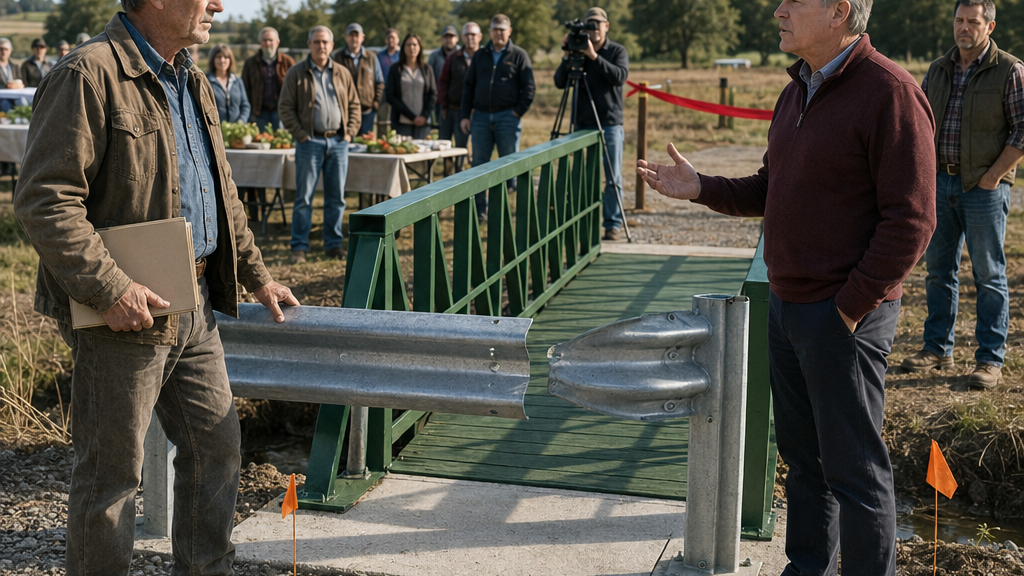
By eight-thirty Saturday morning, fifty people had gathered beside a bridge nobody could cross.
A red ribbon stretched between two temporary posts at the eastern approach. Folding tables stood near the farm-market parking area with coffee, doughnuts, and paper programs. A local reporter had positioned a camera where the new green pedestrian bridge rose cleanly over the drainage ditch.
And at both ends of it stood heavy steel barriers bolted into concrete.
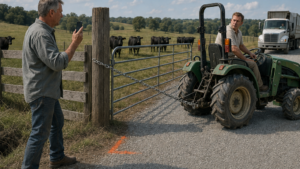
James Nelson rested one hand on the top rail of the western barrier and watched George Miller walk toward him.
George did not hurry. That was one thing James had always known about him. George believed a man who hurried surrendered something.
His jaw was tight, though.
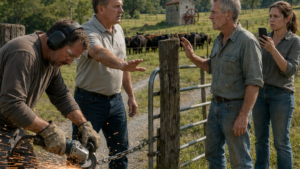
“What is this?”
James looked at the barrier.
“It looks pretty much like what it is.”
“Don’t do that today.”
Behind George, voices had begun to lower. People who had been studying the bridge were now studying the two men.
The bridge itself was impressive enough. Powder-coated steel rails, treated deck boards, concrete landings. It crossed the drainage ditch at the narrow place where walkers had spent years stepping over rocks or circling along the county road.
An orange survey flag trembled beside the barrier near James’s boot.
George pointed toward the bolts.
“Take these out.”
“No.”
“They’re blocking a community project.”
“They’re on my property.”
George stared at him.
James had expected anger. He had rehearsed for anger.
What he had not expected was George’s brief expression of disbelief, as if James had violated some understanding that everyone else had already accepted.
“You knew we were opening today.”
“Yes.”
“You knew families were coming.”
“Yes.”
“You knew we had the paper out here.”
James glanced toward the reporter.
“I knew.”
George stepped closer.
“Then you did this for the show.”
James kept his voice level.
“I did it before the show.”
That answer traveled farther than he meant it to. A few people near the coffee table turned.
George lowered his voice.
“You need to remove them before this gets stupid.”
James reached into the folder tucked beneath his arm and removed a county permit, a contractor invoice, and a stamped sketch showing the barriers entirely inside his parcel.
George barely looked.
“I’ll call the county.”
“They’ve got copies.”
“I’ll call the sheriff if I have to.”
James slipped the papers back into the folder.
“You can call whoever you think you need.”
The reporter had moved closer without pretending not to.
George noticed too.
His face changed.
For six weeks James had imagined this moment differently. He had pictured George standing before the bridge with nowhere to go, finally forced to acknowledge that a property line did not disappear because enough people wanted it to.
The picture had been satisfying.
The reality felt smaller.
A woman with two children stood by the ribbon, explaining why they could not walk across yet. A vendor rolled a cart back toward the parking lot. Someone asked whether the opening had been canceled.
George said, “That approach has been used for years.”
“Used isn’t owned.”
“There’s recorded access.”
James’s hand tightened around the folder.
“No current easement shows on my deed.”
“That doesn’t mean there isn’t one.”
James looked at him.
George’s confidence had returned.
Not bluster this time. Something else.
“You think I never checked?” George asked. “You think I built a bridge because I felt like putting one in your pasture?”
“It isn’t my pasture. It’s the drainage strip.”
“You know what I mean.”
“No. I know what twelve feet means.”
George exhaled through his nose.
Ryan Thomas had come over from the crowd. He kept several feet between himself and both men.
“George.”
“Not now.”
Ryan looked at the barriers, then James.
“Are these permanent?”
“As permanent as they need to be.”
George laughed once without humor.
“There. That’s what this is.”
James turned toward him.
“What?”
“Not a boundary. A lesson.”
James said nothing.
The answer sat between them long enough that Ryan looked away.
George reached toward James’s folder.
“You’ve got your deed. Fine. You’ve got your survey. Fine. But before you make yourself look like the only man in the county who ever read a plat, you might want to look at the older one.”
“What older one?”
George’s expression sharpened.
“The Miller tract division. Before your twelve-foot strip was separated out.”
James felt the morning rearrange itself around those words.
He had read his deed. Sarah King had read it. The surveyor had read the recorded description.
There was no easement.
George pointed toward the eastern side of the ditch.
“That path was a farm lane before there was a market. Before half these houses were here. Access ran through that strip.”
“Past use isn’t the same as a recorded right.”
“No.”
George nodded.
“But a recorded right is.”
Ryan finally spoke.
“George, if you have something recorded, why didn’t you settle this six weeks ago?”
George looked at him.
“Because I thought James knew.”
James almost laughed.
Instead he said, “Knew what?”
George stepped closer, voice quiet enough now that only the three of them could hear.
“Book Forty-Seven. Plat Nine. County archive.”
James’s mouth went dry.
He knew the reference.
Not the contents. The reference.
It appeared in the chain of title as an older parent parcel, one he had never needed to pull because every modern document after it showed the same clean twelve-foot strip beside the ditch.
George watched recognition cross his face.
“There it is,” he said.
James looked past him at the bridge, trapped between the two barriers he had installed before sunrise.
For the first time that morning, it no longer looked like proof.
It looked like a question.
Chapter 2: Orange Flags Along the Drainage Fence
Six weeks earlier, James had found the first orange flag twenty-three inches inside his fence.
He knew because he measured it.
The flag itself was nothing remarkable: thin wire, bright plastic, pushed into damp soil beside the drainage ditch. Another stood fifteen yards farther north. A third had been planted near the worn path people sometimes used during Saturday market traffic.
James pulled none of them.
He walked the strip twice instead.
The drainage corridor ran along the east side of his farm, narrow enough that most people barely noticed it belonged to anyone. His hayfield began beyond the fence. The ditch carried stormwater south beneath the county road. For eleven years James had paid taxes on the little twelve-foot piece between them.
It produced nothing.
That did not make it ownerless.
He photographed every flag.
By lunchtime, he found a laminated notice on the market association board near the gravel parking lot.
PEDESTRIAN ACCESS IMPROVEMENT.
Below it was a simplified site plan.
James stood there long enough that a vendor carrying empty produce crates asked whether he needed something.
“No.”
He leaned closer.
The proposed bridge crossed the drainage ditch almost exactly where people had worn the informal footpath. One approach sat on association land.
The other landed on his twelve-foot strip.
James took another photograph.
Then he went home and opened the steel file cabinet in his office.
His deed was in the second drawer beneath machinery records and tax receipts. He unfolded the survey attached to the closing documents and traced the eastern description with his finger.
Twelve feet.
No notation beside it.
No easement symbol.
No public-access language.
At three that afternoon, he called George.
“You’ve got survey flags on me.”
There was a pause.
Then George said, “They’re laying out the bridge.”
“I gathered that.”
“Good. Saves time.”
James looked through his office window toward the drainage line.
“The western approach is on my parcel.”
“It’s on the access strip.”
“My access strip?”
“The old access.”
James waited.
George continued, “People have crossed there for years.”
“That isn’t what I asked.”
“What are you asking?”
“Who gave permission to build on my land?”
George sighed.
Not angrily.
Almost wearily.
“James, we’ve been talking about this project since winter.”
“You haven’t talked about it with me.”
“It’s been at three meetings.”
“I don’t go to your meetings.”
“That’s your choice.”
James felt irritation rise, but he kept his voice flat.
“So is whether anyone builds on my property.”
“We’re improving a crossing that’s already used.”
“With concrete?”
“With a bridge.”
“George.”
A silence followed.
James could picture him behind the desk at the association office, glasses low on his nose, one hand over whatever stack of papers he considered more important than this conversation.
George finally said, “The grant has deadlines. The contractor is scheduled. If you’ve got a concern, send it in writing.”
Then he hung up.
James held the phone for several seconds.
That evening he walked the strip again.
The orange flags looked different now.
Not like questions.
Like assumptions.
Two days later, a bridge contractor’s truck appeared near the ditch.
James crossed the field before the driver had finished unloading stakes.
“I need to see your layout.”
The contractor hesitated, then unfolded a rolled plan on the hood of the truck.
James placed one finger on the western footing.
“That point is where?”
The contractor turned the page toward himself.
“According to what they gave us, twelve feet west of ditch center.”
James stared at him.
“That’s mine.”
The contractor frowned.
“We were told access was cleared.”
“By who?”
“Association.”
James took out his phone and photographed the drawing.
The contractor did not stop him.
James drove to town that afternoon and scheduled a licensed survey.
The earliest appointment was the following Thursday.
“What are they doing before then?” he asked.
The surveyor checked his calendar.
“Couldn’t tell you.”
James could.
The contractor had left a schedule clipped beneath the site notice.
Excavation Monday.
Forms Tuesday.
Concrete Wednesday.
Survey Thursday.
James went back to the association board at dusk and photographed the schedule.
Then he called George again.
No answer.
He emailed photographs of his deed description, the construction drawing, and the orange flags.
The reply came forty minutes later.
We believe the project is within the established access corridor. Construction will proceed as scheduled.
James read it twice.
He started typing.
Stopped.
Deleted what he had written.
For years, he had avoided arguments at board tables because he knew how those rooms worked. Six people talking at once. Someone saying everybody knew something. Someone else remembering an agreement nobody could produce. By the end, facts blurred into consensus.
He trusted paper.
Lines.
Dates.
Records.
Paper did not interrupt.
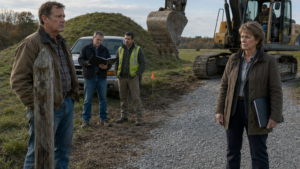
On Monday morning, an excavator arrived.
Its bucket peeled sod from the edge of the drainage strip.
James stood behind the fence with his phone and recorded the first cut.
The operator noticed him and raised one hand uncertainly.
James raised his back.
He did not stop the machine.
By Tuesday afternoon, wooden forms had appeared.
The surveyor was still two days away.
Then, shortly before five, the contractor drove a stake beside one form and sprayed a bright mark onto the soil.
James walked down after they left.
He measured from the fence.
Then from the ditch.
Then again.
The form sat squarely where his deed said it should not.
His phone buzzed.
It was an automated scheduling message from the survey company confirming Thursday at nine.
James looked at the forms.
A concrete truck was scheduled for Wednesday morning.
Chapter 3: The Survey Line Crossed the Concrete Forms
The surveyor arrived Thursday to find fresh concrete where an open strip of grass had been three days before.
James said nothing about that at first.
He simply handed over the deed.
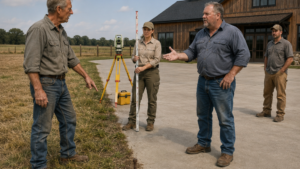
The surveyor spent nearly an hour locating monuments, checking measurements, and setting equipment along the eastern boundary. James followed at a distance, resisting the urge to ask questions every time the instrument turned.
At last the surveyor drove a capped marker into the ground near the bridge approach.
Then another.
He stretched a temporary line between them.
The line crossed directly over one corner of the new concrete footing.
James stared at it.
“How far?”
The surveyor checked his notes.
“At the worst point? Just over four feet.”
“Inside mine.”
“Yes.”
James looked toward the opposite approach.
“And the path?”
“Mostly yours on this side.”
The answer should have felt good.
Instead James thought of George’s email.
Established access corridor.
He took photographs from every angle.
The orange association flags now stood beside the surveyor’s markers like two competing versions of reality.
By noon, James was in Sarah King’s office with the deed, photographs, bridge plan, and survey.
She read before she spoke.
That was one reason he had called her.
Finally she said, “Survey looks clear.”
“It is clear.”
“I said the survey looks clear.”
James leaned back.
“What does that mean?”
“It means boundary and access are two different questions.”
He frowned.
“There’s no easement on the deed.”
“I see that.”
“So?”
“So I check the chain.”
James disliked the answer because it required waiting.
Sarah noticed.
“You hired me to tell you what’s true, not what feels satisfying.”
“I know what I own.”
“Probably.”
“Probably?”
She tapped the survey.
“You own the parcel. That isn’t the same as proving nobody retained a right across it in some older instrument.”
James thought of George saying old access.
“Can you find out?”
“Yes.”
“How long?”
“Depends how old it is.”
James slid George’s email across the desk.
Sarah read it.
“Did you tell him you were getting a survey?”
“Yes.”
“Did you send the result?”
“Not yet.”
“Send it today.”
She drafted a short notice instead.
It identified the parcel, attached the survey, disputed the association’s right to construct, demanded that no further work occur inside James’s boundary, and reserved his rights.
James expected something sharper.
“This is it?”
“This is enough.”
“He already poured concrete.”
“Then we document that too.”
By three-thirty, the notice had been emailed to George, the association’s general address, and the bridge contractor.
The next morning Sarah had a copy delivered to the county recorder with an encroachment affidavit referencing the disputed construction.
James drove past the site after feeding cattle.
Two workers were unloading steel rail sections.
He stopped.
The contractor walked over.
“We got the letter.”
“And?”
“We’ve asked the association.”
“For what?”
“Direction.”
James looked at the new footing.
“Seems like direction ought to be simple.”
The contractor gave him a tired look.
“I build what the client tells me to build unless somebody with authority tells me not to.”
“I’m the owner.”
“I’m not arguing with you.”
“But you’re working.”
“Not on your side this morning.”
That distinction lasted until afternoon.
A small loader began grading the approach.
James photographed it from inside his fence.
Then he called Sarah.
“They’re still going.”
“I know.”
“How?”
“The contractor’s lawyer contacted me.”
“And?”
“They say their contract is with the association, and the association says it has access rights.”
James watched dirt spill from the loader bucket.
“What do we do?”
“We can ask the court for emergency relief.”
He had expected that answer.
“How fast?”
“We can move quickly. Not instantly.”
“And if we don’t?”
Sarah was quiet for a moment.
“Then you keep documenting, but you also accept that damages and consequences can grow.”
James looked at the bridge pieces laid out in the grass.
“What if I let them?”
Another pause.
“Why would you?”
James did not answer.
Sarah said, “James.”
“They’ve had the survey.”
“Yes.”
“They’ve got the notice.”
“Yes.”
“It’s on the county record.”
“Yes.”
“So if they keep building, that’s their choice.”
“It is their choice.”
“Then maybe they should own it.”
Sarah’s voice changed slightly.
“Be careful.”
“With what?”
“With deciding that because somebody is wrong, you have no responsibility for what you knowingly let happen next.”
James almost told her responsibility belonged to the people pouring concrete on land they did not own.
Instead he said, “I’m not stopping them from stopping.”
“No. But you’re considering not stopping them from making the problem worse.”
He looked toward the ditch.
For years people had crossed there during market weekends. James had mostly ignored it. A muddy boot path was not worth a feud. Once he had even replaced a loose fence staple farther north rather than complain after someone squeezed through.
Then the shortcut had become expected.
Then marked.
Then designed.
Then poured.
Small permissions had a way of losing the memory of who gave them.
“I want the record clean,” James said.
“It already is.”
“I want there to be no argument.”
Sarah exhaled.
“There is always an argument.”
That evening, the steel frame of the bridge arrived on a flatbed.
James watched from the farm lane as a crane lifted the first section.
George stood beside the contractor wearing a reflective vest over his work shirt.
For a moment their eyes met across the ditch.
George did not wave.
Neither did James.
The bridge section swung over the water and settled onto the concrete supports.
James raised his phone and took another photograph.
Sarah called before he reached the house.
“I pulled your current deed and the immediately preceding deed.”
“And?”
“No easement appears.”
James stopped walking.
“So we were right.”
“So far.”
He smiled despite himself.
Then she continued.
“But I found a reference in the older chain to a farm-access plat that isn’t digitized. I’ve requested it from the archive.”
James’s smile disappeared.
“How old?”
“Old enough that I don’t want to guess.”
He looked back toward the bridge.
George was still there.
“What does that mean?”
“It means don’t assume this is finished.”
James watched George point toward the western approach as the crew aligned the rail.
Sarah said, “And if you’re asking me whether you should let them keep building while we find out, my advice is no.”
James said nothing.
“James?”
“I heard you.”
“Then hear the rest. Waiting can become a decision too.”
Across the field, a worker drove another orange flag into the ground beside the newly set bridge.
James watched it snap once in the wind.
He still did not ask Sarah to stop the work.
Chapter 4: The Old Plat Made George Look Right
Sarah called James two weeks later and told him not to come to her office angry.
“I’m not angry.”
“You haven’t seen what I found.”
He set the wrench he was holding on the workbench.
“What did you find?”
“The plat George mentioned.”
James drove to the county records office before lunch.
Sarah was waiting at a table beneath fluorescent lights with a sheet of paper almost too large for the space. It was a copy of an old hand-drawn plat, the lines faint enough that someone at the archive had enhanced them before printing.
Sarah pointed to a narrow corridor running along the drainage line.
Orange pencil marked its course.
James leaned closer.
The line crossed the exact place where the new bridge now stood.
Beside it, in small script, were the words farm access.
James read them twice.
“So George was right.”
“I didn’t say that.”
“It’s recorded.”
“It is.”
He straightened.
For weeks he had carried the argument as something simple. His deed. His boundary. Their bridge.
The old sheet complicated every part of it.
Sarah traced the plat with one finger.
“This was created when the original farm was still one large tract. Before several divisions.”
“But access was recorded.”
“Yes.”
“For who?”
“That’s what we still need to establish.”
James looked toward the archive counter.
“You said there was nothing on my deed.”
“There isn’t.”
“Shouldn’t this have carried forward?”
“Sometimes. Sometimes not. Depends on how it was granted, who benefited, whether it was appurtenant, whether it was temporary, whether later instruments terminated it.”
James stared at the orange pencil line.
He disliked how much it resembled the flags George’s people had planted six weeks earlier.
Sarah folded her arms.
“This is why I told you not to assume.”
James said nothing.
On his way home, he stopped at the farm market because Ryan Thomas was standing beside his pickup near the loading area.
Ryan saw him coming and sighed.
“I suppose you found it.”
“You knew?”
“Knew what?”
“The old lane.”
Ryan glanced toward the bridge.
“I knew there used to be one.”
“That’s not what I asked.”
Ryan shut the truck door.
“My dad talked about it. Previous owner let people through there sometimes. Before the market got this big, folks crossed to get from the church lot to the auction field.”
“Let people through.”
“That’s what I remember.”
“George says it was access.”
Ryan rubbed the back of his neck.
“James, I’m not a lawyer.”
“No. You’re on the board.”
“That doesn’t make me a lawyer either.”
James almost walked away.
Ryan stopped him.
“Look, people do use that crossing.”
“I know.”
“You’ve seen market Saturdays. Kids walking the county shoulder. Older people stepping down into the ditch because the path turns to mud.”
“That doesn’t give anybody my land.”
“No.”
The answer came quickly enough to make James look at him.
Ryan continued, “But it does explain why some of us thought fixing the crossing was a good idea.”
“I never said the bridge was a bad idea.”
“That isn’t how it sounds when you block it.”
“It’s on my property.”
Ryan nodded.
“I know what you’re saying.”
“No. You know what I’m saying now. Where was everybody when those flags went in?”
Ryan’s expression tightened.
“We were told access had been checked.”
“By George.”
“By the project committee.”
“George chairs it.”
“That doesn’t mean everybody was trying to steal twelve feet from you.”
James looked across the gravel lot.
Two vendors were watching them while pretending to rearrange crates.
Ryan lowered his voice.
“People are starting to talk.”
“About what?”
“That you’re trying to kill the project because you don’t like the market traffic.”
James laughed once.
“I’ve sold hay to half the vendors’ families.”
“I know.”
“Then tell them.”
Ryan shifted his weight.
“That’s exactly the problem, James. Nobody knows what you think because you don’t tell anybody until you’ve got a certified letter.”
The words landed harder than James expected.
He looked toward the bridge.
Construction had continued. The deck was nearly finished now. Green steel rails ran over the drainage ditch, and the western approach curved toward his strip.
A pair of fresh orange flags stood along its edge.
“George could’ve knocked on my door,” James said.
“He could have.”
“But he didn’t.”
“No.”
“And now I’m supposed to go explain myself?”
“I didn’t say that.”
Ryan opened the pickup door, then paused.
“For what it’s worth, I asked George last week whether we should stop until the title issue was settled.”
James turned.
“What did he say?”
“He said the old plat covered it.”
“And you believed him?”
Ryan looked embarrassed.
“I believed he believed it.”
That was different.
James spent the afternoon with the old plat spread across his kitchen table.
The visible line bothered him less than the possibility behind it.
What if his deed had always carried a burden he had failed to understand?
What if George had been arrogant but not wrong?
The distinction mattered.
James had already allowed concrete to be poured. He had watched the bridge rise while telling himself every additional board belonged to George’s decision.
Now he was no longer certain whose decision it had been.
At six-thirty Sarah called.
“I found the instrument that created the access.”
James sat down.
“And?”
“It wasn’t a simple permanent easement.”
His hand tightened around the phone.
“What was it?”
“A conditional farm-access reservation tied to the original parcel configuration.”
“What does that mean?”
“It means we need the later division documents.”
“Why?”
“Because there’s an expiration condition.”
James looked down at the plat.
The orange pencil line suddenly seemed less final.
“What condition?”
Sarah paused.
“If the original tract was divided in a particular way, the access either relocated or terminated.”
“Was it divided that way?”
“I don’t know yet.”
“When will you?”
“I’m going back into the archive tomorrow.”
James stared through the kitchen window toward the distant bridge.
For the first time since the flags appeared, both possibilities seemed equally dangerous.
George might have been wrong.
Or James might have built his entire stand around a boundary that had never been as simple as he thought.
Chapter 5: The Easement Ended Years Before the Bridge
The missing clause was six lines long.
Sarah laid the copy in front of James at the county archive and tapped the final sentence.
He read it slowly.
The access reservation would remain only until subdivision of the western agricultural tract created independent county-road frontage for the benefited parcel.
James looked at the accompanying division record.
The subdivision had occurred thirty-one years earlier.
The new parcel had received direct road frontage.
The old access had ended with it.
“You’re sure?”
Sarah nodded.
“As sure as I can be without pretending a court can never disagree.”
“But it terminated.”
“The language says it did.”
“And nothing afterward recreated it?”
“I found nothing.”
James read the clause again.
For weeks the bridge had seemed to sit on a boundary argument.
Now the argument had changed.
George had possessed a genuine record. He had simply treated half of it as the whole truth.
Sarah slid another document toward him.
“This is your encroachment affidavit. Recorded before most of the bridge deck went in.”
James saw the date.
“And they kept building.”
“Yes.”
He felt the old satisfaction return.
This time it came with something less comfortable beside it.
Sarah gathered the copies.
“You can still seek emergency relief.”
“The bridge is nearly done.”
“That does not make the issue less urgent.”
“It makes stopping it now look ridiculous.”
“Legal problems often look ridiculous after people spend money creating them.”
James looked at her.
“Whose money?”
“Does it matter?”
“Yes.”
“Then you should have asked that before deciding to wait.”
He did not answer.
That evening the association held a meeting in the market building.
James usually avoided those meetings.
He went anyway.
George sat at the front beside several board members. Ryan was halfway down the table.
Nobody applauded when James entered. Nobody booed either. Heads simply turned, then turned back.
George began before James had removed his jacket.
“I assume this is about the access.”
“It is.”
James placed a copy of the termination clause on the table.
George looked at it but did not touch it.
“You’ve seen this?”
“Yes.”
“When?”
“This afternoon.”
James glanced at Ryan.
Ryan’s expression told him that part might be true.
“So now you stop.”
George leaned back.
“We’re reviewing it.”
“There isn’t much to review.”
“There always is.”
James heard Sarah’s words in George’s mouth and disliked that too.
“The old access ended thirty-one years ago.”
“According to your lawyer.”
“According to the document.”
George finally picked it up.
“The county approved the grant application.”
“The county didn’t grant you my land.”
“The project maps were submitted.”
“With the old plat.”
“With an access corridor that has existed longer than either of us has owned what we own.”
“That isn’t the same thing.”
George’s eyes lifted.
“I know that now.”
Something in the room shifted.
It was the first admission James had heard from him.
Not an apology.
But an admission.
“Then stop construction.”
George rested both hands on the table.
“If I stop it now, we may lose the grant.”
James waited.
George continued.
“The funding period closes at the end of the month. If the project isn’t substantially complete, the association may have to return what’s already been drawn.”
“How much?”
George named the amount.
It was enough to quiet even James.
The bridge was not a private vanity project. The grant had paid most of the engineering, materials, and contractor costs. Vendors and nearby landowners had contributed the balance.
Ryan said, “George, that still doesn’t fix the access problem.”
“I know.”
“Then why are they working tomorrow?”
George looked at him.
“Because if we stop everything before we know the remedy, we guarantee the worst financial outcome.”
James leaned forward.
“You mean you’re gambling that I’ll give in.”
George’s mouth tightened.
“I’m saying the bridge solves a real problem.”
“That wasn’t the question.”
“No. The question you want answered is whether I think the community benefit matters enough that we should find a way through this.”
“Across my land.”
“Across twelve feet that people have crossed for decades.”
“There it is.”
George stood.
“No, James. There you are.”
The room went still.
George lowered his voice.
“You think because I handled this badly, the safety issue disappeared. It didn’t. Last fall a woman slipped in that ditch carrying a child. Two market Saturdays ago people were walking the road because the crossing was mud. You know that.”
James did know.
He had seen the line of cars. He had watched pedestrians step into the road to avoid standing water.
“That still doesn’t make it yours.”
“I didn’t say it did.”
“You built on it.”
“Yes.”
George’s answer was quiet.
Too quiet to dismiss.
“And that may have been my mistake.”
James stared at him.
“But I’m not pretending the reason for the bridge was a mistake.”
Nobody spoke for several seconds.
Later, outside, Sarah stood beside James’s truck.
“You got what you wanted.”
“Did I?”
“He acknowledged the legal problem.”
“Then why are they still building?”
“You know why.”
“The grant.”
“Partly.”
“What else?”
Sarah studied him.
“Because George believes you’ll eventually permit access rather than watch the whole thing fail.”
James looked toward the dark outline of the bridge.
“And what do you believe?”
“That you’re less interested in stopping construction than you were a week ago.”
“That’s not true.”
“Then authorize me to seek an injunction tomorrow morning.”
James opened the truck door.
He did not get in.
Sarah waited.
“If I stop it now,” he said, “he gets to tell everybody we never knew what would’ve happened.”
“What would have happened?”
“If he’d kept going.”
Sarah’s face hardened slightly.
“That sentence should bother you.”
James looked away.
For six weeks George had spoken as if James’s objection were a delay, not a boundary. Every new piece of steel seemed to make the point larger.
James wanted the point finished.
He wanted something nobody could talk around.
“You have the right to stop them,” Sarah said. “Do not confuse having the right to wait with waiting being harmless.”
The next morning crews installed the final rail sections.
James took photographs.
Two days later, the approaches were graded.
He took photographs.
The orange flags remained beside the new crushed stone, bright enough to show in every frame.
Then, on Thursday afternoon, an email from the association arrived.
COMMUNITY BRIDGE OPENING — SATURDAY, 9:00 A.M.
There would be market vendors, refreshments, a ribbon cutting, and local media coverage.
James read the message in his truck.
At the bottom, George had written a short note thanking residents and volunteers for their patience during construction.
James closed the email.
Then he called the contractor he had already spoken with about two steel barriers.
“Saturday,” James said.
“How early?”
“Before anyone gets there.”
Chapter 6: Before the Ribbon, James Closed the Crossing
The contractor’s drill bit struck concrete at 6:47 Saturday morning.
The sound carried across the drainage ditch in hard metallic bursts.
James stood beside the western approach holding the approved barrier layout while two workers positioned the first galvanized steel frame. The bridge behind them was untouched.
That mattered.
Every anchor hole was on James’s side of the recorded boundary. Every measurement had been checked twice.
The orange survey flags were still there.
James had asked the workers not to remove them.
One stood three feet beyond the barrier, bending whenever the drill threw dust into the air.
“Six inches left,” the contractor said.
James checked the watch on his wrist.
The opening was at nine.
“Take your time.”
The contractor looked at him.
“That’s a new one.”
James did not smile.
At the eastern approach, the second barrier was simpler because the property geometry narrowed. It did not block association land. It blocked only the route required to enter or leave the bridge through James’s strip.
At 7:35, both structures were upright.
At 7:52, the anchors were torqued.
The bridge stood between them like an expensive sentence with no beginning or end.
The contractor handed James the installation sheet.
“You’ve got the permit copy?”
“In the truck.”
“Survey?”
“Truck.”
“Recorded notice?”
“Folder.”
The contractor glanced toward the market road.
“You expecting trouble?”
“I’m expecting questions.”
“That what we call it?”
James looked at the bridge.
“Yes.”
The contractor packed his tools without answering.
At eight-fifteen, the first vendor truck turned into the gravel lot.
The driver slowed when he saw the barriers.
Then another vehicle arrived.
Then another.
People began walking toward the crossing.
James remained beside the western gate.
A woman carrying a tray of pastries stopped five yards away.
“What happened?”
“The bridge isn’t open.”
She looked at the red ribbon waiting on the far side.
“It’s opening today.”
“Not across here.”
She stared at him, then at the barrier.
“Oh.”
It was not anger.
Not yet.
Just confusion.
By eight-thirty, confusion had become conversation.
Ryan arrived next.
He parked, walked halfway toward the bridge, stopped, and rubbed one hand across his face.
“You actually did it.”
“Yes.”
Ryan examined the anchors.
“These on your parcel?”
“Yes.”
“Permitted?”
“Yes.”
“You planned this before the meeting.”
James did not answer.
Ryan looked at him.
“James.”
“I had options ready.”
“That’s not what I asked.”
Before James could respond, a vehicle carrying the local reporter pulled into the lot.
Ryan watched it park.
Then he looked back at James.
“You knew they were coming.”
“The invitation said media.”
Ryan shook his head.
“I was hoping you didn’t mean to make it this public.”
James slipped his hands into his jacket pockets.
“I didn’t invite them.”
“No. You just timed it perfectly.”
At eight-forty-three, George arrived.
James saw immediately when George noticed the first barrier.
He stopped walking.
For several seconds, he simply stared.
Then he came straight toward James.
“What is this?”
James heard the first version of the confrontation he had imagined for weeks.
The demands.
The threat to call the county.
The accusation that James was blocking a community project.
James answered each one with documents.
Permit.
Survey.
Recorded affidavit.
Contractor invoice.
George flipped through the papers faster than he could possibly read them.
“This is childish.”
“It’s legal.”
“Those are not the same thing.”
The words landed.
James glanced toward the gathering crowd.
A child had climbed onto the lower bridge rail before a parent pulled him back. Vendors stood beside folding tables nobody was arranging anymore.
George lowered the papers.
“You’ve known for weeks we were opening today.”
“You’ve known for weeks I disputed the crossing.”
“We were working on the legal issue.”
“You kept building.”
“So did you, apparently.”
George gestured toward the barriers.
The reporter had begun filming.
James could feel the camera without looking at it.
He took the papers back.
“My notice has been on county record for six weeks.”
“And you could have gone to court.”
“Yes.”
“But you didn’t.”
James said nothing.
George’s face changed.
Not anger now.
Recognition.
“You wanted this.”
“I wanted you to stop.”
“No.”
George pointed at the completed bridge.
“If that were all you wanted, your lawyer would’ve filed.”
Ryan stepped between them slightly.
“George.”
George ignored him.
“You waited until the bridge was finished.”
“You had the survey.”
“You waited until the ribbon was tied.”
“You had the termination clause.”
“You called a contractor before we even had the board meeting.”
James felt the eyes around him.
He had imagined presenting those same facts as proof that George had been warned.
Now they were becoming proof of something else.
The reporter approached.
“Mr. Nelson, can you explain why access is blocked?”
James looked toward the camera.
For weeks he had believed the answer would be easy.
Because it is my land.
Because they were warned.
Because a boundary means something.
All of those things were still true.
But Ryan was staring at him now too.
George folded his arms.
James said only, “The bridge approaches were constructed across private property without a current easement. The association received formal notice before completion.”
“Will you let people cross today?”
“No.”
A few voices rose behind the reporter.
Someone said the whole morning had been wasted.
Another person asked how much the bridge had cost.
James heard George answer that question quietly to a board member.
The amount sounded larger outside the meeting room.
The ribbon remained tied.
At nine-ten, people began drifting back toward the market.
There was no ceremony.
No speech.
No applause.
The bridge remained exactly where it was, clean and new and unusable.
George eventually walked away without saying anything else.
Ryan stayed.
He stood beside James at the barrier, both of them looking across the empty deck.
For several minutes neither spoke.
Then Ryan said, “George should’ve stopped.”
James nodded.
“He should have.”
“He should’ve talked to you before the first flag went in.”
“Yes.”
“He should’ve checked the whole record.”
“Yes.”
Ryan turned toward him.
“But you knew enough to stop this before it cost what it cost.”
James looked at the orange flag beside the concrete.
Ryan’s voice remained quiet.
“Why didn’t you?”
James had answers.
He had rehearsed all of them.
Because George ignored me.
Because people had treated the strip as theirs for years.
Because a certified notice should mean something.
Because sometimes the only lesson anyone respects is the one they have to pay for.
But standing beside a bridge nobody could use, with market families walking back toward the road, those answers sounded different.
Ryan waited.
James finally said, “I wanted him to finish it.”
Ryan’s expression barely moved.
“Why?”
James looked across at the red ribbon still hanging from the far side.
“So he couldn’t pretend I was making a problem out of nothing.”
Ryan stared at him for another moment.
Then he nodded once, though not in agreement.
“Now nobody can.”
He walked back toward the parking lot.
James remained alone beside the barrier.
For the first time since the orange flags appeared, he wondered whether making the problem impossible to ignore had also made it larger than it ever needed to be.
Chapter 7: Being Right Did Not Make the Cost Disappear
The county engineer did not sit down before delivering his opinion.
“As it stands, nobody should be using that bridge.”
George Miller’s jaw tightened across the mediation table.
James Nelson kept his hands folded over the folder in front of him.
The engineer placed an aerial map between them. “The structure itself passed inspection. That isn’t the problem. The western approach depends on land the association has no secured access across. Until that is resolved, the bridge does not have a lawful pedestrian route.”
George leaned back.
“So we condemn a finished bridge over four feet?”
“We’re not condemning anything.”
“That’s what it amounts to.”
Sarah King turned one page in her notes. “It amounts to exactly what James told the association before the bridge was finished.”
George looked at her.
“I’m aware of what he told us.”
The sentence was quieter than James expected.
Around the table sat Ryan Thomas, two association board members, the county engineer, Sarah, George, and James. No reporter. No market crowd. No ribbon.
The room was small enough that nobody could perform for anyone.
The engineer pointed at three alternatives marked on the map.
“Option one: remove the western approach and reconstruct it entirely within property you control.”
George asked, “Cost?”
The engineer gave an estimate.
One board member closed his eyes.
“Option two,” the engineer continued, “obtain a permanent easement from Mr. Nelson.”
Every face turned toward James.
“No,” he said.
George rubbed his thumb along the edge of the table.
“You didn’t even hear terms.”
“I don’t want a permanent public easement through that strip.”
“You let people walk there for years.”
“I let people walk there.”
George frowned.
James continued, “That is not the same as giving away the decision forever.”
Ryan shifted in his chair.
The engineer tapped the map.
“Option three is relocation. There may be room farther south, but we’d need a new survey, new design approval, and cooperation from adjoining ownership.”
“How much farther?” Ryan asked.
“Maybe eighty feet. Maybe a hundred. Depends on grade and drainage.”
George looked at James.
“And who pays for all this?”
James felt the question coming before George asked it.
Not legally.
Personally.
Sarah answered first.
“That is part of why we’re here.”
George gave a short laugh.
“Of course it is.”
Sarah’s expression remained still.
“You received the survey. You received the written objection. You received notice of the recorded encroachment. You continued construction.”
George looked at the papers.
“I know.”
It was the first time he had said it without qualification.
Ryan looked at him.
“When did you know the old access might not hold?”
George did not answer immediately.
James watched his face.
The explanation, when it came, was not the one James had expected.
“The first week Sarah sent the notice.”
One board member turned sharply.
“You told us counsel was reviewing it.”
“They were.”
“You also told us the plat supported the project.”
“It did support the project.”
Sarah said, “Until the termination provision was found.”
George nodded.
“Until then.”
Ryan leaned forward.
“And after then?”
George looked at him.
“We had six days left before the grant’s substantial-completion deadline.”
Silence settled around the table.
The county engineer stopped marking the map.
George continued.
“If I halted the contractor that morning, we risked losing the grant immediately. We’d already spent money we couldn’t easily replace. Vendors had contributed. The county had promoted the project. The board had promised it before the fall market season.”
James said, “So you gambled on me.”
George met his eyes.
“Yes.”
The directness surprised him.
George went on.
“I thought once it was built, you’d negotiate. I thought you wouldn’t make the whole community eat the cost over a strip you’d allowed people to cross for years.”
“That wasn’t your decision.”
“No.”
George looked down.
“It wasn’t.”
Nothing in James relaxed.
But something changed.
For weeks he had wanted exactly this: George admitting he knew there was a problem and went forward anyway.
Now that he had it, it did not feel like victory.
The county engineer cleared his throat.
“We also need to address responsibility for escalation.”
George looked at James.
Sarah did too.
James knew what was coming.
Sarah had warned him.
Ryan had asked him beside the blocked bridge.
The question had not gone away.
George said, “Tell them.”
James looked at him.
“Tell them what?”
“That you could have stopped it.”
Sarah spoke carefully.
“He could have sought emergency relief. There was no guarantee of immediate success.”
“But he didn’t try.”
“No.”
The room felt smaller.
James looked at the map rather than the people.
“I chose not to.”
A board member asked, “Why?”
His first instinct was to explain.
George had ignored him.
The flags had appeared without permission.
Construction had kept moving after the survey.
Every fact was true.
None answered the question.
James said, “Because I wanted George to finish it.”
Nobody interrupted.
“I wanted there to be something he couldn’t explain away. If I stopped it at the forms, it would become an argument about what might have happened. If I stopped it halfway, he’d say we could have worked something out.”
George’s face was unreadable.
James continued.
“I wanted the bridge sitting there.”
Ryan asked quietly, “So everybody could see?”
“Yes.”
The admission left an unpleasant stillness.
James rubbed his thumb over a crease in the folder.
“I was protecting my land. I still believe that. But I also wanted to prove a point.”
George looked across at him.
“And it cost us.”
“Yes.”
“You knew it would.”
“I knew it could.”
George laughed once, but there was no humor in it.
“So I gambled on you giving in, and you gambled on me being stubborn enough to finish.”
James met his eyes.
“That sounds about right.”
Ryan leaned back.
For once, nobody tried to rescue either man from what they had said.
The county engineer returned to the map.
“The bridge still solves a legitimate safety issue.”
George nodded.
James did too.
“Demolishing it entirely,” the engineer continued, “would recover very little value. And it would put pedestrians back on the road.”
A board member said, “So we force an easement.”
“No,” James said.
The man frowned.
“You just admitted some responsibility.”
“I admitted responsibility for letting the mistake get more expensive. I didn’t surrender the boundary.”
Sarah looked at James.
There was no warning in her expression now.
Only attention.
George asked, “Then what do you want?”
James looked at the map.
South of the bridge, the drainage ditch narrowed again near a section of association-owned ground. Beyond it was a corner of his parcel used only for turning equipment before hay season.
He pointed.
“What about here?”
The engineer leaned closer.
“That’s still your property on the western side.”
“Part of it.”
George shook his head.
“You just said no easement.”
“I said no permanent public path where you built it.”
James moved his finger farther south.
“The market owns this piece, doesn’t it?”
Ryan nodded.
James traced a line around the lowest corner of his field.
“There’s room to bring the path south, cross the ditch, then turn north entirely on association ground.”
The engineer studied it.
“The grade may work.”
George stared at the line.
“What are you suggesting?”
“Relocate the bridge.”
“That was already option three.”
“Not like this.”
James tapped the small field corner.
“You can have temporary construction access there. Written, limited, expires when the work is finished. No public easement. No assumed access beyond what we sign.”
Sarah finally spoke.
“And reimbursement?”
James looked at George.
“My survey costs. Legal costs tied to the encroachment. Barrier installation.”
George’s mouth tightened.
“That’s not nothing.”
“Neither was your bridge.”
One of the board members whispered something to Ryan.
The engineer kept studying the proposed alignment.
“It might save most of the structure.”
George asked, “Most?”
“Deck sections and rails could likely be reused. Footings would need new work. Engineering revision too.”
The room remained quiet.
James looked through the window toward the distant line of fields beyond the county building.
For weeks he had wanted George to lose.
Now he wanted the problem gone without surrendering the reason he had fought it.
George looked at the map once more.
“You’d actually allow construction access?”
“If the agreement says exactly where, exactly why, and exactly when it ends.”
“And after that?”
“The gate closes.”
George gave him a long look.
Then he said, “Put it in writing.”
Chapter 8: The New Crossing Began Where Permission Began
The equipment returned three months later.
This time, James knew it was coming.
A small excavator waited beside the farm gate while the operator remained in the cab. A flatbed carrying salvaged bridge sections sat behind it on the county road.
George Miller stood outside the gate with a rolled plan under one arm.
James walked down from the equipment shed.
George did not touch the latch.
“Morning.”
“Morning.”
George held up the plan.
“Engineer moved the temporary access track about six feet west from the version you signed.”
James stopped.
“Why?”
“Soft ground.”
“And where does six feet put it?”
“Still inside the temporary construction area, according to the revised survey.”
James held out his hand.
George gave him the plan.
Three months earlier, the machinery would already have been moving by the time James discovered a change like that.
Now it sat idling on the road.
James checked the marked line against the agreement Sarah had prepared.
George waited.
“So?” he asked.
James folded the plan.
“It fits.”
“Can they come through?”
James looked at him.
The question was ordinary.
That was what made it matter.
“Yes.”
George opened the gate only after James stepped aside.
The excavator rolled slowly onto the farm.
Along the southern edge of the drainage strip, a new row of orange flags marked the approved construction corridor. They no longer seemed like little declarations planted by somebody who assumed the ground belonged to them.
Each one matched a line James had seen before it went into the soil.
The association had accepted the relocation after two more meetings and a revised engineering estimate. The county allowed the grant to remain active after the association documented the access dispute and corrective plan. Some money was lost. More had to be raised.
George did not pretend otherwise.
The association reimbursed James for the licensed survey, the encroachment filing, a portion of Sarah’s fees connected directly to the boundary dispute, and the barrier installation.
Nobody got everything they wanted.
James considered that evidence the agreement might last.
The old bridge came apart in sections rather than being destroyed. Rails were unbolted. Deck panels were lifted. Most of the steel frame was reused at the new crossing eighty-seven feet south.
The original concrete footings remained temporarily beside the old route like blunt reminders of how expensive certainty could become.
Ryan Thomas stood with James one afternoon while crews set the new western landing.
“Looks better here anyway.”
James glanced at him.
“You saying that because you voted for it?”
“I voted for the first one too.”
“At least you’re consistent.”
Ryan smiled.
“Not really. First one I voted for because George said access was handled.”
“And this one?”
“I read the agreement.”
James looked at him.
Ryan shrugged.
“Figured I ought to learn something.”
The new path approached from association-owned land, crossed the ditch, then curved north without entering the disputed twelve-foot strip. Only the temporary construction route touched James’s farm.
When the work ended, that permission would end too.
No implied public use.
No permanent right.
No phrase vague enough to be remembered differently thirty years later.
One Friday, George came to James’s house carrying the final maintenance agreement.
“You have a minute?”
James wiped his hands on a shop rag.
“You’re already here.”
George ignored that.
They spread the document across the hood of James’s pickup.
The association wanted permission for maintenance workers to enter through James’s gate if they ever needed machinery access to the underside of the bridge.
James read the paragraph twice.
“No.”
George exhaled.
“James.”
“Not like this.”
“It’s maintenance.”
“It says access as reasonably necessary.”
“That’s standard.”
“So was everybody saying the old lane had always been there.”
George looked away.
For a second James saw the old impatience returning.
Then George pulled a pen from his pocket.
“What do you want it to say?”
James looked at him.
“You’re asking?”
“I’m trying something new.”
James almost smiled.
He pointed to the paragraph.
“Scheduled maintenance only. Written notice unless there’s an actual safety emergency. Access limited to the marked route. No public use. Permission revocable if the route changes.”
George wrote notes in the margin.
“What counts as an emergency?”
“Something that makes the bridge unsafe.”
“Not a muddy deck?”
“No.”
“Tree down?”
“If it threatens the structure.”
George nodded.
“No permanent easement?”
“No.”
“Annual permission?”
James considered.
That was the part that still caught at him.
The easiest answer was no.
No access. No ambiguity. No future argument.
But the bridge was no longer sitting on his land. The association had paid what it agreed to pay. George had waited outside his gate with machinery rather than deciding permission was obvious.
James had wanted boundaries respected.
Respect had to mean something beyond permanent refusal.
“Three years,” James said. “Then we review it.”
George stopped writing.
“Three?”
“With the exact route attached.”
George nodded.
“I can live with that.”
“So can I.”
The new bridge opened quietly several weeks later.
There was no ribbon.
That had been George’s decision.
A few vendors brought coffee. Families crossed on their way from the overflow parking area. An older couple stopped halfway over the drainage ditch to look down at the water.
Nobody stood around waiting for James to make a point.
He preferred it that way.
George came over after the first hour.
“It’s getting used.”
James looked at the bridge.
“That was the idea.”
George shoved his hands into his jacket pockets.
“You still think I built the first one because I figured you didn’t matter?”
James considered the question.
“At the time, yes.”
“And now?”
“I think you thought getting the bridge done mattered more than getting permission right.”
George nodded slowly.
“That’s fair.”
He looked toward the old approach, where James’s steel barrier still stood.
“And you?”
“What about me?”
“You still think waiting was worth it?”
James watched a family cross the relocated bridge.
“No.”
George looked surprised.
James continued.
“I think stopping you sooner would’ve been cheaper.”
“For everybody.”
“Yes.”
George rubbed his jaw.
“But you’d still have stopped us.”
James looked at him.
“Absolutely.”
That made George laugh.
Not much.
Enough.
Later that afternoon, after the crowd thinned, James walked the southern boundary alone.
Most of the temporary survey flags had already been removed. One remained near the corner where the construction-access route met his field.
Orange plastic on thin wire.
Months earlier, finding the first one had felt like discovering someone else’s decision planted in his soil.
Now this one stood beside a small permanent marker placed by the surveyor according to the agreement all sides had signed.
James pulled the flag from the ground.
He carried it several steps to the exact boundary line and pushed it back beside the marker.
Ryan, loading boxes in the distance, noticed.
“What are you doing?”
James looked down at the flag.
“Putting it where it belongs.”
Ryan shook his head and went back to work.
Across the ditch, George was closing the maintenance gate.
Before latching it, he looked toward James.
James raised one hand.
George raised his in return.
The new bridge remained open behind him, carrying people safely from one side of the drainage ditch to the other without crossing a foot of James’s farm.
James looked once more at the orange flag.
A boundary, he had learned, did not mean nobody could ever cross.
It meant nobody got to decide that without asking.
The story has ended.