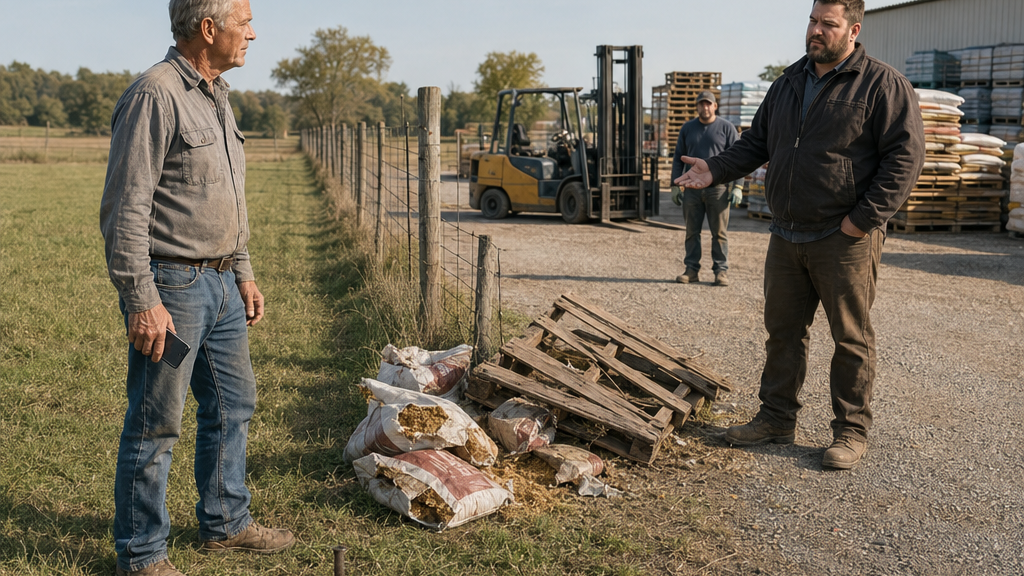
They Called the Edge of His Farm a Gray Zone Until the Survey Showed Fourteen Feet
Chapter 1: The Bags Beside the South Fence
The broken shelving unit had not been there the night before.
Edward Carter stopped halfway down the pasture lane with one hand still resting on the gate chain. Beyond the south fence, the farm-supply yard was already awake—forklift beeper, diesel idle, the hollow bang of something heavy dropped onto concrete. On Edward’s side of the fence sat a bent section of metal shelving, one end buried in weeds.
Beside it were three torn feed sacks.
Two days earlier there had been one.
Edward stared at the pile longer than he needed to.
Then he unhooked the gate and walked over.
The strip of ground ran narrow and awkward between his pasture and the farm-supply property. It was too small to graze properly and too inconvenient to mow with anything larger than his old finish mower. His father had always called it the south tongue, as if the farm had stretched one last piece of itself toward the county road before the commercial lots began.
For years Edward had picked things up there without thinking much about it.
Twine. Plastic wrap. A crushed soda can.
Once, a torn bag of mineral supplement that had spilled gray powder into the grass.
The store was next door. Wind moved things. Trucks shed things. People got careless.
Being neighbors meant not turning every inconvenience into a dispute.
That was what Edward had told himself.
He lifted one of the feed sacks. The plastic was wet underneath but dry on top. It had not blown there overnight. Someone had set it down.
The shelving unit was heavier. He dragged it enough to see the flattened grass beneath it.
No wind had put that there either.
Edward stood, wiped his palms on his jeans, and looked through the fence toward the loading yard.
A forklift operator was moving pallets beneath the metal awning. Two customers stood near the side entrance. Nobody looked his way.
He carried the sacks toward his utility trailer, then stopped.
For the first time in years, he put them back.
He took out his phone.
One photograph of the shelving.
Another of the sacks.
A wider one showing the fence, the pasture edge, and the farm-supply loading dock beyond.
The act felt strangely formal. Almost unfriendly.
He took another anyway.
The next morning, he found a cracked plastic bin beside the shelving.
By the third morning, two broken pallets had appeared.
Edward was standing near the fence, photographing the newest pile, when an eighteen-wheeler eased backward into the supply yard.
The driver needed three corrections to line up with the loading dock. On the last one, the trailer swung wide enough that its rear tires rolled through the grass near Edward’s side.
Edward watched the driver climb down.
A farm-supply employee pulled a damaged pallet from near the dock with a hand jack. One side had split, and several boards hung loose.
The employee rolled it toward the fence.
Edward waited for him to stop.
He did not.
The pallet bumped off the concrete, crossed the weedy margin, and tipped beside Edward’s fence.
Edward lowered his phone.
“Morning.”
The employee looked up.
“Morning.”
“That staying there?”
The man glanced at the pallet as though noticing it for the first time.
“Ryan said stack damaged stuff along the edge until pickup.”
“Which edge?”
The employee hesitated.
“This edge.”
Edward looked down at the grass beneath the pallet.
“This is my ground.”
The employee shrugged in the uncomfortable way of a man who had been given instructions by someone else.
“You’ll have to talk to Ryan.”
“I expect I will.”
The employee left the pallet where it was.
That bothered Edward more than the shrug.
By ten o’clock, Edward had finished checking the hayfield and driven his pickup around to the farm-supply entrance.
Ryan Thompson was behind the counter near the office, talking to a feed customer. He was in his forties, broad through the shoulders, with a clipped beard and the brisk expression of a man who had too many things happening at once.
Edward waited until the customer left.
Ryan gave him a short nod.
“Edward.”
“You’ve got some things sitting on my south strip.”
Ryan glanced toward the loading yard.
“Broken pallets?”
“Pallets. Feed sacks. Shelving. Plastic bin.”
“Pickup’s Thursday.”
“That wasn’t what I asked.”
Ryan leaned one hand on the counter.
“What are you asking?”
“I’m asking why your waste is on my property.”
Ryan’s face changed, but only slightly.
“That strip?”
“Yes.”
Ryan gave a quiet breath through his nose.
“That whole margin is kind of a gray zone.”
Edward said nothing.
Ryan continued.
“Trucks have used it forever. Store’s used it. Your side’s used it. Everybody’s treated that space like part of the loading approach.”
“My pasture hasn’t used your broken shelving.”
“That’s not what I mean.”
“I know what you mean.”
Ryan glanced toward the office door, then back at him.
“Look, I can have the guys clean up anything loose. But that line between your fence and our yard has never been treated like some hard private boundary.”
Edward thought of all the times he had loaded other people’s trash onto his own trailer without saying a word.
“I pay taxes on it.”
“I’m not saying you don’t.”
“Then it isn’t gray.”
Ryan rubbed his thumb along the edge of the counter.
“It’s a practical gray zone, Edward.”
There it was again.
Practical.
A word used when somebody wanted the convenience of a thing without having to define it.
Edward looked through the side window toward the loading yard.
The damaged pallet remained against his fence.
He could have argued.
He could have told Ryan exactly where his father said the old property line ran. He could have pointed toward the weeds and described the iron survey pin he vaguely remembered seeing as a boy.
Instead, he said, “Have your people stop putting things there.”
Ryan’s expression tightened.
“I’ll talk to them.”
“That means today.”
“I said I’ll talk to them.”
Edward nodded once and left.
That afternoon the broken shelving was still there.
So were the feed sacks.
Edward took more photographs.
The next morning, nothing had moved.
He opened a drawer in his kitchen and took out an old accordion folder stamped with the county assessor’s seal. Inside were tax statements, a deed copy, and a folded plat his father had kept so long the creases had turned white.
Edward spread it across the table.
The lines were faded, but the south parcel was clear enough.
He ran one finger toward the corner nearest the supply yard.
There should have been a marker.
He looked through the kitchen window toward the strip of weeds.
For years, Edward had assumed everyone knew where his property ended because he knew.
Now he understood that assumption had been doing more work than any fence.
At noon he returned to the yard.
Ryan was outside this time, directing a forklift.
Edward waited until the machine moved away.
“I’m going to check the line,” he said.
Ryan gave him a puzzled look.
“You can check whatever you want.”
“You sound pretty certain that strip has always been shared.”
Ryan folded his arms.
“I’ve been here eleven years.”
“That wasn’t my question.”
Ryan looked toward the fence, then back at Edward.
“Nobody has treated that strip as private in twenty years.”
Chapter 2: Fourteen Feet Past the Fence
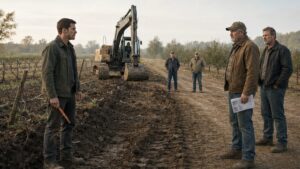
Edward found the iron pin under six inches of dead grass and packed dirt.
He almost missed it.
The faded plat was folded in his back pocket, and he had been pacing the south edge since sunrise, measuring from the corner of the old woven-wire fence toward the county road.
His father had once told him the marker sat “just off the locust stump.”
The stump had rotted away years ago.
Only a shallow depression remained.
Edward scraped at it with the heel of his boot.
Something clicked.
He crouched.
A rust-dark iron rod protruded from the soil.
For several seconds he simply looked at it.
Then he brushed the dirt away with his fingers.
The top of the pin was flattened and scarred, exactly the kind of old survey marker farmers learned not to disturb.
Edward pulled out his phone and photographed it.
He photographed the surrounding fence.
Then he drove to the county offices with the plat on the passenger seat.
The land-use department occupied a low brick building behind the courthouse annex. Inside, the air smelled faintly of printer toner and old carpet.
Jessica Allen listened while Edward explained the dispute.
She did not interrupt until he used Ryan’s phrase.
“Gray zone?”
“That’s what he calls it.”
Jessica turned the plat toward herself.
“Property lines aren’t usually gray.”
“That was my thinking.”
“Use isn’t always the same thing as ownership, though.”
Edward frowned.
She tapped the map.
“This is an older parcel.”
“My father bought it in the seventies.”
“And the commercial tract?”
“Split off later.”
Jessica brought up county mapping records on her screen.
Aerial photographs changed by decade.
Farm field.
Then gravel.
Then a small feed store.
Then a larger paved loading area.
The narrow strip remained.
Jessica zoomed in.
“The GIS layer isn’t survey-grade,” she said. “But your deed description is consistent with the old plat.”
“How far?”
She read the measurements again.
“If the monument you found is the original corner, roughly fourteen feet past the line people appear to be using.”
Edward leaned closer.
“Fourteen feet into their yard?”
“Into what they’re operating as yard space, yes. That doesn’t automatically answer every question.”
“It answers who owns it.”
“It probably answers record title. I’m being careful because I haven’t surveyed it.”
Edward sat back.
“What doesn’t it answer?”
“Whether there’s any recorded easement. Whether there was a license agreement. Whether long-term use created some other issue. Those are different questions.”
Edward disliked the distinction because it interfered with the clean answer he had come for.
Jessica must have seen it.
“I’m not telling you they own it,” she said. “I’m telling you not to treat one answer as all the answers.”
She printed the relevant parcel sheet and wrote the recorded dimensions in the margin.
Edward folded it carefully.
That afternoon, he bought a hundred-foot measuring tape and a bundle of fluorescent survey flags.
Ryan was outside when Edward returned to the strip.
Two employees were stacking feed near the loading dock. A customer pickup idled nearby.
Edward walked straight to the buried pin.
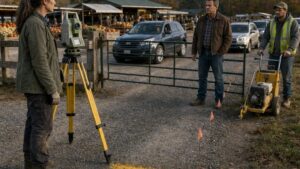
He knelt, cleared the remaining dirt, and hooked the tape to it.
Ryan noticed.
“What are you doing?”
“Checking your gray zone.”
Ryan came closer.
Edward walked the tape toward the paved yard.
Ten feet.
Twelve.
Fourteen.
The tape crossed beyond the weedy edge and onto gravel that the store regularly used for maneuvering.
Edward stopped.
He checked the plat.
Then he measured again.
Ryan watched without speaking.
Edward placed a temporary flag.
Then another farther down the line.
One of the employees had stopped working.
Edward took photographs of the pin, the tape, and the flags.
Ryan finally said, “That doesn’t prove what you think it proves.”
“It proves this isn’t where you said it was.”
“I said people have used it.”
“You said it was gray.”
“I said the use was gray.”
“No. You called the strip gray.”
Ryan glanced at the employee watching them.
Edward could see the irritation arrive in his face.
“This is why people hate boundary arguments,” Ryan said. “You find one old pin and suddenly everybody’s supposed to pretend twenty years didn’t happen.”
Edward wound the tape back several feet and then stopped.
“You still want to call measured ground a gray zone?”
Ryan looked at the flag standing in what he had treated as loading space.
His answer took too long.
That silence gave Edward a satisfaction he had not expected.
It lasted until the next morning.
Jessica called just after seven.
“I found something you should see.”
Edward drove back to the county building.
She had an older scanned plat open beside a handwritten index card from the records archive.
“There’s no permanent easement filed against your parcel that I can find,” she said.
Edward felt his shoulders loosen.
Then she pointed to a note.
“But there is this.”
The handwriting was faint.
TEMPORARY ACCESS—AG DELIVERY.
A year was noted beside it.
Decades earlier.
Edward leaned closer.
“What does that mean?”
“That’s what I’m trying to determine.”
“Temporary how?”
“It doesn’t say.”
“Whose signature?”
“Not on this card.”
Edward stared at the notation.
Jessica pulled up another image.
“This appears to correspond to a site-plan review when the original feed store expanded its loading area.”
“So somebody gave them permission?”
“Possibly.”
“For fourteen feet?”
“Possibly less. Possibly only turning access. Possibly seasonal. We need the underlying document.”
Edward looked out through the office window.
His satisfaction from the day before had vanished.
He had been so certain that finding the pin would end the argument.
Instead, the pin had opened a second one.
Jessica turned another page toward him.
“There’s something else.”
A handwritten reference number had been penciled along the bottom.
Edward recognized the year immediately.
It was the year his father had still been running the farm full-time.
Jessica tapped the notation with one finger.
“This looks like it may trace back to your family.”
Chapter 3: What Everyone Thought They Remembered
The feed truck flattened two of Edward’s new flags before eight o’clock Monday morning.
He saw it happen from the tractor shed.
The truck came off the county road, backed toward the supply yard, then swung wide across the south strip without slowing. One rear tire bent the first fluorescent flag flat. The second disappeared beneath the dual wheels.
Edward killed the tractor engine.
By the time he reached the fence, the driver was already lining up at the dock.
Edward pulled the first flag upright.
The wire stem was bent.
The second had snapped.
He looked at the tire track pressed through his grass.
For a moment, the old response returned automatically: straighten what could be straightened, remove what was broken, keep the day moving.
Instead, he photographed the tracks.
Then he called Mark White.
Mark’s cattle place sat two miles west, where the road dipped and the corn gave way to pasture.
Edward found him repairing a mineral feeder inside a lot beside the barn.
Mark looked up when Edward approached carrying a copy of the old county notation.
“You look official.”
“I’m hoping you remember something.”
“That usually means I’m old.”
Edward handed him the page.
Mark read it.
His expression shifted before he said anything.
“You remember this?”
Mark scratched his cheek.
“I remember trucks turning down there.”
“When?”
“Back when the old feed store was half the size it is now.”
“On our ground?”
Mark handed the paper back.
“Some of it.”
Edward waited.
Mark leaned against the feeder.
“Your dad used to let semis swing wide when they brought bulk fertilizer in spring.”
Edward stared at him.
“Let them?”
“Sure.”
“He never told me that.”
“You weren’t running the place then.”
“I was there.”
“You were baling hay and trying not to be there.”
That was fair enough that Edward did not answer.
Mark continued.
“The old loading dock was tighter. Driver couldn’t make the angle without cutting across the grass.”
“How often?”
“Few times a year.”
“Did they dump there?”
“No.”
“Store pallets?”
“No.”
“Trash?”
“No.”
Mark shook his head.
“It was truck clearance, Edward. Not storage.”
“Was it written?”
Mark glanced toward the barn.
“I don’t know.”
“The county has a temporary-access note.”
“That sounds about right.”
“How temporary?”
Mark gave a short laugh.
“That’s the problem with temporary things around farms. Leave them long enough and somebody younger assumes they were permanent.”
Edward folded the paper.
“Ryan says nobody has treated that ground as private in twenty years.”
Mark looked uncomfortable.
“He isn’t completely making that up.”
Edward’s jaw tightened.
“You just said it was truck clearance.”
“It was. But after your dad slowed down, you didn’t exactly stop anybody either.”
There it was.
Not accusation.
Worse.
Fact.
Edward remembered trucks cutting across the edge during harvest season. He remembered one delivery driver asking with a raised hand from the cab. He remembered waving him through.
He remembered seeing tire tracks later and deciding it was easier not to care.
Mark watched him.
“You’ve always been easy about that strip.”
“Easy isn’t the same as giving it away.”
“I didn’t say it was.”
“Ryan acts like it is.”
Mark bent to tighten a bolt on the feeder.
“Ryan inherited a habit. Doesn’t mean he gets to turn it into a right.”
Edward looked down at the folded county page.
“What would you do?”
Mark shrugged.
“I’d stop arguing about what everybody remembers and decide what you’re allowing now.”
On the drive home, Edward replayed that sentence.
He did not like how much of the dispute had been built from absence.
No fence extension.
No sign.
No written permission.
No written objection.
His father had allowed occasional turns because a truck needed room.
Edward had continued allowing them because stopping one seemed petty.
Somewhere along the way, occasional access had become ordinary use.
Ordinary use had become assumed use.
Assumed use had become pallets and garbage.
Ryan was waiting near the boundary when Edward returned.
One of the broken flags lay on the ground between them.
Ryan picked it up.
“Driver caught this.”
“I noticed.”
“I told them to watch the markers.”
“After they drove over them?”
Ryan ignored that.
“You went to the county.”
Edward looked at him.
“How’d you know?”
“They called asking for old site records.”
“So you know about the access note.”
“I know trucks have used that strip longer than either of us has been arguing about it.”
“My father allowed seasonal turns.”
Ryan spread one hand toward the loading dock.
“Exactly.”
“That isn’t permission to store trash.”
“I told the guys to clean that up.”
“They haven’t.”
Ryan looked toward the pile.
“I’ve got pickup scheduled.”
“On your property?”
Ryan’s mouth tightened.
“Edward, the yard was built around that turn.”
“No. The yard grew until it depended on it.”
“That’s the same thing from where I’m standing.”
“It isn’t from where I am.”
Ryan stepped closer to the temporary line.
“You close off all fourteen feet, I lose the turning radius for feed semis. They’ll have to back from the county road or block the front entrance.”
“Then fix your yard.”
“You think I haven’t looked at that?”
The answer came too quickly.
Edward noticed.
Ryan glanced away.
“The whole loading setup would have to change.”
“How long have you known that?”
Ryan said nothing.
That silence was different from the one beside the measuring tape.
This one carried weight.
Edward looked past him at the pavement, the stacked seed pallets, the forklift path squeezed between the building and the fence.
“You’ve priced it.”
Ryan’s face hardened.
“That’s business information.”
“That means yes.”
Ryan picked up the broken flag and pushed it into the soil.
“I’m telling you the practical reality. If you put posts on that line tomorrow, this operation has a problem.”
“You already have a problem.”
“We both do.”
Edward shook his head.
“No. You have a loading problem. I have your loading problem sitting on my land.”
Ryan looked toward the road as another truck approached.
Then he said quietly, “This place cannot function if you close all fourteen feet.”
Edward watched the truck slow for the turn.
For the first time, he wondered whether Ryan’s insistence had ever really been about history at all.
Chapter 4: The Cost Behind the Gray Zone
The new garbage had been placed directly beside Edward’s flags.
Not blown there. Not dragged by a tire. Placed.
Two torn feed bags were tucked beneath a broken pallet, and a length of plastic strapping had been looped around one of the fluorescent markers as though whoever left it wanted the marker to stay visible.
Edward stood over the pile with his phone in his hand.
The photographs showed everything: the survey flag, the pallet, the fence, the loading dock, the date and time.
He took one from farther back.
Then another.
Only after he had finished did he notice Ryan watching from the other side of the yard.
Edward walked toward him.
Ryan did not wait for the question.
“I told them not to put anything past the gravel.”
Edward held up the phone.
“They did.”
“I can see that.”
“After I told you to stop.”
Ryan looked toward the loading dock.
A forklift was backing away from a stack of seed pallets.
“I’ll get it moved.”
“That was your answer last time.”
“I’ve got thirty things going on.”
“And now one of them is this.”
Ryan’s jaw tightened.
Edward had spent most of his life recognizing the moment when an argument could be avoided with one small retreat. Normally he took it.
This time he stayed where he was.
“What does it cost?” he asked.
Ryan frowned.
“What?”
“To fix the yard.”
“That’s not your concern.”
“You said the place can’t function without my ground.”
“I said it would be difficult.”
“You said it couldn’t function.”
Ryan glanced toward the store entrance, checking whether anyone was close enough to hear.
Edward noticed that too.
“You’ve already looked into changing it,” Edward said. “So what does it cost?”
Ryan folded his arms.
“You think this is some simple matter of painting lines?”
“I don’t know. That’s why I asked.”
“We’d have to move the waste enclosure. Shift the pallet storage. Probably tear out part of the old concrete apron. Maybe change where semis approach the dock.”
“Then do it.”
Ryan laughed once, without humor.
“That’s easy to say when it isn’t your money.”
Edward looked at the building.
“How long have you known?”
Ryan did not answer.
“How long?”
“Couple years.”
The words landed more heavily than Edward expected.
“So this isn’t about what my father allowed.”
“I didn’t say that.”
“You knew the yard was too tight.”
“The yard has been too tight since before I took the job.”
“And instead of fixing it, you kept using my strip.”
Ryan’s voice sharpened.
“We kept using the route everybody had always used.”
“For trucks.”
“Yes.”
“Not trash.”
Ryan looked toward the new pile.
“No.”
That single word changed something.
Not enough to excuse him.
Enough to make the truth cleaner.
Edward put the phone back into his pocket.
“Then why is it still happening?”
Ryan rubbed a hand across his beard.
“Because if I tell the crew that whole side is off-limits, everything gets pushed inward. We lose staging room. The forklift path gets tighter. Deliveries take longer. Customers start backing up near the road.”
“So you didn’t tell them.”
“I told them not to dump.”
“That isn’t the same thing.”
“No.”
Ryan stared at the loading area.
For the first time, Edward could see what the place looked like through his eyes: every pallet occupying space, every truck needing an angle, every minute of delay turning into another problem.
That understanding did not make Edward less angry.
It made the choice clearer.
“You knew there was a problem,” Edward said. “You chose the cheapest place to put it.”
Ryan faced him.
“I chose to keep the operation moving.”
“On my land.”
Ryan’s mouth opened, then closed.
Edward left before the argument could circle back to memory and custom.
At home, he downloaded the photographs to his computer.
He made folders by date.
He added the first feed sack.
The broken shelving.
The pallets.
The tire tracks.
The damaged flags.
Then the newest pile.
For years, Edward had believed keeping records over something like this would make him seem petty. Now each image felt less like accusation than protection against another vague conversation.
By afternoon, he was at the county code office.
The officer at the counter listened while Edward described the repeated debris.
“Have you notified the business?”
“More than once.”
“Can you establish the material came from them?”
Edward slid the photographs across.
Farm-supply labels were visible on torn sacks. The broken pallet sat against the store’s loading area before it appeared on Edward’s side. One photograph showed an employee moving damaged material toward the boundary.
The officer examined the time stamps.
“You’ve got the parcel information?”
Edward handed over the record sheet Jessica had printed.
The officer looked at the survey notation.
“This access question is separate.”
“I understand.”
“You’re filing about disposal on your parcel.”
“Yes.”
“That I can work with.”
The officer entered the complaint.
Edward signed where indicated.
The process was remarkably quiet.
No confrontation.
No courtroom.
No moment of triumph.
Just a form, a case number, and a municipal employee asking whether the debris contained anything hazardous.
When Edward walked outside, he felt less satisfied than he expected.
He had crossed a line of his own.
By filing formally, he had made it impossible for Ryan to keep treating the disagreement as something two neighbors might casually forget.
The next morning, the garbage was still there.
By noon, a county vehicle pulled into the supply yard.
Edward watched from his tractor shed while the officer spoke to Ryan beside the loading dock. Ryan pointed toward the strip twice. The officer walked to Edward’s temporary flags, photographed the debris, then returned to the office.
An hour later, Ryan came through the gate on foot.
“You filed on us.”
“I told you to stop.”
“You could have called me again.”
Edward looked at him.
“How many times counts?”
Ryan exhaled.
“The owner’s going to see this.”
“Maybe he should.”
“You know what happens when somebody sitting two counties away sees a violation notice? He doesn’t ask what makes sense. He asks who let it happen.”
Edward heard the pressure beneath the anger.
Ryan had been trying to prove he could keep the place working.
The gray zone was not just convenient ground.
It was part of the story Ryan had been telling his employer—that the old yard could keep functioning without money being spent on it.
“You could have told him two years ago,” Edward said.
Ryan’s eyes narrowed.
“And you could have told everybody twenty years ago that one tire crossing your grass was the beginning of a property crisis.”
The remark hit because part of it was true.
Edward looked toward the buried survey pin.
“I should’ve spoken sooner.”
Ryan seemed surprised.
Edward continued.
“That doesn’t mean you get to keep doing it after I finally did.”
Ryan looked away.
Neither man spoke for several seconds.
Then Ryan said, “I’ll get the debris moved.”
“Good.”
“But I can’t promise you those trucks never touch that strip again. Not until something changes.”
Edward nodded once.
“Then change something.”
That afternoon, the county returned.
A white notice was fixed beside the farm-supply office door beneath the covered entry.
Edward did not cross the property to read it.
He did not need to.
The officer had already told him what it would say.
Five days to correct the dumping condition and respond.
From across the fence, Edward watched Ryan step outside, read the paper, and remain standing beneath it long after the officer drove away.
Chapter 5: The Trailer Everyone Misunderstood
Edward backed his utility trailer toward the trash pile at seven the next morning.
The sound of the pickup’s reverse alarm carried across the narrow strip, and within minutes two farm-supply employees had stopped working to watch him.
Edward ignored them.
He lowered the tailgate.
The debris had grown into a miserable inventory of other people’s convenience: broken pallets, feed bags, damaged plastic totes, torn wrapping, pieces of shelving, cardboard softened by rain.
Five days had begun.
He was no longer willing to leave the pile sitting there as proof.
But he knew exactly what everyone expected him to do with it.
The thought had occurred to him too.
Load every piece.
Drive around to the front of the farm-supply store.
Set it neatly beside their entrance.
Let customers step around the same rubbish Edward had been stepping around for weeks.
The image had been satisfying for about ten minutes.
Then he had called the county.
The answer was less satisfying.
If Edward moved material onto property where he had no right to place it, he could create a second violation instead of solving the first. If he wanted cleanup costs documented, the officer told him, he should photograph the material, remove it lawfully, keep disposal receipts, and submit them with the case.
So Edward took photographs.
Then he began loading.
He had lifted the second pallet when Ryan appeared.
“What are you doing?”
Edward set the pallet against the trailer rail.
“Cleaning my ground.”
Ryan looked into the empty section of trailer.
“Where are you taking it?”
“Transfer station.”
Ryan stared at him.
“You’re not dumping that in front of the store?”
Edward almost smiled.
“Were you expecting me to?”
“I saw you backing the trailer in.”
“So did everybody else, apparently.”
One employee suddenly became interested in a stack of mineral tubs.
Ryan stepped closer.
“If you’re trying to make some point—”
“I already made the point.”
Edward nodded toward the fluorescent flags.
“That’s what those are for.”
Ryan studied him.
“You filed a violation and now you’re hauling our material away?”
“Yes.”
“Why?”
“Because I want it gone.”
“You could leave it until we handle it.”
“I did leave it.”
Ryan glanced toward the notice still posted near the office.
“You know we have five days.”
“I know.”
“Then why not give us five days?”
Edward picked up a torn feed sack.
“Because I’ve already given you years.”
He put it into the trailer.
Ryan did not answer.
For the next half hour Edward worked while the supply yard operated around him.
He photographed each large item before loading it. He wore gloves for the torn plastic and used a pitchfork for wet cardboard. Dust from spilled feed clung to his boots.
When the pile was nearly gone, he reached the old survey pin.
It stood exposed now in a small circle of cleared soil.
Edward stopped long enough to make sure the trailer tire would not cross it.
Ryan noticed.
“You really care about that little piece of iron now.”
Edward looked down.
“My father cared enough not to pull it out.”
“Your father also let trucks cross.”
“Yes.”
Ryan seemed ready for an argument.
Edward gave him none.
“He did both.”
That answer left nowhere obvious for Ryan to go.
Edward finished loading and strapped the larger pieces down.
At the county transfer station, the attendant weighed the trailer, directed him to the appropriate disposal area, and handed him a printed receipt on the way out.
Edward folded it into his shirt pocket.
By afternoon, he had scanned it with the photographs and submitted everything under the existing complaint number.
The officer called shortly afterward.
“Keep the original.”
“I will.”
“If there are reasonable cleanup or disposal costs, they can be included in the correction file.”
“Does that mean they have to pay me?”
“It means the business may be held responsible depending on the final determination. I’m not promising reimbursement.”
Edward appreciated that answer.
It sounded like Jessica.
Nothing was as simple as people wanted it to be.
The next two days were quieter.
No pallets appeared.
No bags.
The employees kept damaged materials inside the fenced waste enclosure behind the building, though Edward noticed how quickly the area filled.
Delivery trucks still crossed the disputed strip.
But now the drivers slowed near the flags.
On the fourth day, one driver stopped completely, climbed down, and asked an employee to guide him through the turn.
The trailer cleared Edward’s line by inches.
It could be done.
Just not easily.
Late that afternoon, Mark pulled into Edward’s lane.
“Heard you almost decorated the store entrance.”
Edward leaned against the pickup bed.
“Is that what people are saying?”
“That’s what people hoped.”
Edward laughed despite himself.
Mark grinned.
“Would’ve made a better story.”
“Probably a worse case.”
Mark’s expression became more serious.
“You taking the whole fourteen feet away?”
“I don’t know.”
“Ryan buys a lot from people around here.”
“So do I.”
“I know.”
Mark looked toward the supply yard.
“I’m not telling you to give it up.”
“Sounds close.”
“I’m telling you everybody got used to something because nobody had to define it.”
Edward watched a forklift disappear behind the building.
“That includes me.”
Mark nodded.
“Yes.”
It was easier to hear now than it had been in the cattle yard.
Edward had spent years treating silence as evidence of good character.
Sometimes it had been.
Sometimes it had merely postponed a necessary sentence.
That evening, after dark, his phone rang.
Ryan.
Edward nearly let it go to voicemail.
Then he answered.
“Carter.”
There was a pause.
Ryan’s voice sounded different without forklifts and customers behind it.
“The owner saw the violation.”
“I figured.”
“He also saw the estimate for changing the loading area.”
Edward waited.
“We’re going to have to do something,” Ryan said.
“That’s what I’ve been telling you.”
Another pause.
Then Ryan said, “What do you actually want?”
Edward looked through the kitchen window toward the dark line of the south pasture.
Weeks earlier, the answer would have been immediate.
All fourteen feet.
No trucks.
No exceptions.
A hard line because nobody had respected the soft one.
Now the question felt more difficult.
Not because the ground belonged to him any less.
Because ownership did not tell him what kind of neighbor he wanted to become after proving it.
“I want my land treated like mine,” Edward said.
“That’s not a layout.”
“No.”
“So what does it mean?”
Edward looked at the folded plat still lying on the kitchen table.
“Come by tomorrow morning.”
Chapter 6: The Line They Could Both Live With
Ryan arrived without a folder, an attorney, or even the farm-supply jacket he usually wore.
He parked beside Edward’s barn shortly after eight and got out carrying only a tape measure.
“Walk it with me,” he said.
Edward looked at the tape.
“Thought you didn’t trust measurements.”
“I trust them fine. I just didn’t like yours.”
It was the closest thing to humor either of them had managed in weeks.
Edward led him toward the south strip.
The morning delivery rush had not yet begun. From the farm-supply yard came the occasional metallic clank of a forklift mast settling.
They started at the old survey pin.
Edward had left the soil cleared around it.
Ryan crouched and touched the top with two fingers.
“So this is the one.”
“This is the one.”
Ryan stood.
“Owner believes you now.”
“That generous of him.”
Ryan accepted the remark.
“He also believes the county.”
“Probably more relevant.”
They walked toward the loading area.
Ryan stopped where the temporary flags marked Edward’s recorded boundary.
“If we lose all this,” he said, “the longest trailers can still get in. But they’ll need a different approach.”
“How?”
Ryan pointed.
“Come deeper into the front lot, swing across the customer lanes, then back toward the dock.”
“That sounds inconvenient.”
“It is.”
“Possible?”
“Yes.”
Edward looked at him.
Ryan sighed.
“Yes. Possible.”
That was the first time Ryan had admitted it without attaching catastrophe to the answer.
“What about a smaller turn strip?” Edward asked.
Ryan’s eyebrows lifted.
“How small?”
“Enough for the rear tires when a long trailer needs it. Not fourteen feet. Not storage. Not pallets. Not garbage.”
Ryan studied the ground.
“You’d allow that?”
“Written.”
Ryan looked at him again.
“Written how?”
“Defined width. Delivery access only. No permanent equipment. No material storage. No assumption it becomes yours because I don’t complain for six months.”
Ryan gave a slow nod.
“That sounds like something the owner might accept.”
“Might?”
“He’s angry.”
“At me?”
“At the expense.”
“That isn’t the same thing.”
“No.”
They continued along the flags.
Near the center of the strip, the tire tracks were deepest. Ryan crouched and looked back toward the dock.
“If we move pallet storage to the north side and shift the waste enclosure, we could probably keep most trailers off this entirely.”
“You already knew that?”
“I knew there were options.”
Edward stopped.
“That’s not what I asked.”
Ryan remained crouched for a moment before standing.
“We priced a redesign two years ago.”
“How much?”
“Enough that the owner said no.”
“And that’s when you decided my ground was cheaper.”
Ryan’s face tightened.
“I decided the old arrangement was still working.”
“For you.”
“Yes.”
The answer came without defense this time.
Edward looked toward the yard.
“That’s the part that bothers me.”
“I know.”
“No, I don’t think you did.”
Ryan rubbed the measuring tape casing with his thumb.
“I do now.”
Edward nearly let the moment pass.
That was his habit.
Say enough to stop the immediate problem. Leave the uncomfortable part unspoken.
He thought of Mark saying everybody had grown used to something because nobody had to define it.
So Edward spoke.
“I should have stopped this years ago.”
Ryan looked at him.
“I should’ve told your drivers when a turn was okay and when it wasn’t. I should’ve told the old manager not to leave things along the fence. I kept cleaning because arguing seemed petty.”
Ryan said nothing.
“That was my mistake,” Edward continued. “But my silence wasn’t a deed.”
“No.”
“And it wasn’t permanent permission.”
“No.”
The admission sounded heavier than an apology would have.
Edward pointed toward the grass.
“I’m willing to discuss a narrow access strip. I’m not willing to pretend the fourteen feet belong to whoever needs them that morning.”
Ryan nodded.
“That’s fair.”
They spent the next hour measuring.
Not fourteen feet.
Not zero.
A narrow turning margin along the section where long trailers actually needed it, with the rest of Edward’s ground clearly outside the operating area.
Ryan walked the route twice, judging angles.
Edward stood near the survey pin and watched him.
The object had changed meaning again.
At first it had been something buried because nobody needed to think about it.
Then it had become proof.
Now it was a starting point.
By noon, they were at Edward’s kitchen table with the old plat between them.
Ryan sketched the loading path on a blank sheet of paper.
“If we move the waste enclosure here, pallets can stack along the building.”
Edward pointed to the customer lane.
“Then what happens when two semis arrive together?”
“One waits.”
“You hate that.”
“Yes.”
Edward almost smiled.
Ryan did too.
Barely.
Jessica reviewed the proposed arrangement later that week.
She was careful with her language.
“If you intend to allow ongoing access, get it properly described. Don’t rely on this sketch.”
“We learned that lesson,” Edward said.
Ryan looked at him but did not object.
Jessica recommended that the survey crew establish the line precisely before any permanent posts were set. The access permission could then be documented separately from Edward’s ownership.
The county dumping complaint remained open until the business completed cleanup and corrected its waste handling.
Ryan did not ask Edward to withdraw it.
That mattered.
Two days later, the remaining debris was gone.
The waste enclosure was temporarily relocated.
Fresh paint appeared on the loading yard, redirecting pallet staging away from the fence.
The business owner approved the larger redesign reluctantly.
Ryan told Edward the decision in the south pasture.
“He wasn’t happy.”
“Neither was I.”
“He said I should’ve dealt with this sooner.”
Edward looked at him.
“What’d you say?”
“That he was right.”
The answer surprised Edward more than anything Ryan had said during the dispute.
At the survey pin, Ryan extended his tape along the new proposed access line.
“Funny thing,” he said.
“What?”
“I spent two years thinking I was saving the company money.”
“And?”
“Now I’m paying for the redesign anyway, plus the violation, plus your disposal costs.”
Edward looked toward the newly cleared strip.
“Convenience charges interest.”
Ryan gave him a sideways look.
“That something your father used to say?”
“No.”
“Sounds like it.”
The county accepted the corrected plan the following week.
The dumping case moved toward closure once the business reimbursed Edward’s documented disposal fee and demonstrated its revised waste-storage arrangement.
No dramatic settlement followed.
No handshake for an audience.
Ryan simply came by one afternoon and placed the reimbursement check on Edward’s kitchen table.
Then he asked where Edward wanted the permanent posts.
“On the line?” Ryan suggested.
Edward shook his head.
“The access section stays open.”
“Right.”
“Everywhere else, put them where the survey says.”
Ryan nodded.
The next morning a utility truck arrived carrying new posts.
Edward heard the post driver before he saw it.
He walked down from the barn expecting the crew to begin along the flagged boundary.
Instead, the first post went into the ground on the farm-supply side.
Edward stopped.
He took out his tape.
Measured from the old survey pin.
Measured again.
The post stood two feet inside Ryan’s operating yard, not on Edward’s recorded line.
A second post had already been marked at the same offset.
Edward looked toward the supply building.
After everything they had measured, discussed, and finally written down, Ryan had changed the line again.
Chapter 7: Nothing Gray About the Grass
Edward measured the first post three times before he trusted what the tape was telling him.
Two feet inside the farm-supply yard.
Not two feet onto his ground.
Inside Ryan’s.
He moved to the second mark the crew had painted in the gravel.
Same offset.
Edward stood with the tape stretched between his boots and felt suspicion rise before reason could catch it. After weeks of arguments, county records, photographs, flags, trucks, and one hard-earned agreement, his mind had become trained to look for the next quiet encroachment.
The post driver idled nearby.
A crew member leaned out of the cab.
“Something wrong?”
“I don’t know yet.”
Edward took a photograph of the measurement.
Then another.
The habit was automatic now.
A month earlier he would have walked straight across the yard and demanded an explanation. Before that, he might have said nothing at all.
Both instincts seemed equally dangerous.
He walked to the farm-supply office.
Ryan was standing at the counter with a delivery sheet in one hand.
Edward set the tape measure on the counter.
“You moved the posts.”
Ryan looked up.
“Yes.”
“Two feet.”
“Yes.”
“Inside your side.”
Ryan folded the delivery sheet.
“That’s where I told them to put them.”
Edward waited.
Ryan gave him a tired look.
“You thought I was taking two more feet from you?”
“I didn’t know what I thought.”
“That’s almost progress.”
Edward ignored that.
“Why?”
Ryan walked outside with him.
At the first new post, he pointed toward Edward’s marked boundary.
“If we put these exactly on the line, one careless forklift operator clips a post and suddenly we’re arguing about whether the machine crossed onto your land.”
“So you gave up two feet.”
“I created a buffer.”
“Without telling me.”
Ryan nodded.
“That part I could’ve handled better.”
Edward looked from the post to the survey pin.
The concession was so different from what he had expected that he did not immediately know how to receive it.
“Owner agreed to this?”
“He complained.”
“I’m noticing a pattern.”
Ryan almost smiled.
“He said if we’re rebuilding the yard, he’d rather leave room than buy another dispute.”
The crew resumed work.
One post after another went into the ground on the farm-supply side of the boundary, leaving a narrow visible strip of unused ground between the posts and Edward’s legal line.
For years, the disputed edge had been defined by habit.
Now even the empty space meant something.
Within two weeks, the loading yard looked different.
The waste enclosure had been shifted north.
Fresh painted lines redirected pallet staging.
A section of worn concrete had been cut and widened near the dock so longer trailers could begin their turn sooner.
The written access strip remained available where Edward had agreed to it, but its purpose was specific. Trucks could use it for turning. Nothing could be stored there.
The first real test came on a Friday morning when two delivery trucks arrived within five minutes of each other.
Edward was checking a fence brace when he heard the air brakes.
The first truck entered correctly.
The second driver tried to follow too closely and found the approach blocked.
Edward watched from the pasture.
Months earlier, that driver would have swung wide without hesitation.
He began to.
Then the truck stopped.
Its front wheels turned toward Edward’s side.
The rear trailer tires came within a few feet of the new posts.
The driver held there.
A farm-supply employee hurried out and pointed toward the revised route.
The driver backed, corrected, and took the wider approach through the customer lot.
It cost him perhaps ninety seconds.
No tire crossed Edward’s grass.
No flag bent.
No one shouted.
Edward realized he had been holding his breath.
Mark’s pickup came down the county road later that morning and turned into Edward’s lane.
He stepped out and looked toward the redesigned yard.
“Well,” he said, “they still seem to be selling feed.”
“So far.”
Mark leaned against the pickup.
“You happy?”
Edward considered the question.
The south strip was clean.
The pallets were gone.
The broken shelving was gone.
The grass was beginning to recover where tires had once carved through it.
The new posts stood well clear of his recorded boundary.
He should have been able to answer yes.
Instead he said, “I keep expecting something else.”
Mark nodded.
“That’ll wear off.”
“You sound certain.”
“No. Just hopeful.”
They walked toward the old survey pin.
It remained exposed in its ring of bare soil.
Mark looked down.
“Your dad used to know exactly where that was.”
“Apparently everybody did except me.”
“You knew.”
“I forgot it mattered.”
Mark considered that.
“Not the same thing.”
Edward crouched and brushed a small clump of dirt away from the iron.
“My father thought being a good neighbor meant giving people room.”
“He did.”
“I thought it meant not making trouble.”
Mark glanced toward the supply yard.
“And Ryan thought it meant the room belonged to whoever was using it.”
Edward stood.
“That about sums it up.”
A few days later, Jessica came out to review the corrected site arrangement after the survey crew filed its measurements.
She walked the boundary with Edward and Ryan, comparing the permanent posts, the recorded property line, and the narrow access section.
At the end, she closed her folder.
“This is considerably clearer than what you had.”
Ryan looked at Edward.
“High praise.”
Jessica ignored him.
“The ownership line remains where the survey establishes it. The access permission is separately described. That distinction matters.”
Edward looked at the posts.
“I understand that now.”
Jessica gave him a brief nod.
“So does everyone else.”
The county closed the dumping complaint after the business demonstrated that its waste storage had been corrected and Edward’s documented disposal expense had been reimbursed.
The notice disappeared from the office door.
No announcement followed.
Customers kept buying feed.
Edward kept cutting hay.
Ryan kept managing the yard.
The world did not reorganize itself around the dispute.
That was part of what Edward liked about the ending.
One afternoon in early October, he took a bag of grass seed to the south strip.
The damaged patches were smaller than they had looked when covered with garbage. He raked loose soil over the deepest tire marks and scattered seed by hand.
Near the old survey pin, he stopped.
For a moment he considered covering it again.
He could push soil across the top and let the grass grow.
The boundary was recorded.
The posts were in place.
The agreement was written.
There was no practical need to leave a piece of rusty iron visible.
Then a forklift beeped from the yard.
Edward looked over.
Ryan was standing near the loading dock, guiding a pallet into its new staging area.
He saw Edward and raised one hand.
Edward raised his in return.
Nothing more.
Edward looked down at the pin.
He thought of all the years he had quietly picked up what other people left behind because speaking seemed harder than lifting.
He thought of the first broken pallet.
The fourteen-foot measurement.
The county notice.
The trailer everyone expected him to turn into revenge.
The truth was not that he had been too kind.
It was that he had expected people to understand a boundary he had never bothered to state.
Ryan had taken advantage of that silence.
Edward had helped create it.
Those two things could both be true.
He scattered seed around the pin but not over it.
Weeks later, green shoots filled the old tire tracks.
From the road, the south edge looked almost ordinary again: pasture, fence, the farm-supply yard beyond it, and a clean strip of grass between two places that still had to live beside each other.
The iron pin remained visible.
Small.
Rust-dark.
Unremarkable unless someone knew why it mattered.
Edward preferred it that way.
The story has ended.