He Flooded Her Farmhouse With Security Lights—Then the Boundary Reflected Everything Back at Him
Chapter 1: The Night Her Farmhouse Turned White
Sandra Harris woke at 11:47 p.m. because she could read the numbers on the alarm clock without opening her eyes all the way.
For one confused second she thought morning had come early.
Then she saw the white rectangle on the bedroom wall.
Light poured through the thin gap between the curtains, hard and colorless, bright enough to throw the brass handle of her dresser into a sharp shadow. Sandra pushed herself upright and stared toward the window.
“Oh, you have got to be kidding me.”
She crossed the room barefoot and pulled one curtain aside.
Patrick Moore’s equipment yard looked like a ball field.
Four floodlights had been mounted high along the posts on his side of the boundary. Two faced downward toward parked trailers and machinery. The other two threw long white beams almost level across the pasture, through the cottonwood gap, and directly at Sandra’s farmhouse.
She had seen the workers mounting them that afternoon.
She had not understood the angles.
Sandra let the curtain fall.
The light remained around its edges.
Her farmhouse had sat there for more than forty years, long before Patrick bought the narrow twenty-acre parcel next door and turned the old machine shed into a contracting yard. Sandra had slept in this room through thunderstorms, combines running after midnight, calves bawling at weaning, and the year the county replaced the bridge and sent trucks past the house from dawn to dusk.
Noise belonged to working country.
This did not.
A metallic crash sounded from the barn.
Sandra was moving before she consciously decided to.
She pulled on jeans, shoved her feet into rubber boots, and grabbed the flashlight beside the mudroom door, though she almost laughed at that. Outside, she did not need it.
Patrick’s floodlights painted the yard silver-white.
The calving barn stood less than a hundred yards from the farmhouse. As Sandra approached, the cattle inside shifted in a restless wave. Several cows had crowded toward the darker end of the loafing area. One heifer bumped the gate, making the chain jump against the steel tubing.
“Easy,” Sandra said.
She moved slowly along the railing.
The animals knew artificial light. The barn had ordinary work lamps. She used them when checking a cow at two in the morning. But those lights came from above and stayed where they belonged.
This glare cut sideways through the open barn entrance.
Sandra stepped into the beam and squinted.
From there she could see Patrick’s fixtures clearly. Rectangular housings, fresh conduit, pale mounting brackets. One light sat above his fenced equipment apron. Another covered the gravel drive.
The remaining pair seemed to have no purpose except distance.
She took out her phone.
One photograph from the barn entrance.
Another from the gate.
Another from the farmhouse porch.
Then she turned the camera toward the ground, catching the line of light crossing her pasture like a pale strip laid over the grass.
Sandra did not walk next door.
At sixty-one, she had learned that almost nothing improved when discussed across a property line near midnight.
Patrick had not been an easy neighbor even before the lights.
Six months earlier, one of his dump trailers had sat half across the shared gravel approach while a driver loaded crushed stone. Sandra had waited twenty minutes with a feed delivery behind her before someone moved it.
A month later, runoff from his newly graveled yard had cut muddy water toward the roadside ditch.
Then there were little things. Engine idling before daylight. Contractor trucks swinging wide near her fence corner. Patrick complaining when one of Sandra’s hired hands briefly parked a stock trailer beside the shared entrance.
None of it had been enough, by itself, to justify a feud.
Sandra had told herself that repeatedly.
Patrick was running a business.
She was running a farm.
Working land involved inconvenience.
But as she stood in the calving barn with four cows pressed away from the incoming glare, tolerance began to feel less like patience and more like negligence.
She stayed with the cattle until they settled.
Back in the house, Sandra folded a heavy quilt over the curtain rod. It reduced the glare but did not eliminate it. White light leaked around all four edges.
At 1:16 a.m., she heard another cow hit the gate.
At 2:03, she got up again.
At 3:40, she stopped pretending she was going to sleep.
By sunrise, the floodlights had clicked off automatically.
The farmhouse looked normal again.
That almost made Sandra angrier.
She drank coffee at the kitchen table while reviewing the photographs. In daylight, the situation could have been dismissed as irritation. At night, the pictures looked absurd.
At seven thirty, she saw Patrick near the boundary checking a skid-steer.
Sandra put down her mug and walked outside.
He noticed her approaching and removed one work glove with his teeth.
“Morning.”
“We need to talk about those lights.”
Patrick glanced toward the fixtures.
“What about them?”
“They were in my bedroom all night.”
“They’re security lights.”
“I figured that part out.”
He waited.
Sandra kept her voice even.
“They’re also shining into my barn.”
Patrick shrugged. “I had equipment stolen. I’m not doing that again.”
“You can light your yard without lighting my house.”
“They’re on my property.”
“The fixtures are.”
Patrick’s expression tightened slightly.
“They were installed by an electrician.”
“That doesn’t mean they were aimed by one.”
He put the glove back on.
Sandra noticed then that one fixture above the southern fence line pointed almost directly toward her. Its face was visible from where she stood. The second was nearly the same.
She pointed.
“What are those two supposed to be lighting?”
“The back edge.”
“My back edge?”
Patrick exhaled through his nose.
“I’ve got forty thousand dollars’ worth of equipment sitting out here. Maybe more. I’m not turning the place dark because you don’t like seeing a light.”
“I didn’t ask you to turn it dark.”
“Then get heavier curtains.”
The words landed harder than Sandra expected.
Not because they were especially cruel.
Because they ended the conversation.
Patrick turned back toward the skid-steer.
Sandra stood there another moment, studying the line of fence posts between them.
She could have argued.
Rebecca would have argued.
Her late husband certainly would have.
Sandra had spent the years since his death doing something different. Fix what she could. Document what she could not. Do not depend on somebody else becoming reasonable.
She walked back to the house.
Before breakfast she printed six photographs.
On the clearest one, she used a ruler to draw a pencil line from Patrick’s southern fixture across the pasture toward her bedroom window.
Then another from the second fixture toward the calving barn.
She paused.
In daylight, the angles looked even stranger.
Security lights were supposed to illuminate the ground.
Patrick’s two outer fixtures appeared to be aimed almost horizontally.
Sandra stared at the photograph until the coffee beside her went cold.
If the lights had merely spilled onto her property, she could believe carelessness.
But these were pointed.
And sometime between the workers leaving Saturday afternoon and Sandra waking that night, someone had decided exactly where they should point.
Chapter 2: What the Security Lights Were Hiding
“Did Patrick tell you about the theft report?”
The county zoning officer asked the question before Sandra had finished sliding her photographs across the counter.
She stopped with one hand on the folder.
“No.”
The officer studied her.
“He didn’t mention losing equipment?”
“He said he’d had things stolen. Last night was the first I heard of it.”
The officer nodded and opened a computer record.
Sandra had driven into the county seat that morning intending to ask one narrow question: whether a neighboring property could legally throw that much artificial light onto her farm.
Instead, within five minutes, the dispute had widened.
“There was a sheriff’s report about six weeks ago,” the officer said. “Generator, laser level, two saws, some smaller tools. Another incident earlier in the summer. No recovery listed.”
Sandra sat back.
“How much?”
“I don’t have values here.”
“Enough to explain four floodlights?”
“That’s not really my determination.”
He turned one of her photographs sideways.
“But it might explain why they’re there.”
Sandra looked down at Patrick’s yard frozen in the image: trailers, skid-steer, pallets, a compact excavator, the hard white glare cutting beyond all of it.
She did not like the small shift inside herself.
It would have been easier if Patrick had simply been unreasonable.
The officer gave her a complaint form but told her not to expect an immediate ruling. Rural properties sat under a mix of rules depending on use, zoning designation, fixture placement, and whether the light created a measurable nuisance beyond the originating parcel.
“We’ll need to see it after dark,” he said.
“That can be arranged.”
Before leaving, Sandra asked, “If he needs security lights, does that mean he can aim them anywhere?”
“No.”
That answer helped.
Not as much as she expected.
On the drive home, she passed Patrick’s property and saw him near the front gate talking to a man beside a service truck. She continued another hundred yards before changing her mind.
She turned around.
Patrick watched her truck pull onto the shoulder.
Sandra stepped out.
“I went to zoning.”
His jaw shifted.
“That was quick.”
“I wanted to know what the rules are.”
“You could have asked me.”
“I did.”
“No, you told me what you wanted me to do.”
Sandra almost answered.
Then the man beside Patrick opened a clipboard and said, “I can come back.”
Patrick shook his head.
“No. It’s fine.”
The man was an insurance representative. That became clear within minutes, though Sandra had not intended to remain long enough to learn it.
Patrick reached into the cab of his pickup and pulled out a folded letter.
“You want to know why the lights are there?”
He held it toward her.
Sandra hesitated, then took it.
The letter was not dramatic. No threats. No bold warnings.
It listed recommendations after repeated property losses: improved gate controls, camera coverage, locked fuel storage, and stronger perimeter lighting in vulnerable areas.
Sandra read it twice.
“Your insurer required these?”
“Required enough of it that I don’t have much choice.”
“You have a choice about where they point.”
Patrick took the letter back.
“You think thieves stay politely inside the gravel?”
“I think my bedroom is a long way from your gravel.”
The insurance representative cleared his throat.
“The lighting recommendation is for the operational area.”
Patrick looked at him.
Sandra caught the emphasis.
Operational area.
Not Sandra’s pasture.
Patrick folded the letter harder than necessary.
“I’ve had people come through the back,” he said. “That fence line is the weak side.”
Sandra looked toward the boundary.
There was an old hedgerow beyond the equipment yard and, farther west, a county drainage strip where someone could conceivably approach unseen.
For the first time, she understood why Patrick wanted light at the rear edge.
That did not explain the angle.
But it explained the fear.
“What did they take?” she asked.
Patrick looked surprised by the question.
“A generator first time. Then tools. Second time they cut a chain and cleaned out the trailer.”
“Sheriff get anything?”
“No.”
The hardness in his voice changed. It was still anger, but not all of it belonged to Sandra.
“I had to replace equipment while I was still paying for the stolen stuff,” Patrick said. “Then insurance tells me if I don’t improve security, the next claim gets complicated.”
Sandra glanced across the yard.
“I understand why you want lights.”
“Do you?”
“Yes.”
His eyes narrowed, as though agreement made him more suspicious.
“Then what are we doing here?”
“We’re figuring out why two of them light my house.”
Patrick looked away.
For one second, Sandra thought he might concede something.
Instead he said, “Maybe because your place is dark.”
“That’s the point of nighttime.”
The insurance representative suddenly found something interesting on his clipboard.
Patrick’s face reddened.
Sandra regretted the line immediately. It sounded sharper than she intended.
She had come over to establish facts, not win a sentence.
Patrick tucked the letter into his truck.
“You’ve been looking for a reason to complain since I bought this place.”
“No.”
“Drainage. Trucks. Now lights.”
Sandra went still.
The representative took two steps toward his vehicle.
Patrick continued.
“You don’t want a business here. Just say it.”
“I don’t care what you run if it stays on your property.”
“That’s convenient.”
“What does that mean?”
“It means every time the county calls me, your name seems to be somewhere behind it.”
Sandra felt the old instinct rise.
Say less.
Do not feed the argument.
She had relied on that instinct for years.
Patrick saw the silence and gave a humorless laugh.
“Right.”
“What county call?”
“You know exactly which one.”
Sandra did.
Not immediately from his words.
From the drainage ditch behind him.
The summer had been wet. Three months earlier, brown water had flowed from Patrick’s freshly graveled apron during a storm, carrying sediment toward the shared road and cutting a shallow channel near Sandra’s culvert. Heavy trucks had also been using the approach during the softest part of the week.
Sandra had made one call.
One complaint.
She had told herself it was about the road, not Patrick.
She had never told Rebecca.
She had never told Patrick.
At the time, she had thought that was the cleanest way to handle it.
Let the county determine whether there was a problem.
Do not make it personal.
Patrick stepped closer to his gate.
“You filed it, didn’t you?”
Sandra’s mouth went dry.
She could have answered then.
Instead she said, “We’re talking about the lights.”
Patrick stared at her for a long moment.
Then he nodded once.
“That’s what I thought.”
Sandra returned to her truck with the worst kind of unease: not the feeling that Patrick was right, but the knowledge that he was not entirely wrong.
That evening, the county officer arrived just after sunset with a handheld light meter.
Sandra stood with him near the barn while Patrick’s fixtures clicked on one after another.
The meter numbers rose.
The officer walked the property line, then toward the farmhouse.
At each stop, he wrote something down.
Across the fence, Patrick watched from beside his office.
Sandra watched him watching them.
The officer measured again near her bedroom window.
Then he looked toward the fixtures and said quietly, “The spill is significant.”
Sandra should have felt vindicated.
Instead she remembered Patrick’s question.
You filed it, didn’t you?
The officer lowered the meter.
“I’ll need to complete the report.”
Patrick called across the boundary.
“Everything okay over there?”
Sandra turned.
He was not smiling.
Before she could answer, he added, “Or should I wait for another complaint to tell me?”
Rebecca was coming to the farm the next afternoon.
Sandra had not yet decided what she would tell her.
Patrick had just made that decision more difficult.
Because somewhere in Sandra’s kitchen, under a stack of feed invoices and tax receipts, there was still a copy of the complaint bearing her signature.
Chapter 3: The Complaint Sandra Never Mentioned
Rebecca found the complaint before Sandra found the courage to mention it.
She was looking for a receipt.
That was the irritating part.
Sandra had asked her to check the kitchen drawer for the invoice from the veterinary clinic. Rebecca pulled out three envelopes, a packet of mineral-supplement receipts, and then the folded county form.
“What’s this?”
Sandra looked up from the sink.
The paper was already open.
Rebecca read the date.
Then the subject line.
“Roadway drainage and commercial truck impact?”
Sandra dried her hands slowly.
“Put it down.”
Rebecca looked at her.
“You filed this against Patrick?”
“It wasn’t against Patrick.”
“It has his parcel number on it.”
“It was about the ditch.”
Rebecca gave her the look she had used since she was sixteen whenever Sandra tried to separate two things that were obviously connected.
“You told me he was acting like you’d been secretly reporting him.”
“I said he accused me of it.”
“Were you planning to mention that he was right?”
Sandra felt heat climb into her neck.
“He wasn’t right about what it meant.”
Rebecca folded the complaint once, carefully.
“That isn’t the same thing.”
“No.”
The answer came out harder than Sandra intended.
Rebecca stopped.
Sandra leaned against the kitchen counter.
Three months earlier, after a storm, water had crossed the gravel shoulder in a brown sheet. Sediment from Patrick’s newly expanded equipment apron had filled part of the ditch, and tire ruts from loaded trucks had softened the shared approach.
Sandra had called the county road office.
They transferred her.
A clerk told her complaints had to be written.
So Sandra wrote one.
No accusations. No demands that Patrick’s business be closed. Just dates, photographs, and a note that runoff was reaching the shared culvert and heavy trucks were worsening the soft shoulder.
“Why didn’t you talk to him first?” Rebecca asked.
Sandra looked out the kitchen window.
“Because talking to Patrick usually becomes an argument.”
“And now?”
Sandra said nothing.
Rebecca’s expression softened, which somehow made the question worse.
“You thought if the county handled it, you wouldn’t have to.”
“Yes.”
There it was.
Not noble.
Not careful.
Simply true.
Sandra crossed the kitchen and took the form from Rebecca.
“I didn’t lie on it.”
“I didn’t say you did.”
“The ditch was washing.”
“I believe you.”
“The trucks were tearing up the shoulder.”
“I believe you.”
Sandra stared at the signature at the bottom of the page.
“Then what are we arguing about?”
Rebecca sat down.
“That you keep acting like not saying something means you stayed out of it.”
Sandra looked at her daughter.
Rebecca continued, quieter now.
“You didn’t stay out of it. You just let somebody else deliver the message.”
Sandra almost told her that was what rules were for.
She almost said adults should not need personal negotiations before obeying drainage standards or respecting property lines.
Both statements felt true.
Neither answered Rebecca.
A pickup rolled into the yard.
Michael Campbell climbed out carrying two fence insulators Sandra had asked him about the week before. He found the two women in the kitchen with the county complaint between them.
He looked from one face to the other.
“Bad time?”
“Perfect,” Rebecca said.
Sandra gave her a warning glance.
Michael set the insulators on the table.
“What happened?”
Rebecca tapped the paper.
“Did you know Mom filed the drainage complaint on Patrick?”
Michael looked at Sandra.
“Yes.”
Rebecca leaned back.
“Apparently everybody did but me.”
“Not everybody.”
Michael pulled out a chair but did not sit.
Sandra asked, “Did Patrick know?”
“He suspected.”
“Why?”
“Because you were the one with water crossing your entrance.”
Sandra disliked how obvious it sounded.
Michael rubbed his thumb over the brim of his cap.
“For what it’s worth, you weren’t wrong about the runoff.”
Rebecca looked at him.
“So Patrick was?”
“Not exactly.”
Sandra folded her arms.
Michael continued.
“His gravel contractor crowned that yard wrong at first. First hard rain, it sent water toward the road. County made him fix part of it.”
Sandra nodded once.
“And the trucks?”
“They were cutting the shoulder.”
Rebecca looked between them.
“Then why are we treating the complaint like some secret crime?”
“We aren’t,” Michael said.
He finally sat.
“But Patrick didn’t know any of this until a county truck showed up and started measuring his ditch. From his side, somebody reported him without saying a word.”
Sandra heard herself answer defensively.
“That’s what complaint systems are for.”
“Sometimes.”
Michael’s tone stayed neutral.
“He also thinks people around here decided his operation didn’t belong before he ever opened.”
“That’s not my problem.”
“No. But it may be part of his.”
Sandra walked to the window.
Patrick’s yard was visible through a break in the trees. The new lights looked harmless in daylight.
Michael joined her.
“You know he had trouble buying that place?”
Sandra did not.
“Bank wanted more down because he was self-employed,” Michael said. “Then the thefts hit. Then insurance. Now zoning calls.”
“That doesn’t give him the right to light my bedroom.”
“I didn’t say it did.”
“What are you saying?”
“That two things can be true.”
Sandra almost laughed.
It sounded like something Rebecca would say.
Michael pointed toward the road.
“The runoff was real. Those lights are a problem. Patrick also thinks you’ve been trying to get officials after him instead of dealing with him.”
Sandra watched the sun strike a shallow pool still sitting in the ditch. For a moment the surface flashed so brightly she had to turn her eyes away.
Reflected light.
Small in daylight.
Harmless.
She thought about the floodlights at midnight.
“What would you have done?” she asked.
Michael considered.
“Probably talked to him first.”
“And if that failed?”
“Filed exactly what you filed.”
Rebecca gave Sandra a look.
Sandra ignored it.
Michael picked up his keys.
“Being justified doesn’t always mean the way you handled it helped.”
After he left, Sandra and Rebecca stood in the kitchen without speaking.
Finally Sandra said, “I don’t regret reporting the ditch.”
Rebecca nodded.
“I know.”
“I do regret letting him find out from the county.”
“That sounds closer.”
“To what?”
“The actual problem.”
Sandra frowned.
Rebecca smiled faintly.
“You hate arguments so much you arrange them by mail.”
That almost made Sandra smile.
Almost.
At dusk, the county zoning officer returned.
He had completed the measurements from the previous night and needed photographs of the fixture orientation while there was still enough ambient light to see the mounting positions clearly.
Sandra walked the boundary with him.
Patrick came out before they reached the second post.
“More measuring?”
The officer nodded.
“I need to document the fixture direction.”
Patrick’s gaze moved to Sandra.
She did not look away.
The officer photographed the first two lights, then the southern pair.
He stood beneath one fixture and frowned.
“These are adjustable.”
Patrick said, “Most lights are.”
“They can be shielded too.”
“I was told I needed perimeter lighting.”
The officer made another note.
“Perimeter lighting doesn’t require direct spill at this level onto an occupied residence.”
Patrick’s jaw tightened.
Sandra felt the old satisfaction trying to rise.
The official statement.
The measurable fact.
The thing that would settle everything without her having to.
Then Patrick looked at her.
“Tell him about the other complaint.”
The officer glanced up.
Sandra’s first instinct was to say it had nothing to do with this.
Instead she took a breath.
“I filed it.”
Patrick seemed almost surprised.
Sandra continued.
“The runoff complaint. Three months ago. I filed it.”
Rebecca stood near the barn, listening.
Patrick’s face changed only slightly.
“You could’ve told me.”
“Yes.”
The word cost more than Sandra expected.
“I could have.”
For a moment nobody spoke.
Then the zoning officer cleared his throat.
“The prior complaint doesn’t change these measurements.”
He held up his clipboard.
“The nighttime readings exceed what we consider reasonable spill for this use, particularly at the residence and livestock structure.”
Patrick looked at him.
“So what?”
“I’ll issue a correction notice. You’ll have a compliance period to re-aim, shield, replace, or otherwise reduce the off-site impact.”
“How long?”
“Thirty days.”
Sandra felt something loosen in her chest.
Thirty days was longer than she wanted.
But it was official.
Measurable.
Resolved, at least in principle.
Patrick looked toward the fixtures.
“Fine.”
No argument.
No sarcasm.
Just one hard word.
The officer left before full dark.
Rebecca stayed another hour, helping Sandra move mineral tubs and check the cows.
At the gate, she said, “Maybe this ends it.”
Sandra looked toward Patrick’s yard.
Four lights clicked on.
The beams were still there.
But now there was a notice behind them.
A deadline.
A rule.
“It should,” Sandra said.
Across the boundary, Patrick stood beneath one of the fixtures with the correction notice folded in his hand.
Sandra could not see his expression from that distance.
She watched him look toward her farmhouse.
Then toward the lights.
Then back at the notice.
For the first time since the dispute began, Sandra believed the problem might actually be over.
She would remember that certainty three days later, when she stepped outside at dusk and counted six lights instead of four.
Chapter 4: Six Lights After the Warning
Sandra counted them twice.
Six.
Where four rectangular floodlights had hung along Patrick Moore’s fence three nights earlier, there were now six.
She stood at the edge of the barn lot with a mineral bucket in one hand and stared across the boundary until the calves behind her began bawling for feed.
The county correction notice was still inside its thirty-day compliance period. Technically, Patrick had time.
But adding two more lights after receiving it was not compliance delayed.
It was an answer.
Rebecca arrived twenty minutes later and found Sandra beside the gate, looking toward Patrick’s yard.
“You called me like something happened.”
Sandra pointed.
Rebecca counted.
Her mouth opened.
“No.”
“Yes.”
“He added more?”
Sandra nodded.
Rebecca started walking toward the boundary.
Sandra caught her arm.
“Don’t.”
“Mom.”
“Not like this.”
“Like what? With words?”
“With you angry.”
Rebecca pulled free but stopped.
Across the fence, Patrick was on a ladder adjusting one of the new fixtures. An electrician’s truck was gone; there was no one else near him.
Rebecca raised her voice.
“Patrick!”
Sandra closed her eyes.
Patrick looked over.
Rebecca pointed toward the lights.
“You got a county notice and your solution was to make it worse?”
Patrick climbed down slowly.
“Evening, Rebecca.”
“Don’t ‘evening’ me.”
Sandra stepped between them without making it obvious.
Patrick rested one hand on the ladder.
“The notice says I have thirty days.”
“It says reduce the spill,” Sandra said.
“And I’m working on the system.”
“With six lights?”
“I had dark spots.”
Rebecca laughed once.
Patrick looked at her.
“You got something to say, say it.”
“I think you know exactly what you’re doing.”
His expression hardened.
“That makes two of you.”
Sandra felt the argument reaching backward toward the complaint again.
She stopped it.
“Patrick, are these two new fixtures part of the insurance requirement?”
“They’re part of security.”
“That isn’t what I asked.”
He looked toward his equipment yard.
One of the new lamps covered the fuel tank and trailer line. Sandra could see the logic in that placement.
The other did not.
It sat on the southern post, its housing tilted noticeably outward.
Toward her.
Patrick followed her gaze.
Sandra said, “That one is aimed at my barn.”
“It’s aimed at the back perimeter.”
“My barn is past your perimeter.”
Rebecca folded her arms.
Patrick gave a small shrug.
“Maybe you need heavier curtains.”
Sandra stared at him.
There it was again.
Not carelessness.
Not insurance.
Not theft.
Something smaller and meaner had entered the dispute.
Rebecca stepped forward.
“You know what? Maybe we should put every picture online and let—”
“No.”
Sandra’s voice cut across hers.
Rebecca turned.
“No what?”
“No posting pictures. No neighborhood pile-on. No turning this into entertainment.”
“He’s lighting your bedroom.”
“I know where my bedroom is.”
Patrick gave a short, humorless smile.
Sandra saw it.
That was almost enough to make her change her mind.
Instead she picked up the mineral bucket.
“Come on, Rebecca.”
“You’re leaving?”
“Yes.”
Patrick called after them.
“County can come measure again whenever they want.”
Sandra stopped but did not turn.
“I expect they will.”
That night, all six lights came on at 8:41.
The difference was immediate.
The older four had been harsh. The new arrangement was almost architectural, six separate beams crossing the property line at different heights. One washed the pasture. Another caught the barn roof. Two struck the farmhouse.
The newest southern fixture hit the calving area directly.
Sandra stood in the barn aisle watching the cows shift.
“Easy.”
She lowered one set of interior lights, hoping the contrast would help.
It did not.
A cow near the gate pushed backward when a passing moth threw a sudden shadow across the white glare. Another animal crowded her flank.
The gate rattled.
Then metal cracked against metal.
Sandra moved fast.
The cow stumbled sideways, regained her footing, and stood with her rear leg tucked strangely beneath her.
“Easy. Easy.”
Sandra opened the inside panel and eased the others away.
The injured cow limped three steps.
Rebecca, who had stayed for the evening, swore under her breath.
Sandra crouched carefully near the animal.
There was a shallow scrape above the hock and swelling beginning along the joint. Nothing obviously broken.
But it had happened.
That changed the weight of everything.
Rebecca looked through the barn opening toward Patrick’s lights.
“Still want me not to post it?”
“Yes.”
“Mom.”
“Yes.”
Sandra stood.
Her hands were shaking.
She did not want Patrick humiliated.
At that moment, she wanted something worse: for him to understand.
Those were not the same thing.
The distinction mattered.
She called the veterinarian’s office, described the injury, and followed the instructions for keeping the cow confined until morning.
Afterward Rebecca followed her into the tack room.
“What are you going to do?”
“Think.”
“You’ve been thinking for days.”
“I’ve been waiting for rules to do the talking.”
Rebecca leaned against the doorframe.
“And?”
Sandra looked at her.
“They aren’t speaking loud enough.”
At ten fifteen, she walked the boundary with a tape measure, her phone camera, and an old carpenter’s angle finder that had belonged to her husband.
She measured from the fence toward the barn.
Then toward the farmhouse.
She marked approximate beam heights against posts and siding.
Rebecca held the flashlight even though Patrick’s yard provided more than enough illumination.
“What are we measuring for?”
Sandra did not answer.
The irony was not lost on her.
Rebecca noticed.
“You’re doing it again.”
Sandra paused.
“Doing what?”
“Not saying what you’re thinking.”
Sandra looked down at the angle finder.
Then toward Patrick’s six lights.
“I’m trying to find something I can put on my land that makes the problem visible without damaging anything on his.”
Rebecca frowned.
“What?”
Sandra looked at the beam crossing the fence.
“Something reflective.”
Rebecca’s expression changed.
“Mirrors?”
“Not household mirrors.”
“What kind?”
“I don’t know yet.”
For the first time all evening, Rebecca smiled.
Sandra pointed at her.
“Don’t enjoy this.”
“I’m not.”
“You are.”
“A little.”
Sandra shook her head and continued measuring.
She did not want revenge.
That mattered enough that she repeated it silently.
She wanted the light returned to where it came from.
Not scattered toward the road. Not sent into traffic. Not thrown toward another neighbor.
Back into Patrick’s developed yard.
Enough for him to stand inside his own decision.
Near midnight, Sandra sat at the kitchen table with the angle measurements beside her.
A feed invoice lay underneath.
She turned it over and wrote four dimensions in pencil.
Forty-eight by seventy-two.
Four panels.
Then beneath those numbers she wrote one more line.
Keep reflection inside Moore yard.
Sandra stared at the note.
For the first time since Patrick installed the lights, she was no longer waiting for him to choose differently.
She was making a choice of her own.
Chapter 5: Four Panels Facing the Boundary
Rebecca thought Sandra was buying blackout curtains.
She said so when she found her mother at the farm-supply warehouse counter the next afternoon.
“What size windows?”
Sandra looked up.
“Not for windows.”
The clerk rolled a cart from the back carrying four large reflective utility panels wrapped in protective film.
Rebecca stopped walking.
“Oh.”
Sandra signed the invoice.
The panels were not ordinary glass mirrors. They were lightweight, rigid, silver-faced sheets normally used for utility interiors and visual inspection areas. Large enough to catch a floodlight beam. Durable enough to mount temporarily along a fence.
Rebecca touched one corner.
“You actually did it.”
“I bought panels.”
“You bought four giant mirrors.”
“They’re reflective panels.”
Rebecca smiled.
“That sounds much more responsible.”
Sandra ignored her.
Before purchasing anything, she had called the agricultural-extension office and then an electrician. She described the beam angles, property distances, road location, and Patrick’s yard.
Neither person told her the idea was inherently impossible.
Both told her the same thing.
Be careful.
A reflected beam could become Sandra’s problem if she aimed it toward the road, a driver, another residence, or anywhere outside the intended area.
The extension adviser had been especially direct.
“If this is about proving a point, don’t create a new nuisance proving it.”
That sentence stayed with Sandra.
At the farm, she and Rebecca unloaded the panels beside the barn.
Sandra had already installed temporary wooden braces inside her boundary fence. Nothing crossed the property line. Nothing touched Patrick’s posts.
Rebecca held a panel while Sandra fastened the first support.
“You know what Dad would’ve done?”
Sandra tightened the bolt.
“Probably something less reversible.”
Rebecca laughed.
“Definitely.”
Sandra stepped back.
Her husband had never been cruel, but he had possessed a gift for treating an argument like a machine that could be repaired with enough force.
Sandra had built her adult life around the opposite instinct.
Sometimes too far in the opposite direction.
“Higher,” she said.
Rebecca lifted.
Sandra checked the angle.
The first panel faced Patrick’s southern light but not directly. Sandra tilted it slightly downward so the returning beam would strike the gravel loading apron well inside his yard.
The second she aimed toward the metal wall of his office.
The third toward the equipment parking area.
The fourth remained uncertain.
Rebecca watched her adjust the brackets repeatedly.
“You could point that one at his bedroom window.”
“No.”
“He points his at yours.”
“I know.”
“That’s kind of the point.”
“No, the point is to show him what crosses the line. Not to give him something legitimate to complain about.”
Rebecca’s smile faded.
Sandra looked at her.
“If I do exactly what he did, then I’m just arguing about who gets to be wrong.”
Rebecca considered that.
“Fine.”
It was not full agreement.
But it was enough.
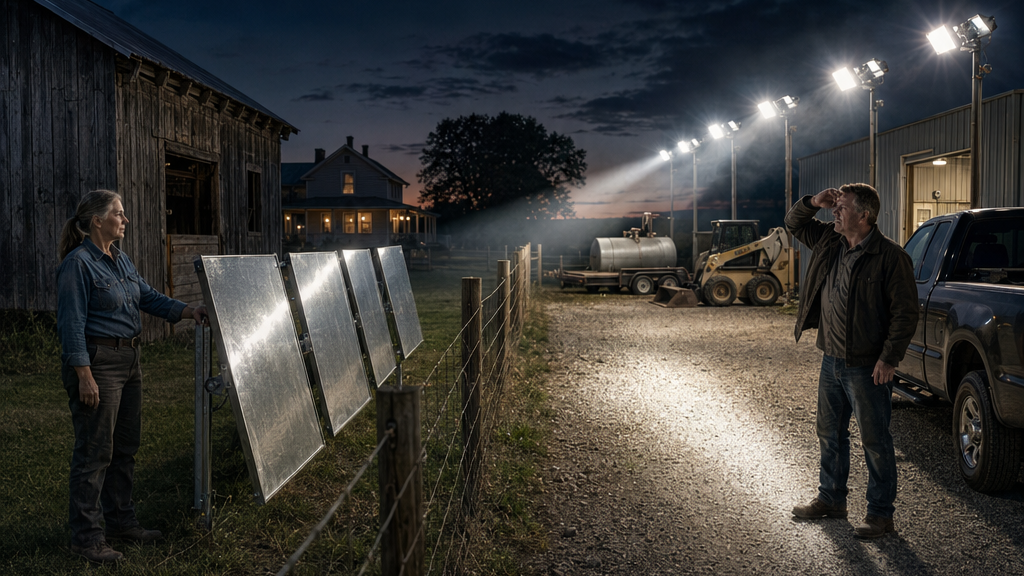
By late afternoon the four silver panels stood along Sandra’s side of the boundary, spaced between the barn and pasture gate.
In sunlight they looked strange but harmless.
Patrick noticed at 5:18.
Sandra was tightening the last bracket when his pickup stopped on the other side of the fence.
He got out and looked at the panels.
“What are those?”
“Reflective panels.”
“I can see that.”
“Then we’re making progress.”
Rebecca made a small coughing sound behind her.
Patrick ignored it.
“What are you doing with them?”
Sandra straightened.
“They’re on my property.”
His eyes narrowed.
She heard her own words.
Patrick heard them too.
“That’s cute.”
“It wasn’t meant to be.”
“You planning to shine something into my yard?”
“No.”
“You just installed four mirrors aimed at me.”
“I installed them in the path of your lights.”
Patrick stepped closer to the fence.
“You realize if you create a hazard, I’ll report it.”
“Yes.”
He seemed thrown off by the answer.
Sandra continued.
“That’s why I measured where the reflection will land.”
“You measured.”
“Yes.”
Patrick looked toward the panels again.
For a moment his face showed uncertainty rather than anger.
That was all Sandra wanted.
Not humiliation.
Recognition that she had thought this through.
Patrick pointed toward the second panel.
“Take them down.”
“No.”
His expression hardened again.
“You don’t get to complain about my lights and then build something to throw them back.”
Sandra met his eyes.
“If the lights remain inside your property, nothing comes back.”
Patrick opened his mouth.
Stopped.
Sandra waited.
The logic sat between them.
Rebecca looked at the ground to hide a smile.
Patrick turned toward his truck.
“This is childish.”
Sandra answered quietly.
“So was adding two more lights after the notice.”
He looked back.
She saw the change immediately.
Not surprise.
Recognition.
She had named the part neither of them had said aloud.
Patrick climbed into his pickup and drove away.
At sunset Sandra checked every bracket again.
The veterinarian had examined the injured cow that morning. Bruising and swelling, no fracture. Rest and observation.
A small mercy.
Still a consequence.
Rebecca brought coffee to the barn.
“You nervous?”
“Yes.”
“Good.”
Sandra looked at her.
Rebecca shrugged.
“Means you’re not doing it for fun.”
At 8:39, Patrick’s office light went on.
At 8:41, the first security fixture clicked alive.
The beam crossed his yard, crossed the boundary, and struck Sandra’s first panel.
A broad white reflection appeared immediately on Patrick’s gravel apron.
Second light.
Second panel.
The side of his office brightened.
Third.
Fourth.
Then the two newer fixtures came on.
For several seconds, the entire boundary seemed alive with overlapping white bands.
Sandra had expected brightness.
She had not expected how clearly the reflection would expose the original angles.
Every beam that crossed onto her farm announced itself by returning.
Not all of it went back. The panels were not perfect mirrors, and Sandra had deliberately tilted them downward. But enough did.
Patrick’s loading apron turned stark white.
The metal siding of his office glared.
His parked skid-steer threw a hard shadow against the fence.
Rebecca whispered, “Wow.”
Sandra did not answer.
She watched the road.
No stray beam.
She checked the neighboring field.
Dark.
The reflection remained where she had intended it.
Inside Patrick’s developed yard.
A door opened.
Patrick stepped out of his office.
He made it three paces before lifting one hand over his eyes.
He looked first at the brightness on the gravel.
Then at the panels.
Then across the fence at Sandra.
Even from that distance she could see his disbelief.
He walked farther into the yard, turning his head away from the strongest reflection.
“Turn those!”
His voice carried across the boundary.
Sandra stood beside the barn.
“I’m not turning anything on.”
“You know what I mean.”
“They’re your lights.”
Patrick crossed toward the fence, shielding his eyes.
“This is ridiculous.”
Sandra’s heart was beating harder than she wanted.
She kept her voice level.
“If you tilt your fixtures down, the reflection goes down.”
“You’re doing this on purpose.”
“Yes.”
The word stopped him.
Sandra continued.
“I’m showing you where your light goes.”
Patrick stared at her.
No county officer.
No complaint form.
No third person.
Just the two of them and six beams physically crossing the property line.
For the first time, Sandra saw him look from one fixture to its reflection.
Not at her.
At the path.
He stood there long enough that Rebecca stopped smiling.
Patrick finally lowered his hand.
“This isn’t over.”
“No,” Sandra said.
“I guess it isn’t.”
He turned and walked back toward his office, squinting against his own lights.
Sandra watched him go.
She had wanted him to understand.
Now she had no idea what understanding would make him do.
Chapter 6: When Patrick Finally Lowered His Voice
Patrick arrived at the shared gate at seven the next morning without a county truck, a deputy, or anyone from his insurance company.
Sandra noticed that first.
She noticed the second thing when he spoke.
He was not shouting.
“Can we talk?”
Sandra had been carrying a scoop of grain toward the barn. She set it inside the gate.
Rebecca’s truck was parked near the farmhouse, but her daughter was still inside.
Sandra walked toward Patrick.
“Talk.”
He looked tired.
The floodlights behind him were off in the daylight, rectangular black housings against pale posts.
“You leaving those panels up?”
“For now.”
“I could file a complaint.”
“You can.”
Patrick rubbed his jaw.
Sandra waited.
A week earlier, she would have filled the silence by explaining herself.
A month earlier, she would have avoided the conversation entirely.
Now she simply stood there.
Patrick looked toward the barn.
“How’s the cow?”
Sandra was surprised he knew.
“Bruised. She’ll be all right.”
He nodded once.
“I heard the gate.”
Sandra studied him.
“That night?”
“Yeah.”
“You never came over.”
“No.”
The word carried its own admission.
Patrick kicked a small stone off the gravel.
“I was angry.”
Sandra said nothing.
“Not about the lights at first.”
He looked at her.
“About everything.”
“The drainage complaint.”
“That too.”
He rested both hands on the top rail of his gate.
“When the county came out over the runoff, I thought somebody around here was trying to push me out. Then the bank starts asking questions because the business address has an open county issue. Then tools get stolen. Insurance tells me to improve security. Then you show up telling me where I can point lights.”
“You were pointing them into my house.”
“I know.”
Sandra felt the significance of those two words.
Not I disagree.
Not technically.
I know.
Patrick looked down.
“The first four weren’t meant for your house.”
Sandra believed him.
Mostly.
“The last two?”
He exhaled.
“One was for the fuel area.”
“And the other?”
Silence.
Patrick’s fingers tightened around the rail.
“The other one didn’t need to be that high.”
Sandra waited.
He looked toward the southern fixture.
“I changed the angle after the notice.”
There it was.
No document could have said it more clearly.
“Why?”
Patrick gave a tired laugh with no humor in it.
“You know why.”
“I want you to say it.”
His eyes came back to hers.
“Because I was angry.”
Sandra nodded.
“At me.”
“Yes.”
“Because I filed the runoff complaint.”
“Because you kept calling officials and acting like you had nothing to do with it.”
The old defensiveness rose.
Sandra let it rise.
Then let it pass.
“I filed it.”
Patrick blinked.
She continued.
“I filed the drainage complaint. I took the pictures. I wrote down the truck dates. I sent it in.”
“I know that now.”
“You didn’t hear it from me.”
“No.”
“You should have.”
Patrick looked almost wary.
Sandra forced herself not to retreat into qualifications.
“The runoff was real. The truck damage was real. I don’t regret reporting either one.”
His face hardened.
Then she added, “I regret making you find out from a county employee.”
The hardness shifted.
Not gone.
But changed.
Patrick looked past her toward the road.
“You could’ve walked over.”
“Yes.”
“I might’ve fixed it.”
“Maybe.”
He gave her a look.
“Still got to get that last word.”
“That wasn’t a last word. That was an honest answer.”
For the first time, Patrick almost smiled.
Almost.
Rebecca appeared on the farmhouse porch but did not approach.
Sandra saw her and was grateful.
Patrick tapped the gate rail.
“I can’t remove all the lights.”
“I didn’t ask you to.”
“You said they were a nuisance.”
“The way they’re aimed is.”
“Insurance wants coverage over the whole yard.”
“Then cover the yard.”
Patrick looked at the fixtures.
“The electrician says shielding them will cost more.”
“Than six industrial floods?”
“Than what I already paid.”
Sandra understood that.
Money turned every principled solution into arithmetic eventually.
Patrick continued.
“If I take them all down and get hit again, insurance can say I ignored recommendations.”
“I understand.”
He looked surprised.
Sandra pointed toward the two southern fixtures.
“These are the problem.”
“Mostly.”
“They’re the worst.”
“Yes.”
Patrick walked to the nearest post.
He looked up.
Then climbed onto the lower fence rail and reached for the fixture bracket.
Sandra frowned.
“What are you doing?”
“Seeing how much movement I’ve got.”
The light was mounted several feet above his reach, but the lower bracket assembly could be loosened from the post.
Patrick retrieved a wrench from his truck.
Sandra watched as he loosened one bolt.
The fixture housing dipped several degrees downward.
It was a small movement.
In daylight, almost meaningless.
But Sandra knew exactly what that angle meant.
“That already helps.”
Patrick glanced at her.
“You can tell?”
“I measured them.”
“Of course you did.”
He adjusted the second fixture.
Not all the way.
Enough that the faces no longer seemed to stare across the boundary.
Patrick stepped back.
“I’ll get the electrician out.”
Sandra nodded.
“And shields.”
“That’ll be part of it.”
He hesitated.
“What about the panels?”
“When your light stays on your side, I don’t need them.”
Patrick looked toward the silver surfaces.
“They made my office unbearable.”
Sandra said nothing.
He caught himself.
A faint, embarrassed expression crossed his face.
“Yeah.”
Sandra looked at him.
“That was the point.”
Patrick nodded slowly.
“I figured that out.”
A long silence settled between them.
Not comfortable.
But no longer hostile enough to require filling.
Patrick finally said, “I still think you were trying to make my business harder.”
“I was trying to keep water out of my entrance.”
“You complained about the trucks too.”
“They were breaking the shoulder.”
“They need somewhere to turn.”
“Not across my approach.”
Patrick rubbed the back of his neck.
“There isn’t much room.”
“I know.”
He looked at her.
That answer seemed to frustrate him more than an argument would have.
Sandra continued.
“I’m not asking you to shut down.”
“What are you asking?”
Sandra glanced toward the boundary, the road, then the dark fixtures.
For years she had believed the safest boundary was one she could enforce without conversation.
A deed line.
A county rule.
A written complaint.
Something impersonal.
Now she understood how easily silence could become its own message.
She met Patrick’s eyes.
“One condition.”
He waited.
“We stop making each other guess.”
Patrick frowned.
Sandra pointed first toward his yard.
“If security changes, you tell me before it changes my property.”
Then toward the road.
“If your trucks need different access, we talk before they use mine.”
She pointed toward herself.
“And if I have a problem with runoff, traffic, lights, anything else, I come to you before I send it to the county unless it’s urgent.”
Patrick considered.
“That’s your condition?”
“That’s the first one.”
He gave her the faintest smile.
“There it is.”
Sandra almost smiled back.
“The practical details still need fixing.”
“Of course they do.”
“Lights downward. Shields on the boundary side. Trucks stay off the soft shoulder. Drainage stays in the ditch.”
Patrick nodded slowly.
“I can work with most of that.”
“Most?”
“The truck turn.”
“Then we figure out another one.”
He looked toward Michael Campbell’s field beyond the road.
“Maybe move the equipment entrance ten yards east.”
Sandra followed his gaze.
It might work.
Not perfectly.
But enough to discuss.
Patrick put the wrench back in his truck.
“I’ll call the electrician.”
Sandra picked up the grain scoop again.
At the barn door she looked back.
Patrick had climbed onto the rail once more.
He reached up and turned the second southern fixture farther downward by hand.
In daylight, it was only a black rectangle changing angle.
But Sandra understood what she was watching.
Not surrender.
Adjustment.
For the first time since the floodlights appeared, that seemed more useful.
Chapter 7: The Light That Stayed on His Side
The first replacement light came on at dusk and stopped exactly at the fence.
Sandra stood in the barn doorway with both hands resting on the top rail and watched the sharp edge of illumination end in the grass.
No glare touched the siding.
No white beam crossed the pasture.
Nothing reached the farmhouse windows.
For several seconds she did not move.
Then the second light came on.
It pointed downward over Patrick’s gravel apron and disappeared beneath a metal shield mounted above the housing. The third covered his fuel area. The fourth washed the equipment line without reaching the boundary.
The two southern fixtures had been replaced completely.
Smaller housings.
Lower poles.
Shields on the farm-facing sides.
Rebecca stepped out beside Sandra.
“Well?”
Sandra kept watching.
“Well what?”
“Are you going to admit it looks good?”
“It looks where it belongs.”
Rebecca smiled.
“That sounded painful.”
Sandra ignored her.
Two weeks had passed since Patrick adjusted the first fixtures by hand at the gate.
The electrician came three days later.
Sandra expected tension.
Instead Patrick walked the electrician along the fence with a printed copy of the county measurements and pointed toward the areas that needed coverage. He never asked Sandra to approve the work.
He did ask one question.
“Does anything hit your barn?”
Sandra checked after dark.
“No.”
That had been the entire conversation.
The county zoning officer returned the following evening, measured again, and closed the light-spill issue pending final documentation.
Patrick did not celebrate.
Neither did Sandra.
The problem had been corrected.
That was enough.
Or it should have been.
Rebecca looked toward the four reflective panels still standing along Sandra’s side of the boundary.
“So now what?”
Sandra knew what she meant.
The panels had become impossible to ignore.
In daylight they caught fragments of sky, barn roof, fence posts, passing clouds. From the road they looked like four silver rectangles interrupting the familiar line of pasture.
“They come down.”
“All of them?”
Sandra looked toward Patrick’s yard.
“Yes.”
Rebecca frowned.
“I’d keep them.”
“For what?”
“Insurance.”
Sandra turned.
Rebecca laughed.
“In case he forgets.”
“He won’t forget.”
“You sound very sure.”
“I’m not.”
Sandra walked to the first panel.
“That’s not a reason to turn the fence into a warning sign.”
She loosened the top bracket.
Rebecca helped support the panel while Sandra removed the lower bolt.
Together they carried it into the barn and leaned it against the wall.
Then the second.
Then the third.
At the fourth, Rebecca stopped.
“You really don’t want one left outside?”
“No.”
“Not even a little?”
Sandra looked at her daughter.
“A boundary isn’t useful because someone can see what you’ll do if they cross it.”
Rebecca waited.
Sandra glanced toward the new lights.
“It’s useful because both people know where it is.”
Rebecca’s expression changed.
Not agreement exactly.
Something quieter.
They carried the last panel inside.
Sandra stacked three against the back wall behind old gates and spare fencing.
She left one standing upright near the workbench.
Rebecca noticed.
“I thought they were all coming down.”
“They are down.”
“That one looks pretty accessible.”
Sandra wiped dust from her hands.
“It’s a useful panel.”
Rebecca smiled.
“Of course.”
Two days later Patrick’s first loaded truck approached the shared entrance just after seven in the morning.
Sandra was repairing a mineral feeder when she heard the engine slow.
She looked toward the road.
For months, Patrick’s drivers had swung wide across the soft shoulder near Sandra’s culvert when entering his yard. During wet weather, the tires cut the ground until water collected in the ruts.
This time the truck did not turn.
It continued another ten yards.
Then turned into a newly widened entrance Patrick had cut farther east.
Sandra straightened.
A compact loader sat near the old approach, filling the worst ruts with gravel and packed soil.
Patrick stood beside it.
When he saw Sandra looking, he raised one hand.
Not a wave exactly.
More acknowledgment.
Sandra walked toward the road.
Patrick met her halfway.
“This should keep the bigger trucks off your corner.”
Sandra studied the new entrance.
The turn was tighter into his yard but still workable. He had removed two sections of internal fencing to make space.
“That cost you.”
Patrick shrugged.
“Less than rebuilding the shoulder twice a year.”
Sandra looked at the ditch.
Water from a recent rain sat low and clear instead of spreading toward her culvert.
“You changed the grade too.”
“Contractor fixed the crown.”
“You didn’t have to do all of it.”
“Yes, I did.”
His tone was matter-of-fact.
Sandra looked at him.
Patrick seemed to realize how the words sounded.
“I mean, if I wanted the trucks off your side, I had to give them somewhere else to go.”
Sandra nodded.
“That makes sense.”
They stood there without needing to turn the moment into anything larger.
Patrick finally said, “Insurance inspection passed.”
“The lights?”
“And cameras. Gate. Fuel lock.”
“Good.”
He put his hands in his pockets.
“County closed your complaint.”
“I know.”
He nodded.
Sandra almost corrected him.
The complaint.
Not your complaint.
Then she decided it did not matter.
Patrick glanced toward her barn.
“You took the mirrors down.”
“Reflective panels.”
He looked at her.
Sandra allowed herself a small smile.
“Mostly.”
“Mostly?”
“One’s in the barn.”
Patrick laughed once.
It was the first time Sandra had heard the sound without bitterness in it.
“I’ll keep that in mind.”
“You shouldn’t need to.”
“No.”
His smile disappeared, though not unpleasantly.
“No, I shouldn’t.”
A truck horn sounded from inside his yard.
Patrick turned.
“I’ve got to go.”
Sandra stepped back toward her property.
“Patrick.”
He looked over his shoulder.
“If the drainage starts again, I’ll come over first.”
Patrick studied her.
“Okay.”
“And if the trucks need something different—”
“I’ll ask.”
Sandra nodded.
That was it.
No handshake.
No apology large enough to erase what had happened.
No sudden friendship.
They returned to work.
That evening Sandra checked the injured cow in the pasture. The swelling had disappeared, and the animal moved normally through the herd.
Rebecca had gone home.
The farm settled into its familiar nighttime rhythm.
Insects along the fence.
A distant engine.
Cattle shifting softly in the grass.
At 8:42, Patrick’s security lights came on.
Sandra was halfway to the farmhouse.
She stopped.
The equipment yard brightened.
The gravel apron.
The fuel tank.
The locked trailers.
The eastern entrance.
All visible.
All protected.
At the southern boundary, a clean line of darkness remained on Sandra’s side.
She walked toward it.
The contrast was almost exact.
Bright gravel on one side.
Pasture shadow on the other.
Nothing physical marked the property line there except fence wire and posts, but now the light itself seemed to understand it.
Sandra stood beside the fence for a moment.
She thought about the first night, when she had woken in a bedroom bright enough to read in.
She thought about the county forms.
The complaint she had hidden.
Patrick’s anger.
Her own.
The injured cow.
The four reflective panels.
The way Patrick had stood in his yard shielding his eyes from his own light.
At the time, Sandra had believed the reflection was the lesson.
Now she understood it had only been the interruption.
The real change came afterward, when neither of them could pretend the problem belonged entirely to the person standing on the other side.
Sandra reached for the top wire.
Across the boundary, Patrick stepped from his office and checked the locked gate.
He looked toward the fence.
For a second they saw each other.
Patrick raised his hand.
This time Sandra raised hers back.
Then he turned toward his equipment, and Sandra continued toward the farmhouse.
Behind her, the security light remained bright.
But it stayed where it belonged.
The story has ended.