The Supply Yard Poured Concrete Across His Farm Boundary Twice—Then He Checked What Their Insurer Had Never Seen
Chapter 1: The Gray Concrete Crossed the Fence Before Breakfast
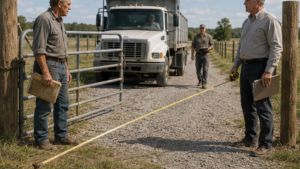
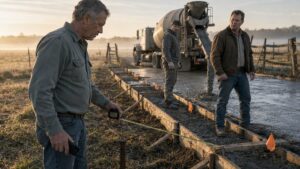
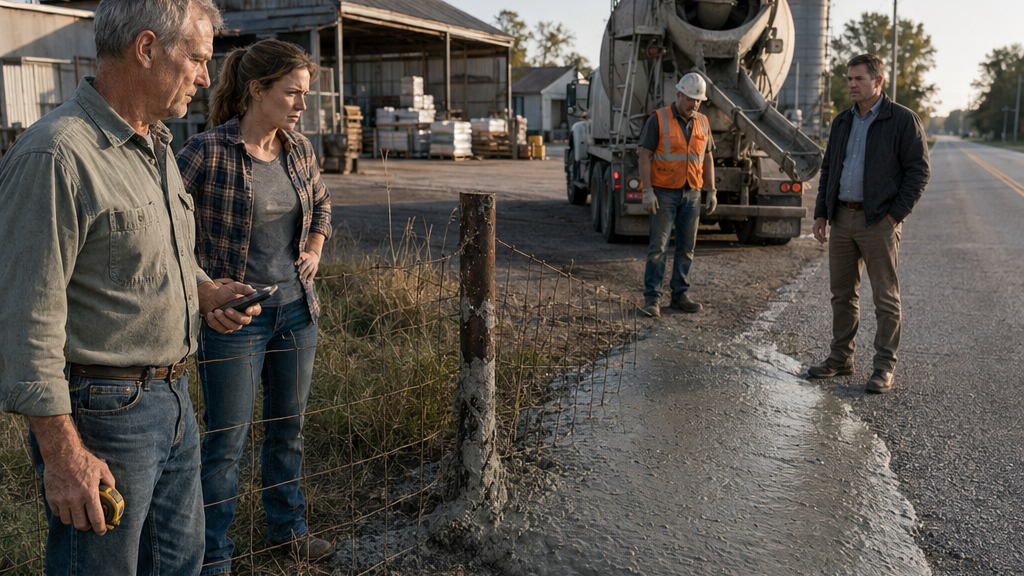
By the time William Hall reached the gate, wet concrete was already pushing beneath the woven-wire fence.
It came through in slow gray folds, flattening the pasture grass and curling around the rust-dark bottom of the corner post. On the road side, a ready-mix truck sat crooked at the mouth of the adjoining supply yard, its rear chute hanging at an angle that made no sense.
“Dennis!”
The driver was already climbing down.
William stepped over the cattle guard and stopped short of the spill. The concrete was moving toward the narrow service strip inside his fence, the only entrance wide enough for the hay wagon scheduled that morning.
Dennis Brown slapped at the chute controls.
“Hold on. Hold on.”
The mixer drum turned behind him with its steady mechanical groan.
“Shut it off,” William said.
“I’m trying.”
Another heavy ribbon dropped, struck the edge of the county-road shoulder, and slid under the fence.
William’s first impulse was to grab a shovel.
His second was better.
He took out his phone.
Dennis saw him.
“Bill, it’s just runoff. We can scrape it.”
William photographed the chute first.
Then the rear of the truck.
Then the concrete crossing the road edge, the fence, and the strip of grass beyond it.
“I didn’t say you couldn’t scrape it.”
Dennis stared at him for a moment, then returned to the controls.
The chute finally lifted.
The concrete stopped.
Silence settled strangely after the machinery noise, broken only by the mixer drum and cattle shifting in the pasture.
Dennis looked toward the spill.
“Chute shifted on the turn.”
“Shifted how?”
“Latch must not have seated.”
“Must not have?”
Dennis rubbed the back of his neck. “I locked it before I pulled out.”
William looked at the yard entrance. The turn was tight. Supply trucks had been making it for years, passing within a few feet of his fence before straightening onto the county road.
“Has it done that before?”
Dennis’s eyes flicked toward the truck.
“Not like this.”
That was not an answer William liked, but he let it sit.
A pickup came down William’s lane from the barn. Heather Roberts stopped twenty feet away, got out, and stared.
“What happened?”
“Concrete truck lost its chute.”
She looked at the gray strip spreading inside the fence.
“That is not losing a chute. That’s pouring half the driveway.”
“It’s not half the driveway.”
“You know what I mean.”
William crouched beside the fence and photographed the concrete against the bottom wire. Some of it had already pushed the mesh out of line. One staple had pulled loose from the post.
Heather folded her arms.
“You need Ryan over here.”
Dennis checked his phone.
“I can give you the office number.”
Heather stared at him. “You’re leaving?”
“I’ve got six yards still loaded.”
William stood.
“You have concrete on my property.”
“I know that.”
“And you’re driving away?”
Dennis’s jaw tightened. “I’m calling the yard. They’ll send somebody.”
He pulled a business card from the cab and handed it to William.
The card carried the supply yard’s office number and Ryan Baker’s name beneath Operations Manager.
Dennis looked once more at the spill.
“I’m sorry, Bill.”
Then he climbed back into the truck.
William watched the mixer ease onto the county road and disappear beyond the soybean field.
Heather said, “That was fast.”
“He’s on a route.”
“That makes it better?”
“No.”
But William understood the instinct. A loaded mixer was a clock. Concrete did not care whose fence had been damaged or which supervisor had failed to show up.
That did not mean Dennis should have left.
It only meant William knew why he had.
A horn sounded from farther down the lane.
William turned.
The hay truck.
Heather closed her eyes.
“Perfect.”
The driver stopped well short of the entrance. The concrete had spread across the firmest part of the service strip, and the edge nearest the gate was too soft to risk a loaded wagon.
William walked out and waved him down.
“Can you come around through the north field?”
The driver looked toward the narrow alternative track.
“With that load?”
“Take it slow.”
“That’ll add twenty minutes.”
“I know.”
William hated asking. The north access crossed uneven ground he normally kept for machinery, not loaded delivery rigs.
Behind him Heather was already taking more photographs.
“Dad.”
He turned.
She pointed to the fence.
The concrete had pushed farther than he had first thought. Gray slurry sat three or four inches deep around the base of the corner post. The grass beneath it had disappeared.
“Take a picture from the road,” William said. “Wide enough to show the shoulder.”
Heather looked surprised.
“Why?”
“So nobody gets confused later about where it went.”
She studied him.
“You sound like you’ve done this before.”
“I’ve had fences damaged before.”
“That isn’t what I meant.”
William ignored the question.
Two seasonal workers arrived from the supply yard with shovels and a skid-steer. Before they touched anything, William walked the boundary with them.
“The county shoulder ends there,” he said, pointing. “Everything behind this fence stays until I’ve documented it.”
One worker nodded immediately.
The other said, “Ryan told us to clean all of it.”
“You can clean it after I photograph it.”
There was no argument in William’s voice.
That helped.
He took measurements from the fence post, photographed the pulled staple, the crushed grass, the blocked entrance, and the gray residue splashed across the lower wires.
Only when he was finished did he step aside.
Ryan Baker arrived forty minutes later in a clean pickup, phone pressed to his ear.
He ended the call before getting out.
“William.”
“Ryan.”
Ryan surveyed the scene.
“Well. That’s a mess.”
Heather gave a short laugh with no humor in it.
Ryan glanced at her, then back at William.
“Dennis says the chute shifted coming out.”
“So he told me.”
“We’ll clean it. If there’s fence repair, send me what it costs.”
William looked at him.
“That simple?”
Ryan spread one hand.
“Doesn’t need to become complicated.”
For a moment William almost agreed.
That was how things were usually handled out there. A machine crossed a line, a fence got bent, somebody brought posts and wire on Monday.
Nobody called lawyers. Nobody wrote formal notices. People fixed what they broke.
William had always preferred it that way.
“What about the entrance?” he asked.
“We’ll scrape it clean.”
“The concrete is already setting in the gravel.”
Ryan nodded toward the skid-steer.
“They’ll get most of it.”
“Most?”
Ryan exhaled.
“William, I’m not trying to minimize it.”
Heather looked directly at him.
“It sounds like you are.”
William raised one hand slightly, not toward her exactly, but enough.
Ryan noticed.
“So here’s what we’ll do,” he said. “Let us finish cleanup. I’ll review Dennis’s route note Monday. If you’ve got damage, get me an estimate. We’ll handle it internally.”
William looked from Ryan to the fence.
Gray concrete had hardened in small ridges around the bottom wire.
Internally.
It was a word he knew better than Ryan could possibly guess.
And for the first time that morning, William wondered exactly what the yard intended to put in writing once the concrete was gone.
Chapter 2: The Report Said the Damage Was Outside His Property
The letter arrived thirteen days later and described William’s damaged farm entrance as though his land had never been touched.
He read the sentence twice.
Then a third time.
The incident summary stated that a ready-mix discharge had occurred during a vehicle turn and required cleanup along the county-road shoulder adjacent to Hall property.
Adjacent.
William set the page on the kitchen table.
Heather, working through invoices at the other end, looked up.
“What?”
He slid the letter toward her.
She read the first paragraph.
“You’re kidding.”
“No.”
“It says roadside shoulder.”
“I can see that.”
“It went under the fence.”
“I know.”
“Half the mess was inside.”
“Not half.”
She dropped the paper.
“Dad.”
William got up and went to the counter, where a contractor’s estimate sat beneath the feed statements.
The contractor had inspected the entrance three days after the spill.
The damage was not catastrophic. That was part of the problem.
There was no collapsed barn, no injured animal, no broken tractor.
There was a damaged fence section, contaminated gravel, hardened concrete in the grass strip, two bent staples, and a corner post that had shifted enough to loosen tension down the line.
The estimate came to twenty-three hundred and sixty dollars.
Enough to matter.
Not enough, perhaps, for Ryan to think William would make trouble.
Heather read the rest of the letter.
“It says the yard completed cleanup and no additional visible property damage was reported.”
William sat down again.
“That’s the part I don’t like.”
“You reported it.”
“I told Ryan to send me whatever he needed for the estimate.”
“And you gave him the estimate.”
“Yesterday.”
“He wrote this before yesterday?”
William looked at the date.
“Yes.”
Heather leaned back.
“So they decided there wasn’t damage before they got the amount.”
William did not answer.
He took out his phone and opened the photographs from the morning of the spill.
The first showed the chute hanging sideways.
The second showed wet concrete crossing the road shoulder.
The third showed it passing beneath the woven wire.
The fourth showed the concrete pooled inside the fence around the post.
He placed the phone next to the letter.
Adjacent to Hall property.
The picture said otherwise.
Heather watched him enlarge the image.
“You took a lot.”
“Enough.”
“You measured it too?”
“Yes.”
She looked toward the mudroom, where his tape measure still hung from a nail.
“You always do that?”
“No.”
“Then why this time?”
William looked again at the report.
Because once, a long time ago, he had watched a warehouse owner lose a legitimate claim because the first cleanup crew removed the damaged materials before anyone photographed them.
Because he had seen drivers change their wording after supervisors got involved.
Because he had spent years reading reports written by people who were not exactly lying but had learned how much truth could disappear inside a careful sentence.
He said only, “It seemed sensible.”
Heather did not look convinced.
The supply yard office was less than a quarter mile away.
William could see the tops of the storage sheds from his west pasture, and on still mornings he heard forklifts before sunrise.
He drove over after lunch.
Ryan was behind a desk in a narrow office lined with delivery schedules and safety notices.
He looked at the estimate.
“Twenty-three sixty?”
“That’s what the contractor gave me.”
“For some gravel and fence wire?”
“For removal, replacement gravel, fence repair, and labor.”
Ryan leaned back.
“William, those numbers get padded.”
“Maybe.”
“You know how contractors are.”
“I know how estimates work.”
Ryan’s eyes sharpened slightly.
William regretted the sentence as soon as he said it. Not because it was wrong, but because of the tone.
He had not come to prove he knew more than Ryan.
He had come to get the entrance fixed.
Ryan tapped the letter.
“Our people cleaned the shoulder.”
“They cleaned the shoulder and part of my strip.”
“You let them.”
“Yes.”
“You were standing there.”
“Yes.”
“So I’m trying to understand what we’re arguing about.”
William felt the old irritation rise—the particular kind created when somebody reduced a factual disagreement to a problem of temperament.
“I’m not arguing about cleanup.”
“Then what?”
“This says there was no visible property damage reported.”
Ryan glanced down.
“That’s the incident language.”
“It’s inaccurate.”
“It’s what I had at the time.”
“You had me standing beside a bent fence.”
Ryan’s mouth tightened.
“I had a minor spill, a cleaned shoulder, and you telling my guys to go ahead.”
William went still.
There it was.
Not a lie.
A framing.
Because William had wanted to avoid fuss, his cooperation with cleanup was now being used as evidence that the loss itself had been small.
Ryan pushed the estimate back.
“If you have something new, send it over. Pictures, contractor details, whatever. Otherwise, from our side, the incident is closed.”
William looked at the page.
“Closed?”
“For now.”
“You told me you’d handle it internally.”
“And I did.”
The answer landed harder than William expected.
Ryan did not look pleased with himself. If anything, he looked tired.
A whiteboard behind him listed delivery runs in red marker. Several were crossed out and rewritten. One truck number appeared beside three separate jobs for the following week.
William recognized nothing important in it.
Not yet.
He stood.
“I’ll send the photographs.”
“Fine.”
“And the estimate again.”
“That’s fine.”
Ryan nodded toward the door.
“We’re not trying to make enemies with you, William.”
William paused.
“Neither am I.”
That was the truth.
It was also the problem.
Back at the farm, Heather was waiting in the kitchen.
“Well?”
“He says send the pictures.”
“And then?”
“He’ll review them.”
“You believe that?”
William took off his cap and set it on the table.
“I believe he’ll look at them.”
“That’s not what I asked.”
He opened the photograph folder on his phone and began transferring images to the computer.
Heather watched him create a folder by date.
Then a second folder for the estimate.
Then a document with the time Dennis had left, the time Ryan arrived, and the time the hay delivery had been diverted through the north field.
“You said you didn’t always do this,” she said.
“I don’t.”
“You’re doing it like you’ve been waiting twenty years to do it.”
William stopped typing.
For several seconds he looked at the screen without seeing it.
Then he stood, went to the small desk by the window, and opened the bottom drawer.
Under old tax records and a bundle of expired machinery warranties lay a black notebook with a cracked vinyl cover.
Heather said nothing.
William picked it up.
The first pages were filled with dates, claim numbers, reserve changes, and handwritten reminders from another life.
He had not opened it in years.
He turned to the first blank page.
At the top, he wrote the date of the concrete spill.
Then he placed Ryan’s letter inside the cover.
Chapter 3: Six Weeks Later the Same Chute Failed Again
William heard Dennis shout before the second stream of concrete reached the fence.
“Back! Back!”
Heather stopped beside him.
They had been standing near the service entrance discussing where to stack a load of fencing supplies when the ready-mix truck began its turn out of the yard.
William recognized Dennis through the windshield.
Then the rear chute swung.
Not gradually.
It snapped sideways with a hard metal jerk.
Wet concrete dropped onto the road edge.
“Not again,” Heather said.
The slurry spread across the gravel shoulder.
Dennis hit the controls.
The chute kept discharging.
Then the gray stream crossed the same narrow strip it had crossed six weeks earlier.
William was moving before Heather was.
But he did not run toward the truck.
He stepped sideways, pulled out his phone, and took a photograph.
“Dad, it’s coming through.”
“I see it.”
The concrete reached the fence.
It pressed under the lower wire and pooled around the same corner post.
Heather stared at him.
“Do something.”
“I am.”
William photographed the chute angle.
The rear tires.
The road shoulder.
The truck number.
Then he lowered the phone and looked at the number again.
He knew it before he opened the old file.
Still, he checked.
Same truck.
Dennis finally stopped the discharge.
He climbed down so fast he nearly missed the lower step.
“Damn it.”
William took another photograph.
Dennis saw the phone and looked away.
Heather said, “You knew.”
Dennis turned.
“What?”
“That thing is broken.”
“No.”
“You just had the same accident.”
“I said no.”
William approached slowly.
“Dennis.”
The driver rubbed both hands over his face.
“It locked when I checked it.”
“Same chute?”
Dennis did not answer.
“Same truck,” William said.
“Yes.”
“Same latch?”
Dennis looked toward the yard.
That look mattered more than his words.
William felt something inside him settle.
Not anger exactly.
A shape.
The first incident had been untidy, disputable, reducible to wording.
This was different.
Two points made a line.
Heather stepped nearer the spill.
“Don’t.”
She stopped.
William pointed.
“Stay out of it until I’m done.”
Her expression changed.
He took a tape measure from the pickup.
From the corner post to the edge of the concrete.
From the bottom wire to the deepest point of the spill.
From the truck tire track to the county shoulder.
He photographed every measurement.
Dennis watched silently.
“You expecting court?” Heather asked.
“No.”
“You’re acting like it.”
William took a final wide photograph showing the truck, fence, yard exit, and concrete in one frame.
“I’m expecting people to remember this differently by tomorrow.”
Dennis flinched.
William saw it.
“I’m not accusing you.”
“You don’t have to.”
“You told me last time the chute shifted.”
“It did.”
“And this time?”
“The latch didn’t hold.”
“Those are different things.”
Dennis glanced toward the office again.
Heather noticed now too.
“What aren’t you saying?”
Dennis picked up his gloves.
“I need to call Ryan.”
“Call him,” William said.
Ryan arrived twelve minutes later.
This time he did not begin with a joke about the mess.
He got out, looked at the spill, then at Dennis.
“What happened?”
Dennis said, “Latch let go.”
Ryan’s jaw moved.
“You check it?”
“Yes.”
“Before you pulled out?”
“Yes.”
Ryan walked to the back of the mixer and looked at the chute assembly.
William watched him touch the latch.
Not inspect it.
Touch it.
Like a man checking something familiar.
Ryan turned to William.
“We’ll get this cleaned.”
Heather laughed once.
Ryan looked at her.
“What?”
“Nothing.”
“It clearly isn’t nothing.”
She pointed at the concrete.
“This is the same place.”
“I can see that.”
“Same truck too.”
Ryan looked toward William.
“You checked?”
“I did.”
Ryan exhaled.
“All right. We’ll document it.”
William almost smiled.
The word was six weeks late.
“Internally?” he asked.
Ryan’s face tightened.
“William.”
“It’s a fair question.”
“We’ll review what happened.”
“You reviewed the last one.”
“And?”
“You wrote that the damage was outside my property.”
Ryan looked briefly toward Dennis.
“That was based on the cleanup record.”
“The cleanup record was wrong.”
“Then we’ll correct it.”
Heather said, “You said that one was closed.”
Ryan ignored her.
William kept his voice level.
“Was this truck inspected after the first incident?”
“Yes.”
“By whom?”
“Our shop.”
“Was the latch replaced?”
“I don’t have that information standing here.”
Dennis shifted his weight.
William saw it again.
That reluctance.
Not the casual shrug from the first day. Something heavier.
Ryan gestured toward the spill.
“Let us deal with the immediate issue first.”
“No.”
It was the first hard refusal William had given him.
Ryan stared.
William pointed toward the concrete.
“You can clean it after I finish.”
“You’ve already got pictures.”
“I’m not done.”
“What else do you need?”
“Truck number. Measurements. Fence condition. Tire position. Chute position. Time. Who was present.”
Heather looked at him.
Even Ryan did.
William realized what they were hearing.
Not a farmer improvising.
A claims man.
The part of his life he had kept boxed away had stepped back into the road without asking permission.
Heather said quietly, “Dad, what exactly did you used to do?”
William took one last photograph.
“Commercial liability claims.”
She frowned.
“You mean insurance?”
“For eleven years.”
Ryan said nothing.
Heather looked from William to the concrete.
“That’s why you kept the first file.”
William put the phone in his pocket.
“That’s why I know two nearly identical losses in six weeks are not something a carrier likes to see.”
Dennis stared at the ground.
Ryan’s posture changed almost imperceptibly.
“What are you suggesting?”
“I’m not suggesting anything.”
“You just brought up the carrier.”
“I said what a carrier notices.”
Ryan folded his arms.
“This was an equipment failure.”
“Maybe.”
“You think Dennis did it deliberately?”
“No.”
Dennis looked up.
William continued.
“I think there are a few possibilities. Driver procedure. Mechanical defect. Inspection issue. Maybe something else.”
Ryan’s voice hardened.
“You don’t know.”
“That’s right.”
The answer seemed to surprise him.
William stepped closer to the fence.
Fresh concrete surrounded the rust-dark post, climbing nearly to the hardened gray ridge left from the first spill.
He took a picture of old concrete and new concrete together.
“I don’t need to know yet.”
Ryan looked at the post.
For the first time, his confidence seemed to falter.
William remembered hundreds of claim files in which the important fact had not been the first loss.
It had been what happened afterward.
Who knew.
What was inspected.
What was repaired.
What remained in service.
Ryan told the workers to wait until William finished documenting.
That, more than anything, told William the conversation had changed.
Twenty minutes later the skid-steer began removing the fresh concrete.
Heather stood beside William near the pickup.
“You never told me you did that for eleven years.”
“You knew I worked insurance.”
“I thought you sat in an office arguing about deductibles.”
“Sometimes.”
She looked at him.
“You almost let the first one go.”
William watched the machine scrape gray material away from the fence.
“Yes.”
“Why?”
He considered giving her the easy answer.
Because the amount was small.
Because Ryan was a neighbor.
Because rural businesses depended on each other.
All were true.
None were enough.
“I got tired of fighting over words for a living,” he said.
Heather waited.
William looked toward Ryan.
“And I didn’t want to spend the rest of my life doing it at home.”
She softened, but only a little.
“Well, it followed you home.”
“Yes.”
Ryan approached before William could say more.
“We’ll get you a corrected incident report.”
William nodded.
“And I’ll have the truck looked at.”
“When?”
“Today.”
William glanced at Dennis.
Dennis was studying the ground again.
Ryan turned to leave.
William said, “One question.”
Ryan stopped.
“When was that latch last written up?”
The yard seemed suddenly louder behind him—forklift beeps, diesel engines, the clatter of pallets.
Ryan did not answer immediately.
And William knew from the delay that there was already something to answer.
Chapter 4: The Driver Had Been Asking for the Truck to Be Checked
Dennis found William three days later beside the damaged fence and asked a question before he said hello.
“Ryan tell you about the latch report?”
William straightened slowly.
He had been measuring from the corner post to the hardened edge of the second spill, using the same point he had photographed after the first one.
“No.”
Dennis looked toward the supply yard.
The morning traffic had thinned. A forklift moved pallets behind the storage shed, and somewhere inside the ready-mix bay a steel panel slammed shut.
William reeled in the tape.
“What report?”
Dennis rubbed one thumb across the knuckle of the other hand.
“I mentioned it.”
“To Ryan?”
“To the shop.”
“That isn’t what I asked.”
Dennis gave him a tired look.
“I told Ryan it wasn’t holding right.”
William did not reach for his notebook.
Not yet.
“When?”
Dennis glanced at the fence post.
“Before the second spill.”
The answer came quietly enough that William almost wished he had misheard it.
“How long before?”
“Couple days.”
William waited.
Dennis shifted his weight.
“Maybe three.”
“And what exactly did you tell him?”
“That the chute was moving under vibration. Not every trip. Sometimes you’d hit rough pavement and it would work itself against the latch.”
“Did it open?”
“Not all the way.”
“Before the second spill?”
“No.”
William kept his voice flat.
“Then what happened?”
“I told the mechanic. He checked it. Tightened something.”
“What?”
“I don’t know.”
“Did he clear the truck?”
Dennis hesitated.
“That’s not really how it works.”
William looked at him.
Dennis sighed.
“We don’t have a big fleet, Bill. If a truck is rolling and the shop can keep it rolling, it rolls.”
“That answer came from Ryan?”
“That answer comes from having concrete booked all week.”
William folded the tape measure.
The simplest version of the story had been that Dennis was careless.
The second simplest version was that Ryan was careless.
Neither now seemed sufficient.
“Why didn’t you tell me this the day it happened?”
Dennis’s face hardened.
“Because I drive for him.”
“That doesn’t answer it.”
“Yes, it does.”
For the first time, William heard anger beneath the driver’s embarrassment.
Dennis kicked lightly at a piece of hardened concrete near the shoulder.
“You think I wanted that thing coming loose twice?”
“No.”
“You think if I refuse a truck every time something rattles, I keep the good routes?”
“I don’t know.”
“I do.”
William said nothing.
Dennis looked toward the yard again.
“I’m sixty next year. I’m not starting over somewhere else because I made the boss mad over a latch the shop said they handled.”
William studied him.
The shrug after the first spill returned to his mind.
He had read it as indifference.
Maybe part of it had been.
But standing there now, Dennis looked less like a man who had not cared and more like a man who had been trying not to say the wrong thing in front of the wrong people.
William disliked how easily he had judged him.
“You still drove it,” William said.
Dennis nodded.
“I did.”
“So you made a choice too.”
“I know.”
There was no defense in the answer.
That mattered.
William walked to the post and hooked the tape at its base.
Dennis watched.
“Why are you measuring from there?”
“Because the road can be argued about.”
Dennis frowned.
“The fence can’t?”
“Not as easily.”
William stretched the tape toward the hardened concrete.
“The first report called it roadside cleanup. If I measure from the shoulder, somebody can debate where the shoulder ended before they scraped it. This post is in both sets of photographs.”
Dennis looked down the line.
The woven wire was old and uneven. One section sagged slightly where cattle had leaned against it years ago. Nothing about it looked formal.
But it was still the line.
William wrote the distance in the old claims notebook.
Dennis noticed the notebook.
“You keeping a file?”
“Yes.”
“Against me?”
“No.”
“You sure?”
William closed it.
“I’m keeping a file about what happened.”
Dennis gave a dry laugh.
“Insurance answer.”
William looked at him.
“I used to work claims.”
“I heard.”
“From Ryan?”
“From everybody.”
That surprised him.
Dennis shrugged.
“Small yard.”
William glanced toward the office.
“What else has everybody heard?”
“That you might go around Ryan.”
“I haven’t decided what I’m doing.”
Dennis studied him.
“You should know one thing.”
William waited.
“If you go after Ryan saying he knew the latch was going to dump concrete, he’ll fight you all the way.”
“I didn’t say that.”
“Good.”
“Because I can’t prove it.”
Dennis nodded.
“That’s what I mean.”
“What can I prove?”
“That I told them it moved.”
“Was it written down?”
Dennis looked uncomfortable again.
“I filled out a maintenance slip.”
William felt his attention sharpen.
“Where is it?”
“In the shop system, I guess.”
“You have a copy?”
“No.”
“Photo?”
“No.”
“So all I have is you telling me there was one.”
Dennis’s expression closed.
“I’m not signing anything.”
“I didn’t ask you to.”
“I’ve got to work there.”
“I understand.”
“Do you?”
William almost answered too quickly.
Then he stopped.
For eleven years he had watched employees get caught between what they had seen and what they could afford to admit.
He had disliked it then too.
“Yes,” he said. “I do.”
Dennis looked relieved and ashamed at the same time.
A ready-mix truck started inside the yard.
Both men turned.
It was not the damaged truck.
Dennis said, “I better go.”
William nodded.
“Thank you for telling me.”
Dennis started toward the road, then stopped.
“Bill.”
“Yes?”
“I checked that latch both mornings.”
William said nothing.
Dennis looked toward the fence.
“I’m not saying I did everything right. But I checked it.”
Then he walked away.
By afternoon, William had nearly convinced himself to wait.
He had Dennis’s account, but no maintenance slip. He had photographs of two spills, but not proof of why they happened. He had Ryan’s inaccurate first report, but inaccuracies were not necessarily dishonesty.
Heather found him at the kitchen table with the notebook open.
“You talked to Dennis?”
William nodded.
“And?”
“He says he reported the latch.”
Her eyes widened.
“That’s it.”
“No.”
“What do you mean, no?”
“It means he says he reported it.”
“So Ryan knew.”
“It means Dennis says Ryan was told there was movement.”
Heather stared at him.
“You’re splitting hairs.”
“Yes.”
“Why?”
“Because hairs matter when you accuse somebody of knowing a truck was unsafe.”
She leaned against the counter.
“He sent it out anyway.”
“I don’t know what the mechanic told him.”
“You’re protecting Ryan.”
“No.”
“It sounds like it.”
William closed the notebook harder than he intended.
“I am protecting the facts.”
The room went quiet.
Heather looked away first.
William regretted the tone immediately, but before he could soften it, a truck engine sounded outside.
Not on the county road.
At the supply yard.
William went to the window.
The familiar ready-mix truck rolled out from behind the maintenance bay.
Same number.
Same drum.
Same rear chute.
It turned toward the county road.
A minute later his phone rang.
Ryan.
William answered.
“You looking out your window?” Ryan asked.
“Yes.”
“The shop checked it.”
William watched the truck straighten past the fence.
“And?”
“It’s back in service.”
Ryan paused.
“I thought you’d want to know.”
The truck accelerated toward the highway.
William kept watching until it disappeared.
For the first time since the second spill, he understood that waiting was also a decision.
Chapter 5: William Stopped Arguing with the Yard
William crossed out the sentence accusing Ryan of knowingly sending a defective truck back onto the road.
Then he crossed out the next one.
Heather watched from the other side of the farm office.
“You’ve been doing that for twenty minutes.”
William drew a line through the words ignored known hazard.
“They’re conclusions.”
“They’re obvious conclusions.”
“They’re still conclusions.”
She pushed away from the filing cabinet.
“You heard Dennis.”
“I heard Dennis say he reported movement in the latch.”
“And the truck went back out.”
“Yes.”
“So what part are you struggling with?”
“The part where I claim to know what Ryan knew, when he knew it, and what the mechanic told him.”
Heather shook her head.
“This is why people get away with things.”
“No. This is how you make sure they can’t dismiss the rest of what you’re saying.”
She looked at the pages spread across the desk.
Two sets of photographs.
Two contractor notes.
The first incident report.
Measurements from the same fence post.
Times, dates, truck number.
William had arranged them in chronological order.
Not emotionally.
Chronologically.
He had forgotten how calming that could be.
Facts had edges.
Anger did not.
The independent contractor arrived midmorning to inspect the second damage.
He crouched near the fence and chipped at a ridge of hardened concrete with the end of a screwdriver.
“This section’s worse.”
William stood beside him.
“Because of the second spill?”
“Because the first one already got into the base.”
He pointed to the corner post.
“You can repair around this, but if you want it right, you’re replacing the gravel strip and re-tensioning the fence.”
Heather said, “Can you put that in writing?”
The contractor nodded.
William added, “Separate what you attribute to the first spill from what you can reasonably attribute to the second.”
Heather looked at him.
The contractor did too.
“You want two estimates?”
“I want one estimate that says what you can support.”
The contractor gave a small smile.
“You really did work insurance.”
William did not smile back.
“Yes.”
After the contractor left, William pinned copies of the first and second photographs side by side.
Same view.
Same rust-dark post.
Same lower wire.
Same yard exit in the background.
The only obvious difference was the amount of green grass left between the concrete.
Heather stood behind him.
“That’s bad.”
“It’s useful.”
“You mean bad for them.”
“I mean clear.”
William traced the edge of the first spill with one finger.
“Look here.”
The first photograph showed the chute angled beyond the truck’s normal centerline.
The second showed nearly the same position.
Heather leaned closer.
“Same failure?”
“Maybe.”
“Same truck.”
“Yes.”
“Same route.”
“Yes.”
“Same fence.”
“Yes.”
She exhaled.
“And you still don’t want to say they knew.”
William sat down.
“I don’t need to.”
That was the point he had been circling for days.
He remembered claim meetings where everybody wasted hours trying to prove bad intent when the loss itself already told a simpler story.
Repeated event.
Same equipment.
Same location.
Similar mechanism.
Prior complaint.
Those facts did not need embellishment.
A carrier would ask its own questions.
William opened a fresh document.
He removed every adjective.
No reckless.
No negligent.
No deliberate.
No ignored hazard.
He wrote only what he could tie to a photograph, date, estimate, or direct conversation.
Incident one.
Truck number.
Approximate time.
Reported chute shift.
Concrete crossing county-road shoulder and entering Hall property beneath woven-wire boundary fence.
Photographs attached.
Cleanup performed before complete written property-damage acknowledgment.
Incident report later described event as shoulder cleanup adjacent to property.
Incident two.
Same truck.
Same route exit.
Same fence section.
Driver stated latch did not hold.
Driver later stated he had previously submitted maintenance concern regarding movement under vibration.
No maintenance record in William’s possession.
Heather read over his shoulder.
“That last sentence sounds weak.”
“It is weak.”
“Then why include it?”
“Because it tells them exactly what I know and exactly what I don’t.”
She folded her arms.
“You make it sound almost boring.”
“Good.”
“Good?”
“If the facts are strong, they don’t need help.”
Heather sat across from him.
“You really miss this?”
William looked at the files.
“No.”
“You look like you do.”
“I miss knowing where to put things.”
“What does that mean?”
He leaned back.
“When something bad happened out here, my father fixed it. Fence down, fix the fence. Culvert blocked, clear it. Cow sick, call the vet. Most problems had a physical answer.”
“And insurance didn’t?”
“Insurance had language.”
Heather waited.
William looked at Ryan’s first report.
“You could watch somebody lose something real, then spend six weeks arguing over whether the right word was damaged or deteriorated.”
“That’s why you quit?”
“Partly.”
“And now you’re doing it again.”
“Yes.”
“Because Ryan made you?”
William considered that.
“No.”
The answer surprised both of them.
“I’m doing it because I let him write the first version.”
Heather’s expression softened.
William continued.
“I thought staying quiet would keep it neighborly. Instead, it gave him room to decide what happened.”
“That wasn’t your fault.”
“I didn’t say it was.”
“But?”
“But I’m not doing it twice.”
By late afternoon, the package was ready.
Photographs.
Measurements.
Contractor estimate.
The first incident report.
A copy of William’s email sending the first estimate.
The chronology.
A request for review of both incidents.
Nothing more.
Heather stood by the printer.
“You know Ryan will find out.”
“Yes.”
“You buy feed there.”
“Yes.”
“They’re the nearest yard.”
“I know.”
“They could make things difficult.”
William gathered the pages into a binder clip.
“They could.”
“So why not tell him first?”
William looked toward the west window.
The storage sheds of the supply yard rose beyond the pasture.
Because that was how he had handled the first incident.
Because Ryan had already shown him what internal handling meant.
Because asking permission to escalate was another version of staying quiet.
“He had two chances to look at the same problem,” William said.
Heather nodded.
“And?”
“And now somebody else gets to.”
He sent the electronic package to the liability carrier listed on the yard’s certificate of insurance and mailed the signed hard copy the same afternoon.
For several minutes afterward, nothing happened.
No dramatic call.
No immediate reply.
The office stayed exactly as it had been.
Heather closed the printer tray.
“That’s it?”
“That’s it.”
She looked almost disappointed.
William understood.
Real escalation rarely sounded like much.
Sometimes it was only a sent message.
Sometimes it was a file leaving one desk and landing on another.
Two days later, the carrier acknowledged receipt.
The email was brief.
The claims representative requested preservation of all maintenance records, inspection notes, driver reports, route documentation, and internal incident materials relating to both losses.
William read the list twice.
Then he looked toward the supply yard.
He no longer needed to ask Ryan whether the latch report existed.
Someone with authority to demand it had just asked the same question.
Chapter 6: The Insurer Asked for the Records Ryan Had Avoided
The claims representative arrived at William’s gate before the supply yard office had opened.
Her vehicle stopped on the county-road shoulder, well clear of the damaged strip.
William noticed that first.
She got out with a tablet, camera, measuring wheel, and a folder containing copies of his photographs.
“You’re Mr. Hall?”
“Yes.”
“I’d like to start with the boundary.”
Not the truck.
Not Ryan.
The boundary.
William liked her immediately for that.
He led her to the corner post.
The concrete from both spills had been partly removed, but hardened gray material remained beneath the lower wire and between the stones at the edge of the service strip.
She crouched.
“This is the same post shown here?”
She held up the first photograph.
“Yes.”
“And this one?”
The second photograph.
“Yes.”
She aligned the image with the physical fence.
The rust marks on the post matched.
So did the old bend in the lower wire.
She photographed the remaining concrete.
“The company’s initial report places most material on the county shoulder.”
William nodded.
“That’s what I objected to.”
“Do you have any reason to believe the fence line moved between incidents?”
“No.”
“Any recent survey dispute?”
“No.”
“Neighbor dispute?”
“No.”
“Good.”
William almost smiled.
He knew what she was doing.
Removing unnecessary explanations.
Across the road, the supply yard came to life.
A forklift beeped.
A garage door lifted.
Ryan walked out of the office and stopped when he saw them.
Even from fifty yards away, William could see the moment he understood who the visitor was.
Ryan crossed the road.
“William.”
“Morning.”
The claims representative introduced herself.
Ryan nodded once.
“I thought you were coming at nine.”
“I was nearby.”
His mouth tightened.
She pointed toward the fence.
“I wanted to see the loss area before operations got busy.”
Ryan looked at William.
“You could’ve told me.”
William met his gaze.
“So could you.”
Ryan did not ask what he meant.
The representative walked them through the site without choosing sides.
She measured the road edge.
The gravel strip.
The post.
The distance of remaining concrete inside the fence.
Then she opened William’s first photograph on the tablet.
Ryan watched the image.
“That was before cleanup.”
“Yes,” she said.
“That’s why we preserve pre-cleanup photographs.”
William said nothing.
Ryan glanced at him.
For years, William had sat across from people during inspections exactly like this. He knew the temptation to fill silence.
He resisted it.
The representative asked Ryan for the first internal incident report.
“I sent it.”
“I have the summary.”
“That’s the report.”
“I’m also requesting the driver’s route note, shop inspection entry, maintenance slips, and any follow-up after the first spill.”
Ryan shifted.
“Our shop records aren’t all formal.”
“Whatever exists.”
“The truck was checked.”
“Then there should be something showing what was checked.”
Ryan looked toward the yard.
“We’re pulling it.”
The representative nodded.
“And after the second incident, the truck returned to service?”
“Yes.”
“When?”
“Same day, I believe.”
William looked at Ryan.
Ryan corrected himself.
“Later that day.”
“Who authorized that?”
“Our shop.”
The representative made a note.
Ryan’s irritation became visible.
“This is turning into a lot over a fence repair.”
She looked up.
“I’m reviewing two similar losses involving the same unit in a six-week period.”
The sentence changed the air between them.
William had known it would.
Ryan looked at him.
“So that’s what you sent them.”
“I sent what happened.”
“You went around me.”
“Yes.”
“We could have handled this.”
William looked toward the concrete beneath the wire.
“We tried that.”
Ryan rubbed his jaw.
“You know what kind of quarter we’ve had?”
“No.”
“Two trucks down already. One driver quit. Commercial customers calling every day because everybody wants pours before freeze-up.”
The representative did not interrupt.
Ryan continued, now speaking mostly to William.
“You think I wanted that truck out there with a problem?”
“I don’t know what you wanted.”
“I wanted to keep ten people working.”
William heard the fatigue beneath the defensiveness.
Ryan pointed toward the yard.
“One truck down means routes get doubled. Routes get doubled, customers go somewhere else. Customers go somewhere else enough times, I cut hours.”
“That doesn’t make the latch work.”
“No.”
The answer came quickly.
Too quickly.
William watched him.
Ryan looked away.
By noon, the carrier had requested the yard’s maintenance history formally.
William did not see the records that day.
He did not expect to.
Three days later, the claims representative called.
“There was a maintenance notation before the second incident.”
William stood in the barn doorway with the phone to his ear.
“What did it say?”
“I can’t give you the full internal record at this stage.”
“Can you tell me whether Dennis reported the latch?”
“Yes.”
William closed his eyes briefly.
“And?”
“The notation recommends further inspection and securing of the chute-latch assembly if movement continued.”
“Was it repaired?”
“There was an adjustment noted.”
“Replacement?”
“Not before the second loss.”
William looked across the pasture toward the yard.
There it was.
Not proof that Ryan had expected another spill.
Not proof that anyone wanted to take a risk.
Something more ordinary.
A warning.
An adjustment.
A recommendation.
A truck kept moving.
The carrier temporarily removed the unit from operation pending inspection.
That afternoon Ryan came to William’s gate alone.
No pickup idling behind him.
No phone in his hand.
He stood beside the same corner post the carrier had photographed.
“You got what you wanted.”
William looked at him.
“No.”
“Truck’s out of service.”
“That wasn’t what I wanted.”
“Then what?”
“I wanted the damage fixed the first time.”
Ryan looked down.
For several seconds neither spoke.
Finally Ryan said, “Dennis told me it was moving.”
William waited.
“The mechanic tightened the assembly.”
“And recommended another inspection.”
Ryan’s eyes lifted.
“You’ve seen it?”
“No.”
“Then how—”
“The carrier told me enough.”
Ryan exhaled.
“We had three big pours booked.”
William said nothing.
“One of our other mixers was already down with a drum issue. If I parked Dennis’s truck too, I was canceling jobs.”
“So you didn’t.”
“No.”
“You thought it would hold.”
“Yes.”
The word came out almost angrily.
Ryan looked at the fence.
“I thought it would finish the week.”
William felt the old satisfaction of a disputed fact finally becoming clear.
It lasted less than a second.
Then he saw Ryan’s face.
Not a villain.
Not a liar caught in some grand scheme.
A manager who had taken a manageable warning, placed it beside payroll, schedules, customers, and pride, and decided the risk could wait.
William knew that kind of decision.
He had spent eleven years reading what came after them.
Ryan kicked lightly at the hardened concrete.
“You’re going to make them hammer us.”
“That depends what you mean by hammer.”
“You know exactly what I mean.”
William looked down the fence line.
The wire was weathered, imperfect, repaired more than once before any concrete truck had touched it.
But it was still where it belonged.
“What happens next isn’t about proving you’re a bad man,” William said.
Ryan gave a humorless laugh.
“Feels like it.”
“It’s about fixing what happened and making sure it doesn’t happen a third time.”
Ryan looked at him.
“And if they ask what you want?”
William did not answer immediately.
For weeks he had imagined having leverage.
Now that he had it, the question felt heavier than the victory.
He looked at the same corner post around which both spills had hardened.
“I’ll tell them.”
Ryan nodded once.
Then he walked back across the road.
William remained by the fence, knowing that for the first time in the dispute, nobody else could decide what counted as enough.
Chapter 7: He Repaired the Boundary Instead of Erasing What Happened
The repair crew arrived at William’s entrance with instructions that had his measurements attached.
That was how he knew the settlement had changed something.
Not because of the check.
Not because the carrier had agreed to pay the documented cost of replacing contaminated gravel, resetting the damaged fence section, and repairing the service strip.
Because the work order began at the rust-dark corner post.
The same post William had used in every photograph.
The same post Ryan’s first incident report had effectively treated as though it stood outside the real damage.
A worker stepped from the truck holding a printed site sketch.
“You Mr. Hall?”
“Yes.”
“We’re supposed to confirm the line with you before we pull anything.”
William looked at Heather.
She noticed it too.
“Imagine that,” she said.
William ignored the satisfaction in her voice.
He walked the crew along the woven-wire fence.
“This post stays if you can save it.”
The worker tapped the wood.
“It’s old.”
“So am I.”
Heather smiled.
The worker did too.
“It’s still solid below the damage,” he said. “We can brace it while we replace the wire.”
“Then keep it.”
They began by removing the hardened concrete that had worked beneath the fence and into the gravel. The first pieces came up easily. Others had bonded into irregular slabs around stones and roots.
William watched one gray chunk break free.
Embedded in its underside was a thin layer of dead grass.
Six weeks apart, two spills had erased that strip twice.
Now the crew was removing both.
Heather stood beside him with coffee.
“You know you could’ve made them replace the whole fence.”
“It doesn’t need replacing.”
“They offered.”
“They offered because it was easier to price.”
“You really cannot accept extra anything.”
William took the cup.
“That sounds like a complaint.”
“It is.”
The carrier had asked William what resolution he wanted.
He had given them a list.
Repair the damaged section.
Remove the concrete contamination.
Restore the gravel access.
Pay the contractor-supported amount.
Require the supply yard to stop using any truck with an unresolved chute-latch concern.
Change the exit procedure so ready-mix drivers secured the chute before making the turn beside his property.
And document the boundary damage accurately in the final claim file.
Heather had wanted one more condition.
Stop using the adjoining yard exit entirely.
The request had been possible. The claims representative had not promised it, but she had said the carrier would raise any reasonable loss-prevention measure with the insured.
Heather still wanted William to ask.
“It would solve the problem,” she said now.
William looked toward the supply yard.
Trucks had used that exit long before Ryan became operations manager. Closing it would force loaded mixers through the other side of the property, adding several minutes and putting them onto a busier stretch of county road.
“It would move the problem,” William said.
“Away from us.”
“Yes.”
“That’s generally the idea.”
William drank his coffee.
“If they can use the exit safely, they should be able to use it.”
Heather frowned.
“After all this?”
“Especially after all this.”
“That doesn’t make sense.”
“It does to me.”
She waited.
William looked at the workers resetting the gravel.
“For a while I wanted them to feel what it was like to lose an option because somebody else made a decision.”
Heather said nothing.
“That isn’t the same as fixing the risk.”
“So you’re letting Ryan off.”
“No.”
William pointed toward the yard.
“They have a written inspection procedure now. They have a route check. The truck that did this is still out pending repair confirmation. Their insurer has the maintenance record. My damage gets fixed.”
He looked at her.
“That’s not letting anybody off.”
Heather nodded slowly.
“It just doesn’t feel very satisfying.”
William smiled faintly.
“That may be why it’s useful.”
Near noon, the old fence wire came down.
For several minutes the boundary existed only as a row of posts and a pale line in the grass where the fence had stood.
William felt unexpectedly uneasy seeing it open.
The worker noticed.
“We’ll have the new wire on before we leave.”
“I know.”
Still, William stayed nearby.
The crew reused the corner post.
They cleaned concrete from its lower half, braced it, and reset the tension along the new section of woven wire.
When they finished, the fence looked almost exactly as it had before the first spill.
Not new.
Not ornamental.
Straight where it needed to be.
Weathered where it had earned the right.
Heather ran one hand over the top wire.
“You kept the ugly post.”
William looked at it.
“It wasn’t the post’s fault.”
She laughed.
A diesel engine sounded from the supply yard.
William turned.
A ready-mix truck eased toward the exit.
Heather’s expression changed immediately.
“That better not be—”
“It isn’t.”
William could see the number from where he stood.
Different unit.
Dennis Brown was driving.
He slowed before the turn.
William watched him stop completely.
Dennis climbed down.
He walked to the rear of the mixer, put both hands on the chute assembly, checked the securing mechanism, then tugged it hard enough for William to see the motion from across the road.
Only then did he climb back into the cab.
Heather said, “He knows we’re watching.”
“Probably.”
Dennis made the turn.
The chute stayed fixed.
The truck passed the corner post with room to spare and continued down the county road.
No concrete touched the shoulder.
For an ordinary delivery, it was an absurdly unremarkable event.
William found himself watching until the mixer disappeared anyway.
Heather nudged him.
“Happy?”
“No.”
“Relieved?”
“A little.”
That afternoon Ryan came over.
He stopped outside the gate instead of driving through.
The gesture was so small William almost missed its meaning.
Ryan looked at the repaired gravel.
“They did a good job.”
“Yes.”
“Fence looks better.”
“About the same.”
Ryan nodded.
Neither man seemed interested in discussing the settlement amount.
The carrier had covered the repairs and related documented costs. Nothing about it had made William richer.
It had simply put him back where he should have been before the first truck turned too sharply.
Ryan put his hands in his jacket pockets.
“They changed our check procedure.”
“I heard.”
“Drivers have to verify chute securement before they leave the loading lane and again before that turn.”
“Good.”
“Shop has to close maintenance notes in writing now.”
William nodded.
Ryan looked toward the post.
“I should’ve had them do that before.”
William waited.
Ryan took a breath.
“The second time.”
The apology stopped there.
No sweeping admission.
No statement that William had been right about everything.
Ryan looked uncomfortable enough that William suspected he had rehearsed a longer version and abandoned it somewhere between the yard and the fence.
“I knew it needed another look,” Ryan said. “I thought the adjustment was enough.”
“You told me.”
“I’m saying it again.”
William nodded.
Ryan glanced at him.
“I didn’t put that truck out because I didn’t care about your place.”
“I know.”
“I was looking at schedules.”
“I know that too.”
Ryan seemed almost annoyed by the lack of argument.
“We were in trouble, William.”
“That explains the choice.”
Ryan waited.
William finished.
“It doesn’t erase it.”
Ryan looked down.
“No.”
That was enough.
Not forgiveness exactly.
Not friendship restored.
Just two men standing beside a boundary neither could pretend was invisible anymore.
Ryan extended his hand.
William looked at it for a second, then shook it.
The grip was brief.
Ryan turned toward the yard.
Before he crossed the road, William said, “Ryan.”
He looked back.
“If something breaks again, call me before the cleanup crew.”
Ryan gave the smallest nod.
“Fair.”
That evening Heather helped William gather the remaining claim papers from the farm office.
The file had grown thicker than he expected.
First photographs.
Second photographs.
Repair estimates.
Incident report.
Carrier correspondence.
Measurements.
The maintenance notation he had never personally seen but no longer needed to see.
Heather picked up the old black claims notebook.
“You keeping this out?”
William took it from her.
For eleven years, that notebook had meant other people’s losses.
Warehouses.
Delivery trucks.
Storefronts.
Equipment accidents.
Arguments over what had happened and what words could be made to mean afterward.
When he left the work, he had believed putting the notebook away meant he had also put away that part of himself.
He understood now that the problem had never been knowing how to document a loss.
The problem had been allowing the work to teach him that every disagreement was exhausting before it even began.
He opened the bottom drawer.
Heather watched.
“You’re really putting it back?”
“Yes.”
“What if Ryan changes his mind about being reasonable?”
“Then I know where it is.”
She smiled.
William placed the notebook inside.
Then he stopped.
He removed two photographs from the file.
The first showed wet concrete sliding beneath the weathered fence after the original spill.
The second showed fresh concrete surrounding the same rust-dark post six weeks later.
He put copies of both in a thin farm-record folder rather than the claims notebook.
Heather noticed.
“Why keep those?”
William closed the drawer.
“Because the fence looks ordinary again.”
She waited for more.
He looked through the office window toward the repaired entrance.
From that distance, nobody would know what had happened there.
The wire ran where it had always run.
The corner post leaned just slightly toward the pasture.
Cars passed the county road.
Across from it, the supply yard continued working.
Nothing dramatic remained.
That was exactly what William had wanted.
But ordinary did not mean unimportant.
“Somebody will own this place after me,” he said. “They shouldn’t have to guess where the line is just because everybody once agreed not to talk about it.”
Heather looked at him for a long moment.
Then she placed the photographs in the farm folder and closed it.
The next morning, William walked to the entrance before starting chores.
He put one hand against the old corner post.
The new wire pulled firmly against it.
Across the road, a truck prepared to leave the supply yard.
Its driver stopped.
Checked the chute.
Made the turn.
William did not take out his phone.
The truck passed without crossing the line.
The story has ended.