The HOA Towed His Medical Van Over Six Inches—Then One Missing Approval Changed Everything
Chapter 1: Six Inches Beyond the Driveway Edge
Michael Jackson stepped outside with his van key already between his fingers and stopped so abruptly that the screen door struck his shoulder.
The driveway was empty.
For several seconds, he simply stared at the pale rectangle of concrete where the van had been parked the night before. His first thought was theft. His second was that he had somehow forgotten lending it to someone, which was ridiculous because almost no one else could drive it comfortably with the hand controls installed beneath the steering wheel.
Then he saw the dark crescent where the rear tire had rested near the driveway edge.
Michael tightened his hand around the key.
The van was not ordinary transportation. He had spent months pretending it was.
After retiring from the Army, he had been the man neighbors called when lawn mowers would not start or garage doors rattled. Cancer had changed the arithmetic of simple things. He could still walk, but treatment left his legs unreliable on bad days, and the van carried the equipment that made longer trips manageable without turning every errand into an argument with his own body.
Tomorrow morning, he had an oncology scan.
He went back inside and called the police non-emergency line. The dispatcher checked the plate.
“It wasn’t stolen, sir. It was towed.”
“By who?”
She gave him the name of a towing company and said the request had come from his homeowners association.
Michael looked through the kitchen window at the empty driveway.
“For what?”
“You’ll have to ask them.”
The HOA office occupied a converted room beside the community clubhouse, less than half a mile away. Michael drove there in the only way available to him: walking slowly, stopping once at a mailbox cluster when the ache in his hip sharpened.
Stephanie White was behind the desk when he entered.
She wore a navy cardigan over a white blouse, and her HOA identification badge hung from a blue lanyard. Michael had seen her at neighborhood meetings but had never spoken to her longer than thirty seconds.
“My van was towed.”
Stephanie looked up from her monitor.
“Address?”
He gave it.
She typed, read something, then nodded as if confirming a package delivery.
“Yes. Parking violation.”
“What parking violation?”
“Vehicle outside the approved paved surface.”
Michael waited.
“That’s it?”
“That is the violation.”
“My van was in my driveway.”
“One tire extended beyond it.”
“How far?”
Stephanie glanced at the screen again.
“Approximately six inches.”
For the first time that morning, Michael thought he had misheard someone.
“Six inches.”
“The photograph is in the file.”
She turned the monitor slightly. The image showed the rear corner of his van. One tire touched the narrow strip of gravel beside the concrete, probably because he had backed in after dark.
Michael leaned closer.
“You had that towed?”
“The rules require vehicles to remain on approved parking surfaces.”
“I’m not asking what the rules say.”
Her expression changed by only a fraction.
“I authorized the tow at two this morning.”
The sentence settled harder than he expected.
“You authorized it personally?”
“Yes.”
“No warning?”
“There have been community notices.”
“I’m asking whether you warned me.”
“Mr. Jackson, we cannot provide individual notice every time—”
“I have a scan tomorrow.”
Stephanie stopped.
Michael disliked saying the next words. He disliked the way illness could turn a conversation, make another person soften their face or lower their voice.
“Oncology,” he said. “The van is modified. I need it.”
Stephanie folded her hands.
“If you have a medical accommodation on file, I can review it.”
“I don’t need an accommodation to park in my own driveway.”
“You were not completely on the driveway.”
“Six inches.”
“The measurement doesn’t change the rule.”
Michael studied her. He had spent years around people who became calmer as arguments became worse. Stephanie had that kind of calm, but hers felt administrative rather than practiced.
“Can you call the yard and release it?”
“I can’t waive an enforcement action after the vehicle has been processed.”
“You ordered it.”
“That doesn’t mean I control the contractor’s procedures.”
Michael almost laughed.
Instead he said, “Give me the address.”
The tow yard sat beyond an industrial strip on the other side of town. Michael called before attempting to find a ride.
The clerk told him the van could be released once he provided identification, registration and payment of the tow and storage fees.
“How quickly?”
“If you get here before four.”
“I don’t have the vehicle that carries my equipment.”
There was a pause.
“You’ll need to arrange transportation, sir.”
Michael called a neighbor who was at work. Then another who did not answer. He considered calling Kathleen and rejected the thought almost immediately. His sister would come. That was the problem. She would come, rearrange her day, ask questions, and look at him in the precise way he had spent months avoiding.
He walked home instead.
At the edge of his driveway he crouched, slowly, and examined the tire stain.
The concrete ended in a straight line. Beyond it, crushed gravel filled a shallow strip before the grass.
The black mark crossed that boundary by less than the length of his hand.
Michael pulled a metal tape measure from the garage.
Six inches.
Almost exactly.
He sat back on one heel, feeling something inside him move from disbelief into anger.
His phone rang.
The oncology clinic.
He answered immediately.
An oncology nurse reminded him that his scan was scheduled for 8:10 the next morning and that he needed to arrive early.
Michael looked at the empty driveway.
“My transportation was taken.”
“Can someone bring you?”
“I’m working on it.”
There was a brief silence on the line.
“Mr. Jackson, I want to be clear. If you miss this slot, I can’t promise we can move you into another one quickly.”
“How long?”
“I don’t know yet. The imaging schedule is tight.”
He rubbed his thumb across the van key.
“Days?”
“I really don’t want to guess.”
Something in her voice made him sit straighter.
“Weeks?”
“Please try to make tomorrow’s appointment.”
Michael looked again at the six-inch tire mark.
For the first time since the driveway had appeared empty, the van itself stopped being the problem.
The clock was.
Chapter 2: The Appointment He Could Not Reach
Kathleen Jackson opened the rear hatch of her SUV, stared at Michael’s folded mobility equipment, and said, “This is not going to work.”
“It’ll fit.”
“No. It’ll physically go inside. That isn’t the same thing.”
Michael braced one hand on the driveway wall.
It was 6:40 the next morning. His scan was in ninety minutes.
Kathleen had arrived wearing slacks, running shoes and the expression she reserved for problems she believed other people had made unnecessarily difficult.
She pushed the folded equipment deeper into the cargo area. The frame struck the back of the passenger seat.
“You’d have nowhere to sit comfortably.”
“I can manage.”
“You say that about everything.”
“I’m saying it about forty minutes in a car.”
“You can barely get into this seat without twisting.”
Michael reached for the door handle.
“Then I’ll twist.”
Kathleen closed the door before he could open it.
“No.”
He stared at her.
She stared back.
They had been brother and sister for sixty years. Neither needed to raise a voice to make a disagreement hostile.
Kathleen exhaled.
“I can call a medical transport service.”
“Already did.”
“And?”
“No same-day availability.”
“A rideshare?”
“Same problem.”
“A cab?”
“Same problem, Kathleen.”
She looked toward the empty driveway.
“You should have called me yesterday.”
“I did call you.”
“At nine last night. After spending the entire day trying not to.”
Michael said nothing.
That was enough of an answer.
Kathleen crossed her arms. “Why didn’t the HOA know you need the van?”
“They know it’s modified.”
“That wasn’t my question.”
Michael looked away.
Months earlier, an HOA packet had arrived with a form for residents requesting accessibility or medical accommodations. He had read it once and put it in a drawer.
Diagnosis.
Physician information.
Nature of accommodation.
Supporting documentation if requested.
He had spent his adult life giving institutions only the information they required. After cancer, everyone seemed to want another piece of him translated into forms.
“I didn’t file the medical paperwork,” he said.
Kathleen went still.
“You what?”
“I didn’t need permission to own my van.”
“That form wasn’t permission.”
“It felt like it.”
“And now?”
Michael’s jaw tightened.
“Now the van is gone.”
Kathleen opened her mouth, then stopped herself.
That restraint irritated him more than criticism would have.
They eventually forced his equipment into the SUV and tried to make the seating arrangement work. Michael lasted three minutes before pain began radiating across his hip and lower back.
Kathleen saw his face.
“We’re not doing this.”
“I can do it.”
“No. You can endure it. That’s different.”
He hated the sentence because it was true.
At 7:18, Kathleen called the clinic herself. Michael listened from the kitchen while she asked about pushing the appointment later in the day.
Her voice gradually changed.
Professional first.
Then insistent.
Then quiet.
When she ended the call, she placed the phone on the counter.
“They can’t hold the slot.”
Michael looked at the clock.
“Call back.”
“I did what I could.”
“Call again.”
“They already moved another patient into the window because you can’t confirm arrival.”
He stared at her.
“You told them I was coming.”
“I told them we were trying.”
“That wasn’t the same thing.”
“No, Michael. It wasn’t.”
The anger rose instantly, looking for somewhere to go.
Kathleen saw it.
“Don’t.”
“Don’t what?”
“Make me the person who took your appointment.”
He turned away.
The kitchen suddenly seemed too small.
Twenty minutes later the oncology nurse called directly.
She sounded apologetic but careful.
A cancellation might open sooner. Otherwise, the next comparable imaging availability in the system was much farther out than anyone wanted.
“How far?”
“I’m seeing several months.”
Michael closed his eyes.
“Several means what?”
“The next guaranteed appointment I can see is just under four months from now.”
Kathleen looked up sharply.
The nurse continued, “I’m putting you on the cancellation list. If something opens, we call immediately.”
“Fine.”
“Mr. Jackson, if your symptoms change—”
“I know.”
“Please don’t wait for the scan if something changes.”
“I understand.”
He ended the call.
Kathleen remained across the kitchen island.
Four months.
Michael picked up the van key from the counter without realizing he was doing it.
The metal had a worn smooth edge from years in his pocket. There had been a time when a key meant readiness. Start the engine. Leave. Fix the problem somewhere else.
Now it opened nothing.
Kathleen said, “Tell me exactly what happened yesterday.”
Michael described the HOA office, Stephanie’s monitor, the photograph, the six inches.
“And you told her about the scan?”
“Yes.”
“Before the vehicle was released from the tow process?”
“I asked her to call them.”
“And what did she say?”
“That the rule was the rule.”
Kathleen’s mouth tightened.
Michael knew that look.
“No.”
“I haven’t said anything.”
“You’re thinking like a lawyer.”
“I am a lawyer.”
“You’re my sister first.”
“That’s exactly why I’m thinking like one.”
Michael stood.
“I want the van back. I don’t want a case.”
Kathleen studied him for a moment.
“Then get the van back. But keep every piece of paper.”
He recovered it late that afternoon after paying the tow and storage charges. The clerk handed him a receipt through thick glass.
Michael inspected the van before driving away.
Nothing damaged. Nothing missing.
That should have made him feel relieved.
Instead he sat behind the wheel and looked at the familiar hand controls.
He had spent the entire day fighting to recover something he should have had when he woke up.
At home, an envelope from the HOA waited in his mailbox.
Michael opened it standing beside the van.
NOTICE OF COMPLIANCE ACTION.
The language was dry and polished. It referenced the parking rule, the date of the violation, and the towing contractor.
Then one sentence caught him.
The removal of the vehicle was an authorized compliance action conducted under Association enforcement procedures.
Michael read it twice.
Kathleen, beside him, held out her hand.
“Give me that.”
He passed her the page.
She read the sentence.
“Authorized by who?”
Michael looked toward the clubhouse at the end of the street.
Yesterday he had assumed Stephanie’s decision and the HOA’s decision were the same thing.
For the first time, he wondered if they were.
Chapter 3: The Measure Beside the Appointment Card
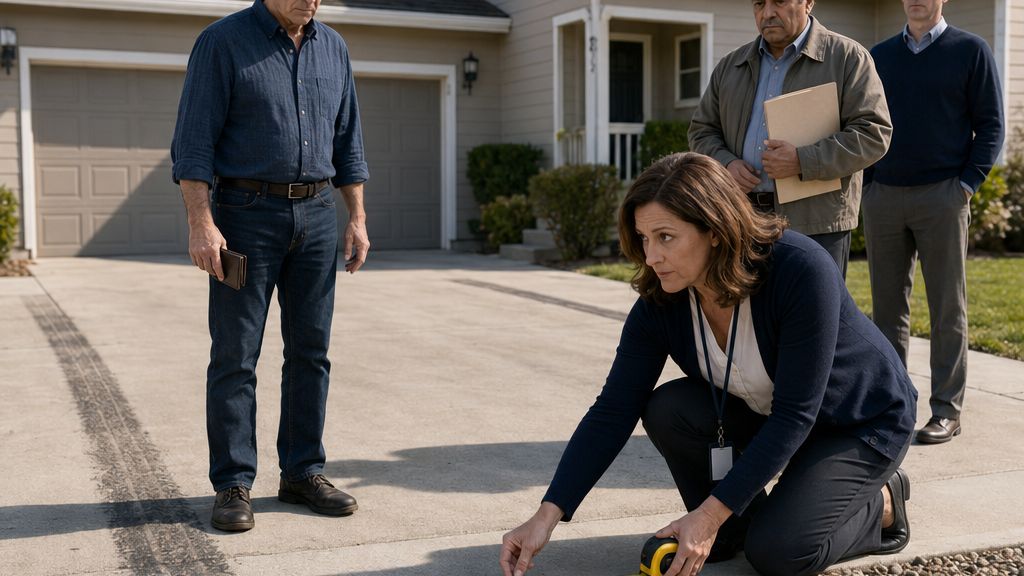
Stephanie White was kneeling in Michael’s driveway with a tape measure when he came outside.
Two members of the HOA board stood behind her. George Ramirez, the treasurer, held a folder against his chest. The board president stood near the sidewalk with the posture of someone hoping the entire matter could be reduced to five quiet minutes.
Stephanie hooked the metal end of the tape against the concrete edge.
Michael stopped on the porch.
“You already have a photograph.”
Stephanie looked up.
“You requested a formal review. We’re documenting the location.”
“I requested an explanation.”
“This is part of it.”
Michael walked down the path.
Three days had passed since the missed scan. He had spent those days answering clinic calls, checking for cancellations and resisting Kathleen’s repeated suggestion that she attend the inspection.
He wanted to handle this himself.
That decision felt increasingly less like independence and more like stubbornness, but he had made it.
Stephanie extended the tape across the gravel.
“Based on the enforcement photograph, the rear tire extended approximately six inches beyond the approved surface.”
George shifted his weight.
The board president asked, “Was there any obstruction to the sidewalk?”
“No,” Michael said.
Stephanie answered at nearly the same time.
“The rule is not limited to sidewalk obstruction.”
Michael watched the yellow tape stretch from concrete to gravel.
The sight was almost absurdly small.
Six inches.
His scan had been postponed for months because of a distance he could cover with one hand.
Stephanie stood.
“The association received multiple complaints regarding vehicles extending beyond approved parking surfaces. Residents have raised concerns about inconsistent enforcement.”
“About my van?”
“About vehicles generally.”
“So nobody complained that my van blocked anything.”
Stephanie’s face tightened slightly.
“That is not the standard.”
George opened the folder.
“Was Mr. Jackson given a violation notice before the tow?”
Stephanie looked toward him.
“Community-wide parking reminders were distributed.”
“That’s not what he asked,” Michael said.
The board president intervened.
“Let’s keep this procedural.”
Michael almost smiled.
Procedural.
That word seemed to appear whenever nobody wanted to discuss what an action had actually done.
Stephanie pointed toward the gravel.
“Mr. Jackson’s vehicle was in violation. The measurement supports the enforcement decision.”
Michael reached into his shirt pocket.
He had carried the card for days without planning to use it.
The oncology appointment card was bent at one corner from his wallet. His name, appointment date and imaging department were printed across the front.
He crouched with some difficulty and placed it on the driveway beside the extended tape.
Nobody spoke.
Michael straightened.
“There’s your six inches.”
Stephanie looked down.
He pointed to the card.
“And there’s the appointment I couldn’t reach.”
The board president glanced at Stephanie.
George stopped holding the folder against his chest.
Michael kept his voice level.
“I told her before the tow yard closed that the van was modified and I had an oncology scan the next morning.”
George looked directly at Stephanie.
“You knew?”
Stephanie’s shoulders became rigid.
“He stated he had an appointment.”
“Oncology,” Michael said.
“I understood that.”
“And he asked you to intervene?”
Stephanie looked from George to Michael.
“Yes.”
The word changed the driveway.
Until then, the board representatives had been treating the incident as a disagreement over proportional enforcement.
Now George’s expression sharpened.
“What did you do?”
“I explained that once a compliance action was processed, reversing it outside established procedure would create an exception.”
Michael said, “You created the procedure at two in the morning.”
“I applied an existing rule.”
“You chose the tow.”
Stephanie drew in a breath.
“We had residents accusing this office of selective enforcement. People were parking partly on lawns, blocking sight lines, extending trailers beyond driveways. Every warning generated another argument about why somebody else got more time.”
There it was.
Not cruelty.
Not exactly.
Something more ordinary and perhaps more dangerous: frustration that had hardened into certainty.
The board president nodded faintly, as if some of this sounded familiar.
Stephanie continued.
“I was instructed that enforcement needed to become consistent.”
“By who?” Michael asked.
“The board has discussed enforcement repeatedly.”
George looked at the president.
“That isn’t authorization for individual towing.”
Stephanie’s attention shifted.
Michael saw it then: the first break in her confidence.
The board president said, “We’re not making findings here.”
George ignored him.
He opened the folder and pulled out the compliance notice Michael had received.
“This says authorized compliance action.”
“Yes,” Stephanie said.
“Authorized under what entry?”
“I’m not sure what you mean.”
“The towing log.”
Stephanie did not answer immediately.
George looked at Michael’s driveway again, then at the six inches marked by the tape.
“For a residential non-emergency tow, there should be an authorization reference.”
Stephanie gathered the tape measure.
“The compliance software records actions differently depending on—”
“Stephanie.”
George’s tone was quiet.
She stopped winding the tape.
“What is the board authorization number?”
Michael looked at her.
The same woman who had told him three days earlier that measurement did not change the rule now held the tape measure between both hands.
The board president stepped closer.
“George, we can verify the records at the office.”
“Yes,” George said. “We can.”
Then he looked at Stephanie again.
“But if there’s an authorization number, she should know where it came from.”
Stephanie’s eyes moved toward Michael.
For a moment he thought she might become angry.
Instead, she looked tired.
“I don’t have the number with me.”
George closed the folder.
“That’s not what I asked.”
Nobody moved.
The appointment card remained on the concrete beside the six-inch mark.
George asked one final time.
“Was there a board authorization number at all?”
Stephanie said nothing.
Chapter 4: Four Months Changed What Anger Could Not
The oncologist looked at Michael’s scan, then looked at it again.
That second look frightened him more than any sentence could have.
Michael sat on the edge of the exam chair with his hands resting on his knees. The room smelled faintly of disinfectant and warmed plastic. A computer fan hummed behind the physician. On the wall, a laminated diagram of the human torso showed neat, color-coded organs that bore little resemblance to what Michael imagined was happening inside his own body.
The oncologist enlarged one section of the image.
Michael watched his face.
“Say it.”
The doctor turned from the monitor.
“There’s progression.”
Michael felt his fingers tighten against his jeans.
“How much?”
“We’re not looking at the same picture we would have hoped to see four months ago.”
“That’s not an answer.”
The oncologist nodded once, accepting the challenge.
“The disease is more advanced than it was at your last confirmed staging.”
Michael stared at the screen.
“Stage two?”
“Yes.”
The words did not arrive with drama. No alarm sounded. Nobody rushed into the room.
That almost made them worse.
Michael had spent four months telling himself that the missed appointment was an administrative problem. A scheduling failure. A delay that had made him angry but not necessarily endangered him.
Now the old six-inch photograph rose in his mind with ridiculous clarity.
The tire.
The gravel.
Stephanie holding the tape measure.
He looked back at the oncologist.
“If I’d had the scan four months ago, would this have been caught sooner?”
The doctor hesitated.
Michael noticed.
“I’m asking a simple question.”
“It isn’t a simple answer.”
“Would it?”
“Possibly.”
“Probably?”
“I can’t tell you that responsibly.”
Michael leaned forward.
“You can tell me whether four months matters.”
“In oncology, time can matter.”
“Then it mattered.”
“I said it can.”
The difference between those two sentences felt enormous.
Michael’s voice hardened.
“I missed the scan because my van was towed.”
“I know what happened.”
“And now you’re telling me it progressed.”
“Yes.”
“So write that down.”
The oncologist held his gaze.
“I will document the delay. I will document your prior staging and what we see now. I will not document that the delay caused the progression unless I can support that medically.”
Michael sat back.
The answer sounded careful because it was careful. He understood that.
He hated it anyway.
The physician continued.
“We need to talk about treatment.”
That changed the room.
Until then, Michael had still been arguing with the past.
Now the future entered.
The recommended plan was more aggressive than what had previously been discussed. Surgery would come first if the additional workup confirmed what the scan suggested. Chemotherapy was now a serious possibility rather than something kept at the edge of conversation.
Michael listened without interrupting.
When the oncologist finished, he asked, “Would this have been necessary four months ago?”
“Maybe not.”
Michael waited.
“But I cannot tell you that with certainty.”
There it was again.
Certainty.
The word had followed him from his driveway to the hospital.
Stephanie had been certain six inches justified a tow.
Now the one thing Michael wanted most—the certainty that she had caused this—was the one thing the doctor refused to give him.
Kathleen was waiting in the corridor.
She stood when Michael came out.
“Well?”
He handed her the printed treatment summary.
She read the first page, then stopped.
Her face changed.
Michael hated that too.
“Don’t.”
“I didn’t say anything.”
“You made the face.”
“What face?”
“The one people make when they think I might break.”
Kathleen folded the paperwork.
“I don’t think you’re going to break.”
“Then stop looking at me like it.”
They rode the elevator down without speaking.
In the parking garage, Michael unlocked the van.
The key turned easily.
For weeks after getting the vehicle back, the simple act of using it had felt like winning something. Today the key felt almost insulting.
Kathleen climbed into the passenger seat.
“What exactly did the doctor say about causation?”
Michael started the engine.
“You heard enough.”
“I need the exact language.”
“He said time matters.”
“That’s not the same as saying the missed scan caused progression.”
Michael gripped the wheel.
“I know what he said.”
Kathleen waited until they were out of the garage.
Then she said, “You need to understand what this does to the case.”
Michael looked at her.
“There’s a case now?”
“There was always potentially a case.”
“You told me you weren’t turning this into one.”
“I told you to keep the paperwork.”
“That’s not an answer.”
Kathleen looked straight ahead.
“If you want to claim that the tow caused more extensive cancer treatment, you need medical support. Not anger. Not sequence. Medical support.”
“I had stage one. I missed the scan. Four months later I have stage two.”
“Yes.”
“What part of that is unclear?”
“The part where a court asks whether the progression would have occurred anyway.”
Michael said nothing.
Kathleen continued, quieter now.
“I’m not defending Stephanie.”
“It sounds like it.”
“I’m trying to keep you from building your entire sense of justice around something we may never be able to prove.”
Michael pulled into his driveway harder than necessary.
The van stopped perfectly within the concrete edges.
He shut off the engine.
For a moment neither moved.
Then Michael reached into the glove compartment and pulled out a photograph.
Kathleen frowned.
It was the image from the HOA review: the tape stretched across the driveway edge, the tire mark, the six-inch measure.
Michael had printed it after the meeting.
He carried it because he wanted to remember exactly how small the violation had been.
Now he placed it on top of the treatment plan.
Six inches over one page.
Chemotherapy over another.
Kathleen looked at both.
“You want her to pay for this.”
“Yes.”
“The HOA?”
“Her.”
Kathleen turned toward him.
“That is not the same thing.”
“She made the decision.”
“The board may have created the culture. The towing company participated. You didn’t file the medical accommodation. The clinic had scheduling constraints. The disease itself has biology we don’t control.”
Michael’s face tightened.
“So everyone gets a little piece until nobody is responsible.”
“I didn’t say that.”
“It’s what it sounds like.”
Kathleen gathered the papers.
“No. I’m saying responsibility and causation are different questions.”
Michael opened his door.
“I don’t care what word lawyers use.”
“You will.”
He stopped.
Kathleen reached into her bag and removed a thin folder.
“I requested the HOA’s enforcement policies after that driveway meeting.”
Michael looked at it.
“You got them?”
“This morning.”
She flipped several pages.
“There’s something else.”
He remained half out of the van.
Kathleen turned one page toward him and pointed to a paragraph.
Michael read it once.
Then again.
Non-emergency residential towing required documented authorization under a procedure Michael had never seen.
Kathleen drew a circle around one line.
“There should be a record attached to your tow.”
Michael looked at her.
“And?”
“There isn’t one in anything they’ve produced.”
He glanced down at the photograph again.
For four months, he had believed the central question was whether six inches had cost him time.
Now a different question had appeared.
Who had been allowed to decide that six inches was enough?
Chapter 5: The Rule Stephanie Did Not Follow
Kathleen slid one sheet of paper across her desk and tapped an empty box with the end of a pen.
“That,” she said, “is the part I care about.”
Michael looked down.
It was the tow authorization form.
Vehicle description.
Address.
Violation category.
Photograph reference.
Measurement: approximately six inches beyond approved paved surface.
Every field contained something except one.
Authorization reference.
Blank.
Michael leaned back in the chair.
“So she broke the rule.”
Kathleen capped the pen.
“Maybe.”
He looked up sharply.
“Maybe?”
“This form is incomplete. That’s important. It is not yet the same thing as proving no authorization existed anywhere.”
“You always do that.”
“Do what?”
“Put a door behind every door.”
“I’m a lawyer. Doors matter.”
Michael looked again at the blank box.
Two weeks had passed since his scan. Treatment planning had become a calendar of consultations, bloodwork and phone calls. The physical fear was still there, but anger had become easier to carry.
Anger had edges.
Cancer did not.
Kathleen opened a second folder.
“The HOA produced board minutes, enforcement logs and contractor invoices.”
“And?”
“The minutes show repeated discussion about parking complaints.”
“Stephanie already said that.”
“Yes. But discussion is not individual authorization.”
Michael felt something cold and satisfying settle into place.
“So she did it on her own.”
“I said we’re getting closer to that.”
The HOA records room confirmed the rest slowly.
Not dramatically.
That was what surprised Michael.
There was no hidden file in a locked drawer. No confession buried in an email. Just absence.
The log for his address showed a complaint category and Stephanie’s compliance note. The towing contractor’s invoice listed her as the requesting party.
No board vote.
No emergency designation.
No authorization number.
George Ramirez met Michael and Kathleen near the end of the records review.
He closed the door behind him.
“I’m not here as your witness.”
Kathleen said, “Then why are you here?”
George rubbed a hand over his mouth.
“Because this has gotten larger than it should have.”
Michael stared at him.
“My cancer got larger than it should have.”
George’s face tightened.
“I’m not talking about that.”
“I am.”
Kathleen gave Michael a brief look.
He ignored it.
George sat across from them.
“The board had been getting hammered for months.”
“By who?” Kathleen asked.
“Residents.”
“About Michael?”
“No. Parking generally. Boats. Trailers. Cars on grass. People saying we enforced one house and ignored another.”
Michael said, “So you told Stephanie to start towing people.”
George shook his head.
“We told management enforcement had to improve.”
“That sounds conveniently different now.”
George did not argue.
“That’s fair.”
The admission disarmed Michael more than denial would have.
George continued.
“There were board members who said she needed to stop giving people endless chances. Tougher enforcement. More consistency. Those exact words came up.”
Kathleen asked, “Did anyone authorize the tow at Michael’s address?”
George looked at the table.
“No.”
Michael sat very still.
Kathleen said, “Did Stephanie have unilateral authority for a non-emergency residential tow?”
“Not under the written procedure.”
The room became quiet.
Michael should have felt triumphant.
Instead he watched George.
“You all pushed her.”
George looked up.
“We pushed for enforcement.”
“And when she went too far?”
George did not answer immediately.
Kathleen did.
“You’re saying she exceeded authority, but the board helped create the pressure.”
George sighed.
“Yes.”
The word changed the shape of Michael’s anger.
Not enough to reduce it.
Enough to complicate it.
On the drive home, Kathleen said, “This is stronger.”
Michael kept his eyes on the road.
“Good.”
“But not in the way you think.”
“I know what I think.”
“You want personal liability.”
“Yes.”
“You want Stephanie separated from the HOA.”
“She made the choice.”
Kathleen looked out the passenger window.
“I’m not saying she didn’t.”
“Then stop trying to soften it.”
“I’m trying to understand what result you actually want.”
“I want her to understand what she did.”
“That is not a legal remedy.”
Michael glanced at her.
“It should be.”
Several days later, the HOA’s insurance representative called Kathleen.
Michael listened on speakerphone from his kitchen.
The representative’s tone was polite and measured. The association disputed any claim that the tow had medically caused Michael’s disease progression. It was willing, however, to discuss documented expenses, transportation consequences, towing costs and procedural concerns through mediation.
Kathleen asked about Stephanie.
The answer became even more careful.
The association considered personnel matters confidential. Coverage questions remained under review. The board preferred a global resolution rather than litigation among multiple parties.
When the call ended, Michael laughed once without humor.
“They want to buy the paperwork problem.”
Kathleen closed her laptop.
“They want to contain risk.”
“Same thing.”
“No.”
“It is to me.”
She looked at him.
“That’s becoming a problem.”
Michael stood.
“I’m the one going through treatment.”
“I know.”
“Then stop telling me how angry I’m allowed to be.”
“I’m not.”
“You keep translating everything into what can be proven.”
“Because you keep translating everything into what should hurt Stephanie most.”
Michael turned away.
The sentence landed because he had not realized how visible that had become.
He picked up the tow photograph from the counter.
The six-inch measurement seemed almost childish now.
Kathleen gathered her things.
Before leaving, she said, “The insurer wants mediation.”
“When?”
“Soon.”
“And if I don’t want it?”
“Then we litigate.”
“Against her.”
“Against whoever the facts support.”
Michael looked at the photo.
Kathleen paused at the door.
“You need to decide whether you’re trying to prove she was wrong or make her feel what you felt.”
After she left, Michael stood alone in the kitchen.
His phone vibrated.
An email.
The sender was Stephanie White.
No attorney copied.
No HOA board.
The message contained only three sentences.
She asked whether Michael would meet with her before mediation.
She said she would come without counsel.
And she asked that Kathleen not attend.
Chapter 6: Why She Chose the Tow Anyway
Stephanie White arrived without her HOA badge.
Michael noticed that before anything else.
For every previous encounter, the blue lanyard had been part of her—something official resting against her blouse, a small piece of authority she seemed almost unaware of wearing.
Now there was only a plain gray sweater.
The HOA meeting room was empty except for them.
Michael had chosen the location because he did not want her in his house and did not want to meet somewhere that made the conversation feel private in the wrong way.
Stephanie sat across the table.
“You can leave whenever you want,” Michael said.
“So can you.”
He folded his arms.
“Why am I here?”
Stephanie looked at the table.
“I wanted to tell you something before mediation.”
“You have lawyers for that.”
“This isn’t for them.”
Michael waited.
She inhaled slowly.
“I knew there was no board authorization number.”
The sentence was so direct that he almost distrusted it.
“You knew when you ordered the tow?”
“Yes.”
Michael did not move.
“Then why?”
Stephanie looked toward the dark window at the end of the room.
“Because I thought I was doing what they wanted.”
“They.”
“The board.”
“George says nobody authorized it.”
“They didn’t.”
“Then what are you saying?”
Stephanie rubbed one thumb against the edge of the table.
“For months, I was told enforcement was weak. Residents were angry. Every meeting had someone accusing us of favoritism. One house gets a warning, another gets a fine, another gets three chances.”
“That still doesn’t answer me.”
“I know.”
Her voice changed.
Not softer.
Less protected.
“At my last property, inconsistent enforcement turned into a disaster. People challenged everything. The board blamed management. Residents blamed the board. Every exception became proof that somebody had connections.”
Michael watched her.
“So you decided nobody gets an exception.”
“I decided consistency was safer.”
“For who?”
Stephanie looked at him.
“For me, probably.”
There was no defense in the answer.
That made it harder to attack.
Michael leaned forward.
“I told you I had an oncology scan.”
“Yes.”
“You remember that.”
“Yes.”
“And you still refused to call the tow yard.”
“Yes.”
His jaw tightened.
“Why?”
Stephanie was silent long enough that Michael could hear the air conditioning cycle on.
Finally she said, “Because by then you had challenged whether I had the authority to tow it.”
Michael stared at her.
“That made you do it?”
“It made me feel like reversing it would prove I didn’t.”
The honesty of the sentence was ugly.
Not theatrical.
Ugly because it was ordinary.
Michael said, “So my appointment became a test of your authority.”
“I didn’t think of it that way then.”
“What way did you think of it?”
Stephanie looked down.
“Six inches.”
Michael’s face changed.
She continued before he could speak.
“That’s what was in front of me. Six inches beyond the surface. A photograph. A rule. A complaint category. Things I could measure.”
“And cancer wasn’t measurable enough?”
“No.”
The answer came immediately.
Then she corrected herself.
“That’s not what I mean.”
“It’s what you said.”
“I mean I didn’t know what to do with something I couldn’t verify right then. If I believed every urgent explanation—”
“You could have called.”
“Yes.”
“You could have paused.”
“Yes.”
“You could have asked one board member.”
“Yes.”
Each answer stripped away another excuse.
Michael expected satisfaction.
It did not come.
Stephanie said, “I chose the thing I could defend on paper.”
“The tow.”
“Yes.”
“And you couldn’t even defend that on paper.”
Her eyes closed briefly.
“No.”
For several seconds, neither spoke.
Michael thought about the blank authorization box.
The hospital scan.
Kathleen asking whether he wanted responsibility or pain.
He said, “Why tell me now?”
“Because the board is going to say I acted alone.”
“You did.”
“I made the decision alone.”
“That’s what that means.”
Stephanie looked at him.
“No. It means I’m responsible for the decision. It doesn’t mean they had nothing to do with how we got there.”
Michael said nothing.
She continued.
“They spent months telling me enforcement had to get tougher. They complained that I was too cautious. One board member told me if residents saw hesitation, every rule would become negotiable.”
“Names?”
“No.”
Michael almost smiled.
“You’re still protecting them.”
“I’m protecting myself from making another claim I can’t document.”
That sounded so much like her that, against his will, Michael understood it.
Stephanie folded her hands.
“They’re prepared to terminate me if that makes this disappear.”
“You want sympathy?”
“No.”
“Your job?”
“I don’t expect you to save it.”
“Then what?”
Her eyes met his.
“I want you to know I wasn’t trying to hurt you.”
Michael felt anger rise again, cleaner this time.
“You knew I had cancer.”
“I knew you said you had an oncology appointment.”
“You believed me?”
A pause.
“Yes.”
“Then you knew enough.”
Stephanie looked away.
Michael stood.
The chair legs scraped against the floor.
“For months I imagined you laughing about it.”
“I didn’t.”
“I imagined you going home that morning and forgetting me.”
Stephanie’s face tightened.
“I didn’t forget.”
“That doesn’t help.”
“I know.”
Michael walked toward the door, then stopped.
He turned back.
“Do you know what the worst part was?”
Stephanie said nothing.
“It wasn’t the tow fee. It wasn’t even the missed appointment.”
His voice stayed level.
“It was standing there asking you for help and realizing you had already turned me into a rule number.”
Stephanie absorbed the words without defending herself.
Michael opened the door.
Behind him she said, “I’m sorry.”
He stopped.
The apology was quiet.
Too late.
Maybe sincere.
Both could be true.
Michael did not turn around.
“I believe you.”
Stephanie inhaled.
“But I don’t forgive you.”
He left.
Kathleen was waiting at his house when he returned.
Two folders lay on the kitchen table.
She pushed one toward him.
“This is the aggressive route.”
Michael opened it.
Claims aimed at maximizing Stephanie’s personal exposure. Arguments over scope of employment. Attempts to reach beyond association coverage if the facts allowed.
Kathleen touched the second folder.
“This is the reform route. Full documented losses, treatment-related transportation costs, fees, policy changes, medical-access process, restrictions on unilateral towing authority.”
Michael looked between them.
“You made both?”
“You need to decide.”
“What would you choose?”
Kathleen leaned back.
“That’s not my decision.”
“You always have an opinion.”
“I do.”
“And?”
She looked at him carefully.
“I think part of you still wants her to lose something because you lost time.”
Michael said nothing.
Kathleen tapped the first folder.
“This one can pursue that.”
Then the second.
“This one can make it harder for anyone else to lose time the same way.”
Michael stared at the two stacks of paper.
For months, he had wanted the answer to become simpler.
Instead, on the eve of mediation, justice had split into two different shapes.
And only he could choose which one he meant.
Chapter 7: The Terms Michael Refused to Cross
The mediator looked across the table at Michael and asked, “What would actually make you whole?”
For the first time that morning, nobody reached for a document.
Michael sat with Kathleen on one side of the conference room. Across from them were the HOA’s insurance representative, the board president, George Ramirez, and Stephanie White. Stephanie had her badge again, but the blue lanyard lay partly hidden beneath the collar of her jacket.
Michael looked at the two settlement folders Kathleen had prepared.
One contained the sharpest version of the case they could make against Stephanie personally.
The other contained something less satisfying to imagine and harder to explain.
Rules.
Procedures.
Money tied to actual losses.
Changes that would remain after everyone in the room had gone home.
The mediator waited.
Michael said, “I want the tow fees back.”
The insurance representative nodded.
“I want every documented transportation expense caused by losing the van.”
Another nod.
“I want coverage for the medical expenses we can reasonably connect to the delay without pretending my doctors said something they didn’t.”
Kathleen turned slightly toward him.
That sentence had not been in either folder.
Michael continued.
“I want compensation for the appointments I missed, the work I lost dealing with this, and what it cost me to get through those four months.”
The insurer wrote something.
“That is all within the range of what we came prepared to discuss.”
Michael looked at the board president.
“I’m not finished.”
The pen stopped.
“No non-emergency residential vehicle gets towed from a homeowner’s property because one employee decides it should.”
The president shifted.
“We already have authorization procedures.”
“You had them when my van disappeared.”
George lowered his eyes.
Michael said, “Then write procedures people actually have to follow.”
The mediator asked, “What specifically?”
Kathleen opened the second folder but did not speak.
Michael had asked her the night before to let him answer for himself.
“Documented approval,” he said. “A second person signs off. If there is no immediate safety issue, the resident gets direct notice before a tow. Not a newsletter from three months earlier. Not some general email. Notice about that vehicle.”
The board president said, “There are situations where immediate action is necessary.”
“Then define them.”
“We do.”
“Not well enough.”
Stephanie looked at him but remained silent.
Michael continued.
“And if somebody says the vehicle is medically necessary, the tow pauses long enough for someone with authority to review that claim.”
The insurer leaned forward.
“That could be abused.”
Michael almost smiled.
“That’s what Stephanie thought.”
Nobody responded.
He placed the old photograph on the conference table.
The image had followed him for months.
Concrete edge.
Tire mark.
Six inches.
Beside it, Kathleen placed the proposed revised towing policy.
The contrast was almost absurd. One photograph had started the dispute. Now pages of procedure were being built around it.
Michael touched the photograph.
“This was treated like an emergency.”
The board president said, “It was treated as a compliance violation.”
“That’s the problem.”
The mediator looked toward Kathleen.
“There is also the issue of Ms. White’s personal exposure.”
Kathleen slid the first folder toward Michael.
He had read every page.
The argument was not ridiculous. Stephanie had knowingly bypassed procedure. Depending on how coverage was resolved, Kathleen believed they could push harder and attempt to leave Stephanie personally responsible for part of the damages.
Michael looked at Stephanie.
She did not ask him for mercy.
That mattered.
The insurance representative said, “Our position remains that personal claims against individual employees will substantially complicate resolution.”
Kathleen replied, “Complication isn’t a defense.”
“I didn’t say it was.”
Michael opened the folder.
He found the page Kathleen had marked.
One demand would preserve the right to pursue Stephanie’s personal assets if insurance exclusions applied.
He read it again.
Then he pulled the page free.
Kathleen watched him.
“Michael.”
He tore it once down the middle.
The sound seemed surprisingly loud.
The insurance representative sat back.
Stephanie’s expression changed for the first time all morning.
Michael placed the torn halves on the table.
“I don’t want her house.”
Kathleen said carefully, “You understand that giving this up may limit leverage.”
“Yes.”
“You don’t have to decide because she apologized.”
“I’m not.”
Stephanie looked down.
Michael turned to the insurer.
“I want her decision to have consequences.”
The board president spoke.
“What does that mean?”
“She doesn’t get to authorize another tow alone.”
Stephanie looked at Michael.
He continued.
“She gets retraining. The board gets retraining too.”
George looked up.
The president frowned.
“The board?”
“Yes.”
“The board did not order your tow.”
“No. You just spent months telling her enforcement wasn’t tough enough, then acted surprised when tough became stupid.”
George closed his eyes briefly.
The board president said, “That characterization is unfair.”
George interrupted him.
“No.”
Everyone looked at him.
George placed both hands on the table.
“He’s right about that part.”
The president stared at him.
George continued.
“We didn’t authorize Michael’s tow. Stephanie did. But we did keep telling management that residents thought enforcement was weak. We wanted results without having to discuss what those results would look like house by house.”
Stephanie watched him.
George’s voice remained flat.
“When this blew up, our first instinct was to say she acted outside policy.”
“She did,” the president said.
“Yes. And we helped create the pressure that made acting outside policy look like initiative until it became expensive.”
Nobody spoke for several seconds.
Michael felt some part of the case rearrange itself again.
For months, he had wanted one guilty person.
Now responsibility sat around the whole table in unequal pieces.
The mediator broke the silence.
“So the proposal is financial restitution, revised towing procedures, a medical-access review process, mandatory board and staff training, and restrictions on unilateral towing authority.”
Michael said, “And an independent review after six months.”
The insurer raised an eyebrow.
“To verify compliance?”
“Yes.”
Kathleen smiled faintly.
The board president looked at George.
George nodded once.
Stephanie finally spoke.
“And if I refuse?”
Everyone turned toward her.
Michael had not expected the question.
The insurance representative said, “That would become an employment matter.”
Stephanie ignored him.
She was looking at Michael.
“If I refuse the restrictions.”
Michael considered her.
“Then I guess you decide whether being right matters more than keeping the job.”
The words landed between them.
Stephanie looked down at the photograph.
Six inches.
A measurement she had once treated as absolute.
After a moment she said, “I’ll accept them.”
The agreement took another three hours.
Lawyers revised language. The insurer narrowed clauses. Kathleen restored protections Michael had nearly surrendered by speaking too broadly. The board president fought over wording that implied institutional responsibility.
Michael refused to leave until one sentence survived intact:
No non-emergency residential tow could proceed solely on the authority of the compliance manager without documented secondary approval.
The medical-access provision took longer.
The board did not want residents invoking vague medical necessity every time a rule became inconvenient.
Michael did not want residents forced to disclose detailed diagnoses to neighbors.
They settled on a confidential process managed through the property company, with temporary holds allowed when a credible medical-access issue was raised.
Imperfect.
Usable.
Real.
By late afternoon, the mediator pushed the final documents toward Michael.
“Read the last page carefully.”
Michael did.
The financial amount was meaningful but nowhere near the fantasy that anger had once built in his mind.
It covered what they could document.
It acknowledged failures without claiming the tow caused every medical consequence that followed.
Stephanie would remain employed under reduced enforcement authority and mandatory retraining.
The board would adopt the revised policy and submit to follow-up review.
Michael signed.
Kathleen signed as his attorney.
Across the table, the others followed.
Stephanie was last.
Before putting down the pen, she looked at him.
“I know this doesn’t fix what happened.”
Michael said, “No.”
She nodded.
Then signed.
Several weeks later, Michael attended the HOA meeting where the revised towing policy was formally adopted.
There was no applause.
He was grateful for that.
Residents asked practical questions. One complained that the new notice requirements would make enforcement slower. Another wanted to know whether boats and trailers were covered.
The board president answered them.
George explained the secondary-authorization requirement.
Stephanie sat near the end of the table with a binder open in front of her.
When the medical-access provision came up, the president glanced toward Michael.
“We developed this after discovering that our existing procedures did not adequately account for situations where transportation may be related to a resident’s medical needs.”
Michael noticed the language.
Not his cancer.
Not his missed scan.
Not his name.
Just the problem.
That was enough.
After the meeting, George found him near the door.
“You okay with how that was handled?”
Michael looked back into the room.
Stephanie was collecting papers.
“Yes.”
George nodded.
“I’m sorry.”
Michael studied him.
“For what part?”
George gave a tired half smile.
“Fair question.”
Michael put on his jacket.
“For wanting somebody else to be strict so you didn’t have to be unpopular.”
George’s smile disappeared.
“Yeah.”
Michael nodded.
“That part mattered.”
Outside, Kathleen waited beside the van.
“You could have told me you were coming out.”
“I knew where you were.”
“That’s not the same thing.”
Michael unlocked the driver’s door.
Kathleen laughed softly.
“What?”
“Nothing.”
“You’re doing the face.”
“What face?”
“The sister face.”
She held out her hand.
“Give me the key.”
Michael looked at her.
“Why?”
“Because you said your treatment wiped you out yesterday, and if that happens again, I’m driving.”
“I can drive.”
“I know.”
He stood with the key between them.
Months earlier, he would have refused automatically.
The key had meant something too specific then.
Independence.
Control.
Proof that illness had not reduced him to needing permission.
Now he looked at Kathleen’s open hand.
He placed the spare key in it.
“Only if I ask.”
“Fine.”
“And you don’t adjust the mirrors.”
“No promises.”
He shook his head and climbed into the van.
At home, Michael backed into the driveway slowly.
The rear camera showed the concrete line.
He stopped, adjusted slightly, and centered the van entirely within the paved surface.
Not because Stephanie had been right.
Not because six inches had suddenly become meaningful.
Because he could.
He shut off the engine and sat for a moment.
On the kitchen counter inside, the settlement paperwork rested beneath a copy of the revised HOA policy.
The old photograph was there too.
The tape measure stretched across the driveway edge.
Six inches.
Once, Michael had looked at that picture and seen everything taken from him.
Now he saw something else.
A rule could mark a boundary.
It could not decide what kind of person stood on either side of it.
Michael stepped out of the van, locked the door, and carried his own key inside.
The spare stayed where Kathleen could reach it.
The story has ended.