The HOA Ordered Him to Tear Out His Father’s Garden—Then the Old Access Map Changed Everything
Chapter 1: The Garden They Suddenly Called Common Property
The certified envelope had been taped to the garden stake beside his father’s tomatoes.
Michael Moore saw it before he saw anything else.
The white envelope hung inside a clear plastic sleeve, its corner fluttering against the cedar stake whenever the morning breeze came through the side yard. Behind it, tomato vines leaned against wire cages Edward Moore had bent by hand more than thirty years earlier.
Michael stopped halfway down the steps.
Nobody from the postal service had put it there. The certified letter had already been delivered to his mailbox on Saturday. He had signed for it himself.
Someone had taken the trouble to bring a copy into his side yard.
He pulled the paper from the sleeve.
RIDGELINE HOMEOWNERS ASSOCIATION.
NOTICE OF VIOLATION.
His eyes went to the paragraph beneath it.
The raised garden structure along the eastern property boundary constituted an obstruction within a designated common-access corridor. Removal was required within thirty days.
Michael read the paragraph twice.
Then he looked at the garden.
Six feet wide. Roughly thirty feet long. Cedar sides darkened by years of rain and soil. Tomatoes on one end, peppers toward the middle, herbs nearest the house.
“Common access,” he said.
The words sounded ridiculous standing there.
He had owned the house for eleven years. Edward had owned it for twenty-nine before that. The garden had been there nearly as long as Michael could remember.
He carried the notice inside and set it beside his coffee.
At the bottom of the second page was an invitation to attend a board meeting that evening.
Michael snorted.
Kathleen Hall had signed the notice as HOA president.
He knew Kathleen well enough to recognize the tone. She had been elected eighteen months earlier after campaigning on “consistent standards.” Since then, trash cans left visible overnight had generated reminder letters. Basketball hoops had been measured against setback rules nobody had enforced in years.
Michael considered most of it paperwork looking for a reason to exist.
He folded the notice once and went back outside.
The garden sat along the wooden privacy fence separating his lot from Jason Lee’s. Edward had built the first version in the mid-1980s. Boards had been replaced. Soil had been turned. The shape had changed slightly at the southern end.
But the garden itself had never disappeared.
Michael crouched beside the first cedar board.
His father’s hands had touched versions of this same line.
He could still hear Edward saying, Don’t crowd the tomatoes. Give them air.
The memory irritated him more than the letter.
By lunchtime, another email from the HOA arrived.
Michael almost deleted it.
Instead he opened the attached enforcement schedule.
The first fine would be assessed after the thirty-day removal period.
Then came the line that made him sit straighter.
Continued noncompliance: $150 per day, subject to governing-document limits and collection procedures.
A hundred and fifty dollars a day.
Michael did the arithmetic automatically.
A week was more than a thousand dollars.
He called the HOA management number.
Kathleen answered herself.
“Michael.”
“I got your letter.”
“I assumed you would.”
“You’re calling my garden common property.”
“I’m calling the corridor common access.”
“That isn’t the same thing.”
There was a brief silence.
“The board has documentation,” Kathleen said.
“So do I. It’s called a deed.”
“I’d encourage you to attend tonight.”
Michael looked through the kitchen window toward the side yard.
“If you have something showing the association owns my dirt, send it.”
“This is bigger than ownership.”
“Then don’t write the notice like it isn’t.”
Kathleen exhaled.
“There are access obligations attached to that side of your lot.”
Michael frowned.
“What access obligations?”
“That’s exactly why you should come tonight.”
He nearly asked another question.
Instead pride got there first.
“If you have authority, put it on paper.”
“Michael—”
He ended the call.
At six-thirty that evening, the HOA meeting began without him.
Michael stayed at his kitchen table with the original closing packet from when Edward transferred the house to him.
He had kept it in a gray accordion folder.
There was the warranty deed. Tax information. Survey copy. Title insurance.
Michael spread the survey flat.
Pipefitters spent careers learning what lines meant. Centerlines, offsets, elevations, dimensions. A bad assumption could put steel several inches from where it belonged, and several inches could wreck an entire installation.
The survey showed the eastern boundary clearly.
His fence sat just inside it.
The garden sat inside the fence line.
Near the eastern edge, however, a faint dashed line ran north to south.
Michael leaned closer.
There was a notation beside it.
ACCESS ESMT.
He stared at the abbreviation.
Easement.
That was different.
Not ownership.
Not common property.
But not nothing.
He found the legal description attached to the HOA letter and compared the references. Lot number matched. Subdivision matched.
The width did not look right.
Kathleen’s notice described a six-foot access corridor.
On the old survey, the dashed line appeared narrower.
Michael found a ruler, then stopped himself.
The paper copy might not be perfectly scaled.
Still, something felt wrong.
He called Jason Lee next door.
Jason answered after several rings.
“You at the meeting?” Michael asked.
There was enough hesitation to answer the question.
“Yeah.”
“What are they saying?”
“That you refused inspection.”
“Nobody asked to inspect anything until today.”
“They said they emailed last week.”
Michael remembered deleting a message with HOA in the subject line without opening it.
“So now I’m uncooperative.”
“I’m just telling you what was said.”
Michael rubbed his forehead.
“What exactly do they think they own?”
Jason lowered his voice.
“I don’t think Kathleen said they own it.”
“She wrote ‘common access.’”
“There’s some old corridor. She says it has to stay clear.”
“For what?”
“I don’t know all the history.”
Michael heard voices behind Jason.
Then Jason said, “They’re scheduling a walk-through Wednesday morning.”
“With whose permission?”
“Michael, don’t turn this into something it doesn’t have to be.”
Michael’s jaw tightened.
“They taped a violation notice inside my yard.”
“I told them that was unnecessary.”
That made Michael pause.
Jason continued.
“Just show up Wednesday.”
The call ended.
Michael looked again at the dashed line.
The next morning he called the county zoning office.
A clerk transferred him twice before a zoning inspector picked up.
Michael gave the address.
“Ridgeline Court?”
“Yes.”
“I’ve heard from your association.”
Michael leaned back.
“Of course you have.”
The inspector ignored the remark.
“They asked whether a raised structure could obstruct recorded access.”
“And?”
“That depends on the easement language. Zoning doesn’t decide private easement rights.”
“So they don’t own that strip.”
“I didn’t say that.”
Michael’s irritation returned.
“Does the county show an easement?”
Keyboard clicks came through the receiver.
A pause.
Then another.
“Yes.”
Michael stopped moving.
“Recorded against the eastern side of the parcel?”
“Yes.”
“How old?”
“Older than the current subdivision association records I’m seeing.”
Michael looked through the window at the garden.
The same cedar boards.
The same fence.
The same line he had believed he understood since childhood.
“What does the easement allow?”
“You’ll need the recorded instrument for that,” the inspector said. “County records can pull it.”
Michael thanked him and hung up.
For the first time since reading Kathleen’s notice, he no longer thought the HOA had invented the problem.
Somebody had recorded a right across his father’s land.
And Michael had no idea what it said.
Chapter 2: Six Feet of Dirt and One Old Line
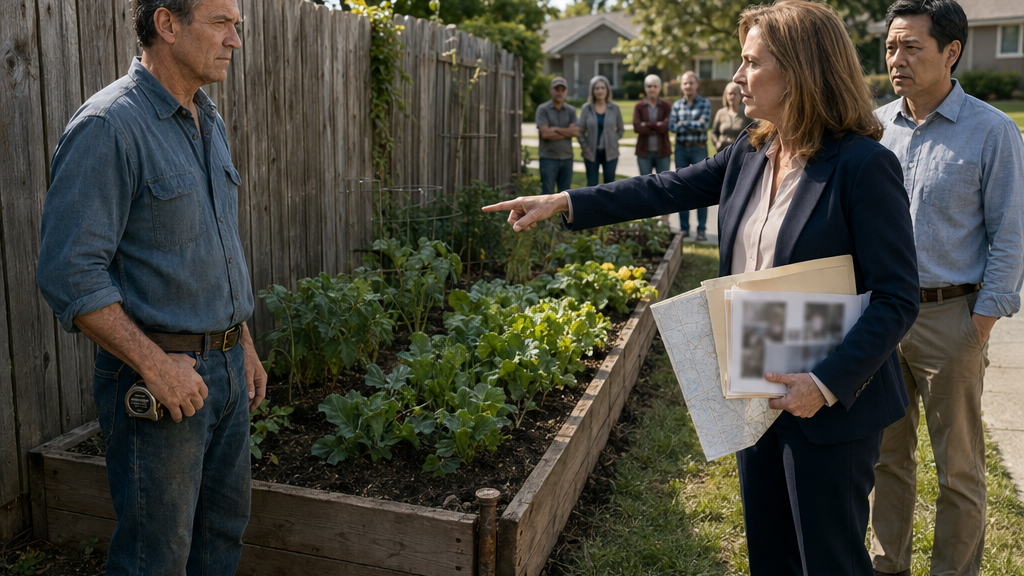
Kathleen Hall arrived Wednesday morning carrying photographs of Michael’s garden in a manila folder.
She was not alone.
Jason came with her, along with the HOA treasurer and two board members. Three neighbors stood near the cul-de-sac pretending not to watch.
Michael waited beside the raised bed.
A steel tape measure hung from his belt.
Kathleen noticed it immediately.
“We’re not surveying the property today.”
“No,” Michael said. “We’re measuring what you’re claiming.”
She opened the folder.
One photograph showed the garden from the sidewalk. Another had been taken from Jason’s side of the fence before the leaves had filled in.
Kathleen pointed toward the strip.
“The recorded corridor runs along this side. Six feet wide. It has to remain unobstructed.”
Michael looked at the nearest cedar board.
“Six feet from where?”
“The eastern boundary.”
“Show me.”
Kathleen hesitated.
Then she unfolded a county map copy.
A thick yellow highlighter line ran beside Michael’s lot.
“This is the access.”
“That’s a tax-map printout.”
“It references the recorded easement.”
“It doesn’t give you a measured starting point.”
Kathleen’s expression tightened.
“The board isn’t here to debate cartography.”
Michael almost laughed.
Instead he reached for the tape.
“No. You’re here to tell me six feet of my yard belongs to you.”
“I did not say it belongs to us.”
“You wrote ‘common access’ and told the county my garden blocks it.”
“Because it does.”
Michael hooked the tape against the fence-side marker near the back corner.
The marker was barely visible: an old iron pin surrounded by packed soil and grass.
He had uncovered it the night before after studying Edward’s survey.
The metal tape hissed outward.
Two feet.
Three.
Four.
Kathleen folded her arms.
Michael stopped.
“Your map reference says the recorded easement is four feet.”
She blinked.
“It says six.”
“Your letter says six.”
He handed Jason the old survey.
“Read the note.”
Jason crouched slightly, squinting.
“Four-foot access easement.”
Nobody spoke.
Michael extended the tape to four feet and pressed his thumb against the mark.
The line landed inside the garden, but well short of the western edge Kathleen had described.
Then he pulled it to six.
That point reached almost all the way across the raised bed.
Michael looked at Kathleen.
“Two feet of difference over thirty feet is sixty square feet you just told me was association-controlled.”
Kathleen took the survey from Jason.
“This is an old residential survey.”
“It’s the recorded-lot reference from when my father owned the place.”
“It may not reflect amendments.”
“Then show me an amendment.”
A neighbor near the street stopped pretending to check a phone.
Kathleen lowered the survey.
“The purpose of today is access clearance.”
“No. The purpose changed when you told me the wrong width.”
One board member shifted uncomfortably.
Kathleen said, “Michael, this is exactly the kind of confrontation the board was trying to avoid.”
He felt the old instinct rise: push harder because he knew where the weak joint was.
At work, if somebody brought the wrong dimension to a fabrication meeting, you stopped the job until they corrected it.
So Michael stayed with the measurement.
“Where does the deed transfer ownership to the HOA?”
Kathleen’s face changed slightly.
Not fear.
Annoyance.
“I’ve never said the deed transfers ownership.”
“You told me on the phone I had obligations attached to land your notice calls common access.”
“Yes.”
“That isn’t the same as common property.”
“No one said it was.”
Michael glanced toward the neighbors.
“You let people think it was.”
Kathleen closed the folder.
“We are trying to preserve emergency access.”
The phrase landed differently than everything before it.
Michael looked at Jason.
Jason did not meet his eyes.
“What emergency access?”
Kathleen answered.
“The board has an obligation to keep designated access points usable.”
“To what?”
“The rear portion of the cul-de-sac.”
Michael stared at her.
“There’s a street ten yards away.”
“There are conditions where that route isn’t sufficient.”
“What conditions?”
Jason finally spoke.
“An ambulance got held up here once.”
Michael turned.
“When?”
“Not recently.”
“How not recently?”
Jason rubbed the back of his neck.
“A few years before you moved back in full-time. There was a landscaping truck parked wrong. The ambulance couldn’t make the turn cleanly.”
Michael looked from Jason to Kathleen.
“So this garden delayed an ambulance?”
“I didn’t say that,” Jason replied.
“Then why are we talking about it?”
“Because after that, everybody started asking which old access routes still existed.”
Kathleen stepped in.
“That’s the board’s concern. Whether you like the terminology or not, there is recorded access.”
Michael looked down at the tape.
Four feet.
The garden did cross part of it.
Not six feet.
But enough that the conversation was no longer as simple as he wanted.
He retracted the tape. The steel snapped into its housing.
Kathleen held out the old survey.
“I’m going to send you the instrument we have.”
“Send the whole thing.”
“I will.”
“Not a summary.”
Her mouth flattened.
“Fine.”
Michael had expected the measurement to end the argument.
Instead it had narrowed it.
The association appeared wrong about the width. Kathleen’s language about control was sloppy at best.
But the line existed.
And Jason’s remark about emergency access would not leave him alone.
As the board members began walking back toward the street, Jason stayed behind.
Michael said, “You could’ve told me about the ambulance before today.”
“You could’ve come to the meeting.”
Michael looked at him.
Jason’s tone was not hostile.
That made it worse.
“You think I’m being stubborn.”
“I think you decided they were wrong before you knew what they were talking about.”
“They are wrong.”
“About some of it.”
Michael said nothing.
Jason glanced toward the garden.
“My point is, maybe find out why your dad signed it before you decide the whole thing is nonsense.”
Michael’s eyes narrowed.
“What makes you think my dad signed anything?”
Jason looked toward Kathleen, already halfway down the sidewalk.
“She has the older instrument.”
Kathleen heard him.
She stopped.
For a moment, Michael saw irritation pass over her face.
Then she opened the manila folder again and removed a photocopy she had not shown him.
“Since we’re doing this here,” she said, “you should probably see it.”
The document was yellowed in the reproduction, the type faint.
Michael took it.
Near the bottom were two signatures.
One belonged to a neighboring owner he did not recognize.
The other he recognized before he read the printed name.
Edward Moore.
Michael stared at his father’s signature.
The date beside it was 1983.
The first version of the raised garden had not been built until the following year.
Chapter 3: His Father’s Signature Was Already There
Michael laid the photocopy beside Edward’s old planting notebook and checked the dates again.
1983 on the easement.
1984 on the first garden sketch.
He had been hoping, without admitting it, that Kathleen’s copy contained a mistake.
It did not.
Edward’s signature was unmistakable.
The broad E. The cramped M. The final upward stroke his father always made too long.
Michael ran his finger just above the ink.
“You knew,” he said quietly.
The kitchen was empty.
Edward had been dead seven years.
Michael opened the planting notebook.
His father had never called it that. It was just an old spiral pad with measurements, fertilizer ratios, seed varieties and notes written in carpenter’s pencil.
Tomatoes—east bed.
Peppers—middle.
Beans along fence if enough sun.
On a page dated April 1984, Edward had drawn the first rectangle.
Michael compared it with the easement.
The garden had been placed after the agreement.
Not before.
That changed the question completely.
It was one thing for an HOA formed years later to discover a garden that predated everything.
It was another for Edward to sign an access instrument and then build beside it knowing exactly where the line ran.
Michael spent twenty minutes searching the notebook for the word easement.
Nothing.
He checked Edward’s old file cabinet in the garage.
Tax receipts.
Appliance warranties.
A property-insurance policy from 1991.
No explanation.
By nine-thirty, he was at the county records office.
The clerk behind the counter took the photocopy and examined the recording stamp.
“This is incomplete.”
Michael looked up.
“What?”
She pointed at the top right corner.
“See the page count?”
He leaned closer.
“Five.”
“You have three.”
His pulse quickened.
“The HOA gave me this.”
“Then they gave you three pages of a five-page recording.”
“Can you pull all five?”
The clerk entered the instrument number.
Michael stood beside the counter while an office printer started behind her.
Page one emerged.
Then two.
Three.
Four.
Five.
She set them in order.
Michael scanned the fourth page first.
It was not more boilerplate.
It was an attachment.
A hand-drawn legal exhibit showed the eastern side of the property with dimensions and directional arrows. The corridor was marked four feet wide.
Michael felt a sharp, private satisfaction.
Kathleen’s six-foot demand was wrong.
But the satisfaction lasted less than a minute.
Page five contained supplemental terms.
He read slowly.
Access for maintenance and emergency passage.
No transfer of fee ownership.
No permanent installation by benefiting parties.
No personal or recreational improvement.
Michael read the ownership line again.
There it was.
The easement granted rights.
It did not transfer the land.
Kathleen could not simply treat the strip as HOA property.
His first instinct was to take a photograph and send it to her immediately.
Then he reached the final paragraph.
The owner of the burdened parcel shall not intentionally obstruct reasonable passage within the described area.
Michael stopped.
The clerk was helping someone at the far end of the counter.
He read the sentence a second time.
Then a third.
The HOA had exaggerated its control.
But the document did require the corridor to remain reasonably usable.
Michael folded his arms.
“Do you have anything showing amendments?”
The clerk returned.
“Let me check.”
She searched by instrument number, subdivision and parcel.
“No amendment to this easement that I see.”
“When was the HOA formed?”
“That’s a different set of filings.”
“Can you check?”
Another search.
“Articles recorded in 1997.”
Michael nodded slowly.
Fourteen years after Edward signed the access agreement.
“So the HOA didn’t create this.”
“No.”
“It inherited whatever rights came with it.”
The clerk gave him a careful look.
“I can tell you what’s recorded. I can’t interpret your legal rights.”
“Understood.”
He looked again at Edward’s signature.
Kathleen had not invented the easement.
She had inherited a real piece of paper containing real obligations.
What she seemed to have done was stretch those obligations beyond the language.
Michael ordered certified copies.
Before leaving, he asked whether any referenced exhibits existed beyond the five pages.
The clerk checked the index.
“One cross-reference.”
“To what?”
“A prior subdivision-access filing.”
“Can I see it?”
She pulled the record.
It was older and less specific. A neighborhood circulation plan from before Ridgeline had taken its present shape.
Michael studied it without understanding enough to trust his first conclusion.
At home, he spread everything across the kitchen table.
The gray HOA notice.
Edward’s planting notebook.
The five-page easement.
The old survey.
The subdivision map.
He lined them up by date.
1983: easement.
1984: garden.
1997: HOA.
Present: removal order.
For two days he had been telling himself the association had stumbled into his yard with no right at all.
That was no longer true.
Kathleen had a right to talk about access.
She did not have a right to call six feet of his yard association-controlled simply because four feet carried an easement.
And Michael had a harder problem.
His father had known the agreement existed before building the garden.
Why would Edward sign away any access right at all, then put a raised bed beside the corridor a year later?
Michael examined the garden sketch again.
A notation he had ignored before sat at the bottom of the page.
East side—leave margin.
No dimension.
Just two words.
Leave margin.
Michael went outside with the certified copy.
The late-afternoon sun threw the fence shadow across the bed.
He stood where the iron pin marked the boundary and imagined the four-foot corridor running through the soil.
The older section of the bed appeared to stop close to that line.
The newer southern extension did not.
Michael had rebuilt that section himself after Edward died.
He pushed the thought away before it could settle.
His phone rang.
Kathleen.
He let it go to voicemail.
A minute later she sent an email.
The subject line read: CONFIRMATION OF REMOVAL DEADLINE.
Michael almost laughed.
Then he saw the attachment.
The HOA had included only the same three pages Kathleen showed him Wednesday.
Not pages four and five.
Michael called the records office again.
“The version you gave me,” he said when the clerk answered, “page four—the exhibit. Was that part of the original recording?”
“Yes.”
“And page five?”
“Yes.”
“So anybody who pulled the complete instrument would get all five?”
“Yes.”
Michael looked at Kathleen’s three-page attachment on his laptop.
Now the problem had changed again.
Either the HOA had never obtained the full document—
or someone had decided three pages were enough.
He opened page five and reread the restrictions.
No transfer of ownership.
No permanent installation by benefiting parties.
Reasonable passage required.
Neither side had the clean victory Michael had wanted.
But somebody had been arguing from an incomplete record.
At the bottom of page five was a typed reference Michael had overlooked:
SEE EXHIBIT B FOR LIMITATIONS ON USE.
Michael checked the packet.
There was no Exhibit B.
He called the records office one more time.
The clerk searched.
Then her voice changed.
“I found it.”
Michael stood.
“It’s indexed separately?”
“Yes. Same date. Different book reference.”
“What is it?”
“A supplemental restriction agreement.”
Michael gripped the edge of the kitchen table.
“Can you send me a certified copy?”
“Yes.”
He looked through the window at the garden his father had built one year after signing the easement.
For the first time, Michael understood that Edward had not forgotten the access line.
He had designed the garden around something Michael still had not seen.
And whatever was in that missing restriction agreement had been important enough to record separately.
Chapter 4: The Easement Was Real, but Ownership Was Not
Jennifer Garcia did not let Michael finish his first sentence.
“Kathleen is wrong,” she said, holding up one hand. “But not completely.”
Michael sat back in the chair across from her desk.
On the table between them lay the certified copy of the easement, the separately recorded restriction agreement, Edward’s old survey, and the HOA notice demanding removal of the garden.
He had expected the meeting to begin with relief.
Instead Jennifer tapped page five with a capped pen.
“This language matters.”
“I know what it says.”
“Then tell me what you think it says.”
Michael frowned.
“It says the land is mine.”
“Yes.”
“It says the association can’t install anything there.”
“Yes.”
“It says the easement is four feet, not six.”
“Yes.”
“And it says nothing about them owning the strip.”
Jennifer nodded.
“Also yes.”
Michael spread his hands.
“So what part am I missing?”
Jennifer rotated the paper toward him.
“This one.”
Reasonable passage.
Michael had already read it enough times to know where her finger would land.
He said, “That doesn’t mean I tear out thirty feet of garden.”
“No.”
“Then Kathleen loses.”
Jennifer’s expression barely changed.
“Legal disputes get expensive when people start using the word lose too early.”
Michael looked toward the window.
Her office overlooked a parking lot, a strip mall, and the top of a water tower. Nothing about the room suggested drama. Gray file cabinets. Framed licenses. A printer humming near the wall.
Jennifer slid another document across.
“I checked the HOA formation filings.”
Michael looked down.
Fourteen years after Edward signed the easement.
“The association did not create the right,” Jennifer said. “It succeeded to whatever benefit ran with the surrounding properties or common interest structure. That means it inherited the limits too.”
Michael read the date again.
“So Kathleen can’t rewrite it.”
“No.”
“She can’t make four feet six.”
“No.”
“She can’t call it association property.”
“Not if we’re talking about ownership.”
There it was.
The clean answer he had wanted.
For about three seconds.
Jennifer reached for another sheet.
“But she can raise a legitimate access issue if the garden physically prevents the use the easement actually protects.”
Michael looked at her.
“What use?”
“Maintenance. Emergency passage. Possibly limited service access depending on how the recorded language is interpreted with the subdivision documents.”
He leaned back.
“That strip has never been used for a truck.”
“Maybe not.”
“Not once.”
“That doesn’t erase the recorded right.”
Michael crossed his arms.
Jennifer watched him do it.
“You came here because you wanted the fines stopped.”
“I came here because they’re wrong.”
“Those are not identical goals.”
Michael’s jaw tightened.
Jennifer continued.
“The fine notice is vulnerable. Their width is unsupported. Their ownership language is unsupported. Their demand that you remove the entire garden appears overbroad.”
“Appears?”
“I don’t promise outcomes before I see every document.”
Michael looked down at the plot map.
Jennifer had drawn two lines across a copy of the garden plan.
One in black showed the property boundary.
One in blue marked the recorded four-foot corridor.
The garden crossed the blue line near its southern end.
Michael knew exactly why.
He had extended it.
He had not told Jennifer yet.
She tapped the intrusion.
“Was this always shaped this way?”
Michael stared at the drawing.
“Mostly.”
“That wasn’t my question.”
He felt irritation, then shame at being irritated.
“My dad rebuilt it a few times.”
“And you?”
Michael said nothing.
Jennifer waited.
He hated lawyers who used silence on people.
He hated more that it worked.
“I added some length after he died.”
“How much?”
“A few feet.”
“Toward the corridor?”
Michael looked at the page again.
“Yes.”
Jennifer nodded once.
Not accusing.
That somehow made it worse.
“Then we need to separate two questions,” she said. “What the HOA is falsely claiming, and what you may actually be obstructing.”
Michael stood and walked to the window.
“They taped a violation notice next to his tomatoes.”
Jennifer did not answer immediately.
When she spoke, her voice was lower.
“This isn’t just a garden to you.”
Michael looked back.
“It doesn’t need to be.”
“No. But it is.”
He sat again.
Jennifer pulled the supplemental restriction agreement closer.
“This helps you. A lot.”
Michael focused.
“The benefiting parties cannot make permanent installations in the corridor. The agreement also restricts expansion of the access beyond the described purpose.”
“So no walkway. No road widening.”
“Likely no unilateral improvement for convenience, yes.”
Michael nodded.
“That’s what my dad protected.”
“Partly.”
Jennifer opened a folder.
“I also spoke with a fire-access consultant.”
Michael frowned.
“You hired somebody?”
“I made a preliminary call. No site visit.”
“And?”
“Current apparatus standards are not the same thing as a 1983 private easement. So nobody gets to convert this into a modern fire lane just because they want one.”
Michael almost smiled.
Jennifer did not.
“But emergency passage is still emergency passage. If the physical route narrows below what is reasonably usable, that can matter.”
“How narrow?”
“That depends on what kind of passage the easement contemplated.”
“So nobody knows.”
“Not yet.”
Michael rubbed a thumb across the edge of Edward’s old planting notebook.
Jennifer said, “I can send a demand letter today. Suspend enforcement. Withdraw the fines. Correct the ownership language. Produce the board’s complete file.”
“Do it.”
“I will.”
“And tell them the garden stays.”
Jennifer looked at him.
“That last part is where you and I may disagree.”
Michael’s eyes hardened.
“They don’t own it.”
“I know.”
“My father didn’t give it away.”
“I know.”
“Then why should I move anything?”
Jennifer leaned back.
“Because ownership and obligation can exist at the same time.”
Michael stood again.
This time Jennifer let him.
At the door he paused.
“What exactly are you asking me to do?”
“Nothing today.”
“Sounds like something.”
“I’m asking you not to confuse their overreach with your innocence.”
Michael turned.
She slid the marked plot map toward the edge of the desk.
“You know measurements. Better than most people in that boardroom probably ever will.”
Michael said nothing.
Jennifer continued.
“If the survey ultimately shows the whole garden is outside the functional access, then we fight the whole demand. If it shows you expanded into part of it, then we deal with that honestly.”
Michael stared at the blue line.
Jennifer folded her hands.
“Do you want to be right, Michael?”
He waited.
“Or do you want to solve the problem?”
Chapter 5: The Reason Edward Left the Corridor Open
The note was tucked inside an envelope Michael almost threw away.
KEEP THIS END CLEAR.
Three words in Edward’s blocky handwriting.
Michael stood in the garage holding the paper under the fluorescent light.
He had been looking for old subdivision correspondence. Instead he found a shoebox full of things Edward had never organized: hardware-store receipts, seed packets, tax notices, appliance manuals, a church raffle ticket, and an envelope marked RIDGELINE ACCESS.
Inside were photocopies of the 1983 agreement.
And the note.
Michael carried everything to the kitchen.
The envelope also held two letters from neighboring property owners.
The first complained about delivery vehicles blocking the turnaround near the end of the cul-de-sac.
The second was shorter.
It referred to a medical call.
Michael read it twice.
An ambulance had been delayed while trying to reach a house beyond the narrow turn. A parked work truck and a drainage ditch had reduced maneuvering space. The delay had not been caused by Edward’s garden. The garden did not exist yet.
But the incident had started a discussion about alternate passage along the eastern edge of Edward’s property.
Michael sat down.
So Jason had been telling the truth.
Not the whole story.
But enough.
Another page contained Edward’s handwritten notes from what appeared to be a neighborhood meeting.
4 ft ONLY.
Emergency/maintenance.
No general traffic.
No paving.
No widening without owner.
Michael leaned back.
For days he had imagined Edward signing the easement because someone pressured him, or because he had not understood what it meant.
The notes suggested the opposite.
Edward had negotiated it line by line.
He had protected the land.
And he had protected the route.
Michael looked toward the side yard.
The garden had never been evidence that Edward ignored the easement.
It had been evidence that Edward understood exactly where it ended.
Michael took the old planting notebook outside.
The original 1984 sketch showed the first bed stopping short of the southern corner.
The present bed extended beyond it.
By nearly five feet.
Michael had added that section after Edward died.
He remembered doing it.
He had wanted more room for peppers and beans. The old boards were rotting, so he rebuilt the entire southern end and pushed it farther down the fence because there seemed to be empty space.
Nobody objected.
Nobody had used the corridor.
Nobody had mentioned the easement.
So Michael forgot it existed.
Or maybe he had never really known.
He knelt beside the southern corner.
With a measuring tape, he found the four-foot line again.
The original bed ended just outside it.
His extension crossed it.
Not by much.
But enough.
He sat on the edge of the cedar board.
For the first time since Kathleen’s letter arrived, Michael felt something that was not anger.
Embarrassment.
He had been demanding that everyone respect lines his own father had respected better than he had.
Jason appeared at the fence gate twenty minutes later.
“You busy?”
Michael held up the note.
“Did you know about this?”
Jason came closer.
He read the three words.
“No.”
“You knew about the ambulance.”
“I knew the story.”
“Why didn’t you say it was before the garden?”
Jason leaned against the fence.
“Because Kathleen kept talking about access. I assumed it was connected.”
“That’s the problem with assumptions.”
Jason looked at him.
Michael almost smiled at the irony.
Instead he handed him Edward’s meeting notes.
Jason read silently.
“He agreed to four feet.”
“Four. Not six.”
“And emergency and maintenance.”
“Not association ownership.”
Jason returned the paper.
“So what are you going to do?”
Michael looked at the southern extension.
“I don’t know.”
“That’s new.”
Michael gave him a flat look.
Jason raised both hands.
“Fair.”
Michael said, “I added that corner.”
Jason followed his gaze.
“After your dad?”
“After he died.”
“How far?”
“Enough to matter.”
Jason was quiet.
Michael expected satisfaction. Maybe even an I told you so.
Instead Jason said, “Kathleen won’t care.”
Michael looked at him.
“She should.”
“She should. But right now she’s got half the neighborhood asking why the board waited until after that ambulance issue to review emergency access.”
“That happened years ago.”
“Different incident.”
Michael frowned.
Jason explained.
“Last fall. Another ambulance had trouble with a contractor van at the bend. Didn’t come through here. But it brought the old route back up.”
That changed Kathleen again.
Not into someone right.
Into someone afraid.
“Why didn’t she tell me that?”
“She probably thought the violation letter was enough.”
Michael shook his head.
“She thinks paperwork is communication.”
Jason gave him a tired smile.
“She thinks inconsistency is liability.”
That afternoon Jennifer called.
“I sent the demand.”
“What did you ask for?”
“Immediate suspension of fines, correction of ownership language, full production of the HOA’s easement file, and no removal pending survey.”
“And?”
“They responded.”
“That fast?”
“Kathleen did.”
Michael heard paper moving.
Jennifer read part of the response.
“The association maintains that complete removal of the raised structure is necessary to ensure future access and consistent enforcement.”
Michael stood.
“Complete removal?”
“Yes.”
“She has the four-foot instrument now.”
“I attached it.”
“And she still wants all thirty feet gone.”
“Yes.”
Michael walked to the kitchen window.
The garden looked different now.
The first section was Edward’s careful compromise.
The southern corner was Michael’s mistake.
But Kathleen wanted both treated the same.
“What else did she say?”
Jennifer hesitated.
“She rejected a limited correction because partial removal would, quote, undermine the association’s enforcement position.”
Michael turned away from the window.
There it was.
Not safety.
Not entirely.
Position.
Jennifer said, “Michael?”
“I’m here.”
“She has a legitimate concern underneath this.”
“I know.”
“But she is choosing a broader remedy than the document supports.”
“I know.”
“You also need to decide whether you’re willing to correct your part.”
Michael looked at Edward’s note on the table.
KEEP THIS END CLEAR.
He had spent days treating compromise as surrender.
His father had apparently known better.
“I’ll correct what’s mine,” Michael said.
Jennifer was silent for a beat.
“Good.”
“But I’m not tearing out the whole garden.”
“I didn’t ask you to.”
“And I’m not signing anything saying the strip is theirs.”
“I wouldn’t let you.”
Michael picked up the old note.
“What happens next?”
“The board called an emergency meeting.”
“When?”
“Tomorrow night.”
Michael looked again at the garden.
This time he did not see one line.
He saw two.
The line Kathleen had crossed by claiming too much.
And the line he had crossed by pretending he owed nothing.
Chapter 6: The Board Meeting Where Both Sides Lost Ground
Kathleen Hall called it association property in the first three minutes.
Michael almost walked out.
The community meeting room was half full. Folding chairs faced a long table where Kathleen sat between the HOA treasurer and two board members. Jason was seated at the far end.
An enlarged plot map had been mounted on foam board beside them.
Kathleen read from a prepared statement.
“The association has a continuing responsibility to preserve association property and emergency access—”
Jennifer, seated beside Michael, touched his forearm.
He stayed seated.
Kathleen continued.
“—including the eastern access corridor adjacent to the Moore residence.”
Michael leaned toward Jennifer.
“She did it again.”
“I heard.”
When public comments opened, Michael stood with the old steel tape measure in one hand and Edward’s certified easement copy in the other.
He did not raise his voice.
“Before we talk about my garden, I want the record to be clear about one thing.”
Kathleen’s expression hardened slightly.
Michael pointed to the enlarged map.
“That blue area is not association property.”
Kathleen said, “It is a recorded association access.”
“That’s not what you just called it.”
A murmur passed through the chairs behind him.
Kathleen glanced toward the board.
Jennifer remained silent.
Michael walked to the map.
“The easement is four feet.”
He extended his tape measure until the yellow steel strip reached four feet.
“This is what the original instrument says.”
He pulled it two more feet.
“This is what the violation letter claims.”
The difference was obvious even from the back row.
Two feet did not sound dramatic until it was hanging in the air.
Michael retracted the tape.
“The association can enforce the rights it has. It cannot create two more feet because that is easier to administer.”
Kathleen said, “Nobody is attempting to take your property.”
“Then stop calling it yours.”
The room went quiet.
For a moment Michael felt the old satisfaction again.
The satisfaction of a correct measurement.
Then he looked at the southern corner drawn on the map.
He knew what came next.
And he hated it.
Michael placed Edward’s original garden sketch beside the enlarged plot.
“My father built the first bed in 1984.”
Kathleen said nothing.
“He kept it outside the access line.”
Jason looked up sharply.
Several neighbors shifted.
Michael continued.
“After he died, I rebuilt the south end.”
He pointed.
“I extended it.”
Jennifer looked at him, but he kept his eyes on the board.
“Part of that extension crosses into the recorded four-foot corridor.”
Nobody spoke.
Kathleen’s face changed.
Not victory.
Surprise.
Michael said, “That part is mine to fix.”
A woman in the second row whispered something to her husband.
Michael heard only the word admitted.
He kept going.
“But that does not make the entire garden an obstruction, and it does not make my property association property.”
One of the unnamed board members leaned toward the microphone.
“How much intrusion are we talking about?”
“That requires a proper survey.”
Kathleen answered before Michael could.
“Which is why the simplest remedy remains complete removal.”
Michael turned toward her.
“Simplest for who?”
“For future enforcement.”
There was that phrase again.
Not emergency safety.
Enforcement.
Jennifer opened a folder.
“With the board’s permission, I’d like to address that.”
Kathleen looked reluctant but nodded.
Jennifer spoke plainly.
“The HOA’s own outside counsel was sent the complete easement instrument last week.”
Kathleen looked at her.
Michael had not known that.
Jennifer continued.
“Counsel advised that the recorded language does not establish association ownership of the burdened land.”
A board member turned toward Kathleen.
“You got that opinion?”
Kathleen’s mouth tightened.
“It was preliminary.”
“When?”
“Monday.”
The room changed.
Michael felt it physically.
Not because Kathleen had been proven evil.
Because she had known there was a problem with her language and used it anyway.
Jennifer said, “The board may have an enforceable access right. That is separate from title.”
Kathleen leaned forward.
“And I have a duty to preserve that access before another emergency exposes us to liability.”
There was real strain in her voice now.
Michael saw it for the first time.
“This board was criticized last year for not enforcing parking restrictions near the turnaround,” Kathleen said. “Residents wanted consistency. They wanted us to stop waiting until something went wrong.”
Jason looked down at his hands.
Kathleen continued.
“If we approve exceptions because a structure is old or sentimental, we create another problem.”
Michael almost responded immediately.
Then he thought about Edward’s note.
KEEP THIS END CLEAR.
“My garden isn’t an exception,” he said. “The agreement itself is the rule.”
Kathleen shook her head.
“You’re asking us to preserve an obstruction.”
“No.”
Michael turned to the map.
“I’m asking you to measure it.”
He took a marker from the tray.
With Jennifer’s permission, he marked the recorded four-foot corridor.
Then he outlined the oldest section of the garden using Edward’s sketch.
The two lines barely touched.
At the south end, his later expansion crossed over.
Michael circled that corner.
“This part may need to move.”
He pointed to the rest.
“This part does not.”
The HOA treasurer asked, “And if the survey confirms that?”
“I move what’s actually in the way.”
Kathleen looked at him.
“And if future emergency access needs more width?”
“Then you follow whatever process the law requires. You don’t pretend you already own it.”
A few people murmured approval.
Michael did not enjoy it as much as he expected.
He looked at Kathleen.
She seemed tired.
Then stubbornness returned to her face.
“The board cannot base policy on one homeowner’s preferred reading.”
Jennifer said, “It wouldn’t. It would base policy on the recorded instrument.”
Kathleen ignored her.
“Complete removal remains the only consistent solution.”
Jason finally lifted his hand.
“Kathleen.”
She turned.
He looked uncomfortable, but his voice stayed steady.
“We can’t keep calling it consistent if the width is wrong.”
Kathleen stared at him.
Jason continued.
“And if Michael is willing to correct the part he added, then we should know where the actual line is before we demand thirty feet of removal.”
The treasurer nodded slowly.
One of the other board members asked, “What are you proposing?”
Jason took a breath.
“I move that all fines and removal enforcement be suspended pending a binding survey of the recorded corridor.”
Kathleen said, “That delays corrective action.”
“It prevents us from correcting the wrong thing.”
Silence.
Then the treasurer seconded the motion.
Kathleen sat back.
Michael watched the vote.
Jason: yes.
Treasurer: yes.
One board member: yes.
The other hesitated, then yes.
Kathleen voted no.
Four to one.
Michael had won something.
Not the case.
Not the garden.
Time.
Precision.
The same things Edward had apparently insisted on forty years earlier.
As people began standing, Kathleen gathered her papers.
Michael approached the table.
She looked up.
“You embarrassed me tonight.”
Michael almost answered defensively.
Instead he said, “I admitted I was wrong too.”
Kathleen’s eyes flicked toward the map.
“That doesn’t make this easier.”
“No.”
“What if the survey says you have to move more than you think?”
Michael looked at the circled southern corner.
“Then I move what the line requires.”
Kathleen studied him as if deciding whether to believe that.
Jason came over carrying the motion form.
“The survey company can be here next week.”
Michael nodded.
Kathleen closed her folder.
As she walked away, Michael looked once more at the enlarged map.
For the first time, nobody in the room was arguing about who felt entitled to the land.
They had voted to find out exactly where the line was.
And now Michael would have to live with whatever that line said.
Chapter 7: What the Survey Line Finally Required
The first survey stake went into the ground three feet west of where Kathleen Hall had insisted the association’s corridor began.
Michael stared at it.
Then he looked toward the southern corner of the garden.
The second stake told a different story.
That one landed eighteen inches inside the cedar extension he had built after Edward died.
For several seconds, Michael said nothing.
The surveyor moved farther down the eastern edge, checking coordinates against the recorded plat and supplemental restriction. Bright flagging appeared at regular intervals, creating a clean line through grass, mulch, and the edge of the garden.
The HOA had been wrong by feet.
Michael had been wrong by inches.
Neither fact canceled the other.
Jason Lee stood near the sidewalk with his hands in his jacket pockets.
“Well,” he said.
Michael looked at him.
“That’s one word for it.”
Jason nodded toward the stakes.
“Could’ve been worse.”
Michael crouched beside the southern cedar board.
Eighteen inches.
He hooked his steel tape measure to the survey stake and extended it to the corner.
The number confirmed what his eyes already knew.
He had crossed the line.
Not Edward.
Him.
The surveyor approached carrying a clipboard.
“The recorded easement is four feet from the boundary through most of this section,” he said. “There’s a slight change near the rear because of the original lot geometry.”
Michael pointed to his garden.
“How much needs to come back?”
“For the recorded corridor itself, this corner is the only permanent structure crossing it.”
“And the rest?”
“Outside the easement.”
Michael straightened.
“Thirty feet of garden doesn’t have to go.”
“No.”
Jason exhaled.
Michael looked at the flags again.
The relief came slower than he expected.
For weeks, he had imagined a clean ending where the survey proved Kathleen wrong and left him untouched.
Instead the line looked almost exactly like Edward’s old sketch.
The original garden stopped where it should.
Michael’s addition did not.
A car door closed near the cul-de-sac.
Kathleen walked toward them carrying a folder.
She stopped at the first stake.
“How far off was our map?”
The surveyor answered professionally.
“The enforcement sketch used by the association overstated the recorded width by approximately two feet.”
Kathleen’s face remained controlled.
“And the garden?”
“One portion intrudes approximately eighteen inches into the recorded access.”
Michael watched her.
This was the moment she could have claimed victory.
She did not.
She looked from the intrusive corner to the rest of the garden.
“So the full removal wasn’t supported.”
The surveyor did not answer the legal question.
“The physical encroachment is limited to that southern section.”
Kathleen nodded.
Michael noticed how tired she looked.
Not defeated.
Just tired.
She opened the folder.
“The board met last night.”
Jason looked surprised.
“Without me?”
“Executive administrative session. No enforcement vote.”
She handed Michael a letter.
He read the first paragraph.
All accrued fines associated with the garden-removal notice were rescinded.
He read it again.
The second paragraph withdrew the association’s description of the easement area as association-owned property.
The third suspended the original removal order permanently and replaced it with a requirement that only confirmed obstructions within the recorded corridor be corrected.
Michael lowered the letter.
“All the fines?”
Kathleen nodded.
“All of them.”
“And the ownership claim?”
“Withdrawn.”
Jason smiled slightly.
Michael did not.
He folded the letter once.
“What about the eighteen inches?”
Kathleen looked at the garden.
“That still needs to be corrected.”
Michael nodded.
“I know.”
She seemed almost disappointed that he did not argue.
“The board also wants the access language rewritten for future notices,” she said. “Ownership and easement rights separated clearly.”
“That should’ve happened before mine.”
“Yes.”
The answer came without defense.
Michael looked at her.
Kathleen held his gaze.
“I was wrong to use ownership language after counsel warned us it was unsupported.”
Jason shifted beside them.
Kathleen continued.
“I still believe the access needed attention.”
“So do I.”
That surprised her.
Michael pointed toward the southern corner.
“I built that part after my father died. He kept the original bed outside the line.”
Kathleen looked at the stakes.
“I didn’t know that.”
“Neither did I. Not until this started.”
For a moment, nobody spoke.
Then Kathleen said, “I’m sorry about the notice being placed inside the garden.”
Michael looked at her.
“That was you?”
“I told the management company to make sure you saw it.”
“You think certified mail wasn’t enough?”
“No.”
A faint, embarrassed smile touched her face.
“In retrospect, it was enough.”
Michael almost smiled back.
Almost.
By afternoon, he had removed the soil from the southern corner.
He worked alone.
The cedar board came free reluctantly, its screws rusted after years near wet soil. Michael used a pry bar, then stopped when a small wooden object rolled out from behind the lower board.
He picked it up.
A seed marker.
Thin wood, darkened with age.
Edward’s handwriting was barely visible.
BEANS.
Michael sat back on his heels.
He remembered that marker.
Edward used to make them from scrap wood, writing the crop name with a black carpenter’s pencil.
Michael had not seen one in years.
The marker must have been trapped behind the original framing and carried forward when Michael rebuilt the bed.
He rubbed the dirt away with his thumb.
The word remained.
Beans.
Nothing about boundaries.
Nothing about easements.
Nothing about ownership.
Just something his father had planted.
Michael looked at the surveyed line, then at the board he had removed.
For weeks, he had treated every inch of the garden as if moving it meant surrendering Edward.
But Edward himself had measured around the corridor.
He had kept what mattered and left what needed to stay open.
Michael set the old marker on the workbench.
Then he shortened the garden.
Exactly to the line.
Chapter 8: He Kept the Garden, Not the Grudge
By early spring, Michael was planting tomatoes beside a strip of ground he had once sworn he would never give up.
The irony was not lost on him.
The rebuilt southern corner stopped cleanly before the survey line. The cedar boards were new, but Michael had reused as much of the old lumber as he could.
The eighteen inches beyond them remained open.
Grass would grow there.
Emergency access would remain possible.
And the garden still occupied almost the same place Edward had chosen in 1984.
Michael pressed soil around a tomato plant and sat back on his heels.
Jason leaned over the fence.
“You finally planting?”
“Apparently.”
“You said last week you were waiting.”
“I changed my mind.”
Jason looked at the first row.
“Your dad’s variety?”
“Close.”
Michael brushed soil from his hands.
Jason pointed toward the narrow open strip.
“Does it bother you?”
“What?”
“That part.”
Michael followed his finger.
Months earlier, he would have answered immediately.
Now he took a moment.
“No.”
Jason raised an eyebrow.
Michael added, “That bothers me less than being wrong and pretending I wasn’t.”
“That sounds almost healthy.”
“Don’t get used to it.”
Jason laughed.
A car pulled into Michael’s driveway.
Kathleen stepped out carrying a flat envelope.
Jason glanced at Michael.
“You want me to disappear?”
“No.”
Kathleen came through the side gate.
She wore no board badge, carried no folder full of violation photographs, and did not stop outside the garden as if she needed permission to look at it.
“I have something for you.”
Michael stood.
Kathleen handed him the envelope.
Inside was the final revised access policy.
He read the first page.
The wording was different.
Recorded easements would be described according to their actual legal function. Association communications could not imply ownership of privately titled property unless the association actually held title. Enforcement involving access corridors required confirmation of recorded dimensions before fines or removal demands were issued.
Michael read the section twice.
“This passed?”
“Unanimously.”
He looked at Jason.
Jason said, “Even me.”
Kathleen ignored him.
“There’s another section.”
Michael turned the page.
Future disputes involving historical property instruments would require the association to obtain the complete recorded document rather than summaries, maps, or partial copies.
Michael looked up.
“That one sounds familiar.”
“It should.”
Kathleen’s expression tightened briefly, then relaxed.
“We were working from an incomplete file.”
“You kept working from it after you knew it was incomplete.”
“Yes.”
No excuse followed.
Michael appreciated that more than an apology written by a lawyer.
He folded the policy.
“What happens with the corridor?”
“Nothing unless access is needed.”
“And if it is?”
“Then the recorded limits apply.”
Michael nodded.
Kathleen looked at the rebuilt garden.
“You kept almost all of it.”
“I was always going to.”
She smiled faintly.
“I know.”
Michael reached toward the workbench beside the fence and picked up Edward’s old seed marker.
The faded word BEANS was still visible.
Kathleen noticed it.
“What’s that?”
“My father’s.”
Michael turned it between his fingers.
“Found it when I moved the corner.”
Kathleen looked toward the open strip.
“He knew where the line was?”
“Better than I did.”
“That must have been difficult to learn.”
Michael considered the question.
“Mostly annoying.”
Jason snorted.
Kathleen smiled.
Then Michael said, “I thought protecting the garden meant protecting everything exactly as he left it.”
Kathleen looked at him.
“And?”
“He didn’t leave it exactly one way.”
Michael pointed toward the old cedar sections.
“He replaced boards. Changed rows. Moved things. He just kept the part that mattered.”
Kathleen nodded slowly.
Michael looked at the policy in his hand.
“You could say the same about rules.”
She understood.
“Keep the purpose. Fix the bad parts.”
“Something like that.”
For the first time since the dispute began, the three of them stood beside the garden without anyone measuring anything.
No board map.
No certified notice.
No accusation.
Just damp soil and new plants.
Kathleen glanced toward the street.
“I should go.”
Michael nodded.
At the gate, she paused.
“For what it’s worth, I really was worried about access.”
“I know.”
“And I still think the board needed to address it.”
“I know that too.”
She studied him.
“You could’ve made this much harder.”
“So could you.”
A brief silence.
“Fair enough,” she said.
Then she left.
Jason waited until her car disappeared.
“That sounded almost like a truce.”
“It wasn’t.”
“What was it?”
Michael looked at the garden.
“Probably enough.”
Jason nodded and went home.
Michael stayed outside.
He carried Edward’s seed marker to the southern corner.
For months he had kept it on the workbench, unsure what to do with it.
The old location where he found it was now outside the garden, inside the narrow corridor he had agreed to keep clear.
He could have put it back there.
Instead he pressed it into the soil beside the new cedar board.
Exactly on the garden side of the confirmed line.
The marker leaned slightly.
Michael straightened it.
BEANS.
His father’s handwriting.
His father’s garden.
Not untouched.
Not erased.
Adjusted.
Michael stood and looked along the eastern edge.
The property still belonged to him.
The easement still existed.
The HOA still had obligations.
So did he.
Nothing had become simpler because somebody won.
It had become clearer because the lines finally meant what they were supposed to mean.
Michael picked up his watering can.
He poured slowly along the first row until the soil darkened around each plant.
When he reached the final corner, the water stopped at the cedar board.
Beyond it, the narrow access strip remained open.
Michael looked at Edward’s marker once more.
Then he moved on to the next row.
The story has ended.