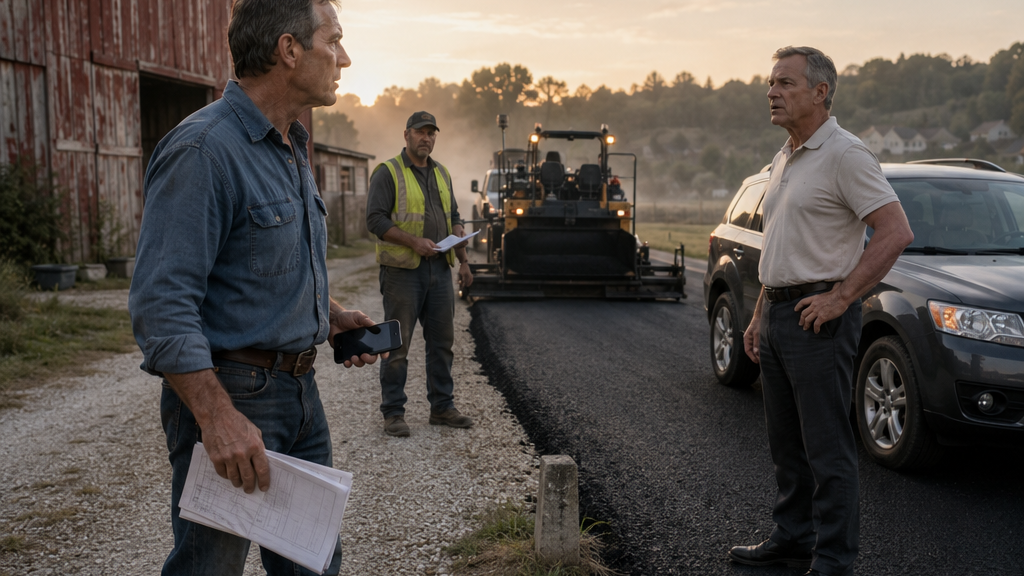
The HOA Paved His Private Road Without Asking—Then the Old Deed Made Everyone Reconsider Who Had the Right to Use It
Chapter 1: The Morning Blacktop Reached His Barn Road
The first thing Mark Miller noticed was not the engine noise. It was the smell.
Hot asphalt reached his kitchen window before sunrise, sharp enough to cut through the coffee steaming beside his hand. He set the mug down and looked toward the barn.
A paving machine was moving up his gravel lane.
For several seconds he simply watched.
The lane ran from the county road along the eastern edge of his acreage, past a line of old maples and toward the red equipment barn his grandfather had built. Mark had spent years grading that road himself, filling low spots after spring rain and ordering fresh stone when ruts got deep.
Now half of it was black.
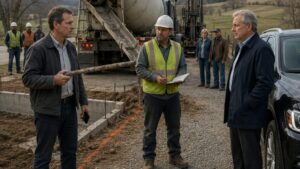
Workers in reflective vests moved around a dump truck while the paving machine pressed another strip of asphalt over the gravel.
Mark was outside before he remembered putting on a jacket.
“Hold up.”
The paving foreman turned. The machine continued crawling.
Mark raised his voice, not enough to shout.
“Please stop that machine.”
The foreman signaled the operator. The engine dropped to an idle.
“You the homeowner?”
“I own this road.”
The foreman looked past Mark toward the subdivision rising beyond the trees.
“We were told this was association access.”
“By who?”
The foreman pulled a folded work order from the cab of a pickup.
Across the top was the name of the neighboring homeowners association. Below it was a paving description covering the access lane from the county road to the new construction entrance.
Mark read it twice.
Dennis Campbell’s name appeared under authorization.
Mark took out his phone and photographed every page.
“Where’s my authorization?”
The foreman frowned.
“Your what?”
“My signature. Permission from the property owner.”
“We deal with whoever hired us.”
“I understand. I’m asking whether they gave you anything showing they had the right to pave my land.”
The foreman searched through the papers again. There was a site sketch, measurements and a purchase order.
There was no document signed by Mark.
The foreman looked uncomfortable now.
“I can pause until somebody sorts it out.”
“That’s all I’m asking.”
Mark walked several yards down the lane.
The asphalt stopped in a hard, uneven edge where it met the old gravel. Steam rose faintly from it. The contrast bothered him more than he expected. His grandfather had put that road in with a borrowed tractor and a rented grader long before the first subdivision house existed.
Mark unfolded the plat he kept in a drawer in the barn office.
The paper had been opened so many times that white cracks crossed its folds. He set it on the hood of his truck and traced the eastern boundary.
The lane was inside it.
He called Dennis.
Dennis answered on the fourth ring.
“Mark.”
“There’s a paving crew on my road.”
A short pause.
“Yes. They started early.”
“You knew about this?”
“Of course I knew. The board’s been working on access for months.”
“You never asked me.”
“Mark, we’ve used that lane for years.”
“You’ve used it when I allowed it.”
“It’s an access easement.”
Mark looked at the black strip cooling beside his boots.
“Then send me the document that says you can pave it.”
Dennis exhaled audibly.
“We’re solving a traffic problem. The construction trucks are tearing through the residential streets. Residents have complained about speed, noise, dust. This route gets the trucks out without sending them past thirty homes.”
“That does not answer my question.”
“The road is functionally shared.”
“Functionally isn’t a deed term.”
Dennis’s voice hardened slightly.
“If you shut that crew down, we’re paying standby charges. The contractor is already behind schedule.”
“Then you should have checked before they poured asphalt.”
“We did check. There’s an easement.”
“What kind?”
Another pause.
“Access.”
“For whom?”
“Mark, I’m not doing a property-law seminar at six-thirty in the morning.”
Mark said nothing.
It was a habit of his, silence. Usually it cooled an argument. He had spent years believing that if he stayed reasonable long enough, other people eventually became reasonable too.
Dennis filled the silence.
“I’ll have someone send you the information. In the meantime, let them finish.”
“No.”
“Excuse me?”
“They stop at the property marker until I see what gives you authority.”
“Mark—”
“No shouting. No threats. Just show me the paper.”
He ended the call.
The foreman was waiting.
“Can we proceed?”
“Not beyond here.”
Mark pointed to the place where fresh asphalt met gravel.
The foreman glanced at the cooling material, then nodded.
“I’ll call my office.”
By seven-thirty, trucks were idling on the county shoulder. By eight, two residents had slowed their cars to stare. Mark could already imagine the version traveling through the subdivision: old man blocks safety project over private road.
At nine, Dennis texted him a photograph of a county record.
The image was crooked, but Mark could make out the words ACCESS EASEMENT and a recording stamp several decades old.
His stomach tightened.
He drove to the county records office with the old plat on the passenger seat.
A clerk entered the parcel number and studied the screen.
“There is an easement associated with the eastern lane,” she said.
Mark leaned closer.
“What does it allow?”
“I’d need to pull the recorded instrument.”
“I was told the road belongs to me.”
“The underlying parcel does.”
“But there’s an easement.”
“Yes.”
The clerk glanced at him.
“Looks older than the subdivision.”
That was the first moment all morning when Mark felt something worse than anger.
Uncertainty.
He had spent hours demanding proof from Dennis because he believed proof would end the argument.
Instead, the first official record he found confirmed that Dennis had not invented everything.
The clerk stood.
“I’ll get the file.”
As she walked toward the records room, Mark looked down at his grandfather’s plat.
The road was still drawn exactly where it had always been.
What had changed was the question underneath it.
Chapter 2: The Easement Was Real but Not Simple
His grandfather’s signature was near the bottom of the page.
Mark recognized it immediately—the heavy M, the slightly crooked last name, the same signature that had appeared on birthday checks and tractor receipts for most of Mark’s childhood.
He had never seen it on this document.
The county clerk placed the photocopy beside the plat.
“This is the recorded easement.”
Mark read the opening paragraph slowly.
The grant dated back decades, long before the subdivision existed. It gave access across a strip along the eastern edge of the property to reach land that had once been separately owned behind his grandfather’s acreage.
“So Dennis was right.”
The clerk tilted her head.
“About what?”
“That people have access.”
“I can tell you what’s recorded. I can’t interpret it for your dispute.”
Mark nodded.
He read further.
The document described ingress and egress for owners, occupants and necessary service access to the landlocked parcel beyond the eastern boundary.
No homeowners association was named.
No subdivision existed yet.
There was nothing about construction staging.
Nothing about changing the road surface.
Nothing about paving.
Mark felt some of his confidence return.
“So they don’t own the road.”
“The parcel map shows you own the underlying land.”
“And the easement doesn’t transfer ownership.”
“Correct.”
That should have felt like victory.
Instead, a sentence farther down slowed him again.
The easement ran with the land and extended to successors and assigns.
The old landlocked parcel had eventually been divided. Parts of it had become the edge of the development.
Mark requested the related records.
By lunchtime, the table in front of him held four decades of property history.
The picture was messier than either side had suggested.
The lane was his.
The right to use some portion of it was not exclusively his.
What remained unclear was whether an old access easement for a rural parcel had somehow grown into permission for an HOA to pave the entire lane and send commercial construction traffic over it.
He drove home with copies in a manila envelope.
The paving crew was gone, but their machines remained parked near the county road. The blacktop ended where Mark had stopped them.
He stood at the line for a while.
On one side, compacted gray gravel.
On the other, smooth black asphalt.
It looked almost absurdly clean, as if someone had drawn a boundary across the road with a ruler.
At his dining table that evening, Mark opened every document again.
He found old mentions of maintenance access. A utility inspection. A drainage crew. Several references to passage.
Then there were things no county record contained.
A landscaping truck Mark had waved through three summers earlier after the subdivision’s main entrance flooded.
A moving van he had allowed to use the lane when a delivery truck blocked the neighborhood road.
A tree-service crew.
An ambulance once, though no one would have questioned that.
Sarah Jackson had called him two winters ago when ice covered the hill at the subdivision entrance.
“Could a few of us get out your way?”
“Sure,” Mark had told her.
He had never written anything down.
He had never charged anyone.
He had never said the permission was temporary because he believed that was obvious.
Tuesday morning, he carried the documents into Catherine Hill’s office.
She read quietly for nearly twenty minutes.
Mark expected her to point at one paragraph and tell him Dennis had crossed a clear legal line.
Instead, she put the easement beside the plat.
“You own the land.”
“I know.”
“And this does establish access rights.”
“I know that now too.”
“What I don’t see is clear authority to pave the road.”
Mark leaned back.
“So they can’t.”
“I didn’t say that.”
His irritation showed.
“Then what are you saying?”
“I’m saying property disputes become expensive when people start with conclusions.”
She tapped the easement.
“This language was written for a different landscape. One parcel. Rural access. Necessary service traffic. The land changed. Ownership changed. Use changed.”
“But the words didn’t.”
“Exactly. Which is why everybody will argue about what they mean now.”
She asked whether the HOA had maintained the lane.
“Not really.”
“Contributed gravel?”
“No.”
“Drainage?”
“I’ve handled it.”
“Snow removal?”
“Sometimes their contractor plows the first stretch if he’s already nearby.”
“With your permission?”
Mark hesitated.
“I never objected.”
Catherine looked at him over the papers.
“That’s not the same answer.”
He stared at the plat.
She continued.
“The paving is one issue. Scope of access is another. If Dennis believes the easement allows residents and contractors through, we need to know what actual use has happened over time.”
“It’s my road.”
“Yes.”
The firmness in her voice made him look up.
“And because it’s your road, we should understand precisely what rights other people may have before you start towing vehicles or blocking access.”
“I haven’t threatened that.”
“You were thinking it.”
Mark almost smiled.
She folded the easement closed.
“The good news is that I see nothing here giving the HOA obvious authority to permanently improve your property without consent.”
“That sounds like more than good news.”
“It is. But it isn’t the whole case.”
She asked him to list every category of use he could remember allowing.
Mark began with utility crews.
Then landscapers.
Then neighbors when roads were blocked.
Then contractors who had occasionally cut through because it was faster.
Catherine stopped writing.
“How often did you object?”
“When somebody abused it.”
“How often?”
He searched his memory.
Once, perhaps, when a delivery truck tore a rut near the barn.
Even then, he had spoken to the driver, not the HOA.
Catherine waited.
Mark knew what she was asking before she said it.
“How often did you tell them they could use it?”
The question sat between them.
For the first time since the paving machine appeared, Mark could not answer with a document.
Chapter 3: Every Favor Had Started Looking Like Permission
Catherine had made a list before Mark arrived the next morning.
Not a legal list.
A memory list.
Tree service. Landscaping crews. Storm detours. Moving trucks. Utility workers. Delivery vehicles. Residents during road repairs. Snowplow.
She pushed the yellow pad toward him.
“You remembered three more after you left.”
Mark studied the page.
Seen together, the favors looked less occasional.
“That’s over eleven years.”
“I know.”
“Half of these happened once.”
“I know that too.”
He tapped the paper.
“This makes it look like I opened a public road.”
“It makes it look like we need to understand what everyone else thought was happening.”
That sentence bothered him all the way home.
Near his mailbox, tire tracks cut from the subdivision side toward the lane. He had seen them a thousand times without assigning meaning to them.
Now every track looked like an argument.
Sarah Jackson was waiting near the subdivision entrance when he walked over that afternoon. She held a folder against her chest and looked uncomfortable.
“I heard you hired an attorney.”
“I did.”
“I’m not here to fight.”
Mark glanced at the folder.
“That usually means paperwork.”
Despite herself, Sarah laughed.
The sound eased something.
They had known each other for almost nine years. Sarah had borrowed Mark’s post-hole digger once. He had used her generator during a storm. Whatever the HOA had become in his mind over the past two days, she was still the woman who brought soup when he had surgery on his shoulder.
She looked toward his lane.
“I honestly thought we could use it.”
“When necessary.”
“That’s not how people understood it.”
Mark felt his jaw tighten.
“People never asked me whether they could pave it.”
“No.”
“Or run construction trucks every day.”
“No.”
“Then what did they understand?”
Sarah shifted the folder under her arm.
“That it was shared access.”
“Shared with who?”
“The back side of the neighborhood. Service companies. Maintenance.”
“Because Dennis said so?”
“Before Dennis.”
That stopped him.
Sarah pointed toward the lane.
“When the main entrance flooded three years ago, you waved everybody through.”
“For two days.”
“I know. But nobody heard you say two days.”
“I shouldn’t have needed to.”
“No. Maybe not.”
There was no accusation in her voice, which made Mark more irritated than if she had accused him.
“You called me during the ice storm,” he said.
“And you told me yes.”
“Exactly. You asked.”
Sarah nodded.
“I did.”
“What changed?”
She looked toward the rows of houses.
“The neighborhood got bigger.”
The answer was so simple that Mark had nothing to say.
When his grandfather owned the acreage, there had been three neighboring families and fields beyond them. When Mark inherited it, the first phase of development had barely started.
Now there were more than a hundred homes.
A favor to three neighbors could remain a favor.
A favor repeated across a hundred households became something nobody remembered asking for.
Sarah opened her folder.
“I brought the paving budget.”
Mark looked at her.
“Why?”
“Because I approved the expense as treasurer.”
His expression hardened.
“I thought there was an access agreement.”
“You thought?”
“Dennis said the legal access had already been established.”
“Did you see anything?”
“I saw the old easement summary. Not the deed itself.”
Mark exhaled.
“So the board approved paving my road without reading the document.”
“We approved money for access improvements.”
“Same thing.”
“No.” Sarah’s voice became firmer. “That matters.”
She showed him the meeting notes.
The board had approved a capped amount for improving a temporary construction route, subject to confirmation of access rights and contractor requirements.
Mark reread the last phrase.
“Subject to confirmation.”
“Yes.”
“Who confirmed it?”
Sarah did not answer immediately.
“That’s what I’m trying to figure out.”
A diesel engine rumbled behind them.
Both turned.
A dump truck came from the subdivision construction area and swung toward Mark’s lane.
Behind it followed another truck carrying framing material.
Mark stepped toward the shoulder.
The first driver slowed but did not stop.
The tires rolled onto the new asphalt and continued across the old gravel toward the county road.
Dust lifted behind it.
Sarah watched the truck disappear.
“I thought the paving crew was stopped.”
“The paving crew is.”
“The route clearly isn’t.”
The second truck approached.
Mark did not walk into the lane. He did not wave his arms. He took out his phone and recorded the truck passing the point where asphalt met gravel.
The driver gave him a brief, uncertain glance.
Mark lowered the phone.
“This is what I mean.”
Sarah looked troubled now.
“I’ll call Dennis.”
“Don’t call him for me.”
“I’m calling him for the board.”
That distinction mattered.
By evening, Catherine had the meeting notes and Sarah’s copy of the paving authorization.
She read them in silence.
“This helps.”
Mark stood beside her desk.
“Enough to stop them?”
“Enough to ask better questions.”
He was beginning to hate that phrase.
Catherine pointed to the approval language.
“The board conditioned spending on confirmation of access rights. If Dennis represented that confirmation had occurred, we need to know what he relied on.”
“He relied on the easement.”
“Maybe.”
“You don’t believe that?”
“I believe people document themselves when they think they’re right.”
She turned to another page.
“Where is the legal opinion? Survey review? Owner consent? Even an email from counsel saying permanent paving is permissible?”
There was nothing.
Late Wednesday afternoon, Sarah called Mark.
Her voice was low.
“I checked the minutes for the last six months.”
“And?”
“There was never a vote granting permanent paving rights.”
Mark looked through his kitchen window toward the lane.
A fresh set of heavy tire marks crossed the gravel.
“Maybe they didn’t think they needed one.”
“That isn’t the strange part.”
“What is?”
Sarah hesitated.
“The board never voted to authorize Dennis to sign the paving contract either.”
Mark tightened his grip on the phone.
“Then who did?”
“Dennis did.”
He stared at the strip of black asphalt outside.
For two days he had been asking whether the HOA had the right to pave his road.
Now a different question had replaced it.
Whether the HOA had ever actually decided to pave it at all.
Chapter 4: Dennis Had Promised the Shortcut Before He Checked
By seven Wednesday evening, Dennis Campbell was standing at the front of the HOA meeting room telling twenty residents that Mark Miller was threatening the safest solution they had found.
Mark heard the sentence from the doorway.
“We cannot pretend,” Dennis said, one hand resting on the back of a folding chair, “that routing heavy construction traffic back through residential streets has no consequences.”
A few people turned when Mark entered.
Dennis saw him but did not stop.
“The alternate route passes parked cars, driveways, and two stretches where children routinely walk to the bus stop. The eastern access keeps commercial traffic away from most homes.”
Mark took an empty chair near the wall.
He had expected Dennis to defend the easement.
He had not expected him to make Mark sound like the man demanding dump trucks beside children.
Sarah Jackson sat at the board table with a stack of folders. She caught Mark’s eye briefly, then looked down.
Dennis finished his explanation and opened the floor.
A resident near the front raised a hand.
“If Mr. Miller owns the road, why did we pave it?”
Dennis answered smoothly.
“The property contains a recorded access easement that has been used for years.”
“That wasn’t the question,” Mark said.
The room went quiet.
Dennis looked at him.
Mark kept his voice level.
“You said the easement lets people pass. Fine. We’re reviewing that. Where does it say the HOA can put asphalt on land it doesn’t own?”
Dennis’s mouth tightened.
“This is exactly the kind of distinction that sounds simple until you’re managing an active project.”
“Then explain it.”
Dennis glanced toward the residents.
“The developer was already weeks behind. Their primary construction entrance has drainage work underway. If we force every delivery through the subdivision, we get trucks where residents have specifically asked us not to have trucks.”
Mark had driven through those streets before the meeting.
For once, he had done it deliberately.
A concrete truck had been maneuvering around a row of parked cars. A child’s basketball hoop stood near the curb. At one corner, two mothers had pulled younger children onto a lawn while a flatbed turned.
Dennis had not invented the problem.
Mark disliked admitting that.
“You could have asked me,” he said.
Dennis’s reply came quickly.
“And if you said no?”
“Then you would have known you didn’t have permission.”
A few residents shifted.
Dennis lowered his voice.
“We did not believe separate permission was required.”
“Based on what?”
“The easement. Historical use. Advice available to us.”
Catherine Hill, seated beside Mark, did not move. She had warned him before the meeting not to argue law from a folding chair.
Mark looked instead at Sarah.
She was reading something.
Dennis continued.
“The contractor’s delay charges are significant. Changing the route again costs everybody here money.”
That drew attention.
A resident asked, “How much?”
Dennis hesitated.
“Potentially several thousand dollars a day depending on schedule impacts.”
Now Mark understood part of what Dennis had been protecting.
It was not simply pride.
He had promised a cleaner route. The developer had scheduled around it. Residents had been told the construction traffic problem was solved. If Dennis reversed himself, every consequence would arrive with his name attached.
Sarah leaned toward one of the other board members and whispered something. The board member frowned.
Mark watched them.
“What?” Dennis asked.
Sarah looked up.
“I’m trying to reconcile dates.”
“Which dates?”
“The paving authorization and the legal review.”
Dennis’s posture changed almost imperceptibly.
“What about them?”
Sarah held up a printed email.
“The board approved funding subject to confirmation of access rights on the ninth.”
“Yes.”
“You signed the paving work order on the tenth.”
“Yes.”
“The attorney’s response about the easement came on the twelfth.”
The room became very still.
Dennis stared at her.
“That response confirmed access existed.”
“It also said the scope should be verified before permanent improvements.”
Dennis’s face reddened.
“That was cautionary language.”
Sarah looked at him.
“It arrived two days after you signed.”
Mark felt his anger settle into something colder.
Until that moment, there had still been a version of the story in which Dennis had made a confident mistake after reading an old easement too broadly.
This was different.
“You authorized it before you had the advice,” Mark said.
Dennis turned toward him.
“I authorized a necessary site improvement based on an easement everyone had treated as valid for years.”
“Before the condition in your own board vote was satisfied.”
Dennis gave a short, frustrated shake of his head.
“You keep reducing this to paperwork because you don’t have to answer to a hundred homeowners.”
“No. I have to answer for my land.”
“And I have to answer when a dump truck clips somebody’s car because we sent it through the wrong entrance.”
There it was again—the part Mark could not dismiss.
He looked around the room.
Several residents were not angry at him. They looked worried.
One man said, “Can the trucks just stop until this is worked out?”
Dennis replied, “The developer will claim delay.”
Sarah said, “That doesn’t mean we keep increasing our exposure.”
Dennis faced her.
“You approved the budget.”
“I approved a conditional budget.”
The words landed harder than if she had raised her voice.
After the meeting, Mark and Catherine stood outside near the temporary construction entrance.
A truck rolled through the subdivision and braked before a narrow turn. Its backup alarm sounded twice before it cleared a parked SUV.
Mark watched until it disappeared.
“Dennis has a point about the traffic,” he said.
Catherine glanced at him.
“That doesn’t give him authority he doesn’t have.”
“I know.”
“You can recognize the problem without accepting his solution.”
Mark folded his plat map.
For most of the week he had wanted the dispute to be simple enough that one person was right and the other was wrong.
It was becoming clear that the problem itself might be real while Dennis’s choice remained indefensible.
Thursday morning, Sarah forwarded another email chain.
The developer had warned the HOA that changing access again could affect delivery schedules and trigger additional costs. Dennis had responded that the eastern route was secured and should be treated as final.
The date was before the paving began.
Mark called Dennis.
“You told them it was secured.”
“It was.”
“You didn’t have my consent.”
“I didn’t believe we needed it.”
“You knew your own counsel had asked for the scope to be verified.”
“We can argue this forever.”
“No,” Mark said. “That’s what I’m trying not to do.”
Dennis was silent.
“Stop using the road until we sort it out.”
“I can’t.”
“You mean you won’t.”
“I mean if I shut that route today, I expose the association to claims and put trucks back through residential streets.”
“And if you keep using it?”
Dennis answered more quietly.
“Then we deal with your claim.”
That was the choice.
Not confusion anymore.
A choice.
At two that afternoon, Catherine sent Mark the final draft.
It did not threaten spectacle. It did not demand apologies.
It identified the parcel, the disputed easement, the lack of written authorization for paving, and the continued contractor traffic. It instructed the HOA and developer to cease further use beyond any clearly established easement rights and to stop permanent alteration of the property pending resolution.
Mark read it once.
Then he signed.
A courier delivered copies to Dennis, the association, and the developer before the business day ended.
At 4:37, Catherine forwarded Mark the delivery confirmations.
Three recipients.
Three signatures.
No one could say they had not been warned.
Chapter 5: The Warning Was Delivered and the Trucks Returned
At six-fifteen Friday morning, Mark counted seven contractor pickups parked on the black asphalt outside his barn.
The cease-and-desist had been delivered less than fourteen hours earlier.
One truck had a ladder rack. Another carried plumbing pipe. Two more sat partly on the gravel where the paving stopped. Farther down the lane, a compressor trailer blocked half the shoulder.
Mark stood in his kitchen with Catherine’s letter open on his phone.
For several seconds he considered calling Dennis.
Then he decided he was tired of conversations that changed nothing.
He walked outside and began taking photographs.
License plates.
Vehicle positions.
The asphalt edge.
The property marker.
The time displayed on his phone.
A pickup approached from the subdivision side.
Mark stepped well off the road and raised one hand.
The driver stopped and lowered the window.
“You with the development?”
“Yes.”
“Do you know this access is disputed?”
The driver looked toward the parked trucks.
“They told us to use the east route.”
“Who?”
“Site office.”
Mark nodded.
“I’m not asking you to argue about it. I’m asking you to go back and tell your superintendent the property owner has formally objected.”
The driver hesitated.
“Can I turn around?”
“Yes.”
Mark moved aside.
The pickup reversed without incident.
At eight, the developer’s site superintendent arrived in a white truck.
He was younger than Mark expected, wearing a hard hat and carrying a tablet.
“I’m told you’re stopping deliveries.”
“I’m telling people the access is disputed.”
“We have an agreement with the HOA.”
“Do you have an agreement with me?”
The superintendent frowned.
“The HOA represented that access was secured.”
“Have you ever seen my consent?”
The man looked at him for a moment.
“No.”
That single answer changed the conversation.
Mark showed him the plat and the cease-and-desist.
The superintendent read both.
“I’m not qualified to interpret easements.”
“Neither am I. That’s why lawyers are involved.”
“What do you want me to do right now?”
“Stop sending active traffic through until your company knows what right it actually has.”
The superintendent looked down the lane toward the subdivision.
“I can move the equipment that has operators here.”
“That would help.”
“I can’t move vehicles belonging to subcontractors if the drivers aren’t on site.”
“I understand.”
The superintendent rubbed his jaw.
“For what it’s worth, we were told this had been settled before we scheduled the paving.”
Mark believed him.
That surprised him.
“You should probably ask who told you that.”
The superintendent gave him a tired look.
“I already know.”
Within an hour, the compressor trailer was removed. Two pickups left. A material truck that had been approaching from the development turned around before entering.
The lane became quieter.
It was the first practical change Mark had achieved since Monday.
Then Dennis arrived.
He parked on the gravel and walked toward Mark.
“What are you doing?”
“Documenting.”
“You’re interfering with contracted work.”
“The superintendent voluntarily rerouted active traffic.”
Dennis looked toward the remaining pickups.
“And those?”
“Unattended.”
“Leave them alone.”
Mark almost laughed.
“They’re parked on my land after written notice.”
“They’re using an access route.”
“Parking is access now?”
Dennis’s face tightened.
“You are turning this into something personal.”
Mark slipped his phone into his pocket.
“You signed the work order without my consent.”
“I signed it because we needed an answer.”
“You needed my answer.”
“I needed a route that kept trucks out of the neighborhood.”
“And you decided my silence over eleven years was close enough to yes.”
Dennis looked at him sharply.
Mark regretted the bitterness as soon as he heard it. Not because it was false, but because it was too easy.
Dennis lowered his voice.
“You did let people use this road.”
“I did.”
“You let our plow through. Utility trucks. Residents.”
“I did.”
“And never once posted a restriction.”
“No.”
“So maybe this isn’t as obvious as you keep pretending.”
Mark looked at the gravel beside his boots.
“That part isn’t.”
Dennis seemed surprised.
“But paving it without asking is.”
Neither man spoke for a moment.
Then Dennis said, “If you tow those trucks, the association will treat it as escalation.”
“I haven’t said I’m towing anything.”
“I’m telling you not to interfere.”
“And I’m telling you the notice was delivered.”
Dennis walked back to his vehicle.
Before getting in, he turned.
“You close this route completely and every truck goes back through the neighborhood. Remember that when people ask why.”
Mark watched him drive away.
At noon, Catherine called.
“The developer’s counsel responded.”
“And?”
“They’re pausing new traffic while they review their agreement with the HOA.”
Mark looked down the lane.
“That’s good.”
“It is.”
“But?”
“But the vehicles already present are a separate issue. If they remain, we follow local procedure exactly. No improvised chains. No blocking them in. No touching anything until notice requirements are satisfied.”
“I wasn’t planning on it.”
“You were thinking about it.”
“That’s becoming an annoying habit of yours.”
“Good.”
By late afternoon, four vehicles remained.
Mark photographed them again.
The site superintendent returned and placed calls to subcontractors. One owner came for his truck and apologized.
“I was told we could park here.”
“I know,” Mark said.
The man looked at the blacktop.
“Thought this belonged to the subdivision.”
“That’s the problem.”
At five-thirty, three vehicles were still there.
Catherine confirmed the final steps with him. The property was privately owned. The vehicles had been documented. Required notices had been provided. The towing company she recommended understood disputed-access situations and would independently verify the conditions before moving anything.
Mark stood at the asphalt edge with the number on his phone.
He thought about his grandfather.
Keep the lane open when neighbors truly need it.
For years Mark had used that sentence as an excuse not to decide what “need” meant.
Now Dennis had decided for him.
Mark pressed call.
The dispatcher asked for the address, ownership information and vehicle count.
Mark answered each question.
When she asked whether the property owner authorized removal, he looked at the three parked trucks.
“Yes,” he said.
The word felt unfamiliar in his mouth.
Not angry.
Not triumphant.
Just clear.
“Yes. I do.”
Chapter 6: Removing the Asphalt Would Cost More Than Laying It
The asphalt-removal contractor walked the length of the lane Saturday morning, made two measurements, and gave Mark a number that erased any satisfaction he had taken from the towing.
“Somewhere between thirteen and fifteen thousand if we restore the base properly.”
Mark stared at him.
“To remove something they installed in one morning?”
“Putting pavement down is easier than taking it up without wrecking what’s under it.”
The contractor crouched at the hard line between blacktop and gravel.
“You don’t just break this and haul it away. We’ll have to protect the drainage edge, remove the material, regrade, replace stone, compact everything.”
Mark looked toward the empty space where the subcontractors’ trucks had been.
The towing itself had been uneventful. The driver had arrived, checked the documentation, photographed each vehicle, and removed the three that remained. No confrontation. No line of angry workers. No dramatic victory.
By Monday, all three had been retrieved from the tow yard.
The only thing left was the road.
And a five-figure problem.
Catherine told him not to authorize removal yet.
“Get the estimate in writing. Send it to the association and developer. Give them the opportunity to respond.”
“They didn’t give me an opportunity before paving it.”
“That is not a reason to repeat their mistake.”
Mark knew she was right.
He disliked her for nearly ten seconds.
The written estimate came to $14,200.
Mark read the number at his dining table while the folded plat sat beside it.
A week earlier, he would have imagined sending that invoice to Dennis with some sharp line attached.
Instead he forwarded it to Catherine without comment.
Tuesday’s HOA meeting was fuller than the previous one.
The towing had traveled through the neighborhood faster than any board email.
Some residents were angry. Others were simply anxious about assessments.
Mark sat against the wall again.
Dennis looked exhausted.
Sarah opened with the financial report.
“The association has potential exposure for towing-related claims, paving restoration and developer schedule costs. We need to separate those issues.”
Dennis said, “The paving was done for association purposes under an existing access easement.”
Sarah looked at him.
“Then we need to discuss these.”
She placed several printed emails on the table.
Mark saw Dennis recognize them.
Sarah read from the first.
It was a message sent before the paving work order. The association’s counsel had not rejected the easement, but had advised confirming whether permanent improvements and expanded construction use were within its scope.
Another email followed.
A board member had asked whether Mark’s written consent had been obtained.
Dennis had answered that historical use made additional permission unnecessary.
Then came the line that changed the room.
Sarah read it exactly.
“Finish the route first and resolve access details after. We cannot lose another week.”
Dennis leaned back.
For the first time since the dispute began, he looked less defensive than tired.
“I wrote that.”
Nobody spoke.
He continued.
“The developer was threatening schedule claims. Residents were complaining daily. We had trucks backing through streets they were never designed for. Every answer required another review, another delay, another meeting.”
Sarah said, “So you skipped the condition.”
“I made a decision.”
“You made the board’s decision.”
Dennis looked at her.
“Yes.”
The admission was almost quiet.
Mark had expected this moment to feel better.
Instead, he found himself remembering the concrete truck maneuvering around parked cars and the child’s basketball hoop near the curb.
Dennis had been wrong.
But he had not been solving an imaginary problem.
One of the residents stood.
“If the asphalt comes out, does that mean nobody can ever use that road again?”
Another asked, “What about emergency access?”
A third said, “Our maintenance contractor uses that side when the main entrance is blocked.”
The questions came faster.
Mark felt every face turn toward him.
This was the point where he could have said yes.
My property. My road. Find another way.
A week earlier he might have enjoyed saying it.
Now the words felt too similar to Dennis’s mistake: deciding the entire future of a road because he believed his need outweighed everybody else’s voice.
Catherine touched the edge of the folder in Mark’s lap.
Not a signal to speak.
A reminder that he did not have to answer immediately.
Sarah brought the meeting back to the cost.
“The restoration estimate is fourteen thousand two hundred dollars.”
A low murmur moved through the room.
“The developer disputes responsibility because it relied on our representation that access was secured. Their position is that the association authorized the work.”
Dennis closed his eyes briefly.
Sarah continued.
“Our insurer has been notified. Counsel recommends resolving restoration directly rather than increasing fees through litigation.”
One board member asked Mark, “Are you demanding the full lane be removed?”
Mark stood.
“I’m asking for my property to be restored.”
“Then what happens after that?”
“I don’t know yet.”
Dennis looked at him.
Mark returned the look.
“That’s the difference,” he said. “I’m not going to decide before I know.”
No one applauded.
Mark was grateful for that.
By Thursday, the association agreed in principle to fund the removal and restoration, reserving the allocation of costs between itself and the developer for later.
The contractor began the following Monday.
Mark stood beside the barn as the hydraulic breaker struck the first section of blacktop.
The asphalt fractured.
A loader lifted a broken slab, and underneath it appeared the pale gray gravel that had been buried for a week.
Mark expected satisfaction.
What he felt instead was relief.
The road was becoming recognizable again.
Sarah came by near noon.
“Some residents think you’re going to put a gate across it.”
“I thought about it.”
“Are you?”
Mark watched the contractor scrape another section clean.
“My grandfather used to let neighbors through here when they needed it.”
Sarah smiled faintly.
“So did you.”
“That was the problem.”
“Letting them through?”
“Never saying what the permission meant.”
Sarah looked toward the subdivision.
“People are nervous.”
“I know.”
“What do you want?”
Mark had spent days answering questions about what he owned.
This one was harder.
“I want people to stop confusing kindness with a permanent right.”
Sarah nodded.
“That seems fair.”
“And I don’t want an ambulance sitting at a locked gate someday because I got angry at an HOA board.”
She looked back at him.
“That also seems fair.”
That evening, Mark walked the restored portion of the lane.
The blacktop was gone from nearly half of it. Fresh gravel had been spread where the base needed repair.
At the old dividing point, he stopped.
For a week the line between asphalt and gravel had meant invasion.
Now, with the asphalt disappearing, the line seemed less important than the question that had survived it.
What happened next?
Mark called Catherine.
“I don’t want a permanent gate.”
“That’s new.”
“I want something written.”
“What kind of something?”
“Emergency access. Necessary maintenance. Maybe temporary access when the main road is actually blocked. Specific uses. Specific notice. No paving. No construction shortcut unless I agree separately.”
Catherine was silent for a moment.
“You’re asking me to draft an access agreement.”
“Yes.”
“You understand you’re not required to offer one simply because the association wants it.”
“I know.”
“Then why offer it?”
Mark looked down at the fresh gravel beneath his boots.
“Because I was wrong about one thing.”
“What?”
“I kept thinking the only choices were letting people do whatever they wanted or shutting the road completely.”
He nudged a loose stone back into the tire track.
“I should have drawn the boundary years ago.”
Catherine’s voice softened.
“And now?”
“Now I want to draw one everybody can actually see.”
Chapter 7: The Road Stayed Private Without Becoming a Wall
The last piece of asphalt left Mark Miller’s property on the teeth of a loader.
It was a jagged black slab no wider than a kitchen table, but Mark watched it rise as if it weighed far more than that. The operator swung it toward the dump truck, released it, and the slab landed with a dull crack among the other broken pieces.
Underneath, fresh gray gravel showed through.
The road looked like itself again.
Not exactly as it had before. The new stone was lighter, and the grading contractor had corrected two low places Mark had meant to fix for years. But the dark strip was gone. No pavement reached toward the barn. No contractor vehicles sat along the shoulder.
Near the county road, a small temporary marker stood where Catherine Hill had recommended the future access boundary be identified.
Mark had resisted the idea of a sign at first.
Signs felt unfriendly.
That had always been part of his problem.
For years, he had preferred a nod, a wave, an open lane. He had believed good neighbors should not need written instructions for every kindness.
Now Catherine’s draft agreement sat inside his truck.
Four pages.
Emergency access.
Necessary maintenance access.
Temporary passage when the subdivision’s primary entrance was physically blocked.
Advance notice when reasonably possible.
No parking.
No staging.
No construction traffic without separate written permission.
No paving, widening, grading, or permanent alteration without Mark’s written consent.
The language was plain enough that Mark could understand it without Catherine sitting beside him.
That mattered.
Sarah Jackson arrived just before the contractor finished.
She stepped out of her car and looked down the restored lane.
“It looks different.”
“It looks like gravel.”
“I meant quieter.”
Mark smiled slightly.
“That too.”
She handed him an envelope.
“The association issued the restoration payment.”
He did not open it immediately.
“Full amount?”
“Fourteen thousand two hundred.”
“And the towing costs?”
“The board agreed to reimburse the documented charges attributable to the unauthorized contractor use. The subcontractors are handling their own storage fees.”
Mark nodded.
Sarah looked toward the marker.
“Is that where the sign goes?”
“If I sign.”
She glanced at him.
“You’re still deciding?”
“I said I’d consider an agreement. I didn’t say I’d sign one.”
“That distinction sounds like Catherine.”
“No. That one’s mine.”
Sarah smiled.
Then her expression changed.
“Dennis resigned this morning.”
Mark looked at her.
“From the board?”
“From the presidency. Effective after tonight’s meeting.”
He had expected that possibility ever since the emails became public to the board.
Still, hearing it produced no satisfaction.
“What happens to him?”
“He remains a homeowner.”
“I know that.”
Sarah understood what he meant.
“The board review found he exceeded his authority. There’ll be new approval procedures for property access, contracts, easements, anything involving land the association doesn’t own.”
“So nobody signs first and checks later.”
“That’s the idea.”
Mark folded the payment envelope and put it in his jacket pocket.
Sarah glanced at the restored road again.
“For what it’s worth, I think most people understand now.”
“Understand what?”
“That you weren’t trying to close us off.”
Mark looked toward the subdivision.
“I almost did.”
She waited.
“After Dennis told me not to interfere,” he said, “I pictured a gate right there. Heavy one. Lock on it. Nobody gets through.”
“You would’ve had every right to protect your property.”
“Maybe.”
He picked up a loose piece of gravel and rolled it between his fingers.
“But that wasn’t really what I wanted.”
That evening, the HOA clubhouse was quieter than it had been at either previous meeting.
Dennis sat at the far end of the board table rather than in the center.
Mark noticed that before anything else.
There was no dramatic announcement.
Sarah read the agenda. The board approved the reimbursement. A new contracting policy passed requiring documented authority before work could occur on property outside HOA ownership.
Then Sarah introduced the proposed access agreement.
One board member asked whether Mark was obligated to provide it.
Catherine answered from beside him.
“No.”
The answer settled the room.
Mark watched Dennis.
For once, Dennis did not fill the silence.
Sarah summarized the terms.
Emergency vehicles.
Essential maintenance when alternate access was unavailable.
Temporary passage during actual obstruction of the main entrance.
Everything else required separate consent.
A resident asked, “Would snow or ice count?”
Mark answered before Catherine could.
“If the main entrance is unsafe or blocked, call me. We can deal with what’s actually happening.”
Another resident asked about delivery trucks.
“No.”
“What if they’re already there?”
“Then they use the normal entrance.”
The resident nodded.
No argument.
It felt strange how little was required once everyone understood that permission had to be asked for instead of assumed.
Then Dennis spoke.
“I owe Mark an apology.”
Mark shifted in his chair.
He had not come for one.
Dennis looked toward him but did not perform for the room.
“I believed the easement gave us more authority than it did. Then I received enough information to know that question was unresolved, and I proceeded anyway.”
He paused.
“I was trying to solve a real problem. That doesn’t excuse deciding someone else’s rights were an inconvenience.”
Mark felt the room waiting for him.
He refused to make the moment larger than it needed to be.
“You should’ve called me before the first truck.”
Dennis nodded.
“Yes.”
“And I should’ve been clearer years ago about what I was allowing.”
Dennis looked surprised.
Mark continued.
“That doesn’t make the paving okay.”
“No.”
“But I understand why some people thought the road was available.”
Sarah glanced down at the agreement.
The board voted to accept its terms if Mark chose to execute it.
Then everyone waited.
Catherine placed the final copy in front of him.
Mark read the signature line.
He thought of his grandfather.
Keep the lane open when neighbors truly need it.
For years, Mark had treated the sentence like a rule that forbade him from ever saying no.
Now he understood it differently.
Need was not entitlement.
Kindness was not surrender.
And a boundary could remain open without becoming invisible.
He signed.
Several weeks later, a maintenance truck stopped at the entrance to the lane.
Mark was repairing a hinge on the barn door when he heard the engine idle.
The driver did not turn in.
He got out and walked toward Mark.
“The main entrance is blocked for drainage work,” he said. “Association office said we have permission to use this route today, but I was told to check with you before entering.”
Mark looked down the lane.
The gravel had darkened slightly after rain. Tire tracks from his own truck ran toward the county road, but there was no black asphalt, no construction convoy, no line of parked vehicles.
Near the entrance, the modest boundary marker stood exactly where they had agreed.
Mark wiped his hands on a rag.
“You’re doing maintenance?”
“Yes, sir. Drainage inspection. We’ll be through twice, then we’re out.”
“No parking?”
“No.”
“No equipment left overnight?”
“No.”
Mark nodded.
“All right.”
The driver started back toward his truck, then stopped.
“Appreciate it.”
Mark walked to the side of the lane and moved the small removable barrier Catherine had insisted they install for days when access was closed.
It was not a gate.
It was not a wall.
It was simply a visible reminder that someone had to ask.
The truck eased forward.
Its tires crossed the gravel slowly.
Mark stood beside the road as it passed, and for the first time in years, someone using the lane knew exactly why it was open.
The story has ended.