The HOA Turned Away Emergency Food After the Storm—Then One Resident Checked Who the Gate Was Really Protecting
Chapter 1: The Relief Truck Stopped at Their Own Gate
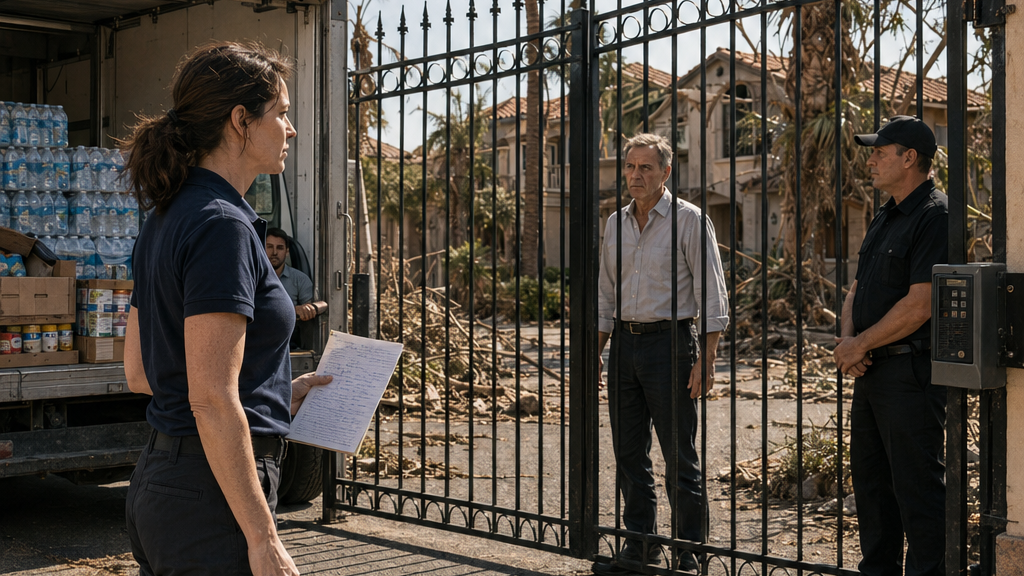
The relief truck braked hard enough that the cases of bottled water shifted against the side rails.
Sarah Taylor heard the plastic thump from twenty yards away.
The black entrance gate had not moved.
On the other side of it, the driver leaned toward his open window and pointed at the keypad as if perhaps the guard had misunderstood. The community security guard stood with one hand raised, palm out.
“No entry.”
Sarah crossed the debris-streaked sidewalk before the driver could answer. A broken mesquite branch lay across one curb, and half the streetlights along the entrance road were still dark from the windstorm three nights earlier.
“What happened?” she asked.
The driver held up a clipboard. “We have this neighborhood on the morning route. Water, shelf-stable meals, infant supplies. We were told somebody here had a distribution list.”
“I do.”
Sarah pulled folded pages from the back pocket of her jeans.
She had spent most of the previous night matching addresses to household needs. The official HOA directory showed 180 homes. Her list was longer in every way that mattered. Next to many addresses she had written small additional numbers.
Two adults.
Three children.
Grandmother.
Sister and baby.
Parents displaced from apartment.
The guard glanced at the pages but did not take them.
“Board president said verified residents only.”
Sarah looked through the gate.
Gregory Davis was walking toward them from the clubhouse side, carrying a radio in one hand.
He had been president of the association for four years and a resident for nearly fifteen. Normally Sarah saw him trimming oleander near his driveway or standing behind a folding table at annual meetings, speaking in the careful, managerial tone of someone who disliked surprises.
That morning, he looked as though he had not slept.
“Gregory,” Sarah said. “This is the delivery we talked about.”
“I know.”
“Then open the gate.”
His eyes moved toward the truck.
“We can accept supplies allocated to residents.”
“They’re not allocated by HOA membership.”
“We have people staying here who aren’t registered occupants.”
“Yes,” Sarah said. “Because their homes were damaged.”
Gregory lowered his voice.
“And we have damaged roads, unsecured sections of perimeter fence, no working east camera, and homeowners already complaining about unfamiliar vehicles.”
Sarah stared at him.
“This truck is not unfamiliar. It has emergency supplies.”
“That isn’t the point.”
Behind her, the driver shifted impatiently.
“I’ve got three more stops after this.”
Sarah turned back to Gregory.
“What exactly is the point?”
He exhaled through his nose.
“Controlled distribution. Listed residents receive supplies. Guests and displaced persons need to use public distribution sites.”
Sarah thought she had misheard him.
“There are children sleeping on living-room floors in here.”
“I know.”
“There are elderly people who haven’t been able to leave.”
“I know that too.”
“Then why would you send their food somewhere else?”
Gregory’s jaw tightened.
“Because if we start treating this neighborhood as an open relief site, we lose control of access.”
Sarah looked at the gate between them and the truck.
For years, that gate had been almost invisible to her. It opened when her windshield tag was read. It closed behind delivery vans. It marked the edge of the neighborhood without demanding much thought.
Now, beyond its bars, she could see water stacked six feet high.
The driver called out, “Ma’am, I need a decision.”
Sarah unfolded her list.
“Gregory, these aren’t strangers coming in off the street. They’re already inside.”
She pointed to an address.
“Donna Robinson has her brother and his wife staying with her.”
Another.
“Two houses on Green Mesa have families from the apartment complex near the wash.”
Then her finger stopped on her own address.
Emily. Two children.
Sarah looked up.
“My sister and her kids are at my house.”
Gregory’s expression changed for half a second.
Not sympathy exactly.
Recognition.
“I’m aware.”
“So they don’t qualify?”
“They are not registered residents.”
The sentence landed more heavily than Sarah expected.
She knew procedures. She built them for a living.
At the county, she coordinated emergency logistics: staging locations, manifests, fuel deliveries, temporary shelters. Fifteen years earlier, during one of her first large incidents, she had waved an unverified truck into a crowded staging site because people were shouting that supplies were needed immediately.
The truck blocked an ambulance lane for nineteen minutes.
No one died. Nothing catastrophic happened.
But Sarah still remembered the supervisor telling her afterward, quietly, “Urgency doesn’t excuse losing the system.”
She had built much of her career around never hearing that sentence again.
So she did what she always did when a situation became heated.
She slowed down.
“Show me the rule,” she said.
Gregory frowned.
“What?”
“The rule you’re using to exclude them.”
“We have emergency access authority.”
“That’s not what I asked.”
The guard looked from one of them to the other.
Sarah held out her pen.
“Show me where it says supplies brought to the community can only be received by names in the HOA directory.”
Gregory did not take the pen.
“We’re not debating bylaws at the gate.”
“I’m not asking for a debate.”
Sarah placed the household list on the hood of her car.
“Mark the households you’re refusing.”
His face hardened.
“Sarah.”
“Mark them.”
The driver checked his watch.
Gregory looked toward the stacked water, then toward the guard.
“We cannot let the truck through under the current conditions.”
Sarah felt heat rise behind her ribs.
She could have told the guard to move. She could have called the county emergency desk and tried to force an immediate confrontation over access.
Instead, she asked the driver, “How long can you stay?”
“Five minutes. Maybe less.”
Sarah looked down at the names on her list.
Five minutes was not enough time to get authority clarified.
Not cleanly.
Not the way she trusted.
She hated that the thought sounded reasonable.
“Can you circle back this afternoon?”
The driver shook his head.
“Tomorrow at the earliest. Supplies are moving fast.”
From the neighborhood side of the gate, someone called Sarah’s name.
Donna Robinson stood fifty feet away holding an empty water jug.
Sarah could not look at her for long.
The truck’s engine changed pitch as the driver put it back in gear.
Emily’s children had eaten crackers and peanut butter for breakfast.
Sarah knew that.
She also knew the truck was about to leave.
“Wait.”
The driver paused.
Sarah picked up her list, tore off the blank final page, and placed it in front of Gregory.
“Then write it.”
Gregory stared at the paper.
“Write what?”
“Write that you refused delivery for anyone who isn’t a verified HOA resident.”
“That’s not how I would characterize—”
“Then characterize it your way.”
Sarah handed him the pen.
“Put down exactly what rule you’re enforcing, exactly who it excludes, and sign it.”
For the first time that morning, Gregory said nothing.
Chapter 2: Every House Held More People Than the List
Emily divided one packet of instant oatmeal between two bowls and added enough hot water to make each portion look larger.
Her son watched the spoon.
Her daughter watched the box on the counter.
There was one packet left.
Sarah stood in the kitchen doorway with Gregory’s unsigned sheet folded in her hand.
Emily did not look up.
“Did the truck come?”
“Yes.”
The spoon stopped.
“And?”
“They turned it away.”
Emily finally looked at her.
“Who is ‘they’?”
“Gregory wouldn’t authorize entry.”
“For food?”
“For distribution to non-residents.”
Emily stared at Sarah long enough that the refrigerator’s intermittent generator hum seemed loud.
“We’re non-residents.”
“I know.”
“So he turned away food because we don’t own a house here?”
“Because he says the HOA can only manage distribution for verified residents.”
Emily gave a short, humorless laugh.
“And you let the truck leave?”
Sarah felt the question before she answered it.
“I didn’t have authority to force private-road access.”
“You have a county badge in your purse.”
“It doesn’t make me sheriff of the neighborhood.”
“I didn’t ask if you were sheriff.”
“Emily.”
Her sister pushed one bowl toward each child.
“No. You always do this.”
“Do what?”
“Explain why something can’t happen until everybody else is comfortable with it.”
Sarah lowered her voice.
“The kids are right here.”
“They already know we’re short on food.”
That was true.
It irritated Sarah more because it was true.
She placed the folded page on the counter.
“I’m building a verified shelter count. If I can establish how many people are physically inside the community, then the board loses the argument that this is uncontrolled outside distribution.”
Emily looked at the page.
“You think a better list is going to make Gregory suddenly decent?”
“I think it gives me something he can’t dismiss.”
Emily picked up the last oatmeal packet, considered opening it, then put it back.
“Fine. Make your list.”
By noon, Sarah had thirty-one addresses.
She moved street by street, carrying a yellow legal pad and asking the same questions.
How many people normally lived here?
How many were staying now?
Children?
Seniors?
Medical or mobility needs?
Food remaining?
Some residents answered cautiously, as though she were collecting information that might later be used against them.
Others opened their doors before she finished knocking.
At one home, three sleeping bags were rolled against the dining-room wall.
At another, Sarah saw a portable crib wedged between a sofa and a coffee table.
The official household count had become almost meaningless.
Donna Robinson met her at the door wearing gardening gloves despite the fact that her yard was covered with broken branches.
“Come in.”
“I only need numbers.”
“You need to see something.”
Donna led her through the house.
Her brother sat near the back window with his ankle elevated on a cushion. His wife was folding towels beside him.
Donna opened the pantry.
Two cans of beans.
Rice.
A jar of pasta sauce.
Half a sleeve of crackers.
“That’s it?”
“That’s what I’ve got that doesn’t need refrigeration.”
Sarah wrote quickly.
“How many meals yesterday?”
Donna folded her arms.
“Ask him.”
Her brother looked away.
Donna answered anyway.
“One.”
Sarah’s pen stopped.
“One meal?”
“He told us he wasn’t hungry at lunch.”
Her brother muttered, “Donna.”
“He wasn’t hungry because he wanted the rest of us to eat.”
Sarah looked at the pantry again.
She had spent the morning converting people into numbers because numbers could be defended in a meeting.
Now the columns on her legal pad felt thin.
“How long has this been happening?”
“Since yesterday.”
“I’ll get something over here.”
Donna’s eyes sharpened.
“From where?”
“I’m working on it.”
“That’s what everyone keeps saying.”
Sarah closed the pad.
Donna immediately looked embarrassed.
“I’m sorry.”
“No.”
“You’re helping.”
“No, you’re right.”
Sarah left with a new number beside Donna’s address and a sentence she could not turn into data.
Skipped meal voluntarily.
By three o’clock, her list covered forty-six homes.
She sat at her dining table adding totals when an email notification appeared on her phone.
HOA EMERGENCY NOTICE.
She opened it.
Residents were reminded that common areas, including the clubhouse parking lot, greenbelt, and internal road shoulders, could not be used for unauthorized distribution activities.
Sarah read it twice.
Emily leaned over her shoulder.
“He’s stopping people from handing out groceries now?”
“He’s stopping organized distribution on common property.”
“That’s the same thing with nicer wording.”
Sarah did not answer.
She had already considered asking residents with intact vehicles to meet a relief truck outside the gate and carry supplies back individually.
Gregory had considered it too.
The notice had arrived less than two hours after Sarah began collecting names.
Someone had told him what she was doing.
By late afternoon, her verified count showed seventy-three additional people sheltering inside the neighborhood beyond registered occupants.
Seventeen were children.
Nine were over seventy.
Sarah copied the totals onto a clean page.
For the first time, the handwritten list no longer looked like an argument.
It looked like a neighborhood the HOA records could not see.
A knock came at the front door just before sunset.
Patrick Lee stood outside.
He was the HOA treasurer, a careful man who could spend ten minutes discussing whether the association should replace six sprinkler heads now or wait until the next budget cycle.
He glanced toward the street before stepping onto the porch.
“I heard you’re making a list.”
“It’s not secret.”
“I know.”
Sarah waited.
Patrick rubbed the edge of his phone case with his thumb.
“Gregory isn’t making this up out of nowhere.”
“That’s not a very reassuring opening.”
“I’m not saying I agree with what he’s doing.”
“Then what are you saying?”
Patrick looked toward the closed entrance gate visible at the end of the distant street.
“The insurer contacted us after the storm.”
Sarah’s expression changed.
“When?”
“Yesterday morning.”
“What did they say?”
Patrick hesitated.
“Not what Gregory keeps telling everyone.”
Chapter 3: The Insurance Email Said Less Than Gregory Claimed
Patrick slid his phone across Sarah’s kitchen table but kept two fingers resting on the edge.
“I’m letting you read it,” he said. “I’m not giving you permission to turn this into some accusation that Gregory lied.”
Sarah looked at him.
“I haven’t read it yet.”
“That hasn’t stopped Donna from telling half the street he’s starving children.”
Emily, standing at the sink, turned around.
“Maybe don’t use that example in this house.”
Patrick winced.
“Fair.”
Sarah pulled the phone closer.
The email was from the HOA’s property insurer.
The subject line referenced storm-related liability precautions.
She read slowly.
Damaged private roads should be restricted where hazards existed.
Nonessential outside traffic should be minimized.
The association was advised to document contractors, delivery vehicles, and temporary access procedures.
Any relief staging on common property should maintain emergency-lane clearance and appropriate supervision.
Sarah reached the end.
Then she scrolled back to the beginning.
“That’s it?”
Patrick nodded.
“Where’s the part about verified residents?”
“There isn’t one.”
“Where does it say displaced guests can’t receive food?”
“It doesn’t.”
Emily came closer.
“So he did lie.”
Patrick sat back.
“I said I’m not calling him a liar.”
Sarah reread one paragraph.
“Did Gregory get another email?”
“No.”
“A phone call?”
“Not that I know of.”
“Legal advice?”
“Not through the board.”
Sarah put the phone down.
For nearly a day, Gregory’s position had rested on a phrase that sounded official: insurance requirements.
The actual warning was narrower.
Traffic.
Road damage.
Staging.
Liability.
Real concerns.
But none of them required deciding who was entitled to a bottle of water.
Sarah should have felt vindicated.
Instead, the email unsettled her for a different reason.
Gregory had not invented the danger.
The west internal road had a cracked shoulder where runoff had undermined the pavement. Two privacy walls were partially collapsed. The east entrance camera was dead. If dozens of cars arrived looking for supplies, emergency access really could become a problem.
The mistake was not that Gregory saw risk.
It was what he had done with it.
“Why didn’t the board tell residents this was the actual guidance?” Sarah asked.
Patrick looked tired.
“Because Gregory said simple rules work better during emergencies.”
“Simple for whom?”
“I know.”
“Do you?”
Patrick’s face tightened.
“I’m the treasurer, Sarah. I spent yesterday trying to figure out whether we had enough reserve money to remove three fallen trees without triggering a special assessment. I’m not sitting around inventing ways to make your sister hungry.”
The kitchen went quiet.
Sarah recognized the edge in his voice.
Not cruelty.
Pressure.
She softened hers.
“I didn’t say you were.”
“No, but that’s where this is going. Everybody wants one person to be the bad guy because that’s easier than admitting the whole neighborhood wasn’t ready.”
Sarah looked again at the email.
“Then help me fix it.”
Patrick stared at the table.
“I already helped more than Gregory would like.”
“Why?”
He looked toward the living room, where Emily’s children were quietly building something out of playing cards.
“Because I voted for the restriction yesterday.”
Sarah said nothing.
Patrick continued.
“I thought we were talking about preventing outside cars from flooding the neighborhood. That’s how he presented it. Controlled access until the roads were inspected.”
“And then?”
“Then this morning I found out the food truck had been turned away.”
Sarah folded her arms.
“You didn’t know?”
“No.”
That was the first fact in two days that made Gregory’s decision feel less like board policy and more like Gregory’s interpretation of it.
Sarah took out her legal pad.
“What exactly did you vote on?”
Patrick gave her the wording.
Temporary control of nonresident vehicle access and common-area use during storm recovery.
Nothing about aid eligibility.
Nothing about guests.
Nothing about food.
Sarah wrote it down.
Her pen moved faster now.
Emily watched her.
“You’ve got him.”
Sarah shook her head.
“No.”
“He used a traffic rule to deny food.”
“I have evidence that his justification is broader than the board authorization.”
“That sounds like having him.”
“It sounds like having one part.”
Emily let out a frustrated breath.
“There’s always another part with you.”
Sarah looked at her sister.
She knew what Emily meant.
She also knew that rushing toward accusation could harden Gregory and divide the board before anyone solved the actual delivery problem.
“I want the trucks through the gate,” Sarah said. “Not a satisfying argument.”
Her phone buzzed.
Another HOA message.
Emergency board meeting scheduled for the following evening.
Agenda item: formalization of temporary storm-access policy.
Patrick read it over her shoulder.
“He’s locking it in.”
Sarah looked at him.
“Can he?”
“If he gets the votes.”
“Will he?”
Patrick did not answer.
That answer was enough.
Later that morning, Sarah went to the HOA office to request the current emergency procedures and access maps.
The office smelled faintly of wet drywall.
A maintenance fan hummed in the corner.
The community security guard handed her a binder and returned to the front desk.
Sarah sat at a folding table beneath a battery-powered lamp.
The documents were familiar in the way many HOA documents were familiar: evacuation diagrams, vendor contacts, gate override instructions, insurance numbers.
She turned a page.
Then another.
A site map showed the main entrance, internal roads, clubhouse, drainage areas, and a second service gate near the eastern edge of the property.
Sarah stopped.
She had forgotten about that gate.
Most residents had.
It was normally chained and used only by landscaping contractors.
A handwritten notation beside it referred to “alternate emergency access review.”
Sarah flipped forward.
Nothing.
She went backward.
Still nothing.
Then, near the back of the binder, she found a divider labeled PREVIOUS RECOMMENDATIONS.
Behind it was an inspection memo from eight months earlier.
Sarah scanned the first paragraph.
Emergency staging.
Secondary vehicle access.
Temporary distribution point.
Her pulse changed.
The recommendation proposed improving the service-gate approach so emergency vehicles or supply deliveries could enter without blocking the main residential lane.
Exactly the problem Gregory now claimed had no safe solution.
At the top corner of the memo, in dark ink, someone had written one word.
DEFERRED.
Sarah sat very still.
The storm had not created every part of this problem.
Some of it had been waiting behind a divider for eight months.
Chapter 4: The Emergency Plan They Never Finished
Sarah found the word DEFERRED again before she found the reason.
It appeared on a second document clipped behind the inspection memo, this time beside an estimate for grading the approach to the eastern service gate, replacing its corroded lock assembly, and painting a temporary emergency lane across part of the maintenance lot.
The price was not extraordinary.
That bothered her more.
She carried the folder to the HOA office counter.
“Is Gregory here?”
The security guard shook his head. “Checking damage near the west wall.”
“Patrick?”
“Clubhouse.”
Sarah photographed the two pages with her phone and returned the originals exactly where she had found them.
Outside, she walked toward the eastern side of the community.
The service gate sat beyond the maintenance shed, almost hidden behind windblown palm fronds and a line of oleander. Unlike the polished black bars at the main entrance, this one was plain chain-link framed in steel. A heavy padlock secured it.
Beyond it ran a narrow paved service road toward a city street.
Sarah gripped the mesh and looked through.
A delivery truck could fit.
Not comfortably, but easily enough with traffic controlled.
More important, the route entered beside the maintenance lot instead of feeding directly into the residential streets.
Someone had already solved the problem Gregory kept describing.
They simply had not paid to make the solution ready.
She heard footsteps behind her.
Gregory approached carrying work gloves and a fluorescent safety vest over one shoulder.
“You’re not supposed to be back here without maintenance.”
Sarah held up her phone.
“I found the recommendation.”
He stopped.
For a moment, neither spoke.
The service gate rattled softly in a gust.
“When was this deferred?” Sarah asked.
“You saw the date.”
“I saw the date. I’m asking why.”
Gregory looked past her at the gate.
“Because it wasn’t necessary at the time.”
“The inspector apparently thought it was.”
“The inspector recommended several improvements.”
Sarah opened the photograph and enlarged the paragraph.
“Secondary emergency access capable of supporting relief deliveries without obstructing primary ingress and egress.”
“I know what it says.”
“Then why wasn’t it done?”
Gregory rubbed one hand over the back of his neck.
“Because the total package was over budget.”
“This item wasn’t.”
“It wasn’t the only item.”
“So the board voted?”
“Yes.”
“How?”
His eyes shifted toward her.
“You’re interrogating me now?”
“I’m trying to understand why we have seventy-three additional people sheltering inside a neighborhood with one functioning delivery route when somebody warned us eight months ago.”
Gregory’s expression hardened, but not in the way it had at the main gate.
This time Sarah saw fatigue underneath it.
“Homeowners were already furious about dues,” he said. “We had the wall repair, pool equipment, drainage work. Then that consultant handed us a list like money appeared because he printed it on letterhead.”
“So you delayed this.”
“We delayed several things.”
“Did you recommend delaying it?”
He did not answer immediately.
That was answer enough.
Sarah looked through the gate again.
“What would it take to use this tomorrow?”
Gregory gave a short laugh.
“You cannot just open a service gate and call it emergency infrastructure.”
“I didn’t.”
“The approach hasn’t been inspected since the storm.”
“Then inspect it.”
“The lock is controlled by maintenance.”
“Replace the lock.”
“You’d need traffic marshals.”
“I can get volunteers.”
“Emergency clearance.”
“I can mark a lane.”
“County approval if you’re bringing relief operations onto association property.”
“I work for the county, Gregory.”
His mouth tightened.
“That is exactly what worries me.”
Sarah turned.
“What does that mean?”
“It means you’re standing here as a homeowner when it helps you and as a county employee when it helps you.”
Her first impulse was anger.
Her second was recognition.
There was some truth in it.
She had used her professional knowledge repeatedly without formally placing herself into an official county role.
“I’m standing here as both,” she said. “Because both are true.”
“That doesn’t make the liabilities disappear.”
“No. It means I know how to manage them.”
Gregory glanced toward the maintenance lot.
“If something happens after we open this gate, everyone will ask why it wasn’t already ready.”
Sarah went still.
There it was.
Not an admission exactly.
But close.
“Is that what this is about?”
“What?”
“If we use it now, people find out the board should have prepared it before the storm.”
His face closed.
“You’re simplifying.”
“No. I think you’ve been simplifying.”
Gregory stepped closer to the gate.
“You know what happened when we proposed that work? People came to the meeting furious over another assessment. One man told us he was choosing between his medication and HOA fees. Another couple had just had their insurance premium jump forty percent. We deferred projects that looked optional.”
Sarah lowered her phone.
That was not the answer she had expected.
Gregory continued.
“And yes, I recommended delaying this one. Because we had a functioning main entrance and no history of needing a second distribution route.”
“Until we did.”
“Yes.”
The word came quietly.
For the first time since the truck had been turned away, Gregory did not sound as though he were defending a rule.
He sounded like someone living inside a decision that had aged badly.
Sarah looked at the locked gate.
“We can’t undo that vote today.”
“No.”
“But we can use what’s here.”
He shook his head.
“Not without approval.”
“Then let me get it.”
Gregory watched her.
“And if the county says no?”
“Then I’ll stop pushing this route.”
“And if they say yes?”
He looked toward the lock.
Sarah understood the real question beneath his.
If the county said yes, Gregory would lose every safety argument except the one he had not yet said aloud.
Pride.
Sarah left the service gate and called the county emergency-management liaison from her car.
She described the road width, gate condition, maintenance lot, traffic separation, volunteer staffing, and proposed delivery window.
The liaison did not say yes.
She asked for photographs.
Then measurements.
Then a sketch.
Sarah spent the next two hours gathering them.
By late afternoon, a city fire inspector met her at the service entrance. He checked clearance, pavement damage, turning radius, and access to the internal emergency lane.
He pointed at one cracked edge of asphalt.
“Keep heavy trucks three feet off that.”
Sarah marked it on her sketch.
He pointed toward the maintenance lot.
“No parking here during delivery.”
She wrote that down too.
At 5:18, the county liaison called back.
“If the HOA approves temporary access control, staffs the entrance, keeps the emergency lane open, and limits deliveries to scheduled relief vehicles, I’m comfortable supporting it.”
Sarah leaned against her car.
“So the county will approve?”
“With those conditions, yes.”
For the first time in two days, she felt a solution take shape that did not depend on proving someone wrong.
She could route the truck through the secondary gate.
Verify each household.
Keep outsiders from wandering through residential streets.
Protect the damaged road.
Meet the insurer’s warning.
Everything Gregory said he wanted could be preserved.
Except complete control.
When Sarah returned home, Emily was folding blankets in the living room.
The children were watching a downloaded cartoon on a tablet with the sound low.
Sarah placed the site map on the kitchen table.
“I found a way.”
Emily looked up cautiously.
“What kind of way?”
“A second gate. The county will support temporary relief access if we manage traffic.”
“So open it.”
“I can’t.”
Emily’s expression fell.
“Why not?”
Sarah laid her finger over the small square representing the service entrance.
“Because it belongs to the association.”
Emily stared at the map.
Sarah continued.
“I can build the plan. I can get county support. I can get volunteers. I can get the delivery scheduled.”
“But?”
“The board has to approve access.”
Emily sank into a chair.
“So Gregory still gets to decide.”
“No.”
Sarah looked at the diagram again.
“Tomorrow, the board gets to decide.”
Chapter 5: Sarah Put the Safe Alternative on the Table
Gregory opened the emergency board meeting by placing a printed resolution in front of every chair.
Sarah had not yet taken the site map out of her folder.
“Given continuing storm hazards,” he said, “I’m proposing we formalize temporary access restrictions until normal conditions are restored.”
The clubhouse smelled of coffee, damp carpet, and too many people in one room.
Residents filled the folding chairs. Several stood along the back wall.
Patrick sat at the board table with his hands clasped.
Two other board members read the resolution silently.
Sarah scanned her copy.
Temporary deliveries to verified residents.
No unauthorized distribution to guests or nonmembers.
No common-area staging without board authorization.
Gregory was trying to turn his interpretation into policy before anyone could challenge it.
Donna spoke from the second row.
“So you’re voting to keep food out?”
Gregory looked at her.
“We are voting to prevent uncontrolled access.”
“Those are not the same thing.”
“Donna, please let me finish.”
A few people murmured.
Sarah remained seated.
She had spent most of the day resisting the temptation to enter the meeting with the insurance email in one hand and the deferred recommendation in the other and simply expose him.
That would feel good for about thirty seconds.
Then half the room would defend Gregory because they disliked being told their board had failed, and the other half would demand his resignation while the food remained outside.
She waited.
Gregory described damaged pavement, security failures, liability, and the insurer’s warning.
Everything he said was technically connected to something real.
That was what made it effective.
When he finished, Sarah stood.
“I have an alternative.”
Gregory’s eyes settled on the folder.
“This is board discussion.”
“I know. I asked to be added under resident emergency access.”
Patrick nodded.
“She’s on the agenda.”
Gregory looked at him but said nothing.
Sarah walked to the table and unfolded the access map.
The service gate appeared on the far side of the diagram, highlighted with a thick line through the maintenance lot.
“This route avoids the damaged west road and keeps delivery vehicles out of the primary entrance.”
One board member leaned forward.
“That gate isn’t operational.”
“It can be operational with a replacement lock.”
“Who inspected the route?”
“The city fire inspector this afternoon.”
Gregory’s head lifted.
Sarah placed the inspection notes beside the map.
“The pavement is usable with a three-foot buffer along the cracked edge. The maintenance lot has enough turning space for scheduled relief trucks. No resident vehicles would be allowed into the staging area.”
A homeowner near the back asked, “What about random people showing up?”
“They don’t come through.”
Sarah pointed to the gate.
“Delivery vehicles only. Scheduled window. Security at the entrance. Two resident volunteers controlling the interior lane. Distribution by verified shelter address.”
Gregory leaned back.
“Verified resident address.”
“Verified shelter address.”
“That’s the same problem we’re discussing.”
“No,” Sarah said. “It’s the distinction we’ve been missing.”
She took out her handwritten list.
“HOA records tell us who owns or leases homes. They do not tell us who is currently sheltering inside them.”
She set the pages beside the map.
“Seventy-three additional people are staying inside this community because of the storm. Seventeen children. Nine people over seventy.”
The room changed.
Not dramatically.
No gasps.
Just the sound of chairs shifting and paper going still.
Sarah continued.
“They are not trying to enter the neighborhood. They are already sleeping here.”
Gregory said, “And the association is not equipped to verify every outside person’s eligibility for relief.”
“It doesn’t have to.”
Sarah placed another sheet on the table.
“We verify the address receiving supplies, not whether every person eating that food appears in the HOA directory.”
Patrick picked up the page.
Sarah pointed to the columns.
“One household representative signs for the delivery. Distribution stays tied to occupied homes. No public relief site. No open vehicle access. No crowd entering the community.”
One of the skeptical board members looked at Gregory.
“That addresses traffic.”
Gregory’s mouth tightened.
“It addresses some traffic.”
“What doesn’t it address?” Sarah asked.
“Liability.”
Sarah placed the insurer’s email on the table.
Patrick looked down.
Gregory noticed.
Sarah did not accuse him.
She simply read the relevant line.
“Minimize nonessential outside traffic. Document delivery vehicles. Maintain emergency-lane clearance and supervised staging.”
She looked around the room.
“This plan does all four.”
Another resident said, “So the insurance company didn’t say residents only?”
Gregory answered before Sarah could.
“The insurer gave us risk guidance. The board determines policy.”
“That’s true,” Sarah said.
Gregory looked almost surprised.
She continued.
“The insurer did not create this restriction. We did.”
Patrick’s eyes shifted from the email to Gregory.
The pronoun mattered.
We.
Sarah was a homeowner too. Patrick had voted for access controls. Gregory had stretched them. The failure was not improved by pretending everyone else stood outside it.
Gregory tapped the resolution.
“If we reverse course after two days, we signal that our emergency restrictions were unnecessary.”
Sarah understood then why every practical answer had failed to move him.
The gate was no longer only about security.
It was evidence.
If it opened under a safe plan, residents would ask why that plan had not existed before.
Sarah pulled the old inspection recommendation from her folder but did not yet place it on the table.
“Gregory, the purpose of an emergency rule is not to prove we were right yesterday.”
His face hardened.
“I am not interested in being lectured.”
“Neither am I.”
She laid the old recommendation beside the new map.
The two routes were nearly identical.
Someone in the front row noticed.
“What’s that?”
Sarah answered.
“An emergency-access recommendation from eight months ago.”
Gregory looked down.
The room became still.
Donna said, “Eight months?”
Sarah kept her voice level.
“It proposed preparing the same service entrance for emergency deliveries.”
Gregory’s eyes met hers.
She could see what he expected next.
Exposure.
Blame.
A demand for resignation.
Instead Sarah said, “It was deferred. That matters later. Right now, it also means we already know this route was considered workable.”
One of the board members picked up the old memo.
“Why was it deferred?”
Gregory answered.
“Cost.”
Sarah looked at him.
He could have stopped there.
Instead he added, “At my recommendation.”
A low murmur moved through the room.
Gregory kept speaking.
“Residents were pushing back on dues. We had other repairs. I treated the second access route as optional because the main gate was functioning.”
Donna said, “And now?”
“And now we had a storm.”
His tone sharpened.
“That doesn’t mean the earlier decision was corrupt. It means circumstances changed.”
Sarah believed him.
That was the difficult part.
He had made a defensible budget decision months before.
Then the storm exposed it.
And rather than admit the board had been underprepared, he had tried to make the consequences fit inside a stricter rule.
One homeowner raised a hand.
“If Sarah’s plan meets the insurance conditions, what exactly is the reason not to do it?”
Gregory stared at the map.
“It creates the appearance that we improperly denied access before.”
Sarah said nothing.
Patrick slowly lifted his head.
Several people looked at Gregory.
He seemed to hear his own sentence only after it was already in the room.
The concern was no longer road clearance.
Not strangers.
Not the insurer.
Appearance.
Patrick removed his glasses and placed them on the table.
“Gregory.”
Gregory looked at him.
Patrick spoke quietly.
“Are we still protecting the neighborhood?”
He glanced toward the old deferred plan.
“Or are we protecting how the board looks?”
Chapter 6: The Vote Was About More Than Food
Patrick put his glasses back on and pulled a blank motion form toward him.
Gregory stared across the table.
“You’re treasurer,” he said. “Think very carefully about what you’re doing.”
“I am.”
Patrick uncapped his pen.
“I move that we authorize temporary supervised relief access through the east service gate under the county conditions Sarah provided, effective tomorrow morning.”
No one in the room spoke.
One of the board members looked at Gregory.
The other looked at Sarah’s map.
Then Donna said from the audience, “Second it.”
“You’re not on the board,” Gregory said.
“I know. Felt good anyway.”
A few people laughed, but the sound died quickly.
The second came from the board member nearest Patrick.
Gregory sat back.
“Discussion.”
Immediately three residents began speaking at once.
One wanted Gregory removed.
Another demanded the association reimburse every resident who had bought emergency groceries.
Someone in the rear asked whether the board could be sued.
Sarah felt the meeting sliding sideways.
She had seen this before—not this room, not these people, but the instant when anger became its own logistics problem.
She stood.
“Stop.”
The word came out harder than she intended.
The room quieted.
Sarah looked at Donna first, then at the board.
“If we spend tonight deciding who gets punished, the truck is still outside tomorrow.”
Gregory watched her carefully.
Sarah continued.
“We can address the earlier decisions. We should. But first we need the gate open safely.”
A resident said, “You’re letting him off.”
“No.”
Sarah folded her hands against the back of a chair.
“I’m refusing to confuse accountability with priority.”
Emily stood near the wall.
Sarah met her eyes.
There had been a time, only two mornings earlier, when Sarah had watched a relief truck leave because she believed she needed perfect authority before making the next move.
She could still hear Emily asking, And you let the truck leave?
Sarah turned back to the room.
“I also need to say something else.”
Patrick stopped writing.
“When that first truck came, I knew people needed the supplies. I knew the rule Gregory was using did not make sense to me.”
She paused.
“And I let the truck leave anyway.”
Gregory’s expression changed.
Sarah did not look away.
“I told myself I needed clearer authority. Better documentation. A cleaner process. Some of that was responsible.”
Emily lowered her eyes.
“Some of it was fear.”
The room was silent now for a different reason.
“Years ago, I made a bad access decision during an emergency operation. Nothing terrible happened, but it could have. Since then I’ve trusted paperwork because paperwork doesn’t panic.”
She looked toward the map.
“But paperwork can also become somewhere to hide.”
No one applauded.
Sarah was grateful for that.
She sat down.
Patrick cleared his throat.
“The motion is on the floor.”
The first board member voted yes.
The second voted yes.
Patrick voted yes.
Three votes.
Gregory remained still.
“As president,” Patrick said, “your vote.”
Gregory looked at Sarah’s plan, then at the old recommendation.
“I abstain.”
The motion passed.
The room released one collective breath.
By six the next morning, the east service gate had a new lock.
Sarah stood beside it in a reflective vest with a clipboard under one arm.
Donna wore another vest twenty yards inside the maintenance lot, directing resident volunteers.
Patrick had brought cones from the clubhouse storage room.
The cracked edge of pavement was marked exactly where the fire inspector had instructed.
At 6:42, the same relief truck that had been turned away rolled toward the gate.
Sarah recognized the driver.
He lowered his window.
“You people ready this time?”
Sarah looked at the open lane behind her.
“Yes.”
The security guard unlocked the chain.
For a second, the gate resisted.
Rust caught in the hinge.
The guard shoved harder.
Steel scraped against asphalt.
Then the opening widened.
The truck moved through slowly.
No cars followed it.
No crowd appeared.
No emergency lane was blocked.
Inside the maintenance lot, volunteers unloaded cases of water onto marked pallets while Sarah checked addresses against the shelter list.
Donna signed for her household.
Then another resident.
Then another.
When Sarah reached her own address, Emily stepped forward.
Sarah handed her a box of shelf-stable meals and a case of water.
Neither sister spoke immediately.
Emily looked toward the open gate.
“You did it.”
Sarah shook her head.
“We did it late.”
Emily studied her face.
Then she took the box.
“That’s not the same as never.”
Across the lot, Gregory stood near the maintenance shed.
He had come without being asked.
He did not wear a vest.
He did not interfere.
When a delivery worker needed a second pallet jack, Gregory unlocked the equipment room and brought one out.
Sarah noticed but said nothing.
The distribution lasted ninety-three minutes.
Seventy-one of the seventy-three displaced people on Sarah’s list received supplies through their host households that morning. The remaining two had left overnight to stay elsewhere.
No accident occurred.
No stranger entered the residential streets.
No emergency lane was blocked.
The gate did not produce chaos when it opened.
It produced a line, a clipboard, cones, and people carrying food home.
Near the end, Gregory approached Sarah.
“You understand this doesn’t settle the board issue.”
“I know.”
“The deferred project, the insurance guidance, all of it.”
“I know.”
He looked at the nearly empty truck.
“I thought if we changed direction immediately, it would look like we had no idea what we were doing.”
Sarah clipped the last signed sheet to her board.
“And did this look like we had no idea?”
Gregory watched Donna carry a case of water toward a neighbor’s car.
“No.”
He looked older than he had three days earlier.
“Maybe the opposite.”
Before Sarah could answer, her phone buzzed.
A county email.
She assumed it was the final delivery confirmation.
Instead, the subject line read:
REQUEST FOR COMPLETE ASSOCIATION EMERGENCY-PLANNING RECORD.
Sarah opened it.
The county emergency-management office wanted the deferred access recommendation, board minutes, storm-response policies, and all temporary restrictions issued since the windstorm.
Patrick came up beside her.
“What is it?”
She handed him the phone.
He read the message once.
Then again.
Gregory saw both their faces.
“What?”
Patrick looked toward him.
“The county wants everything.”
The open service gate stood behind Gregory, sunlight falling through its chain-link frame.
For the first time, opening it had solved the immediate problem.
Now the records behind it were about to become the next one.
Chapter 7: The Gate Stayed, but the Rule Changed
The new emergency-access sign arrived before Gregory’s resignation did.
A maintenance worker bolted it beside the eastern service gate on a Tuesday morning, three weeks after the storm. The metal was still bright enough to catch the sun.
EMERGENCY ACCESS — AUTHORIZED RELIEF AND RESPONSE VEHICLES.
Sarah stood several feet away with her arms folded while the worker tightened the last bolt.
The gate itself had not changed much.
Same chain-link frame.
Same scraped lower hinge.
Same strip of patched pavement where the fire inspector had marked the truck clearance.
But it no longer looked forgotten.
Patrick walked up carrying a folder under one arm.
“You’re early.”
“So are you.”
“Board meeting starts in twenty minutes.”
Sarah glanced at the folder.
“That everything?”
“County response, insurer correspondence, board minutes, invoices.”
“And the reimbursement?”
“Included.”
The county review had not produced the dramatic outcome some residents had wanted.
No state investigator had arrived at Gregory’s door.
No one was led from the clubhouse.
No judge declared the entire board corrupt.
Instead came letters.
Requests.
Corrective recommendations.
A finding that the association’s storm restrictions had exceeded the safety concerns documented by its insurer.
A requirement that future emergency-access policies distinguish between control of vehicles and eligibility for aid.
A demand for a written secondary-access procedure.
And a bill.
The HOA would reimburse the relief organization for added transportation and handling costs caused when the first truck had been turned away and the delivery had to be rescheduled.
It was enough money to matter.
Not enough to destroy anyone.
Patrick opened the clubhouse door.
Inside, the chairs were arranged in rows again.
This time fewer people stood at the back.
The emergency had passed far enough that neighbors had returned to ordinary worries: roof repairs, insurance adjusters, tree removal, work schedules.
Emily sat beside Donna.
Sarah took a seat near the aisle rather than at the board table.
Gregory entered last.
He carried no folder.
That surprised her.
For the past three weeks, every meeting had found him surrounded by paper.
He sat at the center of the board table and called the meeting to order.
Patrick handled the corrective items one by one.
Adoption of the emergency-access protocol.
Approved.
Reimbursement of relief-delivery expenses from contingency reserves.
Approved.
Annual review of emergency routes.
Approved.
Requirement that any future temporary access restriction state exactly what it controls—vehicles, common-area use, or entry—and not be expanded by implication.
Approved.
Each vote was quieter than the storm arguments had been.
Sarah preferred it that way.
Then Patrick reached the final item.
“Board leadership.”
The room shifted.
Gregory looked out at the residents.
“I asked for this to be placed on the agenda.”
Donna straightened.
Sarah saw Emily look at her.
Gregory rested both hands on the table.
“I’m stepping down as president effective tonight.”
A murmur ran through the room.
One resident said, “Good.”
Gregory’s eyes moved toward the voice, but he did not respond.
Patrick started to speak.
Gregory raised a hand.
“I’d like to finish.”
The room settled.
He looked down briefly, then back up.
“When we deferred the secondary access work last year, I believed we were making a reasonable financial decision.”
Sarah listened carefully.
“I still believe the budget pressure was real. I don’t think approving that delay made us reckless people.”
Donna folded her arms.
Gregory continued.
“But after the storm, I knew almost immediately that the delay had left us with fewer options than we should have had.”
He glanced toward Sarah.
“I did not want to admit that.”
There was no theatrical confession in his voice.
That made it harder to dismiss.
“I told myself I was protecting the roads. Then I told myself I was protecting the association from liability. Then I told myself I was protecting residents from uncontrolled access.”
His fingers tightened slightly against the tabletop.
“Those concerns were real.”
He paused.
“But after Sarah brought us a plan that addressed them, I still wanted to say no.”
No one moved.
Gregory looked toward the floor for a moment.
“That was when the issue stopped being safety.”
Sarah felt the sentence land in the room without needing help.
Gregory went on.
“I had defended the original decision publicly. I had told people the restrictions were necessary. Reversing them felt like admitting the board had failed before the storm and that I had made the wrong call after it.”
Patrick watched him steadily.
“So I kept defending control after control stopped serving safety.”
Gregory sat back.
“That was my mistake.”
Donna’s expression softened, but only slightly.
A resident near the wall asked, “Is that supposed to make everything okay?”
Gregory shook his head.
“No.”
Another resident asked whether he planned to move.
“No.”
That caused a different kind of murmur.
Gregory almost smiled.
“I still own my house.”
A few people shifted uncomfortably.
There would be no clean disappearance.
They would still see him taking out trash, collecting mail, trimming plants, walking past the same gates he had once controlled.
That felt more honest to Sarah than exile would have.
Patrick called for nominations for interim president.
The procedural work continued.
No applause.
No triumphant speech.
After the meeting, Donna caught Sarah near the door.
“You could’ve pushed harder.”
“For what?”
“His resignation sooner.”
Sarah looked through the clubhouse windows toward the eastern side of the property.
“Maybe.”
Donna studied her.
“That’s not an answer.”
Sarah smiled faintly.
“I know.”
Emily joined them.
“You’ve been doing that less lately.”
“Doing what?”
“Waiting until you have the perfect answer.”
Donna laughed.
Sarah shook her head.
“I’m working on it.”
Emily’s smile faded into something gentler.
“I was angry at you.”
“I know.”
“I thought you cared more about doing things correctly than about us.”
Sarah looked at her sister.
“That wasn’t completely wrong.”
Emily’s eyes narrowed.
“I wasn’t asking you to agree with me.”
“I know that too.”
Sarah leaned against the doorframe.
“When that truck left, I told myself I had prevented a bigger mess.”
Emily waited.
“I didn’t know whether that was true. I just knew procedure felt safer to me than making a call I might regret.”
“You did make a call.”
Sarah nodded.
“That’s what I finally understood.”
Doing nothing had felt neutral.
It had not been neutral to the people waiting for food.
Emily touched Sarah’s arm.
“You changed it.”
“Eventually.”
“Eventually counts.”
Sarah looked toward the parking lot.
“Not always.”
Emily followed her gaze.
“No.”
They left it there.
Two months later, the HOA held its first emergency-access drill.
There was no storm.
No shortage.
No frightened residents.
Just a county observer, several volunteers, cones, radios, and one box truck borrowed for the morning.
Sarah stood beside Donna near the maintenance lot.
Patrick, now acting board president, checked his watch.
“Ready?”
The security guard nodded.
At the eastern entrance, a volunteer approached with the updated gate key.
The truck slowed.
For a moment Sarah saw the first relief truck again—the stacked water behind black bars, Gregory refusing to move, her own handwritten list pressed against the hood of her car.
She remembered how certain she had been that the next correct document would solve the problem.
The volunteer unlocked the gate.
This time no one argued about whose name belonged on which list.
No one asked whether opening it would make the board look weak.
No one waited for Sarah to insist.
The gate swung open before the truck reached a full stop.
Sarah watched it roll through.
The steel frame stayed where it had always been.
It still marked a boundary.
It still controlled access.
But now the rule behind it knew the difference between keeping danger out and keeping help away.
The story has ended.