The Poisoned Vow: The Maid Who Shattered Napa’s Most Powerful Wedding
CHAPTER 1: THE BROKEN CRYSTAL
The vintage Baccarat champagne flute was half an inch from Julian Sterling’s lips when Maya Lin lunged.
Her strike was not clumsy or hesitant; it was the sharp, violent reflex of someone who had seen death before and knew its smell. Her hand chopped through the sunlit air of the vaulted pavilion, catching Julian’s forearm just above his cufflink. The crystal glass spun out of his grip, cartwheeling through the warm afternoon light before detonating against the polished white marble of the altar steps.
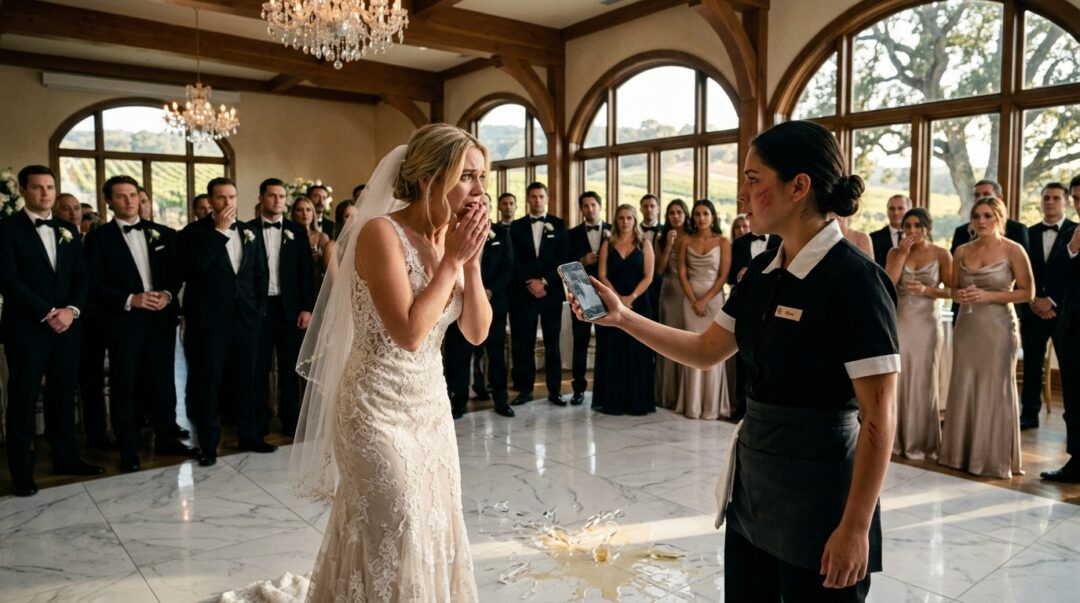
Golden sparkling wine sprayed across the hem of Celeste Montgomery’s French lace wedding gown. Shards of lead crystal skittered across the floor like diamond gravel, clicking against the patent leather of three hundred seated Silicon Valley venture capitalists and Napa wine dynasties.
Julian froze, his mouth slightly open, a drop of Dom Pérignon dripping from his lower lip onto his black satin lapel.
“What the hell is the matter with you?” he shouted, his voice cracking through the sudden, suffocating silence of the pavilion.
Before Julian could step forward, Celeste moved.
The bride marched across the marble, six feet of hand-stitched Chantilly lace trailing behind her like white sea foam. Her diamond-encrusted veil fluttered violently in the draft from the open glass arches. Her face, framed by golden curls, was not merely angry; it was contorted into an ugly, theatrical rage that bared her teeth.
“You clumsy, filthy animal!” Celeste screamed.
Her right hand whipped across Maya’s face with the full force of her body.
The crack echoed off the vaulted redwood rafters like a rifle shot. The heavy sapphire engagement ring on Celeste’s third finger caught Maya across the left cheekbone, tearing through the skin and leaving three bloody, parallel gashes that began to well with dark crimson immediately. Maya was knocked sideways into a floral pedestal, white orchids tumbling around her shoulders as she hit the stone floor on her knees.
Pain flared through Maya’s face like scalding grease, bringing the metallic taste of blood to her tongue. Her white catering apron was soaked with vintage champagne, cold and sticky against her ribs.
Celeste stepped directly over the shattered glass, pointing a manicured index finger at the floor between Maya’s knees. “You ruined my walk down the aisle! You ruined my vows! Kneel down and pick up every single piece of that glass with your bare hands, or I will have the county sheriff drag you out of this valley in chains!”
Maya slowly raised her head.
She did not weep. She did not lower her eyes in shame. She reached up with a steady hand and wiped the smear of blood from her jawline with the back of her wrist, smearing the crimson across her skin. Her dark eyes, clear and cold as laboratory alcohol, locked onto the furious blonde bride standing over her.
“I wouldn’t advise touching that wine, Mrs. Sterling,” Maya said, her voice quiet, clinical, and completely devoid of fear.
“Don’t you dare speak to me!” Celeste hissed, taking another step forward, raising her hand as if to strike her again. “Kneel!”
The grand pavilion was bathed in the warm, blinding glow of the midday Napa sun, filtering through seventy-foot curved glass arches that looked out over the terraced hills of the Mayacamas range. Three hundred guests sat in gold-leafed Chiavari chairs—tech venture moguls from Sand Hill Road, fifth-generation vineyard patriarchs, and federal appellate judges in tailored linen suits. Everything had been orchestrated with the clinical perfection of a five-million-dollar production, from the imported white gardenias flown in from Grasse to the vintage Baccarat stemware commissioned for the bridal toast.
Maya’s cheek burned as if someone had pressed a heated branding iron against her jaw. The three parallel cuts were bleeding freely now, the warm crimson running down her neck and soaking into the starched collar of her black uniform. Her ears rang with the sharp, hollow echo of the slap, but through the ringing, her mind remained ice-cold. She had spent three years in the viticulture toxicology labs at UC Davis studying plant alkaloids and pesticide degradation; she knew what aconite did to human heart tissue, and she knew the man standing on the marble altar had been less than three seconds from cardiac arrest.
Maya reached into the deep right pocket of her black trousers, beneath her stained white service apron. Her fingers closed around her silver smartphone. She tapped the screen with her thumb, bringing up the high-resolution photo she had taken sixty seconds earlier behind the limestone service counter.
She didn’t get to her knees. She stood up straight, brushing the crushed orchids from her apron, and extended the glowing screen directly into Celeste’s face.
“I think you need to see this,” Maya said.
Celeste’s eyes flicked impatiently down to the illuminated display, ready to scream another insult.
Then she stopped.
The color didn’t leave the bride’s face slowly; it vanished in a single, terrifying instant, leaving her skin the gray shade of wet ash. Her open mouth went rigid, her lips parting as her chest stopped rising.
On the screen was an uncropped, fifty-megapixel photo taken from twelve feet away in the north pantry. It showed a pale, slender hand hovering over the groom’s designated crystal flute, tipping the crushed white contents of a wax-paper packet into the golden bubbles.
And on the third finger of that hand, catching the beam of the pantry light, was a one-of-a-kind antique sapphire signet ring carved with the Montgomery family crest—a ring that Celeste’s twin sister, Vivienne, had received from their father that very morning.
CHAPTER 2: THE TASTE OF ACONITE
The silence inside the vaulted glass pavilion was so absolute that the buzzing of a single honeybee against the rose garden windows sounded like an engine.
Celeste looked from the screen of Maya’s phone to the wedding party standing beneath the white floral arch forty feet away. Her twin sister, Vivienne Montgomery, the maid of honor, stood clutching a bouquet of white peonies. Vivienne’s lilac silk dress was immaculate, her blonde chignon perfectly pinned, but as her gaze crossed the room and met Celeste’s frozen stare, the smile on her lips twitched once, then vanished into a blank, unreadable mask.
“Give me that phone,” Julian Sterling demanded, lunging forward and reaching for Maya’s hand.
Maya took a quick step back, slipping the phone into her apron pocket and keeping her eyes fixed on the groom. “Touch this phone, Mr. Sterling, and I will scream for the federal marshals currently attending your third-row tables. You have three state judges sitting in the front pews. You want to explain to them why a catering assistant is holding photographic evidence of attempted homicide?”
Julian’s face darkened, his jaw clenching so hard the muscle bulged beneath his skin. “This girl is a disgruntled temp worker trying to stage a viral shakedown! Call private security! Clear the pavilion!”
“Nobody moves until I say so!” Celeste’s voice tore through the hall, high and ragged with panic.
She turned on Julian, her lace veil shaking violently, her diamond comb slipping from her hair. “You shut your mouth, Julian! Look at the floor!”
Celeste pointed down at the shattered glass between her satin shoes.
Where the champagne had pooled on the pristine Thassos marble, something was happening that should never happen to vintage sparkling wine. A thick, milky-white film was forming across the surface of the golden liquid, curdling against the stone. Maya knelt down, ignoring the blood dripping from her cheek, and pulled a small plastic tube of pH indicator strips from her utility pouch. She dipped the paper into the puddle.
The pale yellow strip turned an instant, violent violet-black.
“Crushed root extract of Aconitum napellus,” Maya said, holding the stained strip up toward the front row of guests. “Monkshood. Commonly known in Napa as wolfsbane. It’s an alkaloid that blocks the voltage-gated sodium channels in cardiac muscle. Two hundred milligrams in sparkling wine causes ventricular arrhythmia within twelve minutes. It looks like a massive heart attack brought on by wedding day stress.”
A gasp swept through the assembly. Two elderly women in the front row stood up, knocking over their gilded folding chairs.
“That’s absurd!” a man’s voice called out from the side corridor.
Thomas Keller, the estate’s fifty-year-old master sommelier, hurried through the pantry double doors, wiping his hands on a clean linen towel. “That bottle was a 2008 Dom Pérignon P2, personally uncorked by my head cellar master ten minutes ago! I inspected the foil myself!”
Keller walked toward the altar, his face flushed with professional outrage. “I poured the bride and groom’s flutes from the same magnum! Look at the reserve glass on the service cart—”
Keller reached out and took a sip from the secondary flute resting on the tray to prove his point.
He swallowed once.
His eyes widened until the whites showed all the way around his irises. The crystal glass slipped from his fingers, shattering against his leather shoes. A wet, choking sound tore out of his throat as he grabbed his collar, his knees buckling beneath him. He hit the marble floor on his side, his body convulsing in violent, rhythmic spasms, a line of white froth bubbling between his purple lips.
“Call nine-one-one!” Celeste shrieked, backing away into the altar draperies, her white gown soaked in wine and vomit. “Somebody get a doctor! Call an ambulance!”
Maya threw her ice pack aside and sprinted across the floor toward the convulsing sommelier, her hands already tearing open the first-aid kit mounted beside the kitchen door.
The scent of crushed orchids, spilled vintage champagne, and chemical bitterness filled the pavilion, turning the festive wedding air into the suffocating atmosphere of a mass casualty zone. Guests in black tuxedos were scrambling toward the side glass exits, knocking over silver ice buckets and crystal centerpieces in their haste to escape the contaminated room. Two off-duty highway patrol officers who had been hired for traffic coordination pushed their way through the screaming crowd, their radios squawking with emergency medical requests.
Maya kept her fingers pressed against the sommelier’s carotid artery. The pulse beneath her latex-gloved fingertips was terrifying—erratic, weak, and fluttering like a dying moth against a windowpane. “His ventricular rhythm is collapsing!” Maya shouted, looking back at the wedding party. “He needs thirty milligrams of atropine sulfate intravenously right now! If the paramedics don’t have a pediatric cardiac kit on that lead ambulance, his diaphragm is going to freeze before they reach the highway!” “He has less than four minutes before his heart fibrillates! Get the atropine from the estate medical kit! Move!”
Through the chaotic roar of screaming wedding guests and overturned tables, Maya glanced toward the side exit leading to the subterranean limestone wine caves.
Vivienne Montgomery was no longer holding her bouquet of peonies.
Her lilac silk dress was already disappearing into the shadows of the cave tunnel, and the heavy iron grille was swinging shut behind her.
CHAPTER 3: THE WINE CAVE INTERROGATION
The limestone wine caves of the Montgomery estate stretched for half a mile beneath the Silverado Trail, hand-carved into the volcanic rock in the 1880s to maintain a constant fifty-eight-degree chill.
Ten minutes after the sommelier collapsed, the heavy oak doors at the cave entrance were slammed shut by armed deputies from the Napa County Sheriff’s Office. Outside on the vineyard road, the wail of three arriving ambulances and four patrol cruisers echoed off the terraced hillsides, but inside the cave, the air was cold, damp, and smelled of oak aging casks and ancient dust.
Celeste walked down the central stone corridor, her torn lace train bunched in her fist, her mascara running in black streaks down her cheeks. Maya Lin walked beside her, carrying a stainless-steel forensic kit she had borrowed from the sheriff’s mobile unit, her bruised cheek throbbing in the damp chill.
“Vivienne has a private tasting suite at the end of tunnel four,” Celeste said, her voice shaking with a combination of rage and hypothermic shock. “She kept her bridal dressing room there because she said the natural humidity was good for her silk gown.”
“She kept her dressing room there because the tunnels have an old emergency drainage portal that leads directly to the lower vineyard road,” Maya said, her flashlight beam cutting through the gloom. “She was planning to leave the moment Julian hit the floor.”
They rounded a massive stack of French oak barrels.
The air deep inside the limestone caves was thick with the rich, alcoholic vapor of two thousand aging oak barrels, a heavy, intoxicating scent that had soaked into the volcanic rock over a century and a half of winemaking. Moisture dripped steadily from the vaulted ceiling, each cold droplet echoing through the darkness like the ticking of an ancient water clock. The temperature hovered at fifty-eight degrees, sending violent shivers through Celeste’s bare, wine-stained shoulders.
Celeste looked at the woman standing across from her—the twin sister who had shared her nursery, her pony rides, and her debutante ball at the Saint Francis Yacht Club. For twenty-seven years, they had worn matching pearl earrings and signed joint birthday cards to their father. But looking at the cold, predatory calculation in Vivienne’s gray eyes, Celeste realized with a sickening jolt that she had never known her sister at all.
At the end of the corridor, the iron-studded door to the private suite stood half-open. Inside, vintage Edison bulbs hung from the vaulted stone ceiling, casting a warm amber glow over antique velvet armchairs, a vanity table covered in diamond jewelry, and an open leather travel trunk.
Vivienne Montgomery stood beside the trunk, wearing a black cashmere sweater over her lilac trousers. In her right hand, she held an open leather passport case; in her left, she held a small glass dropper bottle wrapped in brown pharmaceutical tape.
“Don’t take another step, Celeste,” Vivienne said, her voice flat, cold, and stripped of all the delicate sweetness she had displayed at the rehearsal dinner. “Sheriff Lawson is my godfather. He’s already outside. If you think a catering temp’s smartphone photo will hold up against our family’s legal trust in county court, you’ve spent too much time drinking our own chardonnay.”
Celeste stopped four feet from her twin sister, her chest heaving beneath her corset. “Why, Vivienne? Why Julian? You helped me choose his wedding band! You planned our honeymoon in Lake Como!”
Vivienne let out a short, bitter laugh that sounded like dry gravel grinding in a mill. “I planned your honeymoon because I needed him on a plane with a heart condition that wouldn’t raise questions in an Italian hospital. Julian didn’t marry you for love, you pathetic idiot. Julian married you because his venture capital firm is seventy million dollars in debt to a private equity syndicate in Tokyo.”
Vivienne pointed toward an open manila file resting on the vanity table.
“Look at the prenuptial agreement on the blotter, Celeste. Read page forty-two. Read the rider Julian had his attorneys insert at midnight yesterday.”
Maya stepped forward, keeping her distance from Vivienne, and picked up the bound legal document. She flipped directly to the tabbed section, her eyes scanning the dense legal text.
“The Casualty Survivorship Rider,” Maya read aloud, her voice echoing off the limestone walls. “In the event that the groom suffers fatal medical trauma within seventy-two hours of the execution of the marriage certificate, all proprietary patents, intellectual property, and venture shares under Sterling CleanTech are transferred automatically to the Montgomery Family Trust—with exclusive executive power vested in the managing trustee.”
Maya looked up at Vivienne. “And who is the sole managing trustee of the family trust?”
“I am,” Vivienne said softly, her lips curving into a cold, triumphant sneer. “Because our father had a stroke eighteen months ago and signed full power of attorney over to me. If Julian died on that altar, his clean-tech patents—worth two hundred and forty million dollars on the open market—became mine before the market opened on Monday.”
Celeste took a slow, agonizing breath, her hand rising to her mouth as if she were about to be physically sick. “You were going to murder him in front of three hundred people for a venture portfolio?”
“I was going to save this vineyard!” Vivienne screamed, her composure finally shattering into hysterical fury. “Julian was going to sell our land! He signed a secret letter of intent with a residential developer in San Francisco on Thursday! In twelve months, our grand cru cabernet vines would have been bulldozed into sixty luxury golf villas!”
CHAPTER 4: THE FINANCIAL AUTOPSY
The sound of Vivienne’s scream died against the damp stone, replaced only by the steady, rhythmic drip of condensation from the vaulted ceiling.
Celeste stared at her sister, then slowly turned toward the entrance of the tasting room.
Julian Sterling stood in the arched doorway, flanked by two armed sheriff’s deputies. His tuxedo jacket was gone, his white dress shirt open at the throat, his face pale and tight as a drumhead. In his right hand, he held a sleek aluminum laptop, the screen glowing bright blue in the dim tunnel.
“Is that true, Julian?” Celeste asked, her voice dropping into a register so low and quiet it was terrifying. “Were you selling the Silverado vines?”
Julian didn’t look at her. He looked at Vivienne with a mixture of contempt and cornered desperation.
“The vineyard is bleeding three million dollars a year, Celeste,” Julian said, his voice flat, defensive, and completely devoid of warmth. “The global wine market is down twenty percent. Your grandfather’s distribution deals are thirty years out of date. If I didn’t monetize the underlying real estate, my venture fund would have been pulled into receivership by the first of the month.”
Julian stepped into the room, placing the laptop onto an oak tasting barrel between them. He tapped the trackpad, bringing up a complex financial dashboard crowded with debt covenants, short positions, and real-time wire transfers.
“Vivienne isn’t saving anything,” Julian continued, pointing a finger at his sister. “She didn’t try to kill me to protect the grapes. She tried to kill me because she shorted my tech company’s stock by forty million dollars through an offshore broker in Belize. If I survived the wedding, my merger announcement on Monday morning would have sent the stock up three hundred percent—and Vivienne would have been personally bankrupt by noon.”
Maya Lin looked at the screen, her analytical mind processing the numbers faster than the family could shout at each other. She pointed to a line item at the bottom of the ledger: Clearing Reference #BZ-9912 – Recipient: Sterling Capital Management, LLC.
“Wait,” Maya said, her voice cutting through the rising argument.
Everyone stopped.
The financial dashboard on Julian’s laptop screen was crowded with real-time clearing notifications from electronic exchanges in London, Tokyo, and Frankfurt. A live Bloomberg terminal feed displayed a cascading column of red trade confirmations—over three hundred thousand put options purchased against Sterling CleanTech’s primary ticker symbol within the last forty-eight hours.
Maya leaned closer to the screen, her enologist training giving way to the analytical precision she had learned during her dual degree in forensic chemistry. “The trade execution protocol required a dual-key authorization code,” Maya pointed out, her gloved finger hovering over the glowing glass. “The primary key belonged to the corporate treasurer. But the secondary authorization was signed with an encrypted biometric thumbprint registered to a device right here on this vineyard estate.”
Maya looked from Julian to Vivienne, then back down at the screen. “Mr. Sterling, which IP address executed that Belize short position?”
Julian frowned, his jaw tightening. “My internal audit team flagged it this morning. It came from a secure terminal in San Francisco—”
“No, it didn’t,” Maya said, pulling her phone from her apron pocket and opening the metadata log on the photograph she had taken in the pantry. “The photograph of the aconite powder was taken at 1:42 PM. But the short order on your stock was placed at 1:44 PM—from the local Wi-Fi router inside this private wine cave.”
Maya looked directly at Julian.
“You knew the poison was coming,” Maya said, her voice dropping into an ice-cold realization. “You didn’t look surprised when I smacked that glass out of your hand. You looked angry that the glass broke.”
Celeste’s eyes widened in horror. She looked from her sister to her new husband, the world collapsing around her for the second time in twenty minutes. “Julian… what did you do?”
Vivienne’s hands were shaking so violently that her diamond bracelet clicked against the rim of the oak barrel. She looked at Julian with an expression of pure, unadulterated venom. “You thought you were the only one who knew how to play the market, Julian? You thought because you had an office on Sand Hill Road and a private box at the Chase Center, you could treat a hundred-year-old family legacy like a bankrupt tech startup? I built this vineyard’s international reputation with my bare hands while my sister was picking out floral arrangements.”
Julian took half a step backward toward the two deputies, but the deputies didn’t move with him. They stood with their hands on their duty belts, their eyes locked on him with cold, professional suspicion.
“I didn’t hire her to kill me, Celeste,” Julian stammered, his polished venture-capital confidence evaporating into frantic sweat. “Vivienne approached my chief financial officer three weeks ago. She offered him two million dollars to secure a sample of my medication. My CFO came to me! We knew she was going to spike the glass!”
“And you let her do it?” Celeste screamed, her fists clenching so hard her fingernails bit through the lace of her gloves.
“I had a paramedic standing by in the catering van with the antidote!” Julian yelled back, his face crimson. “All I had to do was take one sip, collapse on the altar, and Vivienne would be arrested on the spot for attempted murder! The merger would go through, the family trust would be dissolved by the probate court, and I would own the entire Napa parcel without having to pay your father a single dime in royalties!”
CHAPTER 5: THE VINEYARD PURSUIT
The silence that followed Julian’s confession was broken by the sound of running footsteps.
Vivienne didn’t wait for the deputies to process what they had heard. With the desperate speed of a cornered animal, she grabbed the open leather passport case from the vanity and bolted through the narrow service door at the rear of the tasting room—the old smugglers’ portal leading out into the vineyard drainage ditches.
“Stop! Police!” one of the deputies shouted, lunging forward, but Vivienne slammed the heavy iron-plated door behind her, the deadbolt clicking into place with a hollow thud.
“There’s no key for that door from this side!” Celeste cried, rattling the brass handle in vain. “It opens only from the vineyard terrace!”
“The north irrigation culvert!” Maya shouted, turning and sprinting back down the main limestone corridor. “The drainage portal comes out near the fermentation tanks at the base of block four! If she gets to the staff parking lot, she has a rental car waiting by the main highway!”
Maya ran through the cold dampness of the cave, her catering apron flapping against her legs, her sneakers gripping the wet stone. Celeste followed behind her, kicking off her four-inch satin heels and hiking her heavy lace skirt above her knees, running barefoot across the cold gravel.
They burst through the main cave entrance into the blinding afternoon sun.
The midday heat out on the vineyard terrace was blistering, radiating off the dark volcanic shale and the rows of heavy, ripening cabernet grapes. The air smelled of sweet dust, wild fennel, and the sharp, chemical tang of copper sulfate spray. Maya’s boots pounded against the hard-packed earth of the service road, her breath burning in her throat as she calculated the water pressure running through the underground main lines.
She had spent three months during her sophomore year re-engineering the automated wash-down manifold for the estate’s sixty-thousand-gallon stainless steel fermentation tanks. She knew that the booster pumps drew directly from the high-pressure agricultural reservoir on the upper ridge, delivering one hundred and twenty pounds per square inch through the brass fire-hose couplings mounted at every hundred yards along the perimeter wall.
The heat of the valley hit them like an open furnace. Down the terraced hillside, amidst the rows of emerald-green cabernet vines, a figure in black and lilac was sprinting toward the gravel staff access road.
“She’s heading for the helipad beside the crush pad!” Celeste yelled, her bare feet bleeding from the sharp shale rocks of the path. “Her helicopter pilot is on standby for the wedding departure!”
Maya didn’t run down the main path. She knew the vineyard layout intimately; she had spent two summers working as an enology intern mapping the automated drip lines across the sixty-acre parcel.
“Follow me!” Maya called out, vaulting over the wooden boundary fence and cutting straight down the steep incline between rows twenty-two and twenty-three.
Ahead of them, the rhythmic thump-thump-thump of a turbine engine began to spool up near the fermentation shed. A sleek blue Bell 407 helicopter was idling on the concrete pad, its rotor blades beginning to slice through the shimmering summer air.
Vivienne reached the edge of the crush pad, her hair wild, waving her arm frantically at the pilot.
Maya reached the central irrigation control manifold twenty yards uphill from the helipad. Mounted to the concrete footing was a high-pressure brass valve marked: WINE TANK WASH-DOWN SYSTEM – 120 PSI.
Maya didn’t hesitate. She grabbed the iron spanner resting on the manifold frame, fitted it to the emergency release bolt, and threw her entire body weight against the lever.
A deafening roar erupted from the two-inch high-pressure fire hose mounted to the retaining wall.
A torrent of pressurized recycled wash-water—four hundred gallons a minute—exploded from the nozzle, striking Vivienne squarely across the shoulders like a physical battering ram. The impact knocked the breath from her lungs and sent her skidding six feet across the wet concrete of the pad, her passport case and the aconite vials flying into the drainage grate.
The helicopter pilot saw the police cruisers rounding the vineyard road below and immediately pulled up on the collective, lifting the skids off the pad and banking hard to the west, abandoning Vivienne to the storm.
Vivienne lay on the wet concrete, soaked, gasping for air, her black sweater ruined, her hands scraping against the gravel as two Napa County deputies vaulted the retaining wall and pinned her wrists behind her back.
Celeste walked up the ramp, her lace gown shredded, her feet caked in red clay, her breath coming in ragged, painful hitches. She stopped two feet from her twin sister, looking down at the woman who shared her face, her blood, and her heritage.
“You said you were doing this for the family, Vivienne,” Celeste whispered, her voice cracking with the unbearable agony of betrayal.
Vivienne looked up from the wet concrete, her eyes filled with cold, remorseless defiance. “There was never a family, Celeste. Father made his choice when he put your name first on the corporate masthead. I just balanced the ledger.”
CHAPTER 6: THE ALTAR OF DECEIT
By five o’clock that evening, the golden light of late afternoon was slanting through the arched windows of the grand pavilion, illuminating a scene that looked like the aftermath of a small war.
Three hundred wedding guests had been evacuated to the lower terrace. The white floral arches had wilted in the dry valley heat. In the center of the marble floor, where the wedding vows were supposed to have been sealed with a kiss, Detective Marcus Vance from the state investigative unit stood beside Napa County Sheriff Lawson, reviewing the digital forensic reports on two tablets.
Sheriff Lawson held a thick stack of certified land records in his heavy, sun-tanned hands, his deputy standing behind him with a digital camera documenting the evidence tags on the aconite vials and the shattered Baccarat crystal. The late afternoon shadows were lengthening across the marble floor, stretching the silhouettes of the federal agents and state investigators across the wilted white orchids.
“The United States Attorney for the Northern District of California has already issued an emergency asset-freeze order on all domestic bank accounts affiliated with Sterling CleanTech and Montgomery Cellars,” Lawson announced, his voice carrying the calm, immovable authority of a veteran county sheriff. “Every vehicle, every corporate aircraft, and every barrel of wine currently aging in these cellars is under federal court custody pending the grand jury indictment on Monday morning.”
Julian Sterling sat on a folding chair in the center of the hall, his hands cuffed in front of him, flanked by two federal agents. His hair was disheveled, his silk tie hanging loose, his expensive veneer of venture-capital authority completely obliterated.
Across from him sat Vivienne Montgomery, her hands bound behind her back, her wet lilac trousers shivering in the draft from the open terrace.
Celeste Montgomery stood near the altar, wrapped in a heavy navy blanket that a female paramedic had draped over her shoulders. She had washed the wine from her face, but the red swelling beneath her eyes and the exhaustion in her posture told the story of an empire that had died in an afternoon.
Maya Lin stood beside her, a fresh butterfly bandage holding the split skin of her cheek together, a bottle of cold spring water in her hands.
“The state crime lab in Sacramento just verified the chemical swabs,” Detective Vance announced, his voice echoing off the vaulted redwood ceiling. “The substance on the shattered crystal is pharmaceutical-grade aconitine. We found a matching four-ounce vial in Vivienne Montgomery’s travel kit, and a series of encrypted wire transfers between Julian Sterling’s holding company and an offshore account in the Caymans.”
Vance turned his gaze toward Julian.
“Mr. Sterling, you are under arrest for attempted capital murder, federal securities fraud, and conspiracy to commit commercial extortion. You have the right to remain silent…”
Julian didn’t listen to the warning. He lifted his head, his bloodshot eyes locking onto Celeste with a sneer that had dropped all pretense of gentility.
“You think you’re a victim, Celeste?” Julian spat, his voice harsh and dry. “You think your father built this vineyard on hard work and family values? Ask your grandfather how he acquired the water rights for block four. Ask him who owned the land before the Montgomerys arrived in 1950.”
Julian let out a short, venomous laugh. “Your father was the one who approached my private equity fund eighteen months ago, Celeste. He wanted to liquidate the trust before your sister found out about the offshore debts. Check the safe in the underground barrel room. The real contract was signed by your father’s own hand.”
The federal agents unrolled yellow crime scene tape across the double French doors, locking down the pavilion as an active felony crime scene. The afternoon breeze carried the rich, sweet scent of crushed grapes from the lower fermenters, a clean natural fragrance that seemed to cleanse the heavy, chemical stench of the aconite from the marble floor.
Detective Vance closed his leather notebook with a sharp snap. “The FBI financial crimes task force in San Francisco is currently serving search warrants on Sterling CleanTech headquarters. We have seized the server hard drives, the offshore wire logs, and the personal communications between Mr. Sterling and his corporate co-conspirators. Nobody is getting bail on Monday morning.”
Celeste didn’t flinch. She pulled the navy blanket tighter around her shoulders, her chin rising, her gray eyes clear and steady for the first time that day.
“My father is in an assisted care facility with vascular dementia, Julian,” Celeste said softly, her voice carrying the quiet, crushing finality of an ancient oak falling in a quiet forest. “Whatever debts he left behind, I will pay. Whatever land he compromised, I will restore. But you will never see another sunrise over this valley as a free man.”
Two deputies hauled Julian to his feet, marching him down the central aisle where three hundred white chairs sat empty. Behind them, Vivienne was led away in silence, her head bowed, refusing to look at her sister as the iron doors of the patrol van slammed shut in the courtyard.
CHAPTER 7: THE AUTUMN VINTAGE
Forty-eight hours later, the Napa Valley sun rose over the Mayacamas Mountains in a brilliant flood of amber and rose gold.
The air was cool, carrying the rich, intoxicating scent of crushed grape skins, damp morning loam, and burning oak shavings from the cooperage down the road. Down in block four, the heavy clusters of cabernet grapes hung thick and purple beneath the morning dew, ready for the first harvest of the season.
Maya Lin stood on the tasting terrace of the main winery, wearing her favorite canvas field jacket, heavy work boots, and a ballcap over her tied-back dark hair. The butterfly bandage was gone from her cheek, leaving a thin, clean pink line that would fade before winter. In her hands, she held a glass hydrometer, measuring the sugar brix of a fresh sample taken from the sunrise pick.
Footsteps clicked on the stone pavers behind her.
The crisp autumn breeze swept down through the canyon, rustling the golden oak leaves along the creek bed and carrying the faint, clean scent of burning grapevine prunings from the neighboring estate. On the wooden tasting deck, the morning light revealed the rich, dark purple clusters of the 2026 crop, untouched by the corporate greed and murderous conspiracies that had nearly destroyed the century-old vineyard two days before.
Maya looked down at the official university grant paperwork in her hands. For three years, she had balanced eighty-hour work weeks between the soil chemistry lab and late-night catering shifts, surviving on burnt diner coffee and instant noodles while she fought to pay off the sixty thousand dollars in federal student loans that threatened to crush her academic career. Now, with a single stroke of a pen, her future was secure, and her research into sustainable rootstock genetics would have a permanent home in the most prestigious soil in California.
Celeste Montgomery walked onto the terrace. She had cut her long blonde hair into a sharp, chin-length bob, wearing simple denim jeans, a warm gray knit sweater, and leather work boots stained with red vineyard clay. She looked five years older than she had on her wedding morning, but the vacant, decorative fragility was gone, replaced by a grounded, resilient calm.
Celeste set two mugs of black coffee on the redwood tasting table, sliding one toward Maya.
“How are the sugars?” Celeste asked, looking out over the rolling sea of green vines.
“Twenty-four point five brix,” Maya replied, taking the mug and inhaling the rich aroma of roasted chicory. “The acidity is holding steady. If you start the crush at dawn tomorrow, the 2026 vintage will be the best vintage this estate has produced in twenty years.”
Celeste took a sip of the hot coffee, her gaze drifting toward the stone pavilion where the broken crystal had been swept away and replaced by rows of stainless steel fermentation bins.
“The Department of Justice approved the restructuring plan yesterday,” Celeste said quietly. “Julian’s clean-tech patents were seized under civil asset forfeiture and sold to a public research trust at Stanford. The proceeds were sufficient to satisfy the corporate debt and pay off the mortgage on the lower forty acres.”
Celeste reached into the pocket of her sweater and withdrew a heavy cream envelope bearing the official seal of the Montgomery Agricultural Foundation. She placed it beside Maya’s hydrometer.
“What is this?” Maya asked.
“A formal appointment as Chief Enologist and Director of Viticultural Research for Montgomery Estate,” Celeste said, her gray eyes warm with genuine, unforced respect. “With an annual research stipend of one hundred and fifty thousand dollars, fully funded by the university endowment. And an equity stake of two percent in every vintage you bottle.”
Maya looked down at the envelope, her throat tightening. “Celeste… I was just a catering server trying to pay off my student loans.”
“You weren’t just a server, Maya,” Celeste said softly, placing her hand gently over the girl’s wrist. “You were the only person in a room of three hundred powerful people who had the courage to see the truth, speak the truth, and take a blow to the face to save a human life. This valley has enough bankers and lawyers. What we need are people who care about the soil.”
Maya looked up, a genuine smile breaking across her face, bright and clear in the morning sun. “On one condition, Mrs. Montgomery.”
Celeste laughed—a light, free sound that seemed to chase away the last lingering shadows of the poisoned altar into the mountain breeze. “Name it.”
“From now on,” Maya said, lifting her coffee mug in a quiet toast toward the rising sun, “we serve only the wine we grow ourselves. And we never, ever drink Dom Pérignon again.”
The valley floor was waking up to the sounds of real labor—the low, steady rumble of John Deere tractors moving through the lower blocks, the cheerful shouting of the seasonal harvesting crews, and the sharp, rhythmic snip of pruning shears cutting through heavy stems. For generations, the Montgomery name had stood for the finest Cabernet Sauvignon in northern California, and as the morning mist burned off the terraced hillsides, the land seemed to breathe a long, silent sigh of relief.
Celeste clinked her mug against Maya’s, the ceramic chime ringing out over the terraced hillsides as the harvest trucks began their slow, rhythmic climb into the golden vines.
The poisoned vow was broken, the empire of deceit was buried beneath the autumn earth, and across the wide, sunlit valley, the vineyard belonged once more to the light.