The Trapped Purse: The Chicago Biker Who Shattered An Alderman’s Embezzlement Empire
CHAPTER 1: THE TEETH OF THE MACHINE
The morning crowd inside the subterranean transit concourse of the Richard J. Daley Center was a dense, rushing tide of dark wool overcoats, damp umbrellas, and squeaking rubber soles on polished gray granite. At eight in the morning, the subterranean hub connecting the Chicago subway lines to the county municipal courts was an echoing cavern of steel and marble, humming with the mechanical grind of four parallel banks of high-speed escalators rising thirty feet toward the glass atrium above.
Evelyn Ross held the polished stainless steel handrail of the central ascending escalator with her right hand, her seventy-two-year-old knees aching from the damp December chill that seeped off Lake Michigan. She wore a modest beige woolen overcoat, her silver hair pulled into a sensible bun, her breath misting slightly in the drafty concourse. Clutched under her left arm was an antique brown leather shoulder bag—worn smooth at the corners, heavy as lead, and secured with a double brass twist-lock.
Behind her, three steps down on the moving metal tread, stood a sharp-featured man in a slate-gray designer windbreaker, wearing polarized titanium-framed sunglasses despite the dim indoor lighting. His name was Greg Finch, and for four blocks from the Blue Line station at Washington Street, he had shadowed Evelyn like a hunting ferret.
As the escalator approached the upper landing where the grooved aluminum steps flattened against the toothed yellow comb plate, Finch took a quick, aggressive half-step forward. With practiced, almost invisible sleight of hand, he jammed the hardened steel tip of a four-inch tactical folding blade into the moving tread gap immediately beneath Evelyn’s left heel, while his left elbow delivered a sharp, deliberate jolt into her ribs.
Evelyn stumbled forward with a startled cry. Her leather purse strap slipped from her shoulder, dangling toward the floor.
SCREEECH.
The heavy, steel-reinforced braided strap was instantly caught by the razor-sharp teeth of the escalator’s moving comb plate. The industrial drive motor didn’t hesitate; with six thousand pounds of hydraulic pulling force, the rotating gear seized the leather, dragging the purse—and Evelyn’s trapped left hand—directly into the stainless steel intake aperture.
“Help me! God help me! My arm is caught!” Evelyn’s shriek sliced through the morning commuter murmurs like a siren.
The crowd panicked, freezing or surging backward in chaotic waves as the mechanical grinding sound escalated into a terrifying metallic screech of tearing leather and shearing aluminum. Evelyn was pulled violently to her knees on the jagged moving teeth, her knuckles wedged within two inches of the revolving gear blades.
From the bottom of the escalator, a towering figure surged through the commuters like an icebreaker parting frozen slush.
Jax “Ironclad” Callahan stood six-foot-three, his broad shoulders filling a weathered black steerhide vest bearing the snarling iron cross emblem of the Chicago Iron Cross Motorcycle Club. A former military police investigator who had survived two tours in Ramadi, Jax possessed the razor-sharp situational awareness that separated survivors from casualties. He had been on his way to the clerk’s office on the seventh floor to pay annual incorporation fees for the club’s veteran outreach center when the scream tore through the concourse.
Jax took the rising escalator steps three at a time, his heavy combat boots slamming against the steel treads with concussive force.
He reached Evelyn just as the gear mechanism began dragging her wrist into the comb.
Jax didn’t try to pull her hand—he knew human tendon was no match for a forty-horsepower electric motor. Instead, he wrapped his massive, heavily tattooed hands around the main braided strap of the handbag, braced his right combat boot against the stationary yellow side skirting, and threw the full two-hundred-and-forty-pound weight of his muscular torso into a violent, backward deadlift.
CRACK.
With a sound like a rifle shot, the two-inch thick braided steerhide strap snapped clean beneath Jax’s brute force, while the sudden mechanical overload tripped the escalator’s emergency friction brake with a deafening hydraulic hiss that locked the moving stairs in place.
Evelyn fell backward into Jax’s chest, sobbing in agony, clutching her left wrist where the sharp comb plate had sliced open a deep, bleeding three-inch laceration across her forearm.
Jax knelt over her on the stationary metal tread, holding the severed handbag securely in his left hand while pulling a clean bandana from his pocket to bandage her bleeding arm. “You’re all right, ma’am. The machine is stopped. Breathe slow.”
Before Evelyn could speak, a piercing voice echoed down the escalator from the upper landing.
“POLICE! SOMEBODY CALL THE POLICE!”
Greg Finch was standing at the top of the stairs, his iPhone raised to eye level, filming the scene with a smug, venomous grin as he pointed an accusing finger down at Jax.
“THAT BIKER JUST MUGGED AN OLD WOMAN! HE CUT HER PURSE STRAP WITH A KNIFE! HE’S STEALING HER BAG! OFFICER, SHOOT HIM!”
Across the granite floor of the main lobby, thirty yards away, Chicago Police Officer Miller was already sprinting toward the escalator bank, his hand unsnapping the retention hood on his Glock 17, his face tight with adrenaline as the screaming crowd parted before him.
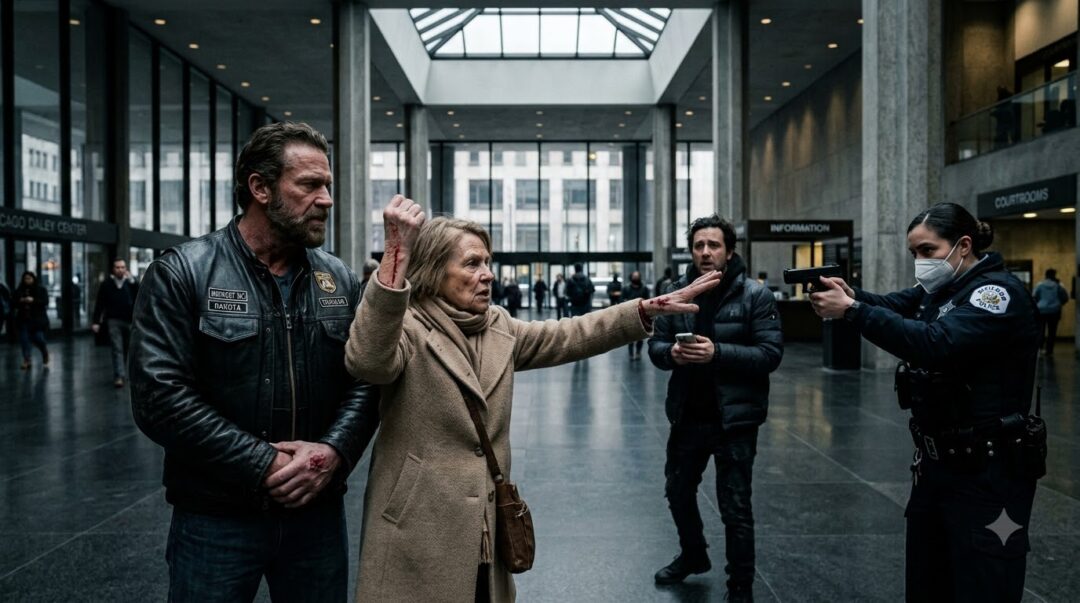
“You! In the leather vest!” Officer Miller roared, leveling his taser toward Jax’s chest. “Drop that purse and put your hands on your head right now! Don’t move an inch!”
Jax didn’t drop the bag. He stood slowly to his full, imposing height on the steel steps, his scarred, bearded face completely calm, his gray eyes locking onto the approaching officer with the unyielding authority of an old soldier who refused to be framed.
Beside him, Evelyn Ross struggled to her feet on trembling legs, ignoring the blood dripping from her bandaged wrist, her eyes blazing with a fury that stunned the entire concourse.
“Officer, lower that weapon!” Evelyn shouted, stepping between Jax’s chest and the police taser. “This man saved my life! That coward with the telephone is the one who pushed me—because he works for Alderman Sterling, and this purse contains thirty million dollars in stolen municipal pension files!”
CHAPTER 2: THE CONCOURSE STANDOFF
The cavernous lobby of the Daley Center seemed to draw in a collective, horrified breath. The morning commuters, numbering over two hundred people huddled between the massive fluted granite pillars, stopped dead in their tracks. Cell phones were raised in every direction, their camera lenses gleaming like tiny glass eyes under the towering glass skylights.
Officer Miller froze, his taser still leveled, but his eyes darted from the bleeding elderly woman in the woolen coat to the smug, well-dressed man holding the smartphone. Miller was a seven-year veteran of the 1st District; he knew every crooked bailiff, every municipal bagman, and every street hustler in the Loop. And he recognized Evelyn Ross.
“Mrs. Ross?” Miller asked, his voice dropping into stunned disbelief. “You’re… you’re Chief Auditor Ross from the city comptroller’s office?”
“I was the chief auditor until Alderman Sterling had my office locked out three weeks ago,” Evelyn said, her voice ringing clear and hard through the high marble atrium. She held up her right arm, the bloody bandana pressed against her torn flesh. “Look at my wrist, Officer Miller! That comb plate would have pulled my hand into the drive gears if this gentleman hadn’t snapped that two-inch leather strap with his bare hands! Do you think an outlaw biker would risk losing his own fingers in an escalator mechanism just to steal an old woman’s lipstick?”
Jax Callahan stood like an iron pillar beside her, the severed leather handbag resting calmly against his hip. He looked at Officer Miller, then turned his gaze toward Greg Finch, who was slowly backing away toward the revolving glass doors leading to Washington Street.
“Officer,” Jax rumbled, his deep baritone carrying the easy, dangerous weight of absolute command. “You might want to secure that civilian with the phone before he walks out into the traffic. His camera was rolling five seconds before the strap even touched the comb plate. In my line of work, we call that premeditated ambush recording.”
Finch’s smirk completely evaporated. His face drained of color as fifty commuters turned their heads to glare at him with sudden, hostile understanding.
“She’s senile! She’s making it up!” Finch yelled, his voice cracking with high-strung panic as he shoved through the crowd toward the street exit. “I’m a licensed investigative journalist with the Civic Reform Project! You have no legal right to detain me!”
“Hold it right there, Finch!” Officer Miller barked, reholstering his taser and reaching for his handcuffs as he sprinted across the granite floor. “Stop where you are!”
Before Miller could cross the twenty yards of open marble, the heavy overhead fluorescent chandeliers in the Daley Center concourse abruptly flickered twice and died with a sickening, mechanical groan.
A heavy darkness crashed down upon the underground terminal, illuminated only by the pale, gray daylight filtering through the high clerestory windows thirty feet above.
CLANG-CLANG-CLANG.
Across every exit corridor leading to the Blue Line and Red Line subway platforms, heavy steel security grilles dropped from the ceiling with concussive, deafening crashes, severing the concourse from the public transit grid. The automated building alert sirens began pulsing with a rhythmic, high-intensity electronic wail:
“Emergency lockdown initiated. Facility closed by administrative order. All occupants remain in designated sectors.”
Through the revolving glass doors on Washington Street, three unmarked black Chevrolet Tahoes with tinted windows and commercial black push-bumpers screeched to a halt at the curb, their high-intensity strobe bars flashing tactical yellow and amber.
Six men in black tactical windbreakers, ballistic vests, and Kevlar helmets emerged from the vehicles. They weren’t Chicago police officers. They wore the embroidered shoulder patches of Sterling Corporate Security Solutions, and they carried semi-automatic carbines fitted with high-capacity magazines held at the low ready.
“They’re cutting off the building,” Evelyn whispered, her fingernails digging into Jax’s leather sleeve as terror finally cracked her composure. “Sterling’s private contractors… they’re not here to arrest me, Jax. They’re here to recover the master cryptographic drive before the federal magistrate convenes on the fourteenth floor.”
Jax caught Evelyn by the waist, smoothly lifting her off the escalator steps onto the landing, shielding her behind a five-foot granite pillar.
“Officer Miller!” Jax called out across the dim concourse. “Your radio working?”
Miller pulled his Motorola radio from his chest rig, clicking the push-to-talk switch. Nothing came through except high-frequency white noise and synthetic static.
“It’s jammed,” Miller said, his face pale as he backed toward Jax’s pillar with his Glock unholstered. “They deployed an industrial radio frequency blocker on the street. Who the hell are those guys with the carbines?”
“They’re a private execution squad with city hall badges,” Jax replied coldly, reaching inside his leather cut to unclip an eight-inch heavy steel pry bar from his biker kit.
He looked down at Evelyn. “Mrs. Ross, you spent forty years auditing this building. Where do the freight passages lead?”
Evelyn’s slate-gray eyes flashed with fierce, desperate intelligence. She pointed toward a narrow, unmarked stainless steel door recessed into the granite wall behind the escalator motor housing.
“The 1906 Chicago Freight Tunnel System,” Evelyn whispered. “Sixty miles of abandoned coal tunnels beneath the Loop. It connects the Daley Center sub-basement directly to the basement vault of the Federal Dirksen Courthouse on Dearborn Street.”
Behind them, the glass revolving doors on Washington Street shattered inward in a shower of crystalline shards as the six tactical contractors breached the building, their weapon lights cutting through the darkness like laser scalpels.
CHAPTER 3: THE SUBTERRANEAN MAZE
The sound of shattering architectural glass echoed through the granite concourse like a detonation, followed immediately by the sharp, authoritative bark of combat boots hitting marble. The six tactical contractors moved in a tight two-element wedge, their fifty-millimeter weapon lights casting blinding cones of white illumination through the darkness, illuminating the terrified commuters who huddled along the walls with their hands covering their heads.
“Clear the floor!” the lead contractor roared, his voice filtered through a tactical throat microphone. “Target is a female, seventy-two, accompanied by a heavy male in motorcycle gang colors! Shoot to neutralize resistance!”
Officer Miller raised his service Glock, leaning out from behind the granite pillar to fire a warning shot, but Jax’s heavy hand clamped over the policeman’s wrist like an iron clamp.
“Don’t engage, Miller,” Jax murmured, his voice ice-cold and steady. “They have Level IV body armor and submachine guns. You’ve got sixteen rounds of nine-millimeter and a polyester shirt. You’d be dead before your brass hit the tile.”
Jax jammed his steel pry bar into the seam of the stainless steel maintenance door behind the escalator housing. He threw his two-hundred-and-forty-pound weight into the leverage, the heavy commercial latch shearing with a sharp acoustic pop.
The door swung inward, revealing a steep, unlit spiral staircase of rusted diamond-plate steel winding down into the black subterranean depths beneath the Chicago Loop.
“Down! Move!” Jax ordered.
Miller took point, his weapon light cutting a narrow path down the rusted iron steps, with Evelyn supported between them. Jax brought up the rear, pulling the heavy steel door shut behind them and jamming the severed pry bar through the interior handle to form an improvised deadbolt.
They spiraled down four levels, descending eighty feet below the street grade into the humid, cold gloom of the old Chicago freight tunnel network.
The cold dampness of the subterranean corridor seeped through Jax’s heavy leather boots, the constant drip of condensation from the overhead water pipes creating a rhythmic, hollow cadence against the concrete floor. Evelyn walked with a quiet, determined resilience that commanded immediate respect; despite her injured, bleeding arm and the seventy-two years that weighed upon her frame, her steps never faltered. She had spent a career tracking ledger entries through the labyrinth of Cook County politics, and down here in the dark, she knew that truth was the only weapon strong enough to pierce Alderman Sterling’s corporate armor. Jax kept his broad back positioned between her and the shadows behind them, his senses tuned to the subtle acoustic reverberations of the underground network.
The tunnel was a six-foot horseshoe-shaped tube of poured concrete, originally built in the early 1900s to haul coal and ash between downtown department stores. The narrow-gauge railroad tracks still ran down the center of the damp floor, flanked by dripping overhead water pipes, bundled telecommunications conduits, and forty years of accumulated industrial grime. The air smelled of damp earth, stagnant river water, and the pungent ozone of high-voltage subway cables hummed through the concrete walls fifty yards away.
Evelyn leaned against the curved concrete wall, her breathing ragged, her hand trembling as she held the torn leather handbag against her ribs.
“Here,” she whispered, opening the brass twist-lock on the purse’s bottom compartment.
From the reinforced Kevlar lining, she extracted a military-grade titanium USB drive stamped with the official seal of the United States Department of the Treasury. Attached to the drive by a braided lanyard was a small, high-density optical storage disc.
“This is the master ledger,” Evelyn said, holding the drive out to Jax. “Alderman Thomas Sterling didn’t just steal from the police and fire pension funds. He established seven fake offshore development accounts in the Cayman Islands to finance private real estate towers along the Chicago River. Over three hundred million dollars was siphoned through dummy infrastructure grants. My partner, David Vance, found the digital paper trail three months ago. They pushed David off the platform at the Monroe subway station and called it a suicide.”
Miller stared at the titanium drive, his jaw working silently in horror. “David Vance was my uncle. They told our family he had clinical depression.”
“Your uncle was a hero who died trying to save the pensions of thirty thousand city workers,” Evelyn said softly, her hand touching Miller’s shoulder. “And if this drive reaches Federal Judge Margaret Caldwell in the Dirksen Building by nine o’clock, the United States Marshals Service will seize Sterling’s offshore assets before he can wire them to Switzerland.”
A heavy metallic boom echoed down the spiral shaft behind them.
Jax looked up into the darkness. The steel maintenance door four floors above was shuddering under the concussive blows of an industrial hydraulic breaching tool. Sparks cascaded down the iron spiral, followed by the muffled hiss of a thermal cutting torch burning through the deadbolt.
“They’re through the first door,” Jax said, his voice dropping into that quiet, lethal battle register. “They’ll be down this shaft in ninety seconds.”
Jax reached into his leather vest, pulled out a small, rugged handheld frequency-hopping radio, and clicked the transmission toggle three times in rapid succession: click-click… click.
“Tank, this is Ironclad,” Jax spoke into the microphone, his baritone vibrating off the curved concrete ribs of the tunnel. “We are in the freight tunnel beneath Sector Four. We have the principal and the package. Initiate Operation Shield-Wall on Dearborn Street right now.”
Through the radio speaker, muffled by eighty feet of solid granite, came the distant, tectonic roar of fifty heavy American V-twin engines firing simultaneously into life on the street above.
CHAPTER 4: THE IRON CROSS VANGUARD
The subterranean concrete tunnel trembled beneath their feet, not from the rumble of the subway trains, but from the immense, synchronized seismic roar of fifty heavy motorcycles idling on the wet asphalt of Dearborn Street, eighty feet above their heads.
“The club is in position at the freight elevator entrance on Adams,” Jax said, his hand guiding Evelyn along the narrow railroad ties. “Miller, keep your eyes on the overhead utility lines. The tunnel splits into a three-way junction two hundred yards ahead. The left tube leads to the federal basement; the right tube leads to the old river intake.”
Behind them, the darkness of the tunnel was suddenly fractured by two brilliant, piercing beams of white light.
The tactical contractors had breached the bottom of the spiral staircase. Their rubber combat boots splashed through the shallow puddles of mineral water on the concrete floor, their weapon-mounted lasers drawing tight green lines through the dripping haze.
“There they are! Track Two!” a contractor’s voice echoed through the tube. “Open fire!”
A three-round burst of suppressed carbine fire chewed into the concrete wall above Jax’s head, sending high-velocity shards of stone and cement dust raining down onto his shoulders.
“Run!” Jax roared, scooping Evelyn into his massive left arm as if she were a child, keeping his broad body between the elderly woman and the incoming gunfire.
Miller turned, raised his service Glock with both hands, and fired four rapid rounds down the tunnel. The concussive muzzle blasts in the enclosed concrete tube sounded like cannon fire, the muzzle flashes briefly blinding the contractors and driving them to take cover behind an antique cast-iron electrical junction box.
Jax sprinted down the narrow track, his heavy combat boots eating the railroad ties, until they reached the massive, rusted iron freight elevator cage at the Adams Street junction.
The elevator was a six-ton industrial platform, suspended by four thick braided steel cables that rose through a vertical brick shaft straight up into the rear alleyway of the Dirksen Federal Building. On the control stanchion, a heavy iron throw-lever was secured with an antique padlocked brass chain.
Jax didn’t waste time looking for a key. He wrapped his leather-gloved hands around the brass lock body, planted his boots against the steel cage frame, and wrenched the padlock with a savage, twisting heave of his shoulders.
The rusted iron hasp sheared with a sharp acoustic crack. Jax hauled the heavy lever into the UP position.
With a shuddering groan that rattled the brick shaft, the massive electric hoist motor in the penthouse above engaged. The counterweight cables twanged under sudden tension, and the heavy iron cage began its slow, grinding ascent toward the surface at three feet per second.
“Get on the platform!” Jax yelled, shoving Miller and Evelyn through the iron sliding gate.
From the dark tunnel behind them, Greg Finch emerged into the lantern light, his face twisted in desperate, homicidal fury. In his right hand, Finch held a suppressed semi-automatic pistol he had taken from the contractor’s weapons cache.
“Drop the drive, you old bitch!” Finch screamed, leveling the weapon at Evelyn’s chest as the elevator platform rose past the four-foot mark. “Sterling will pay me five hundred thousand dollars for that disc! Nobody leaves this shaft alive!”
Finch squeezed the trigger.
Officer Miller dove across the open gate, his body taking the impact of the round squarely in his Kevlar vest. The kinetic shock drove the breath from Miller’s lungs, knocking him onto his back on the diamond-plate floor, but his duty vest held the bullet.
Before Finch could fire a second shot, Jax leaned over the rising steel sill of the elevator cage.
His massive, tattooed right hand shot out like an iron piston, clamping around Finch’s throat with the force of a hydraulic clamp. Jax hoisted the one-hundred-and-sixty-pound operative clean off his feet, dangling him over the open sixty-foot drop of the elevator pit.
Finch gasped, his eyes bulging in sheer terror, his fingers clawing uselessly at Jax’s leather sleeve as the pistol slipped from his paralyzed fingers, clattering into the dark water below.
“You like filming people, Finch?” Jax growled, his face inches from the trembling operative. “Take a picture of the bottom.”
Jax shoved Finch backward onto the safe concrete platform of the tunnel floor, kicking the elevator’s heavy lower iron safety gate shut with a resounding clang.
The air inside the vertical brick shaft was freezing, smelling of wet soot, vintage grease, and the crisp winter draft blowing from the alley above. As the platform rose smoothly along its heavy steel guide rails, Evelyn clutched her handbag to her breast, her eyes fixed on the square of gray daylight expanding above their heads. Officer Miller reloaded his duty weapon with steady, methodical precision, his hands no longer shaking. Facing down armed mercenaries in the dark had burned away any remaining hesitation; he was no longer just an officer responding to a disturbance—he was a witness standing guard over the lifeblood of thirty thousand working families.
The elevator cage surged upward into the brick shaft, rising past the basement levels toward the daylight of the Loop.
As the platform cleared the ground floor threshold, the steel doors opened onto the cold, rain-swept alleyway behind the Federal Building.
Standing in the freezing December drizzle, forming an impenetrable, four-row defensive perimeter of chrome and leather, were fifty members of the Chicago Iron Cross Motorcycle Club. Their heavy cruisers were angled toward the alley entrances, their engines revving until the brick walls trembled, their arms crossed over their cuts like an army of iron guardians.
At the head of the formation stood Tank, holding an extra full-face helmet and a heavy canvas club jacket.
“Package is secured!” Tank roared over the thunder of fifty V-twins. “Form the diamond! We take the front plaza!”
CHAPTER 5: THE LOOP CONVOY
The cold rain over downtown Chicago had turned into an icy winter sleet, coating the black asphalt of Dearborn Street in a treacherous, reflective sheen. The wind coming off the river whipped through the concrete canyons of the Loop at forty miles an hour, howling between the towering granite facades of the financial district.
The iron cage of the freight elevator locked into the alleyway deck with a concussive metallic thud.
Tank stepped forward immediately, his massive six-foot-four frame sheltering Evelyn as she stepped off the platform. Within three seconds, the veteran road captain had wrapped a heavy sheepskin-lined club jacket around her frail shoulders, guiding her into the enclosed, heated passenger cab of Jax’s custom three-wheeled Harley trike.
Officer Miller leaned against the iron gate, clutching his bruised chest where the contractor’s bullet had flattened against his Kevlar vest, his breath coming in ragged gasps of adrenaline.
“You hit, Miller?” Jax asked, strapping on his heavy leather gauntlets.
“Vest took it,” Miller wheezed, managing a grim, defiant grin as he adjusted his duty belt. “Cracked a couple of ribs, but I’m walking. Let’s go see the judge.”
“Climb on Tank’s rear saddle,” Jax commanded. “We have three blocks to the front ceremonial portico of the Dirksen Building. Sterling’s private security will try to ram us at the Adams intersection.”
Jax swung his leg over his heavy trike, hit the starter button, and the 120-cubic-inch engine erupted with a deafening, chest-thumping roar.
The fifty motorcycles of the Iron Cross deployed into an escort formation that had been perfected across four decades of road warfare: a tight, rolling wedge with Jax’s trike at the absolute center, shielded on all four sides by lines of interlocking chrome and heavy steerhide.
The motorcade burst out of the alleyway onto Dearborn Street, tires spraying roosts of cold road slush across the sidewalks.
Ahead, at the intersection of Dearborn and Adams, Alderman Thomas Sterling’s counter-strike was waiting.
Two heavy commercial municipal salt trucks—twenty-ton orange steel behemoths with ten-foot hydraulic steel snowplow blades—had been positioned across the intersection, their diesel engines revving, black exhaust billowing into the gray sky. Flanking the salt trucks were three black armored Suburbans belonging to Sterling Security, their high-beam halogens pinning the approaching motorcycles in a blinding crossfire of light.
Inside the passenger seat of the lead salt truck sat Alderman Thomas Sterling himself, holding a city radio handset, his face purple with homicidal fury.
“Crush them!” Sterling screamed into the radio. “Drop the plows and drive straight through the formation! I don’t care if you kill twenty of them—get that leather bag!”
The two massive twenty-ton trucks dropped their heavy steel plows with an ear-splitting screech of scraping metal against asphalt, accelerating directly toward the motorcycle wedge.
“Break formation!” Jax bellowed into his radio helmet. “Flankers take the sidewalks! Tank, lead the decoy line down Monroe! Trike maintains centerline!”
The fifty motorcycles split with surgical precision.
Thirty bikes veered up onto the broad pedestrian sidewalks, their tires hopping the curbs with effortless agility, swarming around the blind spots of the massive snowplows like a pack of wolves encircling two lumbering mammoths.
As the lead salt truck bore down on Jax’s trike, Tank accelerated his heavy cruiser down the center lane, unclipped a five-pound military smoke canister from his sissy bar, pulled the pin with his teeth, and hurled it through the open intake vent of the salt truck’s radiator.
FWOOSH.
A dense, blinding cloud of thick crimson smoke erupted from the truck’s grille, completely blinding the driver’s windshield. The driver panicked, slamming on his air brakes, the twenty-ton truck fish-tailing across the icy asphalt and jackknifing violently into the second salt truck with a catastrophic crunch of twisted steel and shattered safety glass.
Jax threaded the trike through the six-foot opening between the crumpled bumpers with less than four inches of clearance, accelerating onto the open plaza of the Dirksen Federal Building.
Behind them, the three armored Suburbans attempted to give chase, but twenty Iron Cross riders swarmed the vehicles, executing high-speed flanking maneuvers that boxed the SUVs against the concrete planter boxes of Federal Plaza, their heavy iron chains slashing tires and disabling steering links.
Jax brought his trike to a screeching halt at the foot of the Dirksen Building’s monumental bronze entrance.
Standing on the top landing of the plaza steps, beneath the towering red steel canopy of Alexander Calder’s Flamingo sculpture, were twenty armed United States Marshals in tactical gear, their carbines at the high-ready, backed by Chief Federal Judge Margaret Caldwell herself, who had descended from her chambers in her black judicial robes.
Beside Judge Caldwell stood the United States Attorney for the Northern District of Illinois, holding an open federal case folio.
Jax killed his engine, stepped off the trike, and extended his hand to help Evelyn Ross down onto the granite steps.
“Chief Auditor Ross,” Judge Caldwell called out, her voice cutting through the wail of distant city sirens. “The court is in emergency session. Do you have the evidence?”
Evelyn walked up the granite steps, her head held high, holding the severed leather purse and the titanium cryptographic drive in her hands like a victorious general bearing the enemy’s battle flag.
Before she could take the final three steps, the driver’s door of the crippled salt truck fifty yards back burst open.
Alderman Thomas Sterling staggered onto the plaza, his bespoke Italian overcoat spattered with diesel soot, a snub-nosed .38 revolver clutched in his trembling hand as he aimed the barrel directly at Evelyn’s heart.
CHAPTER 6: THE DIRKSEN PLAZA BREACH
The cold winter air over Federal Plaza seemed to solidify into ice.
Fifty yards away, standing beneath the colossal red curve of the Calder sculpture, Alderman Thomas Sterling looked like a ruined monarch standing in the ashes of his own kingdom. At fifty-six, with his silver hair wild in the freezing wind and his silk tie shredded, the most powerful political boss in Cook County was screaming curses that echoed off the fifty-story glass facade of the Dirksen Building.
“You don’t take my life’s work, Evelyn!” Sterling shrieked, his finger tightening on the trigger of the snub-nosed revolver. “I built this city! Every road, every bridge, every tower belongs to me!”
Before Sterling could align his sights, Jax Callahan moved.
He didn’t draw a gun. He grabbed a heavy, three-foot solid steel motorcycle torque wrench from the sidecar’s exterior mounting bracket, stepped into the open line of fire between Sterling and Evelyn, and hurled the five-pound iron tool with the devastating velocity of an Olympic javelin thrower.
The heavy steel wrench cut through the freezing drizzle with a high-pitched metallic whistle.
It struck Sterling’s right wrist with bone-shattering force.
CRACK.
The revolver flew from Sterling’s hand, clattering harmlessly across the wet granite plaza, while the corrupt alderman shrieked in agony, collapsing to his knees on the freezing concrete while clutching his broken arm to his chest.
Within three seconds, four federal marshals swarmed over Sterling, driving him flat onto the granite, ratcheting heavy steel cuffs over his wrists with crisp, unforgiving clicks.
“Alderman Thomas Sterling,” Chief Deputy Marshal Marcus Kane announced, pressing his knee into the fallen politician’s back. “You are under federal arrest for racketeering, embezzlement of federal public funds, and solicitation of capital murder.”
On the upper landing of the portico, Judge Margaret Caldwell didn’t flinch. She watched the arrest with the cold, impassive majesty of federal justice, then turned her gaze to Evelyn Ross.
“Step inside, Mrs. Ross,” Judge Caldwell said, motioning toward the bronze double doors. “The courtroom is open, the forensic analysts are standing by, and your testimony will be recorded under federal seal.”
Evelyn turned to look at Jax. The towering biker stood at the foot of the steps, his leather cut glistening with freezing sleet, his knuckles scarred, his face calm and unreadable.
She reached out, taking his massive, calloused hand between her small, trembling fingers.
“You risked everything for a woman you didn’t even know, Jax,” she whispered, her voice rich with an emotion that brought tears to the eyes of the marshals standing guard. “Why?”
Jax looked down at her, a faint, gentle crease softening his hardened features.
“My father was a Chicago firefighter for thirty-five years, Mrs. Ross,” Jax murmured softly. “When he died of lung cancer ten years ago, his city pension was the only thing that kept my mother in her home. People who steal from working families aren’t politicians—they’re predators. And outlaws don’t let predators hunt on our watch.”
Jax turned back toward the fifty Iron Cross riders who held the plaza perimeter, their engines idling in a low, respectful rumble.
“We’ll be right here on the steps until you walk back out, Evelyn,” Jax said. “Take your time.”
Evelyn nodded, straightened her wool coat, and walked through the heavy bronze doors into the warmth of the federal courthouse, accompanied by Officer Miller and the United States Attorney.
Inside Courtroom 2503, the proceedings moved with surgical, devastating speed.
The titanium drive was connected to the court’s forensic terminal, projecting the financial records onto three twelve-foot digital display screens. Line by line, transaction by transaction, the grand jury watched twelve years of systematic embezzlement unfold: thirty-two million dollars transferred through shell entities to purchase private yachts, luxury penthouses, and political bribes.
Beside the financial ledgers was an encrypted audio file: Alderman Sterling’s voice, recorded forty-eight hours earlier, instructing Finch to ensure that Evelyn Ross suffered a fatal “pedestrian accident” before she could reach the federal building.
When the final audio recording ended, the grand jury room was silent as a tomb.
Judge Caldwell looked down at the United States Attorney. “Issue immediate federal seizure warrants for all domestic and offshore accounts linked to the Sterling Trust. Every dollar will be restored to the municipal pension reserves with twenty percent statutory interest.”
Two hours later, the heavy bronze doors of the Dirksen Building swung open once more.
The winter storm had finally passed, leaving the Chicago sky washed in a pale, crisp afternoon blue.
Evelyn Ross walked out onto the granite portico, leaning lightly on Officer Miller’s arm. Her bandaged wrist was tucked into her coat, but her face was radiant with a triumphant peace that decades of struggle could not diminish.
At the foot of the steps, fifty motorcycles sat waiting.
As Evelyn descended the staircase, Jax Callahan stepped forward, removed his club’s heavy silver medallion—the Iron Cross of Honor—and placed it gently around her neck.
“Honorary road captain, Evelyn,” Jax smiled. “Any time you need an escort across this city, you just call the clubhouse.”
Evelyn touched the heavy silver cross, looking up at the fifty leather-clad men who had stood as her iron shield against an empire of corruption.
“I don’t need to call, Jax,” she said, her voice carrying across the sunny plaza. “I know the Iron Cross is always watching the road.”
Jax swung his leg over his custom trike, kicked the starter into gear, and raised his right fist into the cold Chicago air.
Fifty engines roared to life in an earth-shaking, glorious symphony of unmuffled American thunder, escorting Evelyn Ross home through the streets of a redeemed city under the wide Midwestern sky.
CHAPTER 7: THE MASTER AUDITOR’S VICTORY
The winter sun stood high over the Chicago River, casting long, sharp shadows across the limestone bridges and the glassy facades of Wacker Drive. Outside the Dirksen Federal Building, the crowd of city workers, retired union members, and transit employees had swollen into the hundreds, their voices rising in an ecstatic, deafening roar as the news flashed across every news terminal in North America:
ALDERMAN THOMAS STERLING INDICTED ON 48 FEDERAL COUNTS; $320 MILLION IN PENSION FUNDS RESTORED BY EMERGENCY JUDICIAL DECREE.
Evelyn Ross stood on the upper landing of the Dirksen plaza, surrounded by the men and women whose livelihoods she had defended with her life. Beside her stood Officer Miller, his uniform torn but his gold star badge polished to a brilliant shine, his arm slung protectively around his aunt, who had rushed down from the Loop upon hearing the news.
Down on the granite pavement, Jax Callahan and the fifty riders of the Chicago Iron Cross MC sat upon their machines, their exhaust pipes rumbling in a low, victorious idle that vibrated through the foundation of the federal building.
Chief Federal Judge Margaret Caldwell walked down the ceremonial staircase, accompanied by two armed federal marshals carrying a sealed velvet presentation folio. She stopped directly in front of Jax’s idling trike, her sharp judicial eyes assessing the scarred, leather-clad outlaw with profound, unyielding respect.
“Mr. Callahan,” Judge Caldwell said, her voice clear and authoritative over the engine rumble. “In thirty years on the federal bench, I have seen men in million-dollar suits commit the most cowardly acts of treason against this republic. And today, I saw an outlaw biker stand as the finest embodiment of civic courage this city has witnessed in half a century.”
Judge Caldwell opened the leather folio, presenting Jax with an official United States District Court Commendation of Valor and a certified Order of Judicial Protection, conferring permanent federal immunity on the Iron Cross Veterans Outreach Center.
“The City of Chicago has tried to seize your clubhouse for municipal redevelopment three times,” Judge Caldwell continued, a faint, rare smile touching her lips. “This federal order declares your property a permanent historic veteran sanctuary under federal conservatorship. No city marshal, no alderman, and no tax collector will ever set foot on your land again without a warrant signed by my hand.”
The crowd on Federal Plaza erupted into a thunderous standing ovation, hundreds of union machinists, teachers, and firefighters cheering and throwing their hats into the winter air, while the fifty bikers hammered their heavy leather fists against their gas tanks in a rhythmic, booming salute.
The cold December air was crisp and clean, carrying the distant scent of roasted chestnuts from the holiday markets on State Street and the deep, reassuring chime of church bells echoing across the Loop. Standing on the granite steps, Evelyn felt a profound, golden warmth spread through her chest that had nothing to do with the winter sun. For five long years, she had lived with the constant, crushing fear that her partner’s death would remain unavenged, that the stolen millions would vanish into offshore bank accounts, and that the city she loved would remain in the grip of ruthless predators. But today, the heavy hand of justice had fallen, delivered not by men in tailored suits, but by an unyielding brotherhood of outlaws who knew the sacred value of an honest name.
Evelyn walked down the final three granite steps, coming to stand beside Jax’s machine. She reached up with both hands, taking Jax’s calloused, oil-stained fingers into her own.
“Your father would have been proud today, Jax,” Evelyn murmured softly, tears of pure joy glistening in her eyes. “He didn’t just leave you a motorcycle. He left you an unyielding soul.”
Jax looked down at the seventy-two-year-old grandmother, feeling the cold weight of the silver medallion resting against her woolen coat.
“He taught me that the only thing worth fighting for is the people who can’t fight for themselves,” Jax said softly. “You showed this whole town what true courage looks like, Evelyn.”
He reached into his saddlebag, pulled out an extra set of brass keys, and pressed them into Evelyn’s palm.
“Those belong to the private executive suite on the top floor of the clubhouse,” Jax said. “It’s got a fireplace, a library, and twenty-four-hour security. Whenever the city gets too loud, that room is yours.”
Evelyn smiled through her tears, closing her fingers tight around the brass keys. “I might just take you up on that, Captain.”
Jax lowered his aviator shades against the bright winter sun, pulled his heavy leather gauntlets over his wrists, and clicked the trike’s transmission into first gear with a solid, satisfying clunk.
He raised his right arm high into the clear blue sky, forming the sign of the Iron Cross.
Fifty heavy American V-twin engines roared to life in an earth-shaking, synchronized crescendo of raw horsepower and open exhaust pipes. The sound rolled down Dearborn Street, echoing off the marble canyons of the Loop like triumphant battle horns, parting the cheering crowds as the iron motorcade began its victory lap through the heart of Chicago.
Evelyn stood on the steps beside Officer Miller, clutching the silver cross against her heart, watching the great convoy roll away toward the lakefront, knowing that the working men and women of Chicago would never walk alone as long as the iron brothers rode the road.