The Cemetery Stand: The Scarred Veteran Who Redeemed A Fallen Soldier’s Honor
CHAPTER 1: THE ACCUSATION IN THE MIST
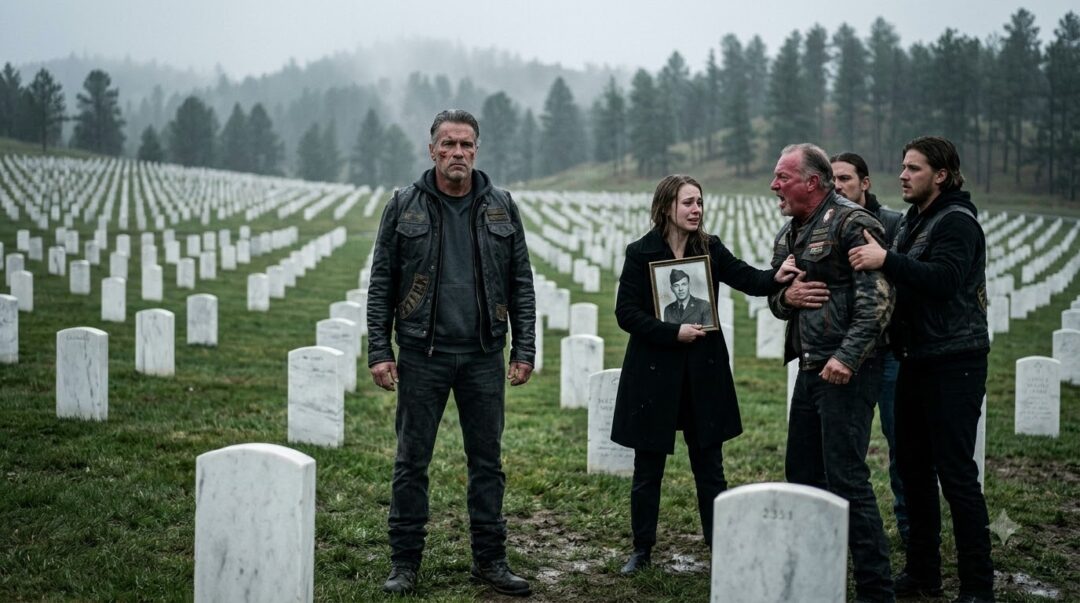
The freezing mountain fog of the Black Hills rolled down from the ponderosa pine ridges over Meade County, South Dakota, draping the limestone knolls of the Black Hills National Cemetery in a heavy, pewter-colored blanket of cold mist. At ten in the morning, five miles south of Sturgis, the cemetery was an endless, geometric sea of white marble military headstones rising from the damp autumn turf, perfectly aligned like regiments of fallen soldiers standing their eternal watch.
Today was the twentieth anniversary of the battle of Hill 402 in the Korengal Valley, and over one hundred people had gathered beneath the solemn black granite memorial arch. There were decorated Army Ranger veterans in dark overcoats, local gold-star families holding damp bouquets of chrysanthemums, and two long rows of heavy black motorcycles parked along the paved perimeter roadway.
Standing at the edge of the crowd, fifty feet from the ceremonial lectern, was Wade “Nomad” Garrison.
At fifty-two, Garrison was a solitary, formidable figure. His salt-and-pepper beard was trimmed close along a scarred jawline that bore the unmistakable jagged seam of an AK-47 shrapnel wound. Beneath his weathered black leather cut—which displayed the bronze Ranger tab and three combat jump stars—his left knee was reinforced with an external titanium medical brace that gave his slow, deliberate steps a distinct metallic click. In his scarred hands, Garrison held a single bouquet of yellow wild roses, his eyes fixed on the marble headstone marking the grave of Master Sergeant Caleb Sterling.
Garrison had taken two steps toward the grave when the heavy gravel beneath the pine trees crunched with violent, aggressive haste.
“GET YOUR HANDS OFF THAT ROSE, GARRISON!”
The shout shattered the sacred silence of the memorial ground like a rifle shot.
Vance Kelly tore through the crowd of mourners, his face purple with grief and thirty years of venomous, unhealed fury. At fifty-eight, Kelly was a burly, barrel-chested powerhouse—the president of the Iron Plains Motorcycle Club and Caleb Sterling’s older brother. He wore a patched denim cut heavy with club rockers, his fists clenched tight as sledgehammers at his sides.
Kelly shoved his way past two startled veteran honor guards, coming to a halt six inches from Garrison’s chest. He stabbed a thick, calloused index finger violently into Garrison’s leather lapel, shoving the scarred veteran back half a step.
“You have no right to stand on this holy grass, you coward!” Kelly roared, his voice cracking with a raw, agonizing rage that turned the heads of every mourner in the cemetery. “My brother Caleb died in that burning Afghan ditch while you crawled out of the valley! You took your medals, you took your government pension, and you let the Pentagon brand Caleb as the man who blew up his own mortar crew! You stole my brother’s honor, and you have the nerve to bring your dirty face to his funeral?”
Garrison didn’t raise his fists. His gray eyes, deep and hollow with thirty years of buried sorrow, looked into Kelly’s contorted face without anger.
“Vance,” Garrison rumbled, his voice low as granite grinding against granite. “I made a promise to Caleb in that trench. I swore I’d be here on the twentieth year. I’m not leaving until I lay these roses on his stone.”
“You lay those weeds on my brother’s stone and I’ll beat you into the dirt where you belong!” Kelly shouted, drawing back his right fist, his knuckles whitening, his entire two-hundred-and-sixty-pound frame shaking with homicidal intent.
Two younger Iron Plains riders moved to restrain their president, while several older Rangers in the crowd gasped, stepping forward to intervene.
Before Kelly’s fist could fly, a clear, ringing voice sliced through the misty cemetery air like a silver bell.
“STOP IT! UNCLE VANCE, STOP IT RIGHT NOW!”
The mourners parted. Rushing down the grassy slope between the white headstones, her dark woolen coat fluttering in the mountain wind, was twenty-four-year-old Maya Sterling.
She was Caleb Sterling’s only child—slender, with her father’s determined jaw and dark, piercing eyes. Her face was pale and wet with tears, but her hands were steady as stone as she stepped directly between the two massive, leather-clad men, planting herself firmly in the path of her uncle’s fist.
“Step aside, Maya!” Kelly choked, tears of rage blurring his eyes. “You were four years old when your daddy came home in a zinc box! You don’t know what this bastard did to him!”
“I know exactly what happened, Uncle Vance,” Maya said, her voice trembling with fierce, righteous power that silenced the entire cemetery. “Because my father didn’t die of soldier error. And Wade Garrison never ran.”
Maya reached into her coat, pulling out an antique silver picture frame sealed in a waterproof transparent document pouch. She held the frame up before Vance Kelly’s face, turning it so every veteran and biker in the front row could see the photograph inside.
It was an authentic, battered 35mm battlefield photograph, taken on Hill 402 twenty minutes before the final explosion.
In the frame, Master Sergeant Caleb Sterling sat in a sandbagged mortar trench, his arm slung around a bloodied, twenty-two-year-old Wade Garrison whose left leg was mangled and wrapped in a field tourniquet. Caleb was laughing defiantly under a scorching sun, but directly behind his right shoulder sat a stack of olive-drab crates containing 120mm mortar rounds.
On the wooden crate lid, stamped in crisp yellow military stencil, was the serial number and manufacturer’s logo: VANCE TACTICAL MUNITIONS – LOT 88-ALPHA – APPROVED FOR COMBAT EXPORT.
Vance Kelly’s breath hitched in his throat. His raised fist slowly sank to his side, his eyes widening in stunned disbelief as he stared at the corporate logo.
“Donald Vance…” Kelly whispered, the color draining from his face. “The billionaire defense contractor… our second cousin.”
“Donald Vance supplied seventy thousand defective mortar shells with hairline casting flaws in their brass baseplates to the Army,” Maya wept, her fingers tracing the edge of the frame. “When the mortar tube exploded on Hill 402, it wasn’t because my father misfired the round. The shell detonated inside the barrel because Donald Vance skimmed twelve million dollars off the manufacturing alloy! And my father took three bullets from the Taliban counter-attack pushing Wade into the ammunition bunker to save this evidence!”
Maya flipped the silver frame over.
Taped to the reverse side of the photograph was a bloodstained handwritten casualty manifest, stamped with Caleb Sterling’s dying fingerprint in dark crimson blood, accompanied by an encrypted Department of Defense whistleblower code: DOD-IG / CLASSIFIED FILE 0092.
A heavy silence descended upon the cemetery, broken only by the cold wind sighing through the pines.
Down on the cemetery access road, three black unmarked Chevrolet Suburbans with tinted windows suddenly pulled through the wrought-iron memorial gates, their heavy engines idling with predatory intent as six armed men in tactical overcoats stepped onto the gravel.
CHAPTER 2: THE TRUTH OF HILL 402
The cold wind coming off the Black Hills whipped the pine branches, sending showers of freezing water droplets cascading across the white marble headstones. Behind Maya Sterling, the crowd of fifty veterans stood in frozen, absolute shock, their eyes shifting from the bloodstained battlefield photograph to the three black Suburbans parked along the cemetery road.
Vance Kelly stood motionless, his heavy denim cut hanging loose over his broad chest. His rough, calloused hand reached out with agonizing slowness, touching the silver picture frame held in Maya’s trembling grip.
“Caleb’s handwriting…” Kelly whispered, his voice cracking as thirty years of blind, venomous hatred crumbled into ash. “That’s my brother’s field script. He used that blue grease pencil on every manifest he signed.”
Kelly slowly turned his head to look at Wade Garrison.
The cold dampness of the Black Hills seemed to soak through Garrison’s leather cut, but the veteran stood like an ancient monument of stone and scar tissue. For twenty agonizing years, he had lived with the crushing burden of silence, obeying a classified non-disclosure directive imposed by a corrupt military board while his best friend’s memory was dragged through the mud. Every night in his small cabin outside Deadwood, he had replayed the blinding flash of the mortar explosion, the sound of Caleb’s final gasping words, and the bitter taste of mountain dust. To see Vance Kelly finally look upon the truth with clear eyes was a release so intense it made the veteran’s scarred chest ache with profound, unvoiced emotion. The brotherhood of combat was not forged in speeches or medals; it was sealed in the shared blood of men who threw themselves into the fire for each other.
The scarred veteran was still holding the single bouquet of yellow wild roses, his jaw clenched, his eyes glistening with unshed tears that he had held behind iron walls for two decades.
“Wade…” Kelly choked, his massive shoulders shaking with an overwhelming, suffocating grief. “All these years… I called you a coward at the memorial halls. I banned your club from the Sturgis rally. I told my mother that Caleb died because you left him in the dirt.”
“I would have traded my life for his ten times over, Vance,” Garrison replied softly, his deep voice thick with the agony of a soldier who had outlived his brothers. “When the mortar cracked, Caleb threw his body over mine. His chest took the shrapnel that was meant for my throat. Before he drew his last breath, he pushed this camera into my vest pocket. He told me: Tell Vance the brass was bad. Don’t let Donald steal our names.“
Garrison looked toward the cemetery gates, where the six men in black tactical overcoats had stepped onto the sod, their right hands concealed inside their jackets, fanning out in a calculated three-prong search line across the marble rows.
“And now Donald Vance is here to clean the slate,” Garrison said, his tone shifting with terrifying, instantaneous speed into the cold, clinical authority of a combat Ranger sniper.
Maya tucked the silver frame securely inside the waterproof briefcase she carried under her arm. “Donald Vance’s private aerospace firm is signing a four-hundred-million-dollar munitions contract with the Department of Defense at the Rapid City Civic Center at three o’clock this afternoon. If this photograph and Caleb’s certified manifest reach the Defense Criminal Investigative Service field office in Rapid City before the signing, the contract is canceled, and Donald faces thirty-two counts of federal procurement fraud and capital manslaughter.”
“Then Donald Vance isn’t walking out of these hills,” Vance Kelly growled.
The Iron Plains president spun on his boot heels, his eyes blazing with a ferocious, righteous fury that transformed his grief into raw steel. He faced the sixty club members and veterans gathered beneath the memorial arch.
“Brothers of the Iron Plains! Veterans of the Black Hills!” Kelly’s voice boomed across the cemetery like an artillery shell. “Twenty years ago, my brother Caleb was murdered by corporate greed! Today, we stand as one brotherhood to escort his daughter and his truth to Rapid City! Unholster your iron!”
From beneath sixty leather cuts, denim vests, and veteran overcoats, the sharp, synchronized metallic clatter of heavy semi-automatic pistols and revolvers being charged echoed through the pine trees.
Down on the cemetery road, the lead tactical contractor—a cold-eyed mercenary named Keller, wearing an earpiece and carrying a suppressed nine-millimeter carbine beneath his coat—paused on the gravel, realizing his six-man snatch squad was facing sixty armed, battle-hardened military veterans standing on holy ground.
Keller reached to his collar, speaking into his throat microphone: “Mr. Vance, we have a catastrophic tactical escalation. The girl is surrounded by sixty armed bikers. We cannot execute a silent retrieval.”
A cultured, reedy voice crackled back through the earpiece—billionaire CEO Donald Vance, broadcasting from his private penthouse suite in Rapid City.
“I don’t give a damn about the funeral, Keller. That photograph is the only physical evidence linking my serial batch to Hill 402. Take the briefcase. Terminate the girl and the veteran. The county sheriff has already declared an emergency quarantine on the cemetery access road. You have five minutes before the state troopers close the valley.”
Keller clicked his radio twice. “Authorization for lethal force confirmed. Take the high ground around the mausoleum. Target the girl’s briefcase.”
The six contractors unzipped their heavy overcoats, producing compact automatic submachine guns fitted with thirty-round magazines, and began advancing through the marble headstones in overlapping tactical bounds.
CHAPTER 3: THE AMBUSH AT THE MAUSOLEUM
“GET MAYA INTO THE CHAPEL!” Wade Garrison bellowed, his voice carrying the unquestionable, razor-sharp authority of a combat Ranger squad leader.
Garrison didn’t seek cover. Despite his titanium knee brace, he moved with explosive agility, grabbing Maya by the collar of her black woolen coat and hurling her behind the solid granite corner of the memorial mausoleum just as automatic gunfire erupted across the holy ground.
CHUG-CHUG-CHUG-CHUG.
A suppressed burst of nine-millimeter armor-piercing rounds chewed through the white marble headstones, sending chunks of pulverized limestone and damp turf spraying across the mourners. One round chipped a four-inch gouge in Caleb Sterling’s headstone, showering the fresh yellow wild roses with white stone dust.
“You bastards!” Vance Kelly screamed in rage. “You dare fire on my brother’s grave?”
Kelly didn’t wait for orders. The fifty-eight-year-old president drew a massive, nickel-plated .454 Casull hunting revolver from his shoulder holster, leveled the eight-inch barrel across the marble balustrade, and squeezed the trigger.
KABOOM.
The deafening, cannon-like blast of the Casull tore through the misty mountain air, throwing a foot-long muzzle flash through the gray drizzle. The three-hundred-grain hard-cast bullet punched clean through the engine block of the lead black Suburban fifty yards away, severing the fuel rail and detonating the battery in a blinding shower of blue electrical sparks and hissing coolant.
Simultaneously, twenty armed veterans opened fire from behind the granite memorials, their return fire cracking across the lawn in a disciplined, overlapping volley that drove Keller and his five mercenaries behind the iron gates of the maintenance shed.
Garrison crouched beside Maya in the mausoleum recess, his scarred hand resting firmly on the grip of his customized Kimber .45 pistol.
The granite walls of the family mausoleum trembled as automatic rounds chipped away at the hand-carved limestone cornices, showering Maya’s shoulders with ancient dust. Garrison kept his body pressed against the young woman, his tactical awareness operating with the cold, crystalline clarity of an elite Ranger sniper under fire. He had survived the bloodiest ambushes of the Korengal Valley and the sniper corridors of Fallujah; facing half a dozen corporate mercenaries on a South Dakota knoll was familiar ground. He checked the magazine of his Kimber .45, feeling the heavy balance of the seven-round single-stack frame in his calloused palm. Every shot had to count; every movement had to buy precious seconds for Maya to reach the waiting motorcade. Behind the marble columns, the sixty veteran riders were moving with disciplined, infantry-trained coordination, using the cemetery’s natural terracing to box the shooters into an inescapable crossfire.
“Maya, listen to me,” Garrison said, his gray eyes pinning hers with absolute calm amidst the gunfire. “Keller’s team has advanced tactical gear, but they’re mercenaries fighting for a paycheck. We’re fighting for your father’s soul. That makes us ten times deadlier. Do you have the original digital memory card?”
Maya pulled a small, military-grade titanium micro-vault from around her neck, tucked beneath her mourning dress. “The 35mm negative and the digital raw scan from the camera are locked in this drive. It’s time-stamped twenty minutes before the explosion.”
“Good,” Garrison nodded. “Vance! Take six men through the north pine trees! Flank their utility vehicle! We’re breaking through the south gates to the motorcycles!”
Kelly grinned through his gray beard, teeth bared like an old mountain wolf. “I’ve got your six, Nomad! Let’s show these corporate hitmen how South Dakota buries its dead!”
The damp pine needles muffled the frantic movements of the veteran defenders as they formed a disciplined perimeter around the marble pillars of the memorial chapel. Every man in the group had faced enemy mortars, ambushes, or roadside improvised explosives during their service years; they understood the brutal arithmetic of small-arms combat and the necessity of immediate, decisive counter-violence. Vance Kelly stood near the chapel steps, his Casull revolver resting in his right hand, his eyes tracking the tree line with predatory vigilance. He knew that Donald Vance’s private mercenaries would stop at nothing to eliminate Maya before she could reach the federal district court in Rapid City.
Kelly and six veteran riders vanished into the thick ponderosa pines to the right, moving silently through the mountain fern undergrowth.
Garrison rose from the mausoleum shadow, leveled his Kimber .45 with both hands, and fired four rapid, precision double-taps at the maintenance shed door. The heavy .45-caliber rounds punched through the corrugated steel siding, forcing Keller and his second-in-command to duck low behind an industrial lawn tractor.
“Move! To the choppers!” Garrison roared.
Garrison scooped Maya under his arm, using his broad, leather-clad torso as a human shield, sprinting across the open thirty yards of wet cemetery turf toward the perimeter road where sixty heavy motorcycles sat idling.
Behind them, the third mercenary leaped from the roof of the cemetery vault, leveling an automatic submachine gun directly at Maya’s back.
Before the shooter could pull the trigger, Vance Kelly emerged from the pine tree line like an iron freight train.
Kelly’s massive, calloused hands caught the mercenary in mid-air, slamming the two-hundred-pound operative against the granite face of a family tomb with a concussive, bone-shattering thud. The mercenary’s weapon flew from his grip, clattering across the grass, as Kelly drove his heavy combat boot into the man’s ribs, pinning him into the mud.
Kelly bent down, ripped the tactical throat microphone from the fallen mercenary’s neck, and clicked the transmission button.
“Donald Vance!” Kelly bellowed into the radio, his voice shaking the mountain mist. “This is Vance Kelly! My brother Caleb sends his regards from Hill 402! And we’re bringing sixty Harley-Davidsons straight through the front doors of your Rapid City boardroom!
CHAPTER 4: THE BLACK HILLS CONVOY
The heavy roar of sixty American V-twin engines fired simultaneously into life, an earth-shaking, subterranean thunder that rattled the pine needles off the ponderosa trees and echoed across the limestone ridges of Meade County like an advancing artillery brigade.
Wade Garrison swung his heavy leg over his custom 124-cubic-inch Harley Road Glide, the matte-black touring machine painted with the faded white lettering of the 75th Ranger Regiment along the gas tank. Beside him, Vance Kelly pulled up on his massive chopper, his scarred face grim, his right hand resting on the throttle like a seasoned warhorse.
Garrison settled Maya into the enclosed, steel-reinforced touring passenger seat behind him, strapping the heavy leather touring harness securely around her waist. He reached into his saddlebag, pulled out Caleb Sterling’s original olive-drab combat field jacket, and wrapped it over Maya’s shoulders.
“Wear your father’s colors, Maya,” Garrison said softly. “Nothing touches you while you’re wearing that patch. The memory of Hill 402 burned in every throttle twist, a reminder that the dead could not speak for themselves unless the living had the courage to face the storm.”
Maya pulled the worn canvas tight against her chest, the scent of old tobacco, gun oil, and cedar smoke bringing a flood of comforting warmth that steeled her heart against the storm.
Kelly raised his left fist high above his head, signaling the sixty riders into a tight, two-abreast tactical road formation.
“Form the iron corridor!” Kelly roared into his helmet radio. “Nomad and the package in the center! Flankers take point and rear! We run Highway 79 at ninety miles an hour all the way to the Pennington County line!”
The motorcade erupted out of the cemetery gates in an unbroken, rolling wall of chrome, leather, and black rubber, their high-beam halogen spotlights slicing through the thickening mountain mist as they banked south onto Highway 79 toward Rapid City.
The road was a ribbon of black, wet asphalt winding through the rugged red-clay canyons and sandstone bluffs of the Black Hills.
The mountain wind howled through the narrow rock gaps of the Black Hills, whipping the rain into blinding sheets that pelted the riders’ leather cuts like gravel. But not a single machine wavered from the line. The sixty motorcycles of the combined veteran chapters rode with an unyielding, synchronized discipline that resembled an armored cavalry column executing a strategic breakthrough. For twenty years, these men had gathered at rallies, saluted the flag, and mourned their fallen brothers in quiet frustration, sensing the deep rot of corporate greed that had infected the defense establishment. Today, riding flank for Caleb Sterling’s daughter, they were not just outlaws on a mountain highway—they were the living shield of American honor, an iron wall standing between a helpless orphan and a multi-billion-dollar corporate syndicate. Garrison leaned his broad torso into the curving mountain sweepers, his scarred hands steady on the throttle grips, feeling the massive pulse of the 124-cubic-inch twin vibrating through his boots.
Garrison rode point in the inner diamond, his speedometer needle pinned at eighty-five miles an hour, his eyes scanning every rock outcrop and drainage culvert for ambush points.
The cold, salt-scented mountain air was biting, cutting through Garrison’s denim vest and stinging his scarred cheekbones, but his eyes never left the narrow blacktop winding through the foothills. The sound of sixty heavy American V-twins running at five thousand revolutions per minute was a physical force that vibrated through the limestone bedrock of Meade County, a rolling wall of acoustic thunder that drowned out the wailing sirens of distant county patrol cruisers trying in vain to converge from rural crossroads. Maya pressed her face against the leather between Garrison’s shoulder blades, drawing strength from the steady, rhythmic breathing of the man who had stood as her father’s brother in the fire of Hill 402.
Behind them, four miles south of the cemetery near the Bear Butte junction, a dark shape loomed on the highway shoulder.
It was a commercial heavy-duty commercial fuel tanker—a forty-ton Peterbilt rig carrying ten thousand gallons of pressurized aviation jet fuel, painted with the commercial logo of Vance Aviation Services.
Parked beside the idling tanker was Keller’s surviving black Suburban, its headlights extinguished in the mountain gloom.
Inside the tanker’s cab sat one of Donald Vance’s corporate logistics drivers, wearing a two-way tactical headset, his trembling hands gripping the heavy eighteen-speed transmission shifter.
Through the radio, Donald Vance’s voice was shrill and psychotic with panic: “Hit them at the junction! Jackknife the tanker across the narrow bridge at Elk Creek! If the fuel tank ruptures and burns forty bikers, the coroner will write it off as an accidental commercial transport collision! Do it right now!”
The driver slammed the heavy diesel engine into gear, the forty-ton tanker roaring forward onto the highway, deliberately swinging its massive polished aluminum tank across both lanes of the Elk Creek overpass just as the sixty motorcycles cleared the ridge.
“TANKER BLOCKING THE BRIDGE!” Kelly’s voice screamed through the radio headsets. “HE’S DUMPING FUEL ON THE ASPHALT!”
Through the mist, Garrison saw a river of white, high-octane aviation jet fuel cascading from the tanker’s ruptured rear manifold, flooding across the two-lane bridge deck in a volatile, sixty-foot pool of raw chemical explosive.
Standing on the far side of the bridge, Keller leaned out of the Suburban’s window with an active magnesium highway flare, preparing to ignite the ten-thousand-gallon fuel slick the moment the lead motorcycles touched the bridge deck.
CHAPTER 5: THE MOUNTAIN BYPASS
The chemical stench of pressurized jet fuel hit Wade Garrison’s nostrils like a wave of pure acid, cutting through the damp pine scent of the Black Hills wind. Forty yards ahead, the massive Peterbilt tanker blocked both lanes of the Elk Creek overpass, while Keller stood beside his black Suburban, his hand cocked back with the hissing, sputtering pink flare ready to turn the bridge into an eight-hundred-degree crematorium.
“EMERGENCY EVASIVE!” Garrison roared into his helmet microphone. “DO NOT HIT THE ASPHALT! TAKE THE OLD LOGGING CUT TO THE RIGHT!”
Garrison didn’t touch his brakes. To brake on jet fuel meant instant sliding into the steel guardrail.
Instead, Garrison threw his entire upper body weight hard to the right, steering the heavy Road Glide off the paved highway onto the narrow, rocky embankment of an abandoned 1880s narrow-gauge railroad grade that cut beneath the bridge abutment.
The heavy motorcycle leaped over the concrete drainage ditch, its heavy touring suspension bottoming out with a metallic clack that sent shockwaves through Garrison’s spine. But the veteran held the bars in an iron grip, his knobby dual-sport tires biting into the wet sandstone scree and gravel of the old rail bed.
Behind him, Vance Kelly and thirty skilled riders followed the line with magnificent, disciplined precision, their cruisers roaring down the embankment like an iron avalanche, bypassing the fuel-slicked bridge deck entirely.
On the road above, Keller saw his trap fail. In a frenzy of desperate rage, the hitman hurled the magnesium flare into the river of jet fuel.
FWOOOM.
A fifty-foot wall of boiling orange fire erupted across the Elk Creek bridge with a concussive, deafening roar that blew the glass out of the Peterbilt’s cab and sent shockwaves rippling through the canyon. The heat radiated down into the railroad cut, singeing the wool collar of Maya’s coat, but Garrison kept the throttle pinned, the Road Glide shooting out from beneath the bridge arches into the open sagebrush valley on the far side of the river.
The narrow rail bed of the abandoned logging line was a treacherous obstacle course of rotted oak crossties, jagged granite ballast, and deep puddles of mountain runoff that splashed against Garrison’s heavy boots in freezing cascades. But the veteran’s titanium-reinforced knee locked into place with mechanical certainty, his weight shifting with fluid, natural grace to keep the seven-hundred-pound Road Glide upright across the rough terrain. Maya held tight to his leather vest, her knuckles white, her faith in the scarred warrior absolute. Below them, the rushing waters of Elk Creek churned with white foam, reflecting the eerie orange glow of the burning fuel tanker that lit the stormy sky behind them like a miniature sunrise. Vance Kelly brought his chopper alongside Garrison’s rear tire, his weathered face split by a fierce, triumphant grin through his wet beard. They had outmaneuvered Donald Vance’s deadly ambush, turning his forty-ton trap into a useless pyre on the mountain pass.
The motorcade scrambled up the southern gravel embankment, rejoining Highway 79 fifty yards past the inferno, leaving the burning tanker and Keller’s stranded SUV trapped behind a wall of uncontrollable flame.
“All riders accounted for!” Kelly’s voice yelled over the radio, his laugh booming through the headsets. “We’re past the choke point! Rapid City limits are six miles ahead!”
“Push the speed!” Garrison commanded. “It’s two-thirty! We have thirty minutes before Donald Vance signs the federal contract!”
The sixty motorcycles accelerated into a screaming, hundred-mile-an-hour phalanx as Highway 79 widened into a four-lane divided expressway descending into the Rapid Valley.
Ahead, through the parting rain clouds, the sprawling concrete and glass skyline of Rapid City rose against the blue silhouette of the Dakota plains.
Descending onto the city’s main thoroughfare, Omaha Street, the motorcade was suddenly flanked by four marked South Dakota Highway Patrol cruisers, their high-intensity blue and red strobes flashing through the afternoon mist.
Garrison tensed, reaching for his sidearm, expecting Donald Vance’s bought lawmen to block the intersection.
Instead, the lead patrol cruiser pulled ahead of Garrison’s front wheel, clicked its siren twice in a ceremonial two-tone salute, and turned on its overhead public address speaker:
“CONVOY FROM THE BLACK HILLS—THIS IS HIGHWAY PATROL CAPTAIN MILLER. WE RECEIVED A DIRECT TRANSMISSION FROM THE PENTAGON INSPECTOR GENERAL TEN MINUTES AGO. WE ARE YOUR OFFICIAL ARMED ESCORT TO THE CIVIC CENTER. FOLLOW ME!”
The sharp tang of high-octane racing fuel and synthetic oil from the sixty high-performance motorcycle engines created a dense, intoxicating cloud that drifted across the sagebrush flat behind the roaring convoy. Vance Kelly pulled his massive chopper within four feet of Garrison’s rear tire, his thumb raised in a grim, victorious salute as they cleared the foothills and entered the wide, open plains surrounding Rapid City. The high-speed formation maintained an iron grip on the highway lanes, daring any corrupt county vehicle to challenge the combined might of South Dakota’s military veterans. The four state patrol cruisers ahead were holding eighty-five miles an hour, their emergency strobes creating a dazzling tunnel of red and blue light through the gray afternoon drizzle, clearing every commercial intersection with military precision.
The four state police cruisers deployed into an aggressive, rolling wedge, clearing every traffic intersection along Omaha Street, parting the afternoon commuter traffic like the Red Sea as sixty motorcycles and four police cruisers tore into downtown Rapid City toward the monumental glass facade of the Rushmore Plaza Civic Center.
CHAPTER 6: THE RAPID CITY STANDOFF
The Rushmore Plaza Civic Center was a massive, multi-tiered complex of granite, glass, and soaring steel trusses, surrounded by broad concrete plazas and manicured green lawns. At two-forty-five in the afternoon, the main ceremonial exhibition hall was packed with three hundred corporate executives, defense procurement officers in dress uniforms, and local media camera crews.
On the elevated mahogany stage beneath the Great Seal of South Dakota sat Donald Vance.
At sixty, the billionaire defense contractor looked like the epitome of American corporate majesty: tailored pinstripe suit, gold cufflinks, his silver hair immaculate, holding an engraved Montblanc fountain pen above a four-hundred-million-dollar defense procurement contract for eighty thousand 120mm heavy mortar rounds.
Beside him stood United States Senator Robert Thorne, beaming for the flashing television cameras as he adjusted his microphone.
“This contract,” Senator Thorne announced, his voice echoing through the acoustic speakers, “represents the finest standard of South Dakota manufacturing excellence, ensuring that our brave men and women overseas receive the highest quality ordnance on earth.”
Donald Vance smiled, touching the gold nib of his pen to the signature line of the parchment deed.
CRASH.
The massive ten-foot commercial tempered-glass double doors at the rear of the exhibition hall exploded inward in a catastrophic, deafening shower of crystalline diamond shards.
Tearing through the shattered entrance at thirty miles an hour came Wade Garrison’s black Road Glide, its straight pipes barking with the deafening, earth-shaking thunder of a combat war machine. The fat rear tire laid down a twenty-foot skid mark of smoking rubber across the polished terrazzo floor, coming to a halt directly at the foot of the central carpeted aisle.
Flanking Garrison were Vance Kelly and twenty battle-hardened veterans of the Iron Plains, their leather cuts soaked with mountain rain and spattered with Dakota red mud, their boots hitting the polished floor with concussive, military authority.
The three hundred corporate guests shrieked in panic, scrambling from their banquet chairs, while six private armed security guards hired by Vance Munitions reached under their blazers for their weapons.
“NOBODY DRAWS A WEAPON!” Captain Miller of the Highway Patrol roared from the shattered entrance, leading eight state troopers with carbines at the ready, forming a protective perimeter around the bikers.
The grand exhibition hall of the Rushmore Civic Center had fallen into a breathless, terrified silence that amplified the steady drip of rainwater from Garrison’s leather cut onto the polished terrazzo floor. The three hundred guests in their designer suits and evening gowns looked on with wide, horrified eyes as the reality of the twenty-year cover-up shattered the corporate illusion. Senator Thorne’s hands were shaking so violently that he dropped his briefing papers onto the carpet, while the television cameras continued to broadcast the confrontation across the entire state of South Dakota.
Donald Vance froze, his fountain pen hovering half an inch above the parchment, his face turning the color of wet chalk as he recognized the scarred outlaw who had survived Hill 402.
“Garrison…” Donald stammered, backing away from the mahogany table, his voice trembling through the open podium microphone. “You’re… you’re trespassing on a private corporate defense summit! Security, arrest these men!”
Wade Garrison didn’t speak. He stepped off his motorcycle, reached his calloused hand back to Maya Sterling, and guided the young woman down onto the carpeted aisle.
Maya walked down the fifty-foot center aisle toward the stage, wearing her father’s olive-drab combat field jacket, her head held high with the unshakable dignity of an American Ranger’s daughter.
She carried the silver picture frame in her right hand, and in her left, she carried a heavy, water-sealed titanium military evidence canister.
Maya climbed the three steps of the stage, stopping four feet from Donald Vance’s trembling table.
She set the silver picture frame squarely on top of the four-hundred-million-dollar defense contract, covering Donald’s signature line with the bloodstained battlefield photograph of Caleb Sterling.
“Donald Vance,” Maya’s voice rang through the vaulted hall, broadcast live to forty thousand television viewers across the state. “Twenty years ago on Hill 402, you murdered my father, Master Sergeant Caleb Sterling, and four members of his squad with defective, hydro-pressured mortar shells that you certified as combat-ready to save twelve million dollars in alloy costs.”
Donald Vance’s eyes bulged in panic. “That’s a slanderous lie! That accident was investigated by the Department of the Army and ruled soldier operational error!”
“The Army investigated a falsified report submitted by your bought inspectors, Donald,” Wade Garrison’s deep baritone boomed from the foot of the stage, his voice cutting through the hall like a razor.
Garrison stepped onto the stage, reached into his leather cut, and produced an eight-pound jagged fragment of scorched, cracked brass—the recovered baseplate of the defective mortar round that had killed Caleb Sterling, with the lot number 88-ALPHA still clearly stamped into the melted alloy.
Garrison dropped the eight-pound chunk of artillery brass onto the mahogany table.
BANG.
The heavy brass cracked the polished mahogany, shattering the crystal water carafe and knocking Donald’s Montblanc pen onto the floor.
“We recovered this baseplate from Caleb’s body during the post-action triage,” Garrison said, his gray eyes pinning Donald with terrifying, unyielding justice. “And the forensic metallurgical analysis completed this morning by the federal laboratory in Denver proves that the brass was thirty percent copper-zinc scrap with zero structural tempering.”
From the side stage entrance, four special agents from the Defense Criminal Investigative Service, accompanied by the United States Attorney for the District of South Dakota, strode onto the platform with badges held high.
The lead federal agent stepped directly up to Donald Vance, pulling a set of heavy steel handcuffs from his belt.
“Donald Vance,” the federal agent announced. “By order of the United States District Court, you are under arrest for conspiracy to commit major procurement fraud, federal wire fraud, and five counts of second-degree murder.
CHAPTER 7: THE MASTER SERGEANT’S SALVO
The high-arched glass ceiling of the Rushmore Plaza Civic Center seemed to reverberate with the collective, stunned silence of three hundred spectators as the heavy steel handcuffs ratcheted shut over Donald Vance’s manicured wrists. The billionaire defense contractor, stripped of his arrogance and his corporate armor, looked small and utterly ruined as two federal marshals hauled him off the stage, his knees sagging under the weight of an inescapable federal indictment.
Senator Thorne stepped away from the podium, his face pale with humiliation, hastily folding his speech and retreating through the backstage curtains before the news cameras could pin him to the podium.
On the main stage, Maya Sterling stood beside Wade Garrison and her uncle, Vance Kelly.
The United States Attorney for South Dakota, a gray-haired veteran of the federal bench named Thomas Campbell, stepped to the center microphone, his expression rich with solemn, profound reverence.
“Ladies and gentlemen,” Campbell’s voice resonated through the auditorium and across the live broadcast feed. “Today, this nation witnesses the correction of a twenty-year injustice that has weighed like a curse upon one of South Dakota’s finest military families. By emergency order of the Secretary of the Army, all previous findings of soldier operational error regarding the battle of Hill 402 are hereby vacated with prejudice.”
The United States Attorney turned to face Maya Sterling, taking a wooden velvet-lined presentation box from a military aide who had just arrived from Ellsworth Air Force Base.
“The official military record now reflects that Master Sergeant Caleb Sterling acted with extraordinary heroism, deliberately absorbing the fatal concussive blast of defective ordnance to shield his surviving squad members,” Campbell continued, his voice thick with genuine emotion. “The President of the United States has directed that Master Sergeant Sterling be posthumously awarded the Congressional Medal of Honor, to be presented to his surviving daughter, Maya Sterling.”
The entire auditorium—hundreds of corporate guests, veterans, journalists, and state troopers—rose to their feet in an earth-shaking, thunderous standing ovation that echoed off the steel rafters.
Maya closed her eyes, tears of pure, unblemished joy streaming down her cheeks as she accepted the velvet box holding the nation’s highest military honor. She buried her face in the collar of her father’s combat jacket, feeling twenty years of cold darkness and family estrangement melt away in the warm light of truth.
Beside her, Vance Kelly turned to Wade Garrison.
The burly Iron Plains president, whose eyes were wet with tears, reached out his massive, calloused arms and wrapped them around Garrison’s shoulders in a bone-crushing, emotional embrace that healed thirty years of fractured brotherhood.
“Forgive me, Nomad,” Kelly wept, his voice muffled against Garrison’s leather cut. “God forgive me for what I said to you.”
“There is nothing to forgive, Vance,” Garrison murmured softly, his hand patting the back of his fallen brother’s cut. “We brought him home. That’s all that matters.”
The afternoon air in Rapid City was crisp and invigorated by the departing storm, the scent of wet pines blowing down from the mountains to mingle with the clean asphalt of the open highway. Standing on the granite plaza, Maya Sterling looked out over the sixty iron machines that had carried her through fire and blood to vindicate her father’s sacrifice. She felt a profound, golden peace settle into her heart—the dark shadow of twenty years of doubt and slander had been completely vaporized in the light of absolute truth. Her father was not a tragic mistake in an official military archive; he was a Congressional Medal of Honor recipient whose courage would inspire future generations of American warriors.
One hour later, sixty motorcycles sat idling on the sunlit plaza outside the Civic Center under a brilliant, cloudless South Dakota sky.
The afternoon sun had melted the mountain mist from the peaks of the Black Hills, turning the pine-covered ridges into a majestic panorama of emerald and gold.
Maya Sterling walked down the ceremonial granite steps, carrying the Medal of Honor in her hands, flanked by her uncle Vance and Wade Garrison.
As she reached the bottom step, the sixty riders of the Iron Plains and the veteran motorcycle clubs snapped to attention simultaneously, raising a crisp, textbook military hand salute that held for thirty silent, reverent seconds.
Garrison knelt beside his Road Glide, took the single bouquet of yellow wild roses from his saddlebag—roses that were now dusted with the sacred marble dust of the Black Hills—and handed them to Maya.
“Take these back to his stone, Maya,” Garrison said, his scarred face glowing with a gentle, noble peace. “Tell your father that his squad completed the mission.”
Maya smiled through her tears, pressing her hand over Garrison’s silver combat tab. “You’ll come with me, Wade? Uncle Vance and you… riding flank?”
Garrison looked at Kelly, then back at the young woman who had fought like a lioness for her father’s name.
He smiled—a faint, rugged crease that seemed to erase twenty years of sorrow from his face.
“Every year, Maya,” Garrison replied. “From now until the end of the road.”
Garrison swung his heavy leg over his machine, kicked the transmission into first gear, and cracked the throttle wide open.
Sixty heavy American V-twin engines barked into life in an earth-shaking, triumphant symphony of raw horsepower and open exhaust pipes. The sound rolled down Omaha Street, booming across the Dakota plains toward the sacred hills like victorious battle thunder, as the iron brotherhood rode home under the great western sky.