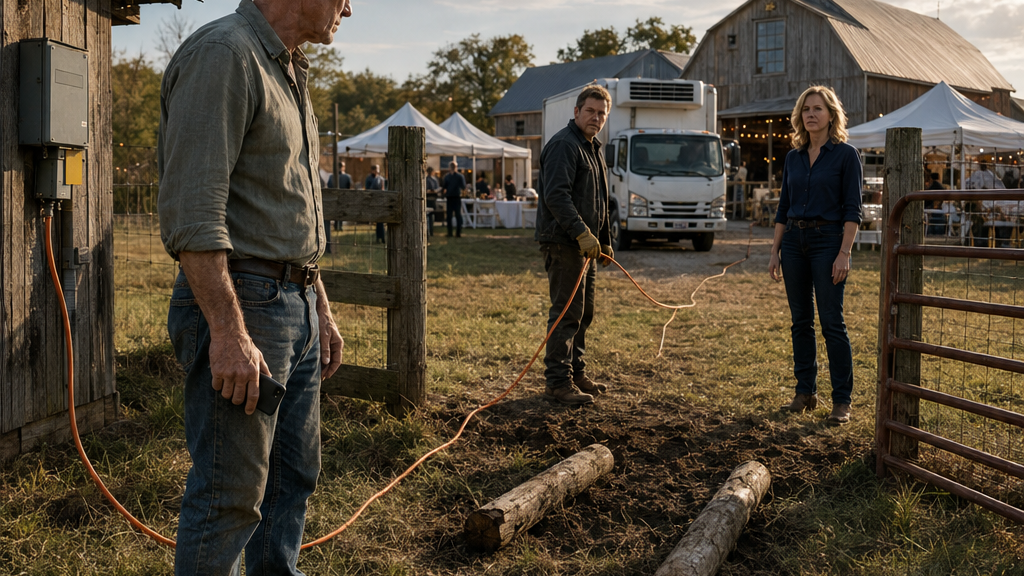
They Cut Through His Farm Fence for Their Harvest Gala—Then Learned What Their Entire Event Was Plugged Into
Chapter 1: The Yellow Tag on Gregory’s Own Power Box
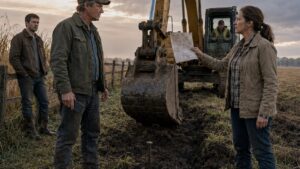
Gregory Moore saw the catering truck before he saw the missing fence posts.
It was sitting fifty yards past his equipment shed, white and oversized against the September pasture, its rear refrigeration unit humming hard enough to carry across the grass. That alone was wrong. The event barn next door had its own gravel service lane. Trucks had no reason to be on Gregory’s side.
Then he noticed the opening.
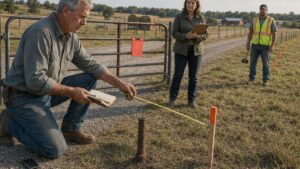
Two treated-wood posts lay flat beside the woven-wire fence, staples still hanging from one of them. A twelve-foot section had been peeled back and tied to a corner brace with bright plastic cord. Beyond it, workers rolled equipment cases toward the converted barn where Heather Carter’s harvest gala was being set up.
Gregory stopped his pickup in the lane.
For several seconds he did nothing.
A younger version of himself would have driven straight across the grass and demanded to know who had touched his fence. His father certainly would have. Gregory could almost hear the old man’s voice: You let somebody move a line once, they’ll swear it was never there.
That memory was exactly why Gregory stayed seated until his hands loosened around the steering wheel.
He got out with his phone.
There were tire marks across the pasture edge, not deep enough to damage the ground but fresh enough to show where the catering truck had turned. The cattle were in the north field, safely separated by an interior gate, but that did not make the opening harmless. A loose heifer in the wrong week could reach the county road faster than anyone expected.
Gregory walked toward the fence.
Ryan Mitchell spotted him first.
Ryan was carrying a coil of black cable over one shoulder. He had worked around the neighboring venue for two seasons and had asked Gregory for favors before—borrowing a chain, turning around a delivery trailer, filling a water jug from the hydrant. Small things.
“Hey, Gregory.”
Gregory pointed at the posts.
“Who took those out?”
Ryan shifted the cable higher. “Just temporary. We’ll put everything back Sunday.”
“That wasn’t what I asked.”
Ryan glanced toward the barn.
“Heather signed off on the layout.”
Gregory looked past him.
White tents were going up behind the barn. A contractor on a ladder was stringing lights between poles. Another worker wheeled a speaker cabinet across the lawn. The harvest gala had grown every year, but this was the first time Gregory had seen the setup spread openly onto his ground.
Then he noticed the orange cable.
It ran from the catering truck, crossed the grass in a broad curve, passed through the opening where his fence had been, and disappeared behind his old equipment shed.
Gregory followed it.
Ryan came after him.
“Gregory, we’ve always run power from here.”
Gregory stopped.
“What?”
“For events.”
“No. You’ve plugged things in here before.”
Ryan seemed puzzled by the distinction.
“That’s what I mean.”
Gregory continued around the shed.
The old outdoor service box was mounted beneath the eave, its gray paint faded and chalky from years of sun. An orange industrial connector had been plugged into the receptacle below it. Above the plug, someone had wrapped a yellow laminated tag around the conduit with a plastic tie.
EVENT POWER — DO NOT DISCONNECT.
Gregory read it twice.
Then he laughed once, without humor.
“You put that on my box?”
Ryan’s expression changed.
“The electrical contractor did. It’s just so nobody accidentally kills the refrigeration.”
“Who would accidentally touch a box behind my shed?”
Ryan did not answer.
Gregory raised his phone.
He photographed the tag.
Then the plug.
Then the cable running around the shed.
Then the cable crossing the grass.
Then the fence opening.
He walked back and photographed the removed posts from both sides, including the old staple holes and the fresh scrape where one post had been dragged.
Ryan watched him.
“You don’t need to make this into something.”
Gregory lowered the phone.
“I came home and found my fence opened and a truck plugged into my service.”
“We figured you knew.”
“Who figured?”
Ryan looked toward the barn again.
“Heather.”
Gregory felt the first clean edge of anger then, not because Heather had made a mistake, but because the mistake had already been converted into an assumption about him.
He went to the interior pasture gate and checked the latch. It was closed. He lifted it, reset it, and pushed the chain through a second link.
When he returned, Ryan was still standing near the fence.
“We’ve done this before,” Ryan said.
Gregory looked at him.
“When?”
“The charity supper. And that fall market. You never said anything.”
Gregory remembered the supper vaguely. A coffee urn. Two strings of lights. Someone had asked if they could use the outlet for a few hours.
He could not remember who.
The fall market was less clear.
That bothered him more than Ryan’s confidence.
Heather appeared from behind the barn before Gregory could answer. She crossed the grass carrying a clipboard, dressed in jeans and a navy blouse, moving with the clipped pace of someone already behind schedule.
“I heard there was a problem.”
Gregory pointed to the opening.
“There is.”
Heather looked at it, then back at him.
“We’ll restore it Sunday morning.”
“You had no permission to take it down Thursday.”
Her face tightened slightly.
“We understood the access arrangement was established.”
“What access arrangement?”
“The same one we’ve used for years.”
“Running a cord for a church fundraiser is not an access arrangement.”
“It wasn’t only the fundraiser.”
That landed harder than Gregory expected.
Heather continued, more carefully now.
“Gregory, nobody is trying to take anything from you. We have vendors arriving. The refrigeration truck can’t make the turn behind the barn because of the new landscaping, and the nearest service connection is here. We’re using the same route the venue has used before.”
“My route.”
“For two days.”
“My fence.”
“We’ll repair it.”
“My electric.”
Heather’s patience thinned.
“And we’ll compensate you for the electricity if that’s the issue.”
Gregory looked toward the orange cable.
“That isn’t the issue.”
Heather exhaled.
“Then tell me what you want.”
“I want everything off my property until we sort out what you think you have permission to use.”
For the first time, she did not answer immediately.
Behind her, a worker raised another line of string lights. The catering unit kept humming.
Heather looked at Ryan, then back at Gregory.
“We cannot dismantle the setup this afternoon.”
“You can unplug from my box.”
“Not without losing refrigeration.”
“That sounds like something you should have planned before you plugged into it.”
Her jaw tightened.
“The gala is Saturday. We have nearly two hundred people coming, contracts with vendors, food arriving tomorrow. We’ll talk through the property question, but the temporary setup is staying through Saturday.”
Gregory stared at her.
Heather gave one short nod, as if a difficult administrative point had now been settled.
Then she turned and walked back toward the barn.
Gregory looked at the yellow tag on his power box.
For the first time, he wondered whether she might genuinely believe she was entitled to leave it there.
Chapter 2: The Favors Nobody Ever Put in Writing
The photograph was six years old, and the orange cord was right there in the corner.
Gregory sat at the kitchen table with the image enlarged on his phone until the pixels blurred.
The picture had been taken during a September charity supper in the old barn before Heather’s company had transformed the place into a full-time event venue. Folding tables stood under cheap white tents. A coffee urn and two crockpots sat on a plywood serving table. In the background, barely noticeable unless someone knew to look for it, an orange extension cord ran toward Gregory’s fence.
He remembered that night now.
Someone had knocked on his back door and asked if they could borrow power because a portable generator would not start.
Gregory had said yes.
No paper. No deadline. No conditions.
Just yes.
He leaned back.
On the kitchen counter lay the photos from that afternoon: missing posts, cable, yellow tag, catering truck.
The difference between then and now seemed obvious to him.
That did not mean it had ever been obvious to anyone else.
He searched farther back through an old folder of farm photographs he kept on the laptop. Most were insurance pictures—barn roofs, equipment serial numbers, fence repairs after storms.
Then he found another event.
A fall market four years earlier.
Pumpkins near the barn. Vendors selling jam and baked goods. A child leading a pony around a temporary pen.
There was the shed in the background.
And another cord.
Gregory stared at it.
He remembered Ryan asking whether they could plug in “a couple things.” Gregory had been loading hay and had waved toward the outlet without stopping the tractor.
He had never gone over to see what a couple things meant.
That was the part that began to trouble him.
Gregory had spent most of his life believing written agreements were what people used when trust had already failed. His father had believed the opposite. The old man measured boundaries twice, saved every receipt, and once made a neighbor move a gate six inches because the hinge post crossed the surveyed line.
Gregory had hated that.
After his father died, Gregory had made a private rule of his own: he would not become a man who needed paperwork to borrow a wrench.
But looking at the old photographs, he could see the weakness in that rule.
The people next door had changed.
The scale had changed.
Only his silence had stayed the same.
At dusk he walked the boundary lane.
The event barn glowed with work lights. The orange cable was still connected. Another thinner line ran beside it toward the lighting contractor’s distribution box.
Ryan was placing rubber cable covers over the section crossing the grass.
Gregory stopped beside him.
“Was it you who asked me for power at the fall market?”
Ryan thought about it.
“Might’ve been.”
“How much did you run?”
“Not much.”
“What is not much?”
Ryan looked at the cables.
“Couple vendor tables, maybe lights.”
“Refrigeration?”
“No.”
“Sound system?”
“I don’t think so.”
“Two hundred guests?”
Ryan gave him a tired look.
“No.”
Gregory nodded.
That was the distinction he had been trying to put into words.
He had lent an outlet.
They had turned the outlet into infrastructure.
Ryan stood up.
“Look, I get why you’re mad about the posts.”
“This isn’t just the posts.”
“I know. But Heather didn’t wake up and decide to steal your electric. Everybody thought this was something we were already allowed to do.”
“Everybody except the person who owns it.”
Ryan did not argue.
That silence was more useful than another explanation.
Gregory walked to the venue’s gravel entrance. A temporary site plan had been clipped inside a clear plastic sleeve on a contractor board. He did not touch it. He leaned close enough to read.
Catering truck.
Lighting.
Sound.
Vendor service.
Three refrigerated holding units.
Gregory read that line again.
Three.
The little coffee urn from six years earlier came back to him with almost embarrassing clarity.
One cord. One urn. Two crockpots.
Now the plan showed equipment distributed across nearly the entire south lawn.
Heather came out of the barn while he was still reading.
“You checking up on us?”
“I’m trying to understand what you’re running from my service.”
“The electrician has the load plan.”
“Your electrician?”
“The event contractor.”
“Did he inspect my panel?”
Heather’s pause answered before she did.
“He was told it had been used for events before.”
“That isn’t an inspection.”
“No, Gregory. It isn’t. But this also isn’t some improvised backyard party. We have professionals handling it.”
He pointed toward the board.
“Three refrigeration units?”
“They’re food holding units.”
“That makes them pull less power?”
Heather folded her arms.
“What exactly are you asking me?”
Gregory almost said, I’m asking whether you have any right to be there.
But the old photographs were waiting in his kitchen.
So he asked a harder question.
“What were you told I had agreed to?”
Heather’s expression softened a fraction.
“That the farm service connection had historically been made available for event use.”
“By me?”
“By the neighboring property owner.”
“That’s a way of saying my name without saying you asked me.”
She looked away toward the barn.
“We inherited operating practices when we took over.”
“And nobody checked which ones were favors.”
Heather’s silence was different from Ryan’s. Less uncertain. More defensive.
Finally she said, “If you want a formal agreement going forward, we can make one.”
“Going forward starts now.”
“We can’t redo Saturday’s logistics in thirty-six hours.”
“That sounds like the same problem you had this afternoon.”
Heather’s eyes hardened.
“And your answer is still to shut down a community event because nobody had you sign a form five years ago?”
Gregory felt the accusation catch.
Not because it was fair.
Because some small part of it was.
He had let convenience stand in for permission because correcting people had felt petty.
Now correcting them looked vindictive.
He turned back toward his farm.
At the fence opening, he stopped and photographed the site plan through the plastic sleeve.
Three refrigerated units.
By the time he reached the kitchen, the question had changed.
It was no longer whether he had once said yes.
It was whether that old yes could reasonably mean all of this.
Chapter 3: The Panel Was His, but the Wiring Wasn’t Simple
“Don’t touch that main disconnect.”
Christine Wright said it before she had even set down her tool bag.
Gregory, who had been standing beside the service box with one hand near the latch, pulled it back.
“I wasn’t going to.”
Christine looked at him.
“You called me at seven in the morning because you wanted to know what you could shut off.”
“I called because somebody plugged half a banquet into my shed.”
“Same difference until I look.”
She opened the panel.
Christine had done electrical work on farms around the county for more than twenty years and possessed the irritating habit of answering only questions she believed had enough facts behind them.
Gregory had hired her for exactly that reason.
She traced the event cable first, checked the connector, then studied the breakers and the older conduit leaving the bottom of the box.
“What’s that feed?”
“Well-house.”
“Yours?”
Gregory hesitated.
“The well-house sits on the old line between the properties.”
Christine looked over.
“That wasn’t my question.”
“It serves my north lot.”
“And?”
“And the venue side used to draw from it too. Years ago.”
Christine crouched beside the conduit.
“Still does?”
“I don’t know.”
She gave him a look.
“Then we’re going to find out before you start proving a point.”
Twenty minutes later, Gregory was less certain than when she arrived.
The service account was in his name. The panel was mounted on his shed. The meter serving it belonged to the utility account attached to his farm.
But the oldest buried feeder left the panel and ran toward the well-house near the former property line.
Christine found voltage on it.
“So if I shut the main off—”
“You probably kill the well circuit.”
“That’s my well.”
“Maybe not only yours.”
Gregory stared toward the event barn.
Heather’s argument from the previous evening returned in an unwelcome form: historically available.
He did not like that those words suddenly had wires attached to them.
At the county permit office, the picture got no cleaner.
The zoning clerk pulled archived property files and an old electrical sketch from before the barn conversion. The service panel was clearly located on Gregory’s parcel.
The buried feeder was shown too.
But the notation beside it was handwritten and vague: EXIST. WELL SERVICE.
No ownership assignment.
No modern easement language.
No clean answer.
Gregory leaned on the counter.
“So the panel is mine.”
“The records show it on your property.”
“The account is mine.”
“That’s a utility question.”
“And the feeder?”
The clerk shook her head.
“I can tell you what the file says. I can’t tell you what private rights grew around something people used for forty years.”
That sentence followed Gregory back to the farm.
Christine was waiting near the shed.
“You look happy,” she said.
“I own the box.”
“Congratulations.”
“And apparently that proves almost nothing useful.”
“That sounds more realistic.”
He glared at her.
She smiled faintly and pointed inside the panel.
“Here’s the useful part.”
She had traced the circuits.
The old well-house feeder left through the buried conduit on the left. The temporary event connection had been attached through a separate branch and exterior receptacle.
“They aren’t the same circuit.”
Gregory stepped closer.
“So I can disconnect the event.”
“Electrically, yes. Assuming nobody changes anything after I leave.”
“Without touching the well-house.”
“Yes.”
Relief came fast, followed immediately by embarrassment that he had wanted such a simple answer.
Christine saw it.
“You wanted me to tell you to throw the main.”
“I wanted to know what was mine.”
“That’s not always the same as knowing what you can safely turn off.”
Gregory closed the panel door.
Heather arrived before Christine finished labeling the temporary branch.
She came across the pasture in work boots, no clipboard this time.
“I heard you went to the county.”
Gregory looked at Christine.
“News travels.”
Heather stopped beside them.
“The well service is shared.”
“The old feeder may be.”
“Which is what I told you. There’s a history of shared utilities here.”
Christine straightened.
Heather looked at the panel.
“So this isn’t as simple as you made it sound yesterday.”
Gregory felt his face warm.
“No. It isn’t.”
Heather seemed surprised by the admission.
He continued.
“But your event cable isn’t part of that old feeder.”
Her expression changed.
Christine pointed to the labeled branch.
“This connection is separate. The well-house stays live if this branch is isolated.”
Heather looked from Christine to Gregory.
“Are you planning to disconnect us?”
“I’m planning to tell you clearly what I should’ve told people years ago. You do not have standing permission to use this panel for events.”
“We’ve used it repeatedly.”
“I know.”
“With your knowledge.”
“Sometimes.”
“And without objection.”
Gregory said nothing.
Heather took that silence as room to continue.
“You can’t spend years letting a practice continue and then act as if we invented it yesterday.”
There it was.
The part he could not dismiss.
Christine quietly packed one meter into her bag.
Gregory looked at the orange cable disappearing through the fence.
“You’re right about one thing.”
Heather waited.
“I should have said something sooner.”
Her shoulders eased slightly.
“But I’m saying it now.”
The easing vanished.
Gregory touched the yellow tag.
“This comes off. The cable comes off. The fence gets restored. If you want future access, you ask and we put it in writing.”
“The gala is tomorrow.”
“I know.”
“We can’t move those loads tomorrow.”
“That doesn’t make them mine.”
Heather stepped closer.
“We’re not talking about somebody stealing power for a camper. This event supports local growers, the preservation work on the barn, seasonal staff. People have paid. Vendors have ordered food.”
“And that gives you my outlet?”
“It gives context.”
“It gives pressure.”
“Yes,” Heather said. “It does.”
For the first time since Thursday, Gregory heard something other than authority in her voice.
Fear.
Not panic. Not apology.
Financial fear.
She looked toward the barn.
“We have already committed to this weekend.”
“Then you need another power source.”
“That isn’t something I can arrange in a day.”
Christine zipped her bag.
“You might be able to get a rental generator.”
Heather gave a short laugh.
“For that load? On harvest weekend?”
Christine shrugged.
“Then I’d start calling.”
Heather looked back at Gregory.
“What are you going to do?”
Gregory considered the question.
His father would already have pulled the connection.
Gregory had spent half his life trying not to be his father.
That did not mean the opposite of every hard boundary was kindness.
“I’ll give you notice,” he said.
Heather’s mouth tightened.
“Notice of what?”
“That the event connection has to be removed.”
“When?”
Gregory looked at Christine.
She nodded once toward the marked branch.
Only then did he answer.
“Before tomorrow evening.”
Heather stared at him for a long moment.
Then she turned toward the barn.
At the fence opening, she stopped.
“You know we’re not going to dismantle a gala because of an extension cord.”
Gregory looked at the separate label Christine had fixed inside his panel.
For the first time since finding the posts on the ground, he knew exactly which cord mattered.
And exactly which one did not.
Chapter 4: Five O’Clock Became More Than a Warning
Heather refused to sign the notice.
Gregory had expected an argument. He had not expected her to slide the single sheet of paper back across the venue office desk without touching the pen beside it.
“I’m not signing something that makes it sound like we’re trespassing,” she said.
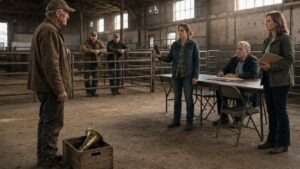
The office sat inside the converted barn behind a wall of reclaimed boards and glass. Through the window, Gregory could see workers carrying folded chairs toward the lawn. Every few seconds, someone passed with flowers, cable covers, table linens, or crates.
Gregory left the paper where it was.
“It says you no longer have permission to use my fence opening, my access strip, or the temporary power connection after five tomorrow.”
Heather read the first paragraph again.
“You’re putting sheriff language in here.”
“It says I may contact the sheriff if somebody comes back onto the property after permission is withdrawn.”
“That’s escalation.”
“No. Cutting my fence was escalation.”
Heather pressed her lips together.
Gregory had spent most of the morning revising the notice because the first version sounded too angry. The second sounded like something his father might have written. The third was the one on Heather’s desk now: dates, locations, equipment, photographs, deadline.
No threats beyond what he was actually prepared to do.
No invented penalties.
No speech about property rights.
Just a line that did what Gregory had failed to do for years.
It said no.
Heather leaned back.
“We’ve already paid deposits on catering, rentals, musicians, staffing. People bought tickets months ago.”
“I’m not asking you to cancel the gala.”
“You know what losing that connection means.”
“Then rent power.”
“You say that like I can call somebody and have industrial generation sitting here by supper.”
Gregory said nothing.
Her eyes narrowed.
“That’s why you picked five.”
“No. I picked five because it gives you more than a day.”
“And because the event will be underway.”
That accusation stopped him.
He had told himself the time was practical. Friday setup could continue. Saturday afternoon gave Heather time to fix the problem.
But he knew what five o’clock meant.
Guests would already be there.
The venue would be exposed.
Gregory did not enjoy recognizing that.
“I can make it four,” he said.
Heather stared at him.
“That’s not the point.”
“No. The point is you have notice now.”
She pushed the sheet toward him.
“I won’t sign it.”
Gregory picked it up.
“All right.”
“You’re just leaving?”
“I came to hand it to you. You read it.”
“That doesn’t mean I agree.”
“It doesn’t ask you to.”
Her face tightened again.
Gregory walked out.
At the county road, instead of turning toward home, he drove into town.
The post office clerk looked at the envelope, then at him.
“Need proof?”
“Yes.”
Gregory almost laughed at how unnatural the answer felt.
He had spent a lifetime believing a handshake was stronger than a receipt because a handshake required someone to look you in the eye.
Now he paid for documented delivery.
By the time he returned to the farm, the orange cable was still running through the fence.
He parked near the shed and saw Ryan coming toward him.
“Heather said you gave her a notice.”
“I did.”
Ryan nodded.
There was something careful in his face.
“You’re really planning to cut us off?”
“If the connection is still there after five tomorrow.”
Ryan looked toward the barn.
“She thinks you’re trying to embarrass her.”
“I’m trying to get my fence back.”
“You could wait until Sunday.”
“I already waited years, apparently.”
Ryan rubbed the back of his neck.
“That’s not fair.”
Gregory looked at him.
“To who?”
“To everybody who didn’t know there was a problem.”
“Did you know yesterday?”
Ryan did not answer.
“That’s what I thought.”
Gregory went to the panel and removed the yellow EVENT POWER tag.
He did not throw it away.
He folded it and put it in his shirt pocket.
That small action steadied him.
The argument was no longer about whether anybody understood.
They understood now.
Late in the afternoon, Heather came down the boundary lane.
She did not enter Gregory’s yard.
She stopped on her side of the open fence.
“You mailed it too?”
“Yes.”
“I read it the first time.”
“You also said you weren’t signing.”
“So now you’re building a record.”
Gregory rested one hand on the fence brace.
“Yes.”
Heather looked genuinely disappointed.
For some reason, that bothered him more than anger would have.
“You know what people around here are going to say,” she said.
“I don’t much care.”
“You do.”
Gregory looked at her.
Heather continued.
“They’ll say you let us use it for years, then waited until the biggest event we’ve ever held to make a stand.”
“Some of that is true.”
Her expression shifted.
He went on.
“I should’ve been clear before. That’s on me.”
Heather seemed almost ready to accept that as a peace offering.
Then Gregory said, “It still doesn’t make tomorrow yours.”
The softness disappeared.
“We’re not moving the setup.”
“That’s your choice.”
“We’re not disconnecting.”
“That’s your choice too.”
Heather shook her head.
“You keep saying that as if choices don’t have consequences.”
Gregory looked at the missing fence posts.
“I’m learning that.”
She left without replying.
Near sunset, Gregory heard the sound of equipment rolling across the grass.
He walked behind the shed.
Ryan and another worker were laying a second heavy cable through the same opening.
Gregory stood quietly until Ryan noticed him.
Ryan stopped.
For a second neither man spoke.
Then Ryan said, “Heather said we need the second feed for backup distribution.”
Gregory looked at the additional orange line lying beside the first.
“You know about the notice.”
“Yes.”
“You know I withdrew permission.”
Ryan’s eyes dropped.
“Yes.”
Gregory nodded once.
That answer changed something.
Before, people could claim confusion.
Now someone had been told directly and had continued anyway.
Gregory raised his phone and took another photograph.
Ryan watched him do it.
Neither man pretended anymore that the problem was a misunderstanding.
Chapter 5: The Gala Looked Perfect Because Nobody Saw the Shortcut
By four Saturday afternoon, nearly two hundred people were standing on a lawn powered through a hole in Gregory Moore’s fence.
From his pasture, the gala looked almost impossible to connect with the orange cables lying behind his shed.
White tablecloths moved lightly under the afternoon breeze. Glassware flashed in the sun. Round tables were arranged between the converted barn and a line of maples near the driveway. Local growers had display tables beneath smaller tents. A quartet tuned instruments near the patio.
Everything was polished.
Everything was temporary.
And almost none of it showed the shortcut underneath.
Gregory walked the boundary once before the guests arrived in full.
The fence opening was still there.
The two heavy cables ran under black rubber covers across the service strip. One fed the catering and refrigeration distribution. The second branched toward lighting and sound.
Christine’s labels inside Gregory’s panel remained exactly where she had put them.
He checked them twice.
Not because he had forgotten.
Because what he was considering no longer felt theoretical.
A catering worker laughed on the other side of the fence. Someone called for another bucket of ice. The quartet began playing a few bars and stopped.
Gregory closed the panel.
At four fifteen, Ryan came over.
“You’re really doing it?”
“If they’re still connected at five.”
Ryan glanced back toward the gala.
“I figured Heather might talk you out of it.”
“She hasn’t tried today.”
Ryan gave a humorless smile.
“She’s been trying to keep the rest of us from talking about it.”
Gregory studied him.
“Do you have a generator?”
“Small one for emergency lighting.”
“That’s not what I asked.”
Ryan shook his head.
“No.”
“What happened to the backup distribution you were adding yesterday?”
“That was just a second feed from your panel.”
Gregory stared at him.
Ryan seemed embarrassed.
“She wanted redundancy.”
“From the same source.”
“I didn’t say it made sense.”
Gregory looked at the orange lines.
“So there’s no backup.”
“Not for the refrigeration and sound loads.”
That was the first thing that morning that actually surprised him.
Heather had spoken for two days as though alternatives existed but were inconvenient.
They did not.
The event had been built around his panel more completely than he had understood.
Ryan lowered his voice.
“She looked at generators. That’s all I know.”
“Then why didn’t she rent one?”
Ryan glanced toward the barn.
“You should ask her.”
Heather arrived twenty minutes later.
She had changed into a dark green dress, formal enough for the gala but simple enough that she could still move quickly through the grounds. From a distance, she looked composed.
Up close, Gregory saw the strain around her eyes.
“You have a minute?”
He nodded.
They walked along the boundary until the music and crowd noise softened.
Heather stopped beside the fence opening.
“I called three rental companies yesterday.”
Gregory waited.
“One had a unit large enough, but it was already committed to a grain operation. Another could bring one Monday. The third gave me a weekend rate that would wipe out what’s left of the gala margin.”
There it was.
Not permission.
Not history.
Money.
Gregory looked toward the tables.
“You expanded faster than the electrical service.”
Heather did not answer immediately.
Then she said, “We had a permanent upgrade designed last winter.”
“What happened?”
“Cost went up.”
“So you delayed it.”
“We delayed part of it.”
“And kept using mine.”
“We kept using a temporary system that had been used before.”
Gregory shook his head.
“That sentence gets thinner every time you say it.”
Heather folded her arms.
“The county approved the event layout.”
“The county approved your temporary operations. That doesn’t make my panel theirs.”
“I know that now.”
The answer caught him.
He turned toward her.
Heather looked at the ground.
“I know it now.”
For the first time, she sounded tired instead of defensive.
“We thought we had another season before the upgrade became unavoidable. Saturday’s gala is what pays for a large portion of the fall operations. Staff. Barn maintenance. Vendor commitments. If we rent emergency generation at the rate I was quoted, the event probably breaks even at best.”
Gregory said nothing.
“I’m not asking you to pretend the fence was okay.”
“You ordered Ryan to keep going after I told you it wasn’t.”
“Yes.”
The plain admission left him nowhere comfortable to stand.
Heather looked directly at him.
“I made that call because I thought you would cool down before Saturday.”
“That was a gamble.”
“Yes.”
“With my property.”
“Yes.”
Gregory could hear the quartet behind them now, the full piece starting as guests settled at tables.
Heather took a breath.
“Give me tonight.”
He looked at her.
“One night. Leave the connection until the event ends. Tomorrow morning we pull everything, rebuild the fence, and Monday I start the permanent service work.”
“You could have said that Thursday.”
“I thought I didn’t need to.”
“That’s the problem.”
“I understand that.”
Gregory looked past her at the gala.
For a moment, he saw the event the way Heather did.
Not as tables and lights.
As invoices.
Staff hours.
Vendor checks.
A season’s margin compressed into one evening.
That understanding did not make her decision right.
It made his next one harder.
“You ignored the written notice.”
“I know.”
“You added another cable after it.”
“I know.”
“You cut a livestock fence without asking.”
“I know.”
Heather’s voice was quieter now.
“I’m not asking you to say I handled it well.”
“What are you asking?”
“To let the mistake cost me something other than the entire event.”
Gregory looked at the orange cable.
Years earlier, that same color had meant a coffee urn and two crockpots.
A favor.
Now it disappeared under cable covers into a business operation large enough to depend on his reluctance to say no.
He realized something then.
If he let it stay because the consequence had become uncomfortable, he would be doing exactly what had created the problem.
Silence first.
Clarity later.
Then silence again when clarity became expensive.
Gregory looked at Heather.
“I gave you a deadline because I meant it.”
Her face went still.
“You’re really going to shut us down.”
“I’m going to disconnect what’s plugged into my service.”
“That is the same thing.”
“No.”
“For every guest out there, it is.”
Gregory did not answer.
Heather looked toward the gala.
“Then at least wait until dinner service is finished.”
“That moves the deadline after you decided to ignore it.”
She shook her head.
“You make this sound mechanical.”
“It has to be.”
“Why?”
“Because if I make it personal, I’ll either do something I regret or let it go again.”
That silenced her.
Heather turned and walked back toward the barn.
At four fifty-five, Gregory checked the cattle gate.
At four fifty-seven, he walked to the shed.
At four fifty-eight, he opened the service box.
At four fifty-nine, the quartet was playing, glassware was clinking, and the string lights had just begun to matter in the lowering sun.
Gregory looked at the marked event branch.
Then he looked at his watch again.
Chapter 6: One Cable Went Quiet at Five
At exactly five, Gregory reached for only the breaker Christine had marked.
Not the main.
Not the old well-house feeder.
Not anything he had not traced and checked.
His fingers rested on the handle.
Across the fence, someone laughed loudly near the patio.
Gregory moved the breaker down.
The first effect was almost disappointing.
Nothing exploded.
No dramatic spark jumped from the panel.
The farm stayed exactly as it was.
Then the hum from the refrigeration truck stopped.
A half second later, the quartet’s amplified microphones went dead.
The small speakers near the patio cut out.
The decorative string lights, visible now under the barn eaves, went dark.
People looked up.
For a moment the musicians kept playing acoustically, bows still moving, until they realized the sound system was gone.
Then a warning alarm began from one of the refrigeration units.
It was not loud enough to panic anyone.
It was loud enough to make people turn.
Gregory stood beside the panel listening to the consequence move across the lawn.
One worker hurried toward the distribution boxes.
Another lifted a rubber cable cover.
Ryan appeared from behind the catering truck and looked directly toward Gregory’s shed.
Gregory did not move.
He checked the well-house circuit.
Still live.
He walked to the hydrant near the cattle lane and turned the handle.
Water came through.
He shut it again.
That mattered more to him than the silence from the gala.
Christine had been right.
Preparation mattered.
The main breaker would have made a larger statement.
It also would have been careless.
Gregory went back to the panel and unplugged the first event connector after confirming the branch was dead.
Then the second.
He coiled both orange cables on his side of the fence.
Not quickly.
Not theatrically.
Just far enough that nobody could reconnect them without crossing onto his property.
When he finished, Ryan came through the fence opening.
He stopped before reaching Gregory.
“You did it.”
“I said I would.”
“The refrigeration alarms are going.”
“You have portable units.”
“Not enough.”
“That isn’t something I can fix.”
Ryan looked toward the barn.
“Heather’s going to come down here.”
“I figured.”
Ryan seemed about to say something else.
Instead he looked at the coiled cables.
“I knew she shouldn’t have added the second one.”
Gregory waited.
Ryan rubbed his palm over the back of his neck.
“She asked whether you’d actually shut it off. I told her I didn’t know.”
“That isn’t the same as telling her not to.”
“No.”
Gregory nodded.
Ryan looked uncomfortable.
“I should’ve stopped after the notice.”
That was as close to an admission as Gregory expected.
“You should’ve.”
Ryan turned toward the gala.
“Do you want me to put the fence back now?”
“Not while you’re scrambling equipment around.”
“Tomorrow?”
“Tomorrow morning.”
Ryan nodded and left.
The event did not collapse.
That surprised Gregory too.
People continued eating. Staff brought out battery lanterns. The quartet moved closer to the tables and played without amplification. The barn staff found enough small generators to restore emergency lighting.
But the illusion of seamlessness was gone.
Workers moved quickly between guests.
The catering crew shifted food into insulated storage.
Some guests began leaving earlier than planned.
Gregory watched from his side of the fence for less than two minutes before deciding he had seen enough.
He closed the panel.
Then he carried the orange cable into the shed.
He had just finished coiling it neatly when Heather arrived.
She did not shout.
That made the confrontation heavier.
Her dress was still formal. One heel had sunk into the pasture edge and collected mud. A staff radio was clipped awkwardly at her waist.
“Reconnect it.”
“No.”
“We have food holding temperatures to maintain.”
“You knew the deadline.”
“I know what I knew. I am telling you now that we have a health and safety problem.”
Gregory looked past her.
“Your catering crew has insulated storage.”
“That buys time.”
“Then use the time.”
Heather stepped closer.
“I will pay for the power.”
“This was never about the electricity bill.”
“Then tell me what fixes it.”
“I already did.”
“You want me to rebuild a fence while two hundred people are sitting fifty yards away?”
“I want you to stop using my service.”
“We have stopped. Because you stopped us.”
Gregory met her eyes.
“Yes.”
Heather’s face flushed.
“You could have waited three hours.”
“And then what would tomorrow have looked like?”
She opened her mouth.
Gregory continued.
“You would’ve said the event was already over. The equipment was leaving. Everybody would promise it wouldn’t happen again. Then next year somebody would tell the new operations manager we’d always done it this way.”
“That isn’t fair.”
“It’s exactly what happened this year.”
Heather looked away.
A battery-powered work light flickered on near the catering truck.
She lowered her voice.
“You wanted them to see it.”
Gregory felt the accusation because there was enough truth in it to hurt.
“I knew they might.”
“You picked five.”
“Yes.”
“So don’t pretend this was only procedure.”
Gregory did not answer immediately.
The easiest response would have been to deny it.
He had already spent too many years hiding inside easy responses.
“I wanted you to understand I meant it.”
Heather looked back at him.
“And if part of me knew it would take a public consequence for that to happen, then yes. That was part of it.”
Her expression hardened.
“At least you admit it.”
“I’m not proud of that part.”
Heather gave a short, tired laugh.
“Wonderful.”
Gregory let the silence sit.
Then he said, “But I’m not sorry I disconnected it.”
For several seconds, the only sound between them was the refrigeration alarm in the distance.
Heather glanced toward the shed.
“Is the well-house still powered?”
“Yes.”
“You’re sure?”
“Yes.”
“Ryan said you hired someone.”
“Christine traced everything.”
“So you planned this.”
“I planned not to shut off anything that wasn’t part of the event.”
Heather’s anger shifted.
Not gone.
Changed.
She had expected recklessness, maybe revenge.
What she saw instead was worse for her argument.
Gregory had been careful.
“You isolated only our branch?”
“Yes.”
Heather looked at the ground.
When she spoke again, her voice was quieter.
“I told the board we had backup.”
Gregory said nothing.
“We didn’t.”
“I know that now.”
“I thought I could get a rental if you forced the issue.”
“But you couldn’t.”
“No.”
That admission carried more than the previous ones.
Heather had not simply gambled that Gregory would back down.
She had gambled that the venue could survive if he did not.
Both assumptions had failed.
A staff member appeared at the fence but stopped when Heather raised a hand.
She turned back to Gregory.
“What do you want tonight?”
“Stay off my side. Don’t reconnect anything. Tomorrow morning, restore the fence.”
“And after that?”
Gregory went into the shed.
When he returned, he carried a manila folder.
Heather looked at it.
“What is that?”
He held it out.
She did not take it immediately.
“You came prepared with paperwork.”
“Yes.”
“What’s in it?”
“Fence repair costs. Christine’s inspection invoice. Photos. The notice you wouldn’t sign. And proposed terms if you ever need temporary access again.”
Heather finally took the folder.
Her expression changed as she felt its weight.
“This is an invoice?”
“Part of it.”
“For what?”
“For what I can actually document.”
She opened the cover.
Gregory had considered adding an access fee.
He had even typed one.
Then deleted it.
Charging a made-up penalty would have turned the dispute into the kind of performance he was trying to avoid.
Heather read the first page.
Her eyes moved down the repair estimate and electrical inspection charge.
Then she reached the pages behind them.
“What are these?”
“Future access terms.”
She looked up.
“You think there’s going to be future access after this?”
“That depends on what you decide the next time you need something that belongs to your neighbor.”
Heather closed the folder.
Behind her, the quartet had started playing again without speakers.
The music reached them faintly across the darkening lawn.
She stood there with the folder against her chest, no longer asking him to reconnect the cable.
For the first time since Thursday, the argument had moved past what Gregory would allow tonight.
Now it was about what either of them was willing to live with afterward.
Chapter 7: The Invoice Wasn’t the Most Expensive Part
The first thing Heather challenged in Gregory’s folder was not the fence repair.
It was the line he had already crossed out.
She stood at his kitchen table Saturday night with the folder open beneath the yellow light and tapped the faint gray text where an “unauthorized access fee” had once appeared.
“You were going to charge me for crossing your grass?”
“I considered it.”
“And then?”
“I decided I couldn’t defend the number.”
Heather looked at him for a moment, then back at the page.
The gala had ended less than an hour earlier. Most guests had gone home. The quartet had finished acoustically. The catering crew had kept the food within safe limits using insulated storage and two small generators borrowed from nearby vendors. The event had survived, though not gracefully.
Heather had changed out of her formal shoes but still wore the green dress. Mud darkened the hem.
Gregory poured coffee for himself.
He did not offer any.
Then, after a second, he reached for another mug.
Heather noticed.
Neither mentioned it.
She studied the actual charges.
Replacement posts.
Wire.
Staples.
Labor estimate.
Christine’s inspection invoice.
A modest amount for electricity already consumed.
“No penalty?” she asked.
“No.”
“You could have made one up.”
“I almost did.”
“Why didn’t you?”
Gregory sat across from her.
“Because being angry doesn’t make a number real.”
Heather gave a tired smile.
“That’s a surprisingly generous principle from the man who shut down my sound system in front of two hundred people.”
Gregory met her eyes.
“I didn’t say I was generous.”
For the first time in three days, she laughed.
It lasted only a second.
Then she reached the proposed access agreement.
Temporary use only by written request.
Defined dates.
Defined loads.
No fence modification without separate permission.
No connection to Gregory’s service without electrical review.
Restoration costs assigned in advance.
Heather read each line slowly.
“This is what you wanted all along?”
“No.”
“What did you want?”
“For people to ask.”
She looked down.
“That simple?”
“It used to be.”
The words settled between them.
Heather closed the folder halfway.
“I did think we were allowed.”
Gregory said nothing.
“I’m not saying that excuses Friday.”
“It doesn’t.”
“I know.”
Her voice carried no argument this time.
“When we took over the barn, Ryan showed me how events had always been set up. Service lane there. Overflow there. Temporary cable from your shed. He said you’d never objected.”
“He wasn’t lying.”
“No.”
“That’s the part I had to admit.”
Heather looked at him.
Gregory rubbed one thumb along the edge of his mug.
“I thought not making an issue out of things made me a better neighbor.”
“Sometimes it does.”
“Sometimes it makes people guess where the line is.”
Heather’s eyes shifted toward the dark window.
“And sometimes people like me guess in our own favor.”
Gregory nodded.
That was the deeper truth of it.
Heather had crossed the boundary.
But Gregory had spent years leaving the boundary blurry because clarity felt too much like confrontation.
He had blamed his father for turning every favor into a ledger.
Then he had gone so far in the other direction that favors stopped having edges.
Heather opened the folder again.
“I’ll pay the fence repair.”
Gregory nodded.
“And Christine’s inspection.”
“All right.”
“And the electricity.”
“All right.”
“I am not paying a fictional access fee.”
“I crossed it out.”
“I’m making sure.”
“That sounds like something I’d do now.”
She looked at him sharply, then smiled despite herself.
Monday morning, the larger problem arrived.
Heather called from the venue office before eight.
“The utility contractor can begin the independent service this week.”
“That’s fast.”
“It’s expensive.”
Gregory waited.
“There’s a complication.”
Of course there was.
The trench route could not safely pass behind the barn because of buried drainage and the old well-house feeder. The most practical temporary construction route crossed twenty feet of Gregory’s pasture edge through the exact opening that Ryan had made.
If Gregory refused, the contractor could reroute around the east side.
That would add weeks.
Possibly longer if rain came.
Heather did not ask him to decide on the phone.
She came to the fence with the contractor’s marked plan.
Gregory studied the route.
A week earlier, he would have said yes before she finished explaining.
Two days earlier, he might have said no simply because he finally could.
Now neither answer felt adequate.
“How long?”
“Three working days.”
“Equipment?”
“Small trencher. Service truck. No heavy trailers.”
“Fence?”
“They need a ten-foot temporary gate.”
Gregory looked at her.
Heather lifted both hands.
“Temporary gate installed properly. Not posts lying in the grass.”
He almost smiled.
“Restored by who?”
“The contractor.”
“In writing?”
“Yes.”
“Dates?”
“Yes.”
“Rain delay terms?”
Heather blinked.
Then she laughed once.
“You’ve changed.”
“No. I’m catching up.”
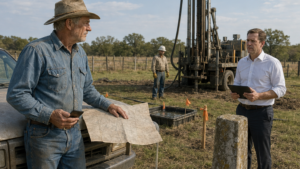
They took the plan into the county meeting room that afternoon because the utility contractor wanted the old well-house arrangement documented before trenching near it.
Christine joined them.
So did the zoning clerk.
There was no dramatic hearing.
No crowd.
No speech.
Just a table, old drawings, new measurements, and four people trying to make sure another informal arrangement did not survive for forty years simply because nobody wanted to write it down.
The old feeder remained in place.
Gregory’s farm retained its service.
The venue received a new independent meter and upgraded capacity.
The temporary construction access was limited to three days, with one weather extension allowed by written notice.
Heather signed first.
Then Gregory.
The pen felt strange in his hand.
Not hostile.
Not distrustful.
Just clear.
The following week, Ryan rebuilt the fence opening with a proper braced service gate instead of replacing it exactly as before.
Gregory had agreed to the change because the utility company still needed occasional access to its new equipment on the venue side.
The gate sat fully within Gregory’s boundary.
It had a heavy latch and a lock.
Heather had no key.
The venue did not need one.
On Friday afternoon, the utility crew energized Heather’s new meter.
Gregory was checking mineral tubs when he heard Ryan call from the lane.
“You want this back?”
He held up the thick orange cable.
Gregory walked over.
For several seconds, he just looked at it.
The cable seemed smaller coiled in Ryan’s hands than it had stretched across the pasture.
Ryan shifted his grip.
“We don’t need it anymore.”
Gregory took it.
A paper tag had been tied around the coil.
VENUE PROPERTY — INDEPENDENT SERVICE ONLY.
Gregory read it and looked at Ryan.
“Your idea?”
“Heather’s.”
Gregory carried the cable to the new gate.
Heather was standing beside the venue’s meter cabinet with the electrician and utility crew. When they finished, she crossed toward him.
“The account is live.”
“I heard.”
“No more borrowing.”
“That’ll simplify things.”
She looked at the rebuilt fence.
“We paid the invoice this morning.”
“I saw.”
“The real invoice.”
Gregory nodded.
Heather rested one hand on the gate brace.
“I still think five o’clock was unnecessarily theatrical.”
Gregory considered lying.
Instead he said, “Maybe it was.”
She looked surprised.
“I also think you would’ve ignored me if there hadn’t been a consequence.”
Heather considered that.
“Maybe I would have.”
Neither of them smiled.
There was no reason to.
Some disagreements did not need a winner in every sentence.
Heather stepped back onto her side.
“Next spring we’re doing a growers’ breakfast.”
Gregory raised an eyebrow.
“We have our own power.”
“Good.”
“And our own access.”
“Better.”
She hesitated.
“You’re invited.”
Gregory looked toward the barn.
“We’ll see.”
“That sounds like a no.”
“It sounds like I’ll decide when you ask me again in spring.”
Heather nodded.
“Fair enough.”
She walked back toward the venue.
Gregory remained beside the fence.
For years, he had thought a closed gate was a sign that neighbors had failed each other.
His father had kept everything locked.
Every shed.
Every lane.
Every boundary.
Gregory had spent decades opening what the old man had closed, partly because he believed trust required it and partly because he never wanted anyone to confuse him with his father.
Now he understood that an open gate meant nothing if no one knew who had the right to open it.
He lifted the orange cable and carried it to the shed.
He did not throw it away.
He hung it neatly from a hook inside, where it could still be used if somebody asked and there was a reason to say yes.
Then he walked back to the boundary.
The new gate stood square between the posts.
Gregory swung it once to make sure it cleared the ground.
The latch dropped cleanly into place.
Across the pasture, Heather’s new meter was humming beside the barn.
Gregory slipped the pin through the latch.
This time, the click did not sound like distrust.
It sounded like both sides finally knowing where the line was.
The story has ended.