The Number on Her Wrist
Part I — The Range Was Waiting
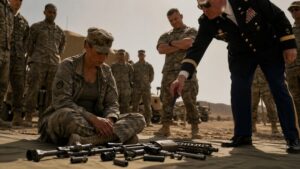
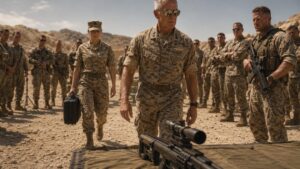
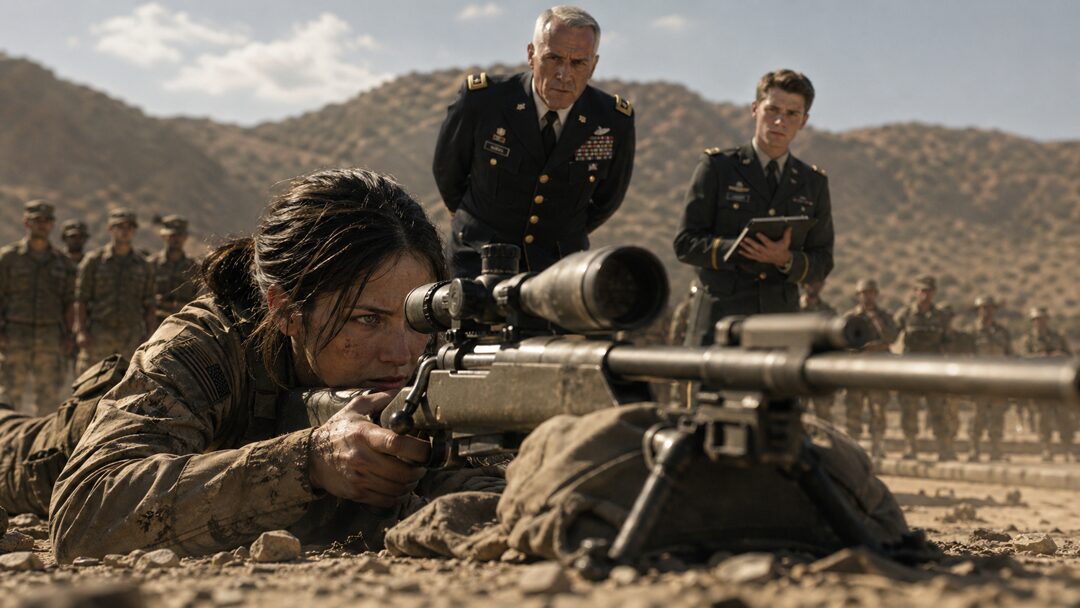
Mara Voss lay flat in the dust with a rifle pressed into her shoulder and seven men behind her waiting for her to embarrass herself.
No one said it aloud.
They did not need to.
The range was silent except for the dry scrape of wind over sandbags and the restless clink of medals on Colonel Adrian Holt’s dress uniform. He stood ten paces behind her, polished black boots planted as if the earth itself had been ordered to hold still. His arms were folded. His expression belonged to a man attending a ceremony, not a test.
A ceremony for the dead, maybe.
Or for a woman he intended to bury twice.
“Former Staff Sergeant Voss,” Holt said, loud enough for everyone on the line to hear, “this is a standard re-certification. Nothing more.”
Mara did not turn around.
Her cheek rested against the rifle stock. Her dark hair was tied low at the nape of her neck. Dust had already settled along her jaw and the back of one hand. That hand was scarred across the knuckle, pale and old, a narrow line of memory that did not ask to be noticed.
“Then standard conditions,” she said.
The range officer, Lieutenant Caleb Rusk, looked down at his clipboard.
He was young enough to still believe clipboards could protect him. Clean uniform. Fresh shave. Notebook tucked under one arm. Eyes moving between Mara and Holt like he could feel the chain of command tightening around his throat.
Holt’s mouth barely moved.
“Adjust the target.”
Caleb hesitated. “Sir?”
“Two hundred meters farther. Crosswind lane.”
One of the soldiers behind Holt shifted his weight. Another gave a small, cruel breath that might have been a laugh if it had been braver.
Mara closed her eyes for half a second.
Not from fear.
From recognition.
There were always men who changed the rules and called it standards.
Caleb cleared his throat. “Colonel, that isn’t part of—”
“It is now.”
The young lieutenant swallowed the rest of the sentence. He signaled to the range crew.
Downrange, the target slid farther into the shimmer of heat until it seemed less like paper and more like a rumor. The flags along the lane snapped and twisted, crosswind dragging at them in uneven bursts. Dust ran over the ground in thin little streams.
Holt stepped closer.
“Any objection, Voss?”
Mara opened her eyes.
Through the scope, the world narrowed. Heat. Paper. Breath. Distance. Wind. The black center of the target trembling in the sun.
“Same rifle?” she asked.
Holt’s jaw tightened, as if he had expected pleading and gotten a measurement instead.
“Yes.”
Mara adjusted the scope once.
Only once.
Behind her, Sergeant Ilya Dane watched with his arms loose at his sides. He was older than the others, broad and sun-browned, with gray in the stubble along his jaw and eyes narrowed from too many years looking across hot distances. He had run ranges long enough to know the difference between arrogance and quiet.
This woman was not arrogant.
That bothered him more.
Holt glanced at Caleb. “Record everything.”
Caleb’s pen touched paper.
Mara heard it.
A scratch in the silence.
For six years, no one had wanted to record anything about her. Not her orders. Not her absence. Not the names of the men who had disappeared beside her. Not the corridor. Not the children who had run toward a flare because the dark behind them was worse.
Now they wanted ink.
She let out one slow breath.
“Ready,” Caleb called, though his voice made the word sound like a question.
Mara settled deeper into the dust.
The range waited.
Holt waited.
Every man behind her waited for the first miss.
Mara touched the trigger like it was a door she had opened before and hated entering.
Then she fired.
Part II — A Line No One Could Explain
The first shot cracked across the range and vanished into the heat.
No one saw the hit.
Mara did not move except to breathe.
The second shot followed.
Then the third.
Then the fourth.
There was no drama in her body. No strain in her shoulders. No theatrical pause. The rifle rose and settled, rose and settled, as if she were not firing at all but counting something only she could see.
Caleb marked each shot.
Holt watched the far target through field glasses, then lowered them.
Nothing about his face changed, but one of the soldiers behind him smirked.
“Can’t see a thing,” the soldier muttered.
Sergeant Dane turned his head just enough to silence him.
Mara fired the last shot.
The range went quiet again.
The silence afterward felt different. Before, it had belonged to judgment. Now it belonged to something waiting under the ground.
“Cease fire,” Caleb called.
Mara lifted her hand away from the rifle and stayed where she was.
Holt’s boots ground softly against the dirt as he stepped forward.
“Well?” he said.
Caleb signaled the retrieval. The target came back slowly, swaying on its track, sun flashing along the metal rail. It took longer than it should have. Or maybe everyone simply became aware of each second.
When the paper reached the line, Caleb walked to it with his clipboard ready.
He stopped.
His pen slid out of his fingers and hit the ground.
Holt’s eyes narrowed. “Lieutenant?”
Caleb did not answer.
Sergeant Dane moved first. He crossed to the target, stopped beside Caleb, and looked.
The red marks formed a near-perfect vertical line through the center.
Not scattered.
Not lucky.
A line.
Tight enough to look intentional. Clean enough to feel impossible. Shot stacked under shot as if the rifle had punched a message through the paper.
Dane did not speak for three full seconds.
Then he said, very quietly, “Jesus.”
That was when the others came closer.
The smirking soldier lost the shape of his mouth.
Another leaned in, then leaned back, as if the paper had heat of its own.
Caleb picked up his pen with fingers that no longer looked steady. “Colonel…”
Holt looked at the target.
For the first time, something moved behind his eyes.
Not admiration.
Not even surprise.
Alarm.
Mara rose from the prone position without hurry. Dust fell from the front of her uniform. She did not look at the target first. She looked at Holt.
He hated that.
“Again,” he said.
Caleb blinked. “Sir?”
“Run it again.”
“Colonel, the sequence is complete.”
“I said again.”
The air changed around the order. Everyone felt it. A second test after a failure made sense. A second test after perfection meant something else.
Mara brushed dust from her sleeve.
“You wanted a number,” she said. “You got one.”
Holt’s face hardened.
“That grouping is irregular.”
Dane looked at him. “Irregular?”
“Verification is required.”
One of the younger soldiers, standing half a step behind the rest, whispered before he could stop himself.
“That’s like the Kassar story.”
Holt turned so fast the soldier flinched.
“What did you say?”
The soldier’s face went pale. “Nothing, sir.”
“No. Say it properly.”
The soldier stared at the ground. “Just an old thing, sir. Border campaign rumor. Ghost shooter. Vertical mark on the corridor posts.”
Dane’s eyes flicked to Mara.
Mara’s expression had not changed.
That was the worst part. Not the shot. Not the line. Not Holt’s sudden anger.
Her stillness.
It was the stillness of someone hearing a dead man’s nickname spoken by a child who had learned it from a dirty joke.
Holt stepped toward her.
“You will retake the sequence.”
“No.”
The word did not rise.
It landed.
Caleb looked from Mara to Holt and back again, his notebook pressed too tightly to his ribs.
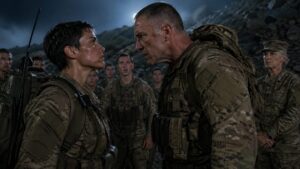
Holt’s voice dropped. “You are under review, Voss. You don’t give orders here.”
“No,” she said again. “I remember.”
The soldiers went silent.
Holt moved close enough that his shadow fell across her boots.
“You walked away from your service record for six years.”
Mara’s eyes lifted to his.
“No, Colonel. My service record walked away from me.”
The line hung there.
Dane glanced down at the target again. The red marks seemed louder now.
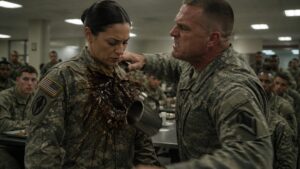
Holt reached for Mara’s arm.
Maybe he meant to pull her away from the line. Maybe he meant to assert rank with touch because words had begun to fail him. Maybe he only wanted to move her before the men started thinking too much.
His fingers closed around her sleeve.
Mara did not resist.
But when he pulled, the cuff slid back.
And the tattoo appeared.
Part III — The Mark Under the Sleeve
It was small enough that anyone could have missed it.
A faded black crosshair at the inside of Mara’s wrist. Scar tissue cut through part of the ink, turning one circle uneven. Above it were three numbers.
Below it, in worn block letters:
DEATH ANGEL.
Holt froze.
Not like a man surprised.
Like a man seeing a door open in a room he had locked from the outside.
His fingers were still around her arm. The grip that had been command a second earlier became something else. Not gentle. Not firm. Empty.
Caleb saw it.
So did Dane.
The others saw only that their colonel had gone pale.
Mara looked down at Holt’s hand on her wrist.
“You can let go now,” she said.
Holt released her.
His throat moved.
“Where did you get that?”
Mara covered the tattoo with her other hand, not from shame, but because the air around it had become too crowded.
“You recognize it.”
“No.”
The denial came too fast.
Dane’s eyes narrowed. Old soldiers knew the smell of a lie before they knew its shape.
Holt turned sharply. “Clear the range.”
No one moved.
His voice cracked like a whip. “Now.”
The soldiers began to scatter, but not cleanly. Their curiosity dragged behind them. Caleb stayed because his duty pinned him there. Dane stayed because no one had ordered him by name and because he had spent half his life pretending not to hear things he heard perfectly.
Mara did not move.
Holt looked at her. “You are dismissed from the line.”
“No.”
“You are finished here.”
“No,” she said. “You made sure everyone was watching. Let them keep watching.”
His eyes flashed. “Stand down.”
Mara’s face softened then, just barely. Not kindness. Memory.
“You already asked me to do that once.”
The words struck Holt harder than the shots had.
For a moment, the entire range seemed to tilt toward him.
Caleb felt his stomach tighten.
He had studied campaigns in clean classrooms. He had memorized maps with neat arrows and dates beneath them. Kassar. Bellwether. Ceasefire corridor. Stabilization phase. Successful withdrawal.
He had never seen a textbook make a colonel afraid.
Holt stepped closer to Mara and lowered his voice.
“You don’t know what you’re doing.”
Mara’s eyes did not leave his.
“That was what you told us before you cut the line.”
Dane inhaled slowly.
Cut the line.
He had heard that phrase once before, not in a report. In a barracks, years ago, from a medic who drank until he could say it and then cried because he had said it.
Bellwether.
The word did not enter the air, but everyone who knew even a little felt it near.
Holt looked toward Caleb. “Lieutenant, the range log will reflect that former Staff Sergeant Voss became noncompliant during evaluation.”
Caleb’s pen hovered over paper.
He wanted to obey.
Obedience was clean. Obedience had edges. Obedience gave you somewhere to put your fear.
But he had seen the target.
He had seen Holt’s face.
He had seen the tattoo.
And for the first time since he had put on the uniform, Caleb understood that a record could be a weapon.
“Sir,” he said carefully, “the live-fire sequence was completed.”
Holt stared at him.
Caleb felt his pulse in his teeth.
Dane’s mouth twitched, not quite a smile.
Mara looked at the young lieutenant for the first time.
Just once.
It was not gratitude.
It was warning.
Truth did not make you safe.
It only made you responsible.
Holt turned back to Mara. “Office. Now.”
Mara glanced at the target, then at the empty sky beyond it.
“Still giving orders from behind me,” she said.
Then she walked past him.
For the first time that morning, Holt followed.
Part IV — Bellwether Was Not a Victory
The range office smelled like burnt coffee, hot paper, and old dust.
Holt shut the door behind them hard enough to rattle the blinds.
Mara stood near the desk. She did not sit. Holt remained by the door, as if blocking it gave him back the authority he had lost outside.
For a few seconds, neither of them spoke.
On the wall behind the desk hung a framed campaign print: KASSAR BORDER STABILIZATION. A flag. A ridge. A slogan about resolve.
Mara looked at it.
Holt saw her looking and hated her for that too.
“You came here to ruin me,” he said.
Mara turned back. “I was summoned.”
“Don’t play dead with me.”
Something almost moved across her face.
Almost.
“I never played dead, Colonel. Other people filed me that way.”
Holt took one step toward her. “Your file was sealed for reasons above your clearance.”
“My clearance died with my team?”
His mouth tightened.
There it was. The first crack in the clean wall.
Mara reached into the inside pocket of her jacket and removed a folded notice. She placed it on the desk.
“Archive review reopened my inactive service file three weeks ago. Not me.”
Holt did not touch it.
She continued, “Someone noticed Bellwether has too many clean numbers.”
The room seemed to shrink.
Outside, faint through the glass, came the distant movement of men pretending not to listen.
Holt’s voice lowered. “Bellwether ended.”
“No. Bellwether was edited.”
“You have no idea what command was facing.”
“I know exactly what command was facing. Cameras. Elections. A ceasefire deadline. A convoy that would make you look like saviors if it arrived clean and a liability if it arrived bloody.”
Holt’s face darkened. “You think you understand war because you had a scope?”
Mara stepped closer.
It was the first aggressive movement she had made all day.
“No,” she said. “I understand the part of war you could do from a distance because I was the distance.”
Holt looked away first.
Only for a heartbeat.
But Mara saw it.
That was the thing about a scope. It taught you how little movement guilt required.
“The tattoo,” Holt said. “That was not authorized.”
A strange sentence. Small. Ridiculous.
Mara almost smiled.
“You abandoned a corridor and you’re worried about ink.”
“You were ordered to disengage.”
“We were ordered to hold until evacuation completed.”
“Command priorities changed.”
“There were children on the road.”
Holt slammed his hand onto the desk. “There were enemy fighters in the crowd.”
“Yes.”
Mara’s voice went quiet enough to force him to hear it.
“And there were children in front of them.”
Holt breathed hard through his nose.
For a moment, the office was gone for Mara.
There was only the road.
The white flare.
The sound of people trying not to scream because screaming drew fire.
A boy with one shoe carrying a baby that was not his.
The radio repeating stand down, stand down, stand down until the words became a kind of weather.
Her spotter, Niko, laughing once because if he did not laugh, he would beg.
Then the flare rising again.
Still here.
Still here.
Still here.
Mara blinked, and the office returned.
Holt was watching her now with something uglier than anger.
Fear recognized itself in another person and hated the mirror.
“Eight hundred forty-seven,” he said.
Mara’s wrist flexed once at her side.
“You thought it was a count.”
His silence answered.
“They all do,” she said. “It makes the story easier.”
He looked at the door. “Lower your voice.”
“No one wants the truth loud until the lie starts cracking.”
“Enough.”
“Eight hundred forty-seven were marked for evacuation when you cut the corridor from the report. Civilians. Medics. Two platoons that got left off the final map because they were attached through a channel no one wanted to admit existed.”
Holt closed his eyes briefly.
Mara saw the numbers moving behind his eyelids.
Not because he had forgotten.
Because he had not.
“My team held the ridge after your withdrawal order,” she said. “Not for victory. Not for glory. So the people on that road knew the corridor was still alive.”
Holt opened his eyes.
“The enemy called you Death Angel,” he said.
Mara shook her head.
“That’s what soldiers like to say.”
“Then what was it?”
She did not answer.
Not yet.
Some truths needed the right witnesses.
Holt’s voice changed. Softer now. More dangerous.
“There is an oversight delegation arriving in forty minutes. You leave before then, this can be corrected quietly. Full reinstatement. Back pay. Medical benefits. Your name restored where it can be restored.”
Mara stared at him.
There it was.
The bargain.
Not justice. A cleaner erasure.
“You’re offering to give me back what you took if I help you keep the grave closed.”
“I’m offering you a life.”
“I had one.”
“You had a rumor.”
Mara’s eyes sharpened.
“No,” she said. “You made me one.”
Outside the office, Caleb stood in the narrow hall with his notebook pressed open against the wall, not writing. Listening was disobedience enough.
Sergeant Dane stood at the far end by the water cooler, arms folded.
He did not look at Caleb.
He simply said, “If you’re going to hear something, Lieutenant, hear all of it.”
Then he opened the door to the records cabinet with a key he was not supposed to have.
Part V — The File That Shouldn’t Exist
The sealed briefing packet was not in the cabinet under Bellwether.
That would have been too honest.
It was filed under range compliance, attached to Mara’s re-certification order as if history could be hidden under paperwork no one wanted to read.
Dane set it on the table in the adjoining briefing room.
Caleb stared at the red band across the folder.
“Sergeant,” he whispered, “we are not cleared for this.”
Dane slid a knife under the seal.
“No,” he said. “We’re just responsible for it.”
The folder opened with a soft tear.
Inside were photocopied fragments, blacked-out paragraphs, clipped maps, a casualty summary, and an old transmission log degraded by time and handling. Caleb read fast at first, then slower as the words began refusing to remain bureaucratic.
NON-ATTRIBUTABLE ASSETS.
EVACUATION INTERRUPTED.
CORRIDOR STATUS OMITTED FROM FINAL BRIEF.
CIVILIAN COUNT UNVERIFIED.
Under a black bar, one name had not been fully erased.
VOSS, M.
Caleb sat down.
His notebook lay open beside the file. All morning he had filled it with times, distances, wind notes, commands. The tidy facts of a test.
Now the facts looked small.
Dane tapped one page. “See that pattern?”
Caleb followed his finger to a copied field note. A crude mark drawn beside the words: vertical red signal, corridor active.
His mouth went dry.
“The shots,” he said.
Dane nodded.
“Wasn’t a trick.”
Caleb looked toward the office door.
Inside, Holt was still talking. Low. Urgent. The voice of a man trying to close a door while the wall around it burned.
Caleb heard Mara say, “I don’t want your inquiry.”
Holt answered, “Then what do you want?”
A pause.
When Mara spoke again, her voice was almost too quiet to catch.
“I want them to stop calling it clean.”
Caleb looked back at the file.
The official campaign print on the wall in the outer room suddenly seemed obscene. A slogan. A flag. A ridge with no bodies on it.
He picked up his pen.
Dane watched him. “What are you doing?”
“Correcting the range log.”
“Careful.”
Caleb looked up.
The older sergeant’s face had no softness in it, but it had something better.
Recognition.
Caleb wrote: Test conditions altered by order of Colonel Holt. Sequence completed. Pattern matches archived Bellwether corridor signal.
His hand shook only once.
Then he added: Witnessed.
Dane gave a short nod.
The sound of vehicles came from outside.
Not range trucks.
Black government sedans rolling over gravel.
The oversight delegation had arrived early.
Holt stepped out of the office first, face reset into command.
Mara followed.
If Caleb had not seen the tattoo, the target, the file, he might have believed Holt had won the room back by standing straighter.
That was another thing command taught well.
Posture as camouflage.
Holt’s eyes fell on the open folder.
For half a second, he looked old.
Then the colonel returned.
“Close that,” he ordered.
Dane did not move.
Caleb stood.
“Lieutenant,” Holt said, each syllable sharp, “you are relieved of record duty.”
Caleb felt every lesson he had ever learned rise inside him and beg to be obeyed.
Yes, sir.
Of course, sir.
Forgive me, sir.
Instead, he closed his notebook around the page he had just written.
“No, sir.”
The room seemed to stop breathing.
Holt stared at him. “What did you say?”
Caleb’s voice was not strong, but it did not break.
“I said no, sir.”
Mara looked at him again.
This time, there was something like sorrow in it.
Choosing truth made you older immediately.
The delegation entered before Holt could answer.
Three civilians in dark suits. One general with a face carved from administrative caution. They had arrived expecting a personnel review.
They stepped into a room holding an open classified fragment, a silent colonel, a young lieutenant standing too straight, an old sergeant who looked ready to be punished, and a woman with dust still on her sleeves.
The general’s eyes went to Holt.
“Colonel. We were told the evaluation was ongoing.”
Holt recovered faster than most men would have.
“It is,” he said. “Former Staff Sergeant Voss displayed signs of instability during live-fire procedures. I recommend immediate suspension of reinstatement review pending psychiatric evaluation.”
The old machinery began turning.
Words like unstable.
Procedure.
Safety.
Review.
Mara listened.
She had heard artillery with less predictable rhythm.
Holt turned toward her. “For the record, are you willing to complete a final demonstration under observation?”
Everyone looked at Mara.
There it was again.
The trap dressed as a standard.
If she refused, he would call it instability.
If she performed, he would call it spectacle.
If she spoke too much, he would call it trauma.
Mara glanced once at Caleb’s notebook.
Then at the open file.
Then at the target still hanging outside in the heat, its red vertical line bright as a wound.
“No,” she said.
Holt’s mouth tightened with relief.
Then Mara added, “Not that demonstration.”
She walked past him toward the door.
“Bring a clean target.”
Part VI — The Corridor Signal
They followed her back to the range.
Not because Holt ordered it.
Because Mara moved as if the place had always been hers and the rest of them were late to understand why.
The sun had dropped lower. The heat had sharpened. The wind moved hard across the lane now, tugging at uniforms, snapping flags, carrying dust against polished shoes and trouser cuffs.
A clean target went up.
White paper.
Untouched center.
Mara took the rifle from the bench.
Holt stepped close. “This proves nothing.”
She looked at him.
“It proved enough when you thought I’d fail.”
The line landed where it needed to.
Not loud.
Not cruel.
True.
Caleb stood beside the delegation with his notebook clutched against his chest. Dane stood behind him, slightly to one side, close enough to be support and far enough not to make a show of it.
Holt faced the general. “This is inappropriate. The subject is manipulating a live-fire review into political theater.”
Mara lay prone.
The phrase subject did not reach her.
The rifle settled.
Her breath slowed.
The world narrowed again.
Not to target, wind, and distance this time.
To road.
Ridge.
Flares.
The radio calling retreat in a voice that had already decided who counted.
Niko beside her, bleeding into the dust, saying, “Make the mark. They’ll know.”
Her own voice, younger and less broken, saying, “They’ll see?”
“They’ll see.”
The children did.
So did the medics.
So did the wounded soldiers who had stopped believing anyone remained on the ridge.
A red vertical line on a checkpoint sign.
A white flare.
Still here.
Mara fired.
Once.
Twice.
Again.
Each shot entered the paper with the same brutal patience.
No one spoke between them.
Even Holt stopped pretending the sound was ordinary.
When the final shot cracked and faded, Mara stayed still for a moment longer.
Then she rose.
The target returned.
The line was there.
Vertical.
Exact.
A message from a war the official record had cleaned until no one could smell blood on it.
Mara walked to the target, unbuttoned her cuff, and pulled back her sleeve.
The tattoo looked smaller in daylight than it had in the office.
Smaller, and worse.
DEATH ANGEL.
She placed her wrist beside the red marks.
Then she looked not at the general, not at the delegation, not at Caleb, but at Holt.
“Ask him what the number means.”
No one moved.
The wind dragged dust across the range.
Holt’s face had gone still in a way that was almost peaceful.
The general turned. “Colonel?”
Holt looked at the target.
Then at Mara’s wrist.
For one final moment, denial remained available to him. It stood there, polished and familiar, wearing his uniform. He could still call her unstable. He could still bury the file under procedure. He could still survive, perhaps, if survival was only the art of staying employed.
Mara did not plead.
That was what undid him.
She gave him no speech to resist. No accusation to swat away. No performance to discredit.
Only the number.
Only the line.
Only the witnesses.
Holt swallowed.
“The official record of Operation Bellwether,” he said, “was incomplete.”
The general’s face hardened. “Incomplete how?”
Holt looked at the soldiers behind him. Men who had watched him arrive as judge. Men now watching him become evidence.
He did not look redeemed.
He looked cornered by the part of himself that had never stopped knowing.
“An evacuation corridor was omitted from the final report,” he said. “Non-attributable sniper assets remained after withdrawal was ordered. Casualty and civilian movement numbers were altered.”
Caleb’s pen moved across paper.
This time, his hand did not shake.
The general said, “By whose authorization?”
Holt shut his eyes.
Mara covered the tattoo.
That was all.
When Holt opened his eyes again, he did not look at her.
“Mine,” he said.
The word did not explode.
It simply removed the air.
Dane bowed his head once, not in respect for Holt, but for the dead who had finally been allowed into the room.
The delegation moved quickly after that. Quiet orders. Phones. A request for the file. A second request for Caleb’s notebook. Holt asked to speak with counsel. The general told him to wait inside.
No one put handcuffs on him.
No one applauded Mara.
The world did not become clean because one man said one true word.
But something shifted.
A record opened its eyes.
At dusk, Mara walked alone toward the edge of the range with her sleeve buttoned again.
Caleb caught up to her near the gravel lot.
He stopped a few feet away, careful not to crowd her.
“Staff Sergeant Voss?”
She turned.
He held the notebook under one arm. It looked different now. He did too.
“I kept the log,” he said.
“I know.”
“They asked for a copy.”
“Good.”
He looked past her to the empty range. The target had been taken down, but he could still see the line in his mind.
“I’m sorry,” he said, then seemed ashamed of how small it sounded.
Mara looked at him for a long moment.
“Don’t spend that word too quickly,” she said. “You may need it later.”
He nodded.
She turned to leave.
But the question escaped him before discipline could stop it.
“Was that really what they called you?”
Mara paused.
Caleb felt suddenly foolish. Young. Greedy for legend when he had just been shown a grave.
“Death Angel,” he said quietly. “Was that the enemy?”
The evening wind moved across the gravel.
Mara looked down at her covered wrist.
For the first time all day, her face changed completely.
Not much.
Just enough to let grief stand where control had been.
“No,” she said. “That was what the children called the flare when they saw we were still there.”
Caleb did not answer.
There was no right answer to that.
Mara walked away without saluting anyone.
At the far end of the lot, Sergeant Dane stood beside an old range truck, pretending to check a tire that needed no checking. As Mara passed, he did not speak. He only stepped aside, giving her the road.
Behind them, the range lights clicked on one by one.
White circles in the dust.
Not flares.
Not signals.
Just light.
Mara kept walking until the voices behind her thinned into distance. She did not feel free. Freedom was too large a word for what one honest afternoon could give back.
But her name was moving again.
Somewhere, in a room full of locked cabinets, a file had reopened.
Somewhere, a young officer had written witnessed and meant it.
Somewhere, eight hundred forty-seven was no longer just a number on a dead woman’s skin.
At the gate, Mara stopped once and unbuttoned her cuff.
The tattoo had faded.
The scar through the crosshair would never fade with it.
She covered it again.
Then she stepped through the gate and into the darkening road, carrying the dead with her, but no longer carrying them alone.