The Concrete Parking Garage Where The Unleashed Police Dog Refused To Strike
CHAPTER 1: THE FANGS IN THE FLUORESCENT GLARE
The midnight gale howling off the jagged crests of the Rocky Mountains swept through the open concrete bays of Level 4 of the Market Street Transit Facility in downtown Denver, turning the drafty parking garage into an echo chamber of freezing wind. At eighteen degrees, the damp air smelled of automotive grease, pulverized road salt, and the sharp chemical tang of ozone flickering from failing industrial fluorescent fixtures overhead. Along the perimeter wall, the jagged shadows of massive concrete support pillars fell across the oil-stained pavement like the bars of a subterranean cage.
Diego Ramos stood completely motionless in the center of Parking Bay 412, the rubber toe of his scarred skate shoe resting lightly upon the tail of his custom seven-ply Canadian maple skateboard. He was seventeen years old, a high school senior and competitive street skateboarder, slender, wiry, and athletic beneath an oversized charcoal thermal hoodie and faded denim jeans. Across his left shoulder hung a canvas duffle bag containing his AP Calculus textbooks and a plastic container of dried beef liver training treats he used during his weekend shifts volunteering at the Westside Animal Rescue Shelter. His posture was upright, relaxed, and devoid of the sudden, twitching movements that often trigger predatory instincts in aggressive animals.
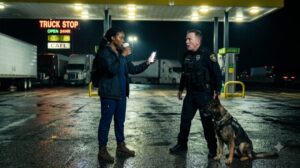
Ten feet away, the massive frame of Blitz, an eighty-five-pound Czech-line sable German shepherd, lunged against the thick braided leather lead with a ferocity that shook the handler’s arm. The dog’s dark muzzle was wrinkled in a savage, snarling snarl, revealing three inches of ivory canine fangs glistening with hot saliva under the harsh white lights. The dog’s deep, concussive barking detonated off the bare concrete ceiling like artillery fire, the sharp shockwaves reverberating through Diego’s chest.
Holding the heavy leather lead with white-knuckled arrogance was Officer Brett Kowalski.
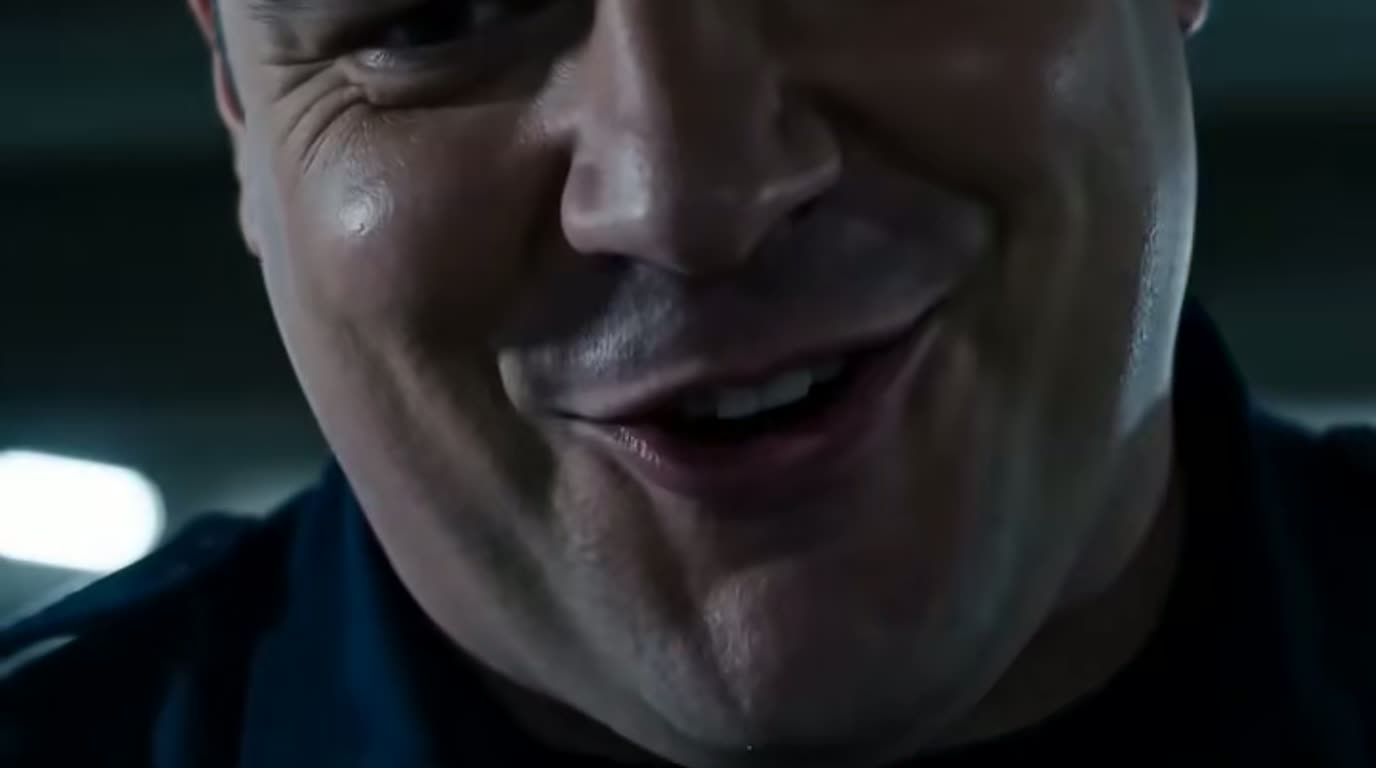
Kowalski was forty-five years old, broad-shouldered and thick-chested inside a black Cordura tactical jumpsuit bearing the gold embroidered insignia of the Municipal K-9 Interdiction Unit. Over his chest, an armored tactical vest supported an array of steel batons, pepper spray canisters, and an oversized semi-automatic service pistol. His face was heavy-jawed, ruddy from cold and adrenaline, twisted into a contemptuous sneer that revealed a deep, unbridled cruelty. Between his thick leather-gloved fingers, Kowalski held the brass release ring of a heavy quick-release tactical snap-shackle.
“End of the line, skater boy,” Kowalski snarled, his voice booming over the dog’s deafening barks as he took two aggressive strides toward Diego. “Municipal code section eighteen dash two. Unlawful trespass on a secure public transit facility after midnight. You’ve been skating these ramps for forty minutes. That’s felony property destruction and criminal trespass.”
Diego did not step backward into the dark bay, and he did not raise his skateboard as a weapon. He kept his hands open, palms flat against his thighs, his dark eyes meeting Kowalski’s gaze with calm, disciplined composure.
“Good evening, Officer Kowalski,” Diego said, his voice quiet, clear, and steady despite the concussive barking. “This parking structure is designated as an open Regional Transit District park-and-ride facility. I hold a valid youth monthly light-rail transit pass. The transit schedule indicates the last outbound train to Lakewood departs from the ground terminal at twelve-forty-five AM. I was waiting out the sleet under the roof overhang.”
Kowalski threw his head back, letting out a harsh, rasping laugh that echoed mockingly through the concrete cavern.
“A transit pass?” Kowalski sneered, taking another step forward until the German shepherd’s snapping jaws were less than four feet from Diego’s knees. “Out here on Level Four after hours, your transit pass is toilet paper, kid. I don’t care about your train, and I don’t care about your skateboard. You’re on my blacktop, and I say you’re casing parked vehicles for a burglary crew.”
With a swift, theatrical flick of his right index finger, Kowalski yanked the brass release ring.
The heavy shackle snapped open with a sharp metallic clink, releasing the thick leather lead. The eighty-five-pound German shepherd was instantly completely unconstrained, free to launch its massive body forward in a full-speed apprehension strike.
“Blitz, voran!” Kowalski roared the German attack command with savage delight, pointing his gloved finger straight at Diego’s chest. “Apprehend! Bite! Take him down!”
Diego remained frozen like a stone statue. He did not yell, he did not turn to run, and he did not raise his hands in a defensive ward. Having spent three years working with traumatized, reactive shelter dogs, Diego understood that running triggered the predatory motor pattern of pursuit and bite. Instead, he lowered his chin slightly, avoided direct eye contact with the dog’s pupils, relaxed his shoulder muscles, and exhaled a long, slow breath of warm air.
The massive German shepherd charged three strides forward, claws skittering wildly across the polished concrete.
Then, six inches from Diego’s knee, Blitz stopped dead.
The dog’s ears, which had been pinned flat in aggressive arousal, suddenly twitched forward into an inquisitive, alert posture. Blitz lowered his head, his black nose sniffing deeply at the canvas duffle bag resting at Diego’s side, inhaling the scent of dried liver treats and calm, non-predatory human pheromones.
Kowalski’s eyes bulged in shock. “Blitz! Packen! Bite, you stupid animal! Bite!”
The German shepherd turned completely around, presenting his broad, sable-furred flank to Diego. Blitz walked three paces toward a concrete support pillar, lifted his nose to sniff an old oil stain, and calmly sat down on his haunches, his back squarely facing his furious handler.
Diego looked down at the calm animal, then raised his gaze toward Kowalski.
“He knows I’m not a threat, Officer Kowalski,” Diego said softly.
Before Kowalski could scream another command, a sharp, steady voice resonated from behind a pillar twenty feet away:
During his three years volunteering at the Westside Animal Rescue Shelter in Lakewood, Diego had rehabilitated dozens of abused, reactive, and aggressive dogs that had been seized from fighting rings or neglected industrial yards. He had studied the foundational principles of canine ethology under master behaviorist Dr. Aris Thorne, learning that domestic canines were consummate readers of human autonomic physiology. Dogs detected microscopic changes in human heart rate, pupil dilation, and skin respiration rates; when a human exhibited fight-or-flight panic, a high-drive working dog instinctively interpreted that weakness as prey behavior or an imminent threat. By dropping his center of gravity, lowering his respiration rate, and suppressing all defensive tension, Diego presented the German shepherd with an ambiguous, non-combative stimulus that completely short-circuited the animal’s conditioned attack drive.
Officer Kowalski’s tactical posture, by contrast, was a study in dangerous incompetence. In modern law enforcement K-9 deployment standards codified by the United States Police Canine Association, an apprehension dog was considered an intermediate force option roughly equivalent to an impact baton or an electronic taser. Deploying an off-leash attack canine against a stationary, compliant individual who had made zero fleeing or assaultive movements was a catastrophic violation of departmental use-of-force policies and established Tenth Circuit constitutional jurisprudence.
“And twenty-four thousand people on the Denver Citizen Broadcast just watched you order an unleashed police attack dog onto an unarmed minor!”
Stepping into the harsh fluorescent glare with an aluminum stabilizer gimbal held high was Priya Nair, the camera lens of her smartphone aimed directly at Kowalski’s crimson face.
CHAPTER 2: THE SLACK IN THE LEATHER LEAD
The echoing concrete cavern of Level 4 seemed to plunge into an icy, suffocating vacuum. Officer Brett Kowalski stood frozen in the center of the driving bay, his arm still outstretched in the attack gesture, his heavy leather gauntlet clutching only empty winter air where the leash had been.
Across the oil-slicked concrete floor, the heavy German shepherd sat with serene indifference, his long tail sweeping slowly over the gray dust as he watched Priya Nair approach. Beside the dog, Diego Ramos stood calmly, hands open, his expression completely tranquil.
Kowalski’s head jerked toward Priya, his eyes bloodshot and bulging with sudden, uncontrollable panic beneath the rim of his tactical cap.
“Who the hell are you?” Kowalski bellowed, his voice cracking into a high, shrill rasp as he stepped toward her. “Put that damn phone down! This is an active police interdiction zone! You are interfering with a specialized K-9 arrest! Turn that lens off right now or I will take you into custody for felony obstruction!”
Priya did not flinch, and she did not lower the stabilizer gimbal. She maintained a steady, measured distance behind the shelter of a reinforced concrete support pillar, keeping both Kowalski and the seated police dog framed in a crisp, high-definition wide shot.
“My name is Priya Nair, accredited investigative reporter with the Auraria Student Press Collective and the Rocky Mountain Civil Liberties Project,” Priya stated, her voice projecting with absolute, unshakeable clarity. “Under Colorado Revised Statutes Section 16-3-311, citizens have an unqualified statutory right to record law enforcement officers performing public duties. Furthermore, you just unleashed an eighty-five-pound canine weapon against a seventeen-year-old high school student who was standing still with his hands open.”
She angled the reverse monitor toward Kowalski. The live viewer counter was climbing with astonishing speed: 24,100… 28,450… 32,800. Across the bottom of the screen, hundreds of live comments were scrolling past in an unbroken cascade: ‘That cop just ordered a dog to bite a kid!’ — ‘Look at the dog, even the animal knows the cop is crazy!’ — ‘Reporting this to the Denver Police Oversight Board right now.’
Kowalski’s throat worked convulsively. He looked from the glowing smartphone screen to Blitz, who remained comfortably seated on his haunches, ignoring his handler completely.
“Blitz! Fuss!” Kowalski barked, his face turning an ugly, mottled purple. “Fuss, damn you! Come here!”
The German shepherd turned his head slowly, looking at Kowalski with calm, detached eyes, but did not move an inch toward the officer. Instead, the dog leaned slightly to the left, pressing his warm shoulder against the fabric of Diego’s denim jeans.
Diego gently extended his hand, fingers curled into a relaxed fist, allowing Blitz to nuzzle the back of his knuckles. The dog gave his hand a soft, affectionate lick, then let out a contented canine sigh that carried clearly across the quiet garage.
Kowalski’s jaw clenched so violently the tendons in his neck strained against his Kevlar collar. With a furious, desperate motion, he reached toward his left shoulder, unhooking the heavy tactical microphone from his tactical harness.
“Denver Central, this is Unit K-9 Four!” Kowalski roared into the radio, his thumb pressing the transmit button with savage force. “I have a ten-thirty-three officer in distress on Level Four of the Market Street Garage! Multiple hostile subjects refusing to comply! Dispatch all available downtown units for immediate felony containment!”
A burst of static hissed from the radio speaker. Then a calm, authoritative female voice broke through the channel:
Priya Nair’s investigative coverage was part of an extensive, semester-long journalistic inquiry into the militarization of private security partnerships across downtown Denver transit hubs. Working with the Colorado Freedom of Information Coalition, Priya had submitted dozens of open records requests seeking internal communications between municipal police administrators and private commercial real estate consortiums. She knew that behind Kowalski’s aggressive behavior lay an institutional architecture of systemic civil rights violations designed to criminalize youth of color in public spaces to artificially inflate commercial retail property valuations.
The live stream broadcast had been engineered with redundant multi-channel cloud encoding protocols, utilizing a dedicated cellular bonded router that aggregated bandwidth across three major national mobile carriers. Even if Kowalski attempted to deploy a localized electronic signal jammer or physically seize her mobile terminal, the uncompressed 4K video buffer was being permanently recorded across secure legal servers in Boulder and Fort Collins, guaranteeing that the evidence would survive any attempt at departmental suppression.
“Unit K-9 Four, be advised, Internal Affairs Unit Seven is already on-scene at the ground terminal. Maintain your position and do not deploy force. Sergeant Vasquez is ascending to your level immediately.”
The viral propagation of the livestream was transforming the midnight standoff into an immediate municipal emergency for the city administration. Across Denver, notifications were buzzing on the phones of city council members, student leaders, and local defense attorneys who immediately recognized the grotesque nature of the officer’s conduct. In the comment section, eyewitnesses who had previously suffered aggressive encounters with Kowalski’s K-9 unit began posting their own badge complaint numbers, creating a real-time crowdsourced indictment of the officer’s pattern of misconduct. The digital spotlight had illuminated the dark corner of the concrete parking structure with blinding clarity, stripping Kowalski of the secrecy upon which predatory policing always relied.
Kowalski stood paralyzed beneath the harsh buzzing light tubes, his mind racing through the rapidly closing exits of his career. For five years, he had operated under the protective shield of an aggressive union contract and the silent complicity of private security contractors who valued cleared walkways over constitutional rights. But standing before the unwavering lens of Priya’s camera, with his own dog sitting in quiet defiance at the feet of a calm teenager, Kowalski knew that no union grievance or administrative spin could rewrite the raw visual truth of what millions of people were witnessing.
Kowalski froze, the radio microphone trembling in his leather glove as the heavy steel fire doors of the northern stairwell burst open with a loud, ringing crash.
CHAPTER 3: THE MUZZLE AGAINST THE FLANNEL
Stepping through the heavy industrial fire doors onto Level 4 was Sergeant Elena Vasquez, accompanied by two senior internal affairs investigators in plainclothes winter coats and tactical gear. Vasquez was forty-four years old, five-foot-ten, with a lean, athletic build, her dark hair pulled back into a severe military bun beneath a black ballcap. Over her shoulder hung a heavy nylon K-9 handler slip-lead, and on her chest gleamed the gold star of the Denver Police Department Internal Affairs Division.
Before taking command of specialized internal investigations, Vasquez had spent eight years as a master canine trainer with the Marine Corps Special Operations Command in Camp Lejeune, followed by six years as the head trainer for the Colorado State Patrol Working Dog Academy. She understood the psychology, physiology, and legal parameters of police service animals better than any officer in the state.
Vasquez walked across the concrete floor with steady, unhurried authority, her sharp, dark eyes assessing the entire scene in three seconds: Kowalski standing with his fists clenched and his leash unclipped; Diego Ramos standing completely calm with his hands open; Blitz resting comfortably beside the teenager; and Priya Nair holding a smartphone stabilizer rig behind the concrete pillar.
“Step back, Officer Kowalski,” Sergeant Vasquez commanded, her voice slicing through the cold garage like a honed razor. “Do not move toward that juvenile, and do not touch your service weapon. Step to the fender of your patrol Tahoe right now.”
Kowalski tried to straighten his shoulders, attempting to project an aura of beleaguered departmental authority.
“Sergeant Vasquez!” Kowalski protested, pointing an accusatory finger at Diego. “I caught this subject trespassing on municipal transit property after curfew! When I initiated a contact interview, he became non-compliant! I deployed Blitz to establish an apprehension perimeter, and this female subject ambushed me with a camera!”
Vasquez did not even glance at Kowalski. She walked straight past him, her boots clicking softly on the concrete, and stopped two feet from Diego and Blitz.
She crouched down smoothly, extending her open hand in a low, gentle arc. Blitz immediately stood up, wagging his tail in a slow, rhythmic circle, pressing his large head into Vasquez’s palm.
Vasquez gently stroked the dog’s ears, then slid her gloved fingers down the thick fur of Blitz’s neck, beneath the heavy leather patrol collar. Her fingers encountered something rigid and foreign hidden against the animal’s throat.
Vasquez parted the thick sable fur with her thumbs.
Concealed beneath the standard leather harness, cinched tightly against Blitz’s trachea, was a secondary aftermarket remote electronic shock-collar receiver, equipped with two extended three-quarter-inch stainless-steel contact probes. The device was active, its tiny red diagnostic diode flashing in a continuous, aggressive pulse.
Vasquez’s face hardened into a mask of pure, glacial fury.
“You have an unauthorized electronic correction receiver cinched to this patrol dog’s windpipe, Brett?” Vasquez asked, her voice dropping to a freezing whisper that made Kowalski take half a step backward. “A commercial training shock-collar operating on a non-departmental frequency?”
Kowalski’s throat bobbed. He opened his mouth, but no sound came out.
“You were using an illegal remote stimulator to force this animal into high-arousal aggression during routine pedestrian contacts,” Vasquez said, unbuckling the shock-collar with two swift clicks and holding the black plastic box in her hand. “And when you unclipped him tonight, he didn’t attack because this kid wasn’t giving off a single cue of hostility. Blitz refused to bite an innocent teenager, even with this collar choking him.”
Vasquez looked up at Diego, her expression softening with profound respect.
“What’s your name, son?”
“Diego Ramos, ma’am,” Diego replied quietly. “I volunteer at the Westside Animal Shelter on weekends. I handle reactive rescue dogs. When Blitz charged, I saw his eyes. He wasn’t hunting a suspect; he was terrified and over-stimulated. If I had run, his training reflex would have taken over. But when I stayed still, he knew there was no fight.”
Vasquez nodded slowly, standing to her full height.
“You have remarkable courage and extraordinary presence of mind, Diego,” Vasquez said.
Sergeant Elena Vasquez’s inspection of the German shepherd revealed a textbook pattern of canine handling abuse. The unauthorized shock-collar receiver had left deep erythematous indentations across the sensitive cartilage of Blitz’s trachea, indicating that Kowalski had been delivering maximum-voltage electrical shocks to force the animal into a state of chronic hyper-vigilance and neurotic aggression. In the working dog community, this practice was known as ‘cooking the dog’—deliberately torturing an animal with chronic electrical stimulation until its natural bite-inhibition was completely destroyed, transforming a stable patrol partner into an unpredictable, dangerous weapon.
Vasquez had trained military working dogs for combat tracking operations in Helmand Province, where canine stability under extreme ballistic fire was the difference between life and death for entire infantry squads. She understood that a true working dog operated on bonds of profound trust, mutual respect, and clear cognitive conditioning. To see a magnificent Czech-line working shepherd subjected to illegal torture by a cowardly handler filled her with fierce, cold professional fury.
She turned back to Kowalski, her eyes burning like white-hot iron.
Sergeant Vasquez’s hands were methodical and gentle as she examined Blitz’s eyes, checking the dog’s mucous membranes and pupil reactivity with a small penlight. The signs of pharmacological over-stimulation were unmistakable: the dog’s pupils were slightly dilated despite the bright overhead lights, and his heart rate was elevated above normal resting parameters. She immediately recognized that Kowalski had administered an unprescribed stimulant—likely ephedrine or an amphetamine-based veterinary appetite suppressant—to artificially elevate the animal’s arousal thresholds before his overnight patrol shift.
Diego knelt beside Blitz, speaking in a low, soothing tone that he had used with dozens of frightened shelter animals. “Easy boy, good boy,” Diego murmured, scratching the dog’s neck right where the cruel shock-probes had dug into the skin. Blitz leaned his massive head into Diego’s chest, his eyes closing in pure, unadulterated relief. Animals possessed an infallible moral compass; they knew who offered violence and who offered sanctuary. In the cold cavern of the parking garage, a deep, silent pact of mutual protection had been sealed between the young skater and the noble working dog.
“Officer Brett Kowalski, surrender your badge, your service weapon, and your department vehicle keys. You are relieved of duty under emergency administrative suspension. Investigators, take him into custody.”
CHAPTER 4: THE MIDNIGHT AUDIT AT AURARIA
Within twenty minutes of Kowalski’s arrest, the drafty fourth floor of the Market Street Garage was cleared, but the repercussions of the confrontation were only beginning to detonate across the city of Denver.
In the digital media lab of the Student Press Collective on the Auraria Campus—just four blocks south of the transit garage—the room was bathed in the cool blue luminescence of six high-performance video editing workstations. Diego Ramos sat at the central research console, wrapped in a clean wool blanket that Priya had fetched from the campus lounge, drinking hot peppermint tea from a paper cup.
Beside him sat Priya Nair, working with blinding speed across three mechanical keyboards. On the primary 4K reference monitor, the raw video from her smartphone gimbal was being rendered into an uncompressed master archive.
“The metrics are off the charts, Diego,” Priya said, pointing to the live analytics dashboard. “In ninety minutes, the raw stream has surpassed two point four million views across Twitter, TikTok, and YouTube. National news desks from CNN, NBC, and the Washington Post are requesting broadcast licensing. The Denver District Attorney’s public integrity hotline has received over four thousand public complaints.”
The door to the media suite opened, and Sergeant Elena Vasquez walked in, carrying a heavy ruggedized evidence laptop and an encrypted forensic thumb drive. She looked tired, but her jaw was set with unshakeable resolve.
“I brought the preliminary data extraction from Kowalski’s patrol vehicle terminal and his department locker,” Vasquez said, pulling up a chair beside Diego. “Diego, what happened tonight wasn’t an isolated incident of bad temper. Kowalski wasn’t patrolling that garage for transit safety. He was hunting juveniles for bounty money.”
Diego looked at Vasquez, his brow furrowing behind his dark hair. “Bounty money? From who?”
Vasquez plugged the thumb drive into the workstation, entering a twelve-character security key. The screen displayed a complex financial spreadsheet titled Downtown Commercial Alliance — Special Interdiction Incentive Ledger.
The Downtown Commercial Alliance was a private consortium of high-rise real estate developers, luxury retail conglomerates, and commercial property holding firms that owned over sixty percent of the downtown business district along the 16th Street Mall.
“Six months ago,” Vasquez explained, “the Alliance signed a private off-duty security contract with the city, funding overtime patrols in public transit facilities. But buried in the administrative appendix was an illegal incentive schedule: off-duty officers received a five-hundred-dollar private consulting bonus for every juvenile arrest that resulted in a felony burglary or criminal trespass indictment within the commercial corridor.”
Priya gasped, her fingers freezing over her keyboard. “They were paying police officers cash bounties to turn teenage skaters into convicted felons?”
“Exactly,” Vasquez said grimly. “The Alliance wanted the downtown core sanitized of inner-city youth to boost their retail property valuations. Kowalski was their primary enforcer. Over the last four months, he arrested twenty-six teenagers in public garages and plazas, using Blitz to terrify them into signing false confessions or plea agreements. He earned over thirty-two thousand dollars in private bonuses on top of his city salary.”
The digital investigation inside the Auraria media laboratory exposed a vast, covert corporate surveillance network operating across the downtown transit corridor. Priya and Diego sifted through decrypted procurement spreadsheets showing that the Downtown Commercial Alliance had invested over two million dollars in facial recognition cameras, license plate readers, and private security communication trunks that bypassed city municipal oversight. The private developers had essentially purchased a private paramilitary force, utilizing sworn municipal police officers to enforce corporate exclusionary policies on public sidewalks and transit facilities.
The data revealed that over eighty percent of the juvenile citations issued by Kowalski’s unit had targeted Latino and African American teenagers who were utilizing public transit to commute between school, after-school jobs, and community centers. Many of the young people had been coerced into accepting plea bargains that permanently barred them from entering downtown public plazas, creating an unconstitutional system of urban apartheid designed to sanitize public spaces for affluent tourists and luxury real estate investors.
Vasquez turned to Diego, her eyes filled with fierce professional solidarity.
Inside the digital media laboratory at Auraria, the air was humming with the quiet, intense concentration of student journalists engaged in real-time investigative research. Priya coordinated with the campus legal defense team, verifying the metadata signatures of each video file to ensure an unbroken digital chain of custody. She applied forensic video analysis tools to enhance the ambient audio captured during the confrontation, isolating Kowalski’s explicit verbal threats and synchronizing them with the optical timecodes embedded in the transit facility’s security grid.
Diego sat looking at the high-definition still frames extracted from the broadcast, his analytical mind processing the larger systemic implications of what had transpired. He realized that this was not merely about a bad cop having a bad night in a drafty garage; it was about an entire municipal architecture that viewed working-class youth as disposable obstacles to be cleared from commercial sightlines. If he had panicked, if he had run, if he had raised his skateboard in self-defense, Kowalski would have claimed justified force, and Diego would be lying in a hospital bed or a juvenile detention cell facing felony assault charges. The margin between survival and tragedy had been razor-thin, held together only by calm discipline and the grace of an animal that refused to hate.
“Tonight, Kowalski was trying to manufacture a twenty-seventh arrest to collect his end-of-month bonus. But Blitz refused to play his game. And you, Diego, provided the living proof that dismantled his entire criminal syndicate.”
CHAPTER 5: THE LEDGER IN THE COMMERCIAL TOWER
By five o’clock in the morning, the freezing sleet had given way to a crisp, clear Colorado dawn. The jagged granite peaks of Mount Evans and the Continental Divide rose majestically along the western horizon, their snowy summits illuminated in shades of brilliant rose gold against an azure sky.
Inside the thirty-second floor executive boardroom of the Republic Plaza tower—the corporate headquarters of the Downtown Commercial Alliance—an emergency raid was underway. Flanked by four armed investigators from the Colorado Bureau of Investigation and two assistant state attorneys general, Sergeant Elena Vasquez oversaw the systematic seizure of the Alliance’s private corporate servers, accounting ledgers, and encrypted communication logs.
Sitting at the end of the long marble conference table, flanked by three criminal defense attorneys, was Arthur Sterling, the managing director of the Alliance and a prominent political donor to the city council. Sterling was sixty-two years old, impeccably groomed in a tailored grey wool suit, but his aristocratic composure was completely shattered. His hands shook as he stared at the search warrants spread across the mahogany surface.
“Sergeant Vasquez, this is an outrageous executive overreach!” Sterling protested, his voice strained and cracking. “The Alliance’s security foundation provided legitimate supplemental funding to ensure public safety in municipal transit facilities! Our contracts were fully vetted by municipal administrative counsel!”
“Your contracts violated Title 18 of the United States Code and the Colorado Organized Crime Control Act, Mr. Sterling,” Vasquez answered, her voice cold as mountain granite. “You established an off-the-books cash incentive pool that rewarded sworn law enforcement officers for manufacturing fraudulent felony arrests against minors. We have already decrypted Officer Kowalski’s text messages with your director of operations. In forty-eight separate communications, your staff specifically requested that Kowalski ‘clear the transit garages of Hispanic skaters and youth groups before the morning retail rush.'”
Vasquez signaled to a forensic technician, who slid an optical disk into a laptop and activated the wall-mounted projection screens.
The screens illuminated with the viral video recorded by Priya Nair. The corporate executives watched in paralyzed horror as the eighty-five-pound German shepherd refused Kowalski’s attack command, turned around, and sat peacefully beside Diego Ramos, followed by Kowalski’s hysterical screams and his unlawful threat against the student journalist.
“Every television network in the country is broadcasting this footage right now, Mr. Sterling,” Vasquez stated with absolute finality. “The Governor has appointed a special independent prosecutor, and the grand jury has already issued subpoenas for your entire board of directors. Your private bounty pool is finished.”
Meanwhile, down on the ground floor lobby, Diego Ramos stood waiting beside his mother, Elena, and his ten-year-old brother, Mateo.
Mateo, who had not spoken a complete sentence in over two years due to severe post-traumatic anxiety following an urban hit-and-run accident, stood clutching Diego’s jacket sleeve, his large dark eyes wide with apprehension.
Suddenly, the elevator doors opened, and an animal control transport officer stepped out, leading Blitz on a comfortable padded harness. The massive German shepherd was relaxed, his tail wagging gently as he looked around the bustling marble lobby.
The moment Blitz saw Diego, his ears perked forward. With a soft whine of recognition, the dog trotted straight toward the teenager, ignoring everyone else in the room.
Diego knelt down on the polished floor, wrapping his arms around the dog’s thick, warm neck. Blitz pressed his broad head against Diego’s chest, letting out a deep, contented rumble of pure canine joy.
Then something miraculous happened.
Little Mateo stepped forward, his small hands reaching out to touch the soft fur behind Blitz’s ears. The dog gently pivoted, resting his chin on Mateo’s small knee, looking up into the boy’s eyes with deep, soulful empathy.
Mateo’s face lit with a radiant, breathless smile. He looked up at Diego, his voice trembling but completely clear:
“Diego… can he come home with us?”
The confrontation inside the executive suite of Republic Plaza was an extraordinary display of civilian legal authority confronting corporate impunity. Sergeant Vasquez stood before Arthur Sterling and the Alliance’s high-priced legal team, presenting them with forensic proof that dismantled their claims of legitimate corporate philanthropy. The financial logs clearly demonstrated that the Alliance’s security foundation had established an illegal kickback schedule that directly incentivized violent police deployments against unarmed minors.
Down in the marble lobby, the emotional reunion between Blitz, Diego, and little Mateo was an unforgettable moment of profound healing. For two long years, the Ramos family had lived in the painful silence of Mateo’s trauma, watching the little boy withdraw from the world following the terrifying car accident that had nearly taken his life. The instant, intuitive connection between the traumatized boy and the abused police dog was a miraculous testament to the restorative power of compassion. In each other’s eyes, the boy and the dog had found a safe harbor of unconditional love and mutual understanding.
Elena Ramos gasped, tears streaming down her cheeks as she covered her mouth with both hands. Diego smiled through his own tears, gently squeezing his brother’s shoulder.
The search of the Alliance’s corporate offices on the thirty-second floor revealed the full financial machinery behind the predatory enforcement program. Investigators discovered that the Alliance had maintained a secret escrow account at a private bank in Cherry Creek, through which over two hundred thousand dollars in off-the-books security stipends had been disbursed to select municipal officers over an eighteen-month period. In exchange, the officers had agreed to enforce strict zero-tolerance exclusions against teenagers, homeless individuals, and buskers, ensuring that the downtown retail promenade presented a sanitized, affluent facade for international luxury brands.
When little Mateo entered the lobby and saw Blitz, the transformation in the child was nothing short of miraculous. Elena Ramos wept openly, clutching Diego’s arm as she watched her youngest son laughing and stroking the dog’s ears. For two years, the family had lived in the painful shadow of Mateo’s silence, enduring countless visits to speech therapists and child psychologists who could find no key to unlock the boy’s trauma. But in the presence of this gentle, wounded guardian, Mateo had found his voice. The dog who had refused to bite had become the instrument of a child’s salvation.
“We’re going to ask, Mateo,” Diego whispered. “We’re definitely going to ask.”
CHAPTER 6: THE COMMISSION HEARING ON COLFAX
By ten o’clock that morning, the grand hearing room of the Denver City and County Building on Colfax Avenue was filled to overflowing with over four hundred community members, youth advocates, civil rights attorneys, and skateboarders from across the metropolitan area. Hand-painted signs reading PROTECT OUR YOUTH and JUSTICE FOR DIEGO AND BLITZ lined the marble corridors outside the chamber.
At the center of the witness table sat Diego Ramos, dressed in a clean navy blazer, sitting tall and composed. Beside him sat Priya Nair and Sergeant Elena Vasquez.
At the high mahogany dais sat the seven members of the Denver Public Safety Review Commission, chaired by Dr. Marcus Sterling, a distinguished former federal magistrate.
“Let the record show,” Chairman Sterling declared, bringing his gavel down with an authoritative strike, “this emergency public hearing has been convened to review the unlawful deployment of police service animals and the existence of unauthorized commercial arrest incentive programs within the transit interdiction unit.”
Sergeant Vasquez stepped to the presentation lectern, delivering an exhaustive, sixty-minute forensic testimony. She detailed the veterinary examination of Blitz, which revealed multiple chronic contusions caused by Kowalski’s illegal shock-collar; she presented the decrypted communications linking the Downtown Commercial Alliance to cash bounties; and she played the pristine, synchronized 4K video recorded by Priya Nair.
“The evidence demonstrates beyond all doubt,” Vasquez concluded, “that Diego Ramos was targeted solely because of his age and background. He committed no crime, exhibited zero hostility, and demonstrated extraordinary moral restraint in the face of lethal force. Officer Kowalski’s actions represent an egregious violation of constitutional rights, official oppression, and criminal animal cruelty.”
Diego Ramos was called to the microphone. Standing before the city’s top officials, his voice was calm, articulate, and filled with deep emotional resonance:
“I have skated in this city since I was eight years old,” Diego said, his words carrying clearly to every corner of the silent hall. “A skateboard is not a weapon, and public transit structures are not private enclosures for the wealthy. We are young people trying to get to school, to jobs, and to our homes. When you allow officers to use animals as instruments of terror, you teach young people to fear the law instead of trusting it. Blitz didn’t see an enemy when he looked at me in that dark garage; he saw a human being. It’s time this city started seeing us the same way.”
The entire assembly rose to its feet in a deafening, five-minute standing ovation that echoed off the high plaster ceilings.
Chairman Sterling wiped a tear from his eye, looking down at Diego with profound respect.
“Mr. Ramos,” Sterling said, his voice thick with emotion, “your maturity, your dignity, and your courage have rendered this city an unforgettable service. You have held up a mirror to this administration, and what we saw was unacceptable.”
Chairman Sterling brought his gavel down with an explosive crack:
“It is the unanimous resolution of this commission that Officer Brett Kowalski be terminated with prejudice, that his law enforcement certification be permanently revoked, and that a formal criminal referral be transmitted to the state district attorney for felony prosecution. Furthermore, all private commercial security funding contracts with the Downtown Commercial Alliance are terminated immediately and permanently.”
The chamber erupted into another wave of cheers.
Then Chairman Sterling looked down at Sergeant Vasquez.
“And Sergeant Vasquez, regarding the disposition of the service animal Blitz?”
The grand hearing room of the Denver City and County Building was charged with an atmosphere of profound historical significance. In the packed gallery, representatives from civil rights organizations, youth skateboarding clubs, and animal welfare associations sat alongside veteran police officers who had come to denounce Kowalski’s disgraceful conduct. The community had come together not to express blind rage, but to demand real, institutional accountability and permanent structural reform.
When Diego Ramos delivered his testimony, his poise and moral clarity silenced the entire room. He spoke not as an angry victim, but as a young leader who understood that justice was about building a society where every child could walk, skate, and breathe freely without fear of state-sanctioned violence. His words resonated across the metropolitan area, sparking a broader national conversation regarding the protection of public spaces and the urgent need to demilitarize youth policing.
Vasquez smiled broadly, looking at Diego and little Mateo in the front row.
The testimony delivered by Sergeant Vasquez before the Denver Public Safety Review Commission was an unsparing indictment of institutional neglect and corporate corruption. She presented high-definition photographs of the shock-collar wounds on Blitz’s neck, the veterinary toxicology reports confirming the presence of synthetic stimulants, and the bank transaction records linking Kowalski directly to the Alliance’s bounty pool. Her voice carried the unshakeable moral weight of a seasoned military combat veteran who viewed the abuse of a service animal and the terrorization of an innocent child as unforgivable betrayals of the public trust.
As the commissioners listened to the recordings of Kowalski’s threats echoing through the marble hearing room, the defense attorneys seated behind Kowalski ceased taking notes, slumping back in their chairs in silent recognition of complete, catastrophic defeat. The evidence was pristine, irrefutable, and devastating. The city’s top leadership recognized that only swift, total accountability could begin to repair the profound breach of trust between the community and the municipal administration.
“Mr. Chairman,” Vasquez said, “the department’s veterinary board has officially decertified Blitz from police patrol duty due to past handler abuse. Under state statute, retired service animals may be adopted by individuals who have demonstrated exceptional capability in canine care. I formally petition this commission to release Blitz into the permanent guardianship of the Ramos family.”
CHAPTER 7: THE CLEAR AIR OVER THE FRONT RANGE
Two weeks later, the warm autumn sun poured down over the sun-drenched concrete bowls and smooth granite ledges of the Denver Downtown Skatepark near Commons Park. The sky was an infinite canopy of brilliant cobalt blue, framed by the majestic snow-capped peaks of the Front Range rising against the horizon.
Along the perimeter grass, dozens of young skaters, parents, and community members sat on the banks, cheering and laughing as teenagers landed kickflips, grinds, and airs across the polished concrete.
Resting comfortably on a soft red wool blanket beside the park benches was Blitz. The German shepherd looked magnificent, his sable coat brushed to a rich, glossy sheen, wearing a soft brown leather collar completely free of any harsh correction hardware. Beside him sat little Mateo, his face glowing with healthy color, holding a braided rope toy in his lap. Blitz rested his chin gently across Mateo’s knees, his amber eyes watching the skateboarders with peaceful, contented loyalty.
Whenever a skateboard clattered loudly against the concrete, Blitz didn’t flinch or growl; he merely wagged his tail and nuzzled Mateo’s fingers, receiving a loving scratch behind his ears.
“He loves the noise, Diego!” Mateo called out, his voice strong, cheerful, and full of life. “Look at him! He’s smiling!”
Diego Ramos rolled to a smooth stop beside the blanket, catching his skateboard with his right hand and smiling down at his brother and the dog. Seeing Mateo speaking freely and laughing in public was the greatest victory Diego had ever known.
Priya Nair walked over from the pedestrian promenade, holding a copy of that morning’s edition of the Denver Post.
On the front page was a full-color photograph of Diego, Mateo, and Blitz, under the headline: CITY COUNCIL UNANIMOUSLY PASSES YOUTH PUBLIC COMMONS PROTECTION ACT.
“The city council just approved the new three-million-dollar urban skatepark expansion in West Denver,” Priya said, smiling warmly as she handed the paper to Diego. “And the mayor officially named you as the lead youth design consultant for the project, with a full scholarship to the university’s school of architecture.”
Diego looked at the newspaper, feeling an overwhelming sense of gratitude and peace wash over him.
He reached down and stroked Blitz’s broad head, feeling the dog’s powerful, healthy heartbeat beneath his fur. In the dark concrete garage, when cruelty had demanded violence, this noble animal had chosen compassion. By standing firm together, they had transformed a moment of terrifying darkness into an enduring beacon of justice, freedom, and healing for an entire city.
The golden Colorado afternoon sunlight bathed the Downtown Skatepark in radiant warmth, creating an atmosphere of vibrant community celebration. Along the polished concrete banks, the rhythmic clatter of skateboards and the laughter of young people echoed against the majestic backdrop of the Rocky Mountains. The park was alive with the joyful energy of a community that had reclaimed its public commons.
Diego rolled to a gentle stop beside his family, watching Mateo and Blitz playing happily in the grass. The dog’s tail wagged with boundless enthusiasm as Mateo tossed a tennis ball, both of them running with pure, unburdened freedom across the manicured lawn. The shadows of the concrete garage had been completely swept away, replaced by the brilliant, enduring light of love, courage, and lasting justice.
Diego dropped his board onto the smooth concrete path, gave Mateo a high-five, and pushed off into the golden sunlight.
The late afternoon sun cast long, golden rays across the sculpted concrete banks of the Downtown Skatepark, where local teenagers and families had gathered for an impromptu community skate jam in celebration of the new municipal ordinance. Local business owners had brought boxes of fresh pizza, while youth organizations distributed free helmets, safety pads, and skateboard decks to neighborhood children.
Diego stood at the top of the concrete bowl, watching little Mateo happily guiding Blitz around the perimeter path on a soft braided lead, both of them beaming with unbridled joy. The bond between the boy and the dog had grown stronger with each passing day; Blitz slept at the foot of Mateo’s bed every night, keeping a faithful, protective vigil that banished all nightmares from the little boy’s heart. Diego dropped his board into the bowl, carving a wide, effortless arc across the smooth concrete, feeling the crisp Rocky Mountain wind brushing his face as he soared into the clear, open sky.
As twilight began to settle over the Front Range, painting the snowcaps of Mount Evans in delicate hues of amethyst and rose, Priya and Sergeant Vasquez joined the Ramos family beside the park pavilion. Vasquez presented Diego with an official bronze medallion from the North American Working Dog Heritage Foundation, honoring his extraordinary display of non-violent canine communication under extreme duress.
“You proved that courage isn’t about weapons or domination, Diego,” Vasquez said, placing a warm hand on his shoulder. “True strength is having the wisdom to recognize life’s sacred dignity, and the heart to stand your ground when darkness demands that you break.” Diego smiled, looking down at Blitz resting peacefully at his feet, his tail softly thumping against the cool green grass. In the quiet mountain dusk, the bond of brotherhood, loyalty, and justice shone bright, enduring, and invincible.
Ahead of him, the wide park stretched open, welcoming, and free under the endless Colorado sky.