The Dark Bellhaven Restaurant Where The Broken Promise Stood Unforgiven
CHAPTER 1: THE SINGLE CANDLE ON SLIPWAY SIX
The October midnight tide surged against the massive granite seawall of Bellhaven Harbor, throwing a cold Atlantic spray against the arched, salt-stained windowpanes of The Obsidian Gull. The restaurant, housed within the weathered red-brick hull of an 1880s fish cannery perched directly over tidal pilings, had fallen completely silent forty minutes after the final dinner guests had departed into the damp coastal fog. The dining room was dark, save for the pale silver moonlight that poured across forty feet of dark, wide-plank heart-pine floors, illuminating empty dining chairs, polished copper cookware hanging above the open pass, and racks of inverted crystal wine goblets that gleamed like suspended icicles.
Mara Voss stood in the center of the dark dining room, her breath rising in faint, pale vapor against the coastal chill. She was thirty-four years old, lean, sinewy, and chiseled from eighteen years of brutal culinary labor, her dark hair pulled back into a severe, utilitarian ponytail. She wore a tailored black double-breasted chef’s coat with the sleeves rolled tightly to her elbows, exposing corded forearms and calloused knuckles that spoke to a lifetime of discipline. For eight agonizing years, Mara had poured every drop of her blood, her grief, and her fierce independence into rebuilding her life after the catastrophic fire that had incinerated her first restaurant, The Brass Lantern. She had been left in the smoking ashes with three hundred thousand dollars in unpayable vendor debts, facing whispers of arson, abandoned by the man who had promised to stand beside her forever.
On table four—the secluded corner table overlooking the dark water of Slipway Six—a single white beeswax candle burned inside a heavy glass hurricane lantern. Beside the silver flatware setting lay a freshly folded white linen napkin.
Mara stepped closer, her heart tightening in her chest.
Embroidered into the hem of the linen was the faded gold crest of The Brass Lantern. Written across the white fabric in familiar, deliberate cursive script with black fountain-pen ink was a single word: Forgive.
A floorboard creaked in the darkness behind the service station.
Mara did not gasp or turn around in fear; her body reacted with the instinctive, coiled tension of a trained boxer. She pivoted on the ball of her right foot, dropping her center of gravity into a balanced southpaw stance, her fists coming up to protect her chin.
Out of the deep shadows beside the wine cellar archway stepped Elias Rook.
He was forty-one years old, broad-shouldered and tall, his frame filling the doorway like an oak timber. His thick dark hair was heavily silvered at the temples, matching a neatly trimmed beard that framed a face weathered by wind, salt, and years of silent hardship. He wore an unbuttoned, rumpled charcoal linen shirt with the sleeves pushed up to his forearms, dark denim trousers, and heavy oil-stained leather work boots. His dark eyes were fixed on Mara with an expression so loaded with sorrow, regret, and unspoken longing that it felt like an open wound.
“You shouldn’t have come back to Bellhaven, Elias,” Mara said, her voice dropping into a low, deadly register that vibrated with eight years of unquenched fury.
“I had to see you, Mara,” Elias answered softly, his voice a deep baritone that carried no arrogance, only an immovable, quiet weight. “I had to make sure the cannery was still standing.”
“You made sure it was standing when you took the insurance settlement and ran to Europe while the embers were still hot?” Mara’s anger snapped like a dry pine bough in a gale.
She exploded forward with terrifying, explosive speed.
Mara closed the eight-foot gap in two blinding strides, throwing a vicious left hook aimed squarely at his jaw. Elias did not flinch; he slipped his head to the right with fluid judo evasion, raising his left forearm to redirect her momentum. His fingers caught her wrist with gentle, iron precision, using her forward rush to pivot his hips and steer her into a heavy leather rolling office chair behind the host station.
The chair spun violently across the polished heart-pine boards, crashing into the reception counter with a concussive bang. Mara rolled over the backrest with gymnastic agility, kipping up cleanly onto the balls of her feet, her boot heels kicking a stack of leather-bound menus off the counter, sending forty heavy parchment pages fluttering through the moonlight like startled sea gulls.
Mara advanced instantly, refusing to give him space to breathe. She threw a stiff, blinding right jab, then stepped inside to drive a vicious horizontal elbow strike toward his ribs. Elias threw his forearms up in a tight double-block, absorbing the shock against his muscular guard, but Mara dropped low, hooking her right leg behind his ankle in a sweeping trip.
Elias countered with instinct honed by decades of martial discipline. He caught her knee in the crook of his elbow, twisted his torso with effortless leverage, and executed a sweeping hip toss.
Mara was launched through the air, her body crashing down across the center of a heavy oak dining table.
The solid two-inch oak planks fractured with a deafening, gunshot-like crack, splitting cleanly in half beneath her back. The table collapsed onto the floor in an explosion of timber splinters. Mara did not stay down. She rolled off the shattered wreckage, her fingers closing around the rim of a heavy, round stainless-steel service tray lying in the debris.
Mara rose, whipping the heavy metal tray through the air like a lethal discus.
Elias saw the silver flash in the moonlight and raised his right forearm in an unyielding parry. The steel tray struck his arm with a concussive clang, deflecting upward and crashing violently through an overhead glass rack suspended above the service bar.
Forty crystal wine goblets exploded simultaneously.
A glittering avalanche of diamond-sharp crystal shards rained down through the shadows, chiming like fractured church bells as they bounced off the hardwood floor.
Mara closed in through the falling glass, throwing a blistering spinning backfist. Elias leaned his head back, the knuckles of her glove grazing his graying beard by a fraction of an inch. She followed through with a low, sweeping kick aimed at his supporting knee. Elias hopped cleanly over her boot, stepping forward and using both hands to push her firmly back by the shoulders.
Mara crashed backward into a towering seven-foot antique mahogany bookcase lined with vintage culinary encyclopedias and maritime ledgers.
The massive bookcase groaned, tilted forward, and toppled toward the dining room floor with an earth-shaking crash. Hundreds of heavy leather volumes cascaded across the room in a cloud of ancient paper dust. Mara caught the upper molding of the adjacent doorframe with one hand, swinging her legs down and landing squarely on her feet, her chest heaving, her knuckles bleeding from a dozen micro-cuts of shattered crystal.
Both fighters froze in the swirling dust, five feet apart, their ragged breathing the only sound in the ruined dining room.
Elias did not raise his hands. Slowly, deliberately, he reached into his left breast pocket.
Mara’s eyes narrowed, her fists tightening to strike if he drew a weapon.
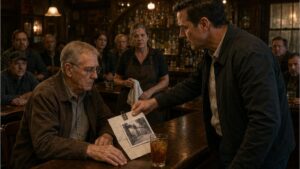
Instead, Elias pulled out a small, worn piece of paper. He stepped forward and placed it gently onto the single unbroken table in the center of the room, right beside the flickering candle flame.
Mara looked down. It was half of a faded, torn photograph—taken on the opening night of The Brass Lantern in the summer of 2018. It showed Mara smiling radiantly in her pristine chef’s whites, her arm linked with the man beside her.
Mara’s breath caught in her throat. Her hand trembled as she reached into the inner lining of her black chef’s coat.
From the secret pocket over her heart, she pulled out a worn scrap of paper she had carried for eight bitter years: the matching torn half of that identical photograph, showing Elias Rook looking down at her with unconditional love.
Mara placed her scrap of paper on the dark mahogany beside his.
The jagged, torn edges of the paper met. They clicked together in absolute, microscopic alignment, completing the image of their shared life.
CHAPTER 2: THE ALIGNMENT OF THE TORN PAPER
The two halves of the torn photograph lay reunited upon the dark, polished mahogany of table four, bathed in the warm, amber glow of the solitary beeswax candle. For eight years, that ragged edge of fibrous white paper had been a jagged fault line running through Mara Voss’s soul—the tangible boundary between the golden promise of her youth and the smoking ruin of her adulthood. Looking down at the completed image, seeing Elias’s younger, unlined face smiling beside her own across the gap, the burning, acidic rage that had fueled her survival began to crack into a hollow, terrifying bewilderment.
“Why?” Mara’s voice was barely a whisper, hoarse and ragged from the brawl, stripped of all combat posture. She looked up at him, her dark eyes glittering with unshed tears in the dim light. “You kept it? You stole three hundred thousand dollars from our fire insurance settlement, you left me to face the arson investigators alone, you let the entire harbor call me a crook… and you kept this scrap of paper in your pocket?”
Elias stood motionless in the moonlight, his broad chest rising and falling beneath his rumpled linen shirt. A thin trickle of dark blood ran from the graze on his cheekbone where her spinning backfist had connected, but he didn’t wipe it away. His eyes were dark pools of sorrow, holding her gaze with unyielding, sorrowful honesty.
“I didn’t take a single dollar for myself, Mara,” Elias said, his voice deep, gravelly, and steady as an anchor chain. “Not one nickel. I haven’t spent an hour in Europe in my life. For eight years, I’ve been working sixty-hour shifts on offshore fishing trawlers out of Gloucester and New Bedford, living in a single rented room over a bait shop, sending money under untraceable money orders to pay down the suppliers you owed.”
Mara shook her head in violent disbelief, her hands trembling as she pointed toward the door. “That’s a lie! The insurance check was deposited into an offshore account registered under your signature on November third, 2018! The sheriff showed me the wire transfer! You vanished the next morning!”
“Look at the account title on that transfer, Mara,” Elias pleaded softly, stepping one pace closer, his hands open and non-threatening. “It wasn’t an offshore account. It was a private escrow holding company named Harbor Crest Ventures. Who owns Harbor Crest, Mara? Who holds the mezzanine debt on every fishing boat, every lobster trap, and every commercial slip from here to Rockland?”
The name struck Mara with the cold, visceral finality of an iron door slamming shut in a subterranean vault.
“Julian Crane,” she whispered, the blood draining from her face.
“Julian Crane,” Elias confirmed, nodding grimly. “Three days before the fire at The Brass Lantern, your brother, Leo, came to me in tears at the wine cellar. He was eighteen years old, terrified, shaking so hard he couldn’t hold a glass. He had gotten into an illegal high-stakes poker game running out of Crane’s yacht club. In forty-eight hours, Crane’s enforcers had manipulated the markers, claiming Leo owed two hundred and eighty thousand dollars in gambling debt.”
Elias took a deep, agonizing breath, his jaw tightening as he relived the darkest hour of his life. “Crane told Leo that if the debt wasn’t cleared by Friday midnight, his men would take him out past Monhegan Island on a lobster boat and throw him overboard with fifty pounds of engine chain around his ankles. Leo was going to throw himself off the Bellhaven drawbridge, Mara. He begged me not to tell you. He knew you would confront Crane, and he knew Crane’s enforcers would kill you both without a second thought.”
Mara clutched the edge of the unbroken table, her knuckles turning bone-white, the room spinning around her as eight years of manufactured reality collapsed. “The fire… you burned the restaurant to pay his debt?”
“I didn’t burn anything,” Elias said fiercely, his voice cracking with righteous anguish. “I went to Crane’s office to offer my personal savings as collateral. While I was in his waiting room, Crane smiled at me, checked his gold pocket watch, and said: ‘You’re too late, Rook. The Brass Lantern is already burning. But if you assign the commercial fire insurance payout directly to my holding firm, I’ll consider the boy’s debt settled and let him live.’ Crane set that fire, Mara. He burned our dream to the ground to force me to hand over the settlement. And if I had stayed in Bellhaven, if I had gone to the police, Crane would have produced a signed confession from Leo claiming he set the blaze himself.”
A low, suffocating sob escaped Mara’s throat. She buried her face in her hands, her shoulders trembling as the monstrous magnitude of his sacrifice washed over her. He had destroyed his own reputation, surrendered his home, his love, and his honor, choosing to be despised as a thief so that her brother could live.
“Why didn’t you tell me?” she wept, looking up at him through hot tears. “Why did you let me hate you for eight years?”
“Because you were safe,” Elias answered gently, his voice thick with emotion. “As long as you hated me, Crane left you alone. He thought the debt was settled and the Voss family was broken. But two days ago, I heard from an old dockworker that Crane had filed an emergency foreclosure petition against The Obsidian Gull. Crane doesn’t just want money anymore, Mara. He wants this cannery. He wants to tear down the historic pier and build a gated luxury yacht marina for private equity billionaires. I came back because I promised your father before he died that I would never let anyone take this ground from you.”
Before Mara could speak, the heavy brass latch of the front double doors clicked with a sharp, resonant snap.
The cold ocean fog swirled into the dark dining room as the heavy oak doors swung slowly inward.
Framed in the open entrance, backlit by the sickly amber glow of the harbor streetlights, stood a tall, imposing silhouette. The man wore a bespoke charcoal cashmere overcoat, an expensive gray fedora tilted slightly forward, and held a glowing Cuban cigar between gloved fingers.
Behind him on the rain-swept boardwalk stood two thick-necked private security enforcers in matching dark trench coats.
The silhouette took two measured steps into the restaurant, his polished leather dress shoes crunching over the carpet of shattered crystal wine glasses.
“What an extraordinarily touching domestic reunion,” Julian Crane’s smooth, aristocratic voice echoed through the ruined dining room, dripping with amused malice. “I do hope I’m not interrupting the reconciliation of Bellhaven’s two most pathetic romantic failures.”
CHAPTER 3: THE SILHOUETTE IN THE SEA FOG
The amber tip of Julian Crane’s cigar flared brightly in the shadows of the doorway, casting a brief, sinister glow across his sharp, aristocratic features. He was fifty-two years old, with slicked-back silver hair, pale gray eyes shielded by round horn-rimmed spectacles, and the immaculate, predatory poise of a man who viewed human beings as line items on a liquidation balance sheet. He walked across the ruined heart-pine floor with slow, deliberate insolence, his two private security guards fanning out to flank the entrance, their hands resting heavy inside the pockets of their dark wool trench coats.
“Julian Crane,” Mara said, her voice dropping into an icy, unyielding tone as she stepped in front of the table, her hands clenched at her sides. “You are trespassing on private commercial property after closing hours. Turn around and get off my pier before I call the state police.”
Crane gave a soft, theatrical laugh that carried no warmth, exhaling a thick cloud of aromatic blue cigar smoke that drifted through the moonlight. “Call whoever you like, my dear Mara. But I think you will find that the State Police Major Crimes Division is currently reviewing an emergency writ of execution issued by the Knox County Superior Court at five o’clock yesterday afternoon.”
Crane reached into the interior breast pocket of his cashmere overcoat and pulled out a crisp, legal-sized manila folio bound with blue ribbon. He tossed it onto the unbroken mahogany table, right beside the reunited halves of the torn photograph.
“What is this?” Mara demanded, refusing to touch the document.
“That is your formal twenty-four-hour notice to vacate premises, Chef Voss,” Crane replied with smooth, chilling satisfaction. “When your late father, Captain Thomas Voss, operated the cannery back in the nineties, he secured a secondary industrial redevelopment mortgage through the Bellhaven Municipal Harbor Trust. What he failed to realize—or perhaps what his failing memory overlooked—was that the mezzanine notes carried an adjustable acceleration clause tied to regional commercial appraisal benchmarks. When my development group, Atlantic Waterfront Holdings, acquired the municipal trust’s debt portfolio last quarter, we triggered the acceleration.”
Crane stepped closer, the sharp tip of his cane tapping against the broken pieces of the shattered oak table. “The outstanding balance on this parcel is seven hundred and forty thousand dollars. Under the statutory terms, if the principal is not tendered in full by eight o’clock tomorrow morning, all ground leases, riparian wharfage rights, and structural improvements revert unconditionally to my corporation. The sheriff will be here at eight-fifteen with an eviction escort to change the deadbolts and supervise the perimeter fencing.”
“You fraudulent vulture,” Elias Rook said, stepping forward until his broad chest was barely eighteen inches from Crane’s face. Elias’s voice was a low, volcanic rumble that made Crane’s two guards tense their shoulders. “I paid you two hundred and eighty thousand dollars in certified funds in 2018. That was twice the actual gambling markers Leo signed. You gave me your word on your father’s name that you would release all claims against the Voss family.”
Crane sneered, looking up into Elias’s towering frame with cold, mocking disdain. “My dear Elias, you were always such a hopelessly romantic simpleton. You paid off a personal promissory note for an eighteen-year-old delinquent. That transaction had nothing to do with the commercial ground lease of Slipway Six. Business is business. The working-class fishing harbor is dead. Bellhaven is being reborn as an exclusive deep-water yacht refuge for Boston and New York venture capital. This drafty, salt-rotted cannery is scheduled for complete demolition next Wednesday to make way for a four-story luxury clubhouse and private champagne lounge.”
“You burned The Brass Lantern,” Mara stated, her voice shaking with controlled, lethal rage as she looked directly into Crane’s pale eyes. “You set the fire yourself.”
Crane smiled, taking a slow draw from his cigar and blowing the smoke toward the high rafters. “An unfortunate tragedy, Chef Voss. A faulty electrical junction box, as the county fire marshal so conclusively ruled. Of course, if a desperate young cook had left an oily rag near a pilot light to collect insurance, that would be a matter for the grand jury, wouldn’t it? Which is why I suggest you pack your favorite knives, gather your charming little keepsakes, and walk away quietly into the fog. If you resist tomorrow morning, I will ensure that the arson investigation is reopened with newly discovered evidence implicating your sweet little brother.”
Before Crane could finish his sentence, the swinging double louver doors leading from the prep kitchen creaked open.
Standing in the doorway, wearing a white baker’s apron coated in flour, was twenty-six-year-old Leo Voss.
Leo’s face was ashen, his hazel eyes wide and filled with devastating, agonizing shame. In his right hand, he clutched a small, rusted steel lockbox with a dented lid—an old tackle box from his childhood.
“Leo…” Mara whispered, turning toward her brother.
Leo walked into the dining room, his knees trembling so violently he could barely keep his balance. Tears streamed down his flour-dusted cheeks, leaving clean tracks through the dust. He stopped five feet from Elias, looking at the older man with an expression of heartbreaking remorse.
“You took the blame, Elias,” Leo choked out, his voice cracking into a ragged sob that echoed off the brick walls. “For eight years… you let Mara think you were a monster… to keep Crane’s men from throwing me into the bay.”
“Go back in the kitchen, Leo,” Elias said gently, his eyes softening with paternal protection. “This isn’t your fight.”
“It is my fight!” Leo shouted, turning to face Julian Crane with sudden, defiant fury. “It’s been my fight since the night you burned The Brass Lantern, Crane! You told me if I ever spoke, you’d kill my sister! But you lied! You were always going to take her restaurant anyway!”
Leo held up the rusted steel tackle box, his knuckles white as he shook it toward Crane.
“What is in that box, Leo?” Mara asked, her voice trembling.
Leo looked at his sister, his chest heaving with desperate resolve. “The night of the fire, Crane’s enforcers locked me in the back storage shed behind the kitchen. They didn’t know I had my phone set to record voice memos for my culinary school exams. I have the entire forty-minute recording of Crane’s head enforcer, Billy Vance, pouring kerosene across the dining room floor and joking on speakerphone with Crane about collecting the insurance.”
Crane’s arrogant smirk froze instantly. The cigar slipped from his fingers, landing with a faint sizzle in a puddle of spilled wine on the floor. His pale eyes widened in sudden, vicious alarm as he looked at his two armed guards.
“Kill the recording,” Crane snarled, his voice dropping all aristocratic pretense into a desperate, feral hiss. “Take the box from the boy and burn it in the harbor right now.”
CHAPTER 4: THE CONFESSION IN THE PASTRY KITCHEN
The two armed security guards in dark trench coats surged forward like wolves, their heavy leather gloves reaching to seize twenty-six-year-old Leo Voss.
“Back off!” Elias Rook’s voice erupted through the dining room with concussive force.
Elias stepped directly into the path of the lead guard. As the enforcer reached inside his coat for an iron baton, Elias executed a devastating judo collar-grip, pivoting his hips in a blinding flash of leverage. The two-hundred-pound guard was lifted off his feet, his body flying through the air before crashing heavily across the host counter, splintering the oak paneling and collapsing in a dazed heap on the floor.
At the same moment, the second guard lunged toward Leo with an extended collapsible steel baton.
Mara Voss moved with the explosive speed that had made her a champion amateur middleweight in her youth. She slipped inside the guard’s downward swing, her left forearm blocking the strike while her right fist drove a thunderous liver hook through his open coat. The guard groaned, his breath exploding from his lungs in a ragged gasp, and Mara followed through with a crisp, bone-cracking right cross to his jaw that sent him crashing backward through the dining room double doors onto the wet boardwalk outside.
Julian Crane backed away toward the open entrance, his silver hair disheveled, his composure completely shattered. He held his silver-tipped cane like a defensive shield, his face twisted in venomous fury.
“You think this changes anything, you harbor trash?” Crane hissed, his voice trembling with manic desperation. “A ten-year-old audio recording from a convicted delinquent won’t stand up for five minutes against my legal team! The foreclosure writ is stamped by the county clerk! At eight o’clock sharp, the sheriff’s tactical unit will breach these doors, and your brother will be remanded to the state penitentiary for commercial extortion! You have four hours left on this pier, Voss! Enjoy the dark!”
Crane turned on his heel, helping his dazed enforcer to his feet, and hurried down the rain-slick boardwalk into the thick ocean fog, the heavy sound of their footsteps fading into the crashing roar of the Atlantic surf.
Inside the shattered dining room, the silence returned, thick and suffocating with the smell of spilled wine, cold rain, and wood smoke.
Leo sank onto the unbroken wooden bench beside table four, his head buried in his flour-dusted hands, his body wracked with deep, agonizing sobs. “I’m sorry, Mara… I’m so sorry… I wanted to tell you every single day. Every time you stayed up until three in the morning doing the bookkeeping, every time you cried over the unpaid fish invoices… I wanted to die. But Crane told me that if I ever said a word, he would hire someone to cut your throat in the walk-in cooler.”
Mara walked slowly over to her brother. The fierce, defensive warrior who had just demolished two armed men vanished, replaced by an older sister whose heart was breaking for the boy she had raised since their mother died.
She knelt down in front of Leo, reaching up to take his trembling hands away from his face.
“Look at me, Leo,” Mara said, her voice soft, tender, and filled with fierce, unconditional love. “Look at your sister.”
Leo raised his tear-stained face, his hazel eyes filled with profound guilt.
“You were eighteen years old,” Mara said, wiping a streak of flour and tears from his cheek with her thumb. “You made a terrible mistake, and a ruthless monster used your fear to destroy our family. But you didn’t run away. You stayed here. You worked sixteen hours a day baking bread, you stood by me, and tonight you walked out of that kitchen with the truth in your hands. I don’t hate you, Leo. I love you. And we are going to finish this together.”
Leo threw his arms around his sister’s neck, weeping openly against her shoulder, releasing eight years of secret terror into the quiet dark of the room.
Elias walked over, placing a large, warm hand on Leo’s back, giving the young man a firm, reassuring squeeze. “Your sister is right, Leo. You kept the recording. That audio file gives us the leverage we need to dismantle Crane’s entire syndicate. But Crane was right about one thing: the municipal foreclosure writ is an administrative court order. The sheriff doesn’t care about audio files until a judge signs an emergency stay. And at eight in the morning, the county clerk will execute the land forfeiture unless we can prove that the municipal harbor trust never had the legal right to mortgage Slipway Six in the first place.”
Mara stood up, brushing the oak splinters from her apron, her eyes narrowing as she looked at Elias. “My father always told me that when he bought the cannery in nineteen-eighty-four, he didn’t buy a standard commercial deed from the town. He said he bought the historic riparian charter from the descendants of Captain Nathaniel Voss.”
“The 1888 Sovereign Riparian Patent,” Elias said, his eyes lighting up with sudden, electrifying realization. “Under Maine maritime law, any harbor pier built before the state coastal zone management act that holds an unbroken nineteenth-century sovereign riparian patent is classified as an inalienable maritime commons. It is legally exempt from municipal taxation, municipal mezzanine liens, and commercial foreclosure!”
“Where did my father keep the original patent, Elias?” Mara asked urgently. “The town archives don’t have a copy; they claimed it was lost in the courthouse flood of ninety-eight.”
“Your father didn’t trust the town hall, Mara,” Elias said, a faint, knowing smile touching his lips for the first time in eight years. “He built a water-tight copper deed vault into the original granite foundation of the cannery—beneath the high-tide mark in the subterranean wine cellar.”
Elias looked at his watch. The hands pointed to quarter past three.
“High tide is at five-forty AM,” Elias warned, his voice turning dead serious. “In two hours, the Atlantic surge will flood the lower foundation chambers under six feet of freezing seawater. If we want that charter, we have to descend into the sea vault right now.”
CHAPTER 5: THE VAULT BENEATH THE GRANITE SEAWALL
The air in the subterranean wine cellar beneath The Obsidian Gull was freezing, damp, and thick with the mineral tang of ancient granite and salt brine. Twenty feet below the dining room floor, the massive, mortarless granite foundation blocks that supported the historic cannery had stood against the crushing weight of the North Atlantic for nearly a century and a half. Outside the heavy stone walls, the Atlantic tide was rising rapidly, its deep, concussive subterranean surges vibrating through the soles of their boots with a rhythmic, thunderous thrum.
Elias Rook led the way down the narrow stone spiral stairs, holding a high-intensity rechargeable LED work lantern in his left hand and a heavy, four-pound steel sledgehammer in his right. Mara and Leo followed closely behind, carrying crowbars, a battery-powered submersible bilge pump, and heavy waterproof canvas sacks.
At the bottom of the stairs, cold, black sea water was already lapping across the flagstones, six inches deep and rising with the surge.
“The foundation is taking on water through the tidal weep holes,” Elias said, shining his beam across the dark expanse of the cellar. Long rows of dust-covered wine racks made of ancient maritime cedar stretched into the shadows, holding hundreds of vintage bottles of Bordeaux and port that Elias had curated years ago. “The original sea vault is in the far northern abutment—directly beneath the main seawall where the foundation keys into the bedrock.”
They waded through the icy brine, their boots splashing softly in the dark. At the far end of the cellar, partially obscured behind a massive stack of salt-cured oak barrels, sat a recessed archway of heavy hand-hewn granite blocks.
Elias set the lantern on an empty barrel and inspected the center keystone of the arch. Carved deep into the weathered gray stone was an anchor encircled by three stars—the historic maritime seal of the Voss family fleet.
“Your father spent six months cutting this vault into the seawall after the nineteen-eighty-four blizzard,” Elias explained, running his calloused fingers over the damp stone seam. “He sealed the access panel with a quarter-inch plate of marine-grade brass, bedded in tallow and pitch to keep out the salt air.”
Elias handed the lantern to Mara, raised the four-pound sledgehammer, and struck the perimeter seam with measured, ringing blows.
The heavy steel hammer rang against the granite with sharp metallic reports that echoed through the subterranean chamber. After seven precise strikes, the centuries-old pitch fractured, and a four-foot square slab of weathered brass loosened from the masonry. Elias jammed the edge of his crowbar into the seam, throwing his broad shoulders into the lever.
With a deep, sucking gasp of breaking vacuum, the heavy brass plate swung outward on heavy bronze pivot pins.
Inside the wall was a dry, cedar-lined alcove barely eighteen inches deep. Resting on the aromatic wood was a heavy, cylindrical deed tube of solid hammered copper, its screw cap sealed with red beeswax and stamped with Captain Thomas Voss’s personal signet ring.
Mara reached into the alcove with trembling hands, lifting the copper cylinder. It was heavy, ice-cold to the touch, and completely dry.
“We have it,” Mara whispered, her heart racing with triumphant awe.
Suddenly, a loud, concussive metallic crash echoed from the top of the stone stairs.
The heavy iron fire door at the cellar entrance slammed shut with a deafening boom. A heavy steel deadbolt clicked into place from the outside, followed by the muffled sound of a padlock snapping shut.
“Hey! Who’s up there?” Leo shouted, rushing toward the stairs.
From behind the iron door, a cold, mocking voice filtered down through the ventilation grate—the voice of Billy Vance, Crane’s head enforcement lieutenant:
“Enjoy the high tide, Voss! Mr. Crane sends his regards! In forty minutes, the seawall flapper valves will submerge, and this basement will fill to the rafters! By the time the sheriff arrives at eight, you’ll all be floating against the ceiling like drowned rats!”
A loud electrical hiss echoed from the corner of the cellar as the external power conduit feeding the basement was severed from above, plunging the chamber into near-total darkness, illuminated only by the narrow beam of Mara’s work lantern.
At that moment, a violent gush of black seawater erupted from the lower drainage vents as the rising ocean tide outside breached the high-tide threshold. The icy water surged from their ankles to their knees in less than ninety seconds.
“The main doors are deadbolted from the outside,” Leo cried in rising panic, pulling frantically on the iron door handle. “It’s a three-inch steel fire door, Mara! We can’t break it with a crowbar!”
“Don’t waste your energy on the door, Leo!” Elias commanded, his voice calm, steady, and commanding in the dark. “This is an active tidal cannery! When they processed fish here in the nineteenth century, they needed an emergency high-tide sluice to flush the processing waste into the harbor current!”
Elias pointed his light toward the low ceiling at the far eastern corner of the vault chamber, where a circular iron grating, four feet in diameter, was set into the granite foundation wall.
“That sluice tunnel dumps directly onto the sandbar beneath Slipway Six,” Elias said, wading rapidly through the waist-deep freezing water toward the grating. “It’s bolted with iron studs, but eighty years of salt water has rusted the brackets! If we can shear the fasteners, we can swim through the sluice before the tide crests!”
Mara held the lantern high with one hand, tucking the copper deed tube securely into the breast of her black chef’s coat, while she grabbed a second crowbar. “Leo, take the lantern! Elias, on my mark—we pry the bottom studs together!”
Side by side in the surging black water, Mara and Elias jammed their steel bars beneath the corroded iron grating. With their boots braced against the ancient granite blocks, they heaved with all their combined strength.
The rusted iron bolts groaned, screeched, and then snapped with explosive metallic pops under the immense leverage.
The heavy iron grate fell away into the dark water, revealing a narrow, brick-lined conduit that sloped upward toward the harbor shore. Through the tunnel, the sweet, cold smell of fresh ocean air and the roar of the surf washed over their faces.
“Go, Leo! Climb through!” Mara shouted, boosting her brother into the opening.
Leo scrambled into the conduit, followed by Elias. Mara took one last look at the flooding vault, grasped the rim of the sluice, and pulled herself into the tunnel just as the dark Atlantic tide completely submerged the granite ceiling behind them.
CHAPTER 6: THE STANDOFF AT THE HIGH-TIDE MARK
The cold October dawn broke over Bellhaven Harbor in a dramatic wash of slate gray and pale amber light. A biting North Atlantic gale whipped whitecaps across the bay, sending sheets of freezing spray over the granite wharves. At half past seven, Slipway Six was cordoned off by private security sawhorses. Parked along the waterfront road were two massive, yellow hydraulic demolition cranes bearing the logo of Atlantic Waterfront Holdings, their heavy diesel engines idling with a deep, menacing drone that shook the wooden pier timbers.
Standing beside the main entrance of The Obsidian Gull, wrapped in his immaculate cashmere overcoat and flanked by six private security guards and two uniformed Knox County sheriff’s deputies, was Julian Crane. He held a leather folio containing the municipal eviction writ, checking his gold pocket watch with an arrogant, triumphant smirk.
“Seven-forty-five, Deputy,” Crane said smoothly to the senior sheriff’s sergeant. “In fifteen minutes, the administrative stay expires. My demolition contractor is authorized to begin removing the roof trusses and perimeter pilings immediately to prevent structural collapse.”
“We still have to perform a safety sweep of the interior, Mr. Crane,” the sergeant replied, unholstering his duty flashlight. “We need to verify that Chef Voss and her staff have vacated the premises.”
“I assure you, Sergeant, Chef Voss is no longer in any condition to dispute the eviction,” Crane purred, a dark, venomous satisfaction glittering in his eyes as he looked toward the harbor tide, knowing the subterranean cellar had been submerged under eight feet of freezing brine for over two hours.
“Is that what you told yourself when you padlocked the basement door, Julian?”
A clear, ringing voice cut through the howling wind with the force of a rifle shot.
Crane spun around, his jaw dropping open, the color instantly draining from his face as if he had seen three ghosts rising from the Atlantic depths.
Walking up the wooden ramp from the public beach below the seawall were Mara Voss, Elias Rook, and Leo Voss.
They were soaked to the bone, their clothes dripping with dark sea water and salt sand, but their posture was magnificent, unbroken, and radiating righteous fury. Mara strode at the head of the group, her black chef’s coat wet and stained with brine, her dark eyes blazing with an intensity that made the armed private guards take an involuntary step backward. Tucked firmly beneath her left arm was the heavy, hammered copper deed cylinder. In Leo’s right hand, held high for all to see, was the rusted steel lockbox containing the audio recording.
“You… you survived?” Crane stammered, his aristocratic voice cracking into a high-pitched rasp of disbelief. “Deputy! Arrest these trespassers immediately! They are violating a court-ordered foreclosure exclusion zone!”
“Stand down, Deputy!”
A third voice, amplified through a heavy public-address loudspeaker, boomed across the entire harbor.
Four unmarked black sport utility vehicles and three marked Maine State Police cruisers swept around the corner of the wharf, their blue and red emergency strobes cutting through the gray dawn mist. The vehicles screeched to a halt in a tactical perimeter, boxing in Crane’s demolition cranes and private security fleet.
Stepping out of the lead state police vehicle was Major Catherine Mercer of the Maine State Police Criminal Investigation Division, accompanied by two armed detectives and the Assistant Attorney General for the State of Maine.
“Major Mercer,” Crane said, attempting to recover his smooth composure, stepping forward with an outstretched hand. “Thank heaven you’ve arrived. These disgruntled tenants have broken into my commercial property and are threatening my contractors—”
“Quiet, Mr. Crane,” Major Mercer interrupted, her voice like cold granite as she ignored his hand completely. “Step away from the building and place your hands on the hood of that cruiser.”
“Do you know who I am?” Crane hissed, his face flushing crimson with indignant rage. “I am the chairman of the Bellhaven Harbor Development Authority! I have a valid judicial writ signed by Judge Henderson!”
“The writ is void, Mr. Crane,” the Assistant Attorney General stated, stepping forward with an official court order bearing a fresh digital seal. “Ten minutes ago, the Maine Supreme Judicial Court in Augusta granted an emergency stay and issued a statewide freeze on all assets associated with Atlantic Waterfront Holdings. Furthermore, two hours ago, an encrypted digital audio transmission was uploaded directly to our major crimes intake portal from this young man’s phone.”
The Assistant Attorney General pressed a button on an audio monitor.
Loud, crystal-clear, and unmistakable, Julian Crane’s voice boomed across the open wharf:
“…The Brass Lantern is already burning. But if you assign the fire insurance payout directly to my holding firm, I’ll consider the boy’s debt settled and let him live…”
The Knox County sheriff’s deputies looked at Crane in disgusted shock, immediately stepping away from him and resting their hands on their service weapons.
Mara Voss stepped forward, unscrewing the heavy copper cap of the deed tube. With steady, deliberate grace, she extracted the preserved 1888 vellum charter and unrolled it before Major Mercer and the state prosecutor.
“This is the Sovereign Riparian Patent of Slipway Six, ratified by the Maine State Legislature in 1888,” Mara declared, her voice carrying across the silent harbor. “It grants the Voss family an inalienable, perpetual public maritime trust over this wharf, completely immune to municipal foreclosure, mezzanine loans, or private equity seizure. This pier was never Julian Crane’s to take.”
Major Mercer examined the pristine red lead seal and the copperplate signatures, then looked up at Julian Crane with cold, unyielding judgment.
“Julian Crane,” Major Mercer announced, producing a pair of stainless-steel handcuffs. “You are under arrest for first-degree commercial arson, attempted murder, extortion, and systemic racketeering. You have the right to remain silent.”
Crane stared at the handcuffs in sheer, unadulterated horror as the steel ratchets clicked tightly around his wrists. His two private enforcers were disarmed and forced to their knees on the wet boardwalk by state troopers.
Leo Voss let out a long, shuddering breath, a brilliant smile breaking across his exhausted face as he embraced his sister.
Elias Rook stood beside Mara on the edge of the pier, looking out across the harbor. The heavy rain had stopped. A sudden break in the storm clouds let through a glorious shaft of bright October sunlight, illuminating the weathered brick facade of The Obsidian Gull in warm, golden fire.
CHAPTER 7: THE MORNING LIGHT OVER THE OBSIDIAN GULL
One week later, the crisp autumn sunshine that bathed Bellhaven Harbor felt warmer and cleaner than any morning Mara Voss could remember. At ten o’clock, the salt breeze coming off the blue waters of the bay was gentle, carrying the fragrant, mouthwatering scents of woodsmoke, roasted garlic, fresh rosemary, and warm, golden sourdough bread baking inside the commercial deck ovens of The Obsidian Gull.
The dining room had been completely restored, transformed into a space that honored both the scars of its past and the brilliance of its future.
The shattered tables had been replaced with beautiful, handcrafted dining tables built from reclaimed white oak timbers salvaged from historic Maine schooners, their surfaces hand-planed and oiled to a deep, lustrous sheen by Elias Rook himself. The fallen bookcase had been raised and re-anchored to the brick foundation, its shelves now proudly displaying century-old maritime charts, antique brass sextants, and the framed 1888 Sovereign Riparian Patent of Slipway Six, recognized by the state legislature as a permanent cultural heritage site.
On table four, positioned beneath the arched window overlooking the sunlit harbor, sat a small, polished silver frame.
Inside the frame were the two reunited halves of the 2018 photograph. The jagged tear down the center had not been concealed or covered; instead, it had been carefully joined with delicate, shimmering lines of gold leaf—the Japanese art of kintsugi, honoring the breakage as an essential part of the object’s enduring strength and beauty.
The kitchen swinging doors pushed open, and twenty-six-year-old Leo Voss emerged carrying a massive wooden peel bearing six loaves of steaming, crusty sourdough boules. Leo’s face was radiant, his eyes bright with pure joy and hard-earned pride. He wore a clean white chef’s jacket embroidered with his own name: Leo Voss — Head Baker.
“First batch of celebration sourdough is out of the hearth, Chef,” Leo announced proudly, setting the golden loaves onto the presentation counter where their crisp crusts crackled softly in the cooling air.
Mara Voss stepped out of the prep kitchen, wearing her pristine black chef’s coat, her dark hair neatly tied back, her face glowing with peaceful fulfillment. She walked over to her brother, broke off a warm, fragrant piece of the crust, tasted it, and closed her eyes in pure delight.
“It’s perfection, Leo,” Mara said softly, smiling with deep, affectionate pride. “Our father would have wept to taste bread this good.”
Leo beamed, wiping his hands on his apron before looking toward the open double doors of the restaurant.
Outside on the wharf, hundreds of local Bellhaven residents, working lobster fishermen in yellow oilskin overalls, harbor merchants, and families from across the county were gathering along the boardwalk. With Julian Crane and his corrupt cartel behind bars awaiting trial at the federal courthouse in Portland, the predatory grip on the waterfront had been completely broken. The state had established a cooperative public trust protecting the fishing fleet, and the entire harbor had declared today a municipal day of celebration.
A pair of heavy boots echoed across the threshold.
Elias Rook walked into the dining room, wearing a clean charcoal chambray shirt, dark trousers, and a leather carpenter’s apron. In his hands, he carried a beautiful, hand-carved mahogany host podium, its front panel inlaid with a brass anchor encircled by three stars.
He set the podium gently by the entrance, wiped a speck of sawdust from his thumb, and looked at Mara. His gray-streaked beard was trimmed, his dark eyes clear, steady, and filled with deep, serene peace.
“The outside dining deck is finished, Mara,” Elias said, his voice a warm, gentle rumble that filled the room. “Sixteen new seats right over the tidal surge, just like we sketched on the back of a paper menu ten years ago.”
Mara walked slowly across the wide heart-pine floor, stopping in front of him. For eight years, there had been a chasm between them, filled with silence, suspicion, and pain. But looking at him now, seeing the quiet nobility of the man who had sacrificed everything to keep her family alive, the last lingering shadow vanished forever from her heart.
She reached out and took his large, calloused hands into her own.
“You built us a home, Elias,” Mara whispered, her voice trembling with sweet, overflowing emotion. “You never stopped protecting us. Not for one second.”
Elias looked down at their joined hands, a rare, profound tear slipping down his weathered cheek. He raised his eyes to hers, his voice thick with devotion. “I promised your father, Mara. But more than that… I promised myself. There has never been another dream for me. Only this harbor. Only this kitchen. Only you.”
Mara stepped forward into his embrace, wrapping her arms around his broad shoulders. Elias held her tightly, burying his face in her dark hair, feeling the deep, synchronized rhythm of their heartbeats—two survivors of the storm, finally anchored in safe waters.
Leo stepped up beside them, clearing his throat with a wide, mischievous grin. He held up a bottle of chilled vintage champagne and three crystal flutes.
“The crowd is backed up all the way to the cannery bridge, Chef,” Leo said, his eyes dancing with excitement. “Are we going to keep the harbor waiting, or are we going to open the doors?”
Mara smiled through her tears, stepping back from Elias’s arms and taking a champagne flute from her brother. Elias poured the sparkling golden wine, the bubbles rising with festive, musical life.
Together, the three of them raised their glasses high in the warm morning sunlight.
“To The Obsidian Gull,” Mara toasted, her voice clear, strong, and triumphant. “To the truth that cannot be drowned, the promises that cannot be broken, and the family that stood unbroken through the fire.”
“To family,” Elias and Leo answered together.
They drank, the sweet, crisp wine sealing the new dawn.
Mara turned toward the entrance, took a deep, invigorating breath of the fresh ocean air, and threw the double doors wide open.
A tremendous, roaring cheer erupted from the waiting crowd along the wharf. The citizens of Bellhaven surged forward with smiles, laughter, and open arms, filling the sunlit dining room with the warmth of a community reunited, their beloved harbor alive, free, and flourishing forever.