The Five Sons Of Iron Valley And The Stolen Deed
CHAPTER 1: THE PLEA BENEATH SLATTED BLINDS
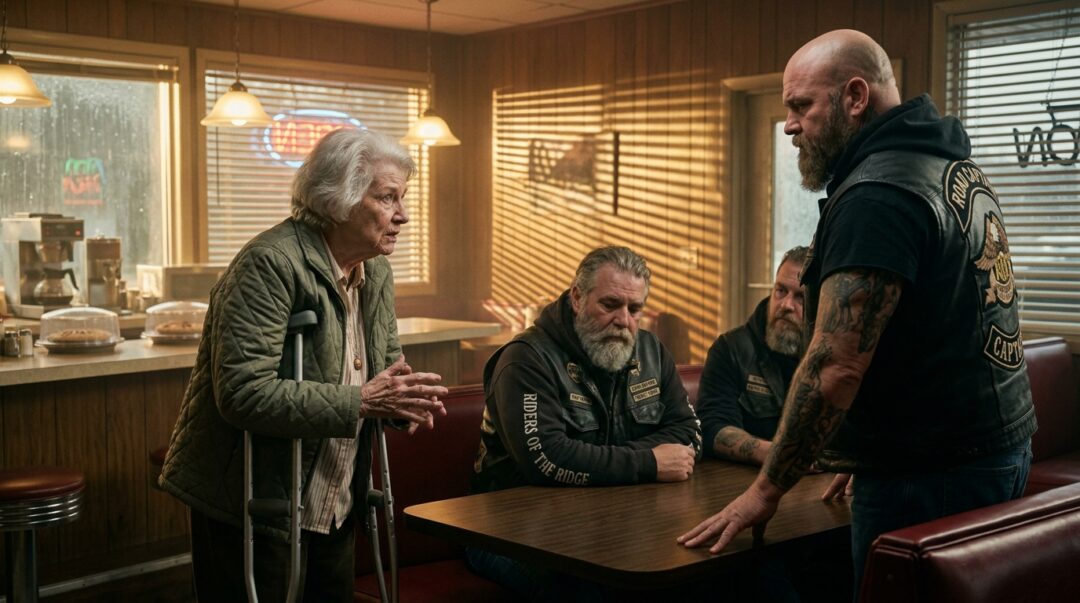
The late morning sun sliced through the dusty Venetian blinds of the Steel City Diner, casting long, prison-bar shadows across the chipped formica table. Braddock, Pennsylvania, smelled of damp autumn river mud, coal dust, and diesel exhaust from the heavy tugboats churning the Monongahela River. In the corner booth, five men in heavy leather vests sat in silence, their broad shoulders crowding the red cracked vinyl. They wore the colors of the Iron Foundry Motorcycle Club—a heavy forged anvil crossed with a welder’s torch emblazoned across their backs.
At the head of the table sat Raymond “Bear” Vance. At forty-eight, Bear looked like he had been hewn out of local river sandstone. His thick forearms, covered in dark hair and silver burn scars from twenty-five years as a structural welder, rested flat against the table on either side of a steaming white ceramic mug of black coffee. His beard was steel-gray, his jaw squared like an anvil, and his cold hazel eyes missed nothing in the room.
Opposite them, standing at the edge of the linoleum aisle, was Clara Jenkins. She was seventy-four years old, frail as dried kindling, leaning heavily upon two aluminum forearm crutches. Her faded floral cardigan had been mended at the elbows with coarse gray thread, and her knuckles were swollen with the cruel arthritis of sixty years in the valley. Yet her silver hair was pinned back in an immaculate bun, and her posture, despite the crutches, held the stiff, unbroken dignity of a woman whose family had poured the steel that built the empire.
In her trembling, spotted right hand, she held a battered, floral-patterned tin cookie box. She set it on the edge of the formica table with a soft, hollow click.
“I have two thousand four hundred dollars here, boys,” Clara said, her voice thin but steady, cutting clearly through the clatter of silverware and the greasy sizzle of the griddle behind the counter. “It’s my social security check from this month, my late husband’s union burial pension, and every copper cent from my jar of silver quarters. I need to hire five grown sons for three days.”
Across from Bear, young Caleb—a twenty-four-year-old mechanic whose hands were perpetually stained with motor oil—nearly choked on his ice water. Jax, the club’s vice president, leaned back against the red vinyl, his sharp eyes narrowing as he rubbed his tattooed neck.
Bear did not smile. He didn’t laugh. He slowly raised his eyes from the steaming coffee to Clara’s face.
“Ma’am,” Bear said, his baritone voice a low, gravelly rumble that vibrated through the tabletop. “With all due respect, we’re not an escort service. We’re a motorcycle club. We fix heavy machinery and we keep our business on the river road. What makes you think you need five sons?”
Clara took a slow, labored step closer, her rubber-tipped crutch squeaking against the worn linoleum. “Because at two o’clock this afternoon, Harrison Croft is bringing two private security vans, a sheriff’s deputy with a certified eviction writ, and a demolition crew to my front gate on Rankin Hill. They’re coming to throw Arthur’s belongings into the mud and bulldoze our home.”
The diner seemed to go completely quiet.
“Arthur?” Bear’s voice suddenly lost its cold detachment. The muscle along his right jaw tightened until a vein pulsed beneath his beard. “You’re Clara Jenkins? Arthur Jenkins’s widow?”
“I am,” she replied softly. “Arthur passed six years ago from black lung and open-hearth burns. And ever since Apex Riverfront Development announced the new container port down on the Monongahela bend, Croft has sent men to poison my well, slash my garden hoses, and threaten my life. Now they claim Arthur signed away our deed three days before he died. It’s a lie. Arthur would have cut off his own right arm before selling an inch of union ground to Apex.”
She looked at the five massive men, her blue eyes glistening with a fierce, desperate plea. “Croft thinks I’m an old woman living alone in the dark. He thinks there’s no man left alive in this valley with the spine to stand between an old widow and a corporate wrecking ball. If I have five grown sons sitting on that front porch when his crew rolls up… he can’t claim abandonment. He can’t bulldoze a house full of working men without a court trial.”
Bear stared down at the tin cookie box. He reached out with one massive, calloused hand, pushed the lid closed with a gentle thud, and slid the box back across the table into Clara’s trembling hands.
“Keep your money, Mrs. Jenkins,” Bear said quietly.
Clara’s face fell, the light dying in her eyes. Her shoulders sagged as if the weight of the entire Allegheny County had crashed down on her frail spine. “I… I understand. It was foolish of me to ask outlaws to—”
“You misunderstand me, ma’am,” Bear interrupted, rising to his full six-foot-two height. His massive frame blocked out the sunlight from the diner window, casting an immense, protective shadow across the table. Behind him, Caleb, Jax, Dutch, and Mason rose in unison, five towering walls of leather and steel. “We don’t take money from Arthur Jenkins’s widow. Arthur carried my father Thomas Vance out of a ruptured slag furnace at Carrie Number Three in 1978. If not for your husband, my father would have died thirty years before his time, and I wouldn’t be standing here breathing clean air.”
Bear reached into his vest pocket, pulled out his worn leather wallet, and slapped a crisp hundred-dollar bill onto the formica table to cover their breakfast tab.
“Your sons are here, Clara,” Bear said, his eyes burning with an unshakeable, lethal resolve. “Let’s go home and introduce ourselves to Mr. Croft.”
Clara stared at them, her breath catching in a ragged sob before she nodded firmly. Bear reached into his pocket for his truck keys, but as he did, Clara pulled a folded legal document from her coat to show him the eviction notice.
Bear unfolded the yellow paper. His gaze dropped to the signature line at the bottom of the writ. His breath froze in his throat.
The certified eviction attorney representing Apex Riverfront was Harrison Croft. But below his name, typed in dark, official ink as the certified managing creditor, was a name Bear had buried twenty years ago: Sterling Vance—Bear’s own estranged elder brother, who had vanished from Braddock after embezzling their father’s life pension and leaving the family to starve in the winter of 1994.
CHAPTER 2: THE TIMBER HOUSE BY THE STEEL RIVER
The low, guttural rumble of four custom Harley-Davidsons echoed off the sheer sandstone bluffs of the Monongahela River as the Iron Foundry convoy escorted Bear’s rusted Ford F-250 up the winding, leaf-strewn switchbacks of Rankin Hill. Below them, the river ran thick and red with autumn silt, reflecting the towering industrial ruins of the Carrie Blast Furnaces like blackened iron ribs against an overcast October sky.
The convoy turned onto a crushed-limestone driveway bordered by overgrown wild rhododendrons and towering black walnut trees. At the summit of the bluff sat the Jenkins homestead: a magnificent, weathered two-story Craftsman house constructed from tongue-and-groove white oak and dressed river stone. Built by Arthur Jenkins’s grandfather in 1912, the house had survived a century of coal soot, wildcat union strikes, economic depression, and relentless seasonal floods. Its wraparound front porch commanded an unbroken panorama of the Monongahela bend—a strategic vantage point worth tens of millions to corporate high-rise developers.
Bear stepped down from the truck cab, his heavy work boots crunching into the limestone. He walked around to the passenger side, opening the door with practiced gentleness. He extended his massive forearm, and Clara took it, her frail, knobby fingers digging into the worn leather of his vest as she pivoted her weight onto her silver forearm crutches.
“Careful on that first step, ma’am,” Bear said, his voice dropping to a protective baritone. “The autumn leaves are slick as wet grease.”
“I’ve walked this porch through sixty-two winters, Raymond,” Clara replied softly, a faint, resilient smile touching the corners of her thin lips. “Though I admit… my knees don’t care much for the cold anymore.”
Behind them, the four Iron Foundry riders killed their ignitions. The rhythmic rumble of the V-twin engines died away, replaced by the cooling tick of hot chrome exhaust pipes and the mournful caw of river crows circling above the valley.
Jax, a lean, sharp-eyed former Army engineer with sleeve tattoos of mechanical blueprints, immediately unhitched a heavy steel utility toolbox from the luggage rack of his Road Glide. Caleb, a broad-shouldered young mechanic whose knuckles bore the permanent black scars of motor oil, walked over to Clara’s side, carrying her weathered floral canvas tote bag with chivalrous care. Behind them, Dutch and Mason—veteran road captains who had spent thirty years sweating over open-hearth furnaces before the mills shut down—fanned out across the perimeter, their experienced eyes scanning the tree line and the access road below.
“Look at this craftsmanship,” Jax murmured, running his gloved fingers along the heavy, hand-hewn oak railings of the front porch. “Full mortise-and-tenon joints. Pegged with heart-pine. You couldn’t bulldoze this porch with a military tank without breaking the frame.”
“My Arthur cut every beam by hand from the old ridge timber,” Clara said with quiet pride, her eyes drifting toward the towering double front doors. “He used to say that a man’s home is the only cathedral where he can speak truth without asking a company foreman for permission.”
They entered the foyer. The interior of the house was warm, smelling of dried lavender, beeswax, seasoned firewood, and aged paper. Sunlight filtered through antique stained-glass transoms, casting amber and emerald diamonds across hand-scraped chestnut floorboards.
Along the wide hallway hung decades of union history: framed black-and-white photographs of soot-stained steelworkers standing shoulder-to-shoulder outside the blast gates; strike banners bearing the embroidered sigil of the United Steelworkers Local 1219; and yellowed newspaper clippings chronicling the bitter wildcat strikes of 1977.
In the center of the wall hung a large, silver-framed portrait. It showed Arthur Jenkins as a young man of twenty-eight, standing on the observation deck of a roaring converter furnace, his arm draped over the shoulder of a younger, broad-faced apprentice welder.
Bear stopped dead in his tracks. His breath caught in his chest. His thick finger reached out, hovering just an inch from the apprentice’s face.
“That’s my dad,” Bear whispered, the rough edge of his voice cracking slightly. “Thomas Vance. He was twenty-one there. He told me about that shift until the day he died. A slag ladle ruptured on furnace four. Two thousand degrees of liquid metal spilled across the gangway. Everyone ran… except Arthur. Arthur dove through the smoke, pulled my dad out by the collar of his leather apron, and dragged him three hundred yards to the safety showers.”
Clara stood beside him, resting her weight on her crutches. She looked up at the portrait, her eyes glistening with unshed tears. “Arthur never spoke of it as heroism, Raymond. He said a working man either carries his brothers or he isn’t a man at all. When Thomas was in the burn ward, Arthur took his shifts so your mother wouldn’t lose the company medical insurance.”
“I never knew that,” Bear murmured, his jaw hardening into granite. “My dad only told me Arthur was the finest man God ever put breath into.”
“He was,” Clara whispered. “And when Arthur died six years ago, I thought the valley had forgotten what honor meant. Until today.”
Suddenly, Jax appeared at the front door, his posture tense, his radio earpiece adjusted. “Bear. We’ve got company coming up the hill. Three vehicles. High speed.”
Bear stepped out onto the porch, flanked by Caleb, Dutch, and Mason.
At the base of the winding driveway, a gleaming black Mercedes-Benz S-Class sedan, flanked by two blacked-out private security SUVs, rolled up the gravel road at aggressive speed. The tires threw crushed stone against the lawn as the three vehicles swung sideways, parking squarely across the front yard in an intimidating formation designed to box in the house.
The doors of the lead SUV snapped open, and four burly men in tactical black windbreakers stepped out, their belts heavy with zip-ties, pepper foggers, and sidearm holsters.
Then the rear door of the Mercedes swung open.
Harrison Croft stepped out onto the grass. He was forty-five, impeccably groomed, wearing a tailored three-piece charcoal wool suit, polished Italian oxfords, and carrying a monogrammed crocodile-skin briefcase. His cold, calculating eyes swept over the motorcycles with sneering contempt before settling on Bear.
Following him out of the passenger side was Gregory Jenkins—Clara’s thirty-two-year-old nephew. Gregory was disheveled, shivering violently despite the mild autumn breeze, his eyes darting frantically. His knuckles were raw, his hands shook uncontrollably, and dark, dried blood was crusted along the fraying collar of his wrinkled button-down shirt.
Bear stepped to the edge of the top porch step, crossing his massive arms over his chest. “You’re trespassing on private property, counselor. Turn those luxury German engines around before we turn them into scrap metal.”
Harrison Croft smiled—a thin, razor-sharp smirk of unshakeable legal arrogance. “I assure you, Mr. Vance, the only trespassers here are you and your motorized vagrants. And as for Mrs. Jenkins…” Croft opened his briefcase, withdrawing a thick, blue-backed legal document with a gold county seal. “She has exactly fifteen minutes to vacate the premises before my security team physically removes her possessions onto the county highway.”
Clara took a step forward on her crutches, her voice trembling with outrage. “This is Arthur’s house, Harrison! I have never signed a single paper giving you or Apex Corporation the right to step foot on this hill!”
Croft chuckled softly, tapping the blue document against his palm. “You didn’t need to sign, Clara. Your nephew Gregory possesses your irrevocable, certified General Durable Power of Attorney. And three days ago, he legally executed the warranty deed transferring full ownership of this parcel to Apex Riverfront Enterprises for the fair market consideration of one million two hundred thousand dollars.”
Gregory hung his head, refusing to meet Clara’s eyes. But as the wind whipped his collar back, Bear’s sharp eyes caught something terrifying beneath Gregory’s frayed shirt: a fresh, jagged purple bruise encircling his throat, shaped exactly like the link-marks of a heavy iron logging chain.
CHAPTER 3: THE DEED BOUND IN BLACK SILK
The front yard grew deathly silent, the only sound the rustle of dry sycamore leaves blowing across the hood of the Mercedes. Bear walked down the three wooden steps of the porch with deliberate, crushing steps. His boots sank into the gravel as he stopped three paces from Harrison Croft. He towered over the corporate attorney, his massive chest rising and falling like a bellows.
“Step closer, counselor,” Bear said, his tone chillingly level. “Show me that paper.”
Croft sneered, holding out the blue-bound document with two manicured fingers. “Look all you want, biker. It’s registered with the Allegheny County Recorder of Deeds. Fully witnessed, certified, and notarized. Gregory here was granted sole power of attorney over Clara’s assets when her hip failed last spring. The money has already been wired into Gregory’s escrow account. Clara is legally an unlawful detainer on corporate private land.”
Bear took the document. He flipped past the boilerplate legal text to the final acknowledgment page. His eyes scanned the notary block.
“Notary Public: Evelyn M. Ross,” Bear read aloud, his gravelly voice carrying across the yard. “Commission expiration: September 2028. Stamped and sealed on Tuesday morning at ten-fifteen.”
Bear looked up, locking eyes with Croft. Then he looked at Gregory, who was visibly trembling, clutching his stomach as if sick.
“That’s interesting, Croft,” Bear said quietly. “Evelyn Ross was my mother’s second cousin. She was a notary in Braddock for thirty-four years. She lived over on Sixth Street. And she died of pancreatic cancer in Mercy Hospital on August fourteenth. I carried her casket to St. Michael’s cemetery myself.”
Croft’s arrogant smirk froze. A flicker of panic flashed across his eyes before his professional mask snapped back into place. “A clerical error. The junior partner at our firm handled the attestation—”
“A dead woman notarized your multi-million-dollar land grab, counselor,” Bear cut him off, his voice like iron grinding on stone. “That’s not a clerical error. That’s federal deed fraud, forgery of state seals, and grand larceny.”
“You don’t know who you’re dealing with, Vance!” Croft snapped, his face reddening. He turned sharply to Gregory. “Tell him, you worthless junkie! Tell him your aunt signed the power of attorney freely before her mental faculties began to deteriorate!”
Gregory flinched as if struck with a whip. Tears welled in his red-rimmed eyes. “I… I had to, Aunt Clara… They said they’d drown me in the river… They broke my ribs in the warehouse cellar…”
“Shut your mouth, Gregory!” Croft roared, taking a threatening step toward the young man.
Gregory stumbled backward in sheer terror. His foot caught the edge of a drainage ditch, and he fell hard onto the wet lawn. As he scrambled to his hands and knees, a thick manila envelope slipped from inside his oversized jacket and spilled across the gravel.
Dutch and Caleb moved like lightning. Before Croft’s security guards could react, Caleb pinned the lead guard against the Mercedes with a forearm shiver, while Dutch scooped up the spilled papers.
Dutch glanced down at the documents, and his weathered face went pale. “Bear. Look at this.”
Bear took the contents from Dutch. It was not a real estate contract. It was a classified geological survey map bearing the corporate stamp of Apex Mineral Holdings, accompanied by a core-sample report dated two weeks ago.
Bear’s eyes scanned the highlighted geological strata beneath the Jenkins homestead. The property did not sit on simple river shale. Directly beneath the Craftsman home lay a massive, undisturbed vein of high-purity scandium and neodymium—rare-earth minerals essential for defense-grade avionics and missile guidance systems, valued at over forty million dollars.
“They don’t want to build a container dock, Clara,” Bear said, turning his head toward the porch where Clara stood gripping her crutches. “They’re sitting on a forty-million-dollar rare-earth deposit. And to get the mineral extraction permits, they need Arthur’s original 1912 land patent deed—the one signed before the Mineral Rights Separation Act of 1920.”
Croft’s eyes darkened into pure venom. The polished attorney vanished, replaced by the vicious enforcer of a ruthless syndicate. “You think you’re clever, Vance? You’re an aging mechanic on a dying river. Hand those surveys back to me, or I will turn this entire bluff into a slaughterhouse.”
Croft stepped back into the safety of his guards and pulled an encrypted satellite phone from his pocket. He tapped the screen and held it out toward Bear, turning the high-resolution display so Bear could see.
On the screen was a live video feed from an underground parking garage in downtown Pittsburgh. In the center of the frame sat an eight-year-old girl in a school uniform, tied to a folding chair with plastic zip-ties, a piece of silver duct tape over her mouth. Behind her stood two men in ski masks holding silenced automatic pistols.
Clara gasped from the porch, her crutch slipping from under her arm as she collapsed to her knees. “Maya! Oh God… Maya!”
“That is Maya Jenkins,” Croft whispered, his voice dripping with sadistic triumph. “Clara’s only great-granddaughter. She was picked up outside St. Anne’s Elementary forty minutes ago. You have until midnight to bring me Arthur’s 1912 original deed patent and vacate this property. If anyone calls the state police… if anyone leaves this hill… the little girl goes into the Monongahela River in a steel drum.”
CHAPTER 4: THE BLACKSMITH’S HAMMER IN THE DARK
The sound of the Mercedes and the two security SUVs tearing back down Rankin Hill left a sickening silence in the yard. Clara lay weeping on the porch floor, her frail hands covering her face as dry, racking sobs tore through her chest.
Bear walked up the steps, bent down, and scooped Clara into his massive arms as effortlessly as if she were a child. He carried her inside the warm living room, setting her down gently into Arthur’s deep leather wingback armchair beside the brick fireplace. Caleb immediately brought her a glass of water and wrapped a warm woolen quilt around her shivering shoulders.
“Maya…” Clara whispered, her face pale as parchment. “My sweet little girl… Raymond, they’re going to kill her. Arthur always warned me… he said the steel bosses have no souls. He said when they want what’s under the earth, they’ll burn the people walking on top of it.”
“No one is killing Maya, Clara,” Bear said, his voice deadly calm, imbued with the absolute certainty of an iron plate. “I give you my sacred oath on my father’s grave. Arthur saved my family forty years ago. I will bring your great-granddaughter home before sunrise.”
Jax closed the heavy oak front doors, throwing the heavy iron deadbolts. He checked his tactical watch. “Bear, we’ve got six hours until Croft’s midnight deadline. That video feed showed concrete pillars with yellow and black chevron paint. That’s the underground parking deck beneath the Apex Tower on Grant Street in Pittsburgh. It’s a fortified corporate bunker. We can’t just kick the front doors in with shotguns without getting the girl hurt.”
“We don’t go in blind,” Bear said. He turned to Clara. “Clara, Croft said he needs the original 1912 deed patent to extract the minerals. Where did Arthur hide it?”
Clara wiped her tears with a trembling lace handkerchief. She pointed a frail finger toward the floorboards beneath the staircase. “Arthur was a master tool-and-die maker. When the company thugs attacked the union hall during the strike of ’77, he built a hidden subterranean forge beneath the root cellar. He said if the bank or the company ever came to seize our life, our salvation would be kept in the iron belly of the house.”
Bear motioned to Dutch and Caleb. They moved to the back of the hallway, pulling open the heavy wooden hatch leading down to the fieldstone cellar. The air grew damp and cold, smelling of aged limestone, preserved fruit, and iron shavings.
At the far end of the cellar stood a blank brick retaining wall. Bear brought a high-powered inspection lantern close to the mortar joints. His fingers traced the masonry until he found a subtle irregularity: a hollow iron rivet set into a decorative anchor stone. Bear pressed the rivet inward with his thumb and twisted it ninety degrees clockwise.
A heavy internal counterweight clunked behind the wall. With a low scraping sound of stone on stone, a four-foot section of brick swung inward, revealing a hidden alcove lit only by the beam of Bear’s lantern.
Inside was Arthur’s private sanctuary: a compact blacksmith’s anvil, a rack of hand-forged pry bars and hammers, and a heavy, cylindrical steel safe bolted directly into the bedrock of Rankin Hill.
“Look at this lock mechanism,” Jax whispered in awe, shining his flashlight on the safe’s faceplate. “It’s not a combination dial. It’s a keyed lever-tumbler with an external hydraulic seal. Only Arthur could open this.”
“Arthur gave me the key on our fiftieth wedding anniversary,” Clara’s voice called softly from the top of the cellar stairs. She had hobbled down the first three steps on her crutches, holding out an antique brass skeleton key with a heart-shaped bow. “He said, ‘Clara, wear this near your heart. If darkness ever covers the valley, this key will unlock the light.'”
Bear took the brass key. He inserted it into the keyhole. It slid home with a smooth, oiled click. Bear turned it half a turn, then gripped the heavy cast-iron wheel and turned with all his strength.
With a deep mechanical clank, the five two-inch steel locking bolts retracted. Bear swung the heavy safe door open.
Inside rested an ornate box of lacquered Pennsylvania cherry wood. Bear lifted the lid.
Resting on a bed of faded red velvet was the original 1912 Land Patent, hand-lettered on heavy parchment sheepskin, bearing the golden seal of the Commonwealth of Pennsylvania. Attached to it was an unbreakable union trust covenant: the land could never be transferred, sold, or subdivided without the unanimous signature of the Jenkins bloodline and the executive trustees of the United Steelworkers Local 1219.
But beneath the deed lay a second, smaller object that made Bear’s blood run cold.
It was a black leather-bound ledger, labeled: APEX INDUSTRIAL COAL & STEEL – ILLEGAL RETIREMENT FUND DIVERSION – 1994.
Bear flipped open the first page. There, written in bold, familiar handwriting, was an accounting ledger detailing thirty million dollars in stolen union pension funds routed through dummy shell corporations in the Cayman Islands.
And at the bottom of every fraudulent transfer slip was the signature of the corporate treasurer who authorized the theft: Sterling Vance.
Beside Sterling’s signature was a series of handwritten notes by Arthur Jenkins: Sterling Vance did not act alone. Harrison Croft coordinated the offshore transfers. They plan to buy up the valley when the families starve. Thomas Vance must never know his eldest son was the thief.
Bear stood frozen in the cold cellar. The betrayal that had shattered his family twenty-five years ago—the theft that had driven his father to drink himself to death and his mother into an early grave—had been engineered by the very man who was now holding little Maya hostage.
Suddenly, the overhead cellar bulb flickered twice and died.
The low hum of the refrigerator upstairs ceased. The house fell into pitch darkness.
Through the small basement window grating, the beam of an infrared laser sight slashed across the stone wall, followed by the muffled thud of suppressed gunfire shattering the front porch windows.
CHAPTER 5: THE MIDNIGHT SIEGE
“Down! Everyone down!” Bear barked, throwing his body over the cherry wood box to shield the documents.
Upstairs, the sound of splintering wood and breaking glass tore through the silence. Harrison Croft hadn’t waited until midnight. He had sent an armed hit team to eliminate the witnesses and burn the house to the ground before any law enforcement could intervene.
Jax pulled his combat knife and unholstered a Glock 19 from beneath his leather vest. “They cut the main power lines at the road transformer! Infrared sweeps on the lawn! They’re moving in tactical four-man fireteams!”
“Dutch, Caleb—get Clara into the forge alcove behind the iron safe!” Bear commanded, his voice ringing with absolute authority. “That steel door can withstand high explosives. Seal her inside until we clear the ground!”
Caleb scooped Clara into his arms and carried her into the secret stone chamber, pulling the heavy steel door shut until only a narrow ventilation seam remained. “You’re safe in here, Grandma Clara,” Caleb whispered. “Nobody touches you while we’re standing.”
Bear and Jax bounded up the wooden cellar stairs into the darkened living room.
The chill October night air was rushing into the house through shattered windows. Outside, two tactical floodlights mounted on pickup trucks bathed the front of the house in blinding white glare. Through the glare, Bear could see six armed mercenaries wearing tactical helmets, night-vision goggles, and body armor advancing across the porch, carrying sledgehammers and military-grade incendiary canisters.
“They’re going to burn Arthur’s home,” Dutch growled, racking the slide of a twelve-gauge Remington pump shotgun he had retrieved from the hall closet.
“Not while I have breath in my lungs,” Bear said.
Bear grabbed a heavy five-foot steel crowbar from Arthur’s workshop rack. “Jax, Dutch—take the flank windows. Blind their night vision with the emergency road flares. Caleb, flank around the root cellar bulkhead and take out their truck floodlights. When the light dies, we strike.”
“Copy that, Boss,” Jax grinned in the dark.
Jax cracked two magnesium emergency flares against the doorframe. With a blinding, hissing roar of brilliant crimson phosphorus, Jax hurled the flares directly through the broken front windows onto the porch.
The mercenaries shrieked in pain as their night-vision goggles were instantly overloaded by ten thousand lumens of blinding magnesium fire. They ripped the goggles off their helmets, momentarily blind and disoriented in the billowing red smoke.
“Now!” Bear roared.
Bear charged through the double front doors like a runaway freight train. The lead mercenary raised an MP5 submachine gun, but Bear’s heavy steel bar swept in a brutal arc, shattering the weapon and sending the guard crashing off the porch railing into the rhododendron bushes.
Behind him, Dutch leveled his shotgun and fired a deafening blast of heavy beanbag rounds into the chest of the second guard, knocking him flat on the limestone gravel.
At the edge of the lawn, Caleb burst from the outside root cellar hatch, sprinting low through the darkness. He dove beneath the lead pickup truck, slammed his steel wrench into the external battery cables, and ripped them free.
The blinding floodlights instantly died, plunging the yard into pitch blackness illuminated only by the dying crimson embers of the flares.
In the dark, the Iron Foundry riders owned the ground. Having grown up in the pitch-black tunnels of the steel mills, they knew every shadow, every ditch, and every stone of Rankin Hill. Within ninety seconds of brutal, close-quarters combat, all six mercenaries were disarmed, zip-tied, and dragged onto the grass.
Bear hauled the mercenary team leader up by the collar of his tactical vest. The man was gasping, blood leaking from a broken nose.
“Who gave the order to burn the house?” Bear demanded, shaking him until his teeth rattled.
“Croft…” the mercenary spat, terror breaking through his training. “Croft said the girl… the girl’s in the basement of Apex Tower… Room B-3. But Croft isn’t there anymore… He’s at the county courthouse! He bribed the nighttime registrar to open the vault at two in the morning to file the forged deed before the morning courts open!”
Bear checked his watch. It was 1:15 AM.
They had exactly forty-five minutes before Croft officially registered the fraudulent deed and wiped Clara’s family from the history of Iron Valley.
Bear turned to Jax and Caleb. “Jax, take Dutch and Mason to the Allegheny County Courthouse on Grant Street. Block every exit. Do not let Croft file that deed, even if you have to chain your bikes across the courthouse steps.”
“What about Maya?” Jax asked, his face etched with concern.
Bear picked up his heavy leather cut, sliding his arms into the sleeves. His eyes burned with an icy, lethal fire. “I’m going to Apex Tower alone. I’m bringing Arthur’s granddaughter home.”
CHAPTER 6: RAID ON THE APEX PENTHOUSE
Downtown Pittsburgh was wrapped in a shroud of freezing river fog as Bear’s Harley-Davidson screamed across the Liberty Bridge, its V-twin engine roaring like a wounded tiger against the steel suspension cables.
He didn’t bother with stealth. He pulled the heavy motorcycle directly onto the granite plaza of the sixty-story Apex Tower, letting the rear tire slide across the polished marble before kicking the stand down right in front of the revolving glass doors.
Carrying Arthur’s heavy five-foot iron pry bar and the cherry wood box strapped securely across his back with leather saddle straps, Bear strode into the brightly lit lobby.
Two armed corporate security guards stepped from behind the circular black marble desk, reaching for their holstered sidearms. “Sir! This building is private property! Put your hands on your—”
Bear didn’t break stride. He closed the distance in two thunderous steps. He grabbed the first guard by his tactical vest and hurled him bodily across the reception desk, shattering the computer monitors. The second guard drew his taser, but Bear’s iron bar struck the weapon from his grip with a sharp metallic clang, followed by a heavy left hook to the jaw that dropped the man unconscious to the marble floor.
Bear grabbed the master security keycard from the fallen guard’s belt and swiped it at the private subterranean elevator. He pressed the button for Sub-Basement 3.
The elevator dropped with sickening speed, thirty feet beneath the city streets into the concrete underbelly of the corporate headquarters.
When the doors slid open with a soft chime, Bear stepped out into a cavernous, dimly lit utility corridor smelling of damp concrete and hydraulic oil. At the far end of the hall, illuminated by a single fluorescent strip, stood an reinforced steel door labeled: VAULT B-3: RESTRICTED ARCHIVES.
Outside the door sat two men in dark suits, armed with Glock pistols, drinking coffee from paper cups.
They looked up in shock as Bear emerged from the gloom like a vengeful specter of iron and leather. Before they could raise their weapons, Bear hurled the heavy steel pry bar like a javelin. The solid iron bar caught the first guard squarely in the chest, lifting him off his feet and slamming him into the concrete wall.
The second guard fired a panicked shot that chipped the concrete an inch from Bear’s ear. Bear closed the distance instantly, his massive right fist slamming into the guard’s temple, driving him unconscious into the floor.
Bear grabbed the fallen keys, unlocked the heavy deadbolt of Vault B-3, and kicked the steel door open with a thunderous crash.
Inside, sitting on a rusted folding chair, was eight-year-old Maya Jenkins. Her school uniform was stained with tears and dust, her small hands bound tightly behind her back with thick yellow plastic zip-ties. When she saw the massive, bearded biker covered in blood and grease burst into the room, her brown eyes went wide with terror, and she began to sob behind the silver duct tape over her mouth.
Bear immediately dropped to one knee, lowering his head so he was at eye level with the child. He reached up with both hands, showing her his empty, open palms.
“Easy, little bird. Easy,” Bear whispered, his voice transforming from a warrior’s roar to the gentle, soothing baritone of a father. “I’m Raymond. I’m a friend of your Great-Grandma Clara.”
Maya stopped thrashing, her tear-filled eyes searching his face.
Bear slowly reached into his pocket and pulled out the small brass skeleton key with the heart-shaped bow. He held it out so she could see.
“Your Great-Grandpa Arthur gave this to Clara,” Bear whispered softly. “And Clara sent me to bring you home. You’re safe now, Maya. The monsters are done.”
With infinite care, Bear used his pocketknife to slice through the yellow zip-ties, then gently peeled the tape from her lips.
Maya threw her thin arms around Bear’s thick neck, burying her face into the rough leather of his vest, weeping uncontrollably. Bear wrapped his massive arms around the trembling girl, holding her close against his chest as if she were made of spun glass.
“I got you, little one,” Bear murmured, patting her back. “I got you.”
He carried Maya out of the vault into the corridor. But as he reached the elevator lobby, a side office door clicked open.
Stepping into the hallway, holding a sleek silver briefcase and a loaded Colt .45 pistol, was an older man with silver hair, wearing an expensive camel-hair overcoat.
Bear stopped dead in his tracks.
The man stared at Bear, his hand trembling on the grip of the pistol. His face was a mirror of Bear’s own, aged by thirty years of corporate corruption and high-stakes greed.
“Raymond?” the man whispered, his voice cracking with disbelief.
Bear’s eyes narrowed into slits of ice. “Sterling.”
Sterling Vance, Bear’s long-lost brother, backed away toward the emergency stairwell, his gun wavering between Bear and the child. “Raymond… listen to me. Croft set this up. I didn’t know they kidnapped a child! I swear to God I didn’t know! They told me it was just an empty union lot!”
“You stole thirty million dollars of our father’s pension, Sterling,” Bear said, his voice terrifying in its stillness. “Our father died on an iron cot in Braddock thinking he was a failure who couldn’t feed his family. And all the while, you were laundering Arthur Jenkins’s life’s blood for Apex.”
“It’s business, Raymond! The valley was dead! I had to survive!” Sterling shouted, sweat beading across his forehead. “Let me go… take the girl and walk away! Croft is at the courthouse right now. In ten minutes, the court clerk signs the deed. You can’t stop it!”
Bear looked at his brother with pure pity and disgust. “I don’t need to stop Croft, Sterling. You do.”
Bear pulled the black leather ledger from his satchel and held it up. “Arthur kept the receipts. Every single wire transfer with your signature and Croft’s personal bank routing numbers. You’re going to walk into that courthouse with me right now, and you’re going to tell the judge the truth. Or I leave you in this basement for the federal marshals.”
CHAPTER 7: THE FIVE SONS OF STEEL VALLEY
The magnificent marble rotunda of the Allegheny County Courthouse was deathly quiet at 1:55 AM. Beneath the towering Romanesque arches designed by H.H. Richardson, Harrison Croft stood outside the locked brass gates of the Recorder of Deeds office, tapping his leather shoe impatiently.
Beside him stood Arthur Finch, a corrupt deputy registrar who had been paid fifty thousand dollars in cash to unlock the county vault after hours and stamp the fraudulent deed into the permanent state registry.
“Hurry up, Arthur,” Croft hissed, checking his Rolex. “Stamp the deed, enter the transaction number into the digital database, and lock the doors.”
“I’m opening the safe now, Harrison,” Finch muttered, fumbling with the heavy brass keys. “Just make sure that wire hits my offshore account before sunrise.”
Suddenly, the massive oak and wrought-iron front doors of the courthouse burst open with a deafening crash that echoed like thunder through the four-story marble rotunda.
Croft spun around in fury. “What the hell is that?”
Walking through the archway, flanked by Jax, Dutch, and Caleb, was Clara Jenkins.
She did not lean on her crutches. She was seated in an antique wooden wheelchair pushed by young Caleb. On her lap rested the original 1912 sheepskin Land Patent. And walking beside her, holding Clara’s frail hand with a radiant smile on her tear-stained face, was little Maya.
Croft’s face turned the color of ash. “Maya? How did you…”
“Looking for your security team, counselor?” a thunderous voice echoed from the balcony above.
Croft looked up in terror.
Standing at the top of the grand marble staircase was Raymond “Bear” Vance. And standing beside him in handcuffs, head bowed in total defeat, was Sterling Vance.
Following behind Bear were two uniformed United States Postal Inspectors and an Assistant United States Attorney, their gold federal badges gleaming under the rotunda chandeliers.
“Harrison Croft,” the federal prosecutor announced, her voice ringing off the marble columns. “You are under arrest for federal mail fraud, interstate kidnapping, conspiracy to commit grand larceny, and the falsification of state records.”
Croft’s eyes bulged with panic. He dropped his crocodile briefcase, turned on his heel, and made a desperate sprint toward the rear courthouse exit leading to Fifth Avenue.
He didn’t make it five yards.
Jax and Dutch stepped smoothly into his path. Jax caught Croft by the lapels of his three-piece charcoal suit, spun him around, and slammed him face-first onto the cold marble floor. Caleb stepped forward and clicked heavy steel handcuffs around Croft’s wrists with a sharp, definitive snap.
Croft lay pinned against the floor, spitting blood and screaming obscenities. “You can’t do this to me! I have corporate immunity! Apex owns this city!”
Clara rolled her wheelchair forward until her wheels stopped six inches from Croft’s face. She looked down at the disgraced attorney with the calm, unbroken majesty of a queen of the mills.
“Apex may own the concrete, Mr. Croft,” Clara said, her voice clear and resonant. “But the men who built this valley own the earth. And as long as Arthur’s blood walks this ground, our home will never be sold.”
The federal agents hauled Croft and Sterling away in chains, their frantic protests fading into the damp night air.
Three weeks later, the autumn air was crisp and gold across Rankin Hill.
The Jenkins homestead had never looked more magnificent. The front porch had been fully restored, its hand-carved oak railings freshly sanded and coated with golden spar varnish. In the front yard, the damaged turf had been reseeded, and the garden beds were filled with vibrant yellow chrysanthemums.
Parked along the crushed-limestone driveway were five pristine Harley-Davidsons, their chrome pipes gleaming brilliantly in the afternoon sun.
On the front porch sat a long banquet table made of rough-sawn white oak, laden with platters of smoked ham, roasted potatoes, freshly baked cornbread, and warm apple pies.
At the head of the table sat Clara Jenkins, looking radiant in a deep royal blue sweater, her eyes dancing with joy as she watched little Maya playing tag with Caleb on the lawn below.
Sitting on either side of Clara were Bear, Jax, Dutch, and Mason.
Clara raised her silver water goblet, tapping it gently with her spoon. The laughter died down, and the men turned their attention to the matriarch.
“Arthur always said that a woman without family is like a tree without roots in a winter gale,” Clara said softly, her voice thick with emotion. “When Arthur passed, I thought my roots were dead. But God didn’t leave me alone on this hill. He sent me five sons made of iron, fire, and honor.”
Clara reached down to a small leather binder beside her plate. She opened it to reveal a certified decree signed that morning by the Chief Judge of the Allegheny County Court of Common Pleas.
“This is my new last will and testament, boys,” Clara said, smiling through happy tears. “The Jenkins homestead is now held in an irrevocable family trust. Raymond ‘Bear’ Vance, Jax Alvarez, Caleb Miller, Dutch Hendricks, and Mason Cole are designated as my legally adopted sons and joint permanent custodians of this land. When my time comes, this hill belongs to the Iron Foundry Club forever. On one condition.”
Bear looked at her, his rugged face softening with deep, humble warmth. “What’s the condition, Ma?”
Clara smiled, pointing her fork at the banquet table. “That you five boys eat every last bite of my apple pie, and you promise to come home for Sunday dinner every week for the rest of your lives.”
The four riders laughed heartily, raising their mugs in a thunderous toast that echoed off the sandstone bluffs of the Monongahela River.
Bear leaned over, kissed Clara gently on her forehead, and took a bite of the warm pie. Below them, the river ran peaceful and steady, carrying the enduring spirit of Iron Valley into the golden dusk.