The One Dollar Father For Family Day At Harbor Point
CHAPTER 1: THE CRUMPLED DOLLAR IN THE HARBOR MIST
The Atlantic fog rolled off Gloucester Harbor in thick, suffocating banks, smelling of brine, freezing diesel fuel, and rusted granite. It was seven o’clock on a freezing Thursday morning in late October. Inside The Salt Anchor Diner, the plate-glass windows were frosted with condensation, muffling the distant, mournful blare of the Dog Bar Breakwater foghorn.
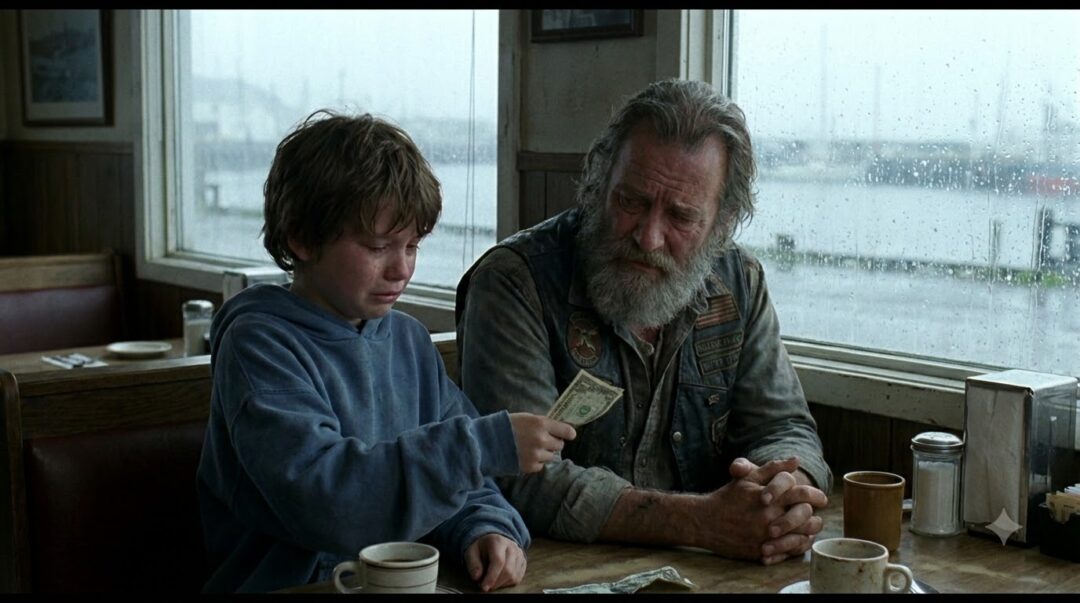
At the back horseshoe booth sat Wyatt “Anchor” Cole, surrounded by four senior riders of the Atlantic Trident Motorcycle Club. At fifty years old, Wyatt was a towering wall of broad-shouldered gristle and scar tissue. His salt-and-pepper beard was trimmed close along a square, weathered jaw that looked like it had been carved from Cape Ann granite. Beneath the faded black leather cut bearing the trident-and-propeller insignia, his heavy forearms were covered in dark anchor tattoos and jagged white scars—permanent reminders of twenty-five years as a commercial deep-sea salvage mechanic. Across from him sat Deck, a wiry former Navy avionics tech, and Moose, a three-hundred-pound drydock crane operator who could hoist a boat engine with a hand crank.
The diner’s brass entrance bell chimed with a hesitant, trembling ring.
The blast of freezing coastal air swept into the warm dining room, carrying with it a tiny figure. Standing on the worn rubber welcome mat was a nine-year-old boy. He wore an oversized navy-blue hooded sweatshirt with frayed cuffs, muddy red rubber rain boots, and faded corduroy trousers that were soaked up to the shins from the harbor spray. His small hands were trembling violently, purple from the freezing drizzle, and his nose was runny and red. Clutched tightly against his small chest, hanging by a braided nylon fishing line around his neck, was a tarnished silver boatswain’s whistle.
The diner fell quiet except for the sizzle of breakfast bacon on the back flattop.
The boy took a deep, shuddering breath, looked past the fishermen at the counter, and walked with determined, clumsy steps straight toward the horseshoe booth at the rear. He stopped at the edge of the table, his wide hazel eyes looking up at Wyatt’s intimidating frame without blinking.
From the front pocket of his oversized hoodie, the boy withdrew a single, tightly crumpled piece of paper. He smoothed it out against his thigh with trembling, cold-numbed fingers and placed it squarely on the formica tabletop between Wyatt’s steaming coffee mug and his plate of rye toast.
It was a United States one-dollar bill—ragged, creased a thousand times, and damp with salt water.
“Mister,” the boy spoke. His voice was thin and high, quivering from cold, but every syllable was delivered with desperate, unyielding seriousness. “Are you the man who fixes the deep-water engines?”
Wyatt did not touch the dollar. He kept his massive hands wrapped around the white ceramic mug, his gray eyes studying the child with the calm, heavy gravity of a lighthouse keeper.
“I am,” Wyatt answered, his voice a low, rhythmic rumble like ocean surf breaking over a gravel bar. “I’m Wyatt. Who are you, son?”
“My name is Toby Walsh,” the boy said, standing as tall as his shivering four-foot frame would allow. “And I want to hire you.”
Deck let out a soft chuckle into his coffee, but Wyatt raised a single calloused finger, and the table went dead silent.
“What does a one-dollar contract buy from Atlantic Trident, Toby?” Wyatt asked quietly.
Toby swallowed hard, his throat bobbing. He reached up, his fingers tightening around the silver whistle against his chest. “Today is Family Day at Harbor Elementary. At two o’clock. Every kid’s dad is going to stand on the auditorium stage. They’re going to talk about their jobs on the ocean. If you don’t have a father to stand with you… they make you sit in the empty library with the study hall monitor while the other kids point and laugh through the glass.”
Toby took a step closer, his eyes pleading with an agonizing intensity that cut through the leather and armor of the men in the booth. “A boy named Julian Sterling pushed me into the drainage ditch yesterday. He said my dad was a thief who drowned his crew on purpose. He said my mother works eighteen hours a day in the fish packing plant because no honest man would ever want us. Julian’s dad is bringing a limousine and catering platters to the school.”
Toby pointed down at the crumpled dollar bill on the table. “I worked three weeks sweeping fish scales off the north pier to earn that dollar. I don’t need a limousine. I just need a father with broad shoulders who isn’t afraid of the storm, so Julian will stop hurting my mom. Can one dollar buy that for one afternoon?”
Moose looked away, staring hard at the diner floorboards as a muscle twitched in his jaw. Deck slowly set his coffee mug down, his expression turning grave.
Wyatt looked down at the crumpled bill. Slowly, with infinite care, his massive, grease-blackened fingers reached out and turned the damp green paper over to inspect it.
Along the margin of the dollar bill, written in faded graphite pencil, was a single line of weathered handwriting:
To my son Toby, when you are big enough to choose your own crew. Keep the bearing true. – Liam.
Wyatt’s heart seized. The air rushed out of his lungs as if he had been struck with a steel mooring cable.
His hand trembled—a hand that had severed underwater hydraulic lines in ninety fathoms of pitch-black ocean without a flinch. He recognized that handwriting. He knew every loop, every slanted angle of those letters.
Three years ago, on a howling December night during the fifty-knot gale off George’s Bank, the commercial trawler The Sea Wolf had taken fifty tons of seawater into her forward cargo hold. Wyatt had been trapped beneath a collapsed deck winch in the flooded engine room, the freezing ocean rising past his neck. It was Captain Liam Walsh who had dove beneath the black water, wedged a six-foot crowbar under the steel beam, and wrenched Wyatt free. Liam had shoved Wyatt into the last inflatable liferaft, cutting the painter line with his knife before the trawler plunged two hundred feet to the ocean floor.
For three years, the corporate media and the maritime board had called Liam Walsh a reckless captain who scuttled his own ship for insurance money.
Wyatt stared at the little boy standing before him. The boy had Liam’s stubborn chin, Liam’s fierce, unwavering hazel eyes, and Liam’s silver boatswain’s whistle around his neck.
Wyatt reached out, took the one-dollar bill, and folded it with reverent care. He slipped it into the left breast pocket of his leather cut, directly over his heart.
Then Wyatt stood up. At six-foot-one, with his massive shoulders blotting out the gray morning light, he reached down and extended his calloused right hand to the boy.
“Contract accepted, Toby,” Wyatt said, his voice ringing with absolute, unbreakable authority. “At two o’clock, you won’t be sitting in that library alone. You’re going to have the biggest damn crew in Massachusetts standing behind you.”
CHAPTER 2: THE CANNERY BY THE DOCKS
The rain began to fall in heavy, slanted sheets as Wyatt’s custom black Harley-Davidson rolled down the uneven cobblestones of Commercial Street. Toby rode in the passenger side of Moose’s heavy Ford F-350 support truck, wrapped in a dry wool naval blanket with a hot thermos of hot chocolate clutched in his small hands.
They pulled into the loading dock of the Cape Ann Seafood Cannery—a sprawling, rusted corrugated-steel complex that reeked of ammonia, gutting water, and industrial brine. It was the last operating processing plant in the harbor, owned entirely by Atlantic Apex Logistics—the multi-million-dollar maritime conglomerate run by Donald Sterling.
Wyatt swung his leg off the Harley, his heavy waterproof work boots splashing into oily puddles. He walked into the cavernous processing room.
The air inside was freezing and deafening, filled with the continuous mechanical screech of high-speed de-heading saws and the clatter of steel conveyor belts. Fifty women in yellow rubber aprons and hairnets stood in a line along the gutting troughs, their hands moving in rapid, repetitive motions as they filleted Atlantic cod under flickering fluorescent tubes.
At the far end of the third line stood Ellen Walsh.
At thirty-two, she possessed the delicate, striking bone structure of an Irish seafarer’s daughter, but exhaustion had carved dark hollows beneath her striking hazel eyes. Her shoulders were bent forward, her fingers red and swollen inside thin latex gloves as she worked through a hundred-pound crate of frozen mackerel.
Wyatt stepped up to the edge of the processing line. “Ellen.”
The sound of his voice carried over the roar of the machinery. Ellen froze. She turned, wiping a strand of wet auburn hair from her forehead with the back of her wrist. When she saw Wyatt standing there in full club colors, flanked by Moose and Deck, her eyes widened in alarm.
“Wyatt?” she gasped, pulling off her gloves. “What happened? Is Toby hurt? Did something happen at the school?”
“Toby is fine, Ellen,” Wyatt said gently, stepping closer. “He’s sitting in Moose’s truck drinking hot cocoa with a dry blanket.”
Ellen sighed, leaning against the stainless-steel gutting table as if her knees were about to buckle. “Why did he go to you, Wyatt? I told him… I told him we can’t burden you. The whole town turned its back on Liam after the inquiry. If people see you associating with us, they’ll pull their maintenance contracts from your marine shop.”
“Let them try,” Wyatt said coldly. “Your boy walked into The Salt Anchor with a one-dollar bill and Liam’s handwriting. He asked me to be his father for Family Day.”
Tears sprang instantly into Ellen’s eyes. She covered her mouth with trembling hands, a ragged sob breaking from her chest. “Oh, God… Toby. He heard the Sterling boy talking yesterday. Julian brought a printed copy of the maritime board’s revocation letter to the fourth-grade playground. The children formed a circle and chanted that Liam was a murderer.”
“Liam was the finest seaman who ever steered a rudder,” Wyatt growled, his fists clenching into iron knots. “And Donald Sterling knows it better than anyone.”
Before Ellen could answer, the double doors of the plant supervisor’s office banged open.
Stepping out onto the raised metal catwalk was Bradley Vance, a sleek, thirty-eight-year-old corporate attorney in a thousand-dollar trench coat, holding a leather portfolio. Behind him stood two burly security guards in dark uniforms.
“Mrs. Walsh!” Bradley Vance called out, his voice amplified by the warehouse acoustics. “You have exceeded your allotted fifteen-minute morning break. Return to your station immediately or your employment will be terminated for cause.”
Wyatt didn’t look up at the catwalk. He took three deliberate strides toward the metal staircase and rested one massive boot on the bottom rung, looking directly up at the attorney.
“Come down here and tell her yourself, pencil-pusher,” Wyatt said, his baritone voice vibrating with lethal menace.
Bradley Vance recoiled slightly, recognizing the Trident president. He adjusted his gold wire-rimmed glasses, clearing his throat to regain his composure as he walked down the stairs, flanked by his guards.
“Mr. Cole. This is private corporate property. Your presence constitutes criminal trespass,” Vance said, opening his portfolio to produce a legal notice. “And as it happens, I am glad you are here to witness this. Mrs. Walsh, on behalf of Atlantic Apex Fleet and our chairman Donald Sterling, I am serving you with an immediate Petition for Custodial Guardianship.”
Ellen gasped, retreating against the stainless-steel table. “What? What are you talking about?”
“Under Massachusetts law,” Vance said smoothly, tapping the document with a gold fountain pen, “a surviving parent who cannot provide adequate shelter, nutrition, and psychological stability may have their child placed into protective state conservatorship. You are currently three months in arrears on your dockside mortgage, which is held by Apex Financial. Furthermore, you work fourteen hours a day, leaving a minor child unsupervised on hazardous industrial piers.”
Vance offered a cold, venomous smile. “Mr. Sterling has generously offered to sponsor Toby at the St. Jude’s Maritime Academy in Maine—fully paid boarding, military discipline, and complete isolation from the disgraceful legacy of his father. You have exactly twenty-four hours to sign the voluntary transfer agreement. If you refuse, the Department of Children and Families will seize Toby from your home at seven o’clock tomorrow morning.”
Ellen dropped to her knees, crying out in sheer terror. “You can’t take my son! You can’t take my baby! He’s all I have left!”
Wyatt stepped between Ellen and the corporate lawyer. He reached out with one hand, clamped his fingers around the top of Vance’s leather portfolio, and ripped it effortlessly from the lawyer’s grip.
With two swift motions, Wyatt tore the custody petition in half, then into quarters, and let the white scraps flutter down into the drainage trough of fish guts.
“Tell Donald Sterling that Toby Walsh is not going anywhere,” Wyatt whispered into Vance’s face, his eyes like two gun barrels. “And tell him that if his process servers come anywhere near Ellen’s cottage, they will leave Cape Ann on a stretcher.”
Vance backed away, his face pale with fury. “You have twenty-four hours, Cole. Tomorrow morning, you and this whole pathetic family will be crushed.”
CHAPTER 3: THE HONOR GUARD OF HARBOR ELEMENTARY
The clock on the brick facade of Harbor Elementary School showed 1:45 PM. The October sky was a bruised charcoal-gray, spitting sleet against the parked luxury SUVs, Audis, and BMWs lining the circular driveway.
Inside the school auditorium, the atmosphere was festive, noisy, and bustling. Over three hundred parents and children filled the oak pews. On the raised mahogany stage stood the annual Family Day banner: HONORING OUR MARITIME HERITAGE.
In the front row sat Donald Sterling. At fifty-five, the chairman of Atlantic Apex looked like an emperor of the coast. He wore a tailored charcoal cashmere overcoat, polished cordovan boots, and a heavy gold signet ring on his pinky. Beside him sat his son, Julian—a smug, well-dressed ten-year-old boy in an expensive school blazer, holding a scale model of the new seventy-foot Apex trawler The Leviathan.
At the back of the auditorium, standing near the double exit doors under the watchful eye of Mrs. Gable, the grim-faced study hall monitor, was Toby Walsh.
Toby had washed his face and combed his hair, but he still wore his frayed navy-blue hoodie and faded trousers. He kept his eyes glued to the double doors, his small fingers clutching Liam’s silver boatswain’s whistle until his knuckles were white.
“Toby, dear,” Mrs. Gable sighed, checking her wristwatch. “It’s seven minutes until two. The presentations are about to start. If no one is coming, you must go to the reading room. Rules are rules.”
Julian Sterling turned around from the front row, catching Toby’s eye. Julian grinned maliciously, raising a hand to mimic a sinking ship going beneath the waves. The two boys sitting next to Julian snickered, nudging each other.
Toby’s lip trembled. A hot tear slipped down his cheek. He looked down at the linoleum floor, his small shoulders sagging under the suffocating humiliation. He had spent his only dollar. The big biker had taken it and forgotten him. Just like everyone else in the harbor.
“I’m sorry, Toby,” Mrs. Gable said gently, placing a hand on his shoulder to lead him toward the hallway. “Let’s go.”
Toby took one step.
Suddenly, the heavy double oak doors of the auditorium vibrated.
Then the concrete foundation beneath the floor began to shudder.
It started as a low, subterranean rumble—like a distant earthquake rolling through the granite bed of Cape Ann. Within three seconds, the rumble escalated into a deafening, thunderous roar that drowned out the chatter of three hundred people.
The plate-glass windows along the auditorium wall rattled violently in their aluminum frames.
Outside on the circular school driveway, twenty custom Harley-Davidsons, Indian Chiefs, and heavy cruisers swept past the barricades in a two-by-two military formation. The deep, bass roar of straight-pipe V-twin exhausts shook the autumn air, their chrome pipes gleaming like polished mirrors through the rain.
The parents in the auditorium gasped, several leaping to their feet in shock. “What on earth is that?”
The heavy double doors of the auditorium swung wide open with a sharp, dramatic thud.
Walking through the threshold was Wyatt “Anchor” Cole.
He had shed his road grease. He wore a crisp, tailored black denim shirt under an immaculate, oiled leather club cut. Pinned to his left chest was a row of civilian and naval maritime commendations: the Coast Guard Meritorious Public Service Medal and the National Deep Sea Diver’s Cross.
Flanking him on either side were Moose, Deck, and sixteen towering, leather-clad members of Atlantic Trident.
And walking right beside Wyatt, her arm linked securely through his massive forearm, was Ellen Walsh. She wore an elegant, vintage navy-blue wool dress, her auburn hair falling in soft curls past her shoulders, her head held high, looking as regal and radiant as an ocean queen.
The auditorium fell into a stunned, breathless silence. You could hear a pin drop on the carpet.
Wyatt scanned the room. His eyes locked onto Toby standing by the back wall.
A warm, broad smile broke across Wyatt’s rugged face. He walked down the center aisle, his heavy motorcycle boots striking the floor with rhythmic, measured authority. He stopped right in front of the little boy.
Wyatt snapped a crisp, formal naval salute.
“Contractor Toby Walsh,” Wyatt’s deep baritone voice echoed off the high mahogany rafters. “Your crew has arrived. Are you ready to take the stage?”
Toby looked up at Wyatt, then at his mother, then at the twenty towering men standing behind them with broad, proud smiles.
Toby’s hazel eyes widened, and a radiant, triumphant grin lit up his entire face. He wiped the lone tear from his cheek with the back of his sleeve.
“Yes, sir!” Toby shouted, his voice ringing with pride.
Wyatt bent down and lifted Toby effortlessly onto his broad right shoulder. With Toby riding high above the crowd, Wyatt walked down the center aisle straight toward the stage.
The crowd of fishermen, cannery workers, and harbor families suddenly broke into spontaneous, thunderous applause. Old captains who had fished with Liam Walsh stood up, clapping their calloused hands and nodding with deep respect.
Donald Sterling’s face flushed purple with rage. He rose from the front row, his jaw clenched, his eyes blazing at Wyatt.
As Wyatt carried Toby past Sterling’s seat, Sterling leaned forward, his voice a venomous whisper meant only for Wyatt’s ears:
“Enjoy your little parade, Cole. Because by midnight tonight, the cannery and your boatyard will be reduced to ash. And you’ll watch this family starve on the streets.”
CHAPTER 4: THE BRASS CHEST IN THE DISMANTLED YARD
The autumn sun set early, drowning Gloucester Harbor in ink-black waters and freezing rain.
Following the triumph at the school, Wyatt brought Toby and Ellen back to the compound of North Shore Marine—Wyatt’s three-acre salvage yard and drydock located at the edge of the abandoned railway wharf. The yard was protected by high chain-link fences topped with barbed wire, guarded by three massive Rottweilers, and lit by high-pressure sodium floodlights that cast an amber glow across stacks of rusted propeller shafts, bronze ship anchors, and deep-water winches.
Inside the heated workshop, the potbelly stove glowed cherry-red with burning birch logs. Toby sat on an upturned wooden cable spool, eagerly devouring a plate of warm beef stew that Moose had brought from the diner.
Ellen stood near the workbench, clutching a steaming mug of tea, her eyes troubled. “Wyatt… what Sterling whispered to you at the school. I saw the look on his face. He’s a ruthless man. When Liam challenged him three years ago, Liam said Sterling would burn down the whole harbor before he let anyone expose the Apex fleet.”
Wyatt wiped grease from his hands with a blue shop rag. “Why did Liam challenge him, Ellen? What was really happening on The Sea Wolf?”
Ellen closed her eyes, trembling slightly. “Liam was an engineer before he was a captain. He designed a patented hydraulic trawling system—the Walsh Eco-Grid. It allowed nets to harvest sixty percent more fish while completely eliminating bycatch of endangered Atlantic bluefin. It was worth tens of millions of dollars. Sterling wanted Liam to sign the patent over to Apex Logistics for twenty thousand dollars.”
“And Liam told him to go to hell,” Wyatt said, his voice dropping.
“Liam was going to present the patent directly to the federal maritime commission in Boston,” Ellen whispered. “The night The Sea Wolf sank, Liam told me over the satellite radio that the engine cooling pump had been tampered with. The main sea chest valve had been cracked intentionally with a sledgehammer. When the ship started taking on water… someone had removed the emergency submersible pumps from the forward hold.”
Wyatt stopped moving. The blue rag slipped from his fingers. “The sea chest was tampered with? The maritime board declared it was operator negligence—that Liam failed to secure the cargo hatches.”
“Because Sterling paid the inspectors!” Ellen cried softly. “Liam knew it was coming. The day before his final voyage, Liam brought a small brass sea chest to the old boatyard out on Ten Pound Island. He told Toby: ‘If anything ever happens to me, tell the man with the anchor tattoo where to look.'”
Wyatt turned sharply to Toby. “Toby. Do you remember where Liam took you?”
Toby swallowed his bite of stew, his eyes wide and serious. He reached into his pocket and pulled out the tarnished silver boatswain’s whistle around his neck.
“My dad didn’t just give me the whistle,” Toby whispered. He unscrewed the cylindrical silver mouthpiece of the whistle.
Inside the hollow chamber was a tiny, rolled strip of oilcloth.
Wyatt took the oilcloth, unrolling it under the bright halogen workbench lamp. Inside was a small, intricately notched bronze key, accompanied by a hand-drawn map of the historic granite lighthouse ruins on Ten Pound Island.
“Deck! Moose!” Wyatt shouted across the workshop. “Fuel the twin-engine Boston Whaler! We’re going to Ten Pound Island right now!”
Twenty minutes later, cutting through four-foot whitecaps in the pitch blackness of Gloucester Harbor, the Whaler slammed against the crumbling granite pier of Ten Pound Island. Wyatt, Deck, and Toby scrambled ashore with tactical lanterns, their beams slicing through the horizontal sleet.
They navigated the slippery rocks to the base of the abandoned 1881 lighthouse keeper’s cottage. In the collapsed brick hearth of the fireplace, Wyatt used a heavy pry bar to dislodge a hollow granite cornerstone.
Behind the stone sat a heavy, watertight bronze munitions chest, sealed with military-grade silicone grease.
Wyatt inserted the bronze key into the chest’s padlock. The tumblers clicked. Wyatt swung the heavy lid back.
Inside lay three objects:
First was Liam’s original handwritten patent notebooks for the Walsh Eco-Grid, containing full mechanical blueprints certified by the United States Patent Office.
Second was a sealed waterproof titanium case containing the voyage data recorder—the commercial “black box”—salvaged from The Sea Wolf before she sank.
And third was an audio cassette tape labeled: STERLING – CARGO HOLD CONVERSATION – DECEMBER 14.
Wyatt opened his tactical rugged laptop on the lighthouse floor, connected the data cable to the titanium black box, and downloaded the encrypted voyage telemetry.
Deck leaned over the glowing screen, his eyes widening in shock. “Wyatt… look at the GPS tracking coordinates! At 23:40, thirty minutes before The Sea Wolf sent her Mayday, there was a second vessel trailing her at three knots. Registration number: US-Apex-01. That’s Donald Sterling’s personal eighty-foot yacht, The Corsair!”
Deck tapped the keyboard, running the digital radio frequency decryptor. “And there’s audio logged on the VHF distress band! Listen!”
Through the laptop speakers, cutting through the crackle of ocean static, came Liam Walsh’s desperate voice:
Mayday, Mayday! This is The Sea Wolf! Hull breach in the forward engine space! The bilge valves have been cut! Corsair, we see your lights off our port quarter! Why aren’t you answering? We have seven men in the water! Donald, answer the radio!
Then, chillingly clear, Donald Sterling’s voice responded over the secure channel:
You should have signed the patent, Liam. Dead captains don’t file federal lawsuits.
CHAPTER 5: FIRE ON THE COLD WATER
Toby stood in the dark lighthouse, his small hand gripping Wyatt’s leather sleeve, tears pouring silently down his cheeks. “He killed my dad… He killed my dad on purpose.”
Wyatt knelt down, placing his massive hands on Toby’s shoulders. His eyes were like molten iron. “Your dad fought like a lion to protect his crew, Toby. And now, we finish his fight.”
Wyatt packed the bronze chest, securing it inside a waterproof tactical backpack. They returned to the Boston Whaler and roared back toward the Gloucester mainland.
But as the boat rounded the inner breakwater into the harbor basin, a sickening crimson glow lit up the low-hanging clouds over the city.
Thick, billowing plumes of black smoke rolled across the water, smelling of burning roofing tar, diesel fuel, and melting plastic.
“The cannery!” Deck shouted over the roar of the twin outboards, pointing his finger toward the wharves. “The Cape Ann Cannery is on fire!”
Wyatt throttled the engines wide open. The Whaler surged through the chop, slamming against the cannery’s private pier.
The entire western wing of the packing plant was a raging inferno. Thirty-foot tongues of orange flame punched through the corrugated-steel roof into the rainy night. Outside on the loading dock, dozens of terrified cannery workers were coughing in the smoke.
“Where is Ellen?” Wyatt roared, leaping onto the dock.
An elderly line worker grabbed Wyatt’s arm, her face black with soot. “Wyatt! She went back into the administrative office to get the employee pension ledgers! Two men in ski masks barred the fire exit doors from the outside and threw gasoline bottles through the windows! She’s trapped inside!”
Wyatt didn’t hesitate for a fraction of a second.
“Moose! Keep Toby on the boat! Deck, grab the heavy winch line from the Harley!”
Wyatt charged toward the blazing side entrance. The heavy double steel doors were secured with a hardened steel chain and an industrial padlock. Inside, through the wire-reinforced glass, Wyatt could see Ellen trapped behind the reception desk, coughing violently as suffocating black smoke filled the room.
“Get back from the door, Ellen!” Wyatt bellowed.
Wyatt grabbed the three-inch steel tow hook from his motorcycle’s rear winch, wrapped the braided steel cable around the padlock and the door handles, and signaled Deck at the throttle of his Harley.
Deck dumped the clutch. The V-twin engine screamed, the rear tire smoking against the wet pavement. With a violent screech of tearing metal, the entire steel door frame was ripped out of the brick wall, crashing onto the pavement.
Wyatt dove through the roaring wall of smoke and flame. He scooped Ellen into his arms, shielding her face with his heavy leather cut, and carried her through the blazing doorway just as the wooden ceiling joists collapsed in a shower of sparks and flaming timber.
He laid Ellen down on the wet grass of the adjacent park. She was coughing raggedly, her face smeared with soot, but she was alive.
“Toby…” she gasped, reaching out weakly.
“Mom! Mom!” Toby scrambled off the boat and threw himself into her arms, weeping with joy as Ellen held him tight against her chest.
Suddenly, a loud crash came from the rear alleyway behind the blazing warehouse.
Deck and Moose sprinted around the corner. A man dressed in black tactical clothes and a ski mask had dropped a five-gallon gas canister and was scrambling over the chain-link fence to a waiting black Dodge Ram pickup.
Moose moved like an enraged grizzly. He caught the man by his ankle, yanked him off the top of the fence, and slammed him face-first into the mud. Moose pinned the man’s arms behind his back with one massive hand and ripped off the ski mask.
It was Bradley Vance—Donald Sterling’s corporate attorney.
In Vance’s open coat pocket was an uncashed cashier’s check for two hundred and fifty thousand dollars, signed by Donald Sterling, with the memo line: FINAL SITE CLEARANCE & DEMOLITION.
Wyatt walked over, his face illuminated by the raging flames behind him. He stepped on the attorney’s hand until the bones groaned.
“Where is Sterling?” Wyatt asked, his voice deadly quiet.
“Go to hell, Cole!” Vance spat, coughing blood.
Wyatt pressed harder. The sound of Vance’s finger joints popping echoed in the alley.
“I asked you a question, counselor. Where is he?”
“Logan Airport!” Vance shrieked in agony. “His private Gulfstream jet is fueled on the executive tarmac! Departure at 4:30 AM for the Cayman Islands! He already transferred the offshore accounts! You’ll never touch him!”
Wyatt checked his watch. It was 3:10 AM.
They had exactly eighty minutes before Donald Sterling left American airspace forever.
CHAPTER 6: THE INTERCEPTION AT THE DRAWBRIDGE
The rain was falling in blinding sheets as the Atlantic Trident motorcade tore down Route 128 South toward Boston at over ninety miles per hour.
Fifteen roaring motorcycles flanked Wyatt’s Harley, their headlights piercing the freezing gloom like a squadron of attack aircraft. Strapped across Wyatt’s chest inside the waterproof tactical pack was the black box, the original patent certificates, and the audio tape.
In the center of the formation rode Moose’s heavy Ford F-350, carrying Ellen, Toby, and the captured attorney Bradley Vance, bound tightly in zip-ties in the back seat.
Wyatt’s helmet radio crackled with Deck’s voice: “Wyatt! State Police dispatched cruisers to the cannery, but Sterling bribed the regional port authority! He has an armed private motorcade—three black Suburbans—escorting him from his seaside estate in Beverly straight to the private executive terminal at Logan!”
“Where do their routes cross ours?” Wyatt demanded over the roar of the wind.
“The Annisquam River Bridge is closed for maintenance,” Deck responded rapidly. “Sterling has to cross the Blynman Canal Drawbridge on Western Avenue! That’s the only route out of Cape Ann for heavy vehicles!”
“We take the bridge,” Wyatt ordered. “Shut it down.”
Five minutes later, the Atlantic Trident convoy roared onto the approach to the Blynman Canal Drawbridge.
The drawbridge operator was a retired Trident veteran named Frank. When Wyatt’s headlights flashed three times in the darkness, Frank hit the emergency marine klaxon.
A deafening siren wailed across the canal. The red-and-white crossing gates dropped across Western Avenue, and the massive twin steel spans of the drawbridge began to rise into the air with a mechanical groan of heavy gears.
Two minutes later, three black Chevrolet Suburbans with tinted windows and flashing blue security lights came speeding down Western Avenue.
The lead Suburban slammed on its brakes, tires screeching against the wet asphalt, stopping barely ten feet from the elevated steel lip of the rising bridge.
The doors of the Suburbans flew open, and eight private security guards stepped out, their hands hovering near concealed holsters.
Then the rear door of the center Suburban opened.
Donald Sterling stepped out into the freezing rain. He held a leather travel bag and an umbrella held by his bodyguard. His face was twisted with arrogant impatience.
“What is the meaning of this?” Sterling barked at the bridge tower. “Raise those gates immediately! I have a priority charter flight!”
“You’re not catching that flight, Sterling,” a thunderous voice boomed from the shadows.
Sterling spun around.
From the darkness of the bridge approach, fifteen Harley-Davidsons formed a semi-circle across the roadway, completely cutting off any retreat. Their high-beam headlights illuminated Sterling in a blinding white crossfire.
Wyatt stepped forward through the glare. He reached into his coat and unslung a heavy, battery-powered marine megaphone. He connected the audio cable of his rugged laptop to the megaphone’s input jack.
“What ridiculous stunt is this, Cole?” Sterling sneered, trying to sound confident, though his eyes darted nervously to his guards. “You have no legal authority to detain me. I am a private citizen traveling on business.”
“You’re not a citizen, Sterling,” Wyatt said. “You’re a pirate.”
Wyatt hit the play button.
The marine megaphone blared with maximum acoustic power, its sound carrying for half a mile across the harbor waters, echoing off the historic homes of Gloucester:
Corsair, we see your lights off our port quarter! Why aren’t you answering? We have seven men in the water! Donald, answer the radio!
You should have signed the patent, Liam. Dead captains don’t file federal lawsuits.
The eight private security guards looked at each other in horror. The lead bodyguard slowly took his hand away from his weapon, stepping three paces away from Sterling.
“That’s… that’s an AI-generated fake!” Sterling screamed, his composure completely shattering as rain plastered his silver hair to his forehead. “It’s slander! It’s extortion!”
“The National Transportation Safety Board doesn’t think so,” Wyatt said, pointing behind Sterling.
Down Western Avenue, the flashing blue and red emergency lights of twelve Massachusetts State Police cruisers and three unmarked FBI tactical vehicles lit up the rainy night like a carnival.
The federal agents poured out of their vehicles with rifles drawn.
“Donald Sterling!” an FBI special agent announced over a loudspeaker. “Step away from the vehicle with your hands above your head! You are under arrest for maritime sabotage, conspiracy to commit murder, and interstate corporate fraud!”
Sterling looked around in wild, animal panic. He grabbed his leather bag, sprinted toward the pedestrian railing of the bridge, intending to jump fifty feet into the freezing, turbulent waters of the Blynman Canal.
He made it two steps.
Wyatt closed the distance like a charging bull. His massive right hand clamped onto the collar of Sterling’s cashmere coat, lifting the multi-millionaire off his feet and slamming him flat onto the cold, wet diamond-plate steel of the bridge deck.
Wyatt knelt over him, his knee pinning Sterling’s chest until the tycoon could barely gasp for air.
“Liam Walsh sent you a message, Sterling,” Wyatt whispered into the terrified man’s ear. “The debt is collected.”
CHAPTER 7: THE HONOR OF CAPTAIN WALSH
One month later, the cold Atlantic winds blew crisp and clean across Harbor Point, but the sun shone brilliant and gold across the water.
The historic Gloucester City Hall auditorium was packed with over five hundred citizens, fishermen, and dignitaries from across New England.
At the center of the stage stood the Governor of Massachusetts, flanked by the Rear Admiral of the United States Coast Guard First District.
On the podium rested a magnificent bronze plaque, alongside the posthumous Congressional Gold Medal for Maritime Heroism.
“Today,” the Governor announced, his voice ringing through the grand hall, “the Commonwealth of Massachusetts officially rectifies a grave historical injustice. Captain Liam Walsh was not only an innocent man; he was a hero who sacrificed his life to save his crew and preserve the future of American sustainable fishing. The Walsh Eco-Grid patent has been legally restored to the Walsh family estate, valued at forty-two million dollars.”
The entire hall erupted in a five-minute standing ovation, cheers and whistles echoing off the high stained-glass windows.
Sitting in the front row of honor was Ellen Walsh, looking magnificent in an emerald wool dress, her face radiant with peace and dignity. Sitting beside her was Toby, proudly wearing a crisp navy blazer, his silver boatswain’s whistle polished until it gleamed like a diamond.
And sitting beside Toby, occupying two full wooden auditorium chairs with his massive frame, was Wyatt “Anchor” Cole, wearing his dress leather club cut.
After the ceremony, the crowd poured out onto the sunlit plaza overlooking the harbor.
Toby walked up to Wyatt, looking up at the veteran salvage diver with his bright hazel eyes. He reached into his blazer pocket and pulled out a small, flat wooden picture frame he had made in school shop class.
Inside the frame, mounted against velvet blue felt, was the crumpled, salt-stained one-dollar bill.
“Wyatt,” Toby said, holding the frame out with both hands. “Our contract was for one day at Family Day. The day is over. But… my mom and I want to know if you’ll sign a new contract.”
Wyatt knelt down on the granite steps, looking at the little boy with deep, fatherly warmth. “What does the new contract say, Toby?”
Toby smiled, pointing to the framed dollar. “It says you have to teach me how to fix deep-sea engines, how to steer a boat through forty-foot waves, and you have to come to dinner every single night for the rest of your life.”
Ellen walked over, slipping her hand gently into Wyatt’s massive calloused palm, her eyes filled with love and gratitude. “And the pay is non-negotiable, Wyatt. One dollar… paid in advance.”
Wyatt laughed—a rich, deep, joyous sound that carried all the way to the water. He took the framed dollar, placed his other arm around Toby’s shoulders, and pulled both Toby and Ellen close against his chest.
“Contract signed, son,” Wyatt whispered, kissing the top of Toby’s head. “For as long as the tide rises.”
Down in the harbor, the twenty motorcycles of Atlantic Trident fired their engines in unison, their thunderous roar celebrating the return of honor to Harbor Point.