The Custom Bolt In The Hidden Drawer Saved The Iron Engine
CHAPTER 1: THE TORQUE IN THE MIDNIGHT BAY
The October night over the industrial rail corridor of South Austin was suffocatingly hot, smelling of creosote, solvent fumes, and scorched ninety-weight gear oil. Inside Bay 4 of the old Missouri Pacific locomotive roundhouse, a single two-hundred-watt halogen work lamp hung suspended from a rusty steel truss, casting a harsh pool of amber glare across an oil-stained concrete floor littered with chrome-vanadium sockets and brass feeler gauges. In the center of the bay, mounted on a hydraulic engine stand, sat an icon of mechanical mythology: a 1948 Vincent Black Shadow ninety-degree V-twin motorcycle engine, its sand-cast aluminum crankcases gleaming like dull silver in the dark.
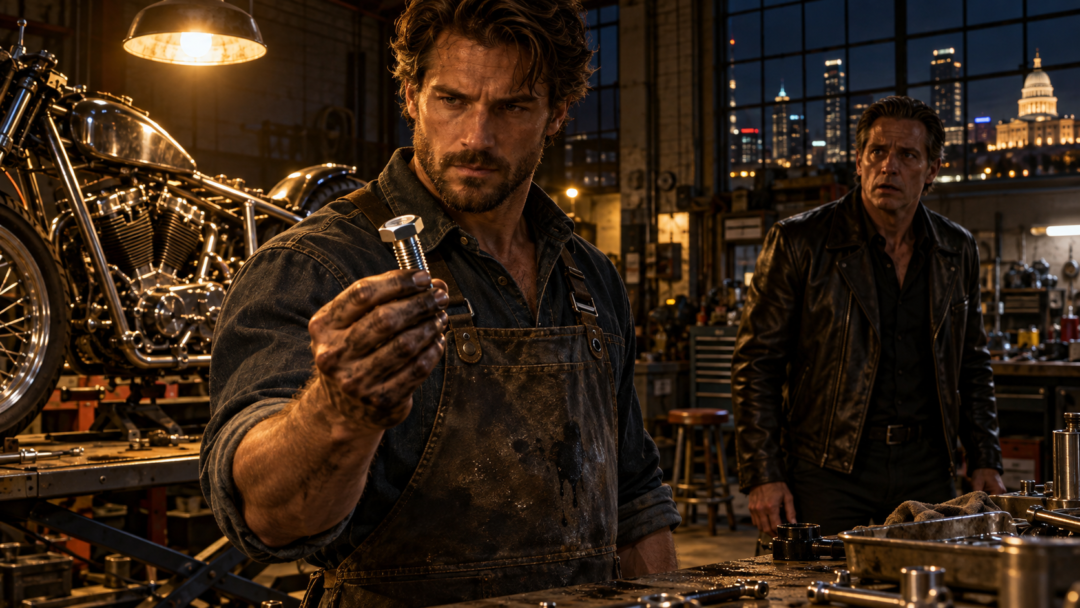
Kade Miller stood at the washbasin in the corner, scrubbing sixty years of carbon grime from his forearms with a pumice brush and orange citrus solvent. At thirty-four, Kade had the broad, knotted shoulders of an artisan who had spent twenty years bent over Bridgeport milling machines and manual engine lathes. His denim apron was stiff with dried metal shavings and cutting fluid, his dark hair plastered to his forehead with sweat, his eyes calm, sharp, and hyper-attentive to the acoustic rhythm of the shop.
Behind his back, near the engine stand, a shadow crossed the concrete.
Tolan Vance walked into the circle of light. At forty-one, Tolan owned Apex Velocity, the high-end custom chopper boutique that occupied the commercial front of the building. His black leather motorcycle boots were polished to a mirror shine, completely unscarred by welding slag. He wore an expensive embroidered shop jacket with CHIEF BUILDER stitched across the left breast in gold thread, his gold wristwatch gleaming against his pale wrist.
Tolan looked toward the washbasin where water was running from the copper tap. With a tight, hurried smirk, his right hand darted into his jacket pocket, withdrawing a threaded steel fastener.
His fingers hovered over the Vincent’s front cylinder head.
With a practiced, snake-like twist, Tolan unthreaded the central Grade-8 cylinder retaining stud—the primary bolt that clamped the high-compression aluminum head against the iron cylinder sleeve—and slipped it into his jacket. In its place, he spun in a replacement bolt whose threads had been pre-stripped on a grinding wheel, leaving the fastener seated loose and crooked in the aluminum casing.
Tolan wiped the engine casting with an oily rag, watching Kade turn off the water.
“Just checking your work, Miller,” Tolan drawled, leaning against the steel tool cart, crossing his arms with an expression of patronizing, theatrical pity. “You’ve been turning wrenches on that English relic for three straight weeks. Henry Sterling is arriving on his private jet from Dallas in twenty minutes to inspect the restoration. You really think you can make that museum piece fire on two cylinders before the clock runs out?”
Kade dried his hands on a clean cotton shop towel, his gaze sweeping the workbench before locking onto the engine block.
His eyes caught the head of the center bolt instantly.
To an untrained eye, it looked like any other five-eighths hex head. But Kade’s fingers knew the geometry of machine screws within two ten-thousandths of an inch. The chamfer on the bolt head was stamped with a cheap, circular import mark, and the shank was seated at an imperceptible three-degree angle—a cross-threaded, stripped trap designed to blow the cylinder head through the petrol tank the second combustion pressure hit twelve to one.
Kade tossed the towel onto the tool chest. His heartbeat did not accelerate. His jaw muscles did not clench. Anger in a machine shop was a fatal distraction; it dulled the precision of the micrometer and made a mechanic strip threads with uncalibrated torque.
“You’ll never get this one running, Kade,” Tolan laughed, stepping around the bike, gesturing with false sympathy at the open carburetors. “British iron is temperamental junk. The metallurgy is soft, the tolerances are sloppy, and some things just can’t be fixed by an independent back-alley grease monkey. Cut your losses. Tell Sterling you couldn’t source the internal fasteners, let Apex take over the restoration contract, and I’ll keep you on as a line mechanic at twenty-eight an hour.”
Kade walked to the bench. He reached beneath the heavy two-inch maple worktop to a concealed sliding drawer that had been installed by his grandfather forty years ago.
He pulled the drawer open.
Inside, resting on a bed of purple velvet, lay a single, hand-crafted fastener: a twelve-point cylinder retaining bolt machined from aerospace-grade Grade-5 titanium alloy. The threads had been cut on a South Bend toolroom lathe with a single-point carbide tool, polished to a mirror finish, its head laser-etched with a unique microscopic serial mark: KM-1948-SPEC.
“Some things can’t be fixed, Tolan,” Kade said, his voice flat, quiet, and resonant as an iron bell. “This one can.”
He picked up a high-torque pneumatic impact driver, spun the stripped bolt out of the aluminum block in half a second, tossed it onto the concrete floor where it clattered at Tolan’s polished boots, and hand-threaded the titanium fastener into the casing.
The threads engaged with buttery, hydraulic smoothness.
Kade set his calibrated Snap-on torque wrench to sixty-five foot-pounds, pulled the handle until the mechanical ratchet clicked with a crisp, authoritative CRACK, and snapped the spark plug leads onto the twin Champion plugs.
He turned on the brass petcock on the underside of the gas tank. The smell of high-octane aviation fuel filled the bay.
He stepped onto the forged steel kick-starter.
Tolan backed away two paces, his arms uncrossing, his face tightening with sudden, uneasy dread.
Kade did not hesitate. He kicked through the compression stroke in one fluid, authoritative plunge of his heavy work boot.
The engine did not sputter. It did not backfire.
With a concussive, deafening BOOM that shook the tin walls of the roundhouse, the one-thousand-cubic-centimeter British twin detonated into life. The dual megaphone exhausts barked with clean, razor-sharp mechanical fury, settling into a deep, rhythmic, thunderous idle that vibrated the concrete floor and made the sockets dance in their trays.
Tolan’s mouth fell open, his face draining of every drop of color as the overhead lamp illuminated the reflection of an elderly gentleman in a tailored wool overcoat stepping through the bay door.
Henry Sterling stood in the threshold, his piercing blue eyes traveling from the roaring vintage engine to Tolan’s open toolbox sitting on the adjacent cart.
There, glinting beneath the halogen light in the top tray of Tolan’s box, was the original Vincent cylinder bolt Tolan had stolen—lying directly beside a stripped fastener stamped with the custom logo of Tolan’s private racing chopper.
Kade hit the magneto kill switch.
The engine spun down, ticking with hot, clean metal in the sudden, breathless silence of the shop.
Kade looked directly into Tolan’s terrified eyes.
“That bolt was yours, Tolan,” Kade said softly. “Check your bike.”
CHAPTER 2: THE THREAD IN THE ALUMINUM
The silence that rushed into Bay 4 after the magneto died was heavier than the eighty-pound flywheel of the Vincent Black Shadow. The twin exhaust pipes ticked rhythmically as the alloy cooled, heat radiating off the polished aluminum heads like heat from an open stove.
Henry Sterling walked into the center of the bay, his leather-soled shoes clicking with measured authority against the oil-stained concrete. At sixty-five, Sterling was the founder and chief executive officer of Sterling Aerospace Dynamics in Fort Worth, a man who had made billions manufacturing jet turbine blades for the Pentagon. He wore an understated charcoal cashmere coat over a charcoal suit, his silver hair neatly cropped, his face bearing the stern, unreadable discipline of a former naval aviator.
He did not look at Kade Miller. He did not look at the vintage motorcycle.
Sterling stopped directly before Tolan’s mobile red tool cart. He reached down with two bare fingers, lifted the grease-stained cylinder bolt resting in the top tray, and turned it over beneath the glare of the hanging halogen work lamp.
“Interesting metallurgy, Mr. Vance,” Sterling said, his voice flat, cultured, and devoid of warmth. “This is an original British Standard Fine thread bolt, manufactured from high-nickel forged steel by the Vincent Works in Stevenage in nineteen forty-eight. It was supposed to be torqued into the front cylinder head of my motorcycle.”
Tolan’s throat clicked as he swallowed hard, a sudden film of cold sweat making his forehead shine under the lamp. “Mr. Sterling… Henry… look, there’s an explanation. I was just conducting a secondary visual inspection. Miller was rushing the assembly, and I wanted to ensure the thread pitch wasn’t binding—”
“You didn’t conduct an inspection, Tolan,” Sterling interrupted, his voice dropping an octave into chilling, razor-sharp finality. “You stole the bolt from my engine while Mr. Miller was washing his hands, and you substituted a pre-stripped fastener that you pulled from your own machine.”
Sterling pointed with the steel bolt toward the adjoining bay—Bay 5—where Tolan’s personal custom racing chopper sat on a chrome lift table. The chopper was a ninety-thousand-dollar promotional vehicle, painted in metallic candy-apple red with gold leaf lettering reading APEX VELOCITY – TITAN SPEC.
Kade walked across the shop to the chopper, bent down, and illuminated the lower left crankcase with his brass penlight.
The oil gallery port on Tolan’s engine block was empty. Fresh, dark synthetic motor oil was dripping down the chrome primary cover onto the lift table in thick, black beads.
“You took the oil gallery plug from your own bike, Tolan,” Kade said, his voice quiet and level. “The thread pitch is identical: five-eighths eighteen fine. But you ground down the lead threads on the bench grinder over by the parts washer to make it look like a fatigue fracture. You thought that when I kicked the Vincent over, the compression stroke would strip the aluminum threads out of the head, dump four quarts of oil onto the floor, and destroy the engine block beyond repair.”
Tolan backed away toward the open bay doors, his eyes darting frantically toward the dark parking lot where the rain was beginning to drum against the asphalt. “You’re making wild accusations! This is a minor shop misunderstanding! Kade’s always been jealous of Apex! He’s an unlicensed back-alley builder who works out of a rented corner of my leasehold!”
“Actually, Mr. Vance,” Sterling said, reaching into his cashmere coat and extracting a heavy manila legal folder, “Mr. Miller does not rent a corner of your leasehold. Mr. Miller is the designated managing trustee of the Missouri Pacific Industrial Reserve. He owns the master deed to this entire twelve-bay complex.”
Sterling slapped the manila folder down onto the steel workbench, right beside Kade’s titanium bolt drawer.
Tolan’s jaw worked soundlessly, his eyes bulging as he read the title on the deed: THE MILLER HEIRS TRUST – COMMERCIAL LAND PATENT 1954.
“Kade’s grandfather, Thomas Miller, built this facility seventy years ago to service diesel switch engines,” Sterling explained, stepping closer to Tolan until the younger builder was pinned against the brick door jamb. “When your firm, Apex Velocity, signed the sublease three years ago, you agreed to provide bonded machine shop services under federal defense contracting oversight. And for the past six months, my defense audit team has been tracking anomalous metallurgical failure reports in secondary turbine actuator brackets manufactured by your CNC machines.”
Tolan’s face lost every vestige of color, turning from pale grey to the sickly white of unbaked flour. “The defense contracts… that was a separate commercial division! We had third-party vendor certification!”
“You had certified third-party paperwork that you forged using the stolen digital credentials of Kade Miller’s master machinist license,” Sterling said, his voice cutting through the humid night air like an icepick.
Sterling turned to Kade, his blue eyes holding deep, unvarnished respect.
“Mr. Miller,” Sterling said, “the Vincent Black Shadow was not brought here simply because I wanted an antique motorcycle for my collection. It was a functional trial of character. My aerospace division needs a Director of Precision Machining to oversee the tooling for our next-generation hypersonic fuel injectors. We needed to know if the man who held the original Miller patents still possessed the integrity to build true under pressure.”
He looked back at the roaring engine, then at Tolan cowering against the brick wall.
“You passed the test, Kade,” Sterling concluded. “And Mr. Vance has just failed his final inspection.”
CHAPTER 3: THE BLUEPRINT IN THE LATHE
The realization of Henry Sterling’s true mission fell upon Bay 4 like a two-ton drop forge. Tolan Vance slumped against the brick wall of the bay door, his polished leather boots slipping in a puddle of rainwater blowing in from the dark parking lot, his arrogant swagger completely destroyed.
“You set me up,” Tolan whispered, his voice trembling with poisonous, defeated rage. “You brought that English antique in here knowing I’d try to take the contract.”
“Nobody forced your hand into Kade’s engine, Tolan,” Henry Sterling replied with icy contempt. “A man who sabotages his colleague’s work does not do so because he is provoked. He does so because he is a fraud who cannot bear the sight of authentic mastery. You built an empire on social media followers, chrome paint jobs, and stolen blueprints.”
Sterling walked to the master toolroom at the back of the bay—a climate-controlled enclosure lined with heavy glass windows, housing Kade’s prized collection of historic American machine tools: a 1942 Monarch 10EE precision toolmaker’s lathe, a Bridgeport vertical mill fitted with digital glass scales, and a granite surface plate flat to forty millionths of an inch.
Kade followed him into the toolroom, turning on the overhead fluorescent tubes. The pristine machinery gleamed with thin coatings of protective amber oil, every wrench, collet, and micrometer arranged in custom foam cutouts like surgical instruments.
Sterling laid his leather briefcase on the granite inspection plate and pulled out a stack of high-resolution digital metallurgical scans.
“Look at these stress fractures, Kade,” Sterling said, pointing to a magnified cross-section of a high-pressure titanium hydraulic flange. “These components were manufactured for the pitch-control actuators on the Navy’s MQ-25 carrier drone program. Apex Velocity was subcontracted to machine eighty units from aerospace-certified Grade-5 Ti-6Al-4V bar stock.”
Kade took an illuminated inspection loupe from his pocket and bent over the photograph. His brow furrowed as his fingers traced the micro-structure of the metal grain.
“This isn’t aerospace-grade titanium,” Kade stated after six seconds of forensic analysis, his voice dropping into hard, mechanical certainty. “Look at the void distribution along the shear plane. There’s interstitial oxygen contamination and iron inclusions. This is cheap, uncertified commercial scrap—recycled melt from an overseas industrial recycler, turned down and polished on a CNC lathe.”
Kade ran his thumb along the ground carbide cross-slide of the Monarch lathe, feeling the cold, unyielding precision of the cast iron. This machine had been calibrated in 1942 to produce tolerances for naval submarine gyroscopes, an era when American manufacturing was defined by an uncompromising ethos of craftsmanship. His grandfather had spent forty years in this roundhouse teaching young apprentices that a machinist did not merely shape metal; he entered into a solemn covenant with the operator whose life depended on the structural integrity of the component. If a thread failed at ten thousand feet or eighty miles an hour, no amount of legal disclaimer or corporate indemnity could wash the blood from the maker’s hands. Tolan had traded that sacred heritage for quick profit margins, treating precision tooling as a speculative game where defective parts could be buried beneath fraudulent inspection stamps.
“Exactly,” Sterling said, his jaw tightening into iron. “Tolan’s holding company pocketed the eighty-thousand-dollar raw material allocation from the Department of Defense, purchased fifteen hundred dollars worth of scrap titanium from a scrap yard in Houston, and machined the parts using your forged digital inspection stamp. Two weeks ago, during high-altitude thermal cycling tests at Patuxent River, one of those actuator flanges sheared under eight thousand pounds of hydraulic pressure.”
Kade’s chest seized with a cold, terrifying fury that went far deeper than the sabotage of a motorcycle engine. Seven years ago, when his first custom speed shop had burned to the ground following a mysterious test track accident, his lead test driver—his younger brother, Jesse—had survived with third-degree burns and shattered legs after a front axle sheared at one hundred and twenty miles an hour.
The police had ruled it a metallurgical fatigue failure.
Kade had blamed himself for seven years, believing his heat-treatment calculations had been flawed.
“Jesse’s axle,” Kade whispered, his knuckles turning white as he gripped the edge of the granite plate until his fingers turned purple. “Tolan sourced the chrome-moly tubing for that chassis.”
“We audited the supplier records yesterday, Kade,” Sterling said softly, placing a heavy hand on Kade’s shoulder. “Tolan didn’t source chrome-moly. He bought standard structural steel pipe, ground off the mill markings, and stamped it with forty-one-thirty aircraft spec numbers. He destroyed your shop seven years ago to eliminate his primary competition in Central Texas.”
Before Kade could speak, the shop intercom crackled with sudden static, followed by the heavy, metallic clatter of an exterior roll-up door slamming shut on the far side of the complex.
Through the glass window of the toolroom, Kade saw Bay 5 plunge into darkness.
Tolan had slipped away from the door.
A second later, the sharp, pungent reek of industrial lacquer thinner and aerosol brake cleaner drifted through the air vents, accompanied by the distinct hiss of a pressurized cutting torch being ignited in the adjacent corridor.
Kade set his micrometer down on the felt cloth, his breathing steady and slow. He remembered his grandfather telling him that metal possessed an indelible memory of every hand that shaped it, retaining the internal stress of bad tooling long after the surface was ground smooth. Tolan had believed that shiny paint could hide structural deceit, but the unforgiving physics of combustion never tolerated a lie.
“He’s in the paint booth,” Kade said, his instincts reacting with military speed. “He’s setting fire to the warehouse to incinerate the scrap metal inventory and the forged certification records!”
CHAPTER 4: THE SLAG IN THE FURNACE
The scream of the industrial fire alarm tore through the vaulted steel rafters of the roundhouse like an air raid siren. Thick, oily black smoke began billowing from the ventilation registers of Bay 5, smelling of burning polyurethane clear-coat, synthetic rubber, and pressurized aerosol propellants.
Kade Miller did not run for the fire escape. He seized a thirty-pound industrial carbon dioxide fire extinguisher from the toolroom bulkhead, kicked the door open, and sprinted through the smoke-filled corridor toward the primary machine shop.
Henry Sterling followed right behind him, pulling his coat up over his mouth and nose, using his mobile phone to dial the Austin Fire Department and the Texas Department of Public Safety.
“The south bay roll-up doors are deadbolted from the inside!” Sterling shouted over the roar of the alarm. “The sprinkler heads haven’t triggered!”
“The sprinkler lines were shut off at the street main!” Kade roared back. “Tolan closed the valve three days ago under the pretense of backflow testing!”
They reached the heavy double steel fire doors connecting Bay 4 to Bay 5. The doors were locked tight, a heavy four-inch hardened steel padlock clamped across the locking bars.
Through the wired safety glass window in the door, the scene was an inferno.
Tolan Vance stood inside the paint booth, wearing an industrial dual-cartridge respirator, holding an acetylene cutting torch in one hand and a five-gallon drum of acetone in the other. He was systematically dousing the racks of boxed military actuator components, watching the orange flames climb the wooden shipping pallets toward the ventilation hood.
Beside the flames sat Tolan’s private scrap bin—the evidence that would send him to a federal penitentiary for thirty years.
“Tolan! Shut off the torch!” Kade bellowed through the glass, slamming his shoulder against the steel door. “The paint booth exhausts are tied to the main gas line! The entire roundhouse will detonate!”
Tolan looked through the glass, his eyes wild and unhinged beneath the respirator goggles. He didn’t answer. He threw the empty acetone drum into the heart of the blaze, dropped the torch into a pool of burning solvent, turned toward the rear loading dock, and vanished through the emergency exit into the rain.
The heat against the steel doors was turning blisteringly hot, the wire-reinforced glass spiderwebbing into thousands of hairline fractures as the paint booth became an inferno.
The heat inside the corridor radiated like an open blast furnace, baking the carbon soot onto Kade’s skin as he maneuvered the heavy oxygen cylinder into position. He knew the layout of this historic roundhouse better than any municipal building inspector; every steel truss overhead had been riveted by hand during the expansion of the rail line, engineered to withstand the concussive vibrations of heavy steam switchers. If the paint booth solvents ignited the primary gas feed running along the southern wall, the resulting pressure wave would collapse the ancient brick arches and bury seventy years of industrial history under tons of flaming debris. The thought of losing this sanctuary of honest labor drove out all hesitation, channeling his energy into absolute, focused action.
Kade did not waste time with the padlock.
He ran to his mobile welding rig, grabbed the high-pressure pure oxygen cylinder hose, ripped off the regulator nozzle, and wedged the heavy brass fitting into the gap between the double doors right above the locking bar.
He backed away twenty feet, pulled his heavy steel center-punch from his apron, and hurled it with terrifying precision through the fractured window glass, striking the brass valve.
With a concussive, deafening ROAR, five thousand pounds of compressed oxygen blasted into the vacuum of the corridor, blowing the double steel doors off their hinges with a concussive shockwave that extinguished the primary fire like a giant blowing out a birthday candle.
Kade surged through the smoking doorway, his thirty-pound carbon dioxide extinguisher discharging in a deafening, continuous blast of freezing white snow that smothered the burning pallets and cooled the acetylene cylinders before the safety plugs could rupture.
Within ninety seconds, the fire was suppressed, leaving behind a smoking, soot-blackened ruin of melted plastic and blistered paint.
Henry Sterling stepped into the bay, coughing through his handkerchief, his face blackened with soot. He pointed his flashlight toward the corner of the loading dock.
There, untouched by the flames, sat six wooden crates stamped with United States Navy procurement seals, alongside fifty pounds of unworked titanium bar stock bearing the crude, counterfeit serial stamps that Tolan had failed to destroy.
Beside the crates lay Tolan’s dropped corporate smartphone, its screen illuminated with an incoming text message from an off-grid freight forwarder at the Port of Houston:
TRANSPORT DRIVER ARRIVED AT GATE 3. SIXTY CRATES LOADED ON FLATBED. DEPARTING FOR BORDER AT 01:00.
Sterling’s eyes flashed with fierce, predatory resolve. “He didn’t just store parts here, Kade. His transport truck is loaded with forty million dollars of counterfeit aerospace hardware, heading for the Mexican border right now.”
Kade looked through the smoke toward Bay 4, where the 1948 Vincent Black Shadow sat on its stand, its titanium cylinder bolt torqued to perfection, its tank filled with aviation fuel.
The fire extinguisher hissed with freezing carbon dioxide, laying down a dense white blanket that chilled the scorched steel. Kade inspected the melted wiring harnesses with rapid, diagnostic eyes, ensuring that the primary electrical circuit breakers had tripped before the high-voltage lines could spark a secondary fire.
“He won’t make the border,” Kade said, his voice dropping into quiet, lethal stillness. “Not tonight.”
CHAPTER 5: THE FLAME ON THE MANIFOLD
The rain was falling in blinding sheets across the industrial rail yards of South Austin as Kade Miller wheeled the Vincent Black Shadow off the hydraulic lift and rolled it onto the concrete apron outside Bay 4. The raw power of the storm had scoured the humidity from the air, dropping the temperature twenty degrees in twenty minutes, sending cold steam rising from the hot aluminum engine cases.
Henry Sterling stood beside his private black SUV, holding a heavy satellite navigation tablet connected to the Texas Department of Public Safety highway monitoring network.
“The transport flatbed was spotted four miles south on State Highway 130,” Sterling reported, his voice cutting through the roar of the storm. “An unmarked Peterbilt semi-truck with a black sleeper cab. Tolan is driving the chase car—his red racing chopper is loaded in the trailer. The highway patrol has two cruisers attempting to intercept, but there’s a three-mile dead zone between the toll plazas where the construction detours bypass the radar checkpoints.”
Kade pulled on a heavy black wax-cotton riding jacket, zipped it to his throat, and strapped on a vintage leather aviator helmet fitted with shatterproof polycarbonate goggles. He snapped on his deerskin work gloves, feeling the precise, tactile feedback of his fingers through the leather.
“State Highway 130 has a thirty-mile straightaway across the Caldwell County prairie,” Kade said, swinging his right leg over the low dual-seat of the Vincent. “In nineteen forty-eight, this motorcycle held the world land-speed record at one hundred and fifty miles an hour on the Bonneville salt flats. With modern aviation fuel and balanced titanium valvetrains, she’ll pull one hundred and thirty-five in third gear.”
“Be careful, son,” Sterling said, reaching out to grip Kade’s forearm with fierce, paternal strength. “Tolan is desperate. A desperate man will use fifty tons of steel to crush anything in his rearview mirror.”
“Tolan doesn’t know how to ride a machine he didn’t buy,” Kade replied.
He turned on the fuel petcock, ticked the dual Amal carburetors until raw gasoline scented the cold air, and jumped his full weight down on the kick-starter.
The one-thousand-cubic-centimeter engine erupted with a terrifying, concussive bellow that drowned out the thunderclaps overhead. The twin exhausts threw blue flame three feet into the wet darkness, settling into a deep, rhythmic mechanical howl that vibrated through Kade’s spine like an electric current.
He kicked the bike into first gear, dropped the clutch, and pinned the throttle.
The rear tire spun on the wet asphalt, smoking through the rainwater, before biting into the pavement with concussive acceleration. The Black Shadow leaped forward into the storm, tearing down the access road toward the highway on-ramp like a black missile.
The wind screamed through the spokes of the front wheel as Kade adjusted his posture, feeling the subtle gyroscopic stabilization of the spinning flywheel beneath the crankcase. In the darkness of the Caldwell County flatlands, the highway stretched out like an unlit ribbon cutting through miles of mesquite and blackland prairie. The machine responded to his lightest input with terrifying immediacy, the mechanical valve lifters tapping in clean, unbroken synchronization. He understood why his grandfather had revered this specific motorcycle; it was built during an era when speed was an art form, a raw confrontation between human courage and mechanical physics that permitted zero deception.
The speed was intoxicating and terrifying.
Without a fairing or windshield, the thirty-degree rain hit Kade’s goggles like shotgun pellets, the cold air tearing at his jacket as the speedometer needle swept past sixty, eighty, one hundred miles an hour in less than eight seconds. The motorcycle felt completely alive beneath him—not a collection of mechanical parts, but an organic extension of his own nervous system, balanced with the mathematical perfection that only eighty hours of manual hand-fitting could achieve.
Every valve stroked with micro-second accuracy; the custom titanium cylinder bolt he had machined held the high-compression head against the iron block with unyielding, diamond-hard rigidity.
Three miles south of the Mustang Ridge interchange, the red tail-lights of the Peterbilt flatbed truck appeared through the swirling wall of highway spray.
The semi-truck was barreling down the two-lane construction detour at eighty-five miles an hour, its trailer loaded with heavy wooden shipping crates wrapped in black waterproof tarpaulins.
Sitting in the passenger seat of the Peterbilt cab, illuminated by the dashboard glow, was Tolan Vance.
Tolan looked into the side mirror, his eyes widening in complete, paralyzed horror as a single round yellow headlight cut through the black rain directly behind his trailer.
“Floor it!” Tolan screamed at the transport driver, slamming his fist against the dashboard. “Ram him into the concrete barriers! It’s Miller on that vintage bike!”
The Peterbilt driver jerked the steering wheel to the left, the forty-ton rig swaying violently across both lanes, the heavy trailer tires splashing waves of water five feet high as the rear bumper swung toward Kade like a massive steel sledgehammer.
Kade did not brake.
He dropped down a gear, the engine howling at seven thousand revolutions, leaned the Black Shadow forty-five degrees into the wet spray, and accelerated through the narrow three-foot gap between the truck’s roaring tires and the concrete jersey barrier.
The handlebars cleared the steel lugs by two inches.
Kade surged alongside the driver’s cab, drawing even with the passenger window.
Through the rain-streaked glass, Tolan stared down at Kade, his face twisted in a feral, terrified rictus of madness.
Kade did not shout. He did not pull a weapon.
He looked at Tolan, raised his left hand, and tapped his thumb against his forefinger—the universal machinist’s sign for zero clearance.
Then, Kade pulled ahead, touched his foot to the rear brake, and fired his emergency high-intensity magnesium road flare directly across the radiator grille of the semi-truck, illuminating the highway in a blinding, screaming glare of brilliant crimson light.
CHAPTER 6: THE DYNO ON THE HIGHWAY
The sudden eruption of the magnesium road flare against the windshield of the Peterbilt transport truck transformed the rain-swept highway into an arena of blinding crimson glare and absolute panic.
The driver, blinded by the intense white-and-red phosphorus bloom, slammed his boots against the dual air-brake pedals with reflexive, terrified force.
The Peterbilt’s twelve air brakes locked with a concussive, pneumatic scream that echoed across the Caldwell County prairie like an explosion. Forty tons of steel and uncertified aerospace cargo began jackknifing across the wet asphalt, the rear trailer swinging in a violent, ninety-degree arc that sent concrete construction barrels flying through the air like bowling pins.
Tolan Vance screamed, his hands clawing at the dashboard as the massive semi-truck skidded sideways across the rain-slicked highway, tires smoking through sheets of water, before grinding to a shuddering, violent halt across both southbound lanes, completely blocking the highway approach to the toll plaza.
Kade Miller brought the Vincent Black Shadow to a stop fifty yards past the wreckage, executing a clean, controlled U-turn on the empty tarmac, the low rumble of the idling V-twin sounding like distant thunder against the dying squall.
Before the smoke from the truck’s tires could clear, the dark highway behind them ignited in a dazzling, multi-colored kaleidoscope of flashing red, blue, and amber emergency strobes.
Six marked interceptor cruisers from the Texas Department of Public Safety and three dark SUVs from the Federal Bureau of Investigation’s Defense Criminal Investigative Service tore through the rain, their sirens howling in deafening unison as they executed a coordinated tactical box around the stranded flatbed.
State Troopers in high-visibility slickers leaped from their cruisers, shotguns and sidearms drawn, moving in tactical formation toward the cab.
“Driver! Step out with your hands empty!” the lead trooper’s loudspeaker boomed across the road. “Tolan Vance, vacate the passenger seat immediately!”
The driver kicked open his door, his hands high above his head, dropping face-down onto the wet asphalt in trembling, instant surrender.
Tolan Vance kicked the passenger door open, stumbling down from the cab into the glare of twenty high-intensity vehicle spotlights. He wore no jacket now, his silk shirt soaked with rain and sweat, his polished leather boots ruined by mud and grease. In his right hand, he clutched a heavy steel tire iron, his eyes wild, unblinking, and entirely unhinged as he backed toward the rear of the trailer.
“Stay back!” Tolan shrieked into the rain, waving the iron rod like a madman. “I built this business! The military owes me sixty million dollars! You can’t touch my cargo without a federal magistrate’s seal!”
Special Agent Marcus Ray of the Defense Criminal Investigative Service stepped forward, flanked by two armed federal marshals.
“The federal magistrate’s seal was issued four hours ago, Mr. Vance,” Agent Ray announced, holding up an unsealed federal warrant. “Along with forty counts of treasonous procurement fraud, criminal sabotage of military aviation assets, and the attempted murder of an aerospace auditor.”
Tolan’s eyes darted frantically across the perimeter of armed troopers, searching for an escape into the dark cotton fields, but the headlights pinned him in an inescapable, blinding cage of light.
Then, his gaze fell upon Kade Miller.
Kade had shut off the engine of the Vincent Black Shadow, resting the historic motorcycle on its forged steel side-stand. He stood beside the machine, his leather gloves tucked into his belt, his posture tall, calm, and unshakable in the storm.
Tolan’s hands began to shake violently. The heavy tire iron slipped from his fingers, clattering against the wet highway pavement with a hollow, pathetic clang.
He dropped to his knees in the middle of the interstate, the rain washing the grease from his face, sobbing in complete, broken ruin as the federal marshals moved in, forcing his arms behind his back and ratcheting the steel handcuffs tight around his wrists.
Henry Sterling’s black SUV pulled alongside the scene, its doors opening to admit the billionaire industrialist into the glare of the lights.
The flashing crimson and sapphire strobes painted the wet prairie grass in wild, surreal pulses of light, casting long shadows across the jackknifed semi-truck. For seven years, Kade had carried the crushing burden of his brother’s injury in silence, believing that an error in his own calculations had nearly cost Jesse his life. He had withdrawn into the solitude of his shop, turning down lucrative commercial partnerships and working eighty hours a week at his manual machines because he could no longer trust the materials sold by modern distributors. To stand on the rain-swept interstate and watch the true perpetrator of that sabotage brought to justice was an emotional release so vast that it seemed to scour the cold night air clean of grief.
Sterling walked to Kade’s side, looking at the idling motorcycle and the handcuffed saboteur being pushed into the back of a state trooper cruiser.
“You rode that machine like an angel of judgment, Kade,” Sterling said, his voice filled with deep, emotional reverence.
Kade looked at the ruined builder being driven away into the night, then turned his gaze down to the warm engine block of the Vincent, where the custom titanium bolt gleamed clean and unyielding under the rain.
“He didn’t build to last, Mr. Sterling,” Kade said softly, wiping a drop of rain from his cheek. “He only built to sell. And when the storm comes, iron always knows the difference.”
CHAPTER 7: THE TRUE IRON IN THE TEXAS SUN
By seven o’clock on Monday morning, the great Texas storm had rolled eastward toward the Gulf of Mexico, leaving behind a sky of crystalline, cold turquoise and a brilliant autumn sun that rose like a ball of fire above the rolling limestone hills of South Austin.
The air around the Missouri Pacific roundhouse was clean and sharp, smelling of wet earth, cedar smoke, and the rich, familiar fragrance of mineral spirits and fresh cutting fluid.
Inside Bay 4, the soot from the paint booth fire had been completely scrubbed away by a professional restoration crew. The heavy steel fire doors had been re-hung on forged iron hinges, the windows cleaned of grime, and the concrete floor polished until it gleamed like a laboratory floor.
In the center of the bay, sitting upon a newly carpeted display pedestal, stood the 1948 Vincent Black Shadow.
The machine was flawless. Every polished aluminum fin caught the morning sunlight; the twin Amal carburetors sat dialed to the thousandth of an inch, and in the center of the front cylinder head, the custom Grade-5 titanium bolt machined by Kade Miller caught the light with the subtle, unbreakable dignity of authentic craftsmanship.
A crowd of thirty master machinists, toolmakers, and veteran mechanics from across Central Texas gathered in the bay, dressed in their clean shop aprons and work boots, their faces filled with quiet, collective pride.
Henry Sterling stood beside the front wheel of the motorcycle, dressed in his tailored charcoal suit, holding a dark blue leather folio bearing the gold embossed crest of Sterling Aerospace Dynamics.
“Ladies and gentlemen,” Sterling’s voice echoed through the high timber rafters, resonant with unassailable authority. “For three decades, the American industrial base has suffered under the illusion that financial manipulation, marketing spin, and cheap offshore compromises could replace the sacred integrity of the tool-and-die trade.”
He gestured toward the gleaming Vincent Black Shadow.
“This engine was assembled by a man who refused to compromise,” Sterling continued, his eyes meeting Kade’s with profound, fraternal respect. “A man who understood that when human lives depend upon the precision of a mechanical component, every thousandth of an inch is a moral covenant.”
Sterling opened the leather folio and handed the documents to Kade.
“By unanimous vote of the Board of Directors of Sterling Aerospace,” Sterling announced, “the primary machining contract for our next-generation defense propulsion systems—totaling eighty-five million dollars over seven years—is awarded exclusively to Miller Precision Engineering.”
A thunderous, roaring ovation erupted from the thirty assembled machinists. Wrenches were clapped against toolboxes, cheering and applause echoing up into the steel trusses, celebrating the triumphant return of honest labor to its rightful throne.
Kade accepted the folio with steady, calloused hands. He did not boast. He did not pump his fists. He looked at the men and women who had stood beside him through seven years of struggle, bowing his head in humble, heartfelt gratitude.
“The work is just beginning, gentlemen,” Kade said, his voice quiet yet carrying to every corner of the roundhouse. “We have eighty turbines to tool. And every bolt will be cut true.”
From the open bay door, a young man in clean denim trousers and an open work shirt walked into the room, leaning lightly on a single polished hickory cane—Jesse Miller, Kade’s younger brother, his face glowing with radiant, triumphant peace.
Jesse walked to the motorcycle, his hand reaching out to touch the cool aluminum of the fuel tank, then looking up into his brother’s eyes.
“She runs, Kade,” Jesse whispered, tears of joy shining in his eyes. “I heard her from the highway. She sounds like thunder.”
Kade wrapped his arm around his brother’s shoulders, feeling the deep, unbreakable bond of family and craft that no sabotage, no fire, and no lie could ever destroy.
Kade walked through the open bays of the roundhouse, feeling the warm morning breeze stir the clean sawdust on the floor. The long shadow of suspicion and self-doubt had finally lifted, replaced by the brilliant, golden clarity of the Texas sun. He looked at the row of vintage machine tools standing ready along the north wall, their heavy cast-iron beds awaiting the fresh billets of aerospace titanium that would arrive on Wednesday. He knew that the task ahead would demand every ounce of his skill, patience, and technical discipline. But he was no longer an isolated machinist fighting against an encroaching tide of corporate compromise; he was the master of his own house, surrounded by men and women who valued the truth of the iron above all else.
He turned toward the open bay doors, where the boundless Texas sun was climbing high into the clear blue sky, warming the steel rails and the ancient limestone hills,
He paused beside the grand central lathe, running his fingertips over the polished brass thread-cutting index plate. On the wall above the machine hung his grandfather’s framed toolmaker’s certificate, signed in Chicago eighty years ago. That certificate was not merely a decorative piece of paper; it was an unbroken lineage of industrial honor that had survived through war, depression, and corporate greed. He knew that the future of American manufacturing did not belong to the speculators who traded paper assets in air-conditioned boardrooms. It belonged to the builders who stood by the machines with honest hands, cutting true metal for the world.
knowing that the foundation beneath his feet was solid, honest, and built to outlast the world.